EP1422792A2 - Kupplungsvorrichtung für ein elektrisches Kabel - Google Patents
Kupplungsvorrichtung für ein elektrisches Kabel Download PDFInfo
- Publication number
- EP1422792A2 EP1422792A2 EP03026394A EP03026394A EP1422792A2 EP 1422792 A2 EP1422792 A2 EP 1422792A2 EP 03026394 A EP03026394 A EP 03026394A EP 03026394 A EP03026394 A EP 03026394A EP 1422792 A2 EP1422792 A2 EP 1422792A2
- Authority
- EP
- European Patent Office
- Prior art keywords
- coupling device
- cable
- sliding contact
- connecting part
- grinding surface
- Prior art date
- Legal status (The legal status is an assumption and is not a legal conclusion. Google has not performed a legal analysis and makes no representation as to the accuracy of the status listed.)
- Granted
Links
Images


Classifications
-
- H—ELECTRICITY
- H01—ELECTRIC ELEMENTS
- H01R—ELECTRICALLY-CONDUCTIVE CONNECTIONS; STRUCTURAL ASSOCIATIONS OF A PLURALITY OF MUTUALLY-INSULATED ELECTRICAL CONNECTING ELEMENTS; COUPLING DEVICES; CURRENT COLLECTORS
- H01R35/00—Flexible or turnable line connectors, i.e. the rotation angle being limited
- H01R35/04—Turnable line connectors with limited rotation angle with frictional contact members
-
- H—ELECTRICITY
- H01—ELECTRIC ELEMENTS
- H01R—ELECTRICALLY-CONDUCTIVE CONNECTIONS; STRUCTURAL ASSOCIATIONS OF A PLURALITY OF MUTUALLY-INSULATED ELECTRICAL CONNECTING ELEMENTS; COUPLING DEVICES; CURRENT COLLECTORS
- H01R2103/00—Two poles
-
- H—ELECTRICITY
- H01—ELECTRIC ELEMENTS
- H01R—ELECTRICALLY-CONDUCTIVE CONNECTIONS; STRUCTURAL ASSOCIATIONS OF A PLURALITY OF MUTUALLY-INSULATED ELECTRICAL CONNECTING ELEMENTS; COUPLING DEVICES; CURRENT COLLECTORS
- H01R24/00—Two-part coupling devices, or either of their cooperating parts, characterised by their overall structure
- H01R24/20—Coupling parts carrying sockets, clips or analogous contacts and secured only to wire or cable
-
- H—ELECTRICITY
- H01—ELECTRIC ELEMENTS
- H01R—ELECTRICALLY-CONDUCTIVE CONNECTIONS; STRUCTURAL ASSOCIATIONS OF A PLURALITY OF MUTUALLY-INSULATED ELECTRICAL CONNECTING ELEMENTS; COUPLING DEVICES; CURRENT COLLECTORS
- H01R24/00—Two-part coupling devices, or either of their cooperating parts, characterised by their overall structure
- H01R24/28—Coupling parts carrying pins, blades or analogous contacts and secured only to wire or cable
-
- H—ELECTRICITY
- H01—ELECTRIC ELEMENTS
- H01R—ELECTRICALLY-CONDUCTIVE CONNECTIONS; STRUCTURAL ASSOCIATIONS OF A PLURALITY OF MUTUALLY-INSULATED ELECTRICAL CONNECTING ELEMENTS; COUPLING DEVICES; CURRENT COLLECTORS
- H01R39/00—Rotary current collectors, distributors or interrupters
- H01R39/64—Devices for uninterrupted current collection
Definitions
- the invention relates to a coupling device, in particular a Stekker, a power plug or socket for an electrical cable according to the preamble of claim 1.
- the coupling device has the function that the electric cable to certain devices, such as sockets, detachably connectable is, without the need for any tools or the like aids needed.
- a known coupling device is a power plug, with which the electrical cable can be connected to a stationary or mobile socket is.
- Another example of the coupling device is a Socket, which is attached to the end of the electric cable and with the power plug is connectable.
- the electric Cable can also be connected to another cable.
- the end of the cable is always rigidly attached.
- the conventional coupling devices have the disadvantage that the Freedom of movement of mobile electrical appliances located at the other end of the Cables are connected, is very severely restricted. It is special not possible, a mobile electrical device as often as its own Turn axis. The rotation of a mobile electrical device leads into In most cases, a twist of the cable. Because the electrical cable is not very flexible, is formed at a twist in approximately helical course of the cable. This will increase the range of the Cable clearly limited. Furthermore, there is a risk that the electrical Conductor or the electrical insulation inside the cable by it to be damaged. This poses a danger to life and health In addition, an electrical short circuit cause a cable fire that causes personal injury or high Property damage may result.
- the cable attachment part relative is movably mounted to the connecting part.
- the core idea of the invention is that the end of the cable is not is rigidly attached to the coupling device, but that the end of Cable is mounted movable relative to the actual coupling device. This increases the range of motion for the entire cable, without any risk of damage to the electrical conductors or the insulation consists.
- the cable attachment part is rotatably mounted relative to the connecting part.
- This can be a mobile electrical device all movements within a circle run, whose radius corresponds approximately to the cable length.
- the mobile electrical device can be rotated as often as you like around its own axis, without that the cable is twisted.
- the entire cable is always rotating around it Longitudinal axis with. The cable is thus not exposed to torsional stress. For this reason, no damage to the cable, the electrical Head or the insulation occur.
- the connecting part and the cable fixing part by at least one sliding contact system with each other electrically are coupled.
- the sliding contact system become the electrical conductors between the connecting part and the cable fixing part not deformed.
- a relative movement between the connecting part and the cable fixing part finds only one Friction between two or more contact elements instead.
- each electrical conductor a sliding contact system is assigned.
- an electrical conductor several sliding contact systems assigned.
- each sliding contact system an electrical conductor is assigned.
- an electrical conductor is assigned.
- the sliding contact system at least a sliding contact and a grinding surface piece comprises.
- the Sliding contact and the grinding surface piece relative to each other movable.
- the sliding contact can be acted upon by a spring force be sufficient for a sufficient galvanic connection between the sliding contact and to ensure the grinding surface piece.
- the sliding contact along a predetermined Web is movable on the grinding surface piece.
- the sliding contact in mechanical terms be designed so that it can intercept those forces in particular, due to the relative movement between the sliding contact and the Abrasive surface piece occur.
- the grinding surface piece has a circular disk. It can be the train be provided for the sliding contact in about a circular path.
- the recess within the circular disk can be of one or more electrical Ladders are penetrated.
- a cable generally several having electrical conductors that are not allowed to come into contact with each other, and associated with each electrical conductor at least one sliding contact system should be the geometric problems that occur overcome this way.
- the grinding surface piece has a cylinder jacket.
- the sliding contact against the outer or inner surface of the cylinder jacket by means of an applied spring force presses.
- the sliding contact system can be designed so that the wear remains low.
- the sliding contact along a circular path is movable on the grinding surface piece.
- a circular motion of the Sliding contact relative to the grinding surface piece can be compared with realize little design effort.
- a Annular disk or a cylinder jacket as sanding surface piece is one Circular path for the sliding contact particularly expedient.
- each of these conductors can have an independent sliding contact system be assigned. In this arrangement, the grinding surface pieces sufficiently isolated against each other, so no risk of short circuit consists.
- two or more Abrasive surface pieces are arranged serially.
- an arrangement of Abrasive surface pieces in a row can, at certain geometrical Be advantageous.
- the grinding surface piece the connecting part assigned and associated with the sliding contact the cable attachment part is.
- the lighter part of the sliding contact system, namely the sliding contact itself, the movable cable assigned is advantageous for the mobility of the entire device.
- the grinding surface piece the cable attachment part and the sliding contact be assigned to the connecting part. This depends on the individual case from the technical and geometrical conditions. Also one Mixed form is conceivable. For example, at a first electrical Head the sliding contact the cable fixing part and the grinding surface piece be associated with the connecting part, while at a second electrical Head of the sliding contact the connecting part and the grinding surface piece associated with the cable attachment part. It can, for example be advantageous if there is little space available for the sliding contact systems stands.
- the connecting part is a single-pole or multi-pole plug.
- This can, for example a mobile electrical device connected to a stationary outlet be, with the cable movable relative to the plug, in particular is rotatable. This will be the possibilities of movement for the mobile increased electrical device.
- the connecting part is a single-pole or multipolar jack is.
- the connecting part is a single-pole or multipolar jack is.
- an extension cable with a movable, in particular rotatable socket provide. This allows the freedom of movement even for such Increase devices using a connection cable with conventional coupling device exhibit.
- the connecting part partially as a plug and is partially designed as a socket.
- a plug for example, with a plug, a socket or a mixed form Plug and socket can be coupled.
- the Connecting part is designed so symmetrical that it with another similarly formed connecting part can be coupled. It can, for example a first half of the connecting part as a plug and a second Half of the connecting part may be formed as a socket.
- this device two identically designed devices can be coupled. there it is sufficient, a single embodiment of a coupling device to provide each of which each coupling device with each another is coupled. This reduces the design effort on the one hand and the number of connectivity options is increased.
- the connecting part is designed as a standard standard plug. This is the connectivity guaranteed to existing power grids.
- the connecting part can be designed as a standardized standard socket be. This also contributes to the compatibility of the coupling device according to the invention at.
- the cable attachment part is a cable connection terminal having. This makes the end of the cable both detachable as well as be permanently attachable to the cable attachment part. For example Can the ends of the electrical conductors of the cable by means of a screw be clamped. Also a solder joint or other common connection methods are possible.
- the connecting part is solid. This contributes to Stability of the connecting part in.
- the connecting part predominantly an electrically insulating material. This is for example achieved by the electrically conductive parts in an electrically insulating Mass be poured. This contributes to short-circuit strength.
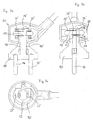
- FIG. 1 is a schematic perspective view of a device according to the invention Coupling device shown.
- the coupling device comprises a Plug part 10 and a cable connection part 20.
- the plug part 10 is solid formed and consists essentially of an electrically insulating Material.
- the plug part On an outer side, the plug part has two electrically conductive protruding parts 14 and 14 'for receiving in the female Are provided area of a complementary trained outlet.
- the plug part 10 Across from the protruding parts 14 and 14 ', the plug part 10 has two Abrasive surface pieces 12 and 12 'on.
- the grinding surface pieces 12 and 12 ' are formed as annular discs.
- the first grinding surface piece 12 is by means of a first electrical Conductor 16 is connected to the first projecting part 14.
- the second Abrasive surface piece 12 ' is by means of a second electrical conductor track 16' connected to the second protruding part 14 '.
- the plug part 10 together with the protruding parts 14 and 14 ', the grinding surface pieces 12 and 12 'and the electrical conductors 16 and 16 'in this concrete example a rigid body.
- the first Abrasive surface piece 12, the first electrical trace 16 and the first protruding Part 14 on the one hand and the second grinding surface piece 12 ', the second electrical conductor 16 'and the second projecting part 14' on the other are electrically isolated from each other. Also between the Schleif vomstükken 12 and 12 'is the electrically insulating material of the plug part 10th
- the electrical conductors 16 and 16 ' are completely within of the electrically insulating material of the plug part 10. Those surfaces the grinding surface pieces 12 and 12 ', each of the other grinding surface piece 12 'and 12, respectively, form part of the outer surface the male part 10 and are accessible from the outside of the male part 10 from. There is a first galvanic connection from the grinding surface piece 12 via the first electrical conductor 16 to the first above Part 14. A second galvanic connection exists between the grinding surface piece 12 'via the second electrical conductor 16' to the second above Part 14 '.
- the cable connection part 20 comprises two housing halves 21 and 21 'which also consist of an electrically insulating material.
- the cable connection part 20 further includes two sliding contacts 22 and 22 'which are releasable are fastened in the cable connection part 20.
- the sliding contacts 22 and 22 ' are Geometrically designed so that they are under application of a spring force pressed against the grinding surface pieces 12 and 12 '.
- the cable connection part 20 is rotatably mounted with respect to the plug part 10. With the cable connection part 20, the sliding contacts 22 and 22 'are rotated.
- the coupling device is geometrically designed so that at each angle of rotation an electrical contact between the grinding surface piece 12 and the sliding contact 22 and between the grinding surface piece 12 'and the sliding contact 22'.
- the cable connection part 20 is thus any number of times relative to the plug part 10 rotatable.
- the sliding contacts 22 and 22 ' are still together with cable lugs 24 and 24 'integrally formed.
- the ends of the electrical conductors of a cable are attached.
- the ends can for example be clamped in the cable lugs 24 and 24 'or be soldered.
- a strain relief be provided for the cable, so that the clamping or soldering connection in the cable lugs 24 and 24 'is not exposed to a tensile load.
- Strain relief for example, a clamp, preferably within the Cable connection part 20 may be provided.
- the cable connection part 20 is made up of two Housing halves 21 and 21 'together. Inside the two housing halves 21 and 21 'are the sliding contacts 22 and 22' with the cable lugs 24 or 24 '. Within the housing half 21 is a recess 26, which is provided for the positive reception of the cable lug 24 is. The other housing half 21 'has a corresponding recess for the cable lug 24 'on. This allows the cable lugs 24 and 24 'through secure easy insertion. Furthermore, it is located inside the housing half 21 a strain relief 28, which is provided for clamping the cable is. The other housing half 21 'also has a corresponding Device on. So that the cable can be sufficiently secured.
- the plug part 10 is solid and consists essentially of an electrically insulating material. Only the protruding parts 14th and 14 'are outside the insulating area of the plug 10. The electrical conductors 16 and 16 'are completely within of the insulating region of the plug part 10. The two grinding surface pieces 12 and 12 'are also almost entirely within the insulating region of the plug part 10. In each case a circular path of the grinding surface pieces 12 and 12 'is exposed to the outside. These exposed circular paths are provided for contact with the sliding contacts 22 and 22 '.
- the preparation of the coupling device according to the invention is relatively easy.
- the plug part 10 is manufactured as a casting in which the grinding surface pieces 12 and 12 'and the electrical conductors 16 and 16 'are integrated.
- the entire plug part 10 integrally formed.
- the cable is through the Strain relief 28 pinched.
- the housing halves 21 and 21 'can for example be designed as plastic hard shells.
- the housing halves 21 and 21 'can then with PVC, alternative plastic, rubber or be overmoulded.
- FIG. 3 is a three-side view of another embodiment of the invention Coupling device shown.
- the in FIG 3 more Embodiment differs from the embodiment according to FIG. 1 and FIG 2 only in that the cable, the cable connection part 20 in penetrates its side wall.
- FIG. 3a is a front view of the cut-out coupling device shown.
- the plug part 10 is substantially solid and is preferably molded from an electrically insulating material.
- the larger area of the protruding parts 14 and 14 ' is outside the male part 10.
- the protruding part 14 is via the electrical conductor 16 with the Grinding surface piece 12 connected.
- the protruding part 14 ' is above the electrical Conductor 16 'connected to the grinding surface piece 12'.
- the Abrasive surface pieces 12 and 12 ' are formed as circular ring disks, which in are equal in size to this concrete example.
- the electrical system penetrates Conductor 16 'the recess of the annular abrasive surface piece 12th
- the gap between the abrasive surface pieces 12 and 12 ' is also filled with the electrically insulating material of the connector part 10.
- the opposite sides of the grinding surface pieces 12 and 12 ' are exposed and form part of the outer surface of the male part 10th
- the electrical conductors 16 and 16 ' are completely electrical insulating material of the connector part 10 enclosed.
- the grinding surface pieces 12 and 12 ', the electrical conductors 16 and 16' and the projecting parts 14 and 14 ' are thus firmly integrated in the plug part 10.
- the plug part 10 is rotatably mounted in the cable connection part 20.
- the cable connection part 20 includes the two housing halves 21 and 21 '.
- the one half of the case 21 has a holder 26 for the positive reception of the Cable lugs 24 and 24 'on.
- the sliding contacts 22 and 22 ' are together formed integrally with the cable lugs 24 and 24 '.
- the sliding contacts 22 and 22 ' are acted upon by a spring force, so that they against the Grinding surface pieces 12 and 12 'are pressed.
- FIG 3b is a side view of the cut-coupling device shown.
- the arrangement of the cable lugs 24 and 24 'in the Bracket 26 clarifies.
- the cable lugs 24 and 24 ' are each form-fitting inserted into a recess of the holder 26.
- FIG. 3c is a plan view of the cutaway Coupling device shown. 3c clarifies the circular path Grinding surface on the grinding surface piece 12 '.
- the cable lug 24 'together with the sliding contacts 22' in is formed approximately U-shaped. Since the sliding contact 22 'as a double-grinding contact is formed, is a safe galvanic connection between the lug 24 'and the grinding surface piece 12' guaranteed.
- the shape of the grinding surface pieces 12 and 12 ' is not on circular disks limited.
- the grinding surface pieces can, for example, as a cylinder jacket or pipe section be formed. In this case, the sliding contacts against the inner and / or outer surface of the cylinder jacket or pipe section are pressed.
- the grinding surface pieces must also not necessarily arranged in a row, but can also be in each other and be arranged concentrically with each other. This can, for example a smaller circular disk or circular disk within the Recess of a larger circular disk are. Also as a cylinder jacket or pipe section trained grinding surface pieces can be arranged concentrically with each other.
- coupling device according to the invention is without limitation Also suitable for three- or multi-pole cables.
- the number of sliding contact systems depends on how many electrical conductors 16 the Recess of the grinding surface piece 12 or 12 'can penetrate.
- the coupling device according to the invention also as a three-pole Safety plug or socket outlet be formed.
- the coupling device according to the invention designed for plugs and sockets that comply with international standards and national standards, standards and regulations.
Landscapes
- Details Of Connecting Devices For Male And Female Coupling (AREA)
- Communication Cables (AREA)
- Cable Accessories (AREA)
- Connections By Means Of Piercing Elements, Nuts, Or Screws (AREA)
Abstract
Description
- FIG 1
- eine schematische Perspektivansicht einer bevorzugten Ausführungsform der Erfindung;
- FIG 2
- eine Explosionsansicht der bevorzugten Ausführungsform der Erfindung; und
- FIG 3
- eine Dreiseitenansicht einer weiteren Ausführungsform der Erfindung.
- 10
- Steckerteil
- 12
- erstes Schleifflächenstück
- 12'
- zweites Schleifflächenstück
- 14
- erstes vorstehendes Teil
- 14'
- zweites vorstehendes Teil
- 16
- erste elektrische Leiterbahn
- 16'
- zweite elektrische Leiterbahn
- 20
- Kabelanschlussteil
- 21
- erste Gehäusehälfte
- 21'
- zweite Gehäusehälfte
- 22
- erster Schleifkontakt
- 22'
- zweiter Schleifkontakt
- 24
- erster Kabelschuh
- 24'
- zweiter Kabelschuh
- 26
- Ausnehmung
- 28
- Zugentlastung
Claims (23)
- Kupplungsvorrichtung, insbesondere Stecker, Netzstecker oder Buchse für ein elektrisches Kabel, die zur lösbaren Verbindung mit einer komplementär ausgebildeten Kupplungsvorrichtung vorgesehen ist und Folgendes umfasst:dadurch gekennzeichnet, dassein Verbindungsteil zum lösbaren Verbinden mit einem komplementär ausgebildeten Teil der komplementär ausgebildeten Kupplungsvorrichtung; undein Kabelbefestigungsteil, an dem das Kabel dauerhaft oder lösbar befestigt oder befestigbar ist;wobei das Verbindungsteil und Kabelfestigungsteil miteinander elektrisch gekoppelt sind;
das Kabelbefestigungsteil (20) relativ zum Verbindungsteil (10) bewegbar gelagert ist. - Kupplungsvorrichtung nach Anspruch 1,
dadurch gekennzeichnet, dass
das Kabelfestigungsteil (20) relativ zum Verbindungsteil (10) drehbar gelagert ist. - Kupplungsvorrichtung nach Anspruch 1 oder 2,
dadurch gekennzeichnet, dass
das Verbindungsteil (10) und das Kabelbefestigungsteil (20) durch wenigstens ein Schleifkontaktsystem (12, 22) miteinander elektrisch gekoppelt sind. - Kupplungsvorrichtung nach einem der Ansprüche 1 bis 3,
dadurch gekennzeichnet, dass
jedem elektrischen Leiter (24) des Kabels wenigstens ein Schleifkontaktsystem (12, 22) zugeordnet ist. - Kupplungsvorrichtung nach einem der Ansprüche 1 bis 3,
dadurch gekennzeichnet, dass
jedem Schleifkontaktsystem (12, 22) wenigstens ein elektrischer Leiter (24) des Kabels zugeordnet ist. - Kupplungsvorrichtung nach einem der Ansprüche 1 bis 5,
dadurch gekennzeichnet, dass
das Schleifkontaktsystem (12, 22) wenigstens einen Schleifkontakt (22) und wenigstens ein Schleifflächenstück (12) umfasst. - Kupplungsvorrichtung nach Anspruch 6,
dadurch gekennzeichnet, dass
der Schleifkontakt (22) entlang einer vorbestimmten Bahn auf dem Schleifflächenstück (12) bewegbar ist. - Kupplungsvorrichtung nach Anspruch 6 oder 7,
dadurch gekennzeichnet, dass
das Schleifflächenstück (12) eine Kreisringscheibe aufweist. - Kupplungsvorrichtung nach Anspruch 6 oder 7,
dadurch gekennzeichnet, dass
das Schleifflächenstück (12) einen Zylindermantel aufweist. - Vorrichtung nach einem der Ansprüche 6 bis 9,
dadurch gekennzeichnet, dass
der Schleifkontakt (22) entlang einer Kreisbahn auf dem Schleifflächenstück (12) bewegbar ist. - Kupplungsvorrichtung nach einem der Ansprüche 6 bis 10,
dadurch gekennzeichnet, dass
zwei oder mehrere Schleifflächenstücke (12, 12') zueinander konzentrisch angeordnet sind. - Kupplungsvorrichtung nach einem der Ansprüche 6 bis 11,
dadurch gekennzeichnet, dass
zwei oder mehrere Schleifflächenstücke (12, 12') seriell angeordnet sind. - Kupplungsvorrichtung nach einem der Ansprüche 6 bis 12,
dadurch gekennzeichnet, dass
das Schleifflächenstück (12) dem Verbindungsteil (10) und der Schleifkontakt (22) dem Kabelfestigungsteil (20) zugeordnet ist. - Kupplungsvorrichtung nach einem der Ansprüche 1 bis 13,
dadurch gekennzeichnet, dass
das Verbindungsteil (10) ein einpoliger oder mehrpoliger Stecker ist. - Kupplungsvorrichtung nach Anspruch 14,
dadurch gekennzeichnet, dass
das Verbindungsteil (10) als genormter Standardstecker ausgebildet ist. - Kupplungsvorrichtung nach einem der Ansprüche 1 bis 13,
dadurch gekennzeichnet, dass
das Verbindungsteil (10) eine einpolige oder mehrpolige Buchse ist. - Kupplungsvorrichtung nach Anspruch 16,
dadurch gekennzeichnet, dass
das Verbindungsteil (10) als genormte Standardbuchse ausgebildet ist. - Kupplungsvorrichtung nach einem der Ansprüche 1 bis 13,
dadurch gekennzeichnet, dass
das Verbindungsteil (10) teilweise als Stecker und teilweise als Buchse ausgebildet ist. - Kupplungsvorrichtung nach Anspruch 18,
dadurch gekennzeichnet, dass
das Verbindungsteil (10) derart symmetrisch ausgebildet ist, dass sie mit einer weiteren gleichartig ausgebildeten ersten Verbindungseinrichtung koppelbar ist. - Kupplungsvorrichtung nach einem der Ansprüche 1 bis 19,
dadurch gekennzeichnet, dass
das Kabelbefestigungsteil (20) wenigstens eine Kabelanschlussklemme (24) aufweist. - Kupplungsvorrichtung nach Anspruch 20,
dadurch gekennzeichnet, dass
jedem Schleifkontakt (22) eine Kabelanschlussklemme (24) zugeordnet ist. - Kupplungsvorrichtung nach einem der Ansprüche 1 bis 21,
dadurch gekennzeichnet, dass
das Verbindungsteil (10) massiv ausgebildet ist. - Kupplungsvorrichtung nach Anspruch 22,
dadurch gekennzeichnet, dass
das Verbindungsteil (10) überwiegend aus einem elektrisch isolierenden Material besteht.
Applications Claiming Priority (2)
| Application Number | Priority Date | Filing Date | Title |
|---|---|---|---|
| DE10254258A DE10254258B4 (de) | 2002-11-20 | 2002-11-20 | Kupplungsvorrichtung für ein elektrisches Kabel |
| DE10254258 | 2002-11-20 |
Publications (4)
| Publication Number | Publication Date |
|---|---|
| EP1422792A2 true EP1422792A2 (de) | 2004-05-26 |
| EP1422792A3 EP1422792A3 (de) | 2006-05-10 |
| EP1422792B1 EP1422792B1 (de) | 2011-09-14 |
| EP1422792B8 EP1422792B8 (de) | 2012-02-29 |
Family
ID=32185878
Family Applications (1)
| Application Number | Title | Priority Date | Filing Date |
|---|---|---|---|
| EP03026394A Expired - Lifetime EP1422792B8 (de) | 2002-11-20 | 2003-11-18 | Kupplungsvorrichtung für ein elektrisches Kabel |
Country Status (4)
| Country | Link |
|---|---|
| EP (1) | EP1422792B8 (de) |
| AT (1) | ATE524853T1 (de) |
| DE (1) | DE10254258B4 (de) |
| ES (1) | ES2373534T3 (de) |
Cited By (1)
| Publication number | Priority date | Publication date | Assignee | Title |
|---|---|---|---|---|
| DE102007030537A1 (de) * | 2007-06-30 | 2009-01-15 | Daimler Ag | Steckdose für eine Anhängevorrichtung |
Family Cites Families (5)
| Publication number | Priority date | Publication date | Assignee | Title |
|---|---|---|---|---|
| DE3940652C2 (de) * | 1989-12-08 | 2000-08-10 | Georg Froehlich | Elektrische Steckverbindung |
| US5772447A (en) * | 1996-02-26 | 1998-06-30 | Koontat Development Co. Ltd. | Pivoting electrical plug |
| US5997310A (en) * | 1998-10-21 | 1999-12-07 | Chiu; Pen-Li | Swivel electric plug |
| DE29822546U1 (de) * | 1998-12-18 | 2000-04-20 | Bosch Gmbh Robert | Kontaktelement zur radialen Kontaktierung |
| FR2821991B1 (fr) * | 2001-03-08 | 2003-05-23 | Cit Alcatel | Dispositif de connexion electrique |
-
2002
- 2002-11-20 DE DE10254258A patent/DE10254258B4/de not_active Expired - Fee Related
-
2003
- 2003-11-18 ES ES03026394T patent/ES2373534T3/es not_active Expired - Lifetime
- 2003-11-18 AT AT03026394T patent/ATE524853T1/de active
- 2003-11-18 EP EP03026394A patent/EP1422792B8/de not_active Expired - Lifetime
Cited By (1)
| Publication number | Priority date | Publication date | Assignee | Title |
|---|---|---|---|---|
| DE102007030537A1 (de) * | 2007-06-30 | 2009-01-15 | Daimler Ag | Steckdose für eine Anhängevorrichtung |
Also Published As
| Publication number | Publication date |
|---|---|
| EP1422792A3 (de) | 2006-05-10 |
| DE10254258A1 (de) | 2004-06-17 |
| EP1422792B8 (de) | 2012-02-29 |
| EP1422792B1 (de) | 2011-09-14 |
| DE10254258B4 (de) | 2013-09-12 |
| ES2373534T3 (es) | 2012-02-06 |
| ATE524853T1 (de) | 2011-09-15 |
Similar Documents
| Publication | Publication Date | Title |
|---|---|---|
| DE69220178T2 (de) | Elektrischer Verbinderzusammenbau | |
| EP2351161B1 (de) | Elektrisches steckverbindungssystem | |
| DE2923399C2 (de) | Verfahren zur elektrischen Verbindung eines Koaxialkabels und Anschlußarmatur für Koaxialkabel | |
| EP1239550B1 (de) | Steckverbinder | |
| EP2442403B1 (de) | Schraubenlose Anschlussklemme | |
| WO2017076781A1 (de) | Hybrid-steckverbinder | |
| EP3633802B1 (de) | Gerätesteckdose, gerätestecker und gerätesteckersystem | |
| EP1467441A2 (de) | Schnellanschliessbare Steckverbindung in Spannzangentechnik | |
| DE3126306C2 (de) | Stecksockel für mehrpolige Niederspannungs-Schutzschalter | |
| DE7738717U1 (de) | Steckdose mit elektrischer Anschlußleitung | |
| EP1733459B1 (de) | Drehlager mit stromdurchführung | |
| EP1422792B1 (de) | Kupplungsvorrichtung für ein elektrisches Kabel | |
| EP2071676A2 (de) | Steckeranordnung | |
| EP1091457B1 (de) | Elektrisches Steckverbindungselement und -system | |
| DE102004003651A1 (de) | Koaxialer Verbindungsstecker | |
| DE10323616A1 (de) | Schnellanschließbare Steckverbindung in Spannzangentechnik | |
| EP1756919B1 (de) | Elektrischer kupplungs-adapter und steckdose | |
| EP1193798B1 (de) | Leiteranschlusselement | |
| DE102016000384B4 (de) | Mehrpoliger elektrischer Verbinder | |
| EP1355379B1 (de) | Steckverbinder mit Schneidklemmkontakten | |
| EP0930673B1 (de) | Transformationseinrichtung und Steckeranordnung | |
| DE102004004203A1 (de) | Verbindungselement für das elektrisch leitende Verbinden mit dem Lampensockel eines Hauptscheinwerfers | |
| DE3941398A1 (de) | Adapter fuer fernmeldetechnische geraete | |
| DE102017131062B3 (de) | Steckdose | |
| DE10311507A1 (de) | Elektrischer Steckverbinder |
Legal Events
| Date | Code | Title | Description |
|---|---|---|---|
| PUAI | Public reference made under article 153(3) epc to a published international application that has entered the european phase |
Free format text: ORIGINAL CODE: 0009012 |
|
| AK | Designated contracting states |
Kind code of ref document: A2 Designated state(s): AT BE BG CH CY CZ DE DK EE ES FI FR GB GR HU IE IT LI LU MC NL PT RO SE SI SK TR |
|
| AX | Request for extension of the european patent |
Extension state: AL LT LV MK |
|
| PUAL | Search report despatched |
Free format text: ORIGINAL CODE: 0009013 |
|
| AK | Designated contracting states |
Kind code of ref document: A3 Designated state(s): AT BE BG CH CY CZ DE DK EE ES FI FR GB GR HU IE IT LI LU MC NL PT RO SE SI SK TR |
|
| AX | Request for extension of the european patent |
Extension state: AL LT LV MK |
|
| 17P | Request for examination filed |
Effective date: 20061102 |
|
| AKX | Designation fees paid |
Designated state(s): AT BE BG CH CY CZ DE DK EE ES FI FR GB GR HU IE IT LI LU MC NL PT RO SE SI SK TR |
|
| 17Q | First examination report despatched |
Effective date: 20070131 |
|
| GRAP | Despatch of communication of intention to grant a patent |
Free format text: ORIGINAL CODE: EPIDOSNIGR1 |
|
| GRAS | Grant fee paid |
Free format text: ORIGINAL CODE: EPIDOSNIGR3 |
|
| GRAA | (expected) grant |
Free format text: ORIGINAL CODE: 0009210 |
|
| AK | Designated contracting states |
Kind code of ref document: B1 Designated state(s): AT BE BG CH CY CZ DE DK EE ES FI FR GB GR HU IE IT LI LU MC NL PT RO SE SI SK TR |
|
| REG | Reference to a national code |
Ref country code: GB Ref legal event code: FG4D Free format text: NOT ENGLISH |
|
| REG | Reference to a national code |
Ref country code: CH Ref legal event code: EP |
|
| RAP2 | Party data changed (patent owner data changed or rights of a patent transferred) |
Owner name: HANS SCHATZ HS STECKVERBINDUNGEN GMBH |
|
| REG | Reference to a national code |
Ref country code: IE Ref legal event code: FG4D Free format text: LANGUAGE OF EP DOCUMENT: GERMAN |
|
| REG | Reference to a national code |
Ref country code: DE Ref legal event code: R096 Ref document number: 50313946 Country of ref document: DE Effective date: 20111201 |
|
| REG | Reference to a national code |
Ref country code: CH Ref legal event code: NV Representative=s name: FIAMMENGHI-FIAMMENGHI |
|
| REG | Reference to a national code |
Ref country code: NL Ref legal event code: VDEP Effective date: 20110914 |
|
| PG25 | Lapsed in a contracting state [announced via postgrant information from national office to epo] |
Ref country code: SE Free format text: LAPSE BECAUSE OF FAILURE TO SUBMIT A TRANSLATION OF THE DESCRIPTION OR TO PAY THE FEE WITHIN THE PRESCRIBED TIME-LIMIT Effective date: 20110914 Ref country code: FI Free format text: LAPSE BECAUSE OF FAILURE TO SUBMIT A TRANSLATION OF THE DESCRIPTION OR TO PAY THE FEE WITHIN THE PRESCRIBED TIME-LIMIT Effective date: 20110914 |
|
| REG | Reference to a national code |
Ref country code: ES Ref legal event code: FG2A Ref document number: 2373534 Country of ref document: ES Kind code of ref document: T3 Effective date: 20120206 |
|
| PG25 | Lapsed in a contracting state [announced via postgrant information from national office to epo] |
Ref country code: GR Free format text: LAPSE BECAUSE OF FAILURE TO SUBMIT A TRANSLATION OF THE DESCRIPTION OR TO PAY THE FEE WITHIN THE PRESCRIBED TIME-LIMIT Effective date: 20111215 Ref country code: CY Free format text: LAPSE BECAUSE OF FAILURE TO SUBMIT A TRANSLATION OF THE DESCRIPTION OR TO PAY THE FEE WITHIN THE PRESCRIBED TIME-LIMIT Effective date: 20110914 Ref country code: SI Free format text: LAPSE BECAUSE OF FAILURE TO SUBMIT A TRANSLATION OF THE DESCRIPTION OR TO PAY THE FEE WITHIN THE PRESCRIBED TIME-LIMIT Effective date: 20110914 |
|
| REG | Reference to a national code |
Ref country code: IE Ref legal event code: FD4D |
|
| PG25 | Lapsed in a contracting state [announced via postgrant information from national office to epo] |
Ref country code: CZ Free format text: LAPSE BECAUSE OF FAILURE TO SUBMIT A TRANSLATION OF THE DESCRIPTION OR TO PAY THE FEE WITHIN THE PRESCRIBED TIME-LIMIT Effective date: 20110914 Ref country code: SK Free format text: LAPSE BECAUSE OF FAILURE TO SUBMIT A TRANSLATION OF THE DESCRIPTION OR TO PAY THE FEE WITHIN THE PRESCRIBED TIME-LIMIT Effective date: 20110914 Ref country code: IE Free format text: LAPSE BECAUSE OF FAILURE TO SUBMIT A TRANSLATION OF THE DESCRIPTION OR TO PAY THE FEE WITHIN THE PRESCRIBED TIME-LIMIT Effective date: 20110914 |
|
| BERE | Be: lapsed |
Owner name: HANS SCHATZ HS STECKVERBINDUNGEN G.M.B.H. Effective date: 20111130 |
|
| PG25 | Lapsed in a contracting state [announced via postgrant information from national office to epo] |
Ref country code: PT Free format text: LAPSE BECAUSE OF FAILURE TO SUBMIT A TRANSLATION OF THE DESCRIPTION OR TO PAY THE FEE WITHIN THE PRESCRIBED TIME-LIMIT Effective date: 20120116 Ref country code: RO Free format text: LAPSE BECAUSE OF FAILURE TO SUBMIT A TRANSLATION OF THE DESCRIPTION OR TO PAY THE FEE WITHIN THE PRESCRIBED TIME-LIMIT Effective date: 20110914 Ref country code: EE Free format text: LAPSE BECAUSE OF FAILURE TO SUBMIT A TRANSLATION OF THE DESCRIPTION OR TO PAY THE FEE WITHIN THE PRESCRIBED TIME-LIMIT Effective date: 20110914 Ref country code: NL Free format text: LAPSE BECAUSE OF FAILURE TO SUBMIT A TRANSLATION OF THE DESCRIPTION OR TO PAY THE FEE WITHIN THE PRESCRIBED TIME-LIMIT Effective date: 20110914 |
|
| PG25 | Lapsed in a contracting state [announced via postgrant information from national office to epo] |
Ref country code: MC Free format text: LAPSE BECAUSE OF NON-PAYMENT OF DUE FEES Effective date: 20111130 |
|
| PLBE | No opposition filed within time limit |
Free format text: ORIGINAL CODE: 0009261 |
|
| STAA | Information on the status of an ep patent application or granted ep patent |
Free format text: STATUS: NO OPPOSITION FILED WITHIN TIME LIMIT |
|
| PG25 | Lapsed in a contracting state [announced via postgrant information from national office to epo] |
Ref country code: DK Free format text: LAPSE BECAUSE OF FAILURE TO SUBMIT A TRANSLATION OF THE DESCRIPTION OR TO PAY THE FEE WITHIN THE PRESCRIBED TIME-LIMIT Effective date: 20110914 |
|
| 26N | No opposition filed |
Effective date: 20120615 |
|
| GBPC | Gb: european patent ceased through non-payment of renewal fee |
Effective date: 20111214 |
|
| PG25 | Lapsed in a contracting state [announced via postgrant information from national office to epo] |
Ref country code: BE Free format text: LAPSE BECAUSE OF NON-PAYMENT OF DUE FEES Effective date: 20111130 |
|
| REG | Reference to a national code |
Ref country code: DE Ref legal event code: R097 Ref document number: 50313946 Country of ref document: DE Effective date: 20120615 |
|
| PG25 | Lapsed in a contracting state [announced via postgrant information from national office to epo] |
Ref country code: GB Free format text: LAPSE BECAUSE OF NON-PAYMENT OF DUE FEES Effective date: 20111214 |
|
| REG | Reference to a national code |
Ref country code: AT Ref legal event code: MM01 Ref document number: 524853 Country of ref document: AT Kind code of ref document: T Effective date: 20111118 |
|
| PG25 | Lapsed in a contracting state [announced via postgrant information from national office to epo] |
Ref country code: AT Free format text: LAPSE BECAUSE OF NON-PAYMENT OF DUE FEES Effective date: 20111118 |
|
| PG25 | Lapsed in a contracting state [announced via postgrant information from national office to epo] |
Ref country code: LU Free format text: LAPSE BECAUSE OF NON-PAYMENT OF DUE FEES Effective date: 20111118 |
|
| PG25 | Lapsed in a contracting state [announced via postgrant information from national office to epo] |
Ref country code: BG Free format text: LAPSE BECAUSE OF FAILURE TO SUBMIT A TRANSLATION OF THE DESCRIPTION OR TO PAY THE FEE WITHIN THE PRESCRIBED TIME-LIMIT Effective date: 20111214 |
|
| PG25 | Lapsed in a contracting state [announced via postgrant information from national office to epo] |
Ref country code: TR Free format text: LAPSE BECAUSE OF FAILURE TO SUBMIT A TRANSLATION OF THE DESCRIPTION OR TO PAY THE FEE WITHIN THE PRESCRIBED TIME-LIMIT Effective date: 20110914 |
|
| PG25 | Lapsed in a contracting state [announced via postgrant information from national office to epo] |
Ref country code: HU Free format text: LAPSE BECAUSE OF FAILURE TO SUBMIT A TRANSLATION OF THE DESCRIPTION OR TO PAY THE FEE WITHIN THE PRESCRIBED TIME-LIMIT Effective date: 20110914 |
|
| REG | Reference to a national code |
Ref country code: FR Ref legal event code: PLFP Year of fee payment: 13 |
|
| REG | Reference to a national code |
Ref country code: FR Ref legal event code: PLFP Year of fee payment: 14 |
|
| REG | Reference to a national code |
Ref country code: FR Ref legal event code: PLFP Year of fee payment: 15 |
|
| PGFP | Annual fee paid to national office [announced via postgrant information from national office to epo] |
Ref country code: FR Payment date: 20171130 Year of fee payment: 15 |
|
| PGFP | Annual fee paid to national office [announced via postgrant information from national office to epo] |
Ref country code: CH Payment date: 20171129 Year of fee payment: 15 Ref country code: IT Payment date: 20171206 Year of fee payment: 15 |
|
| PGFP | Annual fee paid to national office [announced via postgrant information from national office to epo] |
Ref country code: ES Payment date: 20180417 Year of fee payment: 15 |
|
| PGFP | Annual fee paid to national office [announced via postgrant information from national office to epo] |
Ref country code: DE Payment date: 20181130 Year of fee payment: 16 |
|
| REG | Reference to a national code |
Ref country code: CH Ref legal event code: PL |
|
| PG25 | Lapsed in a contracting state [announced via postgrant information from national office to epo] |
Ref country code: LI Free format text: LAPSE BECAUSE OF NON-PAYMENT OF DUE FEES Effective date: 20181130 Ref country code: CH Free format text: LAPSE BECAUSE OF NON-PAYMENT OF DUE FEES Effective date: 20181130 |
|
| PG25 | Lapsed in a contracting state [announced via postgrant information from national office to epo] |
Ref country code: FR Free format text: LAPSE BECAUSE OF NON-PAYMENT OF DUE FEES Effective date: 20181130 Ref country code: IT Free format text: LAPSE BECAUSE OF NON-PAYMENT OF DUE FEES Effective date: 20181118 |
|
| REG | Reference to a national code |
Ref country code: ES Ref legal event code: FD2A Effective date: 20200103 |
|
| PG25 | Lapsed in a contracting state [announced via postgrant information from national office to epo] |
Ref country code: ES Free format text: LAPSE BECAUSE OF NON-PAYMENT OF DUE FEES Effective date: 20181119 |
|
| REG | Reference to a national code |
Ref country code: DE Ref legal event code: R119 Ref document number: 50313946 Country of ref document: DE |
|
| PG25 | Lapsed in a contracting state [announced via postgrant information from national office to epo] |
Ref country code: DE Free format text: LAPSE BECAUSE OF NON-PAYMENT OF DUE FEES Effective date: 20200603 |