EP1424190B1 - Spritzguss- oder extrudiertes Formteil und Verfahren zu dessen Herstellung - Google Patents
Spritzguss- oder extrudiertes Formteil und Verfahren zu dessen Herstellung Download PDFInfo
- Publication number
- EP1424190B1 EP1424190B1 EP03017739A EP03017739A EP1424190B1 EP 1424190 B1 EP1424190 B1 EP 1424190B1 EP 03017739 A EP03017739 A EP 03017739A EP 03017739 A EP03017739 A EP 03017739A EP 1424190 B1 EP1424190 B1 EP 1424190B1
- Authority
- EP
- European Patent Office
- Prior art keywords
- particles
- filler
- plastic
- foamed
- injection
- Prior art date
- Legal status (The legal status is an assumption and is not a legal conclusion. Google has not performed a legal analysis and makes no representation as to the accuracy of the status listed.)
- Expired - Lifetime
Links
- 238000000034 method Methods 0.000 title claims abstract description 8
- 238000002347 injection Methods 0.000 title claims abstract description 7
- 239000007924 injection Substances 0.000 title claims abstract description 7
- 238000004519 manufacturing process Methods 0.000 title claims description 7
- 239000002245 particle Substances 0.000 claims abstract description 76
- 239000000945 filler Substances 0.000 claims abstract description 58
- 229920003023 plastic Polymers 0.000 claims abstract description 35
- 239000004033 plastic Substances 0.000 claims abstract description 35
- 239000000463 material Substances 0.000 claims abstract description 29
- 238000001746 injection moulding Methods 0.000 claims abstract description 21
- 238000001125 extrusion Methods 0.000 claims abstract description 12
- 239000006260 foam Substances 0.000 claims description 8
- 229920001971 elastomer Polymers 0.000 claims description 7
- 239000011521 glass Substances 0.000 claims description 7
- BPQQTUXANYXVAA-UHFFFAOYSA-N Orthosilicate Chemical compound [O-][Si]([O-])([O-])[O-] BPQQTUXANYXVAA-UHFFFAOYSA-N 0.000 claims description 6
- 238000004378 air conditioning Methods 0.000 claims description 5
- 239000011159 matrix material Substances 0.000 claims description 5
- 229920001169 thermoplastic Polymers 0.000 claims description 5
- 239000004416 thermosoftening plastic Substances 0.000 claims description 5
- OKTJSMMVPCPJKN-UHFFFAOYSA-N Carbon Chemical compound [C] OKTJSMMVPCPJKN-UHFFFAOYSA-N 0.000 claims description 4
- 239000000806 elastomer Substances 0.000 claims description 4
- 238000002156 mixing Methods 0.000 claims description 4
- 229920001187 thermosetting polymer Polymers 0.000 claims description 4
- QGZKDVFQNNGYKY-UHFFFAOYSA-O Ammonium Chemical compound [NH4+] QGZKDVFQNNGYKY-UHFFFAOYSA-O 0.000 claims description 3
- 229910052910 alkali metal silicate Inorganic materials 0.000 claims description 3
- 239000000454 talc Substances 0.000 claims description 3
- 229910052623 talc Inorganic materials 0.000 claims description 3
- 239000011324 bead Substances 0.000 claims description 2
- 239000004927 clay Substances 0.000 claims description 2
- 229910052570 clay Inorganic materials 0.000 claims description 2
- 229910052500 inorganic mineral Inorganic materials 0.000 claims description 2
- 239000011707 mineral Substances 0.000 claims description 2
- 239000011148 porous material Substances 0.000 claims description 2
- 239000002994 raw material Substances 0.000 claims description 2
- 235000008733 Citrus aurantifolia Nutrition 0.000 claims 1
- 235000011941 Tilia x europaea Nutrition 0.000 claims 1
- 239000004571 lime Substances 0.000 claims 1
- 239000011369 resultant mixture Substances 0.000 claims 1
- 239000004575 stone Substances 0.000 claims 1
- 235000012222 talc Nutrition 0.000 claims 1
- 239000012778 molding material Substances 0.000 abstract description 6
- 239000000203 mixture Substances 0.000 abstract 1
- 238000002360 preparation method Methods 0.000 abstract 1
- 239000002585 base Substances 0.000 description 15
- 238000000465 moulding Methods 0.000 description 11
- -1 for example Substances 0.000 description 9
- 238000007792 addition Methods 0.000 description 4
- 239000007789 gas Substances 0.000 description 4
- 239000003380 propellant Substances 0.000 description 4
- 229920001577 copolymer Polymers 0.000 description 3
- 235000013312 flour Nutrition 0.000 description 3
- 239000005060 rubber Substances 0.000 description 3
- XLYOFNOQVPJJNP-UHFFFAOYSA-N water Substances O XLYOFNOQVPJJNP-UHFFFAOYSA-N 0.000 description 3
- VTYYLEPIZMXCLO-UHFFFAOYSA-L Calcium carbonate Chemical compound [Ca+2].[O-]C([O-])=O VTYYLEPIZMXCLO-UHFFFAOYSA-L 0.000 description 2
- 230000002776 aggregation Effects 0.000 description 2
- 238000004220 aggregation Methods 0.000 description 2
- 150000001875 compounds Chemical class 0.000 description 2
- 238000010276 construction Methods 0.000 description 2
- 230000000694 effects Effects 0.000 description 2
- 239000005038 ethylene vinyl acetate Substances 0.000 description 2
- 230000002349 favourable effect Effects 0.000 description 2
- 238000005187 foaming Methods 0.000 description 2
- 239000008187 granular material Substances 0.000 description 2
- 230000014759 maintenance of location Effects 0.000 description 2
- 229920001200 poly(ethylene-vinyl acetate) Polymers 0.000 description 2
- 229920005989 resin Polymers 0.000 description 2
- 239000011347 resin Substances 0.000 description 2
- 238000004062 sedimentation Methods 0.000 description 2
- 238000007493 shaping process Methods 0.000 description 2
- 229920003048 styrene butadiene rubber Polymers 0.000 description 2
- KXGFMDJXCMQABM-UHFFFAOYSA-N 2-methoxy-6-methylphenol Chemical compound [CH]OC1=CC=CC([CH])=C1O KXGFMDJXCMQABM-UHFFFAOYSA-N 0.000 description 1
- NIXOWILDQLNWCW-UHFFFAOYSA-M Acrylate Chemical compound [O-]C(=O)C=C NIXOWILDQLNWCW-UHFFFAOYSA-M 0.000 description 1
- 229920002943 EPDM rubber Polymers 0.000 description 1
- 229920000877 Melamine resin Polymers 0.000 description 1
- 229920000459 Nitrile rubber Polymers 0.000 description 1
- 239000002033 PVDF binder Substances 0.000 description 1
- 229930040373 Paraformaldehyde Natural products 0.000 description 1
- 229920001774 Perfluoroether Polymers 0.000 description 1
- 239000004696 Poly ether ether ketone Substances 0.000 description 1
- 239000004952 Polyamide Substances 0.000 description 1
- 239000004962 Polyamide-imide Substances 0.000 description 1
- 239000005062 Polybutadiene Substances 0.000 description 1
- 239000004695 Polyether sulfone Substances 0.000 description 1
- 239000004697 Polyetherimide Substances 0.000 description 1
- 239000004698 Polyethylene Substances 0.000 description 1
- 239000004721 Polyphenylene oxide Substances 0.000 description 1
- 239000004734 Polyphenylene sulfide Substances 0.000 description 1
- 239000004743 Polypropylene Substances 0.000 description 1
- 239000004793 Polystyrene Substances 0.000 description 1
- 229920001328 Polyvinylidene chloride Polymers 0.000 description 1
- 229920001807 Urea-formaldehyde Polymers 0.000 description 1
- 229920006311 Urethane elastomer Polymers 0.000 description 1
- XECAHXYUAAWDEL-UHFFFAOYSA-N acrylonitrile butadiene styrene Chemical compound C=CC=C.C=CC#N.C=CC1=CC=CC=C1 XECAHXYUAAWDEL-UHFFFAOYSA-N 0.000 description 1
- 239000004676 acrylonitrile butadiene styrene Substances 0.000 description 1
- 229920000122 acrylonitrile butadiene styrene Polymers 0.000 description 1
- 230000002411 adverse Effects 0.000 description 1
- GZCGUPFRVQAUEE-SLPGGIOYSA-N aldehydo-D-glucose Chemical compound OC[C@@H](O)[C@@H](O)[C@H](O)[C@@H](O)C=O GZCGUPFRVQAUEE-SLPGGIOYSA-N 0.000 description 1
- 238000009435 building construction Methods 0.000 description 1
- DQXBYHZEEUGOBF-UHFFFAOYSA-N but-3-enoic acid;ethene Chemical compound C=C.OC(=O)CC=C DQXBYHZEEUGOBF-UHFFFAOYSA-N 0.000 description 1
- 229910000019 calcium carbonate Inorganic materials 0.000 description 1
- 229920002678 cellulose Polymers 0.000 description 1
- 239000001913 cellulose Substances 0.000 description 1
- 229920002301 cellulose acetate Polymers 0.000 description 1
- 230000008859 change Effects 0.000 description 1
- 238000001816 cooling Methods 0.000 description 1
- 238000013016 damping Methods 0.000 description 1
- 239000003814 drug Substances 0.000 description 1
- 238000004870 electrical engineering Methods 0.000 description 1
- 238000005516 engineering process Methods 0.000 description 1
- 239000003822 epoxy resin Substances 0.000 description 1
- HIHIPCDUFKZOSL-UHFFFAOYSA-N ethenyl(methyl)silicon Chemical compound C[Si]C=C HIHIPCDUFKZOSL-UHFFFAOYSA-N 0.000 description 1
- 230000003203 everyday effect Effects 0.000 description 1
- 239000004744 fabric Substances 0.000 description 1
- 239000000835 fiber Substances 0.000 description 1
- 229920001973 fluoroelastomer Polymers 0.000 description 1
- 229920005560 fluorosilicone rubber Polymers 0.000 description 1
- 239000000446 fuel Substances 0.000 description 1
- 238000010438 heat treatment Methods 0.000 description 1
- 229920002681 hypalon Polymers 0.000 description 1
- 238000009413 insulation Methods 0.000 description 1
- 230000003993 interaction Effects 0.000 description 1
- 229920003049 isoprene rubber Polymers 0.000 description 1
- 239000007769 metal material Substances 0.000 description 1
- 239000010445 mica Substances 0.000 description 1
- 229910052618 mica group Inorganic materials 0.000 description 1
- 239000010451 perlite Substances 0.000 description 1
- 235000019362 perlite Nutrition 0.000 description 1
- JYIZNFVTKLARKT-UHFFFAOYSA-N phenol;1,3,5-triazine-2,4,6-triamine Chemical compound OC1=CC=CC=C1.NC1=NC(N)=NC(N)=N1 JYIZNFVTKLARKT-UHFFFAOYSA-N 0.000 description 1
- 229920001568 phenolic resin Polymers 0.000 description 1
- 239000005011 phenolic resin Substances 0.000 description 1
- 239000002984 plastic foam Substances 0.000 description 1
- 229920001084 poly(chloroprene) Polymers 0.000 description 1
- 229920002493 poly(chlorotrifluoroethylene) Polymers 0.000 description 1
- 229920001643 poly(ether ketone) Polymers 0.000 description 1
- 229920003229 poly(methyl methacrylate) Polymers 0.000 description 1
- 229920002285 poly(styrene-co-acrylonitrile) Polymers 0.000 description 1
- 229920002492 poly(sulfone) Polymers 0.000 description 1
- 229920002239 polyacrylonitrile Polymers 0.000 description 1
- 229920002647 polyamide Polymers 0.000 description 1
- 229920002312 polyamide-imide Polymers 0.000 description 1
- 229920001230 polyarylate Polymers 0.000 description 1
- 229920002857 polybutadiene Polymers 0.000 description 1
- 229920001707 polybutylene terephthalate Polymers 0.000 description 1
- 239000004417 polycarbonate Substances 0.000 description 1
- 229920000515 polycarbonate Polymers 0.000 description 1
- 239000005023 polychlorotrifluoroethylene (PCTFE) polymer Substances 0.000 description 1
- 229920000647 polyepoxide Polymers 0.000 description 1
- 229920000728 polyester Polymers 0.000 description 1
- 229920006393 polyether sulfone Polymers 0.000 description 1
- 229920002530 polyetherether ketone Polymers 0.000 description 1
- 229920001601 polyetherimide Polymers 0.000 description 1
- 229920000573 polyethylene Polymers 0.000 description 1
- 229920000139 polyethylene terephthalate Polymers 0.000 description 1
- 239000005020 polyethylene terephthalate Substances 0.000 description 1
- 239000004926 polymethyl methacrylate Substances 0.000 description 1
- 229920006324 polyoxymethylene Polymers 0.000 description 1
- 229920001955 polyphenylene ether Polymers 0.000 description 1
- 229920006380 polyphenylene oxide Polymers 0.000 description 1
- 229920000069 polyphenylene sulfide Polymers 0.000 description 1
- 229920001155 polypropylene Polymers 0.000 description 1
- 229920002223 polystyrene Polymers 0.000 description 1
- 239000005077 polysulfide Substances 0.000 description 1
- 229920001021 polysulfide Polymers 0.000 description 1
- 150000008117 polysulfides Polymers 0.000 description 1
- 239000004810 polytetrafluoroethylene Substances 0.000 description 1
- 229920001343 polytetrafluoroethylene Polymers 0.000 description 1
- 229920005749 polyurethane resin Polymers 0.000 description 1
- 229920000915 polyvinyl chloride Polymers 0.000 description 1
- 239000004800 polyvinyl chloride Substances 0.000 description 1
- 239000005033 polyvinylidene chloride Substances 0.000 description 1
- 229920002981 polyvinylidene fluoride Polymers 0.000 description 1
- 239000000843 powder Substances 0.000 description 1
- 230000009467 reduction Effects 0.000 description 1
- 230000000717 retained effect Effects 0.000 description 1
- 239000011435 rock Substances 0.000 description 1
- 229920002050 silicone resin Polymers 0.000 description 1
- 229920002379 silicone rubber Polymers 0.000 description 1
- 239000004945 silicone rubber Substances 0.000 description 1
- 239000012798 spherical particle Substances 0.000 description 1
- 239000007921 spray Substances 0.000 description 1
- 229920001909 styrene-acrylic polymer Polymers 0.000 description 1
- 239000000126 substance Substances 0.000 description 1
- 239000012815 thermoplastic material Substances 0.000 description 1
- 238000009827 uniform distribution Methods 0.000 description 1
- 229920006305 unsaturated polyester Polymers 0.000 description 1
- 229920001567 vinyl ester resin Polymers 0.000 description 1
- 239000002023 wood Substances 0.000 description 1
Images
Classifications
-
- B—PERFORMING OPERATIONS; TRANSPORTING
- B29—WORKING OF PLASTICS; WORKING OF SUBSTANCES IN A PLASTIC STATE IN GENERAL
- B29C—SHAPING OR JOINING OF PLASTICS; SHAPING OF MATERIAL IN A PLASTIC STATE, NOT OTHERWISE PROVIDED FOR; AFTER-TREATMENT OF THE SHAPED PRODUCTS, e.g. REPAIRING
- B29C70/00—Shaping composites, i.e. plastics material comprising reinforcements, fillers or preformed parts, e.g. inserts
- B29C70/58—Shaping composites, i.e. plastics material comprising reinforcements, fillers or preformed parts, e.g. inserts comprising fillers only, e.g. particles, powder, beads, flakes, spheres
- B29C70/66—Shaping composites, i.e. plastics material comprising reinforcements, fillers or preformed parts, e.g. inserts comprising fillers only, e.g. particles, powder, beads, flakes, spheres the filler comprising hollow constituents, e.g. syntactic foam
-
- B—PERFORMING OPERATIONS; TRANSPORTING
- B29—WORKING OF PLASTICS; WORKING OF SUBSTANCES IN A PLASTIC STATE IN GENERAL
- B29C—SHAPING OR JOINING OF PLASTICS; SHAPING OF MATERIAL IN A PLASTIC STATE, NOT OTHERWISE PROVIDED FOR; AFTER-TREATMENT OF THE SHAPED PRODUCTS, e.g. REPAIRING
- B29C44/00—Shaping by internal pressure generated in the material, e.g. swelling or foaming ; Producing porous or cellular expanded plastics articles
- B29C44/02—Shaping by internal pressure generated in the material, e.g. swelling or foaming ; Producing porous or cellular expanded plastics articles for articles of definite length, i.e. discrete articles
-
- B—PERFORMING OPERATIONS; TRANSPORTING
- B29—WORKING OF PLASTICS; WORKING OF SUBSTANCES IN A PLASTIC STATE IN GENERAL
- B29C—SHAPING OR JOINING OF PLASTICS; SHAPING OF MATERIAL IN A PLASTIC STATE, NOT OTHERWISE PROVIDED FOR; AFTER-TREATMENT OF THE SHAPED PRODUCTS, e.g. REPAIRING
- B29C45/00—Injection moulding, i.e. forcing the required volume of moulding material through a nozzle into a closed mould; Apparatus therefor
- B29C45/0013—Injection moulding, i.e. forcing the required volume of moulding material through a nozzle into a closed mould; Apparatus therefor using fillers dispersed in the moulding material, e.g. metal particles
Definitions
- a plastic for an injection-molded material, a plastic, in particular a thermoplastic, duroplastic or elastomer, is usually used as the base material.
- these mentioned plastic materials include the diverse processing options, such. As injection molding and extrusion. This allows a variety of shapes, so that these plastics are also suitable as a cost-effective alternative to metallic materials for use in various industrial areas.
- injection molding a powder or granules of plastic is melted in an injection unit into a molding compound and injected into a heated injection molding tool.
- a structured mold insert is installed, which is completely filled with the molding compound. After cooling and opening the tool, the injection-molded parts are removed.
- Extruding means extruding with screw presses, the so-called extruders.
- the powdery or granular molding material is taken up by the screw, transported and plasticized by friction and additional heating. Upon further transport through the screw, the pressure increases, and the moldable mass is squeezed out through a downstream nozzle in the form of a strand.
- special shaped parts such as profiles, ribbons, webs, tubes, hoses, threads, rods, plates, etc. are used. produced so that the product range is particularly rich.
- the materials specifically desired properties can be given.
- a filler added to the base plastic such as, for example, glass, wood flour, talc, etc., is used to increase the strength, the stiffness or the heat resistance of the molded parts produced therefrom.
- a molding according to the preamble of claim 1 is in EP-A-801 094 disclosed.
- the invention is therefore based on the object to allow moldings with a particularly low weight. Furthermore, a particularly suitable method for producing such molded parts is to be specified.
- This object is achieved according to the invention by admixing foamed particles of a filler or particles of a filler, which foam under customary injection molding or extrusion conditions, as a base material.
- the invention is based on the consideration that an injection-molded material to be processed into a particularly lightweight molded part should be equipped in such a way that it should be adapted to these requirements and technological requirements of the industry. Namely, a molded article made of an injection-molded material having a comparatively high weight often has adverse effects on the cost. For example, a lightweight construction of automotive parts in favor of low fuel consumption is particularly desirable. Among other things, this can be promoted by the fact that even in the production of injection-molded or extruded molded parts is paid very little attention to low weight contributions.
- the molding should have a comparatively low density in all its components or components.
- the original properties of origin for example, with regard to its temperature resistance and dimensional stability as well as its insulation and damping behavior with regard to temperature, sound and vibrations, should at least be retained or even improved.
- This should also be taken into account when choosing a particularly suitable filler.
- foamed particles of a filler or particles of a filler which foam under customary injection molding or extrusion conditions, are added to the injection molding material for molded parts.
- the volume fraction of the foamed particles of the filler is between 10% and 60%, preferably between 20% and 40%.
- a sufficient low distortion and torsional stiffness for example, for molded parts that are used in the bodywork of the automotive industry, such as bumpers, a special significance.
- molded parts in the interior of a motor vehicle such as, for example, for housings of heat exchangers, coolers, air conditioning systems, air supply systems and / or water tanks, a sufficient dimensional stability and heat resistance play a special role.
- the shape of the particles of the filler should particularly promote a uniform distribution in the so-called.
- Plastic matrix and in particular prevent aggregation, clustering and / or sedimentation. Therefore, the particles of the filler expediently have a regular polyhedron shape or preferably a spherical shape instead of a fibrous form. Because balls have that smallest ratio between surface and volume. The result of this held low interaction of the spherical particles of the filler with each other or with the plastic matrix leads to the fact that the mixing effect is facilitated. For example, a clogging of the spray nozzle or the extruder screw is avoided. Also, in the end spatially non-uniform properties of the molded part, such as strength differences, are prevented.
- the foamed particles of the filler expediently have an average particle size which is adapted to a predetermined minimum wall thickness of the molded part to be manufactured.
- the average particle size in the molded part is 1/3 or 1/2 of the wall thickness.
- the size of the foamed particles is expediently chosen such that their internal diameters are too small for this purpose.
- the dimensions of the foamed particles of the filler in fibrous form are advantageously chosen with a length between 3 and 15 mm and a diameter between 5 and 15 microns, while the average particle size of the foamed particles of the filler in spherical form advantageously less than 1 mm, preferably between 0 , 2 mm and 0.9 mm is selected.
- the extruder screw or the plasticizing unit of the injection molding machine is adapted in each case to the particle size.
- the filler particles expediently have a closed-pored structure with respect to the plastic. Through this Structure is the surface of the particles of the filler impermeable or impermeable to the plastic.
- thermoplastic for the injection-molded material is preferably used as plastic, a thermoplastic, a thermoset or an elastomer.
- the thermoplastic used is in particular acrylonitrile-butadiene-styrene copolymer, acrylonitrile-styrene-acrylic ester copolymer, cellulose acetate, cellulose acetobutyrate, ethylene-vinyl acetate, tetrafluoroethylene-hexafluoroethylene copolymer, polyarylamide, polyamideimide, polyacrylonitrile, polyarylate, polyamide, polybutylene terephthalate, polycarbonate, polyethylene, Polyetherimide, polyetheretherketone, polyetherketone etherketone, polyethersulfone, polyethylene terephthalate, perfluoroalkoxy copolymer, polyaminobismeleinimide, polymethyl methacrylate, polyoxymethylene, polypropylene, polyphenylene ether, polyphenylene
- thermosetting resin used in particular is epoxy resin, melamine-formaldehyde resin, melamine-phenol resin, phenol-formaldehyde resin, polyurethane resin, silicone resin, unsaturated polyester, urea-formaldehyde resin or vinyl ester resin.
- acrylate rubber polyester urethane rubber, butadiene rubber, chloroprene rubber, chlorosulfonated polyethylene, ethylene-propylene-diene terpolymer, ethylene-vinyl acetate copolymer, epoxyurethane rubber, fluorosilicone rubber, fluororubber, isoprene-isobutylene copolymer, isoprene rubber, methyl-vinyl -Silicone rubber, acrylonitrile-butadiene rubber, styrene-butadiene rubber or polysulfide rubber is used.
- foamed filler particles are preferably glass foam granules particles, glass beads with a diameter less than 50 microns or activated carbon particles used.
- a raw material for foamed filler particles is preferably glass flour, rock flour, such as mica with a diameter of about 3.0 microns, perlite, chalk, calcium carbonate with a diameter of about 0.7 microns, clay, talc, alkali silicate, Ammonium silicate and / or another silicate or another mineral used.
- a propellant is expediently added to them, or the propellant is dissolved in them or bound in another way.
- the propellant is released as propellant gas and inflates the particles of the filler.
- the method may alternatively be designed so that the filler particles are foamed only during injection molding or extrusion.
- water is released from a so-called alkali silicate and / or ammonium silicate matrix during extrusion, which inflates its particles and thus foams them up.
- the above-mentioned object is achieved by embedded in a plastic provided as a base material foamed particles of a filler.
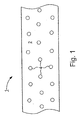
- FIG. 1 shows a fragmentary schematic representation of the components of an injection-molded part.
- the injection-molded part 1 has as base material 2 a thermoplastic material, which is particularly suitable for processing techniques such as injection molding or extrusion due to its plastic properties in the heat. Depending on the given nozzle shape of the respective tool, these processing techniques make it possible to produce correspondingly shaped parts.
- the particularly good shaping properties facilitate a particularly high accuracy of fit in the respective field of use, for example when installed in a motor vehicle.
- the injection-molded part 1 has in addition to the base material 2 embedded therein particles 4 of a filler. These particles 4 determine the specific properties of the injection-molded part 1 with.
- the particles 4 are therefore designed to a particular extent for a usability of the injection-molded part 1 in the field of the automotive industry.
- the particles 4 are designed in such a way that the molded part 1 produced therefrom takes into account the requirements in terms of weight in the automobile industry. These consist in being able to use an extremely lightweight molded part 1, for example, for the housing of air conditioning or air supply systems.
- the intensity and duration of the energy supply as in the document DE 199 09 077 A1 described accordingly selected that the particles 4 of the filler over the plastic have a closed-pore structure.
- foamed particles 4 in the embodiment with a spherical shape facilitates thorough mixing of the particles 4 of the filler with the intended as a base material 2 plastic. This avoids at the same time in a special way unwanted aggregation, clustering and / or sedimentation of the particles 4 of the filler in the so-called.
- Plastic matrix In the so-called.
- a particle shape are also a regular polyhedron shape or a fiber shape.
- the plastic provided with the foamed particles 4 as an injection-molded material is brought into a desired shape by the initially described customary treatment during injection molding and thus processed into particularly accurately fitting molded parts 1.
- the average size of the foamed particles 4 is adapted to the injection mold and is therefore less than 1 mm.
- the average particle size for airtight design is one to be manufactured Formed part 1 adapted to a predetermined minimum wall thickness of the relevant molded part 1 insofar as the average particle size is preferably 1/3 or 1/2 of the wall thickness.
- the average particle size of the filler is 0.9 mm with a minimum wall thickness of 1.8 mm in a forming example of an air conditioning housing molding 1.
- the minimum wall thickness of other molded parts 1 of a motor vehicle is usually between 1 mm and 2 mm, so that a particularly favorable average particle size of the filler is on the order of between 0.2 mm and 0.9 mm.
Landscapes
- Chemical & Material Sciences (AREA)
- Engineering & Computer Science (AREA)
- Mechanical Engineering (AREA)
- Dispersion Chemistry (AREA)
- Manufacturing & Machinery (AREA)
- Composite Materials (AREA)
- Injection Moulding Of Plastics Or The Like (AREA)
- Extrusion Moulding Of Plastics Or The Like (AREA)
- Molding Of Porous Articles (AREA)
Description
- Für einen Spritzguss-Werkstoff wird als Basisstoff üblicherweise ein Kunststoff insbesondere ein Thermoplast, Duroplast oder Elastomer eingesetzt. Zu den wichtigsten Eigenschaften dieser genannten Kunststoff-Werkstoffe zählen die vielfältigen Verarbeitungsmöglichkeiten, wie z. B. Spritzgießen und Extrudieren. Dadurch ist eine mannigfache Formgebung ermöglicht, so dass diese Kunststoffe als zudem kostengünstige Alternative zu metallischen Werkstoffen für den Einsatz in den verschiedensten industriellen Gebieten geeignet sind.
- Beim Spritzgießen wird ein Pulver oder Granulat aus Kunststoff in einer Spritzeinheit zu einer Formmasse aufgeschmolzen und in ein beheiztes Spritzgieß-Werkzeug eingespritzt. In diesem Werkzeug ist ein strukturierter Formeinsatz eingebaut, der komplett mit der Formmasse gefüllt wird. Nach dem Abkühlen und Öffnen des Werkzeugs werden die spritzgegossenen Teile entnommen.
- Extrudieren bedeutet Strangpressen mit Schneckenpressen, den sog. Extrudern. Die pulver- oder granulatförmige Formmasse wird durch die Schnecke aufgenommen, transportiert und durch Reibung und zusätzliche Heizung plastifiziert. Beim weiteren Transport durch die Schnecke erhöht sich der Druck, und die formbare Masse wird durch eine nachgeschaltete Düse in Form eines Stranges ausgepreßt. Je nach Düsenform werden spezielle Formteile wie beispielsweise Profile, Bänder, Bahnen, Rohre, Schläuche, Fäden, Stäbe, Platten u.ä. erzeugt, so dass die Produktpalette besonders reichhaltig ist.
- Durch Zugaben vor und/ oder während eines solchen Formgebungsprozesses können den Werkstoffen spezifisch gewünschte Eigenschaften gegeben werden. So dient üblicherweise ein dem Basiskunststoff zugesetzter Füllstoff wie beispielsweise Glas, Holzmehl, Talkum etc. zur Erhöhung der Festigkeit, der Steifigkeit oder der Wärmestandfestigkeit der daraus gefertigten Formteile.
- Diese derzeit üblichen Füllstoffe weisen im allgemeinen eine wesentlich höhere Dichte als der Basiskunststoff auf. Ein solcher Füllstoff bestimmt somit je nach Volumen-Anteil die Dichte des Spritzguss-Werkstoffes und damit im Endeffekt die Dichte der daraus gefertigten Formteile erheblich. Das Gewicht des Formteiles nimmt also zu.
- Jedoch sind quasi in allen Bereichen des täglichen Lebens mit zunehmender Tendenz besonders leichte Formteile als Bauträger und Werkstoffe gefragt. Besonders in der in der Automobil-, Luft- und Raumfahrtindustrie, aber auch in den Sparten Medizin, Hausgeräte-Technik, Hochbau und Elektrotechnik kommt der Leichtbauweise eine zentrale Bedeutung zu. Dabei sollen allerdings die anderen Ursprungseigenschaften wie beispielsweise die Wärmestandfestigkeit und die Dimensionsstabilität erhalten bleiben.
- Ein Formteil gemäß dem Oberbegriff des Anspruchs 1 wird im
EP-A-801094 - Der Erfindung liegt daher die Aufgabe zugrunde, Formteilen mit einem besonders geringen Gewicht zu ermöglichen. Des Weiteren soll ein besonders geeignetes Verfahren zur Herstellung derartiger Formteile angegeben werden.
- Diese Aufgabe wird erfindungsgemäß gelöst, indem einem als Basisstoff vorgesehenen Kunststoff aufgeschäumte Partikel eines Füllstoffes oder Partikel eines Füllstoffes, die unter üblichen Spritzgieß- oder Extrusionsbedingungen aufschäumen, beigemischt sind.
- Die Erfindung geht dabei von der Überlegung aus, dass ein zu einem besonders leichten Formteil zu verarbeitender Spritzguss-Werkstoff derart ausgestattet sein sollte, dass er diesen Erfordernissen und technologischen Anforderungen der Industrie angepasst sein sollte. Ein aus einem Spritzguss-Werkstoff gefertigtes Formteil mit vergleichsweise hohem Gewicht hat nämlich häufig nachteilige Auswirkungen auf die Kosten. So ist beispielsweise eine leichte Bauweise von Kraftfahrzeugteilen zugunsten eines geringen Kraftstoffverbrauchs besonders gewünscht. Diese kann unter anderem dadurch begünstigt werden, dass bereits bei der Herstellung von spritzgegossenen oder extrudierten Formteilen in hohem Maße auf geringe Gewichtsbeiträge geachtet wird.
- So sollte das Formteil in allen seinen Bestandteilen oder Komponenten eine vergleichsweise geringe Dichte aufweisen. Dabei sollten bisherige Ursprungseigenschaften beispielsweise hinsichtlich seiner Temperaturbeständigkeit und Dimensionsstabilität sowie seines lsolations- und Dämpfungsverhaltens bezüglich Temperatur, Schall und Schwingungen nach Möglichkeit zumindest beibehalten oder sogar verbessert werden. Dies sollte auch bei der Wahl eines besonders geeigneten Füllstoffes berücksichtigt werden. Dazu sind bei dem Spritzguss-Werkstoff für Formteile dem als Basisstoff vorgesehenen Kunststoff statt eines kompakten Füllstoffes aufgeschäumte Partikel eines Füllstoffes oder Partikel eines Füllstoffes, die unter üblichen Spritzgieß- oder Extrusionsbedingungen aufschäumen, beigemischt.
- Bevorzugte Ausgestaltungen des entsprechenden Spritzguss-Werkstoffes für besonders leichte Formteile sind in den Unteransprüchen beschrieben.
- Zur Vereinbarung sich eigentlich widersprechender Anforderungen, einer vergleichsweise geringen Dichte unter gleichzeitiger Aufrechterhaltung der Ursprungseigenschaften des als Basisstoff eingesetzten Kunststoffes, beträgt der Volumen-Anteil der aufgeschäumten Partikel des Füllstoffes zwischen 10 % und 60 %, vorzugsweise zwischen 20 % und 40 %. So haben eine hinreichende Verzugsarmut und Torsionssteifigkeit beispielsweise für Formteile, die im Karosseriebau der Automobilindustrie eingesetzt werden, wie zum Beispiel Stoßfänger, eine besondere Bedeutung. Ferner spielt auch für Formteile im Innenbereich eines Kraftfahrzeuges, wie beispielsweise für Gehäuse von Wärmetauschern, Kühlern, Klimaanlagen, Luftzufuhranlagen und/ oder Wasserkästen, eine hinreichende Formsteifigkeit und Wärmestandfestigkeit eine besondere Rolle.
- Um eine besonders leichte Durchmischung der Partikel des Füllstoffes mit dem als Basisstoff vorgesehenen Kunststoff zu ermöglichen, sollte die Form der Partikel des Füllstoffes in besonderem Maße eine gleichmäßige Verteilung in der sog. Kunststoffmatrix begünstigen und insbesondere eine Aggregation, Clusterbildung und/ oder Sedimentation verhindern. Daher weisen die Partikel des Füllstoffes anstelle einer Faserform zweckmäßigerweise eine regelmäßige Polyederform oder vorzugsweise eine Kugelform auf. Denn Kugeln haben das kleinste Verhältnis zwischen Oberfläche und Volumen. Die infolge dessen gering gehaltene Wechselwirkung der kugelförmigen Partikel des Füllstoffes miteinander oder mit der Kunststoffmatrix führt dabei dazu, dass der Durchmischungseffekt erleichtert wird. Damit wird beispielsweise ein Verstopfen der Spritzdüse bzw. der Extruderschnecke vermieden. Auch werden im Endeffekt räumlich uneinheitliche Eigenschaften des Formteiles, wie zum Beispiel Festigkeitsunterschiede, unterbunden.
- Zur luftdichten Ausgestaltung eines zu fertigenden Formteiles weisen die aufgeschäumten Partikel des Füllstoffes zweckmäßigerweise eine durchschnittliche Partikelgröße auf, die an eine vorgegebene Minimalwandstärke des zu fertigenden Formteiles angepasst ist. Die durchschnittliche Partikelgröße im Formteil beträgt 1/3 oder 1/2 der Wandstärke.
- Um ein Befüllen der aufgeschäumten Partikel mit dem verflüssigten oder erweichten Kunststoff zu verhindern, ist die Größe der aufgeschäumten Partikel zweckmäßigerweise so gewählt, dass ihre Innendurchmesser dafür zu klein sind. Dazu sind die Maße der aufgeschäumten Partikel des Füllstoffes in Faserform vorteilhafterweise mit einer Länge zwischen 3 und 15 mm sowie einem Durchmesser zwischen 5 und 15 µm gewählt, während die durchschnittliche Partikelgröße der aufgeschäumten Partikel des Füllstoffes in Kugelform vorteilhafterweise kleiner als 1 mm, vorzugsweise zwischen 0,2 mm und 0,9 mm gewählt ist. Dabei ist die Extruderschnecke oder die Plastifiziereinheit der Spritzgießmaschine jeweils an die Partikelgröße angepasst.
- Damit die Hohlräume und Blasen in den aufgeschäumten Partikeln des Füllstoffes auch bei größeren Partikeln nicht durch den verflüssigten oder erweichten Kunststoff ausgefüllt werden und das darin enthaltene Gas oder die Luft nicht verdrängt werden, weisen die Füllstoff-Partikel zweckmäßigerweise gegenüber dem Kunststoff eine geschlossenporige Struktur auf. Durch diese Struktur ist die Oberfläche der Partikel des Füllstoffes impermeabel oder undurchlässig für den Kunststoff.
- Für den Spritzguss-Werkstoff ist als Kunststoff vorzugsweise ein Thermoplast, ein Duroplast oder ein Elastomer eingesetzt. Als Thermoplast kommt insbesondere Acrylnitril-Butadien-Styrol-Copolymerisat, Acrylnitril-Styrol-Acrylester-Copolymer, Celluloseacetat, Celluloseacetobutyrat, Ethylen-Vinylacetat, Tetrafluorethylen-Hexafluorethylen-Copolymer, Polyarylamid, Polyamidimid, Polyacrylnitril, Polyarylat, Polyamid, Polybutylentherephtalat, Polycarbonat, Polyethylen, Polyetherimid, Polyetheretherketon, Polyetherketon-etherketon, Polyethersulfon, Polyethylentherephtalat, Perfluoralkoxy Copolymer, Polyaminobismeleinimid, Polymethylmethacrylat, Polyoxymethylen, Polypropylen, Polyphenylenether, Polyphenylenoxid, Polyphenylensulfid, Polystyrol, Polysulfon, Polytetrafluorethylen, Polychlortrifluorethylen, Polyvinylchlorid, Polyvinylidenchlorid, Polyvinylidenfluorid, Styrol-Acrylnitril Copolymer oder Styrol-Butadien Copolymer zum Einsatz. Als Duroplast wird insbesondere Epoxidharz, Melaminformaldehydharz, Melaminphenolharz, Phenol-Formaldehydharz, Polyurethanharz, Silikonharz, Ungesättigte Polyester, Harnstoff-Formaldehydharz oder Vinylesterharz eingesetzt. Während als Elastomer insbesondere Acrylatkautschuk, Polyesterurethan-Kautschuk, Butadien-Kautschuk, Chloropren-Kautschuk, Chlorsulfoniertes Polyethylen, Ethylen-Propylen-Dien Terpolymer, Ethylen-Vinylacetat Copolymer, Epoxidurethan Kautschuk, Fluorsilikonkautschuk, Fluorkautschuk, Isopren-Isobutylen Copolymer, lsoprenkautschuk, Methyl-Vinyl-Silikon Kautschuk, Acrylnitril-Butadien Kautschuk, Styrol-Butadien Kautschuk oder Polysulfid Kautschuk Verwendung findet.
- Für einen besonders gering gehaltenen Herstellungsaufwand werden zweckmäßigerweise kommerziell erhältliche Produkte als Füllstoffe eingesetzt. Als aufgeschäumte Füllstoff-Partikel sind vorzugsweise Glasschaumgranulat-Partikel, Glaskugeln mit einem Durchmesser kleiner 50 µm oder Aktivkohle-Partikel eingesetzt. Als Rohstoff für aufgeschäumte Füllstoff-Partikel ist vorzugsweise Glasmehl, Gesteinsmehl, wie zum Beispiel Glimmer mit einem Durchmesser von ca. 3,0 µm, Perlith, Kreide, Calciumcarbonat mit einem Durchmesser von ca. 0,7 µm, Ton, Talkum, Alkalisilikat, Ammoniumsilikat und/oder ein anderes Silikat oder ein anderer Mineralstoff eingesetzt.
- Bezüglich des Verfahrens zur Herstellung von Formteilen wird die genannte Aufgabe durch die Merkmale des Anspruchs 9 gelöst.,
- Zum Aufschäumen der Füllstoff-Partikel vor dem Einbringen in den Kunststoff wird ihnen zweckmäßigerweise entweder ein Treibmittel beigemengt, oder das Treibmittel wird in ihnen gelöst oder in anderer Weise gebunden. Durch eine geeignete Veränderung der chemischen oder physikalischen Außenbedingungen wird das Treibmittel als Treibgas freigesetzt und bläht die Partikel des Füllstoffes auf. Systeme, wie in
DE 199 09 077 A1 undDE 100 39 390 A1 und in den darin genannten Druckschriften beschrieben, greifen dieses Prinzip auf und wenden es zur Erzeugung von Silikatschäumen und Kunststoffschäumen an. - Zur Verringerung des anfänglichen Arbeitsvolumens des Spritzguss-Werkstoffes kann das Verfahren alternativ derart gestaltet werden, dass die Füllstoff-Partikel erst beim Spritzgießen oder Extrudieren aufgeschäumt werden. So wird beispielsweise aus einer sog. Alkalisilikat- und/ oder Ammoniumsilikatmatrix beim Extrudieren Wasser freigesetzt, das seine Partikel aufbläht und somit aufschäumt.
- Bezüglich des Formteiles wird die oben genannte Aufgabe gelöst, indem in einem als Basisstoff vorgesehenen Kunststoff aufgeschäumte Partikel eines Füllstoffes eingebettet sind.
- Die mit der Erfindung erzielten Vorteile bestehen insbesondere darin, dass durch die Zugabe von aufgeschäumten Partikeln eines Füllstoffes oder von Partikeln eines Füllstoffes, die unter üblichen Spritzgieß- oder Extrusionsbedingungen aufschäumen, zu einem als Basisstoff vorgesehenen Kunststoff Formteile mit einem besonders geringen Gewicht bereitgestellt werden können.
- Gerade durch einen geeignet gewählten Volumen-Anteil der aufgeschäumten Partikel des Füllstoffes ist eine Beibehaltung der günstigen Eigenschaften des Basisstoffes wie Formsteifigkeit, Verzugsarmut und Wärmestandfestigkeit bei insgesamt nur geringer Dichte möglich. Die Verwendung von Füllstoff-Partikeln der genannten Form, Größe und Struktur ermöglicht in Kombination mit einem thermoplastischen, duroplastischen oder elastomeren Kunststoff besonders effektiv die gewünschte Dichteerniedrigung, die im Gegensatz zu der durch die Beigabe eines kompakten Füllstoffes üblicherweise in Kauf genommenen Dichteerhöhung steht. Sollte aus technologischen Gründen dennoch der Zusatz auch eines kompakten Füllstoffes erforderlich sein, so kann die Verwendung der aufgeschäumten oder aufzuschäumenden Füllstoff-Partikel allerdings die unerwünschte Gewichtszunahme zumindest kompensieren. Damit wird ein insgesamt besonders leichtes Formteil mit einem breiten Anwendungsfeld, insbesondere im Bereich der Automobilindustrie, zur Verfügung gestellt.
- Ein Ausführungsbeispiel der Erfindung wird im Folgenden anhand einer Zeichnung näher erläutert. Darin zeigt die Figur eine ausschnittsweise schematische Darstellung der Komponenten eines spritzgegossenen Formteils.
- Das spritzgegossene Formteil 1 weist als Basisstoff 2 einen thermoplastischen Kunststoff auf, der sich aufgrund seiner plastischen Eigenschaften in der Wärme besonders für Verarbeitungstechniken wie das Spritzgießen oder Extrudieren eignet. Diese Verarbeitungstechniken ermöglichen abhängig von der vorgegebenen Düsenform des jeweiligen Werkzeuges die Herstellung entsprechend beschaffener Formteile. Die besonders guten Formgebungseigenschaften erleichtern eine besonders hohe Passgenauigkeit im jeweiligen Verwendungsbereich, beispielsweise beim Verbau in einem Kraftfahrzeug.
- Das spritzgegossene Formteil 1 weist zusätzlich zum Basisstoff 2 darin eingebettete Partikel 4 eines Füllstoffes auf. Diese Partikel 4 bestimmen die spezifischen Eigenschaften des spritzgegossenes Formteiles 1 mit. Die Partikel 4 sind daher in besonderem Maße für eine Verwendbarkeit des spritzgegossenes Formteiles 1 auf dem Gebiet der Automobilindustrie ausgelegt. Dafür sind die Partikel 4 derart ausgebildet, dass das daraus gefertigte Formteil 1 den in der Automobilindustrie gestellten Anforderungen bezüglich des Gewichts Rechnung trägt. Diese bestehen nämlich darin, ein außerordentlich leichtes Formteil 1, beispielsweise für das Gehäuse von Klimaanlagen oder Luftzufuhranlagen einsetzen zu können.
- Zu diesem Zweck sind die im Basisstoff 2 des spritzgegossenen Formteils 1 eingebetteten Partikel 4 des Füllstoffes, wie oben beschrieben, aufgeschäumt.
- Ihr Volumen ist also dadurch vergrößert, dass die aufgeschäumten Partikel 4 mit Luft oder anderen Gasen gefüllte Hohlräume und Blasen aufweisen. Gerade durch die Wahl eines Volumen-Anteils der aufgeschäumten Partikel 4 des Füllstoffes von 40 % im Ausführungsbeispiel ist sowohl eine Beibehaltung der vorteilhaften Eigenschaften bezüglich Formsteifigkeit als auch eine besonders geringe Dichte und damit ein besonders geringes Gewicht des spritzgegossenen Formteiles 1, zum Beispiel eines Gehäuses von Klimaanlagen errreicht. Für den Einsatz beispielsweise für Gehäuse von Wärmetauschern, Kühlern, Luftzufuhranlagen, Wasserkästen und/ oder für ein beliebiges anderes Formteil 1 im Innenbereich oder Außenbereich eines Kratffahrzeuges beträgt der Volumen-Anteil der aufgeschäumten Partikel bedarfsweise zwischen 10 % und 60 %.
- Damit die Hohlräume und Blasen in den aufgeschäumten Partikeln 4 des Füllstoffes nicht durch den als Basisstoff 2 vorgesehenen Kunststoff ausgefüllt werden und die darin enthaltene Luft oder das Gas nicht verdrängt werden, werden die Intensität und Dauer der Energiezufuhr, wie in der Druckschrift
DE 199 09 077 A1 beschrieben, dementsprechend gewählt, dass die Partikel 4 des Füllstoffes gegenüber dem Kunststoff eine geschlossenporige Struktur aufweisen. - Die im Ausführungsbeispiel gezielte Verwendung von aufgeschäumten Partikeln 4 mit einer Kugelform erleichtert eine Durchmischung der Partikel 4 des Füllstoffes mit dem als Basisstoff 2 vorgesehenen Kunststoff. Dies vermeidet gleichzeitig in besonderer Weise eine unerwünschte Aggregation, Clusterbildung und/ oder Sedimentation der Partikel 4 des Füllstoffes in der sog. Kunststoffmatrix. Denkbar als Partikelform sind allerdings auch eine regelmäßige Polyederform oder eine Faserform.
- Anschließend wird der mit den aufgeschäumten Partikeln 4 versehene Kunststoff als Spritzguss-Werkstoff durch die eingangs kurz beschriebene übliche Behandlung beim Spritzgießen in eine gewünschte Form gebracht und somit zu besonders passgenauen Formteilen 1 verarbeitet. Um die Partikel 4 des Füllstoffes bei der Plastifizierung im Spritzgieß-Werkzeug nicht zu zerstören, ist die durchschnittliche Größe der aufgeschäumten Partikel 4 an das Spritzgieß-Werkzeug angepasst und ist daher kleiner als 1 mm. Ferner ist die durchschnittliche Partikelgröße zur luftdichten Ausgestaltung eines zu fertigenden Formteiles 1 an eine vorgegebene Minimalwandstärke des betreffenden Formteiles 1 insoweit angepasst, als das die durchschnittliche Partikelgröße vorzugsweise 1/3 oder 1/2 der Wandstärke beträgt. Im Ausführungsbeispiel beträgt die durchschnittliche Partikelgröße des Füllstoffes 0,9 mm bei einer Minimalwandstärke von 1,8 mm bei einem zum Beispiel ein Klimaanlagengehäuse bildendes Formteil 1. Die Minimalwandstärke anderer Formteile 1 eines Kraftfahrzeuges beträgt üblicherweise zwischen 1 mm und 2 mm, so dass eine besonders günstige durchschnittliche Partikelgröße des Füllstoffes in einer Größenordnung zwischen 0,2 mm und 0,9 mm liegt.
- Die Darstellung der Komponenten des besonders leichten spritzgegossenen Formteiles 1 gilt selbstverständlich gleichermaßen für ein extrudiertes Formteil 1 mit einem besonders geringen Gewicht. Der Unterschied besteht nur in der Verarbeitung im Extruder anstelle der im Spritzgieß-Werkzeug. Für das extrudierte Formteil 1 sind daher bezüglich des eingangs kurz beschriebenen Extrudierens geeignete Betriebsparameter gewählt. Ferner ist bei der Darstellung der Zeitpunkt des Aufschäumens der in der Figur gezeigten aufgeschäumten Partikel 4 des Kunststoffes unbeachtlich.
-
- 1
- Formteil
- 2
- Basisstoff
- 4
- aufgeschäumte Partikel
Claims (9)
- Spritzguss- oder extrudiertes Formteil eines Kraftfahrzeugs, bestehend aus einem Werkstoff (1), bei dem einem als Basisstoff (2) vorgesehenen Kunststoff aufgeschäumte Partikel (4) eines Füllstoffes oder Partikel eines Füllstoffes, die unter üblichen Spritzgieß- oder Extrusionsbedingungen aufschäumen, beigemischt sind, dadurch gekennzeichnet, dass das Formteil eine Minimalwandstärke von 1 mm bis 2 mm aufweist und die durchschnittliche Partikelgröße im Formteil zwischen 1/3 und 1/2 der Minimalwandstärke beträgt.
- Formteil nach Anspruch 1, bei dem der Volumen-Anteil der aufgeschäumten Partikel (4) des Füllstoffes zwischen 10 % und 60 % beträgt.
- Formteil nach Anspruch 1 oder 2, bei dem die Partikel (4) des Füllstoffes eine Faserform, eine regelmäßige Polyederform oder eine Kugelform aufweisen.
- Formteil nach einem der vorhergehenden Ansprüche, dessen aufgeschäumte Partikel (4) des Füllstoffes gegenüber dem Kunststoff eine geschlossenporige Struktur aufweisen.
- Formteil nach einem der vorhergehenden Ansprüche, bei dem als Kunststoff ein Thermoplast, ein Duroplast oder ein Elastomer eingesetzt ist.
- Formteil nach einem der vorhergehenden Ansprüche, bei dem als aufgeschäumte Partikel (4) des Füllstoffes Glasschaumgranulat-Partikel, Glaskugeln oder Aktivkohle-Partikel eingesetzt sind.
- Formteil nach einem der vorhergehenden Ansprüche, bei dem als Rohstoff für aufgeschäumte Partikel (4) des Füllstoffes Glasmehl, Gesteinsmehl, Kalk, Ton, Talkum, Alkalisilikat, Ammoniumsilikat und/oder ein anderer Mineralstoff oder ein anderes Silikat eingesetzt ist.
- Klimaanlage mit einem Gehäuse, dadurch gekennzeichnet, dass das Gehäuse aus einem Formteil (1) nach einem der vorhergehenden Ansprüche besteht.
- Verfahren zur Herstellung von Formteilen (1) nach einem der Ansprüche 1 bis 7, bei dem Partikel eines Füllstoffes in einen Kunststoff eingebracht werden und das daraus entstehende Gemisch als Spritzguss-Werkstoff spritzgegossen oder extrudiert wird, wobei die Partikel des Füllstoffes spätestens beim Spritzgießen oder Extrudieren, vorzugsweise vor dem Einbringen in den Kunststoff, aufgeschäumt werden und die durchschnittliche Partikelgröße im Formteil zwischen 1/3 und 1/2 der Minimalwandstärke beträgt.
Applications Claiming Priority (2)
| Application Number | Priority Date | Filing Date | Title |
|---|---|---|---|
| DE10236509A DE10236509A1 (de) | 2002-08-09 | 2002-08-09 | Spritzguss-Werkstoff für Formteile |
| DE10236509 | 2002-08-09 |
Publications (2)
| Publication Number | Publication Date |
|---|---|
| EP1424190A1 EP1424190A1 (de) | 2004-06-02 |
| EP1424190B1 true EP1424190B1 (de) | 2008-02-20 |
Family
ID=30469626
Family Applications (1)
| Application Number | Title | Priority Date | Filing Date |
|---|---|---|---|
| EP03017739A Expired - Lifetime EP1424190B1 (de) | 2002-08-09 | 2003-08-04 | Spritzguss- oder extrudiertes Formteil und Verfahren zu dessen Herstellung |
Country Status (3)
| Country | Link |
|---|---|
| EP (1) | EP1424190B1 (de) |
| AT (1) | ATE386628T1 (de) |
| DE (2) | DE10236509A1 (de) |
Families Citing this family (4)
| Publication number | Priority date | Publication date | Assignee | Title |
|---|---|---|---|---|
| DE102004025312B4 (de) * | 2004-05-19 | 2010-04-22 | Braun Gmbh | Bauelement |
| FR2916385A1 (fr) * | 2007-05-25 | 2008-11-28 | Cera | Composant structurel de garnissage de vehicule automobile |
| CN106808638B (zh) * | 2015-11-27 | 2019-07-02 | 法国圣戈班玻璃公司 | 注塑件及其形成方法、包边结构以及车窗 |
| DE102017221078A1 (de) * | 2017-11-24 | 2019-05-29 | Zf Friedrichshafen Ag | Verfahren zur Herstellung eines Ölverdrängerkörpers, Ölverdrängerkörper, Getriebeanordnung sowie Kraftfahrzeug |
Family Cites Families (6)
| Publication number | Priority date | Publication date | Assignee | Title |
|---|---|---|---|---|
| US4891387A (en) * | 1988-06-28 | 1990-01-02 | The B. F. Goodrich Company | Bulk polymerized cycloolefin monomers containing microencapsulated blowing agents |
| JP3193433B2 (ja) * | 1992-02-13 | 2001-07-30 | 三菱化学株式会社 | プロピレン系樹脂成形体の製造法 |
| GB9203186D0 (en) * | 1992-02-14 | 1992-04-01 | Balmoral Group | Process for producing microsphere containing thermosetting resin compositions |
| DE4338409A1 (de) * | 1993-11-10 | 1995-05-11 | Bayer Ag | Verwendung von fluorierten Polyolefinen in Polyalkylenterephthalat-Formmassen zur Verbesserung der Kriechstromfestigkeit |
| DE19614022C1 (de) * | 1996-04-09 | 1997-08-28 | Ymos Ag | Thermoplastisch verarbeitbares Polymer-Compound und Verfahren zu seiner Herstellung sowie Verwendung des Polymer-Compounds zur Herstellung von Formteilen |
| US6221486B1 (en) * | 1999-12-09 | 2001-04-24 | Zms, Llc | Expandable polymeric fibers and their method of production |
-
2002
- 2002-08-09 DE DE10236509A patent/DE10236509A1/de not_active Withdrawn
-
2003
- 2003-08-04 AT AT03017739T patent/ATE386628T1/de not_active IP Right Cessation
- 2003-08-04 EP EP03017739A patent/EP1424190B1/de not_active Expired - Lifetime
- 2003-08-04 DE DE50309192T patent/DE50309192D1/de not_active Expired - Lifetime
Non-Patent Citations (1)
| Title |
|---|
| None * |
Also Published As
| Publication number | Publication date |
|---|---|
| DE50309192D1 (de) | 2008-04-03 |
| ATE386628T1 (de) | 2008-03-15 |
| EP1424190A1 (de) | 2004-06-02 |
| DE10236509A1 (de) | 2004-02-19 |
Similar Documents
| Publication | Publication Date | Title |
|---|---|---|
| EP0447423B1 (de) | Formteil aus gespritzten oder extrudierten kunststoffabfällen | |
| DE69228171T2 (de) | Verfahren zur Herstellung von Gegenständen aus Polymermaterial bestehend aus einem geschäumten Kern mit einer umhüllenden Schale, und Vorrichtung für dieses Verfahren | |
| CN110862673B (zh) | 一种3d打印用发泡热塑性弹性体材料及其制备方法 | |
| DE102013222426A1 (de) | Verfahren zur Herstellung eines Halbzeugs zur Verarbeitung zu einem CFK-Bauteil aus Kohlefaserabfällen | |
| EP1493777B1 (de) | Formteile, enthaltend einen Kunststoff sowie poröse Füllstoffpartikeln mit gefüllten Hohlräumen | |
| EP1502726B1 (de) | Werkstoff für Formteile | |
| EP1424190A1 (de) | Spritzguss-Werkstoff für Formteile | |
| EP2033758A1 (de) | Verfahren und Vorrichtung zur Herstellung von faserverstärkten Kunststoffformteilen | |
| EP3107705B1 (de) | Verfahren zur herstellung eines verbundbauteils | |
| EP3760416A1 (de) | Faserverstärkter thermoplastischer harzformkörper und herstellungsverfahren dafür | |
| DE19548854A1 (de) | Verfahren zur Herstellung von Gegenständen aus faserverstärkten Thermoplasten | |
| DE102014223665A1 (de) | Spritzgusswerkzeug, Verfahren zur Herstellung eines Spritzguss-Bauteils und Spritzguss-Bauteil | |
| WO2004022298A1 (de) | Schallisolierendes material und verfahren zu dessen herstellung | |
| WO2018114757A1 (de) | Hohlkörper umfassend eine wand aus einem mehrschichtigen thermoplastischen kunststoff sowie verfahren zu dessen herstellung | |
| DE10036101A1 (de) | Verfahren zur Herstellung von geschäumten Kunststoffgegenständen | |
| WO2019168010A1 (ja) | 繊維強化熱可塑性樹脂の成形物及びその製造方法 | |
| DE102013203618A1 (de) | Verfahren, Werkzeug und Anlage zum Herstellen eines Kunststoffteils für ein Fahrzeug, aus Kunststoff hergestelltes Bauteil für ein Fahrzeug | |
| EP1262294A1 (de) | Holzsubstitut | |
| DE2554060B2 (de) | Aufschaeumbare thermoplastische formmasse | |
| DE102015209334A1 (de) | Granulat, Verfahren und Vorrichtung zu dessen Herstellung | |
| CN101691062B (zh) | 一种高物性橡胶型氯化聚乙烯生产工艺 | |
| DE102005027374A1 (de) | Spritzgießverfahren und -anlage | |
| EP2401137B1 (de) | Extrusionsprofil, insbesondere für luftfahrzeuge, sowie verfahren zur herstellung eines extrusionsprofils | |
| DE19860878A1 (de) | Füllstoff für organische und anorganische Polymere, Verfahren zur Herstellung eines Polymerwerkstoffes mit diesem Füllstoff sowie Verwendung dieses Polymerwerkstoffes | |
| EP0241590A2 (de) | Mischvorrichtung zum Aufbereiten füllstoffhaltiger Kunststoffe |
Legal Events
| Date | Code | Title | Description |
|---|---|---|---|
| PUAI | Public reference made under article 153(3) epc to a published international application that has entered the european phase |
Free format text: ORIGINAL CODE: 0009012 |
|
| AK | Designated contracting states |
Kind code of ref document: A1 Designated state(s): AT BE BG CH CY CZ DE DK EE ES FI FR GB GR HU IE IT LI LU MC NL PT RO SE SI SK TR |
|
| AX | Request for extension of the european patent |
Extension state: AL LT LV MK |
|
| RAP1 | Party data changed (applicant data changed or rights of an application transferred) |
Owner name: BEHR GMBH & CO. KG |
|
| 17P | Request for examination filed |
Effective date: 20041202 |
|
| AKX | Designation fees paid |
Designated state(s): AT BE BG CH CY CZ DE DK EE ES FI FR GB GR HU IE IT LI LU MC NL PT RO SE SI SK TR |
|
| 17Q | First examination report despatched |
Effective date: 20050425 |
|
| 17Q | First examination report despatched |
Effective date: 20050425 |
|
| RTI1 | Title (correction) |
Free format text: INJECTION MOULDED OR EXTRUDED PART AND METHOD FOR ITS MANUFACTURE |
|
| GRAP | Despatch of communication of intention to grant a patent |
Free format text: ORIGINAL CODE: EPIDOSNIGR1 |
|
| GRAS | Grant fee paid |
Free format text: ORIGINAL CODE: EPIDOSNIGR3 |
|
| GRAA | (expected) grant |
Free format text: ORIGINAL CODE: 0009210 |
|
| AK | Designated contracting states |
Kind code of ref document: B1 Designated state(s): AT BE BG CH CY CZ DE DK EE ES FI FR GB GR HU IE IT LI LU MC NL PT RO SE SI SK TR |
|
| REG | Reference to a national code |
Ref country code: GB Ref legal event code: FG4D Free format text: NOT ENGLISH |
|
| REG | Reference to a national code |
Ref country code: CH Ref legal event code: EP |
|
| REG | Reference to a national code |
Ref country code: IE Ref legal event code: FG4D Free format text: LANGUAGE OF EP DOCUMENT: GERMAN |
|
| REF | Corresponds to: |
Ref document number: 50309192 Country of ref document: DE Date of ref document: 20080403 Kind code of ref document: P |
|
| PG25 | Lapsed in a contracting state [announced via postgrant information from national office to epo] |
Ref country code: FI Free format text: LAPSE BECAUSE OF FAILURE TO SUBMIT A TRANSLATION OF THE DESCRIPTION OR TO PAY THE FEE WITHIN THE PRESCRIBED TIME-LIMIT Effective date: 20080220 Ref country code: ES Free format text: LAPSE BECAUSE OF FAILURE TO SUBMIT A TRANSLATION OF THE DESCRIPTION OR TO PAY THE FEE WITHIN THE PRESCRIBED TIME-LIMIT Effective date: 20080531 |
|
| NLV1 | Nl: lapsed or annulled due to failure to fulfill the requirements of art. 29p and 29m of the patents act | ||
| PG25 | Lapsed in a contracting state [announced via postgrant information from national office to epo] |
Ref country code: SI Free format text: LAPSE BECAUSE OF FAILURE TO SUBMIT A TRANSLATION OF THE DESCRIPTION OR TO PAY THE FEE WITHIN THE PRESCRIBED TIME-LIMIT Effective date: 20080220 |
|
| REG | Reference to a national code |
Ref country code: IE Ref legal event code: FD4D |
|
| PG25 | Lapsed in a contracting state [announced via postgrant information from national office to epo] |
Ref country code: SE Free format text: LAPSE BECAUSE OF FAILURE TO SUBMIT A TRANSLATION OF THE DESCRIPTION OR TO PAY THE FEE WITHIN THE PRESCRIBED TIME-LIMIT Effective date: 20080520 Ref country code: NL Free format text: LAPSE BECAUSE OF FAILURE TO SUBMIT A TRANSLATION OF THE DESCRIPTION OR TO PAY THE FEE WITHIN THE PRESCRIBED TIME-LIMIT Effective date: 20080220 Ref country code: CZ Free format text: LAPSE BECAUSE OF FAILURE TO SUBMIT A TRANSLATION OF THE DESCRIPTION OR TO PAY THE FEE WITHIN THE PRESCRIBED TIME-LIMIT Effective date: 20080220 Ref country code: SK Free format text: LAPSE BECAUSE OF FAILURE TO SUBMIT A TRANSLATION OF THE DESCRIPTION OR TO PAY THE FEE WITHIN THE PRESCRIBED TIME-LIMIT Effective date: 20080220 Ref country code: PT Free format text: LAPSE BECAUSE OF FAILURE TO SUBMIT A TRANSLATION OF THE DESCRIPTION OR TO PAY THE FEE WITHIN THE PRESCRIBED TIME-LIMIT Effective date: 20080721 Ref country code: DK Free format text: LAPSE BECAUSE OF FAILURE TO SUBMIT A TRANSLATION OF THE DESCRIPTION OR TO PAY THE FEE WITHIN THE PRESCRIBED TIME-LIMIT Effective date: 20080220 Ref country code: IE Free format text: LAPSE BECAUSE OF FAILURE TO SUBMIT A TRANSLATION OF THE DESCRIPTION OR TO PAY THE FEE WITHIN THE PRESCRIBED TIME-LIMIT Effective date: 20080220 |
|
| PG25 | Lapsed in a contracting state [announced via postgrant information from national office to epo] |
Ref country code: RO Free format text: LAPSE BECAUSE OF FAILURE TO SUBMIT A TRANSLATION OF THE DESCRIPTION OR TO PAY THE FEE WITHIN THE PRESCRIBED TIME-LIMIT Effective date: 20080220 |
|
| EN | Fr: translation not filed | ||
| PLBE | No opposition filed within time limit |
Free format text: ORIGINAL CODE: 0009261 |
|
| STAA | Information on the status of an ep patent application or granted ep patent |
Free format text: STATUS: NO OPPOSITION FILED WITHIN TIME LIMIT |
|
| 26N | No opposition filed |
Effective date: 20081121 |
|
| PG25 | Lapsed in a contracting state [announced via postgrant information from national office to epo] |
Ref country code: MC Free format text: LAPSE BECAUSE OF NON-PAYMENT OF DUE FEES Effective date: 20080831 |
|
| REG | Reference to a national code |
Ref country code: CH Ref legal event code: PL |
|
| GBPC | Gb: european patent ceased through non-payment of renewal fee |
Effective date: 20080804 |
|
| PG25 | Lapsed in a contracting state [announced via postgrant information from national office to epo] |
Ref country code: BG Free format text: LAPSE BECAUSE OF FAILURE TO SUBMIT A TRANSLATION OF THE DESCRIPTION OR TO PAY THE FEE WITHIN THE PRESCRIBED TIME-LIMIT Effective date: 20080520 Ref country code: EE Free format text: LAPSE BECAUSE OF FAILURE TO SUBMIT A TRANSLATION OF THE DESCRIPTION OR TO PAY THE FEE WITHIN THE PRESCRIBED TIME-LIMIT Effective date: 20080220 Ref country code: FR Free format text: LAPSE BECAUSE OF FAILURE TO SUBMIT A TRANSLATION OF THE DESCRIPTION OR TO PAY THE FEE WITHIN THE PRESCRIBED TIME-LIMIT Effective date: 20081212 |
|
| PG25 | Lapsed in a contracting state [announced via postgrant information from national office to epo] |
Ref country code: CH Free format text: LAPSE BECAUSE OF NON-PAYMENT OF DUE FEES Effective date: 20080831 Ref country code: LI Free format text: LAPSE BECAUSE OF NON-PAYMENT OF DUE FEES Effective date: 20080831 |
|
| PG25 | Lapsed in a contracting state [announced via postgrant information from national office to epo] |
Ref country code: BE Free format text: LAPSE BECAUSE OF NON-PAYMENT OF DUE FEES Effective date: 20080831 Ref country code: CY Free format text: LAPSE BECAUSE OF FAILURE TO SUBMIT A TRANSLATION OF THE DESCRIPTION OR TO PAY THE FEE WITHIN THE PRESCRIBED TIME-LIMIT Effective date: 20080220 |
|
| PG25 | Lapsed in a contracting state [announced via postgrant information from national office to epo] |
Ref country code: IT Free format text: LAPSE BECAUSE OF FAILURE TO SUBMIT A TRANSLATION OF THE DESCRIPTION OR TO PAY THE FEE WITHIN THE PRESCRIBED TIME-LIMIT Effective date: 20080220 |
|
| PG25 | Lapsed in a contracting state [announced via postgrant information from national office to epo] |
Ref country code: AT Free format text: LAPSE BECAUSE OF NON-PAYMENT OF DUE FEES Effective date: 20080804 |
|
| PG25 | Lapsed in a contracting state [announced via postgrant information from national office to epo] |
Ref country code: GB Free format text: LAPSE BECAUSE OF NON-PAYMENT OF DUE FEES Effective date: 20080804 |
|
| PG25 | Lapsed in a contracting state [announced via postgrant information from national office to epo] |
Ref country code: LU Free format text: LAPSE BECAUSE OF NON-PAYMENT OF DUE FEES Effective date: 20080804 Ref country code: HU Free format text: LAPSE BECAUSE OF FAILURE TO SUBMIT A TRANSLATION OF THE DESCRIPTION OR TO PAY THE FEE WITHIN THE PRESCRIBED TIME-LIMIT Effective date: 20080821 |
|
| PG25 | Lapsed in a contracting state [announced via postgrant information from national office to epo] |
Ref country code: TR Free format text: LAPSE BECAUSE OF FAILURE TO SUBMIT A TRANSLATION OF THE DESCRIPTION OR TO PAY THE FEE WITHIN THE PRESCRIBED TIME-LIMIT Effective date: 20080220 |
|
| PG25 | Lapsed in a contracting state [announced via postgrant information from national office to epo] |
Ref country code: GR Free format text: LAPSE BECAUSE OF FAILURE TO SUBMIT A TRANSLATION OF THE DESCRIPTION OR TO PAY THE FEE WITHIN THE PRESCRIBED TIME-LIMIT Effective date: 20080521 |
|
| REG | Reference to a national code |
Ref country code: DE Ref legal event code: R082 Ref document number: 50309192 Country of ref document: DE Representative=s name: GRAUEL, ANDREAS, DIPL.-PHYS. DR. RER. NAT., DE |
|
| REG | Reference to a national code |
Ref country code: DE Ref legal event code: R082 Ref document number: 50309192 Country of ref document: DE Representative=s name: GRAUEL, ANDREAS, DIPL.-PHYS. DR. RER. NAT., DE Effective date: 20150323 Ref country code: DE Ref legal event code: R081 Ref document number: 50309192 Country of ref document: DE Owner name: MAHLE INTERNATIONAL GMBH, DE Free format text: FORMER OWNER: BEHR GMBH & CO. KG, 70469 STUTTGART, DE Effective date: 20150323 |
|
| PGFP | Annual fee paid to national office [announced via postgrant information from national office to epo] |
Ref country code: DE Payment date: 20180831 Year of fee payment: 16 |
|
| REG | Reference to a national code |
Ref country code: DE Ref legal event code: R119 Ref document number: 50309192 Country of ref document: DE |
|
| PG25 | Lapsed in a contracting state [announced via postgrant information from national office to epo] |
Ref country code: DE Free format text: LAPSE BECAUSE OF NON-PAYMENT OF DUE FEES Effective date: 20200303 |