EP1426324A2 - Méthode et appareil pour appliquer une capsule à vis sur le goulot fileté d'un récipient - Google Patents
Méthode et appareil pour appliquer une capsule à vis sur le goulot fileté d'un récipient Download PDFInfo
- Publication number
- EP1426324A2 EP1426324A2 EP03257586A EP03257586A EP1426324A2 EP 1426324 A2 EP1426324 A2 EP 1426324A2 EP 03257586 A EP03257586 A EP 03257586A EP 03257586 A EP03257586 A EP 03257586A EP 1426324 A2 EP1426324 A2 EP 1426324A2
- Authority
- EP
- European Patent Office
- Prior art keywords
- cap
- neck
- rotational drive
- applicator
- engagement
- Prior art date
- Legal status (The legal status is an assumption and is not a legal conclusion. Google has not performed a legal analysis and makes no representation as to the accuracy of the status listed.)
- Withdrawn
Links
Images



Classifications
-
- B—PERFORMING OPERATIONS; TRANSPORTING
- B67—OPENING, CLOSING OR CLEANING BOTTLES, JARS OR SIMILAR CONTAINERS; LIQUID HANDLING
- B67B—APPLYING CLOSURE MEMBERS TO BOTTLES JARS, OR SIMILAR CONTAINERS; OPENING CLOSED CONTAINERS
- B67B3/00—Closing bottles, jars or similar containers by applying caps
- B67B3/20—Closing bottles, jars or similar containers by applying caps by applying and rotating preformed threaded caps
- B67B3/2013—Closing bottles, jars or similar containers by applying caps by applying and rotating preformed threaded caps by carousel-type capping machines
- B67B3/2033—Closing bottles, jars or similar containers by applying caps by applying and rotating preformed threaded caps by carousel-type capping machines comprising carousel co-rotating capping heads
Definitions
- the present invention relates to a method and apparatus for applying a threaded cap to a threaded neck of a container.
- the cap is placed on the neck of the container without substantial engagement of the threads.
- a cap is collected by a capping head.
- the capping head suspends the cap in a substantially horizontal plane and the cap is either lowered onto the neck of the container or else the container is raised up to meet the cap.
- the second method is known as the "pick-off" method.
- the caps are suspended above where the containers are transported, such that each cap is inclined with respect to the direction of motion of a respective container.
- the incline of the cap is such that the container neck contacts the inside of the cap and removes the cap from the suspension point.
- the cap is thereby placed on the neck without substantial engagement of the threads.
- the first method of application is by means of an axially downward force which causes the threads of the cap to slide over those of the container and then interengage.
- a second method of applying the cap to the container neck is by rotating the cap relative to the neck of the container. This rotation takes place in the direction of rotation of the threads and is designed so that a predetermined torque is achieved between the cap and the container with the result that the threads are in substantial engagement.
- a common problem with the use of the previously described methods is that if the cap is not placed on the neck so that the threads of the cap are in alignment with those of the neck, the subsequent application of the cap can result in cross-threading.
- the neck and cap are commonly made of different materials, with different hardnesses, if the threads are initially cross-threaded, the subsequent forced application of the cap to the neck by either method can result in the threads becoming damaged. This in turn may lead to subsequent problems with leakage encountered by retailers, distributors and consumers alike. Also, if the threads are damaged, there may be a problem with leakage even if the cap is removed and subsequently applied correctly.
- a method of applying a threaded cap to a threaded neck of a container comprising the steps of: placing the cap on the neck of the container; rotating the cap relative to the neck in an opening direction whilst supporting the cap with respect to the neck; and applying the cap to the neck so as to achieve substantial thread engagement.
- the cap may be rotated relative to the neck in an opening direction through an angle of at least 360°.
- the cap is rotated relative to the neck in an opening direction through an angle of between 36° and 720°.
- the cap may be applied to the neck by means of an axial force which causes the threads on the cap and the threads on the neck to move past each other and then interengage.
- the cap may be applied to the neck by rotation of the cap relative to the neck in a closing direction.
- the cap may be drivingly rotated with respect to the neck by rotational drive means in both the opening and closing directions.
- the cap may be drivingly rotated by rotational drive means in the closing direction and rotated against the rotational drive means in the opening direction.
- an applicator for applying a threaded cap to a threaded neck of a container to achieve substantial thread engagement, the applicator comprising: holding means for holding at least one of the cap and the container; application means for applying the cap to the neck such that the threads of the cap and the neck are substantially fully engaged; and means for rotating the cap relative to the neck in an opening direction whilst supporting the cap with respect to the neck, such that the threads of the neck and the cap are in alignment prior to application of the cap to the neck.
- the application means may comprise means for applying an axial force to at least one of the cap and the neck in the direction of the other of the cap and the neck such that the threads on the cap and the threads on the neck move past each other and interengage.
- the application means may comprise means to rotate the cap relative to the neck in a closing direction.
- the application means comprises rotational drive means.
- the means for rotating the cap relative to the neck in an opening direction may comprise a second rotational drive means different from said rotational drive means to drivingly rotate the cap relative to the neck in a closing direction, the applicator further comprising means to selectively activate one of the two rotational drive means.
- the rotational drive means may be coupled to the holding means via a gear box, the rotational drive means being adapted to selectively rotate the holding means in one of both an opening direction and a closing direction.
- the rotational drive means may be coupled to the holding means by clutch means, the holding means being adapted to be rotated against the clutch means in a direction opposite to the direction of rotation of the rotational drive means.
- engagement means are provided to engage the holding means and rotate the holding means in an opening direction against the direction of rotation of the rotational drive means.
- the engagement means comprises a first formation which positively engages with a second formation provided on the holding means, relative movement between the first and second formations causing the cap to rotate with respect to the neck in an opening direction.
- the engagement means comprises a first surface which frictionally engages a second surface provided on the holding means, relative movement between the first and second surfaces causing the cap to rotate with respect to the neck in an opening direction.
- the duration of engagement between the engagement means and the holding means causes the cap to rotate with respect to the neck through an angle of at least 360°.
- the duration of engagement between the engagement means and the holding means causes the cap to rotate with respect to the neck through an angle of between 36° and 720°.
- the applicator comprises a plurality of holding means, each for holding at least one of a respective cap and container combination, the rotational drive means being common to each of the plurality of holding means.
- the rotational drive means is coupled to each of the plurality of holding means via respective clutch means such that one or more of the holding means may be rotated against the respective clutch means in a direction opposite to the direction of rotation of the rotational drive means while the remainder of the plurality of holding means are rotated in the direction of the rotational drive means.
- the engagement means is common to the plurality of holding means.
- a reverse drive mechanism for use with an applicator for applying a threaded cap to a threaded neck of a container to achieve substantial thread engagement, the applicator comprising holding means for holding at least one of the cap and the container; rotational drive means to rotate the cap relative to the neck in a closing direction such that the threads of the cap and the neck are substantially fully engaged; and clutch means interposed between the rotational drive means and the holding means such that the holding means is adapted to be rotated against the clutch means in a direction opposite to the direction of rotation of the rotational drive means, the reverse drive mechanism comprising engagement means to engage the holding means and rotate the holding means in an opening direction against the direction of rotation of the rotational drive means whilst supporting the cap with respect to the neck such that the threads on the neck and the cap are in alignment prior to the rotational drive means rotating the cap relative to the neck in a closing direction.
- the engagement means comprises a first formation which positively engages with a second formation provided on the holding means, relative movement between the first and second formations causing the cap to rotate with respect to the neck in an opening direction.
- the engagement means may comprise a first surface which fictionally engages a second surface provided on the holding means, relative movement between the first and second surfaces causing the cap to rotate with respect to the neck in an opening direction.
- the duration of engagement between the engagement means and the holding means causes the cap to rotate with respect to the neck through an angle of at least 360°.
- the duration of engagement between the engagement means and the holding means causes the cap to rotate with respect to the neck through an angle of between 36° and 720°.
- FIG 1 there is shown an example of a filling station 2 in which containers, not shown, are filled, for example, with a liquid.
- the containers are then closed with a cap before moving on to be further processed if required.
- the neck of the container and the cap have complementary threads for resealable engagement of the container by the cap. It will be understood that either the cap will be internally threaded and the neck externally threaded or else the cap externally threaded and neck internally threaded.
- the containers enter the filling station at the container in-feed 2 and are transported onto a first transfer wheel 4.
- this transfer wheel rotates about an axis in an anticlockwise direction.
- the first transfer wheel 4 is located adjacent the filler 6 which is rotating about an axis in the opposite direction to the first transfer wheel 4.
- the filler 6 has a radius greater than that of the first transfer wheel 4.
- the containers are transferred to the filler 6 they are transported around the circumference of the filler and are filled with the desired material, for example a potable liquid. Once the containers have been filled they continue around the circumference of filler 6 until they reach a second transfer wheel 8.
- the second transfer wheel 8 rotates about an axis in a direction opposite to that of the filler 6, shown as anti-clockwise.
- the cap placement point 10 is not shown in detail, but it is here that a cap is placed or otherwise rested on the neck of the container such that the threads of the cap and neck of the container are not significantly engaged. This placement may be by means of either the "pick and place” method or "pick-off” method previously described.
- Capping station 12 rotates about an axis in a direction opposite to that of the second transfer wheel 8, shown as clockwise.
- the capping station 12 has a number of capping heads 14 which rotate about the axis of the capping station 12.
- the capping station 12 When the container is being transported around the axis of the capping station 12, it is brought into contact with a capping head 14 and the cap is applied to the neck of the container such that the threads of the cap and the threads of the container become substantially fully engaged.
- the container is passed to a third transfer wheel 16.
- the third transfer wheel 16 rotates about an axis in a direction opposite to that of the capping station, shown as anticlockwise.
- the containers, which are now filled and sealed, are removed from the filling station 1 by the third transfer wheel 16 along out-feed 18 prior to any necessary further processing.
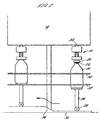
- FIG. 2 shows a side view of a capping station 12 such as that used in the filling station of figure 1.
- a container 20 has a neck 22 on which has been placed a cap 24.
- the container 20 is supported on a stand 26.
- the stand 26 is capable of translational motion by virtue of a rolling support member 28, the stand being located on a platform 30.
- the container 20 is held within two pairs of retaining rails 32 (only one of which is shown) located on opposite sides of the container 20.
- a capping head 14 Located directly above container 20 is a capping head 14, which will be discussed in greater detail below.
- the capping head 14 is attached via shaft 34 to capping station 12.
- the arrow on Figure 2 shows the direction of motion of the container 20 as it moves in the capping station 12.
- the stand 26 and container 20 move at substantially the same speed as the capping head 14, so that the container 20 and capping head 14 remain in direct axial alignment.
- the container moves along the platform 30 it is elevated at step 36, so that the cap 24 is received within the capping head 14.
- the final application of the cap 24 to the neck 22 to take place, so that the threads of the cap and the neck come into substantially full engagement.
- FIG 3 shows a detailed side view of a capping head 14, such as that used in figure 2.
- the capping head comprises a chuck 38, in which is provided a cap recess 40.
- the cap recess 40 is sized such that a cap 24 received within the cap recess can be gripped sufficiently so that any torque applied to the capping head 14 will be directly applied to the cap 24.
- This transfer of torque from the capping head 14 to the cap 24 may be achieved by means of a frictional material within the cap recess 40, or by any other method, for example the positive engagement of a formation provided on the capping head with a corresponding formation provided on the cap.
- the chuck 38 is coupled to shaft 34 via a head load spring 42.
- the head load spring 42 provides a resilience to the capping head 14 on the axial direction.
- the shaft 34 is attached to a clutch mechanism 44, which may take any of the following forms, electrical, magnetic or mechanical.
- the capping head 14 is then attached to a motor, not shown, which provides rotational drive to the capping head 14, to rotate the cap 24 with respect to the container 20 until a predefined torque is achieved between the cap 24 and the neck 22.
- a method of solving this problem is to initially rotate the cap in an opening direction, such that any misalignment is corrected, prior to subsequently applying the cap to the container neck.
- a capping head 14 which is coupled to both a first and a second motor. These motors provide rotational drive in both a clockwise and anticlockwise direction. One of these directions will rotate the cap 24 relative to the neck 22 in an opening direction and the other will rotate the cap 24 relative to the neck 22 in a closing direction. Means are provided on the capping station 12 to selectively couple the capping head 14 first to that motor which rotates the cap in the opening direction and then to that motor which rotates the cap in the closing direction. The ability of the capping station 12 to provide both an opening and closing rotation to the cap 24 will prevent any cross-threaded caps from being applied to the container neck and so remove one cause of subsequent leakage.
- the capping head 14 in this particular embodiment rotates in an opening direction after the cap has been placed on the neck 22 of the container and after the cap has been received in the cap recess 40 of the capping head 14.
- This opening rotation should be' through an angle sufficient to uncross the threads.
- the rotation is preferably through an angle of at least 90°.
- the opening rotation may be through any number of turns sufficient to remove cross-threading and may, for example, be through an angle within the range from 36° and 720°.
- the second rotational drive rotates the capping head 14, and therefore the cap 24, in a closing direction, until a predetermined torque is achieved between the - cap and the neck of the container.
- the capping head 14 is coupled to only one motor but that motor is in turn coupled to a gear box and the capping head is coupled to the output of the gear box.
- the gear box enables the rotational drive from the motor to be provided to the capping head 14 in either an opening or a closing direction.
- means are provided to selectively actuate the gear box so that the capping head is initially rotated in an opening direction before subsequently being rotated in a closing direction. This results in a method of addressing the risk of cross-threading similar to that described with respect to the first embodiment, but without the need for a second rotational drive motor.
- a single motor is provided to rotate the capping head 14 in a direction that will rotate the cap in a closing direction with respect to the container neck.
- the motor is coupled to the capping head 14 by means of a clutch.
- the provision of a clutch enables the capping head to be forceably rotated in a direction opposite to the direction of rotation of the motor without damaging the motor or any of its constituent parts.
- FIG. 4 shows part of a capping station in accordance with this further embodiment.
- the capping station 12 comprises eight capping heads 14 rotating in a circle indicated by arrows 46 about an axis of the capping station.
- each capping head 14 is rotating about its own axis, indicated by arrows 48, under the action of a common motor (not shown).
- each capping head 14 is coupled to that common motor by means of a respective clutch, also not shown.
- Each of the capping heads 14 is provided with a shoulder 50 which may be formed on the chuck 38 or else as an annular protrusion on the shaft 34.
- a plate 52 is provided to one side of the capping station 12 and as the capping heads 14 rotate about the axis of the capping station as indicated by arrows 46 so each of the shoulders in turn engage a surface of plate 52.
- the capping heads 14 continue to rotate about the axis of the capping station 12 so the shoulder 50 slides along the plate 52.
- the frictional engagement between the shoulder 50 and the plate 52 causes the capping head in engagement with the plate to rotate against its clutch in a direction opposite to that in which it is being driven by the motor. This in turn results in the cap received within the chuck 38 being rotated in an opening direction with respect to the container neck.
- the plate 52 is preferably of a length to ensure a reverse rotation of at least 360° although it will be understood that, depending on the number of starts and the length of the threads involved, a reverse rotation of between 36° and 720° may be sufficient to alleviate the problem.
- the plate 52 is bented in the direction of arrows 54 to ensure the necessary frictional engagement with shoulder 50.
- the reverse rotation of the capping head 14 has been described as by means of the frictional engagement of the plate 52 with the shoulders 50, it will be understood that means may be provided to positively engage each of the capping heads in turn and so rotate the capping head against the clutch in a direction opposite to the direction of rotation of the motor.
- the plate 52 may be replaced by a rack having teeth which might engage with corresponding teeth provided on the capping heads 14.
Landscapes
- Engineering & Computer Science (AREA)
- Mechanical Engineering (AREA)
- Sealing Of Jars (AREA)
- Closures For Containers (AREA)
Applications Claiming Priority (2)
| Application Number | Priority Date | Filing Date | Title |
|---|---|---|---|
| GB0228062 | 2002-12-02 | ||
| GB0228062A GB2395942A (en) | 2002-12-02 | 2002-12-02 | Method and apparatus for applying a threaded cap to a threaded neck of a container |
Publications (2)
| Publication Number | Publication Date |
|---|---|
| EP1426324A2 true EP1426324A2 (fr) | 2004-06-09 |
| EP1426324A3 EP1426324A3 (fr) | 2004-06-16 |
Family
ID=9948909
Family Applications (1)
| Application Number | Title | Priority Date | Filing Date |
|---|---|---|---|
| EP03257586A Withdrawn EP1426324A3 (fr) | 2002-12-02 | 2003-12-02 | Méthode et appareil pour appliquer une capsule à vis sur le goulot fileté d'un récipient |
Country Status (6)
| Country | Link |
|---|---|
| US (1) | US7003932B2 (fr) |
| EP (1) | EP1426324A3 (fr) |
| AU (1) | AU2003266430A1 (fr) |
| CA (1) | CA2451811A1 (fr) |
| GB (1) | GB2395942A (fr) |
| ZA (1) | ZA200309361B (fr) |
Families Citing this family (6)
| Publication number | Priority date | Publication date | Assignee | Title |
|---|---|---|---|---|
| EP1852389A4 (fr) * | 2005-02-07 | 2009-06-24 | Yuyama Mfg Co Ltd | Dispositif et procede de bouchage de flacons |
| US7836669B1 (en) | 2006-03-09 | 2010-11-23 | The Sherwin Williams Company | Lid applying apparatus and method with lid orienting device |
| DE102009045637A1 (de) * | 2009-10-13 | 2011-04-14 | Krones Ag | Verfahren und Vorrichtung zum Schraubverschließen von Gefäßen, insbesondere Flaschen |
| JP6163636B2 (ja) * | 2012-07-17 | 2017-07-19 | キユーピー株式会社 | キャップ巻締め方法及びキャップ巻締め装置 |
| CN107285252A (zh) * | 2017-06-21 | 2017-10-24 | 苏州首达机械有限公司 | 回旋旋盖机 |
| US20250376366A1 (en) * | 2024-06-07 | 2025-12-11 | Psr Automation, Inc. | Container top closure apparatus, automation system and related methods |
Family Cites Families (15)
| Publication number | Priority date | Publication date | Assignee | Title |
|---|---|---|---|---|
| DE288815C (fr) | ||||
| GB732653A (en) | 1951-02-28 | 1955-06-29 | Peters G D & Co Ltd | Improvements in automatic capping machines for receptacles |
| GB2121390A (en) * | 1982-06-04 | 1983-12-21 | Metal Closures Ltd | Applying pre-threaded closure caps |
| US4765119A (en) * | 1986-11-14 | 1988-08-23 | Aidlin Automation Corp | Screw capping machine with vertically reciprocable container platform |
| JPS6423987A (en) * | 1987-07-10 | 1989-01-26 | Hoso Giken Kk | Method of clamping cap |
| US4922684A (en) * | 1988-01-15 | 1990-05-08 | Pi, Inc. | Caps for milk bottles and an applicator for placing caps on bottles |
| DD288815A5 (de) * | 1989-11-03 | 1991-04-11 | Veb Forschung U. Rationalisierung Lacke U. Farben,De | Anordnung zum ausrichten und aufschrauben eines flaschenverschlusses |
| DE4011398C2 (de) * | 1990-04-09 | 1994-09-22 | Alcoa Gmbh Verpackwerke | Vorrichtung und Verfahren zum Aufbringen von Schraubverschlüssen auf Behälter |
| JPH0786034B2 (ja) * | 1993-03-19 | 1995-09-20 | 澁谷工業株式会社 | キャッピング方法 |
| GB9306521D0 (en) * | 1993-03-29 | 1993-05-19 | Gei Filling Capping And Labell | A capping machine |
| JPH08244888A (ja) * | 1995-03-09 | 1996-09-24 | Shibuya Kogyo Co Ltd | キャップの締め付け方法およびその装置 |
| IT1293251B1 (it) * | 1997-07-17 | 1999-02-16 | Ima Spa | Apparato per le macchine a giostra adibite alla tappatura di flaconi o simili con tappi a vite. |
| US6105343A (en) * | 1998-11-06 | 2000-08-22 | Pneumatic Scale Corporation | Apparatus and method for a capping machine |
| JP4232311B2 (ja) * | 2000-03-06 | 2009-03-04 | 澁谷工業株式会社 | キャッピング方法とキャッピング装置 |
| JP2002308380A (ja) * | 2001-04-13 | 2002-10-23 | Shibuya Kogyo Co Ltd | キャッピング方法とその装置 |
-
2002
- 2002-12-02 GB GB0228062A patent/GB2395942A/en not_active Withdrawn
-
2003
- 2003-12-01 US US10/726,220 patent/US7003932B2/en not_active Expired - Fee Related
- 2003-12-02 ZA ZA200309361A patent/ZA200309361B/xx unknown
- 2003-12-02 EP EP03257586A patent/EP1426324A3/fr not_active Withdrawn
- 2003-12-02 AU AU2003266430A patent/AU2003266430A1/en not_active Abandoned
- 2003-12-02 CA CA002451811A patent/CA2451811A1/fr not_active Abandoned
Also Published As
| Publication number | Publication date |
|---|---|
| GB0228062D0 (en) | 2003-01-08 |
| CA2451811A1 (fr) | 2004-06-02 |
| GB2395942A (en) | 2004-06-09 |
| AU2003266430A1 (en) | 2004-06-17 |
| US7003932B2 (en) | 2006-02-28 |
| ZA200309361B (en) | 2004-07-26 |
| US20040216430A1 (en) | 2004-11-04 |
| EP1426324A3 (fr) | 2004-06-16 |
Similar Documents
| Publication | Publication Date | Title |
|---|---|---|
| EP1882949B1 (fr) | Appareil pour l'ouverture et la fermeture automatique de tubes d'essai | |
| US3537231A (en) | Bottle capper | |
| JP2019513633A (ja) | 容器を処理するための装置および飲料充填システム | |
| US10399836B2 (en) | Device and method for closing filled containers with a screw cap | |
| EP2109526A2 (fr) | Appareil, système et procédé de soudage par friction à mouvement continu | |
| US7299602B2 (en) | Device for screwing and crimping a cap on a neck | |
| CN111977597B (zh) | 用于保持容器的装置和封闭装置 | |
| US7003932B2 (en) | Method and apparatus for applying a threaded cap to a threaded neck of a container | |
| KR960007438A (ko) | 용기에 마개를 장착시키기 위한 시스템 | |
| WO2020249286A1 (fr) | Machine à capsuler pour l'application de capsules sur des récipients respectifs dans des conditions aseptiques ou ultrapures | |
| CN102139848A (zh) | 用盖子封闭容器的装置和方法 | |
| CN101817492B (zh) | 瓶盖封装方法 | |
| US3771283A (en) | Capping head and machine | |
| EP3106402B1 (fr) | Procede et dispositif pour fermer et imprimer/etiqueter un recipient | |
| CN1623886A (zh) | 用于通过拧上螺旋封盖来封闭容器的封口机 | |
| US5528879A (en) | Apparatus for applying closures to containers | |
| JP3499892B2 (ja) | 蓋締装置 | |
| JP4986232B2 (ja) | 容器のシーリング方法 | |
| US7010902B2 (en) | System and method for capping | |
| JPH0227235B2 (ja) | Kaitenshikikyatsupa | |
| JP2015131652A (ja) | 施蓋装置および施蓋方法 | |
| JP7464834B2 (ja) | キャッパ | |
| CN204824073U (zh) | 容器处理装置及容器处理设备 | |
| JPS63307091A (ja) | キヤツパ | |
| WO2016150734A1 (fr) | Perfectionnements apportés à des têtes de capsulage |
Legal Events
| Date | Code | Title | Description |
|---|---|---|---|
| PUAI | Public reference made under article 153(3) epc to a published international application that has entered the european phase |
Free format text: ORIGINAL CODE: 0009012 |
|
| PUAL | Search report despatched |
Free format text: ORIGINAL CODE: 0009013 |
|
| AK | Designated contracting states |
Kind code of ref document: A2 Designated state(s): AT BE BG CH CY CZ DE DK EE ES FI FR GB GR HU IE IT LI LU MC NL PT RO SE SI SK TR |
|
| AX | Request for extension of the european patent |
Extension state: AL LT LV MK |
|
| AK | Designated contracting states |
Kind code of ref document: A3 Designated state(s): AT BE BG CH CY CZ DE DK EE ES FI FR GB GR HU IE IT LI LU MC NL PT RO SE SI SK TR |
|
| AX | Request for extension of the european patent |
Extension state: AL LT LV MK |
|
| 17P | Request for examination filed |
Effective date: 20041215 |
|
| AKX | Designation fees paid |
Designated state(s): AT BE BG CH CY CZ DE DK EE ES FI FR GB GR HU IE IT LI LU MC NL PT RO SE SI SK TR |
|
| STAA | Information on the status of an ep patent application or granted ep patent |
Free format text: STATUS: THE APPLICATION IS DEEMED TO BE WITHDRAWN |
|
| 18D | Application deemed to be withdrawn |
Effective date: 20060204 |