EP1426338A2 - Method and apparatus for cutting laminated sheets of glass - Google Patents
Method and apparatus for cutting laminated sheets of glass Download PDFInfo
- Publication number
- EP1426338A2 EP1426338A2 EP03104547A EP03104547A EP1426338A2 EP 1426338 A2 EP1426338 A2 EP 1426338A2 EP 03104547 A EP03104547 A EP 03104547A EP 03104547 A EP03104547 A EP 03104547A EP 1426338 A2 EP1426338 A2 EP 1426338A2
- Authority
- EP
- European Patent Office
- Prior art keywords
- glass
- cut
- layers
- sheet
- inclination
- Prior art date
- Legal status (The legal status is an assumption and is not a legal conclusion. Google has not performed a legal analysis and makes no representation as to the accuracy of the status listed.)
- Withdrawn
Links
- 239000011521 glass Substances 0.000 title claims abstract description 86
- 238000005520 cutting process Methods 0.000 title claims abstract description 33
- 238000000034 method Methods 0.000 title claims abstract description 11
- 229920003023 plastic Polymers 0.000 claims abstract description 27
- 239000000463 material Substances 0.000 claims abstract description 26
- 238000010438 heat treatment Methods 0.000 description 3
- 229910003460 diamond Inorganic materials 0.000 description 2
- 239000010432 diamond Substances 0.000 description 2
- 238000000926 separation method Methods 0.000 description 2
- 230000009471 action Effects 0.000 description 1
- 238000007792 addition Methods 0.000 description 1
- 238000004140 cleaning Methods 0.000 description 1
- 230000001419 dependent effect Effects 0.000 description 1
- 239000012467 final product Substances 0.000 description 1
- 238000002844 melting Methods 0.000 description 1
- 230000008018 melting Effects 0.000 description 1
- 238000012986 modification Methods 0.000 description 1
- 230000004048 modification Effects 0.000 description 1
- 230000009467 reduction Effects 0.000 description 1
Images



Classifications
-
- C—CHEMISTRY; METALLURGY
- C03—GLASS; MINERAL OR SLAG WOOL
- C03B—MANUFACTURE, SHAPING, OR SUPPLEMENTARY PROCESSES
- C03B33/00—Severing cooled glass
- C03B33/07—Cutting armoured, multi-layered, coated or laminated, glass products
- C03B33/076—Laminated glass comprising interlayers
- C03B33/078—Polymeric interlayers
-
- B—PERFORMING OPERATIONS; TRANSPORTING
- B32—LAYERED PRODUCTS
- B32B—LAYERED PRODUCTS, i.e. PRODUCTS BUILT-UP OF STRATA OF FLAT OR NON-FLAT, e.g. CELLULAR OR HONEYCOMB, FORM
- B32B17/00—Layered products essentially comprising sheet glass, or glass, slag, or like fibres
- B32B17/06—Layered products essentially comprising sheet glass, or glass, slag, or like fibres comprising glass as the main or only constituent of a layer, next to another layer of a specific material
- B32B17/10—Layered products essentially comprising sheet glass, or glass, slag, or like fibres comprising glass as the main or only constituent of a layer, next to another layer of a specific material of synthetic resin
- B32B17/10005—Layered products essentially comprising sheet glass, or glass, slag, or like fibres comprising glass as the main or only constituent of a layer, next to another layer of a specific material of synthetic resin laminated safety glass or glazing
- B32B17/10807—Making laminated safety glass or glazing; Apparatus therefor
- B32B17/1099—After-treatment of the layered product, e.g. cooling
Definitions
- the present invention concerns an apparatus and a method to cut to size laminated sheets of glass, or sheets of glass provided with a layer of plastic material between two layers of glass.
- the apparatus according to the invention is provided with a frame on which a cutter is mounted to cut the surfaces of the layers of glass, and an inclination bench which inclines a first part of the sheet of glass first in one direction and then in the other.
- the inclination bench is pivoted to the frame of the apparatus at a point such that its action serves both to detach the sheet of glass into two parts, and also to distance said two parts from each other, in order to allow a cutting blade to be inserted between said two parts in order to cut the layer of plastic.
- An apparatus is known to cut to size laminated sheets of glass, of the type consisting of two outer layers of glass between which a layer of transparent plastic material is located; the apparatus is provided with a mechanical cutter equipped with diamond tools that cut the outer surfaces of the two layers of glass that make up the sheet of glass, and with a supporting bench having a part that inclines one segment of the sheet of glass with respect to the other part. The inclination of one part of the bench with respect to the other causes the sheet of glass to break by tearing along the incisions made by the diamond tools.
- an electric resistance, or other heating means is normally used as a cutting element, which heats said layer of plastic material until it is melted and causes it to break completely and consequently become detached from the cut part of the rest of the sheet of glass.
- Applicant has devised and embodied the present invention to overcome these shortcomings of the state of the art and to obtain other advantages.
- One purpose of the present invention is to achieve an apparatus, and perfect a method, to cut laminated sheets of glass, or sheets of glass having an inner layer of plastic material located between two outer layers of glass, which separates the cut part of the sheet of glass from the remaining part of the sheet of glass, including the layer of plastic material between the layers of glass, without having to have recourse to heating means.
- the apparatus comprises a frame provided with a supporting plane on which the sheet of glass is at least partly arranged.
- first incision means which cut the outer surfaces of the two layers of glass
- inclination means pivoted to the frame, able to incline a first part of the sheet of glass with respect to a second part of the sheet of glass, so as to cut by tearing the two layers of glass along the incisions made on the outer surfaces.
- the pivoting point between the inclination means and the frame is arranged below the supporting plane, so that with every rotation of the inclination means the first part of the sheet of glass is separated from the second part, the first part progressively translating downwards.
- the first part is progressively distanced from the second part, so as to allow cutting means of a mechanical type to be inserted into the fissure created between the two parts in order to cut the layer of plastic material of the sheet of glass.
- cutting means of a mechanical type we mean blades, disks, knives, scissors, shears, razors or otherwise.
- the cutting method according to the present invention provides:
- the apparatus and the method according to the present invention thus allow to cut, into two or more parts, a laminated sheet of glass without needing to have recourse to heating means to melt the layer of plastic material which are comprised in such sheets of glass.
- the first and second part of the sheet of glass are progressively distanced from each other, so as to allow the cutting means, of a mechanical type, to be inserted between the two parts, so as to cut the layer of plastic material and hence determine the definitive separation of the two parts of the sheet of glass.
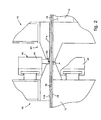
- an apparatus 10 to cut to size sheets of glass 11 comprises a frame 12 provided with a supporting plane 13 and a tilting bench 14 pivoting with respect to the frame 12 at a pivoting point P.
- the sheet of glass 11 is of the type formed by a layer of transparent plastic material 15, such as for example PVB or suchlike, located between an upper layer of glass 16 and a lower layer of glass 17.
- a layer of transparent plastic material 15 such as for example PVB or suchlike
- the thickness of the layer of plastic material 15 is between 0.38 mm and 4.56 mm, while the thickness of each layer of glass 16 and 17 is between about 3 mm and about 8 mm.
- the frame 12 comprises a cutting device 18, of a substantially known type, provided with two incision heads 20 and 21, each one able to support a relative cutting tool 22 and 23.
- the incision heads 20 and 21 are able to slide transversely with respect to the supporting plane 13 and are arranged so that the relative cutting tools 22 and 23 lie on a single vertical plane and act on respective outer surfaces of the two layers of glass 16 and 17, so as to define a first part 11a and a second part 11b of the sheet of glass 11.
- a cutting tool 26 (fig. 5) is also associated with the cutting device 18 and comprises, for example, a blade, a cutting disk or suchlike, able to cut the central layer of plastic material 15 in order to completely separate the first part 11a from the second part 11b of the sheet of glass 11.
- the frame 12 also comprises clamping means 19 (fig. 1), of a substantially known type, such as for example a vice, a gripper or otherwise, which are able to temporarily clamp the second part 11b against the supporting plane 13 and prevent any movement thereof during the steps to cut the sheet of glass 11.
- clamping means 19 of a substantially known type, such as for example a vice, a gripper or otherwise, which are able to temporarily clamp the second part 11b against the supporting plane 13 and prevent any movement thereof during the steps to cut the sheet of glass 11.
- Movement means of a known type and not shown in the drawings, can be provided to move the sheet of glass 11 with respect to the supporting plane 13, so as to be able to determine precisely the point where to make the incisions.
- the tilting bench 14 comprises a gripper 24, able to be selectively actuated to clamp the first part 11a during some of the steps of the cutting operations.
- the pivoting point P (fig. 2) is arranged below the supporting plane 13 and in axis with respect to the vertical plane on which the cut is performed.
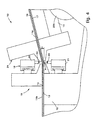
- the upward rotation of the bench 14 leads not only to a detachment of the two parts 11a and 11b in correspondence with the layers of glass 16 and 17, but also a translation, in this case towards the right, of the first part 11a, since, as shown in fig. 4, the upper edge of the first part 11a rests during the rotation on the second part 11b, causing a backward movement of the first part 11a by some millimeters.
- Both the bench 14, the gripper 24, the cutting device 18 and the mechanical-type cutting tool 26 are automatically coordinated with each other by means of an electronic command and control unit, of a known type and not shown in the drawings.
- the apparatus 10 as described heretofore functions as follows.
- the clamping means 19 are activated. Then the transverse incision is made on the outer surfaces of the layers of glass 16 and 17, by means of the cutting tools 22 and 23.
- the sheet of glass 11 is cut transversely, inclining the bench 14 upwards by an angle ⁇ (fig. 4).
- the two parts 11a and 11b are separated in correspondence with the layer of glass 17 and remain attached in correspondence with the layer of glass 16 and with the layer of plastic material 15, the latter, being at least partly elastic, does not break.
- the first part 11a not only rotates together with the bench 14, but also makes a minimum and simultaneous translation towards the right, since the second part 11b, held stationary by the clamping means 19, thrusts relatively the first part 11a in that direction. This double movement occurs also because it is possible to exploit the elasticity of the layer of plastic material 15.
- the electromechanical device 25 is activated, which rotates the bench 14 by an angle ⁇ (fig. 5), of an amplitude substantially double and in the opposite direction with respect to the angle ⁇ , so as to cause the separation of the two parts 11a and 11b also in correspondence with the layer of glass 16.
- the bench 14 is returned to the initial position, the gripper 24 is opened, the clamping means 19 are de-activated, and the first part 11a is discharged in a substantially known manner.
Landscapes
- Chemical & Material Sciences (AREA)
- Engineering & Computer Science (AREA)
- Materials Engineering (AREA)
- Organic Chemistry (AREA)
- Joining Of Glass To Other Materials (AREA)
- Re-Forming, After-Treatment, Cutting And Transporting Of Glass Products (AREA)
Abstract
Description
- a first step wherein, after positioning the sheet of glass on a supporting plane, on the outer surfaces of the two layers of glass respective incisions are made by means of incision means, so as to define a first and a second part of the sheet of glass;
- a second step, wherein said first part is rotated in a first direction of rotation, by a determinate first angle by means of inclination means, rotating around a pivoting point lying below said supporting plane, so as to incline the first part with respect to the second part of the sheet of glass, and simultaneously translate it linearly downwards in order to cut by tearing a first of the two layers of glass; and
- a third step wherein a gripper, associated with inclination means, holds the first part while said inclination means are rotated around the pivoting point, in the opposite direction to the first direction of rotation, so as to cut by tearing a second of the two layers of glass and distance the two parts from each other so as to allow cutting means to be inserted into the fissure that has been created, in order to cut the layer of plastic material mechanically.
- fig. 1 is a side view of an apparatus to cut sheets of glass according to the present invention;
- fig. 2 is an enlarged detail of fig. 1;
- fig. 3 shows a first operating step of the apparatus in fig. 1;
- fig. 4 shows a second operating step of the apparatus in fig. 1;
- fig. 5 shows a third operating step of the apparatus in fig. 1.
Claims (9)
- Method to cut into at least two parts laminated sheets of glass (11) having an inner layer of plastic material (15) located between two outer layers of glass (16, 17), said method comprising a first step wherein, after positioning at least one part of said sheet of glass (11) on a supporting plane (13), on the outer surfaces of said two layers of glass (16, 17) respective incisions are made by means of incision means (18), so as to define a first part (11a) and a second part (11b) of said sheet of glass (11), characterized in that a second step is provided wherein said first part (11a) is rotated in a first direction of rotation by means of inclination means (14) rotating around a pivoting point (P) lying below said supporting plane (13), so as to incline said first part (11a) with respect to said second part (11b) and simultaneously to allow the downward translation of said first part (11a) in order to cut by tearing a first of said two layers of glass (16, 17), and a third step wherein gripping means (24), associated with said inclination means (14), hold said first part (11a) while said inclination means (14) are rotated around said pivoting point (P) in an opposite direction to said first direction of rotation, so as to cut by tearing a second of said layers of glass (17, 16) and to progressively distance said two parts (11a, 11b) from each other and allow cutting means (26) of a mechanical type to be inserted between them, able to cut said layer of plastic material (15).
- Method as in claim 1, characterized in that it comprises a fourth step, wherein said inclination means (14) are repositioned in their initial position and said first part (11a) is discharged by means of discharge means.
- Method as in claim 1, characterized in that said cutting means (26) of a mechanical type comprise a cutting disk, a blade, a shears or suchlike.
- Apparatus to cut into at least two parts laminated sheets of glass (11) having an inner layer of plastic material (15) located between two outer layers of glass (16, 17), said apparatus comprising a frame (12) provided with a supporting plane (13) on which said sheet of glass (11) is able to be at least partly arranged, and on which first incision means (18) are mounted able to cut the outer surfaces of said two layers of glass (16, 17), and inclination means (14) pivoted to said frame (12) at a pivoting point (P) and able to incline a first part (11a) of said sheet of glass (11) with respect to a second part (11b) of said sheet of glass (11), first in one direction and then in the other, so as to cut by tearing said two layers of glass (16, 17) along the plane on which said incisions lie, characterized in that said pivoting point (P) between said inclination means (14) and said frame (12) is arranged below said supporting plane (13), so that the two rotations effected by said inclination means (14) around said pivoting point (P) allow to progressively distance said first part (11a) from said second part (11b) in order to permit cutting means (26), of a mechanical type, to be inserted between said two parts (11a, 11b) in order to cut said layer of plastic material (15).
- Apparatus as in claim 4, characterized in that said inclination means (14) comprise gripping means (24) able to at least temporarily hold said first part (11a) during the second rotation of said inclination means (14).
- Apparatus as in claim 4, characterized in that said incision means (18) comprise incision heads (20, 21) able to slide transversely with respect to said supporting plane (13) and arranged on opposite sides with respect to said sheet of glass (11), and able to support relative cutting tools (22, 23).
- Apparatus as in claim 6, characterized in that said cutting tools (22, 23) lie on a single vertical plane and are able to act on said outer surfaces of said layers of glass (16, 17).
- Apparatus as in claim 4, characterized in that said cutting means (26) comprise a cutting disk, a blade, a shears or suchlike, mounted on said incision means (18).
- Apparatus as in any claim from 4 to 8 inclusive, characterized in that it comprises a command and control unit able to automatically coordinate said inclination means (14), said gripping means (24) and said incision means (18).
Applications Claiming Priority (2)
| Application Number | Priority Date | Filing Date | Title |
|---|---|---|---|
| ITUD20020255 | 2002-12-05 | ||
| IT000255A ITUD20020255A1 (en) | 2002-12-05 | 2002-12-05 | EQUIPMENT FOR CUTTING GLASS SHEETS |
Publications (2)
| Publication Number | Publication Date |
|---|---|
| EP1426338A2 true EP1426338A2 (en) | 2004-06-09 |
| EP1426338A3 EP1426338A3 (en) | 2004-07-28 |
Family
ID=32310211
Family Applications (1)
| Application Number | Title | Priority Date | Filing Date |
|---|---|---|---|
| EP03104547A Withdrawn EP1426338A3 (en) | 2002-12-05 | 2003-12-04 | Method and apparatus for cutting laminated sheets of glass |
Country Status (2)
| Country | Link |
|---|---|
| EP (1) | EP1426338A3 (en) |
| IT (1) | ITUD20020255A1 (en) |
Cited By (3)
| Publication number | Priority date | Publication date | Assignee | Title |
|---|---|---|---|---|
| ITMI20110285A1 (en) * | 2011-02-25 | 2012-08-26 | Macotec S R L | MACHINE FOR CUTTING GLASS SLABS IN GENERAL AND IN PART OF LAYERED GLASS SHEETS. |
| CN108996900A (en) * | 2018-07-09 | 2018-12-14 | 郑玉清 | A kind of conveniently Auto Glasscutter |
| CN112592045A (en) * | 2020-12-04 | 2021-04-02 | 湖南永盛玻璃工艺有限公司 | Cutting device for production of coated glass |
Family Cites Families (3)
| Publication number | Priority date | Publication date | Assignee | Title |
|---|---|---|---|---|
| AT403908B (en) * | 1994-07-04 | 1998-06-25 | Lisec Peter | ARRANGEMENT FOR DIVIDING COMPOSITE GLASS |
| AT408652B (en) * | 1999-04-13 | 2002-02-25 | Lisec Peter | DEVICE FOR DIVIDING COMPOSITE GLASS |
| AT407873B (en) * | 1999-12-13 | 2001-07-25 | Lisec Peter | METHOD AND DEVICE FOR CUTTING FILMS IN COMPOSITE GLASS |
-
2002
- 2002-12-05 IT IT000255A patent/ITUD20020255A1/en unknown
-
2003
- 2003-12-04 EP EP03104547A patent/EP1426338A3/en not_active Withdrawn
Cited By (5)
| Publication number | Priority date | Publication date | Assignee | Title |
|---|---|---|---|---|
| ITMI20110285A1 (en) * | 2011-02-25 | 2012-08-26 | Macotec S R L | MACHINE FOR CUTTING GLASS SLABS IN GENERAL AND IN PART OF LAYERED GLASS SHEETS. |
| EP2492245A1 (en) * | 2011-02-25 | 2012-08-29 | Macotec S.R.L. | Machine for cutting glass sheets in general and laminated glass sheets in particular |
| CN108996900A (en) * | 2018-07-09 | 2018-12-14 | 郑玉清 | A kind of conveniently Auto Glasscutter |
| CN112592045A (en) * | 2020-12-04 | 2021-04-02 | 湖南永盛玻璃工艺有限公司 | Cutting device for production of coated glass |
| CN112592045B (en) * | 2020-12-04 | 2022-09-09 | 山东省强风玻璃有限公司 | Cutting device for production of coated glass |
Also Published As
| Publication number | Publication date |
|---|---|
| ITUD20020255A1 (en) | 2004-06-06 |
| EP1426338A3 (en) | 2004-07-28 |
Similar Documents
| Publication | Publication Date | Title |
|---|---|---|
| JP3317644B2 (en) | Method and apparatus for cutting edge of interlayer film sandwiched between glass sheets | |
| EP2100860A2 (en) | Machine for cutting glass sheets in general and laminated glass sheets in particular | |
| US4879933A (en) | Automatic device for trimming sheets of laminated material | |
| EP2316797B1 (en) | Machine and method for performing cutting operations on a multi-layered glass sheet along a predermined path | |
| CN106660173A (en) | Device For Connecting Strip Ends Of Steel Strips | |
| KR20140024964A (en) | Method and device for producing edge cutouts in sheet glass | |
| EP1426338A2 (en) | Method and apparatus for cutting laminated sheets of glass | |
| CN205473369U (en) | Banded glass cutting device | |
| EP1975131B1 (en) | Machine for cutting sheets of glass in general, and laminated glass in particular, with automatic positioning means | |
| US20050103055A1 (en) | Device and method for dividing vertical glass plates | |
| US4487350A (en) | Method and apparatus for cutting pattern shaped holes in glass sheets | |
| CN104487212B (en) | For cut plastic material, be specifically laminated glazing element device and method | |
| CN112846552A (en) | Laser cutting and welding integrated knife and scissors manufacturing equipment | |
| CA2162917A1 (en) | Device, clamping tool and process for breaking away cuttings when cutting out blanks from cardboard | |
| CN111747639A (en) | Cutting device and cutting system for brittle material substrate | |
| CN111747640A (en) | Curved substrate scribing device and cutting system | |
| CN112872635B (en) | Method for manufacturing cutter scissors integrating laser cutting and welding | |
| EP0835847B1 (en) | Machine for cutting laminated glass plates | |
| KR102741504B1 (en) | Dust cover and its molding apparatus | |
| EP3034478B1 (en) | Apparatus for treating the surface of sheet elements, such as glass sheets | |
| JP2018065705A (en) | Method and apparatus for cutting glass plate | |
| EP4112571B1 (en) | Automatic cutting method, particularly for laminated glass panes and related machine | |
| EP4368588B1 (en) | System for breaking laminated glass plates | |
| EP1473283A2 (en) | Glass sheet cutting method | |
| US2139708A (en) | Method of and apparatus for separating laminated sheets |
Legal Events
| Date | Code | Title | Description |
|---|---|---|---|
| PUAI | Public reference made under article 153(3) epc to a published international application that has entered the european phase |
Free format text: ORIGINAL CODE: 0009012 |
|
| AK | Designated contracting states |
Kind code of ref document: A2 Designated state(s): AT BE BG CH CY CZ DE DK EE ES FI FR GB GR HU IE IT LI LU MC NL PT RO SE SI SK TR |
|
| AX | Request for extension of the european patent |
Extension state: AL LT LV MK |
|
| PUAL | Search report despatched |
Free format text: ORIGINAL CODE: 0009013 |
|
| AK | Designated contracting states |
Kind code of ref document: A3 Designated state(s): AT BE BG CH CY CZ DE DK EE ES FI FR GB GR HU IE IT LI LU MC NL PT RO SE SI SK TR |
|
| AX | Request for extension of the european patent |
Extension state: AL LT LV MK |
|
| GRAP | Despatch of communication of intention to grant a patent |
Free format text: ORIGINAL CODE: EPIDOSNIGR1 |
|
| 17P | Request for examination filed |
Effective date: 20050127 |
|
| AKX | Designation fees paid |
Designated state(s): AT BE BG CH CY CZ DE DK EE ES FI FR GB GR HU IE IT LI LU MC NL PT RO SE SI SK TR |
|
| STAA | Information on the status of an ep patent application or granted ep patent |
Free format text: STATUS: THE APPLICATION IS DEEMED TO BE WITHDRAWN |
|
| 18D | Application deemed to be withdrawn |
Effective date: 20050720 |