EP1426511A1 - Vorrichtung zur Schallabsorption - Google Patents
Vorrichtung zur Schallabsorption Download PDFInfo
- Publication number
- EP1426511A1 EP1426511A1 EP03026917A EP03026917A EP1426511A1 EP 1426511 A1 EP1426511 A1 EP 1426511A1 EP 03026917 A EP03026917 A EP 03026917A EP 03026917 A EP03026917 A EP 03026917A EP 1426511 A1 EP1426511 A1 EP 1426511A1
- Authority
- EP
- European Patent Office
- Prior art keywords
- cylinder
- cover
- glass fibers
- coating
- sound absorbing
- Prior art date
- Legal status (The legal status is an assumption and is not a legal conclusion. Google has not performed a legal analysis and makes no representation as to the accuracy of the status listed.)
- Granted
Links
Images

Classifications
-
- G—PHYSICS
- G10—MUSICAL INSTRUMENTS; ACOUSTICS
- G10K—SOUND-PRODUCING DEVICES; METHODS OR DEVICES FOR PROTECTING AGAINST, OR FOR DAMPING, NOISE OR OTHER ACOUSTIC WAVES IN GENERAL; ACOUSTICS NOT OTHERWISE PROVIDED FOR
- G10K11/00—Methods or devices for transmitting, conducting or directing sound in general; Methods or devices for protecting against, or for damping, noise or other acoustic waves in general
- G10K11/16—Methods or devices for protecting against, or for damping, noise or other acoustic waves in general
- G10K11/162—Selection of materials
Definitions
- the invention relates to a device for sound absorption with a coating for sound absorbing material.
- Such devices are used for sound absorption, for example in workshops, dining rooms, swimming pools, public buildings etc. used to lower the sound level. You will be on the wall or Ceiling areas of such rooms arranged. Even in low-reflection rooms such devices used.
- a device known from practice has a sound-absorbing material in Form a cylinder and is covered with a coating.
- the coating serves contamination (dusting, sticking, etc.) of the sound absorbing material to prevent, as this would reduce the sound absorption capacity.
- the coating also serves to prevent the sound absorbing material from leaking.
- the cover consists of a textile fabric made of polyethylene terephthalate. This Coating has the advantage that it is flame retardant (in the sense of DIN 4102) that the device for sound absorption hardly poses a fire risk or is increased.
- the object of the present invention is to provide a device for sound absorption create, which completely avoid a possibly still existing risk with regard to fire danger should.
- the task is performed by a device for sound absorption with the features of Claim 1 and a coating with the features of claim 11 solved.
- the device and the coating are characterized in that the coating is made of glass fibers includes.
- Such glass fibers are not flammable.
- mineral fibers for example in the form of mineral fiber shells, come into consideration, which are also non-flammable.
- non-flammable refers to the DIN 4,102th
- the covering consists essentially of glass fibers or entirely from glass fibers.
- the glass fibers are advantageously processed into a textile, for example in the form of a warp knitting, which preferably on a double-contour Warp knitting machine is manufactured.
- the warp knitting (the one in the glass A relatively low thread tension is required compared to usual tensions) seamless manufacture of a hose.
- About 50 to 200 glass fibers are preferably used for this combined into a preferably about 0.1 to 0.7, preferably 0.5 mm thick thread, from which the textile is then made.
- the coating advantageously has the shape of a tube wrapped around a cylindrical sound absorbing Body is hammered in at the ends. At the ends of the cylinder can cover be provided which the sound absorbing material and preferably also the Keep cover.
- the glass fibers are preferably made of E-glass. This E-glass is for use suitable and quite inexpensive. You preferably have one Fiber diameter between 1 and 15 microns, but preferably greater than 3 microns and preferably around 10 ⁇ m. Fibers that are larger than 3 ⁇ m in diameter have are generally referred to as non-respiratory, so from abrasion the coating does not pose any health risks.
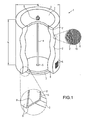
- Figure 1 shows a device 1 for sound absorption, cut open on its front is shown in order to better explain the structure of the device.
- the sound absorbing material 2 has the shape of a cylinder and is not made of flammable mineral fibers.
- the cylinder can consist of one, two or several shell parts manufactured or put together or put together his.
- the sound absorbing material is covered with a coating 6, which is the outside of the cylinder covered. As shown in the magnifying glass below, the Cover 6 folded over the lower end 8 of the cylinder, thus covering the lower End 8 of the cylinder as well as a small part of the inside of the cylinder. A corresponding arrangement can also be provided at the upper end of the cylinder his.
- the magnifying glass on the right shows that the sound-absorbing material is composed of mineral fibers and how the coating 6 is applied thereon.
- a cover 3 is arranged, respectively has a flange which rests on the ends 7, 8 of the cylinder. As in the lower magnifying glass to recognize, he also detects the tissue 6 on the lower end 8 of the cylinder.
- the two lids 3 each have a stepped surface on their to the cylinder-facing side so that the cover 3 slides with respect to the cylinder is prevented.
- the lid 3 still have an opening in their center 5, through which a rod 6 passes as a central suspension.
- the rod 4 or the entire rod 4 are formed threads, so that the cover 3 with corresponding nuts, which are screwed onto the thread, pulled together can be.
- the cover 3 are pressed onto the cylinder and so hold the cylinder and also the tissue 6.
- the rod 4 is above the Cover 3 slightly out. This makes it possible to attach the device 1 to the protruding parts Hang up or fasten ends.
- the rod 4 thus serves as a central suspension the device 1.
- Both the cover 3 and the rod 4 and the nut are made of non-flammable Materials made.
- the lids are made of galvanized sheet steel, for example is powder coated.
- the threaded rod 4 and the nut is also out galvanized metal.
- the cover 6 is made of E-glass.
- E-glass contains only a small amount of alkali and is composed as follows: SiO 2 53 - 57% Na 2 O and K 2 O ⁇ 1% CaO and MgO 22-26% B 2 O 3 5 - 8% Al 2 O 3 12-15% TiO 2 0 - 3% F 2 0 - 0.6% Fe 2 O 3 0 - 0.5%
- the material has the following composition: Al 2 O 3 12 - 16% CaO 16 - 25% B 2 O 3 5-10% K 2 O and Na 2 O 0 - 2% MgO 0 - 5% SiO 2 52 - 56% TiO 2 0 - 0.8% F 2 0 - 1% Fe 2 O 3 0.05 - 0.4%
- the glass fibers have sizes from various chemical components , which usually consist of polymers with a high molecular weight. Such sizes make up no more than 2% by weight in the case of glass fibers. out. In these dosages, they are irrelevant to the flammability of the material.
- the diameter of the glass fiber is usually between 1 and 15 ⁇ m and is preferred larger than 3 ⁇ m, so that the glass fibers are not respirable.
- the glass fibers have a diameter of 10 microns. This ensures good stability with good processability, i.e. flexibility of the glass fibers without breaking them.
- the glass fibers are preferably processed into a warp knitted fabric, such as this is shown schematically in Figure 2.
- Several glass fibers (approx. 50 to 200) here form a thread 10.
- Any warp knitted fabrics other than that shown in FIG. 2 are possible. For example, fringes or underlays are possible, to improve tensile stability in different directions.
- the stitches 9, as shown in Figure 2 preferably have an order of magnitude of a few millimeters, i.e. the dimensions a and b lie between 2 and 5, preferably around 4 mm.
- the thread size is preferably between 0.1 and 0.7 mm.
- a thread thickness of 0.5 mm is preferred.
- the textile is preferably cross wound. This allows it to be the different optical Color requirements can be adjusted depending on the intended use.
- a coating 6 is shown, as it is used to manufacture the device for sound absorption 1.
- the hose has a length l 2 and a diameter d 2 .
- the hose is seamless.
- the apparatus shown in Figure 1 is shown greatly shortened in its length L1.
- the length l 1 can be in the range of meters and is preferably around 1.5 m.
- the diameter d 1 is usually about several decimeters and is preferably about 2 to 3 dm.
Landscapes
- Physics & Mathematics (AREA)
- Engineering & Computer Science (AREA)
- Acoustics & Sound (AREA)
- Multimedia (AREA)
- Soundproofing, Sound Blocking, And Sound Damping (AREA)
- Knitting Of Fabric (AREA)
- Pipe Accessories (AREA)
- Chemical Or Physical Treatment Of Fibers (AREA)
- Building Environments (AREA)
- Nonwoven Fabrics (AREA)
- Exhaust Silencers (AREA)
Abstract
Description
- Figur 1
- eine schematische dreidimensionale Darstellung einer erfindungsgemäßen Vorrichtung,
- Figur 2
- eine schematische Darstellung eines Kettengewirks,
- Figur 3
- eine dreidimensionale schematische Darstellung eines Schlauchs aus der Textilie.
| SiO2 | 53 - 57 % |
| Na2O und K2O | < 1 % |
| CaO und MgO | 22 - 26 % |
| B2O3 | 5 - 8 % |
| Al2O3 | 12-15% |
| TiO2 | 0 - 3 % |
| F2 | 0 - 0,6% |
| Fe2O3 | 0 - 0,5% |
| Al2O3 | 12 - 16 % |
| CaO | 16 - 25 % |
| B2O3 | 5-10% |
| K2O und Na2O | 0 - 2 % |
| MgO | 0 - 5 % |
| SiO2 | 52 - 56 % |
| TiO2 | 0 - 0,8% |
| F2 | 0 - 1 % |
| Fe2O3 | 0,05 - 0,4 % |
Claims (11)
- Vorrichtung zur Schallabsorption mit einem Überzug für schallabsorbierendes Material
dadurch gekennzeichnet, dass
der Überzug (6) Glasfasern umfasst. - Vorrichtung nach Anspruch 1
dadurch gekennzeichnet, dass
der Überzug (6) im Wesentlichen oder gänzlich aus Glasfasern besteht - Vorrichtung nach Anspruch 1 oder 2
dadurch gekennzeichnet, dass
die Glasfasern zu einem Textil verarbeitet, beispielsweise gewirkt oder gewebt, sind. - Vorrichtung nach Anspruch 3
dadurch gekennzeichnet, dass
Maschen (9) des Textils eine Größe von etwa 2 mm bis 5 mm haben, vorzugsweise etwa 4 mm. - Vorrichtung nach einem der Ansprüche 1 bis 4
dadurch gekennzeichnet, dass
der Überzug (6) die Form eines Schlauchs hat. - Vorrichtung nach einem der Ansprüche 1 bis 5
dadurch gekennzeichnet, dass
die Glasfasern aus E-Glas hergestellt sind. - Vorrichtung nach einem der Ansprüche 1 bis 6
dadurch gekennzeichnet, dass
der Faserdurchmesser zwischen 1 µm und 15 µm, vorzugsweise größer als 3 µm und besonders bevorzugt um etwa 10 µm, liegt. - Vorrichtung nach einem der Ansprüche 1 bis 7
dadurch gekennzeichnet, dass
das schallabsorbierende Material (2) die Form eines Zylinders hat und der Überzug (6) die Außenseite des Zylinders überdeckt. - Vorrichtung nach Anspruch 8
dadurch gekennzeichnet, dass
der Überzug (6) um die Enden (7, 8) des Zylinders zur Innenseite des Zylinders umgeschlagen ist. - Vorrichtung nach einem der Ansprüche 7 oder 8
dadurch gekennzeichnet, dass
an den Enden (7, 8) des Zylinders Deckel (3) zur Halterung des Zylinders und vorzugsweise des Überzugs (6) vorgesehen sind, die vorzugsweise in ihrer jeweiligen Mitte Öffnungen (5) für eine zentrale Aufhängung (4) aufweisen, so dass die zentrale Aufhängung (4) die Deckel (3) gegen die Enden des Zylinders (7,8) zieht. - Überzug für schallabsorbierendes Material
dadurch gekennzeichnet, dass
der Überzug (6) Glasfasern umfasst.
Applications Claiming Priority (2)
| Application Number | Priority Date | Filing Date | Title |
|---|---|---|---|
| DE20218251U DE20218251U1 (de) | 2002-11-25 | 2002-11-25 | Vorrichtung zur Schallabsorption |
| DE20218251U | 2002-11-25 |
Publications (2)
| Publication Number | Publication Date |
|---|---|
| EP1426511A1 true EP1426511A1 (de) | 2004-06-09 |
| EP1426511B1 EP1426511B1 (de) | 2006-06-21 |
Family
ID=7977325
Family Applications (1)
| Application Number | Title | Priority Date | Filing Date |
|---|---|---|---|
| EP03026917A Expired - Lifetime EP1426511B1 (de) | 2002-11-25 | 2003-11-24 | Vorrichtung zur Schallabsorption |
Country Status (3)
| Country | Link |
|---|---|
| EP (1) | EP1426511B1 (de) |
| AT (1) | ATE331095T1 (de) |
| DE (2) | DE20218251U1 (de) |
Cited By (4)
| Publication number | Priority date | Publication date | Assignee | Title |
|---|---|---|---|---|
| RU2325489C1 (ru) * | 2006-09-15 | 2008-05-27 | Олег Савельевич Кочетов | Резонансный звукопоглотитель |
| RU2327842C1 (ru) * | 2006-09-15 | 2008-06-27 | Олег Савельевич Кочетов | Штучный звукопоглотитель |
| DE202007013579U1 (de) * | 2007-09-28 | 2009-02-26 | Pinta Acoustic Gmbh | Schallabsorberelement |
| WO2015117176A1 (de) | 2014-02-04 | 2015-08-13 | Dorolti Vasile Lic | Schallabsorber |
Citations (4)
| Publication number | Priority date | Publication date | Assignee | Title |
|---|---|---|---|---|
| CH597453A5 (en) * | 1974-09-23 | 1978-04-14 | Nolco Bv | Sound absorbent ceiling plate |
| DE3144193A1 (de) * | 1981-11-06 | 1983-05-19 | Grünzweig + Hartmann und Glasfaser AG, 6700 Ludwigshafen | Schallabsorbierender koerper, insbesondere fuer einen einbau in schalldaempfer |
| DE3721972C1 (en) * | 1987-07-03 | 1988-09-29 | Werner Braun | Structural element which is in the form of a slab and is intended for soundproofing |
| EP0953736A2 (de) * | 1998-05-01 | 1999-11-03 | Johannes Ulrich Goertz | Schalldämpfereinsatz und Verfahren zu dessen Herstellung |
-
2002
- 2002-11-25 DE DE20218251U patent/DE20218251U1/de not_active Expired - Lifetime
-
2003
- 2003-11-24 AT AT03026917T patent/ATE331095T1/de not_active IP Right Cessation
- 2003-11-24 EP EP03026917A patent/EP1426511B1/de not_active Expired - Lifetime
- 2003-11-24 DE DE50303931T patent/DE50303931D1/de not_active Expired - Lifetime
Patent Citations (4)
| Publication number | Priority date | Publication date | Assignee | Title |
|---|---|---|---|---|
| CH597453A5 (en) * | 1974-09-23 | 1978-04-14 | Nolco Bv | Sound absorbent ceiling plate |
| DE3144193A1 (de) * | 1981-11-06 | 1983-05-19 | Grünzweig + Hartmann und Glasfaser AG, 6700 Ludwigshafen | Schallabsorbierender koerper, insbesondere fuer einen einbau in schalldaempfer |
| DE3721972C1 (en) * | 1987-07-03 | 1988-09-29 | Werner Braun | Structural element which is in the form of a slab and is intended for soundproofing |
| EP0953736A2 (de) * | 1998-05-01 | 1999-11-03 | Johannes Ulrich Goertz | Schalldämpfereinsatz und Verfahren zu dessen Herstellung |
Cited By (4)
| Publication number | Priority date | Publication date | Assignee | Title |
|---|---|---|---|---|
| RU2325489C1 (ru) * | 2006-09-15 | 2008-05-27 | Олег Савельевич Кочетов | Резонансный звукопоглотитель |
| RU2327842C1 (ru) * | 2006-09-15 | 2008-06-27 | Олег Савельевич Кочетов | Штучный звукопоглотитель |
| DE202007013579U1 (de) * | 2007-09-28 | 2009-02-26 | Pinta Acoustic Gmbh | Schallabsorberelement |
| WO2015117176A1 (de) | 2014-02-04 | 2015-08-13 | Dorolti Vasile Lic | Schallabsorber |
Also Published As
| Publication number | Publication date |
|---|---|
| DE50303931D1 (de) | 2006-08-03 |
| ATE331095T1 (de) | 2006-07-15 |
| EP1426511B1 (de) | 2006-06-21 |
| DE20218251U1 (de) | 2003-01-30 |
Similar Documents
| Publication | Publication Date | Title |
|---|---|---|
| DE69308994T2 (de) | Verfahren und Vorrichtung zur Herstellung eines Verbundgarn | |
| DE102010044161B3 (de) | Brandschutzelemente | |
| DE102011057150A1 (de) | Faden und Gewebe für Insektenschutzgitter | |
| DE202012100837U1 (de) | Gewebe mit Changeant-Effekt | |
| DE60314551T2 (de) | Verfahren zur Wärmedämung | |
| DE2403751B2 (de) | Verfahren zur Erhöhung der Zementbeständigkeit von Glasprodukten, insbesondere von Glasfasern, die als Zuschlagstoff für Zement dienen | |
| EP1426511B1 (de) | Vorrichtung zur Schallabsorption | |
| EP0067237B1 (de) | Armierung in Form eines kunststoffüberzogenen Fadengitters | |
| DE69910855T2 (de) | Leichtes und abriebfestes Geflecht | |
| DE102004048584B4 (de) | Wärmedämmverbundsystem und Verwendung einer Außenunterputzzubereitung | |
| WO2019224038A1 (de) | Bewehrungsstab mit alkaliresistentem mantel | |
| DE3144193A1 (de) | Schallabsorbierender koerper, insbesondere fuer einen einbau in schalldaempfer | |
| DE2735371A1 (de) | Verfahren zum herstellen von koerpern aus einem fasergemisch | |
| DE2933689A1 (de) | Polyolefinfasern oder -faeden, ein verfahren zu deren herstellung und bauelemente | |
| WO2010079210A1 (de) | Insektenschutzgewebe | |
| EP0047795A2 (de) | Elektrostatisch ersponnene Faser aus einem polymeren Werkstoff | |
| EP2605903B1 (de) | Brandwiderstandsfähiges bauteil und verfahren zur herstellung des bauteils | |
| EP2157063B1 (de) | Akustikputz | |
| DE2005219A1 (en) | Fire resistant gfr plasterboard | |
| DE2932473C2 (de) | Schallabsorbierender Körper mit einem Basisteil aus Mineralfasern | |
| DE102016209244A1 (de) | Verfahren zur Herstellung eines Garnes, Verfahren zur Herstellung eines Vlieses und Vlies | |
| DE10061839B4 (de) | Armierungsmatte und deren Verwendung | |
| CH676576A5 (de) | ||
| DE19800725C2 (de) | Faserverbund in Strangform und Verfahren und Vorrichtung zu seiner Herstellung | |
| DE2014602C3 (de) | Winkel- oder bogenförmiger Mastenausleger |
Legal Events
| Date | Code | Title | Description |
|---|---|---|---|
| PUAI | Public reference made under article 153(3) epc to a published international application that has entered the european phase |
Free format text: ORIGINAL CODE: 0009012 |
|
| AK | Designated contracting states |
Kind code of ref document: A1 Designated state(s): AT BE BG CH CY CZ DE DK EE ES FI FR GB GR HU IE IT LI LU MC NL PT RO SE SI SK TR |
|
| AX | Request for extension of the european patent |
Extension state: AL LT LV MK |
|
| 17P | Request for examination filed |
Effective date: 20041202 |
|
| AKX | Designation fees paid |
Designated state(s): AT BE BG CH CY CZ DE DK EE ES FI FR GB GR HU IE IT LI LU MC NL PT RO SE SI SK TR |
|
| 17Q | First examination report despatched |
Effective date: 20050414 |
|
| GRAP | Despatch of communication of intention to grant a patent |
Free format text: ORIGINAL CODE: EPIDOSNIGR1 |
|
| GRAS | Grant fee paid |
Free format text: ORIGINAL CODE: EPIDOSNIGR3 |
|
| GRAA | (expected) grant |
Free format text: ORIGINAL CODE: 0009210 |
|
| AK | Designated contracting states |
Kind code of ref document: B1 Designated state(s): AT BE BG CH CY CZ DE DK EE ES FI FR GB GR HU IE IT LI LU MC NL PT RO SE SI SK TR |
|
| PG25 | Lapsed in a contracting state [announced via postgrant information from national office to epo] |
Ref country code: CZ Free format text: LAPSE BECAUSE OF FAILURE TO SUBMIT A TRANSLATION OF THE DESCRIPTION OR TO PAY THE FEE WITHIN THE PRESCRIBED TIME-LIMIT Effective date: 20060621 Ref country code: IE Free format text: LAPSE BECAUSE OF FAILURE TO SUBMIT A TRANSLATION OF THE DESCRIPTION OR TO PAY THE FEE WITHIN THE PRESCRIBED TIME-LIMIT Effective date: 20060621 Ref country code: GB Free format text: LAPSE BECAUSE OF FAILURE TO SUBMIT A TRANSLATION OF THE DESCRIPTION OR TO PAY THE FEE WITHIN THE PRESCRIBED TIME-LIMIT Effective date: 20060621 Ref country code: FI Free format text: LAPSE BECAUSE OF FAILURE TO SUBMIT A TRANSLATION OF THE DESCRIPTION OR TO PAY THE FEE WITHIN THE PRESCRIBED TIME-LIMIT Effective date: 20060621 Ref country code: IT Free format text: LAPSE BECAUSE OF FAILURE TO SUBMIT A TRANSLATION OF THE DESCRIPTION OR TO PAY THE FEE WITHIN THE PRESCRIBED TIME-LIMIT;WARNING: LAPSES OF ITALIAN PATENTS WITH EFFECTIVE DATE BEFORE 2007 MAY HAVE OCCURRED AT ANY TIME BEFORE 2007. THE CORRECT EFFECTIVE DATE MAY BE DIFFERENT FROM THE ONE RECORDED. Effective date: 20060621 Ref country code: SK Free format text: LAPSE BECAUSE OF FAILURE TO SUBMIT A TRANSLATION OF THE DESCRIPTION OR TO PAY THE FEE WITHIN THE PRESCRIBED TIME-LIMIT Effective date: 20060621 Ref country code: SI Free format text: LAPSE BECAUSE OF FAILURE TO SUBMIT A TRANSLATION OF THE DESCRIPTION OR TO PAY THE FEE WITHIN THE PRESCRIBED TIME-LIMIT Effective date: 20060621 Ref country code: RO Free format text: LAPSE BECAUSE OF FAILURE TO SUBMIT A TRANSLATION OF THE DESCRIPTION OR TO PAY THE FEE WITHIN THE PRESCRIBED TIME-LIMIT Effective date: 20060621 |
|
| REG | Reference to a national code |
Ref country code: GB Ref legal event code: FG4D Free format text: NOT ENGLISH |
|
| REG | Reference to a national code |
Ref country code: CH Ref legal event code: EP |
|
| REG | Reference to a national code |
Ref country code: IE Ref legal event code: FG4D Free format text: LANGUAGE OF EP DOCUMENT: GERMAN |
|
| REF | Corresponds to: |
Ref document number: 50303931 Country of ref document: DE Date of ref document: 20060803 Kind code of ref document: P |
|
| PG25 | Lapsed in a contracting state [announced via postgrant information from national office to epo] |
Ref country code: SE Free format text: LAPSE BECAUSE OF FAILURE TO SUBMIT A TRANSLATION OF THE DESCRIPTION OR TO PAY THE FEE WITHIN THE PRESCRIBED TIME-LIMIT Effective date: 20060921 Ref country code: DK Free format text: LAPSE BECAUSE OF FAILURE TO SUBMIT A TRANSLATION OF THE DESCRIPTION OR TO PAY THE FEE WITHIN THE PRESCRIBED TIME-LIMIT Effective date: 20060921 |
|
| PG25 | Lapsed in a contracting state [announced via postgrant information from national office to epo] |
Ref country code: ES Free format text: LAPSE BECAUSE OF FAILURE TO SUBMIT A TRANSLATION OF THE DESCRIPTION OR TO PAY THE FEE WITHIN THE PRESCRIBED TIME-LIMIT Effective date: 20061002 |
|
| PG25 | Lapsed in a contracting state [announced via postgrant information from national office to epo] |
Ref country code: PT Free format text: LAPSE BECAUSE OF FAILURE TO SUBMIT A TRANSLATION OF THE DESCRIPTION OR TO PAY THE FEE WITHIN THE PRESCRIBED TIME-LIMIT Effective date: 20061121 |
|
| PG25 | Lapsed in a contracting state [announced via postgrant information from national office to epo] |
Ref country code: MC Free format text: LAPSE BECAUSE OF NON-PAYMENT OF DUE FEES Effective date: 20061130 |
|
| GBV | Gb: ep patent (uk) treated as always having been void in accordance with gb section 77(7)/1977 [no translation filed] |
Effective date: 20060621 |
|
| REG | Reference to a national code |
Ref country code: IE Ref legal event code: FD4D |
|
| PLBE | No opposition filed within time limit |
Free format text: ORIGINAL CODE: 0009261 |
|
| STAA | Information on the status of an ep patent application or granted ep patent |
Free format text: STATUS: NO OPPOSITION FILED WITHIN TIME LIMIT |
|
| EN | Fr: translation not filed | ||
| 26N | No opposition filed |
Effective date: 20070322 |
|
| PG25 | Lapsed in a contracting state [announced via postgrant information from national office to epo] |
Ref country code: AT Free format text: LAPSE BECAUSE OF NON-PAYMENT OF DUE FEES Effective date: 20061124 |
|
| PG25 | Lapsed in a contracting state [announced via postgrant information from national office to epo] |
Ref country code: FR Free format text: LAPSE BECAUSE OF FAILURE TO SUBMIT A TRANSLATION OF THE DESCRIPTION OR TO PAY THE FEE WITHIN THE PRESCRIBED TIME-LIMIT Effective date: 20070504 Ref country code: GR Free format text: LAPSE BECAUSE OF FAILURE TO SUBMIT A TRANSLATION OF THE DESCRIPTION OR TO PAY THE FEE WITHIN THE PRESCRIBED TIME-LIMIT Effective date: 20060922 |
|
| PG25 | Lapsed in a contracting state [announced via postgrant information from national office to epo] |
Ref country code: BG Free format text: LAPSE BECAUSE OF FAILURE TO SUBMIT A TRANSLATION OF THE DESCRIPTION OR TO PAY THE FEE WITHIN THE PRESCRIBED TIME-LIMIT Effective date: 20060921 Ref country code: EE Free format text: LAPSE BECAUSE OF FAILURE TO SUBMIT A TRANSLATION OF THE DESCRIPTION OR TO PAY THE FEE WITHIN THE PRESCRIBED TIME-LIMIT Effective date: 20060621 |
|
| PG25 | Lapsed in a contracting state [announced via postgrant information from national office to epo] |
Ref country code: LI Free format text: LAPSE BECAUSE OF NON-PAYMENT OF DUE FEES Effective date: 20071130 Ref country code: TR Free format text: LAPSE BECAUSE OF FAILURE TO SUBMIT A TRANSLATION OF THE DESCRIPTION OR TO PAY THE FEE WITHIN THE PRESCRIBED TIME-LIMIT Effective date: 20060621 Ref country code: CH Free format text: LAPSE BECAUSE OF NON-PAYMENT OF DUE FEES Effective date: 20071130 Ref country code: HU Free format text: LAPSE BECAUSE OF FAILURE TO SUBMIT A TRANSLATION OF THE DESCRIPTION OR TO PAY THE FEE WITHIN THE PRESCRIBED TIME-LIMIT Effective date: 20061222 |
|
| REG | Reference to a national code |
Ref country code: CH Ref legal event code: PL |
|
| PG25 | Lapsed in a contracting state [announced via postgrant information from national office to epo] |
Ref country code: CY Free format text: LAPSE BECAUSE OF FAILURE TO SUBMIT A TRANSLATION OF THE DESCRIPTION OR TO PAY THE FEE WITHIN THE PRESCRIBED TIME-LIMIT Effective date: 20060621 Ref country code: FR Free format text: LAPSE BECAUSE OF FAILURE TO SUBMIT A TRANSLATION OF THE DESCRIPTION OR TO PAY THE FEE WITHIN THE PRESCRIBED TIME-LIMIT Effective date: 20060621 |
|
| PGFP | Annual fee paid to national office [announced via postgrant information from national office to epo] |
Ref country code: LU Payment date: 20151123 Year of fee payment: 13 |
|
| PGFP | Annual fee paid to national office [announced via postgrant information from national office to epo] |
Ref country code: NL Payment date: 20151119 Year of fee payment: 13 Ref country code: BE Payment date: 20151126 Year of fee payment: 13 |
|
| PGFP | Annual fee paid to national office [announced via postgrant information from national office to epo] |
Ref country code: DE Payment date: 20161103 Year of fee payment: 14 |
|
| PG25 | Lapsed in a contracting state [announced via postgrant information from national office to epo] |
Ref country code: BE Free format text: LAPSE BECAUSE OF NON-PAYMENT OF DUE FEES Effective date: 20161130 |
|
| REG | Reference to a national code |
Ref country code: NL Ref legal event code: MM Effective date: 20161201 |
|
| PG25 | Lapsed in a contracting state [announced via postgrant information from national office to epo] |
Ref country code: NL Free format text: LAPSE BECAUSE OF NON-PAYMENT OF DUE FEES Effective date: 20161201 Ref country code: LU Free format text: LAPSE BECAUSE OF NON-PAYMENT OF DUE FEES Effective date: 20161130 |
|
| REG | Reference to a national code |
Ref country code: BE Ref legal event code: MM Effective date: 20161130 |
|
| REG | Reference to a national code |
Ref country code: DE Ref legal event code: R119 Ref document number: 50303931 Country of ref document: DE |
|
| PG25 | Lapsed in a contracting state [announced via postgrant information from national office to epo] |
Ref country code: DE Free format text: LAPSE BECAUSE OF NON-PAYMENT OF DUE FEES Effective date: 20180602 |