EP1428651A1 - Verfahren zur Herstellung eines Antriebsriemens aus elastomerem Werkstoff und Antriebsriemen - Google Patents
Verfahren zur Herstellung eines Antriebsriemens aus elastomerem Werkstoff und Antriebsriemen Download PDFInfo
- Publication number
- EP1428651A1 EP1428651A1 EP02027760A EP02027760A EP1428651A1 EP 1428651 A1 EP1428651 A1 EP 1428651A1 EP 02027760 A EP02027760 A EP 02027760A EP 02027760 A EP02027760 A EP 02027760A EP 1428651 A1 EP1428651 A1 EP 1428651A1
- Authority
- EP
- European Patent Office
- Prior art keywords
- mold
- elastomeric material
- belt
- core
- mold core
- Prior art date
- Legal status (The legal status is an assumption and is not a legal conclusion. Google has not performed a legal analysis and makes no representation as to the accuracy of the status listed.)
- Granted
Links
- 239000013536 elastomeric material Substances 0.000 title claims description 32
- 238000004519 manufacturing process Methods 0.000 title claims description 12
- 239000000463 material Substances 0.000 claims abstract description 38
- 238000000034 method Methods 0.000 claims abstract description 31
- 230000002787 reinforcement Effects 0.000 claims description 23
- 239000000835 fiber Substances 0.000 claims description 22
- 239000000853 adhesive Substances 0.000 claims description 13
- 230000001070 adhesive effect Effects 0.000 claims description 13
- 229920002635 polyurethane Polymers 0.000 claims description 12
- 239000004814 polyurethane Substances 0.000 claims description 12
- 238000004132 cross linking Methods 0.000 claims description 7
- 239000004744 fabric Substances 0.000 claims description 7
- 244000144992 flock Species 0.000 claims description 5
- 238000003825 pressing Methods 0.000 claims description 3
- 238000004804 winding Methods 0.000 claims description 3
- 239000003795 chemical substances by application Substances 0.000 claims description 2
- 238000005520 cutting process Methods 0.000 claims description 2
- 238000002347 injection Methods 0.000 claims description 2
- 239000007924 injection Substances 0.000 claims description 2
- 238000013022 venting Methods 0.000 claims 1
- 229920001971 elastomer Polymers 0.000 abstract description 9
- 239000000806 elastomer Substances 0.000 abstract description 8
- 239000002243 precursor Substances 0.000 abstract 1
- 239000002657 fibrous material Substances 0.000 description 3
- 230000009969 flowable effect Effects 0.000 description 3
- 239000007788 liquid Substances 0.000 description 3
- 239000006082 mold release agent Substances 0.000 description 3
- 239000007921 spray Substances 0.000 description 3
- 238000005299 abrasion Methods 0.000 description 2
- 230000005686 electrostatic field Effects 0.000 description 2
- 239000000945 filler Substances 0.000 description 2
- 239000012528 membrane Substances 0.000 description 2
- 230000006855 networking Effects 0.000 description 2
- 229920000728 polyester Polymers 0.000 description 2
- 239000002994 raw material Substances 0.000 description 2
- 239000012779 reinforcing material Substances 0.000 description 2
- 238000003860 storage Methods 0.000 description 2
- 229920000742 Cotton Polymers 0.000 description 1
- 239000004677 Nylon Substances 0.000 description 1
- 239000004952 Polyamide Substances 0.000 description 1
- 239000004743 Polypropylene Substances 0.000 description 1
- 230000001680 brushing effect Effects 0.000 description 1
- 239000002131 composite material Substances 0.000 description 1
- 150000001875 compounds Chemical class 0.000 description 1
- 238000007796 conventional method Methods 0.000 description 1
- 239000003431 cross linking reagent Substances 0.000 description 1
- 238000007598 dipping method Methods 0.000 description 1
- 238000005516 engineering process Methods 0.000 description 1
- 239000002184 metal Substances 0.000 description 1
- 239000000203 mixture Substances 0.000 description 1
- 238000000465 moulding Methods 0.000 description 1
- 229920001778 nylon Polymers 0.000 description 1
- 229920001084 poly(chloroprene) Polymers 0.000 description 1
- 229920002647 polyamide Polymers 0.000 description 1
- 229920001225 polyester resin Polymers 0.000 description 1
- 229920001228 polyisocyanate Polymers 0.000 description 1
- 239000005056 polyisocyanate Substances 0.000 description 1
- 229920005862 polyol Polymers 0.000 description 1
- 150000003077 polyols Chemical class 0.000 description 1
- -1 polypropylene Polymers 0.000 description 1
- 229920001155 polypropylene Polymers 0.000 description 1
- 229920001296 polysiloxane Polymers 0.000 description 1
- UOULCEYHQNCFFH-UHFFFAOYSA-M sodium;hydroxymethanesulfonate Chemical compound [Na+].OCS([O-])(=O)=O UOULCEYHQNCFFH-UHFFFAOYSA-M 0.000 description 1
- 239000007787 solid Substances 0.000 description 1
- 238000005507 spraying Methods 0.000 description 1
- 239000007858 starting material Substances 0.000 description 1
Images


Classifications
-
- B—PERFORMING OPERATIONS; TRANSPORTING
- B29—WORKING OF PLASTICS; WORKING OF SUBSTANCES IN A PLASTIC STATE IN GENERAL
- B29D—PRODUCING PARTICULAR ARTICLES FROM PLASTICS OR FROM SUBSTANCES IN A PLASTIC STATE
- B29D29/00—Producing belts or bands
- B29D29/08—Toothed driving belts
Definitions
- the invention relates to a method for producing a drive belt from a essentially uncrosslinked or uncured, castable elastomeric state Material with a tension member layer embedded in an elastic base body and with an outer reinforcement, which contains fibers, in a form from a mold core, a cup-shaped molded outer part and an intermediate, the strap blank molding mold cavity.
- the invention further relates to drive belts, in particular Timing belts that are manufactured using such a method.
- toothed belts are made Polyurethane made a layer of high-strength, non-woven fiber material and contain a tension member layer.
- the process initially uses fiber material high-strength nonwoven z. B. made of polyester on the mandrel, then the tension member layer is wound onto the fiber material and the mandrel and outer mold part are brought together.
- the polyurethane in the form of a prepolymer blend (starting products) injected and it is crosslinked under vacuum and cured. Then the Belt blank removed and cut into belts of the desired width.
- US Pat. No. 4,053,547 also describes a method for producing drive belts from a castable elastomeric material when uncrosslinked or not hardened described.
- timing belts z. B. made of polyurethane with a fabric on the Teeth made.
- a stretchable fabric is placed on the mandrel wrapped and with strength members that run along the teeth in the tooth shape of the Mold core pressed with the help of the tension member layer wound over it. After this Bringing together the mold core and the outer mold part is under vacuum and with the help of Centrifugal force of the mold cavity with the uncrosslinked or uncured filled with elastomeric material and the entire composite is cross-linked under vacuum and / or hardened.
- the aforementioned methods from the prior art have in common that the Mold cavity before introducing the uncrosslinked or uncured elastomer Material for a good connection of the material to those in the belt Strength members and fabric and to prevent air and liquid inclusions is evacuated in the belt and the material is filled in under vacuum and under vacuum hardens at least to the extent that the overall shape is stable.
- the invention is based on the object, a further method of manufacture of drive belts from a castable in the uncrosslinked or not hardened state elastomeric material with an embedded in the elastic base body Tension member position and with an external reinforcement to provide that easy to do and which causes the fibrous reinforcement and the reinforcement of the Tension member position are firmly connected to the belt and the belt as few as possible Has air pockets.
- the essential aspect in the method according to the invention is that the shape according to the Applying a vacuum and introducing the uncrosslinked or uncured elastomeric material or from its starting products in the mold cavity again is ventilated before the elastomeric material or its starting products so far is or are cross-linked or cured, that it is no longer flowable and has a viscosity has above 500 Pa * s.
- the mold core within the outer mold part which is cup-shaped in this case, in the cup-shaped outer part of the uncrosslinked or uncured elastomeric material or its raw materials is or are cast, then the mold core within the outer mold part over the Material or its starting products is positioned and the mold cavity after the evacuation by pressing the mold core into the material becomes.
- the filling can by filling devices, for. B. Hoses or sockets made from above or from below.
- the castable elastomeric material in the uncured or uncured state can also introduced into the mold cavity under vacuum using centrifugal forces become.
- the invention can essentially complete crosslinking and / or curing of the elastomeric material under pressure respectively.
- the Pressure can e.g. B. by pressing the outer mold part, increasing the air or Gas pressure in the mold or by rotating the mold and thus building up Centrifugal forces take place.
- rotating the shape however, the shape must be stored accordingly.
- networking is essentially complete and / or The elastomeric material is cured at elevated temperature. curing and / or networking are accelerated in this way and the manufacturing process abbreviated.
- the method according to the invention can be used for the most varied of production Drive belts are used.
- the method is particularly preferred in Manufacture of timing belts used because the application and firm, bubble-free connection of an external reinforcement using conventional methods is difficult to do.
- timing belts are complete Filling the form and exact filling of the teeth with elastomeric material of great importance so that belt failures do not occur during use.
- a wide variety of materials such as. B. liquid Rubber compounds (liquid polychloroprene), silicones or polyester-based Resins are used that are after crosslinking or curing in the Behave elastically.
- the method is preferred for the manufacture of polyurethane belts. Then they become prepolymers (Prepolymers) of the polyurethane mixed with crosslinking agent filled into the mold cavity, that crosslink and harden into polyurethane.
- Prepolymers prepolymers of the polyurethane mixed with crosslinking agent filled into the mold cavity, that crosslink and harden into polyurethane.
- Belts made of polyurethane offer very good mechanical properties in terms of strength and flexibility and have a good resistance to external influences, e.g. B. UV light and moisture.
- the outer reinforcement which protects the teeth from abrasion and reduces the coefficient of friction, can it be a tissue, e.g. B. a nylon fabric act in front of the tension member layer is applied to the mandrel and optionally glued.
- the invention Process causes the elastomeric material to each fiber or bundle of fibers Almost completely penetrates tissue and thus a particularly strong bond between Fabric and elastomeric material is guaranteed.
- the material for the outer reinforcement can also be a flock material, which with With the help of an agent that acts as an adhesive before winding the tension member layer onto the Mold core is applied. After the mold has been vented, the vacuum in the fiber layer is under pressure, which leads to the elastomeric material between the fibers flow. After crosslinking and / or curing, this is an optimal one Connection of the fiber layer to the material of the base body is achieved.
- the mold core is provided with an adhesive and with fibers by flocking.
- the Adhesive can be used before and / or after the application of the fibers to the mold. B. applied by spraying, brushing or dipping. You can also have several Layers of fibers and adhesive are applied in different orders, different fibers and different adhesives for each layer can be used. After the mandrel with the fibers and the adhesive has been provided, the tension member layer is wound onto the core.
- a polyurethane-curing system made of polyol and Polyisocyanate (prepolymers of polyurethane) are used, the others Aggregates can be added.
- Fibers made of cotton, polyester, or polypropylene can be used as flock material other materials commonly used in belt production. Prefers However, polyamide fibers are used with which a particularly good Reduction of the coefficient of friction and a particularly high abrasion resistance can be achieved.
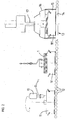
- FIG. 1 a shows how a rotating mold core 1 is used for the production a timing belt from a castable in the uncured or uncured state elastomeric material a mold release agent 3 applied with a spray device 2 becomes.
- the mold core 1 provided with mold release agent 3 is shown by means of the Provide spray devices 4 with an adhesive 5 while rotating.
- the mold core 1 as shown in Figure 1c, with fibers 7 of a flock material from a Sprinkled storage vessel 6, the fibers 7 by means 8 for generating a electrostatic field can be aligned and accelerated.
- the flocked The mold core 1 is again in FIG. 1d with an adhesive 5 from the spray device 4 sprayed and Figure 1e shows the application of a second layer with flock material.
- Figure 1f is on the mold core 1 provided with the material for the outer reinforcement Strength member 9 wound for the tension member layer.
- FIG. 2 shows how the non-cross-linked or not via a feed device 10 hardened elastomeric material or its starting products in the cup-shaped Mold outer part 11 is or will be cast.
- the filled outer mold parts 11, 11 ', 11 " are transported further along a roller conveyor 12.
- an outer part 11 'filled with material according to the figures 1a to 1f treated mold core 1 positioned and held over the material.
- the vacuum chamber 13 is then up to a pressure ⁇ 0.1 bar evacuated, then the mandrel 1 'is pressed down with the aid of the stamp 17, that the uncrosslinked or uncured elastomeric material or its Starting products from the bottom of the mold outer part 11 "into the mold cavity between Mold core 1 'and outer mold part 11 "is pressed and completely fills it.
- the vacuum chamber 13 is vented back to atmospheric pressure, so that the trapped air bubbles, which had a pressure of approx. 0.1 bar by the External pressure are pressed together and collapse. Air pockets too inside the reinforcing material and between the fibers 7 in this way minimized and a very good connection of the fibers 7 to the rest of the belt material guaranteed.
- the blank is removed from the mold and in the toothed belt cut the desired width.
- FIG. 3 shows a toothed belt produced by the method according to the invention in Longitudinal section (section in the direction of rotation) shown.
- the timing belt has one elastic base body 18, containing a tension member layer 19 and an outer reinforcement Fibers 7.
- the toothed belt is made of polyurethane, with 5 as an adhesive for the Fastening the fibers 7 also a system that crosslinks to polyurethane, which additionally contained a filler 20 was used.
Landscapes
- Engineering & Computer Science (AREA)
- Mechanical Engineering (AREA)
- Compositions Of Macromolecular Compounds (AREA)
- Belt Conveyors (AREA)
Abstract
Description
- Figuren 1a bis 1f
- schematisch das Versehen des Formkerns mit Armierungsmaterial und Zugträgerlage
- Figur 2
- schematisch weitere Schritte des Verfahrens
- Figur 3
- schematisch den Schnitt durch einen nach dem erfindungsgemäßen Verfahren hergestellten Zahnriemen in Umlaufrichtung.
- 1
- Formkern
- 2
- Sprühvorrichtung
- 3
- Formtrennmittel
- 4
- Sprühvorrichtung
- 5
- Klebstoff
- 6
- Vorratsgefäß
- 7
- Fasern
- 8
- Mittel zur Erzeugung eines elektrostatischen Feldes
- 9
- Festigkeitsträger für Zugträgerlage
- 10
- Zuführvorrichtung
- 11
- Formaußenteil
- 12
- Rollenförderer
- 13
- Vakuumkammer
- 14
- Boden der Vakuumkammer
- 15
- fester Ring
- 16
- flexible Membran
- 17
- Stempel
- 18
- Grundkörper
- 19
- Zugträgerlage
- 20
- Füllstoff
Claims (10)
- Verfahren zur Herstellung eines Antriebsriemens aus einem im im Wesentlichen unvernetzten oder nicht gehärteten Zustand gießfähigen elastomeren Werkstoff mit einer in einen elastischen Grundkörper (18) eingebetteten Zugträgerlage (19) und mit einer äußeren Armierung, die Fasern (7) enthält, in einer Form aus einem Formkern (1, 1'), einem Formaußenteil (11, 11', 11 ") und einem dazwischenliegenden, den Riemenrohling formenden Formhohlraum,
aufweisend zumindest folgende Schritte:a) Aufbringung des Materials für die äußere Armierung auf den Formkern (1, 1'),b) Aufwickeln der Zugträgerlage (19) auf den mit dem Material für die äußere Armierung versehenen Formkern (1, 1'),c) Positionierung des Formkerns (1, 1') innerhalb des Formaußenteils (11, 11', 11"),d) Evakuierung der gesamten Form bis zu einem Druck < 0,1 bar in einer Vakuumkammer (13),e) Befüllen des Formhohlraumes mit dem unvernetzten oder nicht gehärteten elastomeren Werkstoff oder dessen Ausgangsprodukten,f) Belüften der Vakuumkammer (13) bis zum Atmosphärendruck solange der elastomere Werkstoff oder dessen Ausgangsprodukte noch eine Viskosität aufweist bzw. weisen, die kleiner als 500 Pa*s ist,g) im Wesentlichen vollständige Vernetzung oder Aushärtung des elastomeren Werkstoffes,h) Entfernen des Riemenrohlings aus der Form undi) Schneiden in die gewünschte Riemenbreite. - Verfahren nach Anspruch 1, dadurch gekennzeichnet, dass vor der Positionierung des Formkerns (1, 1') innerhalb des Formaußenteils (11, 11', 11"), das topfförmig ausgebildet ist, in das topfförmige Formaußenteil (11, 11', 11") der unvernetzte oder nicht gehärtete elastomere Werkstoff oder dessen Ausgangsprodukte gegossen wird bzw. werden, dann der Formkern (1, 1') innerhalb des Formaußenteils (11, 11', 11") über dem Werkstoff oder dessen Ausgangsprodukten positioniert wird und der Formhohlraum nach der Evakuierung durch Einpressen des Formkerns (1, 1') in den Werkstoff mit diesem befüllt wird.
- Verfahren nach Anspruch 1, dadurch gekennzeichnet, dass der Formhohlraum durch Injektion des unvernetzten oder nicht gehärteten elastomeren Werkstoffes oder dessen Ausgangsprodukten mit diesem bzw. diesen befüllt wird.
- Verfahren nach zumindest einem der vorhergehenden Ansprüche, dadurch gekennzeichnet, dass die im Wesentlichen vollständige Vernetzung und/oder Aushärtung des elastomeren Werkstoffes unter Druck erfolgt.
- Verfahren nach zumindest einem der vorhergehenden Ansprüche, dadurch gekennzeichnet, dass die im Wesentlichen vollständige Vernetzung und/oder Aushärtung des elastomeren Werkstoffes bei erhöhter Temperatur erfolgt.
- Verfahren nach zumindest einem der vorhergehenden Ansprüche, dadurch gekennzeichnet, dass der Antriebsriemen ein Zahnriemen ist.
- Verfahren nach zumindest einem der vorhergehenden Ansprüche, dadurch gekennzeichnet, dass der elastomere Werkstoff Polyurethan ist.
- Verfahren nach zumindest einem der vorhergehenden Ansprüche, dadurch gekennzeichnet, dass das Material für die äußere Armierung ein Gewebe ist.
- Verfahren nach zumindest einem der Ansprüche 1 bis 7, dadurch gekennzeichnet, dass das Material für die äußere Armierung ein Flockmaterial ist, welches mit Hilfe eines als Klebstoff (5) wirkenden Mittels vor dem Aufwickeln der Zugträgerlage (16) auf den Formkern (1, 1') aufgebracht wird.
- Antriebsriemen, insbesondere Zahnriemen, der nach einem Verfahren gemäß einem der Ansprüche 1 bis 9 hergestellt ist.
Priority Applications (3)
| Application Number | Priority Date | Filing Date | Title |
|---|---|---|---|
| DE50204484T DE50204484D1 (de) | 2002-12-11 | 2002-12-11 | Verfahren zur Herstellung eines Antriebsriemens aus elastomerem Werkstoff |
| AT02027760T ATE305850T1 (de) | 2002-12-11 | 2002-12-11 | Verfahren zur herstellung eines antriebsriemens aus elastomerem werkstoff |
| EP02027760A EP1428651B1 (de) | 2002-12-11 | 2002-12-11 | Verfahren zur Herstellung eines Antriebsriemens aus elastomerem Werkstoff |
Applications Claiming Priority (1)
| Application Number | Priority Date | Filing Date | Title |
|---|---|---|---|
| EP02027760A EP1428651B1 (de) | 2002-12-11 | 2002-12-11 | Verfahren zur Herstellung eines Antriebsriemens aus elastomerem Werkstoff |
Publications (2)
| Publication Number | Publication Date |
|---|---|
| EP1428651A1 true EP1428651A1 (de) | 2004-06-16 |
| EP1428651B1 EP1428651B1 (de) | 2005-10-05 |
Family
ID=32319579
Family Applications (1)
| Application Number | Title | Priority Date | Filing Date |
|---|---|---|---|
| EP02027760A Expired - Lifetime EP1428651B1 (de) | 2002-12-11 | 2002-12-11 | Verfahren zur Herstellung eines Antriebsriemens aus elastomerem Werkstoff |
Country Status (3)
| Country | Link |
|---|---|
| EP (1) | EP1428651B1 (de) |
| AT (1) | ATE305850T1 (de) |
| DE (1) | DE50204484D1 (de) |
Citations (6)
| Publication number | Priority date | Publication date | Assignee | Title |
|---|---|---|---|---|
| US2983637A (en) * | 1958-12-23 | 1961-05-09 | Russell Mfg Co | Gear belt |
| US3138962A (en) * | 1958-06-04 | 1964-06-30 | Gates Rubber Co | Power transmission belting |
| US3200180A (en) * | 1962-02-15 | 1965-08-10 | Method op casting articles from liquid elastomers | |
| US3418186A (en) * | 1965-01-11 | 1968-12-24 | Uniroyal Inc | Method for making toothed drive belts |
| US4053547A (en) * | 1971-10-14 | 1977-10-11 | The Gates Rubber Company | Method for producing a positive drive belt |
| US4066732A (en) * | 1976-11-19 | 1978-01-03 | The Gates Rubber Company | Toothed belt making |
-
2002
- 2002-12-11 AT AT02027760T patent/ATE305850T1/de not_active IP Right Cessation
- 2002-12-11 EP EP02027760A patent/EP1428651B1/de not_active Expired - Lifetime
- 2002-12-11 DE DE50204484T patent/DE50204484D1/de not_active Expired - Fee Related
Patent Citations (6)
| Publication number | Priority date | Publication date | Assignee | Title |
|---|---|---|---|---|
| US3138962A (en) * | 1958-06-04 | 1964-06-30 | Gates Rubber Co | Power transmission belting |
| US2983637A (en) * | 1958-12-23 | 1961-05-09 | Russell Mfg Co | Gear belt |
| US3200180A (en) * | 1962-02-15 | 1965-08-10 | Method op casting articles from liquid elastomers | |
| US3418186A (en) * | 1965-01-11 | 1968-12-24 | Uniroyal Inc | Method for making toothed drive belts |
| US4053547A (en) * | 1971-10-14 | 1977-10-11 | The Gates Rubber Company | Method for producing a positive drive belt |
| US4066732A (en) * | 1976-11-19 | 1978-01-03 | The Gates Rubber Company | Toothed belt making |
Also Published As
| Publication number | Publication date |
|---|---|
| EP1428651B1 (de) | 2005-10-05 |
| ATE305850T1 (de) | 2005-10-15 |
| DE50204484D1 (de) | 2005-11-10 |
Similar Documents
| Publication | Publication Date | Title |
|---|---|---|
| DE2203629A1 (de) | Zahnriemen mit Zähnen auf beiden Seiten sowie Verfahren zu seiner Herstellung | |
| DE2014538C3 (de) | Endloser Zahnriemen und Verfahren zu seiner Herstellung | |
| DE2751059A1 (de) | Verfahren zur herstellung eines zahnriemens aus elastomerem material | |
| EP1854621B1 (de) | Verfahren zum Giessen eines Prothesenschaftes | |
| EP1985465A1 (de) | Speiche, Rad und Verfahren zur Herstellung einer Speiche, insbesondere für Fahrräder | |
| DE3246803A1 (de) | Verfahren zum herstellen von bauteilen aus lagen von faserverstaerktem kunststoff | |
| EP0398064B1 (de) | Schaft einer Hüftgelenkprothese und Verfahren zu dessen Herstellung | |
| DE2058764B2 (de) | Keilriemen | |
| DE2713468A1 (de) | Stator fuer exzenterschneckenpumpen | |
| DE19818036A1 (de) | Verfahren zur Herstellung eines elektrotechnischen Bauteils mit einer kunststoffpassivierten Oberfläche, derartiges Bauteil und Anwendung dieses Bauteils | |
| WO2009112017A2 (de) | Verfahren zur herstellung eines rotorblattes für eine windkraftanlage sowie ein nach diesem verfahren hergestelltes rotorblatt | |
| EP1837151B1 (de) | Verfahren zum Herstellen von Kunststoffteilen | |
| WO2018082808A1 (de) | Verfahren zur herstellung eines druckspeichers | |
| EP1428651B1 (de) | Verfahren zur Herstellung eines Antriebsriemens aus elastomerem Werkstoff | |
| EP1459881A2 (de) | Verfahren zur Herstellung eines Fahrzeug-Karosserieteils | |
| EP3844052B1 (de) | System zu dämmung eines strukturelementes | |
| EP0357651A1 (de) | Verfahren zum versteifen des metallischen chassis, insbesondere der bodengruppe von personenkraftwagen | |
| EP3490782A1 (de) | Verfahren zum herstellen eines dreidimensionalen, vielschichtigen faserverbundteils | |
| CH480571A (de) | Verfahren zum Herstellen einer aus einem Befestigungsteil und einem Dichtungsteil bestehenden Dichtung und nach diesem Verfahren hergestellte Dichtung | |
| EP3162546A1 (de) | Zugelement aus faserverstärktem kunststoff | |
| EP1658166B1 (de) | Polsterteil, insbesondere ausstattungsteil für den innenraum eines kraftfahrzeugs, verfahren zu seiner herstellung und sitz | |
| DE10354106A1 (de) | Verfahren zum Herstellen einer Faserverbundstruktur | |
| WO2024068491A1 (de) | Verfahren und vorrichtung zur herstellung von komposit-formteilen | |
| DE102007004312B4 (de) | Verfahren zur Herstellung eines Faserverbundbauteils für ein Luft- oder Raumfahrzeug | |
| DE69514591T2 (de) | Verfahren zur Herstellung eines starken und zuverlässigen Skis |
Legal Events
| Date | Code | Title | Description |
|---|---|---|---|
| PUAI | Public reference made under article 153(3) epc to a published international application that has entered the european phase |
Free format text: ORIGINAL CODE: 0009012 |
|
| AK | Designated contracting states |
Kind code of ref document: A1 Designated state(s): AT BE BG CH CY CZ DE DK EE ES FI FR GB GR IE IT LI LU MC NL PT SE SI SK TR |
|
| AX | Request for extension of the european patent |
Extension state: AL LT LV MK RO |
|
| 17P | Request for examination filed |
Effective date: 20041216 |
|
| AKX | Designation fees paid |
Designated state(s): AT BE BG CH CY CZ DE DK EE ES FI FR GB GR IE IT LI LU MC NL PT SE SI SK TR |
|
| 17Q | First examination report despatched |
Effective date: 20050127 |
|
| GRAP | Despatch of communication of intention to grant a patent |
Free format text: ORIGINAL CODE: EPIDOSNIGR1 |
|
| RTI1 | Title (correction) |
Free format text: METHOD OF MANUFACTURING A DRIVING BELT MADE OF ELASTOMERIC MATERIAL. |
|
| RTI1 | Title (correction) |
Free format text: METHOD OF MANUFACTURING A DRIVING BELT MADE OF ELASTOMERIC MATERIAL |
|
| GRAS | Grant fee paid |
Free format text: ORIGINAL CODE: EPIDOSNIGR3 |
|
| GRAA | (expected) grant |
Free format text: ORIGINAL CODE: 0009210 |
|
| AK | Designated contracting states |
Kind code of ref document: B1 Designated state(s): AT BE BG CH CY CZ DE DK EE ES FI FR GB GR IE IT LI LU MC NL PT SE SI SK TR |
|
| PG25 | Lapsed in a contracting state [announced via postgrant information from national office to epo] |
Ref country code: IT Free format text: LAPSE BECAUSE OF FAILURE TO SUBMIT A TRANSLATION OF THE DESCRIPTION OR TO PAY THE FEE WITHIN THE PRESCRIBED TIME-LIMIT;WARNING: LAPSES OF ITALIAN PATENTS WITH EFFECTIVE DATE BEFORE 2007 MAY HAVE OCCURRED AT ANY TIME BEFORE 2007. THE CORRECT EFFECTIVE DATE MAY BE DIFFERENT FROM THE ONE RECORDED. Effective date: 20051005 Ref country code: EE Free format text: LAPSE BECAUSE OF FAILURE TO SUBMIT A TRANSLATION OF THE DESCRIPTION OR TO PAY THE FEE WITHIN THE PRESCRIBED TIME-LIMIT Effective date: 20051005 Ref country code: FI Free format text: LAPSE BECAUSE OF FAILURE TO SUBMIT A TRANSLATION OF THE DESCRIPTION OR TO PAY THE FEE WITHIN THE PRESCRIBED TIME-LIMIT Effective date: 20051005 Ref country code: CZ Free format text: LAPSE BECAUSE OF FAILURE TO SUBMIT A TRANSLATION OF THE DESCRIPTION OR TO PAY THE FEE WITHIN THE PRESCRIBED TIME-LIMIT Effective date: 20051005 Ref country code: SI Free format text: LAPSE BECAUSE OF FAILURE TO SUBMIT A TRANSLATION OF THE DESCRIPTION OR TO PAY THE FEE WITHIN THE PRESCRIBED TIME-LIMIT Effective date: 20051005 Ref country code: NL Free format text: LAPSE BECAUSE OF FAILURE TO SUBMIT A TRANSLATION OF THE DESCRIPTION OR TO PAY THE FEE WITHIN THE PRESCRIBED TIME-LIMIT Effective date: 20051005 Ref country code: IE Free format text: LAPSE BECAUSE OF FAILURE TO SUBMIT A TRANSLATION OF THE DESCRIPTION OR TO PAY THE FEE WITHIN THE PRESCRIBED TIME-LIMIT Effective date: 20051005 Ref country code: SK Free format text: LAPSE BECAUSE OF FAILURE TO SUBMIT A TRANSLATION OF THE DESCRIPTION OR TO PAY THE FEE WITHIN THE PRESCRIBED TIME-LIMIT Effective date: 20051005 Ref country code: TR Free format text: LAPSE BECAUSE OF FAILURE TO SUBMIT A TRANSLATION OF THE DESCRIPTION OR TO PAY THE FEE WITHIN THE PRESCRIBED TIME-LIMIT Effective date: 20051005 Ref country code: GB Free format text: LAPSE BECAUSE OF FAILURE TO SUBMIT A TRANSLATION OF THE DESCRIPTION OR TO PAY THE FEE WITHIN THE PRESCRIBED TIME-LIMIT Effective date: 20051005 |
|
| REG | Reference to a national code |
Ref country code: GB Ref legal event code: FG4D Free format text: NOT ENGLISH |
|
| REG | Reference to a national code |
Ref country code: CH Ref legal event code: EP |
|
| REG | Reference to a national code |
Ref country code: IE Ref legal event code: FG4D Free format text: LANGUAGE OF EP DOCUMENT: GERMAN |
|
| REF | Corresponds to: |
Ref document number: 50204484 Country of ref document: DE Date of ref document: 20051110 Kind code of ref document: P |
|
| PG25 | Lapsed in a contracting state [announced via postgrant information from national office to epo] |
Ref country code: CY Free format text: LAPSE BECAUSE OF FAILURE TO SUBMIT A TRANSLATION OF THE DESCRIPTION OR TO PAY THE FEE WITHIN THE PRESCRIBED TIME-LIMIT Effective date: 20051211 Ref country code: AT Free format text: LAPSE BECAUSE OF NON-PAYMENT OF DUE FEES Effective date: 20051211 |
|
| PG25 | Lapsed in a contracting state [announced via postgrant information from national office to epo] |
Ref country code: BE Free format text: LAPSE BECAUSE OF NON-PAYMENT OF DUE FEES Effective date: 20051231 Ref country code: LU Free format text: LAPSE BECAUSE OF NON-PAYMENT OF DUE FEES Effective date: 20051231 Ref country code: MC Free format text: LAPSE BECAUSE OF NON-PAYMENT OF DUE FEES Effective date: 20051231 |
|
| PG25 | Lapsed in a contracting state [announced via postgrant information from national office to epo] |
Ref country code: DK Free format text: LAPSE BECAUSE OF FAILURE TO SUBMIT A TRANSLATION OF THE DESCRIPTION OR TO PAY THE FEE WITHIN THE PRESCRIBED TIME-LIMIT Effective date: 20060105 Ref country code: BG Free format text: LAPSE BECAUSE OF FAILURE TO SUBMIT A TRANSLATION OF THE DESCRIPTION OR TO PAY THE FEE WITHIN THE PRESCRIBED TIME-LIMIT Effective date: 20060105 Ref country code: SE Free format text: LAPSE BECAUSE OF FAILURE TO SUBMIT A TRANSLATION OF THE DESCRIPTION OR TO PAY THE FEE WITHIN THE PRESCRIBED TIME-LIMIT Effective date: 20060105 Ref country code: GR Free format text: LAPSE BECAUSE OF FAILURE TO SUBMIT A TRANSLATION OF THE DESCRIPTION OR TO PAY THE FEE WITHIN THE PRESCRIBED TIME-LIMIT Effective date: 20060105 |
|
| PG25 | Lapsed in a contracting state [announced via postgrant information from national office to epo] |
Ref country code: ES Free format text: LAPSE BECAUSE OF FAILURE TO SUBMIT A TRANSLATION OF THE DESCRIPTION OR TO PAY THE FEE WITHIN THE PRESCRIBED TIME-LIMIT Effective date: 20060116 |
|
| NLV1 | Nl: lapsed or annulled due to failure to fulfill the requirements of art. 29p and 29m of the patents act | ||
| PG25 | Lapsed in a contracting state [announced via postgrant information from national office to epo] |
Ref country code: PT Free format text: LAPSE BECAUSE OF FAILURE TO SUBMIT A TRANSLATION OF THE DESCRIPTION OR TO PAY THE FEE WITHIN THE PRESCRIBED TIME-LIMIT Effective date: 20060306 |
|
| GBV | Gb: ep patent (uk) treated as always having been void in accordance with gb section 77(7)/1977 [no translation filed] |
Effective date: 20051005 |
|
| REG | Reference to a national code |
Ref country code: IE Ref legal event code: FD4D |
|
| PLBE | No opposition filed within time limit |
Free format text: ORIGINAL CODE: 0009261 |
|
| STAA | Information on the status of an ep patent application or granted ep patent |
Free format text: STATUS: NO OPPOSITION FILED WITHIN TIME LIMIT |
|
| 26N | No opposition filed |
Effective date: 20060706 |
|
| PG25 | Lapsed in a contracting state [announced via postgrant information from national office to epo] |
Ref country code: FR Free format text: LAPSE BECAUSE OF FAILURE TO SUBMIT A TRANSLATION OF THE DESCRIPTION OR TO PAY THE FEE WITHIN THE PRESCRIBED TIME-LIMIT Effective date: 20061020 |
|
| EN | Fr: translation not filed | ||
| PG25 | Lapsed in a contracting state [announced via postgrant information from national office to epo] |
Ref country code: CH Free format text: LAPSE BECAUSE OF NON-PAYMENT OF DUE FEES Effective date: 20061231 Ref country code: LI Free format text: LAPSE BECAUSE OF NON-PAYMENT OF DUE FEES Effective date: 20061231 |
|
| REG | Reference to a national code |
Ref country code: CH Ref legal event code: PL |
|
| BERE | Be: lapsed |
Owner name: CONTITECH ANTRIEBSSYSTEME G.M.B.H. Effective date: 20051231 |
|
| PGFP | Annual fee paid to national office [announced via postgrant information from national office to epo] |
Ref country code: DE Payment date: 20071103 Year of fee payment: 6 |
|
| PG25 | Lapsed in a contracting state [announced via postgrant information from national office to epo] |
Ref country code: FR Free format text: LAPSE BECAUSE OF FAILURE TO SUBMIT A TRANSLATION OF THE DESCRIPTION OR TO PAY THE FEE WITHIN THE PRESCRIBED TIME-LIMIT Effective date: 20051231 |
|
| PG25 | Lapsed in a contracting state [announced via postgrant information from national office to epo] |
Ref country code: FR Free format text: LAPSE BECAUSE OF FAILURE TO SUBMIT A TRANSLATION OF THE DESCRIPTION OR TO PAY THE FEE WITHIN THE PRESCRIBED TIME-LIMIT Effective date: 20051005 |
|
| PG25 | Lapsed in a contracting state [announced via postgrant information from national office to epo] |
Ref country code: DE Free format text: LAPSE BECAUSE OF NON-PAYMENT OF DUE FEES Effective date: 20090701 |