EP1429230A2 - Verbessertes geheimes Hashen der TCP SYN/FIN-Korrespondenz - Google Patents
Verbessertes geheimes Hashen der TCP SYN/FIN-Korrespondenz Download PDFInfo
- Publication number
- EP1429230A2 EP1429230A2 EP03300248A EP03300248A EP1429230A2 EP 1429230 A2 EP1429230 A2 EP 1429230A2 EP 03300248 A EP03300248 A EP 03300248A EP 03300248 A EP03300248 A EP 03300248A EP 1429230 A2 EP1429230 A2 EP 1429230A2
- Authority
- EP
- European Patent Office
- Prior art keywords
- packet
- packets
- processed
- connection
- syn
- Prior art date
- Legal status (The legal status is an assumption and is not a legal conclusion. Google has not performed a legal analysis and makes no representation as to the accuracy of the status listed.)
- Granted
Links
Images


Classifications
-
- H—ELECTRICITY
- H04—ELECTRIC COMMUNICATION TECHNIQUE
- H04L—TRANSMISSION OF DIGITAL INFORMATION, e.g. TELEGRAPHIC COMMUNICATION
- H04L63/00—Network architectures or network communication protocols for network security
- H04L63/14—Network architectures or network communication protocols for network security for detecting or protecting against malicious traffic
- H04L63/1408—Network architectures or network communication protocols for network security for detecting or protecting against malicious traffic by monitoring network traffic
-
- H—ELECTRICITY
- H04—ELECTRIC COMMUNICATION TECHNIQUE
- H04L—TRANSMISSION OF DIGITAL INFORMATION, e.g. TELEGRAPHIC COMMUNICATION
- H04L63/00—Network architectures or network communication protocols for network security
- H04L63/14—Network architectures or network communication protocols for network security for detecting or protecting against malicious traffic
- H04L63/1441—Countermeasures against malicious traffic
- H04L63/1458—Denial of Service
Definitions
- This invention relates, generally, to computer based systems and more particularly to methods of detecting security related attacks in such systems.
- TCP services rely on a three-way hand shaking protocol on connection set up.
- a client wishing to make connection with a host sends a synchronization signal (SYN) to the host and the host responds to the client with a SYN acknowledgement (ACK) reply.
- SYN synchronization signal
- ACK acknowledgement
- the client then returns an acknowledgement and the connection is established.
- the handshaking protocol is illustrated in Figure 1.
- the client Upon completion of a connection the client forwards a finish (FIN) packet to the host indicating that there will be no further data or packets directed to the host and the connection is thereafter closed.
- FIN finish
- the attacker will typically use a false or invalid source address such that when the host returns the SYN/ ACK message it does not reach a valid client.
- the host stores half opened connections i.e. connections for which the third leg of the three way protocol has not been completed for a set period of time or until a system time out occurs. If, during this time interval, multiple new half opened connections are established at the host site the memory allocated to retaining such connections becomes swamped and eventually is unable to rec eive any more SYN packets. At this stage the server or host will crash or will not respond to any new connections and the site goes out of service.
- Denial of service attacks have become an increasingly prevalent form of security threat and the problem, so far, has been quite difficult to solve.
- Several countermeasures have been proposed and can be characterized as firewall and router filtering, operating system improvements, protocol improvements and intrusion detection.
- the proxy solutions according to this publication have to maintain, for each connection, the states of the corresponding TCP state machine. This mechanism needs a lot of resources and can be itself the target of a new denial of service attack. Thus, the high cost of the computation overhead makes this solution inappropriate for network routers or switches.
- the counter mechanism according to Wang et al. has a major drawback. If attackers know exactly the detection protocol described by this method they may thwart this approach simply by overflooding the routers with synchronized SYN and unrelated, often invalid FIN packets. Hence the SYN counter and the FIN counter would be roughly the same. However, the victim's TCP/IP stack would be open to many half-opened connections that would not be closed by the invalid FIN packets. This corresponds to the original denial of service attack.
- the 6,321,338 patent further discloses, in addition to the details mentioned above, that intensity measures of event streams e.g. ICMP packets, are particularly suited for detecting flooding attacks. Furthermore, the patent discloses that intensity measures that correlate SYN to SYN _ACK messages, volume analysis of SYN/RST messages or TCP/FIN messages are useful to detect port availability or scanning attacks.
- a second patent of interest is U.S. Patent 5,958,053 which issued on September 28, 1999 to Denker entitled "Communications protocol with improved security".
- the invention therein includes two new first level protocols and several embodiments of a second level protocol.
- the two new first level protocols of the invention include the TCP2B protocol and the TCP2E protocol.
- TCP2B protocol both client and server indicate their support for this protocol using one or more bits in the TCP header.
- the client retransmits its requested options in the ACK message so the server need not store the options after the connection request.
- the server maintains a Friends Table listing addresses of devices recently observed to be in compliance with TCP. If a client's address is on the Friends Table the connection request is processed according to TCP. Otherwise the server sends an acknowledge message to the client to prompt the client to send a reset (RST) message. The client's address can then be added to the Friends Table.
- the 5,958,053 patent discloses the use of a hashing function on the source and destination IP addresses and port numbers plus a secret key, known only to the server to differentiate SYN packets. Additionally, the patent discloses keeping a hash table that includes counters corresponding to respective clients to detect unsuccessful attempts as would occur with a SYN flood attack. Each counter is decremented after receiving a SYN message from its corresponding service and incremented when a successful connection is established between the client and the server upon the reception of the ACK from the client.
- Co-pending application 10/158,115 discloses an improvement on the prior art by maintaining a correspondence between SYNs and FINs thereby closing the security hole. This is done by using a hashing function to map SYN messages to corresponding FIN messages.
- the aforementioned application also provides a coherent way to deal with reset packets.
- the present invention addresses a mechanism which determines the correspondence between SYN packets and FIN packets. It reinforces the mechanism introduced in co-pending application 10/158,115 by using sequence numbers in the computation. According to the present invention it would not be possible to circumvent the reinforced mechanism with a single attacking tool program which does not get explicit information from a victim of an attack.
- a method of detecting a denial of service attack on a connection in a digital communications system comprising the steps of: a) calculating, for a connection establishing packet during a predetermined time interval, a first value using a hash function with source and destination IP addresses, source and destination port numbers and a secret key as input parameters; b) processing a portion of subsequent packets by adding the first value to a second value that is dependent on a sequencing number of each processed subsequent packet and the predetermined time interval to derive respective indexes to a hash table, the hash table having counter values of current, previous and next buckets to which the processed packets are mapped; and c) determining whether there is a denial of service attack by evaluating respective indexes, an attack being indicated when an index value calculated from a processed packet does not point to a current, previous or next bucket that has a counter value greater than zero.
- Figure 1 illustrates the TCP/IP protocol for initiating a connection from a client to a host or server.
- the client sends a connection initiating message (SYN) to the server who responds with a SYN/ACK message sent back to the client.
- SYN connection initiating message
- the client returns an acknowledgement message which fully opens the connection.
- the client Upon completion of a session the client sends a FIN or connection terminating message to the host or server which acknowledges the message and the server returns an acknowledgement to formally close the connection.
- the server maintains a record of a half-opened connection and a plurality of such half-opened messages can overwhelm the server which will lead to a crash and interruption of the service.
- FIG. 2 is a high level diagram of this application showing the router which includes the mechanisms for carrying out the method of the present invention.
- the SYN flood attacks can be detected efficiently by maintaining the states of connections with a hashing table. Such a system can be more efficient then other methods identified in the prior art.
- the associated hashing function must be collision resistant i.e. it must be computationally infeasible to find two couplets hashed in the same bucket. This can be achieved with a keyed function.
- incoming signaling packets (SYN, SYN/ACK, FIN, RST) can be mapped to buckets by a secret hashing function and the statistics can be maintained on each bucket, rather than the entire system.
- a simple counter can be incremented on SYNs and decremented on FINs for each bucket. This way there can at least be a statistical correspondence between SYNs and FINs, and without knowledge of the mapping function, the attacker would have no way of faking the FINs to map to the same bucket (without corresponding to the same SYN). This relies on the assumption that an attacker has only two choices: either completing the three-way handshake and, eventually, the connection or not completing the three-way handshake and leaving the client with a half-open connection.
- the mapping function could hash [source IP, destination IP, destination port, key] to n buckets.
- any efficient data structures supporting insertion, membership queries and optionally, deletion could be used (e.g. Bloom-filter with keyed hashing functions). The main issue is to have an efficient data structure for which the false positive membership queries are very low. This is the reason why the size of the table is huge.
- the key parameter allows the hashing algorithm to be known, but the correspondence between [IPs, port] and bucket to be hidden from the attacker. Thus, the key would be a random number known only to the detection system.
- a global counter would be maintained to track all open connections. It would be the heart of the logic that decides if an attack is underway.
- the present invention provides a means of detecting denial of service attacks that is more efficient and robust then known methods.
- the invention is related to a method of detecting flooding type denial of service attacks in which the SYN messages are matched to the FIN messages by using a hash algorithm that includes use of a key for additional security.
- the invention relies on a method of measuring connection establishing packets (SYN) and connection terminating packets (FIN) received at a router during a predetermined time interval.
- Information in the packets such as source and destination IP addresses, port numbers and a secret key are used to calculate a value using a hash function.
- the main distinguishing feature of the method would be the processing of a probabilistically determined portion of packets of a connection by using a hash algorithm to determine if the packets belong to the flow initiated by a TCP SYN packet.
- the hash algorithm includes a secret key for additional security.
- the result of the hash algorithm is added to a value that is dependent on the sequence number (or optionally the ACK flag) of a packet being processed and the TCP window size of the connection to calculate an index to a hash table.
- All the buckets of the hash table contain a counter corresponding to the number of elements inserted in that bucket. If the index value calculated from a processed packet does not point to a current, previous, or next counter value that is greater than zero, then the processed packet does not belong to any flow initiated by a TCP SYN packet, and the processed packet will be discarded. As packets are processed the counter values in the buckets are maintained.
- the bucket counts are reset at the end of the time interval which will be either a continuous sliding window or a non-overlapping sliding window.
- the method of determining a denial of service attack relies on using any one of a cumulative sum, a moving average or a filter derivative to detect changes in the global counter.
- a TCP connection is initialized with a TCP SYN packet and terminated with a TCP FIN packet.
- the correspondence between these two packets can be established by monitoring the packet sequence numbers. Those numbers must increase according to some rules.
- the initial value of this sequence is determined by the Initial Sequence Number set in the TCP SYN packet.
- a hash table supports the following operations: Insertion , Deletion , and Query .
- One secret hashing function is associated to the table - in fact, more than one function can be required e.g. Bloom filters.
- the function must contain a secret argument to prevent a malicious attacker from thwarting this mechanism.
- the hash uses the following input parameters (SecretValue, IP SOURCE , IP DEST , Port SOURCE , Port DEST ).
- Such function can be based on one-way hashing functions like MD5 or SHA-1.
- the mechanism according to the invention is as follows:
- the value SN refers to the packet sequence number. If this is the case, the packet is accepted. Otherwise, the packet is not recognized as belonging to the flow initiated by the TCP SYN packet. Since the sequence number of the packet is received subsequent to the initial sequence number increased the hash function plus the sequence number must be greater than the hash function for the initial SYN packet.
- the confidence factor t assures with a good probability that the previous packet which has been processed - or the SYN packet - has been inserted in the current bucket or in the previous one.
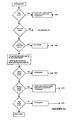
- FIGS. 3A and 3B are flow diagrams illustrating the new mechanism according to the present invention.
- a portion of incoming packets different than SYN, FIN or RST packets which fall within the selection criteria p are processed in order to compute the hash bucket based on IP port numbers and the sequence number.
- the previous and next bucket are defined relative to the current one. If the current bucket is not empty the packet is accepted. If it is empty then it is determined whether the previous bucket is empty. If it is not empty the packet in the previous bucket is deleted and the packet is added to the current bucket. If the previous bucket is also empty it is determined whether the next bucket is empty. If it is the packet is rejected otherwise it is accepted.
- Figure 3B illustrates the process when a incoming packet is a FIN packet or RST packet.
- the hash bucket is calculated based on IP port numbers and the sequence number. Again the previous and next and next buckets are defined in accordance with the current one. If the current bucket is not empty the packet is accepted. If the current bucket is empty and the previous bucket is not empty the packet in the previous bucket is deleted and the new packet is accepted. Otherwise the packet is rejected.
- a variant of this algorithm is to base the computation on the acknowledgment numbers instead of the sequence numbers. This variant is based on the fact that most TCP/IP stack implementations set the ACK flag on each packet - except on the initial SYN packet.
- the mechanism according to the present invention provides a stronger correspondence than the hashing solution which does not consider the sequence numbers. This results in a faster solution than the aforementioned obvious solution simulating the TCP window algorithm. In any event that such a solution would use a hashing function to maintain the data structures keeping the sequence numbers.
- the present invention provides a means of detecting denial-of-service attacks that is more efficient and robust than known methods.
Landscapes
- Engineering & Computer Science (AREA)
- Computer Security & Cryptography (AREA)
- Computer Hardware Design (AREA)
- Computing Systems (AREA)
- General Engineering & Computer Science (AREA)
- Computer Networks & Wireless Communication (AREA)
- Signal Processing (AREA)
- Data Exchanges In Wide-Area Networks (AREA)
- Computer And Data Communications (AREA)
Applications Claiming Priority (2)
| Application Number | Priority Date | Filing Date | Title |
|---|---|---|---|
| US316883 | 1994-10-03 | ||
| US10/316,883 US7373663B2 (en) | 2002-05-31 | 2002-12-12 | Secret hashing for TCP SYN/FIN correspondence |
Publications (3)
| Publication Number | Publication Date |
|---|---|
| EP1429230A2 true EP1429230A2 (de) | 2004-06-16 |
| EP1429230A3 EP1429230A3 (de) | 2004-10-20 |
| EP1429230B1 EP1429230B1 (de) | 2006-08-16 |
Family
ID=32325927
Family Applications (1)
| Application Number | Title | Priority Date | Filing Date |
|---|---|---|---|
| EP03300248A Expired - Lifetime EP1429230B1 (de) | 2002-12-12 | 2003-12-09 | Verbessertes geheimes Hashen der TCP SYN/FIN-Korrespondenz |
Country Status (3)
| Country | Link |
|---|---|
| US (1) | US7373663B2 (de) |
| EP (1) | EP1429230B1 (de) |
| DE (1) | DE60307581T2 (de) |
Cited By (1)
| Publication number | Priority date | Publication date | Assignee | Title |
|---|---|---|---|---|
| WO2006103337A1 (fr) * | 2005-03-31 | 2006-10-05 | France Telecom | Procede de controle d’une table de flots adaptative et de detection d’une attaque par inondation d’un reseau de transmission de donnees par paquets a large bande et equipement d’analyse correspondant |
Families Citing this family (32)
| Publication number | Priority date | Publication date | Assignee | Title |
|---|---|---|---|---|
| IN2014DN00130A (de) * | 2003-08-08 | 2015-05-22 | Ogawa Keiko | |
| US7634655B2 (en) * | 2004-02-13 | 2009-12-15 | Microsoft Corporation | Efficient hash table protection for data transport protocols |
| CN100370757C (zh) * | 2004-07-09 | 2008-02-20 | 国际商业机器公司 | 识别网络内分布式拒绝服务攻击和防御攻击的方法和系统 |
| JP2008508805A (ja) * | 2004-07-29 | 2008-03-21 | インテリ7・インコーポレーテッド | 電子トラフィックを特徴づけ、管理するシステムおよび方法 |
| US20060075142A1 (en) * | 2004-09-29 | 2006-04-06 | Linden Cornett | Storing packet headers |
| US7512684B2 (en) * | 2004-09-30 | 2009-03-31 | Intel Corporation | Flow based packet processing |
| US7620046B2 (en) * | 2004-09-30 | 2009-11-17 | Intel Corporation | Dynamically assigning packet flows |
| US7478429B2 (en) * | 2004-10-01 | 2009-01-13 | Prolexic Technologies, Inc. | Network overload detection and mitigation system and method |
| US20060126640A1 (en) * | 2004-12-14 | 2006-06-15 | Sood Sanjeev H | High performance Transmission Control Protocol (TCP) SYN queue implementation |
| WO2006117013A1 (en) * | 2005-05-04 | 2006-11-09 | Telecom Italia S.P.A. | Method and system for processing packet flows, and computer program product therefor |
| US8132018B2 (en) * | 2005-06-30 | 2012-03-06 | Intel Corporation | Techniques for password attack mitigation |
| US7730209B2 (en) * | 2006-01-18 | 2010-06-01 | Microsoft Corporation | Efficient dispatch of messages based on message headers |
| US8661160B2 (en) * | 2006-08-30 | 2014-02-25 | Intel Corporation | Bidirectional receive side scaling |
| KR100806492B1 (ko) * | 2006-11-13 | 2008-02-21 | 삼성에스디에스 주식회사 | Tcp 상태천이를 이용한 서비스거부 공격의 차단방법 |
| US8031611B2 (en) * | 2006-12-01 | 2011-10-04 | Electronics And Telecommunications Research Institute | Method of generating IP traffic flow based on a time bucket |
| JP4232828B2 (ja) * | 2007-02-01 | 2009-03-04 | 沖電気工業株式会社 | アプリケーション分類方法、ネットワーク異常検知方法、アプリケーション分類プログラム、ネットワーク異常検知プログラム、アプリケーション分類装置、ネットワーク異常検知装置 |
| US8307415B2 (en) * | 2007-05-09 | 2012-11-06 | Microsoft Corporation | Safe hashing for network traffic |
| US8014282B2 (en) * | 2008-06-26 | 2011-09-06 | Intel Corporation | Hashing packet contents to determine a processor |
| TW201031141A (en) * | 2009-02-04 | 2010-08-16 | Univ Nat Taiwan | Packets inspection device and method |
| US9003033B2 (en) * | 2009-06-02 | 2015-04-07 | Centurylink Intellectual Property Llc | IP session-based regulation and billing |
| US8463887B2 (en) * | 2009-12-23 | 2013-06-11 | Citrix Systems, Inc. | Systems and methods for server surge protection in a multi-core system |
| US8706736B2 (en) * | 2011-09-30 | 2014-04-22 | Broadcom Corporation | Extended width entries for hash tables |
| US8832830B2 (en) * | 2011-11-28 | 2014-09-09 | International Business Machines Corporation | Securing network communications from blind attacks with checksum comparisons |
| US9047417B2 (en) | 2012-10-29 | 2015-06-02 | Intel Corporation | NUMA aware network interface |
| WO2014093271A1 (en) * | 2012-12-10 | 2014-06-19 | Xg Technology, Inc. | Hybrid arq system using a sliding purge window for wireless networks |
| US8978138B2 (en) | 2013-03-15 | 2015-03-10 | Mehdi Mahvi | TCP validation via systematic transmission regulation and regeneration |
| US9197362B2 (en) | 2013-03-15 | 2015-11-24 | Mehdi Mahvi | Global state synchronization for securely managed asymmetric network communication |
| US10684973B2 (en) | 2013-08-30 | 2020-06-16 | Intel Corporation | NUMA node peripheral switch |
| US9560173B2 (en) * | 2013-10-22 | 2017-01-31 | Vmware, Inc. | Techniques for improving SYN cache performance |
| GB2540949B (en) * | 2015-07-31 | 2019-01-30 | Arm Ip Ltd | Probabilistic Processor Monitoring |
| US12311606B2 (en) * | 2021-05-14 | 2025-05-27 | Baker Hughes Oilfield Operations Llc | Additive manufacturing distributed inventory management |
| US12058150B2 (en) * | 2021-06-18 | 2024-08-06 | At&T Intellectual Property I, L.P. | Massive vulnerable surface protection |
Family Cites Families (8)
| Publication number | Priority date | Publication date | Assignee | Title |
|---|---|---|---|---|
| US5542089A (en) | 1994-07-26 | 1996-07-30 | International Business Machines Corporation | Method and apparatus for estimating the number of occurrences of frequent values in a data set |
| US5958053A (en) * | 1997-01-30 | 1999-09-28 | At&T Corp. | Communications protocol with improved security |
| US6321338B1 (en) | 1998-11-09 | 2001-11-20 | Sri International | Network surveillance |
| US7304990B2 (en) * | 2000-02-03 | 2007-12-04 | Bandwiz Inc. | Method of encoding and transmitting data over a communication medium through division and segmentation |
| EP1154610A3 (de) | 2000-05-12 | 2005-05-11 | International Business Machines Corporation | Verfahren und System zur Überwindung von TCP Syn Flutungsangriffen |
| US7124440B2 (en) * | 2000-09-07 | 2006-10-17 | Mazu Networks, Inc. | Monitoring network traffic denial of service attacks |
| US7058718B2 (en) * | 2002-01-15 | 2006-06-06 | International Business Machines Corporation | Blended SYN cookies |
| US20030200441A1 (en) * | 2002-04-19 | 2003-10-23 | International Business Machines Corporation | Detecting randomness in computer network traffic |
-
2002
- 2002-12-12 US US10/316,883 patent/US7373663B2/en not_active Expired - Fee Related
-
2003
- 2003-12-09 DE DE60307581T patent/DE60307581T2/de not_active Expired - Fee Related
- 2003-12-09 EP EP03300248A patent/EP1429230B1/de not_active Expired - Lifetime
Cited By (1)
| Publication number | Priority date | Publication date | Assignee | Title |
|---|---|---|---|---|
| WO2006103337A1 (fr) * | 2005-03-31 | 2006-10-05 | France Telecom | Procede de controle d’une table de flots adaptative et de detection d’une attaque par inondation d’un reseau de transmission de donnees par paquets a large bande et equipement d’analyse correspondant |
Also Published As
| Publication number | Publication date |
|---|---|
| US20030226032A1 (en) | 2003-12-04 |
| US7373663B2 (en) | 2008-05-13 |
| EP1429230A3 (de) | 2004-10-20 |
| DE60307581D1 (de) | 2006-09-28 |
| EP1429230B1 (de) | 2006-08-16 |
| DE60307581T2 (de) | 2007-08-09 |
Similar Documents
| Publication | Publication Date | Title |
|---|---|---|
| US7373663B2 (en) | Secret hashing for TCP SYN/FIN correspondence | |
| EP1367799B1 (de) | Hashing der TCP SYN/FIN-Korrespondenz | |
| Templeton et al. | Detecting spoofed packets | |
| US7114182B2 (en) | Statistical methods for detecting TCP SYN flood attacks | |
| EP1433076B1 (de) | Schutz vor verteilten denial-of-service-attacken | |
| US7398317B2 (en) | Thwarting connection-based denial of service attacks | |
| US7836498B2 (en) | Device to protect victim sites during denial of service attacks | |
| US7278159B2 (en) | Coordinated thwarting of denial of service attacks | |
| US7743134B2 (en) | Thwarting source address spoofing-based denial of service attacks | |
| US7043759B2 (en) | Architecture to thwart denial of service attacks | |
| US7301899B2 (en) | Prevention of bandwidth congestion in a denial of service or other internet-based attack | |
| US7190671B2 (en) | Mitigating denial-of-service attacks using frequency domain techniques | |
| EP1722535A2 (de) | Methode und Apparat für das Identifizieren und Deaktivieren von Würmern in Kommunikationsnetzwerken | |
| US20020035628A1 (en) | Statistics collection for network traffic | |
| US20020032880A1 (en) | Monitoring network traffic denial of service attacks | |
| US20060191003A1 (en) | Method of improving security performance in stateful inspection of TCP connections | |
| CN109327426A (zh) | 一种防火墙攻击防御方法 | |
| Kavisankar et al. | A mitigation model for TCP SYN flooding with IP spoofing | |
| Kumarasamy et al. | An active defense mechanism for TCP SYN flooding attacks | |
| CN108667829A (zh) | 一种网络攻击的防护方法、装置及存储介质 | |
| Nashat et al. | Detecting syn flooding agents under any type of ip spoofing | |
| Bellaïche et al. | SYN flooding attack detection by TCP handshake anomalies | |
| Upadhyay et al. | Security Flaw in TCP/IP and Proposed | |
| Manoj et al. | An effective approach to detect DDoS attack | |
| Sansurooah | An approach in identifying and tracing back spoofed IP packets to their sources |
Legal Events
| Date | Code | Title | Description |
|---|---|---|---|
| PUAI | Public reference made under article 153(3) epc to a published international application that has entered the european phase |
Free format text: ORIGINAL CODE: 0009012 |
|
| AK | Designated contracting states |
Kind code of ref document: A2 Designated state(s): AT BE BG CH CY CZ DE DK EE ES FI FR GB GR HU IE IT LI LU MC NL PT RO SE SI SK TR |
|
| AX | Request for extension of the european patent |
Extension state: AL LT LV MK |
|
| PUAL | Search report despatched |
Free format text: ORIGINAL CODE: 0009013 |
|
| AK | Designated contracting states |
Kind code of ref document: A3 Designated state(s): AT BE BG CH CY CZ DE DK EE ES FI FR GB GR HU IE IT LI LU MC NL PT RO SE SI SK TR |
|
| AX | Request for extension of the european patent |
Extension state: AL LT LV MK |
|
| RIC1 | Information provided on ipc code assigned before grant |
Ipc: 7H 04L 29/06 A Ipc: 7H 04L 29/08 B Ipc: 7H 04L 12/26 B |
|
| 17P | Request for examination filed |
Effective date: 20050420 |
|
| 17Q | First examination report despatched |
Effective date: 20050527 |
|
| AKX | Designation fees paid |
Designated state(s): DE ES FR GB IT |
|
| GRAP | Despatch of communication of intention to grant a patent |
Free format text: ORIGINAL CODE: EPIDOSNIGR1 |
|
| GRAS | Grant fee paid |
Free format text: ORIGINAL CODE: EPIDOSNIGR3 |
|
| GRAA | (expected) grant |
Free format text: ORIGINAL CODE: 0009210 |
|
| AK | Designated contracting states |
Kind code of ref document: B1 Designated state(s): DE ES FR GB IT |
|
| REG | Reference to a national code |
Ref country code: GB Ref legal event code: FG4D |
|
| REF | Corresponds to: |
Ref document number: 60307581 Country of ref document: DE Date of ref document: 20060928 Kind code of ref document: P |
|
| PG25 | Lapsed in a contracting state [announced via postgrant information from national office to epo] |
Ref country code: ES Free format text: LAPSE BECAUSE OF FAILURE TO SUBMIT A TRANSLATION OF THE DESCRIPTION OR TO PAY THE FEE WITHIN THE PRESCRIBED TIME-LIMIT Effective date: 20061127 |
|
| ET | Fr: translation filed | ||
| PLBE | No opposition filed within time limit |
Free format text: ORIGINAL CODE: 0009261 |
|
| STAA | Information on the status of an ep patent application or granted ep patent |
Free format text: STATUS: NO OPPOSITION FILED WITHIN TIME LIMIT |
|
| 26N | No opposition filed |
Effective date: 20070518 |
|
| PGFP | Annual fee paid to national office [announced via postgrant information from national office to epo] |
Ref country code: IT Payment date: 20071219 Year of fee payment: 5 |
|
| PGFP | Annual fee paid to national office [announced via postgrant information from national office to epo] |
Ref country code: GB Payment date: 20071218 Year of fee payment: 5 |
|
| PGFP | Annual fee paid to national office [announced via postgrant information from national office to epo] |
Ref country code: DE Payment date: 20071221 Year of fee payment: 5 |
|
| PGFP | Annual fee paid to national office [announced via postgrant information from national office to epo] |
Ref country code: FR Payment date: 20071217 Year of fee payment: 5 |
|
| GBPC | Gb: european patent ceased through non-payment of renewal fee |
Effective date: 20081209 |
|
| REG | Reference to a national code |
Ref country code: FR Ref legal event code: ST Effective date: 20090831 |
|
| PG25 | Lapsed in a contracting state [announced via postgrant information from national office to epo] |
Ref country code: DE Free format text: LAPSE BECAUSE OF NON-PAYMENT OF DUE FEES Effective date: 20090701 |
|
| PG25 | Lapsed in a contracting state [announced via postgrant information from national office to epo] |
Ref country code: GB Free format text: LAPSE BECAUSE OF NON-PAYMENT OF DUE FEES Effective date: 20081209 |
|
| PG25 | Lapsed in a contracting state [announced via postgrant information from national office to epo] |
Ref country code: FR Free format text: LAPSE BECAUSE OF NON-PAYMENT OF DUE FEES Effective date: 20081231 |
|
| PG25 | Lapsed in a contracting state [announced via postgrant information from national office to epo] |
Ref country code: IT Free format text: LAPSE BECAUSE OF NON-PAYMENT OF DUE FEES Effective date: 20081209 |