EP1429570A1 - Système et procédé de localisation sur site - Google Patents
Système et procédé de localisation sur site Download PDFInfo
- Publication number
- EP1429570A1 EP1429570A1 EP02406096A EP02406096A EP1429570A1 EP 1429570 A1 EP1429570 A1 EP 1429570A1 EP 02406096 A EP02406096 A EP 02406096A EP 02406096 A EP02406096 A EP 02406096A EP 1429570 A1 EP1429570 A1 EP 1429570A1
- Authority
- EP
- European Patent Office
- Prior art keywords
- localisation
- mobile device
- site
- mobile phone
- registration
- Prior art date
- Legal status (The legal status is an assumption and is not a legal conclusion. Google has not performed a legal analysis and makes no representation as to the accuracy of the status listed.)
- Withdrawn
Links
Images
Classifications
-
- G—PHYSICS
- G01—MEASURING; TESTING
- G01S—RADIO DIRECTION-FINDING; RADIO NAVIGATION; DETERMINING DISTANCE OR VELOCITY BY USE OF RADIO WAVES; LOCATING OR PRESENCE-DETECTING BY USE OF THE REFLECTION OR RERADIATION OF RADIO WAVES; ANALOGOUS ARRANGEMENTS USING OTHER WAVES
- G01S13/00—Systems using the reflection or reradiation of radio waves, e.g. radar systems; Analogous systems using reflection or reradiation of waves whose nature or wavelength is irrelevant or unspecified
- G01S13/74—Systems using reradiation of radio waves, e.g. secondary radar systems; Analogous systems
-
- G—PHYSICS
- G07—CHECKING-DEVICES
- G07C—TIME OR ATTENDANCE REGISTERS; REGISTERING OR INDICATING THE WORKING OF MACHINES; GENERATING RANDOM NUMBERS; VOTING OR LOTTERY APPARATUS; ARRANGEMENTS, SYSTEMS OR APPARATUS FOR CHECKING NOT PROVIDED FOR ELSEWHERE
- G07C9/00—Individual registration on entry or exit
- G07C9/20—Individual registration on entry or exit involving the use of a pass
- G07C9/28—Individual registration on entry or exit involving the use of a pass the pass enabling tracking or indicating presence
-
- H—ELECTRICITY
- H04—ELECTRIC COMMUNICATION TECHNIQUE
- H04W—WIRELESS COMMUNICATION NETWORKS
- H04W64/00—Locating users or terminals or network equipment for network management purposes, e.g. mobility management
Definitions
- the invention relates to the localisation techniques for localising people within a given site such as a large office building. It is concerned with an on-site localisation system and method as described in the preamble of claim 1 and claim 3, respectively.
- the localisation service centre may obtain the position of a mobile phone: (i) a cooperating mobile station determines its position using some independent means such as satellite-based global positioning GPS, and sends the position information to the localisation service centre using cellular data transmission, (ii) the cooperating mobile station assists the localisation service by reporting results of some auxiliary measurements (timing or amplitude measurements from surrounding cellular base stations) from which the localisation service can compute the mobile station position, (iii) several surrounding base stations measure and compare arrival times and/or directions of signals transmitted by the mobile station and again compute the mobile station position.
- some independent means such as satellite-based global positioning GPS
- the first method based on present-day GPS does not work within a building whereas the second and third method are intended to localise mobile phone users within the wide coverage area of a GSM or other cellular mobile communication systems, i.e. with accuracies of some 50 to 100 meters only.
- RF detectors use fixed short range radio frequency (RF) detectors to detect signals emitted from localisation devices, such as electronic tags, badges or pagers, to be carried by the targeted persons. The person is localised when a signal from his tag is detected by a given short range receiver.
- RF radio frequency
- a campus area pager system including a local area network (LAN) having a system backbone interconnecting base stations for wireless communication to several paging units or mobile terminals. They all include RF receivers and transmitters and are carried by a respective user.
- a paging unit initiates a registration or localisation process by broadcasting a request to any base stations available to receive the broadcast. The latter respond to the paging unit, which in turn selects a canonical base station to register with according to certain criteria such as smallest load. Look-up tables relating to any registered paging unit or mobile terminal its canonical base station are maintained in a pager server.
- a mobile phone carried by a target person is used as a mobile device for locating the person, and any signalling or data messages transmitted by the mobile phone in standby mode or user data transfer mode is used as a localisation signal.
- Short-range localisation receivers listen-in to the messages transmitted from nearby mobile phones to the GSM base stations external to the site and thus detect a mobile phone in their close proximity. From any message received from a properly registered mobile phone, a management system or central service centre determines its position and identity.
- the corresponding localisation system comprises at least
- the present invention is preferably intended for a localisation and identification of people within some local coverage area of the system, e.g. for a determination in which room or corridor or small area within an office site a particular person is located.
- the localisation service registration device LREGD is installed at or near the reception of the office building.
- the registration process taking place upon arrival of a visiting person comprises the following steps: emission of a signalling message by the person's mobile device, reception of the message by the localisation service registration device LREGD, decoding a device identifier from the message header, entering the person's identity and linking the latter with the device identifier.
- the localisation system of the invention is autonomous in that it does not assume cooperation by some GSM cellular mobile communication infrastructure, nor does it require people to carry some extra localisation device such as badges or tags. It simply combines locally installed eavesdropping localisation receivers with the mobile phones already carried by most people, yet without requiring any permanent cooperation by the mobile phone either.
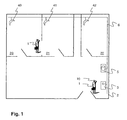
- Fig.1 illustrates how a target person 1 is registered upon entering a certain site, i.e. an office building, a hotel or even a campus comprising several buildings, and subsequently tracked, i.e. continuously localised within the site.
- the target person 1 or mobile phone user enters a building 2 comprising several rooms 20,21,22.
- the person 1 is requested to trigger a signalling exchange from her mobile phone 10 to the GSM infrastructure, while placing the phone close to the localisation service registration device (LREGD) 3.
- the receptionist or the automated LREGD 3 itself may ask the user 1 to briefly turn her mobile phone 10 off and on again.
- the GSM infrastructure assumed here could of course be replaced by any wide area mobile radio system.
- the LREGD 3 picks up the signalling message transmitted by the mobile phone 10 and decodes in particular a device identity in the form of a so-called "source MS identity" in the header part of the message. It may also measure the received power level.
- the source MS identity determines the person 1 carrying that mobile phone 10 in some GSM system-specific format, and the received power level gives an indication of the transmit power applied by the mobile phone 10 and required in a later step below.
- the receptionist of the LREGD 3 or the visiting person herself enters the appropriate identification of the targeted person 1, such as her name, into the LREGD 3, thus confirming or authenticating the mapping of the individual person 1 to the system-specific source MS identity.
- the person 1 can identify herself by presenting a machine-readable identity card to the LREGD 3.
- mobile communication systems typically do not transmit user calling numbers directly over the air, but introduce temporary routing identities in the message headers to and from the mobile stations.
- temporary identities in general are re-assigned whenever the mobile phone changes the GSM base station, they can be used in place of the "source MS identity" in the on-site, i.e. small-scale localisation system of the present invention.
- messages or their pay-loads may be encrypted and the frequencies or spreading codes may be assigned dynamically in some mobile-specific manner. It depends on the protocol as to which part of the message exchange can be used by the localisation service to identify the mobile phone 10 and therewith its user 1.
- the on-site localisation service is now operational for the registered person 1.
- Any signalling or data message transmitted by the mobile phone 10 in standby mode or user data transfer mode to the GSM infrastructure may also be picked up by some nearby localisation receiver (LRX) 40,41,42.
- the LRX 40,41 only accepts very strong signals indicating proximity of the mobile phone transmitter 10, with the threshold given by the power level measured in the registration step above and the required radius from the LRX 40,41 within which the position of the mobile phone should be determined, e.g. some 10 meters.
- the LRX 40,41 either perform the decoding of the message source MS identity locally, or send the raw received messages including received power levels to a localisation service centre (LSC) 5.
- LSC localisation service centre
- the latter is connected to all the LRX 40,41 as well as the LREGD 3 via a local area network (LAN) 6 as is commonplace in modem office buildings and for enterprise-wide computer networks or intranets.
- LAN local area network
- the LSC 5 compares the power levels received by the LRX 40,41, and also maps the source MS identity to the name of the targeted person 1.
- the LRX 40 with the strongest received signal gives the position of the identified person 1, i.e. the cell or room 20 associated with that particular LRX 40.
- the localisation of a particular person will normally only be updated when her mobile phone transmits some signalling, i.e. silent exchange with the GSM base station, or user data, i.e. speech, messages carrying the source MS identity.
- a mobile phone can however be forced to transmit by initiating an acknowledged dummy data or voice call to that person. This would be initiated by the localisation service centre LSC whenever an application requires an updated localisation.
Landscapes
- Engineering & Computer Science (AREA)
- Radar, Positioning & Navigation (AREA)
- Remote Sensing (AREA)
- Physics & Mathematics (AREA)
- General Physics & Mathematics (AREA)
- Computer Networks & Wireless Communication (AREA)
- Mobile Radio Communication Systems (AREA)
Priority Applications (1)
| Application Number | Priority Date | Filing Date | Title |
|---|---|---|---|
| EP02406096A EP1429570A1 (fr) | 2002-12-13 | 2002-12-13 | Système et procédé de localisation sur site |
Applications Claiming Priority (1)
| Application Number | Priority Date | Filing Date | Title |
|---|---|---|---|
| EP02406096A EP1429570A1 (fr) | 2002-12-13 | 2002-12-13 | Système et procédé de localisation sur site |
Publications (1)
| Publication Number | Publication Date |
|---|---|
| EP1429570A1 true EP1429570A1 (fr) | 2004-06-16 |
Family
ID=32319736
Family Applications (1)
| Application Number | Title | Priority Date | Filing Date |
|---|---|---|---|
| EP02406096A Withdrawn EP1429570A1 (fr) | 2002-12-13 | 2002-12-13 | Système et procédé de localisation sur site |
Country Status (1)
| Country | Link |
|---|---|
| EP (1) | EP1429570A1 (fr) |
Cited By (1)
| Publication number | Priority date | Publication date | Assignee | Title |
|---|---|---|---|---|
| CN107452095A (zh) * | 2016-03-18 | 2017-12-08 | 阿里巴巴集团控股有限公司 | 一种用于开启门锁的方法和设备 |
Citations (5)
| Publication number | Priority date | Publication date | Assignee | Title |
|---|---|---|---|---|
| WO1992002104A1 (fr) * | 1990-07-25 | 1992-02-06 | British Telecommunications Public Limited Company | Systeme de radio cellulaire |
| EP0559949A2 (fr) * | 1992-03-07 | 1993-09-15 | Bundesrepublik Deutschland, vertr. durch Vorstand der D. Bundespost TELEKOM, vertr. durch Präs. des Fernmeldetechn. Z.amtes | Méthode pour déterminer l'emplacement et les puissances optimums des émetteurs dans des réseaux radio pico-cellulaires |
| US5914671A (en) * | 1997-02-27 | 1999-06-22 | Micron Communications, Inc. | System and method for locating individuals and equipment, airline reservation system, communication system |
| GB2353910A (en) * | 1999-09-03 | 2001-03-07 | Ibm | Asset tracking using local beacons |
| WO2002073987A2 (fr) * | 2001-03-13 | 2002-09-19 | Telefonaktiebolaget L M Ericsson (Publ) | Procede et support lisible par un ordinateur destines a un programme de localisation d'emplacement d'un terminal mobile |
-
2002
- 2002-12-13 EP EP02406096A patent/EP1429570A1/fr not_active Withdrawn
Patent Citations (5)
| Publication number | Priority date | Publication date | Assignee | Title |
|---|---|---|---|---|
| WO1992002104A1 (fr) * | 1990-07-25 | 1992-02-06 | British Telecommunications Public Limited Company | Systeme de radio cellulaire |
| EP0559949A2 (fr) * | 1992-03-07 | 1993-09-15 | Bundesrepublik Deutschland, vertr. durch Vorstand der D. Bundespost TELEKOM, vertr. durch Präs. des Fernmeldetechn. Z.amtes | Méthode pour déterminer l'emplacement et les puissances optimums des émetteurs dans des réseaux radio pico-cellulaires |
| US5914671A (en) * | 1997-02-27 | 1999-06-22 | Micron Communications, Inc. | System and method for locating individuals and equipment, airline reservation system, communication system |
| GB2353910A (en) * | 1999-09-03 | 2001-03-07 | Ibm | Asset tracking using local beacons |
| WO2002073987A2 (fr) * | 2001-03-13 | 2002-09-19 | Telefonaktiebolaget L M Ericsson (Publ) | Procede et support lisible par un ordinateur destines a un programme de localisation d'emplacement d'un terminal mobile |
Cited By (1)
| Publication number | Priority date | Publication date | Assignee | Title |
|---|---|---|---|---|
| CN107452095A (zh) * | 2016-03-18 | 2017-12-08 | 阿里巴巴集团控股有限公司 | 一种用于开启门锁的方法和设备 |
Similar Documents
| Publication | Publication Date | Title |
|---|---|---|
| US6839022B1 (en) | Network support for subscriber access to mobile caller location information | |
| US10136264B2 (en) | Indoor locating mobile terminals in a mobile cellular telecommunication network | |
| EP1461637B1 (fr) | Procede et appareil de localisation d'unites mobiles poursuivant une autre unite mobile | |
| CN1160991C (zh) | 定位信标系统 | |
| US7315735B2 (en) | System and method for emergency 911 location detection | |
| US8014797B2 (en) | Location information system for a wireless communication device and method therefore | |
| EP1527651B1 (fr) | Systeme de localisation d'une unite mobile | |
| US6839023B1 (en) | Network support for access to location information of a mobile device | |
| US20020169539A1 (en) | Method and system for wireless tracking | |
| US6393271B1 (en) | System and method for wireline based registration of wireless device | |
| US20040203567A1 (en) | Apparatus and method for providing emergency information in a signpost location system | |
| JPH11275642A (ja) | 移動通信装置の位置判定方法、機器および移動通信装置 | |
| US7295846B2 (en) | Method for localizing a mobile terminal in an area under radio coverage of a cellular communication network and of a localization point, corresponding mobile terminal, server and localization point | |
| US20070270157A1 (en) | System and Method for Tracking Position of a Mobile Unit Using Beacons in a Mobile Communication System | |
| US20130099896A1 (en) | Sensor Location and Tagging System | |
| EP1111951A2 (fr) | Systèmes d'accès sans fil et procédé pour localiser un appareil portable là-dedans | |
| EP1429570A1 (fr) | Système et procédé de localisation sur site | |
| EP1303155A1 (fr) | Système, méthode et dispositif de détermination de la position d'une station mobile dans un système de communication sans fil | |
| EP1432151A1 (fr) | Système et procédé de localisation sur site | |
| US20100304762A1 (en) | Indoor tracking system | |
| JP3420714B2 (ja) | 位置情報発信装置,位置情報受信端末および位置情報ホスト、ならびに、これらを用いた位置情報通信システム | |
| EP1810544B1 (fr) | Procede de positionnement de station mobile, systeme de positionnement de mobile, station de base et element de reseau a cet effet | |
| KR100678514B1 (ko) | 이동통신단말기 위치에 따른 위치 기반 서비스 수행시스템 및 방법 | |
| KR100549043B1 (ko) | 이동 단말기 위치 추적 장치 및 방법 | |
| KR200323782Y1 (ko) | 억세스 채널 수신기를 이용한 이동통신 단말기의 위치추적 시스템 |
Legal Events
| Date | Code | Title | Description |
|---|---|---|---|
| PUAI | Public reference made under article 153(3) epc to a published international application that has entered the european phase |
Free format text: ORIGINAL CODE: 0009012 |
|
| AK | Designated contracting states |
Kind code of ref document: A1 Designated state(s): AT BE BG CH CY CZ DE DK EE ES FI FR GB GR IE IT LI LU MC NL PT SE SI SK TR |
|
| AX | Request for extension of the european patent |
Extension state: AL LT LV MK RO |
|
| AKX | Designation fees paid | ||
| REG | Reference to a national code |
Ref country code: DE Ref legal event code: 8566 |
|
| STAA | Information on the status of an ep patent application or granted ep patent |
Free format text: STATUS: THE APPLICATION IS DEEMED TO BE WITHDRAWN |
|
| 18D | Application deemed to be withdrawn |
Effective date: 20041217 |