EP1430745B1 - Dispositif et procede pour transmettre une pluralite de signaux au moyen d'un traitement de protocole a plusieurs niveaux - Google Patents
Dispositif et procede pour transmettre une pluralite de signaux au moyen d'un traitement de protocole a plusieurs niveaux Download PDFInfo
- Publication number
- EP1430745B1 EP1430745B1 EP02776709A EP02776709A EP1430745B1 EP 1430745 B1 EP1430745 B1 EP 1430745B1 EP 02776709 A EP02776709 A EP 02776709A EP 02776709 A EP02776709 A EP 02776709A EP 1430745 B1 EP1430745 B1 EP 1430745B1
- Authority
- EP
- European Patent Office
- Prior art keywords
- protocol
- units
- switching
- unit
- signals
- Prior art date
- Legal status (The legal status is an assumption and is not a legal conclusion. Google has not performed a legal analysis and makes no representation as to the accuracy of the status listed.)
- Expired - Lifetime
Links
Images

Classifications
-
- H—ELECTRICITY
- H04—ELECTRIC COMMUNICATION TECHNIQUE
- H04L—TRANSMISSION OF DIGITAL INFORMATION, e.g. TELEGRAPHIC COMMUNICATION
- H04L45/00—Routing or path finding of packets in data switching networks
- H04L45/52—Multiprotocol routers
-
- H—ELECTRICITY
- H04—ELECTRIC COMMUNICATION TECHNIQUE
- H04Q—SELECTING
- H04Q11/00—Selecting arrangements for multiplex systems
- H04Q11/0001—Selecting arrangements for multiplex systems using optical switching
- H04Q11/0005—Switch and router aspects
-
- H—ELECTRICITY
- H04—ELECTRIC COMMUNICATION TECHNIQUE
- H04L—TRANSMISSION OF DIGITAL INFORMATION, e.g. TELEGRAPHIC COMMUNICATION
- H04L49/00—Packet switching elements
- H04L49/60—Software-defined switches
- H04L49/602—Multilayer or multiprotocol switching, e.g. IP switching
-
- H—ELECTRICITY
- H04—ELECTRIC COMMUNICATION TECHNIQUE
- H04L—TRANSMISSION OF DIGITAL INFORMATION, e.g. TELEGRAPHIC COMMUNICATION
- H04L49/00—Packet switching elements
- H04L49/10—Packet switching elements characterised by the switching fabric construction
- H04L49/101—Packet switching elements characterised by the switching fabric construction using crossbar or matrix
-
- H—ELECTRICITY
- H04—ELECTRIC COMMUNICATION TECHNIQUE
- H04L—TRANSMISSION OF DIGITAL INFORMATION, e.g. TELEGRAPHIC COMMUNICATION
- H04L49/00—Packet switching elements
- H04L49/25—Routing or path finding in a switch fabric
-
- H—ELECTRICITY
- H04—ELECTRIC COMMUNICATION TECHNIQUE
- H04Q—SELECTING
- H04Q11/00—Selecting arrangements for multiplex systems
- H04Q11/0001—Selecting arrangements for multiplex systems using optical switching
- H04Q11/0062—Network aspects
- H04Q11/0066—Provisions for optical burst or packet networks
-
- H—ELECTRICITY
- H04—ELECTRIC COMMUNICATION TECHNIQUE
- H04Q—SELECTING
- H04Q11/00—Selecting arrangements for multiplex systems
- H04Q11/0001—Selecting arrangements for multiplex systems using optical switching
- H04Q11/0062—Network aspects
- H04Q11/0071—Provisions for the electrical-optical layer interface
-
- H—ELECTRICITY
- H04—ELECTRIC COMMUNICATION TECHNIQUE
- H04Q—SELECTING
- H04Q11/00—Selecting arrangements for multiplex systems
- H04Q11/0001—Selecting arrangements for multiplex systems using optical switching
- H04Q11/0062—Network aspects
- H04Q2011/0077—Labelling aspects, e.g. multiprotocol label switching [MPLS], G-MPLS, MPAS
Definitions
- the invention relates to a method and a device for Switching a plurality of packet-oriented signals.
- Such data networks require the data in Shape of data packets from a source to a destination. For this purpose, a corresponding switching system is required.
- the transmission capacity or the data transmission rate in networks has risen sharply, so that too the requirements for these switching systems rose steadily. This led to the need for switching equipment, especially switches and routers, to develop the a data throughput in multi-gigabit or even Have terabit range.
- switching equipment especially switches and routers, to develop the a data throughput in multi-gigabit or even Have terabit range.
- At such high transmission speeds can be the necessary network protocols just as hardware realize the necessary To be able to realize response times.
- Switching devices for these high transmission speeds are being used after a possibility realized an active backplane.
- Crossbar architectures used that are completely parallel work so the throughput of such facilities from the speed of the switching operations of the Crossbar, the Number of individual ports and the internally used communication protocol is limited.
- Crossbar architectures usually work with several Port chips together, which have interfaces with a central Crossbar chip are connected.
- Known crossbar chips include usually buffer memory in case of collisions Caching packets or cells.
- Cell conflict resolution units which regulate the traffic between the individual ports, if one port is receiving data from several other ports should. From the publications DE 19935127 and DE 19935126, as well their references, it can be seen how such cell conflicts can be resolved.
- buffer memories Another component of switching systems are buffer memories, which are required to peaks in the transfer rate in systems with variable data transmission rate - For example, systems where different services the same lines - to be able to intercept.
- protocol processing units or corresponding work Chips on this cache the next Determine port to which the information packet or the cell to be transmitted.
- the protocol processing units determine based on the header and corresponding tables who the package or cell needs to be forwarded to. So can there be multiple tables for a multi-protocol environment, for the processing of z. ATM, MPLS and IP protocols must be used.
- a disadvantage of these known systems is the relatively high implementation effort, since practically the entire protocol mechanisms must be implemented as hardware because of the high transmission speed.
- the provision of buffer memories and associated high-speed communication paths for internal data transfer to and from the buffers leads to a considerable part of the overall effort in implementing such switches.
- Most of the switching systems available on the market for packet networks and their elements are based on hopby-hop routing of the packets through the switching systems.
- the higher the protocol layer and its complexity, on which the decision is made the higher the processing effort is induced.
- a decision is made at layer 1 or layer 2 or layers of the communication layers.
- these layers are usually dependent on the particular network topology that links the switching unit together. They usually include non-overlapping topologies.
- the larger switching units consist of a plurality of protocol processing units that are tied together via coupling units (eg, the above-mentioned active crossbar backplanes) (cf., for example, DE 19935126.0).
- the coupling units used for this purpose due to their simple structure and the small memory size requirements (made possible by a coordination of the running over the coupling units packet streams) a very high performance, which goes into the terrabit range.
- the limited bandwidth of the packet buffers in the protocol processing units still limits the overall packet throughput per protocol processing unit.
- the corresponding interconnection of the protocol processing unit (mentioned in 1.) must be coordinated in the area of memory management by a corresponding additional protocol between the blocks (ie in principle a large, distributed, virtual total packet buffer is thus formed, see DE 19935127.9).
- this leads to a large bandwidth requirement for this additional protocol overhead and, on the other hand, to the necessity of integrating in the protocol processing unit additional communication units for the corresponding distributed memory coordination protocols.
- the coupling units are so far always more powerful, but there are only internal interfaces to the respective protocol processing units in which each packet undergoes full-fledged and complex processing.
- the object of the invention is a fast and cheaper To provide a switching unit.
- each port of a coupling unit has at least one protocol unit which is able to carry out a simple classification of the incoming packets and to process simple protocols quickly.
- connections of the coupling units are provided, which are connected via a network inside or outside the switching unit with a further protocol unit that can perform more complex analyzes for more complex protocols.
- packets that correspond to simplified protocol concepts, such as ATM and MPLS are processed directly in the coupling unit and immediately forwarded.
- the more complex protocol processing units are now only those packets or information about the packets routed through the network, which must be processed there on the higher protocol layers; the corresponding packet forwarding then takes place by means of the coupling units.
- the coupling units also undertake the routing of the packet, after which the output port or destination port has been determined by the protocol unit for complex protocols.
- Modern simplified protocol concepts have a strict division between control / signaling and data transport (eg MPLS with LPD / RSVP-TE (Internet Draft), (I-PoverWDM-Concepts, Method of Initialization of MPLS Paths). see eg RFC3031 / 3032/3034/3035)).
- the data transport effort is kept very simple, the buffering effort (memory and memory speed) is very limited and the coordination effort between distributed buffers is greatly reduced (by means of traffic engineering and connection acceptance / setup).
- the control / signaling traffic can thus vary greatly in complexity and in processing effort also vary greatly depending on the load situation (connection duration) and can still be treated dynamically and flexibly.
- the known switching units are used only in exceptional cases.
- the protocol processing units need only process those packets necessary for signaling (eg control packets) and in those cases where higher level processing is needed.
- the coupling matrix now carries the main overhead of packet forwarding and is connected via the usually simplest and standardized interfaces (point to point) to the network.
- HDLC similar protocols in particular come into question, such.
- the Simple Data Link Protocol SDL, see: Doshi, B. et al., "A Simple Data Link Protocol for High Speed Packet Networks", Bell Labs Technical Journal, pp. 85-104, Vol.4 No.1 ).
- the ports are connected to optical conductors.
- all-optical lambda cross-connecters with / without wavelength conversion are connected to MPLS / ATM couplers and IP router engines.
- network processors will be used for the routing that can be adapted to future more complex protocols via appropriate software solutions.
- the teaching of the invention leads to lower requirements to the packet processing power of the overall architecture. Based on the total throughput, the complete, d. H. protocol handling related to complex protocols a pure exception treatment. A flexible number of Protocol blocks can be connected according to the requirements become. The total throughput will be greater determined by the coupling units themselves, resulting in an increase in performance can lead.
- the present invention thus provides a completely new design of switching devices.
- the coupling blocks have ports that allow connection to an external network, and have at their inputs units for rapid classification of the data packets into those that are fully processed in the coupling unit itself, and those that are to be forwarded to the protocol processing blocks.
- This network is only responsible for communication with the protocol units. There is thus a strict separation between control and transport data traffic at the level of the units and assemblies.
- the coupling units are provided with additional logic, which takes over a large part of the decisions that were taken in the past by protocol units. Only the flow of information sent through more complex protocols is controlled by the known protocol entities. This dispenses with the processing of a majority of the packets in the protocol blocks. Most of the packet load is already processed at the lowest protocol level.
- FIG. 1 shows a purely electrical design of the present invention Invention.
- Port units 14, also called coupling units, are through 10-gigabit interfaces or ports 15 with the Outside world, d. H. an external network 18, directly connected. Within these port units is already a large part the packets are routed according to MPLS.
- the processing of the packages is done by protocol units 17 for less complex Protocols. Packets or their header information, the one IP routings are required in connected protocol blocks 12 processed and then only through the coupling units or port units 14 forwarded.
- the connection between the individual protocol units 12 and 17 is by a Network 13 ensured that only for the exchange of Control information is used.
- routing tables and Exchanged MPLS tables are also called exchanged MPLS tables. Furthermore, a communication takes place using the protocols already described above.
- Another embodiment is a hierarchical network, depending on the expected Protocol load has different levels with different many protocol units appropriate for the corresponding Protocols are responsible. The individual levels are at a different distance to the port units arranged. The level with most protocol units is arranged immediately adjacent to the port units.
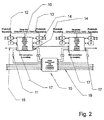
- FIG. 2 shows an embodiment which is additionally still open data forwarding through an optical cross connect with wavelength conversion (and additional wavelength-dependent Splinter combiners) based.
- multi-protocol lambda switching cf. D. Awduche et al .: "Multi-Protocol Lambda Switching: Combining MPLS Traffic Engineering with Optical Cross Connects ", Internet draft, draft-awduche-mpls-te-optical-0 1 .txt) longer existing and bandwidth-intensive MPLS paths own wavelengths are shown, which are then alone in the Cross Connector 10 will be forwarded. Some wavelengths are like previously reserved for classic packet traffic. Your bitstreams are converted optically-electrically and then as in FIG. 1 in the MPLS-compatible crossbar (and possibly in the protocol blocks) further edited.
- the connection to the port units 14 is performed by an E / O converter 11.
- a special analysis unit used the signals or information packages already analyzed in advance to determine which protocols are involved. To This statement will be forwarded to the appropriate package Log unit forwarded.
- Integrated protocol unit preferably simple protocols, like MPLS or ATM, can handle. This will ensure that simultaneously with the analysis process the Information is read and evaluated without them have to be read a second time.
Landscapes
- Engineering & Computer Science (AREA)
- Computer Networks & Wireless Communication (AREA)
- Signal Processing (AREA)
- Data Exchanges In Wide-Area Networks (AREA)
- Communication Control (AREA)
- Small-Scale Networks (AREA)
Claims (9)
- Dispositif pour transmettre une pluralité de signaux en mode paquet dans des réseaux (18, 19), en particulier pour la commutation et le routage dans les réseaux (18, 19), comprenantcaractérisé en ce qu'une pluralité d'autres unités de protocole (17) sont présentes, lesquelles sont attribuées directement aux unités de port (14), et classifient les signaux selon leur protocole de transmission afin de prendre en charge de façon autonome le traitement du protocole en fonction du protocole de transmission pour une partie des paquets et pour transmettre pour une autre partie le traitement du protocole à la première unité de protocole.une pluralité d'unités de port (14), qui comprennent un ou plusieurs ports (15), les ports pouvant être reliés au réseau,une unité de commutation (16), qui présente de préférence la fonction d'un connecteur croisé,au moins une première unité de protocole (12), qui analyse au moins une partie des signaux et fixe leur détermination,
- Dispositif selon la revendication précédente, caractérisé en ce que les autres unités de protocole (17) traitent uniquement des protocoles pour lesquels il n'est pas nécessaire d'effectuer des opérations intensives en mémoire et/ou intensives en temps pour déterminer le calcul des signaux.
- Dispositif selon la revendication précédente, caractérisé en ce que les autres unités de protocole (17) traitent uniquement des signaux dont le protocole est MPLS et/ou ATM.
- Dispositif selon l'une quelconque ou plusieurs des revendications précédentes, caractérisé en ce qu'au moins une autre unité de protocole (17) est attribuée à chaque unité de port.
- Dispositif selon l'une quelconque ou plusieurs des revendications précédentes, caractérisé en ce que les unités de protocole (17, 12) présentent respectivement au moins une interface de réseau par laquelle les unités de protocole sont reliées à un réseau (13).
- Dispositif selon l'une quelconque ou plusieurs des revendications précédentes, caractérisé en ce que les unités de protocole (17, 12) échangent entre elles des signaux de contrôle, afin de mettre à disposition de préférence des informations de commutation et/ou de routage.
- Dispositif selon l'une quelconque ou plusieurs des revendications précédentes, caractérisé en ce que la première unité de protocole (12) traite des signaux qui sont transportés sur la base du IP.
- Dispositif selon l'une quelconque ou plusieurs des revendications précédentes, caractérisé en ce que au moins une partie des unités de port (14) est reliée visuellement au moyen d'un convertisseur E/O (11) à une connexion croisée (10) optique, afin d'effectuer pour celui-ci des opérations de commutation et/ou de routage.
- Procédé pour transmettre une pluralité de signaux en mode paquet dans des réseaux, en particulier pour la commutation et le routage dans les réseaux, avec un dispositif, en particulier selon l'une ou plusieurs des revendications précédentes, qui présentent une hiérarchie d'unités de protocole, certaines hiérarchies des unités de protocole étant attribuées à un protocole en fonction du protocole utilisé et le nombre des unités de protocole dans cette hiérarchie étant dépendant de la fréquence du protocole utilisé, le signal étant analysé dans une première étape pour la détermination du protocole de transmission, afin d'attribuer ensuite, en fonction du protocole de transmission, le signal à une unité de protocole dans la hiérarchie faisant partie du protocole, pour que l'unité de protocole correspondante détermine le calcul pour transmettre ensuite le signal à l'unité de commutation.
Applications Claiming Priority (3)
| Application Number | Priority Date | Filing Date | Title |
|---|---|---|---|
| DE10147750 | 2001-09-27 | ||
| DE10147750A DE10147750A1 (de) | 2001-09-27 | 2001-09-27 | Vorrichtung und Verfahren zur Vermittlung einer Mehrzahl von Signalen unter Verwendung einer mehrstufigen Protokollverarbeitung |
| PCT/DE2002/003593 WO2003030582A2 (fr) | 2001-09-27 | 2002-09-24 | Dispositif et procede pour transmettre une pluralite de signaux au moyen d'un traitement de protocole a plusieurs niveaux |
Publications (2)
| Publication Number | Publication Date |
|---|---|
| EP1430745A2 EP1430745A2 (fr) | 2004-06-23 |
| EP1430745B1 true EP1430745B1 (fr) | 2005-04-13 |
Family
ID=7700540
Family Applications (1)
| Application Number | Title | Priority Date | Filing Date |
|---|---|---|---|
| EP02776709A Expired - Lifetime EP1430745B1 (fr) | 2001-09-27 | 2002-09-24 | Dispositif et procede pour transmettre une pluralite de signaux au moyen d'un traitement de protocole a plusieurs niveaux |
Country Status (13)
| Country | Link |
|---|---|
| US (1) | US20050044264A1 (fr) |
| EP (1) | EP1430745B1 (fr) |
| KR (1) | KR100850382B1 (fr) |
| CN (1) | CN1559159A (fr) |
| AT (1) | ATE293345T1 (fr) |
| AU (1) | AU2002339322A1 (fr) |
| CA (1) | CA2461904C (fr) |
| DE (2) | DE10147750A1 (fr) |
| ES (1) | ES2237698T3 (fr) |
| MX (1) | MXPA04002745A (fr) |
| RU (1) | RU2299529C2 (fr) |
| WO (1) | WO2003030582A2 (fr) |
| ZA (1) | ZA200402053B (fr) |
Families Citing this family (11)
| Publication number | Priority date | Publication date | Assignee | Title |
|---|---|---|---|---|
| US7525958B2 (en) * | 2004-04-08 | 2009-04-28 | Intel Corporation | Apparatus and method for two-stage packet classification using most specific filter matching and transport level sharing |
| US8458280B2 (en) * | 2005-04-08 | 2013-06-04 | Intel-Ne, Inc. | Apparatus and method for packet transmission over a high speed network supporting remote direct memory access operations |
| US7889762B2 (en) | 2006-01-19 | 2011-02-15 | Intel-Ne, Inc. | Apparatus and method for in-line insertion and removal of markers |
| US8078743B2 (en) * | 2006-02-17 | 2011-12-13 | Intel-Ne, Inc. | Pipelined processing of RDMA-type network transactions |
| US7849232B2 (en) | 2006-02-17 | 2010-12-07 | Intel-Ne, Inc. | Method and apparatus for using a single multi-function adapter with different operating systems |
| US8316156B2 (en) | 2006-02-17 | 2012-11-20 | Intel-Ne, Inc. | Method and apparatus for interfacing device drivers to single multi-function adapter |
| US8102857B2 (en) | 2007-02-02 | 2012-01-24 | Motorola Solutions, Inc. | System and method for processing data and control messages in a communication system |
| JP2008306478A (ja) * | 2007-06-07 | 2008-12-18 | Nec Corp | データ転送装置、データ転送方法及びデータ転送プログラム |
| US20090274157A1 (en) * | 2008-05-01 | 2009-11-05 | Vaidya Aniruddha S | Method and apparatus for hierarchical routing in multiprocessor mesh-based systems |
| JP5218979B2 (ja) * | 2008-12-15 | 2013-06-26 | 日本電気株式会社 | データ転送装置 |
| CN101621478A (zh) * | 2009-08-07 | 2010-01-06 | 中兴通讯股份有限公司 | 队列调度的方法及装置 |
Family Cites Families (10)
| Publication number | Priority date | Publication date | Assignee | Title |
|---|---|---|---|---|
| US5450406A (en) * | 1993-04-20 | 1995-09-12 | Kabushiki Kaisha Toshiba | ATM communication system with high speed connection-less service function |
| US5426694A (en) * | 1993-10-08 | 1995-06-20 | Excel, Inc. | Telecommunication switch having programmable network protocols and communications services |
| JP3149845B2 (ja) * | 1998-03-20 | 2001-03-26 | 日本電気株式会社 | Atm通信装置 |
| US6038230A (en) * | 1998-07-22 | 2000-03-14 | Synchrodyne, Inc. | Packet switching with common time reference over links with dynamically varying delays |
| JP3761362B2 (ja) * | 1999-07-28 | 2006-03-29 | 沖電気工業株式会社 | ノード制御装置、ノード装置、光ネットワークシステム及び光パス設定方法 |
| US6721315B1 (en) * | 1999-09-30 | 2004-04-13 | Alcatel | Control architecture in optical burst-switched networks |
| EP1091529A3 (fr) * | 1999-10-08 | 2004-05-19 | Alcatel | Noeud de réseau de télécommunications avec capacité multiprotocole, procédé de traitement de signaux, et réseau de télécommunications comportant des noeuds multiprotocole |
| US6674754B1 (en) * | 1999-11-09 | 2004-01-06 | Synchrodyne Networks, Inc. | Wavelength division multiplexing combined with time division multiplexing using a common time reference |
| WO2001067694A1 (fr) | 2000-03-03 | 2001-09-13 | Celox Networks, Inc. | Serveur de milieu de reseaux a large bande |
| JP2002290399A (ja) * | 2001-03-26 | 2002-10-04 | Fujitsu Ltd | 加入者終端装置およびパケット処理方法 |
-
2001
- 2001-09-27 DE DE10147750A patent/DE10147750A1/de not_active Withdrawn
-
2002
- 2002-09-24 AT AT02776709T patent/ATE293345T1/de not_active IP Right Cessation
- 2002-09-24 ES ES02776709T patent/ES2237698T3/es not_active Expired - Lifetime
- 2002-09-24 US US10/491,081 patent/US20050044264A1/en not_active Abandoned
- 2002-09-24 CA CA002461904A patent/CA2461904C/fr not_active Expired - Fee Related
- 2002-09-24 WO PCT/DE2002/003593 patent/WO2003030582A2/fr not_active Ceased
- 2002-09-24 MX MXPA04002745A patent/MXPA04002745A/es active IP Right Grant
- 2002-09-24 EP EP02776709A patent/EP1430745B1/fr not_active Expired - Lifetime
- 2002-09-24 CN CNA02818808XA patent/CN1559159A/zh active Pending
- 2002-09-24 KR KR1020047004525A patent/KR100850382B1/ko not_active Expired - Fee Related
- 2002-09-24 RU RU2004112765/09A patent/RU2299529C2/ru not_active IP Right Cessation
- 2002-09-24 DE DE50202797T patent/DE50202797D1/de not_active Expired - Fee Related
- 2002-09-24 AU AU2002339322A patent/AU2002339322A1/en not_active Abandoned
-
2004
- 2004-03-15 ZA ZA200402053A patent/ZA200402053B/en unknown
Also Published As
| Publication number | Publication date |
|---|---|
| CA2461904A1 (fr) | 2003-04-10 |
| CA2461904C (fr) | 2008-06-10 |
| ES2237698T3 (es) | 2005-08-01 |
| CN1559159A (zh) | 2004-12-29 |
| ATE293345T1 (de) | 2005-04-15 |
| RU2299529C2 (ru) | 2007-05-20 |
| EP1430745A2 (fr) | 2004-06-23 |
| DE50202797D1 (de) | 2005-05-19 |
| WO2003030582A2 (fr) | 2003-04-10 |
| KR100850382B1 (ko) | 2008-08-04 |
| US20050044264A1 (en) | 2005-02-24 |
| AU2002339322A1 (en) | 2003-04-14 |
| WO2003030582A3 (fr) | 2003-10-02 |
| MXPA04002745A (es) | 2004-07-29 |
| DE10147750A1 (de) | 2003-04-17 |
| KR20040041632A (ko) | 2004-05-17 |
| RU2004112765A (ru) | 2005-05-10 |
| ZA200402053B (en) | 2005-05-27 |
Similar Documents
| Publication | Publication Date | Title |
|---|---|---|
| DE60320044T2 (de) | Paket und optische leitweglenkgeräte und verfahren | |
| DE60031055T2 (de) | Optische Paket-Weiterleitung in einem Netzwerksystem basiert auf optische Etikett-Kopplungstechnik | |
| DE69527489T2 (de) | Vermittlungssystem für optische Pakete | |
| DE69434263T2 (de) | Photonisches Koppelfeld mit Frequenzweglenkung für Zeitmultiplexstrecken | |
| DE69732814T2 (de) | Optisches Paketvermittlungssystem | |
| DE68921312T2 (de) | Aufbau für selbstleitweglenkendes Paketvermittlungsnetz. | |
| DE69811622T2 (de) | Verfahren und Vorrichtung zur Bandbreitenverwaltung in einem Datenübertragungsnetz | |
| DE60103331T2 (de) | Verfahren zum Betreiben eines Puffers für das Wiederzusammenstellen von Paketen und Netzwerk-Router | |
| DE602004005164T2 (de) | Architektur, verfahren und system wdm-gestützter photonischer burst-vermittelter netzwerke | |
| DE202015009244U1 (de) | Routing von Datenverkehr innerhalb von und zwischen autonomen Systemen | |
| DE69729853T2 (de) | Modulare vermittlungsanordnung | |
| DE10011667C2 (de) | Hochgeschwindigkeits-Router | |
| DE10147750A1 (de) | Vorrichtung und Verfahren zur Vermittlung einer Mehrzahl von Signalen unter Verwendung einer mehrstufigen Protokollverarbeitung | |
| EP0419720B1 (fr) | Système de télécommunication à fibre optique avec un ou plusiers commutateurs optiques situés sur le chemin optique | |
| EP1262084B1 (fr) | Procede de commutation de remplacement de dispositifs de transmission dans les reseaux mpls | |
| DE60212558T2 (de) | Optischer TDM und WDM Vermittlungsknoten | |
| DE69722051T2 (de) | ATM-Schaltsystem mit Verteilernetzwerken für variable Verkehrsmuster | |
| EP0587930B1 (fr) | Procédé de commutation pour des cellules de communication optiques | |
| DE69528951T2 (de) | Photonische Schaltmatrix | |
| EP3654594A1 (fr) | Procédé de transmission de données, appareil de communication, programme informatique et support lisible par ordinateur | |
| DE60203100T2 (de) | Netzzugangsanordung | |
| WO2001065775A1 (fr) | Procede de commutation de remplacement de dispositifs de transmission dans des architectures en boucle utilisant les paquets a commutation par etiquette multiprotocole (mpls) | |
| DE69232127T2 (de) | Serieller Multimedia Linienschalter für Parallelnetzwerke und ein heterogenes homologes Rechnersystem | |
| DE60118802T2 (de) | Skalierbarer, modulärer, stringent blockierungsfreier elektro-optischer querverbindungskern | |
| DE10036709A1 (de) | Optischer Netzknoten mit Add-Drop- oder Cross-Connect-Funktionalität |
Legal Events
| Date | Code | Title | Description |
|---|---|---|---|
| PUAI | Public reference made under article 153(3) epc to a published international application that has entered the european phase |
Free format text: ORIGINAL CODE: 0009012 |
|
| 17P | Request for examination filed |
Effective date: 20040219 |
|
| AK | Designated contracting states |
Kind code of ref document: A2 Designated state(s): AT BE BG CH CY CZ DE DK EE ES FI FR GB GR IE IT LI LU MC NL PT SE SK TR |
|
| AX | Request for extension of the european patent |
Extension state: AL LT LV MK RO SI |
|
| GRAP | Despatch of communication of intention to grant a patent |
Free format text: ORIGINAL CODE: EPIDOSNIGR1 |
|
| GRAS | Grant fee paid |
Free format text: ORIGINAL CODE: EPIDOSNIGR3 |
|
| GRAA | (expected) grant |
Free format text: ORIGINAL CODE: 0009210 |
|
| AK | Designated contracting states |
Kind code of ref document: B1 Designated state(s): AT BE BG CH CY CZ DE DK EE ES FI FR GB GR IE IT LI LU MC NL PT SE SK TR |
|
| PG25 | Lapsed in a contracting state [announced via postgrant information from national office to epo] |
Ref country code: IE Free format text: LAPSE BECAUSE OF FAILURE TO SUBMIT A TRANSLATION OF THE DESCRIPTION OR TO PAY THE FEE WITHIN THE PRESCRIBED TIME-LIMIT Effective date: 20050413 Ref country code: FI Free format text: LAPSE BECAUSE OF FAILURE TO SUBMIT A TRANSLATION OF THE DESCRIPTION OR TO PAY THE FEE WITHIN THE PRESCRIBED TIME-LIMIT Effective date: 20050413 Ref country code: EE Free format text: LAPSE BECAUSE OF FAILURE TO SUBMIT A TRANSLATION OF THE DESCRIPTION OR TO PAY THE FEE WITHIN THE PRESCRIBED TIME-LIMIT Effective date: 20050413 Ref country code: SK Free format text: LAPSE BECAUSE OF FAILURE TO SUBMIT A TRANSLATION OF THE DESCRIPTION OR TO PAY THE FEE WITHIN THE PRESCRIBED TIME-LIMIT Effective date: 20050413 Ref country code: TR Free format text: LAPSE BECAUSE OF FAILURE TO SUBMIT A TRANSLATION OF THE DESCRIPTION OR TO PAY THE FEE WITHIN THE PRESCRIBED TIME-LIMIT Effective date: 20050413 Ref country code: CZ Free format text: LAPSE BECAUSE OF FAILURE TO SUBMIT A TRANSLATION OF THE DESCRIPTION OR TO PAY THE FEE WITHIN THE PRESCRIBED TIME-LIMIT Effective date: 20050413 |
|
| REG | Reference to a national code |
Ref country code: GB Ref legal event code: FG4D Free format text: NOT ENGLISH |
|
| REG | Reference to a national code |
Ref country code: CH Ref legal event code: EP |
|
| GBT | Gb: translation of ep patent filed (gb section 77(6)(a)/1977) |
Effective date: 20050413 |
|
| REG | Reference to a national code |
Ref country code: IE Ref legal event code: FG4D Free format text: LANGUAGE OF EP DOCUMENT: GERMAN |
|
| REF | Corresponds to: |
Ref document number: 50202797 Country of ref document: DE Date of ref document: 20050519 Kind code of ref document: P |
|
| PG25 | Lapsed in a contracting state [announced via postgrant information from national office to epo] |
Ref country code: DK Free format text: LAPSE BECAUSE OF FAILURE TO SUBMIT A TRANSLATION OF THE DESCRIPTION OR TO PAY THE FEE WITHIN THE PRESCRIBED TIME-LIMIT Effective date: 20050713 Ref country code: SE Free format text: LAPSE BECAUSE OF FAILURE TO SUBMIT A TRANSLATION OF THE DESCRIPTION OR TO PAY THE FEE WITHIN THE PRESCRIBED TIME-LIMIT Effective date: 20050713 Ref country code: GR Free format text: LAPSE BECAUSE OF FAILURE TO SUBMIT A TRANSLATION OF THE DESCRIPTION OR TO PAY THE FEE WITHIN THE PRESCRIBED TIME-LIMIT Effective date: 20050713 Ref country code: BG Free format text: LAPSE BECAUSE OF FAILURE TO SUBMIT A TRANSLATION OF THE DESCRIPTION OR TO PAY THE FEE WITHIN THE PRESCRIBED TIME-LIMIT Effective date: 20050713 |
|
| REG | Reference to a national code |
Ref country code: ES Ref legal event code: FG2A Ref document number: 2237698 Country of ref document: ES Kind code of ref document: T3 |
|
| PG25 | Lapsed in a contracting state [announced via postgrant information from national office to epo] |
Ref country code: PT Free format text: LAPSE BECAUSE OF FAILURE TO SUBMIT A TRANSLATION OF THE DESCRIPTION OR TO PAY THE FEE WITHIN THE PRESCRIBED TIME-LIMIT Effective date: 20050913 |
|
| PG25 | Lapsed in a contracting state [announced via postgrant information from national office to epo] |
Ref country code: CY Free format text: LAPSE BECAUSE OF FAILURE TO SUBMIT A TRANSLATION OF THE DESCRIPTION OR TO PAY THE FEE WITHIN THE PRESCRIBED TIME-LIMIT Effective date: 20050924 |
|
| PG25 | Lapsed in a contracting state [announced via postgrant information from national office to epo] |
Ref country code: LU Free format text: LAPSE BECAUSE OF NON-PAYMENT OF DUE FEES Effective date: 20050930 Ref country code: MC Free format text: LAPSE BECAUSE OF NON-PAYMENT OF DUE FEES Effective date: 20050930 Ref country code: BE Free format text: LAPSE BECAUSE OF NON-PAYMENT OF DUE FEES Effective date: 20050930 |
|
| REG | Reference to a national code |
Ref country code: IE Ref legal event code: FD4D |
|
| PLBE | No opposition filed within time limit |
Free format text: ORIGINAL CODE: 0009261 |
|
| STAA | Information on the status of an ep patent application or granted ep patent |
Free format text: STATUS: NO OPPOSITION FILED WITHIN TIME LIMIT |
|
| ET | Fr: translation filed | ||
| 26N | No opposition filed |
Effective date: 20060116 |
|
| PG25 | Lapsed in a contracting state [announced via postgrant information from national office to epo] |
Ref country code: CH Free format text: LAPSE BECAUSE OF NON-PAYMENT OF DUE FEES Effective date: 20060930 Ref country code: LI Free format text: LAPSE BECAUSE OF NON-PAYMENT OF DUE FEES Effective date: 20060930 |
|
| REG | Reference to a national code |
Ref country code: CH Ref legal event code: PL |
|
| BERE | Be: lapsed |
Owner name: SIEMENS A.G. Effective date: 20050930 |
|
| NLS | Nl: assignments of ep-patents |
Owner name: NOKIA SIEMENS NETWORKS GMBH & CO. KG Effective date: 20080422 |
|
| REG | Reference to a national code |
Ref country code: FR Ref legal event code: TP |
|
| PGFP | Annual fee paid to national office [announced via postgrant information from national office to epo] |
Ref country code: AT Payment date: 20080915 Year of fee payment: 7 Ref country code: FR Payment date: 20080912 Year of fee payment: 7 Ref country code: IT Payment date: 20080922 Year of fee payment: 7 Ref country code: NL Payment date: 20080915 Year of fee payment: 7 |
|
| PGFP | Annual fee paid to national office [announced via postgrant information from national office to epo] |
Ref country code: GB Payment date: 20080918 Year of fee payment: 7 |
|
| PGFP | Annual fee paid to national office [announced via postgrant information from national office to epo] |
Ref country code: DE Payment date: 20080919 Year of fee payment: 7 |
|
| PGFP | Annual fee paid to national office [announced via postgrant information from national office to epo] |
Ref country code: ES Payment date: 20080929 Year of fee payment: 7 |
|
| REG | Reference to a national code |
Ref country code: GB Ref legal event code: 732E Free format text: REGISTERED BETWEEN 20090205 AND 20090211 |
|
| REG | Reference to a national code |
Ref country code: NL Ref legal event code: V1 Effective date: 20100401 |
|
| GBPC | Gb: european patent ceased through non-payment of renewal fee |
Effective date: 20090924 |
|
| REG | Reference to a national code |
Ref country code: FR Ref legal event code: ST Effective date: 20100531 |
|
| PG25 | Lapsed in a contracting state [announced via postgrant information from national office to epo] |
Ref country code: AT Free format text: LAPSE BECAUSE OF NON-PAYMENT OF DUE FEES Effective date: 20090924 |
|
| PG25 | Lapsed in a contracting state [announced via postgrant information from national office to epo] |
Ref country code: FR Free format text: LAPSE BECAUSE OF NON-PAYMENT OF DUE FEES Effective date: 20090930 Ref country code: NL Free format text: LAPSE BECAUSE OF NON-PAYMENT OF DUE FEES Effective date: 20100401 Ref country code: DE Free format text: LAPSE BECAUSE OF NON-PAYMENT OF DUE FEES Effective date: 20100401 |
|
| PG25 | Lapsed in a contracting state [announced via postgrant information from national office to epo] |
Ref country code: GB Free format text: LAPSE BECAUSE OF NON-PAYMENT OF DUE FEES Effective date: 20090924 |
|
| PG25 | Lapsed in a contracting state [announced via postgrant information from national office to epo] |
Ref country code: IT Free format text: LAPSE BECAUSE OF NON-PAYMENT OF DUE FEES Effective date: 20090924 |
|
| REG | Reference to a national code |
Ref country code: ES Ref legal event code: FD2A Effective date: 20110712 |
|
| PG25 | Lapsed in a contracting state [announced via postgrant information from national office to epo] |
Ref country code: ES Free format text: LAPSE BECAUSE OF NON-PAYMENT OF DUE FEES Effective date: 20110630 |
|
| PG25 | Lapsed in a contracting state [announced via postgrant information from national office to epo] |
Ref country code: ES Free format text: LAPSE BECAUSE OF NON-PAYMENT OF DUE FEES Effective date: 20090925 |