EP1430882A2 - Antioxidans-Kombinationen mit 6,7-disubstituierten 2,2-Dialkylchromanen oder -chromenen - Google Patents
Antioxidans-Kombinationen mit 6,7-disubstituierten 2,2-Dialkylchromanen oder -chromenen Download PDFInfo
- Publication number
- EP1430882A2 EP1430882A2 EP03028016A EP03028016A EP1430882A2 EP 1430882 A2 EP1430882 A2 EP 1430882A2 EP 03028016 A EP03028016 A EP 03028016A EP 03028016 A EP03028016 A EP 03028016A EP 1430882 A2 EP1430882 A2 EP 1430882A2
- Authority
- EP
- European Patent Office
- Prior art keywords
- acid
- group
- butyl
- tert
- derivatives
- Prior art date
- Legal status (The legal status is an assumption and is not a legal conclusion. Google has not performed a legal analysis and makes no representation as to the accuracy of the status listed.)
- Granted
Links
Classifications
-
- A—HUMAN NECESSITIES
- A61—MEDICAL OR VETERINARY SCIENCE; HYGIENE
- A61K—PREPARATIONS FOR MEDICAL, DENTAL OR TOILETRY PURPOSES
- A61K8/00—Cosmetics or similar toiletry preparations
- A61K8/18—Cosmetics or similar toiletry preparations characterised by the composition
- A61K8/30—Cosmetics or similar toiletry preparations characterised by the composition containing organic compounds
- A61K8/33—Cosmetics or similar toiletry preparations characterised by the composition containing organic compounds containing oxygen
- A61K8/34—Alcohols
- A61K8/347—Phenols
-
- A—HUMAN NECESSITIES
- A61—MEDICAL OR VETERINARY SCIENCE; HYGIENE
- A61K—PREPARATIONS FOR MEDICAL, DENTAL OR TOILETRY PURPOSES
- A61K31/00—Medicinal preparations containing organic active ingredients
- A61K31/12—Ketones
- A61K31/122—Ketones having the oxygen directly attached to a ring, e.g. quinones, vitamin K1, anthralin
-
- A—HUMAN NECESSITIES
- A61—MEDICAL OR VETERINARY SCIENCE; HYGIENE
- A61K—PREPARATIONS FOR MEDICAL, DENTAL OR TOILETRY PURPOSES
- A61K31/00—Medicinal preparations containing organic active ingredients
- A61K31/33—Heterocyclic compounds
- A61K31/335—Heterocyclic compounds having oxygen as the only ring hetero atom, e.g. fungichromin
- A61K31/35—Heterocyclic compounds having oxygen as the only ring hetero atom, e.g. fungichromin having six-membered rings with one oxygen as the only ring hetero atom
-
- A—HUMAN NECESSITIES
- A61—MEDICAL OR VETERINARY SCIENCE; HYGIENE
- A61K—PREPARATIONS FOR MEDICAL, DENTAL OR TOILETRY PURPOSES
- A61K45/00—Medicinal preparations containing active ingredients not provided for in groups A61K31/00 - A61K41/00
- A61K45/06—Mixtures of active ingredients without chemical characterisation, e.g. antiphlogistics and cardiaca
-
- A—HUMAN NECESSITIES
- A61—MEDICAL OR VETERINARY SCIENCE; HYGIENE
- A61K—PREPARATIONS FOR MEDICAL, DENTAL OR TOILETRY PURPOSES
- A61K8/00—Cosmetics or similar toiletry preparations
- A61K8/18—Cosmetics or similar toiletry preparations characterised by the composition
- A61K8/30—Cosmetics or similar toiletry preparations characterised by the composition containing organic compounds
- A61K8/31—Hydrocarbons
-
- A—HUMAN NECESSITIES
- A61—MEDICAL OR VETERINARY SCIENCE; HYGIENE
- A61K—PREPARATIONS FOR MEDICAL, DENTAL OR TOILETRY PURPOSES
- A61K8/00—Cosmetics or similar toiletry preparations
- A61K8/18—Cosmetics or similar toiletry preparations characterised by the composition
- A61K8/30—Cosmetics or similar toiletry preparations characterised by the composition containing organic compounds
- A61K8/49—Cosmetics or similar toiletry preparations characterised by the composition containing organic compounds containing heterocyclic compounds
- A61K8/494—Cosmetics or similar toiletry preparations characterised by the composition containing organic compounds containing heterocyclic compounds with more than one nitrogen as the only hetero atom
- A61K8/4946—Imidazoles or their condensed derivatives, e.g. benzimidazoles
-
- A—HUMAN NECESSITIES
- A61—MEDICAL OR VETERINARY SCIENCE; HYGIENE
- A61K—PREPARATIONS FOR MEDICAL, DENTAL OR TOILETRY PURPOSES
- A61K8/00—Cosmetics or similar toiletry preparations
- A61K8/18—Cosmetics or similar toiletry preparations characterised by the composition
- A61K8/30—Cosmetics or similar toiletry preparations characterised by the composition containing organic compounds
- A61K8/67—Vitamins
- A61K8/676—Ascorbic acid, i.e. vitamin C
-
- A—HUMAN NECESSITIES
- A61—MEDICAL OR VETERINARY SCIENCE; HYGIENE
- A61K—PREPARATIONS FOR MEDICAL, DENTAL OR TOILETRY PURPOSES
- A61K8/00—Cosmetics or similar toiletry preparations
- A61K8/18—Cosmetics or similar toiletry preparations characterised by the composition
- A61K8/96—Cosmetics or similar toiletry preparations characterised by the composition containing materials, or derivatives thereof of undetermined constitution
- A61K8/97—Cosmetics or similar toiletry preparations characterised by the composition containing materials, or derivatives thereof of undetermined constitution from algae, fungi, lichens or plants; from derivatives thereof
- A61K8/9783—Angiosperms [Magnoliophyta]
- A61K8/9789—Magnoliopsida [dicotyledons]
-
- A—HUMAN NECESSITIES
- A61—MEDICAL OR VETERINARY SCIENCE; HYGIENE
- A61K—PREPARATIONS FOR MEDICAL, DENTAL OR TOILETRY PURPOSES
- A61K8/00—Cosmetics or similar toiletry preparations
- A61K8/18—Cosmetics or similar toiletry preparations characterised by the composition
- A61K8/96—Cosmetics or similar toiletry preparations characterised by the composition containing materials, or derivatives thereof of undetermined constitution
- A61K8/97—Cosmetics or similar toiletry preparations characterised by the composition containing materials, or derivatives thereof of undetermined constitution from algae, fungi, lichens or plants; from derivatives thereof
- A61K8/9783—Angiosperms [Magnoliophyta]
- A61K8/9794—Liliopsida [monocotyledons]
-
- A—HUMAN NECESSITIES
- A61—MEDICAL OR VETERINARY SCIENCE; HYGIENE
- A61P—SPECIFIC THERAPEUTIC ACTIVITY OF CHEMICAL COMPOUNDS OR MEDICINAL PREPARATIONS
- A61P17/00—Drugs for dermatological disorders
- A61P17/18—Antioxidants, e.g. antiradicals
-
- A—HUMAN NECESSITIES
- A61—MEDICAL OR VETERINARY SCIENCE; HYGIENE
- A61Q—SPECIFIC USE OF COSMETICS OR SIMILAR TOILETRY PREPARATIONS
- A61Q19/00—Preparations for care of the skin
-
- A—HUMAN NECESSITIES
- A61—MEDICAL OR VETERINARY SCIENCE; HYGIENE
- A61Q—SPECIFIC USE OF COSMETICS OR SIMILAR TOILETRY PREPARATIONS
- A61Q5/00—Preparations for care of the hair
-
- A—HUMAN NECESSITIES
- A61—MEDICAL OR VETERINARY SCIENCE; HYGIENE
- A61K—PREPARATIONS FOR MEDICAL, DENTAL OR TOILETRY PURPOSES
- A61K2800/00—Properties of cosmetic compositions or active ingredients thereof or formulation aids used therein and process related aspects
- A61K2800/40—Chemical, physico-chemical or functional or structural properties of particular ingredients
- A61K2800/52—Stabilizers
- A61K2800/522—Antioxidants; Radical scavengers
-
- A—HUMAN NECESSITIES
- A61—MEDICAL OR VETERINARY SCIENCE; HYGIENE
- A61Q—SPECIFIC USE OF COSMETICS OR SIMILAR TOILETRY PREPARATIONS
- A61Q1/00—Make-up preparations; Body powders; Preparations for removing make-up
- A61Q1/14—Preparations for removing make-up
Definitions
- the invention relates to topical cosmetic and pharmaceutical compositions, which is a synergistic combination of a selected 6,7-disubstituted 2,2-dialkylchromane or -chrome with another selected antioxidant.
- Known 2,2-dialkylchroman derivatives are above all tocopherols and tocotrienols.
- the tocopherols are substituted in the 2-position with a methyl radical and with a saturated 4 ', 8', 12'-trimethyltridecyl radical and have either a hydrogen atom or a methyl group in the 5-, 7- and 8-position ( ⁇ -, ⁇ -, ⁇ -, ⁇ -, ⁇ 2 - and ⁇ -tocopherols).
- the tocotrienols also known as ⁇ -tocopherols, differ from the above-mentioned tocopherols in that a trisaturated 4 ', 8', 12 'in place of the saturated 4', 8 ', 12'-trimethyltridecyl radical in the 2-position -Trimethyltridecatrienyl residue consisting of three isoprenyl units is present.
- tocopherols act as antioxidants in fats and oils.
- tocopherols have a variety of beneficial physiological properties, e.g. B. Reduction of muscle damage due to oxidative stress during peak physical performance, reduction of the risk of cataract formation, reduction of oxidative stress in smokers and anticarcinogenic effects.
- the patent US 5,811,083 discloses the amide from 3,4-dihydro-6-hydroxy-2,5,7,8-tetramethyl-1-benzopyran-2-carboxylic acid (Trolox C) and cysteamine as an antioxidant against lipid peroxidation.
- the published patent application EP 655 239 A1 discloses the use of 2,2-dimethylchromanes and -chromenes, which can be substituted in the 6- and 7-positions with OH, CH 3 O or CF 3 CH 2 O groups, as antioxidants in Doxorubicin-containing liposomes.
- the published patent application EP 1 002 533 A1 discloses the use of the 2,2-dimethylchromanes and -chromenes mentioned as antioxidants in compositions for topical or oral administration.
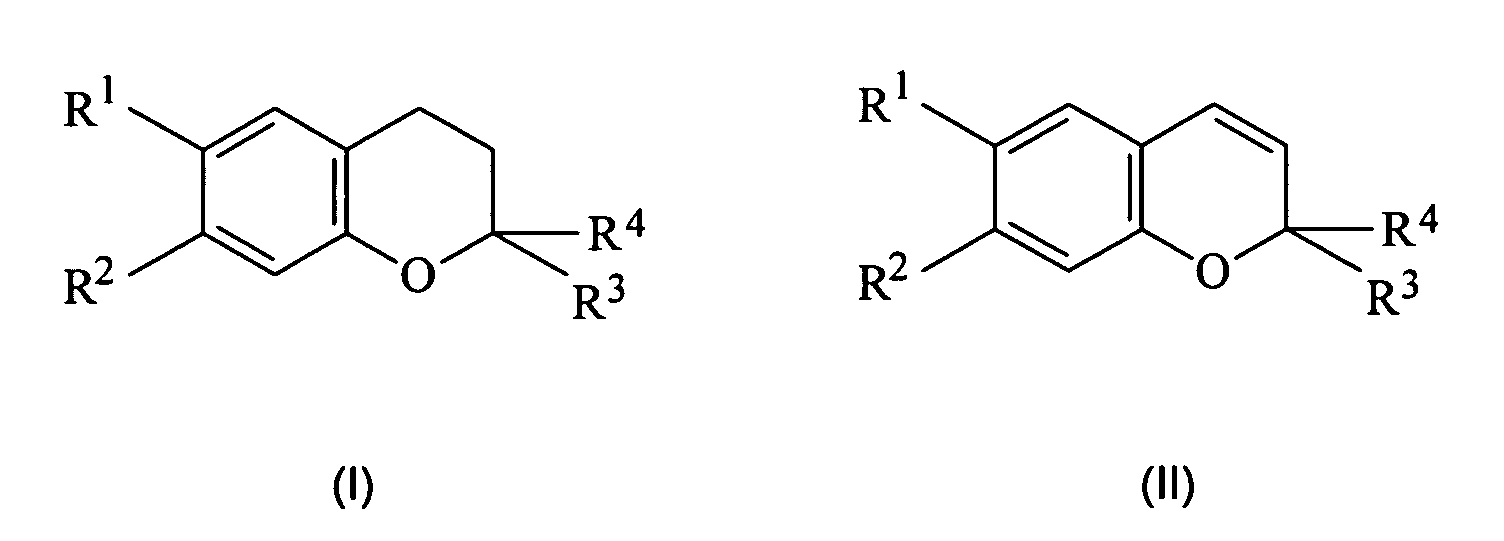
- R 1 and R 2 are independently selected from an OH group, a methoxy group and a CF 3 CH 2 O group.
- R 1 and R 2 are independently selected from an OH group and a methoxy group.
- R 1 represents an OH group and R 2 represents a methoxy group.
- R 3 and R 4 independently of one another represent a C 1 -C 4 alkyl group.
- a C 1 -C 4 alkyl group here is a methyl, ethyl, n-propyl, isopropyl, n-butyl
- R 3 and R 4 are independently selected from a methyl, ethyl, n-propyl, isopropyl and an n-butyl group.
- R 3 and R 4 are particularly preferably independently of one another a methyl or ethyl group. It is extraordinarily preferred that R 3 and R 4 are identical.
- the 6,7-disubstituted 2,2-dialkylchromanes are preferred according to the invention.
- An invention The active substance which is used with particular preference is 2,2-dimethyl-6-hydroxy-7-methoxy-chroman with the systematic name 3,4-dihydro-7-methoxy-2,2-dimethyl-2H-1-benzopyran-6-ol and the INCI name Dimethyl methoxy chromanol.
- the substance is under the trade name Lipochroman-6 from Lipotec S.A. available.
- the 6,7-disubstituted 2,2-dialkylchromanes or -chromenes of the general formulas (I) or (II) according to the invention in amounts of 0.001-5% by weight, preferably 0.005 - 2 wt .-% and particularly preferably 0.01 - 1 wt .-%, each based on the total Composition used.
- the antioxidants their antioxidative effect in the combination according to the invention with the 6,7-disubstituted 2,2-dialkylchromanes or -chromenes of the formula (I) or (II) is increased both to stabilize the fats against autoxidation and also as a radical scavenger and for non-therapeutic skin care and / or for non-therapeutic preventive treatment of skin aging used.
- the flavonoids suitable according to the invention include the glycosides of flavones, flavanones, 3-hydroxyflavones (flavonols), aurones and isoflavones.
- Particularly preferred flavonoids are selected from apigenin-7-glucoside, ⁇ -glucosylrutin, ⁇ -glucosylmyricetin, ⁇ -glucosylisoquercetin, ⁇ -glucosylquercetin, naringin (aurantiin, naringenin-7-rhamnoglucoside), hesperidin (3 ', 5,7-hydroxy-7,7 4'-methoxyflavanone-7-rhamnoglucoside, hesperitin-7-O-rhamnoglucoside), neohesperidine, rutin (3,3 ', 4', 5,7-pentahydroxyflavon-3-rhamnoglucoside, quercetin-3-rhamnoglucoside), trox
- the biflavonoids composed of two flavonoid units, which, for. B. occur in Gingko species.
- Other preferred flavonoids are the chalcones, especially phlorizin and neohesperidin dihydrochalkon.
- the flavonoids are used in amounts of 0.001 to 1% by weight, preferably 0.005 to 0.5% by weight and particularly preferably 0.01 to 0.4% by weight, in each case based on the flavonoid active substance in the entire cosmetic composition , used.
- a particularly preferred flavonoid-rich cosmetic active ingredient is the commercial product Vegeles Phytofiltre AD, a hydrolyzed extract from Adansonia digitata, available from Laboratoires Sérobiologiques (Cognis).
- the antioxidants which are increased according to the invention are selected from polyphenols.
- polyphenols are to be understood as meaning aromatic compounds which contain at least two phenolic hydroxyl groups in the molecule. These include the three dihydroxybenzenes pyrocatechol, resorcinol and hydroquinone, as well as phloroglucin, pyrogallol and hexahydroxybenzene.
- free and etherified polyphenols occur, for example, in flower dyes (anthocyanidins, flavones), in tannins (catechins, tannins), as lichen or fern ingredients (usnic acid, acyl polyphenols), in lignins and as gallic acid derivatives.
- Preferred polyphenols are flavones, catechins, usnic acid, and the derivatives of gallic acid, digallic acid and digalloyl gallic acid as tannins.
- Particularly preferred polyphenols are the monomeric catechins, that is, the derivatives of flavan-3-ols, and leukoanthocyanidins, that is, the derivatives of leukoanthocyanidins, which preferably carry phenolic hydroxyl groups in the 5,7,3 ', 4', 5 'position.
- leukoanthocyanidins that is, the derivatives of leukoanthocyanidins, which preferably carry phenolic hydroxyl groups in the 5,7,3 ', 4', 5 'position.
- epicatechin and epigallocatechin as well as the resulting tannins from self-condensation.
- Such tanning agents are preferably not used in isolated pure substance, but as extracts of plant parts rich in tanning agents, e.g. B.
- a particularly preferred polyphenol-rich cosmetic active ingredient is the commercial product Sepivinol R, an extract from red wine, available from Seppic.
- Another particularly preferred polyphenol-rich cosmetic active ingredient is the commercial product Crodarom Chardonnay, an extract from the kernels of the Chardonnay grape, available from Croda.
- the polyphenols are used in amounts of 0.001 to 10% by weight, preferably 0.005 to 5% by weight and particularly preferably 0.08 to 3% by weight, in each case based on the entire cosmetic composition.
- the ubiquinone of the formula (III) with n 10, also known as coenzyme Q10, is particularly preferred.
- the ubiquinones are used in amounts of 0.0001 to 1% by weight, preferably 0.001 to 0.5% by weight and particularly preferably 0.005 to 0.1% by weight, in each case based on the total cosmetic composition.
- the antioxidants whose activity is increased according to the invention are selected from pentaerythritol tetrakis [3 (3,5-di-tert-butyl-4-hydroxyphenyl) propionate], obtainable, for example, as a commercial product Tinogard TT from Ciba.
- the antioxidants which are increased according to the invention are selected from urocanic acid.
- the antioxidants which are increased according to the invention are selected from carotenoids.
- the carotenoids suitable according to the invention include the carotenes (pure hydrocarbons) and the xanthophylls (oxygen-containing carotenes), the basic structure of which consists of eight isoprene units.
- Carotenoids which are particularly suitable according to the invention are selected from lutein, ⁇ -carotene, ⁇ -carotene and lycopene.
- antioxidants selected from ascorbic acid and its derivatives.
- the use of the derivatives ascorbyl palmitate, stearate, dipalmitate, acetate, Mg ascorbyl phosphate, Na ascorbyl phosphate, sodium and magnesium ascorbate, disodium ascorbyl phosphate and sulfate, potassium ascorbyl tocopheryl phosphate, chitosan ascorbate or Ascorbyl glucoside is particularly preferred according to the invention.
- Ascorbic acid and its Derivatives are preferred in amounts of 0.1 to 2.0 wt .-%, based on the total Composition used.
- they are in accordance with the invention Effect increased antioxidants selected from ferulic acid, ethyl ferulate, caffeic acid and rosemary acid.
- the total amount of additional antioxidants i.e. without the 6,7-disubstituted 2,2-dialkylchromanes or -chromenes, is 0.001-10% by weight, preferably 0.05-5% by weight and in particular 0.1-2% by weight, based on the Total weight of the composition according to the invention.
- compositions can be used both as a leave-on product and as a rinse-off product be formulated.
- Suitable leave-on products are creams, ointments, care pens, Make-ups, lotions, masks, packs and plaster coatings, sprays, mousses as well as deodorants and antiperspirants, especially for forearm treatment, which are used in Form of O / W emulsions, W / O emulsions, O / W / O emulsions, W / O / W emulsions, O / W microemulsions, W / O microemulsions, aqueous, alcoholic or aqueous alcoholic Gels and may be present as an oil.
- Suitable rinse-off products are Washing gels, washing creams, shower gels, shower baths, soaps, shampoos, hair conditioners, Hair dye compositions, hair waving and hair straightening agents and Drinking emulsions and solutions for solid substrates for cleaning and / or maintaining the Skin and / or hair.
- the 6,7-disubstituted 2,2-dialkylchromanes or chromenes used according to the invention are present as a powdery raw material and can easily be incorporated into the prefabricated cosmetic or pharmaceutical compositions below about 40 ° C.
- the previous dissolution of the chroman or chromene derivatives in a suitable solvent increases their dispersibility in the formulation.
- Suitable solvents are the monohydric C 2 -C 4 alcohols, especially ethanol, propanol, isopropanol and butanol, furthermore propylene glycol and polyethylene glycols, especially PEG-4, PEG-200 and PEG-400.
- Polar oil components are also suitable, in particular the triglycerides of saturated and unsaturated C 8 -C 18 fatty acids.
- compositions according to the invention can furthermore contain at least one polyol as a humectant.
- Preferred polyols are diols, triols and higher alcohols, polyglycerols, polyethylene glycols and mono- and disaccharides.
- diols are C 2 -C 12 diols, in particular 1,2-propylene glycol, butylene glycols such as. B. 1,2-butylene glycol, 1,3-butylene glycol and 1,4-butylene glycol, hexanediols, such as. B. 1,6-hexanediol.
- Glycerol and polyglycerols in particular diglycerol and triglycerol, 1,2,6-hexanetriol, and also the polyethylene glycols (PEG) PEG-400, PEG-600, PEG-1000, PEG-1550, PEG-3000 and PEG-4000 are further preferred .
- Suitable monosaccharides according to the invention are e.g. B. glucose, fructose, galactose, arabinose, ribose and mannose and amino sugar such as. B. glucosamine or galactosamine.
- Disaccharides suitable according to the invention are composed of two monosaccharide units, e.g. B. sucrose or lactose. A particularly preferred disaccharide is sucrose.
- honey which predominantly contains glucose and sucrose, is also particularly preferred.
- compositions used according to the invention can also be used other cosmetic active ingredients, e.g. B. protein hydrolyzates or plant extracts, formulate. Many of these substances have an anti-wrinkle or anti-aging effect, so that corresponding compositions used according to the invention also as anti-wrinkle or anti-aging agents can be used.
- both vegetable and animal protein hydrolyzates can be used.
- Animal protein hydrolyzates are e.g. B. elastin, collagen, keratin, silk and milk protein protein hydrolyzates, which may also be in the form of salts.
- Vegetable protein hydrolyzates e.g. B. soy, wheat, potato, almond, pea and rice protein hydrolyzates.
- Corresponding commercial products are e.g. B. DiaMin® (Diamalt), Gluadin® (Cognis), Lexein® (Inolex) and Crotein® (Croda).
- protein hydrolyzates amino acid mixtures obtained in some other way or individual amino acids such as, for example, arginine, lysine, histidine or pyrroglutamic acid may also be used in their place. It is also possible to use derivatives of protein hydrolyzates, e.g. B. in the form of their fatty acid condensation products. Corresponding commercial products are e.g. B. Lamepon® (Cognis), Gluadin® (Cognis), Lexein® (Inolex), Crolastin® or Crotein® (Croda).
- Cationized protein hydrolyzates can also be used according to the invention, it being possible for the underlying protein hydrolyzate to come from animals, plants, marine life forms or from biotechnologically obtained protein hydrolyzates.
- Cationic protein hydrolyzates are preferred, the underlying protein portion of which has a molecular weight of 100 to 25,000 Daltons, preferably 250 to 5000 Daltons.
- Cationic protein hydrolyzates also include quaternized amino acids and their mixtures.
- the cationic protein hydrolyzates can also be further derivatized.
- cationic protein hydrolyzates and derivatives used according to the invention Cocodimonium hydroxypropyl hydrolyzed collagen, Cocodimonium hydroxypropyl hydrolyzed casein, steardimonium hydroxypropyl hydrolyzed collagen.
- the protein hydrolyzates and their derivatives are contained in amounts of 0.01-10% by weight, based on the total composition. Amounts of 0.1 to 5% by weight, in particular 0.1 to 3% by weight, are particularly preferred.
- compositions produced according to the invention may further contain oil components.
- fatty acid esters of monovalent linear or branched C 2 -C 18 alkanols which are particularly suitable according to the invention are octylethylhexanoate, isopropyl palmitate, hexyl laurate, isopropyl myristate, a mixture of the esters of caprylic acid and capric acid with C 12 -C 18 fatty alcohols, as a commercial product Cetiol® LC (Cognis) is available, C 12 -C 15 alkyl octanoate, isodecyl neopentanoate, isononyl isononanoate, 2-ethylhexyl palmitate (e.g.
- Cegesoft® C 24 from Cognis 2-ethyl hexyl stearate, cetearylisononanoonate (mixture of cetylearononanoate)
- Cetiol® SN (Cognis)
- cetearyl octanoate ethyl stearate, isopropyl stearate, butyl stearate and myristyl propionate.
- monoesters of isosorbide (1,4: 3,6-dianhydro-D-glucite) with C 2 -C 24 fatty acids e.g. B. isosorbide monolaurate.
- C 8 -C 22 fatty acid esters of polyvalent C 2 -C 6 alkanols which are particularly suitable according to the invention are fatty acid triglyceride oils which occur as vegetable and animal oils, for. B. sunflower oil, soybean oil, sesame oil, hazelnut oil, almond oil, olive oil, and safflower oil (safflower oil). Safflower oil is particularly preferred.
- Synthetic fatty acid triglyceride oils are also extremely suitable according to the invention.
- the triglycerides of saturated C 8 -C 10 fatty acids are particularly preferred, the fatty acids being both unbranched, such as, for. B.
- esters of this type are the fatty acid esters of 1,2-propylene glycol, neopentyl glycol, e.g. B. neopentyl glycol diheptanoate, trimethylol propane and pentaerythritol, with the 1,2-propylene glycol esters being preferred.
- Examples of preferred oil components according to the invention are the 1,2-propylene glycol diesters of saturated, unbranched C 8 -C 10 fatty acids, particularly preferably the commercial products Myritol® PC and Miglyol® 840.
- Examples of particularly suitable fatty acid esters of polyglycerols (type c) according to the invention are polyglyceryl-2-dipolyhydroxystearate (commercial product Dehymuls® PGPH from Cognis), polyglyceryl-3-diisostearate (commercial product Lameform® TGI from Cognis) and the diester of dilinoleic acid with polyglyceryl-3 diisostearate (commercial product Isolan® PDI from Th. Goldschmidt).
- dicarboxylic acid esters (type d) which are particularly suitable according to the invention are diisopropyl sebacate, diisopropyl adipate, dioctyl malate, dioctyl maleate, dicaprylyl maleate, dioctyl adipate, di-n-butyl adipate, diisooctyl succinate, di- (2-hexyldecyl) diisotridate.
- benzoic acid esters of linear or branched C 10 -C 20 alkanols which are particularly suitable according to the invention are available under the trademark Finsolv® (manufacturer: Finetex).
- Finsolv® TN benzoic acid C12-C15 alkyl ester
- Finsolv® SB benzoic acid isostearyl ester
- Finsolv® BOD benzoic acid octyl docecyl ester
- the esters of glycolic acid, lactic acid, malic acid, tartaric acid, citric acid and salicylic acid are particularly suitable according to the invention as C 8 -C 22 fatty alcohol esters of monovalent or polyvalent C 2 -C 7 hydroxycarboxylic acids.
- esters based on linear C 14/15 alkanols and C 12/13 alkanols branched in the 2-position can be obtained under the trademark Cosmacol® from Nordmann, Rassmann GmbH & Co, Hamburg.
- the commercial products Cosmacol® ESI, Cosmacol® EMI and Cosmacol® ETI are particularly preferred.
- the oil components are contained in an amount of 1-20% by weight in the composition according to the invention. A content of 3-15% by weight, particularly preferably 4-10% by weight, of oil components, based on the total composition, is preferred.
- compositions used according to the invention can furthermore contain nonionic co-emulsifiers.
- Preferred co-emulsifiers are linear C 12 -C 22 fatty alcohols and C 12 -C 22 fatty acid partial esters of C 2 -C 6 polyols.
- Suitable fatty alcohols are, for example, cetyl alcohol, stearyl alcohol, oleyl alcohol, erucalcohol, ricinol alcohol, lauryl alcohol, myristyl alcohol, arachidyl alcohol, caprylic alcohol, capric alcohol, linoleyl alcohol, linolenyl alcohol and behenyl alcohol, and their Guerbet alcohols.
- Preferred polyol fatty acid partial esters are mono- and diesters of glycerol or 1,2-propylene glycol with saturated and unsaturated linear and branched C 12 -C 22 fatty acids and the mono-, sesqui and triesters of sorbitan with saturated and unsaturated linear and branched C 18 -C 22 fatty acids.
- the polyol fatty acid partial esters can be ethoxylated.
- non-polar oil components and fatty substances which are solid at room temperature can also be present.
- these other oil and fat components include fatty acids and natural and synthetic waxes, which can be present both in solid form and in liquid or in aqueous dispersion, and natural and synthetic non-polar cosmetic oils.
- Linear and / or branched, saturated and / or unsaturated C 8-30 fatty acids can be used as fatty acids.
- C 10-22 fatty acids are preferred. Examples are the isostearic acids and isopalmitic acids.
- caproic acid 2-ethylhexanoic, capric acid, lauric acid, isotridecanoic, myristic acid, palmitic acid, stearic acid, isostearic acid, oleic acid, elaidic, Petroselin acid, linoleic acid, linolenic acid, eleostearic acid, arachidonic acid, Gadolein Textre, behenic acid and erucic acid and technical mixtures.
- Solid paraffins or isoparaffins plant waxes such as candelilla wax, carnauba wax, esparto grass wax, fruit waxes and sunflower wax, beeswaxes and other insect waxes, ozokerites, ceresin, walnut and microwaxes made of polyethylene or polypropylene can be used according to the invention as natural or synthetic waxes.
- plant waxes such as candelilla wax, carnauba wax, esparto grass wax, fruit waxes and sunflower wax
- beeswaxes and other insect waxes ozokerites
- ceresin ceresin
- walnut and microwaxes made of polyethylene or polypropylene
- triglycerides of saturated and optionally hydroxylated C 16-30 fatty acids such as. B.
- hardened triglyceride fats hydrogenated palm oil, hydrogenated coconut oil, hydrogenated castor oil
- glyceryl tribehenate or glyceryl tri-12-hydroxystearate further synthetic full esters of fatty acids and glycols (e.g. Syncrowachs®) or polyols with 2 - 6 C atoms, fatty acid monoalkanolamides with a C 12-22 acyl residue and a C 2-4 alkanol residue
- synthetic fatty acid fatty alcohol esters e.g. B.
- ester waxes from natural fatty acids and synthetic C 20-40 fatty alcohols ICI name C20-40 alkyl stearates
- full esters from fatty alcohols and di- and tricarboxylic acids eg. B. dicetyl succinate or dicetyl / stearyl adipate, and mixtures of these substances.
- Advantageous cosmetic oil bodies which can be used according to the invention are, for example, liquid paraffin oils, isoparaffin oils and synthetic hydrocarbons such as 1,3-di (2-ethylhexyl) cyclohexane (Cetiol® S) and di-n-alkyl ether with a total of 12 to 36, in particular 12 to 24 carbon atoms, such as di-n-octyl ether, di-n-decyl ether, di-nnonyl ether, di-n-undecyl ether, n-hexyl-n-octyl ether and n-octyl-n-decyl ether.
- liquid paraffin oils such as 1,3-di (2-ethylhexyl) cyclohexane (Cetiol® S) and di-n-alkyl ether with a total of 12 to 36, in particular 12 to 24 carbon atoms, such as di-
- 1,3-Di- (2-ethyl-hexyl) cyclohexane (Cetiol® S) and di-n-octyl ether (Cetiol® OE) may be preferred.
- symmetrical, asymmetrical or cyclic esters of carbonic acid with fatty alcohols for example described in DE-OS 197 56 454, glycerol carbonate or dicaprylyl carbonate (Cetiol® CC) can be used.
- Further fatty substances to be used advantageously according to the invention are siloxanes.
- the siloxanes can be in the form of oils, resins or gums.
- Preferred siloxanes are polydialkylsiloxanes, such as. B.
- polydimethylsiloxane polyalkylarylsiloxanes, such as.
- B polyphenylmethylsiloxane, polydialkylsiloxanes containing amine and / or hydroxyl groups and cyclic silicones (INCI name: Cyclomethicone), preferably octamethylcyclotetrasiloxane, decamethylcyclopentasiloxane and dodecamethylcyclohexasiloxane.
- compositions used according to the invention can contain at least one polymer.
- the polymers are selected from natural and synthetic anionic, cationic, nonionic and amphoteric polymers. Synthetic and natural anionic and nonionic polymers are preferred according to the invention.
- Suitable anionic polymers contain carboxylate and / or sulfonate groups and as monomers, for example acrylic acid, methacrylic acid, crotonic acid, maleic anhydride and 2-acrylamido-2-methylpropanesulfonic acid.
- the acidic groups can be present in whole or in part as sodium, potassium, ammonium, mono- or triethanolammonium salt.
- Preferred monomers are 2-acrylamido-2-methylpropanesulfonic acid and acrylic acid.
- copolymers of at least one anionic monomer and at least one nonionic monomer are preferred to use copolymers of at least one anionic monomer and at least one nonionic monomer.
- anionic monomers reference is made to the substances listed above.
- Preferred nonionic monomers are acrylamide, methacrylamide, acrylic acid ester, methacrylic acid ester, vinyl pyrrolidone, vinyl ether and vinyl ester.
- Preferred anionic copolymers are acrylic acid-acrylamide copolymers and in particular polyacrylamide copolymers with monomers containing sulfonic acid groups.
- a particularly preferred anionic copolymer consists of 70-55 mol% of acrylamide and 30-45 mol% of 2-acrylamido-2-methylpropanesulfonic acid, the sulfonic acid group being wholly or partly as sodium, potassium, ammonium, mono- or triethanolammonium Salt is present.
- This copolymer can also be crosslinked, the preferred crosslinking agents being polyolefinically unsaturated compounds such as tetraallyloxyethane, allyl sucrose, allylpentaerythritol and methylene bisacrylamide.
- Such a polymer is contained in the commercial product Sepigel® 305 from SEPPIC. The use of this compound has proven to be particularly advantageous in the context of the teaching according to the invention.
- the sodium acryloyldimethyltaurate copolymers sold under the name Simulgel® EG as a compound with isohexadecane and polysorbate-80 have also proven to be particularly effective according to the invention.
- preferred anionic homopolymers are uncrosslinked and crosslinked polyacrylic acids. Allyl ethers of pentaerythritol, sucrose and propylene can be preferred crosslinking agents. Such compounds are, for example, the commercial products Carbopol®.
- Further preferred anionic copolymers are those which contain as monomers 80-98% by weight of optionally substituted acrylic acid and 2-20% by weight of C 12 -C 30 fatty alcohol methacrylic acid ester and which can be crosslinked. Such connections are e.g. B.
- Amphoteric polymers are understood to mean both those polymers which contain both free amino groups and free -COOH or SO 3 H groups in the molecule and are capable of forming internal salts, and also zwitterionic polymers which contain quaternary ammonium groups and -COO - in the molecule . - or -SO 3 - groups or -COOH or SO 3 H groups.
- amphoteric polymer which can be used according to the invention is the acrylic resin available under the name Amphomer®, which is a copolymer of tert-butylaminoethyl methacrylate, N- (1,1,3,3-tetramethylbutyl) acrylamide and two or more monomers from the group consisting of acrylic acid , Methacrylic acid and its simple esters.
- the agents according to the invention can furthermore contain synthetic nonionic polymers. Suitable nonionic synthetic polymers are polyvinyl pyrrolidones and vinyl pyrrolidone / vinyl ester copolymers, e.g. B. the commercial products Luviskol® (BASF), and polyvinyl alcohols.
- Temporary cationic polymers usually contain an amino group which is present as a quaternary ammonium group at certain pH values.
- Chitosan and its derivatives e.g. B. the products Hydagen® CMF, Hydagen® HCMF, Kytamer® PC and Chitolam® NB / 101.
- Chitosans which are particularly suitable have a degree of deacetylation of at least 80% and a molecular weight of 5 ⁇ 10 5 to 5 ⁇ 10 6 g / mol.
- the chitosan must be converted into the salt form. Suitable acids are z. B. acetic acid, glycolic acid, tartaric acid, malic acid, citric acid, lactic acid, 2-pyrrolidone-5-carboxylic acid, benzoic acid and salicylic acid.
- quaternized cellulose derivatives e.g. B. the commercial products Celquat® and Polymer JR®, in particular Celquat® H 100, Celquat® L 200 and Polymer JR®400, cationic alkyl polyglycosides according to DE-PS 44 13 686, cationized honey, cationic guar derivatives, in particular the products Cosmedia ®Guar and Jaguar®, polysiloxanes with quaternary groups, such as the commercial products Q2-7224 (Dow Corning), Dow Corning® 929 Emulsion, SM-2059 (General Electric), SLM-55067 (Wacker) and Abil®-Quat 3270 and 3272 (Th.
- quaternized cellulose derivatives e.g. B. the commercial products Celquat® and Polymer JR®, in particular Celquat® H 100, Celquat® L 200 and Polymer JR®400, cationic alkyl polyglycosides according to DE-PS 44 13 686, cation
- Polyquaternium-2 Polyquaternium-17, Polyquaternium-18 and Polyquaternium-27 with quaternary nitrogen atoms in the main polymer chain.
- the polymers known under the names Polyquaternium-24 can also be used as cationic polymers.
- the crosslinked poly (methacryloyloxyethyltrimethylammonium chloride) with the INCI name Polyquaternium-37 can also be used as a cationic polymer.
- Polyquaternium-37 is often used in the form of a non-aqueous polymer dispersion. Such polymer dispersions are commercially available under the names Salcare® SC 95 and Salcare® SC 96.
- Copolymers of methacryloyloxyethyltrimethylammonium chloride and non-ionic monomers, acrylamide, methacrylamide, acrylic acid-C 1-4 -alkyl and preferably C 1-4 methacrylic acid alkyl esters, which may be crosslinked, optionally, are commercially available under the name Salcare® SC 92nd It is also possible according to the invention that the preparations used contain several, in particular two different polymers of the same charge and / or each contain an ionic and an amphoteric and / or a synthetic nonionic polymer.
- compositions according to the invention can be used as further auxiliaries Contain galenic auxiliaries in the usual amounts.
- auxiliaries are e.g. Thickeners for the aqueous phase, e.g. of the type of layered silicates or fumed silica.
- Other additives are preservatives such as. B. Phenoxyethanol, p-hydroxybezoic acid ester, sorbic acid, complexing agents (e.g. Trilon B) as well as colors and fragrances.
- Emulsifiers may also be present.
- Preferred emulsifiers are selected from the group of nonionic ethylene oxide adducts, or a combination of a hydrophilic, nonionic emulsifier with an HLB value of preferably 10-19 and a lipophilic coemulsifier.
- Preferred hydrophilic emulsifiers are the ethylene oxide adducts on linear C 16 -C 30 fatty alcohols or on partial esters of C 3 -C 6 polyols with C 12 -C 22 fatty acids. It can be particularly preferred to use alkyl polyglycosides of the formula RO - (Z) x as hydrophilic emulsifiers, in which R is a C 8 -C 22 alkyl or alkenyl group, Z is a monosaccharide residue, in particular glucose, and its degree of oligomerization x is a number 1 , 1 to 5, in particular from 1.2 to 1.4.
- the emulsifiers are present in an amount of 0.2-10% by weight, preferably 0.5-8% by weight and particularly preferably 1-7% by weight, in each case based on the total composition.
- Example formulations according to the invention (quantities in parts by weight) 1 2 3 4 5 6 7 8th Phase 1 safflower oil 3.0 3.0 3.0 3.0 3.0 3.0 3.0 Myritol® PC 3.5 3.5 3.5 3.5 3.5 3.5 3.5 3.5 3.5 3.5 3.5 3.5 3.5 3.5 3.5 3.5 3.5 3.5 3.5 3.5 3.5 3.5 3.5 3.5 3.5 3.5 3.5 3.5 3.5 3.5 3.5 3.5 3.5 3.5 3.5 3.5 3.5 3.5 3.5 3.5 3.5 3.5 3.5 3.5 3.5 3.5 3.5 3.5 3.5 3.5 3.5 3.5 3.5 3.5 3.5 3.5 3.5 3.5 3.5 3.5 3.5 3.5 3.5 3.5 3.5 3.5 3.5 3.5 3.5 3.5 3.5 3.5 3.5 3.5 3.5 3.5 3.5 3.5 3.5 3.5 3.5 3.5 3.5 3.5 3.5 3.5 3.5 3.5 3.5 3.5 3.5 3.5 3.5 3.5 3.5 3.5 3.5 3.5 3.5 3.5
- Fat and water phase (phase 1 and phase 2) were heated separately to about 80 ° C.
- the water phase was placed under the homogenizer.
- phase 1 was added and homogenized again for about 1 minute.
- lipochroman-6 and the second antioxidant were added and the pH was adjusted to a value in the range from 4.8 to 5.2 using citric acid.
- the polymer (Sepigel® 305) was then added. A stable emulsion formed, after cooling to 20 ° C a smooth cream of high stability.
- the fat and water phases were heated separately to about 80 ° C.
- the water phase was placed under the homogenizer. Then the fat phase was added and homogenized for about 1 minute.
- Lipochroman-6, the further antioxidant according to the invention and the other cosmetic active ingredients were added and the pH was adjusted to a value in the range from 4.8 to 5.2 using citric acid.
- the carbomer was then added.
- the emulsions 11 and 12 obtained were impregnated with a polyester / viscose mixture.
- the wipes from Example 12 were then dried to a water content of less than 10% by weight.
- the fleece wipes obtained in this way can be used for cleaning, in particular also for removing make-up and for skin care, in particular also in the sensitive area of the eyes.
- the wipes from Example 11 can be used directly, the wipes from Example 12 can be moistened with water before use.
Landscapes
- Health & Medical Sciences (AREA)
- Life Sciences & Earth Sciences (AREA)
- Animal Behavior & Ethology (AREA)
- Veterinary Medicine (AREA)
- Public Health (AREA)
- General Health & Medical Sciences (AREA)
- Epidemiology (AREA)
- Birds (AREA)
- Engineering & Computer Science (AREA)
- Chemical & Material Sciences (AREA)
- Medicinal Chemistry (AREA)
- Mycology (AREA)
- Pharmacology & Pharmacy (AREA)
- Microbiology (AREA)
- Botany (AREA)
- Biotechnology (AREA)
- Emergency Medicine (AREA)
- Dermatology (AREA)
- Bioinformatics & Cheminformatics (AREA)
- Chemical Kinetics & Catalysis (AREA)
- Organic Chemistry (AREA)
- Biochemistry (AREA)
- Nuclear Medicine, Radiotherapy & Molecular Imaging (AREA)
- General Chemical & Material Sciences (AREA)
- Cosmetics (AREA)
- Acyclic And Carbocyclic Compounds In Medicinal Compositions (AREA)
- Organic Low-Molecular-Weight Compounds And Preparation Thereof (AREA)
- Anti-Oxidant Or Stabilizer Compositions (AREA)
- Compositions Of Macromolecular Compounds (AREA)
Abstract
Description
Neben den erwähnten Tocopherolen und Tocotrienolen sind weitere 2,2-Dialkylchroman-Derivate als kosmetische Wirkstoffe bekannt. Die Offenlegungsschrift EP 1 174 140 A1 offenbart Chromanolglycoside als Wirkstoff, der effektiv aktiven Sauerstoff und freie Radikale eliminiert. Explizit offenbart ist 2,5,7,8-Tetramethylchroman-6-ol, das in 2-Position mit einem Glucopyranosylmethyl-, Galactopyranosylmethyl-, Fructofuranosylmethyloder Mannopyranosylmethyl-Rest substituiert ist. Die Patentschrift US 5,811,083 offenbart das Amid aus 3,4-Dihydro-6-hydroxy-2,5,7,8-tetramethyl-1-benzopyran-2-carbonsäure (Trolox C) und Cysteamin als Antioxidans gegen Lipidperoxidation. Die Offenlegungsschrift EP 655 239 A1 offenbart die Verwendung von 2,2-Dimethylchromanen und -chromenen, die in 6- und 7-Position mit OH-, CH3O- oder CF3CH2O-Gruppen substituiert sein können, als Antioxidantien in Doxorubicin-haltigen Liposomen. Daran anknüpfend, offenbart die Offenlegungsschrift EP 1 002 533 A1 die Verwendung der genannten 2,2-Dimethylchromane und -chromene als Antioxidantien in Zusammensetzungen zur topischen oder oralen Verabreichung.

Pentaerythrittetrakis[3(3,5-di-tert.-butyl-4-hydroxyphenyl)propionat], Urocaninsäure, Carotinoiden, Ascorbinsäure und ihren Derivaten, Isoascorbinsäure und ihren Derivaten, Ferulasäure, Ethylferulat, Kaffeesäure, Rosmarinsäure, 2,6-Di-tert.-butyl-4-methylphenol (Butylhydroxytoluol, BHT), tert.-Butyl-4-methoxyphenol (Butylhydroxyanisol, BHA), Pflanzenextrakte, die diese Antioxidantien enthalten, sowie Mischungen der genannten Wirkstoffe.
Ebenfalls bevorzugt sind die aus zwei Flavonoideinheiten aufgebauten Biflavonoide, die z. B. in Gingko-Arten vorkommen. Weitere bevorzugte Flavonoide sind die Chalkone, vor allem Phlorizin und Neohesperidindihydrochalkon.
Erfindungsgemäß werden die Flavonoide in Mengen von 0,001 bis 1 Gew.-%, bevorzugt 0,005 bis 0,5 Gew.-% und besonders bevorzugt 0,01 bis 0,4 Gew.-%, jeweils bezogen auf die Flavonoidaktivsubstanz in der gesamten kosmetischen Zusammensetzung, eingesetzt.
Ein besonders bevorzugter Polyphenol-reicher kosmetischer Wirkstoff ist das Handelsprodukt Sepivinol R, ein Extrakt aus Rotwein, erhältlich von der Firma Seppic. Ein weiterer besonders bevorzugter Polyphenol-reicher kosmetischer Wirkstoff ist das Handelsprodukt Crodarom Chardonnay, ein Extrakt aus den Kernen der Chardonnay-Traube, erhältlich von der Firma Croda.
Erfindungsgemäß werden die Polyphenole in Mengen von 0,001 bis 10 Gew.-%, bevorzugt 0,005 bis 5 Gew.-% und besonders bevorzugt 0,08 bis 3 Gew.-%, jeweils bezogen auf die gesamte kosmetische Zusammensetzung, eingesetzt.

Besonders bevorzugt ist das Ubichinon der Formel (III) mit n = 10, auch bekannt als Coenzym Q10.
Erfindungsgemäß werden die Ubichinone in Mengen von 0,0001 bis 1 Gew.-%, bevorzugt 0,001 bis 0,5 Gew.-% und besonders bevorzugt 0,005 bis 0,1 Gew.-%, jeweils bezogen auf die gesamte kosmetische Zusammensetzung, eingesetzt.
In einer weiteren bevorzugten Ausführungsform sind die erfindungsgemäß in ihrer Wirkung gesteigerten Antioxidantien ausgewählt aus Urocaninsäure.
Zu den erfindungsgemäß geeigneten Carotinoiden zählen die Carotine (reine Kohlenwasserstoffe) und die Xanthophylle (Sauerstoff-haltige Carotine), deren Grundgerüst aus acht Isopren-Einheiten besteht. Erfindungsgemäß besonders geeignete Carotinoide sind ausgewählt aus Lutein, α-Carotin, β-Carotin und Lycopin.
Die erfindungsgemäßen Zusammensetzungen können weiterhin mindestens ein Polyol als Feuchthaltemittel enthalten. Bevorzugte Polyole sind Diole, Triole und höhere Alkohole, Polyglycerine, Polyethylenglycole sowie Mono- und Disaccharide. Unter den Diolen eignen sich C2-C12-Diole, insbesondere 1,2-Propylenglycol, Butylenglycole wie z. B. 1,2-Butylenglycol, 1,3-Butylenglycol und 1,4-Butylenglycol, Hexandiole, wie z. B. 1,6-Hexandiol. Weiterhin bevorzugt geeignet sind Glycerin und Polyglycerine, insbesondere Diglycerin und Triglycerin, 1,2,6-Hexantriol, sowie die Polyethylenglycole (PEG) PEG-400, PEG-600, PEG-1000, PEG-1550, PEG-3000 und PEG-4000.
Erfindungsgemäß geeignete Monosaccharide sind z. B. Glucose, Fructose, Galactose, Arabinose, Ribose und Mannose sowie Aminozucker wie z. B. Glucosamin oder Galactosamin.
Erfindungsgemäß geeignete Disaccharide sind aus zwei Monosaccharideinheiten zusammengesetzt, z. B. Saccharose oder Lactose. Ein besonders bevorzugtes Disaccharid ist Saccharose. Ebenfalls besonders bevorzugt ist die Verwendung von Honig, der überwiegend Glucose und Saccharose enthält.
Wenngleich der Einsatz der Proteinhydrolysate als solche bevorzugt ist, können an ihrer Stelle gegebenenfalls auch anderweitig erhaltene Aminosäuregemische oder einzelne Aminosäuren wie beispielsweise Arginin, Lysin, Histidin oder Pyrroglutaminsäure eingesetzt werden. Ebenfalls möglich ist der Einsatz von Derivaten der Proteinhydrolysate, z. B. in Form ihrer Fettsäure-Kondensationsprodukte. Entsprechende Handelsprodukte sind z. B. Lamepon® (Cognis), Gluadin® (Cognis), Lexein® (Inolex), Crolastin® oder Crotein® (Croda).
Erfindungsgemäß einsetzbar sind auch kationisierte Proteinhydrolysate, wobei das zugrunde liegende Proteinhydrolysat vom Tier, von der Pflanze, von marinen Lebensformen oder von biotechnologisch gewonnenen Proteinhydrolysaten stammen kann. Bevorzugt sind kationische Proteinhydrolysate, deren zugrunde liegender Proteinanteil ein Molekulargewicht von 100 bis zu 25000 Dalton, bevorzugt 250 bis 5000 Dalton aufweist. Weiterhin sind unter kationischen Proteinhydrolysaten quaternierte Aminosäuren und deren Gemische zu verstehen. Weiterhin können die kationischen Proteinhydrolysate auch noch weiter derivatisiert sein. Als typische Beispiele für erfindungsgemäß verwendete kationische Proteinhydrolysate und -derivate seien aufgeführt: Cocodimonium Hydroxypropyl Hydrolyzed Collagen, Cocodimonium Hydroxypropyl Hydrolyzed Casein, Steardimonium Hydroxypropyl Hydrolyzed Collagen.
Erfindungsgemäß sind die Proteinhydrolysate und deren Derivate in Mengen von 0,01 - 10 Gew.-% bezogen auf die gesamte Zusammensetzung, enthalten. Mengen von 0,1 bis 5 Gew.%, insbesondere 0,1 bis 3 Gew.-%, sind besonders bevorzugt.
Beispiele für erfindungsgemäß besonders geeignete Fettsäureester einwertiger linearer oder verzweigter C2-C18-Alkanole (Typ a) sind Octylethylhexanoat, Isopropylpalmitat, Hexyllaurat, Isopropylmyristat, ein Gemisch der Ester von Caprylsäure und Caprinsäure mit C12-C18-Fettalkoholen, das als Handelsprodukt Cetiol® LC (Cognis) erhältlich ist, C12-C15-Alkyloctanoat, Isodecylneopentanoat, Isononylisononanoat, 2-Ethylhexylpalmitat (z. B. Cegesoft® C 24 von Cognis), 2-Ethylhexylstearat, Cetearylisononanoat (Mischung aus Cetylisononanoat und Stearylisononanoat, z. B. Cetiol® SN (Cognis)), Cetearyloctanoat, Ethylstearat, Isopropylstearat, Butylstearat und Myristylpropionat. Weiterhin geeignet sind die Monoester des Isosorbid (1,4:3,6-Dianhydro-D-glucit) mit C2-C24-Fettsäuren, z. B. das Isosorbidmonolaurat.
Beispiele für erfindungsgemäß besonders geeignete C8-C22-Fettsäureester mehrwertiger C2-C6-Alkanole (Typ b) sind als pflanzliche und tierische Öle vorkommende Fettsäuretriglycerid-Öle, z. B. Sonnenblumenöl, Sojaöl, Sesamöl, Haselnußöl, Mandelöl, Olivenöl, sowie Distelöl (Safloröl). Besonders bevorzugt ist Distelöl. Erfindungsgemäß außerordentlich gut geeignet sind weiterhin synthetische Fettsäuretriglycerid-Öle. Besonders bevorzugt sind die Triglyceride von gesättigten C8-C10-Fettsäuren, wobei die Fettsäuren sowohl unverzweigt, wie z. B. bei den Handelsprodukten Myritol® 318 und Myritol® 331 (Cognis) oder Miglyol® 812 (Hüls), als auch verzweigt sein können, wie z. B. bei den Handelsprodukten Estol® GTEH 3609 (Uniqema) oder Myritol® GTEH (Cognis).
Weitere geeignete Ester dieses Typs sind die Fettsäureester des 1,2-Propylenglycols, des Neopentylglycols, z. B. Neopentylglycoldiheptanoat, des Trimethylolpropans und des Pentaerythrits, wobei die 1,2-Propylenglycolester bevorzugt sind. Beispiele für erfindungsgemäß bevorzugte Ölkomponenten sind die 1,2-Propylenglycoldiester von gesättigten, unverzweigten C8-C10-Fettsäuren, besonders bevorzugt die Handelsprodukte Myritol® PC und Miglyol® 840.
Beispiele für erfindungsgemäß besonders geeignete Fettsäureester von Polyglycerinen (Typ c) sind Polyglyceryl-2-dipolyhydroxystearat (Handelsprodukt Dehymuls® PGPH von Cognis), Polyglyceryl-3-diisostearat (Handelsprodukt Lameform® TGI von Cognis) und der Diester der Dilinolsäure mit Polyglyceryl-3-diisostearat (Handelsprodukt Isolan® PDI von Th. Goldschmidt).
Beispiele für erfindungsgemäß besonders geeignete Dicarbonsäureester (Typ d) sind Diisopropylsebacat, Diisopropyladipat, Dioctylmalat, Dioctylmaleat, Dicaprylylmaleat, Dioctyladipat, Di-n-butyladipat, Diisooctylsuccinat, Di-(2-hexyldecyl)-succinat und Diisotridecylacelaat.
Beispiele für erfindungsgemäß besonders geeignete Benzoesäureester von linearen oder verzweigten C10-C20-Alkanolen sind unter dem Warenzeichen Finsolv® (Hersteller: Finetex) erhältlich. Besonders bevorzugt sind die Handelsprodukte Finsolv® TN (Benzoesäure-C12-C15-alkylester), Finsolv® SB (Benzoesäureisostearylester) und Finsolv® BOD (Benzoesäureoctyldocecylester).
Als C8-C22-Fettalkoholester einwertiger oder mehrwertiger C2-C7-Hydroxycarbonsäuren sind die Ester der Glycolsäure, Milchsäure, Äpfelsäure, Weinsäure, Citronensäure und Salicylsäure erfindungsgemäß besonders geeignet. Solche Ester auf Basis von linearen C14/15-Alkanolen und von in 2-Position verzweigten C12/13-Alkanolen sind unter dem Warenzeichen Cosmacol® von der Fa. Nordmann, Rassmann GmbH & Co, Hamburg, zu beziehen. Besonders bevorzugt sind die Handelsprodukte Cosmacol® ESI, Cosmacol® EMI und Cosmacol® ETI.
Die Ölkomponenten sind in einer Menge von 1 - 20 Gew.-% in der erfindungsgemäßen Zusammensetzung enthalten. Bevorzugt ist ein Gehalt von 3 - 15 Gew.-%, besonders bevorzugt von 4 - 10 Gew.-% an Ölkomponenten, bezogen auf die Gesamtzusammensetzung.
Geeignete Fettalkohole sind z.B. Cetylalkohol, Stearylalkohol, Oleylalkohol, Erucaalkohol, Ricinolalkohol, Laurylalkohol, Myristylalkohol, Arachidylalkohol, Caprylalkohol, Caprinalkohol, Linoleylalkohol, Linolenylalkohol und Behenylalkohol, sowie deren Guerbetalkohole.
Bevorzugte Polyol-Fettsäurepartialester sind Mono- und -diester von Glycerin oder 1,2-Propylenglycol mit gesättigten und ungesättigten linearen und verzweigten C12-C22-Fettsäuren sowie die Mono-, Sesqui- und -triester von Sorbitan mit gesättigten und ungesättigten linearen und verzweigten C18-C22-Fettsäuren. Besonders bevorzugt sind Glycerinmonostearat, Glycerinmonopalmitat, Glycerinmonolaurat, Glycerinmonooleat, Glycerindistearat, Glycerindipalmitat, Glycerindilaurat, Glycerindioleat sowie technische Gemische dieser Komponenten, weiterhin Sorbitanmonostearat, Sorbitanmonooleat, Sorbitansesquioleat, Sorbitantristearat, Sorbitantrioleat sowie technische Gemische dieser Komponenten. Die Polyol-Fettsäurepartialester können ethoxyliert sein.
Als Fettsäuren können eingesetzt werden lineare und/oder verzweigte, gesättigte und/oder ungesättigte C8-30-Fettsäuren. Bevorzugt sind C10-22-Fettsäuren. Beispiele sind die Isostearinsäuren und Isopalmitinsäuren. Weitere geeignete Beispiele sind Capronsäure, Caprylsäure, 2-Ethylhexansäure, Caprinsäure, Laurinsäure, Isotridecansäure, Myristinsäure, Palmitinsäure, Palmitoleinsäure, Stearinsäure, Isostearinsäure, Ölsäure, Elaidinsäure, Petroselinsäure, Linolsäure, Linolensäure, Elaeostearinsäure, Arachidonsäure, Gadoleinsäure, Behensäure und Erucasäure sowie deren technische Mischungen.
Als natürliche oder synthetische Wachse können erfindungsgemäß eingesetzt werden feste Paraffine oder Isoparaffine, Pflanzenwachse wie Candelillawachs, Carnaubawachs, Espartograswachs, Fruchtwachse und Sonnenblumenwachs, Bienenwachse und andere Insektenwachse, Ozokerite, Ceresin, Walrat sowie Microwachse aus Polyethylen oder Polypropylen. Weiterhin geeignet sind die Triglyceride gesättigter und gegebenenfalls hydroxylierter C16-30-Fettsäuren, wie z. B. gehärtete Triglyceridfette (hydriertes Palmöl, hydriertes Kokosöl, hydriertes Rizinusöl), Glyceryltribehenat oder Glyceryltri-12-hydroxystearat, weiterhin synthetische Vollester aus Fettsäuren und Glykolen (z. B. Syncrowachs®) oder Polyolen mit 2 ― 6 C-Atomen, Fettsäuremonoalkanolamide mit einem C12-22-Acylrest und einem C2-4-Alkanolrest, synthetische Fettsäure-Fettalkoholester, z. B. Stearylstearat oder Cetylpalmitat, Esterwachse aus natürlichen Fettsäuren und synthetischen C20-40-Fettalkoholen (INCI-Bezeichnung C20-40 Alkyl Stearate) und Vollester aus Fettalkoholen und Di- und Tricarbonsäuren, z. B. Dicetylsuccinat oder Dicetyl-/stearyladipat, sowie Mischungen dieser Substanzen.
Vorteilhafte kosmetische Ölkörper, die erfindungsgemäß eingesetzt werden können, sind beispielsweise flüssige Paraffinöle, Isoparaffinöle und synthetische Kohlenwasserstoffe wie 1,3-Di-(2-ethyl-hexyl)-cyclohexan (Cetiol® S) sowie Di-n-alkylether mit insgesamt 12 bis 36, insbesondere 12 bis 24 C-Atomen, wie Di-n-octylether, Di-n-decylether, Di-nnonylether, Di-n-undecylether, n-Hexyl-n-octylether und n-Octyl-n-decylether. 1,3-Di-(2-ethyl-hexyl)-cyclohexan (Cetiol® S) und Di-n-octylether (Cetiol® OE) können bevorzugt sein. Weiterhin können symmetrische, unsymmetrische oder cyclische Ester der Kohlensäure mit Fettalkoholen, beispielsweise beschrieben in der DE-OS 197 56 454, Glycerincarbonat oder Dicaprylylcarbonat (Cetiol® CC) eingesetzt werden.
Weitere erfindungsgemäß vorteilhaft einzusetzende Fettstoffe sind Siloxane. Die Siloxane können als Öle, Harze oder Gums vorliegen. Bevorzugte Siloxane sind Polydialkylsiloxane, wie z. B. Polydimethylsiloxan, Polyalkylarylsiloxane, wie z. B. Polyphenylmethylsiloxan, Polydialkylsiloxane, die Amin- und/oder Hydroxy-Gruppen enthalten sowie cyclische Silicone (INCI-Bezeichnung: Cyclomethicone), bevorzugt Octamethylcyclotetrasiloxan, Decamethylcyclopentasiloxan und Dodecamethylcyclohexasiloxan.
Geeignete anionische Polymere enthalten Carboxylat- und/oder Sulfonatgruppen und als Monomere beispielsweise Acrylsäure, Methacrylsäure, Crotonsäure, Maleinsäureanhydrid und 2-Acrylamido-2-methylpropansulfonsäure. Dabei können die sauren Gruppen ganz oder teilweise als Natrium-, Kalium-, Ammonium-, Mono- oder Triethanolammonium-Salz vorliegen. Bevorzugte Monomere sind 2-Acrylamido-2-methylpropansulfonsäure und Acrylsäure.
Innerhalb dieser Ausführungsform kann es bevorzugt sein, Copolymere aus mindestens einem anionischen Monomer und mindestens einem nichtionischen Monomer einzusetzen. Bezüglich der anionischen Monomere wird auf die oben aufgeführten Substanzen verwiesen. Bevorzugte nichtionische Monomere sind Acrylamid, Methacrylamid, Acrylsäureester, Methacrylsäureester, Vinylpyrrolidon, Vinylether und Vinylester. Bevorzugte anionische Copolymere sind Acrylsäure-Acrylamid-Copolymere sowie insbesondere Polyacrylamidcopolymere mit Sulfonsäuregruppen-haltigen Monomeren. Ein besonders bevorzugtes anionisches Copolymer besteht aus 70 - 55 Mol-% Acrylamid und 30 - 45 Mol-% 2-Acrylamido-2-methylpropansulfonsäure, wobei die Sulfonsäuregruppe ganz oder teilweise als Natrium-, Kalium-, Ammonium-, Mono- oder Triethanolammonium-Salz vorliegt. Dieses Copolymer kann auch vernetzt vorliegen, wobei als Vernetzungsagentien bevorzugt polyolefinisch ungesättigte Verbindungen wie Tetraallyloxyethan, Allylsucrose, Allylpentaerythrit und Methylen-bisacrylamid zum Einsatz kommen. Ein solches Polymer ist in dem Handelsprodukt Sepigel® 305 der Firma SEPPIC enthalten. Die Verwendung dieses Compounds hat sich im Rahmen der erfindungsgemäßen Lehre als besonders vorteilhaft erwiesen. Auch die unter der Bezeichnung Simulgel® EG als Compound mit Isohexadecan und Polysorbat-80 vertriebenen Natriumacryloyldimethyltaurat-Copolymere haben sich als erfindungsgemäß besonders wirksam erwiesen.
Ebenfalls bevorzugte anionische Homopolymere sind unvernetzte und vernetzte Polyacrylsäuren. Dabei können Allylether von Pentaerythrit, von Sucrose und von Propylen bevorzugte Vernetzungsagentien sein. Solche Verbindungen sind beispielsweise die Handelsprodukte Carbopol®. Weitere bevorzugte anionische Copolymere sind solche, die als Monomere 80 - 98 Gew.-% gewünschtenfalls substituierte Acrylsäure und 2 - 20 Gew.-% C12-C30-Fettalkoholmethacrylsäureester enthalten und vernetzt sein können. Solche Verbindungen sind z. B. die Handelsprodukte Pemulen®.
Unter amphoteren Polymeren versteht man sowohl solche Polymere, die im Molekül sowohl freie Aminogruppen als auch freie -COOH- oder SO3H-Gruppen enthalten und zur Ausbildung innerer Salze befähigt sind, als auch zwitterionische Polymere, die im Molekül quartäre Ammoniumgruppen und -COO-- oder -SO3 --Gruppen bzw. -COOHoder SO3H-Gruppen enthalten. Ein Beispiel für ein erfindungsgemäß einsetzbares amphoteres Polymer ist das unter der Bezeichnung Amphomer® erhältliche Acrylharz, das ein Copolymeres aus tert.-Butylaminoethylmethacrylat, N-(1,1,3,3-Tetramethylbutyl)acrylamid sowie zwei oder mehr Monomeren aus der Gruppe Acrylsäure, Methacrylsäure und deren einfachen Estern darstellt.
Die erfindungsgemäßen Mittel können weiterhin synthetische nichtionische Polymere enthalten. Geeignete nichtionische synthetische Polymere sind Polyvinylpyrrolidone und Vinylpyrrolidon/Vinylester-Copolymere, z. B. die Handelsprodukte Luviskol® (BASF), sowie Polyvinylalkohole.
Bei kationischen Polymeren unterscheidet man "temporär" und "permanent" kationische Polymere. Temporär kationische Polymere enthalten üblicherweise eine Aminogruppe, die bei bestimmten pH-Werten als quartäre Ammoniumgruppe vorliegt. Bevorzugt sind Chitosan und dessen Derivate, z. B. die Produkte Hydagen® CMF, Hydagen® HCMF, Kytamer® PC und Chitolam® NB/101. Besonders gut geeignete Chitosane weisen einen Deacetylierungsgrad von wenigstens 80 % und ein Molekulargewicht von 5 · 105 bis 5 · 106 g/mol auf. Zur Herstellung erfindungsgemäßer Zubereitungen muß das Chitosan in die Salzform überführt werden. Hierzu geeignete Säuren sind z. B. Essigsäure, Glycolsäure, Weinsäure, Apfelsäure, Citronensäure, Milchsäure, 2-Pyrrolidon-5-carbonsäure, Benzoesäure und Salicylsäure.
Ebenfalls als kationisches Polymer verwendbar ist das, gewünschtenfalls vernetzte, Poly(methacryloyloxyethyltrimethylammoniumchlorid) mit der INCI-Bezeichnung Polyquaternium-37. Polyquaternium-37 wird häufig in Form einer nichtwässrigen Polymerdispersion eingesetzt. Solche Polymerdispersionen sind unter den Bezeichnungen Salcare® SC 95 und Salcare® SC 96 im Handel erhältlich.
Copolymere aus Methacryloyloxyethyltrimethylammoniumchlorid und nichtionischen Monomeren, bevorzugt Acrylamid, Methacrylamid, Acrylsäure-C1-4-alkylester und Methacrylsäure-C1-4-alkylester, die gegebenenfalls vernetzt sein können, sind im Handel unter dem Namen Salcare® SC 92 erhältlich.
Es ist erfindungsgemäß auch möglich, dass die verwendeten Zubereitungen mehrere, insbesondere zwei verschiedene Polymere gleicher Ladung und/oder jeweils ein ionisches und ein amphoteres und/oder ein synthetisches nichtionisches Polymer enthalten.
- Anlagerungsprodukte von 4 bis 30 Mol Ethylenoxid und/oder 0 bis 5 Mol Propylenoxid an lineare C8-C30-Fettalkohole, an C12-C22-Fettsäuren und an C8-C15-Alkylphenole,
- C12-C22-Fettsäuremono- und -diester von Anlagerungsprodukten von 1 bis 30 Mol Ethylenoxid an C3-C6-Polyole, insbesondere an Glycerin,
- Ethylenoxid- und Polyglycerin-Anlagerungsprodukte an Methylglucosid-Fettsäureester, Fettsäurealkanolamide und Fettsäureglucamide,
- C8-C22-Alkylmono- und -oligoglycoside und deren ethoxylierte Analoga, wobei Oligomerisierungsgrade von 1,1 bis 5, insbesondere 1,2 bis 2,0, und Glucose als Zuckerkomponente bevorzugt sind,
- Gemische aus Alkyl-(oligo)-glucosiden und Fettalkoholen, z. B. das im Handel erhältliche Produkt Montanov®68,
- Anlagerungsprodukte von 5 bis 60 Mol Ethylenoxid an Rizinusöl und gehärtetes Rizinusöl,
- Partialester von Polyolen mit 3-6 Kohlenstoffatomen mit gesättigten C8-C22-Fettsäuren,
- Sterole (Sterine),
- Phospholipide,
- Fettsäureester von Zuckern und Zuckeralkoholen, wie Sorbit,
- Polyglycerine und Polyglycerinderivate, beispielsweise Polyglycerinpoly-12-hydroxystearat (Handelsprodukt Dehymuls® PGPH).
Die Emulgatoren sind in einer Menge von 0,2 - 10 Gew.-%, bevorzugt 0,5 - 8 Gew.-% und besonders bevorzugt 1 - 7 Gew.-%, jeweils bezogen auf die gesamte Zusammensetzung, enthalten.


Pentaerythrittetrakis[3(3,5-di-tert.-butyl-4-hydroxyphenyl)propionat], Urocaninsäure, Carotinoiden, Ascorbinsäure und ihren Derivaten, Isoascorbinsäure und ihren Derivaten, Ferulasäure, Ethylferulat, Kaffeesäure, Rosmarinsäure, 2,6-Di-tert.-butyl-4-methylphenol, tert.-Butyl-4-methoxyphenol, Pflanzenextrakten, die diese Antioxidantien enthalten, sowie Mischungen der genannten Wirkstoffe.
| Erfindungsgemäße Beispielrezepturen (Mengenangaben in Gewichtsteilen) | |||||||||
| 1 | 2 | 3 | 4 | 5 | 6 | 7 | 8 | ||
| Phase 1 | Distelöl | 3,0 | 3,0 | 3,0 | 3,0 | 3,0 | 3,0 | 3,0 | 3,0 |
| Myritol® PC | 3,5 | 3,5 | 3,5 | 3,5 | 3,5 | 3,5 | 3,5 | 3,5 | |
| Lanette® 22 | 3,0 | 3,0 | 3,0 | 3,0 | 3,0 | 3,0 | 3,0 | 3,0 | |
| Cutina® GMS-V | 3,0 | 3,0 | 3,0 | 3,0 | 3,0 | 3,0 | 3,0 | 3,0 | |
| Stenol® 16/18 | 2,0 | 2,0 | 2,0 | 2,0 | 2,0 | 2,0 | 2,0 | 2,0 | |
| Isopropylstearat | 6,0 | 6,0 | 6,0 | 6,0 | 6,0 | 6,0 | 6,0 | 6,0 | |
| Baysilon® M350 | 1,0 | 1,0 | 1,0 | 1,0 | 1,0 | 1,0 | 1,0 | 1,0 | |
| Uvinul® T 150 | 2,5 | 2,5 | - | 2,5 | 2,5 | 2,5 | 2,5 | - | |
| Propylparaben | 0,2 | 0,2 | 0,2 | 0,2 | 0,2 | 0,2 | 0,2 | 0,2 | |
| Phase 2 | Glycerin | 5,0 | 5,0 | 5,0 | 5,0 | 5,0 | 5,0 | 5,0 | 5,0 |
| Methylparaben | 0,2 | 0,2 | 0,2 | 0,2 | 0,2 | 0,2 | 0,2 | 0,2 | |
| Wasser | 45,0 | 40,0 | 50,0 | 45,0 | 40,0 | 45,0 | 40,0 | 50,0 | |
| Phase 3 | Citronensäure | 0,1 | 0,1 | 0,1 | 0,1 | 0,1 | 0,1 | 0,1 | 0,1 |
| Phase 4 | Lipochroman-6 | 0,01 | 0,01 | 0,01 | 0,01 | 0,01 | 0,01 | 0,01 | 0,01 |
| Natriumascorbylphosphat | 0,1 | - | - | - | - | - | - | - | |
| Sepivinol R | - | 0,5 | - | - | - | - | - | - | |
| Crodarom Chardonnay | - | - | 0,05 | - | - | - | - | - | |
| Coenzym Q 10 | - | - | - | 0,01 | - | - | - | - | |
| Tinogard TT | - | - | - | - | 0,05 | - | - | - | |
| Isoascorbinsäure | - | - | - | - | - | 0,05 | - | - | |
| Rosmarinsäure | - | - | - | - | - | - | 0,05 | - | |
| Lycopin | - | - | - | - | - | - | - | 0,05 | |
| Phase 5 | Sepigel® 305 | 2,0 | 2,0 | 2,0 | 2,0 | 2,0 | 2,0 | 2,0 | 2,0 |
| Wasser | ad 100 | ad 100 | ad 100 | ad 100 | ad 100 | ad 100 | ad 100 | ad 100 |
| Komponente | 9 | 10 | 11 | 12 | 13 |
| Hostaphat KL 340 N | 1,5 | 1,5 | 1,5 | 1,5 | 1,5 |
| Ethylhexylpalmitat | 3,0 | 3,0 | 3,0 | 3,0 | 3,0 |
| Paraffinöl | 8,0 | 8,0 | 8,0 | 8,0 | 8,0 |
| Tocopherylacetat | 0,01 | 0,01 | 0,01 | 0,01 | 0,01 |
| Lipochroman-6® | 0,01 | 0,01 | 0,01 | 0,01 | 0,01 |
| Carbomer | 0,2 | 0,2 | 0,2 | 0,05 | 0,05 |
| NaOH | ad pH 4,8 - 5,2 | ad pH 4,8 - 5,2 | ad pH 4,8 - 5,2 | ad pH 4,8 - 5,2 | ad pH 4,8 - 5,2 |
| Propylenglycol | 10,0 | 10,0 | 10,0 | 10,0 | 10,0 |
| Methylparaben | 0,5 | 0,5 | 0,5 | 0,5 | 0,5 |
| Propylparaben | 0,5 | 0,5 | 0,5 | 0,5 | 0,5 |
| β-Carotin | 0,05 | - | - | - | - |
| Ascorbinsäure | - | 0,05 | - | - | - |
| 2,6-Di-tert.-butyl-4-methylphenol | - | - | 0,05 | - | - |
| Crodarom Chardonnay | - | 0,5 | - | 0,2 | - |
| Vegeles Phytofiltre AD | - | - | - | - | 0,2 |
| Wasser | ad 100 | ad 100 | ad 100 | ad 100 | ad 100 |
Die so erhaltenen Vliestücher können zur Reinigung, insbesondere auch zum Abschminken und zur Pflege der Haut, insbesondere auch im empfindlichen Augenbereich, verwendet werden. Die Tücher aus Beispiel 11 können direkt eingesetzt werden, die Tücher aus Beispiel 12 können vor der Anwendung mit Wasser befeuchtet werden.
| Liste der verwendeten Inhaltsstoffe | |||
| Komponente | INCI-Bezeichung | Hersteller | |
| Baysilonöl® M 350 | Dimethicone | Polydimethylsiloxan | GE-Bayer-Silicones |
| Controx® KS | Tocopherol, Hydrogenated Palm Glycerides Citrate | Tocopherol-Mono-diglyceridecitrat-Gemisch | Cognis |
| Crodarom Chardonnay | Vitis Vinifera (Grape) Seed Extract | Croda | |
| Cutina® GMS-V | Glyceryl Stearate | Glycerin-mono-di-palmitatstearat, pflanzlich | Cognis |
| Kessco® IPS | Isopropyl Stearate | Akzo Nobel | |
| Lanette® 22 | Behenyl Alcohol | Cognis | |
| Lipochroman-6 | Dimethylmethoxy Chromanol | 4-Dihydro-7-methoxy-2,2-dimethyl-2H-1-benzopyran-6-ol | Lipotec S.A: |
| Myritol® PC | Propylene Glycol Dicaprylate/Dicaprate | Cognis | |
| Sepigel® 305 | Polyacrylamide, C13-14 Isoparaffin, Laureth-7 | SEPPIC | |
| Sepivinol R | Wine Extract | Polyphenolreicher Extrakt aus Rotwein | SEPPIC |
| Stenol® 16/18 | Cetearyl Alcohol | Cetyl-/Stearylalkohol (1 : 2) | Cognis |
| Tinogard TT | Tetradibutyl Pentaerithrityl Hydroxycinnamate | Ciba | |
| Uvinul® T 150 | Octyl Triazone | BASF | |
| Vegeles Phytofiltre AD | Water and Propylene Glycol and Bioflavonoids and Hydrolyzed Adansonia Digitata Extract and Dextrin | Cognis |
Claims (9)
- Topische kosmetische oder pharmazeutische Zusammensetzung, enthaltend mindestens ein 6,7-disubstituiertes 2,2-Dialkylchroman oder -chromen der allgemeinen Formel (I) oder (II),wobei R1 und R2 unabhängig voneinander eine OH-Gruppe, eine Methoxy-Gruppe oder eine CF3CH2O-Gruppe und R3 und R4 unabhängig voneinander eine C1-C4-Alkylgruppe darstellen,

und mindestens ein weiteres Antioxidans, ausgewählt aus :Flavonoiden,Polyphenolen,Catechinen,Ubichinonen der Formel (III),mit n = 6, 7, 8, 9 oder 10,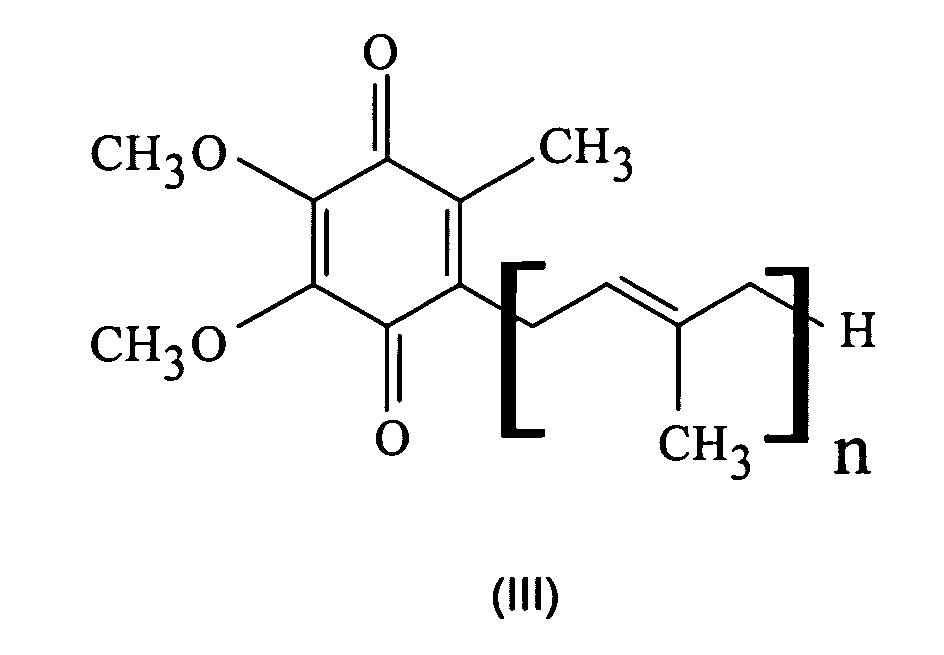 Pentaerythrittetrakis[3(3,5-di-tert.-butyl-4-hydroxyphenyl)propionat],Urocaninsäure,Carotinoiden,Ascorbinsäure und ihren Derivaten,Isoascorbinsäure und ihren Derivaten,Ferulasäure, Ethylferulat, Kaffeesäure und Rosmarinsäure,2,6-Di-tert.-butyl-4-methylphenol,tert.-Butyl-4-methoxyphenol,Pflanzenextrakten, die diese Antioxidantien enthalten,sowie Mischungen dieser genannten Wirkstoffe.
 - Zusammensetzung gemäß Anspruch 1, dadurch gekennzeichnet, dass R1 und R2 unabhängig voneinander eine OH-Gruppe oder eine Methoxy-Gruppe darstellen.
- Zusammensetzung gemäß einem der Ansprüche 1 oder 2, dadurch gekennzeichnet, dass R3 und R4 unabhängig voneinander ausgewählt sind aus einer Methyl-, Ethyl-, n-Propyl-, Isopropyl- und n-Butylgruppe.
- Zusammensetzung gemäß einem der vorstehenden Ansprüche, dadurch gekennzeichnet, dass R1 eine OH-Gruppe, R2 eine Methoxy-Gruppe und R3 und R4 eine Methylgruppe darstellen.
- Zusammensetzung gemäß einem der vorstehenden Ansprüche, dadurch gekennzeichnet, dass das 6,7-disubstituierte 2,2-Dialkylchroman oder -chromen der allgemeinen Formel (I) oder (II) in Mengen von 0,001 - 5 Gew.-%, bezogen auf die gesamte Zusammensetzung, eingesetzt wird.
- Zusammensetzung gemäß einem der vorstehenden Ansprüche, dadurch gekennzeichnet, dass die Carotinoide ausgewählt sind aus Lutein, α-Carotin, β-Carotin und Lycopin.
- Zusammensetzung gemäß einem der vorstehenden Ansprüche, dadurch gekennzeichnet, dass sie konfektioniert ist als ein Leave-on-Produkt wie Creme, Salbe, Pflegestift, Make-up, Lotion, Maske, Packung und Pflasterbeschichtung, Spray, Mousse, die in Form einer O/W-Emulsion, W/O-Emulsion, O/W/O-Emulsion, W/O/W-Emulsion, O/W-Mikroemulsion, W/O-Mikroemulsion, eines wässrigen, alkoholischen oder wässrig-alkoholischen Gels sowie als Öl vorliegen kann, oder als ein Rinse-off-Produkt wie Waschgel, Waschcreme, Duschgel, Duschbad, Seife, Shampoo, Haarkonditioniermittel, Haarfärbezusammensetzung, Haarwell- und Haarglättungsmittel sowie Tränkemulsion und -lösung für feste Substrate zur Reinigung und/oder Pflege der Haut und/oder der Haare.
- Nicht-therapeutische Verwendung von 6,7-disubstituierten 2,2-Dialkylchromanen oder -chromenen der allgemeinen Formeln (I) oder (II),wobei R1 und R2 unabhängig voneinander eine OH-Gruppe, eine Methoxy-Gruppe oder eine CF3CH2O-Gruppe und R3 und R4 unabhängig voneinander eine C1-C4-Alkylgruppe darstellen,

in topischen kosmetischen und pharmazeutischen Zusammensetzungen zur synergistischen Steigerung der antioxidativen Wirkung von Antioxidantien, ausgewählt aus:Flavonoiden, Polyphenolen, Catechinen, Ubichinonen der Formel (III),mit n = 6, 7, 8, 9 oder 10, Pentaerythrittetrakis[3(3,5-di-tert.-butyl-4-hydroxyphenyl)propionat], Urocaninsäure, Carotinoiden, Ascorbinsäure und ihren Derivaten, Isoascorbinsäure und ihren Derivaten, Ferulasäure, Ethylferulat, Kaffeesäure, Rosmarinsäure, 2,6-Di-tert.-butyl-4-methylphenol, tert.-Butyl-4-methoxyphenol, Pflanzenextrakten, die diese Antioxidantien enthalten, sowie Mischungen der genannten Wirkstoffe.
 - Nicht-therapeutische Verwendung von 6,7-disubstituierten 2,2-Dialkylchromanen oder -chromenen der allgemeinen Formeln (I) oder (II),wobei R1 und R2 unabhängig voneinander eine OH-Gruppe, eine Methoxy-Gruppe oder eine CF3CH2O-Gruppe und R3 und R4 unabhängig voneinander eine C1-C4-Alkylgruppe darstellen,

in topischen kosmetischen und pharmazeutischen Zusammensetzungen in Kombination mit Antioxidantien, ausgewählt aus:Flavonoiden, Polyphenolen, Catechinen, Ubichinonen der Formel (III),mit n = 6, 7, 8, 9 oder 10,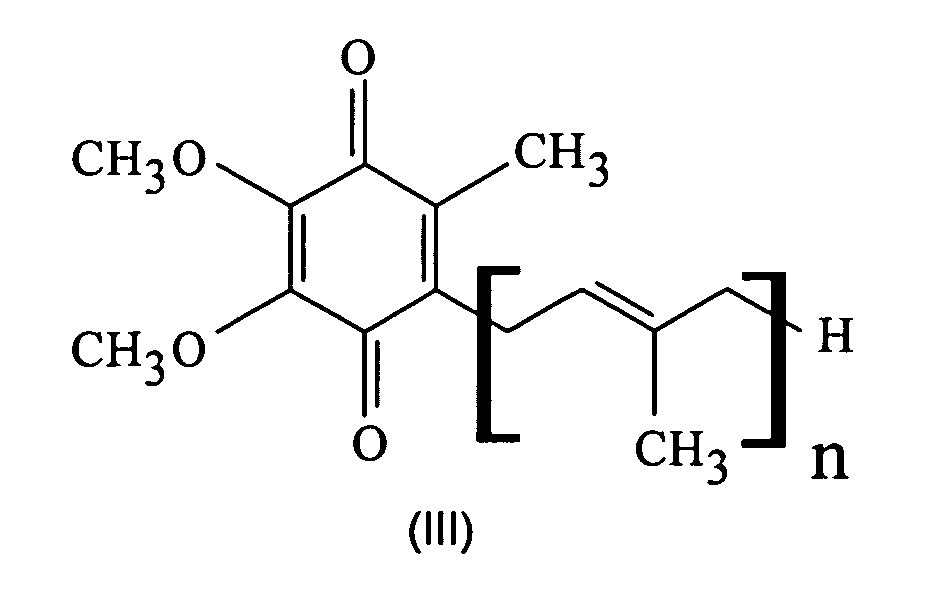 Pentaerythrittetrakis[3(3,5-di-tert.-butyl-4-hydroxyphenyl)propionat], Urocaninsäure, Carotinoiden, Ascorbinsäure und ihren Derivaten, Isoascorbinsäure und ihren Derivaten, Ferulasäure, Ethylferulat, Kaffeesäure, Rosmarinsäure, 2,6-Di-tert.-butyl-4-methylphenol, tert.-Butyl-4-methoxyphenol, Pflanzenextrakten, die diese Antioxidantien enthalten, sowie Mischungen der genannten Wirkstoffe, zur nicht-therapeutischen Hautpflege und/oder zur nicht-therapeutischen vorbeugenden Behandlung der Hautalterung.
Priority Applications (1)
| Application Number | Priority Date | Filing Date | Title |
|---|---|---|---|
| EP09155233A EP2070513B1 (de) | 2002-12-16 | 2003-12-06 | Antioxidans-Kombinationen von Xanthophyllen dotiert mit 6,7-disubstituierten 2,2-Dialkylchromanen oder -chromenen |
Applications Claiming Priority (2)
| Application Number | Priority Date | Filing Date | Title |
|---|---|---|---|
| DE10259014 | 2002-12-16 | ||
| DE10259014A DE10259014A1 (de) | 2002-12-16 | 2002-12-16 | Antioxidans-Kombinationen mit6,7-disubstituierten 2,2-Dialkylchromanen oder-chromenen |
Related Child Applications (1)
| Application Number | Title | Priority Date | Filing Date |
|---|---|---|---|
| EP09155233A Division EP2070513B1 (de) | 2002-12-16 | 2003-12-06 | Antioxidans-Kombinationen von Xanthophyllen dotiert mit 6,7-disubstituierten 2,2-Dialkylchromanen oder -chromenen |
Publications (3)
| Publication Number | Publication Date |
|---|---|
| EP1430882A2 true EP1430882A2 (de) | 2004-06-23 |
| EP1430882A3 EP1430882A3 (de) | 2004-11-03 |
| EP1430882B1 EP1430882B1 (de) | 2009-04-01 |
Family
ID=32336408
Family Applications (2)
| Application Number | Title | Priority Date | Filing Date |
|---|---|---|---|
| EP09155233A Expired - Lifetime EP2070513B1 (de) | 2002-12-16 | 2003-12-06 | Antioxidans-Kombinationen von Xanthophyllen dotiert mit 6,7-disubstituierten 2,2-Dialkylchromanen oder -chromenen |
| EP03028016A Expired - Lifetime EP1430882B1 (de) | 2002-12-16 | 2003-12-06 | Antioxidans-Kombinationen mit 6,7-disubstituierten 2,2-Dialkylchromanen oder -chromenen |
Family Applications Before (1)
| Application Number | Title | Priority Date | Filing Date |
|---|---|---|---|
| EP09155233A Expired - Lifetime EP2070513B1 (de) | 2002-12-16 | 2003-12-06 | Antioxidans-Kombinationen von Xanthophyllen dotiert mit 6,7-disubstituierten 2,2-Dialkylchromanen oder -chromenen |
Country Status (4)
| Country | Link |
|---|---|
| EP (2) | EP2070513B1 (de) |
| AT (2) | ATE531357T1 (de) |
| DE (2) | DE10259014A1 (de) |
| ES (2) | ES2373202T3 (de) |
Cited By (13)
| Publication number | Priority date | Publication date | Assignee | Title |
|---|---|---|---|---|
| DE102004039729A1 (de) * | 2004-08-16 | 2006-03-09 | Beiersdorf Ag | Kosmetische oder dermatologische Zubereitungen mit einem Gehalt an (-)2-Hydroxymethyl-2-Methyl-6-hydroxychromen bzw. einen Extrakt aus Pilzen der Art Daedalea quercina, (-)2-Hydroxymethyl-2-Methyl-6-hydrocychromen enthaltend |
| EP2113242A1 (de) * | 2008-05-02 | 2009-11-04 | Pangaea Laboratories Limited | Antioxidationsmittel für kosmetische, medizinische und pharmazeutische Zubereitungen |
| FR2934490A1 (fr) * | 2008-08-01 | 2010-02-05 | Lvmh Rech | Utilisation dans une composition cosmetique du lipochroman-6 pour ameliorer l'eclat du teint de la peau, notamment du visage |
| FR2934491A1 (fr) * | 2008-08-01 | 2010-02-05 | Lvmh Rech | Composition cosmetique contenant une association de lipochroman-6 et d'un extrait de logoza et son utilisation |
| EP2263641A2 (de) | 2009-06-18 | 2010-12-22 | Henkel AG & Co. KGaA | Antifalten-Kosmetikum mit Antioxidantien |
| EP2017262A4 (de) * | 2006-03-28 | 2011-04-27 | Nippon Oil Corp | Verfahren zur herstellung von carotenoid |
| WO2014188276A3 (en) * | 2013-04-22 | 2015-05-28 | Neocutis Sa | Antioxidant compositions and methods of using the same |
| EP2243464A3 (de) * | 2009-04-20 | 2015-06-17 | Henkel AG & Co. KGaA | Hautbehandlungsmittel gegen Hautalterung I |
| EP2266527A3 (de) * | 2009-06-23 | 2015-08-05 | Henkel AG & Co. KGaA | Sonnenschutzzusammensetzungen mit verbessertem antioxidativen Potential |
| USRE46228E1 (en) | 2007-06-15 | 2016-12-06 | Lipotec, S.A. | Pigmentation-regulating compounds |
| EP2238968B1 (de) * | 2009-04-06 | 2018-05-02 | Henkel AG & Co. KGaA | Hautbehandlungsmittel gegen Hautalterung I |
| EP2238967B1 (de) * | 2009-04-06 | 2018-05-02 | Henkel AG & Co. KGaA | Hautbehandlungsmittel gegen Hautalterung II |
| US10701957B2 (en) | 2007-08-29 | 2020-07-07 | Jxtg Nippon Oil & Energy Corporation | Method for production of carotenoid |
Families Citing this family (3)
| Publication number | Priority date | Publication date | Assignee | Title |
|---|---|---|---|---|
| WO2006023548A2 (en) † | 2004-08-17 | 2006-03-02 | Rhodia Inc. | Low ph structured surfactant compositions |
| DE102005030459A1 (de) * | 2005-06-28 | 2006-11-16 | Henkel Kgaa | Verdickung keratinischer Fasern |
| GB0719202D0 (en) * | 2007-10-02 | 2007-11-07 | Boots Co Plc | Compositions and methods for the skin and hair |
Family Cites Families (13)
| Publication number | Priority date | Publication date | Assignee | Title |
|---|---|---|---|---|
| ES2072223B1 (es) | 1993-11-25 | 1996-03-16 | Lipotec Sa | Liposomas encapsulando doxorubicina. |
| DE4413686C2 (de) | 1994-04-20 | 1996-10-24 | Henkel Kgaa | Kationische Zuckertenside, Verfahren zu ihrer Herstellung und deren Verwendung |
| US5811083A (en) | 1996-03-26 | 1998-09-22 | Estee Lauder, Inc. | Tocopherol derivatives for use in cosmetic compositions |
| DE19756454C1 (de) | 1997-12-18 | 1999-06-17 | Henkel Kgaa | Verwendung von Glycerincarbonat |
| ES2154560B1 (es) | 1998-09-16 | 2001-12-01 | Lipotec Sa | Composicion a base de derivados de cromanos y su uso para reducir quimicamente las reacciones oxidativas o inducidas por radicales libres. |
| US6048886A (en) * | 1998-10-05 | 2000-04-11 | Neigut; Stanley | Compositions and delivery systems for the topical treatment of psoriasis and other conditions of the skin |
| BR9914978A (pt) * | 1998-11-02 | 2001-08-14 | Ciba Sc Holding Ag | Estabilização de produtos de cuidados do corpo e domésticos |
| DE60043295D1 (de) | 1999-03-31 | 2009-12-24 | Cci Corp | Chromanol glycoside zur behandlung von durch ultraviolettes licht verursachten dermopathien |
| WO2001074320A2 (de) * | 2000-03-31 | 2001-10-11 | Henkel Kommanditgesellschaft Auf Aktien | Verwendung von protease-inhibitoren in der kosmetik und pharmazie |
| FR2808189B1 (fr) * | 2000-04-28 | 2004-03-05 | Oreal | Lipochroman-6 comme inhibiteur de no-synthase et utilisations |
| GB0026018D0 (en) * | 2000-10-24 | 2000-12-13 | Novartis Nutrition Ag | New composition |
| FR2816839B1 (fr) * | 2000-11-20 | 2003-09-26 | Schwartz Laboratoires Robert | Produit preparant et protegeant la peau contre les rayons uv, agissant a l'encontre du vieillissement cellulaire et excercant une action immunostimulante |
| DE10206664A1 (de) * | 2002-02-15 | 2003-09-04 | Henkel Kgaa | 6,7-disubstituierte 2,2-Dialkylchromane oder- chromene als Entzündungshemmer |
-
2002
- 2002-12-16 DE DE10259014A patent/DE10259014A1/de not_active Withdrawn
-
2003
- 2003-12-06 EP EP09155233A patent/EP2070513B1/de not_active Expired - Lifetime
- 2003-12-06 EP EP03028016A patent/EP1430882B1/de not_active Expired - Lifetime
- 2003-12-06 ES ES09155233T patent/ES2373202T3/es not_active Expired - Lifetime
- 2003-12-06 DE DE50311367T patent/DE50311367D1/de not_active Expired - Lifetime
- 2003-12-06 ES ES03028016T patent/ES2323266T3/es not_active Expired - Lifetime
- 2003-12-06 AT AT09155233T patent/ATE531357T1/de active
- 2003-12-06 AT AT03028016T patent/ATE427097T1/de active
Cited By (19)
| Publication number | Priority date | Publication date | Assignee | Title |
|---|---|---|---|---|
| DE102004039729A1 (de) * | 2004-08-16 | 2006-03-09 | Beiersdorf Ag | Kosmetische oder dermatologische Zubereitungen mit einem Gehalt an (-)2-Hydroxymethyl-2-Methyl-6-hydroxychromen bzw. einen Extrakt aus Pilzen der Art Daedalea quercina, (-)2-Hydroxymethyl-2-Methyl-6-hydrocychromen enthaltend |
| EP2017262A4 (de) * | 2006-03-28 | 2011-04-27 | Nippon Oil Corp | Verfahren zur herstellung von carotenoid |
| US8097761B2 (en) | 2006-03-28 | 2012-01-17 | Jx Nippon Oil & Energy Corporation | Process for production of carotenoid |
| USRE46228E1 (en) | 2007-06-15 | 2016-12-06 | Lipotec, S.A. | Pigmentation-regulating compounds |
| US10701957B2 (en) | 2007-08-29 | 2020-07-07 | Jxtg Nippon Oil & Energy Corporation | Method for production of carotenoid |
| EP2113242A1 (de) * | 2008-05-02 | 2009-11-04 | Pangaea Laboratories Limited | Antioxidationsmittel für kosmetische, medizinische und pharmazeutische Zubereitungen |
| US8221746B2 (en) | 2008-05-02 | 2012-07-17 | Elliot James Isaacs | Antioxidant for use in cosmetic, medicated and pharmaceutical preparations |
| FR2934490A1 (fr) * | 2008-08-01 | 2010-02-05 | Lvmh Rech | Utilisation dans une composition cosmetique du lipochroman-6 pour ameliorer l'eclat du teint de la peau, notamment du visage |
| FR2934491A1 (fr) * | 2008-08-01 | 2010-02-05 | Lvmh Rech | Composition cosmetique contenant une association de lipochroman-6 et d'un extrait de logoza et son utilisation |
| EP2238967B1 (de) * | 2009-04-06 | 2018-05-02 | Henkel AG & Co. KGaA | Hautbehandlungsmittel gegen Hautalterung II |
| EP2238968B1 (de) * | 2009-04-06 | 2018-05-02 | Henkel AG & Co. KGaA | Hautbehandlungsmittel gegen Hautalterung I |
| EP2243464A3 (de) * | 2009-04-20 | 2015-06-17 | Henkel AG & Co. KGaA | Hautbehandlungsmittel gegen Hautalterung I |
| EP2263641A2 (de) | 2009-06-18 | 2010-12-22 | Henkel AG & Co. KGaA | Antifalten-Kosmetikum mit Antioxidantien |
| DE102009027024A1 (de) | 2009-06-18 | 2010-12-23 | Henkel Ag & Co. Kgaa | Antifalten-Kosmetikum mit Antioxidantien |
| EP2266527A3 (de) * | 2009-06-23 | 2015-08-05 | Henkel AG & Co. KGaA | Sonnenschutzzusammensetzungen mit verbessertem antioxidativen Potential |
| CN105120834A (zh) * | 2013-04-22 | 2015-12-02 | 新科蒂斯公司 | 抗氧化剂组合物及其使用方法 |
| US9713604B2 (en) | 2013-04-22 | 2017-07-25 | Anteis Sa | Antioxidant compositions and methods of using the same |
| WO2014188276A3 (en) * | 2013-04-22 | 2015-05-28 | Neocutis Sa | Antioxidant compositions and methods of using the same |
| RU2654804C2 (ru) * | 2013-04-22 | 2018-05-24 | Антейс Са | Антиоксидантные композиции и способы их применения |
Also Published As
| Publication number | Publication date |
|---|---|
| ES2373202T3 (es) | 2012-02-01 |
| ATE531357T1 (de) | 2011-11-15 |
| ES2323266T3 (es) | 2009-07-10 |
| EP2070513A1 (de) | 2009-06-17 |
| DE10259014A1 (de) | 2004-06-24 |
| EP2070513B1 (de) | 2011-11-02 |
| ATE427097T1 (de) | 2009-04-15 |
| DE50311367D1 (de) | 2009-05-14 |
| EP1430882B1 (de) | 2009-04-01 |
| EP1430882A3 (de) | 2004-11-03 |
Similar Documents
| Publication | Publication Date | Title |
|---|---|---|
| EP1430882B1 (de) | Antioxidans-Kombinationen mit 6,7-disubstituierten 2,2-Dialkylchromanen oder -chromenen | |
| DE19807774A1 (de) | Verwendung von Flavonen bzw. Flavanonen bzw. Flavonoiden zum Schutze von Ascorbinsäure und/oder Ascorbylverbindungen gegen Oxidation | |
| KR20100041684A (ko) | 안정화제로서 디하이드록시아세톤, 레티노이드 및 아스코르브산 글루코사이드를 함유하는 자가 태닝 조성물 | |
| DE102009029110A1 (de) | Antimikrobielle Formulierung | |
| WO2018038974A1 (en) | Method of treating or reducing the severity of dermatological conditions | |
| KR20160065658A (ko) | 유화제를 함유하지 않는 워셔블 클렌징 화장료 조성물 | |
| DE19740879A1 (de) | Desodorierende Zubereitungen auf der Basis von Flavonderivaten und/oder Flavanonderivaten, insbesondere von Flavonoiden | |
| DE19742025A1 (de) | Verwendung von Flavonen und Flavonoiden zur Hautaufhellung oder zur Verhinderung der durch oxidative Proteinaggregation hervorgerufenen Altersflecken | |
| DE10063659A1 (de) | Verfahren zur Herstellung von versprühbaren O/W-Emulsionen | |
| DE10206664A1 (de) | 6,7-disubstituierte 2,2-Dialkylchromane oder- chromene als Entzündungshemmer | |
| DE10063660A1 (de) | Kosmetische und dermatologische Zubereitungen in Form von O/W-Emulsionen mit einem Gehalt an Sterinen und/oder C¶1¶¶2¶-C¶4¶¶0¶-Fettsäuren | |
| DE102004002997A1 (de) | Dünnflüssige W/O Emulsionen ohne O/W-Emulgatoren | |
| DE19845305A1 (de) | Verwendung von oberflächenaktiven Citronensäureestern zur Stabilisierung von Flavonen, Flavanonen bzw. Flavonoiden, synergistische Gemische aus Flavonen, Flavanonen bzw. Flavonoiden und oberflächenaktiven Substanzen sowie kosmetische und dermatologische Zubereitungen mit einem Gehalt an solchen Gemischen | |
| EP1389088A2 (de) | Lipoprotein-cremes mit uv-filtern | |
| EP3383355B1 (de) | Einsatz von additiven zur effektiven konservierung / boostende wirkung bestehender konservierung kosmetischer emulsionen | |
| EP1834631B1 (de) | Kosmetische oder dermatologische Zubereitungen enthaltend Glycyrrhetin und/oder Glycyrrhizin sowie Glucosederivate bzw. Glycerinether | |
| DE102004002996A1 (de) | Dünnflüssige W/O Emulsionen | |
| DE19845324A1 (de) | Verwendung von Nitrilotriessigsäure zur Stabilisierung von Flavonen, Flavanonen bzw. Flavonoiden, synergistische Gemische aus Flavonen, Flavanonen bzw. Flavonoiden und Nitrilessigsäure sowie kosmetische und dermatologische Zubereitungen mit einem Gehalt an solchen Gemischen | |
| EP1057475A1 (de) | Verwendung von Ascorbinsäure und einem oder mehreren Flavonderivaten und /oder Flavanonderivaten, insbesondere Flavonoiden zur Herstellung kosmetischer oder dermatologischer Zubereitungen zur Prophylaxe oder Linderung des Sonnenbrandes | |
| EP0995432A1 (de) | Verwendung von oberflächenaktiven Substanzen zur Stabilisierung von Flavonen, Flavanonen bzw. Flavonoiden, synergistische Gemische aus Flavonen, Flavanonen bzw. Flavonoiden und oberflächen aktiven Substanzen sowie kosmetische und dermatologische Zubereitungen mit einem Gehalt an solchen Gemischen | |
| DE10155960A1 (de) | Kosmetische und dermatologische Stifte | |
| DE10148313A1 (de) | Kosmetische und dermatologische Stifte | |
| DE19845271A1 (de) | Verwendung von Alkylglucosiden zur Stabilisierung von Flavonen, Flavanonen bzw. Flavonoiden, synergistische Gemische aus Flavonen, Flavanonen bzw. Flavonoiden und Alkylglucosiden sowie kosmetische und dermatologische Zubereitungen mit einem Gehalt an solchen Gemischen | |
| DE10148302A1 (de) | Kosmetische und dermatologische Stifte | |
| KR100438402B1 (ko) | 폴리옥시프로필렌-폴리옥시에틸렌 비타민 이를 이용한저점도 수중유형 유화 화장료 |
Legal Events
| Date | Code | Title | Description |
|---|---|---|---|
| PUAI | Public reference made under article 153(3) epc to a published international application that has entered the european phase |
Free format text: ORIGINAL CODE: 0009012 |
|
| 17P | Request for examination filed |
Effective date: 20031206 |
|
| AK | Designated contracting states |
Kind code of ref document: A2 Designated state(s): AT BE BG CH CY CZ DE DK EE ES FI FR GB GR HU IE IT LI LU MC NL PT RO SE SI SK TR |
|
| AX | Request for extension of the european patent |
Extension state: AL LT LV MK |
|
| PUAL | Search report despatched |
Free format text: ORIGINAL CODE: 0009013 |
|
| AK | Designated contracting states |
Kind code of ref document: A3 Designated state(s): AT BE BG CH CY CZ DE DK EE ES FI FR GB GR HU IE IT LI LU MC NL PT RO SE SI SK TR |
|
| AX | Request for extension of the european patent |
Extension state: AL LT LV MK |
|
| AKX | Designation fees paid |
Designated state(s): AT BE BG CH CY CZ DE DK EE ES FI FR GB GR HU IE IT LI LU MC NL PT RO SE SI SK TR |
|
| RIC1 | Information provided on ipc code assigned before grant |
Ipc: A61K 31/353 20060101ALI20060118BHEP Ipc: A61Q 19/00 20060101ALI20060118BHEP Ipc: A61K 8/49 20060101AFI20060118BHEP |
|
| 17Q | First examination report despatched |
Effective date: 20060123 |
|
| RAP1 | Party data changed (applicant data changed or rights of an application transferred) |
Owner name: HENKEL AG & CO. KGAA |
|
| GRAP | Despatch of communication of intention to grant a patent |
Free format text: ORIGINAL CODE: EPIDOSNIGR1 |
|
| RIC1 | Information provided on ipc code assigned before grant |
Ipc: A61K 31/353 20060101ALI20081006BHEP Ipc: A61Q 19/08 20060101ALI20081006BHEP Ipc: A61K 8/49 20060101AFI20081006BHEP |
|
| GRAS | Grant fee paid |
Free format text: ORIGINAL CODE: EPIDOSNIGR3 |
|
| GRAA | (expected) grant |
Free format text: ORIGINAL CODE: 0009210 |
|
| AK | Designated contracting states |
Kind code of ref document: B1 Designated state(s): AT BE BG CH CY CZ DE DK EE ES FI FR GB GR HU IE IT LI LU MC NL PT RO SE SI SK TR |
|
| REG | Reference to a national code |
Ref country code: GB Ref legal event code: FG4D Free format text: NOT ENGLISH |
|
| REG | Reference to a national code |
Ref country code: CH Ref legal event code: EP |
|
| REG | Reference to a national code |
Ref country code: IE Ref legal event code: FG4D Free format text: LANGUAGE OF EP DOCUMENT: GERMAN |
|
| REF | Corresponds to: |
Ref document number: 50311367 Country of ref document: DE Date of ref document: 20090514 Kind code of ref document: P |
|
| REG | Reference to a national code |
Ref country code: ES Ref legal event code: FG2A Ref document number: 2323266 Country of ref document: ES Kind code of ref document: T3 |
|
| PG25 | Lapsed in a contracting state [announced via postgrant information from national office to epo] |
Ref country code: SI Free format text: LAPSE BECAUSE OF FAILURE TO SUBMIT A TRANSLATION OF THE DESCRIPTION OR TO PAY THE FEE WITHIN THE PRESCRIBED TIME-LIMIT Effective date: 20090401 |
|
| NLV1 | Nl: lapsed or annulled due to failure to fulfill the requirements of art. 29p and 29m of the patents act | ||
| REG | Reference to a national code |
Ref country code: IE Ref legal event code: FD4D |
|
| PG25 | Lapsed in a contracting state [announced via postgrant information from national office to epo] |
Ref country code: EE Free format text: LAPSE BECAUSE OF FAILURE TO SUBMIT A TRANSLATION OF THE DESCRIPTION OR TO PAY THE FEE WITHIN THE PRESCRIBED TIME-LIMIT Effective date: 20090401 Ref country code: PT Free format text: LAPSE BECAUSE OF FAILURE TO SUBMIT A TRANSLATION OF THE DESCRIPTION OR TO PAY THE FEE WITHIN THE PRESCRIBED TIME-LIMIT Effective date: 20090902 Ref country code: FI Free format text: LAPSE BECAUSE OF FAILURE TO SUBMIT A TRANSLATION OF THE DESCRIPTION OR TO PAY THE FEE WITHIN THE PRESCRIBED TIME-LIMIT Effective date: 20090401 |
|
| PG25 | Lapsed in a contracting state [announced via postgrant information from national office to epo] |
Ref country code: NL Free format text: LAPSE BECAUSE OF FAILURE TO SUBMIT A TRANSLATION OF THE DESCRIPTION OR TO PAY THE FEE WITHIN THE PRESCRIBED TIME-LIMIT Effective date: 20090401 Ref country code: SE Free format text: LAPSE BECAUSE OF FAILURE TO SUBMIT A TRANSLATION OF THE DESCRIPTION OR TO PAY THE FEE WITHIN THE PRESCRIBED TIME-LIMIT Effective date: 20090701 |
|
| PG25 | Lapsed in a contracting state [announced via postgrant information from national office to epo] |
Ref country code: RO Free format text: LAPSE BECAUSE OF FAILURE TO SUBMIT A TRANSLATION OF THE DESCRIPTION OR TO PAY THE FEE WITHIN THE PRESCRIBED TIME-LIMIT Effective date: 20090401 Ref country code: DK Free format text: LAPSE BECAUSE OF FAILURE TO SUBMIT A TRANSLATION OF THE DESCRIPTION OR TO PAY THE FEE WITHIN THE PRESCRIBED TIME-LIMIT Effective date: 20090401 Ref country code: CZ Free format text: LAPSE BECAUSE OF FAILURE TO SUBMIT A TRANSLATION OF THE DESCRIPTION OR TO PAY THE FEE WITHIN THE PRESCRIBED TIME-LIMIT Effective date: 20090401 Ref country code: IE Free format text: LAPSE BECAUSE OF FAILURE TO SUBMIT A TRANSLATION OF THE DESCRIPTION OR TO PAY THE FEE WITHIN THE PRESCRIBED TIME-LIMIT Effective date: 20090401 |
|
| PLBE | No opposition filed within time limit |
Free format text: ORIGINAL CODE: 0009261 |
|
| STAA | Information on the status of an ep patent application or granted ep patent |
Free format text: STATUS: NO OPPOSITION FILED WITHIN TIME LIMIT |
|
| PG25 | Lapsed in a contracting state [announced via postgrant information from national office to epo] |
Ref country code: SK Free format text: LAPSE BECAUSE OF FAILURE TO SUBMIT A TRANSLATION OF THE DESCRIPTION OR TO PAY THE FEE WITHIN THE PRESCRIBED TIME-LIMIT Effective date: 20090401 |
|
| 26N | No opposition filed |
Effective date: 20100105 |
|
| PG25 | Lapsed in a contracting state [announced via postgrant information from national office to epo] |
Ref country code: BG Free format text: LAPSE BECAUSE OF FAILURE TO SUBMIT A TRANSLATION OF THE DESCRIPTION OR TO PAY THE FEE WITHIN THE PRESCRIBED TIME-LIMIT Effective date: 20090701 |
|
| BERE | Be: lapsed |
Owner name: HENKEL A.G. & CO. KGAA Effective date: 20091231 |
|
| PG25 | Lapsed in a contracting state [announced via postgrant information from national office to epo] |
Ref country code: MC Free format text: LAPSE BECAUSE OF NON-PAYMENT OF DUE FEES Effective date: 20100701 |
|
| PG25 | Lapsed in a contracting state [announced via postgrant information from national office to epo] |
Ref country code: GR Free format text: LAPSE BECAUSE OF FAILURE TO SUBMIT A TRANSLATION OF THE DESCRIPTION OR TO PAY THE FEE WITHIN THE PRESCRIBED TIME-LIMIT Effective date: 20090702 Ref country code: BE Free format text: LAPSE BECAUSE OF NON-PAYMENT OF DUE FEES Effective date: 20091231 |
|
| PG25 | Lapsed in a contracting state [announced via postgrant information from national office to epo] |
Ref country code: IT Free format text: LAPSE BECAUSE OF FAILURE TO SUBMIT A TRANSLATION OF THE DESCRIPTION OR TO PAY THE FEE WITHIN THE PRESCRIBED TIME-LIMIT Effective date: 20090401 |
|
| PG25 | Lapsed in a contracting state [announced via postgrant information from national office to epo] |
Ref country code: LU Free format text: LAPSE BECAUSE OF NON-PAYMENT OF DUE FEES Effective date: 20091206 |
|
| PG25 | Lapsed in a contracting state [announced via postgrant information from national office to epo] |
Ref country code: HU Free format text: LAPSE BECAUSE OF FAILURE TO SUBMIT A TRANSLATION OF THE DESCRIPTION OR TO PAY THE FEE WITHIN THE PRESCRIBED TIME-LIMIT Effective date: 20091002 |
|
| PG25 | Lapsed in a contracting state [announced via postgrant information from national office to epo] |
Ref country code: TR Free format text: LAPSE BECAUSE OF FAILURE TO SUBMIT A TRANSLATION OF THE DESCRIPTION OR TO PAY THE FEE WITHIN THE PRESCRIBED TIME-LIMIT Effective date: 20090401 |
|
| PG25 | Lapsed in a contracting state [announced via postgrant information from national office to epo] |
Ref country code: CY Free format text: LAPSE BECAUSE OF FAILURE TO SUBMIT A TRANSLATION OF THE DESCRIPTION OR TO PAY THE FEE WITHIN THE PRESCRIBED TIME-LIMIT Effective date: 20090401 |
|
| PGFP | Annual fee paid to national office [announced via postgrant information from national office to epo] |
Ref country code: ES Payment date: 20141111 Year of fee payment: 12 Ref country code: CH Payment date: 20141212 Year of fee payment: 12 |
|
| PGFP | Annual fee paid to national office [announced via postgrant information from national office to epo] |
Ref country code: AT Payment date: 20141125 Year of fee payment: 12 |
|
| REG | Reference to a national code |
Ref country code: FR Ref legal event code: PLFP Year of fee payment: 13 |
|
| REG | Reference to a national code |
Ref country code: CH Ref legal event code: PL |
|
| REG | Reference to a national code |
Ref country code: AT Ref legal event code: MM01 Ref document number: 427097 Country of ref document: AT Kind code of ref document: T Effective date: 20151206 |
|
| PG25 | Lapsed in a contracting state [announced via postgrant information from national office to epo] |
Ref country code: LI Free format text: LAPSE BECAUSE OF NON-PAYMENT OF DUE FEES Effective date: 20151231 Ref country code: CH Free format text: LAPSE BECAUSE OF NON-PAYMENT OF DUE FEES Effective date: 20151231 |
|
| PG25 | Lapsed in a contracting state [announced via postgrant information from national office to epo] |
Ref country code: AT Free format text: LAPSE BECAUSE OF NON-PAYMENT OF DUE FEES Effective date: 20151206 |
|
| REG | Reference to a national code |
Ref country code: FR Ref legal event code: PLFP Year of fee payment: 14 |
|
| PG25 | Lapsed in a contracting state [announced via postgrant information from national office to epo] |
Ref country code: ES Free format text: LAPSE BECAUSE OF NON-PAYMENT OF DUE FEES Effective date: 20151207 |
|
| REG | Reference to a national code |
Ref country code: FR Ref legal event code: PLFP Year of fee payment: 15 |
|
| REG | Reference to a national code |
Ref country code: ES Ref legal event code: FD2A Effective date: 20180705 |
|
| PGFP | Annual fee paid to national office [announced via postgrant information from national office to epo] |
Ref country code: GB Payment date: 20221222 Year of fee payment: 20 Ref country code: FR Payment date: 20221222 Year of fee payment: 20 Ref country code: DE Payment date: 20221213 Year of fee payment: 20 |
|
| P01 | Opt-out of the competence of the unified patent court (upc) registered |
Effective date: 20230530 |
|
| REG | Reference to a national code |
Ref country code: DE Ref legal event code: R071 Ref document number: 50311367 Country of ref document: DE |
|
| REG | Reference to a national code |
Ref country code: GB Ref legal event code: PE20 Expiry date: 20231205 |
|
| PG25 | Lapsed in a contracting state [announced via postgrant information from national office to epo] |
Ref country code: GB Free format text: LAPSE BECAUSE OF EXPIRATION OF PROTECTION Effective date: 20231205 |
|
| PG25 | Lapsed in a contracting state [announced via postgrant information from national office to epo] |
Ref country code: GB Free format text: LAPSE BECAUSE OF EXPIRATION OF PROTECTION Effective date: 20231205 |