EP1431021B1 - Verfahren und Vorrichtung zum Herstellen von Hohlkörpern aus Kunststoff - Google Patents
Verfahren und Vorrichtung zum Herstellen von Hohlkörpern aus Kunststoff Download PDFInfo
- Publication number
- EP1431021B1 EP1431021B1 EP03025938A EP03025938A EP1431021B1 EP 1431021 B1 EP1431021 B1 EP 1431021B1 EP 03025938 A EP03025938 A EP 03025938A EP 03025938 A EP03025938 A EP 03025938A EP 1431021 B1 EP1431021 B1 EP 1431021B1
- Authority
- EP
- European Patent Office
- Prior art keywords
- station
- heated
- parisons
- defective
- heating
- Prior art date
- Legal status (The legal status is an assumption and is not a legal conclusion. Google has not performed a legal analysis and makes no representation as to the accuracy of the status listed.)
- Expired - Lifetime
Links
Images


Classifications
-
- B—PERFORMING OPERATIONS; TRANSPORTING
- B29—WORKING OF PLASTICS; WORKING OF SUBSTANCES IN A PLASTIC STATE IN GENERAL
- B29C—SHAPING OR JOINING OF PLASTICS; SHAPING OF MATERIAL IN A PLASTIC STATE, NOT OTHERWISE PROVIDED FOR; AFTER-TREATMENT OF THE SHAPED PRODUCTS, e.g. REPAIRING
- B29C49/00—Blow-moulding, i.e. blowing a preform or parison to a desired shape within a mould; Apparatus therefor
- B29C49/42—Component parts, details or accessories; Auxiliary operations
- B29C49/78—Measuring, controlling or regulating
- B29C49/80—Testing, e.g. for leaks
-
- B—PERFORMING OPERATIONS; TRANSPORTING
- B29—WORKING OF PLASTICS; WORKING OF SUBSTANCES IN A PLASTIC STATE IN GENERAL
- B29B—PREPARATION OR PRETREATMENT OF THE MATERIAL TO BE SHAPED; MAKING GRANULES OR PREFORMS; RECOVERY OF PLASTICS OR OTHER CONSTITUENTS OF WASTE MATERIAL CONTAINING PLASTICS
- B29B11/00—Making preforms
- B29B11/06—Making preforms by moulding the material
- B29B11/08—Injection moulding
-
- B—PERFORMING OPERATIONS; TRANSPORTING
- B29—WORKING OF PLASTICS; WORKING OF SUBSTANCES IN A PLASTIC STATE IN GENERAL
- B29B—PREPARATION OR PRETREATMENT OF THE MATERIAL TO BE SHAPED; MAKING GRANULES OR PREFORMS; RECOVERY OF PLASTICS OR OTHER CONSTITUENTS OF WASTE MATERIAL CONTAINING PLASTICS
- B29B11/00—Making preforms
- B29B11/14—Making preforms characterised by structure or composition
-
- B—PERFORMING OPERATIONS; TRANSPORTING
- B29—WORKING OF PLASTICS; WORKING OF SUBSTANCES IN A PLASTIC STATE IN GENERAL
- B29C—SHAPING OR JOINING OF PLASTICS; SHAPING OF MATERIAL IN A PLASTIC STATE, NOT OTHERWISE PROVIDED FOR; AFTER-TREATMENT OF THE SHAPED PRODUCTS, e.g. REPAIRING
- B29C35/00—Heating, cooling or curing, e.g. crosslinking or vulcanising; Apparatus therefor
- B29C35/02—Heating or curing, e.g. crosslinking or vulcanizing during moulding, e.g. in a mould
- B29C35/08—Heating or curing, e.g. crosslinking or vulcanizing during moulding, e.g. in a mould by wave energy or particle radiation
- B29C35/0805—Heating or curing, e.g. crosslinking or vulcanizing during moulding, e.g. in a mould by wave energy or particle radiation using electromagnetic radiation
- B29C2035/0822—Heating or curing, e.g. crosslinking or vulcanizing during moulding, e.g. in a mould by wave energy or particle radiation using electromagnetic radiation using IR radiation
-
- B—PERFORMING OPERATIONS; TRANSPORTING
- B29—WORKING OF PLASTICS; WORKING OF SUBSTANCES IN A PLASTIC STATE IN GENERAL
- B29C—SHAPING OR JOINING OF PLASTICS; SHAPING OF MATERIAL IN A PLASTIC STATE, NOT OTHERWISE PROVIDED FOR; AFTER-TREATMENT OF THE SHAPED PRODUCTS, e.g. REPAIRING
- B29C49/00—Blow-moulding, i.e. blowing a preform or parison to a desired shape within a mould; Apparatus therefor
- B29C49/42—Component parts, details or accessories; Auxiliary operations
- B29C49/78—Measuring, controlling or regulating
- B29C2049/7874—Preform or article shape, weight, defect or presence
- B29C2049/7876—Defects
-
- B—PERFORMING OPERATIONS; TRANSPORTING
- B29—WORKING OF PLASTICS; WORKING OF SUBSTANCES IN A PLASTIC STATE IN GENERAL
- B29C—SHAPING OR JOINING OF PLASTICS; SHAPING OF MATERIAL IN A PLASTIC STATE, NOT OTHERWISE PROVIDED FOR; AFTER-TREATMENT OF THE SHAPED PRODUCTS, e.g. REPAIRING
- B29C49/00—Blow-moulding, i.e. blowing a preform or parison to a desired shape within a mould; Apparatus therefor
- B29C49/42—Component parts, details or accessories; Auxiliary operations
- B29C49/78—Measuring, controlling or regulating
- B29C2049/788—Controller type or interface
- B29C2049/78805—Computer or PLC control
-
- B—PERFORMING OPERATIONS; TRANSPORTING
- B29—WORKING OF PLASTICS; WORKING OF SUBSTANCES IN A PLASTIC STATE IN GENERAL
- B29C—SHAPING OR JOINING OF PLASTICS; SHAPING OF MATERIAL IN A PLASTIC STATE, NOT OTHERWISE PROVIDED FOR; AFTER-TREATMENT OF THE SHAPED PRODUCTS, e.g. REPAIRING
- B29C49/00—Blow-moulding, i.e. blowing a preform or parison to a desired shape within a mould; Apparatus therefor
- B29C49/42—Component parts, details or accessories; Auxiliary operations
- B29C49/78—Measuring, controlling or regulating
- B29C49/80—Testing, e.g. for leaks
- B29C2049/801—Taking preform or article samples, e.g. by cutting out pieces for analysis
-
- B—PERFORMING OPERATIONS; TRANSPORTING
- B29—WORKING OF PLASTICS; WORKING OF SUBSTANCES IN A PLASTIC STATE IN GENERAL
- B29C—SHAPING OR JOINING OF PLASTICS; SHAPING OF MATERIAL IN A PLASTIC STATE, NOT OTHERWISE PROVIDED FOR; AFTER-TREATMENT OF THE SHAPED PRODUCTS, e.g. REPAIRING
- B29C2949/00—Indexing scheme relating to blow-moulding
- B29C2949/07—Preforms or parisons characterised by their configuration
- B29C2949/0715—Preforms or parisons characterised by their configuration the preform having one end closed
-
- B—PERFORMING OPERATIONS; TRANSPORTING
- B29—WORKING OF PLASTICS; WORKING OF SUBSTANCES IN A PLASTIC STATE IN GENERAL
- B29C—SHAPING OR JOINING OF PLASTICS; SHAPING OF MATERIAL IN A PLASTIC STATE, NOT OTHERWISE PROVIDED FOR; AFTER-TREATMENT OF THE SHAPED PRODUCTS, e.g. REPAIRING
- B29C2949/00—Indexing scheme relating to blow-moulding
- B29C2949/07—Preforms or parisons characterised by their configuration
- B29C2949/072—Preforms or parisons characterised by their configuration having variable wall thickness
-
- B—PERFORMING OPERATIONS; TRANSPORTING
- B29—WORKING OF PLASTICS; WORKING OF SUBSTANCES IN A PLASTIC STATE IN GENERAL
- B29C—SHAPING OR JOINING OF PLASTICS; SHAPING OF MATERIAL IN A PLASTIC STATE, NOT OTHERWISE PROVIDED FOR; AFTER-TREATMENT OF THE SHAPED PRODUCTS, e.g. REPAIRING
- B29C2949/00—Indexing scheme relating to blow-moulding
- B29C2949/07—Preforms or parisons characterised by their configuration
- B29C2949/073—Preforms or parisons characterised by their configuration having variable diameter
-
- B—PERFORMING OPERATIONS; TRANSPORTING
- B29—WORKING OF PLASTICS; WORKING OF SUBSTANCES IN A PLASTIC STATE IN GENERAL
- B29C—SHAPING OR JOINING OF PLASTICS; SHAPING OF MATERIAL IN A PLASTIC STATE, NOT OTHERWISE PROVIDED FOR; AFTER-TREATMENT OF THE SHAPED PRODUCTS, e.g. REPAIRING
- B29C2949/00—Indexing scheme relating to blow-moulding
- B29C2949/07—Preforms or parisons characterised by their configuration
- B29C2949/076—Preforms or parisons characterised by their configuration characterised by the shape
- B29C2949/0768—Preforms or parisons characterised by their configuration characterised by the shape characterised by the shape of specific parts of preform
- B29C2949/077—Preforms or parisons characterised by their configuration characterised by the shape characterised by the shape of specific parts of preform characterised by the neck
- B29C2949/0772—Closure retaining means
- B29C2949/0773—Threads
- B29C2949/0774—Interrupted threads
-
- B—PERFORMING OPERATIONS; TRANSPORTING
- B29—WORKING OF PLASTICS; WORKING OF SUBSTANCES IN A PLASTIC STATE IN GENERAL
- B29C—SHAPING OR JOINING OF PLASTICS; SHAPING OF MATERIAL IN A PLASTIC STATE, NOT OTHERWISE PROVIDED FOR; AFTER-TREATMENT OF THE SHAPED PRODUCTS, e.g. REPAIRING
- B29C2949/00—Indexing scheme relating to blow-moulding
- B29C2949/07—Preforms or parisons characterised by their configuration
- B29C2949/076—Preforms or parisons characterised by their configuration characterised by the shape
- B29C2949/0768—Preforms or parisons characterised by their configuration characterised by the shape characterised by the shape of specific parts of preform
- B29C2949/077—Preforms or parisons characterised by their configuration characterised by the shape characterised by the shape of specific parts of preform characterised by the neck
- B29C2949/0777—Tamper-evident band retaining ring
-
- B—PERFORMING OPERATIONS; TRANSPORTING
- B29—WORKING OF PLASTICS; WORKING OF SUBSTANCES IN A PLASTIC STATE IN GENERAL
- B29C—SHAPING OR JOINING OF PLASTICS; SHAPING OF MATERIAL IN A PLASTIC STATE, NOT OTHERWISE PROVIDED FOR; AFTER-TREATMENT OF THE SHAPED PRODUCTS, e.g. REPAIRING
- B29C2949/00—Indexing scheme relating to blow-moulding
- B29C2949/20—Preforms or parisons whereby a specific part is made of only one component, e.g. only one layer
- B29C2949/22—Preforms or parisons whereby a specific part is made of only one component, e.g. only one layer at neck portion
-
- B—PERFORMING OPERATIONS; TRANSPORTING
- B29—WORKING OF PLASTICS; WORKING OF SUBSTANCES IN A PLASTIC STATE IN GENERAL
- B29C—SHAPING OR JOINING OF PLASTICS; SHAPING OF MATERIAL IN A PLASTIC STATE, NOT OTHERWISE PROVIDED FOR; AFTER-TREATMENT OF THE SHAPED PRODUCTS, e.g. REPAIRING
- B29C2949/00—Indexing scheme relating to blow-moulding
- B29C2949/20—Preforms or parisons whereby a specific part is made of only one component, e.g. only one layer
- B29C2949/24—Preforms or parisons whereby a specific part is made of only one component, e.g. only one layer at flange portion
-
- B—PERFORMING OPERATIONS; TRANSPORTING
- B29—WORKING OF PLASTICS; WORKING OF SUBSTANCES IN A PLASTIC STATE IN GENERAL
- B29C—SHAPING OR JOINING OF PLASTICS; SHAPING OF MATERIAL IN A PLASTIC STATE, NOT OTHERWISE PROVIDED FOR; AFTER-TREATMENT OF THE SHAPED PRODUCTS, e.g. REPAIRING
- B29C2949/00—Indexing scheme relating to blow-moulding
- B29C2949/20—Preforms or parisons whereby a specific part is made of only one component, e.g. only one layer
- B29C2949/26—Preforms or parisons whereby a specific part is made of only one component, e.g. only one layer at body portion
-
- B—PERFORMING OPERATIONS; TRANSPORTING
- B29—WORKING OF PLASTICS; WORKING OF SUBSTANCES IN A PLASTIC STATE IN GENERAL
- B29C—SHAPING OR JOINING OF PLASTICS; SHAPING OF MATERIAL IN A PLASTIC STATE, NOT OTHERWISE PROVIDED FOR; AFTER-TREATMENT OF THE SHAPED PRODUCTS, e.g. REPAIRING
- B29C2949/00—Indexing scheme relating to blow-moulding
- B29C2949/20—Preforms or parisons whereby a specific part is made of only one component, e.g. only one layer
- B29C2949/28—Preforms or parisons whereby a specific part is made of only one component, e.g. only one layer at bottom portion
-
- B—PERFORMING OPERATIONS; TRANSPORTING
- B29—WORKING OF PLASTICS; WORKING OF SUBSTANCES IN A PLASTIC STATE IN GENERAL
- B29C—SHAPING OR JOINING OF PLASTICS; SHAPING OF MATERIAL IN A PLASTIC STATE, NOT OTHERWISE PROVIDED FOR; AFTER-TREATMENT OF THE SHAPED PRODUCTS, e.g. REPAIRING
- B29C2949/00—Indexing scheme relating to blow-moulding
- B29C2949/30—Preforms or parisons made of several components
- B29C2949/3024—Preforms or parisons made of several components characterised by the number of components or by the manufacturing technique
-
- B—PERFORMING OPERATIONS; TRANSPORTING
- B29—WORKING OF PLASTICS; WORKING OF SUBSTANCES IN A PLASTIC STATE IN GENERAL
- B29C—SHAPING OR JOINING OF PLASTICS; SHAPING OF MATERIAL IN A PLASTIC STATE, NOT OTHERWISE PROVIDED FOR; AFTER-TREATMENT OF THE SHAPED PRODUCTS, e.g. REPAIRING
- B29C2949/00—Indexing scheme relating to blow-moulding
- B29C2949/30—Preforms or parisons made of several components
- B29C2949/3032—Preforms or parisons made of several components having components being injected
-
- B—PERFORMING OPERATIONS; TRANSPORTING
- B29—WORKING OF PLASTICS; WORKING OF SUBSTANCES IN A PLASTIC STATE IN GENERAL
- B29C—SHAPING OR JOINING OF PLASTICS; SHAPING OF MATERIAL IN A PLASTIC STATE, NOT OTHERWISE PROVIDED FOR; AFTER-TREATMENT OF THE SHAPED PRODUCTS, e.g. REPAIRING
- B29C49/00—Blow-moulding, i.e. blowing a preform or parison to a desired shape within a mould; Apparatus therefor
- B29C49/02—Combined blow-moulding and manufacture of the preform or the parison
- B29C49/06—Injection blow-moulding
-
- B—PERFORMING OPERATIONS; TRANSPORTING
- B29—WORKING OF PLASTICS; WORKING OF SUBSTANCES IN A PLASTIC STATE IN GENERAL
- B29C—SHAPING OR JOINING OF PLASTICS; SHAPING OF MATERIAL IN A PLASTIC STATE, NOT OTHERWISE PROVIDED FOR; AFTER-TREATMENT OF THE SHAPED PRODUCTS, e.g. REPAIRING
- B29C49/00—Blow-moulding, i.e. blowing a preform or parison to a desired shape within a mould; Apparatus therefor
- B29C49/071—Preforms or parisons characterised by their configuration, e.g. geometry, dimensions or physical properties
-
- B—PERFORMING OPERATIONS; TRANSPORTING
- B29—WORKING OF PLASTICS; WORKING OF SUBSTANCES IN A PLASTIC STATE IN GENERAL
- B29C—SHAPING OR JOINING OF PLASTICS; SHAPING OF MATERIAL IN A PLASTIC STATE, NOT OTHERWISE PROVIDED FOR; AFTER-TREATMENT OF THE SHAPED PRODUCTS, e.g. REPAIRING
- B29C49/00—Blow-moulding, i.e. blowing a preform or parison to a desired shape within a mould; Apparatus therefor
- B29C49/42—Component parts, details or accessories; Auxiliary operations
- B29C49/42378—Handling malfunction
- B29C49/4238—Ejecting defective preforms or products
-
- B—PERFORMING OPERATIONS; TRANSPORTING
- B29—WORKING OF PLASTICS; WORKING OF SUBSTANCES IN A PLASTIC STATE IN GENERAL
- B29C—SHAPING OR JOINING OF PLASTICS; SHAPING OF MATERIAL IN A PLASTIC STATE, NOT OTHERWISE PROVIDED FOR; AFTER-TREATMENT OF THE SHAPED PRODUCTS, e.g. REPAIRING
- B29C49/00—Blow-moulding, i.e. blowing a preform or parison to a desired shape within a mould; Apparatus therefor
- B29C49/42—Component parts, details or accessories; Auxiliary operations
- B29C49/64—Heating or cooling preforms, parisons or blown articles
- B29C49/6409—Thermal conditioning of preforms
- B29C49/6418—Heating of preforms
-
- B—PERFORMING OPERATIONS; TRANSPORTING
- B29—WORKING OF PLASTICS; WORKING OF SUBSTANCES IN A PLASTIC STATE IN GENERAL
- B29K—INDEXING SCHEME ASSOCIATED WITH SUBCLASSES B29B, B29C OR B29D, RELATING TO MOULDING MATERIALS OR TO MATERIALS FOR MOULDS, REINFORCEMENTS, FILLERS OR PREFORMED PARTS, e.g. INSERTS
- B29K2067/00—Use of polyesters or derivatives thereof, as moulding material
-
- B—PERFORMING OPERATIONS; TRANSPORTING
- B29—WORKING OF PLASTICS; WORKING OF SUBSTANCES IN A PLASTIC STATE IN GENERAL
- B29K—INDEXING SCHEME ASSOCIATED WITH SUBCLASSES B29B, B29C OR B29D, RELATING TO MOULDING MATERIALS OR TO MATERIALS FOR MOULDS, REINFORCEMENTS, FILLERS OR PREFORMED PARTS, e.g. INSERTS
- B29K2105/00—Condition, form or state of moulded material or of the material to be shaped
- B29K2105/25—Solid
- B29K2105/253—Preform
- B29K2105/258—Tubular
-
- B—PERFORMING OPERATIONS; TRANSPORTING
- B29—WORKING OF PLASTICS; WORKING OF SUBSTANCES IN A PLASTIC STATE IN GENERAL
- B29L—INDEXING SCHEME ASSOCIATED WITH SUBCLASS B29C, RELATING TO PARTICULAR ARTICLES
- B29L2031/00—Other particular articles
- B29L2031/712—Containers; Packaging elements or accessories, Packages
- B29L2031/7158—Bottles
Definitions
- the invention relates to a method for the production of hollow bodies made of plastic by stretch blow molding of heated preforms according to the preamble of claim 1 and a device suitable for this purpose according to the preamble of claim 5.
- WO-A-01/89790 already discloses an apparatus for producing hollow bodies made of plastic, in which the preforms are singulated and then inserted into special carriers which are fed to the heating station by means of a conveyor belt. All carriers without preform or with crooked preform are ejected before the heating station, after which the resulting gap is closed by damming the carrier on the conveyor. This requires sufficient space and a special conveyor.
- the invention is based on the object to provide a generic method and a generic device for producing hollow bodies made of plastic, which avoids the uneven heating of preforms as possible, without requiring a damming of the preforms prior to heating to close gaps is.
- defective preforms are also at least partially deliberately heated and excreted only shortly before the blowing process.
- the heating of the adjacent defect-free preforms is therefore not disturbed.
- the efficiency of the process and the machine is so little affected. Control and elimination can be optimally integrated in the blowing process or in the blow molding machine; a separate, costly Preforminspektor is not required. Nevertheless, all preforms unsuitable for production can be reliably sorted out.
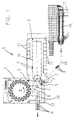
- the stretch blow molding machine S according to FIGS. 1 to 3 has a blowing station 1 in the form of a blowing wheel continuously driven in the direction of the arrow 9 and an upstream heating station 2 with a transport chain 10 continuously circulating in the direction of the arrow for the preforms V and stationary infrared heating boxes 11 ,
- the heated preforms V are transferred by a continuously rotating in the arrow direction transfer wheel 8, which is occupied by a plurality of radially and tangentially controllable gripping arms 13.
- elastic gripping tongs 14 are arranged, which engage below the support ring T of the preforms V.
- the preforms V are held by a stationary guide arc 16 in the pockets until they are absorbed by the lowered holding thorns 12 have been.
- the stretch blow molding machine S further comprises a magazine 17 for the preforms V with a roller sorter 18, the Introducing preforms one after the other and in an upright position in a downwardly inclined chute 19.
- This consists essentially of two below the support ring T of the preforms V attacking guide rails and ends at the periphery of the inlet stator 7, which receives the respective foremost preform V with his pockets 15 and further transported.
- an optoelectronic control station 3 is arranged for the preforms V.
- This has a stationarily arranged above the movement path of the preforms CCD camera 20 with an optics 21 and a lighting device 13.
- the camera 20 generates from each passing preform V an image of the mouth and the support ring, which analyzes in real time in a connected electronic evaluation device 6 and classified.
- the evaluation device 6, which is supported by a microprocessor, is programmed in such a way that a first error signal F1 is generated when inspecting a slightly faulty preform V1 according to FIG. 5 with defects on the sealing surface and / or on the support ring and / or a slightly oval mouth.
- a second fault signal F2 is generated when a preform V2 according to FIG. 6 is inspected with a strongly oval or even closed or only partially open mouth, irrespective of whether the sealing face and the supporting ring are damaged or not. If a proper preform V according to FIG. 4 is inspected with a circular and defect-free mouth and undamaged carrying ring, no error signal is generated.
- the above-described electronic evaluation device 6 controls two sorting stations 4 and 5.
- the first sorting station 5 is assigned to the transfer starwheel 8 and in the circulation area of the preforms V between the heating station 2 and Blowing station 1 provided.
- the additional, second sorting station 5 is assigned to the inlet starwheel 7 and provided in the circulation area of the preforms V between the control station 3 and the heating station 2.
- the first sorting station 4 has a lever-like swiveling switch tongue 20, on which a movable at high speed between two positions, e.g. electro-pneumatic actuator 21 attacks.
- the switch blade 20 between the ejection position shown in Fig. 2 and a nearer to the rotational axis of the transfer wheel 8 neutral position is moved back and forth. In the neutral position, the preforms V can pass through the sorting station 4 or switch tongue 20 without being disturbed. If, on the other hand, the switch blade 20 assumes the ejection position, it acts on a passing preform V1 just below the support ring T and presses it out of the elastic gripper pliers 14. The precipitated preform V1 falls into a first collecting container 22.
- the second sorting station 5 has a lever-like pivotable guide piece 23 which is inserted into an opening of the stationary guide arc 16 and which is connected at high speed by an electropneumatic actuator 24 or the like between a neutral position in which it closes the gap in the guide arc 16 and an ejection position. in which it releases the gap in the guide arc 16, is reciprocable.
- the passing preforms V are held in the pockets 15 and continue unmolested to the heating station 2.
- the preforms V2 under the influence of their own weight and the centrifugal force outwardly through the open gap in the guide arc 16 fall out , if necessary through an air nozzle L is supported.
- the precipitated preforms V2 are received in a second collecting container 25.
- preforms V of injected PET are fed after alignment and separation by the roller sorter 18 via the chute 19 by means of slope down the inlet star wheel 7. There, they are accepted by the sawtooth-like pockets 15 one after the other and moved along the stationary guide arc 16.
- the head portion of each preform V is electro-optically inspected. If muzzle sealing surface and support ring are undamaged and the mouth is completely open and not deformed, there is no reaction of the evaluation device 6 and the faultless preform V runs unmolested on to the transfer station to the heating station 2. There, the preforms are received by inserting the retaining pins 12 of the transport chain 10 and then pass through the heating boxes 11 of the heating station 2.
- the preforms are heated to the desired processing temperature of about 100 °. After passing through a heating box-free Konditionierrange the preforms approach the transfer starwheel 8 and are sequentially detected and held by the controlled gripping arms with the elastic gripping tongs 14, whereupon the retaining mandrels 12 are pulled upwards out of the preforms V. Now the faultless preforms V continue to run to blow station 1 and are used in their open blow molds 9. Thereafter, the blow molds 9 are closed and it takes place in a conventional manner by mechanical pre-stretching with both low-pressure and high-pressure blown air forming the preforms V to the Bottle-shaped hollow bodies H. These are removed after cooling from the open blow molds 9, for example, by a similar to the transfer star wheel 8 constructed outlet star wheel 26 and passed from this to a discharge conveyor 27 for the finished hollow body H.
- the evaluation device 6 If a slightly faulty preform V1 according to FIG. 5 with damages at the mouth and / or the support ring and / or slightly oval, but open mouth is inspected in the control station 3, then the evaluation device 6 generates a first error signal F1, with a corresponding time delay is forwarded according to the transport path between the control device 3 and the first sorter 4 to this.
- the slightly faulty preform V1 just like a faultless preform V, passes the second sorting station 5, which is in neutral position, and is then introduced into the heating station 2 and heated to the processing temperature. Thereafter, in the same manner as in a faultless preform V, the transfer to the Transfersternrad 8.
- preform V1 Only upon reaching the first sorting station 4 of slightly faulty, heated to normal processing temperature preform V1 is discharged in the manner described above by pressing the switch blade 20 and so on another Processing in blowing station 1 excluded. Accordingly, the blow mold 9 that would normally receive the faulty preform V1 does not receive a preform in this case. On the other hand, the preceding and trailing blow molds 9 are fitted with defect-free preforms V, which have been properly brought to their temperature profile, since the faulty preform V1 removed at the sorting station 4 has caused no gap in the area of the heating station 2.
- the evaluation device 6 If a heavily defective preform V2 according to FIG. 6 is inspected by the control station 3 with wholly or partially closed mouth or strongly oval-shaped mouth, the evaluation device 6 generates a second error signal F2 for the second sorting station 5 in accordance with the transport path between control station 3 and sorting station 5 metered delay.
- Such strongly faulty preforms V2 could not be properly taken over by the retaining thorns 12 of the transport chain 10 that can be moved into the preform muzzle and possibly cause disturbances at the transition point between the inlet starwheel 7 and the transport chain 10.
- These preforms V2 are therefore excreted shortly after passing through the control station 3 already in the second sorting station 5 in the manner described by swinging out of the guide piece 23. This creates a gap that passes through the heating station 2.
- This gap can cause an undesirable temperature change on the leading and trailing defect-free preform V, so that it is expedient to exclude these two preforms V from further processing in the blowing station 1.
- the electronic evaluation device 6 automatically triggers an error signal F1 for the leading and the trailing preform V when generating an error signal F2 for a preform V2, regardless of whether it is absolutely error-free or slightly faulty.
- this process step is limited to the case of a closed mouth, etc., which is relatively rare because of the good quality control in the preform manufacturers, and is therefore not very significant.
- the slightly faulty preforms V1 occur more frequently, since the corresponding faults can also be caused by transport to the bottle manufacturer or the like.
- the sorting out of highly defective preforms can also be routed into the inlet area of the heating station, whereby the holding mandrels can act as measuring mandrels or ejectors by automatically ejecting preforms with a narrowed or oval mouth.
- the additional sorting station 5 can then be omitted.
- faulty preforms can be heated in the same way as slightly faulty preforms in the heating station and only be eliminated in the first sorting station on the Transfersternrad if the design of the heating station allows. This is e.g. the case when the transport chain 10 is provided with engaging on the outside of the preforms gripping tongs. In any case, the production of proper hollow body is reduced only as far as necessary by the inventive method and apparatus of the invention.
Landscapes
- Engineering & Computer Science (AREA)
- Manufacturing & Machinery (AREA)
- Mechanical Engineering (AREA)
- Blow-Moulding Or Thermoforming Of Plastics Or The Like (AREA)
- Processing And Handling Of Plastics And Other Materials For Molding In General (AREA)
- Separation Using Semi-Permeable Membranes (AREA)
Description
- Die Erfindung betrifft ein verfahren zum Herstellen von Hohlkörpern aus Kunststoff durch Streckblasen von erwärmten Vorformlingen gemäß dem Oberbegriff des Anspruchs 1 sowie eine hierfür geeignete Vorrichtung gemäß dem Oberbegriff des Anspruchs 5.
- Es ist bereits eine gattungsgemäße Vorrichtung bekannt, bei der sowohl die Kontrollstation als auch die damit verbundene Ausscheidestation mit beträchtlichem Abstand vor der Heizstation angeordnet sind, so dass alle fehlerhaften Vorformlinge noch vor dem Erwärmen ausgeschieden werden können (DE 197 37 527 A1). Die Kontrollstation weist einen eigenen Antriebsmotor auf, der durch eine spezielle Aufholsteuerung dafür sorgt, dass die durch das Ausscheiden aller fehlerhaften Vorformlinge entstandenen Lücken noch vor der Heizstation wieder geschlossen werden. Die Heizstation und die Blasstation werden somit lückenlos mit Vorformlingen bestückt und arbeiten mit maximaler Leistung und maximalem Wirkungsgrad. Der konstruktive Aufwand sowie der Platzbedarf der bekannten Vorrichtung ist jedoch nicht unerheblich und ihre Integration ist manchmal schwierig, weshalb diese Bauweise mit separatem Preforminspektor trotz ihrer Vorzüge nicht für alle Anwendungsfälle geeignet ist.
- Andererseits ist es bereits bekannt, eine mechanische Kontrollstation mit Ausscheidefunktion in das Einlaufsternrad der Heizstation zu integrieren (US-PS 4 693 375). Auch hier werden alle beanstandeten Vorformlinge noch vor der Heizstation ausgeschieden; die dadurch erzeugten Lücken pflanzen sich jedoch voll durch die Heizstation und die Blasstation fort. Dies führt je nach Anteil an fehlerhaften Vorformlingen zu mehr oder weniger starker Beeinträchtigung der Leistung bzw. des Wirkungsgrads. Hinzu kommt, dass durch die Lücken zwischen den Vorformlingen in der Heizstation die Erwärmung der den Lücken vorausgehenden und nachfolgenden Vorformlinge gestört wird, was zu Fehlern in den fertig geblasenen Hohlkörpern, z.B. Getränkeflaschen, führt.
- Schließlich ist durch die WO-A-01/89790 bereits eine Vorrichtung zum Herstellen von Hohlkörpern aus Kunststoff bekannt, bei der die vorformlinge vereinzelt und dann in spezielle Träger eingesetzt werden, die mittels eines Förderbands der Heizstation zugeführt werden. Alle Träger ohne Vorformling oder mit schief sitzendem Vorformling werden noch vor der Heizstation ausgestoßen, wonach die entstandene Lücke durch Aufstauen der Träger auf dem Förderer geschlossen wird. Hierfür ist ausreichend Raum sowie ein spezieller Förderer erforderlich.
- Der Erfindung liegt die Aufgabe zu Grunde, ein gattungsgemäßes Verfahren und eine gattungsgemäße Vorrichtung zum Herstellen von Hohlkörpern aus Kunststoff zu schaffen, das bzw. die ein ungleichmäßiges Erwärmen von Vorformlingen möglichst vermeidet, ohne dass ein Aufstauen der Vorformlinge vor dem Erwärmen zum Schließen von Lücken erforderlich ist.
- Diese Aufgabe wird hinsichtlich des Verfahrens durch die Merkmale des Anspruchs 1 und hinsichtlich der Vorrichtung durch die Merkmale des Anspruchs 5 gelöst.
- Erfindungsgemäß werden auch fehlerhafte Vorformlinge zumindest teilweise bewusst erwärmt und erst kurz vor dem Blasvorgang ausgeschieden. Die Erwärmung der benachbarten fehlerfreien Vorformlinge wird daher nicht gestört. Der Wirkungsgrad des Verfahrens und der Maschine wird so nur gering beeinträchtigt. Kontrolle und Ausscheidung können optimal in das Blasverfahren bzw. in die Blasmaschine integriert werden; ein eigener, kostenaufwändiger Preforminspektor ist nicht erforderlich. Trotzdem können alle für die Produktion ungeeigneten Vorformlinge zuverlässig aussortiert werden.
- Besonders vorteilhaft ist es, wenn gemäß einer Weiterbildung der Erfindung nur diejenigen fehlerhaften Vorformlinge nach dem Erwärmen ausgeschieden werden, die anstandslos auf die üblicherweise in Heizstationen vorgesehenen Haltedorne für den Vorformling-Transport aufgesteckt werden können. Dies ist beispielsweise der Fall bei Vorformlingen mit fehlerhaftem Tragring, fehlerhafter Dichtfläche oder nur leicht ovaler Mündung, Grob fehlerhafte Vorformlinge dagegen, z.B. mit stark ovaler oder geschlossener Mündung, die nicht auf die Haltedorne aufgesteckt werden können, werden dann bereits vor dem Erwärmen ausgeschieden. Auf diese Weise werden die verbleibenden Lücken beim Erwärmen auf ein unbedingt notwendiges Mindestmaß reduziert. Die Unterscheidung zwischen den beiden fehlerhaften Klassen von Vorformlingen ist insbesondere mit optoelektronischer Abtastung und digitaler Signalverarbeitung kein Problem. Auf diese Weise wird ein fehlerhafter Vorformling je nach Art seines Fehlers an der jeweils zweckmäßigsten Stelle entfernt.
- Vorteilhafte Weiterbildungen der Erfindung sind in den Unteransprüchen enthalten.
- Im Nachstehenden wird ein Ausführungsbeispiel der Erfindung anhand der Zeichnungen beschrieben. Es zeigen:
- Fig. 1
- die schematische Draufsicht auf eine Streckblasmaschine
- Fig. 2
- in vergrößerter Darstellung den Ausschnitt Z nach Fig. 1
- Fig. 3
- die Seitenansicht der Kontrollstation der Streckblasmaschine nach Fig. 1, teilweise im Schnitt
- Fig. 4
- die Draufsicht auf einen fehlerfreien Vorformling
- Fig. 5
- die Draufsicht auf einen leicht fehlerhaften Vorformling
- Fig. 6
- die Draufsicht auf einen stark fehlerhaften Vorformling.
- Die Streckblasmaschine S nach Fig. 1 bis 3 besitzt eine Blasstation 1 in Form eines mit mehreren Blasformen 9 bestückten, in Pfeilrichtung kontinuierlich antreibbaren Blasrads und eine vorgeschaltete Heizstation 2 mit einer in Pfeilrichtung kontinuierlich umlaufenden Transportkette 10 für die Vorformlinge V und stationären Infrarot-Heizkästen 11.
- Zwischen den ins Innere der Vorformlinge V elastisch eingreifenden Haltedornen 12 der Transportkette 10 und den Blasformen 9 werden die erwärmten Vorformlinge V durch ein in Pfeilrichtung kontinuierlich rotierendes Transfersternrad 8 überführt, das mit mehreren radial und tangential steuerbaren Greifarmen 13 besetzt ist. An den radial äusseren Enden der Greifarme 13 sind elastische Greifzangen 14 angeordnet, die unterhalb des Tragrings T der Vorformlinge V angreifen.
- Die Zufuhr der Vorformlinge V zu den Haltedornen 12 der Transportkette 10 erfolgt durch ein in Pfeilrichtung kontinuierlich antreibbares Einlaufsternrad 7 mit sägezahnartig geformten Taschen 15. Dabei werden die Vorformlinge V durch einen stationären Führungsbogen 16 in den Taschen gehalten, bis sie von den abgesenkten Haltedornen 12 aufgenommen worden sind.
- Die Streckblasmaschine S umfasst weiter ein Magazin 17 für die Vorformlinge V mit einem Walzensortierer 18, der die Vorformlinge einzeln nacheinander und in aufrechter Normalposition in eine nach unten hin geneigte Rutsche 19 einführt. Diese besteht im wesentlichen aus zwei unterhalb des Tragrings T der Vorformlinge V angreifenden Führungsschienen und endet am Umfang des Einlaufsternrads 7, welches den jeweils vordersten Vorformling V mit seinen Taschen 15 aufnimmt und weitertransportiert.
- In dem sich an die Rutsche 19 anschließenden Umlaufbereich des Einlaufsternrads 7 ist eine optoelektronische Kontrollstation 3 für die Vorformlinge V angeordnet. Diese besitzt eine stationär über der Bewegungsbahn der Vorformlinge angeordnete CCD-Kamera 20 mit einer Optik 21 und einer Beleuchtungseinrichtung 13. Die Kamera 20 erzeugt von jedem vorbeilaufenden Vorformling V ein Bild der Mündung und des Tragrings, das in einer angeschlossenen elektronischen Auswertungseinrichtung 6 in Echtzeit analysiert und klassifiziert wird. Die von einem Mikroprozessor gestützte Auswertungseinrichtung 6 ist derart programmiert, dass beim Inspizieren eines leicht fehlerhaften Vorformlings V1 gemäß Fig. 5 mit Fehlern an der Dichtfläche und/oder am Tragring und/oder einer leicht ovalen Mündung ein erstes Fehlersignal F1 erzeugt wird. Ein zweites Fehlersignal F2 wird erzeugt, wenn ein Vorformling V2 gemäß Fig. 6 mit stark ovaler oder gar geschlossener oder nur teilweise offener Mündung inspiziert wird, unabhängig davon ob die Dichtfläche und der Tragring beschädigt sind oder nicht. Wird ein ordnungsgemäßer Vorformling V gemäß Fig. 4 mit kreisrunder und fehlerfreier Mündung und unbeschädigtem Tragring inspiziert, so wird kein Fehlersignal erzeugt.
- Die vorbeschriebene elektronische Auswertungseinrichtung 6 steuert zwei Sortierstationen 4 und 5 an. Die erste Sortierstation 5 ist dem Transfersternrad 8 zugeordnet und im Umlaufbereich der Vorformlinge V zwischen Heizstation 2 und Blasstation 1 vorgesehen. Die zusätzliche, zweite Sortierstation 5 ist dem Einlaufsternrad 7 zugeordnet und im Umlaufbereich der Vorformlinge V zwischen Kontrollstation 3 und Heizstation 2 vorgesehen.
- Die erste Sortierstation 4 weist eine hebelartig schwenkbare Weichenzunge 20 auf, an der ein mit hoher Geschwindigkeit zwischen zwei Positionen verfahrbares, z.B. elektropneumatisches Stellorgan 21 angreift. Durch dieses wird die Weichenzunge 20 zwischen der in Fig. 2 gezeigten Auswurfstellung und einer näher an der Drehachse des Transfersternrads 8 liegenden Neutralstellung hin- und herbewegt. In der Neutralstellung können die Vorformlinge V die Sortierstation 4 bzw. Weichenzunge 20 unbehelligt passieren. Nimmt dagegen die Weichenzunge 20 die Auswurfstellung ein, so wirkt sie auf einen passierenden Vorformling V1 dicht unterhalb des Tragrings T ein und drückt diesen aus der elastischen Greiferzange 14 heraus. Der ausgeschiedene Vorformling V1 fällt in einen ersten Sammelbehälter 22.
- Die zweite Sortierstation 5 weist ein in eine Öffnung des stationären Führungsbogens 16 eingesetztes, hebelartig schwenkbares Führungsstück 23 auf, das mit hoher Geschwindigkeit durch ein elektropneumatisches Stellorgan 24 oder dgl. zwischen einer Neutralstellung, in der es die Lücke im Führungsbogen 16 schließt und einer Auswurfstellung, in der es die Lücke im Führungsbogen 16 freigibt, hin- und herbewegbar ist. In der Neutralstellung des Führungsstücks 23 werden die passierenden Vorformlinge V in den Taschen 15 gehalten und laufen unbehelligt weiter zur Heizstation 2. In der Auswurfstellung dagegen können die Vorformlinge V2 unter Einfluss ihres Eigengewichts und der Zentrifugalkraft nach aussen hin durch die geöffnete Lücke im Führungsbogen 16 herausfallen, was erforderlichenfalls durch eine Luftdüse L unterstützt wird. Die ausgeschiedenen Vorformlinge V2 werden in einem zweiten Sammelbehälter 25 aufgenommen.
- Die Funktion der vorbeschriebenen Vorrichtung sowie das mit ihr durchgeführte Verfahren laufen folgendermaßen ab:
- Die ungeordnet und mit normaler Raumtemperatur ins Magazin 17 eingeschütteten Vorformlinge V aus gespritztem PET werden nach Ausrichtung und Vereinzelung durch den Walzensortierer 18 über die Rutsche 19 mittels Hangabtrieb dem Einlaufsternrad 7 zugeführt. Dort werden sie durch,die sägezahnartigen Taschen 15 einzeln nacheinander aufgenommen und am stationären Führungsbogen 16 entlangbewegt. Beim Passieren der Kontrollstation 3 wird der Kopfbereich jedes Vorformlings V elektrooptisch inspiziert. Sind Mündungsdichtfläche und Tragring unbeschädigt und ist die Mündung vollständig offen und nicht verformt, so erfolgt keine Reaktion der Auswertungseinrichtung 6 und der fehlerfreie Vorformling V läuft unbehelligt weiter zur Übergabestelle an die Heizstation 2. Dort werden die Vorformlinge durch Einführen der Haltedorne 12 der Transportkette 10 aufgenommen und passieren dann die Heizkästen 11 der Heizstation 2. Dabei werden sie auf die gewünschte Verarbeitungstemperatur von ca. 100° erwärmt. Nach dem Durchlaufen einer heizkastenfreien Konditionierstrecke nähern sich die Vorformlinge dem Transfersternrad 8 und werden der Reihe nach durch dessen gesteuerte Greifarme mit den elastischen Greifzangen 14 erfasst und gehalten, worauf die Haltedorne 12 nach oben hin aus den Vorformlingen V abgezogen werden. Nun laufen die fehlerfreien Vorformlinge V weiter zur Blasstation 1 und werden in deren geöffnete Blasformen 9 eingesetzt. Daraufhin werden die Blasformen 9 geschlossen und es erfolgt in herkömmlicher Weise durch mechanisches Vorrecken sowohl mit Niederdruck- und Hochdruck-Blasluft ein Ausformen der Vorformlinge V zu den flaschenförmigen Hohlkörpern H. Diese werden nach Abkühlung aus den geöffneten Blasformen 9 entnommen, beispielsweise durch ein ähnlich wie das Transfersternrad 8 aufgebaute Auslaufsternrad 26 und von diesem an einen Abförderer 27 für die fertigen Hohlkörper H übergeben.
- Wird in der Kontrollstation 3 ein leicht fehlerhafter Vorformling V1 gemäß Fig. 5 mit Beschädigungen an der Mündung und/oder am Tragring und/oder leicht ovaler, jedoch offener Mündung inspiziert, so erzeugt die Auswertungseinrichtung 6 ein erstes Fehlersignal F1, das mit entsprechender zeitlicher Verzögerung gemäß dem Transportweg zwischen der Kontrolleinrichtung 3 und der ersten Sortiereinrichtung 4 an diese weitergeleitet wird. Zunächst aber passiert der leicht fehlerhafte Vorformling V1 genauso wie ein fehlerfreier Vorformling V die zweite, in Neutralposition stehende Sortierstation 5 und wird dann in die Heizstation 2 eingeschleust und auf Verarbeitungstemperatur erwärmt. Danach erfolgt in gleicher Weise wie bei einem fehlerfreien Vorformling V die Übergabe an das Transfersternrad 8. Erst bei Erreichen der ersten Sortierstation 4 wird der leicht fehlerhafte, auf normale Verarbeitungstemperatur erwärmte Vorformling V1 in vorbeschriebener Weise durch Betätigung der Weichenzunge 20 ausgeschleust und so von einer weiteren Bearbeitung in der Blasstation 1 ausgeschlossen. Dementsprechend empfängt die Blasform 9, die normalerweise den fehlerhaften Vorformling V1 empfangen würde, in diesem Falle keinen Vorformling. Die vorausgehenden und nachlaufenden Blasformen 9 dagegen werden mit fehlerfreien Vorformlingen V bestückt, die ordnungsgemäß auf ihr Temperaturprofil gebracht wurden, da der an der Sortierstation 4 entfernte fehlerhafte Vorformling V1 im Bereich der Heizstation 2 keine Lücke verursacht hat.
- Wird durch die Kontrollstation 3 ein stark fehlerhafter Vorformling V2 gemäß Fig. 6 mit ganz oder teilweise verschlossener Mündung oder stark oval verformter Mündung inspiziert, so erzeugt die Auswertungseinrichtung 6 ein zweites Fehlersignal F2 für die zweite Sortierstation 5 mit entsprechend dem Transportweg zwischen Kontrollstation 3 und Sortierstation 5 bemessener Verzögerung. Derartige stark fehlerhafte Vorformlinge V2 könnten von den in die Vorformlingsmündung einfahrbaren Haltedornen 12 der Transportkette 10 nicht ordnungsgemäß übernommen werden und würden an der Übergangsstelle zwischen Einlaufsternrad 7 und Transportkette 10 evtl. Störungen verursachen. Diese Vorformlinge V2 werden daher kurze Zeit nach dem Passieren der Kontrollstation 3 bereits in der zweiten Sortierstation 5 in der beschriebenen Weise durch Ausschwenken des Führungsstücks 23 ausgeschieden. Dadurch entsteht eine Lücke, die durch die Heizstation 2 hindurchläuft. Diese Lücke kann eine unerwünschte Temperaturänderung am vorauslaufenden und nachlaufenden fehlerfreien Vorformling V verursachen, so dass es zweckmäßig ist, auch diese beiden Vorformlinge V von einer weiteren Verarbeitung in der Blasstation 1 auszuschließen. Hierzu löst die elektronische Auswertungseinrichtung 6 automatisch bei Erzeugen eines Fehlersignals F2 für einen Vorformling V2 jeweils ein Fehlersignal F1 für den vorauslaufenden und den nachlaufenden Vorformling V aus, unabhängig davon ob dieser absolut fehlerfrei oder leicht fehlerhaft ist. Dieser Verfahrensschritt ist jedoch auf den wegen der guten Qualitätskontrolle bei den Vorformlingsherstellern relativ seltenen Fall einer geschlossenen Mündung usw. beschränkt und fällt daher nicht stark ins Gewicht. Die leicht fehlerhaften Vorformlinge V1 treten dagegen häufiger auf, da die entsprechenden Fehlerstellen auch durch den Transport zum Flaschenhersteller o. dgl. hervorgerufen werden können.
- Das Aussortieren stark fehlerhafter Vorformlinge kann auch in den Einlaufbereich der Heizstation verlegt werden, wobei die Haltedorne als Messdorne oder Auswerfer wirken können, indem sie Vorformlinge mit verengter oder ovaler Mündung automatisch ausstoßen. Die zusätzliche Sortierstation 5 kann dann entfallen. Auch können stark fehlerhafte Vorformlinge in der gleichen Weise wie leicht fehlerhafte Vorformlinge in der Heizstation erwärmt und erst in der ersten Sortierstation am Transfersternrad ausgeschieden werden, wenn die Bauweise der Heizstation dies erlaubt. Dies ist z.B. der Fall, wenn die Transportkette 10 mit an der Aussenseite der Vorformlinge angreifenden Greifzangen versehen ist. In jedem Falle wird durch das erfindungsgemäße Verfahren und die erfindungsgemäße Vorrichtung die Produktion ordnungsgemäßer Hohlkörper nur soweit unbedingt erforderlich reduziert.
Claims (9)
- Verfahren zum Herstellen von Hohlkörpern (H) aus Kunststoff durch Streckblasen von erwärmten Vorformlingen (V), wobei die Vorformlinge vor dem Erwärmen kontrolliert und fehlerhafte Vorformlinge ausgeschieden werden, dadurch gekennzeichnet, dass zumindest ein Teil der fehlerhaften Vorformlinge (V) erwärmt und erst nach dem Erwärmen ausgeschieden wird.
- Verfahren nach Anspruch 1, dadurch Gekennzeichnet, das die fehlerhaften Vorformlinge (V),die auf Haltedorne aufgesteckt werden können, erst nach dem Erwärmen ausgeschieden werden, und diejenigen fehlerhaften Vorformlinge (V), die nicht auf Haltedorne aufgesteckt werden können, bereits vor dem Erwärmen ausgeschieden werden.
- Verfahren nach Anspruch 2, dadurch gekennzeichnet, dass die fehlerhaften Vorformlinge (V) mit Fehlern an der Pichtfläche oder am Tragring nach dem Erwärmen und die fehlerhaften Vorformlinge (V) mit ovaler oder verengter Mündung vor dem Erwärmen ausgeschieden werden.
- Verfahren nach Anspruch 2 oder 3, dadurch gekennzeichnet, dass diejenigen fehlenfreien Vorformlinge (V), die einer beim Ausscheiden eines fehlerhaften Vorformlings (V) vor dem Erwärmen erzeugten Lücke benachbart sind, nach dem Erwärmen ausgeschieden werden.
- Vorrichtung zum Herstellen von Hohlkörpern (H) aus Kunststoff durch Streckblasen von erwärmten Vorformlingen (V), mit einer Heizstation (2), einer nachgeschalteten Blasstation (1) und einer vorgeschalteten Kontrollstation (3), dadurch gekennzeichnet, dass zwischen der Heizstation (2) und der Blasstation (1) eine von der Kontrollstation (3) steuerbare Sortierstation (4) zum Ausscheiden von fehlerhaften Vorformlingen (V) angeordnet ist.
- Vorrichtung nach Anspruch 5, dadurch gekennzeichnet, dass zwischen der Kontrollstation (3) und der Heizstation (2) eine zusätzliche, gleichfalls von der Kontrollstation (3) steuerbare Sortierstation (5) zum Ausscheiden von fehlerhaften Vorformlingen (V) angeordnet ist.
- Vorrichtung nach Anspruch 6, dadurch gekennzeichnet, dass die Kontrollstation (3) eine Auswertungseinrichtung (6) aufweist, die zwischen fehlerhaften Vorformlingen (V) mit fehlerfreier oder nur leicht ovaler Mündung einerseits und fehlerhaften Vorformlingen (V') mit stark'ovaler oder verengter Mündung andererseits unterscheidet und veranlasst, dass letztere bereits in der zusätzlichen Sortierstation (5) vor der Heizstation (2) ausgeschieden werden.
- Vorrichtung nach einem der Ansprüche 5 bis 7, dadurch gekennzeichnet, dass die Kontrollstation (3) an einem der Heizstation (2) vorgeschalteten Einlaufsternrad (7) und die Sortierstation (4) an einem zwischen Heizstation (2) und Blasstation (1) angeordneten Transfersternrad (8) angeordnet sind.
- Vorrichtung nach Anspruch 8, dadurch gekennzeichnet, dass die zusätzliche Sortierstation (5) am Einlaufsternrad (7) angeordnet ist.
Applications Claiming Priority (2)
| Application Number | Priority Date | Filing Date | Title |
|---|---|---|---|
| DE10259589 | 2002-12-19 | ||
| DE10259589A DE10259589B3 (de) | 2002-12-19 | 2002-12-19 | Verfahren und Vorrichtung zum Herstellen von Hohlkörpern aus Kunststoff |
Publications (2)
| Publication Number | Publication Date |
|---|---|
| EP1431021A1 EP1431021A1 (de) | 2004-06-23 |
| EP1431021B1 true EP1431021B1 (de) | 2006-06-21 |
Family
ID=31969770
Family Applications (1)
| Application Number | Title | Priority Date | Filing Date |
|---|---|---|---|
| EP03025938A Expired - Lifetime EP1431021B1 (de) | 2002-12-19 | 2003-11-13 | Verfahren und Vorrichtung zum Herstellen von Hohlkörpern aus Kunststoff |
Country Status (4)
| Country | Link |
|---|---|
| US (1) | US7399435B2 (de) |
| EP (1) | EP1431021B1 (de) |
| AT (1) | ATE330774T1 (de) |
| DE (2) | DE10259589B3 (de) |
Families Citing this family (33)
| Publication number | Priority date | Publication date | Assignee | Title |
|---|---|---|---|---|
| DE20308513U1 (de) * | 2003-05-30 | 2004-07-08 | Krones Ag | Vorrichtung zum Zuführen von Vorformlingen zu einer Blasmaschine |
| DE102005060814B4 (de) * | 2005-12-20 | 2014-12-31 | Krones Aktiengesellschaft | Vorrichtung und Verfahren zum Formblasen von Behältern |
| DE102006013843A1 (de) * | 2006-03-25 | 2007-09-27 | Khs Ag | Blasmaschine sowie Verfahren zum Herstellen von Flaschen oder dergleichen Hohlkörper |
| DE102009037172A1 (de) | 2008-02-11 | 2011-02-17 | Krones Ag | Behältnis - Behandlungsanlage mit rückwirkender Korrekturmöglichkeit |
| DE102008008528A1 (de) * | 2008-02-11 | 2009-08-13 | Krones Ag | Behandlungsanlage, insbesondere für Behältnisse mit rückwirkender Korrekturmöglichkeit |
| DE102008013419A1 (de) * | 2008-03-06 | 2009-09-10 | Khs Corpoplast Gmbh & Co. Kg | Verfahren und Vorrichtung zur Blasformung von Behältern |
| EP2546176B1 (de) | 2008-04-18 | 2016-01-20 | SACMI Cooperativa Meccanici Imola Società Cooperativa | Formpressblasverfahren und -vorrichtung |
| DE102008045568A1 (de) | 2008-09-03 | 2010-03-04 | Krones Ag | Einrichtung und Kolben zum Aussortieren von Artikeln |
| DE102009004819A1 (de) | 2009-01-13 | 2010-07-15 | Krones Ag | Vorrichtung und Verfahren zum Aussondern von Vorformlingen |
| DE102009015519A1 (de) * | 2009-04-02 | 2010-10-07 | Krones Ag | Vorrichtung zum Umformen von Kunststoffvorformlingen mit Heizeinrichtung |
| DE102010021445A1 (de) * | 2010-05-25 | 2011-12-01 | Krones Ag | Verfahren und Vorrichtung zur Temperatursteuerung und/oder -regelung einer Heizvorrichtung für Vorformlinge |
| DE102010035496A1 (de) * | 2010-08-25 | 2012-03-01 | Krones Aktiengesellschaft | Fördervorrichtung zum Fördern von Vorformlingen |
| DE102010048417A1 (de) * | 2010-10-15 | 2012-04-19 | Krones Aktiengesellschaft | Vorrichtung zum Herstellen von Kunststoffbehältnissen mit variabler Stationsabschaltung |
| DE102010049385A1 (de) * | 2010-10-26 | 2012-04-26 | Krones Aktiengesellschaft | Blasmaschine in Modulbauweise |
| DE102011007280A1 (de) | 2011-04-13 | 2012-10-18 | Krones Aktiengesellschaft | Behälterbehandlungsmaschine und Verfahren zur Behälterbehandlung |
| DE102011079078A1 (de) | 2011-07-13 | 2013-01-17 | Krones Ag | Einsternzuführung für Behandlungsmaschinen |
| BR112014015315B1 (pt) * | 2011-12-21 | 2021-05-25 | Amcor Limited | sistema de moldagem a sopro de uma pré-forma e método de formação e enchimento de um recipiente com um produto final |
| DE102012101653A1 (de) * | 2012-02-29 | 2013-08-29 | Krones Ag | Preformtransport mit individueller Auswurfmöglichkeit |
| DE102012101915A1 (de) * | 2012-03-07 | 2013-09-12 | Krones Ag | Heizvorrichtung und Verfahren zum Temperieren von Vorformlingen |
| DE102012102356A1 (de) * | 2012-03-20 | 2013-09-26 | Krones Ag | Vorrichtung zum Erwärmen von Kunststoffvorformlingen mit teilweise Wiederverwendbarkeit von Kunststoffvorformlingen |
| DE102013111528A1 (de) * | 2013-10-18 | 2015-04-23 | Krones Ag | Vorrichtung und Verfahren zum Erwärmen von Kunststoffvorformlingen mit motorisch gesteuerten Halteelementen für die Kunststoffvorformlinge |
| DE102014010862B4 (de) * | 2014-07-25 | 2021-01-07 | Khs Corpoplast Gmbh | Verfahren und Vorrichtung zum Transport von Vorformlingen |
| ITBO20150203A1 (it) * | 2015-04-21 | 2016-10-21 | Sacmi | Apparato e metodo di ispezione ottica di preforme. |
| DE102017120106A1 (de) * | 2017-08-31 | 2019-02-28 | Krones Ag | Auffangbehälter mit integrierten Schutzeinrichtungen für Kunststoffvorformlinge und Kunststoffbehältnisse in einer Streckblasmaschine |
| DE102018122548A1 (de) * | 2018-09-14 | 2020-03-19 | Krones Ag | Vorrichtung und Verfahren zum Inspizieren von schwingenden Behältnissen |
| FR3088026B1 (fr) * | 2018-11-02 | 2020-10-16 | Sidel Participations | Procede de gestion de preformes immobilisees dans une station de chauffage |
| DE102019203062A1 (de) | 2019-03-06 | 2020-09-10 | Krones Ag | Verfahren zur Produktführung in einer Streckblas- und/oder Abfüllanlage und Streckblas- und/oder Abfüllanlage für Flaschen |
| CN110014633B (zh) * | 2019-04-17 | 2021-07-06 | 德玛克(长兴)自动化系统有限公司 | 一种倒立式瓶坯传输检测工艺 |
| DE102019008152A1 (de) * | 2019-11-25 | 2021-05-27 | Khs Corpoplast Gmbh | Vorrichtung zur Herstellung von Behältern aus Kunststoff |
| CN111439576B (zh) * | 2020-04-26 | 2024-08-02 | 江苏新美星包装机械股份有限公司 | 瓶坯的翻转输送装置 |
| WO2023275592A1 (en) * | 2021-06-29 | 2023-01-05 | Discma Ag | Method of heating a preform suitable for blow molding |
| DE102021134503A1 (de) | 2021-12-23 | 2023-06-29 | Krones Aktiengesellschaft | Vorrichtung und Verfahren zum Behandeln und insbesondere Sterilisieren von Behältnissen |
| DE102023133494A1 (de) * | 2023-11-30 | 2025-06-05 | Khs Gmbh | Prüfeinrichtung zum Prüfen zumindest eines Preforms, Streckblasmaschine und Verfahren zum Prüfen eines Preforms |
Family Cites Families (9)
| Publication number | Priority date | Publication date | Assignee | Title |
|---|---|---|---|---|
| US4693375A (en) * | 1985-11-22 | 1987-09-15 | Schweers Karl D | Preform handling apparatus |
| US6584805B1 (en) * | 1993-08-24 | 2003-07-01 | Coors Brewing Company | Hot bottle inspection apparatus |
| DE19737527C2 (de) * | 1997-08-28 | 2002-10-24 | Krones Ag | Vorrichtung zur Herstellung von Kunststoffhohlkörpern |
| US5935285A (en) * | 1997-12-30 | 1999-08-10 | Coors Brewing Company | Method for inspecting manufactured articles |
| DE19821105A1 (de) * | 1998-05-12 | 1999-11-18 | Krones Ag | Vorrichtung und Verfahren zur Herstellung von Kunststoffhohlkörpern |
| WO2001089791A1 (en) * | 2000-05-24 | 2001-11-29 | Uniloy Milacron Inc. | Blow molding machine having flexible cavitation |
| US6620352B1 (en) * | 2000-07-27 | 2003-09-16 | Ball Corporation | Automated material distribution control for stretch blow molded articles |
| DE20114032U1 (de) * | 2001-08-24 | 2002-10-02 | KRONES AG, 93073 Neutraubling | Vorrichtung zum Aussondern von fehlerhaften Vorformlingen mit einem Halskragen |
| US6863860B1 (en) * | 2002-03-26 | 2005-03-08 | Agr International, Inc. | Method and apparatus for monitoring wall thickness of blow-molded plastic containers |
-
2002
- 2002-12-19 DE DE10259589A patent/DE10259589B3/de not_active Expired - Fee Related
-
2003
- 2003-11-13 AT AT03025938T patent/ATE330774T1/de not_active IP Right Cessation
- 2003-11-13 DE DE50303934T patent/DE50303934D1/de not_active Expired - Lifetime
- 2003-11-13 EP EP03025938A patent/EP1431021B1/de not_active Expired - Lifetime
- 2003-12-16 US US10/737,293 patent/US7399435B2/en not_active Expired - Lifetime
Also Published As
| Publication number | Publication date |
|---|---|
| DE50303934D1 (de) | 2006-08-03 |
| ATE330774T1 (de) | 2006-07-15 |
| DE10259589B3 (de) | 2004-04-01 |
| EP1431021A1 (de) | 2004-06-23 |
| US20040159586A1 (en) | 2004-08-19 |
| US7399435B2 (en) | 2008-07-15 |
Similar Documents
| Publication | Publication Date | Title |
|---|---|---|
| DE10259589B3 (de) | Verfahren und Vorrichtung zum Herstellen von Hohlkörpern aus Kunststoff | |
| DE69526864T2 (de) | Flaschenkontrolle auf dem transportweg wo die flasche geformt wird | |
| EP2112502B1 (de) | Verfahren und Vorrichtung zur Prüfung von Behälter-Preforms | |
| DE102007049009B4 (de) | Vorrichtung zum Sortieren von Vorformlingen | |
| DE69207644T2 (de) | Vorrichtung zum Anbringen von kratzfesten Beschichtungen auf plastik-opthalmischen Linsen | |
| EP2845715B1 (de) | Inspektions- und Auswerfereinheit | |
| EP2565012B2 (de) | Anlage und Verfahren zum Herstellen von Kunststoffbehältnissen | |
| EP3564006B1 (de) | Vorrichtung zum transport und prüfen von vorformlingen | |
| EP3183073B1 (de) | Vorrichtung und verfahren zum transport von vorformlingen im bereich einer blasmaschine | |
| EP1837157A2 (de) | Blasmachine sowie Verfahren zum Herstellen von Flaschen oder dergleichen Hohlkörper | |
| EP0996531B1 (de) | Vorrichtung und verfahren zur herstellung von kunststoffhohlkörpern | |
| DE102010054792A1 (de) | Vorrichtung zum Behandeln von Behältnissen mit Behältnisausrichtung | |
| DE102005060814B4 (de) | Vorrichtung und Verfahren zum Formblasen von Behältern | |
| DE102014012528A1 (de) | Vorrichtung und Verfahren zum Transport von Vorformlingen im Bereich einer Blasmaschine | |
| WO2017148597A1 (de) | Anlage und verfahren zum behandeln von kunststoffvorformlingen mit luftförderer oder transportshuttle | |
| DE102011056441A1 (de) | Vorrichtung zum Transportieren von Kunststoffvorformlingen | |
| EP2206565A1 (de) | Vorrichtung und Verfahren zum Aussondern von Vorformlingen | |
| DE19737527C2 (de) | Vorrichtung zur Herstellung von Kunststoffhohlkörpern | |
| EP2386403A2 (de) | Heizstrecke und Handhabungsvorrichtung für Vorformlinge | |
| DE102020121425A1 (de) | Vorrichtung und Verfahren zum Behandeln von Kunststoffvorformlingen mit Inspektionseinrichtung | |
| EP1520681B2 (de) | Vorrichtung zur Blasformung von Behältern | |
| DE102005048126A1 (de) | Verfahren und Vorrichtung zum Sortieren von Vorformlingen | |
| DE3823671A1 (de) | Vorrichtung zum herstellen von formteilen | |
| DE69804868T2 (de) | Vorrichtung zum sequentiellen transport von flaschen aus plastikmaterial | |
| EP1568625B1 (de) | Inspektionsmaschine mit einer Vorrichtung zum Transportieren von Hohlkörpern |
Legal Events
| Date | Code | Title | Description |
|---|---|---|---|
| PUAI | Public reference made under article 153(3) epc to a published international application that has entered the european phase |
Free format text: ORIGINAL CODE: 0009012 |
|
| AK | Designated contracting states |
Kind code of ref document: A1 Designated state(s): AT BE BG CH CY CZ DE DK EE ES FI FR GB GR HU IE IT LI LU MC NL PT RO SE SI SK TR |
|
| AX | Request for extension of the european patent |
Extension state: AL LT LV MK |
|
| 17P | Request for examination filed |
Effective date: 20040514 |
|
| 17Q | First examination report despatched |
Effective date: 20040907 |
|
| AKX | Designation fees paid |
Designated state(s): AT CH FR GB IT LI |
|
| RBV | Designated contracting states (corrected) |
Designated state(s): AT BE CH DE FR GB IT LI |
|
| REG | Reference to a national code |
Ref country code: DE Ref legal event code: 8566 |
|
| RBV | Designated contracting states (corrected) |
Designated state(s): AT CH DE FR GB IT LI |
|
| GRAP | Despatch of communication of intention to grant a patent |
Free format text: ORIGINAL CODE: EPIDOSNIGR1 |
|
| GRAS | Grant fee paid |
Free format text: ORIGINAL CODE: EPIDOSNIGR3 |
|
| GRAA | (expected) grant |
Free format text: ORIGINAL CODE: 0009210 |
|
| AK | Designated contracting states |
Kind code of ref document: B1 Designated state(s): AT CH DE FR GB IT LI |
|
| PG25 | Lapsed in a contracting state [announced via postgrant information from national office to epo] |
Ref country code: IT Free format text: LAPSE BECAUSE OF FAILURE TO SUBMIT A TRANSLATION OF THE DESCRIPTION OR TO PAY THE FEE WITHIN THE PRESCRIBED TIME-LIMIT;WARNING: LAPSES OF ITALIAN PATENTS WITH EFFECTIVE DATE BEFORE 2007 MAY HAVE OCCURRED AT ANY TIME BEFORE 2007. THE CORRECT EFFECTIVE DATE MAY BE DIFFERENT FROM THE ONE RECORDED. Effective date: 20060621 |
|
| REG | Reference to a national code |
Ref country code: GB Ref legal event code: FG4D Free format text: NOT ENGLISH |
|
| REG | Reference to a national code |
Ref country code: CH Ref legal event code: EP |
|
| REF | Corresponds to: |
Ref document number: 50303934 Country of ref document: DE Date of ref document: 20060803 Kind code of ref document: P |
|
| GBT | Gb: translation of ep patent filed (gb section 77(6)(a)/1977) |
Effective date: 20060717 |
|
| ET | Fr: translation filed | ||
| PLBE | No opposition filed within time limit |
Free format text: ORIGINAL CODE: 0009261 |
|
| STAA | Information on the status of an ep patent application or granted ep patent |
Free format text: STATUS: NO OPPOSITION FILED WITHIN TIME LIMIT |
|
| 26N | No opposition filed |
Effective date: 20070322 |
|
| PG25 | Lapsed in a contracting state [announced via postgrant information from national office to epo] |
Ref country code: AT Free format text: LAPSE BECAUSE OF NON-PAYMENT OF DUE FEES Effective date: 20061113 |
|
| PG25 | Lapsed in a contracting state [announced via postgrant information from national office to epo] |
Ref country code: LI Free format text: LAPSE BECAUSE OF NON-PAYMENT OF DUE FEES Effective date: 20071130 Ref country code: CH Free format text: LAPSE BECAUSE OF NON-PAYMENT OF DUE FEES Effective date: 20071130 |
|
| REG | Reference to a national code |
Ref country code: CH Ref legal event code: PL |
|
| REG | Reference to a national code |
Ref country code: FR Ref legal event code: PLFP Year of fee payment: 13 |
|
| REG | Reference to a national code |
Ref country code: FR Ref legal event code: PLFP Year of fee payment: 14 |
|
| REG | Reference to a national code |
Ref country code: FR Ref legal event code: PLFP Year of fee payment: 15 |
|
| REG | Reference to a national code |
Ref country code: FR Ref legal event code: PLFP Year of fee payment: 16 |
|
| PGFP | Annual fee paid to national office [announced via postgrant information from national office to epo] |
Ref country code: GB Payment date: 20220930 Year of fee payment: 20 |
|
| PGFP | Annual fee paid to national office [announced via postgrant information from national office to epo] |
Ref country code: FR Payment date: 20221010 Year of fee payment: 20 |
|
| PGFP | Annual fee paid to national office [announced via postgrant information from national office to epo] |
Ref country code: IT Payment date: 20221011 Year of fee payment: 20 Ref country code: DE Payment date: 20220621 Year of fee payment: 20 |
|
| REG | Reference to a national code |
Ref country code: DE Ref legal event code: R071 Ref document number: 50303934 Country of ref document: DE |
|
| REG | Reference to a national code |
Ref country code: GB Ref legal event code: PE20 Expiry date: 20231112 |
|
| PG25 | Lapsed in a contracting state [announced via postgrant information from national office to epo] |
Ref country code: GB Free format text: LAPSE BECAUSE OF EXPIRATION OF PROTECTION Effective date: 20231112 |
|
| PG25 | Lapsed in a contracting state [announced via postgrant information from national office to epo] |
Ref country code: GB Free format text: LAPSE BECAUSE OF EXPIRATION OF PROTECTION Effective date: 20231112 |