EP1432164A2 - Procédé de contrôle d'erreur dans un système de communication sans fil - Google Patents
Procédé de contrôle d'erreur dans un système de communication sans fil Download PDFInfo
- Publication number
- EP1432164A2 EP1432164A2 EP03024954A EP03024954A EP1432164A2 EP 1432164 A2 EP1432164 A2 EP 1432164A2 EP 03024954 A EP03024954 A EP 03024954A EP 03024954 A EP03024954 A EP 03024954A EP 1432164 A2 EP1432164 A2 EP 1432164A2
- Authority
- EP
- European Patent Office
- Prior art keywords
- terminal
- sub
- information
- allocated
- ranging
- Prior art date
- Legal status (The legal status is an assumption and is not a legal conclusion. Google has not performed a legal analysis and makes no representation as to the accuracy of the status listed.)
- Withdrawn
Links
Images








Classifications
-
- H—ELECTRICITY
- H04—ELECTRIC COMMUNICATION TECHNIQUE
- H04L—TRANSMISSION OF DIGITAL INFORMATION, e.g. TELEGRAPHIC COMMUNICATION
- H04L27/00—Modulated-carrier systems
- H04L27/26—Systems using multi-frequency codes
-
- H—ELECTRICITY
- H04—ELECTRIC COMMUNICATION TECHNIQUE
- H04L—TRANSMISSION OF DIGITAL INFORMATION, e.g. TELEGRAPHIC COMMUNICATION
- H04L1/00—Arrangements for detecting or preventing errors in the information received
- H04L1/0001—Systems modifying transmission characteristics according to link quality, e.g. power backoff
-
- H—ELECTRICITY
- H04—ELECTRIC COMMUNICATION TECHNIQUE
- H04L—TRANSMISSION OF DIGITAL INFORMATION, e.g. TELEGRAPHIC COMMUNICATION
- H04L1/00—Arrangements for detecting or preventing errors in the information received
- H04L1/0078—Avoidance of errors by organising the transmitted data in a format specifically designed to deal with errors, e.g. location
- H04L1/0083—Formatting with frames or packets; Protocol or part of protocol for error control
-
- H—ELECTRICITY
- H04—ELECTRIC COMMUNICATION TECHNIQUE
- H04L—TRANSMISSION OF DIGITAL INFORMATION, e.g. TELEGRAPHIC COMMUNICATION
- H04L1/00—Arrangements for detecting or preventing errors in the information received
- H04L1/12—Arrangements for detecting or preventing errors in the information received by using return channel
- H04L1/16—Arrangements for detecting or preventing errors in the information received by using return channel in which the return channel carries supervisory signals, e.g. repetition request signals
- H04L1/1607—Details of the supervisory signal
- H04L1/1621—Group acknowledgement, i.e. the acknowledgement message defining a range of identifiers, e.g. of sequence numbers
-
- H—ELECTRICITY
- H04—ELECTRIC COMMUNICATION TECHNIQUE
- H04L—TRANSMISSION OF DIGITAL INFORMATION, e.g. TELEGRAPHIC COMMUNICATION
- H04L1/00—Arrangements for detecting or preventing errors in the information received
- H04L1/12—Arrangements for detecting or preventing errors in the information received by using return channel
- H04L1/16—Arrangements for detecting or preventing errors in the information received by using return channel in which the return channel carries supervisory signals, e.g. repetition request signals
- H04L1/1607—Details of the supervisory signal
- H04L1/1664—Details of the supervisory signal the supervisory signal being transmitted together with payload signals; piggybacking
-
- H—ELECTRICITY
- H04—ELECTRIC COMMUNICATION TECHNIQUE
- H04L—TRANSMISSION OF DIGITAL INFORMATION, e.g. TELEGRAPHIC COMMUNICATION
- H04L5/00—Arrangements affording multiple use of the transmission path
- H04L5/02—Channels characterised by the type of signal
- H04L5/023—Multiplexing of multicarrier modulation signals, e.g. multi-user orthogonal frequency division multiple access [OFDMA]
-
- H—ELECTRICITY
- H04—ELECTRIC COMMUNICATION TECHNIQUE
- H04W—WIRELESS COMMUNICATION NETWORKS
- H04W28/00—Network traffic management; Network resource management
- H04W28/02—Traffic management, e.g. flow control or congestion control
- H04W28/04—Error control
-
- H—ELECTRICITY
- H04—ELECTRIC COMMUNICATION TECHNIQUE
- H04W—WIRELESS COMMUNICATION NETWORKS
- H04W72/00—Local resource management
- H04W72/04—Wireless resource allocation
- H04W72/044—Wireless resource allocation based on the type of the allocated resource
- H04W72/0453—Resources in frequency domain, e.g. a carrier in FDMA
-
- H—ELECTRICITY
- H04—ELECTRIC COMMUNICATION TECHNIQUE
- H04W—WIRELESS COMMUNICATION NETWORKS
- H04W72/00—Local resource management
- H04W72/20—Control channels or signalling for resource management
- H04W72/23—Control channels or signalling for resource management in the downlink direction of a wireless link, i.e. towards a terminal
-
- H—ELECTRICITY
- H04—ELECTRIC COMMUNICATION TECHNIQUE
- H04W—WIRELESS COMMUNICATION NETWORKS
- H04W76/00—Connection management
- H04W76/10—Connection setup
- H04W76/11—Allocation or use of connection identifiers
-
- H—ELECTRICITY
- H04—ELECTRIC COMMUNICATION TECHNIQUE
- H04L—TRANSMISSION OF DIGITAL INFORMATION, e.g. TELEGRAPHIC COMMUNICATION
- H04L1/00—Arrangements for detecting or preventing errors in the information received
- H04L2001/0092—Error control systems characterised by the topology of the transmission link
- H04L2001/0093—Point-to-multipoint
-
- H—ELECTRICITY
- H04—ELECTRIC COMMUNICATION TECHNIQUE
- H04L—TRANSMISSION OF DIGITAL INFORMATION, e.g. TELEGRAPHIC COMMUNICATION
- H04L27/00—Modulated-carrier systems
- H04L27/26—Systems using multi-frequency codes
- H04L27/2601—Multicarrier modulation systems
-
- H—ELECTRICITY
- H04—ELECTRIC COMMUNICATION TECHNIQUE
- H04L—TRANSMISSION OF DIGITAL INFORMATION, e.g. TELEGRAPHIC COMMUNICATION
- H04L5/00—Arrangements affording multiple use of the transmission path
- H04L5/003—Arrangements for allocating sub-channels of the transmission path
- H04L5/0044—Allocation of payload; Allocation of data channels, e.g. PDSCH or PUSCH
-
- H—ELECTRICITY
- H04—ELECTRIC COMMUNICATION TECHNIQUE
- H04W—WIRELESS COMMUNICATION NETWORKS
- H04W76/00—Connection management
- H04W76/10—Connection setup
-
- H—ELECTRICITY
- H04—ELECTRIC COMMUNICATION TECHNIQUE
- H04W—WIRELESS COMMUNICATION NETWORKS
- H04W76/00—Connection management
- H04W76/30—Connection release
-
- H—ELECTRICITY
- H04—ELECTRIC COMMUNICATION TECHNIQUE
- H04W—WIRELESS COMMUNICATION NETWORKS
- H04W8/00—Network data management
- H04W8/26—Network addressing or numbering for mobility support
Definitions
- the present invention relates to a medium access control (MAC) frame constitution method, and an error control method. More specifically, the present invention relates to a MAC frame constitution method in a wireless communication system using orthogonal frequency division multiple access (OFDMA) technology.
- MAC medium access control
- OFDMA orthogonal frequency division multiple access
- the services provided in the conventional wireless communication systems are those defined in the IEEE 802.16 standard, such as a real-time polling service, a non-real-time polling service, or best effort (BE) service.
- IEEE 802.16 the same number of information bits are used for every time and frequency allocated to one connection in allocation of the time and frequency resources.
- sub-carriers of the same channel gain are allocated irrespective of channel characteristics, so it is impossible to adaptively cope with the channel characteristics, resulting in a deterioration of the system efficiency.
- both the sub-carrier allocation status and the information bit allocation number of each sub-carrier are transferred as sub-carrier allocation information.
- a MAC frame designing method that includes (a) allocating a corresponding connection ID to each terminal; and (b) assigning information on a sub-carrier allocation status for the connection ID and the number of allocated information bits of each sub-carrier to the sub-carrier allocation information.
- the step (b) includes allocating the number of allocated information bits of each sub-carrier in addition to the information on the sub-carrier allocation status.
- the step (b) includes assigning the information on the sub-carrier allocation status and then the number of allocated information bits of each sub-carrier for the allocated sub-carriers; or assigning, by sub-carriers, both the information on the sub-carrier allocation status and the number of allocated information bits.
- a registration method for registering a terminal with an access point using a MAC frame in a wireless communication system.
- the MAC frame is divided into a downlink sub-frame including a broadcast interval and a first management connection interval, and an uplink sub-frame including an access interval and a second management connection interval.
- the broadcast interval is used for transmitting downlink and uplink map messages.
- the registration method includes: (a) the access point receiving a ranging request message from the terminal using the access interval; (b) the access point sending ranging allocation information to the terminal using the downlink and uplink map messages; (c) the access point performing ranging through a ranging slot; (d) the access point receiving a registration request message from the terminal using the second management connection interval; and (e) the access point sending information on whether to permit the registration to the terminal using the first management connection interval.
- the access point sends the uplink and downlink map messages to the terminal using the broadcast interval before it receives the ranging request message.
- the access point receives a ranging response message from the terminal, sends the downlink and uplink map messages including the allocated ranging slot to the terminal, receives the ranging request message from the terminal through the allocated ranging slot, and sends the ranging response message to the terminal using the first management connection interval.
- the access point receives a ranging slot request message from the terminal using the second management connection interval, reallocates the ranging slot to the terminal, and sends the downlink and uplink map messages including information on the reallocated ranging slot. Subsequently, the access point receives a ranging request message from the terminal using the reallocated ranging slot, and sends a ranging response message using the first management connection interval.
- a recording medium with a built-in program which implements a function of designing a MAC frame to register a terminal with an access point in a wireless communication system.
- the function includes: allocating an access interval to the MAC frame so as to enable the terminal to send a ranging request message to the access point; allocating a broadcast interval to the MAC frame so as to enable the access point to send downlink and uplink map messages including allocated ranging information to the terminal; allocating an uplink management connection interval to the MAC frame so as to enable the terminal to send a registration request message to the access point; and allocating a downlink management connection interval to the MAC frame so as to enable the terminal to send information on whether to permit the registration and a ranging response message to the terminal.
- an error control method which is done using a control connection between receiver and transmitter in a wireless communication system.
- the error control method includes: (a) setting up a control connection between the receiver and the transmitter; (b) the receiver checking a reception status of MPDUs (MAC Protocol Data Units) by frames when traffic exists; (c) the receiver constituting an acknowledgement (ACK) message for data transmission in a previous frame and sending it to the transmitter; and (d) disconnecting the control connection when the traffic ends.
- MPDUs MAC Protocol Data Units
- FIG. 1 is a schematic diagram of a wireless communication system according to an embodiment of the present invention.
- the wireless communication system is, as shown in FIG. 1, a point-to-multipoint communication system comprising an AP (Access Point) 100, and a plurality of terminals 200 in communication with the AP by OFDM signal scheme.
- the AP 100 is connected to an Ethernet or an external network 300 and in wireless communication with the multiple terminals 200 on a wireless channel 400.
- the multiple terminals 200 and the AP 100 share one wireless channel 400, so data must be transmitted without a collision.
- the representative traffic of the real-time VBR service is MPEG (Moving Picture Experts Group) video stream.
- service parameters are used that include traffic parameters such as maximum data transfer rate, average data transfer rate, or maximum allowable burst value; and QoS (Quality of Service) parameters such as maximum delay time, allowable jitter value, or data loss rate.
- the representative traffic of the non-real-time VBR service is FTP (File Transfer Protocol).
- service parameters are used that include traffic parameters such as maximum data transfer rate, average data transfer rate, or maximum allowable burst value; and QoS parameters such as maximum delay time, or data loss rate.
- the scheduler of the AP 100 allocates wireless resources adequately to the corresponding VBR connection according to each service parameter value.
- the representative traffic of the BE service is HTTP (HyperText Transfer Protocol), SMTP (Simple Mail Transfer Protocol), or the like. There is no service parameter for the BE service.
- the terminal 200 piggybacks its buffer status on the last data MPDU (MAC Protocol Data Unit) of the corresponding connection of every MAC frame, so it can request the AP 100 for an amount of data to be transferred to the next frame.
- the terminal 200 preferably negotiates with the AP 100 on the resource allocation change using a management connection.
- the AP 100 transmits changed downlink and uplink maps to the next frame using appropriate scheduling. According to circumstances, however, the AP 100 may accept only a part of the resource allocation change requested by the terminal 200.
- the AP 100 allocates a connection ID for the BE service to the corresponding terminal 200.
- the AP 100 allocates wireless resources using the BE connection ID of the terminal 200.
- the terminal 200 piggybacks its buffer status on the last data MPDU of the connection of every MAC frame, so it can request the AP 100 for an amount of data to be transferred to the next frame.
- the AP 100 transmits changed downlink and uplink maps to the next frame using appropriate scheduling. But, according to circumstances, the AP 100 may accept only a part of the resource allocation change requested by the terminal 200. In addition, the AP 100 may not guarantee defined wireless resource allocation in the next frame for the BE connection in case of shortage of the wireless resources.
- the BE service is then provided using the connection ID for EB that is allocated one by one to every terminal 200.
- FIG. 2 is a flow chart of an error control process performed at the receiver according to an embodiment of the present invention
- FIG. 3 is a flow chart of an error control process performed at the transmitter according to an embodiment of the present invention.
- the terminal 200 enters a step of registering with the corresponding AP 100.
- one management connection identified by a 10-bit connection ID is set up on the terminal 200 and the AP 100.
- the AP 100 periodically allocates wireless resources for management connection to the terminal 200 by a basic mode set in the MIB (Management Information Base).
- the terminal 200 periodically reports the AP 100 of the management MPDU amount to be transferred, and the AP 100 appropriately allocates wireless resources for management connection to the terminal 200 according to the management MPDU amount reported by the terminal 200.
- the terminal 200 can request the AP 100 for new connection set-up, connection change, or disconnection.
- the access information of channels for management connection is broadcast using a broadcast message in the broadcast interval.
- the error control function must be provided.
- Each control connection is set up for non-real-time VBR, BE, and management connections to provide the error control function (in step 21).
- the receiver determines whether or not traffic is received (in step 22). If there is no traffic received, then the receiver determines whether or not the traffic is terminated (in step 25). If there is received traffic, then the receiver checks the MPDU reception status by frames (in step 23).
- the receiver constitutes an acknowledgement (ACK) message ACK MPDU for data transmission in the previous frame and sends the ACK message ACK MPDU (in step 24).
- the ACK message has a payload field that represents the first and last sequence numbers successfully received in succession among the MPDUs transmitted in the previous frame.
- the receiver does not send the ACK message.
- the receiver checks whether or not the traffic is terminated (in step 25). If the traffic is terminated, then the receiver disconnects the control connection (in step 26); otherwise, it rechecks the MPDU reception status (in step 23).
- Each control connection is set up for non-real-time VBR, BE, and management connections (in step 31).
- the receiver sends the ACK message ACK MPDU for data transmission in the previous frame.
- the transmitter determines whether or not the ACK message ACK MPDU is received (in step 32). If the ACK message ACK MPDU is not received yet, then the transmitter resends MPDUs (in step 36).
- the transmitter analyzes the received ACK message ACK MPDU by frames (in step 33), and determines whether to resend the MPDUs (in step 34).
- the payload field of the ACK message includes information on the first and last sequence numbers successfully received in succession among the MPDUs transmitted in the previous frame.
- the payload field includes the sequence numbers of the MPDUs of the first range only.
- those out of the range of the sequence numbers reported on the control connection are retransmitted (in steps 35 and 36).
- the transmitter resends all the MPDUs transferred in the previous frame.
- the transmitter resends the MPDUs and checks whether or not the traffic ends (in step 37). If the traffic is terminated, then the transmitter disconnects the control connection (in step 38); otherwise, it analyzes the ACK MPDU by frames a second time (in step 33).
- the error control function described with reference to FIGS. 2 and 3 must be performed continuously during the holding time of the connection under the error control.
- FIG. 4 is a flow chart showing an OFDM feedback information transfer process according to an embodiment of the present invention.
- Each terminal 200 measures the signal-to-noise ratio (SNR) in the units of frame in regard to the transmission quality of each sub-carrier, so as to report the AP 100 of the downlink transmission quality by sub-carriers (in step 41). If the SNR of each sub-carrier is changed from the previous SNR measurement by at least 1 dB (in step 42), then the terminal 200 constitutes OFDM-FBCK MPDUs (in step 43), and sends them to the AP 100 (in step 44). Each terminal 200 can transmit at most one OFDM-FBCK MPDU per frame.
- SNR signal-to-noise ratio
- the OFDM signaling method is adapted as a signal modulation method in designing the physical layer providing the above-mentioned services.
- the OFDM signaling method is widely used in high-speed data communication systems using communication channels having a limited frequency bandwidth, because it reduces a deterioration of performance caused by inter-symbol interference for multi-path fading channels and has a high frequency efficiency.
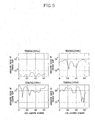
- FIG. 5 shows channel gains for the respective sub-carriers as measured at a plurality of terminals
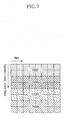
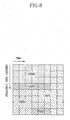
- FIGS. 6, 7, and 8 are conceptual diagrams of time and frequency domains in TDMA, FDMA, and OFDMA, respectively
- FIG. 9 shows a comparison of system efficiencies according to the number of users.
- the channel characteristics between the terminals 200 and the AP 100 are different from one terminal to another.
- the channel gain of one OFDM sub-carrier is low at terminal 200a, but high at other terminals 200b, 200c, and 200d. It is preferable in this case to allocate this sub-carrier to the terminals 200b, 200c, and 200d, and another sub-carrier of a higher channel gain to the terminal 200a, thereby enhancing the system resource efficiency.
- the channel environment of each terminal 200 is measured in allocation of sub-carrier channels such that the sub-carrier channel having the highest channel gain in the aspect of each terminal 200 is used for communication between the AP 100 and the corresponding terminal 200 so as to maximize the frequency resource efficiency.
- a multiple access method that enables one AP 100 to communicate with multiple terminals 200 using a same OFDM symbol interval is called "OFDMA (OFDM Access)"
- the OFDMA method of allocating resources adaptively to the channel environment is called "adaptive OFDMA”
- time or frequency resources are fixedly allocated to the individual users irrespective of the difference in the channel gain of each sub-carrier, so the channel capacity for an increased number of users is the same as that for a single user.
- OFDMA Orthogonal Frequency Division Multiple Access
- a sub-carrier channel having the highest channel gain for each user is selected and allocated to the corresponding user so as to enhance the channel capacity, as shown in FIG. 8.
- the OFDMA method (g1) of adaptively allocating the modulation method of each sub-carrier channel is in system efficiency by about 83% than the TDMA or FDMA method (g2) of uniformly allocating fixed time or frequency resources by users, and by about 33% higher than the TDMA or FDMA method (g3) of using an adaptive modulation method.
- the terminal 200 belonging to the wireless communication system according to the embodiment of the present invention can maintain multiple connections at the same time and allocate multiple sub-carriers having an independent modulation method per connection. Expediently, it is assumed in the following description that all the terminals have no more one connection.
- the terminal 200 can estimate the number of information bits modulated on each allocated sub-carrier channel only if it has information on its allocated sub-carrier channel, the corresponding channel gain, and the received information transfer rate.
- the channel gain of each sub-carrier is calculated at the AP 100 and at each terminal 200 using an independent channel estimation process.
- the AP 100 has only to send information on a list of sub-carrier channels allocated to each terminal 200 and the information transfer rate to the terminal 200, so it can reduce channel dissipation.
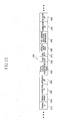
- FIG. 10 is a schematic diagram of a MAC frame according to an embodiment of the present invention.
- FIG. 11 a shows the result of channel gain estimation; and
- FIG. 11 b shows the number of allocated bits by sub-carriers.
- One MAC frame 500 of the wireless communication system is, as shown in FIG. 10, temporally divided into a downlink sub-frame 510 and an uplink sub-frame 520.
- the downlink is a channel for signal transmission from AP 100 to each terminal 200
- the uplink is a channel for signal transmission from each terminal 200 to AP 100.
- the time division duplexing method is used for distributing uplink and downlink channels.
- the downlink sub-frame 510 is divided into, according to function, a broadcast interval 511, and a downlink data, management, and control connection interval 513.
- the uplink sub-frame 520 is divided into, according to function, an access interval 521, and an uplink data, management, and control connection interval 522.
- intervals 511, 512, 521, and 522 have a variable length.
- the slot is defined as a multiple of the OFDM symbol.
- These intervals 511, 512, 521 and 522 may be composed of a slot having a different length.
- the access interval 521 is an interval used for the terminals 200 trying to get a first access to the AP 100, and also for a contention interval possibly having a collision among the terminals 200.
- the broadcast interval 511 carries a preamble, a DD message, a UD message, a downlink map message, or an uplink map message.
- the channel gain estimation value calculated at the AP 100 must be matched to that calculated at the individual terminals 200 in order to correctly estimate the number of allocated information bits for each sub-carrier.
- the channel gain estimation values are unmatched, in which case the information bit allocation pattern by sub-carriers is changed even with small error estimation.
- the transport bit information allocated to the sub-carrier channels with allocation errors are all missed which causes serious deterioration of the whole performance.
- FIGS. 11 a and 11 b show the result of a simulation for channel gain estimation at a frequency-selective fading channel having a SNR of 10 dB:
- FIG. 11a presents the result of channel gain estimation in the 49th and 50th frames for a same channel;
- FIG. 11 b presents the estimated number of bits allocated to each received sub-carrier based on the result of the channel gain estimation of FIG. 11 a. It can be seen from FIG. 11 b that even a small difference of channel gain estimation leads to a considerable error in the calculation of the number of allocated bits.
- FIG. 12 is a structural diagram of a downlink/uplink map information element of a downlink/uplink map message transferred in the broadcast interval in the frame structure according to the embodiment of the present invention.
- the downlink/uplink map information element 600 comprises, as shown in FIG. 12, a terminal ID field 610, a terminal offset field 620, a connection ID field 630, a repeating bit field 640, an uplink/downlink characteristic field 650, a start slot field 660, an end slot field 670, a physical layer type field 680, and a sub-carrier allocation information field 690.
- the terminal ID field 610 enables every terminal 200 connected to the AP 100 to check whether or not the map information corresponds to itself.
- the terminal ID is allocated to each terminal from the AP 100 during the initial registration process. If the terminal ID field 610 is matched to its terminal ID, then the terminal 200 processes map information from the terminal ID to a value just before the value represented by the terminal offset field 620. It the terminal ID field 610 is unmatched to its terminal ID, then the terminal 200 skips as much of the map information as the value represented by the terminal offset field 620 and checks the value of the terminal ID field 610. The terminal 200 repeats this procedure until the terminal ID field 610 is matched to its terminal ID.
- each terminal 200 capable of maintaining multiple connections at the same time may have multiple connections in an interval defined by the terminal ID field 610 and terminal offset field 620.
- the connection ID field 630, the repeating bit field 640, the uplink/downlink characteristic field 640, the start slot field 660, the end slot field 670, the physical layer type field 680, and the sub-carrier allocation information field 690 are allocated to each connection.
- the connection ID field 630, the repeating bit field 640, the uplink/downlink characteristic field 650, the start slot field 660, the end slot field 670, and the physical layer type field 680 have a fixed length, but the sub-carrier allocation information field 690 has a variable length.
- the connection ID field 630 represents a connection ID unique to every terminal 200 connected to the network. Connection ID "0" is reserved for the AP 100 and is used in the initial registration process.
- the repeating bit field 640 provides information on whether or not the value of the sub-carrier allocation information field 690 of the corresponding connection is identical to that of the sub-carrier allocation information field 690 of the previous connection. For example, when the value of the sub-carrier allocation information field 690 of the connection is identical to that of the sub-carrier allocation information field 690 of the previous connection, the repeating bit field 640 is set to "1" and the sub-carrier allocation information field 690 in the corresponding connection is not added. This prevents unnecessary allocation of the repeated sub-carrier allocation information 690 to minimize band dissipation.
- the uplink/downlink characteristic field 650 is a code for discriminating a set of formulated physical layer parameters of the downlink/uplink.
- the start and end slot fields 660 and 670 represent the positions of the start and end slots of each connection, respectively.
- the physical layer type field 680 represents the type of the physical layer operated by the system.
- the sub-carrier allocation information field 690 includes allocated sub-carrier information for each connection and the number of allocated information bits for each sub-carrier.
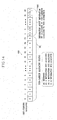
- FIGS. 13, 14, and 15 are schematic diagrams showing the structure of the sub-carrier allocation information according to first, second, and third embodiments of the present invention.
- FIG. 13 shows, for example, the case where the number of sub-carriers per OFDM symbol is 96 and two bits are allocated for transmitting the maximum number of allocated information bits per sub-carrier.
- the 2-bit information allocated to each sub-carrier is "00" in this case, then no information bit is allocated; if the 2-bit information is "01 “, then 2 information bits are allocated; if the 2-bit information is "10”, then 4 information bits are allocated; and if the 2-bit information is "11", then 6 information bits are allocated.
- the field representing the number of allocated information bits of a predetermined size is assigned to all the sub-carriers, thus facilitating implementation, in the first embodiment of the present invention.
- the number of allocated information bits is added even for the sub-carriers not allocated to the corresponding terminal or connection in the first embodiment of the present invention, it may not be added for the sub-carriers not allocated to the terminal or connection. The embodiment of this pattern will now be described with reference to FIG. 14 as follows.
- FIG. 14 shows, for example, the case where the number of sub-carriers per OFDM symbol is 96 and two bits are used to represent the maximum number of allocated information bits per sub-carrier. One bit is allocated to transmit information on whether or not each sub-carrier is allocated, and the fields representing the number of allocated information bits are then added for the allocated sub-carriers only.
- the fields representing the number of allocated information bits are added for the first, third, ..., 91st and 93rd sub-carriers having a sub-carrier allocation status value of "1".
- the values of these fields are "01", “10”, ..., "11” and "01", respectively.
- the field values of "01”, "10” and “11” represent 2-, 4- and 6-bit information bit allocations, respectively.
- the fields representing the number of allocated information bits are added for only the sub-carriers allocated to the terminal or connection to minimize channel dissipation. But, in the second embodiment of the present invention, the corresponding terminal or connection is required to memorize the positions of the sub-carriers allocated to it and map the number of allocated information bits later.
- a description will be given as to an embodiment for transferring information on whether or not each sub-carrier is allocated, in addition to the number of allocated information bits with reference to FIG. 15.
- FIG. 15 shows, for example, the case where the number of sub-carriers per OFDM symbol is 96 and two bits are used to represent the maximum number of allocated information bits per sub-carrier.
- the information on whether the sub-carrier is allocated has a value of "1" (i.e., the sub-carrier is allocated)
- information on the number of allocated information bits for the sub-carrier is added.
- the information on the number of allocated information bits can be 2-bit information of "01", "10" or "11" as in the examples of FIGS. 13 and 14.
- the information representing the number of allocated information bits that has a value of "01", “10", ..., “11” or “01” is added to the first, third, ..., 91st, or 93rd sub-carrier of which the allocation status value is "1".
- whether or not the sub-carrier is allocated is checked in the order of sub-carriers so as to add information on the number of allocated information bits for the allocated sub-carriers only. This reduces channel dissipation, and facilitates implementation in hardware, because the terminal or connection can immediately acquire information on the number of allocated information bits.
- a comparison of the first, second, and third embodiments of the present invention in the aspect of channel dissipation reveals that the transferring method of the first embodiment shown in FIG. 13 has less channel dissipation with a statistically small number of terminals or connections for transferring resource allocation information every frame, and that the transferring methods of the second and third embodiments shown in FIGS. 14 and 15 have less channel dissipation with a statistically large number of terminals or connections for transferring resource allocation information every frame.
- FIGS. 16 and 17 in regard to an initial registration process for the terminal 200 registering with the AP 100.
- FIG. 16 is a flow chart of an initial ranging process according to an embodiment of the present invention
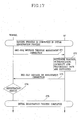
- FIG. 17 is a flow chart of a process for the AP 100 determining whether to permit the registration of the terminal 200 according to an embodiment of the present invention.
- the initial registration process of the terminal 200 with the AP 100 comprises an initial ranging process of FIG. 16, and a process of the AP 100 determining whether to permit the registration of the terminal 200 as shown in FIG. 17.
- the initial ranging process is a process in which the terminal 200 to be connected to the network for the first time communicates information on time synchronization, power level, or frequency offsets with the AP 100 prior to a permission of the AP 100.
- the terminal 200 receives a downlink/uplink map message from the AP 100 (in step 61), and sends a ranging request RNG-REQ message at an access interval to the AP 100 (in step 62), to perform first ranging.
- the first ranging is done through a contention using the access interval, and if it is done successfully, the AP 100 allocates a ranging slot to the terminal 200 (in step 63).
- the AP 100 sends a ranging response RNG-RSP message to the terminal 200 using a specific connection ID (in step 64), and then a downlink/uplink map message to the terminal 200 (in step 65).
- the downlink/uplink map message includes allocation information on the ranging slot allocated by the AP 100.
- the terminal 200 Upon receiving the downlink/uplink map message, the terminal 200 sends the ranging request RNG-REQ message to the AP 100 through a ranging slot (in step 66), and receives the ranging response RNG-RSP message from the AP 100 through a management connection (in step 67). In this manner, the second ranging is performed using the ranging slot to complete the initial ranging process.
- the terminal 200 sends a registration request REG-REQ message to the AP 100 on the management connection (in step 71).
- the registration request REG-REQ message includes information such as authentication, transmission rate, capability, etc.
- the AP 100 determines whether or not it can support the information such as authentication, transmission rate, or capability as included in the registration request REG-REQ message (in step 72). Then the AP 100 sends a registration response REG-RSP message on the management connection to inform the terminal 200 of whether to permit the registration (in step 73). If the registration result is confirmed as successful (in step 74), then the initial registration process ends (in step 75).
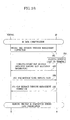
- FIG. 18 shows, in a flow chart form, a ranging process during data communication according to an embodiment of the present invention.
- the terminal 200 may decide to perform the ranging process a second time when the packet reception rate is deteriorated for a defined time period due to a change of the channel status.
- the terminal 200 sends a ranging slot request (RNGSlot-REQ) message to the AP 100 on the management connection (in step 81), and the AP 100 allocates a ranging slot to the terminal 200 (in step 82).
- the AP 100 sends a downlink/uplink map message including information on the ranging slot allocation status to the terminal 200 (in step 83).
- the terminal 200 sends a ranging request (RNG-REQ) message to the AP 100 through the ranging slot (in step 84) and receives a ranging response (RNG-RSP) message on the management connection (in step 85), thereby completing the ranging process during data communication.
- RNG-REQ ranging request
- RNG-RSP ranging response
- the above-described MAC frame designing method can be implemented as a program and stored in a recording medium such as CD-ROM, RAM, floppy disk, hard disk, magneto-optical disc, or the like.
- the MAC frame designing method stored in the recording medium can be executed with a computer.
- the MAC frame structure of the present invention enables efficient provision of a BE service, a real-time VBR service, and a non-real-time VBR service, and maximization of efficiency of time and frequency resources.
- the MAC frame in a wireless communication system includes a terminal ID allocated to each of multiple terminals. At least one connection ID is allocated to each terminal having the terminal ID, and sub-carrier allocation information is allocated to each connection having the connection ID.
- the sub-carrier allocation information includes a sub-carrier allocation status for each sub-carrier, and the number of allocated information bits for each sub-carrier.
- the sub-carrier allocation status and the number of allocated information bits for each sub-carrier can be allocated, by sub-carriers, to the sub-carrier allocation information using a same number of bits; or the information on the sub-carrier allocation status is first allocated to the sub-carrier allocation information and the number of allocated information bits for each sub-carrier is allocated.
Landscapes
- Engineering & Computer Science (AREA)
- Signal Processing (AREA)
- Computer Networks & Wireless Communication (AREA)
- Quality & Reliability (AREA)
- Mobile Radio Communication Systems (AREA)
- Small-Scale Networks (AREA)
Priority Applications (4)
| Application Number | Priority Date | Filing Date | Title |
|---|---|---|---|
| EP05111028A EP1643671A1 (fr) | 2002-12-16 | 2003-10-29 | Procédé de conception de trame de contrôle d'accès au support dans un système de communication sans fil |
| EP08168917.6A EP2019507B1 (fr) | 2002-12-16 | 2003-10-29 | Procédé d'enregistrement de terminal dans un système de communication sans fil et produit de programme informatique correspondant |
| EP08168908.5A EP2019506B1 (fr) | 2002-12-16 | 2003-10-29 | Procédé de conception de trame MAC dans un système de communication sans fil |
| EP08168920.0A EP2019508B1 (fr) | 2002-12-16 | 2003-10-29 | Procédé d'enregistrement de terminal dans un système de communication sans fil et produit de programme informatique correspondant |
Applications Claiming Priority (2)
| Application Number | Priority Date | Filing Date | Title |
|---|---|---|---|
| KR2002080317 | 2002-12-16 | ||
| KR1020020080317A KR100542090B1 (ko) | 2002-12-16 | 2002-12-16 | 무선 통신 시스템에서의 오류 제어 방법, 매체 접속 제어프레임 설계 방법 및 단말기 등록 방법과 기록 매체 |
Related Child Applications (4)
| Application Number | Title | Priority Date | Filing Date |
|---|---|---|---|
| EP08168920.0A Division EP2019508B1 (fr) | 2002-12-16 | 2003-10-29 | Procédé d'enregistrement de terminal dans un système de communication sans fil et produit de programme informatique correspondant |
| EP05111028A Division EP1643671A1 (fr) | 2002-12-16 | 2003-10-29 | Procédé de conception de trame de contrôle d'accès au support dans un système de communication sans fil |
| EP08168917.6A Division EP2019507B1 (fr) | 2002-12-16 | 2003-10-29 | Procédé d'enregistrement de terminal dans un système de communication sans fil et produit de programme informatique correspondant |
| EP08168908.5A Division EP2019506B1 (fr) | 2002-12-16 | 2003-10-29 | Procédé de conception de trame MAC dans un système de communication sans fil |
Publications (2)
| Publication Number | Publication Date |
|---|---|
| EP1432164A2 true EP1432164A2 (fr) | 2004-06-23 |
| EP1432164A3 EP1432164A3 (fr) | 2004-10-27 |
Family
ID=32388326
Family Applications (5)
| Application Number | Title | Priority Date | Filing Date |
|---|---|---|---|
| EP05111028A Withdrawn EP1643671A1 (fr) | 2002-12-16 | 2003-10-29 | Procédé de conception de trame de contrôle d'accès au support dans un système de communication sans fil |
| EP08168908.5A Expired - Lifetime EP2019506B1 (fr) | 2002-12-16 | 2003-10-29 | Procédé de conception de trame MAC dans un système de communication sans fil |
| EP08168917.6A Expired - Lifetime EP2019507B1 (fr) | 2002-12-16 | 2003-10-29 | Procédé d'enregistrement de terminal dans un système de communication sans fil et produit de programme informatique correspondant |
| EP03024954A Withdrawn EP1432164A3 (fr) | 2002-12-16 | 2003-10-29 | Procédé de contrôle d'erreur dans un système de communication sans fil |
| EP08168920.0A Expired - Lifetime EP2019508B1 (fr) | 2002-12-16 | 2003-10-29 | Procédé d'enregistrement de terminal dans un système de communication sans fil et produit de programme informatique correspondant |
Family Applications Before (3)
| Application Number | Title | Priority Date | Filing Date |
|---|---|---|---|
| EP05111028A Withdrawn EP1643671A1 (fr) | 2002-12-16 | 2003-10-29 | Procédé de conception de trame de contrôle d'accès au support dans un système de communication sans fil |
| EP08168908.5A Expired - Lifetime EP2019506B1 (fr) | 2002-12-16 | 2003-10-29 | Procédé de conception de trame MAC dans un système de communication sans fil |
| EP08168917.6A Expired - Lifetime EP2019507B1 (fr) | 2002-12-16 | 2003-10-29 | Procédé d'enregistrement de terminal dans un système de communication sans fil et produit de programme informatique correspondant |
Family Applications After (1)
| Application Number | Title | Priority Date | Filing Date |
|---|---|---|---|
| EP08168920.0A Expired - Lifetime EP2019508B1 (fr) | 2002-12-16 | 2003-10-29 | Procédé d'enregistrement de terminal dans un système de communication sans fil et produit de programme informatique correspondant |
Country Status (3)
| Country | Link |
|---|---|
| US (9) | US7391774B2 (fr) |
| EP (5) | EP1643671A1 (fr) |
| KR (1) | KR100542090B1 (fr) |
Cited By (3)
| Publication number | Priority date | Publication date | Assignee | Title |
|---|---|---|---|---|
| EP1997251A4 (fr) * | 2006-03-20 | 2013-06-05 | Intel Corp | Réseau à accès sans fil et procédé d'allocation de ressources en temps et en fréquence |
| EP1983784A4 (fr) * | 2006-02-07 | 2013-08-07 | Ntt Docomo Inc | Station mobile, dispositif de reseau d'acces radio et procede de demande de ressource |
| CN107104778A (zh) * | 2009-12-30 | 2017-08-29 | 领特德国有限公司 | 信道适配的方法和装置 |
Families Citing this family (76)
| Publication number | Priority date | Publication date | Assignee | Title |
|---|---|---|---|---|
| US7042857B2 (en) * | 2002-10-29 | 2006-05-09 | Qualcom, Incorporated | Uplink pilot and signaling transmission in wireless communication systems |
| KR100542090B1 (ko) * | 2002-12-16 | 2006-01-11 | 한국전자통신연구원 | 무선 통신 시스템에서의 오류 제어 방법, 매체 접속 제어프레임 설계 방법 및 단말기 등록 방법과 기록 매체 |
| US8036200B2 (en) * | 2003-01-21 | 2011-10-11 | Avaya Inc. | Efficient polled frame exchange on a shared-communications channel |
| US8099099B2 (en) * | 2003-02-19 | 2012-01-17 | Qualcomm Incorporated | Methods and apparatus related to assignment in a wireless communications system |
| US8611283B2 (en) * | 2004-01-28 | 2013-12-17 | Qualcomm Incorporated | Method and apparatus of using a single channel to provide acknowledgement and assignment messages |
| KR20050088817A (ko) * | 2004-03-03 | 2005-09-07 | 삼성전자주식회사 | 광대역 무선 접속 통신 시스템에서 이동 가입자 단말기의핸드오버에 따른 네트워크 재진입 시스템 및 방법 |
| WO2005088853A1 (fr) | 2004-03-09 | 2005-09-22 | Neocific Inc. | Procedes et dispositif pour acces aleatoire dans des systemes de communication a ondes porteuses multiples |
| KR100810333B1 (ko) * | 2004-06-15 | 2008-03-04 | 삼성전자주식회사 | 광대역 무선 접속 통신 시스템에서 소프트 핸드오버 지원을 위한 장치 및 방법 |
| US8891349B2 (en) | 2004-07-23 | 2014-11-18 | Qualcomm Incorporated | Method of optimizing portions of a frame |
| US8054783B2 (en) * | 2004-08-06 | 2011-11-08 | Nextel Communications Inc. | System and method for dividing subchannels in a OFDMA network |
| US8270512B2 (en) | 2004-08-12 | 2012-09-18 | Interdigital Technology Corporation | Method and apparatus for subcarrier and antenna selection in MIMO-OFDM system |
| EP2427011B1 (fr) * | 2004-10-15 | 2014-08-27 | Apple Inc. | Procédé d'attribution de ressources de communication |
| US7751363B1 (en) * | 2004-11-22 | 2010-07-06 | Nextel Communications Inc. | System and method for allocating traffic and associated control channels |
| US8831115B2 (en) | 2004-12-22 | 2014-09-09 | Qualcomm Incorporated | MC-CDMA multiplexing in an orthogonal uplink |
| KR100933131B1 (ko) * | 2005-01-08 | 2009-12-21 | 삼성전자주식회사 | 광대역 무선 접속 통신 시스템에서 레인징 슬럿 할당시스템 및 방법 |
| US20060176882A1 (en) * | 2005-02-10 | 2006-08-10 | Beceem Communications Inc. | Method and system of early indication for multi-user wireless communication systems |
| US8811273B2 (en) * | 2005-02-22 | 2014-08-19 | Texas Instruments Incorporated | Turbo HSDPA system |
| US20060198335A1 (en) * | 2005-03-04 | 2006-09-07 | Jukka Reunamaki | Embedding secondary transmissions in an existing wireless communications network |
| US8325826B2 (en) * | 2005-03-09 | 2012-12-04 | Qualcomm Incorporated | Methods and apparatus for transmitting signals facilitating antenna control |
| US7826807B2 (en) * | 2005-03-09 | 2010-11-02 | Qualcomm Incorporated | Methods and apparatus for antenna control in a wireless terminal |
| US7664480B2 (en) * | 2005-03-24 | 2010-02-16 | Lg Electronics Inc. | Method of connecting to network in broadband wireless access system |
| KR20070000321A (ko) * | 2005-06-27 | 2007-01-02 | 삼성전자주식회사 | 직교주파수분할 다중접속 이동통신시스템에서 동적 채널할당방법 |
| US7782895B2 (en) * | 2005-08-03 | 2010-08-24 | Nokia Corporation | Apparatus, and associated method, for allocating data for communication upon communication channels in a multiple input communication system |
| US20070036067A1 (en) * | 2005-08-12 | 2007-02-15 | Interdigital Technology Corporation | Method and apparatus for sending downlink control information in an orthogonal frequency division multiple access system |
| GB0517843D0 (en) * | 2005-09-02 | 2005-10-12 | Pace Micro Tech Plc | Flexible data partitioning in systems using wideband channel bonding modems |
| KR100735265B1 (ko) * | 2005-09-14 | 2007-07-03 | 삼성전자주식회사 | 무선 통신 시스템에서 아이피 주소 구성 방법 및 시스템 |
| EP1764934B1 (fr) | 2005-09-15 | 2022-03-30 | Huawei Technologies Co., Ltd. | Méthode de génération de trame dans un système de communication à accès multiple par division de fréquences orthogonales |
| CN100531046C (zh) * | 2005-09-30 | 2009-08-19 | 鸿富锦精密工业(深圳)有限公司 | 通过无线局域网回报移动用户信息的方法 |
| KR100975699B1 (ko) * | 2005-11-05 | 2010-08-12 | 삼성전자주식회사 | 실시간 서비스를 지원하는 무선 통신 시스템에서의상향링크 자원 요청 및 할당 방법 |
| WO2007053948A1 (fr) * | 2005-11-10 | 2007-05-18 | Nortel Networks Limited | Systeme et procede pour fournir un plan de commande de couche de controle d'acces au support pour des reseaux de relais sans fil |
| CA2626895C (fr) | 2005-11-11 | 2013-11-05 | Lg Electronics Inc. | Procede de controle de communications relais |
| WO2007053950A1 (fr) * | 2005-11-12 | 2007-05-18 | Nortel Networks Limited | Systeme et procede pour fournir un plan de donnees de controle d'acces au support pour des reseaux de communication sans fil |
| CN1996806A (zh) * | 2006-01-06 | 2007-07-11 | 北京三星通信技术研究有限公司 | 无线通信系统中在竞争资源中传输数据的设备和方法 |
| KR100946886B1 (ko) * | 2006-02-07 | 2010-03-09 | 삼성전자주식회사 | 무선 이동 통신 시스템에서 네트워크 진입 방법 |
| KR100965657B1 (ko) * | 2006-02-07 | 2010-06-23 | 삼성전자주식회사 | 통신 시스템에서 레인징 방법 및 시스템 |
| US8102802B2 (en) | 2006-05-08 | 2012-01-24 | Motorola Mobility, Inc. | Method and apparatus for providing downlink acknowledgments and transmit indicators in an orthogonal frequency division multiplexing communication system |
| GB2439366A (en) * | 2006-06-20 | 2007-12-27 | Nec Technologies | Resource block scheduling in communication networks |
| US7620370B2 (en) * | 2006-07-13 | 2009-11-17 | Designart Networks Ltd | Mobile broadband wireless access point network with wireless backhaul |
| US7720485B2 (en) * | 2006-07-14 | 2010-05-18 | Qualcomm Incorporated | Methods and apparatus related to assignment in a wireless communications system |
| US7724853B2 (en) * | 2006-07-14 | 2010-05-25 | Qualcomm Incorporated | Enabling mobile switched antennas |
| US8225186B2 (en) * | 2006-07-14 | 2012-07-17 | Qualcomm Incorporated | Ecoding and decoding methods and apparatus for use in a wireless communication system |
| US8229427B2 (en) * | 2006-07-14 | 2012-07-24 | Qualcomm Incorporated | Status validation for terminals in a wireless communication system |
| US8942218B2 (en) * | 2006-09-29 | 2015-01-27 | Intel Corporation | Retransmission of data using sub-carrier frequency permutation |
| KR101398908B1 (ko) * | 2007-05-22 | 2014-05-26 | 삼성전자주식회사 | 모바일 아이피를 사용하는 이동 통신 시스템에서 단말의이동성 관리 방법 및 시스템 |
| EP2007057A1 (fr) * | 2007-06-19 | 2008-12-24 | Alcatel Lucent | Procédé de programmation rapide de paquets d'utilisateurs multiples dans un réseau de communication radio, programmation correspondante et système |
| US8098623B2 (en) * | 2007-10-03 | 2012-01-17 | Telefonaktiebolaget Lm Ericsson | Telecommunications frame structure accomodating differing formats |
| US20090097401A1 (en) * | 2007-10-12 | 2009-04-16 | Wael William Diab | Method and system for configurable data rate thresholds for energy efficient ethernet |
| EP2215748A2 (fr) * | 2007-10-23 | 2010-08-11 | Nokia Siemens Networks OY | Technique de compression multi-utilisateur pour un réseau |
| US8861549B2 (en) * | 2007-11-05 | 2014-10-14 | Telefonaktiebolaget Lm Ericsson (Publ) | Multiple compatible OFDM systems with different bandwidths |
| US8155701B2 (en) | 2007-11-07 | 2012-04-10 | Telefonaktiebolaget Lm Ericsson (Publ) | Uplink radio frames apportioned for plural multiple access technologies |
| US20090161616A1 (en) * | 2007-11-07 | 2009-06-25 | Telefonaktiebolaget Lm Ericsson (Publ) | Ranging procedure identification of enhanced wireless terminal |
| KR101443630B1 (ko) * | 2007-11-09 | 2014-09-23 | 엘지전자 주식회사 | 기본 신호 할당 단위 설정 방법 및 이를 이용한 신호 전송방법 |
| KR101146866B1 (ko) * | 2007-11-13 | 2012-05-16 | 삼성전자주식회사 | 통신 시스템에서 자원할당 시스템 및 방법 |
| US20090129332A1 (en) * | 2007-11-20 | 2009-05-21 | Qualcomm Incorporated | Methods and apparatus for providing an efficient frame structure for wireless communication systems |
| KR101414709B1 (ko) * | 2007-12-28 | 2014-07-03 | 한국과학기술원 | 광대역 무선통신시스템에서 제어정보 통신 장치 및 방법 |
| US20090185476A1 (en) * | 2008-01-16 | 2009-07-23 | Telefonaktiebolaget Lm Ericsson | Duration-shortened ofdm symbols |
| GB2458258A (en) | 2008-02-04 | 2009-09-16 | Nec Corp | Method of controlling base station loading in a mobile communication system |
| US8331284B2 (en) * | 2008-03-03 | 2012-12-11 | Qualcomm Incorporated | Method of assigning traffic resources to one or more access terminals |
| JP5239676B2 (ja) * | 2008-09-18 | 2013-07-17 | 富士通株式会社 | 無線通信システム、通信方法及び無線基地局 |
| US9008077B2 (en) * | 2009-03-17 | 2015-04-14 | Entropic Communications, Inc. | Method for quick map recovery in case of error in MoCA |
| DE112010004553T5 (de) | 2009-11-24 | 2012-09-06 | Electronics And Telecommunications Research Institute | Verfahren zum Senden eines Rahmens in einem Drahtloskommunikationssystem auf Mehrbenutzerbasis |
| KR101948082B1 (ko) | 2009-11-24 | 2019-04-25 | 한국전자통신연구원 | 다중 사용자 다중 안테나 기반 무선통신 시스템에서 데이터 보호 방법 |
| CN102771060B (zh) | 2009-11-24 | 2016-05-18 | 韩国电子通信研究院 | 用于在基于多用户多输入多输出的无线通信系统中恢复传送失败的帧的方法 |
| WO2011099782A2 (fr) * | 2010-02-11 | 2011-08-18 | 엘지전자 주식회사 | Dispositif de régulation de la puissance d'émission en voie montante et procédé associé |
| US9148858B2 (en) * | 2010-07-12 | 2015-09-29 | Samsung Electronics Co., Ltd. | Apparatus and method for controlling uplink transmission power in a mobile communication system |
| CN102883344B (zh) * | 2011-07-15 | 2015-05-27 | 华为终端有限公司 | 一种无线网络管理消息交互的方法及装置 |
| US9712362B2 (en) * | 2014-03-20 | 2017-07-18 | Newracom, Inc. | Method for transmitting and receiving data in wireless local area network and apparatus for the same |
| US20160080115A1 (en) * | 2014-09-12 | 2016-03-17 | Samsung Electronics Co., Ltd. | Methods for efficient acknowledgement in wireless systems |
| WO2016078684A1 (fr) | 2014-11-17 | 2016-05-26 | Huawei Technologies Co., Ltd. | Structure de trame, dispositif de réception de signal de communication, dispositif de transmission de signal de communication, et procédé de réception ou de transmission de signal de communication |
| TWI750136B (zh) * | 2015-09-23 | 2021-12-21 | 美商Idac控股公司 | 以無線傳送/接收單元(wtru)為中心傳輸 |
| US9867189B2 (en) * | 2015-09-29 | 2018-01-09 | Newracom, Inc. | Resource allocation indication for multi-user multiple-input-multiple-output (MU-MIMO) orthogonal frequency division multiple access (OFDMA) communication |
| JP7012460B2 (ja) * | 2017-06-08 | 2022-01-28 | パナソニック株式会社 | 基地局、端末、無線通信システムおよび通信方法 |
| JP7238775B2 (ja) * | 2017-07-27 | 2023-03-14 | ソニーグループ株式会社 | 無線lan通信装置および無線lan通信方法 |
| US11129125B1 (en) * | 2020-03-06 | 2021-09-21 | Cisco Technology, Inc. | Coordinated radio fine time measurement |
| EP4256827A4 (fr) * | 2020-12-24 | 2024-06-12 | Samsung Electronics Co., Ltd. | Procédé et dispositif pour une découverte de dispositif à l'aide d'une bande ultralarge (uwb) |
| US20240031834A1 (en) * | 2022-07-22 | 2024-01-25 | Apple Inc. | Systems and methods for multi-beam coverage by multiple communication nodes |
Family Cites Families (49)
| Publication number | Priority date | Publication date | Assignee | Title |
|---|---|---|---|---|
| US6289308B1 (en) * | 1990-06-01 | 2001-09-11 | U.S. Philips Corporation | Encoded wideband digital transmission signal and record carrier recorded with such a signal |
| US5307349A (en) | 1992-04-07 | 1994-04-26 | Hughes Aircraft Company | TDMA network and protocol for reader-transponder communications and method |
| JP3248348B2 (ja) * | 1994-03-15 | 2002-01-21 | 松下電器産業株式会社 | 通信方法及び通信装置 |
| AU695092B2 (en) * | 1994-06-02 | 1998-08-06 | Amati Communications Corporation | Method and apparatus for coordinating multi-point-to-point communications in a multi-tone data transmission system |
| US5754754A (en) * | 1995-07-26 | 1998-05-19 | International Business Machines Corporation | Transmission order based selective repeat data transmission error recovery system and method |
| DE69736684T2 (de) | 1996-01-23 | 2007-09-13 | Ntt Mobile Communications Network Inc. | Kommunikationsanordnung und Übertragungsstation mit Fehlerdetektion und Wiederübertragung |
| US6584144B2 (en) | 1997-02-24 | 2003-06-24 | At&T Wireless Services, Inc. | Vertical adaptive antenna array for a discrete multitone spread spectrum communications system |
| EP1863201A3 (fr) * | 1997-04-24 | 2014-03-19 | Ntt Mobile Communications Network Inc. | Procédé et système pour communications mobiles |
| US6367045B1 (en) * | 1999-07-01 | 2002-04-02 | Telefonaktiebolaget Lm Ericsson (Publ) | Bandwidth efficient acknowledgment/negative acknowledgment in a communication system using automatic repeat request (ARQ) |
| DE60039081D1 (de) * | 1999-03-12 | 2008-07-10 | Aware Inc | Mehrträger-Modulationssystem und Verfahren |
| US6772215B1 (en) | 1999-04-09 | 2004-08-03 | Telefonaktiebolaget Lm Ericsson (Publ) | Method for minimizing feedback responses in ARQ protocols |
| KR100360778B1 (ko) | 1999-12-27 | 2002-11-13 | 한국전자통신연구원 | 직교 주파수 분할 다중 방식의 무선 랜에 적합한 매체접근 제어 프레임 구성 장치 및 방법 |
| US7366133B1 (en) | 1999-12-30 | 2008-04-29 | Aperto Networks, Inc. | Integrated, self-optimizing, multi-parameter/multi-variable point-to-multipoint communication system [II] |
| WO2001067665A2 (fr) * | 2000-03-09 | 2001-09-13 | Raytheon Company | Etalement de spectre de sequence directe de domaine de frequence dote de code de frequence temporelle flexible |
| US6934752B1 (en) * | 2000-03-23 | 2005-08-23 | Sharewave, Inc. | Quality of service extensions for multimedia applications in wireless computer networks |
| US6721569B1 (en) | 2000-09-29 | 2004-04-13 | Nortel Networks Limited | Dynamic sub-carrier assignment in OFDM systems |
| US7519011B2 (en) | 2000-09-29 | 2009-04-14 | Intel Corporation | Frame structure for radio communications system |
| US7072315B1 (en) | 2000-10-10 | 2006-07-04 | Adaptix, Inc. | Medium access control for orthogonal frequency-division multiple-access (OFDMA) cellular networks |
| ES2281049T3 (es) * | 2000-10-24 | 2007-09-16 | Nortel Networks Limited | Metodos, sistemas y estructura de canal compartido. |
| AU2002249851A1 (en) | 2000-10-27 | 2002-08-12 | L-3 Communications Corporation | Adaptive, multi-rate waveform and frame structure for a synchronous ds-cdma system |
| US6819930B1 (en) | 2000-11-03 | 2004-11-16 | Lucent Technologies Inc. | Apparatus and method for use in allocating a channel resource in wireless multiple access communications systems |
| US6567387B1 (en) | 2000-11-07 | 2003-05-20 | Intel Corporation | System and method for data transmission from multiple wireless base transceiver stations to a subscriber unit |
| US20020086707A1 (en) * | 2000-11-15 | 2002-07-04 | Struhsaker Paul F. | Wireless communication system using block filtering and fast equalization-demodulation and method of operation |
| US7197022B2 (en) | 2000-11-15 | 2007-03-27 | Wi-Lan, Inc. | Framing for an adaptive modulation communication system |
| KR100352896B1 (ko) | 2000-11-20 | 2002-09-16 | 에스케이 텔레콤주식회사 | 무선 근거리 통신망 시스템에서 미디어 억세스 콘트롤계층의 데이터 전송 처리 방법 |
| MXPA03005307A (es) | 2000-12-15 | 2004-12-02 | Adaptix Inc | Comunicaciones de multiportadores con asignacion de subportadora con base en grupos. |
| US6947748B2 (en) * | 2000-12-15 | 2005-09-20 | Adaptix, Inc. | OFDMA with adaptive subcarrier-cluster configuration and selective loading |
| KR100375824B1 (ko) | 2000-12-20 | 2003-03-15 | 한국전자통신연구원 | 무선 lan 시스템에서 가변 데이터 속도를 지원하는ofdm 변복조 장치 및 방법 |
| US7164669B2 (en) | 2001-01-19 | 2007-01-16 | Adaptix, Inc. | Multi-carrier communication with time division multiplexing and carrier-selective loading |
| US7237035B1 (en) * | 2001-02-12 | 2007-06-26 | Ceterus Networks, Inc. | Frame structure and method for wavelength concatenated channel framing |
| US7110349B2 (en) * | 2001-03-06 | 2006-09-19 | Brn Phoenix, Inc. | Adaptive communications methods for multiple user packet radio wireless networks |
| US6611231B2 (en) * | 2001-04-27 | 2003-08-26 | Vivato, Inc. | Wireless packet switched communication systems and networks using adaptively steered antenna arrays |
| US6816455B2 (en) * | 2001-05-09 | 2004-11-09 | Telecom Italia S.P.A. | Dynamic packet filter utilizing session tracking |
| DE10122698B4 (de) | 2001-05-10 | 2004-05-19 | Siemens Ag | Verfahren zur Bestimmung von Modulationsverfahren für Unter-Träger eines OFDM-Symbols |
| EP1263160A1 (fr) | 2001-06-01 | 2002-12-04 | Telefonaktiebolaget Lm Ericsson | Procédé et récepteur pour un transfert de paquets de données efficace dans un protocole de transmission avec demande de répétition |
| US7773699B2 (en) * | 2001-10-17 | 2010-08-10 | Nortel Networks Limited | Method and apparatus for channel quality measurements |
| ATE245326T1 (de) * | 2001-11-30 | 2003-08-15 | Cit Alcatel | Ip plattform für verbesserte mehrpunkt- zugriffsysteme |
| US7155171B2 (en) | 2001-12-12 | 2006-12-26 | Saraband Wireless | Vector network analyzer applique for adaptive communications in wireless networks |
| US20030227881A1 (en) * | 2002-02-19 | 2003-12-11 | Liangchi Hsu | Apparatus, and associated method, for facilitating delivery of signaling data in a packet radio communication system |
| CN104283832B (zh) * | 2002-03-08 | 2018-06-19 | 英特尔公司 | 用于高速率正交频分复用通信的系统和方法 |
| US7406065B2 (en) * | 2002-03-14 | 2008-07-29 | Qualcomm, Incorporated | Method and apparatus for reducing inter-channel interference in a wireless communication system |
| US7653012B2 (en) * | 2002-09-26 | 2010-01-26 | Sharp Laboratories Of America, Inc. | Relay transmission of data in a centralized network |
| KR100368063B1 (ko) | 2002-09-27 | 2003-01-15 | 유병섭 | 진공로를 이용한 선재의 열처리방법 |
| US7590079B2 (en) * | 2002-10-25 | 2009-09-15 | Motorola, Inc. | Method of communication device initiated frame exchange |
| US8320301B2 (en) * | 2002-10-25 | 2012-11-27 | Qualcomm Incorporated | MIMO WLAN system |
| KR100542090B1 (ko) | 2002-12-16 | 2006-01-11 | 한국전자통신연구원 | 무선 통신 시스템에서의 오류 제어 방법, 매체 접속 제어프레임 설계 방법 및 단말기 등록 방법과 기록 매체 |
| KR100552669B1 (ko) * | 2002-12-26 | 2006-02-20 | 한국전자통신연구원 | 층적 공간-시간 구조의 검파기를 갖는 다중 입출력시스템에 적용되는 적응 변복조 장치 및 그 방법 |
| US8064548B2 (en) | 2007-05-18 | 2011-11-22 | Ntt Docomo, Inc. | Adaptive MaxLogMAP-type receiver structures |
| US8289893B2 (en) * | 2009-07-07 | 2012-10-16 | Samsung Electronics Co., Ltd. | Apparatus and method for supporting multicast communication in broadband wireless access system |
-
2002
- 2002-12-16 KR KR1020020080317A patent/KR100542090B1/ko not_active Expired - Lifetime
-
2003
- 2003-10-27 US US10/695,135 patent/US7391774B2/en not_active Expired - Lifetime
- 2003-10-29 EP EP05111028A patent/EP1643671A1/fr not_active Withdrawn
- 2003-10-29 EP EP08168908.5A patent/EP2019506B1/fr not_active Expired - Lifetime
- 2003-10-29 EP EP08168917.6A patent/EP2019507B1/fr not_active Expired - Lifetime
- 2003-10-29 EP EP03024954A patent/EP1432164A3/fr not_active Withdrawn
- 2003-10-29 EP EP08168920.0A patent/EP2019508B1/fr not_active Expired - Lifetime
-
2008
- 2008-06-16 US US12/214,180 patent/US8139532B2/en not_active Expired - Lifetime
- 2008-08-04 US US12/221,529 patent/US7974252B2/en active Active
- 2008-10-24 US US12/258,041 patent/US7986682B2/en not_active Expired - Lifetime
-
2012
- 2012-02-09 US US13/369,610 patent/US8861459B2/en not_active Expired - Lifetime
-
2014
- 2014-09-12 US US14/484,547 patent/US9603174B2/en not_active Expired - Fee Related
-
2017
- 2017-03-06 US US15/450,808 patent/US10206207B2/en not_active Expired - Lifetime
-
2019
- 2019-01-02 US US16/237,767 patent/US11076394B2/en not_active Expired - Fee Related
-
2021
- 2021-07-26 US US17/385,855 patent/US20210360596A1/en not_active Abandoned
Cited By (6)
| Publication number | Priority date | Publication date | Assignee | Title |
|---|---|---|---|---|
| EP1983784A4 (fr) * | 2006-02-07 | 2013-08-07 | Ntt Docomo Inc | Station mobile, dispositif de reseau d'acces radio et procede de demande de ressource |
| EP1997251A4 (fr) * | 2006-03-20 | 2013-06-05 | Intel Corp | Réseau à accès sans fil et procédé d'allocation de ressources en temps et en fréquence |
| US9167571B2 (en) | 2006-03-20 | 2015-10-20 | Intel Corporation | Base station and method for resource allocation using localized and distributed resource blocks |
| EP3125630A1 (fr) * | 2006-03-20 | 2017-02-01 | Intel Corporation | Statio de base et procédé d'allocation des ressources |
| CN107104778A (zh) * | 2009-12-30 | 2017-08-29 | 领特德国有限公司 | 信道适配的方法和装置 |
| CN107104778B (zh) * | 2009-12-30 | 2021-07-02 | 领特贝特林共有限责任两合公司 | 信道适配的装置 |
Also Published As
| Publication number | Publication date |
|---|---|
| US8861459B2 (en) | 2014-10-14 |
| US7974252B2 (en) | 2011-07-05 |
| US20140376508A1 (en) | 2014-12-25 |
| US20170181202A1 (en) | 2017-06-22 |
| EP2019508B1 (fr) | 2014-12-10 |
| US20120140722A1 (en) | 2012-06-07 |
| US20190141686A1 (en) | 2019-05-09 |
| EP2019506A3 (fr) | 2011-10-19 |
| EP2019506B1 (fr) | 2014-02-26 |
| US20090116425A1 (en) | 2009-05-07 |
| EP1432164A3 (fr) | 2004-10-27 |
| EP2019508A2 (fr) | 2009-01-28 |
| US9603174B2 (en) | 2017-03-21 |
| US20080316967A1 (en) | 2008-12-25 |
| US20210360596A1 (en) | 2021-11-18 |
| US20080259903A1 (en) | 2008-10-23 |
| US7986682B2 (en) | 2011-07-26 |
| US10206207B2 (en) | 2019-02-12 |
| KR100542090B1 (ko) | 2006-01-11 |
| EP2019507A2 (fr) | 2009-01-28 |
| EP2019507B1 (fr) | 2014-12-10 |
| EP2019506A2 (fr) | 2009-01-28 |
| EP2019507A3 (fr) | 2011-10-19 |
| EP1643671A1 (fr) | 2006-04-05 |
| US11076394B2 (en) | 2021-07-27 |
| KR20040053862A (ko) | 2004-06-25 |
| EP2019508A3 (fr) | 2011-10-19 |
| US20040114566A1 (en) | 2004-06-17 |
| US8139532B2 (en) | 2012-03-20 |
| US7391774B2 (en) | 2008-06-24 |
Similar Documents
| Publication | Publication Date | Title |
|---|---|---|
| US11076394B2 (en) | Error control method, medium access control (MAC) frame designing method, and terminal registration method in wireless communication system and recording medium | |
| US8374145B2 (en) | Method for requesting and reporting channel quality information in wireless portable internet system | |
| CN101796880B (zh) | 增强的多用户传输 | |
| US7986662B2 (en) | Apparatus and method for reducing map channel overhead in a broadband wireless communication system | |
| US8570958B2 (en) | Method and apparatus for efficient scheduling in broadband wireless access networks | |
| CN1675892A (zh) | 确保无线局域网中的服务质量的方法及设备 | |
| WO2000022865A2 (fr) | Adaptation de liaison et de cellule radio dans des systemes tdd | |
| JP2003018117A (ja) | 多元接続装置および多元接続方法 | |
| US7580383B2 (en) | Adaptive modulation and other extensions of the physical layer in multiple access systems | |
| US20090077430A1 (en) | Hybrid automatic repeat request apparatus and method for allocating packet-based fixed resources in a wireless mobile communication system | |
| EP1832137A1 (fr) | Procede de commande de transmission de donnees destine a des services multimedia et de diffusion dans un systeme d'acces sans fil large bande | |
| Song et al. | MAC implementation for IMT-advanced multi-gigabit nomadic systems |
Legal Events
| Date | Code | Title | Description |
|---|---|---|---|
| PUAI | Public reference made under article 153(3) epc to a published international application that has entered the european phase |
Free format text: ORIGINAL CODE: 0009012 |
|
| AK | Designated contracting states |
Kind code of ref document: A2 Designated state(s): AT BE BG CH CY CZ DE DK EE ES FI FR GB GR HU IE IT LI LU MC NL PT RO SE SI SK TR |
|
| AX | Request for extension of the european patent |
Extension state: AL LT LV MK |
|
| PUAL | Search report despatched |
Free format text: ORIGINAL CODE: 0009013 |
|
| RIC1 | Information provided on ipc code assigned before grant |
Ipc: 7H 04L 5/14 B Ipc: 7H 04L 27/26 B Ipc: 7H 04L 1/16 B Ipc: 7H 04L 1/00 A |
|
| AK | Designated contracting states |
Kind code of ref document: A3 Designated state(s): AT BE BG CH CY CZ DE DK EE ES FI FR GB GR HU IE IT LI LU MC NL PT RO SE SI SK TR |
|
| AX | Request for extension of the european patent |
Extension state: AL LT LV MK |
|
| 17P | Request for examination filed |
Effective date: 20050419 |
|
| AKX | Designation fees paid |
Designated state(s): AT BE BG CH CY CZ DE DK EE ES FI FR GB GR HU IE IT LI LU MC NL PT RO SE SI SK TR |
|
| 17Q | First examination report despatched |
Effective date: 20050712 |
|
| STAA | Information on the status of an ep patent application or granted ep patent |
Free format text: STATUS: THE APPLICATION IS DEEMED TO BE WITHDRAWN |
|
| 18D | Application deemed to be withdrawn |
Effective date: 20090505 |