EP1432181A2 - Classificateur de paquets - Google Patents
Classificateur de paquets Download PDFInfo
- Publication number
- EP1432181A2 EP1432181A2 EP03104138A EP03104138A EP1432181A2 EP 1432181 A2 EP1432181 A2 EP 1432181A2 EP 03104138 A EP03104138 A EP 03104138A EP 03104138 A EP03104138 A EP 03104138A EP 1432181 A2 EP1432181 A2 EP 1432181A2
- Authority
- EP
- European Patent Office
- Prior art keywords
- packet
- classifier
- stage
- predetermined data
- data
- Prior art date
- Legal status (The legal status is an assumption and is not a legal conclusion. Google has not performed a legal analysis and makes no representation as to the accuracy of the status listed.)
- Withdrawn
Links
Images




Classifications
-
- H—ELECTRICITY
- H04—ELECTRIC COMMUNICATION TECHNIQUE
- H04L—TRANSMISSION OF DIGITAL INFORMATION, e.g. TELEGRAPHIC COMMUNICATION
- H04L47/00—Traffic control in data switching networks
- H04L47/10—Flow control; Congestion control
-
- H—ELECTRICITY
- H04—ELECTRIC COMMUNICATION TECHNIQUE
- H04L—TRANSMISSION OF DIGITAL INFORMATION, e.g. TELEGRAPHIC COMMUNICATION
- H04L45/00—Routing or path finding of packets in data switching networks
- H04L45/74—Address processing for routing
- H04L45/745—Address table lookup; Address filtering
- H04L45/7453—Address table lookup; Address filtering using hashing
-
- H—ELECTRICITY
- H04—ELECTRIC COMMUNICATION TECHNIQUE
- H04L—TRANSMISSION OF DIGITAL INFORMATION, e.g. TELEGRAPHIC COMMUNICATION
- H04L47/00—Traffic control in data switching networks
- H04L47/10—Flow control; Congestion control
- H04L47/24—Traffic characterised by specific attributes, e.g. priority or QoS
- H04L47/2441—Traffic characterised by specific attributes, e.g. priority or QoS relying on flow classification, e.g. using integrated services [IntServ]
-
- H—ELECTRICITY
- H04—ELECTRIC COMMUNICATION TECHNIQUE
- H04L—TRANSMISSION OF DIGITAL INFORMATION, e.g. TELEGRAPHIC COMMUNICATION
- H04L47/00—Traffic control in data switching networks
- H04L47/10—Flow control; Congestion control
- H04L47/32—Flow control; Congestion control by discarding or delaying data units, e.g. packets or frames
-
- H—ELECTRICITY
- H04—ELECTRIC COMMUNICATION TECHNIQUE
- H04L—TRANSMISSION OF DIGITAL INFORMATION, e.g. TELEGRAPHIC COMMUNICATION
- H04L49/00—Packet switching elements
- H04L49/90—Buffering arrangements
-
- H—ELECTRICITY
- H04—ELECTRIC COMMUNICATION TECHNIQUE
- H04L—TRANSMISSION OF DIGITAL INFORMATION, e.g. TELEGRAPHIC COMMUNICATION
- H04L49/00—Packet switching elements
- H04L49/90—Buffering arrangements
- H04L49/9042—Separate storage for different parts of the packet, e.g. header and payload
-
- H—ELECTRICITY
- H04—ELECTRIC COMMUNICATION TECHNIQUE
- H04L—TRANSMISSION OF DIGITAL INFORMATION, e.g. TELEGRAPHIC COMMUNICATION
- H04L49/00—Packet switching elements
- H04L49/90—Buffering arrangements
- H04L49/9063—Intermediate storage in different physical parts of a node or terminal
- H04L49/9068—Intermediate storage in different physical parts of a node or terminal in the network interface card
- H04L49/9073—Early interruption upon arrival of a fraction of a packet
Definitions
- the present invention relates to a packet classifier for classifying packets from a packet switching network.
- a packet classifier may be used, for example, in a system for sending time division multiplex (TDM) telephony data across a packet network.
- TDM time division multiplex
- Packet classifiers are required to classify packets being transported through high data rate packet networks, such as one gigabit or ten gigabit Ethernets. In TDM transmission across packet networks, the data tend to be sent in small packets so as to reduce the overall latency of the system. Packet loss must be minimised because retransmission is not generally possible and missing packets introduce errors into a TDM data stream. Thus, a packet classifier is required to classify minimum-sized packets arriving at peak rates without loss.
- Packet classifiers are also required to support a range of protocols including existing protocols, such as Ethernet, IPv4, IPv6, MPLS, UDP, L2TP and RTP, together with emerging protocols, such as IETF-L2TPv3 and PWE3 standards.
- Incoming packets are required to be classified across multiple layers in a protocol stack. Also, false or faulty packets should be rejected so as to prevent or reject disturbance on TDM data flow and so as to prevent deliberate attempts at sabotage.
- One known type of packet classifier is based on a network processor programmed to perform the appropriate classification routines. Such an arrangement is flexible and adaptable to support multiple protocol stacks. However, such a network processor is generally not able to support minimum sized packets arriving at the maximum data rate on a high-speed packet network.
- a packet classifier for classifying packets flowing through a node of a packet switching network, comprising first to Nth stages, where N is an integer greater than 1, arranged to perform in hardware different steps of the packet classification on each packet presented to the classifier, the stages being arranged to process different packets simultaneously and each ith stage being arranged to process each packet when the (i-1)th stage has processed the packet for each integer i such that 1 ⁇ i ⁇ N.
- the step performed by each ith stage may be dependant on the result of the step performed by the (i-1)th stage.
- a first of the stages may be arranged to identify the protocol of each packet.
- the first stage may be arranged to assign a template number corresponding to the identified protocol.
- the first stage may be arranged to compare at least part of the header of each packet with first predetermined data for a match.
- the first predetermined data may be programmable in the first stage.
- the first stage may comprise a plurality of first registers for containing the first predetermined data.
- the first stage may be arranged to mask the result of the comparison in accordance with second predetermined data.
- the second predetermined data may be programmable in the first stage.
- the first stage may comprise a plurality of second registers for containing the second predetermined data.
- the first stage may be arranged to discard any packet for which no match is found.
- a second of the stages may be arranged to extract from the header of each packet at least one field dependant on the identified protocol.
- the at least one field may represent a destination of the packet.
- a third of the stages may be arranged to identify the destination of the packet.
- the destination may be identified as a flow number.
- the third stage may be arranged to compare at least part of the at least one extracted field with third predetermined data.
- the third predetermined data may be programmable in the third stage.
- the third stage may comprise a content addressable memory arrangement for the third predetermined data.
- the content addressable memory arrangement may comprise a memory for the third predetermined data, a comparator for comparing the at least one extracted field with the third predetermined data, a masking arrangement for masking the comparator output in accordance with predetermined masking data, and a controller for signalling the packet destination when a match is found.
- the content addressable memory arrangement may comprise a plurality of memories for the third predetermined data, a plurality of comparators for simultaneously comparing the at least one extracted field with the predetermined data from respective ones of the memories, a plurality of masking arrangements for simultaneously masking the outputs of respective ones of the comparators in accordance with predetermined masking data, and a controller for signalling the packet destination when a match is found in any one of the masked comparator outputs.
- the third stage may comprise means for performing a hash function on at least part of the at least one extracted field to derive an address and a memory containing a hash table and arranged to be addressed by the derived address to return the packet destination.
- the third stage may be arranged to perform a linear search if the returned address is not unique.
- a fourth of the stages may be arranged to confirm the destination of the packet.
- the fourth stage may be arranged to compare at least part of the at least one extracted field with a field corresponding to the destination identified by the third stage and to confirm the destination if a match is found.
- the fourth stage may be arranged to discard the packet if no match is found.
- each stage is in the form of hardware as opposed to a programmable data processor under the control of software, and is therefore capable of operating at higher speed.
- the stages may be made programmable to the extent of adapting operation to deal with a range of protocols, including existing and future protocols, and can support protocol stacks.
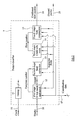
- FIG. 1 illustrates a packet interface 100 providing a time division multiplex (TDM) access port 101 and a packet switch fabric interface 102 for interfacing between one or more TDM data flows and one or more connections to a packet switching network.
- the packet interface 100 has a host control/data interface 103 for connection to a host controller such as a computer.
- the packet interface 100 is also provided with off-chip packet memory (not shown) connected to a port 104 for storing packet data and headers of packets passing through the packet interface 100.
- the TDM access port 101 is connected to a TDM interface 105 provided with a clock recovery arrangement 106.
- An incoming TDM data flow is converted by a payload assembly block 107 into packet payloads which are supplied to a central task manager 108.
- packets received from the packet switching network via the interface 102 and intended for the TDM data flows are supplied by the task manager 108 to a TDM formatter 109, which supplies data in a format suitable for the interface 105.
- Packets for transmission to the packet switching network are supplied by the task manager 108 to a packet formatter 110, which formats the packets and supplies them to a quad packet interface MAC 111 for transmission to the packet switching network.
- incoming packets from the network are supplied by the interface MAC 111 to a packet classifier 7 constituting an embodiment of the invention. Classification information provided by the classifier 7 is supplied to the task manager 108.
- the packet interface 100 has a host interface 112 and a direct memory access (DMA) controller 113 for interfacing with the host controller (not shown) via the interface 103.
- An administration block 114 controls operation of the packet interface 100 under supervision of the host controller.
- a JTAG (Joint Test Action Group) interface 115 is connected to a JTAG test block 116.
- the block 116 controls testing of on-board memories, logic scan paths and a JTAG boundary scan chain in accordance with standard IEEE 1149.1.
- the packet classifier 7 determines the destination of packets arriving from the packet switching network via the interface 102 and the interface MAC 111. Depending on the contents of the header packets, each packet payload data with or without the corresponding header may be routed by the central task manager 108 to the TDM access port 101, to the host by means of the DMA control 113, or back to the packet switching network, which may comprise a local area network (LAN).
- the packet payload data are temporarily stored or buffered via a memory manager and interface controller 117, 118 in either on-chip memory or off-chip memory.
- Each block of the packet interface 100 can request access to the on-chip or off-chip packet memory via the memory manager, which arbitrates between blocks requesting access and controls the read and write access to the memories.
- the task manager 108 passes information about the location of the data in memory between the other blocks of the interface 100.
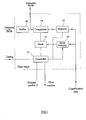
- FIG. 2 illustrates the packet classifier 7 of Figure 1 in more detail.
- the classifier 7 receives a clock at an input 10 connected to a timing block 11, which supplies timing signals to the other parts of the classifier 7 for controlling the operation thereof.
- the classifier 7 also comprises first to fourth stages 12 to 15, which are embodied as hardwired circuits dedicated to performing their individual functions.
- the headers from the packet receiver 4 are supplied to an input 16 connected to an input of the first stage 12.
- the second stage 13 performs its processing in respect of the packet so that the first stage 12 may then process the header of the next packet to arrive.
- each packet is processed by the first to fourth stages 12 to 15 in order with the individual stages simultaneously processing different packets.
- the stages 12 to 15 are thus arranged as a pipeline with the packets effectively passing through each pipeline stage in turn and with each stage processing a different packet.
- Each pipeline stage 12 to 15 takes a number of clock cycles in order to complete its processing. For example, for minimum sized packets (64 bytes) arriving on two G Ethernet ports, the packet classifier must be capable of accepting a new packet for classification every 33 clock cycles in the case of a 100MHz clock.
- the first stage 12 is programmed with classification data from an input 17 allowing N different packet protocols to be detected.
- the first stage 12 compares the appropriate fields in the packet header with data identifying the protocol to which the packet belongs and assigns a template number representing the protocol. Conversely, if no match is found, the first stage 12 supplies a discard packet signal at an output 18.
- the second stage 13 receives the packet header and the template number from the first stage 12 and extracts from the header one or more fields as determined by the template number.
- the third stage 14 is based on content addressable memory (CAM) techniques addressed by the extracted field or fields corresponding to the template number.
- the third stage 14 also receives the classification data from the input 17 and includes an M deep CAM for identifying the flow number.
- M deep CAM for identifying the flow number.
- the appropriate data for each flow number are programmed in the third stage 14 and the packet being processed can be allocated to any one of the M data flows in accordance with the extracted header fields.
- the third stage 14 either determines the flow number for the packet or supplies a discard packet signal to the output 18.
- the flow number and the extracted fields are supplied to a fourth stage 15 which performs a field comparison.
- the fourth stage 15 compares the extracted fields appropriate to the flow number with pre-programmed fields determined by the flow number. If a match is found, a confirmed flow number signal is supplied to an output 20. Otherwise, a discard packet signal is supplied to the output 18.
- FIG 3 shows the first stage 12 of Figure 2 in more detail.
- the first stage comprises a buffer 30 which receives each header in turn from the input 16 and is controlled by a controller 31.
- the header for the packet being processed by the first stage 12 is retained in the buffer 30 until processing is complete, after which the header is forwarded from the buffer 30 to the second stage 13.
- the header is also supplied from the buffer 30 to a comparator 33, which performs a comparison with the contents of a set of registers 34.
- the controller 31 receives timing signals from the timing circuit 11 and controls the operation of the buffer 30, the comparator 33 and the registers 34. The controller 31 also receives the output of the comparator 33 and supplies discard packet signals or template numbers as appropriate. The classification data are supplied to the registers during programming.
- the registers 34 are arranged as N pairs of registers, with each pair containing match and mask data relating to a respective protocol. Match and mask data can be added or deleted as appropriate, for example to extend the packet classifier capability to a new protocol or to delete data relating to a protocol which is no longer to be supported.
- the header For each packet arriving at the packet classifier, the header is entered in the buffer 30 and is compared in the comparator 33 with the contents of each pair of registers in turn until a match is found or all of the pairs of registers have been used without finding a match.
- the header is compared against the contents of each match register, starting with the first such register 35, and the result of the match is masked with the contents of the corresponding mask register 36 so that only the relevant protocol fields are checked.
- the controller 31 supplies the corresponding template number for use by the second and third stages 13 and 14. If no match is found, the controller 31 supplies a discard packet signal.
- Figure 4 illustrates the second stage 13 in more detail.
- the header for the packet which has just been processed by the first stage 12 is supplied to a buffer 40 of the second stage 13.
- the template number from the first stage 12 is supplied to a select fields block 41, which selects those fields required to be extracted in accordance with the template number determined by the first stage 12.
- the header and a select fields signal are supplied to an extract fields block 42, which extracts from the header those fields which are required by the third and fourth stages 14 and 15 for subsequent processing.
- the block 41 is also programmable with classification data so that those fields which are to be extracted can be set in accordance with each protocol corresponding to a template number.
- Figure 5 illustrates the third stage 14 in more detail.
- the extracted fields from the second stage 13 are supplied to a buffer 50, which passes the extracted fields to the fourth stage when processing of the current packet by the third stage is complete.
- the extracted fields are supplied as addresses to a content addressable memory (CAM) arrangement, which has previously been programmed with the classification data to deliver the flow number for the outgoing data flow to which the packet is allocated when the extracted fields are presented.
- CAM content addressable memory
- the third stage 14 Although an actual hardware CAM may be used in the third stage 14 and has the advantage that the flow number (if present) can be retrieved in a single memory read cycle, CAMs are relatively expensive to provide. Accordingly, the third stage 14 shown in Figure 5 makes use of a cheaper arrangement which requires more read cycles in order to simulate the operation of a CAM.
- a controller 51 receives timing signals from the timing block 11 and supplies address signals to the address inputs of memories 52 and 53.
- the memory 52 is pre-programmed by the classification data with predetermined field data and the memory 53 is pre-programmed with corresponding mask data.
- the outputs of the buffer 50 and the memory 52 are supplied to a comparator 54, whose output is supplied to a mask circuit 55.
- the mask circuit 55 receives the mask data from the memory 53 and supplies an output to the controller 51.
- the controller 51 steps through the addresses of the memories 52 and 53.
- the comparator 54 compares the field data at each location of the memory 52 with the extracted fields in the buffer 50 and the result of the comparison is masked in the mask circuit 55 by the corresponding mask data from the memory 53. If a match is found, the controller supplies the flow number for the extracted fields, which flow number is a function of the address which was supplied to the memories 52 and 53 and which resulted in a match. Conversely, if the controller 51 cycles through all of the addresses, or all of the occupied address of the memories 52 and 53, without finding a match, the controller 51 supplies a discard packet signal.
- the blocks 52 to 55 may be multiplicated with the memories of each block being addressed simultaneously by the controller 51 and, if a match is found, the controller 51 deriving the flow number from the current address and the one of the blocks signalling a match.
- the buffer 50 supplies the extracted fields to memories 51 1 - 51 n , which receive field data from memories 52 1 -52 n , respectfully.
- the outputs of the comparators 54 1 -54 n are supplied to mask circuits 55 1 -55 n , respectively, which receive mask data from the mask memories 53 1 -53 n , respectively.
- the outputs of the mask circuits are supplied to the controller 51 and, if a match is found, the flow number is derived from the address currently supplied to the memories and from which of the mask circuits 55 1 -55 n has detected a match.
- the third stage 14 may be embodied by means of a hash table as shown in Figure 7.
- the extracted fields are supplied to a buffer 70 and then to a hash function block 71.
- the hashing function is performed on the extracted fields and computes an address which is supplied to a hash memory 72 containing a hash table.
- the memory indicates whether a valid match has been found and returns the flow number to a controller 73.
- the result may not be unique because the hash function is not guaranteed to produce a unique address for each data flow. If the result is not unique, a second stage look-up is required. This may be achieved by using an alternative hashing function to generate a new address for accessing the hash table.
- a linear search block 74 may perform a linear search in a separate table. If no flow number or no unique flow number is found, a discard packet signal is generated.
- a CAM arrangement always produces a result in a well-defined maximum time, in practice such arrangements are limited to relatively small numbers of flows. For embodiments where relatively large numbers of flows have to be supported, a hash table arrangement may be more appropriate.
- Figure 8 illustrates the fourth stage 15 in more detail.
- the flow number from the third stage 14 is supplied to a buffer 60, as an address to a memory 61 and as an address to a masking arrangement 62, which receives the extracted fields from the second stage 13.
- the memory 61 and the masking arrangement 62 are pre-programmed with classification data.
- the memory 61 contains appropriate validation data at the address of each flow number. Such validation data is present in the header of any complete and valid packet intended for the data flow corresponding to the flow number.
- Protocols such as RTP and L2TPv3 make provision for the packet headers to contain a random or arbitrary data item for identifying the data flow to which the packet is assigned (in the form of SSRC and Cookie, respectively).
- SSRC and Cookie data flow to which the packet is assigned
- Such data are programmed into the memory 61 so that the correct validation data are supplied by the memory 61 to a comparator 63 in response to the associated flow number.
- the masking arrangement 62 uses the flow number to determine the appropriate pre-programmed mask for selecting from the extracted fields the data which should correspond to that supplied by the memory 61.
- the data are supplied to another input of the comparator 63.
- the comparator 63 detects a match indicating that the packet has been validated, it supplies a signal to open a gate 64, which supplies a confirmed flow number to the output 20 of the packet classifier 7. Conversely, if no match is found, the comparator 63 supplies a discard packet signal.
- some other form of validation data may be used, such as the source address in the case of IP packets or the packet length.
- the fourth stage 15 thus performs a validation or verification function to ensure that the packet is intact and is validated for transmission in the dataflow corresponding to the flow number.
- DOS internet denial of service
Landscapes
- Engineering & Computer Science (AREA)
- Computer Networks & Wireless Communication (AREA)
- Signal Processing (AREA)
- Data Exchanges In Wide-Area Networks (AREA)
Applications Claiming Priority (2)
| Application Number | Priority Date | Filing Date | Title |
|---|---|---|---|
| GBGB0229647.3A GB0229647D0 (en) | 2002-12-19 | 2002-12-19 | Packet classifer |
| GB0229647 | 2002-12-19 |
Publications (2)
| Publication Number | Publication Date |
|---|---|
| EP1432181A2 true EP1432181A2 (fr) | 2004-06-23 |
| EP1432181A3 EP1432181A3 (fr) | 2005-10-19 |
Family
ID=9950031
Family Applications (1)
| Application Number | Title | Priority Date | Filing Date |
|---|---|---|---|
| EP03104138A Withdrawn EP1432181A3 (fr) | 2002-12-19 | 2003-11-10 | Classificateur de paquets |
Country Status (3)
| Country | Link |
|---|---|
| US (1) | US20050044252A1 (fr) |
| EP (1) | EP1432181A3 (fr) |
| GB (1) | GB0229647D0 (fr) |
Cited By (3)
| Publication number | Priority date | Publication date | Assignee | Title |
|---|---|---|---|---|
| CN101043440B (zh) * | 2006-03-25 | 2011-02-16 | 华为技术有限公司 | 一种WiMAX网络中支持多业务流操作的方法 |
| CN1996991B (zh) * | 2006-01-06 | 2012-02-29 | 华为技术有限公司 | WiMAX网络中服务流策略的配置方法 |
| WO2015107385A3 (fr) * | 2013-12-18 | 2015-09-24 | Marvell Israel (M.I.S.L.) Ltd. | Procedes et dispositif de reseau pour la gestion de surabonnement |
Families Citing this family (14)
| Publication number | Priority date | Publication date | Assignee | Title |
|---|---|---|---|---|
| KR100590770B1 (ko) * | 2003-12-24 | 2006-06-15 | 한국전자통신연구원 | 대역폭을 이용한 데이터 플로우 정렬 장치 및 방법 |
| US7606231B2 (en) * | 2005-02-18 | 2009-10-20 | Broadcom Corporation | Pipeline architecture for a network device |
| DE602006013128D1 (de) * | 2005-06-15 | 2010-05-06 | Solarflare Comm Inc | Empfangen von daten gemäss eines datentransferprotokolls von daten, die ein beliebiges einer mehrzahl von empgangsgeräten gerichtet sind |
| US8179896B2 (en) * | 2006-11-09 | 2012-05-15 | Justin Mark Sobaje | Network processors and pipeline optimization methods |
| CN101242344B (zh) * | 2007-02-05 | 2013-03-20 | 财团法人工业技术研究院 | 网络封包分类器与其方法 |
| US20090034734A1 (en) * | 2007-07-31 | 2009-02-05 | Viasat, Inc. | Multi-Level Key Manager |
| KR100920518B1 (ko) * | 2007-11-27 | 2009-10-09 | 한국전자통신연구원 | 패킷 분류 장치 및 방법 |
| US7706289B2 (en) * | 2007-12-30 | 2010-04-27 | Oracle America, Inc. | System and method for validating packet classification |
| US8638793B1 (en) | 2009-04-06 | 2014-01-28 | Marvell Israle (M.I.S.L) Ltd. | Enhanced parsing and classification in a packet processor |
| US9276851B1 (en) | 2011-12-20 | 2016-03-01 | Marvell Israel (M.I.S.L.) Ltd. | Parser and modifier for processing network packets |
| US20130155918A1 (en) * | 2011-12-20 | 2013-06-20 | Nokia Siemens Networks Oy | Techniques To Enhance Header Compression Efficiency And Enhance Mobile Node Security |
| WO2016008079A1 (fr) | 2014-07-14 | 2016-01-21 | 华为技术有限公司 | Procédé de traitement de paquets et dispositif associé pour dispositif de réseau |
| US11303541B2 (en) * | 2019-02-05 | 2022-04-12 | Ciena Corporation | Systems and methods for transaction models and declaration configuration in a distributed architecture |
| CN114866488B (zh) * | 2021-01-18 | 2024-08-06 | 阿里巴巴集团控股有限公司 | 信息流识别方法、网络芯片及网络设备 |
Family Cites Families (9)
| Publication number | Priority date | Publication date | Assignee | Title |
|---|---|---|---|---|
| EP0689748B1 (fr) * | 1993-03-20 | 1998-09-16 | International Business Machines Corporation | Procede et appareil d'extraction d'informations de connexion a partir d'en-tetes de protocole |
| US5793954A (en) * | 1995-12-20 | 1998-08-11 | Nb Networks | System and method for general purpose network analysis |
| US6377998B2 (en) * | 1997-08-22 | 2002-04-23 | Nortel Networks Limited | Method and apparatus for performing frame processing for a network |
| US6625650B2 (en) * | 1998-06-27 | 2003-09-23 | Intel Corporation | System for multi-layer broadband provisioning in computer networks |
| US7193997B2 (en) * | 2001-03-19 | 2007-03-20 | International Business Machines Corporation | Packet classification |
| US6904057B2 (en) * | 2001-05-04 | 2005-06-07 | Slt Logic Llc | Method and apparatus for providing multi-protocol, multi-stage, real-time frame classification |
| US7042848B2 (en) * | 2001-05-04 | 2006-05-09 | Slt Logic Llc | System and method for hierarchical policing of flows and subflows of a data stream |
| US7002965B1 (en) * | 2001-05-21 | 2006-02-21 | Cisco Technology, Inc. | Method and apparatus for using ternary and binary content-addressable memory stages to classify packets |
| US7191241B2 (en) * | 2002-09-27 | 2007-03-13 | Alacritech, Inc. | Fast-path apparatus for receiving data corresponding to a TCP connection |
-
2002
- 2002-12-19 GB GBGB0229647.3A patent/GB0229647D0/en not_active Ceased
-
2003
- 2003-11-10 EP EP03104138A patent/EP1432181A3/fr not_active Withdrawn
- 2003-12-17 US US10/739,685 patent/US20050044252A1/en not_active Abandoned
Cited By (4)
| Publication number | Priority date | Publication date | Assignee | Title |
|---|---|---|---|---|
| CN1996991B (zh) * | 2006-01-06 | 2012-02-29 | 华为技术有限公司 | WiMAX网络中服务流策略的配置方法 |
| CN101043440B (zh) * | 2006-03-25 | 2011-02-16 | 华为技术有限公司 | 一种WiMAX网络中支持多业务流操作的方法 |
| WO2015107385A3 (fr) * | 2013-12-18 | 2015-09-24 | Marvell Israel (M.I.S.L.) Ltd. | Procedes et dispositif de reseau pour la gestion de surabonnement |
| US9674102B2 (en) | 2013-12-18 | 2017-06-06 | Marvell Israel (M.I.S.L.) Ltd. | Methods and network device for oversubscription handling |
Also Published As
| Publication number | Publication date |
|---|---|
| US20050044252A1 (en) | 2005-02-24 |
| EP1432181A3 (fr) | 2005-10-19 |
| GB0229647D0 (en) | 2003-01-22 |
Similar Documents
| Publication | Publication Date | Title |
|---|---|---|
| EP1432181A2 (fr) | Classificateur de paquets | |
| US9571396B2 (en) | Packet parsing and control packet classification | |
| US6041058A (en) | Hardware filtering method and apparatus | |
| US6650642B1 (en) | Network relaying apparatus and network relaying method capable of high-speed routing and packet transfer | |
| US7697527B2 (en) | Method and apparatus for direct frame switching using frame contained destination information | |
| US7835375B2 (en) | Method and apparatus for providing multi-protocol, multi-stage, real-time frame classification | |
| US20010037396A1 (en) | Stackable lookup engines | |
| US6347087B1 (en) | Content-based forwarding/filtering in a network switching device | |
| US6788683B1 (en) | Flow identifying device, flow processing device, flow identifying method, and flow processing method | |
| US7382777B2 (en) | Method for implementing actions based on packet classification and lookup results | |
| US6115379A (en) | Unicast, multicast, and broadcast method and apparatus | |
| US5406555A (en) | Charging in LAN for only packets used by subscribers | |
| CN107710700B (zh) | 处理计算机网络中的分组的系统和方法 | |
| US20030189932A1 (en) | Device for flow classifying and packet forwarding device with flow classify function | |
| US7373412B2 (en) | Apparatus for selecting and sorting packets from a packet data transmission network | |
| US6980547B1 (en) | Distributed switch/router silicon engine | |
| WO2005055487A2 (fr) | Traitement de message reseau par mise en correspondance de motifs inverses | |
| US7107352B2 (en) | Virtual egress packet classification at ingress | |
| US6256307B1 (en) | Local area network receive filter | |
| EP1345380A2 (fr) | Procédé, dispositif et un produit de type "programme d'ordinateur" pour classifier des paquets de données | |
| US20110078181A1 (en) | Communication device | |
| KR100836947B1 (ko) | 우선 순위 또는 차별화된 서비스 정보에 입각한 태그 발생 | |
| KR101017536B1 (ko) | 패턴 매칭을 사용하는 네트워크 메시지 처리 | |
| US6721319B1 (en) | Network system | |
| US6671277B1 (en) | Network relaying apparatus and network relaying method capable of high quality transfer of packets under stable service quality control |
Legal Events
| Date | Code | Title | Description |
|---|---|---|---|
| PUAI | Public reference made under article 153(3) epc to a published international application that has entered the european phase |
Free format text: ORIGINAL CODE: 0009012 |
|
| AK | Designated contracting states |
Kind code of ref document: A2 Designated state(s): AT BE BG CH CY CZ DE DK EE ES FI FR GB GR HU IE IT LI LU MC NL PT RO SE SI SK TR |
|
| AX | Request for extension of the european patent |
Extension state: AL LT LV MK |
|
| PUAL | Search report despatched |
Free format text: ORIGINAL CODE: 0009013 |
|
| AK | Designated contracting states |
Kind code of ref document: A3 Designated state(s): AT BE BG CH CY CZ DE DK EE ES FI FR GB GR HU IE IT LI LU MC NL PT RO SE SI SK TR |
|
| AX | Request for extension of the european patent |
Extension state: AL LT LV MK |
|
| 17P | Request for examination filed |
Effective date: 20060303 |
|
| AKX | Designation fees paid |
Designated state(s): DE FR |
|
| STAA | Information on the status of an ep patent application or granted ep patent |
Free format text: STATUS: THE APPLICATION IS DEEMED TO BE WITHDRAWN |
|
| 18D | Application deemed to be withdrawn |
Effective date: 20080603 |