EP1432296A1 - Dispositif comprenant un composant électrique ou électronique - Google Patents
Dispositif comprenant un composant électrique ou électronique Download PDFInfo
- Publication number
- EP1432296A1 EP1432296A1 EP02360349A EP02360349A EP1432296A1 EP 1432296 A1 EP1432296 A1 EP 1432296A1 EP 02360349 A EP02360349 A EP 02360349A EP 02360349 A EP02360349 A EP 02360349A EP 1432296 A1 EP1432296 A1 EP 1432296A1
- Authority
- EP
- European Patent Office
- Prior art keywords
- component
- housing
- heat pipe
- insulating material
- heat
- Prior art date
- Legal status (The legal status is an assumption and is not a legal conclusion. Google has not performed a legal analysis and makes no representation as to the accuracy of the status listed.)
- Withdrawn
Links
- 239000011810 insulating material Substances 0.000 claims abstract description 22
- 238000010438 heat treatment Methods 0.000 claims description 15
- 238000001816 cooling Methods 0.000 description 8
- 239000012141 concentrate Substances 0.000 description 1
- 238000010295 mobile communication Methods 0.000 description 1
Images
Classifications
-
- H—ELECTRICITY
- H05—ELECTRIC TECHNIQUES NOT OTHERWISE PROVIDED FOR
- H05K—PRINTED CIRCUITS; CASINGS OR CONSTRUCTIONAL DETAILS OF ELECTRIC APPARATUS; MANUFACTURE OF ASSEMBLAGES OF ELECTRICAL COMPONENTS
- H05K7/00—Constructional details common to different types of electric apparatus
- H05K7/20—Modifications to facilitate cooling, ventilating, or heating
- H05K7/2029—Modifications to facilitate cooling, ventilating, or heating using a liquid coolant with phase change in electronic enclosures
- H05K7/20336—Heat pipes, e.g. wicks or capillary pumps
Definitions
- the invention relates to a device comprising an electric or electronic component and a housing, the component being arranged within the housing and the housing being able to act as a heat sink, and further comprising a heat pipe extending between the component and the housing.
- Such a device is known from EP 946 085 A1.
- the heat pipes are used in connection with components which generate large amounts of heat so that the heat pipes can provide additional cooling reducing local hot spots.
- EP 946 085 A1 is a disadvantage as it increases the necessary power consumption and time duration for heating up these components.
- the thermally insulating material ensures an efficient heating of the component. During the heating of the component, almost no heat flows is able to flow away. Instead, the insulating material concentrates the heating on the component. The heating, therefore, may be carried out fast and with little power consumption.
- the heat pipe ensures that during normal conditions, in particular during normal operation of the component, the heat produced by the component can flow away via the heat pipe to the housing.
- the housing therefore, acts as a heat sink for the component with the heat pipe being the carrier of the heat to the housing. Due to the heat pipe, the heat is able to pass the insulating material so that the component is cooled. Therefore, the heat pipe ensures an efficient cooling of the component.
- the insulating material in connection with the heat pipe provide a device with both, an efficient cooling and an efficient heating of a component within the device.
- GSM Global System for Mobile Communications
- Each radio access network comprises at least a base transceiver station and a mobile station.
- the base transceiver station is equipped with a number of devices each of them being located within a housing.
- the base transceiver station and therefore its devices are constructed for outdoor use.
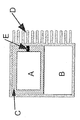
- the device comprises two electric or electronic components A, B. Both components A, B produce heat when they are operating under normal operating conditions. Therefore, both components A, B have to be cooled so that the temperature of the components A, B does not increase above a maximum temperature. Furthermore, the component A requires a minimum temperature for operating properly so that it has to be heated if the temperature of the device becomes lower than this minimum temperature. In particular, such heating is necessary under startup conditions of the component A.
- the component A is surrounded by an insulating material C which has thermal insulating characteristics.
- the insulating material C is surrounding the component A totally. It may be in contact with some of the outer surfaces of the component A but it must not.
- the thermally insulating material C avoids that heat flows away from the component A. Therefore, when the temperature of the device is below the minimum temperature and when the component A is heated e.g. by a heating element inside of the component A, the insulating material C avoids that the heat of the heating element flows away from the component A. As a result, the component A is heated up faster than without the insulating material C.
- the insulating material C serves for an efficient heating of the component A. However, on the other hand, the insulating material C is a problem for an efficient cooling of the component A as the insulating material C avoids that the heat flows away from the component A.
- the insulating material C with the encapsulated component A is arranged within a housing D.
- the insulating material C therefore, is arranged between the component A and the housing D.
- Some of the outer surfaces of the insulating material C may be in contact with the inner surfaces of the housing D but this must not be necessarily the case.
- the housing D is provided with a number of radiator fins for cooling purposes.
- the housing D therefore, is able to act as a heat sink.
- a heat pipe E is provided.
- the heat pipe E has a tubular form and is the only thermal connection between the component A and the housing D.
- the heat pipe E extends between one of the outer surfaces of the component A and one of the inner surfaces of the housing D.
- the heat pipe E therefore, traverses the insulating material C.
- the heat pipe E is in contact with the component A and the housing D.
- the heat pipe E therefore, is able to transport heat from the component A to the housing D.
- the heat pipe E is a known physical component that is able to transfer heat from one point to another.
- the heat pipe E therefore, can maintain a constant temperature or a temperature range of the component A.
- An example of a heat pipe is described in US 5,335,720.
- the component B is located within the housing D.
- the outer surfaces of the component B are in thermal contact with the inner surfaces of the housing D. Therefore, the heat produced under normal operating conditions by the component B can flow away directly to the housing D so that the component B is cooled.
- the components A, B are turned on after they had not been used for some time so that the temperature in particular of the component A is under the minimum temperature. Furthermore, it is assumed that the heat pipe E is provided such that it maintains a constant temperature within a temperature range which is defined by the mentioned minimum and maximum temperature.
- the component A is heated as described. Due to the insulating material C, the heat produced by heating the component A is held within the component A and cannot flow away.
- the heat pipe E from the component A to the housing D is not yet active or is only active to a very low extent as long as the temperature of the component A is still under the minimum temperature of the temperature range of the heat pipe E. Therefore, almost no heat can flow over the heat pipe E from the component A to the housing D. As a result, the component A is heated up quickly.
- the heat pipe E begins to transfer heat from the component A to the housing D. With the help of this heat flow, the heat pipe E maintains the temperature of the component A within the minimum and the maximum temperature. As a result, the cooling of the component A is carried out via the heat pipe E to the housing D.
- the component B is cooled directly by the housing D.
Landscapes
- Engineering & Computer Science (AREA)
- Microelectronics & Electronic Packaging (AREA)
- Physics & Mathematics (AREA)
- Thermal Sciences (AREA)
- Cooling Or The Like Of Electrical Apparatus (AREA)
Priority Applications (1)
| Application Number | Priority Date | Filing Date | Title |
|---|---|---|---|
| EP02360349A EP1432296A1 (fr) | 2002-12-16 | 2002-12-16 | Dispositif comprenant un composant électrique ou électronique |
Applications Claiming Priority (1)
| Application Number | Priority Date | Filing Date | Title |
|---|---|---|---|
| EP02360349A EP1432296A1 (fr) | 2002-12-16 | 2002-12-16 | Dispositif comprenant un composant électrique ou électronique |
Publications (1)
| Publication Number | Publication Date |
|---|---|
| EP1432296A1 true EP1432296A1 (fr) | 2004-06-23 |
Family
ID=32338211
Family Applications (1)
| Application Number | Title | Priority Date | Filing Date |
|---|---|---|---|
| EP02360349A Withdrawn EP1432296A1 (fr) | 2002-12-16 | 2002-12-16 | Dispositif comprenant un composant électrique ou électronique |
Country Status (1)
| Country | Link |
|---|---|
| EP (1) | EP1432296A1 (fr) |
Cited By (4)
| Publication number | Priority date | Publication date | Assignee | Title |
|---|---|---|---|---|
| DE102004030236B3 (de) * | 2004-06-23 | 2006-02-23 | Lisa Dräxlmaier GmbH | Geräteträger für ein Kraftfahrzeug |
| DE102008037372A1 (de) * | 2008-09-18 | 2010-04-01 | Lear Corporation Gmbh | Gehäuse für temperatursensible Komponenten |
| DE102012102719A1 (de) * | 2012-03-29 | 2013-10-02 | Dr. Ing. H.C. F. Porsche Aktiengesellschaft | Kühlsystem für ein elektrisches System |
| WO2014077634A1 (fr) * | 2012-11-16 | 2014-05-22 | 주식회사 케이엠더블유 | Dispositif de station de base de petite taille dans un système de communication mobile |
Citations (3)
| Publication number | Priority date | Publication date | Assignee | Title |
|---|---|---|---|---|
| US5548643A (en) * | 1994-07-21 | 1996-08-20 | Northern Telecom Limited | Wireless base station-having cooling passages |
| EP0863696A2 (fr) * | 1997-03-05 | 1998-09-09 | Nortel Networks Corporation | Unité électronique |
| US6201221B1 (en) * | 1999-09-16 | 2001-03-13 | Lucent Technologies, Inc. | Method and apparatus for heat regulating electronics products |
-
2002
- 2002-12-16 EP EP02360349A patent/EP1432296A1/fr not_active Withdrawn
Patent Citations (3)
| Publication number | Priority date | Publication date | Assignee | Title |
|---|---|---|---|---|
| US5548643A (en) * | 1994-07-21 | 1996-08-20 | Northern Telecom Limited | Wireless base station-having cooling passages |
| EP0863696A2 (fr) * | 1997-03-05 | 1998-09-09 | Nortel Networks Corporation | Unité électronique |
| US6201221B1 (en) * | 1999-09-16 | 2001-03-13 | Lucent Technologies, Inc. | Method and apparatus for heat regulating electronics products |
Cited By (5)
| Publication number | Priority date | Publication date | Assignee | Title |
|---|---|---|---|---|
| DE102004030236B3 (de) * | 2004-06-23 | 2006-02-23 | Lisa Dräxlmaier GmbH | Geräteträger für ein Kraftfahrzeug |
| DE102008037372A1 (de) * | 2008-09-18 | 2010-04-01 | Lear Corporation Gmbh | Gehäuse für temperatursensible Komponenten |
| DE102012102719A1 (de) * | 2012-03-29 | 2013-10-02 | Dr. Ing. H.C. F. Porsche Aktiengesellschaft | Kühlsystem für ein elektrisches System |
| WO2014077634A1 (fr) * | 2012-11-16 | 2014-05-22 | 주식회사 케이엠더블유 | Dispositif de station de base de petite taille dans un système de communication mobile |
| US9572196B2 (en) | 2012-11-16 | 2017-02-14 | Kmw Inc. | Small-sized base station device in mobile communication system |
Similar Documents
| Publication | Publication Date | Title |
|---|---|---|
| KR100298348B1 (ko) | 기지국열조절시스템및방법 | |
| US5655375A (en) | Antenna mast-top mountable thermo-electrically cooled amplifier enclosure system | |
| CN114243251A (zh) | 车体天线模块和冷却车体天线模块的方法 | |
| JP2004295718A (ja) | 情報処理装置の液例システム | |
| EP3509099B1 (fr) | Dissipateur thermique | |
| JPH1123091A (ja) | 液体循環型熱電冷却・加熱装置 | |
| WO2002049105A3 (fr) | Refroidisseurs localises thermoelectriques pour circuits integres de communication hautes frequences et hyperfrequences | |
| WO2003007372A3 (fr) | Dispositif de refroidissement pour ordinateur | |
| CN111399563B (zh) | 用户终端设备 | |
| US9232682B2 (en) | Base station in a wireless communication system | |
| US6201221B1 (en) | Method and apparatus for heat regulating electronics products | |
| KR20090071148A (ko) | 롤 크라운 제어가 가능한 냉각 롤 | |
| US7548427B2 (en) | Apparatus and docking station for cooling of computing devices | |
| US20040226695A1 (en) | Temperature control of thermooptic devices | |
| US20090036167A1 (en) | System and method for base station heat dissipation using chimneys | |
| US7111666B2 (en) | Heat sink | |
| US12402277B2 (en) | System and method for all-in-one compact refrigeration using a liquid cooling solution for a hardware processor | |
| KR20040061286A (ko) | Tec와 히트 파이프 조합의 하이브리드 히트 익스체인저 | |
| KR101619626B1 (ko) | 수/공냉 통합형 열전소자 장치 | |
| CN210381726U (zh) | 壳体组件及电子设备 | |
| WO2025260272A1 (fr) | Système de régulation de la température d'un composant électronique | |
| KR200263749Y1 (ko) | 열전소자모듈을 냉각시키기 위한 라디에이터형 냉각장치 | |
| JPS6030994A (ja) | ヒ−トパイプ装置 | |
| KR100451129B1 (ko) | 열전소자를 이용한 냉풍발생장치 | |
| KR20010054418A (ko) | 통신전자장비용 방열판의 열확산 장치 |
Legal Events
| Date | Code | Title | Description |
|---|---|---|---|
| PUAI | Public reference made under article 153(3) epc to a published international application that has entered the european phase |
Free format text: ORIGINAL CODE: 0009012 |
|
| AK | Designated contracting states |
Kind code of ref document: A1 Designated state(s): AT BE BG CH CY CZ DE DK EE ES FI FR GB GR IE IT LI LU MC NL PT SE SI SK TR |
|
| AX | Request for extension of the european patent |
Extension state: AL LT LV MK RO |
|
| AKX | Designation fees paid | ||
| REG | Reference to a national code |
Ref country code: DE Ref legal event code: 8566 |
|
| STAA | Information on the status of an ep patent application or granted ep patent |
Free format text: STATUS: THE APPLICATION IS DEEMED TO BE WITHDRAWN |
|
| 18D | Application deemed to be withdrawn |
Effective date: 20041224 |