EP1432395B1 - Verfahren zum färben von keratinfasern unter verwendung von carbonylverbindungen zur verbesserung der farbstabilität von haarfärbungen - Google Patents
Verfahren zum färben von keratinfasern unter verwendung von carbonylverbindungen zur verbesserung der farbstabilität von haarfärbungen Download PDFInfo
- Publication number
- EP1432395B1 EP1432395B1 EP02800586A EP02800586A EP1432395B1 EP 1432395 B1 EP1432395 B1 EP 1432395B1 EP 02800586 A EP02800586 A EP 02800586A EP 02800586 A EP02800586 A EP 02800586A EP 1432395 B1 EP1432395 B1 EP 1432395B1
- Authority
- EP
- European Patent Office
- Prior art keywords
- bis
- und
- acid
- hair treatment
- oder
- Prior art date
- Legal status (The legal status is an assumption and is not a legal conclusion. Google has not performed a legal analysis and makes no representation as to the accuracy of the status listed.)
- Expired - Lifetime
Links
- 210000004209 hair Anatomy 0.000 title claims abstract description 122
- 238000000034 method Methods 0.000 title claims abstract description 59
- 108010076876 Keratins Proteins 0.000 title claims abstract description 21
- 102000011782 Keratins Human genes 0.000 title claims abstract description 21
- 238000004040 coloring Methods 0.000 title claims abstract description 6
- 150000001728 carbonyl compounds Chemical class 0.000 title claims description 39
- -1 heteroaromatic carbonyl compounds Chemical class 0.000 claims abstract description 170
- 238000011282 treatment Methods 0.000 claims abstract description 68
- 125000003118 aryl group Chemical group 0.000 claims abstract description 7
- 239000003795 chemical substances by application Substances 0.000 claims description 79
- 239000000975 dye Substances 0.000 claims description 58
- 229920000642 polymer Polymers 0.000 claims description 51
- 150000001875 compounds Chemical class 0.000 claims description 43
- 230000003647 oxidation Effects 0.000 claims description 38
- 238000007254 oxidation reaction Methods 0.000 claims description 38
- 238000004043 dyeing Methods 0.000 claims description 36
- 239000002243 precursor Substances 0.000 claims description 35
- 150000003839 salts Chemical group 0.000 claims description 25
- 239000004904 UV filter Substances 0.000 claims description 24
- 239000003531 protein hydrolysate Substances 0.000 claims description 23
- 239000000126 substance Substances 0.000 claims description 21
- 239000004094 surface-active agent Substances 0.000 claims description 18
- 239000000982 direct dye Substances 0.000 claims description 17
- 108010009736 Protein Hydrolysates Proteins 0.000 claims description 16
- 229940126062 Compound A Drugs 0.000 claims description 11
- NLDMNSXOCDLTTB-UHFFFAOYSA-N Heterophylliin A Natural products O1C2COC(=O)C3=CC(O)=C(O)C(O)=C3C3=C(O)C(O)=C(O)C=C3C(=O)OC2C(OC(=O)C=2C=C(O)C(O)=C(O)C=2)C(O)C1OC(=O)C1=CC(O)=C(O)C(O)=C1 NLDMNSXOCDLTTB-UHFFFAOYSA-N 0.000 claims description 11
- 229910052784 alkaline earth metal Inorganic materials 0.000 claims description 8
- 229910052783 alkali metal Inorganic materials 0.000 claims description 7
- 125000002915 carbonyl group Chemical group [*:2]C([*:1])=O 0.000 claims description 7
- 150000001340 alkali metals Chemical class 0.000 claims description 6
- 150000001450 anions Chemical class 0.000 claims description 6
- KETQAJRQOHHATG-UHFFFAOYSA-N 1,2-naphthoquinone Chemical compound C1=CC=C2C(=O)C(=O)C=CC2=C1 KETQAJRQOHHATG-UHFFFAOYSA-N 0.000 claims description 5
- 229940105324 1,2-naphthoquinone Drugs 0.000 claims description 5
- PZTGRDMCBZUJDL-UHFFFAOYSA-N 1,2-naphthoquinone-4-sulfonic acid Chemical class C1=CC=C2C(S(=O)(=O)O)=CC(=O)C(=O)C2=C1 PZTGRDMCBZUJDL-UHFFFAOYSA-N 0.000 claims description 5
- ZWNYDPBLEDGGQD-UHFFFAOYSA-N 1-prop-2-enylindole-2,3-dione Chemical compound C1=CC=C2N(CC=C)C(=O)C(=O)C2=C1 ZWNYDPBLEDGGQD-UHFFFAOYSA-N 0.000 claims description 5
- QNVKZKOSAXYVFZ-UHFFFAOYSA-N 2-(3-oxoinden-1-ylidene)propanedinitrile Chemical compound C1=CC=C2C(=O)CC(=C(C#N)C#N)C2=C1 QNVKZKOSAXYVFZ-UHFFFAOYSA-N 0.000 claims description 5
- DKZBBWMURDFHNE-NSCUHMNNSA-N coniferyl aldehyde Chemical compound COC1=CC(\C=C\C=O)=CC=C1O DKZBBWMURDFHNE-NSCUHMNNSA-N 0.000 claims description 5
- DKZBBWMURDFHNE-UHFFFAOYSA-N trans-coniferylaldehyde Natural products COC1=CC(C=CC=O)=CC=C1O DKZBBWMURDFHNE-UHFFFAOYSA-N 0.000 claims description 5
- VEXZGXHMUGYJMC-UHFFFAOYSA-M Chloride anion Chemical compound [Cl-] VEXZGXHMUGYJMC-UHFFFAOYSA-M 0.000 claims description 4
- 150000001342 alkaline earth metals Chemical class 0.000 claims description 4
- 150000004056 anthraquinones Chemical class 0.000 claims description 4
- JXDYKVIHCLTXOP-UHFFFAOYSA-N isatin Chemical compound C1=CC=C2C(=O)C(=O)NC2=C1 JXDYKVIHCLTXOP-UHFFFAOYSA-N 0.000 claims description 4
- QFSYADJLNBHAKO-UHFFFAOYSA-N 2,5-dihydroxy-1,4-benzoquinone Chemical compound OC1=CC(=O)C(O)=CC1=O QFSYADJLNBHAKO-UHFFFAOYSA-N 0.000 claims description 3
- IWCNKAHLWXRURC-UHFFFAOYSA-N 2-[(1-methylpyridin-1-ium-4-yl)methylidene]-1h-indol-3-one;iodide Chemical compound [I-].C1=C[N+](C)=CC=C1\C=C\1C(=O)C2=CC=CC=C2N/1 IWCNKAHLWXRURC-UHFFFAOYSA-N 0.000 claims description 3
- GBWBUIOUJHJPOR-UHFFFAOYSA-M 4-methylbenzenesulfonate;1-methylquinolin-1-ium-4-carbaldehyde Chemical compound CC1=CC=C(S([O-])(=O)=O)C=C1.C1=CC=C2[N+](C)=CC=C(C=O)C2=C1 GBWBUIOUJHJPOR-UHFFFAOYSA-M 0.000 claims description 3
- CPELXLSAUQHCOX-UHFFFAOYSA-M Bromide Chemical compound [Br-] CPELXLSAUQHCOX-UHFFFAOYSA-M 0.000 claims description 3
- 150000003863 ammonium salts Chemical class 0.000 claims description 3
- PYKYMHQGRFAEBM-UHFFFAOYSA-N anthraquinone Natural products CCC(=O)c1c(O)c2C(=O)C3C(C=CC=C3O)C(=O)c2cc1CC(=O)OC PYKYMHQGRFAEBM-UHFFFAOYSA-N 0.000 claims description 3
- IZALUMVGBVKPJD-UHFFFAOYSA-N benzene-1,3-dicarbaldehyde Chemical compound O=CC1=CC=CC(C=O)=C1 IZALUMVGBVKPJD-UHFFFAOYSA-N 0.000 claims description 3
- 150000001768 cations Chemical class 0.000 claims description 3
- ICNKHMSIGGQUMV-UHFFFAOYSA-N pyrrolo[3,2-g]indole-2,3,5,6-tetrone Chemical compound O=C1C=C2C(=O)C(=O)N=C2C2=C1C(=O)C=N2 ICNKHMSIGGQUMV-UHFFFAOYSA-N 0.000 claims description 3
- KUCOHFSKRZZVRO-UHFFFAOYSA-N terephthalaldehyde Chemical compound O=CC1=CC=C(C=O)C=C1 KUCOHFSKRZZVRO-UHFFFAOYSA-N 0.000 claims description 3
- JOXIMZWYDAKGHI-UHFFFAOYSA-N toluene-4-sulfonic acid Chemical compound CC1=CC=C(S(O)(=O)=O)C=C1 JOXIMZWYDAKGHI-UHFFFAOYSA-N 0.000 claims description 3
- PIINXYKJQGMIOZ-UHFFFAOYSA-N 1,2-dipyridin-2-ylethane-1,2-dione Chemical compound C=1C=CC=NC=1C(=O)C(=O)C1=CC=CC=N1 PIINXYKJQGMIOZ-UHFFFAOYSA-N 0.000 claims description 2
- KXYBYRKRRGSZCX-UHFFFAOYSA-N 1-methylindole-3-carbaldehyde Chemical compound C1=CC=C2N(C)C=C(C=O)C2=C1 KXYBYRKRRGSZCX-UHFFFAOYSA-N 0.000 claims description 2
- HDAPIBMBUOAWPU-UHFFFAOYSA-N 1-methylquinolin-1-ium-2-carbaldehyde Chemical class C1=CC=C2[N+](C)=C(C=O)C=CC2=C1 HDAPIBMBUOAWPU-UHFFFAOYSA-N 0.000 claims description 2
- ZECPUIKOXAUFEB-UHFFFAOYSA-N 1-methylquinolin-1-ium-4-carbaldehyde Chemical class C1=CC=C2[N+](C)=CC=C(C=O)C2=C1 ZECPUIKOXAUFEB-UHFFFAOYSA-N 0.000 claims description 2
- DWLVFWDCSFTDOD-UHFFFAOYSA-N 2-(1h-indol-3-yl)-2-oxoacetic acid Chemical compound C1=CC=C2C(C(=O)C(=O)O)=CNC2=C1 DWLVFWDCSFTDOD-UHFFFAOYSA-N 0.000 claims description 2
- HOADHXUXKOKYNC-UHFFFAOYSA-O 2-[(1-methylpyridin-1-ium-4-yl)methylidene]-1h-indol-3-one Chemical class C1=C[N+](C)=CC=C1\C=C\1C(=O)C2=CC=CC=C2N/1 HOADHXUXKOKYNC-UHFFFAOYSA-O 0.000 claims description 2
- CMWKITSNTDAEDT-UHFFFAOYSA-N 2-nitrobenzaldehyde Chemical compound [O-][N+](=O)C1=CC=CC=C1C=O CMWKITSNTDAEDT-UHFFFAOYSA-N 0.000 claims description 2
- ZETIVVHRRQLWFW-UHFFFAOYSA-N 3-nitrobenzaldehyde Chemical compound [O-][N+](=O)C1=CC=CC(C=O)=C1 ZETIVVHRRQLWFW-UHFFFAOYSA-N 0.000 claims description 2
- RUKJCCIJLIMGEP-ONEGZZNKSA-N 4-dimethylaminocinnamaldehyde Chemical compound CN(C)C1=CC=C(\C=C\C=O)C=C1 RUKJCCIJLIMGEP-ONEGZZNKSA-N 0.000 claims description 2
- TYITZWXVYYSISG-UHFFFAOYSA-N 4-nitro-1h-indole-2,3-dione Chemical compound [O-][N+](=O)C1=CC=CC2=C1C(=O)C(=O)N2 TYITZWXVYYSISG-UHFFFAOYSA-N 0.000 claims description 2
- BXRFQSNOROATLV-UHFFFAOYSA-N 4-nitrobenzaldehyde Chemical compound [O-][N+](=O)C1=CC=C(C=O)C=C1 BXRFQSNOROATLV-UHFFFAOYSA-N 0.000 claims description 2
- UNMYHYODJHKLOC-UHFFFAOYSA-N 5-Nitroisatin Chemical compound [O-][N+](=O)C1=CC=C2NC(=O)C(=O)C2=C1 UNMYHYODJHKLOC-UHFFFAOYSA-N 0.000 claims description 2
- FQMOARKYYKXWRB-UHFFFAOYSA-N 6-nitro-1h-indole-2,3-dione Chemical compound [O-][N+](=O)C1=CC=C2C(=O)C(=O)NC2=C1 FQMOARKYYKXWRB-UHFFFAOYSA-N 0.000 claims description 2
- GVZRFFXBGZSJTH-UHFFFAOYSA-N 7-nitro-1h-indole-2,3-dione Chemical compound [O-][N+](=O)C1=CC=CC2=C1NC(=O)C2=O GVZRFFXBGZSJTH-UHFFFAOYSA-N 0.000 claims description 2
- YYVYAPXYZVYDHN-UHFFFAOYSA-N 9,10-phenanthroquinone Chemical compound C1=CC=C2C(=O)C(=O)C3=CC=CC=C3C2=C1 YYVYAPXYZVYDHN-UHFFFAOYSA-N 0.000 claims description 2
- AFVFQIVMOAPDHO-UHFFFAOYSA-M Methanesulfonate Chemical compound CS([O-])(=O)=O AFVFQIVMOAPDHO-UHFFFAOYSA-M 0.000 claims description 2
- AFPRJLBZLPBTPZ-UHFFFAOYSA-N acenaphthoquinone Chemical compound C1=CC(C(C2=O)=O)=C3C2=CC=CC3=C1 AFPRJLBZLPBTPZ-UHFFFAOYSA-N 0.000 claims description 2
- XMBWDFGMSWQBCA-UHFFFAOYSA-N hydrogen iodide Chemical compound I XMBWDFGMSWQBCA-UHFFFAOYSA-N 0.000 claims description 2
- ITMCEJHCFYSIIV-UHFFFAOYSA-N triflic acid Chemical compound OS(=O)(=O)C(F)(F)F ITMCEJHCFYSIIV-UHFFFAOYSA-N 0.000 claims description 2
- GCDPALKHLUSMGF-UHFFFAOYSA-M 4-methylbenzenesulfonate;1-methyl-2h-quinolin-1-ium-1-carbaldehyde Chemical compound CC1=CC=C(S([O-])(=O)=O)C=C1.C1=CC=C2[N+](C)(C=O)CC=CC2=C1 GCDPALKHLUSMGF-UHFFFAOYSA-M 0.000 claims 1
- 239000000835 fiber Substances 0.000 abstract description 21
- 239000003086 colorant Substances 0.000 abstract description 19
- 125000004122 cyclic group Chemical group 0.000 abstract description 5
- 125000004432 carbon atom Chemical group C* 0.000 description 68
- 239000000203 mixture Substances 0.000 description 64
- 239000000194 fatty acid Substances 0.000 description 59
- 235000014113 dietary fatty acids Nutrition 0.000 description 58
- 229930195729 fatty acid Natural products 0.000 description 58
- 150000004665 fatty acids Chemical class 0.000 description 45
- 125000000217 alkyl group Chemical group 0.000 description 41
- 239000000047 product Substances 0.000 description 38
- 229920001577 copolymer Polymers 0.000 description 34
- 150000002148 esters Chemical class 0.000 description 31
- BARWIPMJPCRCTP-CLFAGFIQSA-N oleyl oleate Chemical compound CCCCCCCC\C=C/CCCCCCCCOC(=O)CCCCCCC\C=C/CCCCCCCC BARWIPMJPCRCTP-CLFAGFIQSA-N 0.000 description 29
- 125000002091 cationic group Chemical group 0.000 description 28
- 150000002191 fatty alcohols Chemical class 0.000 description 27
- IAYPIBMASNFSPL-UHFFFAOYSA-N Ethylene oxide Chemical compound C1CO1 IAYPIBMASNFSPL-UHFFFAOYSA-N 0.000 description 26
- PEDCQBHIVMGVHV-UHFFFAOYSA-N Glycerine Chemical compound OCC(O)CO PEDCQBHIVMGVHV-UHFFFAOYSA-N 0.000 description 25
- 150000003254 radicals Chemical class 0.000 description 25
- QGZKDVFQNNGYKY-UHFFFAOYSA-N Ammonia Chemical compound N QGZKDVFQNNGYKY-UHFFFAOYSA-N 0.000 description 24
- 238000002360 preparation method Methods 0.000 description 24
- LFQSCWFLJHTTHZ-UHFFFAOYSA-N EtOH Substances CCO LFQSCWFLJHTTHZ-UHFFFAOYSA-N 0.000 description 23
- UFHFLCQGNIYNRP-UHFFFAOYSA-N Hydrogen Chemical compound [H][H] UFHFLCQGNIYNRP-UHFFFAOYSA-N 0.000 description 23
- 239000003921 oil Substances 0.000 description 21
- 235000019198 oils Nutrition 0.000 description 21
- XLYOFNOQVPJJNP-UHFFFAOYSA-N water Substances O XLYOFNOQVPJJNP-UHFFFAOYSA-N 0.000 description 21
- 239000000178 monomer Substances 0.000 description 20
- 230000008569 process Effects 0.000 description 20
- WHNWPMSKXPGLAX-UHFFFAOYSA-N N-Vinyl-2-pyrrolidone Chemical compound C=CN1CCCC1=O WHNWPMSKXPGLAX-UHFFFAOYSA-N 0.000 description 19
- 229910052739 hydrogen Inorganic materials 0.000 description 18
- 229910052757 nitrogen Inorganic materials 0.000 description 18
- FMRHJJZUHUTGKE-UHFFFAOYSA-N Ethylhexyl salicylate Chemical compound CCCCC(CC)COC(=O)C1=CC=CC=C1O FMRHJJZUHUTGKE-UHFFFAOYSA-N 0.000 description 17
- 239000002253 acid Substances 0.000 description 17
- 239000001257 hydrogen Substances 0.000 description 16
- RTZKZFJDLAIYFH-UHFFFAOYSA-N Diethyl ether Chemical compound CCOCC RTZKZFJDLAIYFH-UHFFFAOYSA-N 0.000 description 15
- DNIAPMSPPWPWGF-UHFFFAOYSA-N Propylene glycol Chemical compound CC(O)CO DNIAPMSPPWPWGF-UHFFFAOYSA-N 0.000 description 15
- 125000005843 halogen group Chemical group 0.000 description 15
- 235000018102 proteins Nutrition 0.000 description 14
- 102000004169 proteins and genes Human genes 0.000 description 14
- 108090000623 proteins and genes Proteins 0.000 description 14
- 235000000346 sugar Nutrition 0.000 description 14
- OSCJHTSDLYVCQC-UHFFFAOYSA-N 2-ethylhexyl 4-[[4-[4-(tert-butylcarbamoyl)anilino]-6-[4-(2-ethylhexoxycarbonyl)anilino]-1,3,5-triazin-2-yl]amino]benzoate Chemical compound C1=CC(C(=O)OCC(CC)CCCC)=CC=C1NC1=NC(NC=2C=CC(=CC=2)C(=O)NC(C)(C)C)=NC(NC=2C=CC(=CC=2)C(=O)OCC(CC)CCCC)=N1 OSCJHTSDLYVCQC-UHFFFAOYSA-N 0.000 description 13
- 239000002537 cosmetic Substances 0.000 description 13
- 230000000694 effects Effects 0.000 description 13
- 239000000839 emulsion Substances 0.000 description 13
- 125000002496 methyl group Chemical group [H]C([H])([H])* 0.000 description 13
- 241000209140 Triticum Species 0.000 description 12
- 235000021307 Triticum Nutrition 0.000 description 12
- KRKNYBCHXYNGOX-UHFFFAOYSA-N citric acid Chemical compound OC(=O)CC(O)(C(O)=O)CC(O)=O KRKNYBCHXYNGOX-UHFFFAOYSA-N 0.000 description 12
- 239000006071 cream Substances 0.000 description 12
- CIWBSHSKHKDKBQ-JLAZNSOCSA-N Ascorbic acid Chemical compound OC[C@H](O)[C@H]1OC(=O)C(O)=C1O CIWBSHSKHKDKBQ-JLAZNSOCSA-N 0.000 description 11
- 102000008186 Collagen Human genes 0.000 description 11
- 108010035532 Collagen Proteins 0.000 description 11
- LYCAIKOWRPUZTN-UHFFFAOYSA-N Ethylene glycol Chemical compound OCCO LYCAIKOWRPUZTN-UHFFFAOYSA-N 0.000 description 11
- WQZGKKKJIJFFOK-GASJEMHNSA-N Glucose Natural products OC[C@H]1OC(O)[C@H](O)[C@@H](O)[C@@H]1O WQZGKKKJIJFFOK-GASJEMHNSA-N 0.000 description 11
- 150000007513 acids Chemical class 0.000 description 11
- FPIPGXGPPPQFEQ-OVSJKPMPSA-N all-trans-retinol Chemical compound OC\C=C(/C)\C=C\C=C(/C)\C=C\C1=C(C)CCCC1(C)C FPIPGXGPPPQFEQ-OVSJKPMPSA-N 0.000 description 11
- 229910021529 ammonia Inorganic materials 0.000 description 11
- 229920001436 collagen Polymers 0.000 description 11
- 239000008103 glucose Substances 0.000 description 11
- GLDOVTGHNKAZLK-UHFFFAOYSA-N octadecan-1-ol Chemical compound CCCCCCCCCCCCCCCCCCO GLDOVTGHNKAZLK-UHFFFAOYSA-N 0.000 description 11
- 125000001453 quaternary ammonium group Chemical group 0.000 description 11
- KFZMGEQAYNKOFK-UHFFFAOYSA-N Isopropanol Chemical compound CC(C)O KFZMGEQAYNKOFK-UHFFFAOYSA-N 0.000 description 10
- WQZGKKKJIJFFOK-VFUOTHLCSA-N beta-D-glucose Chemical compound OC[C@H]1O[C@@H](O)[C@H](O)[C@@H](O)[C@@H]1O WQZGKKKJIJFFOK-VFUOTHLCSA-N 0.000 description 10
- LQZZUXJYWNFBMV-UHFFFAOYSA-N dodecan-1-ol Chemical compound CCCCCCCCCCCCO LQZZUXJYWNFBMV-UHFFFAOYSA-N 0.000 description 10
- 239000003995 emulsifying agent Substances 0.000 description 10
- 235000011187 glycerol Nutrition 0.000 description 10
- 125000004435 hydrogen atom Chemical group [H]* 0.000 description 10
- WWZKQHOCKIZLMA-UHFFFAOYSA-N octanoic acid Chemical compound CCCCCCCC(O)=O WWZKQHOCKIZLMA-UHFFFAOYSA-N 0.000 description 10
- IPCSVZSSVZVIGE-UHFFFAOYSA-N palmitic acid group Chemical group C(CCCCCCCCCCCCCCC)(=O)O IPCSVZSSVZVIGE-UHFFFAOYSA-N 0.000 description 10
- 239000011734 sodium Substances 0.000 description 10
- 229910052708 sodium Inorganic materials 0.000 description 10
- NIXOWILDQLNWCW-UHFFFAOYSA-N 2-Propenoic acid Natural products OC(=O)C=C NIXOWILDQLNWCW-UHFFFAOYSA-N 0.000 description 9
- QGZKDVFQNNGYKY-UHFFFAOYSA-O Ammonium Chemical compound [NH4+] QGZKDVFQNNGYKY-UHFFFAOYSA-O 0.000 description 9
- DGAQECJNVWCQMB-PUAWFVPOSA-M Ilexoside XXIX Chemical compound C[C@@H]1CC[C@@]2(CC[C@@]3(C(=CC[C@H]4[C@]3(CC[C@@H]5[C@@]4(CC[C@@H](C5(C)C)OS(=O)(=O)[O-])C)C)[C@@H]2[C@]1(C)O)C)C(=O)O[C@H]6[C@@H]([C@H]([C@@H]([C@H](O6)CO)O)O)O.[Na+] DGAQECJNVWCQMB-PUAWFVPOSA-M 0.000 description 9
- DFPAKSUCGFBDDF-UHFFFAOYSA-N Nicotinamide Chemical compound NC(=O)C1=CC=CN=C1 DFPAKSUCGFBDDF-UHFFFAOYSA-N 0.000 description 9
- YBGZDTIWKVFICR-JLHYYAGUSA-N Octyl 4-methoxycinnamic acid Chemical compound CCCCC(CC)COC(=O)\C=C\C1=CC=C(OC)C=C1 YBGZDTIWKVFICR-JLHYYAGUSA-N 0.000 description 9
- GOOHAUXETOMSMM-UHFFFAOYSA-N Propylene oxide Chemical compound CC1CO1 GOOHAUXETOMSMM-UHFFFAOYSA-N 0.000 description 9
- 125000002887 hydroxy group Chemical group [H]O* 0.000 description 9
- 235000020957 pantothenol Nutrition 0.000 description 9
- 229910052700 potassium Inorganic materials 0.000 description 9
- 229920006395 saturated elastomer Polymers 0.000 description 9
- 229940088594 vitamin Drugs 0.000 description 9
- 229930003231 vitamin Natural products 0.000 description 9
- 235000013343 vitamin Nutrition 0.000 description 9
- 239000011782 vitamin Substances 0.000 description 9
- YBJHBAHKTGYVGT-ZKWXMUAHSA-N (+)-Biotin Chemical compound N1C(=O)N[C@@H]2[C@H](CCCCC(=O)O)SC[C@@H]21 YBJHBAHKTGYVGT-ZKWXMUAHSA-N 0.000 description 8
- ZLMJMSJWJFRBEC-UHFFFAOYSA-N Potassium Chemical compound [K] ZLMJMSJWJFRBEC-UHFFFAOYSA-N 0.000 description 8
- GSEJCLTVZPLZKY-UHFFFAOYSA-N Triethanolamine Chemical group OCCN(CCO)CCO GSEJCLTVZPLZKY-UHFFFAOYSA-N 0.000 description 8
- 150000001298 alcohols Chemical class 0.000 description 8
- 125000003342 alkenyl group Chemical group 0.000 description 8
- 229920006317 cationic polymer Polymers 0.000 description 8
- HVYWMOMLDIMFJA-DPAQBDIFSA-N cholesterol Chemical compound C1C=C2C[C@@H](O)CC[C@]2(C)[C@@H]2[C@@H]1[C@@H]1CC[C@H]([C@H](C)CCCC(C)C)[C@@]1(C)CC2 HVYWMOMLDIMFJA-DPAQBDIFSA-N 0.000 description 8
- 238000009826 distribution Methods 0.000 description 8
- JVTAAEKCZFNVCJ-UHFFFAOYSA-N lactic acid Chemical compound CC(O)C(O)=O JVTAAEKCZFNVCJ-UHFFFAOYSA-N 0.000 description 8
- 229920000191 poly(N-vinyl pyrrolidone) Polymers 0.000 description 8
- 229920001296 polysiloxane Polymers 0.000 description 8
- 239000011591 potassium Substances 0.000 description 8
- HLZKNKRTKFSKGZ-UHFFFAOYSA-N tetradecan-1-ol Chemical compound CCCCCCCCCCCCCCO HLZKNKRTKFSKGZ-UHFFFAOYSA-N 0.000 description 8
- 239000001993 wax Substances 0.000 description 8
- FPIPGXGPPPQFEQ-UHFFFAOYSA-N 13-cis retinol Natural products OCC=C(C)C=CC=C(C)C=CC1=C(C)CCCC1(C)C FPIPGXGPPPQFEQ-UHFFFAOYSA-N 0.000 description 7
- WNWHHMBRJJOGFJ-UHFFFAOYSA-N 16-methylheptadecan-1-ol Chemical compound CC(C)CCCCCCCCCCCCCCCO WNWHHMBRJJOGFJ-UHFFFAOYSA-N 0.000 description 7
- SMZOUWXMTYCWNB-UHFFFAOYSA-N 2-(2-methoxy-5-methylphenyl)ethanamine Chemical compound COC1=CC=C(C)C=C1CCN SMZOUWXMTYCWNB-UHFFFAOYSA-N 0.000 description 7
- WSSJONWNBBTCMG-UHFFFAOYSA-N 2-hydroxybenzoic acid (3,3,5-trimethylcyclohexyl) ester Chemical compound C1C(C)(C)CC(C)CC1OC(=O)C1=CC=CC=C1O WSSJONWNBBTCMG-UHFFFAOYSA-N 0.000 description 7
- PLIKAWJENQZMHA-UHFFFAOYSA-N 4-aminophenol Chemical class NC1=CC=C(O)C=C1 PLIKAWJENQZMHA-UHFFFAOYSA-N 0.000 description 7
- SNPLKNRPJHDVJA-ZETCQYMHSA-N D-panthenol Chemical compound OCC(C)(C)[C@@H](O)C(=O)NCCCO SNPLKNRPJHDVJA-ZETCQYMHSA-N 0.000 description 7
- 241000196324 Embryophyta Species 0.000 description 7
- 150000001412 amines Chemical class 0.000 description 7
- 150000001413 amino acids Chemical class 0.000 description 7
- 125000003277 amino group Chemical group 0.000 description 7
- 125000000129 anionic group Chemical group 0.000 description 7
- 230000015572 biosynthetic process Effects 0.000 description 7
- NOPFSRXAKWQILS-UHFFFAOYSA-N docosan-1-ol Chemical compound CCCCCCCCCCCCCCCCCCCCCCO NOPFSRXAKWQILS-UHFFFAOYSA-N 0.000 description 7
- BXWNKGSJHAJOGX-UHFFFAOYSA-N hexadecan-1-ol Chemical compound CCCCCCCCCCCCCCCCO BXWNKGSJHAJOGX-UHFFFAOYSA-N 0.000 description 7
- 238000004519 manufacturing process Methods 0.000 description 7
- 125000004433 nitrogen atom Chemical group N* 0.000 description 7
- 239000002736 nonionic surfactant Substances 0.000 description 7
- NKJOXAZJBOMXID-UHFFFAOYSA-N 1,1'-Oxybisoctane Chemical compound CCCCCCCCOCCCCCCCC NKJOXAZJBOMXID-UHFFFAOYSA-N 0.000 description 6
- KBPLFHHGFOOTCA-UHFFFAOYSA-N 1-Octanol Chemical compound CCCCCCCCO KBPLFHHGFOOTCA-UHFFFAOYSA-N 0.000 description 6
- LQJBNNIYVWPHFW-UHFFFAOYSA-N 20:1omega9c fatty acid Natural products CCCCCCCCCCC=CCCCCCCCC(O)=O LQJBNNIYVWPHFW-UHFFFAOYSA-N 0.000 description 6
- 244000060011 Cocos nucifera Species 0.000 description 6
- 235000013162 Cocos nucifera Nutrition 0.000 description 6
- CERQOIWHTDAKMF-UHFFFAOYSA-N Methacrylic acid Chemical compound CC(=C)C(O)=O CERQOIWHTDAKMF-UHFFFAOYSA-N 0.000 description 6
- 229920000289 Polyquaternium Polymers 0.000 description 6
- AUNGANRZJHBGPY-SCRDCRAPSA-N Riboflavin Chemical compound OC[C@@H](O)[C@@H](O)[C@@H](O)CN1C=2C=C(C)C(C)=CC=2N=C2C1=NC(=O)NC2=O AUNGANRZJHBGPY-SCRDCRAPSA-N 0.000 description 6
- 108010073771 Soybean Proteins Proteins 0.000 description 6
- PPBRXRYQALVLMV-UHFFFAOYSA-N Styrene Chemical compound C=CC1=CC=CC=C1 PPBRXRYQALVLMV-UHFFFAOYSA-N 0.000 description 6
- 238000010521 absorption reaction Methods 0.000 description 6
- 125000002947 alkylene group Chemical group 0.000 description 6
- 239000003945 anionic surfactant Substances 0.000 description 6
- 239000013065 commercial product Substances 0.000 description 6
- GHVNFZFCNZKVNT-UHFFFAOYSA-N decanoic acid Chemical compound CCCCCCCCCC(O)=O GHVNFZFCNZKVNT-UHFFFAOYSA-N 0.000 description 6
- MTHSVFCYNBDYFN-UHFFFAOYSA-N diethylene glycol Chemical group OCCOCCO MTHSVFCYNBDYFN-UHFFFAOYSA-N 0.000 description 6
- UKMSUNONTOPOIO-UHFFFAOYSA-N docosanoic acid Chemical compound CCCCCCCCCCCCCCCCCCCCCC(O)=O UKMSUNONTOPOIO-UHFFFAOYSA-N 0.000 description 6
- POULHZVOKOAJMA-UHFFFAOYSA-N dodecanoic acid Chemical compound CCCCCCCCCCCC(O)=O POULHZVOKOAJMA-UHFFFAOYSA-N 0.000 description 6
- 239000000284 extract Substances 0.000 description 6
- 239000000118 hair dye Substances 0.000 description 6
- 229920001519 homopolymer Polymers 0.000 description 6
- VKOBVWXKNCXXDE-UHFFFAOYSA-N icosanoic acid Chemical compound CCCCCCCCCCCCCCCCCCCC(O)=O VKOBVWXKNCXXDE-UHFFFAOYSA-N 0.000 description 6
- 238000005259 measurement Methods 0.000 description 6
- 230000001590 oxidative effect Effects 0.000 description 6
- 229940101267 panthenol Drugs 0.000 description 6
- 239000011619 pantothenol Substances 0.000 description 6
- 239000000419 plant extract Substances 0.000 description 6
- 229920000435 poly(dimethylsiloxane) Polymers 0.000 description 6
- 229920006294 polydialkylsiloxane Polymers 0.000 description 6
- 229920005862 polyol Polymers 0.000 description 6
- 239000002453 shampoo Substances 0.000 description 6
- 239000000243 solution Substances 0.000 description 6
- 229940001941 soy protein Drugs 0.000 description 6
- 125000001424 substituent group Chemical group 0.000 description 6
- GHOKWGTUZJEAQD-ZETCQYMHSA-N (D)-(+)-Pantothenic acid Chemical compound OCC(C)(C)[C@@H](O)C(=O)NCCC(O)=O GHOKWGTUZJEAQD-ZETCQYMHSA-N 0.000 description 5
- 229920000536 2-Acrylamido-2-methylpropane sulfonic acid Polymers 0.000 description 5
- XHZPRMZZQOIPDS-UHFFFAOYSA-N 2-Methyl-2-[(1-oxo-2-propenyl)amino]-1-propanesulfonic acid Chemical compound OS(=O)(=O)CC(C)(C)NC(=O)C=C XHZPRMZZQOIPDS-UHFFFAOYSA-N 0.000 description 5
- QTBSBXVTEAMEQO-UHFFFAOYSA-M Acetate Chemical compound CC([O-])=O QTBSBXVTEAMEQO-UHFFFAOYSA-M 0.000 description 5
- 244000144725 Amygdalus communis Species 0.000 description 5
- FEWJPZIEWOKRBE-JCYAYHJZSA-N Dextrotartaric acid Chemical compound OC(=O)[C@H](O)[C@@H](O)C(O)=O FEWJPZIEWOKRBE-JCYAYHJZSA-N 0.000 description 5
- MHAJPDPJQMAIIY-UHFFFAOYSA-N Hydrogen peroxide Chemical compound OO MHAJPDPJQMAIIY-UHFFFAOYSA-N 0.000 description 5
- ZQPPMHVWECSIRJ-UHFFFAOYSA-N Oleic acid Natural products CCCCCCCCC=CCCCCCCCC(O)=O ZQPPMHVWECSIRJ-UHFFFAOYSA-N 0.000 description 5
- 229910019142 PO4 Inorganic materials 0.000 description 5
- 240000007313 Tilia cordata Species 0.000 description 5
- 239000004480 active ingredient Substances 0.000 description 5
- 150000001299 aldehydes Chemical class 0.000 description 5
- 235000020224 almond Nutrition 0.000 description 5
- 125000003178 carboxy group Chemical group [H]OC(*)=O 0.000 description 5
- MWKFXSUHUHTGQN-UHFFFAOYSA-N decan-1-ol Chemical compound CCCCCCCCCCO MWKFXSUHUHTGQN-UHFFFAOYSA-N 0.000 description 5
- KPUWHANPEXNPJT-UHFFFAOYSA-N disiloxane Chemical class [SiH3]O[SiH3] KPUWHANPEXNPJT-UHFFFAOYSA-N 0.000 description 5
- 239000003925 fat Substances 0.000 description 5
- 235000019197 fats Nutrition 0.000 description 5
- 150000002431 hydrogen Chemical class 0.000 description 5
- QXJSBBXBKPUZAA-UHFFFAOYSA-N isooleic acid Natural products CCCCCCCC=CCCCCCCCCC(O)=O QXJSBBXBKPUZAA-UHFFFAOYSA-N 0.000 description 5
- 239000007788 liquid Substances 0.000 description 5
- 239000011570 nicotinamide Substances 0.000 description 5
- 235000005152 nicotinamide Nutrition 0.000 description 5
- QJGQUHMNIGDVPM-UHFFFAOYSA-N nitrogen group Chemical group [N] QJGQUHMNIGDVPM-UHFFFAOYSA-N 0.000 description 5
- 229960001679 octinoxate Drugs 0.000 description 5
- DXGLGDHPHMLXJC-UHFFFAOYSA-N oxybenzone Chemical compound OC1=CC(OC)=CC=C1C(=O)C1=CC=CC=C1 DXGLGDHPHMLXJC-UHFFFAOYSA-N 0.000 description 5
- 229910052760 oxygen Inorganic materials 0.000 description 5
- 235000021317 phosphate Nutrition 0.000 description 5
- 229920000036 polyvinylpyrrolidone Polymers 0.000 description 5
- LXNHXLLTXMVWPM-UHFFFAOYSA-N pyridoxine Chemical compound CC1=NC=C(CO)C(CO)=C1O LXNHXLLTXMVWPM-UHFFFAOYSA-N 0.000 description 5
- GHMLBKRAJCXXBS-UHFFFAOYSA-N resorcinol Chemical compound OC1=CC=CC(O)=C1 GHMLBKRAJCXXBS-UHFFFAOYSA-N 0.000 description 5
- 159000000000 sodium salts Chemical class 0.000 description 5
- 238000003756 stirring Methods 0.000 description 5
- JZRWCGZRTZMZEH-UHFFFAOYSA-N thiamine Chemical compound CC1=C(CCO)SC=[N+]1CC1=CN=C(C)N=C1N JZRWCGZRTZMZEH-UHFFFAOYSA-N 0.000 description 5
- 150000003722 vitamin derivatives Chemical class 0.000 description 5
- ALSTYHKOOCGGFT-KTKRTIGZSA-N (9Z)-octadecen-1-ol Chemical compound CCCCCCCC\C=C/CCCCCCCCO ALSTYHKOOCGGFT-KTKRTIGZSA-N 0.000 description 4
- LDVVTQMJQSCDMK-UHFFFAOYSA-N 1,3-dihydroxypropan-2-yl formate Chemical compound OCC(CO)OC=O LDVVTQMJQSCDMK-UHFFFAOYSA-N 0.000 description 4
- CDXJLTUAWFHXNY-UHFFFAOYSA-N 1-(3-methylbutoxy)octane Chemical compound CCCCCCCCOCCC(C)C CDXJLTUAWFHXNY-UHFFFAOYSA-N 0.000 description 4
- LTSWUFKUZPPYEG-UHFFFAOYSA-N 1-decoxydecane Chemical compound CCCCCCCCCCOCCCCCCCCCC LTSWUFKUZPPYEG-UHFFFAOYSA-N 0.000 description 4
- CDVLDJICOUBXTI-UHFFFAOYSA-N 1-decoxyundecane Chemical compound CCCCCCCCCCCOCCCCCCCCCC CDVLDJICOUBXTI-UHFFFAOYSA-N 0.000 description 4
- CMCBDXRRFKYBDG-UHFFFAOYSA-N 1-dodecoxydodecane Chemical compound CCCCCCCCCCCCOCCCCCCCCCCCC CMCBDXRRFKYBDG-UHFFFAOYSA-N 0.000 description 4
- KUTWKGLRMXBROO-UHFFFAOYSA-N 1-hexoxyoctane Chemical compound CCCCCCCCOCCCCCC KUTWKGLRMXBROO-UHFFFAOYSA-N 0.000 description 4
- XFALGLQQBRKCCV-UHFFFAOYSA-N 1-hexoxyundecane Chemical compound CCCCCCCCCCCOCCCCCC XFALGLQQBRKCCV-UHFFFAOYSA-N 0.000 description 4
- KJCVRFUGPWSIIH-UHFFFAOYSA-N 1-naphthol Chemical compound C1=CC=C2C(O)=CC=CC2=C1 KJCVRFUGPWSIIH-UHFFFAOYSA-N 0.000 description 4
- DKZRLCHWDNEKRH-UHFFFAOYSA-N 1-nonoxynonane Chemical compound CCCCCCCCCOCCCCCCCCC DKZRLCHWDNEKRH-UHFFFAOYSA-N 0.000 description 4
- BTWPHTDACLVGMG-UHFFFAOYSA-N 1-octoxydecane Chemical compound CCCCCCCCCCOCCCCCCCC BTWPHTDACLVGMG-UHFFFAOYSA-N 0.000 description 4
- BGWLKTKHQMBLFA-UHFFFAOYSA-N 1-undecoxydodecane Chemical compound CCCCCCCCCCCCOCCCCCCCCCCC BGWLKTKHQMBLFA-UHFFFAOYSA-N 0.000 description 4
- TXYKVMGAIGVXFY-UHFFFAOYSA-N 1-undecoxyundecane Chemical compound CCCCCCCCCCCOCCCCCCCCCCC TXYKVMGAIGVXFY-UHFFFAOYSA-N 0.000 description 4
- XDOFQFKRPWOURC-UHFFFAOYSA-N 16-methylheptadecanoic acid Chemical compound CC(C)CCCCCCCCCCCCCCC(O)=O XDOFQFKRPWOURC-UHFFFAOYSA-N 0.000 description 4
- OBETXYAYXDNJHR-UHFFFAOYSA-N 2-Ethylhexanoic acid Chemical compound CCCCC(CC)C(O)=O OBETXYAYXDNJHR-UHFFFAOYSA-N 0.000 description 4
- CDAWCLOXVUBKRW-UHFFFAOYSA-N 2-aminophenol Chemical compound NC1=CC=CC=C1O CDAWCLOXVUBKRW-UHFFFAOYSA-N 0.000 description 4
- CWLKGDAVCFYWJK-UHFFFAOYSA-N 3-aminophenol Chemical class NC1=CC=CC(O)=C1 CWLKGDAVCFYWJK-UHFFFAOYSA-N 0.000 description 4
- HRPVXLWXLXDGHG-UHFFFAOYSA-N Acrylamide Chemical compound NC(=O)C=C HRPVXLWXLXDGHG-UHFFFAOYSA-N 0.000 description 4
- 235000011437 Amygdalus communis Nutrition 0.000 description 4
- GHVHDYYKJYXFGU-UHFFFAOYSA-N Beta-Orcinol Chemical compound CC1=CC(O)=C(C)C(O)=C1 GHVHDYYKJYXFGU-UHFFFAOYSA-N 0.000 description 4
- 235000008733 Citrus aurantifolia Nutrition 0.000 description 4
- XTJFFFGAUHQWII-UHFFFAOYSA-N Dibutyl adipate Chemical compound CCCCOC(=O)CCCCC(=O)OCCCC XTJFFFGAUHQWII-UHFFFAOYSA-N 0.000 description 4
- AQZGPSLYZOOYQP-UHFFFAOYSA-N Diisoamyl ether Chemical compound CC(C)CCOCCC(C)C AQZGPSLYZOOYQP-UHFFFAOYSA-N 0.000 description 4
- LCGLNKUTAGEVQW-UHFFFAOYSA-N Dimethyl ether Chemical compound COC LCGLNKUTAGEVQW-UHFFFAOYSA-N 0.000 description 4
- 229930091371 Fructose Natural products 0.000 description 4
- 244000208060 Lawsonia inermis Species 0.000 description 4
- 241001465754 Metazoa Species 0.000 description 4
- LRHPLDYGYMQRHN-UHFFFAOYSA-N N-Butanol Chemical compound CCCCO LRHPLDYGYMQRHN-UHFFFAOYSA-N 0.000 description 4
- PVNIIMVLHYAWGP-UHFFFAOYSA-N Niacin Chemical compound OC(=O)C1=CC=CN=C1 PVNIIMVLHYAWGP-UHFFFAOYSA-N 0.000 description 4
- 235000021314 Palmitic acid Nutrition 0.000 description 4
- QAOWNCQODCNURD-UHFFFAOYSA-L Sulfate Chemical compound [O-]S([O-])(=O)=O QAOWNCQODCNURD-UHFFFAOYSA-L 0.000 description 4
- 244000269722 Thea sinensis Species 0.000 description 4
- 235000011941 Tilia x europaea Nutrition 0.000 description 4
- FPIPGXGPPPQFEQ-BOOMUCAASA-N Vitamin A Natural products OC/C=C(/C)\C=C\C=C(\C)/C=C/C1=C(C)CCCC1(C)C FPIPGXGPPPQFEQ-BOOMUCAASA-N 0.000 description 4
- 239000013543 active substance Substances 0.000 description 4
- 125000002252 acyl group Chemical group 0.000 description 4
- POJWUDADGALRAB-UHFFFAOYSA-N allantoin Chemical compound NC(=O)NC1NC(=O)NC1=O POJWUDADGALRAB-UHFFFAOYSA-N 0.000 description 4
- 239000007864 aqueous solution Substances 0.000 description 4
- 235000010323 ascorbic acid Nutrition 0.000 description 4
- 239000011668 ascorbic acid Substances 0.000 description 4
- 229960005070 ascorbic acid Drugs 0.000 description 4
- 125000001797 benzyl group Chemical group [H]C1=C([H])C([H])=C(C([H])=C1[H])C([H])([H])* 0.000 description 4
- 239000005018 casein Substances 0.000 description 4
- BECPQYXYKAMYBN-UHFFFAOYSA-N casein, tech. Chemical compound NCCCCC(C(O)=O)N=C(O)C(CC(O)=O)N=C(O)C(CCC(O)=N)N=C(O)C(CC(C)C)N=C(O)C(CCC(O)=O)N=C(O)C(CC(O)=O)N=C(O)C(CCC(O)=O)N=C(O)C(C(C)O)N=C(O)C(CCC(O)=N)N=C(O)C(CCC(O)=N)N=C(O)C(CCC(O)=N)N=C(O)C(CCC(O)=O)N=C(O)C(CCC(O)=O)N=C(O)C(COP(O)(O)=O)N=C(O)C(CCC(O)=N)N=C(O)C(N)CC1=CC=CC=C1 BECPQYXYKAMYBN-UHFFFAOYSA-N 0.000 description 4
- 235000021240 caseins Nutrition 0.000 description 4
- 239000004359 castor oil Substances 0.000 description 4
- 235000019438 castor oil Nutrition 0.000 description 4
- 229920002678 cellulose Polymers 0.000 description 4
- 239000001913 cellulose Substances 0.000 description 4
- 235000015165 citric acid Nutrition 0.000 description 4
- AQEFLFZSWDEAIP-UHFFFAOYSA-N di-tert-butyl ether Chemical compound CC(C)(C)OC(C)(C)C AQEFLFZSWDEAIP-UHFFFAOYSA-N 0.000 description 4
- ZQPPMHVWECSIRJ-MDZDMXLPSA-N elaidic acid Chemical compound CCCCCCCC\C=C\CCCCCCCC(O)=O ZQPPMHVWECSIRJ-MDZDMXLPSA-N 0.000 description 4
- UVCJGUGAGLDPAA-UHFFFAOYSA-N ensulizole Chemical compound N1C2=CC(S(=O)(=O)O)=CC=C2N=C1C1=CC=CC=C1 UVCJGUGAGLDPAA-UHFFFAOYSA-N 0.000 description 4
- ZEMPKEQAKRGZGQ-XOQCFJPHSA-N glycerol triricinoleate Natural products CCCCCC[C@@H](O)CC=CCCCCCCCC(=O)OC[C@@H](COC(=O)CCCCCCCC=CC[C@@H](O)CCCCCC)OC(=O)CCCCCCCC=CC[C@H](O)CCCCCC ZEMPKEQAKRGZGQ-XOQCFJPHSA-N 0.000 description 4
- 125000000623 heterocyclic group Chemical group 0.000 description 4
- FUZZWVXGSFPDMH-UHFFFAOYSA-N hexanoic acid Chemical compound CCCCCC(O)=O FUZZWVXGSFPDMH-UHFFFAOYSA-N 0.000 description 4
- 150000002430 hydrocarbons Chemical class 0.000 description 4
- 230000002209 hydrophobic effect Effects 0.000 description 4
- SIOLDWZBFABPJU-UHFFFAOYSA-N isotridecanoic acid Chemical compound CC(C)CCCCCCCCCC(O)=O SIOLDWZBFABPJU-UHFFFAOYSA-N 0.000 description 4
- 239000004310 lactic acid Substances 0.000 description 4
- 235000014655 lactic acid Nutrition 0.000 description 4
- 239000004571 lime Substances 0.000 description 4
- WQEPLUUGTLDZJY-UHFFFAOYSA-N n-Pentadecanoic acid Natural products CCCCCCCCCCCCCCC(O)=O WQEPLUUGTLDZJY-UHFFFAOYSA-N 0.000 description 4
- 238000006384 oligomerization reaction Methods 0.000 description 4
- OIPPWFOQEKKFEE-UHFFFAOYSA-N orcinol Chemical compound CC1=CC(O)=CC(O)=C1 OIPPWFOQEKKFEE-UHFFFAOYSA-N 0.000 description 4
- 239000007800 oxidant agent Substances 0.000 description 4
- 150000004989 p-phenylenediamines Chemical class 0.000 description 4
- CNVZJPUDSLNTQU-SEYXRHQNSA-N petroselinic acid Chemical compound CCCCCCCCCCC\C=C/CCCCC(O)=O CNVZJPUDSLNTQU-SEYXRHQNSA-N 0.000 description 4
- NBIIXXVUZAFLBC-UHFFFAOYSA-K phosphate Chemical compound [O-]P([O-])([O-])=O NBIIXXVUZAFLBC-UHFFFAOYSA-K 0.000 description 4
- 229920000223 polyglycerol Polymers 0.000 description 4
- 239000010695 polyglycol Substances 0.000 description 4
- 229920000151 polyglycol Polymers 0.000 description 4
- 150000003077 polyols Chemical group 0.000 description 4
- 229920002451 polyvinyl alcohol Polymers 0.000 description 4
- 235000013855 polyvinylpyrrolidone Nutrition 0.000 description 4
- LDIJKUBTLZTFRG-UHFFFAOYSA-N pyrazolo[1,5-a]pyrimidine Chemical compound N1=CC=CN2N=CC=C21 LDIJKUBTLZTFRG-UHFFFAOYSA-N 0.000 description 4
- GEHJYWRUCIMESM-UHFFFAOYSA-L sodium sulfite Chemical compound [Na+].[Na+].[O-]S([O-])=O GEHJYWRUCIMESM-UHFFFAOYSA-L 0.000 description 4
- CXVGEDCSTKKODG-UHFFFAOYSA-N sulisobenzone Chemical compound C1=C(S(O)(=O)=O)C(OC)=CC(O)=C1C(=O)C1=CC=CC=C1 CXVGEDCSTKKODG-UHFFFAOYSA-N 0.000 description 4
- UFTFJSFQGQCHQW-UHFFFAOYSA-N triformin Chemical compound O=COCC(OC=O)COC=O UFTFJSFQGQCHQW-UHFFFAOYSA-N 0.000 description 4
- 235000021122 unsaturated fatty acids Nutrition 0.000 description 4
- 150000004670 unsaturated fatty acids Chemical class 0.000 description 4
- 235000019155 vitamin A Nutrition 0.000 description 4
- 239000011719 vitamin A Substances 0.000 description 4
- 239000011720 vitamin B Substances 0.000 description 4
- 229940045997 vitamin a Drugs 0.000 description 4
- 239000011701 zinc Substances 0.000 description 4
- 239000002888 zwitterionic surfactant Substances 0.000 description 4
- OYHQOLUKZRVURQ-NTGFUMLPSA-N (9Z,12Z)-9,10,12,13-tetratritiooctadeca-9,12-dienoic acid Chemical compound C(CCCCCCC\C(=C(/C\C(=C(/CCCCC)\[3H])\[3H])\[3H])\[3H])(=O)O OYHQOLUKZRVURQ-NTGFUMLPSA-N 0.000 description 3
- WRIDQFICGBMAFQ-UHFFFAOYSA-N (E)-8-Octadecenoic acid Natural products CCCCCCCCCC=CCCCCCCC(O)=O WRIDQFICGBMAFQ-UHFFFAOYSA-N 0.000 description 3
- GVJHHUAWPYXKBD-UHFFFAOYSA-N (±)-α-Tocopherol Chemical compound OC1=C(C)C(C)=C2OC(CCCC(C)CCCC(C)CCCC(C)C)(C)CCC2=C1C GVJHHUAWPYXKBD-UHFFFAOYSA-N 0.000 description 3
- CFOQKXQWGLAKSK-UHFFFAOYSA-N 13-docosen-1-ol Natural products CCCCCCCCC=CCCCCCCCCCCCCO CFOQKXQWGLAKSK-UHFFFAOYSA-N 0.000 description 3
- HZAXFHJVJLSVMW-UHFFFAOYSA-N 2-Aminoethan-1-ol Chemical compound NCCO HZAXFHJVJLSVMW-UHFFFAOYSA-N 0.000 description 3
- LMVLKKWOPCOSTH-UHFFFAOYSA-N 4-methyl-6-(4-methyltridecan-6-yloxy)tridecane Chemical compound CCCCCCCC(CC(C)CCC)OC(CC(C)CCC)CCCCCCC LMVLKKWOPCOSTH-UHFFFAOYSA-N 0.000 description 3
- QSBYPNXLFMSGKH-UHFFFAOYSA-N 9-Heptadecensaeure Natural products CCCCCCCC=CCCCCCCCC(O)=O QSBYPNXLFMSGKH-UHFFFAOYSA-N 0.000 description 3
- QTBSBXVTEAMEQO-UHFFFAOYSA-N Acetic acid Chemical compound CC(O)=O QTBSBXVTEAMEQO-UHFFFAOYSA-N 0.000 description 3
- 235000009434 Actinidia chinensis Nutrition 0.000 description 3
- 235000009436 Actinidia deliciosa Nutrition 0.000 description 3
- 235000002961 Aloe barbadensis Nutrition 0.000 description 3
- 244000144927 Aloe barbadensis Species 0.000 description 3
- 235000021357 Behenic acid Nutrition 0.000 description 3
- DPUOLQHDNGRHBS-UHFFFAOYSA-N Brassidinsaeure Natural products CCCCCCCCC=CCCCCCCCCCCCC(O)=O DPUOLQHDNGRHBS-UHFFFAOYSA-N 0.000 description 3
- 235000004936 Bromus mango Nutrition 0.000 description 3
- 239000005632 Capric acid (CAS 334-48-5) Substances 0.000 description 3
- 239000005635 Caprylic acid (CAS 124-07-2) Substances 0.000 description 3
- 240000003538 Chamaemelum nobile Species 0.000 description 3
- 235000007866 Chamaemelum nobile Nutrition 0.000 description 3
- 244000241257 Cucumis melo Species 0.000 description 3
- 235000015510 Cucumis melo subsp melo Nutrition 0.000 description 3
- RGHNJXZEOKUKBD-SQOUGZDYSA-N D-gluconic acid Chemical compound OC[C@@H](O)[C@@H](O)[C@H](O)[C@@H](O)C(O)=O RGHNJXZEOKUKBD-SQOUGZDYSA-N 0.000 description 3
- URXZXNYJPAJJOQ-UHFFFAOYSA-N Erucic acid Natural products CCCCCCC=CCCCCCCCCCCCC(O)=O URXZXNYJPAJJOQ-UHFFFAOYSA-N 0.000 description 3
- WSFSSNUMVMOOMR-UHFFFAOYSA-N Formaldehyde Chemical compound O=C WSFSSNUMVMOOMR-UHFFFAOYSA-N 0.000 description 3
- 239000005715 Fructose Substances 0.000 description 3
- RFSUNEUAIZKAJO-ARQDHWQXSA-N Fructose Chemical compound OC[C@H]1O[C@](O)(CO)[C@@H](O)[C@@H]1O RFSUNEUAIZKAJO-ARQDHWQXSA-N 0.000 description 3
- 235000010469 Glycine max Nutrition 0.000 description 3
- 229920000663 Hydroxyethyl cellulose Polymers 0.000 description 3
- 239000005639 Lauric acid Substances 0.000 description 3
- 235000014826 Mangifera indica Nutrition 0.000 description 3
- 240000007228 Mangifera indica Species 0.000 description 3
- 235000007232 Matricaria chamomilla Nutrition 0.000 description 3
- 239000005642 Oleic acid Substances 0.000 description 3
- 240000007594 Oryza sativa Species 0.000 description 3
- 235000007164 Oryza sativa Nutrition 0.000 description 3
- 244000018633 Prunus armeniaca Species 0.000 description 3
- 235000009827 Prunus armeniaca Nutrition 0.000 description 3
- ISRUGXGCCGIOQO-UHFFFAOYSA-N Rhoden Chemical compound CNC(=O)OC1=CC=CC=C1OC(C)C ISRUGXGCCGIOQO-UHFFFAOYSA-N 0.000 description 3
- 235000009184 Spondias indica Nutrition 0.000 description 3
- 229920002472 Starch Polymers 0.000 description 3
- 235000021355 Stearic acid Nutrition 0.000 description 3
- 229930182558 Sterol Natural products 0.000 description 3
- ULUAUXLGCMPNKK-UHFFFAOYSA-N Sulfobutanedioic acid Chemical compound OC(=O)CC(C(O)=O)S(O)(=O)=O ULUAUXLGCMPNKK-UHFFFAOYSA-N 0.000 description 3
- 235000019486 Sunflower oil Nutrition 0.000 description 3
- FEWJPZIEWOKRBE-UHFFFAOYSA-N Tartaric acid Natural products [H+].[H+].[O-]C(=O)C(O)C(O)C([O-])=O FEWJPZIEWOKRBE-UHFFFAOYSA-N 0.000 description 3
- FJJCIZWZNKZHII-UHFFFAOYSA-N [4,6-bis(cyanoamino)-1,3,5-triazin-2-yl]cyanamide Chemical compound N#CNC1=NC(NC#N)=NC(NC#N)=N1 FJJCIZWZNKZHII-UHFFFAOYSA-N 0.000 description 3
- 229920006322 acrylamide copolymer Polymers 0.000 description 3
- 239000003513 alkali Substances 0.000 description 3
- 150000008044 alkali metal hydroxides Chemical class 0.000 description 3
- 230000003113 alkalizing effect Effects 0.000 description 3
- 125000005907 alkyl ester group Chemical group 0.000 description 3
- 150000008051 alkyl sulfates Chemical class 0.000 description 3
- 235000011399 aloe vera Nutrition 0.000 description 3
- DTOSIQBPPRVQHS-PDBXOOCHSA-N alpha-linolenic acid Chemical compound CC\C=C/C\C=C/C\C=C/CCCCCCCC(O)=O DTOSIQBPPRVQHS-PDBXOOCHSA-N 0.000 description 3
- 235000020661 alpha-linolenic acid Nutrition 0.000 description 3
- UBNYRXMKIIGMKK-RMKNXTFCSA-N amiloxate Chemical compound COC1=CC=C(\C=C\C(=O)OCCC(C)C)C=C1 UBNYRXMKIIGMKK-RMKNXTFCSA-N 0.000 description 3
- 229920006318 anionic polymer Polymers 0.000 description 3
- RWZYAGGXGHYGMB-UHFFFAOYSA-N anthranilic acid Chemical class NC1=CC=CC=C1C(O)=O RWZYAGGXGHYGMB-UHFFFAOYSA-N 0.000 description 3
- 239000002585 base Substances 0.000 description 3
- 229940116226 behenic acid Drugs 0.000 description 3
- 239000012965 benzophenone Substances 0.000 description 3
- NJKOMDUNNDKEAI-UHFFFAOYSA-N beta-sitosterol Natural products CCC(CCC(C)C1CCC2(C)C3CC=C4CC(O)CCC4C3CCC12C)C(C)C NJKOMDUNNDKEAI-UHFFFAOYSA-N 0.000 description 3
- 235000020958 biotin Nutrition 0.000 description 3
- 239000011616 biotin Substances 0.000 description 3
- 229960002685 biotin Drugs 0.000 description 3
- 239000011575 calcium Substances 0.000 description 3
- 229960000846 camphor Drugs 0.000 description 3
- BVKZGUZCCUSVTD-UHFFFAOYSA-N carbonic acid Chemical compound OC(O)=O BVKZGUZCCUSVTD-UHFFFAOYSA-N 0.000 description 3
- 239000003093 cationic surfactant Substances 0.000 description 3
- 229960000541 cetyl alcohol Drugs 0.000 description 3
- 150000001805 chlorine compounds Chemical class 0.000 description 3
- 239000010949 copper Substances 0.000 description 3
- 239000003431 cross linking reagent Substances 0.000 description 3
- 150000005690 diesters Chemical class 0.000 description 3
- 238000006471 dimerization reaction Methods 0.000 description 3
- 235000013870 dimethyl polysiloxane Nutrition 0.000 description 3
- 239000006185 dispersion Substances 0.000 description 3
- 229960000735 docosanol Drugs 0.000 description 3
- DPUOLQHDNGRHBS-KTKRTIGZSA-N erucic acid Chemical compound CCCCCCCC\C=C/CCCCCCCCCCCC(O)=O DPUOLQHDNGRHBS-KTKRTIGZSA-N 0.000 description 3
- 125000001495 ethyl group Chemical group [H]C([H])([H])C([H])([H])* 0.000 description 3
- 238000000605 extraction Methods 0.000 description 3
- 229910052731 fluorine Inorganic materials 0.000 description 3
- 238000009472 formulation Methods 0.000 description 3
- LQJBNNIYVWPHFW-QXMHVHEDSA-N gadoleic acid Chemical compound CCCCCCCCCC\C=C/CCCCCCCC(O)=O LQJBNNIYVWPHFW-QXMHVHEDSA-N 0.000 description 3
- 235000009569 green tea Nutrition 0.000 description 3
- 230000037308 hair color Effects 0.000 description 3
- 150000004820 halides Chemical class 0.000 description 3
- 229930195733 hydrocarbon Natural products 0.000 description 3
- 238000005984 hydrogenation reaction Methods 0.000 description 3
- 125000002768 hydroxyalkyl group Chemical group 0.000 description 3
- 235000019447 hydroxyethyl cellulose Nutrition 0.000 description 3
- BTFJIXJJCSYFAL-UHFFFAOYSA-N icosan-1-ol Chemical compound CCCCCCCCCCCCCCCCCCCCO BTFJIXJJCSYFAL-UHFFFAOYSA-N 0.000 description 3
- 239000002563 ionic surfactant Substances 0.000 description 3
- 229960004488 linolenic acid Drugs 0.000 description 3
- KQQKGWQCNNTQJW-UHFFFAOYSA-N linolenic acid Natural products CC=CCCC=CCC=CCCCCCCCC(O)=O KQQKGWQCNNTQJW-UHFFFAOYSA-N 0.000 description 3
- 239000011777 magnesium Substances 0.000 description 3
- 229910021645 metal ion Inorganic materials 0.000 description 3
- 229940043348 myristyl alcohol Drugs 0.000 description 3
- ZIUHHBKFKCYYJD-UHFFFAOYSA-N n,n'-methylenebisacrylamide Chemical compound C=CC(=O)NCNC(=O)C=C ZIUHHBKFKCYYJD-UHFFFAOYSA-N 0.000 description 3
- GOQYKNQRPGWPLP-UHFFFAOYSA-N n-heptadecyl alcohol Natural products CCCCCCCCCCCCCCCCCO GOQYKNQRPGWPLP-UHFFFAOYSA-N 0.000 description 3
- QIQXTHQIDYTFRH-UHFFFAOYSA-N octadecanoic acid Chemical compound CCCCCCCCCCCCCCCCCC(O)=O QIQXTHQIDYTFRH-UHFFFAOYSA-N 0.000 description 3
- OQCDKBAXFALNLD-UHFFFAOYSA-N octadecanoic acid Natural products CCCCCCCC(C)CCCCCCCCC(O)=O OQCDKBAXFALNLD-UHFFFAOYSA-N 0.000 description 3
- 229940055577 oleyl alcohol Drugs 0.000 description 3
- XMLQWXUVTXCDDL-UHFFFAOYSA-N oleyl alcohol Natural products CCCCCCC=CCCCCCCCCCCO XMLQWXUVTXCDDL-UHFFFAOYSA-N 0.000 description 3
- 239000001301 oxygen Substances 0.000 description 3
- SERHXTVXHNVDKA-UHFFFAOYSA-N pantolactone Chemical compound CC1(C)COC(=O)C1O SERHXTVXHNVDKA-UHFFFAOYSA-N 0.000 description 3
- 229940115458 pantolactone Drugs 0.000 description 3
- SIEVQTNTRMBCHO-UHFFFAOYSA-N pantolactone Natural products CC1(C)OC(=O)CC1O SIEVQTNTRMBCHO-UHFFFAOYSA-N 0.000 description 3
- 150000003904 phospholipids Chemical class 0.000 description 3
- NHZMQXZHNVQTQA-UHFFFAOYSA-N pyridoxamine Chemical compound CC1=NC=C(CO)C(CN)=C1O NHZMQXZHNVQTQA-UHFFFAOYSA-N 0.000 description 3
- WQGWDDDVZFFDIG-UHFFFAOYSA-N pyrogallol Chemical class OC1=CC=CC(O)=C1O WQGWDDDVZFFDIG-UHFFFAOYSA-N 0.000 description 3
- 239000002994 raw material Substances 0.000 description 3
- 229960001755 resorcinol Drugs 0.000 description 3
- 235000009566 rice Nutrition 0.000 description 3
- 235000002020 sage Nutrition 0.000 description 3
- 239000008107 starch Substances 0.000 description 3
- 235000019698 starch Nutrition 0.000 description 3
- 239000008117 stearic acid Substances 0.000 description 3
- 150000003432 sterols Chemical class 0.000 description 3
- 235000003702 sterols Nutrition 0.000 description 3
- 150000008163 sugars Chemical class 0.000 description 3
- 125000000542 sulfonic acid group Chemical group 0.000 description 3
- AKEJUJNQAAGONA-UHFFFAOYSA-N sulfur trioxide Inorganic materials O=S(=O)=O AKEJUJNQAAGONA-UHFFFAOYSA-N 0.000 description 3
- 239000002600 sunflower oil Substances 0.000 description 3
- 238000003786 synthesis reaction Methods 0.000 description 3
- 239000003760 tallow Substances 0.000 description 3
- 239000011975 tartaric acid Substances 0.000 description 3
- 235000002906 tartaric acid Nutrition 0.000 description 3
- 229930003799 tocopherol Natural products 0.000 description 3
- 239000011732 tocopherol Substances 0.000 description 3
- 150000003626 triacylglycerols Chemical class 0.000 description 3
- 125000005209 triethanolammonium group Chemical class 0.000 description 3
- KJIOQYGWTQBHNH-UHFFFAOYSA-N undecanol Chemical compound CCCCCCCCCCCO KJIOQYGWTQBHNH-UHFFFAOYSA-N 0.000 description 3
- 235000019156 vitamin B Nutrition 0.000 description 3
- 229940011671 vitamin b6 Drugs 0.000 description 3
- GVJHHUAWPYXKBD-IEOSBIPESA-N α-tocopherol Chemical compound OC1=C(C)C(C)=C2O[C@@](CCC[C@H](C)CCC[C@H](C)CCCC(C)C)(C)CCC2=C1C GVJHHUAWPYXKBD-IEOSBIPESA-N 0.000 description 3
- WTVHAMTYZJGJLJ-UHFFFAOYSA-N (+)-(4S,8R)-8-epi-beta-bisabolol Natural products CC(C)=CCCC(C)C1(O)CCC(C)=CC1 WTVHAMTYZJGJLJ-UHFFFAOYSA-N 0.000 description 2
- RGZSQWQPBWRIAQ-CABCVRRESA-N (-)-alpha-Bisabolol Chemical compound CC(C)=CCC[C@](C)(O)[C@H]1CCC(C)=CC1 RGZSQWQPBWRIAQ-CABCVRRESA-N 0.000 description 2
- CFOQKXQWGLAKSK-KTKRTIGZSA-N (13Z)-docosen-1-ol Chemical compound CCCCCCCC\C=C/CCCCCCCCCCCCO CFOQKXQWGLAKSK-KTKRTIGZSA-N 0.000 description 2
- AEPMMTRERWOSHG-HULFFUFUSA-N (1E,3E)-dodeca-1,3-dien-1-ol Chemical compound CCCCCCCC\C=C\C=C\O AEPMMTRERWOSHG-HULFFUFUSA-N 0.000 description 2
- LPGUXCZWQAHKLZ-XBLVEGMJSA-N (1e,3e)-deca-1,3-dien-1-ol Chemical compound CCCCCC\C=C\C=C\O LPGUXCZWQAHKLZ-XBLVEGMJSA-N 0.000 description 2
- OILXMJHPFNGGTO-UHFFFAOYSA-N (22E)-(24xi)-24-methylcholesta-5,22-dien-3beta-ol Natural products C1C=C2CC(O)CCC2(C)C2C1C1CCC(C(C)C=CC(C)C(C)C)C1(C)CC2 OILXMJHPFNGGTO-UHFFFAOYSA-N 0.000 description 2
- CUXYLFPMQMFGPL-WPOADVJFSA-N (9Z,11E,13E)-octadeca-9,11,13-trienoic acid Chemical compound CCCC\C=C\C=C\C=C/CCCCCCCC(O)=O CUXYLFPMQMFGPL-WPOADVJFSA-N 0.000 description 2
- IKYKEVDKGZYRMQ-PDBXOOCHSA-N (9Z,12Z,15Z)-octadecatrien-1-ol Chemical compound CC\C=C/C\C=C/C\C=C/CCCCCCCCO IKYKEVDKGZYRMQ-PDBXOOCHSA-N 0.000 description 2
- 125000004178 (C1-C4) alkyl group Chemical group 0.000 description 2
- BJEPYKJPYRNKOW-REOHCLBHSA-N (S)-malic acid Chemical compound OC(=O)[C@@H](O)CC(O)=O BJEPYKJPYRNKOW-REOHCLBHSA-N 0.000 description 2
- DJYWKXYRGAMLRE-QXMHVHEDSA-N (z)-icos-9-en-1-ol Chemical compound CCCCCCCCCC\C=C/CCCCCCCCO DJYWKXYRGAMLRE-QXMHVHEDSA-N 0.000 description 2
- TVPWKOCQOFBNML-SEYXRHQNSA-N (z)-octadec-6-en-1-ol Chemical compound CCCCCCCCCCC\C=C/CCCCCO TVPWKOCQOFBNML-SEYXRHQNSA-N 0.000 description 2
- MYRTYDVEIRVNKP-UHFFFAOYSA-N 1,2-Divinylbenzene Chemical compound C=CC1=CC=CC=C1C=C MYRTYDVEIRVNKP-UHFFFAOYSA-N 0.000 description 2
- QLAJNZSPVITUCQ-UHFFFAOYSA-N 1,3,2-dioxathietane 2,2-dioxide Chemical compound O=S1(=O)OCO1 QLAJNZSPVITUCQ-UHFFFAOYSA-N 0.000 description 2
- DFIIJEHQGUKXKU-UHFFFAOYSA-N 1,3-bis(2-ethylhexyl)cyclohexane Chemical compound CCCCC(CC)CC1CCCC(CC(CC)CCCC)C1 DFIIJEHQGUKXKU-UHFFFAOYSA-N 0.000 description 2
- VIXBPSTZNCRCJE-UHFFFAOYSA-N 1,3-bis[4-amino-n-(2-hydroxyethyl)anilino]propan-2-ol Chemical compound C1=CC(N)=CC=C1N(CCO)CC(O)CN(CCO)C1=CC=C(N)C=C1 VIXBPSTZNCRCJE-UHFFFAOYSA-N 0.000 description 2
- FRASJONUBLZVQX-UHFFFAOYSA-N 1,4-dioxonaphthalene Natural products C1=CC=C2C(=O)C=CC(=O)C2=C1 FRASJONUBLZVQX-UHFFFAOYSA-N 0.000 description 2
- CBCKQZAAMUWICA-UHFFFAOYSA-N 1,4-phenylenediamine Chemical compound NC1=CC=C(N)C=C1 CBCKQZAAMUWICA-UHFFFAOYSA-N 0.000 description 2
- BOKGTLAJQHTOKE-UHFFFAOYSA-N 1,5-dihydroxynaphthalene Chemical compound C1=CC=C2C(O)=CC=CC2=C1O BOKGTLAJQHTOKE-UHFFFAOYSA-N 0.000 description 2
- OWEGWHBOCFMBLP-UHFFFAOYSA-N 1-(4-chlorophenoxy)-1-(1H-imidazol-1-yl)-3,3-dimethylbutan-2-one Chemical compound C1=CN=CN1C(C(=O)C(C)(C)C)OC1=CC=C(Cl)C=C1 OWEGWHBOCFMBLP-UHFFFAOYSA-N 0.000 description 2
- DXJWXUJMLBHMHP-UHFFFAOYSA-N 1-[(2-methylpropan-2-yl)oxy]octane Chemical compound CCCCCCCCOC(C)(C)C DXJWXUJMLBHMHP-UHFFFAOYSA-N 0.000 description 2
- FBJAGEQLOUPXHL-UHFFFAOYSA-N 1-sulfanylethanesulfonic acid Chemical compound CC(S)S(O)(=O)=O FBJAGEQLOUPXHL-UHFFFAOYSA-N 0.000 description 2
- XUJLWPFSUCHPQL-UHFFFAOYSA-N 11-methyldodecan-1-ol Chemical compound CC(C)CCCCCCCCCCO XUJLWPFSUCHPQL-UHFFFAOYSA-N 0.000 description 2
- OXEDXHIBHVMDST-UHFFFAOYSA-N 12Z-octadecenoic acid Natural products CCCCCC=CCCCCCCCCCCC(O)=O OXEDXHIBHVMDST-UHFFFAOYSA-N 0.000 description 2
- MRQOOXQWSNRMAM-UHFFFAOYSA-N 2,5-dimethylpyrazolo[1,5-a]pyrimidine-3,7-diamine Chemical compound NC1=CC(C)=NC2=C(N)C(C)=NN21 MRQOOXQWSNRMAM-UHFFFAOYSA-N 0.000 description 2
- VFFKUMJVZWLOQM-UHFFFAOYSA-N 2,6-dimethylpyrazolo[1,5-a]pyrimidine-3,7-diamine Chemical compound NC1=C(C)C=NC2=C(N)C(C)=NN21 VFFKUMJVZWLOQM-UHFFFAOYSA-N 0.000 description 2
- LGZOJZFHAJJLCF-UHFFFAOYSA-N 2,7-dimethylpyrazolo[1,5-a]pyrimidine-3,5-diamine Chemical compound CC1=CC(N)=NC2=C(N)C(C)=NN21 LGZOJZFHAJJLCF-UHFFFAOYSA-N 0.000 description 2
- KWSVXCAQFTWTEF-UHFFFAOYSA-N 2-(2,5-diaminophenyl)ethanol Chemical compound NC1=CC=C(N)C(CCO)=C1 KWSVXCAQFTWTEF-UHFFFAOYSA-N 0.000 description 2
- GVNVAWHJIKLAGL-UHFFFAOYSA-N 2-(cyclohexen-1-yl)cyclohexan-1-one Chemical compound O=C1CCCCC1C1=CCCCC1 GVNVAWHJIKLAGL-UHFFFAOYSA-N 0.000 description 2
- ATBJHESGXAEWOU-UHFFFAOYSA-N 2-[(3-aminopyrazolo[1,5-a]pyrimidin-7-yl)-(2-hydroxyethyl)amino]ethanol Chemical compound OCCN(CCO)C1=CC=NC2=C(N)C=NN21 ATBJHESGXAEWOU-UHFFFAOYSA-N 0.000 description 2
- RHIPXPBQVGXJNL-UHFFFAOYSA-N 2-[(3-aminopyrazolo[1,5-a]pyrimidin-7-yl)amino]ethanol Chemical compound OCCNC1=CC=NC2=C(N)C=NN21 RHIPXPBQVGXJNL-UHFFFAOYSA-N 0.000 description 2
- ZQLZWNDBBQUIEY-UHFFFAOYSA-N 2-[(7-aminopyrazolo[1,5-a]pyrimidin-3-yl)-(2-hydroxyethyl)amino]ethanol Chemical compound NC1=CC=NC2=C(N(CCO)CCO)C=NN12 ZQLZWNDBBQUIEY-UHFFFAOYSA-N 0.000 description 2
- DMUXRIHPNREBPF-UHFFFAOYSA-N 2-[2-[2-[2-(2,5-diaminophenoxy)ethoxy]ethoxy]ethoxy]benzene-1,4-diamine Chemical compound NC1=CC=C(N)C(OCCOCCOCCOC=2C(=CC=C(N)C=2)N)=C1 DMUXRIHPNREBPF-UHFFFAOYSA-N 0.000 description 2
- UXFQFBNBSPQBJW-UHFFFAOYSA-N 2-amino-2-methylpropane-1,3-diol Chemical compound OCC(N)(C)CO UXFQFBNBSPQBJW-UHFFFAOYSA-N 0.000 description 2
- BMTSZVZQNMNPCT-UHFFFAOYSA-N 2-aminopyridin-3-ol Chemical compound NC1=NC=CC=C1O BMTSZVZQNMNPCT-UHFFFAOYSA-N 0.000 description 2
- YIWUKEYIRIRTPP-UHFFFAOYSA-N 2-ethylhexan-1-ol Chemical compound CCCCC(CC)CO YIWUKEYIRIRTPP-UHFFFAOYSA-N 0.000 description 2
- SFAAOBGYWOUHLU-UHFFFAOYSA-N 2-ethylhexyl hexadecanoate Chemical compound CCCCCCCCCCCCCCCC(=O)OCC(CC)CCCC SFAAOBGYWOUHLU-UHFFFAOYSA-N 0.000 description 2
- 239000004808 2-ethylhexylester Substances 0.000 description 2
- 125000000954 2-hydroxyethyl group Chemical group [H]C([*])([H])C([H])([H])O[H] 0.000 description 2
- PMNLUUOXGOOLSP-UHFFFAOYSA-N 2-mercaptopropanoic acid Chemical compound CC(S)C(O)=O PMNLUUOXGOOLSP-UHFFFAOYSA-N 0.000 description 2
- OBCSAIDCZQSFQH-UHFFFAOYSA-N 2-methyl-1,4-phenylenediamine Chemical compound CC1=CC(N)=CC=C1N OBCSAIDCZQSFQH-UHFFFAOYSA-N 0.000 description 2
- BANXPJUEBPWEOT-UHFFFAOYSA-N 2-methyl-Pentadecane Chemical compound CCCCCCCCCCCCCC(C)C BANXPJUEBPWEOT-UHFFFAOYSA-N 0.000 description 2
- ZTMADXFOCUXMJE-UHFFFAOYSA-N 2-methylbenzene-1,3-diol Chemical compound CC1=C(O)C=CC=C1O ZTMADXFOCUXMJE-UHFFFAOYSA-N 0.000 description 2
- BXAAQNFGSQKPDZ-UHFFFAOYSA-N 3-[1,2,2-tris(prop-2-enoxy)ethoxy]prop-1-ene Chemical compound C=CCOC(OCC=C)C(OCC=C)OCC=C BXAAQNFGSQKPDZ-UHFFFAOYSA-N 0.000 description 2
- XYRDGCCCBJITBH-UHFFFAOYSA-N 3-amino-2-chloro-6-methylphenol Chemical compound CC1=CC=C(N)C(Cl)=C1O XYRDGCCCBJITBH-UHFFFAOYSA-N 0.000 description 2
- BGMAIXRJQFTHIH-UHFFFAOYSA-N 3-amino-4H-pyrazolo[1,5-a]pyrimidin-5-one Chemical compound C1=CC(O)=NC2=C(N)C=NN21 BGMAIXRJQFTHIH-UHFFFAOYSA-N 0.000 description 2
- 229940018563 3-aminophenol Drugs 0.000 description 2
- HVYWMOMLDIMFJA-UHFFFAOYSA-N 3-cholesterol Natural products C1C=C2CC(O)CCC2(C)C2C1C1CCC(C(C)CCCC(C)C)C1(C)CC2 HVYWMOMLDIMFJA-UHFFFAOYSA-N 0.000 description 2
- ALRHLSYJTWAHJZ-UHFFFAOYSA-N 3-hydroxypropionic acid Chemical compound OCCC(O)=O ALRHLSYJTWAHJZ-UHFFFAOYSA-N 0.000 description 2
- KKJKXQYVUVWWJP-UHFFFAOYSA-N 4-[(4,7,7-trimethyl-3-oxo-2-bicyclo[2.2.1]heptanylidene)methyl]benzenesulfonic acid Chemical compound CC1(C)C2CCC1(C)C(=O)C2=CC1=CC=C(S(O)(=O)=O)C=C1 KKJKXQYVUVWWJP-UHFFFAOYSA-N 0.000 description 2
- AXDJCCTWPBKUKL-UHFFFAOYSA-N 4-[(4-aminophenyl)-(4-imino-3-methylcyclohexa-2,5-dien-1-ylidene)methyl]aniline;hydron;chloride Chemical compound Cl.C1=CC(=N)C(C)=CC1=C(C=1C=CC(N)=CC=1)C1=CC=C(N)C=C1 AXDJCCTWPBKUKL-UHFFFAOYSA-N 0.000 description 2
- YVHADNHJPSBNRQ-UHFFFAOYSA-N 4-[4-(4-aminophenyl)-1,4-diazepan-1-yl]aniline Chemical compound C1=CC(N)=CC=C1N1CCN(C=2C=CC(N)=CC=2)CCC1 YVHADNHJPSBNRQ-UHFFFAOYSA-N 0.000 description 2
- PZKNKZNLQYKXFV-UHFFFAOYSA-N 4-amino-2-(aminomethyl)phenol Chemical compound NCC1=CC(N)=CC=C1O PZKNKZNLQYKXFV-UHFFFAOYSA-N 0.000 description 2
- KRQUHMFZMVSALZ-UHFFFAOYSA-N 4-amino-2-(diethylaminomethyl)phenol Chemical compound CCN(CC)CC1=CC(N)=CC=C1O KRQUHMFZMVSALZ-UHFFFAOYSA-N 0.000 description 2
- ALYNCZNDIQEVRV-PZFLKRBQSA-N 4-amino-3,5-ditritiobenzoic acid Chemical compound [3H]c1cc(cc([3H])c1N)C(O)=O ALYNCZNDIQEVRV-PZFLKRBQSA-N 0.000 description 2
- ALYNCZNDIQEVRV-UHFFFAOYSA-N 4-aminobenzoic acid Chemical class NC1=CC=C(C(O)=O)C=C1 ALYNCZNDIQEVRV-UHFFFAOYSA-N 0.000 description 2
- JQVAPEJNIZULEK-UHFFFAOYSA-N 4-chlorobenzene-1,3-diol Chemical compound OC1=CC=C(Cl)C(O)=C1 JQVAPEJNIZULEK-UHFFFAOYSA-N 0.000 description 2
- QGNGOGOOPUYKMC-UHFFFAOYSA-N 4-hydroxy-6-methylaniline Chemical compound CC1=CC(O)=CC=C1N QGNGOGOOPUYKMC-UHFFFAOYSA-N 0.000 description 2
- POFHPEMDZNTTBW-UHFFFAOYSA-M 4-methylbenzenesulfonate;1-methylquinolin-1-ium-2-carbaldehyde Chemical compound CC1=CC=C(S([O-])(=O)=O)C=C1.C1=CC=C2[N+](C)=C(C=O)C=CC2=C1 POFHPEMDZNTTBW-UHFFFAOYSA-M 0.000 description 2
- QZHXKQKKEBXYRG-UHFFFAOYSA-N 4-n-(4-aminophenyl)benzene-1,4-diamine Chemical compound C1=CC(N)=CC=C1NC1=CC=C(N)C=C1 QZHXKQKKEBXYRG-UHFFFAOYSA-N 0.000 description 2
- DMBUAGDHNUPLRA-UHFFFAOYSA-N 5,6-dimethylpyrazolo[1,5-a]pyrimidine-3,7-diamine Chemical compound NC1=C(C)C(C)=NC2=C(N)C=NN21 DMBUAGDHNUPLRA-UHFFFAOYSA-N 0.000 description 2
- DBFYESDCPWWCHN-UHFFFAOYSA-N 5-amino-2-methylphenol Chemical compound CC1=CC=C(N)C=C1O DBFYESDCPWWCHN-UHFFFAOYSA-N 0.000 description 2
- ODHCTXKNWHHXJC-VKHMYHEASA-N 5-oxo-L-proline Chemical compound OC(=O)[C@@H]1CCC(=O)N1 ODHCTXKNWHHXJC-VKHMYHEASA-N 0.000 description 2
- KIEGFAYDOKCBOK-UHFFFAOYSA-N 6-hydroxy-4,5-dimethyl-1h-pyridin-2-one Chemical compound CC1=CC(=O)NC(O)=C1C KIEGFAYDOKCBOK-UHFFFAOYSA-N 0.000 description 2
- WEPOCTWSRWLQLL-UHFFFAOYSA-N 6-methoxypyridine-2,3-diamine Chemical compound COC1=CC=C(N)C(N)=N1 WEPOCTWSRWLQLL-UHFFFAOYSA-N 0.000 description 2
- OQMZNAMGEHIHNN-UHFFFAOYSA-N 7-Dehydrostigmasterol Natural products C1C(O)CCC2(C)C(CCC3(C(C(C)C=CC(CC)C(C)C)CCC33)C)C3=CC=C21 OQMZNAMGEHIHNN-UHFFFAOYSA-N 0.000 description 2
- XGRCGWLFRPCJOC-UHFFFAOYSA-N 7-n,7-n,2,5-tetramethylpyrazolo[1,5-a]pyrimidine-3,7-diamine Chemical compound CN(C)C1=CC(C)=NC2=C(N)C(C)=NN12 XGRCGWLFRPCJOC-UHFFFAOYSA-N 0.000 description 2
- 235000007754 Achillea millefolium Nutrition 0.000 description 2
- 240000000073 Achillea millefolium Species 0.000 description 2
- 244000298697 Actinidia deliciosa Species 0.000 description 2
- 229920001817 Agar Polymers 0.000 description 2
- POJWUDADGALRAB-PVQJCKRUSA-N Allantoin Natural products NC(=O)N[C@@H]1NC(=O)NC1=O POJWUDADGALRAB-PVQJCKRUSA-N 0.000 description 2
- 235000019489 Almond oil Nutrition 0.000 description 2
- GUBGYTABKSRVRQ-XLOQQCSPSA-N Alpha-Lactose Chemical compound O[C@@H]1[C@@H](O)[C@@H](O)[C@@H](CO)O[C@H]1O[C@@H]1[C@@H](CO)O[C@H](O)[C@H](O)[C@H]1O GUBGYTABKSRVRQ-XLOQQCSPSA-N 0.000 description 2
- DHMQDGOQFOQNFH-UHFFFAOYSA-M Aminoacetate Chemical compound NCC([O-])=O DHMQDGOQFOQNFH-UHFFFAOYSA-M 0.000 description 2
- 244000144730 Amygdalus persica Species 0.000 description 2
- 229920000856 Amylose Polymers 0.000 description 2
- 240000005528 Arctium lappa Species 0.000 description 2
- 235000003130 Arctium lappa Nutrition 0.000 description 2
- 235000008078 Arctium minus Nutrition 0.000 description 2
- 235000018185 Betula X alpestris Nutrition 0.000 description 2
- 235000018212 Betula X uliginosa Nutrition 0.000 description 2
- BVKZGUZCCUSVTD-UHFFFAOYSA-M Bicarbonate Chemical compound OC([O-])=O BVKZGUZCCUSVTD-UHFFFAOYSA-M 0.000 description 2
- 239000004215 Carbon black (E152) Substances 0.000 description 2
- 229920002134 Carboxymethyl cellulose Polymers 0.000 description 2
- 229920001661 Chitosan Polymers 0.000 description 2
- 101150065749 Churc1 gene Proteins 0.000 description 2
- KRKNYBCHXYNGOX-UHFFFAOYSA-K Citrate Chemical compound [O-]C(=O)CC(O)(CC([O-])=O)C([O-])=O KRKNYBCHXYNGOX-UHFFFAOYSA-K 0.000 description 2
- 240000000560 Citrus x paradisi Species 0.000 description 2
- 244000303965 Cyamopsis psoralioides Species 0.000 description 2
- 244000007835 Cyamopsis tetragonoloba Species 0.000 description 2
- 229920000858 Cyclodextrin Polymers 0.000 description 2
- FBPFZTCFMRRESA-FSIIMWSLSA-N D-Glucitol Natural products OC[C@H](O)[C@H](O)[C@@H](O)[C@H](O)CO FBPFZTCFMRRESA-FSIIMWSLSA-N 0.000 description 2
- AUNGANRZJHBGPY-UHFFFAOYSA-N D-Lyxoflavin Natural products OCC(O)C(O)C(O)CN1C=2C=C(C)C(C)=CC=2N=C2C1=NC(=O)NC2=O AUNGANRZJHBGPY-UHFFFAOYSA-N 0.000 description 2
- FBPFZTCFMRRESA-JGWLITMVSA-N D-glucitol Chemical compound OC[C@H](O)[C@@H](O)[C@H](O)[C@H](O)CO FBPFZTCFMRRESA-JGWLITMVSA-N 0.000 description 2
- RGHNJXZEOKUKBD-UHFFFAOYSA-N D-gluconic acid Natural products OCC(O)C(O)C(O)C(O)C(O)=O RGHNJXZEOKUKBD-UHFFFAOYSA-N 0.000 description 2
- 229920001353 Dextrin Polymers 0.000 description 2
- 108010082495 Dietary Plant Proteins Proteins 0.000 description 2
- ROSDSFDQCJNGOL-UHFFFAOYSA-N Dimethylamine Chemical compound CNC ROSDSFDQCJNGOL-UHFFFAOYSA-N 0.000 description 2
- KCXVZYZYPLLWCC-UHFFFAOYSA-N EDTA Chemical compound OC(=O)CN(CC(O)=O)CCN(CC(O)=O)CC(O)=O KCXVZYZYPLLWCC-UHFFFAOYSA-N 0.000 description 2
- 241000195955 Equisetum hyemale Species 0.000 description 2
- DNVPQKQSNYMLRS-NXVQYWJNSA-N Ergosterol Natural products CC(C)[C@@H](C)C=C[C@H](C)[C@H]1CC[C@H]2C3=CC=C4C[C@@H](O)CC[C@]4(C)[C@@H]3CC[C@]12C DNVPQKQSNYMLRS-NXVQYWJNSA-N 0.000 description 2
- 241000206672 Gelidium Species 0.000 description 2
- 244000068988 Glycine max Species 0.000 description 2
- AEMRFAOFKBGASW-UHFFFAOYSA-N Glycolic acid Chemical compound OCC(O)=O AEMRFAOFKBGASW-UHFFFAOYSA-N 0.000 description 2
- ZRALSGWEFCBTJO-UHFFFAOYSA-N Guanidine Chemical compound NC(N)=N ZRALSGWEFCBTJO-UHFFFAOYSA-N 0.000 description 2
- 229920002907 Guar gum Polymers 0.000 description 2
- 229920000084 Gum arabic Polymers 0.000 description 2
- 206010019049 Hair texture abnormal Diseases 0.000 description 2
- 241000208680 Hamamelis mollis Species 0.000 description 2
- 241001456088 Hesperocnide Species 0.000 description 2
- 235000008694 Humulus lupulus Nutrition 0.000 description 2
- 244000025221 Humulus lupulus Species 0.000 description 2
- OAKJQQAXSVQMHS-UHFFFAOYSA-N Hydrazine Chemical compound NN OAKJQQAXSVQMHS-UHFFFAOYSA-N 0.000 description 2
- 239000004354 Hydroxyethyl cellulose Substances 0.000 description 2
- 229920002153 Hydroxypropyl cellulose Polymers 0.000 description 2
- JVTAAEKCZFNVCJ-UHFFFAOYSA-M Lactate Chemical compound CC(O)C([O-])=O JVTAAEKCZFNVCJ-UHFFFAOYSA-M 0.000 description 2
- GUBGYTABKSRVRQ-QKKXKWKRSA-N Lactose Natural products OC[C@H]1O[C@@H](O[C@H]2[C@H](O)[C@@H](O)C(O)O[C@@H]2CO)[C@H](O)[C@@H](O)[C@H]1O GUBGYTABKSRVRQ-QKKXKWKRSA-N 0.000 description 2
- 241001072282 Limnanthes Species 0.000 description 2
- XUMBMVFBXHLACL-UHFFFAOYSA-N Melanin Chemical compound O=C1C(=O)C(C2=CNC3=C(C(C(=O)C4=C32)=O)C)=C2C4=CNC2=C1C XUMBMVFBXHLACL-UHFFFAOYSA-N 0.000 description 2
- BAVYZALUXZFZLV-UHFFFAOYSA-N Methylamine Chemical compound NC BAVYZALUXZFZLV-UHFFFAOYSA-N 0.000 description 2
- 102000014171 Milk Proteins Human genes 0.000 description 2
- 108010011756 Milk Proteins Proteins 0.000 description 2
- QUBHKIHVNBLQBS-UHFFFAOYSA-N N-benzyl-N',N'-dimethyl-N-(3-methylphenyl)-1-phenylethane-1,2-diamine 2,3-dihydroxybutanedioic acid Chemical compound OC(=O)C(O)C(O)C(O)=O.C=1C=CC=CC=1C(CN(C)C)N(C=1C=C(C)C=CC=1)CC1=CC=CC=C1 QUBHKIHVNBLQBS-UHFFFAOYSA-N 0.000 description 2
- CAHGCLMLTWQZNJ-UHFFFAOYSA-N Nerifoliol Natural products CC12CCC(O)C(C)(C)C1CCC1=C2CCC2(C)C(C(CCC=C(C)C)C)CCC21C CAHGCLMLTWQZNJ-UHFFFAOYSA-N 0.000 description 2
- PKACFTKQQUDJDA-UHFFFAOYSA-N OC1=CC=NC2=C(N)C=NN21 Chemical compound OC1=CC=NC2=C(N)C=NN21 PKACFTKQQUDJDA-UHFFFAOYSA-N 0.000 description 2
- 235000019502 Orange oil Nutrition 0.000 description 2
- WYWZRNAHINYAEF-UHFFFAOYSA-N Padimate O Chemical compound CCCCC(CC)COC(=O)C1=CC=C(N(C)C)C=C1 WYWZRNAHINYAEF-UHFFFAOYSA-N 0.000 description 2
- 235000019482 Palm oil Nutrition 0.000 description 2
- 240000004371 Panax ginseng Species 0.000 description 2
- 235000005035 Panax pseudoginseng ssp. pseudoginseng Nutrition 0.000 description 2
- 235000003140 Panax quinquefolius Nutrition 0.000 description 2
- 241000282372 Panthera onca Species 0.000 description 2
- CNVZJPUDSLNTQU-UHFFFAOYSA-N Petroselaidic acid Natural products CCCCCCCCCCCC=CCCCCC(O)=O CNVZJPUDSLNTQU-UHFFFAOYSA-N 0.000 description 2
- 229920000691 Poly[bis(2-chloroethyl) ether-alt-1,3-bis[3-(dimethylamino)propyl]urea] Polymers 0.000 description 2
- 239000004372 Polyvinyl alcohol Substances 0.000 description 2
- 102100038239 Protein Churchill Human genes 0.000 description 2
- 235000006040 Prunus persica var persica Nutrition 0.000 description 2
- JUJWROOIHBZHMG-UHFFFAOYSA-N Pyridine Chemical compound C1=CC=NC=C1 JUJWROOIHBZHMG-UHFFFAOYSA-N 0.000 description 2
- RADKZDMFGJYCBB-UHFFFAOYSA-N Pyridoxal Chemical compound CC1=NC=C(CO)C(C=O)=C1O RADKZDMFGJYCBB-UHFFFAOYSA-N 0.000 description 2
- 244000305267 Quercus macrolepis Species 0.000 description 2
- 235000019484 Rapeseed oil Nutrition 0.000 description 2
- 244000178231 Rosmarinus officinalis Species 0.000 description 2
- 240000000513 Santalum album Species 0.000 description 2
- 235000008632 Santalum album Nutrition 0.000 description 2
- 229920002125 Sokalan® Polymers 0.000 description 2
- 235000002595 Solanum tuberosum Nutrition 0.000 description 2
- 244000061456 Solanum tuberosum Species 0.000 description 2
- CZMRCDWAGMRECN-UGDNZRGBSA-N Sucrose Chemical compound O[C@H]1[C@H](O)[C@@H](CO)O[C@@]1(CO)O[C@@H]1[C@H](O)[C@@H](O)[C@H](O)[C@@H](CO)O1 CZMRCDWAGMRECN-UGDNZRGBSA-N 0.000 description 2
- 229930006000 Sucrose Natural products 0.000 description 2
- QAOWNCQODCNURD-UHFFFAOYSA-N Sulfuric acid Chemical compound OS(O)(=O)=O QAOWNCQODCNURD-UHFFFAOYSA-N 0.000 description 2
- 235000009108 Urtica dioica Nutrition 0.000 description 2
- XWCYDHJOKKGVHC-UHFFFAOYSA-N Vitamin A2 Chemical compound OCC=C(C)C=CC=C(C)C=CC1=C(C)C=CCC1(C)C XWCYDHJOKKGVHC-UHFFFAOYSA-N 0.000 description 2
- 229930003270 Vitamin B Natural products 0.000 description 2
- 229930003756 Vitamin B7 Natural products 0.000 description 2
- 229920004482 WACKER® Polymers 0.000 description 2
- XDLGATIAMPGERU-UHFFFAOYSA-N [2-[[4-[[7,7-dimethyl-3-oxo-4-(sulfomethyl)-2-bicyclo[2.2.1]heptanyl]methyl]phenyl]methyl]-7,7-dimethyl-3-oxo-4-bicyclo[2.2.1]heptanyl]methanesulfonic acid Chemical compound CC1(C)C2CCC1(CS(O)(=O)=O)C(=O)C2CC(C=C1)=CC=C1CC1C(=O)C2(CS(O)(=O)=O)CCC1C2(C)C XDLGATIAMPGERU-UHFFFAOYSA-N 0.000 description 2
- RFQSMLBZXQOMKK-UHFFFAOYSA-N [3-[(4,8-diamino-6-bromo-1,5-dioxonaphthalen-2-yl)amino]phenyl]-trimethylazanium;chloride Chemical compound [Cl-].C[N+](C)(C)C1=CC=CC(NC=2C(C3=C(N)C=C(Br)C(=O)C3=C(N)C=2)=O)=C1 RFQSMLBZXQOMKK-UHFFFAOYSA-N 0.000 description 2
- HSWXSHNPRUMJKI-UHFFFAOYSA-N [8-[(2-methoxyphenyl)hydrazinylidene]-7-oxonaphthalen-2-yl]-trimethylazanium;chloride Chemical compound [Cl-].COC1=CC=CC=C1N\N=C/1C2=CC([N+](C)(C)C)=CC=C2C=CC\1=O HSWXSHNPRUMJKI-UHFFFAOYSA-N 0.000 description 2
- CMPPYVDBIJWGCB-UHFFFAOYSA-N [8-[(4-amino-3-nitrophenyl)hydrazinylidene]-7-oxonaphthalen-2-yl]-trimethylazanium;chloride Chemical compound [Cl-].C12=CC([N+](C)(C)C)=CC=C2C=CC(=O)\C1=N\NC1=CC=C(N)C([N+]([O-])=O)=C1 CMPPYVDBIJWGCB-UHFFFAOYSA-N 0.000 description 2
- UXEAWNJALIUYRH-UHFFFAOYSA-N [8-[(4-aminophenyl)hydrazinylidene]-7-oxonaphthalen-2-yl]-trimethylazanium;chloride Chemical compound [Cl-].C12=CC([N+](C)(C)C)=CC=C2C=CC(=O)\C1=N/NC1=CC=C(N)C=C1 UXEAWNJALIUYRH-UHFFFAOYSA-N 0.000 description 2
- 150000001241 acetals Chemical class 0.000 description 2
- 230000002378 acidificating effect Effects 0.000 description 2
- 230000009471 action Effects 0.000 description 2
- 230000010933 acylation Effects 0.000 description 2
- 238000005917 acylation reaction Methods 0.000 description 2
- 239000000654 additive Substances 0.000 description 2
- 239000000443 aerosol Substances 0.000 description 2
- 235000010419 agar Nutrition 0.000 description 2
- 235000010443 alginic acid Nutrition 0.000 description 2
- 229920000615 alginic acid Polymers 0.000 description 2
- 229910001854 alkali hydroxide Inorganic materials 0.000 description 2
- 229910001860 alkaline earth metal hydroxide Inorganic materials 0.000 description 2
- 125000003282 alkyl amino group Chemical group 0.000 description 2
- 229960000458 allantoin Drugs 0.000 description 2
- 239000008168 almond oil Substances 0.000 description 2
- RGZSQWQPBWRIAQ-LSDHHAIUSA-N alpha-Bisabolol Natural products CC(C)=CCC[C@@](C)(O)[C@@H]1CCC(C)=CC1 RGZSQWQPBWRIAQ-LSDHHAIUSA-N 0.000 description 2
- WQZGKKKJIJFFOK-PHYPRBDBSA-N alpha-D-galactose Chemical compound OC[C@H]1O[C@H](O)[C@H](O)[C@@H](O)[C@H]1O WQZGKKKJIJFFOK-PHYPRBDBSA-N 0.000 description 2
- BJEPYKJPYRNKOW-UHFFFAOYSA-N alpha-hydroxysuccinic acid Natural products OC(=O)C(O)CC(O)=O BJEPYKJPYRNKOW-UHFFFAOYSA-N 0.000 description 2
- CBTVGIZVANVGBH-UHFFFAOYSA-N aminomethyl propanol Chemical compound CC(C)(N)CO CBTVGIZVANVGBH-UHFFFAOYSA-N 0.000 description 2
- 239000002280 amphoteric surfactant Substances 0.000 description 2
- 150000001449 anionic compounds Chemical class 0.000 description 2
- YZXBAPSDXZZRGB-DOFZRALJSA-N arachidonic acid Chemical compound CCCCC\C=C/C\C=C/C\C=C/C\C=C/CCCC(O)=O YZXBAPSDXZZRGB-DOFZRALJSA-N 0.000 description 2
- 150000005840 aryl radicals Chemical class 0.000 description 2
- QVGXLLKOCUKJST-UHFFFAOYSA-N atomic oxygen Chemical compound [O] QVGXLLKOCUKJST-UHFFFAOYSA-N 0.000 description 2
- XNEFYCZVKIDDMS-UHFFFAOYSA-N avobenzone Chemical compound C1=CC(OC)=CC=C1C(=O)CC(=O)C1=CC=C(C(C)(C)C)C=C1 XNEFYCZVKIDDMS-UHFFFAOYSA-N 0.000 description 2
- OGBUMNBNEWYMNJ-UHFFFAOYSA-N batilol Chemical class CCCCCCCCCCCCCCCCCCOCC(O)CO OGBUMNBNEWYMNJ-UHFFFAOYSA-N 0.000 description 2
- 235000013871 bee wax Nutrition 0.000 description 2
- 235000015278 beef Nutrition 0.000 description 2
- 239000012166 beeswax Substances 0.000 description 2
- GGNQRNBDZQJCCN-UHFFFAOYSA-N benzene-1,2,4-triol Chemical compound OC1=CC=C(O)C(O)=C1 GGNQRNBDZQJCCN-UHFFFAOYSA-N 0.000 description 2
- 150000001556 benzimidazoles Chemical class 0.000 description 2
- BLFLLBZGZJTVJG-UHFFFAOYSA-N benzocaine Chemical class CCOC(=O)C1=CC=C(N)C=C1 BLFLLBZGZJTVJG-UHFFFAOYSA-N 0.000 description 2
- 150000008366 benzophenones Chemical class 0.000 description 2
- LGJMUZUPVCAVPU-UHFFFAOYSA-N beta-Sitostanol Natural products C1CC2CC(O)CCC2(C)C2C1C1CCC(C(C)CCC(CC)C(C)C)C1(C)CC2 LGJMUZUPVCAVPU-UHFFFAOYSA-N 0.000 description 2
- 230000008033 biological extinction Effects 0.000 description 2
- WXNRYSGJLQFHBR-UHFFFAOYSA-N bis(2,4-dihydroxyphenyl)methanone Chemical compound OC1=CC(O)=CC=C1C(=O)C1=CC=C(O)C=C1O WXNRYSGJLQFHBR-UHFFFAOYSA-N 0.000 description 2
- SAOKZLXYCUGLFA-UHFFFAOYSA-N bis(2-ethylhexyl) adipate Chemical compound CCCCC(CC)COC(=O)CCCCC(=O)OCC(CC)CCCC SAOKZLXYCUGLFA-UHFFFAOYSA-N 0.000 description 2
- WMNULTDOANGXRT-UHFFFAOYSA-N bis(2-ethylhexyl) butanedioate Chemical compound CCCCC(CC)COC(=O)CCC(=O)OCC(CC)CCCC WMNULTDOANGXRT-UHFFFAOYSA-N 0.000 description 2
- SODJJEXAWOSSON-UHFFFAOYSA-N bis(2-hydroxy-4-methoxyphenyl)methanone Chemical compound OC1=CC(OC)=CC=C1C(=O)C1=CC=C(OC)C=C1O SODJJEXAWOSSON-UHFFFAOYSA-N 0.000 description 2
- 229940036350 bisabolol Drugs 0.000 description 2
- HHGZABIIYIWLGA-UHFFFAOYSA-N bisabolol Natural products CC1CCC(C(C)(O)CCC=C(C)C)CC1 HHGZABIIYIWLGA-UHFFFAOYSA-N 0.000 description 2
- GDTBXPJZTBHREO-UHFFFAOYSA-N bromine Chemical compound BrBr GDTBXPJZTBHREO-UHFFFAOYSA-N 0.000 description 2
- 125000000484 butyl group Chemical group [H]C([*])([H])C([H])([H])C([H])([H])C([H])([H])[H] 0.000 description 2
- ULBTUVJTXULMLP-UHFFFAOYSA-N butyl octadecanoate Chemical compound CCCCCCCCCCCCCCCCCC(=O)OCCCC ULBTUVJTXULMLP-UHFFFAOYSA-N 0.000 description 2
- 229910052791 calcium Inorganic materials 0.000 description 2
- 238000004177 carbon cycle Methods 0.000 description 2
- 239000001768 carboxy methyl cellulose Substances 0.000 description 2
- 235000010948 carboxy methyl cellulose Nutrition 0.000 description 2
- 150000007942 carboxylates Chemical class 0.000 description 2
- 239000008112 carboxymethyl-cellulose Substances 0.000 description 2
- 230000015556 catabolic process Effects 0.000 description 2
- 239000003054 catalyst Substances 0.000 description 2
- 229920003086 cellulose ether Polymers 0.000 description 2
- 230000008859 change Effects 0.000 description 2
- 239000000460 chlorine Substances 0.000 description 2
- 229910052801 chlorine Inorganic materials 0.000 description 2
- 125000001309 chloro group Chemical group Cl* 0.000 description 2
- 235000012000 cholesterol Nutrition 0.000 description 2
- APEJMQOBVMLION-UHFFFAOYSA-N cinnamamide Chemical compound NC(=O)C=CC1=CC=CC=C1 APEJMQOBVMLION-UHFFFAOYSA-N 0.000 description 2
- 229960003344 climbazole Drugs 0.000 description 2
- MRUAUOIMASANKQ-UHFFFAOYSA-N cocamidopropyl betaine Chemical compound CCCCCCCCCCCC(=O)NCCC[N+](C)(C)CC([O-])=O MRUAUOIMASANKQ-UHFFFAOYSA-N 0.000 description 2
- 229940073507 cocamidopropyl betaine Drugs 0.000 description 2
- 229940096386 coconut alcohol Drugs 0.000 description 2
- 239000003240 coconut oil Substances 0.000 description 2
- 235000019864 coconut oil Nutrition 0.000 description 2
- 239000007859 condensation product Substances 0.000 description 2
- UFULAYFCSOUIOV-UHFFFAOYSA-N cysteamine Chemical compound NCCS UFULAYFCSOUIOV-UHFFFAOYSA-N 0.000 description 2
- 238000006731 degradation reaction Methods 0.000 description 2
- 239000003599 detergent Substances 0.000 description 2
- 238000011161 development Methods 0.000 description 2
- 230000018109 developmental process Effects 0.000 description 2
- 150000001983 dialkylethers Chemical class 0.000 description 2
- DENRZWYUOJLTMF-UHFFFAOYSA-N diethyl sulfate Chemical compound CCOS(=O)(=O)OCC DENRZWYUOJLTMF-UHFFFAOYSA-N 0.000 description 2
- 239000004205 dimethyl polysiloxane Substances 0.000 description 2
- YIOJGTBNHQAVBO-UHFFFAOYSA-N dimethyl-bis(prop-2-enyl)azanium Chemical class C=CC[N+](C)(C)CC=C YIOJGTBNHQAVBO-UHFFFAOYSA-N 0.000 description 2
- PKPOVTYZGGYDIJ-UHFFFAOYSA-N dioctyl carbonate Chemical compound CCCCCCCCOC(=O)OCCCCCCCC PKPOVTYZGGYDIJ-UHFFFAOYSA-N 0.000 description 2
- 239000004815 dispersion polymer Substances 0.000 description 2
- 239000008344 egg yolk phospholipid Substances 0.000 description 2
- DNVPQKQSNYMLRS-APGDWVJJSA-N ergosterol Chemical compound C1[C@@H](O)CC[C@]2(C)[C@@H](CC[C@@]3([C@@H]([C@H](C)/C=C/[C@H](C)C(C)C)CC[C@H]33)C)C3=CC=C21 DNVPQKQSNYMLRS-APGDWVJJSA-N 0.000 description 2
- 239000010696 ester oil Substances 0.000 description 2
- 125000001033 ether group Chemical group 0.000 description 2
- 150000002170 ethers Chemical class 0.000 description 2
- 125000004494 ethyl ester group Chemical group 0.000 description 2
- SHZIWNPUGXLXDT-UHFFFAOYSA-N ethyl hexanoate Chemical compound CCCCCC(=O)OCC SHZIWNPUGXLXDT-UHFFFAOYSA-N 0.000 description 2
- 235000019387 fatty acid methyl ester Nutrition 0.000 description 2
- 125000001153 fluoro group Chemical group F* 0.000 description 2
- 229930182830 galactose Natural products 0.000 description 2
- 239000000499 gel Substances 0.000 description 2
- 229940102465 ginger root Drugs 0.000 description 2
- 235000008434 ginseng Nutrition 0.000 description 2
- 229940107131 ginseng root Drugs 0.000 description 2
- 235000012208 gluconic acid Nutrition 0.000 description 2
- 229950006191 gluconic acid Drugs 0.000 description 2
- 229930182478 glucoside Natural products 0.000 description 2
- 150000008131 glucosides Chemical class 0.000 description 2
- 125000005456 glyceride group Chemical group 0.000 description 2
- 235000010417 guar gum Nutrition 0.000 description 2
- 239000000665 guar gum Substances 0.000 description 2
- 229960002154 guar gum Drugs 0.000 description 2
- 150000002373 hemiacetals Chemical class 0.000 description 2
- PMMXXYHTOMKOAZ-UHFFFAOYSA-N hexadecyl 7-methyloctanoate Chemical compound CCCCCCCCCCCCCCCCOC(=O)CCCCCC(C)C PMMXXYHTOMKOAZ-UHFFFAOYSA-N 0.000 description 2
- JYTMDBGMUIAIQH-UHFFFAOYSA-N hexadecyl oleate Natural products CCCCCCCCCCCCCCCCOC(=O)CCCCCCCC=CCCCCCCCC JYTMDBGMUIAIQH-UHFFFAOYSA-N 0.000 description 2
- ZSIAUFGUXNUGDI-UHFFFAOYSA-N hexan-1-ol Chemical compound CCCCCCO ZSIAUFGUXNUGDI-UHFFFAOYSA-N 0.000 description 2
- 235000012907 honey Nutrition 0.000 description 2
- 230000007062 hydrolysis Effects 0.000 description 2
- 238000006460 hydrolysis reaction Methods 0.000 description 2
- 150000004679 hydroxides Chemical class 0.000 description 2
- 229920013821 hydroxy alkyl cellulose Polymers 0.000 description 2
- ROBFUDYVXSDBQM-UHFFFAOYSA-N hydroxymalonic acid Chemical compound OC(=O)C(O)C(O)=O ROBFUDYVXSDBQM-UHFFFAOYSA-N 0.000 description 2
- 239000001863 hydroxypropyl cellulose Substances 0.000 description 2
- 235000010977 hydroxypropyl cellulose Nutrition 0.000 description 2
- 229910001412 inorganic anion Inorganic materials 0.000 description 2
- XUGNVMKQXJXZCD-UHFFFAOYSA-N isopropyl palmitate Chemical compound CCCCCCCCCCCCCCCC(=O)OC(C)C XUGNVMKQXJXZCD-UHFFFAOYSA-N 0.000 description 2
- 239000008101 lactose Substances 0.000 description 2
- CAHGCLMLTWQZNJ-BQNIITSRSA-N lanosterol Chemical compound C([C@@]12C)C[C@H](O)C(C)(C)[C@@H]1CCC1=C2CC[C@]2(C)[C@@H]([C@@H](CCC=C(C)C)C)CC[C@]21C CAHGCLMLTWQZNJ-BQNIITSRSA-N 0.000 description 2
- 239000004816 latex Substances 0.000 description 2
- 229920000126 latex Polymers 0.000 description 2
- CSFWPUWCSPOLJW-UHFFFAOYSA-N lawsone Chemical compound C1=CC=C2C(=O)C(O)=CC(=O)C2=C1 CSFWPUWCSPOLJW-UHFFFAOYSA-N 0.000 description 2
- 239000000787 lecithin Substances 0.000 description 2
- VGSVNUGKHOVSPK-UHFFFAOYSA-N leukoaminochrome Chemical compound C1=C(O)C(O)=CC2=C1NCC2 VGSVNUGKHOVSPK-UHFFFAOYSA-N 0.000 description 2
- 229910052749 magnesium Inorganic materials 0.000 description 2
- FPYJFEHAWHCUMM-UHFFFAOYSA-N maleic anhydride Chemical compound O=C1OC(=O)C=C1 FPYJFEHAWHCUMM-UHFFFAOYSA-N 0.000 description 2
- 239000001630 malic acid Substances 0.000 description 2
- 235000011090 malic acid Nutrition 0.000 description 2
- FQPSGWSUVKBHSU-UHFFFAOYSA-N methacrylamide Chemical compound CC(=C)C(N)=O FQPSGWSUVKBHSU-UHFFFAOYSA-N 0.000 description 2
- 229920000609 methyl cellulose Polymers 0.000 description 2
- GPFXHMRRNNELPO-UHFFFAOYSA-N methyl sulfate;phenylazanium Chemical compound COS([O-])(=O)=O.[NH3+]C1=CC=CC=C1 GPFXHMRRNNELPO-UHFFFAOYSA-N 0.000 description 2
- 239000001923 methylcellulose Substances 0.000 description 2
- 235000021239 milk protein Nutrition 0.000 description 2
- 239000002480 mineral oil Substances 0.000 description 2
- 235000010446 mineral oil Nutrition 0.000 description 2
- ZUVBIBLYOCVYJU-UHFFFAOYSA-N naphthalene-1,7-diol Chemical compound C1=CC=C(O)C2=CC(O)=CC=C21 ZUVBIBLYOCVYJU-UHFFFAOYSA-N 0.000 description 2
- OENHRRVNRZBNNS-UHFFFAOYSA-N naphthalene-1,8-diol Chemical compound C1=CC(O)=C2C(O)=CC=CC2=C1 OENHRRVNRZBNNS-UHFFFAOYSA-N 0.000 description 2
- DFQICHCWIIJABH-UHFFFAOYSA-N naphthalene-2,7-diol Chemical compound C1=CC(O)=CC2=CC(O)=CC=C21 DFQICHCWIIJABH-UHFFFAOYSA-N 0.000 description 2
- IPSIPYMEZZPCPY-UHFFFAOYSA-N new fuchsin Chemical compound [Cl-].C1=CC(=[NH2+])C(C)=CC1=C(C=1C=C(C)C(N)=CC=1)C1=CC=C(N)C(C)=C1 IPSIPYMEZZPCPY-UHFFFAOYSA-N 0.000 description 2
- 229960003966 nicotinamide Drugs 0.000 description 2
- 239000012875 nonionic emulsifier Substances 0.000 description 2
- 229960002446 octanoic acid Drugs 0.000 description 2
- ZQPPMHVWECSIRJ-KTKRTIGZSA-N oleic acid group Chemical group C(CCCCCCC\C=C/CCCCCCCC)(=O)O ZQPPMHVWECSIRJ-KTKRTIGZSA-N 0.000 description 2
- BARWIPMJPCRCTP-UHFFFAOYSA-N oleic acid oleyl ester Natural products CCCCCCCCC=CCCCCCCCCOC(=O)CCCCCCCC=CCCCCCCCC BARWIPMJPCRCTP-UHFFFAOYSA-N 0.000 description 2
- ALSTYHKOOCGGFT-MDZDMXLPSA-N oleyl alcohol Chemical compound CCCCCCCC\C=C\CCCCCCCCO ALSTYHKOOCGGFT-MDZDMXLPSA-N 0.000 description 2
- 239000010502 orange oil Substances 0.000 description 2
- 150000002891 organic anions Chemical class 0.000 description 2
- 125000004430 oxygen atom Chemical group O* 0.000 description 2
- 239000002540 palm oil Substances 0.000 description 2
- SECPZKHBENQXJG-FPLPWBNLSA-N palmitoleic acid Chemical compound CCCCCC\C=C/CCCCCCCC(O)=O SECPZKHBENQXJG-FPLPWBNLSA-N 0.000 description 2
- 239000011713 pantothenic acid Substances 0.000 description 2
- 230000035515 penetration Effects 0.000 description 2
- WXZMFSXDPGVJKK-UHFFFAOYSA-N pentaerythritol Chemical compound OCC(CO)(CO)CO WXZMFSXDPGVJKK-UHFFFAOYSA-N 0.000 description 2
- 239000012071 phase Substances 0.000 description 2
- 230000005501 phase interface Effects 0.000 description 2
- 125000001997 phenyl group Chemical group [H]C1=C([H])C([H])=C(*)C([H])=C1[H] 0.000 description 2
- 239000010452 phosphate Substances 0.000 description 2
- 150000003013 phosphoric acid derivatives Chemical class 0.000 description 2
- 229940068065 phytosterols Drugs 0.000 description 2
- BTSZTGGZJQFALU-UHFFFAOYSA-N piroctone olamine Chemical compound NCCO.CC(C)(C)CC(C)CC1=CC(C)=CC(=O)N1O BTSZTGGZJQFALU-UHFFFAOYSA-N 0.000 description 2
- 229940081510 piroctone olamine Drugs 0.000 description 2
- 229920002553 poly(2-methacrylolyloxyethyltrimethylammonium chloride) polymer Polymers 0.000 description 2
- 229940051841 polyoxyethylene ether Drugs 0.000 description 2
- 229920000056 polyoxyethylene ether Polymers 0.000 description 2
- 229920000136 polysorbate Polymers 0.000 description 2
- 239000001267 polyvinylpyrrolidone Substances 0.000 description 2
- 229940115476 ppg-1 trideceth-6 Drugs 0.000 description 2
- 150000003138 primary alcohols Chemical class 0.000 description 2
- 125000002924 primary amino group Chemical group [H]N([H])* 0.000 description 2
- 150000003217 pyrazoles Chemical class 0.000 description 2
- FFNJDUZBKSGSIV-UHFFFAOYSA-N pyrazolo[1,5-a]pyrimidine-3,5-diamine Chemical compound C1=CC(N)=NC2=C(N)C=NN21 FFNJDUZBKSGSIV-UHFFFAOYSA-N 0.000 description 2
- PNFZIEOWPDFJBH-UHFFFAOYSA-N pyrazolo[1,5-a]pyrimidine-3,7-diamine Chemical compound NC1=CC=NC2=C(N)C=NN21 PNFZIEOWPDFJBH-UHFFFAOYSA-N 0.000 description 2
- 150000003222 pyridines Chemical class 0.000 description 2
- 239000011699 pyridoxamine Substances 0.000 description 2
- 235000008151 pyridoxamine Nutrition 0.000 description 2
- 239000011677 pyridoxine Substances 0.000 description 2
- 235000008160 pyridoxine Nutrition 0.000 description 2
- 150000003856 quaternary ammonium compounds Chemical class 0.000 description 2
- 230000009467 reduction Effects 0.000 description 2
- 238000006722 reduction reaction Methods 0.000 description 2
- 238000006268 reductive amination reaction Methods 0.000 description 2
- 229960003471 retinol Drugs 0.000 description 2
- 235000020944 retinol Nutrition 0.000 description 2
- 239000011607 retinol Substances 0.000 description 2
- 235000019192 riboflavin Nutrition 0.000 description 2
- 229960002477 riboflavin Drugs 0.000 description 2
- 239000002151 riboflavin Substances 0.000 description 2
- YGSDEFSMJLZEOE-UHFFFAOYSA-N salicylic acid Chemical compound OC(=O)C1=CC=CC=C1O YGSDEFSMJLZEOE-UHFFFAOYSA-N 0.000 description 2
- 235000003441 saturated fatty acids Nutrition 0.000 description 2
- 150000004671 saturated fatty acids Chemical class 0.000 description 2
- KZJWDPNRJALLNS-VJSFXXLFSA-N sitosterol Chemical compound C1C=C2C[C@@H](O)CC[C@]2(C)[C@@H]2[C@@H]1[C@@H]1CC[C@H]([C@H](C)CC[C@@H](CC)C(C)C)[C@@]1(C)CC2 KZJWDPNRJALLNS-VJSFXXLFSA-N 0.000 description 2
- NLQLSVXGSXCXFE-UHFFFAOYSA-N sitosterol Natural products CC=C(/CCC(C)C1CC2C3=CCC4C(C)C(O)CCC4(C)C3CCC2(C)C1)C(C)C NLQLSVXGSXCXFE-UHFFFAOYSA-N 0.000 description 2
- 235000010265 sodium sulphite Nutrition 0.000 description 2
- 239000007787 solid Substances 0.000 description 2
- 239000002904 solvent Substances 0.000 description 2
- 239000000600 sorbitol Substances 0.000 description 2
- 238000001179 sorption measurement Methods 0.000 description 2
- 239000003549 soybean oil Substances 0.000 description 2
- 235000012424 soybean oil Nutrition 0.000 description 2
- 239000008347 soybean phospholipid Substances 0.000 description 2
- 239000012177 spermaceti Substances 0.000 description 2
- 229940084106 spermaceti Drugs 0.000 description 2
- 230000000087 stabilizing effect Effects 0.000 description 2
- 150000003431 steroids Chemical class 0.000 description 2
- HCXVJBMSMIARIN-PHZDYDNGSA-N stigmasterol Chemical compound C1C=C2C[C@@H](O)CC[C@]2(C)[C@@H]2[C@@H]1[C@@H]1CC[C@H]([C@H](C)/C=C/[C@@H](CC)C(C)C)[C@@]1(C)CC2 HCXVJBMSMIARIN-PHZDYDNGSA-N 0.000 description 2
- BFDNMXAIBMJLBB-UHFFFAOYSA-N stigmasterol Natural products CCC(C=CC(C)C1CCCC2C3CC=C4CC(O)CCC4(C)C3CCC12C)C(C)C BFDNMXAIBMJLBB-UHFFFAOYSA-N 0.000 description 2
- 239000005720 sucrose Substances 0.000 description 2
- 150000005846 sugar alcohols Chemical class 0.000 description 2
- BDHFUVZGWQCTTF-UHFFFAOYSA-M sulfonate Chemical compound [O-]S(=O)=O BDHFUVZGWQCTTF-UHFFFAOYSA-M 0.000 description 2
- 150000003871 sulfonates Chemical class 0.000 description 2
- 150000003467 sulfuric acid derivatives Chemical class 0.000 description 2
- XTHPWXDJESJLNJ-UHFFFAOYSA-N sulfurochloridic acid Chemical compound OS(Cl)(=O)=O XTHPWXDJESJLNJ-UHFFFAOYSA-N 0.000 description 2
- 229940095064 tartrate Drugs 0.000 description 2
- TUNFSRHWOTWDNC-HKGQFRNVSA-N tetradecanoic acid Chemical compound CCCCCCCCCCCCC[14C](O)=O TUNFSRHWOTWDNC-HKGQFRNVSA-N 0.000 description 2
- DZKXJUASMGQEMA-UHFFFAOYSA-N tetradecyl tetradecanoate Chemical compound CCCCCCCCCCCCCCOC(=O)CCCCCCCCCCCCC DZKXJUASMGQEMA-UHFFFAOYSA-N 0.000 description 2
- 235000019157 thiamine Nutrition 0.000 description 2
- 239000011721 thiamine Substances 0.000 description 2
- CWERGRDVMFNCDR-UHFFFAOYSA-N thioglycolic acid Chemical compound OC(=O)CS CWERGRDVMFNCDR-UHFFFAOYSA-N 0.000 description 2
- 235000019149 tocopherols Nutrition 0.000 description 2
- AQWHMKSIVLSRNY-UHFFFAOYSA-N trans-Octadec-5-ensaeure Natural products CCCCCCCCCCCCC=CCCCC(O)=O AQWHMKSIVLSRNY-UHFFFAOYSA-N 0.000 description 2
- JREYOWJEWZVAOR-UHFFFAOYSA-N triazanium;[3-methylbut-3-enoxy(oxido)phosphoryl] phosphate Chemical compound [NH4+].[NH4+].[NH4+].CC(=C)CCOP([O-])(=O)OP([O-])([O-])=O JREYOWJEWZVAOR-UHFFFAOYSA-N 0.000 description 2
- DWKARHJHPSUOBW-UHFFFAOYSA-N trimethyl-[3-[(2e)-2-(3-methyl-5-oxo-1-phenylpyrazol-4-ylidene)hydrazinyl]phenyl]azanium;chloride Chemical compound [Cl-].CC1=NN(C=2C=CC=CC=2)C(O)=C1N=NC1=CC=CC([N+](C)(C)C)=C1 DWKARHJHPSUOBW-UHFFFAOYSA-N 0.000 description 2
- LOIYMIARKYCTBW-UHFFFAOYSA-N urocanic acid Chemical compound OC(=O)C=CC1=CNC=N1 LOIYMIARKYCTBW-UHFFFAOYSA-N 0.000 description 2
- 235000015112 vegetable and seed oil Nutrition 0.000 description 2
- 239000008158 vegetable oil Substances 0.000 description 2
- LLWJPGAKXJBKKA-UHFFFAOYSA-N victoria blue B Chemical compound [Cl-].C1=CC(N(C)C)=CC=C1C(C=1C=CC(=CC=1)N(C)C)=C(C=C1)C2=CC=CC=C2C1=[NH+]C1=CC=CC=C1 LLWJPGAKXJBKKA-UHFFFAOYSA-N 0.000 description 2
- ROVRRJSRRSGUOL-UHFFFAOYSA-N victoria blue bo Chemical compound [Cl-].C12=CC=CC=C2C(NCC)=CC=C1C(C=1C=CC(=CC=1)N(CC)CC)=C1C=CC(=[N+](CC)CC)C=C1 ROVRRJSRRSGUOL-UHFFFAOYSA-N 0.000 description 2
- 229920001567 vinyl ester resin Polymers 0.000 description 2
- 239000011735 vitamin B7 Substances 0.000 description 2
- 235000011912 vitamin B7 Nutrition 0.000 description 2
- 238000005406 washing Methods 0.000 description 2
- 239000010497 wheat germ oil Substances 0.000 description 2
- 229940118846 witch hazel Drugs 0.000 description 2
- 229920001285 xanthan gum Polymers 0.000 description 2
- 235000010493 xanthan gum Nutrition 0.000 description 2
- 239000000230 xanthan gum Substances 0.000 description 2
- 229940082509 xanthan gum Drugs 0.000 description 2
- 239000001841 zingiber officinale Substances 0.000 description 2
- QUEDXNHFTDJVIY-UHFFFAOYSA-N γ-tocopherol Chemical class OC1=C(C)C(C)=C2OC(CCCC(C)CCCC(C)CCCC(C)C)(C)CCC2=C1 QUEDXNHFTDJVIY-UHFFFAOYSA-N 0.000 description 2
- PFTAWBLQPZVEMU-DZGCQCFKSA-N (+)-catechin Chemical compound C1([C@H]2OC3=CC(O)=CC(O)=C3C[C@@H]2O)=CC=C(O)C(O)=C1 PFTAWBLQPZVEMU-DZGCQCFKSA-N 0.000 description 1
- KZJWDPNRJALLNS-VPUBHVLGSA-N (-)-beta-Sitosterol Natural products O[C@@H]1CC=2[C@@](C)([C@@H]3[C@H]([C@H]4[C@@](C)([C@H]([C@H](CC[C@@H](C(C)C)CC)C)CC4)CC3)CC=2)CC1 KZJWDPNRJALLNS-VPUBHVLGSA-N 0.000 description 1
- BQPPJGMMIYJVBR-UHFFFAOYSA-N (10S)-3c-Acetoxy-4.4.10r.13c.14t-pentamethyl-17c-((R)-1.5-dimethyl-hexen-(4)-yl)-(5tH)-Delta8-tetradecahydro-1H-cyclopenta[a]phenanthren Natural products CC12CCC(OC(C)=O)C(C)(C)C1CCC1=C2CCC2(C)C(C(CCC=C(C)C)C)CCC21C BQPPJGMMIYJVBR-UHFFFAOYSA-N 0.000 description 1
- HEOCBCNFKCOKBX-RELGSGGGSA-N (1s,2e,4r)-4,7,7-trimethyl-2-[(4-methylphenyl)methylidene]bicyclo[2.2.1]heptan-3-one Chemical compound C1=CC(C)=CC=C1\C=C/1C(=O)[C@]2(C)CC[C@H]\1C2(C)C HEOCBCNFKCOKBX-RELGSGGGSA-N 0.000 description 1
- WFXHUBZUIFLWCV-UHFFFAOYSA-N (2,2-dimethyl-3-octanoyloxypropyl) octanoate Chemical compound CCCCCCCC(=O)OCC(C)(C)COC(=O)CCCCCCC WFXHUBZUIFLWCV-UHFFFAOYSA-N 0.000 description 1
- NKNCGBHPGCHYCQ-UHFFFAOYSA-N (2,5-diaminophenyl)methanol Chemical compound NC1=CC=C(N)C(CO)=C1 NKNCGBHPGCHYCQ-UHFFFAOYSA-N 0.000 description 1
- GHGPIPTUDQZJJS-UHFFFAOYSA-N (2-chlorophenyl)hydrazine Chemical compound NNC1=CC=CC=C1Cl GHGPIPTUDQZJJS-UHFFFAOYSA-N 0.000 description 1
- CSVWWLUMXNHWSU-UHFFFAOYSA-N (22E)-(24xi)-24-ethyl-5alpha-cholest-22-en-3beta-ol Natural products C1CC2CC(O)CCC2(C)C2C1C1CCC(C(C)C=CC(CC)C(C)C)C1(C)CC2 CSVWWLUMXNHWSU-UHFFFAOYSA-N 0.000 description 1
- RQOCXCFLRBRBCS-UHFFFAOYSA-N (22E)-cholesta-5,7,22-trien-3beta-ol Natural products C1C(O)CCC2(C)C(CCC3(C(C(C)C=CCC(C)C)CCC33)C)C3=CC=C21 RQOCXCFLRBRBCS-UHFFFAOYSA-N 0.000 description 1
- OBETXYAYXDNJHR-SSDOTTSWSA-M (2r)-2-ethylhexanoate Chemical compound CCCC[C@@H](CC)C([O-])=O OBETXYAYXDNJHR-SSDOTTSWSA-M 0.000 description 1
- PDHSAQOQVUXZGQ-JKSUJKDBSA-N (2r,3s)-2-(3,4-dihydroxyphenyl)-3-methoxy-3,4-dihydro-2h-chromene-5,7-diol Chemical compound C1([C@H]2OC3=CC(O)=CC(O)=C3C[C@@H]2OC)=CC=C(O)C(O)=C1 PDHSAQOQVUXZGQ-JKSUJKDBSA-N 0.000 description 1
- DSEKYWAQQVUQTP-XEWMWGOFSA-N (2r,4r,4as,6as,6as,6br,8ar,12ar,14as,14bs)-2-hydroxy-4,4a,6a,6b,8a,11,11,14a-octamethyl-2,4,5,6,6a,7,8,9,10,12,12a,13,14,14b-tetradecahydro-1h-picen-3-one Chemical compound C([C@H]1[C@]2(C)CC[C@@]34C)C(C)(C)CC[C@]1(C)CC[C@]2(C)[C@H]4CC[C@@]1(C)[C@H]3C[C@@H](O)C(=O)[C@@H]1C DSEKYWAQQVUQTP-XEWMWGOFSA-N 0.000 description 1
- OIQXFRANQVWXJF-QBFSEMIESA-N (2z)-2-benzylidene-4,7,7-trimethylbicyclo[2.2.1]heptan-3-one Chemical compound CC1(C)C2CCC1(C)C(=O)\C2=C/C1=CC=CC=C1 OIQXFRANQVWXJF-QBFSEMIESA-N 0.000 description 1
- CHGIKSSZNBCNDW-UHFFFAOYSA-N (3beta,5alpha)-4,4-Dimethylcholesta-8,24-dien-3-ol Natural products CC12CCC(O)C(C)(C)C1CCC1=C2CCC2(C)C(C(CCC=C(C)C)C)CCC21 CHGIKSSZNBCNDW-UHFFFAOYSA-N 0.000 description 1
- MEJYDZQQVZJMPP-ULAWRXDQSA-N (3s,3ar,6r,6ar)-3,6-dimethoxy-2,3,3a,5,6,6a-hexahydrofuro[3,2-b]furan Chemical compound CO[C@H]1CO[C@@H]2[C@H](OC)CO[C@@H]21 MEJYDZQQVZJMPP-ULAWRXDQSA-N 0.000 description 1
- RQKQKYICHBSFNX-UHFFFAOYSA-N (4,5-diamino-1-ethylpyrazol-3-yl)methanol Chemical compound CCN1N=C(CO)C(N)=C1N RQKQKYICHBSFNX-UHFFFAOYSA-N 0.000 description 1
- LHGUPKWTLOUVPW-UHFFFAOYSA-N (4,5-diamino-1-methylpyrazol-3-yl)methanol Chemical compound CN1N=C(CO)C(N)=C1N LHGUPKWTLOUVPW-UHFFFAOYSA-N 0.000 description 1
- DPTWQNJCRFZYPL-UHFFFAOYSA-N (4,5-diamino-1-propan-2-ylpyrazol-3-yl)methanol Chemical compound CC(C)N1N=C(CO)C(N)=C1N DPTWQNJCRFZYPL-UHFFFAOYSA-N 0.000 description 1
- AALXZHPCKJILAZ-UHFFFAOYSA-N (4-propan-2-ylphenyl)methyl 2-hydroxybenzoate Chemical compound C1=CC(C(C)C)=CC=C1COC(=O)C1=CC=CC=C1O AALXZHPCKJILAZ-UHFFFAOYSA-N 0.000 description 1
- RBCOYOYDYNXAFA-UHFFFAOYSA-L (5-hydroxy-4,6-dimethylpyridin-3-yl)methyl phosphate Chemical compound CC1=NC=C(COP([O-])([O-])=O)C(C)=C1O RBCOYOYDYNXAFA-UHFFFAOYSA-L 0.000 description 1
- JXNPEDYJTDQORS-HZJYTTRNSA-N (9Z,12Z)-octadecadien-1-ol Chemical compound CCCCC\C=C/C\C=C/CCCCCCCCO JXNPEDYJTDQORS-HZJYTTRNSA-N 0.000 description 1
- BIDDLDNGQCUOJQ-KAMYIIQDSA-N (z)-2,3-diphenylprop-2-enoic acid Chemical class C=1C=CC=CC=1/C(C(=O)O)=C/C1=CC=CC=C1 BIDDLDNGQCUOJQ-KAMYIIQDSA-N 0.000 description 1
- GEYOCULIXLDCMW-UHFFFAOYSA-N 1,2-phenylenediamine Chemical compound NC1=CC=CC=C1N GEYOCULIXLDCMW-UHFFFAOYSA-N 0.000 description 1
- XGNXYCFREOZBOL-UHFFFAOYSA-N 1,3-benzodioxol-5-amine Chemical compound NC1=CC=C2OCOC2=C1 XGNXYCFREOZBOL-UHFFFAOYSA-N 0.000 description 1
- FTNJQNQLEGKTGD-UHFFFAOYSA-N 1,3-benzodioxole Chemical class C1=CC=C2OCOC2=C1 FTNJQNQLEGKTGD-UHFFFAOYSA-N 0.000 description 1
- KEQGZUUPPQEDPF-UHFFFAOYSA-N 1,3-dichloro-5,5-dimethylimidazolidine-2,4-dione Chemical compound CC1(C)N(Cl)C(=O)N(Cl)C1=O KEQGZUUPPQEDPF-UHFFFAOYSA-N 0.000 description 1
- 150000005207 1,3-dihydroxybenzenes Chemical class 0.000 description 1
- WZCQRUWWHSTZEM-UHFFFAOYSA-N 1,3-phenylenediamine Chemical compound NC1=CC=CC(N)=C1 WZCQRUWWHSTZEM-UHFFFAOYSA-N 0.000 description 1
- FBMQNRKSAWNXBT-UHFFFAOYSA-N 1,4-diaminoanthracene-9,10-dione Chemical compound O=C1C2=CC=CC=C2C(=O)C2=C1C(N)=CC=C2N FBMQNRKSAWNXBT-UHFFFAOYSA-N 0.000 description 1
- UKIARGZKGOGJNE-UHFFFAOYSA-N 1-(16-methylheptadecanoyloxy)butyl 16-methylheptadecanoate Chemical compound CC(C)CCCCCCCCCCCCCCC(=O)OC(CCC)OC(=O)CCCCCCCCCCCCCCC(C)C UKIARGZKGOGJNE-UHFFFAOYSA-N 0.000 description 1
- OQWWMUWGSBRNMA-UHFFFAOYSA-N 1-(2,4-diaminophenoxy)ethanol Chemical compound CC(O)OC1=CC=C(N)C=C1N OQWWMUWGSBRNMA-UHFFFAOYSA-N 0.000 description 1
- NLXFWUZKOOWWFD-UHFFFAOYSA-N 1-(2-hydroxyethylamino)-4-(methylamino)anthracene-9,10-dione Chemical compound O=C1C2=CC=CC=C2C(=O)C2=C1C(NCCO)=CC=C2NC NLXFWUZKOOWWFD-UHFFFAOYSA-N 0.000 description 1
- WUKUJHQGDDICTM-UHFFFAOYSA-N 1-(2-methylpentoxy)octane Chemical compound CCCCCCCCOCC(C)CCC WUKUJHQGDDICTM-UHFFFAOYSA-N 0.000 description 1
- XYAQUYKPDDPZHG-UHFFFAOYSA-N 1-(4-aminoanilino)propan-2-ol Chemical compound CC(O)CNC1=CC=C(N)C=C1 XYAQUYKPDDPZHG-UHFFFAOYSA-N 0.000 description 1
- ICVRBKCRXNVOJC-UHFFFAOYSA-N 1-amino-4-(methylamino)anthracene-9,10-dione Chemical compound O=C1C2=CC=CC=C2C(=O)C2=C1C(N)=CC=C2NC ICVRBKCRXNVOJC-UHFFFAOYSA-N 0.000 description 1
- HXKKHQJGJAFBHI-UHFFFAOYSA-N 1-aminopropan-2-ol Chemical compound CC(O)CN HXKKHQJGJAFBHI-UHFFFAOYSA-N 0.000 description 1
- FKKAGFLIPSSCHT-UHFFFAOYSA-N 1-dodecoxydodecane;sulfuric acid Chemical compound OS(O)(=O)=O.CCCCCCCCCCCCOCCCCCCCCCCCC FKKAGFLIPSSCHT-UHFFFAOYSA-N 0.000 description 1
- JOLQKTGDSGKSKJ-UHFFFAOYSA-N 1-ethoxypropan-2-ol Chemical compound CCOCC(C)O JOLQKTGDSGKSKJ-UHFFFAOYSA-N 0.000 description 1
- YMRBWWVXSSYSGH-UHFFFAOYSA-N 1-methylpyrazole-3,4,5-triamine Chemical compound CN1N=C(N)C(N)=C1N YMRBWWVXSSYSGH-UHFFFAOYSA-N 0.000 description 1
- KQGOJGSMIRVVJL-UHFFFAOYSA-N 1-n-methyl-4-n-[4-[4-(methylamino)anilino]butyl]benzene-1,4-diamine Chemical compound C1=CC(NC)=CC=C1NCCCCNC1=CC=C(NC)C=C1 KQGOJGSMIRVVJL-UHFFFAOYSA-N 0.000 description 1
- OVYMWJFNQQOJBU-UHFFFAOYSA-N 1-octanoyloxypropan-2-yl octanoate Chemical compound CCCCCCCC(=O)OCC(C)OC(=O)CCCCCCC OVYMWJFNQQOJBU-UHFFFAOYSA-N 0.000 description 1
- RZRNAYUHWVFMIP-KTKRTIGZSA-N 1-oleoylglycerol Chemical compound CCCCCCCC\C=C/CCCCCCCC(=O)OCC(O)CO RZRNAYUHWVFMIP-KTKRTIGZSA-N 0.000 description 1
- HANWHVWXFQSQGJ-UHFFFAOYSA-N 1-tetradecoxytetradecane Chemical compound CCCCCCCCCCCCCCOCCCCCCCCCCCCCC HANWHVWXFQSQGJ-UHFFFAOYSA-N 0.000 description 1
- OWEGMIWEEQEYGQ-UHFFFAOYSA-N 100676-05-9 Natural products OC1C(O)C(O)C(CO)OC1OCC1C(O)C(O)C(O)C(OC2C(OC(O)C(O)C2O)CO)O1 OWEGMIWEEQEYGQ-UHFFFAOYSA-N 0.000 description 1
- ULQISTXYYBZJSJ-UHFFFAOYSA-M 12-hydroxyoctadecanoate Chemical compound CCCCCCC(O)CCCCCCCCCCC([O-])=O ULQISTXYYBZJSJ-UHFFFAOYSA-M 0.000 description 1
- 229940114069 12-hydroxystearate Drugs 0.000 description 1
- XYTLYKGXLMKYMV-UHFFFAOYSA-N 14alpha-methylzymosterol Natural products CC12CCC(O)CC1CCC1=C2CCC2(C)C(C(CCC=C(C)C)C)CCC21C XYTLYKGXLMKYMV-UHFFFAOYSA-N 0.000 description 1
- HYZJCKYKOHLVJF-UHFFFAOYSA-N 1H-benzimidazole Chemical compound C1=CC=C2NC=NC2=C1 HYZJCKYKOHLVJF-UHFFFAOYSA-N 0.000 description 1
- XAWPKHNOFIWWNZ-UHFFFAOYSA-N 1h-indol-6-ol Chemical compound OC1=CC=C2C=CNC2=C1 XAWPKHNOFIWWNZ-UHFFFAOYSA-N 0.000 description 1
- ORVPXPKEZLTMNW-UHFFFAOYSA-N 1h-indol-7-ol Chemical compound OC1=CC=CC2=C1NC=C2 ORVPXPKEZLTMNW-UHFFFAOYSA-N 0.000 description 1
- JVVRJMXHNUAPHW-UHFFFAOYSA-N 1h-pyrazol-5-amine Chemical compound NC=1C=CNN=1 JVVRJMXHNUAPHW-UHFFFAOYSA-N 0.000 description 1
- WXFKWEVAPSWLOI-UHFFFAOYSA-N 1h-pyrazole-3,4,5-triamine Chemical compound NC1=NNC(N)=C1N WXFKWEVAPSWLOI-UHFFFAOYSA-N 0.000 description 1
- LHGQFZQWSOXLEW-UHFFFAOYSA-N 1h-pyrazole-4,5-diamine Chemical compound NC=1C=NNC=1N LHGQFZQWSOXLEW-UHFFFAOYSA-N 0.000 description 1
- KEUDMLLLHGLIGH-UHFFFAOYSA-N 1h-pyrazole;pyrimidine Chemical class C=1C=NNC=1.C1=CN=CN=C1 KEUDMLLLHGLIGH-UHFFFAOYSA-N 0.000 description 1
- 229940043268 2,2,4,4,6,8,8-heptamethylnonane Drugs 0.000 description 1
- GZVVXXLYQIFVCA-UHFFFAOYSA-N 2,3-dimethylbenzene-1,4-diamine Chemical compound CC1=C(C)C(N)=CC=C1N GZVVXXLYQIFVCA-UHFFFAOYSA-N 0.000 description 1
- ZXDDPOHVAMWLBH-UHFFFAOYSA-N 2,4-Dihydroxybenzophenone Chemical compound OC1=CC(O)=CC=C1C(=O)C1=CC=CC=C1 ZXDDPOHVAMWLBH-UHFFFAOYSA-N 0.000 description 1
- SWELIMKTDYHAOY-UHFFFAOYSA-N 2,4-diamino-6-hydroxypyrimidine Chemical compound NC1=CC(=O)N=C(N)N1 SWELIMKTDYHAOY-UHFFFAOYSA-N 0.000 description 1
- 229940113489 2,4-diaminophenoxyethanol Drugs 0.000 description 1
- SYEYEGBZVSWYPK-UHFFFAOYSA-N 2,5,6-triamino-4-hydroxypyrimidine Chemical compound NC1=NC(N)=C(N)C(O)=N1 SYEYEGBZVSWYPK-UHFFFAOYSA-N 0.000 description 1
- BWAPJIHJXDYDPW-UHFFFAOYSA-N 2,5-dimethyl-p-phenylenediamine Chemical compound CC1=CC(N)=C(C)C=C1N BWAPJIHJXDYDPW-UHFFFAOYSA-N 0.000 description 1
- BRMHZFZMBVIHMO-UHFFFAOYSA-N 2,5-dimethylpyrazole-3,4-diamine Chemical compound CC1=NN(C)C(N)=C1N BRMHZFZMBVIHMO-UHFFFAOYSA-N 0.000 description 1
- KEEQZNSCYCPKOJ-UHFFFAOYSA-N 2,6-diethylbenzene-1,4-diamine Chemical compound CCC1=CC(N)=CC(CC)=C1N KEEQZNSCYCPKOJ-UHFFFAOYSA-N 0.000 description 1
- BXBOXUNPNIJELB-UHFFFAOYSA-N 2,6-dimethoxypyridine-3,5-diamine Chemical compound COC1=NC(OC)=C(N)C=C1N BXBOXUNPNIJELB-UHFFFAOYSA-N 0.000 description 1
- MJAVQHPPPBDYAN-UHFFFAOYSA-N 2,6-dimethylbenzene-1,4-diamine Chemical compound CC1=CC(N)=CC(C)=C1N MJAVQHPPPBDYAN-UHFFFAOYSA-N 0.000 description 1
- DHGISFWHDBPFBJ-UHFFFAOYSA-N 2-(11-methyldodecanoyloxy)ethyl 11-methyldodecanoate Chemical compound CC(C)CCCCCCCCCC(=O)OCCOC(=O)CCCCCCCCCC(C)C DHGISFWHDBPFBJ-UHFFFAOYSA-N 0.000 description 1
- OATHWIHWTWDNLJ-UHFFFAOYSA-N 2-(16-methylheptadecanoyloxy)propyl 16-methylheptadecanoate Chemical compound CC(C)CCCCCCCCCCCCCCC(=O)OCC(C)OC(=O)CCCCCCCCCCCCCCC(C)C OATHWIHWTWDNLJ-UHFFFAOYSA-N 0.000 description 1
- ZEXQZDBPFALETL-UHFFFAOYSA-N 2-(2,4-diamino-6-chloro-3-nitrophenyl)ethanol Chemical compound NC1=CC(Cl)=C(CCO)C(N)=C1[N+]([O-])=O ZEXQZDBPFALETL-UHFFFAOYSA-N 0.000 description 1
- KULOFVMDAJSPOK-UHFFFAOYSA-N 2-(2,5-diaminophenoxy)ethanol Chemical compound NC1=CC=C(N)C(OCCO)=C1 KULOFVMDAJSPOK-UHFFFAOYSA-N 0.000 description 1
- STNOBKHYSBEHCH-UHFFFAOYSA-N 2-(2-amino-4-nitrophenyl)ethylurea Chemical compound NC(=O)NCCC1=CC=C([N+]([O-])=O)C=C1N STNOBKHYSBEHCH-UHFFFAOYSA-N 0.000 description 1
- ILDXSRFKXABMHH-UHFFFAOYSA-N 2-(2-aminophenyl)ethanol Chemical compound NC1=CC=CC=C1CCO ILDXSRFKXABMHH-UHFFFAOYSA-N 0.000 description 1
- PVLQNEPQDXRGDX-UHFFFAOYSA-N 2-(2-hydroxyethyl)naphthalen-1-ol Chemical compound C1=CC=CC2=C(O)C(CCO)=CC=C21 PVLQNEPQDXRGDX-UHFFFAOYSA-N 0.000 description 1
- SBUMIGFDXJIPLE-UHFFFAOYSA-N 2-(3-amino-4-methoxyanilino)ethanol Chemical compound COC1=CC=C(NCCO)C=C1N SBUMIGFDXJIPLE-UHFFFAOYSA-N 0.000 description 1
- JILWUYWXYQTKLL-UHFFFAOYSA-N 2-(3-amino-4-methyl-2-nitrophenyl)ethanol Chemical compound CC1=CC=C(CCO)C([N+]([O-])=O)=C1N JILWUYWXYQTKLL-UHFFFAOYSA-N 0.000 description 1
- QBOQGVXXIUOJRM-UHFFFAOYSA-N 2-(4,5-diamino-3-methylpyrazol-1-yl)ethanol Chemical compound CC1=NN(CCO)C(N)=C1N QBOQGVXXIUOJRM-UHFFFAOYSA-N 0.000 description 1
- KDBUTNSQYYLYOY-UHFFFAOYSA-N 2-(4,5-diaminopyrazol-1-yl)ethanol Chemical compound NC=1C=NN(CCO)C=1N KDBUTNSQYYLYOY-UHFFFAOYSA-N 0.000 description 1
- GHKOYBVXCWBGCT-UHFFFAOYSA-N 2-(4-amino-1,3-benzodioxol-5-yl)ethanol Chemical compound C1=C(CCO)C(N)=C2OCOC2=C1 GHKOYBVXCWBGCT-UHFFFAOYSA-N 0.000 description 1
- LGZSBRSLVPLNTM-UHFFFAOYSA-N 2-(4-amino-2-methyl-5-nitroanilino)ethanol Chemical compound CC1=CC(N)=C([N+]([O-])=O)C=C1NCCO LGZSBRSLVPLNTM-UHFFFAOYSA-N 0.000 description 1
- YESOPQNVGIQNEV-UHFFFAOYSA-N 2-(4-amino-2-nitroanilino)benzoic acid Chemical compound [O-][N+](=O)C1=CC(N)=CC=C1NC1=CC=CC=C1C(O)=O YESOPQNVGIQNEV-UHFFFAOYSA-N 0.000 description 1
- LGGKGPQFSCBUOR-UHFFFAOYSA-N 2-(4-chloro-2-nitroanilino)ethanol Chemical compound OCCNC1=CC=C(Cl)C=C1[N+]([O-])=O LGGKGPQFSCBUOR-UHFFFAOYSA-N 0.000 description 1
- GEDBTTQRNHWAQC-UHFFFAOYSA-N 2-(4-methoxyphenyl)pyridine-3,4-diamine Chemical compound C1=CC(OC)=CC=C1C1=NC=CC(N)=C1N GEDBTTQRNHWAQC-UHFFFAOYSA-N 0.000 description 1
- RFIMISVNSAUMBU-UHFFFAOYSA-N 2-(hydroxymethyl)-2-(prop-2-enoxymethyl)propane-1,3-diol Chemical compound OCC(CO)(CO)COCC=C RFIMISVNSAUMBU-UHFFFAOYSA-N 0.000 description 1
- RYVFEFXJFWSQHB-UHFFFAOYSA-N 2-(hydroxymethyl)naphthalen-1-ol Chemical compound C1=CC=CC2=C(O)C(CO)=CC=C21 RYVFEFXJFWSQHB-UHFFFAOYSA-N 0.000 description 1
- BEWCNXNIQCLWHP-UHFFFAOYSA-N 2-(tert-butylamino)ethyl 2-methylprop-2-enoate Chemical compound CC(=C)C(=O)OCCNC(C)(C)C BEWCNXNIQCLWHP-UHFFFAOYSA-N 0.000 description 1
- GHCFWKFREBNSPC-UHFFFAOYSA-N 2-Amino-4-methylpyrimidine Chemical compound CC1=CC=NC(N)=N1 GHCFWKFREBNSPC-UHFFFAOYSA-N 0.000 description 1
- VLZVIIYRNMWPSN-UHFFFAOYSA-N 2-Amino-4-nitrophenol Chemical compound NC1=CC([N+]([O-])=O)=CC=C1O VLZVIIYRNMWPSN-UHFFFAOYSA-N 0.000 description 1
- DEZOGYCXWGTILF-UHFFFAOYSA-N 2-[(4-chlorophenyl)methyl]pyrazole-3,4-diamine Chemical compound NC1=C(N)C=NN1CC1=CC=C(Cl)C=C1 DEZOGYCXWGTILF-UHFFFAOYSA-N 0.000 description 1
- YBRJTUFWBLSLHY-UHFFFAOYSA-N 2-[2-(2-octadecanoyloxyethoxy)ethoxy]ethyl octadecanoate Chemical compound CCCCCCCCCCCCCCCCCC(=O)OCCOCCOCCOC(=O)CCCCCCCCCCCCCCCCC YBRJTUFWBLSLHY-UHFFFAOYSA-N 0.000 description 1
- DWHIUNMOTRUVPG-UHFFFAOYSA-N 2-[2-[2-[2-[2-[2-(2-dodecoxyethoxy)ethoxy]ethoxy]ethoxy]ethoxy]ethoxy]ethanol Chemical compound CCCCCCCCCCCCOCCOCCOCCOCCOCCOCCOCCO DWHIUNMOTRUVPG-UHFFFAOYSA-N 0.000 description 1
- FHHDPRNJLKDPEV-UHFFFAOYSA-N 2-[2-amino-4-(2-hydroxyethyl)-3-nitrophenyl]ethanol Chemical compound NC1=C(CCO)C=CC(CCO)=C1[N+]([O-])=O FHHDPRNJLKDPEV-UHFFFAOYSA-N 0.000 description 1
- FGYCMSFOZIRDLN-UHFFFAOYSA-N 2-[3-(2-hydroxyethylamino)-2-methylanilino]ethanol Chemical compound CC1=C(NCCO)C=CC=C1NCCO FGYCMSFOZIRDLN-UHFFFAOYSA-N 0.000 description 1
- NZKTVPCPQIEVQT-UHFFFAOYSA-N 2-[4-[(4-aminophenyl)diazenyl]-n-(2-hydroxyethyl)anilino]ethanol Chemical compound C1=CC(N)=CC=C1N=NC1=CC=C(N(CCO)CCO)C=C1 NZKTVPCPQIEVQT-UHFFFAOYSA-N 0.000 description 1
- ISCYHXYLVTWDJT-UHFFFAOYSA-N 2-[4-amino-n-(2-hydroxyethyl)anilino]ethanol Chemical compound NC1=CC=C(N(CCO)CCO)C=C1 ISCYHXYLVTWDJT-UHFFFAOYSA-N 0.000 description 1
- FLCAOAGLACNSPB-UHFFFAOYSA-N 2-[4-amino-n-[2-[4-amino-n-(2-hydroxyethyl)anilino]ethyl]anilino]ethanol Chemical compound C1=CC(N)=CC=C1N(CCO)CCN(CCO)C1=CC=C(N)C=C1 FLCAOAGLACNSPB-UHFFFAOYSA-N 0.000 description 1
- IOAOAKDONABGPZ-UHFFFAOYSA-N 2-amino-2-ethylpropane-1,3-diol Chemical compound CCC(N)(CO)CO IOAOAKDONABGPZ-UHFFFAOYSA-N 0.000 description 1
- QHKGDMNPQAZMKD-UHFFFAOYSA-N 2-amino-2-methylbutan-1-ol Chemical compound CCC(C)(N)CO QHKGDMNPQAZMKD-UHFFFAOYSA-N 0.000 description 1
- MPGFDYDCTBHZQG-UHFFFAOYSA-N 2-amino-4-(2-hydroxyethyl)-3-nitrophenol Chemical compound NC1=C(O)C=CC(CCO)=C1[N+]([O-])=O MPGFDYDCTBHZQG-UHFFFAOYSA-N 0.000 description 1
- SWFNPENEBHAHEB-UHFFFAOYSA-N 2-amino-4-chlorophenol Chemical compound NC1=CC(Cl)=CC=C1O SWFNPENEBHAHEB-UHFFFAOYSA-N 0.000 description 1
- KWXIPEYKZKIAKR-UHFFFAOYSA-N 2-amino-4-hydroxy-6-methylpyrimidine Chemical compound CC1=CC(O)=NC(N)=N1 KWXIPEYKZKIAKR-UHFFFAOYSA-N 0.000 description 1
- BMRXXBXPVJOAMM-UHFFFAOYSA-N 2-amino-5-chloropyridin-3-ol Chemical compound NC1=NC=C(Cl)C=C1O BMRXXBXPVJOAMM-UHFFFAOYSA-N 0.000 description 1
- HCPJEHJGFKWRFM-UHFFFAOYSA-N 2-amino-5-methylphenol Chemical compound CC1=CC=C(N)C(O)=C1 HCPJEHJGFKWRFM-UHFFFAOYSA-N 0.000 description 1
- ZMXYNJXDULEQCK-UHFFFAOYSA-N 2-amino-p-cresol Chemical compound CC1=CC=C(O)C(N)=C1 ZMXYNJXDULEQCK-UHFFFAOYSA-N 0.000 description 1
- PUAQLLVFLMYYJJ-UHFFFAOYSA-N 2-aminopropiophenone Chemical compound CC(N)C(=O)C1=CC=CC=C1 PUAQLLVFLMYYJJ-UHFFFAOYSA-N 0.000 description 1
- AJZRIOLJTXDFDY-UHFFFAOYSA-N 2-benzyl-5-methylpyrazole-3,4-diamine Chemical compound NC1=C(N)C(C)=NN1CC1=CC=CC=C1 AJZRIOLJTXDFDY-UHFFFAOYSA-N 0.000 description 1
- MGLZGLAFFOMWPB-UHFFFAOYSA-N 2-chloro-1,4-phenylenediamine Chemical compound NC1=CC=C(N)C(Cl)=C1 MGLZGLAFFOMWPB-UHFFFAOYSA-N 0.000 description 1
- CDFNUSAXZDSXKF-UHFFFAOYSA-N 2-chloro-6-(ethylamino)-4-nitrophenol Chemical compound CCNC1=CC([N+]([O-])=O)=CC(Cl)=C1O CDFNUSAXZDSXKF-UHFFFAOYSA-N 0.000 description 1
- SWZVJOLLQTWFCW-UHFFFAOYSA-N 2-chlorobenzene-1,3-diol Chemical compound OC1=CC=CC(O)=C1Cl SWZVJOLLQTWFCW-UHFFFAOYSA-N 0.000 description 1
- VSXIZXFGQGKZQG-UHFFFAOYSA-N 2-cyano-3,3-diphenylprop-2-enoic acid Chemical compound C=1C=CC=CC=1C(=C(C#N)C(=O)O)C1=CC=CC=C1 VSXIZXFGQGKZQG-UHFFFAOYSA-N 0.000 description 1
- NFIHXTUNNGIYRF-UHFFFAOYSA-N 2-decanoyloxypropyl decanoate Chemical compound CCCCCCCCCC(=O)OCC(C)OC(=O)CCCCCCCCC NFIHXTUNNGIYRF-UHFFFAOYSA-N 0.000 description 1
- LRFYRWUMJLXTJH-UHFFFAOYSA-N 2-ethyl-5-(4-methoxyphenyl)pyrazole-3,4-diamine Chemical compound NC1=C(N)N(CC)N=C1C1=CC=C(OC)C=C1 LRFYRWUMJLXTJH-UHFFFAOYSA-N 0.000 description 1
- MEKRUGGNBTYVRV-UHFFFAOYSA-N 2-ethyl-5-methylpyrazole-3,4-diamine Chemical compound CCN1N=C(C)C(N)=C1N MEKRUGGNBTYVRV-UHFFFAOYSA-N 0.000 description 1
- OPJWPPVYCOPDCM-UHFFFAOYSA-N 2-ethylhexyl octadecanoate Chemical compound CCCCCCCCCCCCCCCCCC(=O)OCC(CC)CCCC OPJWPPVYCOPDCM-UHFFFAOYSA-N 0.000 description 1
- FXFTWEVIIHVHDS-UHFFFAOYSA-N 2-fluorobenzene-1,4-diamine Chemical compound NC1=CC=C(N)C(F)=C1 FXFTWEVIIHVHDS-UHFFFAOYSA-N 0.000 description 1
- ORWUQAQITKSSRZ-UHFFFAOYSA-N 2-hydroxyethyl 4-[bis[2-(2-hydroxyethoxy)ethyl]amino]benzoate Chemical compound OCCOCCN(CCOCCO)C1=CC=C(C(=O)OCCO)C=C1 ORWUQAQITKSSRZ-UHFFFAOYSA-N 0.000 description 1
- LYEBIHUMFJCIMG-UHFFFAOYSA-N 2-methyl-5-phenylpyrazole-3,4-diamine Chemical compound NC1=C(N)N(C)N=C1C1=CC=CC=C1 LYEBIHUMFJCIMG-UHFFFAOYSA-N 0.000 description 1
- SRJCJJKWVSSELL-UHFFFAOYSA-N 2-methylnaphthalen-1-ol Chemical compound C1=CC=CC2=C(O)C(C)=CC=C21 SRJCJJKWVSSELL-UHFFFAOYSA-N 0.000 description 1
- XOAXOKSJNVLLHZ-UHFFFAOYSA-N 2-methylpyrazole-3,4-diamine Chemical compound CN1N=CC(N)=C1N XOAXOKSJNVLLHZ-UHFFFAOYSA-N 0.000 description 1
- GFKHZYMALAAJBX-UHFFFAOYSA-N 2-n,2-n-dimethylpyrimidine-2,4,5,6-tetramine Chemical compound CN(C)C1=NC(N)=C(N)C(N)=N1 GFKHZYMALAAJBX-UHFFFAOYSA-N 0.000 description 1
- HVHNMNGARPCGGD-UHFFFAOYSA-N 2-nitro-p-phenylenediamine Chemical compound NC1=CC=C(N)C([N+]([O-])=O)=C1 HVHNMNGARPCGGD-UHFFFAOYSA-N 0.000 description 1
- SGRCVQDBWHCTIS-UHFFFAOYSA-N 2-nonanoyloxypropyl nonanoate Chemical compound CCCCCCCCC(=O)OCC(C)OC(=O)CCCCCCCC SGRCVQDBWHCTIS-UHFFFAOYSA-N 0.000 description 1
- WNYJRJRHKRZXEO-UHFFFAOYSA-N 2-propan-2-ylbenzene-1,4-diamine Chemical compound CC(C)C1=CC(N)=CC=C1N WNYJRJRHKRZXEO-UHFFFAOYSA-N 0.000 description 1
- CTGVWWNOCSCKKI-UHFFFAOYSA-N 2-tert-butyl-5-methylpyrazole-3,4-diamine Chemical compound CC1=NN(C(C)(C)C)C(N)=C1N CTGVWWNOCSCKKI-UHFFFAOYSA-N 0.000 description 1
- KLEXDBGYSOIREE-UHFFFAOYSA-N 24xi-n-propylcholesterol Natural products C1C=C2CC(O)CCC2(C)C2C1C1CCC(C(C)CCC(CCC)C(C)C)C1(C)CC2 KLEXDBGYSOIREE-UHFFFAOYSA-N 0.000 description 1
- HEMGYNNCNNODNX-UHFFFAOYSA-N 3,4-diaminobenzoic acid Chemical compound NC1=CC=C(C(O)=O)C=C1N HEMGYNNCNNODNX-UHFFFAOYSA-N 0.000 description 1
- UVUGDGRIYQQKIT-UHFFFAOYSA-N 3,4-dihydro-2h-1,4-benzoxazin-6-amine Chemical compound O1CCNC2=CC(N)=CC=C21 UVUGDGRIYQQKIT-UHFFFAOYSA-N 0.000 description 1
- HWWIVWKTKZAORO-UHFFFAOYSA-N 3,4-dihydro-2h-1,4-benzoxazin-6-ol Chemical compound O1CCNC2=CC(O)=CC=C21 HWWIVWKTKZAORO-UHFFFAOYSA-N 0.000 description 1
- YCRGIOIOENCYMG-UHFFFAOYSA-N 3-(cyclopentylamino)phenol Chemical compound OC1=CC=CC(NC2CCCC2)=C1 YCRGIOIOENCYMG-UHFFFAOYSA-N 0.000 description 1
- WAVOOWVINKGEHS-UHFFFAOYSA-N 3-(diethylamino)phenol Chemical compound CCN(CC)C1=CC=CC(O)=C1 WAVOOWVINKGEHS-UHFFFAOYSA-N 0.000 description 1
- CTGSQPRDMHCIMM-UHFFFAOYSA-N 3-(ethylamino)-4-methylphenol Chemical compound CCNC1=CC(O)=CC=C1C CTGSQPRDMHCIMM-UHFFFAOYSA-N 0.000 description 1
- XDHQHBSDKYPJRG-UHFFFAOYSA-N 3-[2-nitro-4-(trifluoromethyl)anilino]propane-1,2-diol Chemical compound OCC(O)CNC1=CC=C(C(F)(F)F)C=C1[N+]([O-])=O XDHQHBSDKYPJRG-UHFFFAOYSA-N 0.000 description 1
- UWRBFYBQPCJRRL-UHFFFAOYSA-N 3-[bis(carboxymethyl)amino]propanoic acid Chemical compound OC(=O)CCN(CC(O)=O)CC(O)=O UWRBFYBQPCJRRL-UHFFFAOYSA-N 0.000 description 1
- SYRZWFBWUASJJI-UHFFFAOYSA-N 3-amino-2,4-dichlorophenol Chemical compound NC1=C(Cl)C=CC(O)=C1Cl SYRZWFBWUASJJI-UHFFFAOYSA-N 0.000 description 1
- XSBKXUJEVYHSNO-UHFFFAOYSA-N 3-amino-2,6-dimethylphenol Chemical compound CC1=CC=C(N)C(C)=C1O XSBKXUJEVYHSNO-UHFFFAOYSA-N 0.000 description 1
- SIYKOUNMJAUPEV-UHFFFAOYSA-N 3-amino-2-(2-hydroxyethyl)-4,6-dinitrophenol Chemical compound NC1=C(CCO)C(O)=C([N+]([O-])=O)C=C1[N+]([O-])=O SIYKOUNMJAUPEV-UHFFFAOYSA-N 0.000 description 1
- QOXOZONBQWIKDA-UHFFFAOYSA-N 3-hydroxypropyl Chemical group [CH2]CCO QOXOZONBQWIKDA-UHFFFAOYSA-N 0.000 description 1
- ASHGTJPOSUFTGB-UHFFFAOYSA-N 3-methoxyphenol Chemical compound COC1=CC=CC(O)=C1 ASHGTJPOSUFTGB-UHFFFAOYSA-N 0.000 description 1
- AXNUJYHFQHQZBE-UHFFFAOYSA-N 3-methylbenzene-1,2-diamine Chemical compound CC1=CC=CC(N)=C1N AXNUJYHFQHQZBE-UHFFFAOYSA-N 0.000 description 1
- RCXJYACRSIUCGP-UHFFFAOYSA-N 3-n-(2-aminoethyl)-2,5-dimethylpyrazole-3,4-diamine Chemical compound CC1=NN(C)C(NCCN)=C1N RCXJYACRSIUCGP-UHFFFAOYSA-N 0.000 description 1
- ATVJXMYDOSMEPO-UHFFFAOYSA-N 3-prop-2-enoxyprop-1-ene Chemical compound C=CCOCC=C ATVJXMYDOSMEPO-UHFFFAOYSA-N 0.000 description 1
- FPTJELQXIUUCEY-UHFFFAOYSA-N 3beta-Hydroxy-lanostan Natural products C1CC2C(C)(C)C(O)CCC2(C)C2C1C1(C)CCC(C(C)CCCC(C)C)C1(C)CC2 FPTJELQXIUUCEY-UHFFFAOYSA-N 0.000 description 1
- ZQBHGSSAKLGUBH-UHFFFAOYSA-N 4,5,6-triamino-1h-pyrimidin-2-one Chemical compound NC1=NC(=O)NC(N)=C1N ZQBHGSSAKLGUBH-UHFFFAOYSA-N 0.000 description 1
- HSDSBIUUVWRHTM-UHFFFAOYSA-N 4-(2-nitroanilino)phenol Chemical compound C1=CC(O)=CC=C1NC1=CC=CC=C1[N+]([O-])=O HSDSBIUUVWRHTM-UHFFFAOYSA-N 0.000 description 1
- VTXBLQLZQLHDIL-UHFFFAOYSA-N 4-(3-hydroxypropylamino)-3-nitrophenol Chemical compound OCCCNC1=CC=C(O)C=C1[N+]([O-])=O VTXBLQLZQLHDIL-UHFFFAOYSA-N 0.000 description 1
- UNBOSJFEZZJZLR-UHFFFAOYSA-N 4-(4-nitrophenylazo)aniline Chemical compound C1=CC(N)=CC=C1N=NC1=CC=C([N+]([O-])=O)C=C1 UNBOSJFEZZJZLR-UHFFFAOYSA-N 0.000 description 1
- BGNGWHSBYQYVRX-UHFFFAOYSA-N 4-(dimethylamino)benzaldehyde Chemical compound CN(C)C1=CC=C(C=O)C=C1 BGNGWHSBYQYVRX-UHFFFAOYSA-N 0.000 description 1
- XPLTXYDVYDWSSO-UHFFFAOYSA-N 4-(ethylamino)-3-nitrobenzoic acid Chemical compound CCNC1=CC=C(C(O)=O)C=C1[N+]([O-])=O XPLTXYDVYDWSSO-UHFFFAOYSA-N 0.000 description 1
- JFMGYULNQJPJCY-UHFFFAOYSA-N 4-(hydroxymethyl)-1,3-dioxolan-2-one Chemical compound OCC1COC(=O)O1 JFMGYULNQJPJCY-UHFFFAOYSA-N 0.000 description 1
- MWKPYVXITDAZLL-UHFFFAOYSA-N 4-[3-(2,4-diaminophenoxy)propoxy]benzene-1,3-diamine Chemical compound NC1=CC(N)=CC=C1OCCCOC1=CC=C(N)C=C1N MWKPYVXITDAZLL-UHFFFAOYSA-N 0.000 description 1
- IDMNXIMPWQGMDO-UHFFFAOYSA-N 4-[3-(2,4-diaminophenyl)propyl]benzene-1,3-diamine Chemical compound NC1=CC(N)=CC=C1CCCC1=CC=C(N)C=C1N IDMNXIMPWQGMDO-UHFFFAOYSA-N 0.000 description 1
- LINZUAHGDQMPTJ-UHFFFAOYSA-N 4-amino-2-(1-amino-3-hydroxypropyl)phenol Chemical compound OCCC(N)C1=CC(N)=CC=C1O LINZUAHGDQMPTJ-UHFFFAOYSA-N 0.000 description 1
- DSVRZWSDAPTPDQ-UHFFFAOYSA-N 4-amino-2-(2-hydroxyethoxy)phenol Chemical compound NC1=CC=C(O)C(OCCO)=C1 DSVRZWSDAPTPDQ-UHFFFAOYSA-N 0.000 description 1
- WSEFOZIMAJPJHW-UHFFFAOYSA-N 4-amino-2-(hydroxymethyl)phenol Chemical compound NC1=CC=C(O)C(CO)=C1 WSEFOZIMAJPJHW-UHFFFAOYSA-N 0.000 description 1
- UGQGQNKOSVSKEG-UHFFFAOYSA-N 4-amino-2-(hydroxymethylamino)phenol Chemical compound NC1=CC=C(O)C(NCO)=C1 UGQGQNKOSVSKEG-UHFFFAOYSA-N 0.000 description 1
- RGKJLNMYCNSVKZ-UHFFFAOYSA-N 4-amino-2-(methoxymethyl)phenol Chemical compound COCC1=CC(N)=CC=C1O RGKJLNMYCNSVKZ-UHFFFAOYSA-N 0.000 description 1
- HLIGKHFHQXRAOX-UHFFFAOYSA-N 4-amino-2-[(5-amino-2-hydroxyphenyl)methyl]phenol Chemical compound NC1=CC=C(O)C(CC=2C(=CC=C(N)C=2)O)=C1 HLIGKHFHQXRAOX-UHFFFAOYSA-N 0.000 description 1
- GMNKPLHGHUSMSQ-UHFFFAOYSA-N 4-amino-2-[[4-[(5-amino-2-hydroxyphenyl)methyl]piperazin-1-yl]methyl]phenol Chemical compound NC1=CC=C(O)C(CN2CCN(CC=3C(=CC=C(N)C=3)O)CC2)=C1 GMNKPLHGHUSMSQ-UHFFFAOYSA-N 0.000 description 1
- ZYZQSCWSPFLAFM-UHFFFAOYSA-N 4-amino-2-chlorophenol Chemical compound NC1=CC=C(O)C(Cl)=C1 ZYZQSCWSPFLAFM-UHFFFAOYSA-N 0.000 description 1
- MXJQJURZHQZLNN-UHFFFAOYSA-N 4-amino-2-fluorophenol Chemical compound NC1=CC=C(O)C(F)=C1 MXJQJURZHQZLNN-UHFFFAOYSA-N 0.000 description 1
- HDGMAACKJSBLMW-UHFFFAOYSA-N 4-amino-2-methylphenol Chemical compound CC1=CC(N)=CC=C1O HDGMAACKJSBLMW-UHFFFAOYSA-N 0.000 description 1
- DHKIYDNMIXSKQP-UHFFFAOYSA-N 4-amino-3-(hydroxymethyl)phenol Chemical compound NC1=CC=C(O)C=C1CO DHKIYDNMIXSKQP-UHFFFAOYSA-N 0.000 description 1
- MNPLTKHJEAFOCA-UHFFFAOYSA-N 4-amino-3-fluorophenol Chemical compound NC1=CC=C(O)C=C1F MNPLTKHJEAFOCA-UHFFFAOYSA-N 0.000 description 1
- IQXUIDYRTHQTET-UHFFFAOYSA-N 4-amino-3-nitrophenol Chemical compound NC1=CC=C(O)C=C1[N+]([O-])=O IQXUIDYRTHQTET-UHFFFAOYSA-N 0.000 description 1
- KGEXISHTCZHGFT-UHFFFAOYSA-N 4-azaniumyl-2,6-dichlorophenolate Chemical compound NC1=CC(Cl)=C(O)C(Cl)=C1 KGEXISHTCZHGFT-UHFFFAOYSA-N 0.000 description 1
- HIQIXEFWDLTDED-UHFFFAOYSA-N 4-hydroxy-1-piperidin-4-ylpyrrolidin-2-one Chemical compound O=C1CC(O)CN1C1CCNCC1 HIQIXEFWDLTDED-UHFFFAOYSA-N 0.000 description 1
- BPSGVKFIQZZFNH-UHFFFAOYSA-N 4-hydroxy-2-methyl-1h-pyrimidin-6-one Chemical compound CC1=NC(O)=CC(=O)N1 BPSGVKFIQZZFNH-UHFFFAOYSA-N 0.000 description 1
- NLMQHXUGJIAKTH-UHFFFAOYSA-N 4-hydroxyindole Chemical compound OC1=CC=CC2=C1C=CN2 NLMQHXUGJIAKTH-UHFFFAOYSA-N 0.000 description 1
- 125000002528 4-isopropyl benzyl group Chemical group [H]C1=C([H])C(=C([H])C([H])=C1C([H])([H])*)C([H])(C([H])([H])[H])C([H])([H])[H] 0.000 description 1
- ZFIQGRISGKSVAG-UHFFFAOYSA-N 4-methylaminophenol Chemical compound CNC1=CC=C(O)C=C1 ZFIQGRISGKSVAG-UHFFFAOYSA-N 0.000 description 1
- VGNTUDBFWCGMGV-UHFFFAOYSA-N 4-n,1-dimethylpyrazole-3,4,5-triamine Chemical compound CNC=1C(N)=NN(C)C=1N VGNTUDBFWCGMGV-UHFFFAOYSA-N 0.000 description 1
- POKISONDDBRXBK-UHFFFAOYSA-N 4-n,4-n,2-trimethylbenzene-1,4-diamine Chemical compound CN(C)C1=CC=C(N)C(C)=C1 POKISONDDBRXBK-UHFFFAOYSA-N 0.000 description 1
- XBTWVJKPQPQTDW-UHFFFAOYSA-N 4-n,4-n-diethyl-2-methylbenzene-1,4-diamine Chemical compound CCN(CC)C1=CC=C(N)C(C)=C1 XBTWVJKPQPQTDW-UHFFFAOYSA-N 0.000 description 1
- QNGVNLMMEQUVQK-UHFFFAOYSA-N 4-n,4-n-diethylbenzene-1,4-diamine Chemical compound CCN(CC)C1=CC=C(N)C=C1 QNGVNLMMEQUVQK-UHFFFAOYSA-N 0.000 description 1
- UOWYGPTYSRURDP-UHFFFAOYSA-N 4-n,4-n-dipropylbenzene-1,4-diamine Chemical compound CCCN(CCC)C1=CC=C(N)C=C1 UOWYGPTYSRURDP-UHFFFAOYSA-N 0.000 description 1
- XCJRRZLPXALCIP-UHFFFAOYSA-N 4-n-(2-methoxyethyl)benzene-1,4-diamine Chemical compound COCCNC1=CC=C(N)C=C1 XCJRRZLPXALCIP-UHFFFAOYSA-N 0.000 description 1
- ZWUNNXOYHZGABC-UHFFFAOYSA-N 4-n-(4-aminobutyl)benzene-1,4-diamine Chemical compound NCCCCNC1=CC=C(N)C=C1 ZWUNNXOYHZGABC-UHFFFAOYSA-N 0.000 description 1
- OAQDBKQAJRFJIY-UHFFFAOYSA-N 4-n-[2-(4-amino-n-ethyl-3-methylanilino)ethyl]-4-n-ethyl-2-methylbenzene-1,4-diamine Chemical compound C=1C=C(N)C(C)=CC=1N(CC)CCN(CC)C1=CC=C(N)C(C)=C1 OAQDBKQAJRFJIY-UHFFFAOYSA-N 0.000 description 1
- OOPWJBCZQDTTNE-UHFFFAOYSA-N 4-n-[4-(4-aminoanilino)butyl]benzene-1,4-diamine Chemical compound C1=CC(N)=CC=C1NCCCCNC1=CC=C(N)C=C1 OOPWJBCZQDTTNE-UHFFFAOYSA-N 0.000 description 1
- BBTNLADSUVOPPN-UHFFFAOYSA-N 5,6-diaminouracil Chemical compound NC=1NC(=O)NC(=O)C=1N BBTNLADSUVOPPN-UHFFFAOYSA-N 0.000 description 1
- YGRFRBUGAPOJDU-UHFFFAOYSA-N 5-(2-hydroxyethylamino)-2-methylphenol Chemical compound CC1=CC=C(NCCO)C=C1O YGRFRBUGAPOJDU-UHFFFAOYSA-N 0.000 description 1
- DDQAFFLMUSVRSQ-UHFFFAOYSA-N 5-(methylamino)benzene-1,3-diol Chemical compound CNC1=CC(O)=CC(O)=C1 DDQAFFLMUSVRSQ-UHFFFAOYSA-N 0.000 description 1
- SPNBXQUPIHKTMI-UHFFFAOYSA-N 5-amino-2-(1-hydroxyethoxy)phenol Chemical compound CC(O)OC1=CC=C(N)C=C1O SPNBXQUPIHKTMI-UHFFFAOYSA-N 0.000 description 1
- WDQMXRWYXILWPT-UHFFFAOYSA-N 5-amino-4-chloro-2-methylphenol Chemical compound CC1=CC(Cl)=C(N)C=C1O WDQMXRWYXILWPT-UHFFFAOYSA-N 0.000 description 1
- MUHQJMUYRYHUIW-UHFFFAOYSA-N 5-amino-4-methoxy-2-methylphenol Chemical compound COC1=CC(C)=C(O)C=C1N MUHQJMUYRYHUIW-UHFFFAOYSA-N 0.000 description 1
- CMYXTZPTHYRATM-UHFFFAOYSA-N 5-hydrazinyl-1,3-dimethylpyrazol-4-amine Chemical compound CC1=NN(C)C(NN)=C1N CMYXTZPTHYRATM-UHFFFAOYSA-N 0.000 description 1
- JSVCLRZBHIRDNZ-UHFFFAOYSA-N 5-methyl-2-phenylpyrazole-3,4-diamine Chemical compound NC1=C(N)C(C)=NN1C1=CC=CC=C1 JSVCLRZBHIRDNZ-UHFFFAOYSA-N 0.000 description 1
- CGTQMHXEGLHVFE-UHFFFAOYSA-N 5-methyl-2-propan-2-ylpyrazole-3,4-diamine Chemical compound CC(C)N1N=C(C)C(N)=C1N CGTQMHXEGLHVFE-UHFFFAOYSA-N 0.000 description 1
- NYEINRQDXMWWDE-UHFFFAOYSA-N 5-tert-butyl-2-methylpyrazole-3,4-diamine Chemical compound CN1N=C(C(C)(C)C)C(N)=C1N NYEINRQDXMWWDE-UHFFFAOYSA-N 0.000 description 1
- PVXPPJIGRGXGCY-DJHAAKORSA-N 6-O-alpha-D-glucopyranosyl-alpha-D-fructofuranose Chemical compound O[C@@H]1[C@@H](O)[C@H](O)[C@@H](CO)O[C@@H]1OC[C@@H]1[C@@H](O)[C@H](O)[C@](O)(CO)O1 PVXPPJIGRGXGCY-DJHAAKORSA-N 0.000 description 1
- SLXKOJJOQWFEFD-UHFFFAOYSA-N 6-aminohexanoic acid Chemical compound NCCCCCC(O)=O SLXKOJJOQWFEFD-UHFFFAOYSA-N 0.000 description 1
- LNDZXOWGUAIUBG-UHFFFAOYSA-N 6-aminouracil Chemical compound NC1=CC(=O)NC(=O)N1 LNDZXOWGUAIUBG-UHFFFAOYSA-N 0.000 description 1
- JJHVYGVVMBYCMQ-UHFFFAOYSA-N 6-hydroxy-4-methyl-1h-pyridin-2-one Chemical compound CC=1C=C(O)NC(=O)C=1 JJHVYGVVMBYCMQ-UHFFFAOYSA-N 0.000 description 1
- ATNZJTUJPNJYQS-UHFFFAOYSA-N 6-methoxy-2-(2-methoxyethyl)pyridine-3,4-diamine Chemical compound COCCC1=NC(OC)=CC(N)=C1N ATNZJTUJPNJYQS-UHFFFAOYSA-N 0.000 description 1
- ATCBPVDYYNJHSG-UHFFFAOYSA-N 6-methoxy-2-n-methylpyridine-2,3-diamine Chemical compound CNC1=NC(OC)=CC=C1N ATCBPVDYYNJHSG-UHFFFAOYSA-N 0.000 description 1
- NNGSFBDCUNKGIM-UHFFFAOYSA-N 6-methyl-1,2,3,4-tetrahydroquinoxaline Chemical compound N1CCNC2=CC(C)=CC=C21 NNGSFBDCUNKGIM-UHFFFAOYSA-N 0.000 description 1
- ZVDCYZVYRXZJQF-UHFFFAOYSA-N 6-nitro-1,2,3,4-tetrahydroquinoxaline Chemical compound N1CCNC2=CC([N+](=O)[O-])=CC=C21 ZVDCYZVYRXZJQF-UHFFFAOYSA-N 0.000 description 1
- FHVDTGUDJYJELY-UHFFFAOYSA-N 6-{[2-carboxy-4,5-dihydroxy-6-(phosphanyloxy)oxan-3-yl]oxy}-4,5-dihydroxy-3-phosphanyloxane-2-carboxylic acid Chemical compound O1C(C(O)=O)C(P)C(O)C(O)C1OC1C(C(O)=O)OC(OP)C(O)C1O FHVDTGUDJYJELY-UHFFFAOYSA-N 0.000 description 1
- TWLMSPNQBKSXOP-UHFFFAOYSA-N 6358-09-4 Chemical compound NC1=CC([N+]([O-])=O)=CC(Cl)=C1O TWLMSPNQBKSXOP-UHFFFAOYSA-N 0.000 description 1
- XZOYHFBNQHPJRQ-UHFFFAOYSA-N 7-methyloctanoic acid Chemical compound CC(C)CCCCCC(O)=O XZOYHFBNQHPJRQ-UHFFFAOYSA-N 0.000 description 1
- 244000215068 Acacia senegal Species 0.000 description 1
- RNIHAPSVIGPAFF-UHFFFAOYSA-N Acrylamide-acrylic acid resin Chemical compound NC(=O)C=C.OC(=O)C=C RNIHAPSVIGPAFF-UHFFFAOYSA-N 0.000 description 1
- 229920000178 Acrylic resin Polymers 0.000 description 1
- 239000004925 Acrylic resin Substances 0.000 description 1
- 244000298715 Actinidia chinensis Species 0.000 description 1
- 241000251468 Actinopterygii Species 0.000 description 1
- 241000157282 Aesculus Species 0.000 description 1
- 235000001674 Agaricus brunnescens Nutrition 0.000 description 1
- 244000208874 Althaea officinalis Species 0.000 description 1
- 235000006576 Althaea officinalis Nutrition 0.000 description 1
- 229920000945 Amylopectin Polymers 0.000 description 1
- 244000080767 Areca catechu Species 0.000 description 1
- 235000006226 Areca catechu Nutrition 0.000 description 1
- 239000004475 Arginine Substances 0.000 description 1
- 241000612703 Augusta Species 0.000 description 1
- LSNNMFCWUKXFEE-UHFFFAOYSA-M Bisulfite Chemical compound OS([O-])=O LSNNMFCWUKXFEE-UHFFFAOYSA-M 0.000 description 1
- 241000167854 Bourreria succulenta Species 0.000 description 1
- 241000195940 Bryophyta Species 0.000 description 1
- 0 C*(C=CNC)C(N=*c1ccc(*)cc1)=I Chemical compound C*(C=CNC)C(N=*c1ccc(*)cc1)=I 0.000 description 1
- NQQCVCRELFTDJA-UHFFFAOYSA-N CC1(C)C2CCC1(C)C(=O)C2=CC1=CC=CC=C1.CC1(C)C2CCC1(C)C(=O)C2=CC1=CC=CC=C1 Chemical compound CC1(C)C2CCC1(C)C(=O)C2=CC1=CC=CC=C1.CC1(C)C2CCC1(C)C(=O)C2=CC1=CC=CC=C1 NQQCVCRELFTDJA-UHFFFAOYSA-N 0.000 description 1
- GAWIXWVDTYZWAW-UHFFFAOYSA-N C[CH]O Chemical group C[CH]O GAWIXWVDTYZWAW-UHFFFAOYSA-N 0.000 description 1
- OYPRJOBELJOOCE-UHFFFAOYSA-N Calcium Chemical compound [Ca] OYPRJOBELJOOCE-UHFFFAOYSA-N 0.000 description 1
- CURLTUGMZLYLDI-UHFFFAOYSA-N Carbon dioxide Chemical compound O=C=O CURLTUGMZLYLDI-UHFFFAOYSA-N 0.000 description 1
- BVKZGUZCCUSVTD-UHFFFAOYSA-L Carbonate Chemical compound [O-]C([O-])=O BVKZGUZCCUSVTD-UHFFFAOYSA-L 0.000 description 1
- GHOKWGTUZJEAQD-UHFFFAOYSA-N Chick antidermatitis factor Natural products OCC(C)(C)C(O)C(=O)NCCC(O)=O GHOKWGTUZJEAQD-UHFFFAOYSA-N 0.000 description 1
- KZBUYRJDOAKODT-UHFFFAOYSA-N Chlorine Chemical compound ClCl KZBUYRJDOAKODT-UHFFFAOYSA-N 0.000 description 1
- 239000004380 Cholic acid Substances 0.000 description 1
- LPZCCMIISIBREI-MTFRKTCUSA-N Citrostadienol Natural products CC=C(CC[C@@H](C)[C@H]1CC[C@H]2C3=CC[C@H]4[C@H](C)[C@@H](O)CC[C@]4(C)[C@H]3CC[C@]12C)C(C)C LPZCCMIISIBREI-MTFRKTCUSA-N 0.000 description 1
- 241000207199 Citrus Species 0.000 description 1
- 235000008317 Condalia obovata Nutrition 0.000 description 1
- 244000147935 Condalia obovata Species 0.000 description 1
- RYGMFSIKBFXOCR-UHFFFAOYSA-N Copper Chemical compound [Cu] RYGMFSIKBFXOCR-UHFFFAOYSA-N 0.000 description 1
- 235000009917 Crataegus X brevipes Nutrition 0.000 description 1
- 235000013204 Crataegus X haemacarpa Nutrition 0.000 description 1
- 235000009685 Crataegus X maligna Nutrition 0.000 description 1
- 235000009444 Crataegus X rubrocarnea Nutrition 0.000 description 1
- 235000009486 Crataegus bullatus Nutrition 0.000 description 1
- 235000017181 Crataegus chrysocarpa Nutrition 0.000 description 1
- 235000009682 Crataegus limnophila Nutrition 0.000 description 1
- 240000000171 Crataegus monogyna Species 0.000 description 1
- 235000004423 Crataegus monogyna Nutrition 0.000 description 1
- 235000002313 Crataegus paludosa Nutrition 0.000 description 1
- 235000009840 Crataegus x incaedua Nutrition 0.000 description 1
- 241000195493 Cryptophyta Species 0.000 description 1
- 241001440269 Cutina Species 0.000 description 1
- FBPFZTCFMRRESA-KVTDHHQDSA-N D-Mannitol Chemical compound OC[C@@H](O)[C@@H](O)[C@H](O)[C@H](O)CO FBPFZTCFMRRESA-KVTDHHQDSA-N 0.000 description 1
- HEBKCHPVOIAQTA-QWWZWVQMSA-N D-arabinitol Chemical compound OC[C@@H](O)C(O)[C@H](O)CO HEBKCHPVOIAQTA-QWWZWVQMSA-N 0.000 description 1
- ZZZCUOFIHGPKAK-UHFFFAOYSA-N D-erythro-ascorbic acid Natural products OCC1OC(=O)C(O)=C1O ZZZCUOFIHGPKAK-UHFFFAOYSA-N 0.000 description 1
- 208000001840 Dandruff Diseases 0.000 description 1
- ARVGMISWLZPBCH-UHFFFAOYSA-N Dehydro-beta-sitosterol Natural products C1C(O)CCC2(C)C(CCC3(C(C(C)CCC(CC)C(C)C)CCC33)C)C3=CC=C21 ARVGMISWLZPBCH-UHFFFAOYSA-N 0.000 description 1
- KZQYIMCESJLPQH-UHFFFAOYSA-N Demethylated antipyrine Chemical compound N1C(C)=CC(=O)N1C1=CC=CC=C1 KZQYIMCESJLPQH-UHFFFAOYSA-N 0.000 description 1
- 229920002307 Dextran Polymers 0.000 description 1
- 239000004375 Dextrin Substances 0.000 description 1
- 239000004266 EU approved firming agent Substances 0.000 description 1
- 102000016942 Elastin Human genes 0.000 description 1
- 108010014258 Elastin Proteins 0.000 description 1
- QSVJYFLQYMVBDR-UHFFFAOYSA-N Ergosterin Natural products C1C(O)CCC2(C)C3=CCC4(C)C(C(C)C=CC(C)C(C)C)CCC4C3=CC=C21 QSVJYFLQYMVBDR-UHFFFAOYSA-N 0.000 description 1
- 235000013830 Eruca Nutrition 0.000 description 1
- 241000801434 Eruca Species 0.000 description 1
- 239000004386 Erythritol Substances 0.000 description 1
- UNXHWFMMPAWVPI-UHFFFAOYSA-N Erythritol Natural products OCC(O)C(O)CO UNXHWFMMPAWVPI-UHFFFAOYSA-N 0.000 description 1
- KRHYYFGTRYWZRS-UHFFFAOYSA-M Fluoride anion Chemical compound [F-] KRHYYFGTRYWZRS-UHFFFAOYSA-M 0.000 description 1
- YCKRFDGAMUMZLT-UHFFFAOYSA-N Fluorine atom Chemical group [F] YCKRFDGAMUMZLT-UHFFFAOYSA-N 0.000 description 1
- DSLZVSRJTYRBFB-UHFFFAOYSA-N Galactaric acid Natural products OC(=O)C(O)C(O)C(O)C(O)C(O)=O DSLZVSRJTYRBFB-UHFFFAOYSA-N 0.000 description 1
- IAJILQKETJEXLJ-UHFFFAOYSA-N Galacturonsaeure Natural products O=CC(O)C(O)C(O)C(O)C(O)=O IAJILQKETJEXLJ-UHFFFAOYSA-N 0.000 description 1
- 108010010803 Gelatin Proteins 0.000 description 1
- BKLIAINBCQPSOV-UHFFFAOYSA-N Gluanol Natural products CC(C)CC=CC(C)C1CCC2(C)C3=C(CCC12C)C4(C)CCC(O)C(C)(C)C4CC3 BKLIAINBCQPSOV-UHFFFAOYSA-N 0.000 description 1
- 229920000569 Gum karaya Polymers 0.000 description 1
- MIWUTEVJIISHCP-UHFFFAOYSA-N HC Blue No. 2 Chemical compound OCCNC1=CC=C(N(CCO)CCO)C=C1[N+]([O-])=O MIWUTEVJIISHCP-UHFFFAOYSA-N 0.000 description 1
- GZGZVOLBULPDFD-UHFFFAOYSA-N HC Red No. 3 Chemical compound NC1=CC=C(NCCO)C([N+]([O-])=O)=C1 GZGZVOLBULPDFD-UHFFFAOYSA-N 0.000 description 1
- PNENOUKIPPERMY-UHFFFAOYSA-N HC Yellow No. 4 Chemical compound OCCNC1=CC=C([N+]([O-])=O)C=C1OCCO PNENOUKIPPERMY-UHFFFAOYSA-N 0.000 description 1
- 244000020551 Helianthus annuus Species 0.000 description 1
- 235000003222 Helianthus annuus Nutrition 0.000 description 1
- CMBYOWLFQAFZCP-UHFFFAOYSA-N Hexyl dodecanoate Chemical compound CCCCCCCCCCCC(=O)OCCCCCC CMBYOWLFQAFZCP-UHFFFAOYSA-N 0.000 description 1
- AVXURJPOCDRRFD-UHFFFAOYSA-N Hydroxylamine Chemical compound ON AVXURJPOCDRRFD-UHFFFAOYSA-N 0.000 description 1
- SIKJAQJRHWYJAI-UHFFFAOYSA-N Indole Chemical compound C1=CC=C2NC=CC2=C1 SIKJAQJRHWYJAI-UHFFFAOYSA-N 0.000 description 1
- AXISYYRBXTVTFY-UHFFFAOYSA-N Isopropyl tetradecanoate Chemical compound CCCCCCCCCCCCCC(=O)OC(C)C AXISYYRBXTVTFY-UHFFFAOYSA-N 0.000 description 1
- 241000721662 Juniperus Species 0.000 description 1
- 208000007976 Ketosis Diseases 0.000 description 1
- 239000004166 Lanolin Substances 0.000 description 1
- LOPKHWOTGJIQLC-UHFFFAOYSA-N Lanosterol Natural products CC(CCC=C(C)C)C1CCC2(C)C3=C(CCC12C)C4(C)CCC(C)(O)C(C)(C)C4CC3 LOPKHWOTGJIQLC-UHFFFAOYSA-N 0.000 description 1
- ARIWANIATODDMH-UHFFFAOYSA-N Lauric acid monoglyceride Natural products CCCCCCCCCCCC(=O)OCC(O)CO ARIWANIATODDMH-UHFFFAOYSA-N 0.000 description 1
- 235000004431 Linum usitatissimum Nutrition 0.000 description 1
- 240000006240 Linum usitatissimum Species 0.000 description 1
- 229920000161 Locust bean gum Polymers 0.000 description 1
- FYYHWMGAXLPEAU-UHFFFAOYSA-N Magnesium Chemical compound [Mg] FYYHWMGAXLPEAU-UHFFFAOYSA-N 0.000 description 1
- GUBGYTABKSRVRQ-PICCSMPSSA-N Maltose Natural products O[C@@H]1[C@@H](O)[C@H](O)[C@@H](CO)O[C@@H]1O[C@@H]1[C@@H](CO)OC(O)[C@H](O)[C@H]1O GUBGYTABKSRVRQ-PICCSMPSSA-N 0.000 description 1
- 240000000982 Malva neglecta Species 0.000 description 1
- 235000000060 Malva neglecta Nutrition 0.000 description 1
- 229930195725 Mannitol Natural products 0.000 description 1
- 235000010654 Melissa officinalis Nutrition 0.000 description 1
- 244000062730 Melissa officinalis Species 0.000 description 1
- CERQOIWHTDAKMF-UHFFFAOYSA-M Methacrylate Chemical compound CC(=C)C([O-])=O CERQOIWHTDAKMF-UHFFFAOYSA-M 0.000 description 1
- 239000004165 Methyl ester of fatty acids Substances 0.000 description 1
- BZORFPDSXLZWJF-UHFFFAOYSA-N N,N-dimethyl-1,4-phenylenediamine Chemical compound CN(C)C1=CC=C(N)C=C1 BZORFPDSXLZWJF-UHFFFAOYSA-N 0.000 description 1
- CHJJGSNFBQVOTG-UHFFFAOYSA-N N-methyl-guanidine Natural products CNC(N)=N CHJJGSNFBQVOTG-UHFFFAOYSA-N 0.000 description 1
- SFEJLGXFERZHIP-UHFFFAOYSA-N NC1N(N(C(=C1CCO)N)C)N Chemical compound NC1N(N(C(=C1CCO)N)C)N SFEJLGXFERZHIP-UHFFFAOYSA-N 0.000 description 1
- GQPLMRYTRLFLPF-UHFFFAOYSA-N Nitrous Oxide Chemical compound [O-][N+]#N GQPLMRYTRLFLPF-UHFFFAOYSA-N 0.000 description 1
- HGMADQPCPDASBR-UHFFFAOYSA-N OCCN1CCN(CC(O)=O)C1 Chemical class OCCN1CCN(CC(O)=O)C1 HGMADQPCPDASBR-UHFFFAOYSA-N 0.000 description 1
- 229910004727 OSO3H Inorganic materials 0.000 description 1
- 241000123069 Ocyurus chrysurus Species 0.000 description 1
- 102000015636 Oligopeptides Human genes 0.000 description 1
- 108010038807 Oligopeptides Proteins 0.000 description 1
- 239000004435 Oxo alcohol Substances 0.000 description 1
- QHZLMUACJMDIAE-UHFFFAOYSA-N Palmitic acid monoglyceride Natural products CCCCCCCCCCCCCCCC(=O)OCC(O)CO QHZLMUACJMDIAE-UHFFFAOYSA-N 0.000 description 1
- 235000021319 Palmitoleic acid Nutrition 0.000 description 1
- 239000005662 Paraffin oil Substances 0.000 description 1
- 235000019483 Peanut oil Nutrition 0.000 description 1
- 241000218657 Picea Species 0.000 description 1
- 240000004713 Pisum sativum Species 0.000 description 1
- 235000010582 Pisum sativum Nutrition 0.000 description 1
- 239000004698 Polyethylene Substances 0.000 description 1
- NKSOSPOXQKNIKJ-CLFAGFIQSA-N Polyoxyethylene dioleate Chemical compound CCCCCCCC\C=C/CCCCCCCC(=O)OCCOC(=O)CCCCCCC\C=C/CCCCCCCC NKSOSPOXQKNIKJ-CLFAGFIQSA-N 0.000 description 1
- OFOBLEOULBTSOW-UHFFFAOYSA-N Propanedioic acid Natural products OC(=O)CC(O)=O OFOBLEOULBTSOW-UHFFFAOYSA-N 0.000 description 1
- WTKZEGDFNFYCGP-UHFFFAOYSA-N Pyrazole Chemical compound C=1C=NNC=1 WTKZEGDFNFYCGP-UHFFFAOYSA-N 0.000 description 1
- 206010037660 Pyrexia Diseases 0.000 description 1
- CZPWVGJYEJSRLH-UHFFFAOYSA-N Pyrimidine Chemical compound C1=CN=CN=C1 CZPWVGJYEJSRLH-UHFFFAOYSA-N 0.000 description 1
- NCYCYZXNIZJOKI-OVSJKPMPSA-N Retinaldehyde Chemical compound O=C\C=C(/C)\C=C\C=C(/C)\C=C\C1=C(C)CCCC1(C)C NCYCYZXNIZJOKI-OVSJKPMPSA-N 0.000 description 1
- 241000219100 Rhamnaceae Species 0.000 description 1
- 240000004808 Saccharomyces cerevisiae Species 0.000 description 1
- LUSZGTFNYDARNI-UHFFFAOYSA-N Sesamol Chemical compound OC1=CC=C2OCOC2=C1 LUSZGTFNYDARNI-UHFFFAOYSA-N 0.000 description 1
- 229920001800 Shellac Polymers 0.000 description 1
- VBIIFPGSPJYLRR-UHFFFAOYSA-M Stearyltrimethylammonium chloride Chemical compound [Cl-].CCCCCCCCCCCCCCCCCC[N+](C)(C)C VBIIFPGSPJYLRR-UHFFFAOYSA-M 0.000 description 1
- 241000934878 Sterculia Species 0.000 description 1
- NLDBCFRIELDMRO-UHFFFAOYSA-N Stigmasterin Natural products CCCC(CC)C=CC(C)C1CCC2C3CC=C4CC(O)CCC4(C)C3CCC12C NLDBCFRIELDMRO-UHFFFAOYSA-N 0.000 description 1
- NINIDFKCEFEMDL-UHFFFAOYSA-N Sulfur Chemical group [S] NINIDFKCEFEMDL-UHFFFAOYSA-N 0.000 description 1
- NSOXQYCFHDMMGV-UHFFFAOYSA-N Tetrakis(2-hydroxypropyl)ethylenediamine Chemical compound CC(O)CN(CC(C)O)CCN(CC(C)O)CC(C)O NSOXQYCFHDMMGV-UHFFFAOYSA-N 0.000 description 1
- 235000006468 Thea sinensis Nutrition 0.000 description 1
- 241001255830 Thema Species 0.000 description 1
- 235000007303 Thymus vulgaris Nutrition 0.000 description 1
- 240000002657 Thymus vulgaris Species 0.000 description 1
- 240000000377 Tussilago farfara Species 0.000 description 1
- 235000004869 Tussilago farfara Nutrition 0.000 description 1
- HZYXFRGVBOPPNZ-UHFFFAOYSA-N UNPD88870 Natural products C1C=C2CC(O)CCC2(C)C2C1C1CCC(C(C)=CCC(CC)C(C)C)C1(C)CC2 HZYXFRGVBOPPNZ-UHFFFAOYSA-N 0.000 description 1
- QYKIQEUNHZKYBP-UHFFFAOYSA-N Vinyl ether Chemical class C=COC=C QYKIQEUNHZKYBP-UHFFFAOYSA-N 0.000 description 1
- 229930003268 Vitamin C Natural products 0.000 description 1
- 229930003427 Vitamin E Natural products 0.000 description 1
- 240000008042 Zea mays Species 0.000 description 1
- 235000005824 Zea mays ssp. parviglumis Nutrition 0.000 description 1
- 235000002017 Zea mays subsp mays Nutrition 0.000 description 1
- HCHKCACWOHOZIP-UHFFFAOYSA-N Zinc Chemical compound [Zn] HCHKCACWOHOZIP-UHFFFAOYSA-N 0.000 description 1
- SZAMSYKZCSDVBH-CLFAGFIQSA-N [(z)-octadec-9-enyl] (z)-docos-13-enoate Chemical compound CCCCCCCC\C=C/CCCCCCCCCCCC(=O)OCCCCCCCC\C=C/CCCCCCCC SZAMSYKZCSDVBH-CLFAGFIQSA-N 0.000 description 1
- 235000010489 acacia gum Nutrition 0.000 description 1
- 239000000205 acacia gum Substances 0.000 description 1
- 235000011054 acetic acid Nutrition 0.000 description 1
- 150000001242 acetic acid derivatives Chemical class 0.000 description 1
- 229940019789 acid black 52 Drugs 0.000 description 1
- 238000005903 acid hydrolysis reaction Methods 0.000 description 1
- 229940099540 acid violet 43 Drugs 0.000 description 1
- ODHCTXKNWHHXJC-UHFFFAOYSA-N acide pyroglutamique Natural products OC(=O)C1CCC(=O)N1 ODHCTXKNWHHXJC-UHFFFAOYSA-N 0.000 description 1
- 230000002411 adverse Effects 0.000 description 1
- IAJILQKETJEXLJ-QTBDOELSSA-N aldehydo-D-glucuronic acid Chemical compound O=C[C@H](O)[C@@H](O)[C@H](O)[C@H](O)C(O)=O IAJILQKETJEXLJ-QTBDOELSSA-N 0.000 description 1
- 150000001323 aldoses Chemical class 0.000 description 1
- 229940072056 alginate Drugs 0.000 description 1
- 125000001931 aliphatic group Chemical group 0.000 description 1
- 229910000287 alkaline earth metal oxide Inorganic materials 0.000 description 1
- 238000005904 alkaline hydrolysis reaction Methods 0.000 description 1
- 150000003973 alkyl amines Chemical class 0.000 description 1
- 125000005466 alkylenyl group Chemical group 0.000 description 1
- OENHQHLEOONYIE-UKMVMLAPSA-N all-trans beta-carotene Natural products CC=1CCCC(C)(C)C=1/C=C/C(/C)=C/C=C/C(/C)=C/C=C/C=C(C)C=CC=C(C)C=CC1=C(C)CCCC1(C)C OENHQHLEOONYIE-UKMVMLAPSA-N 0.000 description 1
- SHGAZHPCJJPHSC-YCNIQYBTSA-N all-trans-retinoic acid Chemical compound OC(=O)\C=C(/C)\C=C\C=C(/C)\C=C\C1=C(C)CCCC1(C)C SHGAZHPCJJPHSC-YCNIQYBTSA-N 0.000 description 1
- 235000019169 all-trans-retinol Nutrition 0.000 description 1
- 239000011717 all-trans-retinol Substances 0.000 description 1
- 229940086737 allyl sucrose Drugs 0.000 description 1
- 229940087168 alpha tocopherol Drugs 0.000 description 1
- 230000009435 amidation Effects 0.000 description 1
- 238000007112 amidation reaction Methods 0.000 description 1
- 125000003368 amide group Chemical group 0.000 description 1
- 150000001408 amides Chemical class 0.000 description 1
- OYTKINVCDFNREN-UHFFFAOYSA-N amifampridine Chemical compound NC1=CC=NC=C1N OYTKINVCDFNREN-UHFFFAOYSA-N 0.000 description 1
- 229960004012 amifampridine Drugs 0.000 description 1
- 229940051880 analgesics and antipyretics pyrazolones Drugs 0.000 description 1
- 235000021120 animal protein Nutrition 0.000 description 1
- 239000003963 antioxidant agent Substances 0.000 description 1
- 235000006708 antioxidants Nutrition 0.000 description 1
- 229940054051 antipsychotic indole derivative Drugs 0.000 description 1
- 235000021342 arachidonic acid Nutrition 0.000 description 1
- 229940114079 arachidonic acid Drugs 0.000 description 1
- ODKSFYDXXFIFQN-UHFFFAOYSA-N arginine Natural products OC(=O)C(N)CCCNC(N)=N ODKSFYDXXFIFQN-UHFFFAOYSA-N 0.000 description 1
- 239000000987 azo dye Substances 0.000 description 1
- HNYOPLTXPVRDBG-UHFFFAOYSA-N barbituric acid Chemical compound O=C1CC(=O)NC(=O)N1 HNYOPLTXPVRDBG-UHFFFAOYSA-N 0.000 description 1
- 239000000440 bentonite Substances 0.000 description 1
- 229910000278 bentonite Inorganic materials 0.000 description 1
- SVPXDRXYRYOSEX-UHFFFAOYSA-N bentoquatam Chemical compound O.O=[Si]=O.O=[Al]O[Al]=O SVPXDRXYRYOSEX-UHFFFAOYSA-N 0.000 description 1
- JBIROUFYLSSYDX-UHFFFAOYSA-M benzododecinium chloride Chemical compound [Cl-].CCCCCCCCCCCC[N+](C)(C)CC1=CC=CC=C1 JBIROUFYLSSYDX-UHFFFAOYSA-M 0.000 description 1
- RWCCWEUUXYIKHB-UHFFFAOYSA-N benzophenone Chemical compound C=1C=CC=CC=1C(=O)C1=CC=CC=C1 RWCCWEUUXYIKHB-UHFFFAOYSA-N 0.000 description 1
- 229940111759 benzophenone-2 Drugs 0.000 description 1
- MJVXAPPOFPTTCA-UHFFFAOYSA-N beta-Sistosterol Natural products CCC(CCC(C)C1CCC2C3CC=C4C(C)C(O)CCC4(C)C3CCC12C)C(C)C MJVXAPPOFPTTCA-UHFFFAOYSA-N 0.000 description 1
- 235000013734 beta-carotene Nutrition 0.000 description 1
- 239000011648 beta-carotene Substances 0.000 description 1
- TUPZEYHYWIEDIH-WAIFQNFQSA-N beta-carotene Natural products CC(=C/C=C/C=C(C)/C=C/C=C(C)/C=C/C1=C(C)CCCC1(C)C)C=CC=C(/C)C=CC2=CCCCC2(C)C TUPZEYHYWIEDIH-WAIFQNFQSA-N 0.000 description 1
- GUBGYTABKSRVRQ-QUYVBRFLSA-N beta-maltose Chemical compound OC[C@H]1O[C@H](O[C@H]2[C@H](O)[C@@H](O)[C@H](O)O[C@@H]2CO)[C@H](O)[C@@H](O)[C@@H]1O GUBGYTABKSRVRQ-QUYVBRFLSA-N 0.000 description 1
- VBICKXHEKHSIBG-UHFFFAOYSA-N beta-monoglyceryl stearate Natural products CCCCCCCCCCCCCCCCCC(=O)OCC(O)CO VBICKXHEKHSIBG-UHFFFAOYSA-N 0.000 description 1
- 229960002747 betacarotene Drugs 0.000 description 1
- VHIZYFAEPDWBFM-UHFFFAOYSA-M bis(2-hexadecanoyloxyethyl)-dimethylazanium;chloride Chemical compound [Cl-].CCCCCCCCCCCCCCCC(=O)OCC[N+](C)(C)CCOC(=O)CCCCCCCCCCCCCCC VHIZYFAEPDWBFM-UHFFFAOYSA-M 0.000 description 1
- 235000020279 black tea Nutrition 0.000 description 1
- 238000004061 bleaching Methods 0.000 description 1
- 239000007844 bleaching agent Substances 0.000 description 1
- 238000009835 boiling Methods 0.000 description 1
- 229910052794 bromium Inorganic materials 0.000 description 1
- 150000001649 bromium compounds Chemical class 0.000 description 1
- 125000001246 bromo group Chemical group Br* 0.000 description 1
- HOWJQLVNDUGZBI-UHFFFAOYSA-N butane;propane Chemical compound CCC.CCCC HOWJQLVNDUGZBI-UHFFFAOYSA-N 0.000 description 1
- 239000004204 candelilla wax Substances 0.000 description 1
- 235000013868 candelilla wax Nutrition 0.000 description 1
- 235000013877 carbamide Nutrition 0.000 description 1
- 229910052799 carbon Inorganic materials 0.000 description 1
- 150000004649 carbonic acid derivatives Chemical class 0.000 description 1
- 125000002843 carboxylic acid group Chemical group 0.000 description 1
- 150000001735 carboxylic acids Chemical class 0.000 description 1
- 239000004203 carnauba wax Substances 0.000 description 1
- 235000013869 carnauba wax Nutrition 0.000 description 1
- 229940073669 ceteareth 20 Drugs 0.000 description 1
- 229940081733 cetearyl alcohol Drugs 0.000 description 1
- WOWHHFRSBJGXCM-UHFFFAOYSA-M cetyltrimethylammonium chloride Chemical compound [Cl-].CCCCCCCCCCCCCCCC[N+](C)(C)C WOWHHFRSBJGXCM-UHFFFAOYSA-M 0.000 description 1
- OGEBRHQLRGFBNV-RZDIXWSQSA-N chembl2036808 Chemical class C12=NC(NCCCC)=NC=C2C(C=2C=CC(F)=CC=2)=NN1C[C@H]1CC[C@H](N)CC1 OGEBRHQLRGFBNV-RZDIXWSQSA-N 0.000 description 1
- 238000006243 chemical reaction Methods 0.000 description 1
- 239000007795 chemical reaction product Substances 0.000 description 1
- 239000003638 chemical reducing agent Substances 0.000 description 1
- 235000019693 cherries Nutrition 0.000 description 1
- 235000019416 cholic acid Nutrition 0.000 description 1
- 150000001851 cinnamic acid derivatives Chemical class 0.000 description 1
- SECPZKHBENQXJG-UHFFFAOYSA-N cis-palmitoleic acid Natural products CCCCCCC=CCCCCCCCC(O)=O SECPZKHBENQXJG-UHFFFAOYSA-N 0.000 description 1
- 235000020971 citrus fruits Nutrition 0.000 description 1
- 239000012459 cleaning agent Substances 0.000 description 1
- 238000004581 coalescence Methods 0.000 description 1
- 239000000084 colloidal system Substances 0.000 description 1
- 239000006103 coloring component Substances 0.000 description 1
- 239000008139 complexing agent Substances 0.000 description 1
- 238000004590 computer program Methods 0.000 description 1
- 108010006161 conchiolin Proteins 0.000 description 1
- 230000003750 conditioning effect Effects 0.000 description 1
- 230000021615 conjugation Effects 0.000 description 1
- 229910052802 copper Inorganic materials 0.000 description 1
- QRJOYPHTNNOAOJ-UHFFFAOYSA-N copper gold Chemical compound [Cu].[Au] QRJOYPHTNNOAOJ-UHFFFAOYSA-N 0.000 description 1
- 235000005822 corn Nutrition 0.000 description 1
- 239000008406 cosmetic ingredient Substances 0.000 description 1
- 235000012343 cottonseed oil Nutrition 0.000 description 1
- 239000002385 cottonseed oil Substances 0.000 description 1
- 230000008878 coupling Effects 0.000 description 1
- 238000010168 coupling process Methods 0.000 description 1
- 238000005859 coupling reaction Methods 0.000 description 1
- 238000004132 cross linking Methods 0.000 description 1
- LDHQCZJRKDOVOX-NSCUHMNNSA-N crotonic acid Chemical compound C\C=C\C(O)=O LDHQCZJRKDOVOX-NSCUHMNNSA-N 0.000 description 1
- 238000005520 cutting process Methods 0.000 description 1
- 229940097362 cyclodextrins Drugs 0.000 description 1
- NLDGJRWPPOSWLC-UHFFFAOYSA-N deca-1,9-diene Chemical compound C=CCCCCCCC=C NLDGJRWPPOSWLC-UHFFFAOYSA-N 0.000 description 1
- SASYSVUEVMOWPL-NXVVXOECSA-N decyl oleate Chemical compound CCCCCCCCCCOC(=O)CCCCCCC\C=C/CCCCCCCC SASYSVUEVMOWPL-NXVVXOECSA-N 0.000 description 1
- FYGDTMLNYKFZSV-MRCIVHHJSA-N dextrin Chemical compound O[C@@H]1[C@@H](O)[C@H](O)[C@@H](CO)OC1O[C@@H]1[C@@H](CO)OC(O[C@@H]2[C@H](O[C@H](O)[C@H](O)[C@H]2O)CO)[C@H](O)[C@H]1O FYGDTMLNYKFZSV-MRCIVHHJSA-N 0.000 description 1
- 235000019425 dextrin Nutrition 0.000 description 1
- 150000004985 diamines Chemical class 0.000 description 1
- 150000001990 dicarboxylic acid derivatives Chemical class 0.000 description 1
- GSPKZYJPUDYKPI-UHFFFAOYSA-N diethoxy sulfate Chemical compound CCOOS(=O)(=O)OOCC GSPKZYJPUDYKPI-UHFFFAOYSA-N 0.000 description 1
- 229940008406 diethyl sulfate Drugs 0.000 description 1
- QBSJHOGDIUQWTH-UHFFFAOYSA-N dihydrolanosterol Natural products CC(C)CCCC(C)C1CCC2(C)C3=C(CCC12C)C4(C)CCC(C)(O)C(C)(C)C4CC3 QBSJHOGDIUQWTH-UHFFFAOYSA-N 0.000 description 1
- GQOKIYDTHHZSCJ-UHFFFAOYSA-M dimethyl-bis(prop-2-enyl)azanium;chloride Chemical compound [Cl-].C=CC[N+](C)(C)CC=C GQOKIYDTHHZSCJ-UHFFFAOYSA-M 0.000 description 1
- ROSDSFDQCJNGOL-UHFFFAOYSA-O dimethylaminium Chemical compound C[NH2+]C ROSDSFDQCJNGOL-UHFFFAOYSA-O 0.000 description 1
- SWSQBOPZIKWTGO-UHFFFAOYSA-N dimethylaminoamidine Natural products CN(C)C(N)=N SWSQBOPZIKWTGO-UHFFFAOYSA-N 0.000 description 1
- REZZEXDLIUJMMS-UHFFFAOYSA-M dimethyldioctadecylammonium chloride Chemical compound [Cl-].CCCCCCCCCCCCCCCCCC[N+](C)(C)CCCCCCCCCCCCCCCCCC REZZEXDLIUJMMS-UHFFFAOYSA-M 0.000 description 1
- 238000002845 discoloration Methods 0.000 description 1
- 239000004664 distearyldimethylammonium chloride (DHTDMAC) Substances 0.000 description 1
- 238000007700 distillative separation Methods 0.000 description 1
- QHKNLARMWXIVSM-UHFFFAOYSA-N dodecyl 4-methylbenzenesulfonate Chemical compound CCCCCCCCCCCCOS(=O)(=O)C1=CC=C(C)C=C1 QHKNLARMWXIVSM-UHFFFAOYSA-N 0.000 description 1
- PGQAXGHQYGXVDC-UHFFFAOYSA-N dodecyl(dimethyl)azanium;chloride Chemical compound Cl.CCCCCCCCCCCCN(C)C PGQAXGHQYGXVDC-UHFFFAOYSA-N 0.000 description 1
- 239000003814 drug Substances 0.000 description 1
- 235000013399 edible fruits Nutrition 0.000 description 1
- 235000013345 egg yolk Nutrition 0.000 description 1
- 210000002969 egg yolk Anatomy 0.000 description 1
- 229920002549 elastin Polymers 0.000 description 1
- 230000001804 emulsifying effect Effects 0.000 description 1
- 230000002708 enhancing effect Effects 0.000 description 1
- 229960000655 ensulizole Drugs 0.000 description 1
- 230000007613 environmental effect Effects 0.000 description 1
- 229960004697 enzacamene Drugs 0.000 description 1
- 230000007071 enzymatic hydrolysis Effects 0.000 description 1
- 238000006047 enzymatic hydrolysis reaction Methods 0.000 description 1
- UNXHWFMMPAWVPI-ZXZARUISSA-N erythritol Chemical compound OC[C@H](O)[C@H](O)CO UNXHWFMMPAWVPI-ZXZARUISSA-N 0.000 description 1
- 229940009714 erythritol Drugs 0.000 description 1
- 235000019414 erythritol Nutrition 0.000 description 1
- 235000004626 essential fatty acids Nutrition 0.000 description 1
- 125000001301 ethoxy group Chemical group [H]C([H])([H])C([H])([H])O* 0.000 description 1
- 125000000816 ethylene group Chemical group [H]C([H])([*:1])C([H])([H])[*:2] 0.000 description 1
- 210000003746 feather Anatomy 0.000 description 1
- 235000004426 flaxseed Nutrition 0.000 description 1
- 239000006260 foam Substances 0.000 description 1
- 230000037406 food intake Effects 0.000 description 1
- 235000012631 food intake Nutrition 0.000 description 1
- 239000003205 fragrance Substances 0.000 description 1
- ZZUFCTLCJUWOSV-UHFFFAOYSA-N furosemide Chemical compound C1=C(Cl)C(S(=O)(=O)N)=CC(C(O)=O)=C1NCC1=CC=CO1 ZZUFCTLCJUWOSV-UHFFFAOYSA-N 0.000 description 1
- DSLZVSRJTYRBFB-DUHBMQHGSA-N galactaric acid Chemical compound OC(=O)[C@H](O)[C@@H](O)[C@@H](O)[C@H](O)C(O)=O DSLZVSRJTYRBFB-DUHBMQHGSA-N 0.000 description 1
- WIGCFUFOHFEKBI-UHFFFAOYSA-N gamma-tocopherol Natural products CC(C)CCCC(C)CCCC(C)CCCC1CCC2C(C)C(O)C(C)C(C)C2O1 WIGCFUFOHFEKBI-UHFFFAOYSA-N 0.000 description 1
- 239000008273 gelatin Substances 0.000 description 1
- 229920000159 gelatin Polymers 0.000 description 1
- 235000019322 gelatine Nutrition 0.000 description 1
- 235000011852 gelatine desserts Nutrition 0.000 description 1
- 239000000174 gluconic acid Substances 0.000 description 1
- 229940097043 glucuronic acid Drugs 0.000 description 1
- 150000002314 glycerols Chemical class 0.000 description 1
- 150000002357 guanidines Chemical class 0.000 description 1
- 210000003128 head Anatomy 0.000 description 1
- 230000036541 health Effects 0.000 description 1
- 125000005842 heteroatom Chemical group 0.000 description 1
- IPCSVZSSVZVIGE-UHFFFAOYSA-M hexadecanoate Chemical compound CCCCCCCCCCCCCCCC([O-])=O IPCSVZSSVZVIGE-UHFFFAOYSA-M 0.000 description 1
- 229940100463 hexyl laurate Drugs 0.000 description 1
- 235000010181 horse chestnut Nutrition 0.000 description 1
- 150000007857 hydrazones Chemical class 0.000 description 1
- 239000000416 hydrocolloid Substances 0.000 description 1
- WGCNASOHLSPBMP-UHFFFAOYSA-N hydroxyacetaldehyde Natural products OCC=O WGCNASOHLSPBMP-UHFFFAOYSA-N 0.000 description 1
- 125000004029 hydroxymethyl group Chemical group [H]OC([H])([H])* 0.000 description 1
- MTNDZQHUAFNZQY-UHFFFAOYSA-N imidazoline Chemical compound C1CN=CN1 MTNDZQHUAFNZQY-UHFFFAOYSA-N 0.000 description 1
- 150000004693 imidazolium salts Chemical class 0.000 description 1
- 150000002466 imines Chemical class 0.000 description 1
- 230000006872 improvement Effects 0.000 description 1
- 150000002475 indoles Chemical class 0.000 description 1
- 239000004615 ingredient Substances 0.000 description 1
- 238000011835 investigation Methods 0.000 description 1
- 229910052740 iodine Inorganic materials 0.000 description 1
- 239000011630 iodine Substances 0.000 description 1
- PNDPGZBMCMUPRI-UHFFFAOYSA-N iodine Chemical compound II PNDPGZBMCMUPRI-UHFFFAOYSA-N 0.000 description 1
- 125000003010 ionic group Chemical group 0.000 description 1
- 150000002500 ions Chemical class 0.000 description 1
- KUVMKLCGXIYSNH-UHFFFAOYSA-N isopentadecane Natural products CCCCCCCCCCCCC(C)C KUVMKLCGXIYSNH-UHFFFAOYSA-N 0.000 description 1
- 125000001449 isopropyl group Chemical group [H]C([H])([H])C([H])(*)C([H])([H])[H] 0.000 description 1
- 229940119170 jojoba wax Drugs 0.000 description 1
- 235000010494 karaya gum Nutrition 0.000 description 1
- 239000000231 karaya gum Substances 0.000 description 1
- 229940039371 karaya gum Drugs 0.000 description 1
- 150000002584 ketoses Chemical class 0.000 description 1
- 150000003903 lactic acid esters Chemical class 0.000 description 1
- 229940058690 lanosterol Drugs 0.000 description 1
- 229940031674 laureth-7 Drugs 0.000 description 1
- 235000010445 lecithin Nutrition 0.000 description 1
- 229940067606 lecithin Drugs 0.000 description 1
- JXNPEDYJTDQORS-UHFFFAOYSA-N linoleyl alcohol Natural products CCCCCC=CCC=CCCCCCCCCO JXNPEDYJTDQORS-UHFFFAOYSA-N 0.000 description 1
- 239000000944 linseed oil Substances 0.000 description 1
- 235000021388 linseed oil Nutrition 0.000 description 1
- 229940057995 liquid paraffin Drugs 0.000 description 1
- 235000010420 locust bean gum Nutrition 0.000 description 1
- 239000000711 locust bean gum Substances 0.000 description 1
- 230000005923 long-lasting effect Effects 0.000 description 1
- 239000006210 lotion Substances 0.000 description 1
- 230000002535 lyotropic effect Effects 0.000 description 1
- 150000004988 m-phenylenediamines Chemical class 0.000 description 1
- VZCYOOQTPOCHFL-UPHRSURJSA-N maleic acid Chemical compound OC(=O)\C=C/C(O)=O VZCYOOQTPOCHFL-UPHRSURJSA-N 0.000 description 1
- 239000011976 maleic acid Substances 0.000 description 1
- 239000000594 mannitol Substances 0.000 description 1
- 235000010355 mannitol Nutrition 0.000 description 1
- 235000001035 marshmallow Nutrition 0.000 description 1
- SOXAGEOHPCXXIO-DVOMOZLQSA-N menthyl anthranilate Chemical compound CC(C)[C@@H]1CC[C@@H](C)C[C@H]1OC(=O)C1=CC=CC=C1N SOXAGEOHPCXXIO-DVOMOZLQSA-N 0.000 description 1
- 229960002248 meradimate Drugs 0.000 description 1
- 229960003151 mercaptamine Drugs 0.000 description 1
- HEBKCHPVOIAQTA-UHFFFAOYSA-N meso ribitol Natural products OCC(O)C(O)C(O)CO HEBKCHPVOIAQTA-UHFFFAOYSA-N 0.000 description 1
- 229910052751 metal Inorganic materials 0.000 description 1
- 239000002184 metal Substances 0.000 description 1
- 125000005395 methacrylic acid group Chemical group 0.000 description 1
- 125000000956 methoxy group Chemical group [H]C([H])([H])O* 0.000 description 1
- HOVAGTYPODGVJG-UHFFFAOYSA-N methyl beta-galactoside Natural products COC1OC(CO)C(O)C(O)C1O HOVAGTYPODGVJG-UHFFFAOYSA-N 0.000 description 1
- 150000004702 methyl esters Chemical class 0.000 description 1
- XJRBAMWJDBPFIM-UHFFFAOYSA-N methyl vinyl ether Chemical compound COC=C XJRBAMWJDBPFIM-UHFFFAOYSA-N 0.000 description 1
- 239000000693 micelle Substances 0.000 description 1
- 239000004530 micro-emulsion Substances 0.000 description 1
- 235000013336 milk Nutrition 0.000 description 1
- 239000008267 milk Substances 0.000 description 1
- 210000004080 milk Anatomy 0.000 description 1
- 150000007522 mineralic acids Chemical class 0.000 description 1
- 238000002156 mixing Methods 0.000 description 1
- RZRNAYUHWVFMIP-UHFFFAOYSA-N monoelaidin Natural products CCCCCCCCC=CCCCCCCCC(=O)OCC(O)CO RZRNAYUHWVFMIP-UHFFFAOYSA-N 0.000 description 1
- 239000012170 montan wax Substances 0.000 description 1
- 150000002780 morpholines Chemical class 0.000 description 1
- 235000011929 mousse Nutrition 0.000 description 1
- 229940078812 myristyl myristate Drugs 0.000 description 1
- NEYDFSYOIJKORW-UHFFFAOYSA-N n,n-bis(methylamino)benzamide Chemical compound CNN(NC)C(=O)C1=CC=CC=C1 NEYDFSYOIJKORW-UHFFFAOYSA-N 0.000 description 1
- YRDNVESFWXDNSI-UHFFFAOYSA-N n-(2,4,4-trimethylpentan-2-yl)prop-2-enamide Chemical compound CC(C)(C)CC(C)(C)NC(=O)C=C YRDNVESFWXDNSI-UHFFFAOYSA-N 0.000 description 1
- FYTRVVJHEWUARG-UHFFFAOYSA-N n-(2-aminophenyl)nitramide Chemical class NC1=CC=CC=C1N[N+]([O-])=O FYTRVVJHEWUARG-UHFFFAOYSA-N 0.000 description 1
- HYDJHCUXQSESEO-UHFFFAOYSA-N n-(2-chloro-3-hydroxy-4-methylphenyl)-2,2,2-trifluoroacetamide Chemical compound CC1=CC=C(NC(=O)C(F)(F)F)C(Cl)=C1O HYDJHCUXQSESEO-UHFFFAOYSA-N 0.000 description 1
- DZQXQAXLDXJEAG-UHFFFAOYSA-N n-(2-hydroxyphenyl)nitramide Chemical class OC1=CC=CC=C1N[N+]([O-])=O DZQXQAXLDXJEAG-UHFFFAOYSA-N 0.000 description 1
- 229940049292 n-(3-(dimethylamino)propyl)octadecanamide Drugs 0.000 description 1
- MLKPMOZMNCKWGN-UHFFFAOYSA-N n-[2-(2,5-diaminophenoxy)ethyl]acetamide Chemical compound CC(=O)NCCOC1=CC(N)=CC=C1N MLKPMOZMNCKWGN-UHFFFAOYSA-N 0.000 description 1
- WWVIUVHFPSALDO-UHFFFAOYSA-N n-[3-(dimethylamino)propyl]octadecanamide Chemical compound CCCCCCCCCCCCCCCCCC(=O)NCCCN(C)C WWVIUVHFPSALDO-UHFFFAOYSA-N 0.000 description 1
- FZZQNEVOYIYFPF-UHFFFAOYSA-N naphthalene-1,6-diol Chemical compound OC1=CC=CC2=CC(O)=CC=C21 FZZQNEVOYIYFPF-UHFFFAOYSA-N 0.000 description 1
- JRNGUTKWMSBIBF-UHFFFAOYSA-N naphthalene-2,3-diol Chemical compound C1=CC=C2C=C(O)C(O)=CC2=C1 JRNGUTKWMSBIBF-UHFFFAOYSA-N 0.000 description 1
- 150000002790 naphthalenes Chemical class 0.000 description 1
- 150000004780 naphthols Chemical class 0.000 description 1
- 230000007935 neutral effect Effects 0.000 description 1
- 238000006386 neutralization reaction Methods 0.000 description 1
- 235000001968 nicotinic acid Nutrition 0.000 description 1
- 239000011664 nicotinic acid Substances 0.000 description 1
- 229960003512 nicotinic acid Drugs 0.000 description 1
- 239000007764 o/w emulsion Substances 0.000 description 1
- WWZKQHOCKIZLMA-UHFFFAOYSA-M octanoate Chemical compound CCCCCCCC([O-])=O WWZKQHOCKIZLMA-UHFFFAOYSA-M 0.000 description 1
- 229960003921 octisalate Drugs 0.000 description 1
- FMJSMJQBSVNSBF-UHFFFAOYSA-N octocrylene Chemical group C=1C=CC=CC=1C(=C(C#N)C(=O)OCC(CC)CCCC)C1=CC=CC=C1 FMJSMJQBSVNSBF-UHFFFAOYSA-N 0.000 description 1
- 229960000601 octocrylene Drugs 0.000 description 1
- 229940120511 oleyl erucate Drugs 0.000 description 1
- 229920001542 oligosaccharide Polymers 0.000 description 1
- 150000002482 oligosaccharides Chemical class 0.000 description 1
- 239000004006 olive oil Substances 0.000 description 1
- 235000008390 olive oil Nutrition 0.000 description 1
- 239000003605 opacifier Substances 0.000 description 1
- 238000005457 optimization Methods 0.000 description 1
- 150000007524 organic acids Chemical class 0.000 description 1
- 239000008385 outer phase Substances 0.000 description 1
- 150000002923 oximes Chemical class 0.000 description 1
- 229960001173 oxybenzone Drugs 0.000 description 1
- ATGUVEKSASEFFO-UHFFFAOYSA-N p-aminodiphenylamine Chemical compound C1=CC(N)=CC=C1NC1=CC=CC=C1 ATGUVEKSASEFFO-UHFFFAOYSA-N 0.000 description 1
- AFDXODALSZRGIH-UHFFFAOYSA-N p-coumaric acid methyl ether Natural products COC1=CC=C(C=CC(O)=O)C=C1 AFDXODALSZRGIH-UHFFFAOYSA-N 0.000 description 1
- JYTMDBGMUIAIQH-ZPHPHTNESA-N palmityl oleate Chemical compound CCCCCCCCCCCCCCCCOC(=O)CCCCCCC\C=C/CCCCCCCC JYTMDBGMUIAIQH-ZPHPHTNESA-N 0.000 description 1
- 229940055726 pantothenic acid Drugs 0.000 description 1
- 235000019161 pantothenic acid Nutrition 0.000 description 1
- FJKROLUGYXJWQN-UHFFFAOYSA-N papa-hydroxy-benzoic acid Natural products OC(=O)C1=CC=C(O)C=C1 FJKROLUGYXJWQN-UHFFFAOYSA-N 0.000 description 1
- 239000012188 paraffin wax Substances 0.000 description 1
- 239000000312 peanut oil Substances 0.000 description 1
- 239000002304 perfume Substances 0.000 description 1
- 125000002467 phosphate group Chemical group [H]OP(=O)(O[H])O[*] 0.000 description 1
- 150000008105 phosphatidylcholines Chemical class 0.000 description 1
- 150000003009 phosphonic acids Chemical class 0.000 description 1
- 230000000704 physical effect Effects 0.000 description 1
- QXYMVUZOGFVPGH-UHFFFAOYSA-N picramic acid Chemical compound NC1=CC([N+]([O-])=O)=CC([N+]([O-])=O)=C1O QXYMVUZOGFVPGH-UHFFFAOYSA-N 0.000 description 1
- 239000000049 pigment Substances 0.000 description 1
- 229920002401 polyacrylamide Polymers 0.000 description 1
- 229920001521 polyalkylene glycol ether Polymers 0.000 description 1
- 239000000244 polyoxyethylene sorbitan monooleate Substances 0.000 description 1
- 235000010482 polyoxyethylene sorbitan monooleate Nutrition 0.000 description 1
- 229950008882 polysorbate Drugs 0.000 description 1
- 229940068968 polysorbate 80 Drugs 0.000 description 1
- 229920000053 polysorbate 80 Polymers 0.000 description 1
- 229940068965 polysorbates Drugs 0.000 description 1
- 230000008092 positive effect Effects 0.000 description 1
- 235000012015 potatoes Nutrition 0.000 description 1
- 238000004321 preservation Methods 0.000 description 1
- 238000002203 pretreatment Methods 0.000 description 1
- FJWSMXKFXFFEPV-UHFFFAOYSA-N prop-2-enamide;hydrochloride Chemical compound Cl.NC(=O)C=C FJWSMXKFXFFEPV-UHFFFAOYSA-N 0.000 description 1
- 239000003380 propellant Substances 0.000 description 1
- 125000001436 propyl group Chemical group [H]C([*])([H])C([H])([H])C([H])([H])[H] 0.000 description 1
- QQONPFPTGQHPMA-UHFFFAOYSA-N propylene Natural products CC=C QQONPFPTGQHPMA-UHFFFAOYSA-N 0.000 description 1
- 125000004805 propylene group Chemical group [H]C([H])([H])C([H])([*:1])C([H])([H])[*:2] 0.000 description 1
- 230000007065 protein hydrolysis Effects 0.000 description 1
- JEXVQSWXXUJEMA-UHFFFAOYSA-N pyrazol-3-one Chemical class O=C1C=CN=N1 JEXVQSWXXUJEMA-UHFFFAOYSA-N 0.000 description 1
- UMJSCPRVCHMLSP-UHFFFAOYSA-N pyridine Natural products COC1=CC=CN=C1 UMJSCPRVCHMLSP-UHFFFAOYSA-N 0.000 description 1
- MIROPXUFDXCYLG-UHFFFAOYSA-N pyridine-2,5-diamine Chemical compound NC1=CC=C(N)N=C1 MIROPXUFDXCYLG-UHFFFAOYSA-N 0.000 description 1
- VHNQIURBCCNWDN-UHFFFAOYSA-N pyridine-2,6-diamine Chemical compound NC1=CC=CC(N)=N1 VHNQIURBCCNWDN-UHFFFAOYSA-N 0.000 description 1
- WLFXSECCHULRRO-UHFFFAOYSA-N pyridine-2,6-diol Chemical compound OC1=CC=CC(O)=N1 WLFXSECCHULRRO-UHFFFAOYSA-N 0.000 description 1
- FGVVTMRZYROCTH-UHFFFAOYSA-N pyridine-2-thiol N-oxide Chemical compound [O-][N+]1=CC=CC=C1S FGVVTMRZYROCTH-UHFFFAOYSA-N 0.000 description 1
- 229960003581 pyridoxal Drugs 0.000 description 1
- 239000011674 pyridoxal Substances 0.000 description 1
- 235000008164 pyridoxal Nutrition 0.000 description 1
- ZUFQODAHGAHPFQ-UHFFFAOYSA-N pyridoxine hydrochloride Chemical compound Cl.CC1=NC=C(CO)C(CO)=C1O ZUFQODAHGAHPFQ-UHFFFAOYSA-N 0.000 description 1
- 229940083082 pyrimidine derivative acting on arteriolar smooth muscle Drugs 0.000 description 1
- PZRKPUQWIFJRKZ-UHFFFAOYSA-N pyrimidine-2,4,5,6-tetramine Chemical compound NC1=NC(N)=C(N)C(N)=N1 PZRKPUQWIFJRKZ-UHFFFAOYSA-N 0.000 description 1
- CSNFMBGHUOSBFU-UHFFFAOYSA-N pyrimidine-2,4,5-triamine Chemical compound NC1=NC=C(N)C(N)=N1 CSNFMBGHUOSBFU-UHFFFAOYSA-N 0.000 description 1
- MISVBCMQSJUHMH-UHFFFAOYSA-N pyrimidine-4,6-diamine Chemical compound NC1=CC(N)=NC=N1 MISVBCMQSJUHMH-UHFFFAOYSA-N 0.000 description 1
- 150000003230 pyrimidines Chemical class 0.000 description 1
- 229960002026 pyrithione Drugs 0.000 description 1
- 229940079877 pyrogallol Drugs 0.000 description 1
- 150000003242 quaternary ammonium salts Chemical class 0.000 description 1
- 229940079053 quaternium-27 Drugs 0.000 description 1
- 238000005956 quaternization reaction Methods 0.000 description 1
- 125000001567 quinoxalinyl group Chemical class N1=C(C=NC2=CC=CC=C12)* 0.000 description 1
- 238000011084 recovery Methods 0.000 description 1
- 230000008929 regeneration Effects 0.000 description 1
- 238000011069 regeneration method Methods 0.000 description 1
- 235000020945 retinal Nutrition 0.000 description 1
- 239000011604 retinal Substances 0.000 description 1
- 229930002330 retinoic acid Natural products 0.000 description 1
- 238000012552 review Methods 0.000 description 1
- 238000007363 ring formation reaction Methods 0.000 description 1
- 229960004889 salicylic acid Drugs 0.000 description 1
- 150000003902 salicylic acid esters Chemical class 0.000 description 1
- 210000004761 scalp Anatomy 0.000 description 1
- HFHDHCJBZVLPGP-UHFFFAOYSA-N schardinger α-dextrin Chemical compound O1C(C(C2O)O)C(CO)OC2OC(C(C2O)O)C(CO)OC2OC(C(C2O)O)C(CO)OC2OC(C(O)C2O)C(CO)OC2OC(C(C2O)O)C(CO)OC2OC2C(O)C(O)C1OC2CO HFHDHCJBZVLPGP-UHFFFAOYSA-N 0.000 description 1
- 150000007659 semicarbazones Chemical class 0.000 description 1
- 238000007493 shaping process Methods 0.000 description 1
- 239000004208 shellac Substances 0.000 description 1
- ZLGIYFNHBLSMPS-ATJNOEHPSA-N shellac Chemical compound OCCCCCC(O)C(O)CCCCCCCC(O)=O.C1C23[C@H](C(O)=O)CCC2[C@](C)(CO)[C@@H]1C(C(O)=O)=C[C@@H]3O ZLGIYFNHBLSMPS-ATJNOEHPSA-N 0.000 description 1
- 235000013874 shellac Nutrition 0.000 description 1
- 229940113147 shellac Drugs 0.000 description 1
- 239000010703 silicon Substances 0.000 description 1
- 229910052710 silicon Inorganic materials 0.000 description 1
- 229920002545 silicone oil Polymers 0.000 description 1
- 229950005143 sitosterol Drugs 0.000 description 1
- 235000015500 sitosterol Nutrition 0.000 description 1
- 239000000344 soap Substances 0.000 description 1
- 229940057950 sodium laureth sulfate Drugs 0.000 description 1
- GTKIEPUIFBBXJQ-UHFFFAOYSA-M sodium;2-[(4-hydroxy-9,10-dioxoanthracen-1-yl)amino]-5-methylbenzenesulfonate Chemical compound [Na+].[O-]S(=O)(=O)C1=CC(C)=CC=C1NC1=CC=C(O)C2=C1C(=O)C1=CC=CC=C1C2=O GTKIEPUIFBBXJQ-UHFFFAOYSA-M 0.000 description 1
- SXHLENDCVBIJFO-UHFFFAOYSA-M sodium;2-[2-(2-dodecoxyethoxy)ethoxy]ethyl sulfate Chemical compound [Na+].CCCCCCCCCCCCOCCOCCOCCOS([O-])(=O)=O SXHLENDCVBIJFO-UHFFFAOYSA-M 0.000 description 1
- 210000002023 somite Anatomy 0.000 description 1
- 239000007921 spray Substances 0.000 description 1
- 230000006641 stabilisation Effects 0.000 description 1
- 238000011105 stabilization Methods 0.000 description 1
- 238000010186 staining Methods 0.000 description 1
- 239000007858 starting material Substances 0.000 description 1
- 229940032091 stigmasterol Drugs 0.000 description 1
- 235000016831 stigmasterol Nutrition 0.000 description 1
- KDYFGRWQOYBRFD-UHFFFAOYSA-L succinate(2-) Chemical compound [O-]C(=O)CCC([O-])=O KDYFGRWQOYBRFD-UHFFFAOYSA-L 0.000 description 1
- 125000001273 sulfonato group Chemical group [O-]S(*)(=O)=O 0.000 description 1
- 239000011593 sulfur Chemical group 0.000 description 1
- 229910052717 sulfur Inorganic materials 0.000 description 1
- 229960000368 sulisobenzone Drugs 0.000 description 1
- 230000008961 swelling Effects 0.000 description 1
- 150000003899 tartaric acid esters Chemical class 0.000 description 1
- DZLFLBLQUQXARW-UHFFFAOYSA-N tetrabutylammonium Chemical compound CCCC[N+](CCCC)(CCCC)CCCC DZLFLBLQUQXARW-UHFFFAOYSA-N 0.000 description 1
- CBXCPBUEXACCNR-UHFFFAOYSA-N tetraethylammonium Chemical compound CC[N+](CC)(CC)CC CBXCPBUEXACCNR-UHFFFAOYSA-N 0.000 description 1
- QEMXHQIAXOOASZ-UHFFFAOYSA-N tetramethylammonium Chemical compound C[N+](C)(C)C QEMXHQIAXOOASZ-UHFFFAOYSA-N 0.000 description 1
- OULAJFUGPPVRBK-UHFFFAOYSA-N tetratriacontan-1-ol Chemical compound CCCCCCCCCCCCCCCCCCCCCCCCCCCCCCCCCCO OULAJFUGPPVRBK-UHFFFAOYSA-N 0.000 description 1
- 229960003495 thiamine Drugs 0.000 description 1
- DPJRMOMPQZCRJU-UHFFFAOYSA-M thiamine hydrochloride Chemical compound Cl.[Cl-].CC1=C(CCO)SC=[N+]1CC1=CN=C(C)N=C1N DPJRMOMPQZCRJU-UHFFFAOYSA-M 0.000 description 1
- 239000002562 thickening agent Substances 0.000 description 1
- NJRXVEJTAYWCQJ-UHFFFAOYSA-N thiomalic acid Chemical compound OC(=O)CC(S)C(O)=O NJRXVEJTAYWCQJ-UHFFFAOYSA-N 0.000 description 1
- 239000001585 thymus vulgaris Substances 0.000 description 1
- 229960000984 tocofersolan Drugs 0.000 description 1
- 235000010384 tocopherol Nutrition 0.000 description 1
- 229960001295 tocopherol Drugs 0.000 description 1
- 230000002110 toxicologic effect Effects 0.000 description 1
- 231100000027 toxicology Toxicity 0.000 description 1
- VZCYOOQTPOCHFL-UHFFFAOYSA-N trans-butenedioic acid Natural products OC(=O)C=CC(O)=O VZCYOOQTPOCHFL-UHFFFAOYSA-N 0.000 description 1
- LDHQCZJRKDOVOX-UHFFFAOYSA-N trans-crotonic acid Natural products CC=CC(O)=O LDHQCZJRKDOVOX-UHFFFAOYSA-N 0.000 description 1
- 238000005809 transesterification reaction Methods 0.000 description 1
- FAGMGMRSURYROS-UHFFFAOYSA-M trihexadecyl(methyl)azanium;chloride Chemical compound [Cl-].CCCCCCCCCCCCCCCC[N+](C)(CCCCCCCCCCCCCCCC)CCCCCCCCCCCCCCCC FAGMGMRSURYROS-UHFFFAOYSA-M 0.000 description 1
- RRHXZLALVWBDKH-UHFFFAOYSA-M trimethyl-[2-(2-methylprop-2-enoyloxy)ethyl]azanium;chloride Chemical compound [Cl-].CC(=C)C(=O)OCC[N+](C)(C)C RRHXZLALVWBDKH-UHFFFAOYSA-M 0.000 description 1
- OEIXGLMQZVLOQX-UHFFFAOYSA-N trimethyl-[3-(prop-2-enoylamino)propyl]azanium;chloride Chemical compound [Cl-].C[N+](C)(C)CCCNC(=O)C=C OEIXGLMQZVLOQX-UHFFFAOYSA-N 0.000 description 1
- VLPFTAMPNXLGLX-UHFFFAOYSA-N trioctanoin Chemical compound CCCCCCCC(=O)OCC(OC(=O)CCCCCCC)COC(=O)CCCCCCC VLPFTAMPNXLGLX-UHFFFAOYSA-N 0.000 description 1
- AAAQKTZKLRYKHR-UHFFFAOYSA-N triphenylmethane Chemical compound C1=CC=CC=C1C(C=1C=CC=CC=1)C1=CC=CC=C1 AAAQKTZKLRYKHR-UHFFFAOYSA-N 0.000 description 1
- UJMBCXLDXJUMFB-UHFFFAOYSA-K trisodium;5-oxo-1-(4-sulfonatophenyl)-4-[(4-sulfonatophenyl)diazenyl]-4h-pyrazole-3-carboxylate Chemical compound [Na+].[Na+].[Na+].[O-]C(=O)C1=NN(C=2C=CC(=CC=2)S([O-])(=O)=O)C(=O)C1N=NC1=CC=C(S([O-])(=O)=O)C=C1 UJMBCXLDXJUMFB-UHFFFAOYSA-K 0.000 description 1
- 229940057402 undecyl alcohol Drugs 0.000 description 1
- 150000003672 ureas Chemical class 0.000 description 1
- 229940005605 valeric acid Drugs 0.000 description 1
- 235000019871 vegetable fat Nutrition 0.000 description 1
- 235000013311 vegetables Nutrition 0.000 description 1
- 125000000391 vinyl group Chemical group [H]C([*])=C([H])[H] 0.000 description 1
- NCYCYZXNIZJOKI-UHFFFAOYSA-N vitamin A aldehyde Natural products O=CC=C(C)C=CC=C(C)C=CC1=C(C)CCCC1(C)C NCYCYZXNIZJOKI-UHFFFAOYSA-N 0.000 description 1
- 239000011691 vitamin B1 Substances 0.000 description 1
- 239000011716 vitamin B2 Substances 0.000 description 1
- 239000011708 vitamin B3 Substances 0.000 description 1
- 239000011675 vitamin B5 Substances 0.000 description 1
- 239000011726 vitamin B6 Substances 0.000 description 1
- 235000019154 vitamin C Nutrition 0.000 description 1
- 239000011718 vitamin C Substances 0.000 description 1
- 235000019165 vitamin E Nutrition 0.000 description 1
- 239000011709 vitamin E Substances 0.000 description 1
- 229940046009 vitamin E Drugs 0.000 description 1
- 229940046001 vitamin b complex Drugs 0.000 description 1
- 239000007762 w/o emulsion Substances 0.000 description 1
- 239000003643 water by type Substances 0.000 description 1
- 210000002268 wool Anatomy 0.000 description 1
- 229910052725 zinc Chemical class 0.000 description 1
- PICXIOQBANWBIZ-UHFFFAOYSA-N zinc;1-oxidopyridine-2-thione Chemical compound [Zn+2].[O-]N1C=CC=CC1=S.[O-]N1C=CC=CC1=S PICXIOQBANWBIZ-UHFFFAOYSA-N 0.000 description 1
- 239000004711 α-olefin Substances 0.000 description 1
- 235000004835 α-tocopherol Nutrition 0.000 description 1
- 239000002076 α-tocopherol Substances 0.000 description 1
- OENHQHLEOONYIE-JLTXGRSLSA-N β-Carotene Chemical compound CC=1CCCC(C)(C)C=1\C=C\C(\C)=C\C=C\C(\C)=C\C=C\C=C(/C)\C=C\C=C(/C)\C=C\C1=C(C)CCCC1(C)C OENHQHLEOONYIE-JLTXGRSLSA-N 0.000 description 1
Classifications
-
- A—HUMAN NECESSITIES
- A61—MEDICAL OR VETERINARY SCIENCE; HYGIENE
- A61Q—SPECIFIC USE OF COSMETICS OR SIMILAR TOILETRY PREPARATIONS
- A61Q5/00—Preparations for care of the hair
- A61Q5/10—Preparations for permanently dyeing the hair
-
- A—HUMAN NECESSITIES
- A61—MEDICAL OR VETERINARY SCIENCE; HYGIENE
- A61K—PREPARATIONS FOR MEDICAL, DENTAL OR TOILETRY PURPOSES
- A61K8/00—Cosmetics or similar toiletry preparations
- A61K8/18—Cosmetics or similar toiletry preparations characterised by the composition
- A61K8/30—Cosmetics or similar toiletry preparations characterised by the composition containing organic compounds
- A61K8/33—Cosmetics or similar toiletry preparations characterised by the composition containing organic compounds containing oxygen
-
- A—HUMAN NECESSITIES
- A61—MEDICAL OR VETERINARY SCIENCE; HYGIENE
- A61K—PREPARATIONS FOR MEDICAL, DENTAL OR TOILETRY PURPOSES
- A61K8/00—Cosmetics or similar toiletry preparations
- A61K8/18—Cosmetics or similar toiletry preparations characterised by the composition
- A61K8/30—Cosmetics or similar toiletry preparations characterised by the composition containing organic compounds
- A61K8/33—Cosmetics or similar toiletry preparations characterised by the composition containing organic compounds containing oxygen
- A61K8/34—Alcohols
- A61K8/347—Phenols
-
- A—HUMAN NECESSITIES
- A61—MEDICAL OR VETERINARY SCIENCE; HYGIENE
- A61K—PREPARATIONS FOR MEDICAL, DENTAL OR TOILETRY PURPOSES
- A61K8/00—Cosmetics or similar toiletry preparations
- A61K8/18—Cosmetics or similar toiletry preparations characterised by the composition
- A61K8/30—Cosmetics or similar toiletry preparations characterised by the composition containing organic compounds
- A61K8/33—Cosmetics or similar toiletry preparations characterised by the composition containing organic compounds containing oxygen
- A61K8/35—Ketones, e.g. benzophenone
-
- A—HUMAN NECESSITIES
- A61—MEDICAL OR VETERINARY SCIENCE; HYGIENE
- A61K—PREPARATIONS FOR MEDICAL, DENTAL OR TOILETRY PURPOSES
- A61K8/00—Cosmetics or similar toiletry preparations
- A61K8/18—Cosmetics or similar toiletry preparations characterised by the composition
- A61K8/30—Cosmetics or similar toiletry preparations characterised by the composition containing organic compounds
- A61K8/33—Cosmetics or similar toiletry preparations characterised by the composition containing organic compounds containing oxygen
- A61K8/35—Ketones, e.g. benzophenone
- A61K8/355—Quinones
-
- A—HUMAN NECESSITIES
- A61—MEDICAL OR VETERINARY SCIENCE; HYGIENE
- A61K—PREPARATIONS FOR MEDICAL, DENTAL OR TOILETRY PURPOSES
- A61K8/00—Cosmetics or similar toiletry preparations
- A61K8/18—Cosmetics or similar toiletry preparations characterised by the composition
- A61K8/30—Cosmetics or similar toiletry preparations characterised by the composition containing organic compounds
- A61K8/46—Cosmetics or similar toiletry preparations characterised by the composition containing organic compounds containing sulfur
- A61K8/466—Cosmetics or similar toiletry preparations characterised by the composition containing organic compounds containing sulfur containing sulfonic acid derivatives; Salts
-
- A—HUMAN NECESSITIES
- A61—MEDICAL OR VETERINARY SCIENCE; HYGIENE
- A61K—PREPARATIONS FOR MEDICAL, DENTAL OR TOILETRY PURPOSES
- A61K8/00—Cosmetics or similar toiletry preparations
- A61K8/18—Cosmetics or similar toiletry preparations characterised by the composition
- A61K8/30—Cosmetics or similar toiletry preparations characterised by the composition containing organic compounds
- A61K8/49—Cosmetics or similar toiletry preparations characterised by the composition containing organic compounds containing heterocyclic compounds
- A61K8/4906—Cosmetics or similar toiletry preparations characterised by the composition containing organic compounds containing heterocyclic compounds with one nitrogen as the only hetero atom
-
- A—HUMAN NECESSITIES
- A61—MEDICAL OR VETERINARY SCIENCE; HYGIENE
- A61K—PREPARATIONS FOR MEDICAL, DENTAL OR TOILETRY PURPOSES
- A61K8/00—Cosmetics or similar toiletry preparations
- A61K8/18—Cosmetics or similar toiletry preparations characterised by the composition
- A61K8/30—Cosmetics or similar toiletry preparations characterised by the composition containing organic compounds
- A61K8/49—Cosmetics or similar toiletry preparations characterised by the composition containing organic compounds containing heterocyclic compounds
- A61K8/4906—Cosmetics or similar toiletry preparations characterised by the composition containing organic compounds containing heterocyclic compounds with one nitrogen as the only hetero atom
- A61K8/4913—Cosmetics or similar toiletry preparations characterised by the composition containing organic compounds containing heterocyclic compounds with one nitrogen as the only hetero atom having five membered rings, e.g. pyrrolidone carboxylic acid
- A61K8/492—Cosmetics or similar toiletry preparations characterised by the composition containing organic compounds containing heterocyclic compounds with one nitrogen as the only hetero atom having five membered rings, e.g. pyrrolidone carboxylic acid having condensed rings, e.g. indol
-
- A—HUMAN NECESSITIES
- A61—MEDICAL OR VETERINARY SCIENCE; HYGIENE
- A61K—PREPARATIONS FOR MEDICAL, DENTAL OR TOILETRY PURPOSES
- A61K8/00—Cosmetics or similar toiletry preparations
- A61K8/18—Cosmetics or similar toiletry preparations characterised by the composition
- A61K8/30—Cosmetics or similar toiletry preparations characterised by the composition containing organic compounds
- A61K8/49—Cosmetics or similar toiletry preparations characterised by the composition containing organic compounds containing heterocyclic compounds
- A61K8/4906—Cosmetics or similar toiletry preparations characterised by the composition containing organic compounds containing heterocyclic compounds with one nitrogen as the only hetero atom
- A61K8/4926—Cosmetics or similar toiletry preparations characterised by the composition containing organic compounds containing heterocyclic compounds with one nitrogen as the only hetero atom having six membered rings
Definitions
- the invention relates to a dyeing method for keratin fibers, in which in a hair treatment step, the color stability of a dye applied with oxidation dye precursors is improved, and the use of aromatic or heteroaromatic carbonyl compounds and / or cyclic aliphatic carbonyl compounds to improve the color stability of the dyeing of keratin fibers.
- Human hair is today treated in a variety of ways with hair cosmetic preparations. These include, for example, the cleansing of hair with shampoos, the care and regeneration with rinses and cures and the bleaching, dyeing and shaping of the hair with dyes, tinting agents, waving agents and styling preparations. In this case, means for changing or nuancing the color of the head hair play a prominent role. Apart from the bleaching agents that cause an oxidative lightening of the hair by degradation of the natural hair dyes, so in the field of hair coloring essentially three types of hair dye are of importance:
- oxidation colorants For permanent, intensive colorations with corresponding fastness properties, so-called oxidation colorants are used. Such colorants usually contain oxidation dye precursors, so-called developer components and coupler components.
- the developer components form the actual dyes under the influence of oxidizing agents or of atmospheric oxygen with one another or with coupling with one or more coupler components.
- the oxidation dyes are characterized by excellent, long-lasting dyeing results. For naturally acting dyeings but usually a mixture of a larger number of oxidation dye precursors must be used; In many cases, direct dyes are still used for shading.
- dyeing or tinting agents which contain so-called direct drawers as a coloring component. These are dye molecules that grow directly on the hair and do not require an oxidative process to form the color. These dyes include, for example, the henna already known from antiquity for coloring body and hair. These dyeings are generally much more sensitive to shampooing than the oxidative dyeings, so that a much more undesirable nuance shift or even a visible "discoloration" occurs much more quickly.
- keratinic fibers are understood to mean furs, wool, feathers and, in particular, human hair.
- the carbonyl compounds A1 and A2 according to the invention may have one, two or three carbonyl groups.
- the carbonyl groups may be fully or partially functionalized as hemiacetals, acetals, ketals, oximes, hydrazones, semicarbazones or imines.
- All of the carbonyl compounds A1 and A2 according to the invention have as a common structural feature a conjugated system in which the double bond of a carbonyl group or one of the abovementioned functionalized carbonyl compounds is in conjugation with at least one further double bond.
- conjugated double bonds mean at least two double bonds, which are each separated from one another by a single bond.
- hemiacetals, acetals and ketals do not have a double bond system as a group, they can be used during the process according to the invention be converted by hydrolysis into a carbonyl group and are therefore to be regarded as equivalent functionalities.
- the carbonyl compounds A1 and A2 according to the invention may also be colored according to the invention. Coloring carbonyl compounds alter or nuance the color of the fibers when applied to previously dyed keratin fibers. This color change is visible to the human eye.
- the carbonyl compounds are not selected from derivatives of anthraquinone.
- carbonyl compounds A are: 1,2-naphthoquinone, isophthalaldehyde, terephthalaldehyde, 3-dicyanomethylene-indan-1-one, coniferyl aldehyde, isatin, N-allyl isatin, 4-nitroisatin, 5-nitroisatin, 6-nitroisatin, 7 Nitroisatin, 1-methylindole-3-aldehyde, 2,3,5,6-tetraoxo-2,3,5,6-tetrahydropyrrolo [3,2-g] indole, 4-dimethylaminocinnamaldehyde, 2-nitrobenzaldehyde, 3-nitrobenzaldehyde , 4-nitrobenzaldehyde, 3-indolylglyoxylic acid, 2,5-dihydroxy-p-benzoquinone, 9,10-phenanthrenequinone, acenaphthenequinone, 2,2'-pyridyl and
- the counterions in the case of cations are selected from alkali metal, alkaline earth metal cations and ammonium cations and in the case of anions selected from chloride, bromide, iodide, hexafluorophosphate, tetrachlorozincate, tetrafluoroborate, trifluoromethylsulfonate, methylsulfonate and p -Toluolsulfonat.
- ammonium ions examples include tetra-n-butylammonium, tetramethylammonium, tetraethylammonium and ammonium.
- Preferred carbonyl compounds A are 1,2-naphthoquinone, 2-formyl-1-methylquinolinium p-toluenesulfonate, 4-formyl-1-methylquinolinium p-toluenesulfonate, 4- (3-oxo-2-indolinylidenemethyl) -1-methylpyridinium iodide, 3-dicyanomethylene-indan-1-one, Coniferyl aldehyde, N-allyl isatin, 3,5,5-trimethylcyclohex-5-ene-1,2,4-trione and alkali metal, alkaline earth metal and ammonium salts of 1,2-naphthoquinone-4-sulfonic acid.
- the carbonyl compounds A according to the invention are present in the hair treatment composition in amounts of from 0.01 to 20 mmol, preferably from 1 to 8 mmol, based on 100 g of the composition.
- the hair treatment agent used in the method according to the invention is free of the carbonyl compound pyridoxal and its derivatives.
- process step a) encompasses all processes known to those skilled in the art in which an oxidation dye according to claim 1 is applied to the hair, which may have been moistened, and this either for a period of a few minutes to about 45 minutes on the hair leave and then rinsed with water or a surfactant-containing agent. It is in this context explicitly on the known monographs, z. B. KH Schrader, bases and formulations of cosmetics, 2nd edition, Wegig book publishing house, Heidelberg, 1989 , referenced, which reflect the corresponding knowledge of the professional.
- the dye applied to the keratin fibers in the dyeing process in step a) of the process according to the invention is an oxidation dye containing, as the oxidation dye precursor, at least one oxidation dye precursor (B) of the developer type (B1). and additionally coupler-type oxidation dye precursors (B2) and, optionally, natural and synthetic substantive dyes (C). Mixtures of representatives of one or more of these groups may also be included in the oxidation colorant.
- the hair treatment agents used in step b) of the method according to the invention may also contain the oxidation dye precursors (B) and / or at least one substantive dye (C).
- the hair treatment agent contains no oxidation dye precursors (B).
- C 1 - to C 4 -alkyl radicals mentioned as substituents in the compounds according to the invention are the groups methyl, ethyl, propyl, isopropyl and butyl. Ethyl and methyl are preferred alkyl radicals.
- C 1 - to C 4 -alkoxy radicals preferred according to the invention are, for example, a methoxy or an ethoxy group.
- a C 1 - to C 4 -hydroxyalkyl group a hydroxymethyl, a 2-hydroxyethyl, a 3-hydroxypropyl or a 4-hydroxybutyl group may be mentioned.
- a 2-hydroxyethyl group is particularly preferred.
- a particularly preferred C 2 to C 4 polyhydroxyalkyl group is the 1,2-dihydroxyethyl group.
- halogen atoms are according to the invention F, Cl or Br atoms, Cl atoms are very particularly preferred.
- the other terms used are derived according to the invention from the definitions given here.
- nitrogen-containing groups of the formula (I) are in particular the amino groups, C 1 to C 4 monoalkylamino groups, C 1 to C 4 dialkylamino groups, C 1 to C 4 trialkylammonium groups, C 1 to C 4 monohydroxyalkylamino groups, Imidazolinium and ammonium.
- Particularly preferred p-phenylenediamines of the formula (I) are selected from p-phenylenediamine, p-toluenediamine, 2-chloro-p-phenylenediamine, 2,3-dimethyl-p-phenylenediamine, 2,6-dimethyl-p-phenylenediamine, 2 , 6-diethyl-p-phenylenediamine, 2,5-dimethyl-p-phenylenediamine, N, N-dimethyl-p-phenylenediamine, N, N-diethyl-p-phenylenediamine, N, N-dipropyl-p-phenylenediamine, 4-amino-3-methyl- (N, N-diethyl) -aniline, N, N-bis ( ⁇ -hydroxyethyl) -p-phenylenediamine, 4-N, N- Bis ( ⁇ -hydroxyethyl) amino-2-methylaniline, 4-N, N-bis ( ⁇
- Very particular preferred p-phenylenediamine derivatives of the formula (I) according to the invention are p-phenylenediamine, p-toluenediamine, 2- ( ⁇ -hydroxyethyl) -p-phenylenediamine, 2- ( ⁇ , ⁇ -dihydroxyethyl) -p-phenylenediamine and N, N bis ( ⁇ -hydroxyethyl) -p-phenylendiarnin.
- developer component (B1) compounds which contain at least two aromatic nuclei which are substituted by amino and / or hydroxyl groups.
- Preferred dinuclear developing agents of the formula (II) are in particular: N, N'-bis ( ⁇ -hydroxyethyl) -N, N'-bis (4-aminophenyl) -1,3-diamino-propan-2-ol, N , N'-bis ( ⁇ -hydroxyethyl) -N, N'-bis (4-aminophenyl) ethylenediamine, N, N'-bis (4-aminophenyl) tetramethylenediamine, N, N'-bis ( ⁇ -hydroxyethyl) -N, N'-bis (4-aminophenyl) tetramethylenediamine, N, N'-bis (4-methylaminophenyl) tetramethylenediamine, N, N'-diethyl-N, N'-bis - (4-amino-3-methylphenyl) ethylenediamine, bis (2-hydroxy-5-aminophenyl) methane, N,
- Very particularly preferred binuclear developer components of the formula (II) are N, N'-bis ( ⁇ -hydroxyethyl) -N, N'-bis (4-aminophenyl) -1,3-diamino-propan-2-ol, bis N, N'-bis (4-aminophenyl) -1,4-diazacycloheptane and 1,10-bis (2,5-diaminophenyl) -1,4, 7,10-tetraoxadecane or one of its physiologically acceptable salts.
- Preferred p-aminophenols of the formula (III) are, in particular, p-aminophenol, N-methyl-p-aminophenol, 4-amino-3-methylphenol, 4-amino-3-fluorophenol, 2-hydroxymethylamino-4-aminophenol, 4 -Amino-3-hydroxymethylphenol, 4-amino-2- ( ⁇ -hydroxyethoxy) -phenol, 4-amino-2-methylphenol, 4-amino-2-hydroxymethylphenol, 4-amino-2-methoxymethyl-phenol, 4-amino 2-aminomethylphenol, 4-amino-2- ( ⁇ -hydroxyethyl-aminomethyl) -phenol, 4-amino-2- ( ⁇ , ⁇ -dihydroxyethyl) -phenol, 4-amino-2-fluorophenol, 4-amino-2 -chlorophenol, 4-amino-2,6-dichlorophenol, 4-amino-2- (diethyl-aminomethyl) -phenol and their physiological
- Very particularly preferred compounds of the formula (III) are p-aminophenol, 4-amino-3-methylphenol, 4-amino-2-aminomethylphenol, 4-amino-2- ( ⁇ , ⁇ -dihydroxyethyl) -phenol and 4-amino 2- (diethylaminomethyl) -phenol.
- the developing component (B1) may be selected from o-aminophenol and its derivatives such as 2-amino-4-methylphenol, 2-amino-5-methylphenol or 2-amino-4-chlorophenol.
- the developer component (B1) may be selected from heterocyclic developer components such as the pyridine, pyrimidine, pyrazole, pyrazole pyrimidine derivatives and their physiologically acceptable salts.
- Preferred pyridine derivatives are in particular the compounds described in the patents GB 1 026 978 and GB 1 153 196 such as 2,5-diamino-pyridine, 2- (4-methoxyphenyl) -amino-3-amino-pyridine, 2,3-diamino-6-methoxypyridine, 2- ( ⁇ -methoxyethyl) -amino 3-amino-6-methoxy-pyridine and 3,4-diamino-pyridine.
- Preferred pyrimidine derivatives are in particular the compounds described in the German patent DE 2 359 399 , the Japanese Patent Application JP 02019576 A2 or in the published patent application WO 96/15765 such as 2,4,5,6-tetraaminopyrimidine, 4-hydroxy-2,5,6-triaminopyrimidine, 2-hydroxy-4,5,6-triaminopyrimidine, 2-dimethylamino-4,5,6-triaminopyrimidine, 2,4-dihydroxy-5,6-diaminopyrimidine and 2,5,6-triaminopyrimidine.
- Preferred pyrazole derivatives are in particular the compounds described in the patents DE 3 843 892 . DE 4 133 957 and patent applications WO 94/08969 . WO 94/08970 .
- EP-740 931 and DE 195 43 988 such as 4,5-diamino-1-methylpyrazole, 4,5-diamino-1- ( ⁇ -hydroxyethyl) pyrazole, 3,4-diaminopyrazole, 4,5-diamino-1- (4-chlorobenzyl) - pyrazole, 4,5-diamino-1,3-dimethylpyrazole, 4,5-diamino-3-methyl-1-phenylpyrazole, 4,5-diamino-1-methyl-3-phenylpyrazole, 4-amino-1,3- dimethyl-5-hydrazinopyrazole, 1-benzyl-4,5-diamino-3-methylpyrazole, 4,5-diamino
- pyrazolo [1,5-a] -pyrimidines of the above formula (IV) can be prepared as described in the literature by cyclization from an aminopyrazole or hydrazine.
- coupler type oxidation dye precursors (B2) m-phenylenediamine derivatives, naphthols, resorcin and resorcinol derivatives, pyrazolones and m-aminophenol derivatives are usually used.
- Examples of preferred couplers (B2) are m-aminophenol and its derivatives such as 5-amino-2-methylphenol, 3-amino-2-chloro-6-methylphenol, 2-hydroxy-4-aminophenoxyethanol, 2,6-dimethyl 3-aminophenol, 3-trifluoroacetylamino-2-chloro-6-methylphenol, 5-amino-4-chloro-2-methylphenol, 5-amino-4-methoxy-2-methylphenol, 5- (2-hydroxyethyl) amino 2-methylphenol, 3-diethylamino-phenol, N-cyclopentyl-3-aminophenol, 1,3-dihydroxy-5-methylaminobenzene, 3-ethylamino-4-methylphenol and 2,4-dichloro-3-aminophenol, o-aminophenol and its derivatives, m-diaminobenzene and its derivatives such as 2,4-diaminophenoxyethanol, 1,3-bis (2,4-diaminophenoxy
- coupler components (B2) are 1-naphthol, 1,5-dihydroxynaphthalene, 2,7-dihydroxynaphthalene, 1,7-dihydroxynaphthalene, 3-aminophenol, 5-amino-2-methylphenol, 2-amino-3-hydroxypyridine, resorcinol , 4-chlororesorcinol, 2-chloro-6-methyl-3-aminophenol, 2-methylresorcinol, 5-methylresorcinol, 2,5-dimethylresorcinol and 2,6-dihydroxy-3,4-dimethylpyridine.
- Direct dyes (C) are usually nitrophenylenediamines, nitroaminophenols, azo dyes, anthraquinones or indophenols.
- Preferred substantive dyes (C) are those under the international designations or trade names HC Yellow 2, HC Yellow 4, HC Yellow 5, HC Yellow 6, HC Yellow 12, HC Orange 1, Disperse Orange 3, HC Red 1, HC Red 3 , HC Red 10, HC Red 11, HC Red 13, HC Red BN, HC Blue 2, HC Blue 12, Disperse Blue 3, HC Violet 1, Disperse Violet 1, Disperse Violet 4, Acid Violet 43, Disperse Black 9 and Acid Black 52 known compounds as well as 1,4-diamino- 2-nitrobenzene, 2-amino-4-nitrophenol, 1,4-bis ( ⁇ -hydroxyethyl) amino-2-nitrobenzene, 3-nitro-4- ( ⁇ -hydroxyethyl) aminophenol, 2- (2-hydroxyethyl) amino-4,6-dinitrophenol, 1- (2-hydroxyethyl
- Preferred cationic substantive dyes of group (C) are in particular the following compounds:
- the compounds of the formulas (DZ1), (DZ3) and (DZ5) are very particularly preferred cationic substantive dyes of the group (C).
- the cationic direct dyes, which are sold under the trademark Arianor ®, according to the invention are particularly preferred substantive dyes.
- Naturally occurring dyes such as those found in henna red, henna neutral, henna black, chamomile flower, sandalwood, black tea, buckthorn bark, sage, bluewood, madder root, catechu, seder and alkano root, can be used as substantive dyes (C. ) are used.
- the oxidation dye precursors or the direct dyes each represent uniform compounds. Rather, in the hair dyeing compositions or hair treatment compositions according to the invention, due to the production process for the individual dyes, in minor amounts still contain other components, as far as they do not adversely affect the dyeing or other reasons, such. As toxicological, must be excluded.
- the monograph will be expressly referred to Ch. Zviak, The Science of Hair Care, Chapter 7 (pp. 248-250, direct dyes ) such as Chapter 8, pages 264-267 ; Oxidation dye precursors), published as Volume 7 of the series “Dermatology” (Editor: Ch., Culnan and H. Maibach), published by Marcel Dekker Inc., New York, Basel, 1986 , as well as the "European Inventory of Cosmetic Raw Materials", published by the European Community, available in floppy form from the Federal Association of German industrial and commercial companies for pharmaceuticals, health products and personal care registered association, Mannheim, reference is made.
- Both the oxidation dye precursors (B) and the substantive dyes (C) are, when used in the colorant or in the hair treatment agent of the inventive method, preferably in amounts of 0.01 to 20 wt .-%, preferably 0, 1 to 5 wt .-%, each based on the total agent included.
- the oxidation colorant is usually adjusted to slightly acidic to alkaline, ie to pH values in the range from about 5 to 11.
- the colorants contain alkalizing agents, usually alkali or alkaline earth hydroxides, ammonia or organic amines.
- alkalizing agents are monoethanolamine, monoisopropanolamine, 2-amino-2-methyl-propanol, 2-amino-2-methyl-1,3-propanediol, 2-amino-2-ethyl-1,3-propanediol, 2-amino-2 -methylbutanol and triethanolamine and alkali and alkaline earth metal hydroxides.
- monoethanolamine, triethanolamine and 2-amino-2-methyl-propanol and 2-amino-2-methyl-1,3-propanediol are preferred within the scope of this group.
- ⁇ -amino acids such as ⁇ -aminocaproic acid as an alkalizing agent is also possible.
- the preparation of the oxidizing agent is then mixed with the preparation with the dye precursors immediately prior to dyeing the hair.
- the resulting ready-to-use hair dye preparation should preferably have a pH in the range of 6 to 10. Particularly preferred is the use of the hair dye in a weakly alkaline medium.
- the application temperatures may range between 15 and 40 ° C, preferably at the temperature of the scalp.
- the hair dye is removed by rinsing of the hair to be dyed.
- the washing with a shampoo is eliminated if a strong surfactant-containing carrier, eg. As a dyeing shampoo was used.
- the formation of the coloration can be supported and increased by adding certain metal ions to the agent.
- metal ions are, for example, Zn 2+ , Cu 2+ , Fe 2+ , Fe 3+ , Mn 2+ , Mn 4+ , Li + , Mg 2+ , Ca 2+ and Al 3+ .
- Particularly suitable are Zn 2+ , Cu 2+ and Mn 2+ .
- the metal ions can in principle be used in the form of any physiologically acceptable salt.
- Preferred salts are the acetates, sulfates, halides, lactates and tartrates.
- the preparation with the dye precursors can be applied to the hair without prior mixing with the oxidation component. After an exposure time of 20 to 30 minutes, the oxidation component is then applied, if appropriate after an intermediate rinse. After a further exposure time of 10 to 20 minutes is then rinsed and nachshampooniert if desired.
- the corresponding agent is adjusted to a pH of about 4 to 7.
- the hair treatment composition is applied to the hair after process step a).
- the dyeing process [process step a)] is from a few minutes to several days before the application of the hair treatment agent in process step b) of the process according to the invention. Under several days, 2 to 21 days, preferably 2 to 14 days to understand. In this embodiment, moreover, it is preferred to rinse the oxidation dye from the fibers between steps a) and b) and optionally to dry.
- the exposure time of the hair treatment agent applied to the hair in method step b) is preferably 2 to 45 minutes, more preferably 5 to 15 minutes.
- fatty substances (D) can be further improved.
- fatty substances are to be understood fatty acids, fatty alcohols, natural and synthetic waxes, which are both solid and as well liquid in aqueous dispersion, and to understand natural and synthetic cosmetic oil components.
- the fatty acids used can be linear and / or branched, saturated and / or unsaturated fatty acids having 6 to 30 carbon atoms. Preference is given to fatty acids having 10 to 22 carbon atoms. Among these could be mentioned, for example, isostearic as the commercial products Emersol ® 871 and Emersol ® 875, and isopalmitic acids such as the commercial product Edenor ® IP 95, and all other products sold under the trade names Edenor ® (Cognis) fatty acids.
- fatty acids are caproic, caprylic, 2-ethylhexanoic, capric, lauric, isotridecanoic, myristic, palmitic, palmitoleic, stearic, isostearic, oleic, elaidic, petroselic, linoleic, linolenic as well as their technical mixtures, which are obtained, for example, in the pressure splitting of natural fats and oils, in the oxidation of aldehydes from Roelen's oxosynthesis or the dimerization of unsaturated fatty acids.
- Particularly preferred are usually the fatty acid cuttings obtainable from coconut oil or palm oil; In particular, the use of stearic acid is usually preferred.
- the amount used is 0.1 to 15 wt.%, Based on the entire hair treatment agent. In a preferred embodiment, the amount is 0.5-10% by weight, with amounts of from 1 to 5% by weight being particularly advantageous.
- fatty alcohols it is possible to use saturated, mono- or polyunsaturated, branched or unbranched fatty alcohols with C 6 -C 30 -, preferably C 10 -C 22 - and very particularly preferably C 12 -C 22 -carbon atoms.
- Decanols, octanols, dodecadienol, decadienol, oleyl alcohol, eruca alcohol, ricinoleic alcohol, stearyl alcohol, isostearyl alcohol, cetyl alcohol, lauryl alcohol, myristyl alcohol, arachidyl alcohol, caprylic alcohol, capric alcohol, linoleyl alcohol, linolenyl alcohol and behenyl alcohol are, for example, decanol, octanolol, dodecadienol, decadienol , as well as their Guerbet alcohols, this list being exemplary and not should have limiting character.
- the fatty alcohols are derived from preferably natural fatty acids, which can usually be based on recovery from the esters of fatty acids by reduction.
- those fatty alcohol cuts which are produced by reduction of naturally occurring triglycerides such as beef tallow, palm oil, peanut oil, rapeseed oil, cottonseed oil, soybean oil, sunflower oil and linseed oil or fatty acid esters formed from their transesterification products with corresponding alcohols, and thus represent a mixture of different fatty alcohols.
- Such substances are, for example, under the names Stenol ® such as Stenol ® 1618 or Lanette ® such as Lanette ® O or Lorol ®, for example, Lorol ® C8, Lorol C14 ®, Lorol C18 ®, ® Lorol C8-18, HD-Ocenol ®, Crodacol ® such as Crodacol ® CS, Novol ®, Eutanol ® G, Guerbitol ® 16, Guerbitol ® 18, Guerbitol ® 20, Isofol ® 12, Isofol ® 16, Isofol ® 24, Isofol ® 36, Isocarb ® 12, Isocarb ® 16 or acquire Isocarb® ® 24 for sale.
- Stenol ® such as Stenol ® 1618 or Lanette ® such as Lanette ® O or Lorol ®
- Lorol ® C8 Lorol C8-18
- wool wax alcohols as are commercially available, for example under the names of Corona ®, White Swan ®, Coronet ® or Fluilan ® can be used according to the invention.
- the fatty alcohols are used in amounts of from 0.1 to 30% by weight, based on the total hair treatment agent, preferably in amounts of from 0.1 to 20% by weight.
- the natural or synthetic waxes used according to the invention may be solid paraffins or isoparaffins, carnauba waxes, beeswaxes, candelilla waxes, ozokerites, ceresin, spermaceti, sunflower wax, fruit waxes such as apple wax or citrus wax, microwaxes of PE or PP.
- Such waxes are available, for example, from Kahl & Co., Trittau.
- the amount used is 0.1-50 wt.% Based on the total hair treatment agent, preferably 0.1 to 20 wt.% And particularly preferably 0.1 to 15 wt.% Based on the entire hair treatment agent.
- the amount of natural and synthetic cosmetic oil bodies used in the compositions used according to the invention is usually from 0.1 to 30% by weight, based on the total hair treatment agent, preferably from 0.1 to 20% by weight, and in particular from 0.1 to 15% by weight. -%.
- the total amount of oil and fat components in the hair treatment compositions according to the invention is usually 0.5-75 wt .-%, based on the total agent. Amounts of 0.5-35 wt .-% are preferred according to the invention.
- hydroxycarboxylic acid esters are full esters of glycolic acid, lactic acid, malic acid, tartaric acid or citric acid.
- suitable hydroxycarboxylic esters are esters of ⁇ -hydroxypropionic acid, tartronic acid, D-gluconic acid, sugar acid, mucic acid or glucuronic acid.
- Suitable alcohol components of these esters are primary, linear or branched aliphatic alcohols having 8-22 C atoms, ie, for example, fatty alcohols or synthetic fatty alcohols.
- the esters of C 12 -C 15 fatty alcohols are particularly preferred.
- Esters of this type are commercially available, eg under the trademark Cosmacol® ® EniChem, Augusta Industriale.
- the amount of hydroxycarboxylic acid ester used is 0.1 to 15% by weight on the entire hair treatment agent, preferably 0.1 to 10 wt.% And most preferably 0.1 to 5 wt.%.
- the combination of the carbonyl component A with surfactants (E) has proved to be advantageous.
- the replaceable agents used according to the invention therefore contain surfactants.
- surfactants is understood as meaning surface-active substances which form adsorption layers on the upper and boundary surfaces or which can aggregate in volume phases to give micelle colloids or lyotropic mesophases.
- anionic surfactants consisting of a hydrophobic radical and a negatively charged hydrophilic head group
- amphoteric surfactants which carry both a negative and a compensating positive charge
- cationic surfactants which, in addition to a hydrophobic radical, have a positively charged hydrophilic group
- nonionic surfactants which have no charges but strong dipole moments and are highly hydrated in aqueous solution.
- Preferred anionic surfactants are alkyl sulfates, alkyl polyglycol ether sulfates and ether carboxylic acids having 10 to 18 carbon atoms in the alkyl group and up to 12 glycol ether groups in the molecule, sulfosuccinic acid mono- and dialkyl esters having 8 to 18 carbon atoms in the alkyl group and sulfosuccinic monoalkylpolyoxyethyl ester having 8 to 18 C atoms in the alkyl group and 1 to 6 oxyethyl groups, Monoglycerdisulfate, alkyl and Alkenyletherphosphate and Eiweissfettkladensate.
- Zwitterionic surfactants are those surface-active compounds which carry in the molecule at least one quaternary ammonium group and at least one -COO (-) or -SO 3 (-) group.
- Particularly suitable zwitterionic surfactants are the so-called betaines such as N-alkyl-N, N-dimethylammonium glycinates, for example cocoalkyl dimethylammonium glycinate, N-acylaminopropyl N, N-dimethylammonium glycinates, for example cocoacylaminopropyldimethylammonium glycinate, and 2-alkyl-3 carboxymethyl-3-hydroxyethyl-imidazolines having in each case 8 to 18 C atoms in the alkyl or acyl group, and the cocoacylaminoethylhydroxyethylcarboxymethylglycinate.
- a preferred zwitterionic surfactant is the fatty acid amide derivative known by the INCI name
- Ampholytic surfactants (E3) are understood as meaning those surface-active compounds which contain, in addition to a C 8 -C 24 -alkyl or -acyl group, at least one free amino group and at least one -COOH or -SO 3 H-group in the molecule and for forming internal Salts are capable.
- ampholytic surfactants are N-alkylglycines, N-alkylpropionic acids, N-alkylaminobutyric acids, N-alkyliminodipropionic acids, N-hydroxyethyl-N-alkylamidopropylglycines, N-alkyltaurines, N-alkylsarcosines, 2-alkylaminopropionic acids and alkylaminoacetic acids each having about 8 to 24 C Atoms in the alkyl group.
- Particularly preferred ampholytic surfactants are N-cocoalkylaminopropionate, cocoacylaminoethylaminopropionate and C 12 -C 18 acylsarcosine.
- the fatty acid N-alkylpolyhydroxyalkylamides used are preferably glucamides of the formula (XII) in which R 17 is hydrogen or an alkyl group and R 16 CO is the acyl radical of caproic acid, caprylic acid, capric acid, lauric acid, myristic acid, palmitic acid, palmitic acid, stearic acid, Isostearic acid, oleic acid, elaidic acid, petroselinic acid, linoleic acid, linolenic acid, arachidic acid, gadoleic acid, behenic acid or erucic acid or whose technical mixtures.
- R 17 is hydrogen or an alkyl group
- R 16 CO is the acyl radical of caproic acid, caprylic acid, capric acid, lauric acid, myristic acid, palmitic acid, palmitic acid, stearic acid, Isostearic acid, oleic acid, elaidic acid, pet
- fatty acid N-alkylglucamides of the formula (XII) which are obtained by reductive amination of glucose with methylamine and subsequent acylation with lauric acid or C 12/14 coconut fatty acid or a corresponding derivative.
- the polyhydroxyalkylamides can also be derived from maltose and palatinose.
- the preferred nonionic surfactants are the alkylene oxide addition products of saturated linear fatty alcohols and fatty acids having in each case 2 to 30 moles of ethylene oxide per mole of fatty alcohol or fatty acid. Preparations having excellent properties are also obtained if they contain fatty acid esters of ethoxylated glycerol as nonionic surfactants.
- the alkyl radical R contains 6 to 22 carbon atoms and may be both linear and branched. Preference is given to primary linear and methyl-branched in the 2-position aliphatic radicals.
- Such alkyl radicals are, for example, 1-octyl, 1-decyl, 1-lauryl, 1-myristyl, 1-cetyl and 1-stearyl. Particularly preferred are 1-octyl, 1-decyl, 1-lauryl, 1-myristyl.
- oxo-alcohols as starting materials predominate compounds with an odd number of carbon atoms in the alkyl chain.
- nonionic surfactants are the sugar surfactants. These may preferably be present in the agents used according to the invention in amounts of from 0.1 to 20% by weight, based on the total agent. Amounts of 0.5-15% by weight are preferred, and most preferred are amounts of 0.5-7.5% by weight.
- the compounds used as surfactant with alkyl groups may each be uniform substances. However, it is usually preferred to start from the production of these substances from native plant or animal raw materials, so as to obtain substance mixtures with different, depending on the particular raw material alkyl chain lengths.
- the surfactants which are adducts of ethylene oxide and / or propylene oxide with fatty alcohols or derivatives of these addition products
- both products with a "normal” homolog distribution and those with a narrow homolog distribution can be used.
- "normal" homolog distribution are meant mixtures of homologs obtained in the reaction of fatty alcohol and alkylene oxide using alkali metals, alkali metal hydroxides or alkali metal alcoholates as catalysts.
- Narrowed homolog distributions are obtained when, for example, hydrotalcites, alkaline earth metal salts of ether carboxylic acids, alkaline earth metal oxides, hydroxides or alcoholates are used as catalysts.
- the use of products with narrow homolog distribution may be preferred.
- the surfactants (E) are used in amounts of 0.1-45% by weight, preferably 0.5-30% by weight and very particularly preferably 0.5-25% by weight, based on the total hair treatment agent used according to the invention ,
- quaternary ammonium compounds are ammonium halides, especially chlorides and bromides, such as alkyltrimethylammonium chlorides, dialkyldimethylammonium chlorides and trialkylmethylammonium chlorides, e.g.
- cetyltrimethylammonium chloride stearyltrimethylammonium chloride, distearyldimethylammonium chloride, lauryldimethylammonium chloride, lauryldimethylbenzylammonium chloride and tricetylmethylammonium chloride, and the imidazolium compounds known under the INCI names Quaternium-27 and Quaternium-83.
- the long alkyl chains of the above-mentioned surfactants preferably have 10 to 18 carbon atoms.
- Esterquats are known substances which contain both at least one ester function and at least one quaternary ammonium group as a structural element.
- Preferred ester quats are quaternized ester salts of fatty acids with triethanolamine, quaternized ester salts of fatty acids with diethanolalkylamines and quaternized ester salts of fatty acids with 1,2-dihydroxypropyldialkylamines.
- Such products are marketed under the trade names Stepantex® ®, ® and Dehyquart® Armocare® ®.
- the alkylamidoamines are usually prepared by amidation of natural or synthetic fatty acids and fatty acid cuts with dialkylaminoamines.
- An inventively particularly suitable compound from this group of substances under the name Tegoamid ® S 18 commercial stearamidopropyl dimethylamine is.
- the cationic surfactants (E6) are preferably contained in the agents used according to the invention in amounts of from 0.05 to 10% by weight, based on the total agent. Amounts of 0.1 to 5 wt .-% are particularly preferred.
- Anionic, nonionic, zwitterionic and / or amphoteric surfactants and mixtures thereof may be preferred according to the invention.
- the agents according to the invention preferably contain the emulsifiers in amounts of 0.1-25% by weight, in particular 0.5-15% by weight, based on the total agent.
- compositions according to the invention may preferably comprise at least one nonionic emulsifier having an HLB value of 8 to 18, according to the methods described in US Pat Rompp Lexicon Chemistry (ed. J. Falbe, M. Regitz), 10th edition, Georg Thieme Verlag Stuttgart, New York, (1997), page 1764 , listed definitions.
- Nonionic emulsifiers having an HLB value of 10 to 15 may be particularly preferred according to the invention.
- polymers (G) can support the color-retaining effect of the carbonyl compound A.
- polymers (G) are added to the hair treatment compositions used according to the invention, wherein both cationic, anionic, amphoteric and nonionic polymers have been found to be effective.
- Cationic polymers (G1) are polymers which have a group in the main and / or side chain which may be "temporary” or “permanent” cationic.
- "permanently cationic” refers to those polymers which have a cationic group, irrespective of the pH of the agent. These are usually polymers containing a quaternary nitrogen atom, for example in the form of an ammonium group.
- Preferred cationic groups are quaternary ammonium groups.
- those polymers in which the quaternary ammonium group is bonded via a C 14 hydrocarbon group to a polymer main chain constructed from acrylic acid, methacrylic acid or derivatives thereof have proven to be particularly suitable.
- Homopolymers of the general formula (XIII), wherein R 18 is -H or -CH 3 , R 19 , R 20 and R 21 are independently selected from C 1-4 alkyl, alkenyl or hydroxyalkyl groups, m 1, 2, 3 or 4 , n is a natural number and X - is a physiologically acceptable organic or inorganic anion, as well as copolymers consisting essentially of the monomer units listed in formula (XIII) and nonionic monomer units, are particularly preferred cationic polymers. In the context of these polymers, preference is given to those according to the invention for which at least one of the following conditions applies: R 18 is a methyl group R 19 , R 20 and R 21 are methyl groups m has the value 2.
- Suitable physiologically tolerated counterions X - include, for example, halide ions, sulfate ions, phosphate ions, methosulfate ions and organic ions such as lactate, citrate, tartrate and acetate ions. Preference is given to halide ions, in particular chloride.
- a suitable homopolymer is the, if desired cross-linked, poly (methacryloyloxyethyltrimethylammonium chloride) with the INCI name Polyquaternium-37.
- the crosslinking can be carried out with the aid of poly olefinically unsaturated compounds, for example divinylbenzene, tetraallyloxyethane, methylene-bisacrylamide, diallyl ether, polyallyl polyglyceryl ethers, or allyl ethers of sugars or sugar derivatives such as erythritol, pentaerythritol, arabitol, mannitol, sorbitol, sucrose or glucose.
- Methylenebisacrylamide is a preferred crosslinking agent.
- the homopolymer is preferably used in the form of a non-aqueous polymer dispersion, which should have a polymer content of not less than 30% by weight.
- Such polymer dispersions are (under the names Salcare ® SC 95 about 50% polymer content, additional components: mineral oil (INCI name: Mineral Oil) and tridecyl-polyoxypropylene-polyoxyethylene-ether (INCI name: PPG-1 trideceth-6) ) and Salcare ® SC 96 (about 50% polymer content, additional components: mixture of diesters of propylene glycol with a mixture of caprylic and capric acid (INCI name: propylene glycol Dicaprylate / Dicaprate) and tridecyl-polyoxypropylene-polyoxyethylene-ether (INCI Designation: PPG-1-trideceth-6)) are commercially available.
- Copolymers having monomer units of the formula (XIII) contain as nonionic monomer units preferably acrylamide, methacrylamide, acrylic acid C 1-4 alkyl esters and methacrylic acid C 1-4 alkyl esters. Among these nonionic monomers, the acrylamide is particularly preferred. These copolymers can also be crosslinked, as described above in the case of the homopolymers. A copolymer preferred according to the invention is the crosslinked acrylamide-methacryloyloxyethyltrimethylammonium chloride copolymer. Such copolymers in which the monomers are present in a weight ratio of about 20:80, are commercially available as approximately 50% non-aqueous polymer dispersion 92 under the name Salcare ® SC.
- Can be used as cationic polymers are sold under the names Polyquaternium-24 (commercial product z. B. Quatrisoft ® LM 200), known polymers.
- Gaffix ® VC 713 manufactured by ISP:
- the copolymers of vinylpyrrolidone such as the commercial products Copolymer 845 (ISP manufacturer) are Gafquat ® ASCP 1011, Gafquat ® HS 110, Luviquat ® 8155 and Luviquat ® MS 370 available are.
- cationic polymers are the so-called "temporary cationic" polymers. These polymers usually contain an amino group which, at certain pH values, is present as quaternary ammonium group and thus cationic.
- temporary cationic polymers usually contain an amino group which, at certain pH values, is present as quaternary ammonium group and thus cationic.
- chitosan and its derivatives are preferred as Hydagen CMF ®, Hydagen HCMF ®, Kytamer ® PC and Chitolam ® NB / 101 are freely available commercially, for example under the trade names.
- preferred cationic polymers are cationic cellulose derivatives and chitosan and its derivatives, in particular the commercial products Polymer ® JR 400, Hydagen ® HCMF and Kytamer ® PC, cationic guar derivatives, cationic honey derivatives, in particular the commercial product Honeyquat ® 50, cationic alkyl polyglycosides according to the DE-PS 44 13 686 and polyquaternium-37 type polymers.
- cationized protein hydrolysates are to be counted among the cationic polymers, wherein the underlying protein hydrolyzate from the animal, for example from collagen, milk or keratin, from the plant, for example from wheat, corn, rice, potatoes, soy or almonds, marine life forms, for example from fish collagen or algae, or biotechnologically derived protein hydrolysates.
- the protein hydrolyzates on which the cationic derivatives according to the invention are based can be prepared from the corresponding proteins by chemical, in particular alkaline or acid hydrolysis, by enzymatic hydrolysis and / or a combination be obtained from both types of hydrolysis.
- cationic protein hydrolyzates are to be understood as meaning quaternized amino acids and mixtures thereof.
- the quaternization of the protein hydrolyzates or amino acids is often carried out by means of quaternary ammonium salts such as N, N-dimethyl-N- (n-alkyl) -N- (2-hydroxy-3-chloro-n-propyl) ammonium halides.
- the cationic protein hydrolysates may also be further derivatized.
- the cationic protein hydrolyzates and derivatives according to the invention those listed under the INCI names in the " International Cosmetic Ingredient Dictionary and Handbook ", (seventh edition 1997, The Cosmetic, Toiletry and Fragrance Association 1101 17th Street, NW, Suite 300, Washington, DC 20036-4702 Cocodimonium Hydroxypropyl Hydrolyzed Collagen, Cocodimopnium Hydroxypropyl Hydrolyzed Casein, Cocodimonium Hydroxypropyl Hydrolyzed Collagen, Cocodimonium Hydroxypropyl Hydrolyzed Hair Keratin, Cocodimonium Hydroxypropyl Hydrolyzed Keratin, Cocodimonium Hydroxypropyl Hydrolyzed Rice Protein, Cocodimonium Hydroxypropyl Hydrolyzed Silk, Cocodimonium Hydroxypropyl Hydrolyzed Soy Protein, Cocodimonium Hydroxypropyl Hydrolyzed Wheat Protein, Cocodi
- the anionic polymers (G2) which can support the color-retaining effect of the carbonyl compound A, are anionic polymers which have carboxylate and / or sulfonate groups.
- anionic monomers from which such polymers may consist are acrylic acid, methacrylic acid, crotonic acid, maleic anhydride and 2-acrylamido-2-methylpropanesulfonic acid.
- the acidic groups may be wholly or partly present as sodium, potassium, ammonium, mono- or triethanolammonium salt.
- Preferred monomers are 2-acrylamido-2-methylpropanesulfonic acid and acrylic acid.
- Anionic polymers which contain 2-acrylamido-2-methylpropanesulfonic acid as sole or copolymer monomer have proved to be effective, it being possible for the sulfonic acid group to be wholly or partly present as sodium, potassium, ammonium, mono- or triethanolammonium salt.
- Suitable is the homopolymer of 2-acrylamido-2-methyl propane sulfonic acid, which is available for example under the name Rheothik ® 11-80 commercially.
- copolymers of at least one anionic monomer and at least one nonionic monomer are preferable to use copolymers of at least one anionic monomer and at least one nonionic monomer.
- anionic monomers reference is made to the substances listed above.
- Preferred nonionic monomers are acrylamide, methacrylamide, acrylic esters, methacrylic esters, vinylpyrrolidone, vinyl ethers and vinyl esters.
- Preferred anionic copolymers are acrylic acid-acrylamide copolymers and in particular polyacrylamide copolymers with sulfonic acid-containing monomers.
- a particularly preferred anionic copolymer consists of 70 to 55 mol% of acrylamide and 30 to 45 mol% 2-acrylamido-2-methylpropanesulfonic acid, wherein the sulfonic acid group is wholly or partly as sodium, potassium, ammonium, mono- or triethanolammonium salt is present.
- This copolymer can also be crosslinked, with preference being given to using crosslinking agents as polyolefinically unsaturated compounds such as tetraallyloxyethane, allylsucrose, allylpentaerythritol and methylenebisacrylamide.
- crosslinking agents such as polyolefinically unsaturated compounds such as tetraallyloxyethane, allylsucrose, allylpentaerythritol and methylenebisacrylamide.
- Such a polymer is contained in the commercial product Sepigel ® 305 from SEPPIC.
- the use of this compound, which in addition to the polymer component contains a hydrocarbon mixture (C 13 -C 14 isoparaffin) and a nonionic emulsifier (laureth-7), has proved to be particularly advantageous within the scope of the teaching according to the invention.
- Simulgel ® 600 as a compound with isohexadecane and polysorbate-80 Natriumacryloyldimethyltaurat copolymers have proved to be particularly effective according to the invention.
- anionic homopolymers are uncrosslinked and crosslinked polyacrylic acids. Allyl ethers of pentaerythritol, of sucrose and of Propylene be preferred crosslinking agents. Such compounds are for example available under the trademark Carbopol ® commercially.
- Copolymers of maleic anhydride and methyl vinyl ether, especially those with crosslinks, are also color-retaining polymers.
- a with 1,9-decadiene crosslinked maleic acid-methyl vinyl ether copolymer is commercially available under the name Stabileze® ® QM.
- amphoteric polymers can be used as polymers for enhancing the effect of the carbonyl compound A.
- amphoteric polymers includes both those polymers which contain both free amino groups and free -COOH or SO 3 H group in the molecule and are capable of forming internal salts, as well as zwitterionic polymers containing in the molecule quaternary ammonium groups and -COO - or -SO 3 - groups, and such polymers comprising - COOH or SO 3 H groups and quaternary ammonium groups.
- amphopolymer suitable is the acrylic resin commercially available as Amphomer ® is a copolymer of tert-butylaminoethyl methacrylate, N- (1,1,3,3-tetramethylbutyl) -acrylamide and two or more monomers from the group of acrylic acid, Represents methacrylic acid and its simple esters.
- amphoteric polymers are those in the British patent application 2 104 091 , the European patent application 47 714 , the European patent application 217 274 , the European patent application 283 817 and the German Offenlegungsschrift 28 17 369 mentioned compounds.
- the hair treatment compositions according to the invention may contain nonionic polymers (G4) in another embodiment.
- the hair treatment agents used to comprise a plurality of, in particular two different polymers of the same charge and / or one ionic and one amphoteric and / or nonionic polymer in each case.
- the polymers (G) are preferably present in the hair treatment compositions used according to the invention in amounts of from 0.05 to 10% by weight, based on the total composition. Amounts of 0.1 to 5, in particular from 0.1 to 3 wt.%, Are particularly preferred.
- protein hydrolysates and / or amino acids and their derivatives (H) may be present in the preparations used according to the invention.
- Protein hydrolysates are product mixtures obtained by acid, alkaline or enzymatically catalyzed degradation of proteins (proteins).
- protein hydrolysates of both vegetable and animal origin can be used.
- Animal protein hydrolysates are, for example, elastin, collagen, keratin, silk and milk protein protein hydrolysates, which may also be present in the form of salts.
- Such products are, for example, under the trademarks Dehylan ® (Cognis), Promois® ® (Interorgana) Collapuron ® (Cognis), Nutrilan® ® (Cognis), Gelita-Sol ® (German Gelatinefabriken Stoess & Co), Lexein ® (Inolex) and kerasol tm ® (Croda) sold.
- Preferred according to the invention is the use of protein hydrolysates of plant origin, eg. Soybean, almond, pea, potato and wheat protein hydrolysates.
- Such products are, for example, under the trademarks Gluadin ® (Cognis), diamine ® (Diamalt) ® (Inolex) and Crotein ® (Croda) available.
- protein hydrolysates Although the use of the protein hydrolysates is preferred as such, amino acid mixtures otherwise obtained may be used in their place, if appropriate. Also possible is the use of derivatives of protein hydrolysates, for example in the form of their fatty acid condensation products. Such products are sold, for example, under the names Lamepon® ® (Cognis), Lexein ® (Inolex), Crolastin ® (Croda) or crotein ® (Croda).
- the protein hydrolysates or their derivatives are preferably contained in the agents used according to the invention in amounts of from 0.1 to 10% by weight, based on the total agent. Amounts of 0.1 to 5 wt.% Are particularly preferred.
- the effect of the carbonyl compounds A by UV filter (I) can be increased.
- the UV filters to be used according to the invention are not subject to any general restrictions with regard to their structure and their physical properties. On the contrary, all UV filters which can be used in the cosmetics sector and whose absorption maximum lies in the UVA (315-400 nm), in the UVB (280-315 nm) or in the UVC ( ⁇ 280 nm) range are suitable. UV filters with an absorption maximum in the UVB range, in particular in the range from about 280 to about 300 nm, are particularly preferred.
- the UV filters used according to the invention can be selected, for example, from substituted benzophenones, p-aminobenzoic acid esters, diphenylacrylic acid esters, cinnamic acid esters, salicylic acid esters, benzimidazoles and o-aminobenzoic acid esters.
- UV filters which can be used according to the invention are 4-aminobenzoic acid, N, N, N-trimethyl-4- (2-oxobrom-3-ylidenemethyl) aniline methylsulfate, 3,3,5-trimethylcyclohexyl salicylate (homosalates), 2-hydroxy-4-methoxy-benzophenone (benzophenone-3; Uvinul ® M 40, Uvasorb MET ®, ® Neo Heliopan BB, Eusolex ® 4360), 2-phenylbenzimidazole-5-sulfonic acid and potassium, sodium and triethanolamine salts ( Phenylbenzimidazole Sulfonic Acid; Parsol ® HS; Neo Heliopan Hydro ®), 3,3 '- (1,4-phenylenedimethylene) -bis (7,7-dimethyl-2-oxo-bicyclo [2.2.1] hept-1- yl-methane sulfonic acid) and salts thereof, 1- (4-tert
- water-insoluble in the teaching of the invention has the higher effect compared to such water-soluble compounds that differ from it by one or more additional ionic groups.
- water-insoluble are to be understood as meaning those UV filters which dissolve in water at 20 ° C. to not more than 1% by weight, in particular not more than 0.1% by weight.
- these compounds should be soluble in the usual cosmetic oil components at room temperature to at least 0.1, in particular at least 1 wt.%).
- the use of water-insoluble UV filters may therefore be preferred according to the invention.
- UV filters which have a cationic group, in particular a quaternary ammonium group.
- UV filters have the general structure U - Q.
- the structural part U stands for a UV-absorbing group.
- This group can in principle be derived from the known UV filters which can be used in the cosmetics sector, in which a group, generally a hydrogen atom, of the UV filter is replaced by a cationic group Q, in particular having a quaternary amino function ,
- Structural parts U which are derived from cinnamic acid amide or from N, N-dimethylaminobenzoic acid amide are preferred according to the invention.
- the structural parts U can in principle be chosen such that the absorption maximum of the UV filters can be in both the UVA (315-400 nm) and in the UVB (280-315 nm) or in the UVC ( ⁇ 280 nm) range. UV filters with an absorption maximum in the UVB range, in particular in the range from about 280 to about 300 nm, are particularly preferred.
- the structural part U also as a function of structural part Q, is preferably selected so that the molar extinction coefficient of the UV filter at the absorption maximum is above 15,000, in particular above 20,000.
- the structural part Q preferably contains, as a cationic group, a quaternary ammonium group. This quaternary ammonium group can in principle be connected directly to the structural part U, so that the structural part U represents one of the four substituents of the positively charged nitrogen atom.
- one of the four substituents on the positively charged nitrogen atom is preferably a group, in particular an alkylene group having 2 to 6 carbon atoms, which acts as a compound between the structural part U and the positively charged nitrogen atom.
- the group Q has the general structure - (CH 2 ) x -N + R 1 R 2 R 3 X - , in which x is an integer from 1 to 4, R 1 and R 2 independently of one another are C 1 -4 alkyl groups, R 3 is a C 1-22 alkyl group or a benzyl group and X - is a physiologically acceptable anion.
- x preferably represents the number 3
- R 1 and R 2 each represent a methyl group and R 3 represents either a methyl group or a saturated or unsaturated, linear or branched hydrocarbon chain having 8 to 22, in particular 10 to 18, carbon atoms.
- Physiologically acceptable anions are, for example, inorganic anions such as halides, in particular chloride, bromide and fluoride, sulfate ions and phosphate ions and organic anions such as lactate, citrate, acetate, tartrate, methosulfate and tosylate.
- inorganic anions such as halides, in particular chloride, bromide and fluoride, sulfate ions and phosphate ions and organic anions such as lactate, citrate, acetate, tartrate, methosulfate and tosylate.
- UV filters with cationic groups are the commercially available compounds cinnamic acid trimethyl ammonium chloride (Incroquat ® UV-283) and dodecyl tosylate (Escalol ® HP 610).
- the teaching of the invention also includes the use of a combination of several UV filters.
- the combination of at least one water-insoluble UV filter with at least one UV filter with a cationic group is preferred.
- the UV filters (I) are usually present in the hair treatment compositions used according to the invention in amounts of 0.1-5% by weight, based on the total hair treatment agent. Amounts of 0.4-2.5 wt% are preferred.
- the color-retaining effect of the carbonyl compounds A according to the invention can furthermore be increased by a 2-pyrrolidinone-5-carboxylic acid and its derivatives (J) become.
- the carbonyl compounds A are contained in combination with derivatives of 2-pyrrolidinone-5-carboxylic acid in the hair treatment agent used.
- the sodium salt is most preferred.
- the amounts used in the hair treatment compositions used according to the invention are from 0.05 to 10% by weight, based on the total composition, particularly preferably from 0.1 to 5, and in particular from 0.1 to 3,% by weight.
- vitamins, pro-vitamins and vitamin precursors are preferred, which are usually assigned to groups A, B, C, E, F and H.
- vitamin A includes retinol (vitamin A 1 ) and 3,4-didehydroretinol (vitamin A 2 ).
- the ⁇ -carotene is the provitamin of retinol.
- vitamin A component according to the invention for example, vitamin A acid and its esters, vitamin A aldehyde and vitamin A alcohol and its esters such as the palmitate and the acetate into consideration.
- the preparations used according to the invention preferably contain the vitamin A component in amounts of 0.05-1% by weight, based on the total hair treatment agent.
- Vitamin C (ascorbic acid). Vitamin C is used in the hair treatment compositions according to the invention preferably in amounts of 0.1 to 3 wt.%, Based on the total agent. Use in the form of palmitic acid ester, glucosides or phosphates may be preferred. The use in combination with tocopherols may also be preferred.
- Vitamin E tocopherols, especially ⁇ -tocopherol.
- Tocopherol and its derivatives which include in particular the esters such as acetate, nicotinate, phosphate and succinate, are preferably present in the hair treatment compositions used according to the invention in amounts of 0.05-1% by weight, based on the total composition.
- Vitamin F is usually understood as meaning essential fatty acids, in particular linoleic acid, linolenic acid and arachidonic acid.
- Vitamin H is the compound (3aS, 4S, 6aR) -2-oxohexahydrothienol [3,4-d] -imidazole-4-valeric acid, for which, however, the trivial name biotin has meanwhile prevailed.
- Biotin is preferably present in the hair treatment compositions used according to the invention in amounts of from 0.0001 to 1.0% by weight, in particular in amounts of from 0.001 to 0.01% by weight.
- the hair treatment compositions used according to the invention preferably contain vitamins, provitamins and vitamin precursors from groups A, B, E and H.
- Panthenol, pantolactone, pyridoxine and its derivatives as well as nicotinic acid amide and biotin are particularly preferred.
- extracts are produced by extraction of the whole plant. However, in individual cases it may also be preferred to prepare the extracts exclusively from flowers and / or leaves of the plant.
- According to the invention are especially the extracts of green tea, oak bark, stinging nettle, witch hazel, hops, chamomile, burdock root, horsetail, hawthorn, linden, almond, aloe vera, spruce needle, horse chestnut, sandalwood, juniper, coconut, mango, apricot, lime, wheat , Kiwi, melon, orange, grapefruit, sage, rosemary, birch, mallow, meadowfoam, quenelle, yarrow, thyme, lemon balm, toadstool, coltsfoot, marshmallow, meristem, ginseng and ginger root.
- Especially suitable for the hair treatment compositions according to the invention are the extracts of green tea, almond, aloe vera, coconut, mango, apricot, lime, wheat, kiwi and melon.
- alcohols and mixtures thereof can be used as extraction agent for the preparation of said plant extracts water.
- the alcohols are lower alcohols such as ethanol and isopropanol, but especially polyhydric alcohols such as ethylene glycol and propylene glycol, both as the sole extractant and in admixture with water, are preferred.
- Plant extracts based on water / propylene glycol in a ratio of 1:10 to 10: 1 have proven to be particularly suitable.
- the plant extracts can be used according to the invention both in pure and in diluted form. If they are used in diluted form, they usually contain about 2-80 wt.% Active substance and as a solvent, the extractant or extractant mixture used in their extraction.
- mixtures of several, in particular two, different plant extracts may be preferable to use mixtures of several, in particular two, different plant extracts in the hair treatment compositions used according to the invention.
- the color-retaining active ingredient combination according to the invention is applied to the keratinic fiber, in particular human hair
- emulsions such as W / O, O / W, PIT emulsions (called phase inversion emulsions, PIT), microemulsions and multiple emulsions, gels, sprays, Aerosols and foam aerosols suitable.
- the pH of these preparations can in principle be between 2 and 11. It is preferably between 5 and 11, with values of 6 to 10 being particularly preferred.
- any acid or base that can be used for cosmetic purposes can be used.
- acids are used as acids.
- By-acids are understood to mean those acids which are absorbed as part of the usual food intake and have positive effects on the human organism.
- Eat acids are, for example, acetic acid, lactic acid, tartaric acid, citric acid, malic acid, ascorbic acid and gluconic acid.
- citric acid and lactic acid is particularly preferred.
- Preferred bases are ammonia, alkali hydroxides, monoethanolamine, triethanolamine and N, N, N ', N'-tetrakis (2-hydroxypropyl) ethylenediamine.
- Preparations remaining on the hair have proven to be effective and can therefore represent preferred embodiments of the teaching according to the invention.
- hair remaining according to the invention are understood such preparations that are not rinsed out of the hair within the scope of treatment after a period of a few seconds to one hour with the aid of water or an aqueous solution. Rather, the preparations remain until the next shampooing, i. usually more than 12 hours, on the hair.
- these preparations are formulated as a hair conditioner or hair conditioner.
- the preparations of the invention according to this embodiment can be rinsed with water or an at least predominantly aqueous agent after this exposure time; however, they may be left on the hair as stated above. It may be preferred to apply the preparation according to the invention to the hair before the application of a cleansing agent, a waving agent or other hair treatment agents. In this case, the preparation of the invention serves as a color protection for the following applications.
- the agents according to the invention may, for example, also be cleaning agents such as shampoos, care agents such as rinses, firming agents such as hair setting agents, Mousse, styling gels and hair drier, permanent deformation agents such as perming and fixing agents and particularly used in the context of a permanent waving process or dyeing process pre-treatment or rinsing act.
- cleaning agents such as shampoos
- care agents such as rinses
- firming agents such as hair setting agents, Mousse, styling gels and hair drier
- permanent deformation agents such as perming and fixing agents and particularly used in the context of a permanent waving process or dyeing process pre-treatment or rinsing act.
- these preparations may in principle contain all other components known to the person skilled in the art for such cosmetic compositions.
- the color creams A to D were prepared according to the following formulations with the dye precursors according to Table 1.
- the color creams E, F, G and H are commercial products of Schwarzkopf-Henkel: Color cream E Poly Vital Colors ® No. 54 "Copper Gold” Color cream F Poly Country Colors ® No. 45 "Toscana” Color cream G Poly Country Colors ® No. 75 "Cherry Fever” Color cream H Poly Country Colors ® No. 69 "speaking”
- the substances Hydrenol ® D, Lorol ® techn. and Eumulgin ® B2 were melted at 80 ° C, with 80 ° C hot water containing Texapon ® NSO and Dehyton ® K, mixed and emulsified with vigorous stirring. Thereafter, the emulsion was cooled with gentle stirring.
- the dye precursors according to Table 1 were dissolved in the 50 ° C hot water with the addition of sodium sulfite, ascorbic acid and ammonia. This dye precursor solution was added to the emulsion, adjusted to pH 10 with ammonia and made up to 100 g with water. It was stirred until it reached room temperature.
- hair treatment agents N1 to N13 containing a carbonyl compound (C1 to C13) were prepared.
- the corresponding formulations are summarized in Tables 2 to 4.
- the substances Hydrenol ® D, Lorol ® techn. and Eumulgin ® B2 were melted at 80 ° C, with 80 ° C hot water containing Texapon ® NSO and Dehyton ® K, mixed and emulsified with vigorous stirring. Thereafter, the emulsion was cooled with gentle stirring.
- the corresponding carbonyl compound according to Table 2 was dissolved in the 50 ° C hot water with the addition of sodium sulfite, ascorbic acid and ammonia. This solution was added to the emulsion, adjusted to pH 10 with ammonia and made up to 100 g with water. It was stirred until it reached room temperature.
- Cutina ® GMS was melted at 60-70 ° C. While stirring, the substances Cetiol ® 868, paraffin oil, Dehydol ® LS 4, and finally the carbonyl compound was added. After the mixture was cooled to room temperature, the pH was adjusted to pH 10 with ammonia.
- a color cream was mixed in a 1: 1 ratio with a 6% hydrogen peroxide solution to give the ready-to-use colorant, and the mixture was applied to 5 cm strands of standardized, 80% gray, but non-pretreated human hair (Kerling).
- the amount ratio of the dye used to the hair used was 4 to 1.
- the hair was rinsed with water and then dried.
- the strand of hair was halved.
- One half was used to determine the light fastness (method according to DIN 54004 with the device Xenotest 150 from Hanau).
- the other half of the hair tress was treated with one of the hair treatment agents at 32 ° C for 5 minutes and then rinsed. For each gram of dry hair to be treated, 1.5 grams of the hair treatment composition was used for this purpose. Thereafter, a determination of the lightfastness.
- the light fastness scale ranges from 1 (very low light fastness) to 8 (excellent light fastness).
- the measured values show a light fastness of the dyeing increased by the process according to the invention.
- Strands of the company Kerling (0.5 g Kerling, natural white) were tied off in the middle and one half bleached (upper part of the strands). The other half was bleached twice and subjected to two conventional perm treatments with the poly lock-regular perm product (lower stripe part).
- the fibers were each exposed in a first step for 30 minutes at room temperature of the reducing solution (containing 7.9 wt.% Thioglykolklare), rinsed with pure water and then fixed at room temperature for 10 minutes (oxidation solution, containing 2.6 Wt.% Hydrogen peroxide). After the oxidative treatment, the fibers were each rinsed again and dried.
- a color cream prepared under point a was mixed with a 6% strength hydrogen peroxide solution in a ratio of 1: 1 to give the ready-to-use colorant, and the mixture was applied to the pretreated strands.
- the amount ratio of the dye used to the hair used was 4 to 1.
- the hair was rinsed with water and, as described under point c, measured colorimetrically.
- the tress was washed 6 times with a conventional shampoo, then dried and again carried out a colorimetric measurement. The washfastness of the dyeing was determined. The results are shown in Table 6.
- a color cream prepared under point a was mixed with a 6% strength hydrogen peroxide solution in a ratio of 1: 1 to obtain the ready-to-use colorant, and the mixture was applied to the pretreated strands.
- the Amount ratio of the dye used to the hair used was 4 to 1.
- the hair was rinsed with water and, as described under point c, measured colorimetrically.
- the hair tress was treated for 5 minutes with one of the hair treatment compositions according to Tables 2 to 4 at 32 ° C.
- 1.5 grams of the hair treatment composition was used for this purpose.
- the hair was then rinsed and dried.
- the strands were measured colorimetrically. Thereafter, the same strand was shampooed 6 times and dried and reassayed colorimetrically to determine the wash fastness.
- the measurement results of the colorimetric investigations are summarized in Table 6.
- each strand of hair was measured at eight points using the color measuring system Texflash DC 3881 from Datacolor.
- the specimen to be measured was fixed to the spectrophotometer in a clamping device, the reflectance values were measured over the visible light range of 390-700 nm at a distance of 10 nm and processed by a computer.
- the computer program determined the standard color values according to the CIELab system according to DIN 5033.
- the measurement results of the total color difference ⁇ E were evaluated with the software Data Color Tools QC according to the formula below and summarized in the following table.
- the standard (initial color value) for determining the fastness to washing is in each case the dyed hair which may have been treated with the hair treatment agent immediately before the six times shampooing.
- AE ⁇ ⁇ L 2 + ⁇ ⁇ a 2 + ⁇ ⁇ b 2
Landscapes
- Health & Medical Sciences (AREA)
- Life Sciences & Earth Sciences (AREA)
- Animal Behavior & Ethology (AREA)
- General Health & Medical Sciences (AREA)
- Public Health (AREA)
- Veterinary Medicine (AREA)
- Birds (AREA)
- Epidemiology (AREA)
- Emergency Medicine (AREA)
- Cosmetics (AREA)
Abstract
Description
- Die Erfindung betrifft ein Färbeverfahren für Keratinfasern, in welchem in einem Haarbehandlungsschritt die Farbstabilität einer mit Oxidationsfarbstoffvorprodukten aufgebrachten Färbung verbessert wird, sowie die Verwendung aromatischer oder heteroaromatischer Carbonylverbindungen und/oder zyklischer aliphatischer Carbonylverbindungen zur Verbesserung der Farbstabilität der Färbung von Keratinfasern.
- Menschliches Haar wird heute in vielfältiger Weise mit haarkosmetischen Zubereitungen behandelt. Dazu gehören etwa die Reinigung der Haare mit Shampoos, die Pflege und Regeneration mit Spülungen und Kuren sowie das Bleichen, Färben und Verformen der Haare mit Färbemitteln, Tönungsmitteln, Wellmitteln und Stylingpräparaten. Dabei spielen Mittel zur Veränderung oder Nuancierung der Farbe des Kopfhaares eine herausragende Rolle. Sieht man von den Blondiermitteln, die eine oxidative Aufhellung der Haare durch Abbau der natürlichen Haarfarbstoffe bewirken, ab, so sind im Bereich der Haarfärbung im wesentlichen drei Typen von Haarfärbemitteln von Bedeutung:
- Für dauerhafte, intensive Färbungen mit entsprechenden Echtheitseigenschaften werden sogenannte Oxidationsfärbemittel verwendet. Solche Färbemittel enthalten üblicherweise Oxidationsfarbstoffvorprodukte, sogenannte Entwicklerkomponenten und Kupplerkomponenten. Die Entwicklerkomponenten bilden unter dem Einfluß von Oxidationsmitteln oder von Luftsauerstoff untereinander oder unter Kupplung mit einer oder mehreren Kupplerkomponenten die eigentlichen Farbstoffe aus. Die Oxidationsfärbemittel zeichnen sich zwar durch hervorragende, lang anhaltende Färbeergebnisse aus. Für natürlich wirkende Färbungen muß aber üblicherweise eine Mischung aus einer größeren Zahl von Oxidationsfarbstoffvorprodukten eingesetzt werden; in vielen Fällen werden weiterhin direktziehende Farbstoffe zur Nuancierung verwendet. Weisen die im Verlauf der Farbausbildung gebildeten bzw. direkt eingesetzten Farbstoffe deutlich unterschiedliche Echtheiten (z. B. UV-Stabilität, Schweißechtheit, Waschechtheit etc.) auf, so kann es mit der Zeit zu einer erkennbaren und daher unerwünschten Farbverschiebung kommen. Dieses Phänomen tritt verstärkt auf, wenn die Frisur Haare oder Haarzonen unterschiedlichen Schädigungsgrades aufweist. Ein Beispiel dafür sind lange Haare, bei denen die lange Zeit allen möglichen Umwelteinflüssen ausgesetzten Haarspitzen in der Regel deutlich stärker geschädigt sind als die relativ frisch nachgewachsenen Haarzonen. Desweiteren bedürfen die bisher erlangten Waschechtheiten, insbesondere der Rot-, Violett- und Kupferfarbtöne, sowie die Lichtechtheiten, insbesondere der Rot- und Violettnuancen, der Verbesserung.
- Für temporäre Färbungen werden üblicherweise Färbe- oder Tönungsmittel verwendet, die als färbende Komponente sogenannte Direktzieher enthalten. Hierbei handelt es sich um Farbstoffmoleküle, die direkt auf das Haar aufziehen und keinen oxidativen Prozeß zur Ausbildung der Farbe benötigen. Zu diesen Farbstoffen gehört beispielsweise das bereits aus dem Altertum zur Färbung von Körper und Haaren bekannte Henna. Diese Färbungen sind gegen Shampoonieren in der Regel deutlich empfindlicher als die oxidativen Färbungen, so daß dann sehr viel schneller eine vielfach unerwünschte Nuancenverschiebung oder gar eine sichtbare "Entfärbung" eintritt.
- Schließlich hat in jüngster Zeit ein neuartiges Färbeverfahren große Beachtung gefunden. Bei diesem Verfahren werden Vorstufen des natürlichen Haarfarbstoffes Melanin auf das Haar aufgebracht; diese bilden dann im Rahmen oxidativer Prozesse im Haar naturanaloge Farbstoffe aus. Ein solches Verfahren mit 5,6-Dihydroxyindolin als Farbstoffvorprodukt wurde in der
EP-B1-530 229 - Es hat nicht an Anstrengungen gefehlt, die Echtheit von Färbungen keratinischer Fasern zu verbessern. Eine Entwicklungsrichtung ist die Optimierung der Farbstoffe selbst bzw. die Synthese neuer, modifizierter Farbstoffmoleküle. Eine weitere Entwicklungsrichtung ist die Suche nach Zusätzen für die Färbemittel, um die Echtheit der Färbungen zu erhöhen. Eine bekannte Problemlösung ist, dem Färbemittel UV-Filter zuzusetzen. Diese Filtersubstanzen werden beim Färbeprozeß zusammen mit dem Farbstoff auf das Haar aufgebracht, wodurch in vielen Fällen eine Steigerung der Stabilität der Färbung gegen die Einwirkung von Tages- oder Kunstlicht erzielt wird.
- Das Färben von Keratinfasern mit Färbemitteln, die Carbonylverbindungen in Kombination mit Aminen, heteroaromatischen Aminen, aromatischen Hydroxyverbindungen, Aminosäuren, Oligopeptiden und/oder CH-aciden Verbindungen enthalten, ist in der Druckschrift
WO 98/47473 DE-10048922.2 ). Die Behandlung oxidativ gefärbter Keratinfasern mit den unten genannten erfindungsgemäßen Carbonylverbindungen zur Stabilisierung der Farbe ist im Stnad der Technik nicht beschrieben. - Überraschenderweise wurde gefunden, daß durch den Einsatz von aromatischen oder heteroaromatischen Carbonylverbindungen (A1) und/oder zyklischen aliphatischen Carbonylverbindungen (A2) die Farbstabilität von mit einem Färbemittel, enthaltend als Oxidationsfarbstoff mindestens ein Oxidationsfarbstoffvorprodukt vom Entwicklertyp (B1) und zusätzlich Oxidationsfarbstoffvorprodukte vom Kupplertyp (B2), gefärbten Keratinfasern signifikant gesteigert werden kann. Unter Farbstabilität im Sinne der Erfindung ist die Erhaltung der erzielten Färbung hinsichtlich Nuance und/oder Intensität zu verstehen, wenn die keratinische Faser dem wiederholten Einfluß von Licht sowie wäßrigen Mitteln, insbesondere tensidhaltigen Mitteln wie Shampoos, ausgesetzt wird.
- Ein erster Gegenstand der vorliegenden Erfindung ist daher ein Verfahren zur Verbesserung der Farbstabilität der Färbung von Keratinfasern, welches dadurch gekennzeichnet ist, dass
- a) die Keratinfaser einem Färbevorgang unter Verwendung eines Oxidationsfärbemittels, enthaltend als Oxidationsfarbstoffvorprodukt mindestens ein Oxidationsfarbstoffvorprodukt (B) vom Entwicklertyp (B1) und zusätzlich Oxidationsfarbstoffvorprodukte vom Kupplertyp (B2), unterworfen wird und
- b) nach dem Färbevorgang ein Haarbehandlungsmittel, enthaltend mindestens eine Carbonylverbindung A, welches kein Derivat des Anthrachinons ist und ausgewählt ist aus aromatischen oder heteroaromatischen Carbonylverbindungen (A1) und zyklischen aliphatischen Carbonylverbindungen (A2), auf die Fasern aufgebracht und
- c) nach einer Einwirkzeit von 2 - 45 Minuten
- d) von den Fasern abgespült wird,
- Unter keratinischen Fasern werden erfindungsgemäß Pelze, Wolle, Federn und insbesondere menschliche Haare verstanden.
- Die Carbonylverbindungen A1 und A2 im Sinne der Erfindung können ein, zwei oder drei Carbonylgruppen aufweisen. Die Carbonylgruppen können ganz oder teilweise funktionalisiert als Halbacetale, Acetale, Ketale, Oxime, Hydrazone, Semicarbazone oder Imine vorliegen. Alle erfindungsgemäßen Carbonylverbindungen A1 und A2 besitzen als gemeinsames Strukturmerkmal ein konjugiertes System, in welchem die Doppelbindung einer Carbonylgruppe bzw. einer der obengenannten funktionalisierten Carbonylverbindungen mit mindestens einer weiteren Doppelbindung in Konjugation steht. Unter konjugierten Doppelbindungen sind erfindungsgemäß mindestens zwei Doppelbindungen zu verstehen, welche jeweils untereinander durch eine Einfachbindung getrennt sind. Halbacetale, Acetale und Ketale weisen als Gruppe zwar kein Doppelbindungssystem auf, können aber während des erfindungsgemäßen Verfahrens durch Hydrolyse in eine Carbonylgruppe umgewandelt werden und sind daher als äquivalente Funktionalitäten anzusehen.
- Die erfindungsgemäßen Carbonylverbindungen A1 und A2 können erfindungegemäß auch farbgebend sein. Farbgebende Carbonylverbindungen verändern bzw. nuancieren bei Anwendung an zuvor gefärbten Keratinfasern die Farbe der Fasern. Diese Farbveränderung ist für das menschliche Auge sichtbar.
- Die Carbonylverbindungen sind nicht ausgewählt aus Derivaten des Anthrachinons.
- Als Beispiele für erfindungsgemäße Carbonylverbindungen A sind genannt: 1,2-Naphthochinon, Isophthalaldehyd, Terephthalaldehyd, 3-Dicyanmethylen-indan-1-on, Coniferylaldehyd, Isatin, N-Allylisatin, 4-Nitroisatin, 5-Nitroisatin, 6-Nitroisatin, 7-Nitroisatin, 1-Methylindol-3-aldehyd, 2,3,5,6-Tetraoxo-2,3,5,6-tetrahydropyrrolo[3,2-g]indol, 4-Dimethylaminozimtaldehyd, 2-Nitrobenzaldehyd, 3-Nitrobenzaldehyd, 4-Nitrobenzaldehyd, 3-Indolylglyoxylsäure, 2,5-Dihydroxy-p-benzochinon, 9,10-Phenanthrenchinon, Acenaphthenchinon, 2,2'-Pyridil und 3,5,5-Trimethylcyclohex-5-en-1,2,4-trion, sowie 1,2-Naphthochinon-4-sulfonsäure-, 2-Formyl-1-methylchinolinium-, 4-Formyl-1-methylchinolinium- und 4-(3-Oxo-2-indolinylidenmethyl)-1-methylpyridinium-Salze. Für den Fall, daß die Verbindungen als Salz vorliegen, sind die Gegenionen im Falle von Kationen ausgewählt aus Alkali-, Erdalkalimetalikationen und Ammoniumkationen und im Falle von Anionen ausgewählt aus Chlorid, Bromid, Iodid, Hexafluorophosphat, Tetrachlorozinkat, Tetrafluoroborat, Trifluormethylsulfonat, Methylsulfonat und p-Toluolsulfonat.
- Beispiele für bevorzugte Ammoniumionen sind Tetra-n-butylammonium, Tetramethylammonium, Tetraethylammonium und Ammonium.
- Bevorzugte Carbonylverbindungen A sind 1,2-Naphthochinon, 2-Formyl-1-methylchinolinium-p-toluolsulfonat, 4-Formyl-1-methylchinolinium-p-toluolsulfonat, 4-(3-Oxo-2-indolinylidenmethyl)-1-methylpyridiniumiodid, 3-Dicyanmethylen-indan-1-on, Coniferylaldehyd, N-Allylisatin, 3,5,5-Trimethylcyclohex-5-en-1,2,4-trion sowie Alkalimetall-, Erdalkalimetall- und Ammoniumsalze der 1,2-Naphthochinon-4-sulfonsäure.
- Die erfindungsgemäßen Carbonylverbindungen A sind in dem Haarbehandlungsmittel in Mengen von 0,01 bis 20 mmol, bevorzugt von 1 bis 8 mmol, bezogen auf 100 g des Mittels, enthalten.
- Selbstverständlich können auch mehrere erfindungsgemäße Carbonylverbindungen gleichzeitig enthalten sein. In einer speziellen Ausführungsform ist das in dem erfindungsgemäßen Verfahren verwendete Haarbehandlungmittel frei von der Carbonylverbindung Pyridoxal und seinen Derivaten.
- Der Begriff des im Verfahrensschritt a) durchgeführten Färbevorgangs umfaßt dabei alle dem Fachmann bekannten Verfahren, bei denen auf das, gegebenenfalls angefeuchtete, Haar ein Oxidationsfärbemittel gemäß Anspruch 1 aufgebracht wird und dieses entweder für eine Zeit zwischen wenigen Minuten und ca. 45 Minuten auf dem Haar belassen und anschließend mit Wasser oder einem tensidhaltigen Mittel ausgespült wird. Es wird in diesem Zusammenhang ausdrücklich auf die bekannten Monographien, z. B. K. H. Schrader, Grundlagen und Rezepturen der Kosmetika, 2. Auflage, Hüthig Buch Verlag, Heidelberg, 1989, verwiesen, die das entsprechende Wissen des Fachmannes wiedergeben.
- Das im Färbevorgang in Schritt a) des erfindungsgemäßen Verfahrens auf die Keratinfasern aufgebrachte Färbemittel ist ein Oxidationsfärbemittel, enthaltend als Oxidationsfarbstoffvorprodukt zwingend mindestens ein Oxidationsfarbstoffvorprodukt (B) vom Entwicklertyp (B1) und zusätzlich Oxidationsfarbstoffvorprodukte vom Kuppler-Typ (B2) sowie gegebenenfalls natürliche und synthetische direktziehende Farbstoffe (C). Mischungen von Vertretern einer oder mehrerer dieser Gruppen können ebenso im Oxidationsfärbemittel enthalten sein.
- Die im Schritt b) des erfindungsgemäßen Verfahrens verwendeten Haarbehandlungsmittel können ebenfalls die Oxidationsfarbstoffvorprodukte (B) und/oder mindestens einen direktziehenden Farbstoff (C) enthalten. In einer speziellen Ausführungsform des erfindungsgemäßen Verfahrens enthält das Haarbehandlungsmittel keine Oxidationsfarbstoffvorprodukte (B).
- Es kann erfindungsgemäß bevorzugt sein, als Entwicklerkomponente (B1) ein p-Phenylendiaminderivat oder eines seiner physiologisch verträglichen Salze einzusetzen. Besonders bevorzugt sind p-Phenylendiaminderivate der Formel (I)

- G1 steht für ein Wasserstoffatom, einen C1- bis C4-Alkylrest, einen C1- bis C4-Monohydroxyalkylrest, einen C2- bis C4-Polyhydroxyalkylrest, einen (C1- bis C4)-Alkoxy-(C1- bis C4)-alkylrest, einen 4'-Aminophenylrest oder einen C1- bis C4-Alkylrest, der mit einer stickstofhaltigen Gruppe, einem Phenyl- oder einem 4'-Aminophenylrest substituiert ist;
- G2 steht Für ein Wasserstoffatom, einen C1- bis C4-Alkylrest, einen C1- bis C4-Monohydroxyalkylrest, einen C2- bis C4-Polyhydroxyalkylrest, einen (C1- bis C4)-Alkoxy-(C1- bis C4)-alkylrest oder einen C1- bis C4-Alkylrest, der mit einer stickstoffhaltigen Gruppe substituiert ist;
- G3 steht für ein Wasserstoffatom, ein Halogenatom, wie ein Chlor-, Brom-, Iod- oder Fluoratom, einen C1- bis C4-Alkylrest, einen C1- bis C4-Monohydroxyalkylrest, einen C2- bis C4-Polyhydroxyalkylrest, einen C1- bis C4-Hydroxyalkoxyrest, einen C1- bis C4-Acetylaminoalkoxyrest, einen C1- bis C4- Mesylaminoalkoxyrest oder einen C1-bis C4-Carbamoylaminoalkoxyrest;
- G4 steht für ein Wasserstoffatom, ein Halogenatom oder einen C1- bis C4-Alkylrest oder
- wenn G3 und G4 in ortho-Stellung zueinander stehen, können sie gemeinsam eine verbrückende α,ω-Alkylendioxogruppe, wie beispielsweise eine Ethylendioxygruppe bilden.
- Beispiele für die als Substituenten in den erfindungsgemäßen Verbindungen genannten C1- bis C4-Alkylreste sind die Gruppen Methyl, Ethyl, Propyl, Isopropyl und Butyl. Ethyl und Methyl sind bevorzugte Alkylreste. Erfmdungsgemäß bevorzugte C1- bis C4-Alkoxyreste sind beispielsweise eine Methoxy- oder eine Ethoxygruppe. Weiterhin können als bevorzugte Beispiele für eine C1- bis C4-Hydroxyalkylgruppe eine Hydroxymethyl-, eine 2-Hydroxyethyl-, eine 3-Hydroxypropyl- oder eine 4-Hydroxybutylgruppe genannt werden. Eine 2-Hydroxyethylgruppe ist besonders bevorzugt. Eine besonders bevorzugte C2- bis C4-Polyhydroxyalkylgruppe ist die 1,2-Dihydroxyethylgruppe. Beispiele für Halogenatome sind erfindungsgemäß F-, Cl- oder Br-Atome, Cl-Atome sind ganz besonders bevorzugt. Die weiteren verwendeten Begriffe leiten sich erfindungsgemäß von den hier gegebenen Definitionen ab. Beispiele für stickstoffhaltige Gruppen der Formel (I) sind insbesondere die Aminogruppen, C1 - bis C4-Monoalkylaminogruppen, C1- bis C4-Dialkylaminogruppen, C1- bis C4-Trialkylammoniumgruppen, C1- bis C4-Monohydroxyalkylaminogruppen, Imidazolinium und Ammonium.
- Besonders bevorzugte p-Phenylendiamine der Formel (I) sind ausgewählt aus p-Phenylendiamin, p-Toluylendiamin, 2-Chlor-p-phenylendiamin, 2,3-Dimethyl-p-phenylendiamin, 2,6-Dimethyl-p-phenylendiamin, 2,6-Diethyl-p-phenylendiamin, 2,5-Dimethyl-p-phenylendiamin, N,N-Dimethyl-p-phenylendiamin, N,N-Diethyl-p-phenylendiamin, N,N-Dipropyl-p-phenylendiamin, 4-Amino-3-methyl-(N,N-diethyl)-anilin, N,N-Bis-(β-hydroxyethyl)-p-phenylendiamin, 4-N,N-Bis-(β-hydroxyethyl)-amino-2-methylanilin, 4-N,N-Bis-(β-hydroxyethyl)-amino-2-chloranilin, 2-(β-Hydroxyethyl)-p-phenylendiamin, 2-(α,β-Dihydroxyethyl)-p-phenylendiamin, 2-Fluor-p-phenylendiamin, 2-Isopropyl-p-phenylendiamin, N-(β-Hydroxypropyl)-p-phenylendiamin, 2-Hydroxymethyl-p-phenylendiamin, N,N-Dimethyl-3-methyl-p-phenylendiamin, N,N-(Ethyl,β-hydroxyethyl)-p-phenylendiamin, N-(β,γ-Dihydroxypropyl)-p-phenylendiamin, N-(4-Aminophenyl)-p-phenylendiamin, N-Phenyl-p-phenylendiamin, 2-(β-Hydroxyethyloxy)-p-phenylendiamin, 2-(β-Acetylaminoethyloxy)-p-phenylendiamin, N-(β-Methoxyethyl)-p-phenylendiamin und 5,8-Diaminobenzo-1,4-dioxan sowie ihren physiologisch verträglichen Salzen.
- Erfindungsgemäß ganz besonders bevorzugte p-Phenylendiaminderivate der Formel (I) sind p-Phenylendiamin, p-Toluylendiamin, 2-(β-Hydroxyethyl)-p-phenylendiamin, 2-(α,β-Dihydroxyethyl)-p-phenylendiamin und N,N-Bis-(β-hydroxyethyl)-p-phenylendiarnin.
- Es kann erfindungsgemäß weiterhin bevorzugt sein, als Entwicklerkomponente (B1) Verbindungen einzusetzen, die mindestens zwei aromatische Kerne enthalten, die mit Amino- und/oder Hydroxylgruppen substituiert sind.
- Unter den zweikernigen Entwicklerkomponenten, die in den Färbezusammensetzungen und gegebenenfalls in dem Haarbehandlungsmittel gemäß der Erfindung verwendet werden können, kann man insbesondere die Verbindungen nennen, die der folgenden Formel (II) entsprechen, sowie ihre physiologisch verträglichen Salze:

- Z1 und Z2 stehen unabhängig voneinander für einen Hydroxyl- oder NH2-Rest, der gegebenenfalls durch einen C1- bis C4-Alkylrest, durch einen C1- bis C4-Hydroxyalkylrest und/oder durch eine Verbrückung Y substituiert ist oder der gegebenenfalls Teil eines verbrückenden Ringsystems ist,
- die Verbrückung Y steht für eine Alkylengruppe mit 1 bis 14 Kohlenstoffatomen, wie beispielsweise eine lineare oder verzweigte Alkylenkette oder einen Alkylenring, die von einer oder mehreren stickstoffhaltigen Gruppen und/oder einem oder mehreren Heteroatomen wie Sauerstoff-, Schwefel- oder Stickstoffatomen unterbrochen oder beendet sein kann und eventuell durch einen oder mehrere Hydroxyl- oder C1- bis C8-Alkoxyreste substituiert sein kann, oder eine direkte Bindung,
- G5 und G6 stehen unabhängig voneinander für ein Wasserstoff- oder Halogenatom, einen C1- bis C4-Alkylrest, einen C1- bis C4-Monohydroxyalkylrest, einen C2- bis C4-Polyhydroxyalkylrest, einen C1- bis C4-Aminoalkylrest oder eine direkte Verbindung zur Verbrückung Y,
- G7, G8, G9, G10, G11 und G12 stehen unabhängig voneinander für ein Wasserstoffatom, eine direkte Bindung zur Verbrückung Y oder einen C1- bis C4-Alkylrest,
mit den Maßgaben, daß - die Verbindungen der Formel (II) nur eine Verbrückung Y pro Molekül enthalten und
- die Verbindungen der Formel (II) mindestens eine Aminogruppe enthalten, die mindestens ein Wasserstoffatom trägt.
- Die in Formel (II) verwendeten Substituenten sind erfindungsgemäß analog zu den obigen Ausführungen definiert.
- Bevorzugte zweikernige Entwicklerkomponenten der Formel (II) sind insbesondere: N,N'-Bis-(β-hydroxyethyl)-N,N'-bis-(4-aminophenyl)-1,3-diamino-propan-2-ol, N,N'-Bis-(β-hydroxyethyl)-N,N'-bis-(4-aminophenyl)-ethylendiamin, N,N'-Bis-(4-aminophenyl)-tetramethylendiamin, N,N'-Bis-(β-hydroxyethyl)-N,N'-bis-(4-aminophenyl)-tetramethylendiamin, N,N'-Bis-(4-methyl-aminophenyl)-tetramethylendiamin, N,N'-Diethyl-N,N'-bis-(4-amino-3-methylphenyl)-ethylendiamin, Bis-(2-hydroxy-5-aminophenyl)-methan, N,N'-Bis-(4-aminophenyl)-1,4-diazacycloheptan, N,N'-Bis-(2-hydroxy-5-aminobenzyl)-piperazin, N-(4-Aminophenyl)-p-phenylendiamin und 1,10-Bis-(2,5-diaminophenyl)-1,4,7,10-tetraoxadecan und ihre physiologisch verträglichen Salze.
- Ganz besonders bevorzugte zweikernige Entwicklerkomponenten der Formel (II) sind N,N'-Bis-(β-hydroxyethyl)-N,N'-bis-(4-aminophenyl)-1,3-diamino-propan-2-ol, Bis-(2-hydroxy-5-aminophenyl)-methan, N,N'-Bis-(4-aminophenyl)-1,4-diazacycloheptan und 1,10-Bis-(2,5-diaminophenyl)-1,4,7,10-tetraoxadecan oder eines ihrer physiologisch verträglichen Salze.
- Weiterhin kann es erfindungsgemäß bevorzugt sein, als Entwicklerkomponente (B1) ein p-Aminophenolderivat oder eines seiner physiologisch verträglichen Salze einzusetzen. Besonders bevorzugt sind p-Aminophenolderivate der Formel (III)

- G13 steht für ein Wasserstoffatom, ein Halogenatom, einen C1- bis C4-Alkylrest, einen C1- bis C4-Monohydroxyalkylrest, einen C2- bis C4-Polyhydroxyalkylrest, einen (C1-bis C4)-Alkoxy-(C1- bis C4)-alkylrest, einen C1- bis C4-Aminoalkylrest, einen Hydroxy-(C1- bis C4)-alkylaminorest, einen C1- bis C4-Hydroxyalkoxyrest, einen C1-bis C4-Hydroxyalkyl-(C1-bis C4)-aminoalkylrest oder einen (Di-C1- bis C4-Alkylamino)-(C1- bis C4)-alkylrest, und
- G14 steht für ein Wasserstoff- oder Halogenatom, einen C1- bis C4-Alkylrest, einen C1-bis C4-Monohydroxyalkylrest, einen C2- bis C4-Polyhydroxyalkylrest, einen (C1- bis C4)-Alkoxy-(C1- bis C4)-alkylrest, einen C1- bis C4-Aminoalkykest oder einen C1- bis C4-Cyanoalkylrest,
- G15 steht für Wasserstoff, einen C1- bis C4-Alkylrest, einen C1- bis C4-Monohydroxyalkylrest, einen C2- bis C4-Polyhydroxyalkylrest, einen Phenylrest oder einen Benzylrest, und
- G16 steht für Wasserstoff oder ein Halogenatom.
- Die in Formel (III) verwendeten Substituenten sind erfindungsgemäß analog zu den obigen Ausführungen definiert.
- Bevorzugte p-Aminophenole der Formel (III) sind insbesondere p-Aminophenol, N-Methyl-p-aminophenol, 4-Amino-3-methyl-phenol, 4-Amino-3-fluorphenol, 2-Hydroxymethylamino-4-aminophenol, 4-Amino-3-hydroxymethylphenol, 4-Amino-2-(β-hydroxyethoxy)-phenol, 4-Amino-2-methylphenol, 4-Amino-2-hydroxymethylphenol, 4-Amino-2-methoxymethyl-phenol, 4-Amino-2-aminomethylphenol, 4-Amino-2-(β-hydroxyethyl-aminomethyl)-phenol, 4-Amino-2-(α,β-dihydroxyethyl)-phenol, 4-Amino-2-fluorphenol, 4-Amino-2-chlorphenol, 4-Amino-2,6-dichlorphenol, 4-Amino-2-(diethyl-aminomethyl)-phenol sowie ihre physiologisch verträglichen Salze.
- Ganz besonders bevorzugte Verbindungen der Formel (III) sind p-Aminophenol, 4-Amino-3-methylphenol, 4-Amino-2-aminomethylphenol, 4-Amino-2-(α,β-dihydroxyethyl)-phenol und 4-Amino-2-(diethylaminomethyl)-phenol.
- Ferner kann die Entwicklerkomponente (B1) ausgewählt sein aus o-Aminophenol und seinen Derivaten, wie beispielsweise 2-Amino-4-methylphenol, 2-Amino-5-methylphenol oder 2-Amino-4-chlorphenol.
- Weiterhin kann die Entwicklerkomponente (B1) ausgewählt sein aus heterocyclischen Entwicklerkomponenten, wie beispielsweise den Pyridin-, Pyrimidin-, Pyrazol-, Pyrazol-Pyrimidin-Derivaten und ihren physiologisch verträglichen Salzen.
- Bevorzugte Pyridin-Derivate sind insbesondere die Verbindungen, die in den Patenten
GB 1 026 978 GB 1 153 196 - Bevorzugte Pyrimidin-Derivate sind insbesondere die Verbindungen, die im deutschen Patent
DE 2 359 399 , der japanischen OffenlegungsschriftJP 02019576 A2 WO 96/15765 - Bevorzugte Pyrazol-Derivate sind insbesondere die Verbindungen, die in den Patenten
DE 3 843 892 ,DE 4 133 957 und PatentanmeldungenWO 94/08969 WO 94/08970 EP-740 931 DE 195 43 988 beschrieben werden, wie 4,5-Diamino-1-methylpyrazol, 4,5-Diamino-1-(β-hydroxyethyl)-pyrazol, 3,4-Diaminopyrazol, 4,5-Diamino-1-(4-chlorbenzyl)-pyrazol, 4,5-Diamino-1,3-dimethylpyrazol, 4,5-Diamino-3-methyl-1-phenylpyrazol, 4,5-Diamino-1-methyl-3-phenylpyrazol, 4-Amino-1,3-dimethyl-5-hydrazinopyrazol, 1-Benzyl-4,5-diamino-3-methylpyrazol, 4,5-Diamino-3-tert.-butyl-1-methylpyrazol, 4,5-Diamino-1-tert.-butyl-3-methylpyrazol, 4,5-Diamino-1-(ß-hydroxyethyl)-3-methylpyrazol, 4,5-Diamino-l-ethyl-3-methylpyrazol, 4,5-Diamino-1-ethyl-3-(4-methoxyphenyl)-pyrazol, 4,5-Diamino-l-ethyl-3-hydroxymethylpyrazol, 4,5-Diami no-3-hydroxymethyl-1-methylpyrazol, 4,5-Diamino-3 -hydroxymethyl-1-isopropylpyrazol, 4,5-Diamino-3-methyl-1-isopropylpyrazol, 4-Amino-(β-aminoethyl)amino-1,3-dimethylpyrazol, 3,4,5-Triaminopyrazol, 1-Methyl-3,4,5-triaminopyrazol, 3,5-Diamino-1-methyl-4-methylaminopyrazol und 3,5-Diamino-4-(β-hydroxyethyl)amino-1-methylpyrazol. - Bevorzugte Pyrazolopyrimidin-Derivate sind insbesondere die Derivate des Pyrazolo[1,5-a]-pyrimidins der folgenden Formel (IV) und dessen tautomeren Formen, sofern ein tautomeres Gleichgewicht besteht:

- G17, G18, G19 und G20 unabhängig voneinander stehen für ein Wasserstoffatom, einen C1- bis C4-Alkylrest, einen Aryl-Rest, einen C1- bis C4-Hydroxyalkylrest, einen C2-bis C4-Polyhydroxyalkylrest einen (C1- bis C4)-Alkoxy-(C1- bis C4)-alkylrest, einen C1- bis C4-Aminoalkylrest, der gegebenenfalls durch einen Acetylcarbamoyl- oder einen Sulfonyl-Rest geschützt sein kann, einen (C1- bis C4)-Alkylamino-(C1- bis C4)-alkylrest, einen Di-[(C1- bis C4)-alkyl]-(C1- bis C4)-aminoalkylrest, wobei die Dialkyl-Reste gegebenenfalls einen Kohlenstoffzyklus oder einen Heterozyklus mit 5 oder 6 Kettengliedern bilden, einen C1- bis C4-Hydroxyalkyl- oder einen Di-(C1- bis C4)-[Hydroxyalkyl]-(C1- bis C4)-aminoalkylrest,
- die X-Reste stehen unabhängig voneinander für ein Wasserstoffatom, einen C1- bis C4-Alkylrest, einen Aryl-Rest, einen C1- bis C4-Hydroxyalkylrest, einen C2- bis C4-Polyhydroxyalkylrest, einen C1- bis C4-Aminoalkylrest, einen (C1- bis C4)-Alkylamino-(C1- bis C4)-alkylrest, einen Di-[(C1- bis C4)alkyl]- (C1- bis C4)-aminoalkylrest, wobei die Dialkyl-Reste gegebenenfalls einen Kohlenstoffzyklus oder einen Heterozyklus mit 5 oder 6 Kettengliedern bilden, einen C1- bis C4-Hydroxyalkyl- oder einen Di-(C1- bis C4-hydroxyalkyl)-aminoalkylrest, einen Aminorest, einen C1- bis C4-Alkyl- oder Di-(C1- bis C4-hydroxyalkyl)-aminorest, ein Halogenatom, eine Carboxylsäuregruppe oder eine Sulfonsäuregruppe,
- i hat den Wert 0, 1, 2 oder 3,
- p hat den Wert 0 oder 1,
- q hat den Wert 0 oder 1 und
- n hat den Wert 0 oder 1,
mit der Maßgabe, daß - die Summe aus p + q ungleich 0 ist,
- wenn p + q gleich 2 ist, n den Wert 0 hat, und die Gruppen NG17G18 und NG19G20 belegen die Positionen (2,3); (5,6); (6,7); (3,5) oder (3,7);
- wenn p + q gleich 1 ist, n den Wert 1 hat, und die Gruppen NG17G18 (oder NG19G20) und die Gruppe OH belegen die Positionen (2,3); (5,6); (6,7); (3,5) oder (3,7);
- Die in Formel (IV) verwendeten Substituenten sind erfindungsgemäß analog zu den obigen Ausführungen definiert.
- Wenn das Pyrazolo-[1,5-a]-pyrimidin der obenstehenden Formel (IV) eine Hydroxygruppe an einer der Positionen 2, 5 oder 7 des Ringsystems enthält, besteht ein tautomeres Gleichgewicht, das zum Beispiel im folgenden Schema dargestellt wird:

- Unter den Pyrazolo-[1,5-a]-pyrimidinen der obenstehenden Formel (IV) kann man insbesondere nennen:
- Pyrazolo-[1,5-a]-pyrimidin-3,7-diamin;
- 2,5-Dimethyl-pyrazolo-[1,5-a]-pyrimidin-3,7-diamin;
- Pyrazolo-[1,5-a]-pyrimidin-3,5-diamin;
- 2,7-Dimethyl-pyrazolo-[1,5-a]-pyrimidin-3,5-diamin;
- 3-Aminopyrazolo-[1,5-a]-pyrimidin-7-ol;
- 3-Aminopyrazolo-[1,5-a]-pyrimidin-5-ol;
- 2-(3-Aminopyrazolo-[1,5-a]-pyrimidin-7-ylamino)-ethanol;
- 2-(7-Aminopyrazol-[1,5-a]-pyrimidin-3-ylamino)-ethanol;
- 2-[(3-Aminopyrazolo-[1,5-a]-pyrimidin-7-yl)-(2-hydroxy-ethyl)-amino]-ethanol;
- 2-[(7-Aminopyrazolo-[1,5-a]-pyrimidin-3-yl)-(2-hydroxy-ethyl)-amino]-ethanol;
- 5,6-Dimethylpyrazolo-[1,5-a]-pyrimidin-3,7-diamin;
- 2,6-Dimethylpyrazolo-[1,5-a]-pyrimidin-3,7-diamin;
- 3-Amino-7-dimethylamino-2,5-dimethylpyrazolo-[1,5-a]-pyrimidin;
- Die Pyrazolo-[1,5-a]-pyrimidine der obenstehenden Formel (IV) können wie in der Literatur beschrieben durch Zyklisierung ausgehend von einem Aminopyrazol oder von Hydrazin hergestellt werden.
- Als Oxidationsfarbstoffvorprodukte vom Kuppler-Typ (B2) werden in der Regel m-Phenylendiaminderivate, Naphthole, Resorcin und Resorcinderivate, Pyrazolone und m-Aminophenolderivate verwendet.
- Als Beispiele für bevorzugte Kuppler (B2) sind m-Aminophenol und dessen Derivate wie 5-Amino-2-methylphenol, 3-Amino-2-chlor-6-methylphenol, 2-Hydroxy-4-aminophenoxyethanol, 2,6-Dimethyl-3-aminophenol, 3-Trifluoroacetylamino-2-chlor-6-methylphenol, 5-Amino-4-chlor-2-methylphenol, 5-Amino-4-methoxy-2-methylphenol, 5-(2-Hydroxyethyl)-amino-2-methylphenol, 3-Diethylamino-phenol, N-Cyclopentyl-3-aminophenol, 1,3-Dihydroxy-5-methylaminobenzol, 3-Ethylamino-4-methylphenol und 2,4-Dichlor-3-aminophenol, o-Aminophenol und dessen Derivate, m-Diaminobenzol und dessen Derivate wie beispielsweise 2,4-Diaminophenoxyethanol, 1,3-Bis-(2,4-diaminophenoxy)-propan, 1-Methoxy-2-amino-4-(2-hydroxyethylamino)-benzol, 1,3-Bis-(2,4-diaminophenyl)-propan, 2,6-Bis-(2-hydroxyethylamino)-1-methylbenzol und 1-Amino-3-bis(2-hydroxyethyl)amino-benzol, o-Diaminobenzol und dessen Derivate wie beispielsweise 3,4-Diaminobenzoesäure und 2,3-Diamino-1-methylbenzol, Di- beziehungsweise Trihydroxybenzolderivate wie beispielsweise Resorcin, Resorcinmonomethylether, 2-Methylresorcin, 5-Methylresorcin, 2,5-Dimethylresorcin, 2-Chlorresorcin, 4-Chlorresorcin, Pyrogallol und 1,2,4-Trihydroxybenzol, Pyridinderivate wie beispielsweise 2,6-Dihydroxypyridin, 2-Amino-3-hydroxypyridin, 2-Amino-5-chlor-3-hydroxypyridin, 3-Amino-2-methylamino-6-methoxypyridin, 2,6-Dihydroxy-3,4-dimethylpyridin, 2,6-Dihydroxy-4-methylpyridin, 2,6-Diaminopyridin, 2,3-Diamino-6-methoxypyridin und 3,5-Diamino-2,6-dimethoxypyridin, Naphthalinderivate wie beispielsweise 1-Naphthol, 2-Methyl-1-naphthol, 2-Hydroxymethyl-1-naphthol, 2-Hydroxyethyl-1-naphthol, 1,5-Dihydroxynaphthalin, 1,6-Dihydroxynaphthalin, 1,7-Dihydroxynaphthalin, 1,8-Dihydroxynaphthalin, 2,7-Dihydroxynaphthalin und 2,3-Dihydroxynaphthalin, Morpholinderivate wie beispielsweise 6-Hydroxybenzomorpholin und 6-Aminobenzomorpholin, Chinoxalinderivate wie beispielsweise 6-Methyl-1,2,3,4-tetrahydrochinoxalin, Pyrazolderivate wie beispielsweise 1-Phenyl-3-methylpyrazol-5-on, Indolderivate wie beispielsweise 4-Hydroxyindol, 6-Hydroxyindol und 7-Hydroxyindol, Pyrimidinderivate, wie beispielsweise 4,6-Diaminopyrimidin, 4-Amino-2,6-dihydroxypyrimidin, 2,4-Diamino-6-hydroxypyrimidin, 2,4,6-Trihydroxypyrimidin, 2-Amino-4-methylpyrimidin, 2-Amino-4-hydroxy-6-methylpyrimidin und 4,6-Dihydroxy-2-methylpyrimidin, oder Methylendioxybenzolderivate wie beispielsweise 1-Hydroxy-3,4-methylendioxybenzol, 1-Amino-3,4-methylendioxybenzol und 1-(2-Hydroxyethyl)-amino-3,4-methylendioxybenzol.
- Besonders geeignete Kupplerkomponenten (B2) sind 1-Naphthol, 1,5-Dihydroxynaphthalin, 2,7-Dihydroxynaphthalin, 1,7-Dihydroxynaphthalin, 3-Aminophenol, 5-Amino-2-methylphenol, 2-Amino-3-hydroxypyridin, Resorcin, 4-Chlorresorcin, 2-Chlor-6-methyl-3-aminophenol, 2-Methylresorcin, 5-Methylresorcin, 2,5-Dimethylresorcin und 2,6-Dihydroxy-3,4-dimethylpyridin.
- Direktziehende Farbstoffe (C) sind üblicherweise Nitrophenylendiamine, Nitroaminophenole, Azofarbstoffe, Anthrachinone oder Indophenole. Bevorzugte direktziehende Farbstoffe (C) sind die unter den internationalen Bezeichnungen bzw. Handelsnamen HC Yellow 2, HC Yellow 4, HC Yellow 5, HC Yellow 6, HC Yellow 12, HC Orange 1, Disperse Orange 3, HC Red 1, HC Red 3, HC Red 10, HC Red 11, HC Red 13, HC Red BN, HC Blue 2, HC Blue 12, Disperse Blue 3, HC Violet 1, Disperse Violet 1, Disperse Violet 4, Acid Violet 43, Disperse Black 9 und Acid Black 52 bekannten Verbindungen sowie 1,4-Diamino-2-nitrobenzol, 2-Amino-4-nitrophenol, 1,4-Bis-(β-hydroxyethyl)-amino-2-nitrobenzol, 3-Nitro-4-(β-hydroxyethyl)aminophenol, 2-(2-Hydroxyethyl)amino-4,6-dinitrophenol, 1-(2-Hydroxyethyl)amino-4-methyl-2-nitrobenzol, 1-Amino-4-(2-hydroxyethyl)amino-5-chlor-2-nitrobenzol, 4-Amino-3-nitrophenol, 1-(2-Ureidoethyl)amino-4-nitrobenzol, 4-Amino-2-nitrodiphenylamin-2'-carbonsäure, 6-Nitro-1,2,3,4-tetrahydrochinoxalin, 2-Hydroxy-1,4-naphthochinon, Pikraminsäure und deren Salze, 2-Amino-6-chloro-4-nitrophenol, 4-Ethylamino-3-nitrobenzoesäure und 2-Chloro-6-ethylamino-1-hydroxy-4-nitrobenzol.
- Ferner können kationische direktziehende Farbstoffe als direktziehende Farbstoffe (C) Verwendung finden. Besonders bevorzugt sind dabei
- (i) kationische Triphenylmethanfarbstoffe, wie beispielsweise Basic Blue 7, Basic Blue 26, Basic Violet 2 und Basic Violet 14,
- (ii) aromatischen Systeme, die mit einer quaternären Stickstoffgruppe substituiert sind, wie beispielsweise Basic Yellow 57, Basic Red 76, Basic Blue 99, Basic Brown 16 und Basic Brown 17, sowie
- (iii) direktziehende Farbstoffe, die einen Heterocyclus enthalten, der mindestens ein quaternäres Stickstoffatom aufweist, wie sie beispielsweise in der
EP-A2-998 908 - Bevorzugte kationische direktziehende Farbstoffe der Gruppe (C) sind insbesondere die folgenden Verbindungen:


- Die Verbindungen der Formeln (DZ1), (DZ3) und (DZ5) sind ganz besonders bevorzugte kationische direktziehende Farbstoffe der Gruppe (C). Die kationischen direktziehenden Farbstoffe, die unter dem Warenzeichen Arianor® vertrieben werden, sind erfindungsgemäß besonders bevorzugte direktziehende Farbstoffe.
- Weiterhin können auch in der Natur vorkommende Farbstoffe, wie sie beispielsweise in Henna rot, Henna neutral, Henna schwarz, Kamillenblüte, Sandelholz, schwarzem Tee, Faulbaumrinde, Salbei, Blauholz, Krappwurzel, Catechu, Sedre und Alkannawurzel enthalten sind, als direktziehende Farbstoffe (C) eingesetzt werden.
- Es ist nicht erforderlich, daß die Oxidationsfarbstoffvorprodukte oder die direktziehenden Farbstoffe jeweils einheitliche Verbindungen darstellen. Vielmehr können in den erfindungsgemäßen Haarfärbemitteln bzw. Haarbehandlungsmitteln, bedingt durch die Herstellungsverfahren für die einzelnen Farbstoffe, in untergeordneten Mengen noch weitere Komponenten enthalten sein, soweit diese nicht das Färbeergebnis nachteilig beeinflussen oder aus anderen Gründen, z. B. toxikologischen, ausgeschlossen werden müssen.
- Bezüglich der in den Mitteln des erfindungegemäßen Verfahrens einsetzbaren Farbstoffe wird weiterhin ausdrücklich auf die Monographie Ch. Zviak, The Science of Hair Care, Kapitel 7 (Seiten 248-250; direktziehende Farbstoffe) sowie Kapitel 8, Seiten 264-267; Oxidationsfarbstoffvorprodukte), erschienen als Band 7 der Reihe "Dermatology" (Hrg.: Ch., Culnan und H. Maibach), Verlag Marcel Dekker Inc., New York, Basel, 1986, sowie das "Europäische Inventar der Kosmetik-Rohstoffe", herausgegeben von der Europäischen Gemeinschaft, erhältlich in Diskettenform vom Bundesverband Deutscher Industrie- und Handelsunternehmen für Arzneimittel, Reformwaren und Körperpflegemittel e.V., Mannheim, Bezug genommen.
- Sowohl die Oxidationsfarbstoffvorprodukte (B) als auch die direktziehenden Farbstoffe (C) sind, wenn diese in dem Färbemittel bzw. in dem Haarbehandlungsmittel des erfindungsgemäßen Verfahrens zur Anwendung kommen, bevorzugt in Mengen von 0,01 bis 20 Gew.-%, vorzugsweise 0,1 bis 5 Gew.-%, jeweils bezogen auf das gesamte Mittel, enthalten.
- Das Oxidationsfärbemittel wird üblicherweise schwach sauer bis alkalisch, d. h. auf pH-Werte im Bereich von etwa 5 bis 11, eingestellt, Zu diesem Zweck enthalten die Färbemittel Alkalisierungsmittel, üblicherweise Alkali- oder Erdalkalihydroxide, Ammoniak oder organische Amine. Bevorzugte Alkalisierungsmittel sind Monoethanolamin, Monoisopropanolamin, 2-Amino-2-methyl-propanol, 2-Amino-2-methyl-1,3-propandiol, 2-Amino-2-ethyl-1,3-propandiol, 2-Amino-2-methylbutanol und Triethanolamin sowie Alkali- und Erdalkalimetallhydroxide. Insbesondere Monoethanolamin, Triethanolamin sowie 2-Amino-2-methyl-propanol und 2-Amino-2-methyl-1,3-propandiol sind im Rahmen dieser Gruppe bevorzugt. Auch die Verwendung von ω-Aminosäuren wie ω-Aminocapronsäure als Alkalisierungsmittel ist möglich.
- Zweckmäßigerweise wird die Zubereitung des Oxidationsmittels dann unmittelbar vor dem Färben der Haare mit der Zubereitung mit den Farbstoffvorprodukten vermischt. Das dabei entstehende gebrauchsfertige Haarfärbepräparat sollte bevorzugt einen pH-Wert im Bereich von 6 bis 10 aufweisen. Besonders bevorzugt ist die Anwendung der Haarfärbemittel in einem schwach alkalischen Milieu. Die Anwendungstemperaturen können in einem Bereich zwischen 15 und 40 °C, bevorzugt bei der Temperatur der Kopfhaut, liegen. Nach einer Einwirkungszeit von ca. 5 bis 45, insbesondere 15 bis 30, Minuten wird das Haarfärbemittel durch Ausspülen von dem zu färbenden Haar entfernt. Das Nachwaschen mit einem Shampoo entfällt, wenn ein stark tensidhaltiger Träger, z. B. ein Färbeshampoo, verwendet wurde.
- Weiterhin kann die Ausbildung der Färbung dadurch unterstützt und gesteigert werden, daß dem Mittel bestimmte Metallionen zugesetzt werden. Solche Metallionen sind beispielsweise Zn2+, Cu2+, Fe2+, Fe3+, Mn2+, Mn4+, Li+, Mg2+, Ca2+ und Al3+. Besonders geeignet sind dabei Zn2+, Cu2+ und Mn2+. Die Metallionen können prinzipiell in der Form eines beliebigen, physiologisch verträglichen Salzes eingesetzt werden. Bevorzugte Salze sind die Acetate, Sulfate, Halogenide, Lactate und Tartrate. Durch Verwendung dieser Metallsalze kann sowohl die Ausbildung der Färbung beschleunigt als auch die Farbnuance gezielt beeinflußt werden.
- Insbesondere bei schwer färbbarem Haar kann die Zubereitung mit den Farbstoffvorprodukten ohne vorherige Vermischung mit der Oxidationskomponente auf das Haar aufgebracht werden. Nach einer Einwirkdauer von 20 bis 30 Minuten wird dann - gegebenenfalls nach einer Zwischenspülung - die Oxidationskomponente aufgebracht. Nach einer weiteren Einwirkdauer von 10 bis 20 Minuten wird dann gespült und gewünschtenfalls nachshampooniert. Bei dieser Ausführungsform wird gemäß einer ersten Variante, bei der das vorherige Aufbringen der Farbstoffvorprodukte eine bessere Penetration in das Haar bewirken soll, das entsprechende Mittel auf einen pH-Wert von etwa 4 bis 7 eingestellt.
- In einer bevorzugten Ausführungsform des erfindungsgemäßen Verfahrens wird das Haarbehandlungsmittel nach dem Verfahrensschritt a) auf das Haar aufgebracht Der Färbevorgang [Verfahrensschritt a)] liegt dabei von wenigen Minuten bis zu mehreren Tagen vor der Anwendung des Haarbehandlungsmittels im Verfahrensschritt b) des erfindungsgemäßen Verfahrens. Unter mehreren Tagen sind 2 bis 21 Tage, bevorzugt 2 bis 14 Tage zu verstehen. In dieser Ausführungsform ist es darüberhinaus bevorzugt, zwischen den Verfahrensschritten a) und b) das Oxidationsfärbemittel von den Fasern abzuspülen und gegebenenfalls zu trocknen.
- Generell beträgt die Einwirkzeit des im Verfahrensschritt b) auf das Haar aufgebrachten Haarbehandlungsmittels bevorzugt 2 bis 45 Minuten, besonders bevorzugt 5 bis 15 Minuten.
- In einer weiteren Ausführungsform der Erfindung kann die Wirkung der erfindungsgemäßen Carbonylverbindungen A des Haarbehandlungsmittels durch Fettstoffe (D) weiter verbessert werden. Unter Fettstoffen sind zu verstehen Fettsäuren, Fettalkohole, natürliche und synthetische Wachse, welche sowohl in fester Form als auch flüssig in wäßriger Dispersion vorliegen können, und natürliche und synthetische kosmetische Ölkomponenten zu verstehen.
- Als Fettsäuren können eingesetzt werden lineare und/oder verzweigte, gesättigte und/oder ungesättigte Fettsäuren mit 6 - 30 Kohlenstoffatomen. Bevorzugt sind Fettsäuren mit 10 - 22 Kohlenstoffatomen. Hierunter wären beispielsweise zu nennen die Isostearinsäuren, wie die Handelsprodukte Emersol® 871 und Emersol® 875, und Isopalmitinsäuren wie das Handelsprodukt Edenor® IP 95, sowie alle weiteren unter den Handelsbezeichnungen Edenor® (Cognis) vertriebenen Fettsäuren. Weitere typische Beispiele für solche Fettsäuren sind Capronsäure, Caprylsäure, 2-Ethylhexansäure, Caprinsäure, Laurinsäure, Isotridecansäure, Myristinsäure, Palmitinsäure, Palmitoleinsäure, Stearinsäure, Isostearinsäure, Ölsäure, Elaidinsäure, Petroselinsäure, Linolsäure, Linolensäure, Elaeostearinsäure, Arachinsäure, Gadoleinsäure, Behensäure und Erucasäure sowie deren technische Mischungen, die z.B. bei der Druckspaltung von natürlichen Fetten und Ölen, bei der Oxidation von Aldehyden aus der Roelen'schen Oxosynthese oder der Dimerisierung von ungesättigten Fettsäuren anfallen. Besonders bevorzugt sind üblicherweise die Fettsäureschnitte, welche aus Cocosöl oder Palmöl erhältlich sind; insbesondere bevorzugt ist in der Regel der Einsatz von Stearinsäure.
- Die Einsatzmenge beträgt dabei 0,1 - 15 Gew.%, bezogen auf das gesamte Haarbehandlungsmittel. In einer bevorzugten Ausführungsform beträgt die Menge 0,5 - 10 Gew.%, wobei ganz besonders vorteilhaft Mengen von 1 - 5 Gew.% sein können.
- Als Fettalkohole können eingesetzt werden gesättigte, ein- oder mehrfach ungesättigte, verzweigte oder unverzweigte Fettalkohole mit C6 - C30-, bevorzugt C10 - C22- und ganz besonders bevorzugt C12 - C22- Kohlenstoffatomen. Einsetzbar im Sinne der Erfindung sind beispielsweise Decanol, Octanol, Octenol, Dodecenol, Decenol, Octadienol, Dodecadienol, Decadienol, Oleylalkohol, Erucaalkohol, Ricinolalkohol, Stearylalkohol, Isostearylalkohol, Cetylalkohol, Laurylalkohol, Myristylalkohol, Arachidylalkohol, Caprylalkohol, Caprinalkohol, Linoleylalkohol, Linolenylalkohol und Behenylalkohol, sowie deren Guerbetalkohole, wobei diese Aufzählung beispielhaften und nicht limitierenden Charakter haben soll. Die Fettalkohole stammen jedoch von bevorzugt natürlichen Fettsäuren ab, wobei üblicherweise von einer Gewinnung aus den Estern der Fettsäuren durch Reduktion ausgegangen werden kann. Erfindungsgemäß einsetzbar sind ebenfalls solche Fettalkoholschnitte, die durch Reduktion natürlich vorkommender Triglyceride wie Rindertalg, Palmöl, Erdnußöl, Rüböl, Baumwollsaatöl, Sojaöl, Sonnenblumenöl und Leinöl oder aus deren Umesterungsprodukten mit entsprechenden Alkoholen entstehenden Fettsäureestern erzeugt werden, und somit ein Gemisch von unterschiedlichen Fettalkoholen darstellen. Solche Substanzen sind beispielsweise unter den Bezeichnungen Stenol®, z.B. Stenol® 1618 oder Lanette®, z.B. Lanette® O oder Lorol®, z.B. Lorol® C8, Lorol® C14, Lorol® C18, Lorol® C8-18, HD-Ocenol®, Crodacol®, z.B. Crodacol® CS, Novol®, Eutanol® G, Guerbitol® 16, Guerbitol® 18, Guerbitol® 20, Isofol® 12, Isofol® 16, Isofol® 24, Isofol® 36, Isocarb® 12, Isocarb® 16 oder Isocarb® 24 käuflich zu erwerben. Selbstverständlich können erfindungsgemäß auch Wollwachsalkohole, wie sie beispielsweise unter den Bezeichnungen Corona®, White Swan®, Coronet® oder Fluilan® käuflich zu erwerben sind, eingesetzt werden. Die Fettalkohole werden in Mengen von 0,1 - 30 Gew.-%, bezogen auf das gesamte Haarbehandlungsmittel, bevorzugt in Mengen von 0,1 - 20 Gew.-% eingesetzt.
- Als natürliche oder synthetische Wachse können erfindungsgemäß eingesetzt werden feste Paraffine oder Isoparaffine, Carnaubawachse, Bienenwachse, Candelillawachse, Ozokerite, Ceresin, Walrat, Sonnenblumenwachs, Fruchtwachse wie beispielsweise Apfelwachs oder Citruswachs, Microwachse aus PE- oder PP. Derartige Wachse sind beispielsweise erhältlich über die Fa. Kahl & Co., Trittau.
Die Einsatzmenge beträgt 0,1 - 50 Gew.% bezogen auf das gesamte Haarbehandlungsmittel, bevorzugt 0,1 - 20 Gew.% und besonders bevorzugt 0,1 - 15 Gew.% bezogen auf das gesamte Haarbehandlungsmittel. - Zu den natürlichen und synthetischen kosmetischen Ölkörpern, welche die Wirkung der erfindungsgemäßen Carbonylverbindungen A steigern können, sind beispielsweise zu zählen:
- pflanzliche Öle. Beispiele für solche Öle sind Sonnenblumenöl, Olivenöl, Sojaöl, Rapsöl, Mandelöl, Jojobaöl, Orangenöl, Weizenkeimöl, Pfirsichkernöl und die flüssigen Anteile des Kokosöls. Geeignet sind aber auch andere Triglyceridöle wie die flüssigen Anteile des Rindertalgs sowie synthetische Triglyceridöle.
- flüssige Paraffinöle, Isoparaffinöle und synthetische Kohlenwasserstoffe sowie Di-n-alkylether mit insgesamt zwischen 12 bis 36 C-Atomen, insbesondere 12 bis 24 C-Atomen, wie beispielsweise Di-n-octylether, Di-n-decylether, Di-n-nonylether, Di-n-undecylether, Di-n-dodecylether, n-Hexyl-n-octylether, n-Octyl-n-decylether, n-Decyln-undecylether, n-Undecyl-n-dodecylether und n-Hexyl-n-Undecylether sowie Di-tert-butylether, Di-iso-pentylether, Di-3-ethyldecylether, tert.-Butyl-n-octylether, iso-Pentyl-n-octylether und 2-Methyl-pentyl-n-octylether. Die als Handelsprodukte erhältlichen Verbindungen 1,3-Di-(2-ethyl-hexyl)-cyclohexan (Cetiol® S) und Di-n-octylether (Cetiol® OE) können bevorzugt sein.
- Esteröle. Unter Esterölen sind zu verstehen die Ester von C6 - C30 - Fettsäuren mit C2 - C30 - Fettalkoholen. Bevorzugt sind die Monoester der Fettsäuren mit Alkoholen mit 2 bis 24 C-Atomen. Beispiele für eingesetzte Fettsäurenanteile in den Estern sind Capronsäure, Caprylsäure, 2-Ethylhexansäure, Caprinsäure, Laurinsäure, Isotridecansäure, Myristinsäure, Palmitinsäure, Palmitoleinsäure, Stearinsäure, Isostearinsäure, Ölsäure, Elaidinsäure, Petroselinsäure, Linolsäure, Linolensäure, Elaeostearinsäure, Arachinsäure, Gadoleinsäure, Behensäure und Erucasäure sowie deren technische Mischungen, die z.B. bei der Druckspaltung von natürlichen Fetten und Ölen, bei der Oxidation von Aldehyden aus der Roelen'schen Oxosynthese oder der Dimerisierung von ungesättigten Fettsäuren anfallen. Beispiele für die Fettalkoholanteile in den Esterölen sind Isopropylalkohol, Capronalkohol, Caprylalkohol, 2-Ethylhexylalkohol, Caprinalkohol, Laurylalkohol, Isotridecylalkohol, Myristylalkohol, Cetylalkohol, Palmoleylalkohol, Stearylalkohol, Isostearylalkohol, Oleylalkohol, Elaidylalkohol, Petroselinylalkohol, Linolylalkohol, Linolenylalkohol, Elaeostearylalkohol, Arachylalkohol, Gadoleylalkohol, Behenylalkohol, Erucylalkohol und Brassidylalkohol sowie deren technische Mischungen, die z.B. bei der Hochdruckhydrierung von technischen Methylestern auf Basis von Fetten und Ölen oder Aldehyden aus der Roelen'schen Oxosynthese sowie als Monomerfraktion bei der Dimerisierung von ungesättigten Fettalkoholen anfallen. Erfindungsgemäß besonders bevorzugt sind Isopropylmyristat (Rilanit® IPM), Isononansäure-C16-18-alkylester (Cetiol® SN), 2-Ethylhexylpalmitat (Cegesoft® 24), Stearinsäure-2-ethylhexylester (Cetiol® 868), Cetyloleat, Glycerintricaprylat, Kokosfettalkohol-caprinat/-caprylat (Cetiol® LC), n-Butylstearat, Oleylerucat (Cetiol® J 600), Isopropylpalmitat (Rilanit® IPP), Oleyl Oleate (Cetiol®), Laurinsäurehexylester (Cetiol® A), Di-n-butyladipat (Cetiol® B), Myristylmyristat (Cetiol® MM), Cetearyl Isononanoate (Cetiol® SN), Ölsäuredecylester (Cetiol® V).
- Dicarbonsäureester wie Di-n-butyladipat, Di-(2-ethylhexyl)-adipat, Di-(2-ethylhexyl)-succinat und Di-isotridecylacelaat sowie Diolester wie Ethylenglykol-dioleat, Ethylenglykol-di-isotridecanoat, Propylenglykol-di(2-ethylhexanoat), Propylenglykol-di-isostearat, Propylenglykol-di-pelargonat, Butandiol-di-isostearat, Neopentylglykoldicaprylat,
- symmetrische, unsymmetrische oder cyclische Ester der Kohlensäure mit Fettalkoholen, beispielsweise beschrieben in der
DE-OS 197 56 454 - Trifettsäureester von gesättigten und/oder ungesättigten linearen und/oder verzweigten Fettsäuren mit Glycerin,
- Fettsäurepartialglyceride, das sind Monoglyceride, Diglyceride und deren technische Gemische. Bei der Verwendung technischer Produkte können herstellungsbedingt noch geringe Mengen Triglyceride enthalten sein. Die Partialglyceride folgen vorzugsweise der Formel (V),
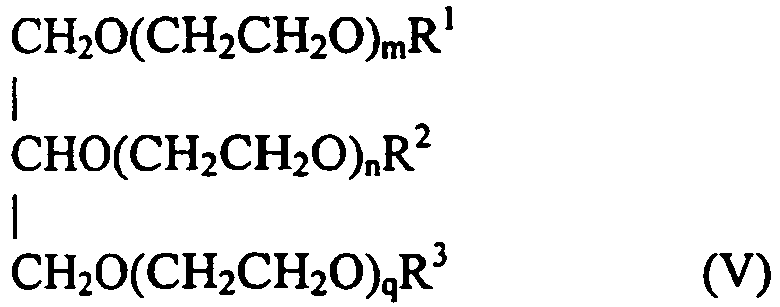
- Die Einsatzmenge der natürlichen und synthetischen kosmetischen Ölkörper in den erfindungsgemäß verwendeten Mitteln beträgt üblicherweise 0,1 - 30 Gew.%, bezogen auf das gesamte Haarbehandlungsmittel, bevorzugt 0,1 - 20 Gew.-%, und insbesondere 0,1 - 15 Gew.-%.
- Die Gesamtmenge an Öl- und Fettkomponenten in den erfindungsgemäßen Haarbehandlungsmitteln beträgt üblicherweise 0,5 - 75 Gew.-%, bezogen auf das gesamte Mittel. Mengen von 0,5 - 35 Gew.-% sind erfindungsgemäß bevorzugt.
- Weiterhin hat sich gezeigt, daß die Wirkung der erfindungsgemäßen Carbonylverbindung A gesteigert werden kann, wenn er mit Hydroxycarbonsäureestern kombiniert wird. Bevorzugte Hydroxycarbonsäureester sind Vollester der Glycolsäure, Milchsäure, Äpfelsäure, Weinsäure oder Citronensäure. Weitere grundsätzlich geeigneten Hydroxycarbonsäureester sind Ester der β-Hydroxypropionsäure, der Tartronsäure, der D-Gluconsäure, Zuckersäure, Schleimsäure oder Glucuronsäure. Als Alkoholkomponente dieser Ester eignen sich primäre, lineare oder verzweigte aliphatische Alkohole mit 8 - 22 C-Atomen, also z.B. Fettalkohole oder synthetische Fettalkohole. Dabei sind die Ester von C12-C15-Fettalkoholen besonders bevorzugt. Ester dieses Typs sind im Handel erhältlich, z.B. unter dem Warenzeichen Cosmacol® der EniChem, Augusta Industriale. Die Einsatzmenge der Hydroxycarbonsäureester beträgt dabei 0,1 - 15 Gew.% bezogen auf das gesamte Haarbehandlungsmittel, bevorzugt 0,1 - 10 Gew.% und ganz besonders bevorzugt 0,1 - 5 Gew.%.
- Ebenfalls als vorteilhaft hat sich die Kombination der Carbonylkomponente A mit Tensiden (E) erwiesen. In einer weiteren bevorzugten Ausführungsform enthalten die erfindungsgemäß verwendeten Nachbahandlungsmittel daher Tenside. Unter dem Begriff Tenside werden grenzflächenaktive Substanzen, die an Ober- und Grenzflächen Adsorptionsschichten bilden oder in Volumenphasen zu Mizellkolloiden oder lyotropen Mesophasen aggregieren können, verstanden. Man unterscheidet Aniontenside bestehend aus einem hydrophoben Rest und einer negativ geladenen hydrophilen Kopfgruppe, amphotere Tenside, welche sowohl eine negative als auch eine kompensierende positive Ladung tragen, kationische Tenside, welche neben einem hydrophoben Rest eine positiv geladene hydrophile Gruppe aufweisen, und nichtionische Tenside, welche keine Ladungen sondern starke Dipolmomente aufweisen und in wäßriger Lösung stark hydratisiert sind. Weitergehende Definitionen und Eigenschaften von Tensiden finden sich in "H.-D.Dörfler, Grenzflächen- und Kolloidchemie, VCH Verlagsgesellschaft mbH. Weinheim, 1994". Die zuvor wiedergegebene Begriffsbestimmung findet sich ab S. 190 in dieser Druckschrift.
- Als anionische Tenside (E1) eignen sich in erfindungsgemäßen Zubereitungen alle für die Verwendung am menschlichen Körper geeigneten anionischen oberflächenaktiven Stoffe. Diese sind gekennzeichnet durch eine wasserlöslich machende, anionische Gruppe wie z. B. eine Carboxylat-, Sulfat-, Sulfonat- oder Phosphat-Gruppe und eine lipophile Alkylgruppe mit etwa 8 bis 30 C-Atomen. Zusätzlich können im Molekül Glykol- oder Polyglykolether-Gruppen, Ester-, Ether- und Amidgruppen sowie Hydroxylgruppen enthalten sein. Beispiele für geeignete anionische Tenside sind, jeweils in Form der Natrium-, Kalium- und Ammonium- sowie der Mono-, Di- und Trialkanolammoniumsalze mit 2 bis 4 C-Atomen in der Alkanolgruppe,
- lineare und verzweigte Fettsäuren mit 8 bis 30 C-Atomen (Seifen),
- Ethercarbonsäuren der Formel R-O-(CH2-CH2O)x-CH2-COOH, in der R eine lineare Alkylgruppe mit 8 bis 30 C-Atomen und x = 0 oder 1 bis 16 ist,
- Acylsarcoside mit 8 bis 24 C-Atomen in der Acylgruppe,
- Acyltauride mit 8 bis 24 C-Atomen in der Acylgruppe,
- Acylisethionate mit 8 bis 24 C-Atomen in der Acylgruppe,
- Sulfobernsteinsäuremono- und -dialkylester mit 8 bis 24 C-Atomen in der Alkylgruppe und Sulfobernsteinsäuremono-alkylpolyoxyethylester mit 8 bis 24 C-Atomen in der Alkylgruppe und 1 bis 6 Oxyethylgruppen,
- lineare Alkansulfonate mit 8 bis 24 C-Atomen,
- lineare Alpha-Olefinsulfonate mit 8 bis 24 C-Atomen,
- Alpha-Sulfofettsäuremethylester von Fettsäuren mit 8 bis 30 C-Atomen,
- Alkylsulfate und Alkylpolyglykolethersulfate der Formel R-O(CH2-CH2O)x-OSO3H, in der R eine bevorzugt lineare Alkylgruppe mit 8 bis 30 C-Atomen und x = 0 oder 1 bis 12 ist,
- Gemische oberflächenaktiver Hydroxysulfonate gemäß
DE-A-37 25 030 , - sulfatierte Hydroxyalkylpolyethylen- und/oder Hydroxyalkylenpropylenglykolether gemäß
DE-A-37 23 354 , - Sulfonate ungesättigter Fettsäuren mit 8 bis 24 C-Atomen und 1 bis 6 Doppelbindungen gemäß
DE-A-39 26 344 , - Ester der Weinsäure und Zitronensäure mit Alkoholen, die Anlagerungsprodukte von etwa 2-15 Molekülen Ethylenoxid und/oder Propylenoxid an Fettalkohole mit 8 bis 22 C-Atomen darstellen,
- Alkyl- und/oder Alkenyletherphosphate der Formel (VI),

- sulfatierte Fettsäurealkylenglykolester der Formel (VII),
R10CO(AlkO)nSO3M (VII)
in der R10CO- für einen linearen oder verzweigten, aliphatischen, gesättigten und/oder ungesättigten Acylrest mit 6 bis 22 C-Atomen, Alk für CH2CH2, CHCH3CH2 und/oder CH2CHCH3, n für Zahlen von 0,5 bis 5 und M für ein Kation steht, wie sie in derDE-OS 197 36 906.5 - Monoglyceridsulfate und Monoglyceridethersulfate der Formel (VIII),

EP-B1 0 561 825 , derEP-B1 0 561 999 , derDE-A1 42 04 700 oder von A.K.Biswas et al. in J.Am.Oil.Chem.Soc. 37, 171 (1960) und F.U.Ahmed in J.Am.Oil.Chem.Soc. 67, 8 (1990) beschrieben worden sind, - Amidethercarbonsäuren wie sie in der
EP 0 690 044 beschrieben sind, - Kondensationsprodukte aus C8 - C30 - Fettalkoholen mit Proteinhydrolysaten und/oder Aminosäuren und deren Derivaten,welche dem Fachmann als Eiweissfettsäurekondensate bekannt sind, wie beispielsweise die Lamepon® - Typen, Gluadin® - Typen, Hostapon® KCG oder die Amisoft® - Typen.
- Bevorzugte anionische Tenside sind Alkylsulfate, Alkylpolyglykolethersulfate und Ethercarbonsäuren mit 10 bis 18 C-Atomen in der Alkylgruppe und bis zu 12 Glykolethergruppen im Molekül, Sulfobemsteinsäuremono- und -dialkylester mit 8 bis 18 C-Atomen in der Alkylgruppe und Sulfobemsteinsäuremono-alkylpolyoxyethylester mit 8 bis 18 C-Atomen in der Alkylgruppe und 1 bis 6 Oxyethylgruppen, Monoglycerdisulfate, Alkyl- und Alkenyletherphosphate sowie Eiweissfettsäurekondensate.
- Als zwitterionische Tenside (E2) werden solche oberflächenaktiven Verbindungen bezeichnet, die im Molekül mindestens eine quartäre Ammoniumgruppe und mindestens eine -COO(-) - oder -SO3 (-) -Gruppe tragen. Besonders geeignete zwitterionische Tenside sind die sogenannten Betaine wie die N-Alkyl-N,N-dimethylammonium-glycinate, beispielsweise das Kokosalkyl-dimethylammoniumglycinat, N-Acyl-aminopropyl-N,N-dimethylammoniumglycinate, beispielsweise das Kokosacylaminopropyldimethylammoniumglycinat, und 2-Alkyl-3-carboxymethyl-3-hydroxyethyl-imidazoline mit jeweils 8 bis 18 C-Atomen in der Alkyl- oder Acylgruppe sowie das Kokosacylaminoethylhydroxyethylcarboxymethylglycinat. Ein bevorzugtes zwitterionisches Tensid ist das unter der INCI-Bezeichnung Cocamidopropyl Betaine bekannte Fettsäureamid-Derivat.
- Unter ampholytischen Tensiden (E3) werden solche oberflächenaktiven Verbindungen verstanden, die außer einer C8 - C24 - Alkyl- oder -Acylgruppe im Molekül mindestens eine freie Aminogruppe und mindestens eine -COOH- oder -SO3H-Grupp enthalten und zur Ausbildung innerer Salze befähigt sind. Beispiele für geeignete ampholytische Tenside sind N-Alkylglycine, N-Alkylpropionsäuren, N-Alkylaminobuttersäuren, N-Alkyliminodipropionsäuren, N-Hydroxyethyl-N-alkylamidopropylglycine, N-Alkyltaurine, N-Alkylsarcosine, 2-Alkylaminopropionsäuren und Alkylaminoessigsäuren mit jeweils etwa 8 bis 24 C-Atomen in der Alkylgruppe. Besonders bevorzugte ampholytische Tenside sind das N-Kokosalkylaminopropionat, das Kokosacylaminoethylaminopropionat und das C12 - C18 - Acylsarcosin.
- Nichtionische Tenside (E4) enthalten als hydrophile Gruppe z.B. eine Polyolgruppe, eine Polyalkylenglykolethergruppe oder eine Kombination aus Polyol- und Polyglykolethergruppe. Solche Verbindungen sind beispielsweise
- Anlagerungsprodukte von 2 bis 50 Mol Ethylenoxid und/oder 0 bis 5 Mol Propylenoxid an lineare und verzweigte Fettalkohole mit 8 bis 30 C-Atomen, an Fettsäuren mit 8 bis 30 C-Atomen und an Alkylphenole mit 8 bis 15 C-Atomen in der Alkylgruppe,
- mit einem Methyl- oder C2 - C6 - Alkylrest endgruppenverschlossene Anlagerungsprodukte von 2 bis 50 Mol Ethylenoxid und/oder 0 bis 5 Mol Propylenoxid an lineare und verzweigte Fettalkohole mit 8 bis 30 C-Atomen, an Fettsäuren mit 8 bis 30 C-Atomen und an Alkylphenole mit 8 bis 15 C-Atomen in der Alkylgruppe, wie beispielsweise die unter den Verkaufsbezeichnungen Dehydol® LS, Dehydol® LT (Cognis) erhältlichen Typen,
- C12-C30-Fettsäuremono- und -diester von Anlagerungsprodukten von 1 bis 30 Mol Ethylenoxid an Glycerin,
- Anlagerungsprodukte von 5 bis 60 Mol Ethylenoxid an Rizinusöl und gehärtetes Rizinusöl,
- Polyolfettsäureester, wie beispielsweise das Handelsprodukt Hydagen® HSP (Cognis) oder Sovermol - Typen (Cognis),
- alkoxilierte Triglyceride,
- alkoxilierte Fettsäurealkylester der Formel (IX),
R12CO-(OCH2CHR13)wOR14 (IX)
in der R12CO für einen linearen oder verzweigten, gesättigten und/oder ungesättigten Acylrest mit 6 bis 22 Kohlenstoffatomen, R13 für Wasserstoff oder Methyl, R14 Für lineare oder verzweigte Alkylreste mit 1 bis 4 Kohlenstoffatomen und w für Zahlen von 1 bis 20 steht, - Aminoxide,
- Hydroxymischether, wie sie beipielsweise in der
DE-OS 19738866 - Sorbitanfettsäureester und Anlagerungeprodukte von Ethylenoxid an Sorbitanfettsäureester wie beispielsweise die Polysorbate,
- Zuckerfettsäureester und Anlagerungsprodukte von Ethylenoxid an Zuckerfettsäureester,
- Anlagerungsprodukte von Ethylenoxid an Fettsäurealkanolamide und Fettamine,
- Zuckertenside vom Typ der Alkyl- und Alkenyloligoglykoside gemäß Formel (X),
R15O-[G]p (X)
in der R15 für einen Alkyl- oder Alkenylrest mit 4 bis 22 Kohlenstoffatomen, G für einen Zuckerrest mit 5 oder 6 Kohlenstoffatomen und p für Zahlen von 1 bis 10 steht. Sie können nach den einschlägigen Verfahren der präparativen organischen Chemie erhalten werden. Stellvertretend für das umfangreiche Schrifttum sei hier auf die Übersichtsarbeit von Biermann et al. in Starch/Stärke 45, 281 (1993), B. Salka in Cosm.Toil. 108, 89 (1993) sowie J. Kahre et al. in SÖFW-Journal Heft 8, 598 (1995) verwiesen. Die Alkyl- und Alkenyloligoglykoside können sich von Aldosen bzw. Ketosen mit 5 oder 6 Kohlenstoffatomen, vorzugweise von Glucose, ableiten. Die bevorzugten Alkyl- und/oder Alkenyloligoglykoside sind somit Alkyl- und/oder Alkenyloligoglucoside. Die Indexzahl p in der allgemeinen Formel (X) gibt den Oligomerisierungsgrad (DP), d. h. die Verteilung von Mono- und Oligoglykosiden an und steht für eine Zahl zwischen 1 und 10. Während p im einzelnen Molekül stets ganzzahlig sein muß und hier vor allem die Werte p = 1 bis 6 annehmen kann, ist der Wert p für ein bestimmtes Alkyloligoglykosid eine analytisch ermittelte rechnerische Größe, die meistens eine gebrochene Zahl darstellt. Vorzugsweise werden Alkyl- - und/oder Alkenyloligoglykoside mit einem mittleren Oligomerisierungsgrad p von 1,1 bis 3,0 eingesetzt. Aus anwendungstechnischer Sicht sind solche Alkyl- und/oder Alkenyloligoglykoside bevorzugt, deren Oligomerisierungsgrad kleiner als 1,7 ist und insbesondere zwischen 1,2 und 1,4 liegt. Der Alkyl- bzw. Alkenylrest R1 kann sich von primären Alkoholen mit 4 bis 11, vorzugsweise 8 bis 10 Kohlenstoffatomen ableiten. Typische Beispiele sind Butanol, Capronalkohol, Caprylalkohol, Caprinalkohol und Undecylalkohol sowie deren technische Mischungen, wie sie beispielsweise bei der Hydrierung von technischen Fettsäuremethylestern oder im Verlauf der Hydrierung von Aldehyden aus der Roelen'schen Oxosynthese erhalten werden. - Bevorzugt sind Alkyloligoglucoside der Kettenlänge C8-C10 (DP = 1 bis 3), die als Vorlauf bei der destillativen Auftrennung von technischem C8-C18-Kokosfettalkohol anfallen und mit einem Anteil von weniger als 6 Gew.% C12-Alkohol verunreinigt sein können sowie Alkyloligoglucoside auf Basis technischer C9/11-Oxoalkohole (DP = 1 bis 3). Der Alkyl- bzw. Alkenylrest R15 kann sich ferner auch von primären Alkoholen mit 12 bis 22, vorzugsweise 12 bis 14 Kohlenstoffatomen ableiten. Typische Beispiele sind Laurylalkohol, Myristylalkohol, Cetylalkohol, Palmoleylalkohol, Stearylalkohol, Isostearylalkohol, Oleylalkohol, Elaidylalkohol, Petroselinylalkohol, Arachylalkohol, Gadoleylalkohol, Behenylalkohol, Erucylalkohol, Brassidylalkohol sowie deren technische Gemische, die wie oben beschrieben erhalten werden können. Bevorzugt sind Alkyloligoglucoside auf Basis von gehärtetem C12/14-Kokosalkohol mit einem DP von 1 bis 3.
- Zuckertenside vom Typ der Fettsäure-N-alkylpolyhydroxyalkylamide, nichtionische Tenside der Formel (XI),

- Vorzugsweise werden als Fettsäure-N-alkylpolyhydroxyalkylamide Glucamide der Formel (XII) eingesetzt, in der R17 für Wasserstoff oder eine Alkylgruppe steht und R16CO für den Acylrest der Capronsäure, Caprylsäure, Caprinsäure, Laurinsäure, Myristinsäure, Palmitinsäure, Palmoleinsäure, Stearinsäure, Isostearinsäure, Ölsäure, Elaidinsäure, Petroselinsäure, Linolsäure, Linolensäure, Arachinsäure, Gadoleinsäure, Behensäure oder Erucasäure bzw. derer technischer Mischungen steht. Besonders bevorzugt sind Fettsäure-N-alkylglucamide der Formel (XII), die durch reduktive Aminierung von Glucose mit Methylamin und anschließende Acylierung mit Laurinsäure oder C12/14-Kokosfettsäure bzw. einem entsprechenden Derivat erhalten werden. Weiterhin können sich die Polyhydroxyalkylamide auch von Maltose und Palatinose ableiten.
- Als bevorzugte nichtionische Tenside haben sich die Alkylenoxid-Anlagerungsprodukte an gesättigte lineare Fettalkohole und Fettsäuren mit jeweils 2 bis 30 Mol Ethylenoxid pro Mol Fettalkohol bzw. Fettsäure erwiesen. Zubereitungen mit hervorragenden Eigenschaften werden ebenfalls erhalten, wenn sie als nichtionische Tenside Fettsäureester von ethoxyliertem Glycerin enthalten.
- Diese Verbindungen sind durch die folgenden Parameter gekennzeichnet. Der Alkylrest R enthält 6 bis 22 Kohlenstoffatome und kann sowohl linear als auch verzweigt sein. Bevorzugt sind primäre lineare und in 2-Stellung methylverzweigte aliphatische Reste. Solche Alkylreste sind beispielsweise 1-Octyl, 1-Decyl, 1-Lauryl, 1-Myristyl, 1-Cetyl und 1-Stearyl. Besonders bevorzugt sind 1-Octyl, 1-Decyl, 1-Lauryl, 1-Myristyl. Bei Verwendung sogenannter "Oxo-Alkohole" als Ausgangsstoffe überwiegen Verbindungen mit einer ungeraden Anzahl von Kohlenstoffatomen in der Alkylkette.
- Weiterhin sind ganz besonders bevorzugte nichtionische Tenside die Zuckertenside. Diese können in den erfindungsgemäß verwendeten Mitteln bevorzugt in Mengen von 0,1 - 20 Gew.%, bezogen auf das gesamte Mittel, enthalten sein. Mengen von 0,5 - 15 Gew.-% sind bevorzugt, und ganz besonders bevorzugt sind Mengen von 0,5 - 7,5 Gew.%.
- Bei den als Tensid eingesetzten Verbindungen mit Alkylgruppen kann es sich jeweils um einheitliche Substanzen handeln. Es ist jedoch in der Regel bevorzugt, bei der Herstellung dieser Stoffe von nativen pflanzlichen oder tierischen Rohstoffen auszugehen, so daß man Substanzgemische mit unterschiedlichen, vom jeweiligen Rohstoff abhängigen Alkylkettenlängen erhält.
Bei den Tensiden, die Anlagerungsprodukte von Ethylen- und/oder Propylenoxid an Fettalkohole oder Derivate dieser Anlagerungsprodukte darstellen, können sowohl Produkte mit einer "normalen" Homologenverteilung als auch solche mit einer eingeengten Homologenverteilung verwendet werden. Unter "normaler" Homologenverteilung werden dabei Mischungen von Homologen verstanden, die man bei der Umsetzung von Fettalkohol und Alkylenoxid unter Verwendung von Alkalimetallen, Alkalimetallhydroxiden oder Alkalimetallalkoholaten als Katalysatoren erhält. Eingeengte Homologenverteilungen werden dagegen erhalten, wenn beispielsweise Hydrotalcite, Erdalkalimetallsalze von Ethercarbonsäuren, Erdalkalimetalloxide, -hydroxide oder -alkoholate als Katalysatoren verwendet werden. Die Verwendung von Produkten mit eingeengter Homologenverteilung kann bevorzugt sein. - Die Tenside (E) werden in Mengen von 0,1 - 45 Gew.%, bevorzugt 0,5 - 30 Gew.% und ganz besonders bevorzugt von 0,5 - 25 Gew.%, bezogen auf das gesamte erfindungsgemäß verwendete Haarbehandlungsmittel, eingesetzt.
- Erfindungsgemäß einsetzbar sind ebenfalls kationische Tenside (E6) vom Typ der quartärnen Ammoniumverbindungen, der Esterquats und der Amidoamine. Bevorzugte quaternäre Ammoniumverbindungen sind Ammoniumhalogenide, insbesondere Chloride und Bromide, wie Alkyltrimethylammoniumchloride, Dialkyldimethylammoniumchloride und Trialkylmethylammoniumchloride, z. B. Cetyltrimethylammoniumchlorid, Stearyltrimethylammoniumchlorid, Distearyldimethylammoniumchlorid, Lauryldimethylammoniumchlorid, Lauryldimethylbenzylammoniumchlorid und Tricetylmethylammoniumchlorid, sowie die unter den INCI-Bezeichnungen Quaternium-27 und Quaternium-83 bekannten Imidazolium-Verbindungen. Die langen Alkylketten der oben genannten Tenside weisen bevorzugt 10 bis 18 Kohlenstoffatome auf.
- Bei Esterquats handelt es sich um bekannte Stoffe, die sowohl mindestens eine Esterfunktion als auch mindestens eine quartäre Ammoniumgruppe als Strukturelement enthalten. Bevorzugte Esterquats sind quaternierte Estersalze von Fettsäuren mit Triethanolamin, quaternierte Estersalze von Fettsäuren mit Diethanolalkylaminen und quatemierten Estersalzen von Fettsäuren mit 1,2-Dihydroxypropyldialkylaminen. Solche Produkte werden beispielsweise unter den Warenzeichen Stepantex®, Dehyquart® und Armocare® vertrieben. Die Produkte Armocare® VGH-70, ein N,N-Bis(2-Palmitoyloxyethyl)dimethylammoniumchlorid, sowie Dehyquart® F-75, Dehyquart® C-4046, Dehyquart® L80 und Dehyquart® AU-35 sind Beispiele für solche Esterquats.
- Die Alkylamidoamine werden üblicherweise durch Amidierung natürlicher oder synthetischer Fettsäuren und Fettsäureschnitte mit Dialkylaminoaminen hergestellt. Eine erfindungsgemäß besonders geeignete Verbindung aus dieser Substanzgruppe stellt das unter der Bezeichnung Tegoamid® S 18 im Handel erhältliche Stearamidopropyl-dimethylamin dar.
- Die kationischen Tenside (E6) sind in den erfindungsgemäß verwendeten Mitteln bevorzugt in Mengen von 0,05 bis 10 Gew.%, bezogen auf das gesamte Mittel, enthalten. Mengen von 0,1 bis 5 Gew.-% sind besonders bevorzugt.
- Anionische, nichtionische, zwitterionische und/oder amphotere Tenside sowie deren Mischungen können erfindungsgemäß bevorzugt sein.
- In einer weiteren bevorzugten Ausführungsform kann die Wirkung der Carbonylverbindung A durch Emulgatoren (F) gesteigert werden. Emulgatoren bewirken an der Phasengrenzfläche die Ausbildung von wasser- bzw. ölstabilen Adsorptionsschichten, welche die dispergierten Tröpfchen gegen Koaleszenz schützen und damit die Emulsion stabilisieren. Emulgatoren sind daher wie Tenside aus einem hydrophoben und einem hydrophilen Molekülteil aufgebaut. Hydrophile Emulgatoren bilden bevorzugt O/W - Emulsionen und hydrophobe Emulgatoren bilden bevorzugt W/O - Emulsionen. Unter einer Emulsion ist eine tröpfchenförmige Verteilung (Dispersion) einer Flüssigkeit in einer anderen Flüssigkeit unter Aufwand von Energie zur Schaffung von stabilisierenden Phasengrenzflächen mittels Tensiden zu verstehen. Die Auswahl dieser emulgierenden Tenside oder Emulgatoren richtet sich dabei nach den zu dispergierenden Stoffen und der jeweiligen äußeren Phase sowie der Feinteiligkeit der Emulsion. Weiterführende Definitionen und Eigenschaften von Emulgatoren finden sich in "H.-D.Dörfler, Grenzflächen- und Kolloidchemie, VCH Verlagsgesellschaft mbH. Weinheim, 1994". Erfindungsgemäß verwendbare Emulgatoren sind beispielsweise
- Anlagerungsprodukte von 4 bis 30 Mol Ethylenoxid und/oder 0 bis 5 Mol Propylenoxid an lineare Fettalkohole mit 8 bis 22 C-Atomen, an Fettsäuren mit 12 bis 22 C-Atomen und an Alkylphenole mit 8 bis 15 C-Atomen in der Alkylgruppe,
- C12-C22-Fettsäuremono- und -diester von Anlagerungsprodukten von 1 bis 30 Mol Ethylenoxid an Polyole mit 3 bis 6 Kohlenstoffatomen, insbesondere an Glycerin,
- Ethylenoxid- und Polyglycerin-Anlagerungsprodukte an Methylglucosid-Fettsäureester, Fettsäurealkanolamide und Fettsäureglucamide,
- C8-C22-Alkylmono- und -oligoglycoside und deren ethoxylierte Analoga, wobei Oligomerisierungsgrade von 1,1 bis 5, insbesondere 1,2 bis 2,0, und Glucose als Zuckerkomponente bevorzugt sind,
- Gemische aus Alkyl-(oligo)-glucosiden und Fettalkoholen zum Beispiel das im Handel erhältliche Produkt Montanov®68,
- Anlagerungsprodukte von 5 bis 60 Mol Ethylenoxid an Rizinusöl und gehärtetes Rizinusöl,
- Partialester von Polyolen mit 3-6 Kohlenstoffatomen mit gesättigten Fettsäuren mit 8 bis 22 C-Atomen,
- Sterine. Als Sterine wird eine Gruppe von Steroiden verstanden, die am C-Atom 3 des Steroid-Gerüstes eine Hydroxylgruppe tragen und sowohl aus tierischem Gewebe (Zoosterine) wie auch aus pflanzlichen Fetten (Phytosterine) isoliert werden. Beispiele für Zoosterine sind das Cholesterin und das Lanosterin. Beispiele geeigneter Phytosterine sind Ergosterin, Stigmasterin und Sitosterin. Auch aus Pilzen und Hefen werden Sterine, die sogenannten Mykosterine, isoliert.
- Phospholipide. Hierunter werden vor allem die Glucose-Phospolipide, die z.B. als Lecithine bzw. Phospahtidylcholine aus z.B. Eidotter oder Pflanzensamen (z.B. Sojabohnen) gewonnen werden, verstanden.
- Fettsäureester von Zuckern und Zuckeralkoholen, wie Sorbit,
- Polyglycerine und Polyglycerinderivate wie beispielsweise Polyglycerinpoly-12-hydroxystearat (Handelsprodukt Dehymuls® PGPH),
- Lineare und verzweigte Fettsäuren mit 8 bis 30 C - Atomen und deren Na-, K-, Ammonium-, Ca-, Mg- und Zn - Salze.
- Die erfindungsgemäßen Mittel enthalten die Emulgatoren bevorzugt in Mengen von 0,1 - 25 Gew.%, insbesondere 0,5 - 15 Gew.%, bezogen auf das gesamte Mittel.
- Bevorzugt können die erfindungsgemäßen Zusammensetzungen mindestens einen nichtionogenen Emulgator mit einem HLB-Wert von 8 bis 18, gemäß den im Römpp-Lexikon Chemie (Hrg. J. Falbe, M.Regitz), 10. Auflage, Georg Thieme Verlag Stuttgart, New York, (1997), Seite 1764, aufgeführten Definitionen enthalten. Nichtionogene Emulgatoren mit einem HLB-Wert von 10 - 15 können erfindungsgemäß besonders bevorzugt sein.
- Weiterhin hat es sich gezeigt, daß Polymere (G) die farberhaltende Wirkung der Carbonylverbindung A unterstützen können. In einer weiteren Ausführungsform werden den erfindungsgemäß verwendeten Haarbehandlungsmitteln daher Polymere zugesetzt, wobei sich sowohl kationische, anionische, amphotere als auch nichtionische Polymere als wirksam erwiesen haben.
- Unter kationischen Polymeren (G1) sind Polymere zu verstehen, welche in der Haupt- und/oder Seitenkette eine Gruppe aufweisen, welche "temporär" oder "permanent" kationisch sein kann. Als "permanent kationisch" werden erfindungsgemäß solche Polymere bezeichnet, die unabhängig vom pH-Wert des Mittels eine kationische Gruppe aufweisen. Dies sind in der Regel Polymere, die ein quartäres Stickstoffatom, beispielsweise in Form einer Ammoniumgruppe, enthalten. Bevorzugte kationische Gruppen sind quartäre Ammoniumgruppen. Insbesondere solche Polymere, bei denen die quartäre Ammoniumgruppe über eine C14-Kohlenwasserstoffgruppe an eine aus Acrylsäure, Methacrylsäure oder deren Derivaten aufgebaute Polymerhauptkette gebunden sind, haben sich als besonders geeignet erwiesen.
- Homopolymere der allgemeinen Formel (XIII),

R18 steht für eine Methylgruppe
R19, R20 und R21 stehen für Methylgruppen
m hat den Wert 2. - Als physiologisch verträgliches Gegenionen X- kommen beispielsweise Halogenidionen, Sulfationen, Phosphationen, Methosulfationen sowie organische Ionen wie Lactat-, Citrat- , Tartrat- und Acetationen in Betracht. Bevorzugt sind Halogenidionen, insbesondere Chlorid.
- Ein geeignetes Homopolymer ist das, gewünschtenfalls vernetzte, Poly(methacryloyloxyethyltrimethylammoniumchlorid) mit der INCI-Bezeichnung Polyquaternium-37. Die Vernetzung kann gewünschtenfalls mit Hilfe mehrfach olefinisch ungesättigter Verbindungen, beispielsweise Divinylbenzol, Tetraallyloxyethan, Methylen-bisacrylamid, Diallylether, Polyallylpolyglycerylether, oder Allylethern von Zuckern oder Zuckerderivaten wie Erythritol, Pentaerythritol, Arabitol, Mannitol, Sorbitol, Sucrose oder Glucose erfolgen. Methylenbisacrylamid ist ein bevorzugtes Vernetzungsagens.
- Das Homopolymer wird bevorzugt in Form einer nichtwäßrigen Polymerdispersion, die einen Polymeranteil nicht unter 30 Gew.% aufweisen sollte, eingesetzt. Solche Polymerdispersionen sind unter den Bezeichnungen Salcare® SC 95 (ca. 50 % Polymeranteil, weitere Komponenten: Mineralöl (INCI-Bezeichnung: Mineral Oil) und Tridecyl-polyoxypropylen-polyoxyethylen-ether (INCI-Bezeichnung: PPG-1-Trideceth-6)) und Salcare® SC 96 (ca. 50 % Polymeranteil, weitere Komponenten: Mischung von Diestern des Propylenglykols mit einer Mischung aus Capryl- und Caprinsäure (INCI-Bezeichnung: Propylene Glycol Dicaprylate/Dicaprate) und Tridecyl-polyoxypropylen-polyoxyethylen-ether (INCI-Bezeichnung: PPG-1-Trideceth-6)) im Handel erhältlich.
- Copolymere mit Monomereinheiten gemäß Formel (XIII) enthalten als nichtionogene Monomereinheiten bevorzugt Acrylamid, Methacrylamid, Acrylsäure-C1-4-alkylester und Methacrylsäure-C1-4-alkylester. Unter diesen nichtionogenen Monomeren ist das Acrylamid besonders bevorzugt. Auch diese Copolymere können, wie im Falle der Homopolymere oben beschrieben, vernetzt sein. Ein erfindungsgemäß bevorzugtes Copolymer ist das vernetzte Acrylamid-Methacryloyloxyethyltrimethylammoniumchlorid-Copolymer. Solche Copolymere, bei denen die Monomere in einem Gewichtsverhältnis von etwa 20:80 vorliegen, sind im Handel als ca. 50 %ige nichtwäßrige Polymerdispersion unter der Bezeichnung Salcare® SC 92 erhältlich.
- Weitere bevorzugte kationische Polymere sind beispielsweise
- quaternisierte Cellulose-Derivate, wie sie unter den Bezeichnungen Celquat® und Polymer JR® im Handel erhältlich sind. Die Verbindungen Celquat® H 100, Celquat® L 200 und Polymer JR®400 sind bevorzugte quaternierte Cellulose-Derivate,
- kationische Alkylpolyglycoside gemäß der
DE-PS 44 13 686 - kationisierter Honig, beispielsweise das Handelsprodukt Honeyquat® 50,
- kationische Guar-Derivate, wie insbesondere die unter den Handelsnamen Cosmedia®Guar und Jaguar® vertriebenen Produkte,
- Polysiloxane mit quaternären Gruppen, wie beispielsweise die im Handel erhältlichen Produkte Q2-7224 (Hersteller: Dow Corning; ein stabilisiertes Trimethylsilylamodimethicon), Dow Corning® 929 Emulsion (enthaltend ein hydroxyl-aminomodifiziertes Silicon, das auch als Amodimethicone bezeichnet wird), SM-2059 (Hersteller: General Electric), SLM-55067 (Hersteller: Wacker) sowie Abil®-Quat 3270 und 3272 (Hersteller: Th. Goldschmidt), diquaternäre Polydimethylsiloxane, Quaternium-80),
- polymere Dimethyldiallylammoniumsalze und deren Copolymere mit Estern und Amiden von Acrylsäure und Methacrylsäure. Die unter den Bezeichnungen Merquat®100 (Poly(dimethyldiallylammoniumchlorid)) und Merquat®550 (Dimethyldiallylammoniumchlorid-Acrylamid-Copolymer) im Handel erhältlichen Produkte sind Beispiele für solche kationischen Polymere,
- Copolymere des Vinylpyrrolidons mit quaternierten Derivaten des Dialkylaminoalkylacrylats und -methacrylats, wie beispielsweise mit Diethylsulfat quaternierte Vinylpyrrolidon-Dimethylaminoethylmethacrylat-Copolymere. Solche Verbindungen sind unter den Bezeichnungen Gafquat®734 und Gafquat®755 im Handel erhältlich,
- Vinylpyrrolidon-Vinylimidazoliummethochlorid-Copolymere, wie sie unter den Bezeichnungen Luviquat® FC 370, FC 550, FC 905 und HM 552 angeboten werden,
- quatemierter Polyvinylalkohol,
- sowie die unter den Bezeichnungen Polyquaternium 2, Polyquaternium 17, Polyquaternium 18 und Polyquaternium 27 bekannten Polymeren mit quartären Stickstoffatomen in der Polymerhauptkette.
- Gleichfalls als kationische Polymere eingesetzt werden können die unter den Bezeichnungen Polyquaternium-24 (Handelsprodukt z. B. Quatrisoft® LM 200), bekannten Polymere. Ebenfalls erfindungsgemäß verwendbar sind die Copolymere des Vinylpyrrolidons, wie sie als Handelsprodukte Copolymer 845 (Hersteller: ISP), Gaffix® VC 713 (Hersteller: ISP), Gafquat®ASCP 1011, Gafquat®HS 110, Luviquat®8155 und Luviquat® MS 370 erhältlich sind.
- Weitere erfindungsgemäße kationische Polymere sind die sogenannten "temporär kationischen" Polymere. Diese Polymere enthalten üblicherweise eine Aminogruppe, die bei bestimmten pH-Werten als quartäre Ammoniumgruppe und somit kationisch vorliegt. Bevorzugt sind beispielsweise Chitosan und dessen Derivate, wie sie beispielsweise unter den Handelsbezeichnungen Hydagen® CMF, Hydagen® HCMF, Kytamer® PC und Chitolam® NB/101 im Handel frei verfügbar sind.
Erfindungsgemäß bevorzugte kationische Polymere sind kationische Cellulose-Derivate und Chitosan und dessen Derivate, insbesondere die Handelsprodukte Polymer®JR 400, Hydagen® HCMF und Kytamer® PC, kationische Guar-Derivate, kationische Honig-Derivate, insbesondere das Handelsprodukt Honeyquat® 50, kationische Alkylpolyglycoside gemäß derDE-PS 44 13 686 - Weiterhin sind kationisierte Proteinhydrolysate zu den kationischen Polymeren zu zählen, wobei das zugrunde liegende Proteinhydrolysat vom Tier, beispielsweise aus Collagen, Milch oder Keratin, von der Pflanze, beispielsweise aus Weizen, Mais, Reis, Kartoffeln, Soja oder Mandeln, von marinen Lebensformen, beispielsweise aus Fischcollagen oder Algen, oder biotechnologisch gewonnenen Proteinhydrolysaten, stammen kann. Die den erfindungsgemäßen kationischen Derivaten zugrunde liegenden Proteinhydrolysate können aus den entsprechenden Proteinen durch eine chemische, insbesondere alkalische oder saure Hydrolyse, durch eine enzymatische Hydrolyse und/oder einer Kombination aus beiden Hydrolysearten gewonnen werden. Die Hydrolyse von Proteinen ergibt in der Regel ein Proteinhydrolysat mit einer Molekulargewichtsverteilung von etwa 100 Dalton bis hin zu mehreren tausend Dalton. Bevorzugt sind solche kationischen Proteinhydrolysate, deren zugrunde liegender Proteinanteil ein Molekulargewicht von 100 bis zu 25000 Dalton, bevorzugt 250 bis 5000 Dalton aufweist. Weiterhin sind unter kationischen Proteinhydrolysaten quaternierte Aminosäuren und deren Gemische zu verstehen. Die Quaternisierung der Proteinhydrolysate oder der Aminosäuren wird häufig mittels quaternären Ammoniumsalzen wie beispielsweise N,N-Dimethyl-N-(n-Alkyl)-N-(2-hydroxy-3-chloro-n-propyl)-ammoniumhalogeniden durchgeführt. Weiterhin können die kationischen Proteinhydrolysate auch noch weiter derivatisiert sein. Als typische Beispiele für die erfindungsgemäßen kationischen Proteinhydrolysate und -derivate seien die unter den INCI - Bezeichnungen im "International Cosmetic Ingredient Dictionary and Handbook", (seventh edition 1997, The Cosmetic, Toiletry, and Fragrance Association 1101 17th Street, N.W., Suite 300, Washington, DC 20036-4702) genannten und im Handel erhältlichen Produkte genannt: Cocodimonium Hydroxypropyl Hydrolyzed Collagen, Cocodimopnium Hydroxypropyl Hydrolyzed Casein, Cocodimonium Hydroxypropyl Hydrolyzed Collagen, Cocodimonium Hydroxypropyl Hydrolyzed Hair Keratin, Cocodimonium Hydroxypropyl Hydrolyzed Keratin, Cocodimonium Hydroxypropyl Hydrolyzed Rice Protein, Cocodimonium Hydroxypropyl Hydrolyzed Silk, Cocodimonium Hydroxypropyl Hydrolyzed Soy Protein, Cocodimonium Hydroxypropyl Hydrolyzed Wheat Protein, Cocodimonium Hydroxypropyl Silk Amino Acids, Hydroxypropyl Arginine Lauryl/Myristyl Ether HCl, Hydroxypropyltrimonium Gelatin, Hydroxypropyltrimonium Hydrolyzed Casein, Hydroxypropyltrimonium Hydrolyzed Collagen, Hydroxypropyltrimonium Hydrolyzed Conchiolin Protein, Hydroxypropyltrimonium Hydrolyzed keratin, Hydroxypropyltrimonium Hydrolyzed Rice Bran Protein, Hydroxyproypltrimonium Hydrolyzed Silk, Hydroxypropyltrimonium Hydrolyzed Soy Protein, Hydroxypropyl Hydrolyzed Vegetable Protein, Hydroxypropyltrimonium Hydrolyzed Wheat Protein, Hydroxypropyltrimonium Hydrolyzed Wheat Protein/Siloxysilicate, Laurdimonium Hydroxypropyl Hydrolyzed Soy Protein, Laurdimonium Hydroxypropyl Hydrolyzed Wheat Protein, Laurdimonium Hydroxypropyl Hydrolyzed Wheat Protein/Siloxysilicate, Lauryldimonium Hydroxypropyl Hydrolyzed Casein, Lauryldimonium Hydroxypropyl Hydrolyzed Collagen, Lauryldimonium Hydroxypropyl Hydrolyzed Keratin, Lauryldimonium Hydroxypropyl Hydrolyzed Silk, Lauryldimonium Hydroxypropyl Hydrolyzed Soy Protein, Steardimonium Hydroxypropyl Hydrolyzed Casein, Steardimonium Hydroxypropyl Hydrolyzed Collagen, Steardimonium Hydroxypropyl Hydrolyzed Keratin, Steardimonium Hydroxypropyl Hydrolyzed Rice Protein, Steardimonium Hydroxypropyl Hydrolyzed Silk, Steardimonium Hydroxypropyl Hydrolyzed Soy Protein, Steardimonium Hydroxypropyl Hydrolyzed Vegetable Protein, Steardimonium Hydroxypropyl Hydrolyzed Wheat Protein, Steartrimonium Hydroxyethyl Hydrolyzed Collagen, Quaternium-76 Hydrolyzed Collagen, Quaternium-79 Hydrolyzed Collagen, Quaternium-79 Hydrolyzed Keratin, Quaternium-79 Hydrolyzed Milk Protein, Quaternium-79 Hydrolyzed Silk, Quaternium-79 Hydrolyzed Soy Protein, Quaternium-79 Hydrolyzed Wheat Protein.
- Ganz besonders bevorzugt sind die kationischen Proteinhydrolysate und -derivate auf pflanzlicher Basis.
- Bei den anionischen Polymeren (G2), welche die farberhaltende Wirkung der Carbonylverbindung A unterstützen können, handelt es sich um anionische Polymere, welche Carboxylat- und/oder Sulfonatgruppen aufweisen. Beispiele für anionische Monomere, aus denen derartige Polymere bestehen können, sind Acrylsäure, Methacrylsäure, Crotonsäure, Maleinsäureanhydrid und 2-Acrylamido-2-methylpropansulfonsäure. Dabei können die sauren Gruppen ganz oder teilweise als Natrium-, Kalium-, Ammonium-, Mono- oder Triethanolammonium-Salz vorliegen. Bevorzugte Monomere sind 2-Acryl-amido-2-methylpropansulfonsäure und Acrylsäure.
- Als wirkungsvoll haben sich anionische Polymere erwiesen, die als alleiniges oder CoMonomer 2-Acrylamido-2-methylpropansulfonsäure enthalten, wobei die Sulfonsäuregruppe ganz oder teilweise als Natrium-, Kalium-, Ammonium-, Mono- oder Triethanolammonium-Salz vorliegen kann.
- Geeignet ist das Homopolymer der 2-Acrylamido-2-methylpropansulfonsäure, das beispielsweise unter der Bezeichnung Rheothik®11-80 im Handel erhältlich ist.
- Innerhalb dieser Ausführungsform kann es bevorzugt sein, Copolymere aus mindestens einem anionischen Monomer und mindestens einem nichtionogenen Monomer einzusetzen. Bezüglich der anionischen Monomere wird auf die oben aufgeführten Substanzen verwiesen. Bevorzugte nichtionogene Monomere sind Acrylamid, Methacrylamid, Acrylsäureester, Methacrylsäureester, Vinylpyrrolidon, Vinylether und Vinylester.
- Bevorzugte anionische Copolymere sind Acrylsäure-Acrylamid-Copolymere sowie insbesondere Polyacrylamidcopolymere mit Sulfonsäuregruppen-haltigen Monomeren. Ein besonders bevorzugtes anionisches Copolymer besteht aus 70 bis 55 Mol-% Acrylamid und 30 bis 45 Mol% 2-Acrylamido-2-methylpropansulfonsäure, wobei die Sulfonsäuregruppe ganz oder teilweise als Natrium-, Kalium-, Ammonium-, Mono- oder Triethanolammonium-Salz vorliegt. Dieses Copolymer kann auch vernetzt vorliegen, wobei als Vemetzungsagentien bevorzugt polyolefinisch ungesättigte Verbindungen wie Tetraallyloxyethan, Allylsucrose, Allylpentaerythrit und Methylen-bisacrylamid zum Einsatz kommen. Ein solches Polymer ist in dem Handelsprodukt Sepigel®305 der Firma SEPPIC enthalten. Die Verwendung dieses Compounds, das neben der Polymerkomponente eine Kohlenwasserstoffmischung (C13-C14-Isoparaffin) und einen nichtionogenen Emulgator (Laureth-7) enthält, hat sich im Rahmen der erfindungsgemäßen Lehre als besonders vorteilhaft erwiesen.
- Auch die unter der Bezeichnung Simulgel®600 als Compound mit Isohexadecan und Polysorbat-80 vertriebenen Natriumacryloyldimethyltaurat-Copolymere haben sich als erfindungsgemäß besonders wirksam erwiesen.
- Ebenfalls bevorzugte anionische Homopolymere sind unvernetzte und vernetzte Polyacrylsäuren. Dabei können Allylether von Pentaerythrit, von Sucrose und von Propylen bevorzugte Vernetzungsagentien sein. Solche Verbindungen sind beispielsweise unter dem Warenzeichen Carbopol® im Handel erhältlich.
- Copolymere aus Maleinsäureanhydrid und Methylvinylether, insbesondere solche mit Vernetzungen, sind ebenfalls farberhaltende Polymere. Ein mit 1,9-Decadiene vernetztes Maleinsäure-Methylvinylether-Copolymer ist unter der Bezeichnungg Stabileze® QM im Handel erhältlich.
- Weiterhin können als Polymere zur Steigerung der Wirkung der Carbonylverbindung A amphotere Polymere (G3) verwendet werden. Unter dem Begriff amphotere Polymere werden sowohl solche Polymere, die im Molekül sowohl freie Aminogruppen als auch freie -COOH- oder SO3H-Gruppe enthalten und zur Ausbildung innerer Salze befähigt sind, als auch zwitterionische Polymere, die im Molekül quartäre Ammoniumgruppen und -COO-- oder -SO3 --Gruppen enthalten, und solche Polymere zusammengefaßt, die - COOH- oder SO3H-Gruppen und quartäre Ammoniumgruppen enthalten.
- Ein Beispiel für ein erfindungsgemäß einsetzbares Amphopolymer ist das unter der Bezeichnung Amphomer® erhältliche Acrylharz, das ein Copolymeres aus tert.-Butylaminoethylmethacrylat, N-(1,1,3,3-Tetramethylbutyl)acrylamid sowie zwei oder mehr Monomeren aus der Gruppe Acrylsäure, Methacrylsäure und deren einfachen Estern darstellt.
- Weitere erfindungsgemäß einsetzbare amphotere Polymere sind die in der britischen Offenlegungsschrift
2 104 091 47 714 217 274 283 817 28 17 369 genannten Verbindungen. - Bevorzugt eingesetzte amphotere Polymere sind solche Polymerisate, die sich im wesentlichen zusammensetzen aus
- (a) Monomeren mit quartären Ammoniumgruppen der allgemeinen Formel (XIV),
R22-CH=CR23-CO-Z-(CnH2n)-N(+)R24R25R26 A(-) (XIV)
in der R22 und R23 unabhängig voneinander stehen für Wasserstoff oder eine Methylgruppe und R24, R25 und R26 unabhängig voneinander für Alkylgruppen mit 1 bis 4 Kohlenstoffatomen, Z eine NH-Gruppe oder ein Sauerstoffatom, n eine ganze Zahl von 2 bis 5 und A(-) das Anion einer organischen oder anorganischen Säure ist, und - (b) monomeren Carbonsäuren der allgemeinen Formel (XV),
R27-CH=CR28-COOH (XV)
in denen R27 und R28 unabhängig voneinander Wasserstoff oder Methylgruppen sind. - Diese Verbindungen können sowohl direkt als auch in Salzform, die durch Neutralisation der Polymerisate, beispielsweise mit einem Alkalihydroxid, erhalten wird, erfindungsgemäß eingesetzt werden. Bezüglich der Einzelheiten der Herstellung dieser Polymerisate wird ausdrücklich auf den Inhalt der deutschen Offenlegungsschrift
39 29 973 Bezug genommen. Ganz besonders bevorzugt sind solche Polymerisate, bei denen Monomere des Typs (a) eingesetzt werden, bei denen R24 , R25 und R26 Methylgruppen sind, Z eine NH-Gruppe und A(-) ein Halogenid-, Methoxysulfat- oder Ethoxysulfat-Ion ist; Acrylamidopropyl-trimethyl-ammoniumchlorid ist ein besonders bevorzugtes Monomeres (a). Als Monomeres (b) für die genannten Polymerisate wird bevorzugt Acrylsäure verwendet. - Die erfindungsgemäßen Haarbehandlungsmittel können in einer weiteren Ausführungsform nichtionogene Polymere (G4) enthalten.
- Geeignete nichtionogene Polymere sind beispielsweise:
- Vinylpyrrolidon/Vinylester-Copolymere, wie sie beispielsweise unter dem Warenzeichen Luviskol® (BASF) vertrieben werden. Luviskol® VA 64 und Luviskol® VA 73, jeweils Vinylpyrrolidon/Vinylacetat-Copolymere, sind ebenfalls bevorzugte nichtionische Polymere.
- Celluloseether, wie Hydroxypropylcellulose, Hydroxyethylcellulose und Methylhydroxypropylcellulose, wie sie beispielsweise unter den Warenzeichen Culminal® und Benecel® (AQUALON) vertrieben werden.
- Schellack
- Polyvinylpyrrolidone, wie sie beispielsweise unter der Bezeichnung Luviskol® (BASF) vertrieben werden.
- Siloxane. Diese Siloxane können sowohl wasserlöslich als auch wasserunlöslich sein. Geeignet sind sowohl flüchtige als auch nichtflüchtige Siloxane, wobei als nichtflüchtige Siloxane solche Verbindungen verstanden werden, deren Siedepunkt bei Normaldruck oberhalb von 200 °C liegt. Bevorzugte Siloxane sind Polydialkylsiloxane, wie beispielsweise Polydimethylsiloxan, Polyalkylarylsiloxane, wie beispielsweise Polyphenylmethylsiloxan, ethoxylierte Polydialkylsiloxane sowie Polydialkylsiloxane, die Amin- und/oder Hydroxy-Gruppen enthalten.
- Glycosidisch substituierte Silicone gemäß der
EP 0612759 B1 . - Es ist erfindungsgemäß auch möglich, daß die verwendeten Haarbehandlungsmittel mehrere, insbesondere zwei verschiedene Polymere gleicher Ladung und/oder jeweils ein ionisches und ein amphoteres und/oder nicht ionisches Polymer enthalten.
- Die Polymere (G) sind in den erfindungsgemäß verwendeten Haarbehandlungsmitteln bevorzugt in Mengen von 0,05 bis 10 Gew.%, bezogen auf das gesamte Mittel, enthalten. Mengen von 0,1 bis 5, insbesondere von 0,1 bis 3 Gew.%, sind besonders bevorzugt.
- Weiterhin können in den erfindungsgemäß verwendeten Zubereitungen Proteinhydrolysate und/oder Aminosäuren und deren Derivate (H) enthalten sein. Proteinhydrolysate sind Produktgemische, die durch sauer, basisch oder enzymatisch katalysierten Abbau von Proteinen (Eiweißen) erhalten werden.
Erfindungsgemäß können Proteinhydrolysate sowohl pflanzlichen als auch tierischen Ursprungs eingesetzt werden. - Tierische Proteinhydrolysate sind beispielsweise Elastin-, Kollagen-, Keratin-, Seiden- und Milcheiweiß-Proteinhydrolysate, die auch in Form von Salzen vorliegen können. Solche Produkte werden beispielsweise unter den Warenzeichen Dehylan® (Cognis), Promois® (Interorgana), Collapuron® (Cognis), Nutrilan® (Cognis), Gelita-Sol® (Deutsche Gelatine Fabriken Stoess & Co), Lexein® (Inolex) und Kerasol® (Croda) vertrieben.
- Erfindungsgemäß bevorzugt ist die Verwendung von Proteinhydrolysaten pflanzlichen Ursprungs, z. B. Soja-, Mandel-, Erbsen-, Kartoffel- und Weizenproteinhydrolysate. Solche Produkte sind beispielsweise unter den Warenzeichen Gluadin® (Cognis), DiaMin® (Diamalt), Lexein® (Inolex) und Crotein® (Croda) erhältlich.
- Wenngleich der Einsatz der Proteinhydrolysate als solche bevorzugt ist, können an deren Stelle gegebenenfalls auch anderweitig erhaltene Aminosäuregemische eingesetzt werden. Ebenfalls möglich ist der Einsatz von Derivaten der Proteinhydrolysate, beispielsweise in Form ihrer Fettsäure-Kondensationsprodukte. Solche Produkte werden beispielsweise unter den Bezeichnungen Lamepon® (Cognis), Lexein® (Inolex), Crolastin® (Croda) oder Crotein® (Croda) vertrieben.
- Die Proteinhydrolysate oder deren Derivate sind in den erfindungsgemäß verwendeten Mitteln bevorzugt in Mengen von 0,1 bis 10 Gew.%, bezogen auf das gesamte Mittel, enthalten. Mengen von 0,1 bis 5 Gew.% sind besonders bevorzugt.
- Weiterhin kann in einer bevorzugten Ausführungsform der Erfindung die Wirkung der Carbonylverbindungen A durch UV - Filter (I) gesteigert werden. Die erfindungsgemäß zu verwendenden UV-Filter unterliegen hinsichtlich ihrer Struktur und ihrer physikalischen Eigenschaften keinen generellen Einschränkungen. Vielmehr eignen sich alle im Kosmetikbereich einsetzbaren UV-Filter, deren Absorptionsmaximum im UVA(315-400 nm)-, im UVB(280-315nm)- oder im UVC(<280 nm)-Bereich liegt. UV-Filter mit einem Absorptionsmaximum im UVB-Bereich, insbesondere im Bereich von etwa 280 bis etwa 300 nm, sind besonders bevorzugt.
Die erfindungsgemäß verwendeten UV-Filter können beispielsweise ausgewählt werden aus substituierten Benzophenonen, p-Aminobenzoesäureestern, Diphenylacrylsäureestem, Zimtsäureestern, Salicylsäureestern, Benzimidazolen und o-Aminobenzoesäureestern. Beispiele für erfindungsgemäß verwendbar UV-Filter sind 4-Amino-benzoesäure, N,N,N-Trimethyl-4-(2-oxobom-3-ylidenmethyl)anilin-methylsulfat, 3,3,5-Trimethyl-cyclohexylsalicylat (Homosalate), 2-Hydroxy-4-methoxy-benzophenon (Benzophenone-3; Uvinul®M 40, Uvasorb®MET, Neo Heliopan®BB, Eusolex®4360), 2-Phenylbenzimidazol-5-sulfonsäure und deren Kalium-, Natrium- und Triethanolaminsalze (Phenylbenzimidazole sulfonic acid; Parsol®HS; Neo Heliopan®Hydro), 3,3'-(1,4-Phenylendimethylen)-bis(7,7-dimethyl-2-oxo-bicyclo-[2.2.1]hept-1-yl-methan-sulfonsäure) und deren Salze, 1-(4-tert.-Butylphenyl)-3-(4-methoxyphenyl)-propan-1,3-dion (Butyl methoxydibenzoylmethane; Parsol®1789, Eusolex®9020), α-(2-Oxoborn-3-yliden)-toluol-4-sulfonsäure und deren Salze, ethoxylierte 4-Aminobenzoesäure-ethylester (PEG-25 PABA; Uvinul®P 25), 4-Dimethylaminobenzoesäure-2-ethylhexylester (Octyl Dimethyl PABA; Uvasorb®DMO, Escalol®507, Eusolex®6007), Salicylsäure-2-ethylhexylester (Octyl Salicylat; Escalol®587, Neo Heliopan®OS, Uvinul®O18), 4-Methoxyzimtsäure-isopentylester (Isoamyl p-Methoxycinnamate; Neo Heliopan®E 1000), 4-Methoxyzimtsäure-2-ethylhexyl-ester (Octyl Methoxycinnamate; Parsol®MCX, Escalol®557, Neo Heliopan®AV), 2-Hydroxy-4-methoxybenzophenon-5-sulfonsäure und deren Natriumsalz (Benzophenone-4; Uvinul®MS 40; Uvasorb®S 5), 3-(4'-Methylbenzyliden)-D,L-Campher (4-Methylbenzylidene camphor; Parsol®5000, Eusolex®6300), 3-Benzyliden-campher (3-Benzylidene camphor), 4-Isopropylbenzylsalicylat, 2,4,6-Trianilino-(p-carbo-2'-ethylhexyl-1'-oxi)-1,3,5-triazin, 3-Imidazol-4-yl-acrylsäure und deren Ethylester, Polymere des N-{(2 und 4)-[2-oxoborn-3-ylidenmethyl]benzyl}-acrylamids, 2,4-Dihydroxybenzophenon (Benzophenone-1; Uvasorb®20 H, Uvinul®400), 1,1'-Diphenylacrylonitrilsäure-2-ethylhexyl-ester (Octocrylene; Eusolex®OCR, Neo Heliopan®Type 303, Uvinul®N 539 SG), o-Aminobenzoesäure-menthylester (Menthyl Anthranilate; Neo Heliopan®MA), 2,2',4,4'-Tetrahydroxybenzophenon (Benzophenone-2; Uvinul®D-50), 2,2'-Dihydroxy-4,4'-dimethoxybenzophenon (Benzophenone-6), 2,2'-Dihydroxy-4,4'-dimethoxybenzophenon-5-natri-umsulfonat und 2-Cyano-3,3-diphenylacrylsäure-2'-ethylhexylester. Bevorzugt sind 4-Amino-benzoesäure, N,N,N-Trimethyl-4-(2-oxobom-3-ylidenmethyl)anilin-methylsulfat, 3,3,5-Trimethyl-cyclohexylsalicylat, 2-Hydroxy-4-methoxy-benzophenon, 2-Phenylben-zimidazol-5-sulfonsäure und deren Kalium-, Natrium- und Triethanolaminsalze, 3,3'-(1,4-Phenylendimethylen)-bis(7,7-dimethyl-2-oxo-bicyclo-[2.2.1]hept-1-yl-methan-sulfonsäure) und deren Salze, 1-(4-tert.-Butylphenyl)-3-(4-methoxyphenyl)-propan-1,3-dion, α-(2-Oxoborn-3-yliden)-toluol-4-sulfonsäure und deren Salze, ethoxylierte 4-Aminobenzoesäure-ethylester, 4-Dimethylaminobenzoesäure-2-ethylhexylester, Salicylsäure-2-ethylhexylester, 4-Methoxyzimtsäure-isopentylester, 4-Methoxyzimtsäure-2-ethylhexyl-ester, 2-Hydroxy-4-methoxybenzophenon-5-sulfonsäure und deren Natriumsalz, 3-(4'-Methylbenzyliden)-D,L-Campher, 3-Benzyliden-campher, 4-Isopropylbenzylsalicylat, 2,4,6-Tri-anilino-(p-carbo-2'-ethylhexyl-1'-oxi)-1,3,5-triazin, 3-Imidazol-4-yl-acrylsäure und deren Ethylester, Polymere des N-{(2 und 4)-[2-oxoborn-3-ylidenmethyl]benzyl}-acrylamid. Erfindungsgemäß ganz besonders bevorzugt sind 2-Hydroxy-4-methoxy-benzophenon, 2-Phenylbenzimidazol-5-sulfonsäure und deren Kalium-, Natrium- und Triethanolaminsalze, 1-(4-tert.-Butylphenyl)-3-(4-methoxyphenyl)-propan-1,3-dion, 4-Methoxyzimtsäure-2-ethylhexyl-ester und 3-(4'-Methylbenzyliden)-D,L-Campher. - Bevorzugt sind solche UV-Filter, deren molarer Extinktionskoeffizient am Absorptionsmaximum oberhalb von 15 000, insbesondere oberhalb von 20000, liegt.
- Weiterhin wurde gefunden, daß bei strukturell ähnlichen UV-Filtern in vielen Fällen die wasserunlösliche Verbindung im Rahmen der erfindungsgemäßen Lehre die höhere Wirkung gegenüber solchen wasserlöslichen Verbindungen aufweist, die sich von ihr durch eine oder mehrere zusätzlich ionische Gruppen unterscheiden. Als wasserunlöslich sind im Rahmen der Erfindung solche UV-Filter zu verstehen, die sich bei 20 °C zu nicht mehr als 1 Gew.-%, insbesondere zu nicht mehr als 0,1 Gew.-%, in Wasser lösen. Weiterhin sollten diese Verbindungen in üblichen kosmetischen Ölkomponenten bei Raumtemperatur zu mindestens 0,1, insbesondere zu mindestens 1 Gew.% löslich sein). Die Verwendung wasserunlöslicher UV-Filter kann daher erfindungsgemäß bevorzugt sein.
- Gemäß einer weiteren Ausführungsform der Erfindung sind solche UV-Filter bevorzugt, die eine kationische Gruppe, insbesondere eine quartäre Ammoniumgruppe, aufweisen.
- Diese UV-Filter weisen die allgemeine Struktur U - Q auf.
- Der Strukturteil U steht dabei für eine UV-Strahlen absorbierende Gruppe. Diese Gruppe kann sich im Prinzip von den bekannten, im Kosmetikbereich einsetzbaren, oben genannten UV-Filtern ableiten, in dem eine Gruppe, in der Regel ein Wasserstoffatom, des UV-Filters durch eine kationische Gruppe Q, insbesondere mit einer quartären Aminofunktion, ersetzt wird.
- Verbindungen, von denen sich der Strukturteil U ableiten kann, sind beispielsweise
- substituierte Benzophenone,
- p-Aminobenzoesäureester,
- Diphenylacrylsäureester,
- Zimtsäureester,
- Salicylsäureester,
- Benzimidazole und
- o-Aminobenzoesäureester.
- Strukturteile U, die sich vom Zimtsäureamid oder vom N,N-Dimethylamino-benzoesäureamid ableiten, sind erfindungsgemäß bevorzugt.
- Die Strukturteile U können prinzipiell so gewählt werden, daß das Absorptionsmaximum der UV-Filter sowohl im UVA(315-400 nm)-, als auch im UVB(280-315nm)- oder im UVC(<280 nm)-Bereich liegen kann. UV-Filter mit einem Absorptionsmaximum im UVB-Bereich, insbesondere im Bereich von etwa 280 bis etwa 300 nm, sind besonders bevorzugt.
- Weiterhin wird der Strukturteil U, auch in Abhängigkeit von Strukturteil Q, bevorzugt so gewählt, daß der molare Extinktionskoeffizient des UV-Filters am Absorptionsmaximum oberhalb von 15 000, insbesondere oberhalb von 20000, liegt.
Der Strukturteil Q enthält als kationische Gruppe bevorzugt eine quartäre Ammoniumgruppe. Diese quartäre Ammoniumgruppe kann prinzipiell direkt mit dem Strukturteil U verbunden sein, so daß der Strukturteil U einen der vier Substituenten des positiv geladenen Stickstoffatomes darstellt. Bevorzugt ist jedoch einer der vier Substituenten am positiv geladenen Stickstoffatom eine Gruppe, insbesondere eine Alkylengruppe mit 2 bis 6 Kohlenstoffatomen, die als Verbindung zwischen dem Strukturteil U und dem positiv geladenen Stickstoffatom fungiert. - Vorteilhafterweise hat die Gruppe Q die allgemeine Struktur -(CH2)x-N+R1R2R3 X-, in der x steht für eine ganze Zahl von 1 bis 4, R1 und R2 unabhängig voneinander stehen für C1-4-Alkylgruppen, R3 steht für eine C1-22-Alkylgruppe oder eine Benzylgruppe und X- für ein physiologisch verträgliches Anion. Im Rahmen dieser allgemeinen Struktur steht x bevorzugt für die die Zahl 3, R1 und R2 jeweils für eine Methylgruppe und R3 entweder für eine Methylgruppe oder eine gesättigte oder ungesättigte, lineare oder verzweigte Kohlenwasserstoffkette mit 8 bis 22, insbesondere 10 bis 18, Kohlenstoffatomen.
- Physiologisch verträgliche Anionen sind beispielsweise anorganische Anionen wie Halogenide, insbesondere Chlorid, Bromid und Fluorid, Sulfationen und Phosphationen sowie organische Anionen wie Lactat, Citrat, Acetat, Tartrat, Methosulfat und Tosylat.
- Zwei bevorzugte UV-Filter mit kationischen Gruppen sind die als Handelsprodukte erhältlichen Verbindungen Zimtsäureamidopropyl-trimethylammoniumchlorid (Incroquat®UV-283) und Dodecyl-dimethylaminobenzamidopropyl-dimethylammoniumtosylat (Escalol® HP 610).
- Selbstverständlich umfaßt die erfindungsgemäße Lehre auch die Verwendung einer Kombination von mehreren UV-Filtern. Im Rahmen dieser Ausführungsform ist die Kombination mindestens eines wasserunlöslichen UV-Filters mit mindestens einem UV-Filter mit einer kationischen Gruppe bevorzugt.
- Die UV-Filter (I) sind in den erfindungsgemäß verwendeten Haarbehandlungsmitteln üblicherweise in Mengen 0,1-5 Gew.%, bezogen auf das gesamte Haarbehandlungsmittel, enthalten. Mengen von 0,4-2,5 Gew.% sind bevorzugt.
- Die farberhaltende Wirkung der erfindungsgemäßen Carbonylverbindungen A kann weiterhin durch eine 2-Pyrrolidinon-5-carbonsäure und deren Derivate (J) gesteigert werden. In einer weitereren Ausführung der Erfindung sind daher die Carbonylverbindungen A in Kombination mit Derivaten der 2-Pyrrolidinon-5-carbonsäure im verwendeten Haarbehandlungsmittel enthalten. Bevorzugt sind die Natrium-, Kalium-, Calcium-, Magnesium- oder Ammoniumsalze, bei denen das Ammoniumion neben Wasserstoff eine bis drei C1- bis C4-Alkylgruppen trägt. Das Natriumsalz ist ganz besonders bevorzugt. Die eingesetzten Mengen in den erfindungsgemäß verwendeten Haarbehandlungsmitteln betragen 0,05 bis 10 Gew.%, bezogen auf das gesamte Mittel, besonders bevorzugt 0,1 bis 5, und insbesondere 0,1 bis 3 Gew.%.
- Ebenfalls als vorteilhaft hat sich die Kombination der Carbonylverbindungen A mit Vitaminen, Provitaminen und Vitaminvorstufen sowie deren Derivaten (K) erwiesen.
- Dabei sind erfindungsgemäß solche Vitamine, Pro-Vitamine und Vitaminvorstufen bevorzugt, die üblicherweise den Gruppen A, B, C, E, F und H zugeordnet werden.
- Zur Gruppe der als Vitamin A bezeichneten Substanzen gehören das Retinol (Vitamin A1) sowie das 3,4-Didehydroretinol (Vitamin A2). Das β-carotin ist das Provitamin des Retinols. Als Vitamin A-Komponente kommen erfindungsgemäß beispielsweise Vitamin A-Säure und deren Ester, Vitamin A-Aldehyd und Vitamin A-Alkohol sowie dessen Ester wie das Palmitat und das Acetat in Betracht. Die erfindungsgemäß verwendeten Zubereitungen enthalten die Vitamin A-Komponente bevorzugt in Mengen von 0,05-1 Gew.%, bezogen auf das gesamte Haarbehandlungsmittel.
- Zur Vitamin B-Gruppe oder zu dem Vitamin B-Komplex gehören u. a.
- Vitamin B1 (Thiamin)
- Vitamin B2 (Riboflavin)
- Vitamin B3. Unter dieser Bezeichnung werden häufig die Verbindungen Nicotinsäure und Nicotinsäureamid (Niacinamid) geführt. Erfindungsgemäß bevorzugt ist das Nicotinsäureamid, das in den erfindungsgemäß verwendetenen Mitteln bevorzugt in Mengen von 0,05 bis 1 Gew.-%, bezogen auf das gesamte Mittel, enthalten ist.
- Vitamin B5 (Pantothensäure, Panthenol und Pantolacton). Im Rahmen dieser Gruppe wird bevorzugt das Panthenol und/oder Pantolacton eingesetzt. Erfindungsgemäß einsetzbare Derivate des Panthenols sind insbesondere die Ester und Ether des Panthenols sowie kationisch derivatisierte Panthenole. Einzelne Vertreter sind beispielsweise das Panthenoltriacetat, der Panthenolmonoethylether und dessen Monoacetat sowie die in der
WO 92/13829 - Vitamin B6 (Pyridoxin sowie Pyridoxamin).
- Vitamin C (Ascorbinsäure). Vitamin C wird in den erfindungsgemäß verwendeten Haarbehandlungsmitteln bevorzugt in Mengen von 0,1 bis 3 Gew.%, bezogen auf das gesamte Mittel eingesetzt. Die Verwendung in Form des Palmitinsäureesters, der Glucoside oder Phosphate kann bevorzugt sein. Die Verwendung in Kombination mit Tocopherolen kann ebenfalls bevorzugt sein.
- Vitamin E (Tocopherole, insbesondere α-Tocopherol). Tocopherol und seine Derivate, worunter insbesondere die Ester wie das Acetat, das Nicotinat, das Phosphat und das Succinat fallen, sind in den erfindungsgemäß verwendeten Haarbehandlungsmitteln bevorzugt in Mengen von 0,05-1 Gew.%, bezogen auf das gesamte Mittel, enthalten.
- Vitamin F. Unter dem Begriff "Vitamin F" werden üblicherweise essentielle Fettsäuren, insbesondere Linolsäure, Linolensäure und Arachidonsäure, verstanden.
- Vitamin H. Als Vitamin H wird die Verbindung (3aS,4S, 6aR)-2-Oxohexahydrothienol[3,4-d]-imidazol-4-valeriansäure bezeichnet, für die sich aber zwischenzeitlich der Trivialname Biotin durchgesetzt hat. Biotin ist in den erfindungsgemäß verwendeten Haarbehandlungsmitteln bevorzugt in Mengen von 0,0001 bis 1,0 Gew.%, insbesondere in Mengen von 0,001 bis 0,01 Gew.% enthalten.
- Bevorzugt enthalten die erfindungsgemäß verwendeten Haarbehandlungsmittel Vitamine, Provitamine und Vitaminvorstufen aus den Gruppen A, B, E und H.
- Panthenol, Pantolacton, Pyridoxin und seine Derivate sowie Nicotinsäureamid und Biotin sind besonders bevorzugt.
- Schließlich kann die Wirkung der Carbonylverbindungen A auch durch den kombinierten Einsatz mit Pflanzenextrakten (L) gesteigert werden.
- Üblicherweise werden diese Extrakte durch Extraktion der gesamten Pflanze hergestellt. Es kann aber in einzelnen Fällen auch bevorzugt sein, die Extrakte ausschließlich aus Blüten und/oder Blättern der Pflanze herzustellen.
- Hinsichtlich der erfindungsgemäß verwendbaren Pflanzenextrakte wird insbesondere auf die Extrakte hingewiesen, die in der auf Seite 44 der 3. Auflage des Leitfadens zur Inhaltsstoffdeklaration kosmetischer Mittel, herausgegeben vom Industrieverband Körperpflege- und Waschmittel e.V. (IKW), Frankfurt, beginnenden Tabelle aufgeführt sind.
- Erfindungsgemäß sind vor allem die Extrakte aus Grünem Tee, Eichenrinde, Brennessel, Hamamelis, Hopfen, Kamille, Klettenwurzel, Schachtelhalm, Weißdorn, Lindenblüten, Mandel, Aloe Vera, Fichtennadel, Roßkastanie, Sandelholz, Wacholder, Kokosnuß, Mango, Aprikose, Limone, Weizen, Kiwi, Melone, Orange, Grapefruit, Salbei, Rosmarin, Birke, Malve, Wiesenschaumkraut, Quendel, Schafgarbe, Thymian, Melisse, Hauhechel, Huflattich, Eibisch, Meristem, Ginseng und Ingwerwurzel bevorzugt.
- Besonders bevorzugt sind die Extrakte aus Grünem Tee, Eichenrinde, Brennessel, Hamamelis, Hopfen, Kamille, Klettenwurzel, Schachtelhalm, Lindenblüten, Mandel, Aloe Vera, Kokosnuß, Mango, Aprikose, Limone, Weizen, Kiwi, Melone, Orange, Grapefruit, Salbei, Rosmarin, Birke, Wiesenschaumkraut, Quendel, Schafgarbe, Hauhechel, Meristem, Ginseng und Ingwerwurzel.
- Ganz besonders für die erfindungsgemäß verwendeten Haarbehandlungsmittel geeignet sind die Extrakte aus Grünem Tee, Mandel, Aloe Vera, Kokosnuß, Mango, Aprikose, Limone, Weizen, Kiwi und Melone.
- Als Extraktionsmittel zur Herstellung der genannten Pflanzenextrakte können Wasser, Alkohole sowie deren Mischungen verwendet werden. Unter den Alkoholen sind dabei niedere Alkohole wie Ethanol und Isopropanol, insbesondere aber mehrwertige Alkohole wie Ethylenglykol und Propylenglykol, sowohl als alleiniges Extraktionsmittel als auch in Mischung mit Wasser, bevorzugt. Pflanzenextrakte auf Basis von Wasser/Propylenglykol im Verhältnis 1:10 bis 10:1 haben sich als besonders geeignet erwiesen.
- Die Pflanzenextrakte können erfindungsgemäß sowohl in reiner als auch in verdünnter Form eingesetzt werden. Sofern sie in verdünnter Form eingesetzt werden, enthalten sie üblicherweise ca. 2-80 Gew.% Aktivsubstanz und als Lösungsmittel das bei ihrer Gewinnung eingesetzte Extraktionsmittel oder Extraktionsmittelgemisch.
- Weiterhin kann es bevorzugt sein, in den erfindungsgemäß eingesetzten Haarbehandlungsmitteln Mischungen aus mehreren, insbesondere aus zwei, verschiedenen Pflanzenextrakten einzusetzen.
- Hinsichtlich der Art, gemäß der die erfindungsgemäße farberhaltende Wirkstoffkombination auf die keratinische Faser, insbesondere das menschliche Haar, aufgebracht wird, bestehen keine prinzipiellen Einschränkungen. Als Konfektionierung dieser Zubereitungen sind beispielsweise Cremes, Lotionen, Lösungen, Wässer, Emulsionen wie W/O-, O/W-, PIT-Emulsionen (Emulsionen nach der Lehre der Phaseninversion, PIT genannt), Mikroemulsionen und multiple Emulsionen, Gele, Sprays, Aerosole und Schaumaerosole geeignet. Der pH-Wert dieser Zubereitungen kann prinzipiell bei Werten von 2 - 11 liegen. Er liegt bevorzugt zwischen 5 und 11, wobei Werte von 6 bis 10 besonders bevorzugt sind. Zur Einstellung dieses pH-Wertes kann praktisch jede für kosmetische Zwecke verwendbare Säure oder Base verwendet werden. Üblicherweise werden als Säuren Genußsäuren verwendet. Unter Genußsäuren werden solche Säuren verstanden, die im Rahmen der üblichen Nahrungsaufnahme aufgenommen werden und positive Auswirkungen auf den menschlichen Organismus haben. Genußsäuren sind beispielsweise Essigsäure, Milchsäure, Weinsäure, Zitronensäure, Äpfelsäure, Ascorbinsäure und Gluconsäure. Im Rahmen der Erfindung ist die Verwendung von Zitronensäure und Milchsäure besonders bevorzugt. Bevorzugte Basen sind Ammoniak, Alkalihydroxide, Monoethanolamin, Triethanolamin sowie N,N,N',N'-Tetrakis-(2-hydroxypropyl)-ethylendiamin.
- Auf dem Haar verbleibende Zubereitungen haben sich als wirksam erwiesen und können daher bevorzugte Ausführungsformen der erfindungsgemäßen Lehre darstellen. Unter auf dem Haar verbleibend werden erfindungsgemäß solche Zubereitungen verstanden, die nicht im Rahmen der Behandlung nach einem Zeitraum von wenigen Sekunden bis zu einer Stunde mit Hilfe von Wasser oder einer wäßrigen Lösung wieder aus dem Haar ausgespült werden. Vielmehr verbleiben die Zubereitungen bis zur nächsten Haarwäsche, d.h. in der Regel mehr als 12 Stunden, auf dem Haar.
- Gemäß einer bevorzugten Ausführungsform werden diese Zubereitungen als Haarkur oder Haar-Conditioner formuliert. Die erfindungsgemäßen Zubereitungen gemäß dieser Ausführungsform können nach Ablauf dieser Einwirkzeit mit Wasser oder einem zumindest überwiegend wasserhaltigen Mittel ausgespült werden; sie können jedoch, wie oben ausgeführt, auf dem Haar belassen werden. Dabei kann es bevorzugt sein, die erfindungsgemäße Zubereitung vor der Anwendung eines reinigenden Mittels, eines Wellmittels oder anderen Haarbehandlungsmitteln auf das Haar aufzubringen. In diesem Falle dient die erfindungsgemäße Zubereitung als Farbschutz für die nachfolgenden Anwendungen.
- Gemäß weiteren bevorzugten Ausführungsformen kann es sich bei den erfindungsgemäßen Mitteln aber beispielsweise auch um reinigende Mittel wie Shampoos, pflegende Mittel wie Spülungen, festigende Mittel wie Haarfestiger, Schaumfestiger, Styling Gels und Fönwellen, dauerhafte Verformungsmittel wie Dauerwell- und Fixiermittel sowie insbesondere im Rahmen eines Dauerwellverfahrens oder Färbeverfahrens eingesetzte Vorbehandlungsmittel oder Nachspülungen handeln.
- Neben dem erfindungsgemäß zwingend erforderlichen farberhaltenden Wirkstoff und den weiteren, oben genannten bevorzugten Komponenten können diese Zubereitungen prinzipiell alle weiteren, dem Fachmann für solche kosmetischen Mittel bekannten Komponenten enthalten.
- Weitere Wirk-, Hilfs- und Zusatzstoffe sind beispielsweise
- nichtionische Polymere wie beispielsweise Vinylpyrrolidon/Vinylacrylat-Copolymere, Polyvinylpyrrolidon und Vinylpyrrolidon/Vinylacetat-Copolymere und Polysiloxane,
- Verdickungsmittel wie Agar-Agar, Guar-Gum, Alginate, Xanthan-Gum, Gummi arabicum, Karaya-Gummi, Johannisbrotkernmehl, Leinsamengummen, Dextrane, Cellulose-Derivate, z. B. Methylcellulose, Hydroxyalkylcellulose und Carboxymethylcellulose, Stärke-Fraktionen und Derivate wie Amylose, Amylopektin und Dextrine, Tone wie z. B. Bentonit oder vollsynthetische Hydrokolloide wie z. B. Polyvinylalkohol,
- Strukturanten wie Maleinsäure und Milchsäure,
- haarkonditionierende Verbindungen wie Phospholipide, beispielsweise Sojalecithin, Ei-Lecitin und Kephaline, sowie Silikonöle,
- Parfümöle, Dimethylisosorbid und Cyclodextrine,
- Lösungsmittel und -vermittler wie Ethanol, Isopropanol, Ethylenglykol, Propylenglykol, Glycerin und Diethylenglykol,
- symmetrische und unsymmetrische, lineare und verzweigte Dialkylether mit insgesamt zwischen 12 bis 36 C-Atomen, insbesondere 12 bis 24 C-Atomen, wie beispielsweise Di-n-octylether, Di-n-decylether, Di-n-nonylether, Di-n-undecylether und Di-n-dodecylether, n-Hexyl-n-octylether, n-Octyl-n-decylether, n-Decyl-n-undecylether, n-Undecyl-n-dodecylether und n-Hexyl-n-Undecylether sowie Di-tert-butylether, Di-iso-pentylether, Di-3-ethyldecylether, tert.-Butyl-n-octylether, isoPentyl-n-octylether und 2-Methyl-pentyl-n-octylether,
- Fettalkohole, insbesondere lineare und/oder gesättigte Fettalkohole mit 8 bis 30 C-Atomen,
- Monoester von C8 bis C30 - Fettsäuren mit Alkoholen mit 6 bis 24 C-Atomen,
- faserstrukturverbessernde Wirkstoffe, insbesondere Mono-, Di- und Oligosaccharidewie beispielsweise Glucose, Galactose, Fructose, Fruchtzucker und Lactose,
- konditionierende Wirkstoffe wie Paraffinöle, pflanzliche Öle, z. B. Sonnenblumenöl, Orangenöl, Mandelöl, Weizenkeimöl und Pfirsichkernöl sowie
- Phospholipide, beispielsweise Sojalecithin, Ei-Lecithin und Kephaline,
- quaternierte Amine wie Methyl-1-alkylamidoethyl-2-alkylimidazolinium-methosulfät,
- Entschäumer wie Silikone,
- Farbstoffe zum Anfärben des Mittels,
- Antischuppenwirkstoffe wie Piroctone Olamine, Zink Omadine und Climbazol,
- weitere Substanzen zur Einstellung des pH-Wertes, wie beispielsweise α- und β-Hydroxycarbonsäuren,
- Wirkstoffe wie Allantoin und Bisabolol,
- Cholesterin,
- Konsistenzgeber wie Zuckerester, Polyolester oder Polyolalkylether,
- Fette und Wachse wie Walrat, Bienenwachs, Montanwachs und Paraffine,
- Fettsäurealkanolamide,
- Komplexbildner wie EDTA, NTA, β-Alanindiessigsäure und Phosphonsäuren,
- Quell- und Penetrationsstoffe wie Glycerin, Propylenglykolmonoethylether, Carbonate, Hydrogencarbonate, Guanidine, Harnstoffe sowie primäre, sekundäre und tertiäre Phosphate,
- Trübungsmittel wie Latex, Styrol/PVP- und Styrol/Acrylamid-Copolymere
- Perlglanzmittel wie Ethylenglykolmono- und -distearat sowie PEG-3-distearat,
- Pigmente,
- Reduktionsmittel wie z. B. Thioglykolsäure und deren Derivate, Thiomilchsäure, Cysteamin, Thioäpfelsäure und α-Mercaptoethansulfonsäure,
- Treibmittel wie Propan-Butan-Gemische, N2O, Dimethylether, CO2 und Luft,
- Antioxidantien.
- Bezüglich weiterer fakultativer Komponenten sowie die eingesetzten Mengen dieser Komponenten wird ausdrücklich auf die dem Fachmann bekannten einschlägigen Handbücher, z. B. die oben genannte Monographie von K. H. Schrader verwiesen.
- Zum Wirkungsnachweis wurden Messungen durchgeführt, die die verbesserte Waschechtheit und die erhöhte Lichtechtheit der erzielten Färbungen nach dem erfindungsgemäßen Verfahren belegen.
- Zur Färbung wurden zunächst die Farbcremes A bis D gemäß folgenden Rezepturen mit den Farbstoffvorprodukten gemäß Tabelle 1 hergestellt. Die Farbcremes E, F, G und H sind Handelsprodukte der Firma Schwarzkopf-Henkel:
Farbcreme E Poly Vital Colors® Nr. 54 "Kupfergold" Farbcreme F Poly Country Colors® Nr. 45 "Toscana" Farbcreme G Poly Country Colors® Nr. 75 "Cherry Fever" Farbcreme H Poly Country Colors® Nr. 69 "Provence" 
-
Hydrenol® D' 8,5 g Lorol® techn.2 2,0 g Eumulgin® B23 1,5 g Texapon® NSO4 15,0 g Dehyton® K5 12,5 g Natriumsulfit 0,5 g Ascorbinsäure 0,2 g Farbstoffvorprodukte gemäß Tabelle 1 Ammoniak (25 %ige wäßrige Lösung) ad pH 10 Wasser ad 100 g 1 C16-18 Fettalkohol (INCI-Bezeichnung: Cetearyl Alcohol) (COGNIS)
2 C12-18 Fettalkohol (INCI-Bezeichnung: Coconut Alcohol) (COGNIS)
3 Cetylstearylalkohol + 20 EO (INCI-Bezeichnung: Ceteareth-20) (COGNIS)
4 Laurylethersulfat, Natriumsalz (ca. 27.5% Aktivsubstanz, INCI-Bezeichnung: Sodium Laureth Sulfate) (COGNIS)
5 N,N-Dimethyl-N-(C8-18-kokosamidopropyl)ammoniumacetobetain (ca. 30% Aktivsubstanz, INCI-Bezeichnung: Aqua (Water), Cocamidopropyl Betaine) (COGNIS) - Die Substanzen Hydrenol® D, Lorol® techn. und Eumulgin® B2 wurden bei 80°C aufgeschmolzen, mit dem 80°C heißen Wasser, enthaltend Texapon® NSO und Dehyton® K, vermischt und unter starkem Rühren emulgiert. Danach wurde die Emulsion unter schwachem Rühren abgekühlt. Die Farbstoffvorprodukte gemäß Tabelle 1 wurden in dem 50°C heißen Wasser unter Zugabe von Natriumsulfit, Ascorbinsäure und Ammoniak gelöst. Diese Farbstoffvorproduktlösung wurde zur Emulsion gegeben, diese mit Ammoniak auf einen pH-Wert von pH 10 eingestellt und mit Wasser auf 100 g aufgefüllt. Es wurde bis zum Erreichen der Raumtemperatur nachgerührt.
- Zur Verbesserung der Farbstabilität des gefärbten Haars wurden die Haarbehandlungsmittel N1 bis N13, enthaltend eine Carbonylverbindung (C1 bis C13), hergestellt. Die entsprechenden Rezepturen sind in den Tabellen 2 bis 4 zusammengefasst.
- Die Substanzen Hydrenol® D, Lorol® techn. und Eumulgin® B2 wurden bei 80°C aufgeschmolzen, mit dem 80°C heißen Wasser, enthaltend Texapon® NSO und Dehyton® K, vermischt und unter starkem Rühren emulgiert. Danach wurde die Emulsion unter schwachem Rühren abgekühlt. Die entsprechende Carbonylverbindung gemäß Tabelle 2 wurde in dem 50°C heißen Wasser unter Zugabe von Natriumsulfit, Ascorbinsäure und Ammoniak gelöst. Diese Lösung wurde zur Emulsion gegeben, diese mit Ammoniak auf einen pH-Wert von pH 10 eingestellt und mit Wasser auf 100 g aufgefüllt. Es wurde bis zum Erreichen der Raumtemperatur nachgerührt.
- Cutina® GMS wurde bei 60-70°C aufgeschmolzen. Unter Rühren wurden die Substanzen Cetiol® 868, Paraffinöl, Dehydol® LS 4 und zuletzt die Carbonylverbindung zugegeben. Nachdem die Mischung auf Raumtemperatur abgekühlt wurde, wurde mit Ammoniak der pH-Wert auf pH 10 eingestellt.
- Die Carbonylverbindung gemäß Tabelle 4 werden in dem 50°C heißen Wasser unter Zugabe von Ammoniak (25 %ige wäßrige Lösung) gelöst. Danach wurde Natrosol® 250
- HR zugegeben, der pH-Wert mit Ammoniak auf pH 10 eingestellt und mit Wasser auf 100 g aufgefüllt.
- Liste der in den Haarbehandlungsmittel N1 bis N13 verwendeten Carbonylverbindungen (erfindungsgemäß):
C1 3-Dicyanmethylen-indan-1-on C2 4-Formyl-1-methylchinolinium-p-toluolsulfonat C3 4-(3-Oxo-2-indolinylidenmethyl)-1-methylpyridinium-iodid C4 1,2-Naphthochinon C5 1,2-Naphthochinon-4-sulfonsäure C6 3,5,5-Trimethylcyclohex-5-en-1,2,4-trion C7 Isophthalaldehyd C8 Terephthalaldehyd C9 2,3,5,6-Tetraoxo-2,3,5,6-tetrahydropyrrolo[3,2-g]indol C10 2-Formyl-1-methylchinolinium-p-toluolsulfonat x H2O C11 2,5-Dihydroxy-p-benzochinon C12 Coniferylaldehyd C13 N-Allylisatin 


- Eine Farbcreme wurde im Verhältnis 1 zu 1 mit einer 6 %igen Wasserstoffperoxid-Lösung unter Erhalt des gebrauchsfertigen Färbemittels vermischt und die Mischung auf 5 cm lange Strähnen standardisierten, zu 80% ergrauten, aber nicht vorbehandelten Menschenhaars (Firma Kerling) aufgetragen. Das Mengenverhältnis vom eingesetzten Färbemittel zum verwendeten Haar betrug 4 zu 1. Nach 30 Minuten Einwirkzeit bei 32°C wurde das Haar mit Wasser gespült und anschließend getrocknet. Die Haarsträhne wurde halbiert. Die eine Hälfte wurde zur Bestimmung der Lichtechtheit verwendet (Methode nach DIN 54004 mit dem Gerät Xenotest 150 der Firma Hanau).
Die andere Hälfte der Haarsträhne wurde für 5 Minuten mit einem der Haarbehandlungsmittel bei 32°C behandelt und anschließend gespült. Pro Gramm des zu behandelnden, trockenen Haars wurden zu diesem Zweck 1,5 g des Haarbehandlungsmittels eingesetzt. Danach erfolgte eine Bestimmung der Lichtechtheit. - Die Ergebnisse der Lichtechtheitsbestimmung sind in Tabelle 5 zusammengefasst.

- Die Lichtechtheitsskala reicht von 1 (sehr geringe Lichtechtheit) bis 8 (hervorragende Lichtechtheit). Die Meßwerte weisen eine durch das erfindunggemäße Verfahren gesteigerte Lichtechtheit der Färbung aus.
- Die Bestimmung der Waschechtheit findet an gezielt vorgeschädigten Haarsträhnen statt.
- Strähnen der Fa. Kerling (0,5g Kerling, Naturweiß) wurden mittig abgebunden und eine Hälfte gebleicht (oberer Strähnenteil). Die andere Hälfte wurde zweimal gebleicht und zwei herkömmlichen Dauerwellbehandlungen mit dem Handelsprodukt Poly Lock-Normale Dauerwelle unterzogen (unterer Strähnenteil). Im Rahmen einer Dauerwellbehandlung wurden die Fasern jeweils in einem ersten Schritt für 30 Minuten bei Raumtemperatur der Reduktionslösung (enthaltend 7,9 Gew.% Thioglykolsäure) ausgesetzt, mit reinem Wasser gespült und anschließend bei Raumtemperatur für 10 Minuten fixiert (Oxidationslösung, enthaltend 2,6 Gew.% Wasserstoffperoxid). Nach der oxidativen Behandlung wurden die Fasern jeweils erneut gespült und getrocknet.
- Eine unter Punkt a hergestellte Farbcreme wurde unter Erhalt des gebrauchsfertigen Färbemittels im Verhältnis 1 zu 1 mit einer 6 %igen Wasserstoffperoxid-Lösung vermischt und die Mischung auf die vorbehandelten Strähnen aufgetragen. Das Mengenverhältnis vom eingesetzten Färbemittel zum verwendeten Haar betrug 4 zu 1. Nach 30 Minuten Einwirkzeit bei 32°C wurde das Haar mit Wasser gespült und, wie unter Punkt c beschrieben, farbmetrisch vermessen. Anschließend wurde die Strähne 6 mal mit einem üblichen Haarwaschmittel gewaschen, danach getrocknet und erneut eine farbmetrische Messung durchgeführt. Die Waschechtheit der Färbung wurde bestimmt. Die Ergebnisse sind der Tabelle 6 zu entnehmen.
- Eine unter Punkt a hergestellte Farbcreme wurde unter Erhalt des gebrauchsfertigen Färbemittels im Verhältnis 1 zu 1 mit einer 6 %igen Wasserstoffperoxid-Lösung vermischt und die Mischung auf die vorbehandelten Strähnen aufgetragen. Das Mengenverhältnis vom eingesetzten Färbemittel zum verwendeten Haar betrug 4 zu 1. Nach 30 Minuten Einwirkzeit bei 32°C wurde das Haar mit Wasser gespült und, wie unter Punkt c beschrieben, farbmetrisch vermessen. Dann wurde die Haarsträhne für 5 Minuten mit einem der Haarbehandlungsmittel nach den Tabellen 2 bis 4 bei 32°C behandelt. Pro Gramm des zu behandelnden, trockenen Haars wurden zu diesem Zweck 1,5 g des Haarbehandlungsmittels eingesetzt. Anschließend wurde das Haar gespült und getrocknet. Die Strähnen wurden farbmetisch vermessen. Danach wurde die gleiche Strähne 6 mal shampooniert und getrocknet und zur Bestimmung der Waschechtheit erneut farbmetrisch vermessen. Die Meßergebnisse der farbmetrischen Untersuchungen sind in Tabelle 6 zusammengefaßt.


- Zur farbmetrischen Vermessung wurde jede Haarsträhne an acht Stellen mit Hilfe des Farbmeßsystemes Texflash DC 3881 der Firma Datacolor vermessen. Dabei wurde die zu vermessende Probe in einer Einspannvorrichtung am Spektralphotometer fixiert, die Remissionswerte über den Bereich des sichtbaren Lichtes von 390 - 700 nm im Abstand von 10 nm gemessen und über einen Rechner verarbeitet. Das Rechnerprogramm ermittelte die Normfarbwerte nach dem CIELab-System entsprechend DIN 5033. Die Meßergebnisse des Gesamtfarbabstandes ΔE wurden mit der Software Data Color Tools QC gemäß der untenstehenden Formel ausgewertet und in der folgenden Tabelle zusammengefaßt. Der Standard (Ausgangsfarbwert) zur Bestimmung der Waschechtheit ist jeweils das gefärbte und gegebenenfalls mit dem Haarbehandlungsmittel behandelte Haar unmittelbar vor dem sechsmaligen Shampoonieren.

- Je größer der ΔE-Wert ist, desto stärker ist die Farbabnahme gegenüber dem Ausgangsfarbwert, d. h. umso schlechter ist die Waschechtheit.
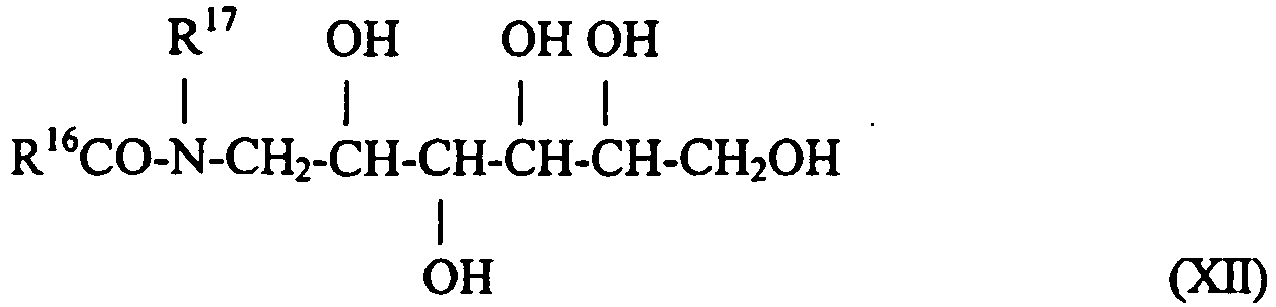
Claims (16)
- Verfahren zur Verbesserung der Farbstabilität der Färbung von Keratinfasern, dadurch gekennzeichnet, dassa) die Keratinfaser einem Färbevorgang unter Verwendung eines Oxidationsfärbemittels, enthaltend als Oxidationsfarbstoffvorprodukt mindestens ein Oxidationsfarbstoffvorprodukt (B) vom Entwicklertyp (B1) und zusätzlich Oxidationsfarbstoffvorprodukte vom Kupplertyp (B2), unterworfen wird undb) nach dem Färbevorgang ein Haarbehandlungsmittel, enthaltend mindestens eine Carbonylverbindung A, welche kein Derivat des Anthrachinons ist und ausgewählt ist aus aromatischen oder heteroaromatischen Carbonylverbindungen (A1) und zyklischen aliphatischen Carbonylverbindungen (A2), auf die Fasern aufgebracht undc) nach einer Einwirkzeit von 2 - 45 Minutend) von den Fasern abgespült wird,
mit der Massgabe, dass die Carbonylverbindungen (A1) und (A2) als gemeinsames Strukturmerkmal ein konjugiertes System darstellen, in welchem die Doppelbindung einer Carbonylgruppe mit mindestens einer weiteren Doppelbindung in Konjugation steht. - Verfahren nach Anspruch 1, dadurch gekennzeichnet, dass die Carbonylverbindung A in einer Menge von 0,01 bis 20 mmol, bezogen auf 100 g des gesamten Haarbehandlungsmittels, enthalten ist.
- Verfahren nach einem der Ansprüche 1 oder 2, dadurch gekennzeichnet, dass die Carbonylverbindung A in einer Menge von 1 bis 8 mmol, bezogen auf 100 g des gesamten Haarbehandlungsmittels, enthalten ist.
- Verfahren nach einem der Ansprüche 1 bis 3, dadurch gekennzeichnet, dass die Carbonylverbindung A ausgewählt ist aus 1,2-Naphthochinon, Isophthalaldehyd, Terephthalaldehyd, 3-Dicyanmethylen-indan-1-on, Coniferylaldehyd, Isatin, N-Allylisatin, 4-Nitroisatin, 5-Nitroisatin, 6-Nitroisatin, 7-Nitroisatin, 1-Methylindol-3-aldehyd, 2,3,5,6-Tetraoxo-2,3,5,6-tetrahydropyrrolo[3,2-g]indol, 4-Dimethylaminozimtaldehyd, 2-Nitrobenzaldehyd, 3-Nitrobenzaldehyd, 4-Nitrobenzaldehyd, 3-Indolylglyoxylsäure, 2,5-Dihydroxy-p-benzochinon, 9,10-Phenanthrenchinon, Acenaphthenchinon, 2,2'-Pyridil und 3,5,5-Trimethylcyclohex-5-en-1,2,4-trion, 1,2-Naphthochinon-4-sulfonsäure-, 2-Formyl-1-methylchinolinium-, 4-Formyl-1-methyl-chinolinium- und 4-(3-Oxo-2-indolinylidenmethyl)-1-methylpyridinium-Salze, mit der Maßgabe, dass für den Fall, dass die Verbindungen als Salz vorliegen, die Gegenionen im Falle von Kationen ausgewählt sind aus Alkali-, Erdalkalimetallkationen und Ammoniumkationen und im Falle von Anionen ausgewählt sind aus Chlorid, Bromid, Iodid, Hexafluorophosphat, Tetrachlorozinkat, Tetrafluoroborat, Trifluormethylsulfonat, Methylsulfonat und p-Toluolsulfonat.
- Verfahren nach der Anspruch 4, dadurch gekennzeichnet, dass die Carbonylverbindung A ausgewählt ist aus 1,2-Naphthochinon, 1-Formyl-1-methylchinolinium-p-toluolsulfonat, 4-Formyl-1-methylchinolinium-p-toluolsulfonat, 4-(3-Oxo-2-indolinylidenmethyl)-1-methylpyridiniumiodid, 3-Dicyanmethylen-indan-1-on, Coniferylaldehyd, N-Allylisatin und Alkali-, Erdalkali- und Ammonium-Salzen der 1,2-Naphthochinon-4-sulfonsäure.
- Verfahren nach einem der Ansprüche 1 bis 5, dadurch gekennzeichnet, dass das Haarbehandlungsmittel zusätzlich mindestens ein Polymer (G) enthält.
- Verfahren nach einem der Ansprüche 1 bis 6, dadurch gekennzeichnet, dass das Haarbehandlungsmittel zusätzlich mindestens ein Tensid (E) enthält.
- Verfahren nach einem der Ansprüche 1 bis 7, dadurch gekennzeichnet, dass das Haarbehandlungsmittel zusätzlich mindestens einen Fettstoff (D) enthält.
- Verfahren nach einem der Ansprüche 1 bis 8, dadurch gekennzeichnet, dass das Haarbehandlungsmittel zusätzlich Proteinhydrolysate und/oder deren Derivate (H) enthält.
- Verfahren nach einem der Ansprüche 1 bis 9, dadurch gekennzeichnet, dass das Haarbehandlungsmittel zusätzlich mindestens einen UV-Filter (J) enthält.
- Verfahren nach einem der Ansprüche 1 bis 10, dadurch gekennzeichnet, dass das Haarbehandlungsmittel zusätzlich mindestens einen direktziehenden Farbstoff (C) enthält.
- Verfahren nach einem der Ansprüche 1 bis 11, dadurch gekennzeichnet, dass das Haarbehandlungsmittel keine Oxidationsfarbstoffvorprodukte (B) enthält.
- Verfahren nach einem der Ansprüche 1 bis 12, dadurch gekennzeichnet, dass die Einwirkzeit des Haarbehandlungsmittels 2 bis 45 Minuten beträgt.
- Verfahren nach einem der Ansprüche 1 bis 13, dadurch gekennzeichnet, dass die Einwirkzeit des Haarbehandlungsmittels 5 bis 15 Minuten beträgt.
- Verfahren nach Anspruch 14, dadurch gekennzeichnet, dass zwischen den Verfahrensschritten a) und b) das Färbemittel von den Fasern abgespült wird und die Fasern daraufhin gegebenenfalls getrocknet werden.
- Verfahren nach Anspruch 15, dadurch gekennzeichnet, dass zwischen dem Verfahrensschritt a) und dem Verfahrensschritt b) ein Zeitraum von einigen Minuten bis mehreren Tagen liegt.
Applications Claiming Priority (3)
| Application Number | Priority Date | Filing Date | Title |
|---|---|---|---|
| DE10148671 | 2001-10-02 | ||
| DE2001148671 DE10148671A1 (de) | 2001-10-02 | 2001-10-02 | Verfahren zum Färben von Keratinfasern unter Verwendung von Carbonylverbindungen zur Verbesserung der Farbstabilität von Haarfärbungen |
| PCT/EP2002/010957 WO2003030848A1 (de) | 2001-10-02 | 2002-09-30 | Verfahren zum färben von keratinfasern unter verwendung von carbonylverbindungen zur verbesserung der farbstabilität von haarfärbungen |
Publications (2)
| Publication Number | Publication Date |
|---|---|
| EP1432395A1 EP1432395A1 (de) | 2004-06-30 |
| EP1432395B1 true EP1432395B1 (de) | 2012-08-08 |
Family
ID=7701175
Family Applications (1)
| Application Number | Title | Priority Date | Filing Date |
|---|---|---|---|
| EP02800586A Expired - Lifetime EP1432395B1 (de) | 2001-10-02 | 2002-09-30 | Verfahren zum färben von keratinfasern unter verwendung von carbonylverbindungen zur verbesserung der farbstabilität von haarfärbungen |
Country Status (3)
| Country | Link |
|---|---|
| EP (1) | EP1432395B1 (de) |
| DE (1) | DE10148671A1 (de) |
| WO (1) | WO2003030848A1 (de) |
Families Citing this family (45)
| Publication number | Priority date | Publication date | Assignee | Title |
|---|---|---|---|---|
| DE10148849A1 (de) * | 2001-10-04 | 2003-04-17 | Henkel Kgaa | Mittel zum Färben von keratinhaltigen Fasern |
| DE10229420A1 (de) * | 2002-06-29 | 2004-01-29 | Henkel Kgaa | Verfahren zur schonenden oxidativen Färbung von Haaren |
| DE50306682D1 (de) * | 2002-08-30 | 2007-04-12 | Henkel Kgaa | Synergistische kombination von seidenproteinen |
| DE10260880A1 (de) * | 2002-12-23 | 2004-07-01 | Henkel Kgaa | Färbetablette |
| US7371264B2 (en) | 2004-08-26 | 2008-05-13 | The Procter & Gamble Company | Keratin dyeing compounds, keratin dyeing compositions containing them, and use thereof |
| US7276089B2 (en) * | 2004-08-26 | 2007-10-02 | The Procter & Gamble Company | Keratin dyeing compounds, keratin dyeing compositions containing them, and use thereof |
| BRPI0514529A (pt) * | 2004-08-26 | 2008-06-10 | Procter & Gamble | compostos para tingimento de queratina, composições para tingimento de queratina que contêm estes compostos e uso destas composições |
| US7288123B2 (en) | 2004-08-26 | 2007-10-30 | The Procter & Gamble Company | Keratin dyeing compounds, keratin dyeing compositions containing them, and use thereof |
| US7399317B2 (en) * | 2004-08-26 | 2008-07-15 | The Procter & Gamble Company | Keratin dyeing compounds, keratin dyeing compositions containing them, and use thereof |
| US7341606B2 (en) | 2005-08-23 | 2008-03-11 | The Procter & Gamble Company | Keratin dyeing compounds, keratin dyeing compositions containing them, and use thereof |
| FR2915376B1 (fr) | 2007-04-30 | 2011-06-24 | Oreal | Utilisation d'un agent de couplage multi-carbo sites multi-groupements pour proteger la couleur vis-a-vis du lavage de fibres keratiniques teintes artificiellement; procedes de coloration |
| FR2925323B1 (fr) | 2007-12-21 | 2009-12-18 | Oreal | Procede de coloration en presence d'un agent oxydant et d'une amine organique particuliere et dispositif |
| FR2925311B1 (fr) | 2007-12-21 | 2009-12-18 | Oreal | Procede d'eclaircissement de fibres keratiniques humaines mettant en oeuvre une composition anhydre et une amine organique particuliere et dispositif approprie |
| FR2925307B1 (fr) | 2007-12-21 | 2009-12-18 | Oreal | Procede de coloration directe eclaircissante ou d'oxydation en presence d'une amine organique particuliere et dispositif |
| EP2329809A4 (de) * | 2008-08-19 | 2015-04-15 | Kao Corp | Haarfärbezusammensetzung |
| FR2940092B1 (fr) | 2008-12-19 | 2011-02-18 | Oreal | Composition de teinture d'oxydation des fibres keratiniques comprenant un corps gras amide ou ester |
| FR2940101B1 (fr) | 2008-12-19 | 2011-02-18 | Oreal | Composition de teinture d'oxydation de fibres keratiniques comprenant un corps gras et un derive 4,5-diaminopyrazole |
| FR2940107B1 (fr) | 2008-12-19 | 2011-03-18 | Oreal | Procede d'eclaircissement de matieres keratiniques mettant en oeuvre une emulsion comprenant un agent alcalin et une composition oxydante |
| FR2940103B1 (fr) | 2008-12-19 | 2011-06-10 | Oreal | Procede de coloration eclaircissante de matieres keratiniques mettant en oeuvre une emulsion comprenant un colorant et un agent alcalin et une composition oxydante |
| FR2940061B1 (fr) | 2008-12-19 | 2011-03-04 | Oreal | Composition de teinture d'oxydation des fibres keratiniques comprenant un corps gras et un derive de diaminopyrazolone. |
| FR2940100B1 (fr) | 2008-12-19 | 2011-02-18 | Oreal | Composition de teinture d'oxydation des fibres keratiniques comprenant un corps gras et la n,n bis (beta-hydroxyethyl)-paraphenylene diamine |
| BRPI0907287B1 (pt) * | 2008-12-19 | 2018-01-02 | L'oréal | "processo de clareamento ou de coloração das fibras queratínicas e dispositivo com vários comportamentos" |
| FR2940083B1 (fr) * | 2008-12-19 | 2013-04-26 | Oreal | Procede de coloration directe eclaircissante ou d'oxydation en presence d'une composition aqueuse riche en corps gras et dispositif |
| FR2940082B1 (fr) * | 2008-12-19 | 2013-10-11 | Oreal | Procede de coloration directe eclaircissante ou d'oxydation en presence d'une base inorganique et dispositif |
| FR2940108B1 (fr) | 2008-12-19 | 2011-04-29 | Oreal | Procede d'eclaircissement de matieres keratiniques mettant en oeuvre une composition anhydre comprenant un agent alcalin et une composition oxydante |
| FR2940055B1 (fr) | 2008-12-19 | 2015-03-27 | Oreal | Composition de teinture d'oxydation des fibres keratiniques comprenant le para-aminophenol, du dipropyleneglycol, et un precurseur de colorant additionnel. |
| JP5808077B2 (ja) | 2008-12-19 | 2015-11-10 | ロレアル | 無機塩基の存在下で着色または明色化する方法及びキット |
| EP2198834B1 (de) | 2008-12-19 | 2015-03-18 | L'Oréal | Aufhellungsverfahren für menschliche Keratinfasern durch Einsatz einer wasserfreien Zusammensetzung und einer basischen Mischung aus Monoethanolamin und Aminsäure, sowie geeignete Vorrichtung |
| FR2940077B1 (fr) | 2008-12-19 | 2012-07-20 | Oreal | Procede de coloration eclaircissante de matieres keratiniques mettant en oeuvre une composition anhydre colorante comprenant un agent alcalin et une composition oxydante. |
| FR2940078B1 (fr) | 2008-12-19 | 2011-05-13 | Oreal | Composition comprenant un corps gras et un polymere cationique, procede de coloration la mettant en oeuvre et dispositifs |
| FR2940090B1 (fr) | 2008-12-19 | 2011-02-25 | Oreal | Composition oxydante pour le traitement des fibres keratiniques comprenant une huile, un alcool gras et un alcool gras oxyalkylene |
| EP2198832B1 (de) | 2008-12-19 | 2017-01-25 | L'Oréal | Verfahren zur Aufhellung der menschlichen keratinischen Fasern mit einer wasserfreien Zubereitung und kit |
| FR2940105B1 (fr) | 2008-12-19 | 2011-04-08 | Oreal | Composition comprenant un corps gras et un tensioactif oxyethylene particulier, procede de coloration la mettant en oeuvre et dispositifs |
| JP5815205B2 (ja) | 2008-12-19 | 2015-11-17 | ロレアル | 有機アミン及び無機塩基の存在下で、淡色化し、あるいは淡色化直接染色し、あるいは酸化染色する方法、及びそのためのデバイス |
| FR2940079B1 (fr) | 2008-12-19 | 2011-02-18 | Oreal | Composition comprenant au moins un alcool gras solide, procede de coloration la mettant en oeuvre et dispositifs |
| EP2198843B1 (de) | 2008-12-19 | 2017-09-13 | L'Oréal | Aufhellung der menschlichen keratinischen Fasern mit einer wasserfreien Zubereitung enthaltend die Kombination aus Monoethanolamine und alkalischen Aminosäure und Kit. |
| FR2940104B1 (fr) | 2008-12-19 | 2011-08-19 | Oreal | Procede de traitement des cheveux mettant en oeuvre une emulsion directe comprenant un agent oxydant et une composition contenant un agent alcalin |
| FR2940102B1 (fr) | 2008-12-19 | 2016-03-11 | Oreal | Composition de teinture d'oxydation des fibres keratiniques comprenant un corps gras, un epaississant et un precurseur de colorant d'oxydation |
| FR2940106B1 (fr) | 2008-12-19 | 2013-04-12 | Oreal | Composition comprenant un corps gras et un silicate, procede de coloration la mettant en oeuvre et dispositifs |
| FR2940067B1 (fr) | 2008-12-19 | 2011-02-25 | Oreal | Composition oxydante pour le traitement des fibres keratiniques comprenant un polymere cationique, un amide gras et un agent-oxygene |
| FR2954160B1 (fr) | 2009-12-22 | 2012-03-30 | Oreal | Composition de coloration ou d'eclaircissement comprenant un corps gras et un polymere amphotere |
| FR2954159B1 (fr) | 2009-12-22 | 2012-02-10 | Oreal | Agent de coloration et/ou de decoloration des fibres keratiniques comprenant une composition comprenant un agent alcalinisant et une composition anhydre comprenant un oxydant, l'une ou l'autre des compositions pouvant contenir un corps gras |
| FR2954127B1 (fr) | 2009-12-22 | 2015-10-30 | Oreal | Agent de coloration et/ou de decoloration des fibres keratiniques en deux parties, comprenant un corps gras et un agent sequestrant. |
| FR2954121B1 (fr) | 2009-12-22 | 2016-03-25 | Oreal | Agent de coloration et/ou de decoloration des fibres keratiniques en deux parties, comprenant un corps gras particulier et une reductone. |
| FR2971158B1 (fr) * | 2010-06-18 | 2015-01-09 | Oreal | Procede d'eclaircissement ou de coloration en presence de (bi)carbonate d'ammonium et d'une base minerale, dispositif |
Family Cites Families (9)
| Publication number | Priority date | Publication date | Assignee | Title |
|---|---|---|---|---|
| US3871818A (en) * | 1972-10-30 | 1975-03-18 | Avon Prod Inc | Promoting color change in human hair with a dialdehyde compound and a nitrogen containing compound |
| FR2421607A1 (fr) * | 1978-04-06 | 1979-11-02 | Oreal | Procede de teinture des fibres keratiniques en deux temps par variation de ph |
| DE3829102C1 (de) * | 1988-08-27 | 1989-08-10 | Rudolf 7000 Stuttgart De Bauer | |
| LU87403A1 (fr) * | 1988-12-06 | 1990-07-10 | Oreal | Procede de teinture de fibres keratiniques avec un hydroxyindole,associe a un derive quinonique |
| FR2649887B1 (fr) * | 1989-07-21 | 1994-07-08 | Oreal | Procede de coloration mettant en oeuvre des colorants indoliques et des precurseurs de colorants d'oxydation et agents de teinture mis en oeuvre |
| FR2672211B1 (fr) * | 1991-02-04 | 1993-05-21 | Oreal | Procede de teinture des fibres keratiniques avec un mono- ou dihydroxyindole et un derive carbonyle aromatique non-oxydant et agent de teinture. |
| DE19717224A1 (de) | 1997-04-24 | 1998-10-29 | Henkel Kgaa | Verwendung von ungesättigten Aldehyden zum Färben von keratinhaltigen Fasern |
| DE19941450A1 (de) * | 1999-08-31 | 2001-03-01 | Schwarzkopf Gmbh Hans | Haarfärbeverfahren |
| DE10048922A1 (de) * | 2000-10-04 | 2002-04-11 | Henkel Kgaa | Neue Verwendung von kurzkettigen Aldehyden und Formaldehyd abspaltenden Verbindungen |
-
2001
- 2001-10-02 DE DE2001148671 patent/DE10148671A1/de not_active Withdrawn
-
2002
- 2002-09-30 WO PCT/EP2002/010957 patent/WO2003030848A1/de not_active Ceased
- 2002-09-30 EP EP02800586A patent/EP1432395B1/de not_active Expired - Lifetime
Also Published As
| Publication number | Publication date |
|---|---|
| DE10148671A1 (de) | 2003-04-10 |
| EP1432395A1 (de) | 2004-06-30 |
| WO2003030848A1 (de) | 2003-04-17 |
Similar Documents
| Publication | Publication Date | Title |
|---|---|---|
| EP1326579B1 (de) | Neue verwendung von kurzkettigen carbonsäuren | |
| EP1326577B2 (de) | Neue verwendung von kurzkettigen carbonsäuren | |
| DE10148671A1 (de) | Verfahren zum Färben von Keratinfasern unter Verwendung von Carbonylverbindungen zur Verbesserung der Farbstabilität von Haarfärbungen | |
| EP1531853B2 (de) | Synergistische kombination von seidenproteinen | |
| DE10240757A1 (de) | Synergistische Kombination von Seidenproteinen | |
| EP1729853B1 (de) | Verwendung kationischer stärkederivate zum farberhalt | |
| EP1339379B1 (de) | Neue verwendung von proteinhydrolysaten | |
| DE10107216A1 (de) | Wirkstoffkombination aus Kohlenwasserstoffen und Ölen in kosmetischen Mitteln | |
| DE10048922A1 (de) | Neue Verwendung von kurzkettigen Aldehyden und Formaldehyd abspaltenden Verbindungen | |
| EP1771144B1 (de) | Haarkonditionierende mittel mit aminofunktionellen siliconen | |
| EP1761232B2 (de) | Haarreinigungsmittel mit aminofunktionellen siliconen | |
| DE10061420A1 (de) | Neue Verwendung von Polyhydroxyverbindungen | |
| EP1321124A2 (de) | Verwendung von ausgewählten kurzkettigen Carbonsäuren | |
| EP1707242B1 (de) | Oxidationsfärbemittel mit 1,5- und/oder 2,7-Dihydroxynaphtalin und mindestens einem weiteren Kuppler | |
| EP1696870A1 (de) | T nungsmittel in tuben | |
| DE10060814A1 (de) | Neue Verwendung von Phospholipiden | |
| EP1669108B1 (de) | Geruchsreduzierendes Haarbehandlungsmittel | |
| DE102004041572A1 (de) | Extrakte als Strukturanten | |
| DE102004024511A1 (de) | Verwendung von Polysulfiden zur Farbstabilisierung | |
| WO2006032321A1 (de) | Pflegende haarbehandlungsmittel mit polyvinylalkohol | |
| EP1786385A1 (de) | Pflegendes haarfärbemittel |
Legal Events
| Date | Code | Title | Description |
|---|---|---|---|
| PUAI | Public reference made under article 153(3) epc to a published international application that has entered the european phase |
Free format text: ORIGINAL CODE: 0009012 |
|
| 17P | Request for examination filed |
Effective date: 20040326 |
|
| AK | Designated contracting states |
Kind code of ref document: A1 Designated state(s): AT BE BG CH CY CZ DE DK EE ES FI FR GB GR IE IT LI LU MC NL PT SE SK TR |
|
| 17Q | First examination report despatched |
Effective date: 20070130 |
|
| RAP1 | Party data changed (applicant data changed or rights of an application transferred) |
Owner name: HENKEL AG & CO. KGAA |
|
| REG | Reference to a national code |
Ref country code: DE Ref legal event code: R079 Ref document number: 50215556 Country of ref document: DE Free format text: PREVIOUS MAIN CLASS: A61K0007130000 Ipc: A61Q0005100000 |
|
| GRAP | Despatch of communication of intention to grant a patent |
Free format text: ORIGINAL CODE: EPIDOSNIGR1 |
|
| RIC1 | Information provided on ipc code assigned before grant |
Ipc: A61Q 5/10 20060101AFI20120206BHEP Ipc: A61K 8/35 20060101ALI20120206BHEP Ipc: A61K 8/49 20060101ALI20120206BHEP Ipc: A61K 8/34 20060101ALI20120206BHEP Ipc: A61K 8/33 20060101ALI20120206BHEP Ipc: A61K 8/46 20060101ALI20120206BHEP |
|
| GRAS | Grant fee paid |
Free format text: ORIGINAL CODE: EPIDOSNIGR3 |
|
| GRAA | (expected) grant |
Free format text: ORIGINAL CODE: 0009210 |
|
| AK | Designated contracting states |
Kind code of ref document: B1 Designated state(s): AT BE BG CH CY CZ DE DK EE ES FI FR GB GR IE IT LI LU MC NL PT SE SK TR |
|
| REG | Reference to a national code |
Ref country code: GB Ref legal event code: FG4D Free format text: NOT ENGLISH |
|
| REG | Reference to a national code |
Ref country code: CH Ref legal event code: EP Ref country code: AT Ref legal event code: REF Ref document number: 569430 Country of ref document: AT Kind code of ref document: T Effective date: 20120815 |
|
| REG | Reference to a national code |
Ref country code: IE Ref legal event code: FG4D Free format text: LANGUAGE OF EP DOCUMENT: GERMAN |
|
| REG | Reference to a national code |
Ref country code: DE Ref legal event code: R096 Ref document number: 50215556 Country of ref document: DE Effective date: 20121011 |
|
| REG | Reference to a national code |
Ref country code: NL Ref legal event code: VDEP Effective date: 20120808 |
|
| PG25 | Lapsed in a contracting state [announced via postgrant information from national office to epo] |
Ref country code: CY Free format text: LAPSE BECAUSE OF FAILURE TO SUBMIT A TRANSLATION OF THE DESCRIPTION OR TO PAY THE FEE WITHIN THE PRESCRIBED TIME-LIMIT Effective date: 20120808 Ref country code: FI Free format text: LAPSE BECAUSE OF FAILURE TO SUBMIT A TRANSLATION OF THE DESCRIPTION OR TO PAY THE FEE WITHIN THE PRESCRIBED TIME-LIMIT Effective date: 20120808 |
|
| PG25 | Lapsed in a contracting state [announced via postgrant information from national office to epo] |
Ref country code: PT Free format text: LAPSE BECAUSE OF FAILURE TO SUBMIT A TRANSLATION OF THE DESCRIPTION OR TO PAY THE FEE WITHIN THE PRESCRIBED TIME-LIMIT Effective date: 20121210 Ref country code: GR Free format text: LAPSE BECAUSE OF FAILURE TO SUBMIT A TRANSLATION OF THE DESCRIPTION OR TO PAY THE FEE WITHIN THE PRESCRIBED TIME-LIMIT Effective date: 20121109 Ref country code: SE Free format text: LAPSE BECAUSE OF FAILURE TO SUBMIT A TRANSLATION OF THE DESCRIPTION OR TO PAY THE FEE WITHIN THE PRESCRIBED TIME-LIMIT Effective date: 20120808 |
|
| PG25 | Lapsed in a contracting state [announced via postgrant information from national office to epo] |
Ref country code: NL Free format text: LAPSE BECAUSE OF FAILURE TO SUBMIT A TRANSLATION OF THE DESCRIPTION OR TO PAY THE FEE WITHIN THE PRESCRIBED TIME-LIMIT Effective date: 20120808 |
|
| BERE | Be: lapsed |
Owner name: HENKEL A.G. & CO. KGAA Effective date: 20120930 |
|
| PG25 | Lapsed in a contracting state [announced via postgrant information from national office to epo] |
Ref country code: MC Free format text: LAPSE BECAUSE OF NON-PAYMENT OF DUE FEES Effective date: 20120930 Ref country code: CZ Free format text: LAPSE BECAUSE OF FAILURE TO SUBMIT A TRANSLATION OF THE DESCRIPTION OR TO PAY THE FEE WITHIN THE PRESCRIBED TIME-LIMIT Effective date: 20120808 Ref country code: DK Free format text: LAPSE BECAUSE OF FAILURE TO SUBMIT A TRANSLATION OF THE DESCRIPTION OR TO PAY THE FEE WITHIN THE PRESCRIBED TIME-LIMIT Effective date: 20120808 Ref country code: ES Free format text: LAPSE BECAUSE OF FAILURE TO SUBMIT A TRANSLATION OF THE DESCRIPTION OR TO PAY THE FEE WITHIN THE PRESCRIBED TIME-LIMIT Effective date: 20121119 Ref country code: EE Free format text: LAPSE BECAUSE OF FAILURE TO SUBMIT A TRANSLATION OF THE DESCRIPTION OR TO PAY THE FEE WITHIN THE PRESCRIBED TIME-LIMIT Effective date: 20120808 |
|
| PG25 | Lapsed in a contracting state [announced via postgrant information from national office to epo] |
Ref country code: IT Free format text: LAPSE BECAUSE OF FAILURE TO SUBMIT A TRANSLATION OF THE DESCRIPTION OR TO PAY THE FEE WITHIN THE PRESCRIBED TIME-LIMIT Effective date: 20120808 Ref country code: SK Free format text: LAPSE BECAUSE OF FAILURE TO SUBMIT A TRANSLATION OF THE DESCRIPTION OR TO PAY THE FEE WITHIN THE PRESCRIBED TIME-LIMIT Effective date: 20120808 |
|
| PLBE | No opposition filed within time limit |
Free format text: ORIGINAL CODE: 0009261 |
|
| STAA | Information on the status of an ep patent application or granted ep patent |
Free format text: STATUS: NO OPPOSITION FILED WITHIN TIME LIMIT |
|
| REG | Reference to a national code |
Ref country code: IE Ref legal event code: MM4A |
|
| 26N | No opposition filed |
Effective date: 20130510 |
|
| PG25 | Lapsed in a contracting state [announced via postgrant information from national office to epo] |
Ref country code: BE Free format text: LAPSE BECAUSE OF NON-PAYMENT OF DUE FEES Effective date: 20120930 Ref country code: BG Free format text: LAPSE BECAUSE OF FAILURE TO SUBMIT A TRANSLATION OF THE DESCRIPTION OR TO PAY THE FEE WITHIN THE PRESCRIBED TIME-LIMIT Effective date: 20121108 Ref country code: IE Free format text: LAPSE BECAUSE OF NON-PAYMENT OF DUE FEES Effective date: 20120930 |
|
| REG | Reference to a national code |
Ref country code: DE Ref legal event code: R097 Ref document number: 50215556 Country of ref document: DE Effective date: 20130510 |
|
| PGFP | Annual fee paid to national office [announced via postgrant information from national office to epo] |
Ref country code: DE Payment date: 20130925 Year of fee payment: 12 Ref country code: CH Payment date: 20130912 Year of fee payment: 12 Ref country code: AT Payment date: 20130828 Year of fee payment: 12 |
|
| PGFP | Annual fee paid to national office [announced via postgrant information from national office to epo] |
Ref country code: GB Payment date: 20130925 Year of fee payment: 12 Ref country code: FR Payment date: 20130910 Year of fee payment: 12 |
|
| PG25 | Lapsed in a contracting state [announced via postgrant information from national office to epo] |
Ref country code: TR Free format text: LAPSE BECAUSE OF FAILURE TO SUBMIT A TRANSLATION OF THE DESCRIPTION OR TO PAY THE FEE WITHIN THE PRESCRIBED TIME-LIMIT Effective date: 20120808 |
|
| PG25 | Lapsed in a contracting state [announced via postgrant information from national office to epo] |
Ref country code: LU Free format text: LAPSE BECAUSE OF NON-PAYMENT OF DUE FEES Effective date: 20120930 |
|
| REG | Reference to a national code |
Ref country code: DE Ref legal event code: R119 Ref document number: 50215556 Country of ref document: DE |
|
| REG | Reference to a national code |
Ref country code: CH Ref legal event code: PL |
|
| REG | Reference to a national code |
Ref country code: AT Ref legal event code: MM01 Ref document number: 569430 Country of ref document: AT Kind code of ref document: T Effective date: 20140930 |
|
| GBPC | Gb: european patent ceased through non-payment of renewal fee |
Effective date: 20140930 |
|
| REG | Reference to a national code |
Ref country code: DE Ref legal event code: R119 Ref document number: 50215556 Country of ref document: DE Effective date: 20150401 |
|
| REG | Reference to a national code |
Ref country code: FR Ref legal event code: ST Effective date: 20150529 |
|
| PG25 | Lapsed in a contracting state [announced via postgrant information from national office to epo] |
Ref country code: DE Free format text: LAPSE BECAUSE OF NON-PAYMENT OF DUE FEES Effective date: 20150401 Ref country code: CH Free format text: LAPSE BECAUSE OF NON-PAYMENT OF DUE FEES Effective date: 20140930 Ref country code: LI Free format text: LAPSE BECAUSE OF NON-PAYMENT OF DUE FEES Effective date: 20140930 Ref country code: GB Free format text: LAPSE BECAUSE OF NON-PAYMENT OF DUE FEES Effective date: 20140930 |
|
| PG25 | Lapsed in a contracting state [announced via postgrant information from national office to epo] |
Ref country code: FR Free format text: LAPSE BECAUSE OF NON-PAYMENT OF DUE FEES Effective date: 20140930 Ref country code: AT Free format text: LAPSE BECAUSE OF NON-PAYMENT OF DUE FEES Effective date: 20140930 |