EP1432746B1 - Deodorantien und antiperspirantien - Google Patents
Deodorantien und antiperspirantien Download PDFInfo
- Publication number
- EP1432746B1 EP1432746B1 EP01989525A EP01989525A EP1432746B1 EP 1432746 B1 EP1432746 B1 EP 1432746B1 EP 01989525 A EP01989525 A EP 01989525A EP 01989525 A EP01989525 A EP 01989525A EP 1432746 B1 EP1432746 B1 EP 1432746B1
- Authority
- EP
- European Patent Office
- Prior art keywords
- antiperspirant
- deodorant
- acid
- amps
- copolymers
- Prior art date
- Legal status (The legal status is an assumption and is not a legal conclusion. Google has not performed a legal analysis and makes no representation as to the accuracy of the status listed.)
- Expired - Lifetime
Links
- 239000003213 antiperspirant Substances 0.000 title claims abstract description 31
- 239000002781 deodorant agent Substances 0.000 title claims abstract description 31
- 230000001166 anti-perspirative effect Effects 0.000 title claims abstract description 30
- 229920001577 copolymer Polymers 0.000 claims abstract description 57
- 239000000654 additive Substances 0.000 claims abstract description 23
- 229910052731 fluorine Inorganic materials 0.000 claims abstract description 16
- 239000011737 fluorine Substances 0.000 claims abstract description 16
- 125000002091 cationic group Chemical group 0.000 claims abstract description 13
- 229910052710 silicon Inorganic materials 0.000 claims abstract description 13
- 239000010703 silicon Substances 0.000 claims abstract description 13
- XHZPRMZZQOIPDS-UHFFFAOYSA-N 2-Methyl-2-[(1-oxo-2-propenyl)amino]-1-propanesulfonic acid Chemical compound OS(=O)(=O)CC(C)(C)NC(=O)C=C XHZPRMZZQOIPDS-UHFFFAOYSA-N 0.000 claims abstract description 12
- 230000000996 additive effect Effects 0.000 claims abstract description 11
- IRLPACMLTUPBCL-KQYNXXCUSA-N 5'-adenylyl sulfate Chemical compound C1=NC=2C(N)=NC=NC=2N1[C@@H]1O[C@H](COP(O)(=O)OS(O)(=O)=O)[C@@H](O)[C@H]1O IRLPACMLTUPBCL-KQYNXXCUSA-N 0.000 claims description 71
- -1 methylvinyl Chemical group 0.000 claims description 53
- PEDCQBHIVMGVHV-UHFFFAOYSA-N Glycerine Chemical compound OCC(O)CO PEDCQBHIVMGVHV-UHFFFAOYSA-N 0.000 claims description 31
- 239000000203 mixture Substances 0.000 claims description 31
- XLYOFNOQVPJJNP-UHFFFAOYSA-N water Substances O XLYOFNOQVPJJNP-UHFFFAOYSA-N 0.000 claims description 26
- 150000002148 esters Chemical class 0.000 claims description 25
- 150000001875 compounds Chemical class 0.000 claims description 19
- 238000007334 copolymerization reaction Methods 0.000 claims description 18
- 150000003839 salts Chemical class 0.000 claims description 18
- 239000000126 substance Substances 0.000 claims description 17
- DKGAVHZHDRPRBM-UHFFFAOYSA-N Tert-Butanol Chemical compound CC(C)(C)O DKGAVHZHDRPRBM-UHFFFAOYSA-N 0.000 claims description 16
- NIXOWILDQLNWCW-UHFFFAOYSA-N 2-Propenoic acid Natural products OC(=O)C=C NIXOWILDQLNWCW-UHFFFAOYSA-N 0.000 claims description 15
- YCKRFDGAMUMZLT-UHFFFAOYSA-N Fluorine atom Chemical compound [F] YCKRFDGAMUMZLT-UHFFFAOYSA-N 0.000 claims description 15
- IJGRMHOSHXDMSA-UHFFFAOYSA-N Atomic nitrogen Chemical compound N#N IJGRMHOSHXDMSA-UHFFFAOYSA-N 0.000 claims description 14
- NJSSICCENMLTKO-HRCBOCMUSA-N [(1r,2s,4r,5r)-3-hydroxy-4-(4-methylphenyl)sulfonyloxy-6,8-dioxabicyclo[3.2.1]octan-2-yl] 4-methylbenzenesulfonate Chemical compound C1=CC(C)=CC=C1S(=O)(=O)O[C@H]1C(O)[C@@H](OS(=O)(=O)C=2C=CC(C)=CC=2)[C@@H]2OC[C@H]1O2 NJSSICCENMLTKO-HRCBOCMUSA-N 0.000 claims description 14
- WHNWPMSKXPGLAX-UHFFFAOYSA-N N-Vinyl-2-pyrrolidone Chemical compound C=CN1CCCC1=O WHNWPMSKXPGLAX-UHFFFAOYSA-N 0.000 claims description 13
- XUIMIQQOPSSXEZ-UHFFFAOYSA-N Silicon Chemical compound [Si] XUIMIQQOPSSXEZ-UHFFFAOYSA-N 0.000 claims description 12
- 125000004432 carbon atom Chemical group C* 0.000 claims description 12
- 238000009826 distribution Methods 0.000 claims description 11
- ZQXSMRAEXCEDJD-UHFFFAOYSA-N n-ethenylformamide Chemical compound C=CNC=O ZQXSMRAEXCEDJD-UHFFFAOYSA-N 0.000 claims description 11
- IAYPIBMASNFSPL-UHFFFAOYSA-N Ethylene oxide Chemical compound C1CO1 IAYPIBMASNFSPL-UHFFFAOYSA-N 0.000 claims description 10
- 125000003903 2-propenyl group Chemical group [H]C([*])([H])C([H])=C([H])[H] 0.000 claims description 9
- SMZOUWXMTYCWNB-UHFFFAOYSA-N 2-(2-methoxy-5-methylphenyl)ethanamine Chemical compound COC1=CC=C(C)C=C1CCN SMZOUWXMTYCWNB-UHFFFAOYSA-N 0.000 claims description 8
- HRPVXLWXLXDGHG-UHFFFAOYSA-N Acrylamide Chemical compound NC(=O)C=C HRPVXLWXLXDGHG-UHFFFAOYSA-N 0.000 claims description 8
- CERQOIWHTDAKMF-UHFFFAOYSA-N Methacrylic acid Chemical compound CC(=C)C(O)=O CERQOIWHTDAKMF-UHFFFAOYSA-N 0.000 claims description 8
- PPBRXRYQALVLMV-UHFFFAOYSA-N Styrene Chemical class C=CC1=CC=CC=C1 PPBRXRYQALVLMV-UHFFFAOYSA-N 0.000 claims description 8
- 150000001735 carboxylic acids Chemical class 0.000 claims description 8
- GOOHAUXETOMSMM-UHFFFAOYSA-N Propylene oxide Chemical compound CC1CO1 GOOHAUXETOMSMM-UHFFFAOYSA-N 0.000 claims description 7
- 125000001931 aliphatic group Chemical group 0.000 claims description 7
- 229930195733 hydrocarbon Natural products 0.000 claims description 7
- 125000005394 methallyl group Chemical group 0.000 claims description 7
- 125000002496 methyl group Chemical group [H]C([H])([H])* 0.000 claims description 7
- 229910052757 nitrogen Inorganic materials 0.000 claims description 7
- 125000004437 phosphorous atom Chemical group 0.000 claims description 7
- 238000010526 radical polymerization reaction Methods 0.000 claims description 7
- MYMOFIZGZYHOMD-UHFFFAOYSA-N Dioxygen Chemical compound O=O MYMOFIZGZYHOMD-UHFFFAOYSA-N 0.000 claims description 6
- NINIDFKCEFEMDL-UHFFFAOYSA-N Sulfur Chemical compound [S] NINIDFKCEFEMDL-UHFFFAOYSA-N 0.000 claims description 6
- 239000006071 cream Substances 0.000 claims description 6
- 238000004132 cross linking Methods 0.000 claims description 6
- 229910052760 oxygen Inorganic materials 0.000 claims description 6
- 239000001301 oxygen Substances 0.000 claims description 6
- 229910052698 phosphorus Inorganic materials 0.000 claims description 6
- 229910052717 sulfur Inorganic materials 0.000 claims description 6
- 239000011593 sulfur Substances 0.000 claims description 6
- QIQCZROILFZKAT-UHFFFAOYSA-N tetracarbon dioxide Chemical group O=C=C=C=C=O QIQCZROILFZKAT-UHFFFAOYSA-N 0.000 claims description 6
- 125000000391 vinyl group Chemical group [H]C([*])=C([H])[H] 0.000 claims description 6
- 125000000349 (Z)-3-carboxyprop-2-enoyl group Chemical group O=C([*])/C([H])=C([H])\C(O[H])=O 0.000 claims description 5
- 239000004215 Carbon black (E152) Substances 0.000 claims description 5
- 229920003171 Poly (ethylene oxide) Polymers 0.000 claims description 5
- 150000001408 amides Chemical class 0.000 claims description 5
- 125000003118 aryl group Chemical group 0.000 claims description 5
- FQPSGWSUVKBHSU-UHFFFAOYSA-N methacrylamide Chemical compound CC(=C)C(N)=O FQPSGWSUVKBHSU-UHFFFAOYSA-N 0.000 claims description 5
- 125000005395 methacrylic acid group Chemical class 0.000 claims description 5
- 229920001451 polypropylene glycol Polymers 0.000 claims description 5
- 229920002554 vinyl polymer Polymers 0.000 claims description 5
- JWYVGKFDLWWQJX-UHFFFAOYSA-N 1-ethenylazepan-2-one Chemical compound C=CN1CCCCCC1=O JWYVGKFDLWWQJX-UHFFFAOYSA-N 0.000 claims description 4
- NLHHRLWOUZZQLW-UHFFFAOYSA-N Acrylonitrile Chemical class C=CC#N NLHHRLWOUZZQLW-UHFFFAOYSA-N 0.000 claims description 4
- KAKZBPTYRLMSJV-UHFFFAOYSA-N Butadiene Chemical compound C=CC=C KAKZBPTYRLMSJV-UHFFFAOYSA-N 0.000 claims description 4
- VQTUBCCKSQIDNK-UHFFFAOYSA-N Isobutene Chemical compound CC(C)=C VQTUBCCKSQIDNK-UHFFFAOYSA-N 0.000 claims description 4
- RRHGJUQNOFWUDK-UHFFFAOYSA-N Isoprene Chemical compound CC(=C)C=C RRHGJUQNOFWUDK-UHFFFAOYSA-N 0.000 claims description 4
- XTXRWKRVRITETP-UHFFFAOYSA-N Vinyl acetate Chemical class CC(=O)OC=C XTXRWKRVRITETP-UHFFFAOYSA-N 0.000 claims description 4
- 239000003212 astringent agent Substances 0.000 claims description 4
- PNLUGRYDUHRLOF-UHFFFAOYSA-N n-ethenyl-n-methylacetamide Chemical compound C=CN(C)C(C)=O PNLUGRYDUHRLOF-UHFFFAOYSA-N 0.000 claims description 4
- 238000002360 preparation method Methods 0.000 claims description 4
- VZCYOOQTPOCHFL-UHFFFAOYSA-N trans-butenedioic acid Natural products OC(=O)C=CC(O)=O VZCYOOQTPOCHFL-UHFFFAOYSA-N 0.000 claims description 4
- RRHXZLALVWBDKH-UHFFFAOYSA-M trimethyl-[2-(2-methylprop-2-enoyloxy)ethyl]azanium;chloride Chemical compound [Cl-].CC(=C)C(=O)OCC[N+](C)(C)C RRHXZLALVWBDKH-UHFFFAOYSA-M 0.000 claims description 4
- UZNHKBFIBYXPDV-UHFFFAOYSA-N trimethyl-[3-(2-methylprop-2-enoylamino)propyl]azanium;chloride Chemical compound [Cl-].CC(=C)C(=O)NCCC[N+](C)(C)C UZNHKBFIBYXPDV-UHFFFAOYSA-N 0.000 claims description 4
- ZTWTYVWXUKTLCP-UHFFFAOYSA-N vinylphosphonic acid Chemical class OP(O)(=O)C=C ZTWTYVWXUKTLCP-UHFFFAOYSA-N 0.000 claims description 4
- OFOBLEOULBTSOW-UHFFFAOYSA-N Propanedioic acid Natural products OC(=O)CC(O)=O OFOBLEOULBTSOW-UHFFFAOYSA-N 0.000 claims description 3
- 230000000845 anti-microbial effect Effects 0.000 claims description 3
- 239000006210 lotion Substances 0.000 claims description 3
- VZCYOOQTPOCHFL-UPHRSURJSA-N maleic acid Chemical compound OC(=O)\C=C/C(O)=O VZCYOOQTPOCHFL-UPHRSURJSA-N 0.000 claims description 3
- 239000011976 maleic acid Substances 0.000 claims description 3
- RQAKESSLMFZVMC-UHFFFAOYSA-N n-ethenylacetamide Chemical compound CC(=O)NC=C RQAKESSLMFZVMC-UHFFFAOYSA-N 0.000 claims description 3
- 239000000843 powder Substances 0.000 claims description 3
- 238000012673 precipitation polymerization Methods 0.000 claims description 3
- 239000007921 spray Substances 0.000 claims description 3
- OEPOKWHJYJXUGD-UHFFFAOYSA-N 2-(3-phenylmethoxyphenyl)-1,3-thiazole-4-carbaldehyde Chemical class O=CC1=CSC(C=2C=C(OCC=3C=CC=CC=3)C=CC=2)=N1 OEPOKWHJYJXUGD-UHFFFAOYSA-N 0.000 claims description 2
- KGIGUEBEKRSTEW-UHFFFAOYSA-N 2-vinylpyridine Chemical class C=CC1=CC=CC=N1 KGIGUEBEKRSTEW-UHFFFAOYSA-N 0.000 claims description 2
- UVRCNEIYXSRHNT-UHFFFAOYSA-N 3-ethylpent-2-enamide Chemical compound CCC(CC)=CC(N)=O UVRCNEIYXSRHNT-UHFFFAOYSA-N 0.000 claims description 2
- KFDVPJUYSDEJTH-UHFFFAOYSA-N 4-ethenylpyridine Chemical class C=CC1=CC=NC=C1 KFDVPJUYSDEJTH-UHFFFAOYSA-N 0.000 claims description 2
- LPQLVKHWWGULLA-UHFFFAOYSA-N C(C)(C)C(=CC(=O)N)C(C)C Chemical compound C(C)(C)C(=CC(=O)N)C(C)C LPQLVKHWWGULLA-UHFFFAOYSA-N 0.000 claims description 2
- VVQNEPGJFQJSBK-UHFFFAOYSA-N Methyl methacrylate Chemical compound COC(=O)C(C)=C VVQNEPGJFQJSBK-UHFFFAOYSA-N 0.000 claims description 2
- BZHJMEDXRYGGRV-UHFFFAOYSA-N Vinyl chloride Chemical class ClC=C BZHJMEDXRYGGRV-UHFFFAOYSA-N 0.000 claims description 2
- 125000004450 alkenylene group Chemical group 0.000 claims description 2
- 150000008064 anhydrides Chemical class 0.000 claims description 2
- 125000000732 arylene group Chemical group 0.000 claims description 2
- 125000002993 cycloalkylene group Chemical group 0.000 claims description 2
- UYMKPFRHYYNDTL-UHFFFAOYSA-N ethenamine Chemical class NC=C UYMKPFRHYYNDTL-UHFFFAOYSA-N 0.000 claims description 2
- 229920001519 homopolymer Polymers 0.000 claims description 2
- 229920001515 polyalkylene glycol Polymers 0.000 claims description 2
- RZKYDQNMAUSEDZ-UHFFFAOYSA-N prop-2-enylphosphonic acid Chemical compound OP(O)(=O)CC=C RZKYDQNMAUSEDZ-UHFFFAOYSA-N 0.000 claims description 2
- BFKJFAAPBSQJPD-UHFFFAOYSA-N tetrafluoroethene Chemical class FC(F)=C(F)F BFKJFAAPBSQJPD-UHFFFAOYSA-N 0.000 claims description 2
- FZGFBJMPSHGTRQ-UHFFFAOYSA-M trimethyl(2-prop-2-enoyloxyethyl)azanium;chloride Chemical compound [Cl-].C[N+](C)(C)CCOC(=O)C=C FZGFBJMPSHGTRQ-UHFFFAOYSA-M 0.000 claims description 2
- GXJFCAAVAPZBDY-UHFFFAOYSA-N trimethyl-[2-(2-methylprop-2-enoylamino)ethyl]azanium;chloride Chemical compound [Cl-].CC(=C)C(=O)NCC[N+](C)(C)C GXJFCAAVAPZBDY-UHFFFAOYSA-N 0.000 claims description 2
- CCVMLEHYQVSFOM-UHFFFAOYSA-N trimethyl-[2-(prop-2-enoylamino)ethyl]azanium;chloride Chemical compound [Cl-].C[N+](C)(C)CCNC(=O)C=C CCVMLEHYQVSFOM-UHFFFAOYSA-N 0.000 claims description 2
- NLVXSWCKKBEXTG-UHFFFAOYSA-N vinylsulfonic acid Chemical compound OS(=O)(=O)C=C NLVXSWCKKBEXTG-UHFFFAOYSA-N 0.000 claims description 2
- 125000003647 acryloyl group Chemical group O=C([*])C([H])=C([H])[H] 0.000 claims 3
- JKNCOURZONDCGV-UHFFFAOYSA-N 2-(dimethylamino)ethyl 2-methylprop-2-enoate Chemical compound CN(C)CCOC(=O)C(C)=C JKNCOURZONDCGV-UHFFFAOYSA-N 0.000 claims 1
- GFHWCDCFJNJRQR-UHFFFAOYSA-M 2-ethenyl-1-methylpyridin-1-ium;chloride Chemical compound [Cl-].C[N+]1=CC=CC=C1C=C GFHWCDCFJNJRQR-UHFFFAOYSA-M 0.000 claims 1
- XEEYSDHEOQHCDA-UHFFFAOYSA-N 2-methylprop-2-ene-1-sulfonic acid Chemical compound CC(=C)CS(O)(=O)=O XEEYSDHEOQHCDA-UHFFFAOYSA-N 0.000 claims 1
- TVIKPKVFMVKUGQ-UHFFFAOYSA-M 4-ethenyl-1-methylpyridin-1-ium;chloride Chemical compound [Cl-].C[N+]1=CC=C(C=C)C=C1 TVIKPKVFMVKUGQ-UHFFFAOYSA-M 0.000 claims 1
- FLCAEMBIQVZWIF-UHFFFAOYSA-N 6-(dimethylamino)-2-methylhex-2-enamide Chemical compound CN(C)CCCC=C(C)C(N)=O FLCAEMBIQVZWIF-UHFFFAOYSA-N 0.000 claims 1
- 150000001253 acrylic acids Chemical class 0.000 claims 1
- UACSZOWTRIJIFU-UHFFFAOYSA-N hydroxymethyl 2-methylprop-2-enoate Chemical compound CC(=C)C(=O)OCO UACSZOWTRIJIFU-UHFFFAOYSA-N 0.000 claims 1
- 239000002253 acid Substances 0.000 abstract description 11
- PXGOKWXKJXAPGV-UHFFFAOYSA-N Fluorine Chemical compound FF PXGOKWXKJXAPGV-UHFFFAOYSA-N 0.000 abstract 1
- 229920000642 polymer Polymers 0.000 description 35
- 239000003921 oil Substances 0.000 description 29
- 235000019198 oils Nutrition 0.000 description 29
- CERQOIWHTDAKMF-UHFFFAOYSA-M Methacrylate Chemical compound CC(=C)C([O-])=O CERQOIWHTDAKMF-UHFFFAOYSA-M 0.000 description 24
- DAKWPKUUDNSNPN-UHFFFAOYSA-N Trimethylolpropane triacrylate Chemical compound C=CC(=O)OCC(CC)(COC(=O)C=C)COC(=O)C=C DAKWPKUUDNSNPN-UHFFFAOYSA-N 0.000 description 24
- 239000012071 phase Substances 0.000 description 22
- 239000003795 chemical substances by application Substances 0.000 description 19
- 238000004519 manufacturing process Methods 0.000 description 19
- 239000000194 fatty acid Substances 0.000 description 17
- 235000014113 dietary fatty acids Nutrition 0.000 description 16
- 229930195729 fatty acid Natural products 0.000 description 16
- 238000006243 chemical reaction Methods 0.000 description 13
- 150000004665 fatty acids Chemical class 0.000 description 13
- 150000002191 fatty alcohols Chemical class 0.000 description 13
- 238000003756 stirring Methods 0.000 description 13
- PUAQLLVFLMYYJJ-UHFFFAOYSA-N 2-aminopropiophenone Chemical compound CC(N)C(=O)C1=CC=CC=C1 PUAQLLVFLMYYJJ-UHFFFAOYSA-N 0.000 description 12
- 101100038180 Caenorhabditis briggsae rpb-1 gene Proteins 0.000 description 12
- 239000002304 perfume Substances 0.000 description 12
- 150000001298 alcohols Chemical class 0.000 description 11
- 239000000178 monomer Substances 0.000 description 11
- 239000002904 solvent Substances 0.000 description 11
- 230000015572 biosynthetic process Effects 0.000 description 10
- 235000013870 dimethyl polysiloxane Nutrition 0.000 description 10
- 235000011187 glycerol Nutrition 0.000 description 10
- 229920000435 poly(dimethylsiloxane) Polymers 0.000 description 10
- 229920001223 polyethylene glycol Polymers 0.000 description 10
- 229920000151 polyglycol Polymers 0.000 description 10
- 239000010695 polyglycol Substances 0.000 description 10
- 238000006116 polymerization reaction Methods 0.000 description 10
- LFQSCWFLJHTTHZ-UHFFFAOYSA-N Ethanol Chemical compound CCO LFQSCWFLJHTTHZ-UHFFFAOYSA-N 0.000 description 9
- WOBHKFSMXKNTIM-UHFFFAOYSA-N Hydroxyethyl methacrylate Chemical compound CC(=C)C(=O)OCCO WOBHKFSMXKNTIM-UHFFFAOYSA-N 0.000 description 9
- 239000002202 Polyethylene glycol Substances 0.000 description 9
- 239000000499 gel Substances 0.000 description 9
- 239000003999 initiator Substances 0.000 description 9
- DNIAPMSPPWPWGF-UHFFFAOYSA-N propylene glycol Substances CC(O)CO DNIAPMSPPWPWGF-UHFFFAOYSA-N 0.000 description 9
- NIXOWILDQLNWCW-UHFFFAOYSA-M Acrylate Chemical compound [O-]C(=O)C=C NIXOWILDQLNWCW-UHFFFAOYSA-M 0.000 description 8
- RTZKZFJDLAIYFH-UHFFFAOYSA-N Diethyl ether Chemical compound CCOCC RTZKZFJDLAIYFH-UHFFFAOYSA-N 0.000 description 8
- LVYZJEPLMYTTGH-UHFFFAOYSA-H dialuminum chloride pentahydroxide dihydrate Chemical compound [Cl-].[Al+3].[OH-].[OH-].[Al+3].[OH-].[OH-].[OH-].O.O LVYZJEPLMYTTGH-UHFFFAOYSA-H 0.000 description 8
- 238000000034 method Methods 0.000 description 8
- 239000003755 preservative agent Substances 0.000 description 8
- 239000002537 cosmetic Substances 0.000 description 7
- 239000004205 dimethyl polysiloxane Substances 0.000 description 7
- 150000002170 ethers Chemical class 0.000 description 7
- 239000003205 fragrance Substances 0.000 description 7
- 229920001296 polysiloxane Polymers 0.000 description 7
- 239000011734 sodium Substances 0.000 description 7
- CIWBSHSKHKDKBQ-JLAZNSOCSA-N Ascorbic acid Chemical compound OC[C@H](O)[C@H]1OC(=O)C(O)=C1O CIWBSHSKHKDKBQ-JLAZNSOCSA-N 0.000 description 6
- FBPFZTCFMRRESA-JGWLITMVSA-N D-glucitol Chemical compound OC[C@H](O)[C@@H](O)[C@H](O)[C@H](O)CO FBPFZTCFMRRESA-JGWLITMVSA-N 0.000 description 6
- XMSXQFUHVRWGNA-UHFFFAOYSA-N Decamethylcyclopentasiloxane Chemical compound C[Si]1(C)O[Si](C)(C)O[Si](C)(C)O[Si](C)(C)O[Si](C)(C)O1 XMSXQFUHVRWGNA-UHFFFAOYSA-N 0.000 description 6
- KRKNYBCHXYNGOX-UHFFFAOYSA-N citric acid Chemical compound OC(=O)CC(O)(C(O)=O)CC(O)=O KRKNYBCHXYNGOX-UHFFFAOYSA-N 0.000 description 6
- 229940008099 dimethicone Drugs 0.000 description 6
- 125000003438 dodecyl group Chemical group [H]C([H])([H])C([H])([H])C([H])([H])C([H])([H])C([H])([H])C([H])([H])C([H])([H])C([H])([H])C([H])([H])C([H])([H])C([H])([H])C([H])([H])* 0.000 description 6
- 239000007788 liquid Substances 0.000 description 6
- 230000002335 preservative effect Effects 0.000 description 6
- FBPFZTCFMRRESA-FSIIMWSLSA-N D-Glucitol Natural products OC[C@H](O)[C@H](O)[C@@H](O)[C@H](O)CO FBPFZTCFMRRESA-FSIIMWSLSA-N 0.000 description 5
- WPMWEFXCIYCJSA-UHFFFAOYSA-N Tetraethylene glycol monododecyl ether Chemical compound CCCCCCCCCCCCOCCOCCOCCOCCO WPMWEFXCIYCJSA-UHFFFAOYSA-N 0.000 description 5
- 239000004359 castor oil Substances 0.000 description 5
- 235000019438 castor oil Nutrition 0.000 description 5
- 239000003995 emulsifying agent Substances 0.000 description 5
- 239000000839 emulsion Substances 0.000 description 5
- 239000003349 gelling agent Substances 0.000 description 5
- ZEMPKEQAKRGZGQ-XOQCFJPHSA-N glycerol triricinoleate Natural products CCCCCC[C@@H](O)CC=CCCCCCCCC(=O)OC[C@@H](COC(=O)CCCCCCCC=CC[C@@H](O)CCCCCC)OC(=O)CCCCCCCC=CC[C@H](O)CCCCCC ZEMPKEQAKRGZGQ-XOQCFJPHSA-N 0.000 description 5
- 150000002430 hydrocarbons Chemical class 0.000 description 5
- 230000002209 hydrophobic effect Effects 0.000 description 5
- 239000000600 sorbitol Substances 0.000 description 5
- PUPZLCDOIYMWBV-UHFFFAOYSA-N (+/-)-1,3-Butanediol Chemical compound CC(O)CCO PUPZLCDOIYMWBV-UHFFFAOYSA-N 0.000 description 4
- YIWUKEYIRIRTPP-UHFFFAOYSA-N 2-ethylhexan-1-ol Chemical compound CCCCC(CC)CO YIWUKEYIRIRTPP-UHFFFAOYSA-N 0.000 description 4
- AEMRFAOFKBGASW-UHFFFAOYSA-N Glycolic acid Chemical compound OCC(O)=O AEMRFAOFKBGASW-UHFFFAOYSA-N 0.000 description 4
- 239000004166 Lanolin Substances 0.000 description 4
- LRHPLDYGYMQRHN-UHFFFAOYSA-N N-Butanol Chemical compound CCCCO LRHPLDYGYMQRHN-UHFFFAOYSA-N 0.000 description 4
- 150000007513 acids Chemical class 0.000 description 4
- LDHQCZJRKDOVOX-NSCUHMNNSA-N crotonic acid Chemical compound C\C=C\C(O)=O LDHQCZJRKDOVOX-NSCUHMNNSA-N 0.000 description 4
- 238000010438 heat treatment Methods 0.000 description 4
- 235000019388 lanolin Nutrition 0.000 description 4
- 229940039717 lanolin Drugs 0.000 description 4
- 239000011777 magnesium Substances 0.000 description 4
- 239000011541 reaction mixture Substances 0.000 description 4
- 229920002545 silicone oil Polymers 0.000 description 4
- 150000003626 triacylglycerols Chemical class 0.000 description 4
- ULQISTXYYBZJSJ-UHFFFAOYSA-N 12-hydroxyoctadecanoic acid Chemical compound CCCCCCC(O)CCCCCCCCCCC(O)=O ULQISTXYYBZJSJ-UHFFFAOYSA-N 0.000 description 3
- 102100026735 Coagulation factor VIII Human genes 0.000 description 3
- 101000911390 Homo sapiens Coagulation factor VIII Proteins 0.000 description 3
- YIVJZNGAASQVEM-UHFFFAOYSA-N Lauroyl peroxide Chemical compound CCCCCCCCCCCC(=O)OOC(=O)CCCCCCCCCCC YIVJZNGAASQVEM-UHFFFAOYSA-N 0.000 description 3
- OKKJLVBELUTLKV-UHFFFAOYSA-N Methanol Chemical compound OC OKKJLVBELUTLKV-UHFFFAOYSA-N 0.000 description 3
- YXFVVABEGXRONW-UHFFFAOYSA-N Toluene Chemical compound CC1=CC=CC=C1 YXFVVABEGXRONW-UHFFFAOYSA-N 0.000 description 3
- DOOTYTYQINUNNV-UHFFFAOYSA-N Triethyl citrate Chemical compound CCOC(=O)CC(O)(C(=O)OCC)CC(=O)OCC DOOTYTYQINUNNV-UHFFFAOYSA-N 0.000 description 3
- 239000004480 active ingredient Substances 0.000 description 3
- 239000013543 active substance Substances 0.000 description 3
- 125000000217 alkyl group Chemical group 0.000 description 3
- YCLAMANSVUJYPT-UHFFFAOYSA-L aluminum chloride hydroxide hydrate Chemical compound O.[OH-].[Al+3].[Cl-] YCLAMANSVUJYPT-UHFFFAOYSA-L 0.000 description 3
- 239000004599 antimicrobial Substances 0.000 description 3
- 239000011575 calcium Substances 0.000 description 3
- NEHMKBQYUWJMIP-UHFFFAOYSA-N chloromethane Chemical compound ClC NEHMKBQYUWJMIP-UHFFFAOYSA-N 0.000 description 3
- HVYWMOMLDIMFJA-DPAQBDIFSA-N cholesterol Chemical compound C1C=C2C[C@@H](O)CC[C@]2(C)[C@@H]2[C@@H]1[C@@H]1CC[C@H]([C@H](C)CCCC(C)C)[C@@]1(C)CC2 HVYWMOMLDIMFJA-DPAQBDIFSA-N 0.000 description 3
- 239000007957 coemulsifier Substances 0.000 description 3
- 230000000052 comparative effect Effects 0.000 description 3
- 229940086555 cyclomethicone Drugs 0.000 description 3
- GVJHHUAWPYXKBD-UHFFFAOYSA-N d-alpha-tocopherol Natural products OC1=C(C)C(C)=C2OC(CCCC(C)CCCC(C)CCCC(C)C)(C)CCC2=C1C GVJHHUAWPYXKBD-UHFFFAOYSA-N 0.000 description 3
- 150000005690 diesters Chemical class 0.000 description 3
- MTHSVFCYNBDYFN-UHFFFAOYSA-N diethylene glycol Chemical compound OCCOCCO MTHSVFCYNBDYFN-UHFFFAOYSA-N 0.000 description 3
- 239000000975 dye Substances 0.000 description 3
- 238000009472 formulation Methods 0.000 description 3
- ZXEKIIBDNHEJCQ-UHFFFAOYSA-N isobutanol Chemical compound CC(C)CO ZXEKIIBDNHEJCQ-UHFFFAOYSA-N 0.000 description 3
- 244000005700 microbiome Species 0.000 description 3
- 238000006386 neutralization reaction Methods 0.000 description 3
- 239000012188 paraffin wax Substances 0.000 description 3
- 229920005862 polyol Polymers 0.000 description 3
- 235000013772 propylene glycol Nutrition 0.000 description 3
- 239000012429 reaction media Substances 0.000 description 3
- 239000000243 solution Substances 0.000 description 3
- 239000003381 stabilizer Substances 0.000 description 3
- UFTFJSFQGQCHQW-UHFFFAOYSA-N triformin Chemical compound O=COCC(OC=O)COC=O UFTFJSFQGQCHQW-UHFFFAOYSA-N 0.000 description 3
- 239000001993 wax Substances 0.000 description 3
- JNYAEWCLZODPBN-JGWLITMVSA-N (2r,3r,4s)-2-[(1r)-1,2-dihydroxyethyl]oxolane-3,4-diol Chemical compound OC[C@@H](O)[C@H]1OC[C@H](O)[C@H]1O JNYAEWCLZODPBN-JGWLITMVSA-N 0.000 description 2
- DSEKYWAQQVUQTP-XEWMWGOFSA-N (2r,4r,4as,6as,6as,6br,8ar,12ar,14as,14bs)-2-hydroxy-4,4a,6a,6b,8a,11,11,14a-octamethyl-2,4,5,6,6a,7,8,9,10,12,12a,13,14,14b-tetradecahydro-1h-picen-3-one Chemical compound C([C@H]1[C@]2(C)CC[C@@]34C)C(C)(C)CC[C@]1(C)CC[C@]2(C)[C@H]4CC[C@@]1(C)[C@H]3C[C@@H](O)C(=O)[C@@H]1C DSEKYWAQQVUQTP-XEWMWGOFSA-N 0.000 description 2
- 229920002818 (Hydroxyethyl)methacrylate Polymers 0.000 description 2
- VBICKXHEKHSIBG-UHFFFAOYSA-N 1-monostearoylglycerol Chemical compound CCCCCCCCCCCCCCCCCC(=O)OCC(O)CO VBICKXHEKHSIBG-UHFFFAOYSA-N 0.000 description 2
- ZFFMLCVRJBZUDZ-UHFFFAOYSA-N 2,3-dimethylbutane Chemical group CC(C)C(C)C ZFFMLCVRJBZUDZ-UHFFFAOYSA-N 0.000 description 2
- OZAIFHULBGXAKX-UHFFFAOYSA-N 2-(2-cyanopropan-2-yldiazenyl)-2-methylpropanenitrile Chemical compound N#CC(C)(C)N=NC(C)(C)C#N OZAIFHULBGXAKX-UHFFFAOYSA-N 0.000 description 2
- SVTBMSDMJJWYQN-UHFFFAOYSA-N 2-methylpentane-2,4-diol Chemical compound CC(O)CC(C)(C)O SVTBMSDMJJWYQN-UHFFFAOYSA-N 0.000 description 2
- QCDWFXQBSFUVSP-UHFFFAOYSA-N 2-phenoxyethanol Chemical compound OCCOC1=CC=CC=C1 QCDWFXQBSFUVSP-UHFFFAOYSA-N 0.000 description 2
- WRMNZCZEMHIOCP-UHFFFAOYSA-N 2-phenylethanol Chemical compound OCCC1=CC=CC=C1 WRMNZCZEMHIOCP-UHFFFAOYSA-N 0.000 description 2
- KUDUQBURMYMBIJ-UHFFFAOYSA-N 2-prop-2-enoyloxyethyl prop-2-enoate Chemical compound C=CC(=O)OCCOC(=O)C=C KUDUQBURMYMBIJ-UHFFFAOYSA-N 0.000 description 2
- ALYNCZNDIQEVRV-UHFFFAOYSA-N 4-aminobenzoic acid Chemical compound NC1=CC=C(C(O)=O)C=C1 ALYNCZNDIQEVRV-UHFFFAOYSA-N 0.000 description 2
- ZCTQGTTXIYCGGC-UHFFFAOYSA-N Benzyl salicylate Chemical compound OC1=CC=CC=C1C(=O)OCC1=CC=CC=C1 ZCTQGTTXIYCGGC-UHFFFAOYSA-N 0.000 description 2
- UYWQUFXKFGHYNT-UHFFFAOYSA-N Benzylformate Chemical compound O=COCC1=CC=CC=C1 UYWQUFXKFGHYNT-UHFFFAOYSA-N 0.000 description 2
- 229920001661 Chitosan Polymers 0.000 description 2
- 239000004971 Cross linker Substances 0.000 description 2
- XDTMQSROBMDMFD-UHFFFAOYSA-N Cyclohexane Chemical compound C1CCCCC1 XDTMQSROBMDMFD-UHFFFAOYSA-N 0.000 description 2
- VGGSQFUCUMXWEO-UHFFFAOYSA-N Ethene Chemical compound C=C VGGSQFUCUMXWEO-UHFFFAOYSA-N 0.000 description 2
- 239000005977 Ethylene Substances 0.000 description 2
- LYCAIKOWRPUZTN-UHFFFAOYSA-N Ethylene glycol Chemical compound OCCO LYCAIKOWRPUZTN-UHFFFAOYSA-N 0.000 description 2
- VZCYOOQTPOCHFL-OWOJBTEDSA-N Fumaric acid Chemical compound OC(=O)\C=C\C(O)=O VZCYOOQTPOCHFL-OWOJBTEDSA-N 0.000 description 2
- MHAJPDPJQMAIIY-UHFFFAOYSA-N Hydrogen peroxide Chemical compound OO MHAJPDPJQMAIIY-UHFFFAOYSA-N 0.000 description 2
- DGAQECJNVWCQMB-PUAWFVPOSA-M Ilexoside XXIX Chemical compound C[C@@H]1CC[C@@]2(CC[C@@]3(C(=CC[C@H]4[C@]3(CC[C@@H]5[C@@]4(CC[C@@H](C5(C)C)OS(=O)(=O)[O-])C)C)[C@@H]2[C@]1(C)O)C)C(=O)O[C@H]6[C@@H]([C@H]([C@@H]([C@H](O6)CO)O)O)O.[Na+] DGAQECJNVWCQMB-PUAWFVPOSA-M 0.000 description 2
- KFZMGEQAYNKOFK-UHFFFAOYSA-N Isopropanol Chemical compound CC(C)O KFZMGEQAYNKOFK-UHFFFAOYSA-N 0.000 description 2
- BTJXBZZBBNNTOV-UHFFFAOYSA-N Linalyl benzoate Chemical compound CC(C)=CCCC(C)(C=C)OC(=O)C1=CC=CC=C1 BTJXBZZBBNNTOV-UHFFFAOYSA-N 0.000 description 2
- FYYHWMGAXLPEAU-UHFFFAOYSA-N Magnesium Chemical compound [Mg] FYYHWMGAXLPEAU-UHFFFAOYSA-N 0.000 description 2
- NBIIXXVUZAFLBC-UHFFFAOYSA-N Phosphoric acid Chemical compound OP(O)(O)=O NBIIXXVUZAFLBC-UHFFFAOYSA-N 0.000 description 2
- FAPWRFPIFSIZLT-UHFFFAOYSA-M Sodium chloride Chemical compound [Na+].[Cl-] FAPWRFPIFSIZLT-UHFFFAOYSA-M 0.000 description 2
- 229920002125 Sokalan® Chemical class 0.000 description 2
- NWGKJDSIEKMTRX-AAZCQSIUSA-N Sorbitan monooleate Chemical compound CCCCCCCC\C=C/CCCCCCCC(=O)OC[C@@H](O)[C@H]1OC[C@H](O)[C@H]1O NWGKJDSIEKMTRX-AAZCQSIUSA-N 0.000 description 2
- GWEVSGVZZGPLCZ-UHFFFAOYSA-N Titan oxide Chemical compound O=[Ti]=O GWEVSGVZZGPLCZ-UHFFFAOYSA-N 0.000 description 2
- XEFQLINVKFYRCS-UHFFFAOYSA-N Triclosan Chemical compound OC1=CC(Cl)=CC=C1OC1=CC=C(Cl)C=C1Cl XEFQLINVKFYRCS-UHFFFAOYSA-N 0.000 description 2
- GSEJCLTVZPLZKY-UHFFFAOYSA-N Triethanolamine Chemical class OCCN(CCO)CCO GSEJCLTVZPLZKY-UHFFFAOYSA-N 0.000 description 2
- OKKRPWIIYQTPQF-UHFFFAOYSA-N Trimethylolpropane trimethacrylate Chemical compound CC(=C)C(=O)OCC(CC)(COC(=O)C(C)=C)COC(=O)C(C)=C OKKRPWIIYQTPQF-UHFFFAOYSA-N 0.000 description 2
- HCHKCACWOHOZIP-UHFFFAOYSA-N Zinc Chemical compound [Zn] HCHKCACWOHOZIP-UHFFFAOYSA-N 0.000 description 2
- XLOMVQKBTHCTTD-UHFFFAOYSA-N Zinc monoxide Chemical compound [Zn]=O XLOMVQKBTHCTTD-UHFFFAOYSA-N 0.000 description 2
- 150000001299 aldehydes Chemical class 0.000 description 2
- POJWUDADGALRAB-UHFFFAOYSA-N allantoin Chemical compound NC(=O)NC1NC(=O)NC1=O POJWUDADGALRAB-UHFFFAOYSA-N 0.000 description 2
- 229910052782 aluminium Inorganic materials 0.000 description 2
- XAGFODPZIPBFFR-UHFFFAOYSA-N aluminium Chemical compound [Al] XAGFODPZIPBFFR-UHFFFAOYSA-N 0.000 description 2
- 150000001412 amines Chemical class 0.000 description 2
- 150000003868 ammonium compounds Chemical class 0.000 description 2
- 239000003963 antioxidant agent Substances 0.000 description 2
- 235000006708 antioxidants Nutrition 0.000 description 2
- 239000007864 aqueous solution Substances 0.000 description 2
- 235000010323 ascorbic acid Nutrition 0.000 description 2
- 239000011668 ascorbic acid Substances 0.000 description 2
- 229960005070 ascorbic acid Drugs 0.000 description 2
- 235000013871 bee wax Nutrition 0.000 description 2
- 239000012166 beeswax Substances 0.000 description 2
- QUKGYYKBILRGFE-UHFFFAOYSA-N benzyl acetate Chemical compound CC(=O)OCC1=CC=CC=C1 QUKGYYKBILRGFE-UHFFFAOYSA-N 0.000 description 2
- 230000000035 biogenic effect Effects 0.000 description 2
- BTANRVKWQNVYAZ-UHFFFAOYSA-N butan-2-ol Chemical compound CCC(C)O BTANRVKWQNVYAZ-UHFFFAOYSA-N 0.000 description 2
- 235000019437 butane-1,3-diol Nutrition 0.000 description 2
- WERYXYBDKMZEQL-UHFFFAOYSA-N butane-1,4-diol Chemical compound OCCCCO WERYXYBDKMZEQL-UHFFFAOYSA-N 0.000 description 2
- 235000012000 cholesterol Nutrition 0.000 description 2
- NEHNMFOYXAPHSD-UHFFFAOYSA-N citronellal Chemical compound O=CCC(C)CCC=C(C)C NEHNMFOYXAPHSD-UHFFFAOYSA-N 0.000 description 2
- QMVPMAAFGQKVCJ-UHFFFAOYSA-N citronellol Chemical compound OCCC(C)CCC=C(C)C QMVPMAAFGQKVCJ-UHFFFAOYSA-N 0.000 description 2
- 238000010276 construction Methods 0.000 description 2
- 125000004386 diacrylate group Chemical group 0.000 description 2
- 125000005131 dialkylammonium group Chemical group 0.000 description 2
- MWYMHZINPCTWSB-UHFFFAOYSA-N dimethylsilyloxy-dimethyl-trimethylsilyloxysilane Chemical class C[SiH](C)O[Si](C)(C)O[Si](C)(C)C MWYMHZINPCTWSB-UHFFFAOYSA-N 0.000 description 2
- KPUWHANPEXNPJT-UHFFFAOYSA-N disiloxane Chemical class [SiH3]O[SiH3] KPUWHANPEXNPJT-UHFFFAOYSA-N 0.000 description 2
- 238000007046 ethoxylation reaction Methods 0.000 description 2
- RRAFCDWBNXTKKO-UHFFFAOYSA-N eugenol Chemical compound COC1=CC(CC=C)=CC=C1O RRAFCDWBNXTKKO-UHFFFAOYSA-N 0.000 description 2
- 239000012530 fluid Substances 0.000 description 2
- 229940075529 glyceryl stearate Drugs 0.000 description 2
- 150000002334 glycols Chemical class 0.000 description 2
- 229910001385 heavy metal Inorganic materials 0.000 description 2
- 238000010348 incorporation Methods 0.000 description 2
- 239000004615 ingredient Substances 0.000 description 2
- XUGNVMKQXJXZCD-UHFFFAOYSA-N isopropyl palmitate Chemical compound CCCCCCCCCCCCCCCC(=O)OC(C)C XUGNVMKQXJXZCD-UHFFFAOYSA-N 0.000 description 2
- 150000002576 ketones Chemical class 0.000 description 2
- CDOSHBSSFJOMGT-UHFFFAOYSA-N linalool Chemical compound CC(C)=CCCC(C)(O)C=C CDOSHBSSFJOMGT-UHFFFAOYSA-N 0.000 description 2
- UWKAYLJWKGQEPM-LBPRGKRZSA-N linalyl acetate Chemical compound CC(C)=CCC[C@](C)(C=C)OC(C)=O UWKAYLJWKGQEPM-LBPRGKRZSA-N 0.000 description 2
- 239000007791 liquid phase Substances 0.000 description 2
- 229910052749 magnesium Inorganic materials 0.000 description 2
- 229910052751 metal Inorganic materials 0.000 description 2
- 239000002184 metal Substances 0.000 description 2
- 230000003020 moisturizing effect Effects 0.000 description 2
- ZIUHHBKFKCYYJD-UHFFFAOYSA-N n,n'-methylenebisacrylamide Chemical compound C=CC(=O)NCNC(=O)C=C ZIUHHBKFKCYYJD-UHFFFAOYSA-N 0.000 description 2
- 125000002347 octyl group Chemical group [H]C([*])([H])C([H])([H])C([H])([H])C([H])([H])C([H])([H])C([H])([H])C([H])([H])C([H])([H])[H] 0.000 description 2
- BARWIPMJPCRCTP-CLFAGFIQSA-N oleyl oleate Chemical compound CCCCCCCC\C=C/CCCCCCCCOC(=O)CCCCCCC\C=C/CCCCCCCC BARWIPMJPCRCTP-CLFAGFIQSA-N 0.000 description 2
- 230000010494 opalescence Effects 0.000 description 2
- 239000003960 organic solvent Substances 0.000 description 2
- 125000005007 perfluorooctyl group Chemical group FC(C(C(C(C(C(C(C(F)(F)F)(F)F)(F)F)(F)F)(F)F)(F)F)(F)F)(F)* 0.000 description 2
- MDHYEMXUFSJLGV-UHFFFAOYSA-N phenethyl acetate Chemical compound CC(=O)OCCC1=CC=CC=C1 MDHYEMXUFSJLGV-UHFFFAOYSA-N 0.000 description 2
- 229960005323 phenoxyethanol Drugs 0.000 description 2
- 239000000419 plant extract Substances 0.000 description 2
- 229920000191 poly(N-vinyl pyrrolidone) Polymers 0.000 description 2
- 229920000233 poly(alkylene oxides) Polymers 0.000 description 2
- 229920002401 polyacrylamide Polymers 0.000 description 2
- 239000004584 polyacrylic acid Chemical class 0.000 description 2
- 229920001281 polyalkylene Polymers 0.000 description 2
- 229920000223 polyglycerol Polymers 0.000 description 2
- 150000003077 polyols Chemical class 0.000 description 2
- 229920000036 polyvinylpyrrolidone Polymers 0.000 description 2
- 235000013855 polyvinylpyrrolidone Nutrition 0.000 description 2
- MQOCIYICOGDBSG-UHFFFAOYSA-M potassium;hexadecanoate Chemical compound [K+].CCCCCCCCCCCCCCCC([O-])=O MQOCIYICOGDBSG-UHFFFAOYSA-M 0.000 description 2
- 238000001556 precipitation Methods 0.000 description 2
- BDERNNFJNOPAEC-UHFFFAOYSA-N propan-1-ol Chemical class CCCO BDERNNFJNOPAEC-UHFFFAOYSA-N 0.000 description 2
- YPFDHNVEDLHUCE-UHFFFAOYSA-N propane-1,3-diol Chemical compound OCCCO YPFDHNVEDLHUCE-UHFFFAOYSA-N 0.000 description 2
- 108700004121 sarkosyl Proteins 0.000 description 2
- 230000001953 sensory effect Effects 0.000 description 2
- 229910052708 sodium Inorganic materials 0.000 description 2
- RYYKJJJTJZKILX-UHFFFAOYSA-M sodium octadecanoate Chemical compound [Na+].CCCCCCCCCCCCCCCCCC([O-])=O RYYKJJJTJZKILX-UHFFFAOYSA-M 0.000 description 2
- 239000007787 solid Substances 0.000 description 2
- PRAKJMSDJKAYCZ-UHFFFAOYSA-N squalane Chemical compound CC(C)CCCC(C)CCCC(C)CCCCC(C)CCCC(C)CCCC(C)C PRAKJMSDJKAYCZ-UHFFFAOYSA-N 0.000 description 2
- 125000005504 styryl group Chemical group 0.000 description 2
- 239000000725 suspension Substances 0.000 description 2
- 210000004243 sweat Anatomy 0.000 description 2
- 150000003509 tertiary alcohols Chemical class 0.000 description 2
- CIHOLLKRGTVIJN-UHFFFAOYSA-N tert‐butyl hydroperoxide Chemical compound CC(C)(C)OO CIHOLLKRGTVIJN-UHFFFAOYSA-N 0.000 description 2
- RUVINXPYWBROJD-ONEGZZNKSA-N trans-anethole Chemical compound COC1=CC=C(\C=C\C)C=C1 RUVINXPYWBROJD-ONEGZZNKSA-N 0.000 description 2
- 125000005208 trialkylammonium group Chemical group 0.000 description 2
- 239000001069 triethyl citrate Substances 0.000 description 2
- VMYFZRTXGLUXMZ-UHFFFAOYSA-N triethyl citrate Natural products CCOC(=O)C(O)(C(=O)OCC)C(=O)OCC VMYFZRTXGLUXMZ-UHFFFAOYSA-N 0.000 description 2
- 235000013769 triethyl citrate Nutrition 0.000 description 2
- 238000001291 vacuum drying Methods 0.000 description 2
- 229940099259 vaseline Drugs 0.000 description 2
- 229940088594 vitamin Drugs 0.000 description 2
- 229930003231 vitamin Natural products 0.000 description 2
- 239000011782 vitamin Substances 0.000 description 2
- 235000013343 vitamin Nutrition 0.000 description 2
- 229910052725 zinc Inorganic materials 0.000 description 2
- 239000011701 zinc Substances 0.000 description 2
- SQTVAHSLDLVHHX-UHFFFAOYSA-M (2,6-dimethyl-4-phenylheptan-4-yl)-(2-ethoxyethyl)-dimethylazanium chloride Chemical compound [Cl-].CCOCC[N+](C)(C)C(CC(C)C)(CC(C)C)C1=CC=CC=C1 SQTVAHSLDLVHHX-UHFFFAOYSA-M 0.000 description 1
- CRDAMVZIKSXKFV-FBXUGWQNSA-N (2-cis,6-cis)-farnesol Chemical compound CC(C)=CCC\C(C)=C/CC\C(C)=C/CO CRDAMVZIKSXKFV-FBXUGWQNSA-N 0.000 description 1
- 239000000260 (2E,6E)-3,7,11-trimethyldodeca-2,6,10-trien-1-ol Substances 0.000 description 1
- LWEXAPVESMZHFG-NRFANRHFSA-N (2s)-2,6-diamino-n-hexadecylhexanamide Chemical compound CCCCCCCCCCCCCCCCNC(=O)[C@@H](N)CCCCN LWEXAPVESMZHFG-NRFANRHFSA-N 0.000 description 1
- OIQXFRANQVWXJF-QBFSEMIESA-N (2z)-2-benzylidene-4,7,7-trimethylbicyclo[2.2.1]heptan-3-one Chemical compound CC1(C)C2CCC1(C)C(=O)\C2=C/C1=CC=CC=C1 OIQXFRANQVWXJF-QBFSEMIESA-N 0.000 description 1
- 239000001490 (3R)-3,7-dimethylocta-1,6-dien-3-ol Substances 0.000 description 1
- OWFJMIVZYSDULZ-PXOLEDIWSA-N (4s,4ar,5s,5ar,6s,12ar)-4-(dimethylamino)-1,5,6,10,11,12a-hexahydroxy-6-methyl-3,12-dioxo-4,4a,5,5a-tetrahydrotetracene-2-carboxamide Chemical compound C1=CC=C2[C@](O)(C)[C@H]3[C@H](O)[C@H]4[C@H](N(C)C)C(=O)C(C(N)=O)=C(O)[C@@]4(O)C(=O)C3=C(O)C2=C1O OWFJMIVZYSDULZ-PXOLEDIWSA-N 0.000 description 1
- 125000000008 (C1-C10) alkyl group Chemical group 0.000 description 1
- QMVPMAAFGQKVCJ-SNVBAGLBSA-N (R)-(+)-citronellol Natural products OCC[C@H](C)CCC=C(C)C QMVPMAAFGQKVCJ-SNVBAGLBSA-N 0.000 description 1
- CDOSHBSSFJOMGT-JTQLQIEISA-N (R)-linalool Natural products CC(C)=CCC[C@@](C)(O)C=C CDOSHBSSFJOMGT-JTQLQIEISA-N 0.000 description 1
- MIOPJNTWMNEORI-GMSGAONNSA-N (S)-camphorsulfonic acid Chemical compound C1C[C@@]2(CS(O)(=O)=O)C(=O)C[C@@H]1C2(C)C MIOPJNTWMNEORI-GMSGAONNSA-N 0.000 description 1
- YYMCVDNIIFNDJK-XFQWXJFMSA-N (z)-1-(3-fluorophenyl)-n-[(z)-(3-fluorophenyl)methylideneamino]methanimine Chemical compound FC1=CC=CC(\C=N/N=C\C=2C=C(F)C=CC=2)=C1 YYMCVDNIIFNDJK-XFQWXJFMSA-N 0.000 description 1
- STYXVTBFUKQEKM-UHFFFAOYSA-N 1,1,1,2,3,3,4,4,5,5,6,6,7,7,8,8,8-heptadecafluorooctan-2-yl 2-methylprop-2-enoate Chemical compound CC(=C)C(=O)OC(F)(C(F)(F)F)C(F)(F)C(F)(F)C(F)(F)C(F)(F)C(F)(F)C(F)(F)F STYXVTBFUKQEKM-UHFFFAOYSA-N 0.000 description 1
- BODMYPYTCKYRSP-UHFFFAOYSA-N 1,1-dioctylcyclohexane Chemical compound CCCCCCCCC1(CCCCCCCC)CCCCC1 BODMYPYTCKYRSP-UHFFFAOYSA-N 0.000 description 1
- ZWVMLYRJXORSEP-UHFFFAOYSA-N 1,2,6-Hexanetriol Chemical compound OCCCCC(O)CO ZWVMLYRJXORSEP-UHFFFAOYSA-N 0.000 description 1
- 229940015975 1,2-hexanediol Drugs 0.000 description 1
- 229940058015 1,3-butylene glycol Drugs 0.000 description 1
- WCIQNYOXLZQQMU-UHFFFAOYSA-N 1-Phenylethyl propanoate Chemical compound CCC(=O)OC(C)C1=CC=CC=C1 WCIQNYOXLZQQMU-UHFFFAOYSA-N 0.000 description 1
- JPPRXACMNPYJNK-UHFFFAOYSA-N 1-docosoxydocosane Chemical compound CCCCCCCCCCCCCCCCCCCCCCOCCCCCCCCCCCCCCCCCCCCCC JPPRXACMNPYJNK-UHFFFAOYSA-N 0.000 description 1
- CMCBDXRRFKYBDG-UHFFFAOYSA-N 1-dodecoxydodecane Chemical compound CCCCCCCCCCCCOCCCCCCCCCCCC CMCBDXRRFKYBDG-UHFFFAOYSA-N 0.000 description 1
- IIZPXYDJLKNOIY-JXPKJXOSSA-N 1-palmitoyl-2-arachidonoyl-sn-glycero-3-phosphocholine Chemical class CCCCCCCCCCCCCCCC(=O)OC[C@H](COP([O-])(=O)OCC[N+](C)(C)C)OC(=O)CCC\C=C/C\C=C/C\C=C/C\C=C/CCCCC IIZPXYDJLKNOIY-JXPKJXOSSA-N 0.000 description 1
- 229940114069 12-hydroxystearate Drugs 0.000 description 1
- 229940114072 12-hydroxystearic acid Drugs 0.000 description 1
- BJELTSYBAHKXRW-UHFFFAOYSA-N 2,4,6-triallyloxy-1,3,5-triazine Chemical compound C=CCOC1=NC(OCC=C)=NC(OCC=C)=N1 BJELTSYBAHKXRW-UHFFFAOYSA-N 0.000 description 1
- JAHNSTQSQJOJLO-UHFFFAOYSA-N 2-(3-fluorophenyl)-1h-imidazole Chemical compound FC1=CC=CC(C=2NC=CN=2)=C1 JAHNSTQSQJOJLO-UHFFFAOYSA-N 0.000 description 1
- FLUWAIIVLCVEKF-UHFFFAOYSA-N 2-Methyl-1-phenyl-2-propanyl acetate Chemical compound CC(=O)OC(C)(C)CC1=CC=CC=C1 FLUWAIIVLCVEKF-UHFFFAOYSA-N 0.000 description 1
- LBLYYCQCTBFVLH-UHFFFAOYSA-N 2-Methylbenzenesulfonic acid Chemical compound CC1=CC=CC=C1S(O)(=O)=O LBLYYCQCTBFVLH-UHFFFAOYSA-N 0.000 description 1
- MJTPMXWJHPOWGH-UHFFFAOYSA-N 2-Phenoxyethyl isobutyrate Chemical compound CC(C)C(=O)OCCOC1=CC=CC=C1 MJTPMXWJHPOWGH-UHFFFAOYSA-N 0.000 description 1
- FKMHSNTVILORFA-UHFFFAOYSA-N 2-[2-(2-dodecoxyethoxy)ethoxy]ethanol Chemical compound CCCCCCCCCCCCOCCOCCOCCO FKMHSNTVILORFA-UHFFFAOYSA-N 0.000 description 1
- LCZVSXRMYJUNFX-UHFFFAOYSA-N 2-[2-(2-hydroxypropoxy)propoxy]propan-1-ol Chemical compound CC(O)COC(C)COC(C)CO LCZVSXRMYJUNFX-UHFFFAOYSA-N 0.000 description 1
- NLMKTBGFQGKQEV-UHFFFAOYSA-N 2-[2-[2-[2-[2-[2-[2-[2-[2-[2-[2-[2-[2-[2-[2-[2-[2-[2-[2-(2-hexadecoxyethoxy)ethoxy]ethoxy]ethoxy]ethoxy]ethoxy]ethoxy]ethoxy]ethoxy]ethoxy]ethoxy]ethoxy]ethoxy]ethoxy]ethoxy]ethoxy]ethoxy]ethoxy]ethoxy]ethanol Chemical compound CCCCCCCCCCCCCCCCOCCOCCOCCOCCOCCOCCOCCOCCOCCOCCOCCOCCOCCOCCOCCOCCOCCOCCOCCOCCO NLMKTBGFQGKQEV-UHFFFAOYSA-N 0.000 description 1
- MPNXSZJPSVBLHP-UHFFFAOYSA-N 2-chloro-n-phenylpyridine-3-carboxamide Chemical compound ClC1=NC=CC=C1C(=O)NC1=CC=CC=C1 MPNXSZJPSVBLHP-UHFFFAOYSA-N 0.000 description 1
- VSXIZXFGQGKZQG-UHFFFAOYSA-N 2-cyano-3,3-diphenylprop-2-enoic acid Chemical compound C=1C=CC=CC=1C(=C(C#N)C(=O)O)C1=CC=CC=C1 VSXIZXFGQGKZQG-UHFFFAOYSA-N 0.000 description 1
- JGUMTYWKIBJSTN-UHFFFAOYSA-N 2-ethylhexyl 4-[[4,6-bis[4-(2-ethylhexoxycarbonyl)anilino]-1,3,5-triazin-2-yl]amino]benzoate Chemical compound C1=CC(C(=O)OCC(CC)CCCC)=CC=C1NC1=NC(NC=2C=CC(=CC=2)C(=O)OCC(CC)CCCC)=NC(NC=2C=CC(=CC=2)C(=O)OCC(CC)CCCC)=N1 JGUMTYWKIBJSTN-UHFFFAOYSA-N 0.000 description 1
- NPSJHQMIVNJLNN-UHFFFAOYSA-N 2-ethylhexyl 4-nitrobenzoate Chemical compound CCCCC(CC)COC(=O)C1=CC=C([N+]([O-])=O)C=C1 NPSJHQMIVNJLNN-UHFFFAOYSA-N 0.000 description 1
- 239000004808 2-ethylhexylester Substances 0.000 description 1
- WFUGQJXVXHBTEM-UHFFFAOYSA-N 2-hydroperoxy-2-(2-hydroperoxybutan-2-ylperoxy)butane Chemical compound CCC(C)(OO)OOC(C)(CC)OO WFUGQJXVXHBTEM-UHFFFAOYSA-N 0.000 description 1
- BMCSBVHAGWUAQR-UHFFFAOYSA-N 2-hydroxy-2-(2-methylprop-2-enoylamino)acetic acid Chemical compound CC(=C)C(=O)NC(O)C(O)=O BMCSBVHAGWUAQR-UHFFFAOYSA-N 0.000 description 1
- WSSJONWNBBTCMG-UHFFFAOYSA-N 2-hydroxybenzoic acid (3,3,5-trimethylcyclohexyl) ester Chemical compound C1C(C)(C)CC(C)CC1OC(=O)C1=CC=CC=C1O WSSJONWNBBTCMG-UHFFFAOYSA-N 0.000 description 1
- TURITJIWSQEMDB-UHFFFAOYSA-N 2-methyl-n-[(2-methylprop-2-enoylamino)methyl]prop-2-enamide Chemical compound CC(=C)C(=O)NCNC(=O)C(C)=C TURITJIWSQEMDB-UHFFFAOYSA-N 0.000 description 1
- AGBXYHCHUYARJY-UHFFFAOYSA-N 2-phenylethenesulfonic acid Chemical compound OS(=O)(=O)C=CC1=CC=CC=C1 AGBXYHCHUYARJY-UHFFFAOYSA-N 0.000 description 1
- GRJRKPMIRMSBNK-UHFFFAOYSA-N 3,3,4,4,5,5,6,6,7,7,8,8,8-tridecafluorooctan-1-ol Chemical compound OCCC(F)(F)C(F)(F)C(F)(F)C(F)(F)C(F)(F)C(F)(F)F GRJRKPMIRMSBNK-UHFFFAOYSA-N 0.000 description 1
- FRIBMENBGGCKPD-UHFFFAOYSA-N 3-(2,3-dimethoxyphenyl)prop-2-enal Chemical compound COC1=CC=CC(C=CC=O)=C1OC FRIBMENBGGCKPD-UHFFFAOYSA-N 0.000 description 1
- TYCHBDHDMFEQMC-UHFFFAOYSA-N 3-(dimethylamino)-2-methylprop-2-enoic acid Chemical compound CN(C)C=C(C)C(O)=O TYCHBDHDMFEQMC-UHFFFAOYSA-N 0.000 description 1
- JRJBVWJSTHECJK-PKNBQFBNSA-N 3-Methyl-4-(2,6,6-trimethyl-2-cyclohexen-1-yl)-3-buten-2-one Chemical compound CC(=O)C(\C)=C\C1C(C)=CCCC1(C)C JRJBVWJSTHECJK-PKNBQFBNSA-N 0.000 description 1
- BXAAQNFGSQKPDZ-UHFFFAOYSA-N 3-[1,2,2-tris(prop-2-enoxy)ethoxy]prop-1-ene Chemical compound C=CCOC(OCC=C)C(OCC=C)OCC=C BXAAQNFGSQKPDZ-UHFFFAOYSA-N 0.000 description 1
- YYPNJNDODFVZLE-UHFFFAOYSA-N 3-methylbut-2-enoic acid Chemical compound CC(C)=CC(O)=O YYPNJNDODFVZLE-UHFFFAOYSA-N 0.000 description 1
- UNDXPKDBFOOQFC-UHFFFAOYSA-N 4-[2-nitro-4-(trifluoromethyl)phenyl]morpholine Chemical compound [O-][N+](=O)C1=CC(C(F)(F)F)=CC=C1N1CCOCC1 UNDXPKDBFOOQFC-UHFFFAOYSA-N 0.000 description 1
- DYPSPXFRXXXUNB-UHFFFAOYSA-N 4-ethenylpyridine;hydrochloride Chemical compound Cl.C=CC1=CC=NC=C1 DYPSPXFRXXXUNB-UHFFFAOYSA-N 0.000 description 1
- PBMWEQHOZPTUQQ-UHFFFAOYSA-N 4-hydroxy-2-methylbut-2-enamide Chemical compound NC(=O)C(C)=CCO PBMWEQHOZPTUQQ-UHFFFAOYSA-N 0.000 description 1
- MBZRJSQZCBXRGK-UHFFFAOYSA-N 4-tert-Butylcyclohexyl acetate Chemical compound CC(=O)OC1CCC(C(C)(C)C)CC1 MBZRJSQZCBXRGK-UHFFFAOYSA-N 0.000 description 1
- IQAGXMNEUYBTLG-UHFFFAOYSA-N 5-hydroxy-2-methylpent-2-enamide Chemical compound NC(=O)C(C)=CCCO IQAGXMNEUYBTLG-UHFFFAOYSA-N 0.000 description 1
- YSFGBPCBPNVLOK-UHFFFAOYSA-N 6-hydroxy-2-methylhex-2-enamide Chemical compound NC(=O)C(C)=CCCCO YSFGBPCBPNVLOK-UHFFFAOYSA-N 0.000 description 1
- 235000007173 Abies balsamea Nutrition 0.000 description 1
- 229920001817 Agar Polymers 0.000 description 1
- POJWUDADGALRAB-PVQJCKRUSA-N Allantoin Natural products NC(=O)N[C@@H]1NC(=O)NC1=O POJWUDADGALRAB-PVQJCKRUSA-N 0.000 description 1
- 244000144927 Aloe barbadensis Species 0.000 description 1
- 235000002961 Aloe barbadensis Nutrition 0.000 description 1
- 235000011437 Amygdalus communis Nutrition 0.000 description 1
- 244000144725 Amygdalus communis Species 0.000 description 1
- 241000416162 Astragalus gummifer Species 0.000 description 1
- 235000000832 Ayote Nutrition 0.000 description 1
- 239000004342 Benzoyl peroxide Substances 0.000 description 1
- OMPJBNCRMGITSC-UHFFFAOYSA-N Benzoylperoxide Chemical compound C=1C=CC=CC=1C(=O)OOC(=O)C1=CC=CC=C1 OMPJBNCRMGITSC-UHFFFAOYSA-N 0.000 description 1
- KWIUHFFTVRNATP-UHFFFAOYSA-N Betaine Natural products C[N+](C)(C)CC([O-])=O KWIUHFFTVRNATP-UHFFFAOYSA-N 0.000 description 1
- 208000035985 Body Odor Diseases 0.000 description 1
- NFWDNXZCLUSYFA-UHFFFAOYSA-N C(C(=C)C)(=O)OC(C(C(F)(F)F)(F)F)(C(C(C(C(C(C(C(C(F)(F)F)(F)F)(F)F)(F)F)(F)F)(F)F)(F)F)(F)F)F Chemical compound C(C(=C)C)(=O)OC(C(C(F)(F)F)(F)F)(C(C(C(C(C(C(C(C(F)(F)F)(F)F)(F)F)(F)F)(F)F)(F)F)(F)F)(F)F)F NFWDNXZCLUSYFA-UHFFFAOYSA-N 0.000 description 1
- VXZOCGIBNPTPBK-UHFFFAOYSA-N C(C(=C)C)(=O)OC(C(O)(C(O)(F)F)F)(OC(C(F)(F)F)(F)F)C(C(C(C(C(C(C(C(F)(F)F)(F)F)(F)F)(F)F)(F)F)(F)F)(F)F)(F)F Chemical compound C(C(=C)C)(=O)OC(C(O)(C(O)(F)F)F)(OC(C(F)(F)F)(F)F)C(C(C(C(C(C(C(C(F)(F)F)(F)F)(F)F)(F)F)(F)F)(F)F)(F)F)(F)F VXZOCGIBNPTPBK-UHFFFAOYSA-N 0.000 description 1
- OYPRJOBELJOOCE-UHFFFAOYSA-N Calcium Chemical compound [Ca] OYPRJOBELJOOCE-UHFFFAOYSA-N 0.000 description 1
- 240000007436 Cananga odorata Species 0.000 description 1
- OKTJSMMVPCPJKN-UHFFFAOYSA-N Carbon Chemical compound [C] OKTJSMMVPCPJKN-UHFFFAOYSA-N 0.000 description 1
- 229920002134 Carboxymethyl cellulose Polymers 0.000 description 1
- NPBVQXIMTZKSBA-UHFFFAOYSA-N Chavibetol Natural products COC1=CC=C(CC=C)C=C1O NPBVQXIMTZKSBA-UHFFFAOYSA-N 0.000 description 1
- 244000223760 Cinnamomum zeylanicum Species 0.000 description 1
- WTEVQBCEXWBHNA-UHFFFAOYSA-N Citral Natural products CC(C)=CCCC(C)=CC=O WTEVQBCEXWBHNA-UHFFFAOYSA-N 0.000 description 1
- KRKNYBCHXYNGOX-UHFFFAOYSA-K Citrate Chemical compound [O-]C(=O)CC(O)(CC([O-])=O)C([O-])=O KRKNYBCHXYNGOX-UHFFFAOYSA-K 0.000 description 1
- 241000207199 Citrus Species 0.000 description 1
- 235000008733 Citrus aurantifolia Nutrition 0.000 description 1
- 240000004244 Cucurbita moschata Species 0.000 description 1
- 235000009854 Cucurbita moschata Nutrition 0.000 description 1
- 235000009804 Cucurbita pepo subsp pepo Nutrition 0.000 description 1
- ZZZCUOFIHGPKAK-UHFFFAOYSA-N D-erythro-ascorbic acid Natural products OCC1OC(=O)C(O)=C1O ZZZCUOFIHGPKAK-UHFFFAOYSA-N 0.000 description 1
- 239000004375 Dextrin Substances 0.000 description 1
- 229920001353 Dextrin Polymers 0.000 description 1
- NEHDRDVHPTWWFG-UHFFFAOYSA-N Dioctyl hexanedioate Chemical compound CCCCCCCCOC(=O)CCCCC(=O)OCCCCCCCC NEHDRDVHPTWWFG-UHFFFAOYSA-N 0.000 description 1
- IUMSDRXLFWAGNT-UHFFFAOYSA-N Dodecamethylcyclohexasiloxane Chemical compound C[Si]1(C)O[Si](C)(C)O[Si](C)(C)O[Si](C)(C)O[Si](C)(C)O[Si](C)(C)O1 IUMSDRXLFWAGNT-UHFFFAOYSA-N 0.000 description 1
- 241000196324 Embryophyta Species 0.000 description 1
- 108090000790 Enzymes Proteins 0.000 description 1
- 102000004190 Enzymes Human genes 0.000 description 1
- 108090000371 Esterases Proteins 0.000 description 1
- FMRHJJZUHUTGKE-UHFFFAOYSA-N Ethylhexyl salicylate Chemical compound CCCCC(CC)COC(=O)C1=CC=CC=C1O FMRHJJZUHUTGKE-UHFFFAOYSA-N 0.000 description 1
- 239000005770 Eugenol Substances 0.000 description 1
- 108010010803 Gelatin Proteins 0.000 description 1
- 241000206672 Gelidium Species 0.000 description 1
- 235000010469 Glycine max Nutrition 0.000 description 1
- 244000068988 Glycine max Species 0.000 description 1
- 244000020551 Helianthus annuus Species 0.000 description 1
- 235000003222 Helianthus annuus Nutrition 0.000 description 1
- UFHFLCQGNIYNRP-UHFFFAOYSA-N Hydrogen Chemical compound [H][H] UFHFLCQGNIYNRP-UHFFFAOYSA-N 0.000 description 1
- 229920000663 Hydroxyethyl cellulose Polymers 0.000 description 1
- 239000004354 Hydroxyethyl cellulose Substances 0.000 description 1
- 244000018716 Impatiens biflora Species 0.000 description 1
- KLDXJTOLSGUMSJ-JGWLITMVSA-N Isosorbide Chemical compound O[C@@H]1CO[C@@H]2[C@@H](O)CO[C@@H]21 KLDXJTOLSGUMSJ-JGWLITMVSA-N 0.000 description 1
- 235000010254 Jasminum officinale Nutrition 0.000 description 1
- 240000005385 Jasminum sambac Species 0.000 description 1
- 240000007049 Juglans regia Species 0.000 description 1
- 235000009496 Juglans regia Nutrition 0.000 description 1
- 241000234269 Liliales Species 0.000 description 1
- 241000234435 Lilium Species 0.000 description 1
- 241001072282 Limnanthes Species 0.000 description 1
- 241000208467 Macadamia Species 0.000 description 1
- 235000010654 Melissa officinalis Nutrition 0.000 description 1
- 244000062730 Melissa officinalis Species 0.000 description 1
- 235000006679 Mentha X verticillata Nutrition 0.000 description 1
- 235000002899 Mentha suaveolens Nutrition 0.000 description 1
- 235000001636 Mentha x rotundifolia Nutrition 0.000 description 1
- 229920000881 Modified starch Polymers 0.000 description 1
- BACYUWVYYTXETD-UHFFFAOYSA-N N-Lauroylsarcosine Chemical compound CCCCCCCCCCCC(=O)N(C)CC(O)=O BACYUWVYYTXETD-UHFFFAOYSA-N 0.000 description 1
- DYUGTPXLDJQBRB-UHFFFAOYSA-N N-myristoylglycine Chemical compound CCCCCCCCCCCCCC(=O)NCC(O)=O DYUGTPXLDJQBRB-UHFFFAOYSA-N 0.000 description 1
- YBGZDTIWKVFICR-JLHYYAGUSA-N Octyl 4-methoxycinnamic acid Chemical compound CCCCC(CC)COC(=O)\C=C\C1=CC=C(OC)C=C1 YBGZDTIWKVFICR-JLHYYAGUSA-N 0.000 description 1
- 240000007594 Oryza sativa Species 0.000 description 1
- 235000007164 Oryza sativa Nutrition 0.000 description 1
- QVHMSMOUDQXMRS-UHFFFAOYSA-N PPG n4 Chemical compound CC(O)COC(C)COC(C)COC(C)CO QVHMSMOUDQXMRS-UHFFFAOYSA-N 0.000 description 1
- WYWZRNAHINYAEF-UHFFFAOYSA-N Padimate O Chemical compound CCCCC(CC)COC(=O)C1=CC=C(N(C)C)C=C1 WYWZRNAHINYAEF-UHFFFAOYSA-N 0.000 description 1
- 235000019483 Peanut oil Nutrition 0.000 description 1
- ALQSHHUCVQOPAS-UHFFFAOYSA-N Pentane-1,5-diol Chemical compound OCCCCCO ALQSHHUCVQOPAS-UHFFFAOYSA-N 0.000 description 1
- 244000025272 Persea americana Species 0.000 description 1
- 235000008673 Persea americana Nutrition 0.000 description 1
- 240000008299 Pinus lambertiana Species 0.000 description 1
- 239000004952 Polyamide Substances 0.000 description 1
- 239000004743 Polypropylene Substances 0.000 description 1
- ZLMJMSJWJFRBEC-UHFFFAOYSA-N Potassium Chemical compound [K] ZLMJMSJWJFRBEC-UHFFFAOYSA-N 0.000 description 1
- 235000009827 Prunus armeniaca Nutrition 0.000 description 1
- 244000018633 Prunus armeniaca Species 0.000 description 1
- UVMRYBDEERADNV-UHFFFAOYSA-N Pseudoeugenol Natural products COC1=CC(C(C)=C)=CC=C1O UVMRYBDEERADNV-UHFFFAOYSA-N 0.000 description 1
- 235000019484 Rapeseed oil Nutrition 0.000 description 1
- 241000220317 Rosa Species 0.000 description 1
- 240000007164 Salvia officinalis Species 0.000 description 1
- 235000003434 Sesamum indicum Nutrition 0.000 description 1
- 244000040738 Sesamum orientale Species 0.000 description 1
- VYPSYNLAJGMNEJ-UHFFFAOYSA-N Silicium dioxide Chemical class O=[Si]=O VYPSYNLAJGMNEJ-UHFFFAOYSA-N 0.000 description 1
- 244000044822 Simmondsia californica Species 0.000 description 1
- 235000004433 Simmondsia californica Nutrition 0.000 description 1
- 206010040904 Skin odour abnormal Diseases 0.000 description 1
- DWAQJAXMDSEUJJ-UHFFFAOYSA-M Sodium bisulfite Chemical compound [Na+].OS([O-])=O DWAQJAXMDSEUJJ-UHFFFAOYSA-M 0.000 description 1
- 229920002472 Starch Polymers 0.000 description 1
- 102000019197 Superoxide Dismutase Human genes 0.000 description 1
- 108010012715 Superoxide dismutase Proteins 0.000 description 1
- UWHCKJMYHZGTIT-UHFFFAOYSA-N Tetraethylene glycol, Natural products OCCOCCOCCOCCO UWHCKJMYHZGTIT-UHFFFAOYSA-N 0.000 description 1
- 235000011941 Tilia x europaea Nutrition 0.000 description 1
- RTAQQCXQSZGOHL-UHFFFAOYSA-N Titanium Chemical compound [Ti] RTAQQCXQSZGOHL-UHFFFAOYSA-N 0.000 description 1
- 229920001615 Tragacanth Polymers 0.000 description 1
- ZJCCRDAZUWHFQH-UHFFFAOYSA-N Trimethylolpropane Chemical compound CCC(CO)(CO)CO ZJCCRDAZUWHFQH-UHFFFAOYSA-N 0.000 description 1
- 239000004904 UV filter Substances 0.000 description 1
- 229930003268 Vitamin C Natural products 0.000 description 1
- 229930003427 Vitamin E Natural products 0.000 description 1
- 240000008042 Zea mays Species 0.000 description 1
- 235000016383 Zea mays subsp huehuetenangensis Nutrition 0.000 description 1
- 235000002017 Zea mays subsp mays Nutrition 0.000 description 1
- QCWXUUIWCKQGHC-UHFFFAOYSA-N Zirconium Chemical compound [Zr] QCWXUUIWCKQGHC-UHFFFAOYSA-N 0.000 description 1
- MCMNRKCIXSYSNV-UHFFFAOYSA-N ZrO2 Inorganic materials O=[Zr]=O MCMNRKCIXSYSNV-UHFFFAOYSA-N 0.000 description 1
- LMETVDMCIJNNKH-UHFFFAOYSA-N [(3,7-Dimethyl-6-octenyl)oxy]acetaldehyde Chemical compound CC(C)=CCCC(C)CCOCC=O LMETVDMCIJNNKH-UHFFFAOYSA-N 0.000 description 1
- WPIXDZRBNKMSNJ-UHFFFAOYSA-N [K].CCCCCCCCCCCCN(C)CC(O)=O Chemical compound [K].CCCCCCCCCCCCN(C)CC(O)=O WPIXDZRBNKMSNJ-UHFFFAOYSA-N 0.000 description 1
- 230000002378 acidificating effect Effects 0.000 description 1
- 239000000853 adhesive Substances 0.000 description 1
- 230000001070 adhesive effect Effects 0.000 description 1
- 235000010419 agar Nutrition 0.000 description 1
- 125000003545 alkoxy group Chemical group 0.000 description 1
- 125000002947 alkylene group Chemical group 0.000 description 1
- 229960000458 allantoin Drugs 0.000 description 1
- 235000011399 aloe vera Nutrition 0.000 description 1
- QUMXDOLUJCHOAY-UHFFFAOYSA-N alpha-methylbenzyl acetate Natural products CC(=O)OC(C)C1=CC=CC=C1 QUMXDOLUJCHOAY-UHFFFAOYSA-N 0.000 description 1
- WUOACPNHFRMFPN-UHFFFAOYSA-N alpha-terpineol Chemical compound CC1=CCC(C(C)(C)O)CC1 WUOACPNHFRMFPN-UHFFFAOYSA-N 0.000 description 1
- AZDRQVAHHNSJOQ-UHFFFAOYSA-N alumane Chemical class [AlH3] AZDRQVAHHNSJOQ-UHFFFAOYSA-N 0.000 description 1
- 229910000147 aluminium phosphate Inorganic materials 0.000 description 1
- 229940063655 aluminum stearate Drugs 0.000 description 1
- 229940048506 aluminum zirconium tetrachlorohydrex gly Drugs 0.000 description 1
- WYANSMZYIOPJFV-UHFFFAOYSA-L aluminum;2-aminoacetic acid;zirconium(4+);chloride;hydroxide;hydrate Chemical compound O.[OH-].[Al+3].[Cl-].[Zr+4].NCC(O)=O WYANSMZYIOPJFV-UHFFFAOYSA-L 0.000 description 1
- YAKZEVHORUHNLS-UHFFFAOYSA-K aluminum;sodium;2-hydroxypropanoate;chloride;hydroxide;hydrate Chemical compound O.[OH-].[Na+].[Al+3].[Cl-].CC(O)C([O-])=O YAKZEVHORUHNLS-UHFFFAOYSA-K 0.000 description 1
- UBNYRXMKIIGMKK-RMKNXTFCSA-N amiloxate Chemical compound COC1=CC=C(\C=C\C(=O)OCCC(C)C)C=C1 UBNYRXMKIIGMKK-RMKNXTFCSA-N 0.000 description 1
- 229960004050 aminobenzoic acid Drugs 0.000 description 1
- 229940011037 anethole Drugs 0.000 description 1
- 125000002490 anilino group Chemical group [H]N(*)C1=C([H])C([H])=C([H])C([H])=C1[H] 0.000 description 1
- 125000000129 anionic group Chemical group 0.000 description 1
- 239000003242 anti bacterial agent Substances 0.000 description 1
- 229940121363 anti-inflammatory agent Drugs 0.000 description 1
- 239000002260 anti-inflammatory agent Substances 0.000 description 1
- 230000003110 anti-inflammatory effect Effects 0.000 description 1
- 239000000043 antiallergic agent Substances 0.000 description 1
- 229940088710 antibiotic agent Drugs 0.000 description 1
- 238000000149 argon plasma sintering Methods 0.000 description 1
- 239000012298 atmosphere Substances 0.000 description 1
- XNEFYCZVKIDDMS-UHFFFAOYSA-N avobenzone Chemical compound C1=CC(OC)=CC=C1C(=O)CC(=O)C1=CC=C(C(C)(C)C)C=C1 XNEFYCZVKIDDMS-UHFFFAOYSA-N 0.000 description 1
- 125000000751 azo group Chemical group [*]N=N[*] 0.000 description 1
- 230000001580 bacterial effect Effects 0.000 description 1
- OGBUMNBNEWYMNJ-UHFFFAOYSA-N batilol Chemical class CCCCCCCCCCCCCCCCCCOCC(O)CO OGBUMNBNEWYMNJ-UHFFFAOYSA-N 0.000 description 1
- SRSXLGNVWSONIS-UHFFFAOYSA-N benzenesulfonic acid Chemical compound OS(=O)(=O)C1=CC=CC=C1 SRSXLGNVWSONIS-UHFFFAOYSA-N 0.000 description 1
- 229940092714 benzenesulfonic acid Drugs 0.000 description 1
- UREZNYTWGJKWBI-UHFFFAOYSA-M benzethonium chloride Chemical compound [Cl-].C1=CC(C(C)(C)CC(C)(C)C)=CC=C1OCCOCC[N+](C)(C)CC1=CC=CC=C1 UREZNYTWGJKWBI-UHFFFAOYSA-M 0.000 description 1
- 229960001950 benzethonium chloride Drugs 0.000 description 1
- BLFLLBZGZJTVJG-UHFFFAOYSA-N benzocaine Chemical class CCOC(=O)C1=CC=C(N)C=C1 BLFLLBZGZJTVJG-UHFFFAOYSA-N 0.000 description 1
- 235000019400 benzoyl peroxide Nutrition 0.000 description 1
- 229940007550 benzyl acetate Drugs 0.000 description 1
- 125000001797 benzyl group Chemical group [H]C1=C([H])C([H])=C(C([H])=C1[H])C([H])([H])* 0.000 description 1
- JGQFVRIQXUFPAH-UHFFFAOYSA-N beta-citronellol Natural products OCCC(C)CCCC(C)=C JGQFVRIQXUFPAH-UHFFFAOYSA-N 0.000 description 1
- 229960003237 betaine Drugs 0.000 description 1
- ZFMQKOWCDKKBIF-UHFFFAOYSA-N bis(3,5-difluorophenyl)phosphane Chemical compound FC1=CC(F)=CC(PC=2C=C(F)C=C(F)C=2)=C1 ZFMQKOWCDKKBIF-UHFFFAOYSA-N 0.000 description 1
- ZPOLOEWJWXZUSP-WAYWQWQTSA-N bis(prop-2-enyl) (z)-but-2-enedioate Chemical group C=CCOC(=O)\C=C/C(=O)OCC=C ZPOLOEWJWXZUSP-WAYWQWQTSA-N 0.000 description 1
- 229910001593 boehmite Inorganic materials 0.000 description 1
- FZJUFJKVIYFBSY-UHFFFAOYSA-N bourgeonal Chemical compound CC(C)(C)C1=CC=C(CCC=O)C=C1 FZJUFJKVIYFBSY-UHFFFAOYSA-N 0.000 description 1
- CDQSJQSWAWPGKG-UHFFFAOYSA-N butane-1,1-diol Chemical compound CCCC(O)O CDQSJQSWAWPGKG-UHFFFAOYSA-N 0.000 description 1
- 125000000484 butyl group Chemical group [H]C([*])([H])C([H])([H])C([H])([H])C([H])([H])[H] 0.000 description 1
- 229910052791 calcium Inorganic materials 0.000 description 1
- 229960000846 camphor Drugs 0.000 description 1
- 239000004204 candelilla wax Substances 0.000 description 1
- 235000013868 candelilla wax Nutrition 0.000 description 1
- 229940073532 candelilla wax Drugs 0.000 description 1
- 229910052799 carbon Inorganic materials 0.000 description 1
- 239000001768 carboxy methyl cellulose Substances 0.000 description 1
- 235000010948 carboxy methyl cellulose Nutrition 0.000 description 1
- 239000008112 carboxymethyl-cellulose Substances 0.000 description 1
- 239000004203 carnauba wax Substances 0.000 description 1
- 235000013869 carnauba wax Nutrition 0.000 description 1
- 239000000969 carrier Substances 0.000 description 1
- 239000001913 cellulose Substances 0.000 description 1
- 229920002678 cellulose Polymers 0.000 description 1
- 229920003086 cellulose ether Polymers 0.000 description 1
- 229940106189 ceramide Drugs 0.000 description 1
- 150000001783 ceramides Chemical class 0.000 description 1
- 229930183167 cerebroside Natural products 0.000 description 1
- 150000001784 cerebrosides Chemical class 0.000 description 1
- 229940073669 ceteareth 20 Drugs 0.000 description 1
- 229940056318 ceteth-20 Drugs 0.000 description 1
- 229960000541 cetyl alcohol Drugs 0.000 description 1
- 229940085262 cetyl dimethicone Drugs 0.000 description 1
- 229960001927 cetylpyridinium chloride Drugs 0.000 description 1
- NFCRBQADEGXVDL-UHFFFAOYSA-M cetylpyridinium chloride monohydrate Chemical compound O.[Cl-].CCCCCCCCCCCCCCCC[N+]1=CC=CC=C1 NFCRBQADEGXVDL-UHFFFAOYSA-M 0.000 description 1
- WOWHHFRSBJGXCM-UHFFFAOYSA-M cetyltrimethylammonium chloride Chemical compound [Cl-].CCCCCCCCCCCCCCCC[N+](C)(C)C WOWHHFRSBJGXCM-UHFFFAOYSA-M 0.000 description 1
- 239000010628 chamomile oil Substances 0.000 description 1
- 235000019480 chamomile oil Nutrition 0.000 description 1
- 239000003638 chemical reducing agent Substances 0.000 description 1
- FOCAUTSVDIKZOP-UHFFFAOYSA-N chloroacetic acid Chemical compound OC(=O)CCl FOCAUTSVDIKZOP-UHFFFAOYSA-N 0.000 description 1
- 229940106681 chloroacetic acid Drugs 0.000 description 1
- 235000017803 cinnamon Nutrition 0.000 description 1
- 229940043350 citral Drugs 0.000 description 1
- 229930003633 citronellal Natural products 0.000 description 1
- 235000000983 citronellal Nutrition 0.000 description 1
- 235000000484 citronellol Nutrition 0.000 description 1
- 235000020971 citrus fruits Nutrition 0.000 description 1
- 239000010634 clove oil Substances 0.000 description 1
- 239000003240 coconut oil Substances 0.000 description 1
- 235000019864 coconut oil Nutrition 0.000 description 1
- 239000008139 complexing agent Substances 0.000 description 1
- 239000000470 constituent Substances 0.000 description 1
- 238000007796 conventional method Methods 0.000 description 1
- 239000003246 corticosteroid Substances 0.000 description 1
- 229960001334 corticosteroids Drugs 0.000 description 1
- 229920006037 cross link polymer Polymers 0.000 description 1
- 239000013078 crystal Substances 0.000 description 1
- 125000000753 cycloalkyl group Chemical group 0.000 description 1
- DDJSWKLBKSLAAZ-UHFFFAOYSA-N cyclotetrasiloxane Chemical compound O1[SiH2]O[SiH2]O[SiH2]O[SiH2]1 DDJSWKLBKSLAAZ-UHFFFAOYSA-N 0.000 description 1
- DTPCFIHYWYONMD-UHFFFAOYSA-N decaethylene glycol Polymers OCCOCCOCCOCCOCCOCCOCCOCCOCCOCCO DTPCFIHYWYONMD-UHFFFAOYSA-N 0.000 description 1
- GHVNFZFCNZKVNT-UHFFFAOYSA-N decanoic acid Chemical class CCCCCCCCCC(O)=O GHVNFZFCNZKVNT-UHFFFAOYSA-N 0.000 description 1
- STORWMDPIHOSMF-UHFFFAOYSA-N decanoic acid;octanoic acid;propane-1,2,3-triol Chemical compound OCC(O)CO.CCCCCCCC(O)=O.CCCCCCCCCC(O)=O STORWMDPIHOSMF-UHFFFAOYSA-N 0.000 description 1
- SQIFACVGCPWBQZ-UHFFFAOYSA-N delta-terpineol Natural products CC(C)(O)C1CCC(=C)CC1 SQIFACVGCPWBQZ-UHFFFAOYSA-N 0.000 description 1
- 235000019425 dextrin Nutrition 0.000 description 1
- WMWXXXSCZVGQAR-UHFFFAOYSA-N dialuminum;oxygen(2-);hydrate Chemical compound O.[O-2].[O-2].[O-2].[Al+3].[Al+3] WMWXXXSCZVGQAR-UHFFFAOYSA-N 0.000 description 1
- BWUPRNSPZFPYEK-UHFFFAOYSA-N dichloro(diethyl)germane Chemical compound CC[Ge](Cl)(Cl)CC BWUPRNSPZFPYEK-UHFFFAOYSA-N 0.000 description 1
- 125000006264 diethylaminomethyl group Chemical group [H]C([H])([H])C([H])([H])N(C([H])([H])*)C([H])([H])C([H])([H])[H] 0.000 description 1
- XXJWXESWEXIICW-UHFFFAOYSA-N diethylene glycol monoethyl ether Chemical compound CCOCCOCCO XXJWXESWEXIICW-UHFFFAOYSA-N 0.000 description 1
- 229940075557 diethylene glycol monoethyl ether Drugs 0.000 description 1
- UGMCXQCYOVCMTB-UHFFFAOYSA-K dihydroxy(stearato)aluminium Chemical compound CCCCCCCCCCCCCCCCCC(=O)O[Al](O)O UGMCXQCYOVCMTB-UHFFFAOYSA-K 0.000 description 1
- 229940095104 dimethyl benzyl carbinyl acetate Drugs 0.000 description 1
- VAYGXNSJCAHWJZ-UHFFFAOYSA-N dimethyl sulfate Chemical compound COS(=O)(=O)OC VAYGXNSJCAHWJZ-UHFFFAOYSA-N 0.000 description 1
- SZXQTJUDPRGNJN-UHFFFAOYSA-N dipropylene glycol Chemical compound OCCCOCCCO SZXQTJUDPRGNJN-UHFFFAOYSA-N 0.000 description 1
- 239000002270 dispersing agent Substances 0.000 description 1
- 229940079593 drug Drugs 0.000 description 1
- 239000003814 drug Substances 0.000 description 1
- 238000001035 drying Methods 0.000 description 1
- 239000003792 electrolyte Chemical class 0.000 description 1
- 230000005670 electromagnetic radiation Effects 0.000 description 1
- 238000004945 emulsification Methods 0.000 description 1
- UVCJGUGAGLDPAA-UHFFFAOYSA-N ensulizole Chemical compound N1C2=CC(S(=O)(=O)O)=CC=C2N=C1C1=CC=CC=C1 UVCJGUGAGLDPAA-UHFFFAOYSA-N 0.000 description 1
- BEFDCLMNVWHSGT-UHFFFAOYSA-N ethenylcyclopentane Chemical compound C=CC1CCCC1 BEFDCLMNVWHSGT-UHFFFAOYSA-N 0.000 description 1
- 125000004494 ethyl ester group Chemical group 0.000 description 1
- STVZJERGLQHEKB-UHFFFAOYSA-N ethylene glycol dimethacrylate Chemical compound CC(=C)C(=O)OCCOC(=O)C(C)=C STVZJERGLQHEKB-UHFFFAOYSA-N 0.000 description 1
- 229960002217 eugenol Drugs 0.000 description 1
- 238000001704 evaporation Methods 0.000 description 1
- 230000008020 evaporation Effects 0.000 description 1
- 229940043259 farnesol Drugs 0.000 description 1
- 229930002886 farnesol Natural products 0.000 description 1
- 235000019197 fats Nutrition 0.000 description 1
- 239000001148 ferula galbaniflua oil terpeneless Substances 0.000 description 1
- 239000004872 foam stabilizing agent Substances 0.000 description 1
- 239000001530 fumaric acid Substances 0.000 description 1
- 229910021485 fumed silica Inorganic materials 0.000 description 1
- WIGCFUFOHFEKBI-UHFFFAOYSA-N gamma-tocopherol Natural products CC(C)CCCC(C)CCCC(C)CCCC1CCC2C(C)C(O)C(C)C(C)C2O1 WIGCFUFOHFEKBI-UHFFFAOYSA-N 0.000 description 1
- 239000007789 gas Substances 0.000 description 1
- 229920000159 gelatin Polymers 0.000 description 1
- 239000008273 gelatin Substances 0.000 description 1
- 235000019322 gelatine Nutrition 0.000 description 1
- 235000011852 gelatine desserts Nutrition 0.000 description 1
- WTEVQBCEXWBHNA-JXMROGBWSA-N geranial Chemical compound CC(C)=CCC\C(C)=C\C=O WTEVQBCEXWBHNA-JXMROGBWSA-N 0.000 description 1
- 229940087559 grape seed Drugs 0.000 description 1
- IUJAMGNYPWYUPM-UHFFFAOYSA-N hentriacontane Chemical compound CCCCCCCCCCCCCCCCCCCCCCCCCCCCCCC IUJAMGNYPWYUPM-UHFFFAOYSA-N 0.000 description 1
- XJNUECKWDBNFJV-UHFFFAOYSA-N hexadecyl 2-ethylhexanoate Chemical compound CCCCCCCCCCCCCCCCOC(=O)C(CC)CCCC XJNUECKWDBNFJV-UHFFFAOYSA-N 0.000 description 1
- FHKSXSQHXQEMOK-UHFFFAOYSA-N hexane-1,2-diol Chemical compound CCCCC(O)CO FHKSXSQHXQEMOK-UHFFFAOYSA-N 0.000 description 1
- XXMIOPMDWAUFGU-UHFFFAOYSA-N hexane-1,6-diol Chemical compound OCCCCCCO XXMIOPMDWAUFGU-UHFFFAOYSA-N 0.000 description 1
- 229940051250 hexylene glycol Drugs 0.000 description 1
- 150000004677 hydrates Chemical class 0.000 description 1
- 239000001257 hydrogen Substances 0.000 description 1
- 229910052739 hydrogen Inorganic materials 0.000 description 1
- 239000003752 hydrotrope Substances 0.000 description 1
- 150000004679 hydroxides Chemical class 0.000 description 1
- FAHBNUUHRFUEAI-UHFFFAOYSA-M hydroxidooxidoaluminium Chemical compound O[Al]=O FAHBNUUHRFUEAI-UHFFFAOYSA-M 0.000 description 1
- 125000002887 hydroxy group Chemical group [H]O* 0.000 description 1
- WGCNASOHLSPBMP-UHFFFAOYSA-N hydroxyacetaldehyde Natural products OCC=O WGCNASOHLSPBMP-UHFFFAOYSA-N 0.000 description 1
- WPFVBOQKRVRMJB-UHFFFAOYSA-N hydroxycitronellal Chemical compound O=CCC(C)CCCC(C)(C)O WPFVBOQKRVRMJB-UHFFFAOYSA-N 0.000 description 1
- 235000019447 hydroxyethyl cellulose Nutrition 0.000 description 1
- 229910001867 inorganic solvent Inorganic materials 0.000 description 1
- 239000003049 inorganic solvent Substances 0.000 description 1
- 229930002839 ionone Natural products 0.000 description 1
- 150000002499 ionone derivatives Chemical class 0.000 description 1
- BAUYGSIQEAFULO-UHFFFAOYSA-L iron(2+) sulfate (anhydrous) Chemical compound [Fe+2].[O-]S([O-])(=O)=O BAUYGSIQEAFULO-UHFFFAOYSA-L 0.000 description 1
- 229910000359 iron(II) sulfate Inorganic materials 0.000 description 1
- 229960002479 isosorbide Drugs 0.000 description 1
- 239000001851 juniperus communis l. berry oil Substances 0.000 description 1
- 229940057905 laureth-3 Drugs 0.000 description 1
- SDQFDHOLCGWZPU-UHFFFAOYSA-N lilial Chemical compound O=CC(C)CC1=CC=C(C(C)(C)C)C=C1 SDQFDHOLCGWZPU-UHFFFAOYSA-N 0.000 description 1
- 239000004571 lime Substances 0.000 description 1
- 229930007744 linalool Natural products 0.000 description 1
- UWKAYLJWKGQEPM-UHFFFAOYSA-N linalool acetate Natural products CC(C)=CCCC(C)(C=C)OC(C)=O UWKAYLJWKGQEPM-UHFFFAOYSA-N 0.000 description 1
- 239000003589 local anesthetic agent Substances 0.000 description 1
- 229960005015 local anesthetics Drugs 0.000 description 1
- 239000000314 lubricant Substances 0.000 description 1
- 239000000395 magnesium oxide Substances 0.000 description 1
- CPLXHLVBOLITMK-UHFFFAOYSA-N magnesium oxide Inorganic materials [Mg]=O CPLXHLVBOLITMK-UHFFFAOYSA-N 0.000 description 1
- AXZKOIWUVFPNLO-UHFFFAOYSA-N magnesium;oxygen(2-) Chemical compound [O-2].[Mg+2] AXZKOIWUVFPNLO-UHFFFAOYSA-N 0.000 description 1
- 235000009973 maize Nutrition 0.000 description 1
- FPYJFEHAWHCUMM-UHFFFAOYSA-N maleic anhydride Chemical compound O=C1OC(=O)C=C1 FPYJFEHAWHCUMM-UHFFFAOYSA-N 0.000 description 1
- 239000000463 material Substances 0.000 description 1
- 238000002844 melting Methods 0.000 description 1
- 229940050176 methyl chloride Drugs 0.000 description 1
- JZMJDSHXVKJFKW-UHFFFAOYSA-M methyl sulfate(1-) Chemical compound COS([O-])(=O)=O JZMJDSHXVKJFKW-UHFFFAOYSA-M 0.000 description 1
- XJRBAMWJDBPFIM-UHFFFAOYSA-N methyl vinyl ether Chemical compound COC=C XJRBAMWJDBPFIM-UHFFFAOYSA-N 0.000 description 1
- LVHBHZANLOWSRM-UHFFFAOYSA-N methylenebutanedioic acid Natural products OC(=O)CC(=C)C(O)=O LVHBHZANLOWSRM-UHFFFAOYSA-N 0.000 description 1
- 239000004200 microcrystalline wax Substances 0.000 description 1
- 235000019808 microcrystalline wax Nutrition 0.000 description 1
- 239000002480 mineral oil Substances 0.000 description 1
- 150000007522 mineralic acids Chemical class 0.000 description 1
- 235000019426 modified starch Nutrition 0.000 description 1
- YHOSNAAUPKDRMI-UHFFFAOYSA-N n,n-di(propan-2-yl)prop-2-enamide Chemical compound CC(C)N(C(C)C)C(=O)C=C YHOSNAAUPKDRMI-UHFFFAOYSA-N 0.000 description 1
- OVHHHVAVHBHXAK-UHFFFAOYSA-N n,n-diethylprop-2-enamide Chemical compound CCN(CC)C(=O)C=C OVHHHVAVHBHXAK-UHFFFAOYSA-N 0.000 description 1
- 229940088644 n,n-dimethylacrylamide Drugs 0.000 description 1
- YLGYACDQVQQZSW-UHFFFAOYSA-N n,n-dimethylprop-2-enamide Chemical compound CN(C)C(=O)C=C YLGYACDQVQQZSW-UHFFFAOYSA-N 0.000 description 1
- BXWNKGSJHAJOGX-UHFFFAOYSA-N n-hexadecyl alcohol Natural products CCCCCCCCCCCCCCCCO BXWNKGSJHAJOGX-UHFFFAOYSA-N 0.000 description 1
- SHIGCAOWAAOWIG-UHFFFAOYSA-N n-prop-2-enylformamide Chemical compound C=CCNC=O SHIGCAOWAAOWIG-UHFFFAOYSA-N 0.000 description 1
- WWZKQHOCKIZLMA-UHFFFAOYSA-N octanoic acid Chemical compound CCCCCCCC(O)=O WWZKQHOCKIZLMA-UHFFFAOYSA-N 0.000 description 1
- 230000009965 odorless effect Effects 0.000 description 1
- 239000004006 olive oil Substances 0.000 description 1
- 235000008390 olive oil Nutrition 0.000 description 1
- 210000000056 organ Anatomy 0.000 description 1
- 150000001451 organic peroxides Chemical class 0.000 description 1
- TWNQGVIAIRXVLR-UHFFFAOYSA-N oxo(oxoalumanyloxy)alumane Chemical compound O=[Al]O[Al]=O TWNQGVIAIRXVLR-UHFFFAOYSA-N 0.000 description 1
- DXGLGDHPHMLXJC-UHFFFAOYSA-N oxybenzone Chemical compound OC1=CC(OC)=CC=C1C(=O)C1=CC=CC=C1 DXGLGDHPHMLXJC-UHFFFAOYSA-N 0.000 description 1
- RVTZCBVAJQQJTK-UHFFFAOYSA-N oxygen(2-);zirconium(4+) Chemical compound [O-2].[O-2].[Zr+4] RVTZCBVAJQQJTK-UHFFFAOYSA-N 0.000 description 1
- RUVINXPYWBROJD-UHFFFAOYSA-N para-methoxyphenyl Natural products COC1=CC=C(C=CC)C=C1 RUVINXPYWBROJD-UHFFFAOYSA-N 0.000 description 1
- 239000002245 particle Substances 0.000 description 1
- 239000000312 peanut oil Substances 0.000 description 1
- 229940100460 peg-100 stearate Drugs 0.000 description 1
- LSNGGFVRVLNEDC-UHFFFAOYSA-N pent-4-ene-1,1,1,3-tetrol Chemical group C=CC(O)CC(O)(O)O LSNGGFVRVLNEDC-UHFFFAOYSA-N 0.000 description 1
- UWJJYHHHVWZFEP-UHFFFAOYSA-N pentane-1,1-diol Chemical compound CCCCC(O)O UWJJYHHHVWZFEP-UHFFFAOYSA-N 0.000 description 1
- 125000005005 perfluorohexyl group Chemical group FC(F)(F)C(F)(F)C(F)(F)C(F)(F)C(F)(F)C(F)(F)* 0.000 description 1
- 125000000864 peroxy group Chemical group O(O*)* 0.000 description 1
- 239000000546 pharmaceutical excipient Substances 0.000 description 1
- 239000000825 pharmaceutical preparation Substances 0.000 description 1
- 125000001997 phenyl group Chemical group [H]C1=C([H])C([H])=C(*)C([H])=C1[H] 0.000 description 1
- 229940067107 phenylethyl alcohol Drugs 0.000 description 1
- 150000003904 phospholipids Chemical class 0.000 description 1
- 229910052615 phyllosilicate Inorganic materials 0.000 description 1
- 229920002432 poly(vinyl methyl ether) polymer Polymers 0.000 description 1
- 229920002647 polyamide Polymers 0.000 description 1
- 239000003996 polyglycerol polyricinoleate Substances 0.000 description 1
- 235000010958 polyglycerol polyricinoleate Nutrition 0.000 description 1
- 239000003505 polymerization initiator Substances 0.000 description 1
- 229920001155 polypropylene Polymers 0.000 description 1
- 229920002451 polyvinyl alcohol Polymers 0.000 description 1
- 235000019422 polyvinyl alcohol Nutrition 0.000 description 1
- 239000001267 polyvinylpyrrolidone Substances 0.000 description 1
- 239000011591 potassium Substances 0.000 description 1
- 229910052700 potassium Inorganic materials 0.000 description 1
- 239000001103 potassium chloride Substances 0.000 description 1
- 229940114930 potassium stearate Drugs 0.000 description 1
- ANBFRLKBEIFNQU-UHFFFAOYSA-M potassium;octadecanoate Chemical compound [K+].CCCCCCCCCCCCCCCCCC([O-])=O ANBFRLKBEIFNQU-UHFFFAOYSA-M 0.000 description 1
- 239000002243 precursor Substances 0.000 description 1
- FBCQUCJYYPMKRO-UHFFFAOYSA-N prop-2-enyl 2-methylprop-2-enoate Chemical compound CC(=C)C(=O)OCC=C FBCQUCJYYPMKRO-UHFFFAOYSA-N 0.000 description 1
- 229960004063 propylene glycol Drugs 0.000 description 1
- 230000001681 protective effect Effects 0.000 description 1
- 235000018102 proteins Nutrition 0.000 description 1
- 108090000623 proteins and genes Proteins 0.000 description 1
- 102000004169 proteins and genes Human genes 0.000 description 1
- 235000015136 pumpkin Nutrition 0.000 description 1
- 239000000700 radioactive tracer Substances 0.000 description 1
- 239000000376 reactant Substances 0.000 description 1
- 235000009566 rice Nutrition 0.000 description 1
- WBHHMMIMDMUBKC-QJWNTBNXSA-M ricinoleate Chemical compound CCCCCC[C@@H](O)C\C=C/CCCCCCCC([O-])=O WBHHMMIMDMUBKC-QJWNTBNXSA-M 0.000 description 1
- 229940066675 ricinoleate Drugs 0.000 description 1
- 239000010670 sage oil Substances 0.000 description 1
- 150000003902 salicylic acid esters Chemical class 0.000 description 1
- 229940071089 sarcosinate Drugs 0.000 description 1
- 229920006395 saturated elastomer Polymers 0.000 description 1
- 150000004671 saturated fatty acids Chemical class 0.000 description 1
- 235000003441 saturated fatty acids Nutrition 0.000 description 1
- 229920002050 silicone resin Polymers 0.000 description 1
- 239000000344 soap Substances 0.000 description 1
- 235000010413 sodium alginate Nutrition 0.000 description 1
- 239000011780 sodium chloride Substances 0.000 description 1
- BTURAGWYSMTVOW-UHFFFAOYSA-M sodium dodecanoate Chemical compound [Na+].CCCCCCCCCCCC([O-])=O BTURAGWYSMTVOW-UHFFFAOYSA-M 0.000 description 1
- 229940079827 sodium hydrogen sulfite Drugs 0.000 description 1
- 235000010267 sodium hydrogen sulphite Nutrition 0.000 description 1
- 229940082004 sodium laurate Drugs 0.000 description 1
- 229940045845 sodium myristate Drugs 0.000 description 1
- 229940045870 sodium palmitate Drugs 0.000 description 1
- 159000000000 sodium salts Chemical class 0.000 description 1
- 229940080350 sodium stearate Drugs 0.000 description 1
- ZUFONQSOSYEWCN-UHFFFAOYSA-M sodium;2-(methylamino)acetate Chemical compound [Na+].CNCC([O-])=O ZUFONQSOSYEWCN-UHFFFAOYSA-M 0.000 description 1
- ADWNFGORSPBALY-UHFFFAOYSA-M sodium;2-[dodecyl(methyl)amino]acetate Chemical compound [Na+].CCCCCCCCCCCCN(C)CC([O-])=O ADWNFGORSPBALY-UHFFFAOYSA-M 0.000 description 1
- FWFUWXVFYKCSQA-UHFFFAOYSA-M sodium;2-methyl-2-(prop-2-enoylamino)propane-1-sulfonate Chemical compound [Na+].[O-]S(=O)(=O)CC(C)(C)NC(=O)C=C FWFUWXVFYKCSQA-UHFFFAOYSA-M 0.000 description 1
- CVYDEWKUJFCYJO-UHFFFAOYSA-M sodium;docosanoate Chemical compound [Na+].CCCCCCCCCCCCCCCCCCCCCC([O-])=O CVYDEWKUJFCYJO-UHFFFAOYSA-M 0.000 description 1
- GGXKEBACDBNFAF-UHFFFAOYSA-M sodium;hexadecanoate Chemical compound [Na+].CCCCCCCCCCCCCCCC([O-])=O GGXKEBACDBNFAF-UHFFFAOYSA-M 0.000 description 1
- MRQYKJNZWPCFNB-UHFFFAOYSA-M sodium;icosanoate Chemical class [Na+].CCCCCCCCCCCCCCCCCCCC([O-])=O MRQYKJNZWPCFNB-UHFFFAOYSA-M 0.000 description 1
- JUQGWKYSEXPRGL-UHFFFAOYSA-M sodium;tetradecanoate Chemical compound [Na+].CCCCCCCCCCCCCC([O-])=O JUQGWKYSEXPRGL-UHFFFAOYSA-M 0.000 description 1
- 235000010199 sorbic acid Nutrition 0.000 description 1
- 239000004334 sorbic acid Substances 0.000 description 1
- 229940075582 sorbic acid Drugs 0.000 description 1
- 241000894007 species Species 0.000 description 1
- 235000019698 starch Nutrition 0.000 description 1
- 239000008107 starch Substances 0.000 description 1
- 125000004079 stearyl group Chemical group [H]C([*])([H])C([H])([H])C([H])([H])C([H])([H])C([H])([H])C([H])([H])C([H])([H])C([H])([H])C([H])([H])C([H])([H])C([H])([H])C([H])([H])C([H])([H])C([H])([H])C([H])([H])C([H])([H])C([H])([H])C([H])([H])[H] 0.000 description 1
- 150000005846 sugar alcohols Polymers 0.000 description 1
- BDHFUVZGWQCTTF-UHFFFAOYSA-N sulfonic acid Chemical compound OS(=O)=O BDHFUVZGWQCTTF-UHFFFAOYSA-N 0.000 description 1
- CXVGEDCSTKKODG-UHFFFAOYSA-N sulisobenzone Chemical compound C1=C(S(O)(=O)=O)C(OC)=CC(O)=C1C(=O)C1=CC=CC=C1 CXVGEDCSTKKODG-UHFFFAOYSA-N 0.000 description 1
- 229960000368 sulisobenzone Drugs 0.000 description 1
- 230000008961 swelling Effects 0.000 description 1
- 238000003786 synthesis reaction Methods 0.000 description 1
- 229920001059 synthetic polymer Polymers 0.000 description 1
- 150000003505 terpenes Chemical class 0.000 description 1
- 235000007586 terpenes Nutrition 0.000 description 1
- 229940116411 terpineol Drugs 0.000 description 1
- 150000005621 tetraalkylammonium salts Chemical class 0.000 description 1
- OULAJFUGPPVRBK-UHFFFAOYSA-N tetratriacontan-1-ol Chemical compound CCCCCCCCCCCCCCCCCCCCCCCCCCCCCCCCCCO OULAJFUGPPVRBK-UHFFFAOYSA-N 0.000 description 1
- REZOIPSCCRVWNN-UHFFFAOYSA-N tetratriacontan-17-ol Chemical compound CCCCCCCCCCCCCCCCCC(O)CCCCCCCCCCCCCCCC REZOIPSCCRVWNN-UHFFFAOYSA-N 0.000 description 1
- 239000002562 thickening agent Substances 0.000 description 1
- 239000010936 titanium Substances 0.000 description 1
- 229910052719 titanium Inorganic materials 0.000 description 1
- 239000004408 titanium dioxide Substances 0.000 description 1
- 229930003799 tocopherol Natural products 0.000 description 1
- 235000010384 tocopherol Nutrition 0.000 description 1
- 229960001295 tocopherol Drugs 0.000 description 1
- 239000011732 tocopherol Substances 0.000 description 1
- 235000010487 tragacanth Nutrition 0.000 description 1
- 239000000196 tragacanth Substances 0.000 description 1
- 229940116362 tragacanth Drugs 0.000 description 1
- CRDAMVZIKSXKFV-UHFFFAOYSA-N trans-Farnesol Natural products CC(C)=CCCC(C)=CCCC(C)=CCO CRDAMVZIKSXKFV-UHFFFAOYSA-N 0.000 description 1
- LDHQCZJRKDOVOX-UHFFFAOYSA-N trans-crotonic acid Natural products CC=CC(O)=O LDHQCZJRKDOVOX-UHFFFAOYSA-N 0.000 description 1
- VPYJNCGUESNPMV-UHFFFAOYSA-N triallylamine Chemical compound C=CCN(CC=C)CC=C VPYJNCGUESNPMV-UHFFFAOYSA-N 0.000 description 1
- ICUTUKXCWQYESQ-UHFFFAOYSA-N triclocarban Chemical compound C1=CC(Cl)=CC=C1NC(=O)NC1=CC=C(Cl)C(Cl)=C1 ICUTUKXCWQYESQ-UHFFFAOYSA-N 0.000 description 1
- 229960003500 triclosan Drugs 0.000 description 1
- ZIBGPFATKBEMQZ-UHFFFAOYSA-N triethylene glycol Chemical compound OCCOCCOCCO ZIBGPFATKBEMQZ-UHFFFAOYSA-N 0.000 description 1
- FAGMGMRSURYROS-UHFFFAOYSA-M trihexadecyl(methyl)azanium;chloride Chemical compound [Cl-].CCCCCCCCCCCCCCCC[N+](C)(CCCCCCCCCCCCCCCC)CCCCCCCCCCCCCCCC FAGMGMRSURYROS-UHFFFAOYSA-M 0.000 description 1
- UNXRWKVEANCORM-UHFFFAOYSA-N triphosphoric acid Chemical class OP(O)(=O)OP(O)(=O)OP(O)(O)=O UNXRWKVEANCORM-UHFFFAOYSA-N 0.000 description 1
- 150000004670 unsaturated fatty acids Chemical class 0.000 description 1
- 235000021122 unsaturated fatty acids Nutrition 0.000 description 1
- 235000013311 vegetables Nutrition 0.000 description 1
- 239000010679 vetiver oil Substances 0.000 description 1
- 235000019154 vitamin C Nutrition 0.000 description 1
- 239000011718 vitamin C Substances 0.000 description 1
- 235000019165 vitamin E Nutrition 0.000 description 1
- 239000011709 vitamin E Substances 0.000 description 1
- 229940046009 vitamin E Drugs 0.000 description 1
- 150000003722 vitamin derivatives Chemical class 0.000 description 1
- 239000000341 volatile oil Substances 0.000 description 1
- 235000020234 walnut Nutrition 0.000 description 1
- 150000003751 zinc Chemical class 0.000 description 1
- 239000011787 zinc oxide Substances 0.000 description 1
- 229940043810 zinc pyrithione Drugs 0.000 description 1
- XOOUIPVCVHRTMJ-UHFFFAOYSA-L zinc stearate Chemical compound [Zn+2].CCCCCCCCCCCCCCCCCC([O-])=O.CCCCCCCCCCCCCCCCCC([O-])=O XOOUIPVCVHRTMJ-UHFFFAOYSA-L 0.000 description 1
- PICXIOQBANWBIZ-UHFFFAOYSA-N zinc;1-oxidopyridine-2-thione Chemical compound [Zn+2].[O-]N1C=CC=CC1=S.[O-]N1C=CC=CC1=S PICXIOQBANWBIZ-UHFFFAOYSA-N 0.000 description 1
- 229910052726 zirconium Inorganic materials 0.000 description 1
- GVJHHUAWPYXKBD-IEOSBIPESA-N α-tocopherol Chemical compound OC1=C(C)C(C)=C2O[C@@](CCC[C@H](C)CCC[C@H](C)CCCC(C)C)(C)CCC2=C1C GVJHHUAWPYXKBD-IEOSBIPESA-N 0.000 description 1
Classifications
-
- C—CHEMISTRY; METALLURGY
- C08—ORGANIC MACROMOLECULAR COMPOUNDS; THEIR PREPARATION OR CHEMICAL WORKING-UP; COMPOSITIONS BASED THEREON
- C08F—MACROMOLECULAR COMPOUNDS OBTAINED BY REACTIONS ONLY INVOLVING CARBON-TO-CARBON UNSATURATED BONDS
- C08F291/00—Macromolecular compounds obtained by polymerising monomers on to macromolecular compounds according to more than one of the groups C08F251/00 - C08F289/00
-
- A—HUMAN NECESSITIES
- A61—MEDICAL OR VETERINARY SCIENCE; HYGIENE
- A61K—PREPARATIONS FOR MEDICAL, DENTAL OR TOILETRY PURPOSES
- A61K8/00—Cosmetics or similar toiletry preparations
- A61K8/18—Cosmetics or similar toiletry preparations characterised by the composition
- A61K8/72—Cosmetics or similar toiletry preparations characterised by the composition containing organic macromolecular compounds
- A61K8/81—Cosmetics or similar toiletry preparations characterised by the composition containing organic macromolecular compounds obtained by reactions involving only carbon-to-carbon unsaturated bonds
- A61K8/8141—Compositions of homopolymers or copolymers of compounds having one or more unsaturated aliphatic radicals, each having only one carbon-to-carbon double bond, and at least one being terminated by only one carboxyl radical, or of salts, anhydrides, esters, amides, imides or nitriles thereof; Compositions of derivatives of such polymers
- A61K8/8158—Homopolymers or copolymers of amides or imides, e.g. (meth) acrylamide; Compositions of derivatives of such polymers
-
- A—HUMAN NECESSITIES
- A61—MEDICAL OR VETERINARY SCIENCE; HYGIENE
- A61K—PREPARATIONS FOR MEDICAL, DENTAL OR TOILETRY PURPOSES
- A61K8/00—Cosmetics or similar toiletry preparations
- A61K8/18—Cosmetics or similar toiletry preparations characterised by the composition
- A61K8/72—Cosmetics or similar toiletry preparations characterised by the composition containing organic macromolecular compounds
- A61K8/81—Cosmetics or similar toiletry preparations characterised by the composition containing organic macromolecular compounds obtained by reactions involving only carbon-to-carbon unsaturated bonds
- A61K8/817—Compositions of homopolymers or copolymers of compounds having one or more unsaturated aliphatic radicals, each having only one carbon-to-carbon double bond, and at least one being terminated by a single or double bond to nitrogen or by a heterocyclic ring containing nitrogen; Compositions or derivatives of such polymers, e.g. vinylimidazol, vinylcaprolactame, allylamines (Polyquaternium 6)
- A61K8/8182—Copolymers of vinyl-pyrrolidones. Compositions of derivatives of such polymers
-
- A—HUMAN NECESSITIES
- A61—MEDICAL OR VETERINARY SCIENCE; HYGIENE
- A61K—PREPARATIONS FOR MEDICAL, DENTAL OR TOILETRY PURPOSES
- A61K8/00—Cosmetics or similar toiletry preparations
- A61K8/18—Cosmetics or similar toiletry preparations characterised by the composition
- A61K8/72—Cosmetics or similar toiletry preparations characterised by the composition containing organic macromolecular compounds
- A61K8/84—Cosmetics or similar toiletry preparations characterised by the composition containing organic macromolecular compounds obtained by reactions otherwise than those involving only carbon-carbon unsaturated bonds
- A61K8/86—Polyethers
-
- A—HUMAN NECESSITIES
- A61—MEDICAL OR VETERINARY SCIENCE; HYGIENE
- A61K—PREPARATIONS FOR MEDICAL, DENTAL OR TOILETRY PURPOSES
- A61K8/00—Cosmetics or similar toiletry preparations
- A61K8/18—Cosmetics or similar toiletry preparations characterised by the composition
- A61K8/72—Cosmetics or similar toiletry preparations characterised by the composition containing organic macromolecular compounds
- A61K8/91—Graft copolymers
-
- A—HUMAN NECESSITIES
- A61—MEDICAL OR VETERINARY SCIENCE; HYGIENE
- A61Q—SPECIFIC USE OF COSMETICS OR SIMILAR TOILETRY PREPARATIONS
- A61Q15/00—Anti-perspirants or body deodorants
-
- C—CHEMISTRY; METALLURGY
- C08—ORGANIC MACROMOLECULAR COMPOUNDS; THEIR PREPARATION OR CHEMICAL WORKING-UP; COMPOSITIONS BASED THEREON
- C08F—MACROMOLECULAR COMPOUNDS OBTAINED BY REACTIONS ONLY INVOLVING CARBON-TO-CARBON UNSATURATED BONDS
- C08F265/00—Macromolecular compounds obtained by polymerising monomers on to polymers of unsaturated monocarboxylic acids or derivatives thereof as defined in group C08F20/00
- C08F265/04—Macromolecular compounds obtained by polymerising monomers on to polymers of unsaturated monocarboxylic acids or derivatives thereof as defined in group C08F20/00 on to polymers of esters
-
- C—CHEMISTRY; METALLURGY
- C08—ORGANIC MACROMOLECULAR COMPOUNDS; THEIR PREPARATION OR CHEMICAL WORKING-UP; COMPOSITIONS BASED THEREON
- C08L—COMPOSITIONS OF MACROMOLECULAR COMPOUNDS
- C08L51/00—Compositions of graft polymers in which the grafted component is obtained by reactions only involving carbon-to-carbon unsaturated bonds; Compositions of derivatives of such polymers
- C08L51/003—Compositions of graft polymers in which the grafted component is obtained by reactions only involving carbon-to-carbon unsaturated bonds; Compositions of derivatives of such polymers grafted on to macromolecular compounds obtained by reactions only involving unsaturated carbon-to-carbon bonds
-
- A—HUMAN NECESSITIES
- A61—MEDICAL OR VETERINARY SCIENCE; HYGIENE
- A61K—PREPARATIONS FOR MEDICAL, DENTAL OR TOILETRY PURPOSES
- A61K2800/00—Properties of cosmetic compositions or active ingredients thereof or formulation aids used therein and process related aspects
- A61K2800/40—Chemical, physico-chemical or functional or structural properties of particular ingredients
- A61K2800/54—Polymers characterized by specific structures/properties
Definitions
- the present invention relates to deodorants and antiperspirants containing comb-shaped copolymers based on acryloyldimethyltaurine acid.
- Deodorants and antiperspirants are presented in various forms, such as gels, sticks, creams, sprays or powders.
- Cosmetic deodorizers are used to eliminate body odor that results when the odorless sweat is decomposed by microorganisms.
- the usual cosmetic deodorants are based on different active principles.
- antiperspirants can be reduced by astringent - for example, aluminum salts such as aluminum hydroxychloride - the formation of sweat.
- antimicrobial substances in cosmetic deodorants, the bacterial flora on the skin can be reduced. Ideally, only the odor causing microorganisms should be effectively reduced.
- the combination of astringents with antimicrobial substances is also common.
- antiperspirant agents are often incompatible with common ingredients of deodorant cosmetic and pharmaceutical preparations.
- So deodorant sticks are usually formed from soap-glycol gels, since lower glycols and glycerol in the presence of sodium stearate can form clear, transparent gels, which can additionally absorb alcohol and water. Due to the alkalinity of the soaps, acidic agents, for example, aluminum hydroxychloride, can not be incorporated into such carriers.
- soap-free deodorants and antiperspirants have also been developed, for example based on liquid oils (for example paraffin oils, castor oil, isopropyl palmitate), which are mixed with semisolid constituents (eg Vaseline, Lanolin), solid components (eg beeswax, ceresin, microcrystalline waxes or ozokerite) and / or high-melting waxes (eg carnauba wax, candelilla wax) are thickened.
- semisolid constituents eg Vaseline, Lanolin
- solid components eg beeswax, ceresin, microcrystalline waxes or ozokerite
- high-melting waxes eg carnauba wax, candelilla wax
- Suitable liquid oils are silicone oils which give the skin a very pleasant feeling on the skin.
- these are very expensive and have disadvantages in the stable incorporation of water-soluble drugs and are difficult to formulate in agents with higher water contents.
- AMPS acryloyldimethyltaurine acid
- the copolymers according to the invention preferably have a molecular weight of 10 3 g / mol to 10 9 g / mol, particularly preferably from 10 4 to 10 7 g / mol, particularly preferably 5 * 10 4 to 5 * 10 6 g / mol.
- the acryloyldimethyltaurates may be the inorganic or organic salts of acryloyldimethyltaurine acid (acrylamidopropyl-2-methyl-2-sulphonic acid). Preference is given to the Li + , Na + , K + , Mg ++ , Ca ++ , Al +++ and / or NH 4 + salts. Likewise preferred are the monoalkylammonium, dialkylammonium, trialkylammonium and / or tetraalkylammonium salts, the alkyl substituents of the amines independently being (C 1 -C 22 ) -alkyl radicals or (C 2 -C 10 ) -hydroxyalkyl radicals. Furthermore, one to three times ethoxylated ammonium compounds with different degrees of ethoxylation are preferred. It should be noted that mixtures of two or more of the abovementioned representatives are also within the meaning of the invention.
- the degree of neutralization of acryloyldimethyltaurine can be between 0 and 100%, particularly preferred is a degree of neutralization of above 80%.
- the content of acryloyldimethyltaurine or acryloyldimethyltaurates is at least 0.1% by weight, preferably from 20 to 99.5% by weight, particularly preferably from 50 to 98% by weight.
- comonomers B it is possible to use all olefinically unsaturated, noncationic monomers whose reaction parameters permit copolymerization with acryloyldimethyltaurine acid and / or acryloyldimethyltaurates in the respective reaction media.
- Preferred comonomers B) are unsaturated carboxylic acids and their anhydrides and salts, and also their esters with aliphatic, olefinic, cycloaliphatic, arylaliphatic or aromatic alcohols having a carbon number of 1 to 30.
- Acrylic acid, methacrylic acid, styrenesulfonic acid, maleic acid, fumaric acid, crotonic acid, itaconic acid and senecioic acid are particularly preferred as unsaturated carboxylic acids.
- Preferred counterions are Li + , Na + , K + , Mg ++ , Ca ++ , Al +++ , NH 4 + , monoalkylammonium, dialkylammonium, trialkylammonium and / or tetraalkylammonium radicals, where the Alkyl substituents of the amines are independently (C 1 -C 22 ) -alkyl or (C 2 -C 10 ) -hydroxyalkyl.
- Further preferred comonomers B) are open-chain N-vinylamides, preferably N-vinylformamide (VIFA), N-vinylmethylformamide, N-vinylmethylacetamide (VIMA) and N-vinylacetamide; cyclic N-vinylamides (N-vinyllactams) having a ring size of 3 to 9, preferably N-vinylpyrrolidone (NVP) and N-vinylcaprolactam; Amides of acrylic and methacrylic acid, preferably acrylamide, methacrylamide, N, N-dimethylacrylamide, N, N-diethylacrylamide and N, N-diisopropylacrylamide; alkoxylated acrylic and methacrylamides, preferably hydroxyethyl me
- the proportion by weight of comonomers B), based on the total mass of the copolymers, can be from 0 to 99.8% by weight and is preferably from 0.5 to 80% by weight, more preferably from 2 to 50% by weight.
- Suitable comonomers C) are all olefinically unsaturated monomers with cationic charge which are capable of forming copolymers in the reaction media chosen with acryloyldimethyltaurine acid or its salts. The resulting distribution of the cationic charges across the chains can be random, alternating, block or gradient-like. It should be noted; that the cationic comonomers C) are also to be understood as meaning those which carry the cationic charge in the form of a betainic, zwitterionic or amphoteric structure.
- Comonomers C) within the meaning of the invention are also amino-functionalized precursors which are converted by polymer-analogous reactions into their corresponding quaternary (eg reaction with dimethyl sulfate, methyl chloride), zwitterionic (eg reaction with hydrogen peroxide), betainic (eg reaction with chloroacetic acid), or amphoteric derivatives can.
- comonomers C) are Diallyldimethylammonium chloride (DADMAC), [2- (methacryloyloxy) ethyl] trimethylammonium chloride (MAPTAC), [2- (acryloyloxy) ethyl] trimethylammonium chloride, [2-methacrylamidoethyl] trimethyl ammonium chloride, [2- (acrylamido) ethyl] trimethylammonium chloride, N-methyl-2-vinyl pyridinium chloride N-methyl-4-vinyl pyridinium chloride dimethylaminoethyl dimethylaminopropylmethacrylamide, Methacryloylethyl-N-oxide and / or Methacryloylethyl betaine.
- Suitable polymerizable, silicon-containing components D) are all at least monoolefinically unsaturated compounds which are capable of free-radical copolymerization under the particular reaction conditions selected.
- the distribution of the individual silicone-containing monomers over the resulting polymer chains does not necessarily have to be statistical.
- the formation of, for example, block (also multiblock) or gradient-like structures is within the meaning of the invention. Combinations of two or more different silicone-containing agents are also possible.
- the use of silicone-containing components having two or more polymerization-active groups leads to the formation of branched or crosslinked structures.
- R 2 in the compounds of the formula (I) represents an element of the group [-ZR 1 ], these are difunctional monomers which can be used to crosslink the resulting polymer structures.
- Formula (I) not only describes vinylically functionalized, silicone-containing polymer species with a polymer-typical distribution, but also defined compounds with discrete molecular weights.
- Particularly preferred silicone-containing components are the following acrylically or methacrylically modified silicone-containing components:
- the content of silicon-containing components may be up to 99.8% by weight, preferably 0.5 to 30% by weight, particularly preferably 1 to 20% by weight.
- Suitable polymerizable, fluorine-containing components E) are all at least monoolefinically unsaturated compounds which are capable of free-radical copolymerization under the particular reaction conditions chosen.
- the distribution of the individual fluorine-containing monomers over the resulting polymer chains does not necessarily have to be statistical.
- Combinations of two or more different fluorine-containing components E) is also possible, it being clear to the expert that monofunctional representatives are responsible for formation comb-shaped structures lead, whereas di-, tri-, or polyfunctional components E) lead to at least partially crosslinked structures.
- Preferred fluorine-containing components E) are those of the formula (II).
- R 1 represents a polymerizable function from the group of vinylically unsaturated compounds, which is suitable for the construction of polymeric structures by free radicals.
- a suitable chemical bridge Y is required to attach the fluorine-containing moiety to the reactive end group R 1 .
- Preferred bridges Y are -O-, -C (O) -, -C (O) -O-, -S-, -O-CH 2 -CH (O -) - CH 2 OH, -O-CH 2 - CH (OH) -CH 2 -O-, -O-SO 2 -O-, -OS (O) -O-, -PH-, -P (CH 3 ) -, -PO 3 -, -NH-, -N (CH 3 ) -, -O- (C 1 -C 50 ) alkyl-O-, -O-phenyl-O-, -O-benzyl-O-, -O- (C 5 -C 8 ) cycloalkyl -O-, -O- (C 1 -C 50 ) alkenyl-O-, -O- (CH (CH 3 ) -CH 2 -O) n -, -O
- Preferred fluorine-containing components E) according to formula (II) Perfluorohexylethanol methacrylate, Perfluorhexoylpropanol methacrylate, Perfluoroctyethanol methacrylate, Perfluoroctylpropanol methacrylate, Perfluorhexylethanolylpolygycolether methacrylate, Perfluorhexoyl-propanolyl-poly [ethylene glycol-co-propylene glycol] acrylate, Perfluoroctyethanolyl-poly [ethylene glycol-block co-propylene glycol] methacrylate, Perfluoroctylpropanolyl-polypropylene-glycol ether methacrylate.
- the content of fluorine-containing components to 99.9 wt .-%, preferably 0.5 to 30 wt .-%, particularly preferably 1 to 20 wt .-%, amount.
- the macromonomers F) are at least monoolefinically functionalized polymers having one or more discrete repeating units and a number average molecular weight greater than or equal to 200 g / mol. In the copolymerization and mixtures of chemically different macromonomers F) can be used.
- the macromonomers are polymeric structures which are composed of one or more repeating unit (s) and have a characteristic molecular weight distribution for polymers.
- Preferred as macromonomers F) are compounds according to formula (III).
- R 1 represents a polymerizable function from the group of vinylically unsaturated compounds, which are suitable for the construction of polymeric structures by free radicals.
- a suitable bridging group Y is required to attach the polymer chain to the reactive end group.
- Preferred bridges Y are -O-, -C (O) -, -C (O) -O-, -S-, -O-CH 2 -CH (O -) - CH 2 OH, -O-CH 2 - CH (OH) -CH 2 O-, -O-SO 2 -O-, -O-SO 2 -O-, -O-SO-O-, -PH-, -P (CH 3 ) -, -PO 3 -, -NH- and -N (CH 3 ) -, more preferably -O-.
- the polymeric middle part of the macromonomer is represented by the discrete repeating units A, B, C and D.
- Preferred repeating units A, B, C and D are derived from acrylamide, methacrylamide, ethylene oxide, propylene oxide, AMPS, acrylic acid, methacrylic acid, methyl methacrylate, acrylonitrile, maleic acid, vinyl acetate, styrene, 1,3-butadiene, isoprene, isobutene, diethylacrylamide and diisopropylacrylamide ,
- indices v, w, x and z in formula (III) represent the stoichiometric coefficients concerning the repeating units A, B, C and D.
- v, w, x and z are independently 0 to 500, preferably 1 to 30, wherein the Sum of the four coefficients on average ⁇ 1 must be.
- the distribution of repeating units across the macromonomer chain may be random, blocky, alternating or gradient-like.
- R 2 represents a linear or branched aliphatic, olefinic, cycloaliphatic, arylaliphatic or aromatic (C 1 -C 50 ) -hydrocarbon radical, OH, -NH 2 , -N (CH 3 ) 2 or is identical to the structural unit [-YR 1 ].
- R 2 equal to [-YR 1 ] are difunctional macromonomers, which are suitable for crosslinking of the copolymers.
- macromonomers F are acrylic or methacrylic monofunctionalized alkyl ethoxylates according to formula (IV).
- R 3 , R 4 , R 5 and R 6 independently of one another are hydrogen or n-aliphatic, iso-aliphatic, olefinic, cycloaliphatic, arylaliphatic or aromatic (C 1 -C 30 ) -hydrocarbon radicals.
- R 3 and R 4 are H or -CH 3 , more preferably H;
- R 5 is H or -CH 3 ;
- R 6 is an n-aliphatic, iso-aliphatic, olefinic, cycloaliphatic, arylaliphatic or aromatic (C 1 -C 30 ) hydrocarbon radical.
- v and w are the stoichiometric coefficients concerning the ethylene oxide units (EO) and propylene oxide units (PO).
- EO ethylene oxide units
- PO propylene oxide units
- v and w are independently 0 to 500, preferably 1 to 30, wherein the sum of v and w must be on average ⁇ 1.
- the distribution of EO and PO units across the macromonomer chain can be random, block, alternating or gradient.
- Y stands for the bridges mentioned above.
- the molecular weight of the macromonomers F) is preferably from 200 g / mol to 10 6 g / mol, more preferably from 150 to 10 4 g / mol, and particularly preferably from 200 to 5000 g / mol.
- suitable macromonomers can be used up to 99.8 wt .-%.
- the ranges find 0.5 to 30 wt .-% and 70 to 99.5 wt .-% application.
- Particular preference is given to fractions of from 1 to 20% by weight and from 75 to 95% by weight.
- Preferred copolymers are those obtainable by copolymerization of at least those of components A), C) and D).
- copolymers are those obtainable by copolymerization of at least the components A), D) and F).
- copolymers are those obtainable by copolymerization of at least components A) and D).
- the copolymerization is carried out in the presence of at least one polymeric additive G), wherein the additive G) before the actual copolymerization is added to the polymerization completely or partially dissolved.
- the use of several additives G) is also according to the invention.
- Crosslinked additives G) can also be used.
- the additives G) or mixtures thereof need only be completely or partially soluble in the chosen polymerization medium.
- the additive G) has several functions. On the one hand, it prevents the formation of overcrosslinked polymer fractions in the forming copolymer in the actual polymerization step and, on the other hand, the additive G) is statistically attacked by active radicals in accordance with the generally known mechanism of graft copolymerization.
- additives G have the property of changing the solution parameters of the copolymers which form during the free-radical polymerization reaction in such a way that the average molecular weights are shifted to higher values.
- those prepared with the addition of additives G) advantageously show a significantly higher viscosity in aqueous solution.
- Preferred as additives G) are in water and / or alcohols, preferably in t-butanol, soluble homo- and copolymers. Copolymers are to be understood as meaning those with more than two different monomer types.
- additives G are homopolymers and copolymers of N-vinylformamide, N-vinylacetamide, N-vinylpyrrolidone, ethylene oxide, propylene oxide, acryloyldimethyltaurine, N-vinylcaprolactam, N-vinylmethylacetamide, acrylamide, acrylic acid, methacrylic acid, N-vinylmorpholide, hydroxyethyl methacrylate, Diallyldimethylammonium chloride (DADMAC) and / or [2- (methacryloyloxy) ethyl] trimethylammonium chloride (MAPTAC); Polyalkylene glycols and / or alkyl polyglycols.
- Particularly preferred additives G) are polyvinylpyrrolidones (such as Luviskol K15 ®, K20 ® and K30 ® from BASF), poly (N-vinylformamides), poly (N-vinylcaprolactams) and copolymers of N-vinylpyrrolidone, N-vinylformamide and / or acrylic acid which may also be partially or completely saponified.
- polyvinylpyrrolidones such as Luviskol K15 ®, K20 ® and K30 ® from BASF
- poly (N-vinylformamides) poly (N-vinylcaprolactams)
- copolymers of N-vinylpyrrolidone, N-vinylformamide and / or acrylic acid which may also be partially or completely saponified.
- the molecular weight of the additives G) is preferably 10 2 to 10 7 g / mol, more preferably 0.5 * 10 4 to 10 6 g / mol.
- the amount used of the polymeric additive G based on the total mass of the monomers to be polymerized in the copolymerization, preferably 0.1 to 90 wt .-%, particularly preferably 1 to 20 wt .-% and particularly preferably 1.5 to 10 wt .-%.
- the copolymers according to the invention are crosslinked, ie they contain comonomers having at least two polymerizable vinyl groups.
- Preferred crosslinkers are methylenebisacrylamide; methylenebismethacrylamide; Esters of unsaturated mono- and polycarboxylic acids with polyols, preferably diacrylates and triacrylates or -methacrylates, more preferably butanediol and ethylene glycol diacrylate or methacrylate, trimethylolpropane triacrylate (TMPTA) and trimethylolpropane trimethacrylate (TMPTMA); Allyl compounds, preferably allyl (meth) acrylate, triallyl cyanurate, maleic acid diallyl esters, polyallyl esters, tetraallyloxyethane, triallylamine, tetraallylethylenediamine; Allyl ester of phosphoric acid; and / or vinylphosphonic acid derivatives.
- crosslinker preferably allyl (
- the proportion by weight of crosslinking comonomers, based on the total mass of the copolymers, is preferably up to 20% by weight, particularly preferably 0.05 to 10% by weight and particularly preferably 0.1 to 7% by weight.
- the polymerization medium can be any organic or inorganic solvent which is largely inert with respect to radical polymerization reactions and advantageously allows the formation of medium or high molecular weights.
- Preferably use find water; lower alcohols; preferably methanol, ethanol, propanols, iso-, sec- and t-butanol, particularly preferably t-butanol; Hydrocarbons having 1 to 30 carbon atoms and mixtures of the aforementioned compounds.
- the polymerization reaction is preferably carried out in the temperature range between 0 and 150 ° C, more preferably between 10 and 100 ° C, both at atmospheric pressure and under elevated or reduced pressure.
- the polymerization can also be carried out under a protective gas atmosphere, preferably under nitrogen.
- High-energy electromagnetic radiation, mechanical energy or the usual chemical polymerization initiators such as organic peroxides, for example benzoyl peroxide, tert-butyl hydroperoxide, methyl ethyl ketone peroxide, cumene hydroperoxide, dilauroyl peroxide or azo initiators, for example azodiisobutyronitrile (AIBN), can be used to initiate the polymerization.
- organic peroxides for example benzoyl peroxide, tert-butyl hydroperoxide, methyl ethyl ketone peroxide, cumene hydroperoxide, dilauroyl peroxide or azo initiators, for example azodiisobutyronitrile (AIBN)
- AIBN azodiisobutyronitrile
- inorganic peroxy compounds such as (NH 4 ) 2 S 2 O 8 , K 2 S 2 O 8 or H 2 O 2 , optionally in combination with reducing agents (eg sodium hydrogen sulfite, ascorbic acid, iron (II) sulfate, etc.) or redox systems containing as reducing component an aliphatic or aromatic sulfonic acid (eg benzenesulfonic acid, toluenesulfonic acid etc.).
- reducing agents eg sodium hydrogen sulfite, ascorbic acid, iron (II) sulfate, etc.
- redox systems containing as reducing component an aliphatic or aromatic sulfonic acid (eg benzenesulfonic acid, toluenesulfonic acid etc.).
- solvents can be used which are largely inert with respect to radical polymerization reactions and allow the formation of high molecular weights.
- t-butanol is used as the reaction medium.
- Mixtures of two or more representatives of the potential solvents described are of course also according to the invention.
- This also includes emulsions of immiscible solvents (eg water / hydrocarbons). Basically, all types of reaction are suitable, leading to the polymer structures of the invention (solution, emulsion, precipitation, high pressure, suspension, bulk, gel, etc.).
- copolymers Nos. 1 to 67 are available according to the following Preparation Methods 1, 2, 3 and 4.
- Copolymers Nos. 28 to 40, 53, 60, 61 and 63 are copolymers obtainable by radical copolymerization of at least component A) and component D).
- the copolymers Nos. 1 to 27, 41 to 52, 54 to 59, 62 and 64 to 67 are not copolymers obtainable by radical copolymerization of at least component A) and component D).
- Butanol can be produced.
- the monomers were initially charged in t-butanol, the reaction mixture was rendered inert and then the reaction was started after heating to 60 ° C. by addition of the corresponding t-butanol-soluble initiator (preferably dilauroyl peroxide).
- the polymers are isolated after completion of the reaction (2 hours) by suction of the solvent and by subsequent vacuum drying.
- These polymers can be prepared by the gel polymerization in water.
- the monomers are dissolved in water, the reaction mixture is rendered inert and then the reaction after heating to 65 ° C by addition of suitable initiator or initiator systems (preferably Na 2 S 2 O 8 ) started.
- suitable initiator or initiator systems preferably Na 2 S 2 O 8 .
- the polymer gels are then comminuted and after drying the polymers are isolated.
- These polymers can be prepared by the emulsion process in water.
- the monomers are in a mixture of water / organ.
- Solvent preferably cyclohexane
- the reaction mixture is neutralized by means of N 2 and then the reaction after Heating to 80 ° C by addition of suitable initiator or initiator systems (preferably Na 2 S 2 O 8 ) started.
- suitable initiator or initiator systems preferably Na 2 S 2 O 8
- the polymer emulsions are subsequently evaporated (cyclohexane acts as a tracer for water), thereby isolating the polymers.
- These polymers are by the solution process in organic solvents (preferably toluene, eg also tertiary alcohols) can be produced.
- organic solvents preferably toluene, eg also tertiary alcohols
- the monomers are initially charged in the solvent, the reaction mixture is rendered inert and then the reaction is started after heating to 70 ° C. by addition of suitable initiator or initiator systems (preferably dilauroyl peroxide).
- suitable initiator or initiator systems preferably dilauroyl peroxide.
- the polymers are isolated by evaporation of the solvent and subsequent vacuum drying.
- Polymers with hydrophobic side chains, crosslinked, grafted No. composition manufacturing 24 95 g AMPS 5 g BB10, 1.9 g of TMPTA, 1 g poly NVP 1 25 90 g AMPS 10g BB10, 1.9 g of TMPTA, 1 g poly NVP 1 26 85 g AMPS 15g BB10, 1, 9 g of TMPTA, 1 g poly NVP 1 27 90 g AMPS 10g BB10, 1.9 g of TMPTA, 1 g poly NVP 1
- the copolymers are water-soluble or water-swellable.
- the described, optionally feasible grafting of the copolymers with other polymers leads to products with special polymer morphology, which give optically clear gels in aqueous systems.
- a potential disadvantage of the copolymers without grafting is a more or less strong opalescence in aqueous solution. This is based on previously unavoidable, overcrosslinked polymer fractions which are formed during the synthesis and are insufficiently swollen in water. As a result, light-scattering particles whose size is significantly above the wavelength of the visible light and therefore cause opalescence are formed.
- the described, optionally feasible grafting process significantly reduces or completely eliminates the formation of over-crosslinked polymer fractions compared to conventional techniques.
- Silicon-modified copolymers can take over the functions of silicone oils in part or in full. The use of silicones can be reduced or avoided by the copolymers.
- the deodorants and antiperspirants according to the invention contain, based on the finished compositions, preferably 0.01 to 10 wt .-%, particularly preferably 0.1 to 5 wt.%, Particularly preferably 0.5 to 3 wt .-% of the copolymers.
- the agents according to the invention preferably contain from 0.01 to 89% by weight, more preferably from 5 to 50% by weight, particularly preferably from 10 to 30% by weight, of water.
- the agents according to the invention preferably contain up to 10% by weight, preferably from 1 to 6% by weight, of glycerol.
- the agents according to the invention preferably contain antimicrobial agents which inhibit the sweat-decomposing microorganisms or the sweat-decomposing esterase enzyme.
- Preferred antimicrobial agents are cetyltrimethylammonium chloride, cetylpyridinium chloride, benzethonium chloride, diisobutylethoxyethyldimethylbenzylammonium chloride, sodium N-laurylsarcosinate, sodium N-palmethyl sarcosinate, lauroylsarcosine, N-myristoylglycine, potassium N-laurylsarcosine, trimethylammonium chloride, sodium aluminum chlorohydroxylactate, triethyl citrate, tricetylmethylammonium chloride, 2,4,4 'Trichloro-2'-hydroxydiphenyl ether (triclosan), phenoxyethanol, 1,5-pentanediol, 1,6-hexanediol, 3,4,4'-trichlorocarbanilide (triclocarban), diaminoalkylamide, for example L-lysine hexadecylamide, citrate heavy
- the agents according to the invention preferably contain the antimicrobial agents in amounts of up to 50% by weight, particularly preferably 0.01 to 10% by weight, particularly preferably 0.1 to 10% by weight.
- the agents according to the invention preferably contain astringents.
- Preferred astringents are oxides, preferably magnesium oxide, aluminum oxide, titanium dioxide, zirconium dioxide and zinc oxide, oxide hydrates, preferably aluminum oxide hydrate (boehmite) and hydroxides, preferably calcium, magnesium, aluminum, titanium, zirconium or zinc.
- the agents according to the invention preferably contain the astringent active substances in amounts of 0 to 50% by weight, more preferably 0.01 to 10% by weight and especially preferably 0.1 to 10% by weight.
- agents according to the invention contain gelling agents.
- Suitable gelling agents are all surface-active substances which, when dissolved in the liquid phase, form a network structure and thus solidify the liquid phase.
- Suitable gelling agents are e.g. mentioned in WO 98/58625.
- Preferred gelling agents are metal salts of fatty acids, preferably having 12 to 22 C atoms, for example sodium stearate, sodium palmitate, sodium laurate, sodium arachidates, sodium behenate, potassium stearate, potassium palmitate, sodium myristate, potassium palmitate, aluminum monostearate, hydroxyfatty acids, for example 12-hydroxystearic acid, lauryl, 16- Hydroxyhexadecanoylklare; fatty acid amides; fatty acid; Dibenzal sorbitol and alcohol-soluble polyamides and polyacrylamides or mixtures thereof.
- the agents according to the invention preferably contain 0.01 to 20% by weight, more preferably 0.1 to 10% by weight, more preferably 1 to 8% by weight and most preferably 3 to 7% by weight of gelling agents.
- the agents according to the invention contain additional alcohols.
- Preferred alcohols are alkoxylated alcohols having preferably 1 to 80, particularly preferably 3 to 20, alkoxy groups and at least one free hydroxyl group.
- Particularly preferred are ethanol, propanol, isopropanol, n-butanol, i-butanol, t-butanol, glycerol, diethylene glycol, triethylene glycol, dipropylene glycol, tripropylene glycol, liquid polypropylene polyethylene glycol copolymers, tetrapropylene glycol, tetraethylene glycol, dibutylene glycol, trimethylene glycol, diethylene glycol monoethyl ether, PEG-8, 1,3-butanediol, 1,4-butanediol, glycerol propoxylate, propylene glycol, hexylene glycol, 1,2-hexanediol, 1,3-butylene glycol, 1,2,6-trihydroxyhexane and 1,2,3-
- More preferred alcohols are polyethylene glycols having a molecular weight less than 2,000.
- the agents according to the invention preferably contain from 5 to 90% by weight, more preferably from 5 to 80% by weight and especially preferably from 20 to 60% by weight, of alcohol.
- fragrance or perfume oils individual perfume compounds, for example the synthetic products of the ester type, ethers, aldehydes, ketones, alcohols and hydrocarbons can be used.
- Fragrance compounds of the ester type are, for example, benzyl acetate, phenoxyethyl isobutyrate, p-tert-butylcyclohexyl acetate, linalyl acetate, dimethylbenzylcarbinyl acetate, phenylethyl acetate, linalyl benzoate, benzyl formate, ethyl methyl phenylglycinate, allyl cyclohexyl propionate, styrallyl propionate and benzyl salicylate.
- the ethers include, for example, benzyl ethyl ether, to the aldehydes, for example, the linear alkanals having 8 to 18 carbon atoms, citral, citronellal, citronellyloxyacetaldehyde, cyclic aldehyde, hydroxycitronellal, lilial and bourgeonal, to the ketones, for example, the ionone, alpha-isomethylionone and methyl cedrylketone , to the alcohols anethole, citronellol, eugenol, geranion, linalool, phenylethyl alcohol and terpineol, to the Hydrocarbons mainly include the terpenes and balsams. Preferably, mixtures of different fragrances are used, which together produce an attractive fragrance.
- Perfume oils may also contain natural fragrance mixtures such as are available from plant or animal sources, e.g. Pine, citrus, jasmine, lily, rose, or ylang-ylang oil. Also, lower volatility volatile oils, which are most commonly used as aroma components, are useful as perfume oils, e.g. Sage oil, chamomile oil, clove oil, lemon balm oil, mint oil, cinnamon leaf oil, lime blossom oil, juniper berry oil, vetiver oil, oliban oil, galbanum oil and ladanum oil.
- perfume oils e.g. Sage oil, chamomile oil, clove oil, lemon balm oil, mint oil, cinnamon leaf oil, lime blossom oil, juniper berry oil, vetiver oil, oliban oil, galbanum oil and ladanum oil.
- compositions according to the invention can be used as further auxiliaries and additives for oil bodies, emulsifiers and coemulsifiers, superfatting agents, moisturizing agents, stabilizers, biogenic active ingredients (local anesthetics, antibiotics, antiinflammatories, antiallergic agents, corticosteroids, sebostatics), vitamins, phanthenol, allantoin, plant extracts, for example Aloe vera and proteins, glycerol, preservatives, pearlescers, dyes and fragrances, solvents, hydrotropes, enzymes, excipients, for example phyllosilicates, fumed silica, electrolyte salts such as KCl, NaCl, complexing agents, antioxidants and UV light protection filters.
- biogenic active ingredients local anesthetics, antibiotics, antiinflammatories, antiallergic agents, corticosteroids, sebostatics
- vitamins phanthenol, allantoin, plant extracts, for
- oil body any fatty substance that is liquid at room temperature (25 ° C).
- Suitable nonionic co-emulsifiers include adducts of 0 to 30 moles of ethylene oxide and / or 0 to 5 moles of propylene oxide to linear fatty alcohols having 8 to 22 carbon atoms, to fatty acids having 12 to 22 carbon atoms, to alkylphenols with 8 bis 15 C atoms in the alkyl group and on sorbitol or sorbitol esters; (C 12 -C 18 ) fatty acid mono- and diesters of addition products of 0 to 30 moles of ethylene oxide with glycerol; Glycerol mono- and diesters and sorbitan mono- and diesters of saturated and unsaturated fatty acids having 6 to 22 carbon atoms and optionally their ethylene oxide addition products; Addition products of 15 to 60 moles of ethylene oxide with castor oil and / or hydrogenated castor oil; Polyol and in particular polyglycerol esters, such as
- Polyglycerol polyricinoleate and polyglycerol poly-12-hydroxy stearate are also suitable are mixtures of compounds of several of these classes of substances.
- Suitable ionogenic co-emulsifiers are e.g. anionic emulsifiers, such as mono-, di- or tri-phosphoric acid esters, but also cationic emulsifiers such as mono-, di- and tri-alkyl quats and their polymeric derivatives.
- substances such as polyethoxylated lanolin derivatives, lecithin derivatives, polyol fatty acid esters, monoglycerides and fatty acid alkanolamides can be used, the latter also serving as foam stabilizers.
- isopropyl palmitate, glycerol and / or sorbitol are available as a moisturizing substance.
- metal salts of fatty acids such as magnesium, aluminum and / or zinc stearate can be used.
- Biogenic active ingredients are understood, for example, as plant extracts and vitamin complexes.
- compositions according to the invention can be blended with conventional ceramides, pseudoceramides, fatty acid N-alkylpolyhydroxyalkylamides, cholesterol, cholesterol fatty acid esters, fatty acids, triglycerides, cerebrosides, phospholipids and similar substances as a care additive.
- cellulose ethers and other cellulose derivatives eg carboxymethylcellulose, hydroxyethylcellulose
- gelatin starch and starch derivatives
- sodium alginates fatty acid polyethylene glycol esters
- agar-agar tragacanth or dextrins
- polyvinyl alcohols polyacrylamides, polyvinylamides, polysulfonic acids, polyacrylic acid, polyacrylic acid esters, polyvinylpyrrolidone, polyvinyl methyl ether, polyethylene oxides, copolymers of maleic anhydride and vinyl methyl ether, and various mixtures and copolymers of the above compounds, including their various salts and esters.
- polymers may optionally be crosslinked or uncrosslinked.
- Suitable UV filters are e.g. 4-aminobenzoic acid; 3- (4 'trimethylammonio) benzylidene-borane-2-one methyl sulfate; 3,3,5-trimethyl-cyclohexyl salicylate; 2-hydroxy-4-methoxybenzophenone; 2-phenylbenzimidazole-5-sulfonic acid and its potassium, sodium and triethanolamine salts; 3,3 '- (1,4-phenylenedimethine) bis- (7,7-dimethyl-2-oxobicyclo [2.2.1] heptane-1-methanesulfonic acid and its salts; 1- (4-tert-butylphenyl) -3- (4-methoxyphenyl) propane-1,3-dione, 3- (4'-sulfo) -benzyliden-bornan-2-one and its salts; 2-cyano-3,3-diphenyl-acrylic acid (2 ethylhexyl ester); polymer
- antioxidants for example, superoxide dismutase, tocopherol (vitamin E) and ascorbic acid (vitamin C) are available.
- Suitable preservatives are, for example, phenoxyethanol, parabens, pentanediol or sorbic acid.
- Dyes which may be used are those which are suitable and approved for cosmetic purposes.
- the deodorants and antiperspirants are preferably lotions, creams, sticks (also multiphase sticks), sprays, roll-on preparations and powders.
- the agents according to the invention preferably have a pH of from 2 to 12, more preferably from 3 to 8.
- the following examples serve to illustrate the invention without, however, restricting it (all percentages are% by weight).
- the copolymers used in the examples are representatives of the particularly preferred copolymers No. 1 to No. 67 already mentioned in the description.
- the preparation was carried out according to the methods specified there 1, 2, 3 or 4 using the preferred initiators and solvents.
- Example 5 Non-alcoholic deodorant roll-on (opaque) (comparative example)
- a Tegodeo CW 90 2.0% Ricinoleate / Tetrahydroxypropyl- Ethylene / Laureth-3 / propylene glycol Polyethylene glycol (3) lauryl ether 1.0% triethanolamine 1.0% B Copolymer No. 18 1.2% Water dist. ad 100 C Tagat R 40 3.0% PEG-40 hydrogenated castor oil perfume oil q.s. preservative q.s. D Citric acid (50% in water) 0.2%
- a Copolymer No. 27 1.0% Water dist. ad 100 B Hydagen DCMF 0.1 chitosan glycolic acid 1.5% Glycerine (86%) 2.0%
- a Eumulgin B2 flakes 1.0% Ceteareth-20 Copolymer No. 35 1.0% Cetiol 5 5.0% Dioctylcyclohexane Cetiol OE 5.0% Dicaprylicether Hydagen C.A.T. 2.0% triethylcitrate B Hydagen DCMF 0.1% chitosan glycolic acid 0.04% Water dist. Ad 100 preservative 2.0%
Landscapes
- Health & Medical Sciences (AREA)
- Life Sciences & Earth Sciences (AREA)
- Chemical & Material Sciences (AREA)
- Veterinary Medicine (AREA)
- Public Health (AREA)
- General Health & Medical Sciences (AREA)
- Animal Behavior & Ethology (AREA)
- Epidemiology (AREA)
- Birds (AREA)
- Organic Chemistry (AREA)
- Polymers & Plastics (AREA)
- Medicinal Chemistry (AREA)
- Chemical Kinetics & Catalysis (AREA)
- Cosmetics (AREA)
- Macromonomer-Based Addition Polymer (AREA)
- Disinfection, Sterilisation Or Deodorisation Of Air (AREA)
- Addition Polymer Or Copolymer, Post-Treatments, Or Chemical Modifications (AREA)
- Compositions Of Macromolecular Compounds (AREA)
Abstract
Description
- Die vorliegende Erfindung betrifft Deodorantien und Antiperspirantien, enthaltend kammförmige Copolymere auf Basis von Acryloyldimethyltaurinsäure.
- Deodorantien und Antiperspirantien werden in unterschiedlichen Formen, wie Gele, Sticks, Cremes, Sprays oder Puder dargeboten. Kosmetische Deodorierungsmittel dienen dazu, Körpergeruch zu beseitigen, der entsteht, wenn der an sich geruchlose Schweiß durch Mikroorganismen zersetzt wird. Den üblichen kosmetischen Deodorantien liegen unterschiedliche Wirkprinzipien zugrunde.
In sogenannten Antiperspirantien kann durch Adstringenzien- beispielsweise Aluminiumsalze wie Aluminiumhydroxychlorid - die Bildung des Schweißes reduziert werden. Durch die Verwendung antimikrobieller Stoffe in kosmetischen Deodorantien kann die Bakterienflora auf der Haut reduziert werden. Dabei sollten im Idealfall nur die Geruch verursachenden Mikroorganismen wirksam reduziert werden. Auch die Kombination von Adstringenzien mit antimikrobiell wirksamen Stoffen ist gebräuchlich.
Insbesondere antiperspirierende Wirkstoffe sind häufig mit gängigen Bestandteilen deodorierender kosmetischer und pharmazeutischer Präparate nicht kompatibel. So werden deodorierende Stifte in der Regel aus Seifen-Glykol-Gelen gebildet, da niedere Glykole und Glycerin in Gegenwart von Natriumstearat klare, transparente Gele bilden können, welche zusätzlich Alkohol und Wasser aufnehmen können. Aufgrund der Alkalinität der Seifen können saure Wirkstoffe, beispielsweise Aluminiumhydroxychlorid in solche Träger nicht eingearbeitet werden. - Wegen dieser Nachteile wurden auch seifenfreie Deodorantien und Antiperspiraritien entwickelt, z.B. auf Basis flüssiger Öle (z.B. Paraffinöle, Ricinusöl, Isopropylpalmitat), die mit halbfesten Bestandteilen (z.B. Vaseline, Lanolin), festen Bestandteilen (z.B. Bienenwachs, Ceresin, mikrokristallinen Wachse bzw. Ozokerit) und/ oder hochschmelzenden Wachsen (z.B. Carnaubawachs, Candelillwachs) verdickt sind. Nachteilig ist, dass wasserlösliche Wirkstoffe häufig nicht genug fettlöslich sind und folglich nur unzureichend in kosmetische Grundlagen eingebaut werden können. Andererseits ist ein gewisser Wassergehalt durchaus erwünscht, um die Verträglichkeit der Mittel mit der menschlichen Haut oder um die Löslichkeit von salzartigen Inhaltsstoffen zu verbessern. Als flüssige Öle eignen sich Silikonöle, die ein sehr angenehmes Hautgefühl der Mittel ergeben. Diese sind jedoch sehr teuer und weisen Nachteile bei der stabilen Einarbeitung wasserlöslicher Wirkstoffe auf und sind in Mitteln mit höheren Wassergehalten schwer formulierbar.
- Überraschend wurde nun gefunden, dass sich eine neue Klasse von Kammpolymeren auf Basis von Acryloyldimethyltaurinsäure (AMPS) - die sich sowohl als Verdicker, Konsistenzgeber, Emulgator, Solubilisator, Dispergator, Gleitmittel, Haftmittel, Conditioner und/oder Stabilisator eignen - hervorragend zur Formulierung von Deodorantien und Antiperspirantien eignen.
- Gegenstand der Erfindung sind Deodorantien und Antiperspirantien, enthaltend mindestens ein Copolymer, erhältlich durch radikalische Copolymerisation von
- A) Acryloyldimethyltaurinsäure und/oder Acryloyldimethyliauraten,
- B) gegebenenfalls einem oder mehreren weiteren olefinisch ungesättigten, nicht kationischen, gegebenenfalls vernetzenden, Comonomeren, die wenigstens ein Sauerstoff-, Stickstoff-, Schwefel- oder Phosphoratom aufweisen und ein Molekulargewicht kleiner 500 g/mol besitzen,
- C) gegebenenfalls einem oder mehreren olefinisch ungesättigten, kationischen Comonomeren, die wenigstens ein Sauerstoff-, Stickstoff-, Schwefel- oder Phosphoratom aufweisen und ein Molekulargewicht kleiner 500 g/mol besitzen,
- D) einer oder mehreren mindestens monofunktionellen, zur radikalischen Polymerisation befähigten, siliziumhaltigen Komponente(n), wobei mindestens eine siliziumhaltige Komponente eine Verbindung der Formel (I)
R1-Z-[(Si(R3R4)-O-)w-(Si(R5R6)-O)x-]-R2 (I)
ist, wobei- R1 einen Vinyl-, Allyl-, Methallyl-, Methylvinyl-, Acryl-(CH2=CH-CO-), Methacryl-(CH2=C[CH3]-CO-), Crotonyl-, Senecionyl-, Itaconyl-, Maleinyl-, Fumaryl- oder Styrylrest darstellt,
- Z eine chemische Brücke, bevorzugt -O-, -((C1-C50)Alkylen)-, -((C6-C30) Arylen)-, -((C5-C8) Cycloalkylen)-, -((C1-C50)Alkenylen)-, -(Polypropylenoxid)n-, -(Polyethylenoxid)o-, -(Polypropylenoxid)n(Polyethylenoxid)o-, wobei n und o unabhängig voneinander Zahlen von 0 bis 200 bedeuten und die Verteilung der EO/PO-Einheiten statistisch oder blockförmig sein kann, -((C1-C10)Alkyl)-(Si(OCH3)2)- und -(Si(OCH3)2)-, darstellt,
- R3, R4, R5 und R6 unabhängig voneinander -CH3, -O-CH3, -C6H5 oder -O-C6H5 bedeuten,
- w und x stöchiometrische Koeffizienten repräsentieren, die unabhängig voneinander 0 bis 500, bevorzugt 10 bis 250, betragen, wobei entweder w oder x größer Null sein muss und wobei die Verteilung der Wiederholungseinheiten über die Kette hinweg nicht nur rein statistisch, sondern auch blockartig, alternierend oder gradientenartig sein kann,
- R2 einen ungesättigten aliphatischen, cycloaliphatischen, arylaliphatischen oder aromatischen Rest mit jeweils 1 bis 50 C-Atomen, vorzugsweise einen olefinischen (C1-C50)-Kohlenwasserstoffrest symbolisiert (linear oder verzweigt) oder für die Struktureinheit [-Z-R1] steht, wobei Z und R1 die oben genannten Bedeutungen haben,
- E) gegebenenfalls einer oder mehreren mindestens monofunktionellen, zur radikalischen Polymerisation befähigten, fluorhaltigen Komponente(n),
- F) gegebenenfalls einem oder mehreren einfach oder mehrfach olefinisch ungesättigten, gegebenenfalls vernetzenden, Makromonomeren, die jeweils mindestens ein Sauerstoff-, Stickstoff-, Schwefel- oder Phosphoratom besitzen und ein zahlenmittleres Molekulargewicht größer oder gleich 200 g/mol aufweisen, wobei es sich bei den Makromonomeren nicht um eine siliziumhaltige Komponente D) oder fluorhaltige Komponente E) handelt,
- G) wobei die Copolymerisation gegebenenfalls in Gegenwart mindestens eines polymeren Additivs mit zahlenmittleren Molekulargewichten von 200 g/mol bis 109 g/mol erfolgt.
- Die erfindungsgemäßen Copolymere besitzen bevorzugt ein Molekulargewicht von 103 g/mol bis 109 g/mol, besonders bevorzugt von 104 bis 107 g/mol, insbesondere bevorzugt 5*104 bis 5*106 g/mol.
- Bei den Acryloyldimethyltauraten kann es sich um die anorganischen oder organischen Salze der Acryloyldimethyltaurinsäure (Acrylamidopropyl-2-methyl-2-sulfonsäure) handeln. Bevorzugt werden die Li+-, Na+-, K+-, Mg++-, Ca++-, Al+++- und/oder NH4 +-Salze. Ebenfalls bevorzugt sind die Monoalkylammonium-, Dialkylammonium-, Trialkylammonium- und/oder Tetraalkylammoniumsalze, wobei es sich bei den Alkylsubstituenten der Amine unabhängig voneinander um (C1-C22)-Alkylreste oder (C2-C10)-Hydroxyalkylreste handelt. Weiterhin sind auch ein bis dreifach ethoxylierte Ammoniumverbindungen mit unterschiedlichem Ethoxylierungsgrad bevorzugt. Es sollte angemerkt werden, dass auch Mischungen von zwei- oder mehreren der oben genannten Vertreter im Sinne der Erfindung sind.
- Der Neutralisationsgrad der Acryloyldimethyltaurinsäure kann zwischen 0 und 100 % betragen, besonders bevorzugt ist ein Neutralisationsgrad von oberhalb 80%.
- Bezogen auf die Gesamtmasse der Copolymere beträgt der Gehalt an Acryloyldimethyltaurinsäure bzw. Acryloyldimethyltauraten mindestens 0,1 Gew.-%, bevorzugt 20 bis 99,5 Gew.-%, besonders bevorzugt 50 bis 98 Gew.-%.
- Als Comonomere B) können alle olefinisch ungesättigten, nicht kationischen Monomere eingesetzt werden, deren Reaktionsparameter eine Copolymerisation mit Acryloyldimethyltaurinsäure und/oder Acryloyldimethyltauraten in den jeweiligen Reaktionsmedien erlauben.
Als Comonomere B) bevorzugt sind ungesättigte Carbonsäuren und deren Anhydride und Salze, sowie deren Ester mit aliphatischen, olefinischen, cycloaliphatischen, arylaliphatischen oder aromatischen Alkoholen mit einer Kohlenstoffzahl von 1 bis 30.
Als ungesättigte Carbonsäuren besonders bevorzugt sind Acrylsäure, Methacrylsäure, Styrolsulfonsäure, Maleinsäure, Fumarsäure, Crotonsäure, Itaconsäure und Seneciosäure.
Als Gegenionen bevorzugt sind Li+, Na+, K+, Mg++, Ca++, Al+++, NH4 +, Monoalkylammonium-, Dialkylammonium-, Trialkylammonium- und/oder Tetraalkylammonium-reste, wobei es sich bei den Alkylsubstituenten der Amine unabhängig voneinander um (C1-C22)-Alkylreste oder (C2-C10)-Hydroxyalkylreste handelt. Zusätzlich können auch ein bis dreifach ethoxylierte Ammoniumverbindungen mit unterschiedlichem Ethoxylierungsgrad Anwendung finden. Der Neutralisationsgrad der Carbonsäuren kann zwischen 0 und 100 % betragen.
Als Comonomere B) weiterhin bevorzugt sind offenkettige N-Vinylamide, bevorzugt N-Vinylformamid (VIFA), N-Vinylmethylformamid, N-Vinylmethylacetamid (VIMA) und N-Vinylacetamid; cyclische N-Vinylamide (N-Vinyllactame) mit einer Ringgröße von 3 bis 9, bevorzugt N-Vinylpyrrolidon (NVP) und N-Vinylcaprolactam; Amide der Acryl- und Methacrylsäure, bevorzugt Acrylamid, Methacrylamid, N,N-Dimethylacrylamid, N,N-Diethylacrylamid und N,N-Diisopropylacrylamid; alkoxylierte Acryl- und Methacrylamide, bevorzugt Hydroxyethylmethacrylat, Hydroxymethylmethacrylamid, Hydroxyethylmethacrylamid, Hydroxypropylmethacrylamid und Bernsteinsäuremono-[2-(methacryloyloxy)-ethylester]; N,N-Dimethylaminomethacrylat; Diethylamino-methylmethacrylat; Acryl- und Methacrylamidoglykolsäure; 2- und 4-Vinylpyridin; Vinylacetat; Methacrylsäureglycidylester; Styrol; Acrylnitril; Vinylchlorid; Stearylacrylat; Laurylmethacrylat; Vinylidenchlorid; und/oder Tetrafluorethylen.
Als Comonomere B) ebenfalls geeignet sind anorganische Säuren und deren Salze und Ester. Bevorzugte Säuren sind Vinylphosphonsäure, Vinylsulfonsäure, Allylphosphonsäure und Methallylsulfonsäure. - Der Gewichtsanteil der Comonomere B), bezogen auf die Gesamtmasse der Copolymere, kann 0 bis 99,8 Gew.-% betragen und beträgt bevorzugt 0,5 bis 80 Gew.-%, besonders bevorzugt 2 bis 50 Gew.-%.
- Als Comonomere C) kommen alle olefinisch ungesättigten Monomere mit kationischer Ladung in Frage, die in der Lage sind, in den gewählten Reaktionsmedien mit Acryloyldimethyltaurinsäure oder deren Salze Copolymere zu bilden. Die dabei resultierende Verteilung der kationischen Ladungen über die Ketten hinweg kann statistisch, alternierend, block- oder gradientenartig sein. Es sei darauf hingewiesen werden; dass unter den kationischen Comonomeren C) auch solche zu verstehen sind, die die kationische Ladung in Form einer betainischen, zwitterionischen, oder amphoteren Struktur tragen.
Comonomere C) im Sinne der Erfindung sind auch aminofunktionalisierte Precursor, die durch polymeranaloge Reaktionen in Ihre entsprechenden quaternären (z.B. Reaktion mit Dimethylsulfat, Methylchlorid), zwitterionischen (z.B. Reaktion mit Wasserstoffperoxid), betainischen (z.B. Reaktion mit Chloressigsäure), oder amphoteren Derivate überführt werden können. - Besonders bevorzugt als Comonomere C) sind
Diallyldimethylammoniumchlorid (DADMAC),
[2-(Methacryloyloxy)ethyl]trimethylammoniumchlorid (MAPTAC),
[2-(Acryloyloxy)ethyl]trimethylammoniumchlorid,
[2-Methacrylamidoethyl]trimethylammoniumchlorid,
[2-(Acrylamido)ethyl]trimethylammoniumchlorid,
N-Methyl-2-vinylpyridiniumchlorid
N-Methyl-4-vinylpyridiniumchlorid
Dimethylaminoethylmethacrylat,
Dimethylaminopropylmethacrylamid,
Methacryloylethyl-N-oxid und/oder
Methacryloylethyl-betain. - Der Gewichtsanteil der Comonomeren C) kann, bezogen auf die Gesamtmasse der Copolymere, 0,1 bis 99,8 Gew.-%, bevorzugt 0,5 bis 30 Gew.-% und besonders bevorzugt 1 bis 20 Gew.-% betragen.
- Als polymerisationsfähige, siliziumhaltige Komponenten D) sind alle mindestens einfach olefinisch ungesättigten Verbindungen geeignet, die unter den jeweils gewählten Reaktionsbedingungen zur radikalischen Copolymerisation befähigt sind. Dabei muss die Verteilung der einzelnen silikonhaltigen Monomere über die entstehenden Polymerketten hinweg nicht notwendigerweise statistisch erfolgen. Auch die Ausbildung von beispielsweise block- (auch multiblock-) oder gradientenartigen Strukturen ist im Sinne der Erfindung. Kombinationen von zwei oder mehreren unterschiedlichen silikonhaltigen Vertretern sind auch möglich. Die Verwendung von silikonhaltigen Komponenten mit zwei oder mehr polymerisationsaktiven Gruppen führt zum Aufbau verzweigter oder vernetzter Strukturen.
- Wenn R2 in den Verbindungen der Formel (I) ein Element der Gruppe [-Z-R1] darstellt, handelt es sich um difunktionelle, Monomere, die zur Vemetzung der entstehenden Polymerstrukturen herangezogen werden können.
Formel (I) beschreibt nicht nur vinylisch funktionalisierte, silikonhaltige Polymerspezies mit einer polymertypischen Verteilung, sondern auch definierte Verbindungen mit diskreten Molekulargewichten. - Besonders bevorzugte silikonhaltige Komponenten sind die folgenden acrylisch- oder methacrylisch modifizierten silikonhaltigen Komponenten:
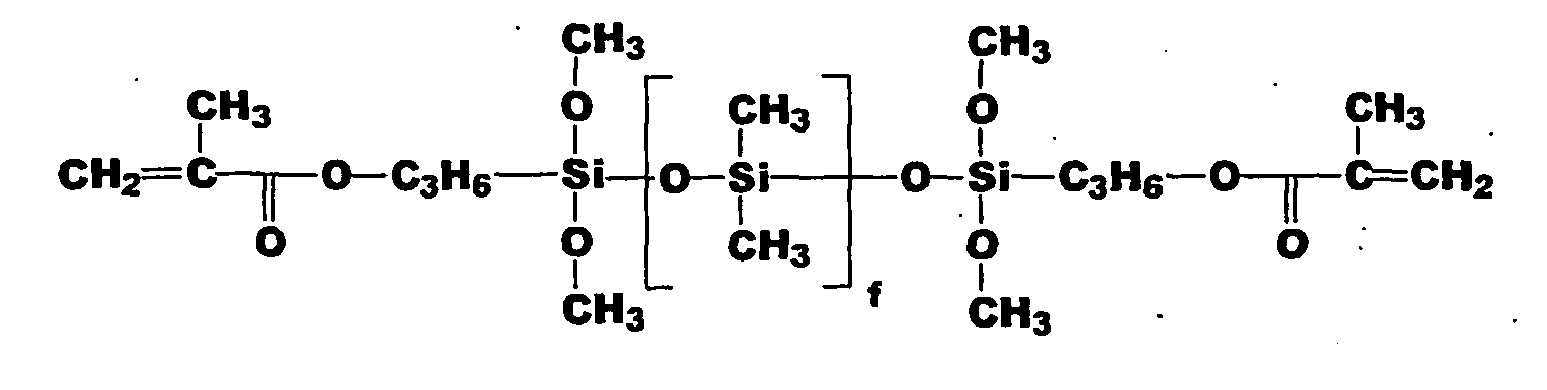
- Methacryloxyproplydimethylsilyl endgeblockte Polydimethylsiloxane (f=2 bis 500)

- Methacryloxypropyl endgeblockte Polydimethylsiloxane (f= 2 bis 500 bis)

- Vinyldimethoxysilyl endgeblockte Polydimethylsiloxane (f = 2-500)
- Bezogen auf die Gesamtmasse der Copolymere kann der Gehalt an siliziumhaltigen Komponenten bis 99,8 Gew.-%, bevorzugt 0,5 bis 30 Gew.-%, insbesondere bevorzugt 1 bis 20 Gew.-%, betragen.
- Als polymerisationsfähige, fluorhaltige Komponenten E) sind alle mindestens einfach olefinisch ungesättigten Verbindungen geeignet, die unter den jeweils gewählten Reaktionsbedingungen zur radikalischen Copolymerisation befähigt sind. Dabei muss die Verteilung der einzelnen fluorhaltigen Monomere über die entstehenden Polymerketten hinweg nicht notwendigerweise statistisch erfolgen. Auch die Ausbildung von beispielsweise block- (auch muttibtock-) oder gradientenartigen Strukturen ist im Sinne der Erfindung. Kombinationen von zwei oder mehreren unterschiedlichen, fluorhaltigen Komponenten E) ist auch möglich, wobei dem Experten klar ist, dass monofunktionelle Vertreter zur Bildung kammförmiger Strukturen führen, wohingegen di-, tri-, oder polyfunktionelle Komponenten E) zu zumindest teilvernetzten Strukturen führen.
- Bevorzugte fluorhaltige Komponenten E) sind solche gemäß Formel (II).
R1-Y-CrH2rCsF2sCF3 (II)
- Dabei stellt R1 eine polymerisationsfähige Funktion aus der Gruppe der vinylisch ungesättigten Verbindungen dar, die zum Aufbau polymerer Strukturen auf radikalischem Wege geeignet ist. Bevorzugt stellt R1 ein Vinyl-, Allyl-, Methallyl-, Methylvinyl-, Acryl- (CH2=CH-CO-), Methacryl- (CH2=C[CH3]-CO-), Crotonyl-, Senecionyl-, Itaconyl-, Maleinyl-, Fumaryl- oder Styrylrest, besonders bevorzugt einen Acryl- und Methacrylrest, dar.
Zur Anbindung der fluorhaltigen Gruppierung an die reaktive Endgruppe R1 ist eine geeignete chemische Brücke Y erforderlich. Bevorzugte Brücken Y sind -O-, -C(O)-, -C(O)-O-, -S-, -O-CH2-CH(O-)-CH2OH, -O-CH2-CH(OH)-CH2-O-, -O-SO2-O-, -O-S(O)-O-, -PH-, -P(CH3)-, -PO3-, -NH-, -N(CH3)-, -O-(C1-C50)Alkyl-O-, -O-Phenyl-O-, -O-Benzyl-O-, -O-(C5-C8)Cycloalkyl-O-, -O-(C1-C50)Alkenyl-O-, -O-(CH(CH3)-CH2-O)n-, -O-(CH2-CH2-O)n- und -O-([CH-CH2-O]n-[CH2-CH2-O]m)o-, wobei n, m und o unabhängig voneinander Zahlen von 0 bis 200 bedeuten und die Verteilung der EO- und PO-Einheiten statistisch oder blockförmig sein kann.
Bei r und s handelt es sich um stöchiometrische Koeffizienten, die unabhängig voneinander Zahlen von 0 bis 200 bedeuten. - Bevorzugte fluorhaltige Komponenten E) gemäß Formel (II) sind
Perfluorhexylethanol-methacrylat,
Perfluorhexoylpropanol-methacrylat,
Perfluoroctyethanol-methacrylat,
Perfluoroctylpropanol-methacrylat,
Perfluorhexylethanolylpolygycolether-methacrylat,
Perfluorhexoyl-propanolyl-poly-[ethylglykol-co-propylenglycolether]-acrylat,
Perfluoroctyethanolyl-poly-[ethylglykol-blockco-propylenglycolether]-methacrylat,
Perfluoroctylpropanolyl-polypropylen-glycolether-methacrylat. - Bezogen auf die Gesamtmasse des Copolymeren kann der Gehalt an fluorhaltigen Komponenten bis 99,9 Gew.-%, bevorzugt 0,5 bis 30 Gew.-%, insbesondere bevorzugt 1 bis 20 Gew.-%, betragen.
- Bei den Makromonomeren F) handelt sich um mindestens einfach olefinisch funktionalisierte Polymere mit einer oder mehreren diskreten Wiederholungseinheiten und einem zahlenmittleren Molekulargewicht größer oder gleich 200 g/mol. Bei der Copolymerisation können auch Mischungen chemisch unterschiedlicher Makromonomere F) eingesetzt werden. Bei den Makromonomeren handelt es sich um polymere Strukturen, die aus einer oder mehreren Wiederholungseinheit(en) aufgebaut sind und eine für Polymere charakteristische Molekulargewichtsverteilung aufweisen.
Bevorzugt als Makromonomere F) sind Verbindungen gemäß Formel (III).
R1-Y-[(A)v-(B)w-(C)x-(D)z]-R2 (III)
- R1 stellt eine polymerisationsfähige Funktion aus der Gruppe der vinylisch ungesättigten Verbindungen dar, die zum Aufbau polymerer Strukturen auf radikalischem Wege geeignet sind. Bevorzugt stellt R1 einen Viriyl-, Allyl-, Methallyl-, Methylvinyl-, Acryl- (CH2=CH-CO-), Methacryl- (CH2=C[CH3]-CO-), Crotonyl-, Senecionyl-, Itaconyl-, Maleinyl-, Fumaryl- oder Styrylrest dar.
Zur Anbindung der Polymerkette an die reaktive Endgruppe ist eine geeignete verbrückende Gruppe Y erforderlich. Bevorzugte Brücken Y sind -O-, -C(O)-, -C(O)-O-, -S-, -O-CH2-CH(O-)-CH2OH, -O-CH2-CH(OH)-CH2O-, -O-SO2-O-, -O-SO2-O-, -O-SO-O-, -PH-, -P(CH3)-, -PO3-, -NH- und -N(CH3)-, besonders bevorzugt -O-.
Der polymere Mittelteil des Makromonomeren wird durch die diskreten Wiederholungseinheiten A, B, C und D repräsentiert. Bevorzugte Wiederholungseinheiten A,B,C und D leiten sich ab von Acrylamid, Methacrylamid, Ethylenoxid, Propylenoxid, AMPS, Acrylsäure, Methacrylsäure, Methylmethacrylat, Acrylnitril, Maleinsäure, Vinylacetat, Styrol, 1,3-Butadien, Isopren, Isobuten, Diethylacrylamid und Diisopropylacrylamid. - Die Indizes v, w, x und z in Formel (III) repräsentieren die stöchiometrische Koeffizienten betreffend die Wiederholungseinheiten A, B, C und D. v, w, x und z betragen unabhängig voneinander 0 bis 500, bevorzugt 1 bis 30, wobei die Summe der vier Koeffizienten im Mittel ≥ 1 sein muss.
Die Verteilung der Wiederholungseinheiten über die Makromonomerkette kann statistisch, blockartig, alternierend oder gradientenartig sein.
R2 bedeutet einen linearen oder verzweigten aliphatischen, olefinischen, cycloaliphatischen, arylaliphatischen oder aromatischen (C1-C50)-Kohlenwasserstoffrest, OH, -NH2, -N(CH3)2 oder ist gleich der Struktureinheit [-Y-R1].
Im Falle von R2 gleich [-Y-R1] handelt es sich um difunktionelle Makromonomere, die zur Vernetzung der Copolymere geeignet sind. - Besonders bevorzugt als Makromonomere F) sind acrylisch- oder methacrylisch monofunktionalisierte Alkylethoxylate gemäß Formel (IV).

- R3, R4, R5 und R6 bedeuten unabhängig voneinander Wasserstoff oder n-aliphatische, iso-aliphatische, olefinische, cycloaliphatische, arylaliphatische oder aromatische (C1-C30)-Kohlenwasserstoffreste.
Bevorzugt sind R3 und R4 gleich H oder -CH3, besonders bevorzugt H; R5 ist gleich H oder -CH3; und R6 ist gleich einem n-aliphatischen, iso-aliphatischen, olefinischen, cycloaliphatischen, arylaliphatischen oder aromatischen (C1-C30)-Kohlenwasserstoffrest.
v und w sind wiederum die stöchiometrischen Koeffizienten betreffend die Ethylenoxideinheiten (EO) und Propylenoxideinheiten (PO). v und w betragen unabhängig voneinander 0 bis 500, bevorzugt 1 bis 30, wobei die Summe aus v und w im Mittel ≥ 1 sein muss. Die Verteilung der EO- und PO-Einheiten über die Makromonomerkette kann statistisch, blockartig, alternierend oder gradientenartig sein. Y steht für die obengenannten Brücken. - Weiterhin insbesondere bevorzugte Makromonomeren F) haben die folgende Struktur gemäß Formel (IV):
Bezeichnung R3 R4 R5 R6 v w ®LA-030-methyacrylat H H -CH3 -Lauryl 3 0 ®LA-070-methacrylat H H -CH3 -Lauryl 7 0 ®LA-200-methacrylat H H -CH3 -Lauryl 20 0 ®LA-250-methacrylat H H -CH3 -Lauryl 25 0 ®T-080-methyacrylat H H -CH3 -Talk 8 0 ®T-080-acrylat H H H -Talk 8 0 ®T-250-methyacrylat H H -CH3 -Talk 25 0 ®T-250-crotonat -CH3 H -CH3 -Talk 25 0 ®OC-030-methacrylat H H -CH3 -Octyl 3 0 ®OC-105-methacrylat H H -CH3 -Octyl 10 5 ®Behenyl-010-methyaryl H H H -Behenyl 10 0 ®Behenyl-020-methyaryl H H H -Behenyl 20 0 ®Behenyl-010-senecionyl -CH3 -CH3 H -Behenyl 10 0 ®PEG-440-diacrylat H H H -Acryl 10 0 ®B-11-50-methacrylat H H -CH3 -Butyl 17 13 ®MPEG-750-methacrylat H H -CH3 -Methyl 18 0 ®P-010-acrylat H H H -Phenyl 10 0 ®O-050-acrylat H H H -Oleyl 5 0 - Weiterhin als Makromonomere F) insbesondere geeignet sind Ester der (Meth)acrylsäure mit
(C10-C18)-Fettalkoholpolyglykolethern mit 8 EO-Einheiten (Genapol® C-080)
C11-Oxoalkoholpolyglykolethern mit 8 EO-Einheiten (Genapol® UD-080)
(C12-C14)-Fettalkoholpolyglykolethern mit 7 EO-Einheiten (Genapol® LA-070)
(C12-C14)-Fettalkoholpolyglykolethern mit 11 EO-Einheiten (Genapol® LA-110)
(C16-C18)-Fettalkoholpolyglykolethem mit 8-EO-Einheiten (Genapol® T-080)
(C16-C18)-Fettalkoholpolyglykolethern mit 15 EO-Einheiten (Gemipol® T-150)
(C16-C18)-Fettalkoholpolyglykolethern mit 11 EO-Einheiten (Genapol® T-110)
(C16-C18)-Fettatkoholpotygtycotethern mit 20 EO-Einheiten (Genapol® T-200)
(C16-C18)-Fettalkoholpolyglykolethern mit 25 EO-Einheiten (Genapol® T-250)
(C18-C22)-Fettalkoholpolyglykolethern mit 25 EO-Einheiten und/oder
iso-(C16-C18)-Fettalkoholpolyglykolethern mit 25 EO-Einheiten.
Bei den Genapol®-Typen handelt es sich um Produkte der Firma Clariant, GmbH. - Bevorzugt beträgt das Molekulargewicht der Makromonomeren F) 200 g/mol bis 106 g/mol, besonders bevorzugt 150 bis 104 g/mol und insbesondere bevorzugt 200 bis 5000 g/mol.
- Bezogen auf die Gesamtmasse der Copolymere können geeignete Makromonomere bis zu 99,8 Gew.-% eingesetzt werden. Bevorzugt finden die Bereiche 0,5 bis 30 Gew.-% und 70 bis 99,5 Gew.-% Anwendung. Besonders bevorzugt sind Anteile von 1 bis 20 Gew.-% und 75 bis 95 Gew.-%.
- Bevorzugt als Copolymere sind solche, die durch Copolymerisation mindestens der der Komponenten A), C) und D) erhältlich sind.
- Weiterhin bevorzugt als Copolymere sind solche, die durch Copolymerisation mindestens der Komponenten A), D) und F) erhältlich sind.
- Weiterhin bevorzugt als Copolymere sind solche, die durch Copolymerisation mindestens der Komponenten A) und D) erhältlich sind.
- In einer bevorzugten Ausführungsform wird die Copolymerisation in Gegenwart mindestens eines polymeren Additivs G) durchgeführt, wobei das Additiv G) vor der eigentlichen Copolymerisation dem Polymerisationsmedium ganz- oder teilweise gelöst zugegeben wird. Die Verwendung von mehreren Additiven G) ist ebenfalls erfindungsgemäß. Vernetzte Additive G) können ebenfalls verwendet werden.
Die Additive G) bzw. deren Mischungen müssen lediglich ganz oder teilweise im gewählten Polymerisationsmedium löslich sein. Während des eigentlichen Polymerisationsschrittes hat das Additiv G) mehrere Funktionen. Einerseits verhindert es im eigentlichen Polymerisationsschritt die Bildung übervernetzter Polymeranteile im sich bildenden Copolymerisat und andererseits wird das Additiv G) gemäß dem allgemein bekannten Mechanismus der Pfropf-Copolymerisation statistisch von aktiven Radikalen angegriffen. Dies führt dazu, dass je nach Additiv G) mehr oder weniger große Anteile davon in die Copolymere eingebaut werden. Zudem besitzen geeignete Additive G) die Eigenschaft, die Lösungsparameter der sich bildenden Copolymere während der radikalischen Polymerisationsreaktion derart zu verändern, dass die mittleren Molekulargewichte zu höheren Werten verschoben werden. Verglichen mit analogen Copolymeren, die ohne den Zusatz der Additive G) hergestellt wurden, zeigen solche, die unter Zusatz von Additiven G) hergestellt wurden, vorteilhafterweise eine signifikant höhere Viskosität in wässriger Lösung.
Bevorzugt als Additive G) sind in Wasser und/oder Alkoholen, bevorzugt in t-Butanol, lösliche Homo- und Copolymere. Unter Copolymeren sind dabei auch solche mit mehr als zwei verschiedenen Monomertypen zu verstehen.
Besonders bevorzugt als Additive G) sind Homo- und Copolymere aus N-Vinylformamid, N-Vinylacetamid, N-Vinylpyrrolidon, Ethylenoxid, Propylenoxid, Acryloyldimethyltaurinsäure, N-Vinylcaprolactam, N-Vinylmethylacetamid, Acrylamid, Acrylsäure, Methacrylsäure, N-Vinylmorpholid, Hydroxyethylmethacrylat, Diallyldimethylammoniumchlorid (DADMAC) und/oder [2-(Methacryloyloxy)ethyl]trimethylammoniumchlorid (MAPTAC); Polyalkylenglykole und/oder Alkylpolyglykole.
Insbesondere bevorzugt als Additive G) sind Polyvinylpyrrolidone (z.B. Luviskol K15®, K20® und K30® von BASF), Poly(N-Vinylformamide), Poly(N-Vinylcaprolactame) und Copolymere aus N-Vinylpyrrolidon, N-Vinylformamid und/oder Acrylsäure, die auch teilweise oder vollständig verseift sein können. - Das Molekulargewicht der Additive G) beträgt bevorzugt 102 bis 107 g/mol, besonders bevorzugt 0,5*104 bis 106 g/mol.
- Die Einsatzmenge des polymeren Additivs G) beträgt, bezogen auf die Gesamtmasse der bei der Copolymerisation zu polymerisierenden Monomere, bevorzugt 0,1 bis 90 Gew.-%, besonders bevorzugt 1 bis 20 Gew.-% und insbesondere bevorzugt 1,5 bis 10 Gew.-%.
- In einer weiteren bevorzugten Ausführungsform sind die erfindungsgemäßen Copolymere vernetzt, d.h. sie enthalten Comonomere mit mindestens zwei polymerisationsfähigen Vinylgruppen.
Bevorzugte Vernetzer sind Methylenbisacrylamid; Methylenbismethacrylamid; Ester ungesättigter Mono- und Polycarbonsäuren mit Polyolen, bevorzugt Diacrylate und Triacrylate bzw. -methacrylate, besonders bevorzugt Butandiol- und Ethylengiykoldiacrylat bzw. -methacrylat, Trimethylolpropantriacrylat (TMPTA) und Trimethylolpropantrimethacrylat (TMPTMA); Allylverbindungen, bevorzugt Allyl(meth)acrylat, Triallylcyanurat, Maleinsäurediallylester, Polyallylester, Tetraallyloxyethan, Triallylamin, Tetraallylethylendiamin; Allylester der Phosphorsäure; und/oder Vinylphosphonsäurederivate.
Insbesondere bevorzugt als Vernetzer ist Trimethylolpropantriacrylat (TMPTA). - Der Gewichtsanteil an vernetzenden Comonomeren, bezogen auf die Gesamtmasse der Copolymere, beträgt bevorzugt bis 20 Gew.-%, besonders bevorzugt 0,05 bis 10 Gew.-% und insbesondere bevorzugt 0,1 bis 7 Gew.-%.
- Als Polymerisationsmedium können alle organischen oder anorganischen Lösungsmittel dienen, die sich bezüglich radikalischer Polymerisationsreaktionen weitestgehend inert verhalten und vorteilhafterweise die Bildung mittlerer oder hoher Molekulargewichte zulassen. Bevorzugt Verwendung finden Wasser; niedere Alkohole; bevorzugt Methanol, Ethanol, Propanole, iso-, sec.- und t-Butanol, insbesondere bevorzugt t-Butanol; Kohlenwasserstoffe mit 1 bis 30 Kohlenstoffatomen und Mischungen der vorgenannten Verbindungen.
- Die Polymerisationsreaktion erfolgt bevorzugt im Temperaturbereich zwischen 0 und 150°C, besonders bevorzugt zwischen 10 und 100°C, sowohl bei Normaldruck als auch unter erhöhtem oder erniedrigtem Druck. Gegebenenfalls kann die Polymerisation auch unter einer Schutzgasatmosphäre, vorzugsweise unter Stickstoff, ausgeführt werden.
- Zur Auslösung der Polymerisation können energiereiche elektromagnetische Strahlen, mechanische Energie oder die üblichen chemischen Polymerisationsinitiatoren, wie organische Peroxide, z.B. Benzoylperoxid, tert.-Butylhydroperoxid, Methylethylketonperoxid, Cumolhydroperoxid, Dilauroylperoxid oder Azoinitiatoren, wie z.B. Azodiisobutyronitril (AIBN), verwendet werden.
Ebenfalls geeignet sind anorganische Peroxyverbindungen, wie z.B. (NH4)2S2O8, K2S2O8 oder H2O2, gegebenenfalls in Kombination mit Reduktionsmitteln (z.B. Natriumhydrogensulfit, Ascorbinsäure, Eisen(II)-sulfat etc.) oder Redoxsystemen, welche als reduzierende Komponente eine aliphatische oder aromatische Sulfonsäure (z.B. Benzolsulfonsäure, Toluolsulfonsäure etc.) enthalten.
Als Polymerisationsmedium können alle Lösungsmittel dienen, die sich bezüglich radikalischer Polymerisationsreaktionen weitestgehend inert verhalten und die Bildung hoher Molekulargewichte zulassen. Bevorzugt Verwendung finden Wasser und niedere, tertiäre Alkohole oder Kohlenwasserstoffe mit 3 bis 30 C-Atomen. In einer besonders bevorzugten Ausführungsweise wird t-Butanol als Reaktionsmedium verwendet. Mischungen aus zwei- oder mehreren Vertretern der beschriebenen potentiellen Lösungsmitteln sind selbstverständlich ebenfalls erfindungsgemäß. Dies schließt auch Emulsionen von nicht miteinander mischbaren Solventien ein (z.B. Wasser/Kohlenwasserstoffe). Grundsätzlich sind alle Arten der Reaktionsführung geeignet, die zu den erfindungsgemäßen Polymerstrukturen führen (Lösungspolymerisation, Emulsionsverfahren, Fällungsverfahren, Hochdruckverfahren, Suspensionsverfahren, Substanzpolymerisation, Gelpolymerisation usw.). - Bevorzugt eignet sich die Fällungspolymerisation, besonders bevorzugt die Fällungspolymerisation in tert.-Butanol.
- Die nachfolgende Auflistung zeigt 67 Copolymere, die für die Formulierung der erfindungsgemäßen Mittel besonders geeignet sind. Die verschiedenen Copolymere Nr. 1 bis Nr. 67 sind gemäß den folgenden Herstellverfahren 1, 2, 3 und 4 erhältlich. Die Copolymere Nr. 28 bis 40, 53, 60, 61 und 63 sind Copolymere, die durch radikalische Copolymerisation von zumindest Komponente A) und Komponente D) erhältlich sind. Die Copolymere Nr. 1 bis 27, 41 bis 52, 54 bis 59, 62 und 64 bis 67 stellen demgegenüber keine Copolymere dar, die durch radikalische Copolymerisation von zumindest Komponente A) und Komponente D) erhältlich sind.
- Diese Polymere sind nach dem Fällungsverfahren in tert. Butanol herstellbar. Dabei wurden die Monomere in t-Butanol vorgelegt, die Reaktionsmischung inertisiert und anschließend die Reaktion nach Anheizen auf 60°C durch Zugabe des entsprechenden t-Butanol löslichen Initiators (bevorzugt Dilauroylperoxid) gestartet. Die Polymere werden nach beendeter Reaktion (2 Stunden) durch Absaugen des Lösungsmittels und durch anschließende Vakuumtrocknung isoliert.
- Diese Polymere sind nach dem Gelpolymerisationsverfahren in Wasser herstellbar. Dabei werden die Monomere in Wasser gelöst, die Reaktionsmischung inertisiert und anschließend die Reaktion nach Anheizen auf 65°C durch Zugabe von geeigneten Initiatoren- oder Initiatorsystemen (bevorzugt Na2S2O8) gestartet. Die Polymergele werden anschließend zerkleinert und nach Trocknung die Polymere isoliert.
- Diese Polymere sind nach dem Emulsionsverfahren in Wasser herstellbar. Dabei werden die Monomere in einer Mischung aus Wasser/organ. Lösungsmittel (bevorzugt Cyclohexan) unter Verwendung eines Emulgators emulgiert, die Reaktionsmischung mittels N2 inertisiert und anschließend die Reaktion nach Anheizen auf 80°C durch Zugabe von geeigneten Initiatoren- oder Initiatorsystemen (bevorzugt Na2S2O8) gestartet. Die Polymeremulsionen werden anschließend eingedampft (Cyclohexan fungiert als Schlepper für Wasser) und dadurch die Polymere isoliert.
- Diese Polymere sind nach dem Lösungsverfahren in organischen Lösungsmitteln (bevorzugt Toluol, z.B. auch tert. Alkohole) herstellbar. Dabei werden die Monomere im Lösungsmittel vorgelegt, die Reaktionsmischung inertisiert und anschließend die Reaktion nach Anheizen auf 70°C durch Zugabe von geeigneten Initiatoren- oder Initiatorsystemen (bevorzugt Dilauroylperoxid) gestartet. Die Polymere werden durch Abdampfen des Lösungsmittels und durch anschließende Vakuumtrocknung isoliert.
- Polymere mit hydrophoben Seitenketten, unvernetzt
Nr. Zusammensetzung Herstellverfahren 1 95 g AMPS 5 g Genapol T-080 1 2 90 g AMPS 10 g Genapol T-080 1 3 85 g AMPS 15 g Genapol T-080 1 4 80 g AMPS 20 g Genapol T-080 1 5 70 g AMPS 30 g Genapol T-080 1 6 50 g AMPS 50 g Genapol T-080 3 7 40 g AMPS 60 g Genapol T-080 3 8 30 g AMPS 70 g Genapol T-080 3 9 20 g AMPS 80 g Genapol T-080 3 10 60 g AMPS 60 g BB10 4 11 80 g AMPS 20 g BB10 4 12 90 g AMPS 10 g BB10 3 13 80 g AMPS 20 g BB10 1 14 80 g AMPS 20 g Genapol LA040 1 - Polymere mit hydrophoben Seitenketten, vernetzt
Nr. Zusammensetzung Herstellverfahren 15 80 g AMPS 20 g Genapol LA040 0.6g AMA 1 16 80 g AMPS 20 g Genapol LA040 0,8 AMA 1 17 80 g AMPS 20 g Genapol LA040 1,0 g AMA 1 18 628,73 g AMPS 120,45 g Genapol T-250 6,5 g TMPTA 2 19 60 g AMPS 40 g BB10 1,9 g TMPTA 4 20 80 g AMPS 20 g BB10 1,4 g TMPTA 4 21 90 g AMPS 10 g BB10 1,9 g TMPTA 4 22 80 g AMPS 20 g BB10 1,9 g TMPTA 4 23 60 g AMPS 40 g BB10 1,4 g TMPTA 4 - Polymere mit hydrophoben Seitenketten, vernetzt, gepfropft
Nr. Zusammensetzung Herstellverfahren 24 95 g AMPS 5 g BB10, 1,9 g TMPTA, 1 g Poly-NVP 1 25 90 g AMPS 10 g BB10, 1,9 g TMPTA, 1 g Poly-NVP 1 26 85 g AMPS 15 g BB10, 1;9 g TMPTA, 1 g Poly-NVP 1 27 90 g AMPS 10 g BB10, 1,9 g TMPTA, 1 g Poly-NVP 1 - Polymere mit siliziumhaltigen Gruppen, unvernetzt
Nr. Zusammensetzung Herstellverfahren 28 80 g AMPS, 20 g Silvet 867 1 29 80 g AMPS, 50 g Silvet 867 4 - Polymere mit siliziumhaltigen Gruppen, vernetzt
Nr. Zusammensetzung Herstellverfahren 30 80 g AMPS, 20 g Silvet 867, 0,5 g MBA 4 31 80 g AMPS, 20 g Silvet 867, 1,0 g MBA 1 32 60 g AMPS, 40 g Y-12867, 0,95 g AMA 1 33 80 g AMPS, 20 g Y-12867, 0,95g AMA 1 34 90 g AMPS, 10 g Y-12867, 0,95 g AMA 1 35 60 g AMPS, 40 g Silvet 7280, 0,95 g AMA 1 36 80 g AMPS, 20 g Silvet 7280, 0,95 g AMA 1 37 90 g AMPS, 10 g Silvet 7280, 0,95 g AMA 1 38 60 g AMPS, 40 g Silvet 7608, 0,95 g AMA 1 39 80 g AMPS, 20 g Silvet 7608, 0,95 g AMA 1 40 90 g AMPS, 10 g Silvet 7608, 0,95 g AMA 1 - Polymere mit hydrophoben Seitenketten und kationischen Gruppen, unvernetzt
Nr. Zusammensetzung Herstellverfahren 41 87,5 g AMPS, 7,5 g Genapol T-110, 5 g DADMAC 2 42 40 g AMPS, 10 g Genapol T110, 45 g Methacrylamid 2 43 55 g AMPS, 40 g Genapol LA040, 5 g Quat 1 44 75 g AMPS, 10 g BB10, 6,7 g Quat 1 - Polymere mit hydrophoben Seitenketten und kationischen Gruppen, vernetzt
Nr. Zusammensetzung Herstellverfahren 45 60 g AMPS, 20 g Genapol T-80, 10 g Quat, 10 g HEMA 1 46 75 g AMPS, 20 g GenapolT-250, 5 g Quat, 1,4 g TMPTA 1 47 75 g AMPS, 20 g GenapolT-250, 10 g Quat, 1,4 g TMPTA 1 48 75 g AMPS, 20 g GenapolT-250, 20 g Quat, 1,4 g TMPTA 1 - Polymere mit fluorhaltigen Gruppen
Nr. Zusammensetzung Herstellverfahren 49 94 g AMPS, 2,02 g Fluowet AC 600 1 50 80 g AMPS, 20 g Perfluoroctylpolyethylenglykolmethacrylat, 1 g Span 80 3 - Polymere mit fluorhaltigen Gruppen, gepfropft
Nr. Zusammensetzung Herstellverfahren 51 80 g AMPS, 10 g Fluowet AC 600, 5 g Poly-NVP 1 52 70 g AMPS, 5 g Poly-NVP 8 g Perfluoroctylethyloxyglycerinmethacrylat, 4 - Multifunktionelle Polymere
Nr. Zusammensetzung Herstellverfahren 53 80 g AMPS, 10 g Genapol LA070, 10 g Silvet 7608, 1 1,8 g TMPTA 54 70 g AMPS, 5 g N-Vinylpyrrolidon, 15 g Genapol T-250 4 methacrylat, 10 g Quat, 10 g Poly-NVP 55 80 g AMPS, 5 g N-Vinylformamid, 5 g Genapol O-150- 2 methacrylat, 10 g DADMAC, 1,8 g TMPTA, 8 g Poly-N- Vinylformamid 56 70 g AMPS, 5 g N-Vinylpyrrolidon, 15 g Genapol T- 1 250-methacrylat, 10 g Quat, 10 g Poly-NVP 57 60 g AMPS, 10 g Genapol-BE-020-methacrylat, 1 10 g Genapol T-250-acrylat, 20 g Quat, 1 g Span 80 58 60 g AMPS, 20 g MPEG-750-methacrylat, 1 10 g Methacryloxypyldimethicon, 10 g Perfluorooctylpolyethylenglycol-methacrylat, 10 g Poly[N-vinylcaprolacton-co-acrylsäure] (10/90) 59 80 g AMPS, 5 g N-Vinylformamid, 5 g Genapol O-150- 1 methacrylat, 10gDADMAC, 1,8 g TMPTA 60 70 g AMPS, 10 g Genapol T-250-acrylat, 5 g N-Methyl- 1 4-vinylpyridiniumchlorid, 2,5 g Silvet Y-12867, 2,5 g Perfluorhexylpolyethylenglykolmethacrylat, 10 g Polyethylenglykoldimethacrylat, 4 g Poly[N-Vinylcaprolactam] 61 10 g AMPS, 20 g Acrylamid, 30 g N-2-Vinylpyrrolidon, 3 20 g Silvet 7608, 10 g Methacryloxypyl dimethicon, 10 g Fluowet AC 812 62 60 g AMPS, 10 g DADMAC, 10 g Quat, 10 g Genapol-LA- 1 250-crotonat, 10 g Methacryloxypyldimethicon, 7 g Poly[acrylsäure-co-N-vinylformamid] 63 50 g AMPS, 45 g Silvet 7608, 1,8 g TMPTA, 1 8 g Poly[N-Vinylformamid] 64 20 g AMPS, 10 g Genapol T 110, 35 g MAA, 30 g 4 HEMA, 5 g DADMAC 65 20 g AMPS, 80 g BB10, 1,4 g TMPTA 1 66 75 g AMPS, 20 g BB10, 6,7 g Quat, 1,4 g TMPTA 1 67 35 g AMPS, 60 g Acrylamid, 2 g VIFA, 4 2,5 g Vinylphosphonsäure, 2 Mol-% Fluowet EA-600 -
- AMPS
- Acryloyldimethyltaurat, wahlweise Na- oder NH4-Salz
- Genapol® T-080
- C16-C18-Fettalkoholpolyglykolether mit 8 EO-Einheiten
- Genapol® T-110
- C12-C14-Fettalkoholpolyglykolether mit 11 EO-Einheiten
- Genapol® T-250
- C16-C18-Feftalkoholpolyglycolether mit 25 EO-Einheiten
- Genapol® LA-040
- C12-C14-Fettalkoholpolyglykolether mit 4 EO-Einheiten
- Genapol® LA-070
- C12-C14-Fettalkoholpolyglykolether mit 7 EO-Einheiten
- Genapol® O-150 methacrylat
- C16-C18-Fettalkoholpolyglykolether methacrylat mit 15 EO-Einheiten,
- Genapol® LA-250 crotonat
- C12-C14-Fettalkoholpolyglykolether crotonat mit 25 EO-Einheiten
- Genapol® T-250 methacrylat
- C16-C18-Fettalkoholpolyglycolether methacrylat mit 25 EO-Einheiten
- Genapol® T-250 acrylat
- C16-C18-Fettalkoholpolyglycolether methacrylat mit 25 EO-Einheiten
- BB10®
- Polyoxyethylen(10)Behenylether
- TMPTA
- Trimethylolpropantriacrylat
- Poly-NVP
- Poly-N-Vinylpyrrolidon
- Silvet® 867
- Siloxan Polyalkylenoxid Copolymer
- MBA
- Methylen-bis-acrylamid
- AMA
- Allylmethacrylat
- ®Y-12867
- Siloxan Polyalkylenoxid Copolymer
- Silvet® 7608
- Polyalkylenoxid-modifiziertes Heptamethyltrisiloxan
- Silvet® 7280
- Polyalkylenoxid-modifiziertes Heptamethyltrisiloxan
- DADMAC
- Diallyldimethyl-ammoniumchlorid
- HEMA
- 2-Hydroxyethylmethacrylat
- Quat
- 2-(Methacryloyloxy)ethyltrimethylammoniumchforid
- Fluowet® AC 600
- Perfluoralkylethylacrylat
- Span® 80
- Sorbitanester
- In einer bevorzugten Ausführungsform sind die Copolymere wasserlöslich oder wasserquellbar.
- Die beschriebene, optional durchführbare Pfropfung der Copolymere mit anderen Polymeren führt zu Produkten mit besonderer Polymermorphologie, die in wässrigen Systemen optisch klare Gele ergeben. Ein potenzieller Nachteil der Copolymere ohne Pfropfung besteht in einer mehr oder weniger starken Opaleszenz in wässriger Lösung. Diese beruht auf bisher nicht zu vermeidenden, übervernetzten Polymeranteilen, die während der Synthese entstehen und in Wasser nur unzureichend gequollen vorliegen. Dadurch bilden sich Licht streuende Teilchen aus, deren Größe deutlich oberhalb der Wellenlänge des sichtbaren Lichts liegt und deshalb Ursache der Opaleszenz sind. Durch das beschriebene, optional durchführbare Pfropfverfahren wird die Bildung übervernetzter Polymeranteile gegenüber herkömmlichen Techniken deutlich reduziert oder gänzlich vermieden.
- Die beschriebene, optional durchführbare Inkorporation sowohl von kationischen Ladungen als auch von Silizium-, Fluor oder Phosphoratomen in die Copolymere führt zu Produkten, die in kosmetischen Formulierungen besondere sensorische und rheologische Eigenschaften besitzen. Eine Verbesserung der sensorischen und rheologischen Eigenschaften kann insbesondere bei der Verwendung in Rinse-off Produkten vorteilhaft sein.
- Siliziummodifizierte Copolymere können die Funktionen von Silikonölen in teilweise oder in vollem Umfang übernehmen. Der Einsatz von Silikonen kann durch die Copolymere reduziert oder vermieden werden.
- Die erfindungsgemäßen Deodorantien und Antiperspirantien enthalten, bezogen auf die fertigen Mittel, bevorzugt 0,01 bis 10 Gew.-%, besonders bevorzugt 0,1 bis 5 Gew.%, insbesondere bevorzugt 0,5 bis 3 Gew.-% der Copolymere.
- Bevorzugt enthalten die erfindungsgemäßen Mittel 0,01 bis 89 Gew.-%, besonders bevorzugt 5 bis 50 Gew.-%, insbesondere bevorzugt 10 bis 30 Gew.-% Wasser.
- Bevorzugt enthalten die erfindungsgemäßen Mittel bis 10 Gew.-%, bevorzugt 1 bis 6 Gew.-% Glycerin.
Bevorzugt enthalten die erfindungsgemäßen Mittel antimikrobielle Wirkstoffe, die die schweißzersetzenden Mikroorganismen bzw. das schweißzersetzende Esterase-Enzym hemmen.
Bevorzugt geeignet als antimikrobielle Wirkstoffe sind Cetyltrimethylammoniumchlorid, Cetylpyridiniumchlorid, Benzethoniumchlorid, Diisobutylethoxyethyldimethylbenzylammoniumchlorid, Natrium N-Laurylsarcosinat, Natrium-N-Palmethylsarcosinat, Lauroylsarcosin, N-Myristoylglycin, Kalium-N-Laurylsarcosin, Trimethylammoniumchlorid, Natriumaluminiumchlorohydroxylactat, Triethylcitrat, Tricetylmethylammoniumchlorid, 2,4,4'-Trichloro-2'-hydroxydiphenylether (Triclosan), Phenoxyethanol, 1,5-Pentandiol, 1,6-Hexandiol, 3,4,4'-trichlorocarbanilid (Triclocarban), Diaminoalkylamid, beispielsweise L-Lysinhexadecylamid, Citratschwermetallsalze, Salicylate, Piroctose, insbesondere Zinksalze, Pyrithione und deren Schwermetallsalze, insbesondere Zinkpyrithion, Zinkphenolsulfa, Farnesol und Kombinationen dieser Wirksubstanzen. - Die erfindungsgemäßen Mittel enthalten die antimikrobiellen Mittel bevorzugt in Mengen bis 50 Gew.-%, besonders bevorzugt 0,01 bis 10 Gew.-%, insbesondere bevorzugt 0,1 bis 10 Gew.-%.
- Bevorzugt enthalten die erfindungsgemäßen Mittel Adstringenzien.
Bevorzugte Adstringenzien sind Oxide, bevorzugt Magnesiumoxid, Aluminiumoxid, Titandioxid, Zirkondioxid und Zinkoxid, Oxidhydrate, bevorzugt Aluminiumoxidhydrat (Böhmit) und Hydroxide, bevorzug von Calcium, Magnesium, Aluminium, Titan, Zirkon oder Zink.
Die erfindungsgemäßen Mittel enthalten die adstringenden Wirkstoffe bevorzugt in Mengen 0 bis 50 Gew.-%, besonders bevorzugt 0,01 bis 10 Gew.-% und insbesondere bevorzugt 0,1 bis 10 Gew.-%. - Weiterhin bevorzugt enthalten die erfindungsgemäßen Mittel Gelierungsmittel.
Als Gelierungsmittel eignen sich alle oberflächenaktiven Stoffe, die in der flüssigen Phase gelöst eine Netzwerkstruktur ausbilden und so die flüssige Phase verfestigen. - Geeignete Geliermittel sind z.B. in WO 98/58625 genannt.
- Bevorzugte Gelierungsmittel sind Metallsalze von Fettsäuren, bevorzugt mit 12 bis 22 C-Atomen, beispielsweise Natriumstearat, Natriumpalmitat, Natriumlaurat, Natriumarachidate, Natriumbehenat, Kaliumstearat, Kaliumpalmitat, Natriummyristat, Kaliumpalmitat, Aluminiummonostearat, Hydroxyfettsäuren, beispielsweise 12-Hydroxystearinsäure, -lauryl-, 16-Hydroxyhexadecanoylsäure; Fettsäureamide; Fettsäurealkanolamide; Dibenzalsorbit und alkohollösliche Polyamide und Polyacrylamide oder Mischungen solcher.
- Bevorzugt enthalten die erfindungsgemäßen Mittel 0,01 bis 20 Gew.-%, besonders bevorzugt 0,1 bis 10 Gew.-%, insbesondere bevorzugt 1 bis 8 Gew.-% und ganz besonders bevorzugt 3 bis 7 Gew.-% an Geliermitteln.
- In einer weiteren bevorzugten Ausführungsform enthalten die erfindungsgemäßen Mittel zusätzliche Alkohole.
- Bevorzugte Alkohole sind alkoxylierte Alkohole mit bevorzugt 1 bis 80, besonders bevorzugt 3 bis 20, Alkoxygruppen und mindestens einer freien Hydroxylgruppe. Besonders bevorzugt sind Ethanol, Propanol, Isopropanol, n-Butanol, i-Butanol, t-Butanol, Glycerin, Diethylenglykol, Triethylenglykol, Dipropylenglykol, Tripropylenglykol, flüssige Polypropylenpolyethylenglycol-Copolymere, Tetrapropylenglykol, Tetraethylenglykol, Dibutylenglykol, Trimethylenglykol, Diethylenglycolmonoethylether, PEG-8, 1,3-Butandiol, 1,4-Butandiol, Glycerolpropoxylat, Propylenglycol, Hexylenglykol, 1,2-Hexandiol, 1,3-Butylenglycol, 1,2,6-Trihydroxyhexan und 1,2,3-Trihydroxhexan. Weitere bevorzugte Alkohole sind Polyethylenglykole mit einer relativen Molekülmasse unter 2000. Insbesondere ist ein Einsatz von Polyethylenglykol mit einer relativen Molekülmasse zwischen 200 und 600 und in Mengen bis zu 45 Gew.-% und von Polyethylenglykol mit einer relativen Molekülmasse zwischen 400 und 600 in Mengen von 5 bis 25 Gew.-% bevorzugt.
Die erfindungsgemäßen Mittel enthalten bevorzugt 5 bis 90 Gew.-%, besonders bevorzugt 5 bis 80 Gew.-% und insbesondere bevorzugt 20 bis 60 Gew.-% an Alkohol. - Als Duft- bzw. Parfümöle können einzelne Riechstoffverbindungen, z.B. die synthetischen Produkte vom Typ der Ester, Ether, Aldehyde, Ketone, Alkohole und Kohlenwasserstoffe verwendet werden. Riechstoffverbindungen vom Typ der Ester sind z.B. Benzylacetat, Phenoxyethylisobutyrat, p-tert.-Butylcyclohexylacetat, Linalylacetat, Dimethylbenzylcarbinylacetat, Phenylethylacetat, Linalylbenzoat, Benzylformiat, Ethyl-methylphenylglycinat, Allylcydohexylpropionat, Styrallylpropionat und Benzylsalicylat. Zu den Ethern zählen beispielsweise Benzylethylether, zu den Aldehyden z.B. die linearen Alkanale mit 8 bis 18 C-Atomen, Citral, Citronellal, Citronellyloxyacetaldehyd, Cycllamenaldehyd, Hydroxycitronellal, Lilial und Bourgeonal, zu den Ketonen z.B. die lonone, alpha-Isomethylionon und Methyl-cedrylketon, zu den Alkoholen Anethol, Citronellol, Eugenol, Geranion, Linalool, Phenylethylalkohol und Terpineol, zu den Kohlenwasserstoffen gehören hauptsächlich die Terpene und Balsame. Bevorzugt werden Mischungen verschiedener Riechstoffe verwendet, die gemeinsam eine ansprechende Duftnote erzeugen.
- Parfümöle können auch natürliche Riechstoffgemische enthalten, wie sie aus pflanzlichen oder tierischen Quellen zugänglich sind, z.B. Pinien-, Citrus-, Jasmin-, Lilien-, Rosen-, oder Ylang-Ylang-Öl. Auch ätherische Öle geringerer Flüchtigkeit, die meist als Aromakomponenten verwendet werden, eignen sich als Parfümöle, z.B. Salbeiöl, Kamillenöl, Nelkenöl, Melissenöl, Minzenöl, Zimtblätteröl, Lindenblütenöl, Wacholderbeerenöl, Vetiveröl, Olibanöl, Galbanumöl und Ladanumöl.
- Die erfindungsgemäßen Mittel können als weitere Hilfs- und Zusatzstoffe Ölkörper, Emulgatoren und Co-Emulgatoren, Überfettungsmittel, feuchtigkeitsspendende Mittel, Stabilisatoren, biogene Wirkstoffe (Lokalanästhetika, Antibiotika, Antiphlogistik, Antiallergica, Corticosteroide, Sebostatika), Vitamine, Phanthenol, Allantoin, Pflanzenextrakte, beispielsweise Aloe Vera und Proteine, Glycerin, Konservierungsmittel, Perlglanzmittel, Farb- und Duftstoffe, Lösungsmittel, Hydrotrope, Enzyme, Trägersubstanzen, beispielsweise Schichtsilikate, pyrogene Kieselsäure, Elektrolytsalze wie KCl, NaCl, Komplexbildner, Antioxidation und UV-Lichtschutzfilter enthalten.
- Unter Ölkörper ist jegliche Fettsubstanz zu verstehen, die bei Raumtemperatur (25°C) flüssig ist.
- Die Fett-Phase kann ein oder mehrere Öle umfassen, die vorzugsweise aus folgenden Ölen ausgewählt werden:
- a) Silikonöle, flüchtig oder nicht flüchtig, linear, verzweigt oder ringförmig, eventuell organisch modifiziert, Phenylsilikone, Silikonharze und -gummis, die bei Raumtemperatur fest oder flüssig sind:
- b) Mineralöle, wie Paraffin- oder Vaselinöl
- c) Öle tierischen Ursprungs, wie Perhydrosqualen oder Lanolin;
- d) Öle pflanzlichen Ursprungs, wie flüssige Triglyceride, z.B. Sonnenblumen-, Mais-, Soja-, Reis-, Jojoba-, Babusscu-, Kürbis-, Traubenkern-, Sesam-, Walnuss-, Aprikosen-, Makadamia-, Avocado-, Süßmandel-, Wiesenschaumkraut-, Ricinusöl, Triglyceride der Capryl/Caprinsäuren, Olivenöl, Erdnussöl, Rapsöl und Kokosnussöl;
- e) synthetische Öle, wie Purcellinöl, Isoparaffine, lineare und/oder verzweigte Fettalkohole und Fettsäureester, bevorzugt Guerbetalkohole mit 6 bis 18, vorzugsweise 8 bis 10, Kohlenstoffatomen; Ester von linearen (C6-C13)-Fettsäuren mit linearen (C6-C20)-Fettalkoholen; Ester von verzweigten (C6-C13)-Carbonsäuren mit linearen (C6-C20)-Fettalkoholen, Ester von linearen (C6-C18)-Fettsäuren mit verzweigten Alkoholen, insbesondere 2-Ethylhexanol; Ester von linearen und/oder verzweigten Fettsäuren mit mehrwertigen Alkoholen (wie z.B. Dimerdiol oder Trimerdiol) und/oder Guerbetalkoholen; Triglyceride auf Basis (C6-C10)-Fettsäuren,
- f) Ester, wie Dioctyladipat, Diisopropyl dimer dilineloat, Propylenglykole/dicaprilat oder Wachse wie Bienenwachs, Paraffinwachs oder Mikrowachse, gegebenenfalls in Kombination mit hydrophilen Wachsen, wie z.B. Cetylstearylalkohol,
- g) fluorierte und perfluorierte Öle;
- h) fluorierte Silikonöle;
- i) Gemische der obengenannten Substanzen.
- Als nichtionogene Co-Emulgatoren kommen u.a. in Betracht Anlagerungsprodukte von 0 bis 30 Mol Ethylenoxid und/oder 0 bis 5 Mol Propylenoxid an lineare Fettalkohole mit 8 bis 22 C-Atomen, an Fettsäuren mit 12 bis 22 C-Atomen, an Alkylphenole mit 8 bis 15 C-Atomen in der Alkylgruppe und an Sorbitan- bzw. Sorbitolester; (C12-C18)-Fettsäuremono- und -diester von Anlagerungsprodukten von 0 bis 30 Mol Ethylenoxid an Glycerin; Glycerinmono- und -diester und Sorbitanmono- und -diester von gesättigten und ungesättigten Fettsäuren mit 6 bis 22 Kohlenstoffatomen und ggfs. deren Ethylenoxidanlagerungsprodukten; Anlagerungsprodukte von 15 bis 60 Mol Ethylenoxid an Rizinusöl und/oder gehärtetes Rizinusöl; Polyol- und insbesondere Polyglycerinester, wie z.B.
- Polyglycerinpolyricinoleat und Polyglycerinpoly-12-hydroxystearat. Ebenfalls geeignet sind Gemische von Verbindungen aus mehreren dieser Substanzklassen.
- Als ionogene Co-Emulgatoren eignen sich z.B. anionische Emulgatoren, wie mono-, di- oder tri-Phosphorsäureester, aber auch kationische Emulgatoren wie mono-, di- und tri-Alkylquats und deren polymere Derivate.
- Als Überfettungsmittel können Substanzen wie beispielsweise polyethoxylierte Lanolinderivate, Lecithinderivate, Polyolfettsäureester, Monoglyceride und Fettsäurealkanolamide verwendet werden, wobei die letzteren gleichzeitig als Schaumstabilisatoren dienen. Als feuchtigkeitsspendende Substanz stehen beispielsweise Isopropylpalmitat, Glycerin und/ oder Sorbitol zu Verfügung.
- Als Stabilisatoren können Metallsalze von Fettsäuren, wie z.B. Magnesium-, Aluminium- und/oder Zinkstearat eingesetzt werden.
Unter biogenen Wirkstoffen sind beispielsweise Pflanzenextrakte und Vitaminkomplexe zu verstehen. - Die erfindungsgemäßen Mittel können mit konventionellen Ceramiden, Pseudoceramiden, Fettsäure-N-alkylpolyhydroxyalkylamiden, Cholesterin, Cholesterinfettsäureestern, Fettsäuren, Triglyceriden, Cerebrosiden, Phospholipiden und ähnlichen Stoffen als Pflegezusatz abgemischt werden.
- Um die rheologischen Eigenschaften von wässrigen oder lösungsmittelhaltigen Emulsionen oder Suspensionen einzustellen, werden in der Fachliteratur eine Vielzahl von unterschiedlichen Systemen angegeben. Bekannt sind beispielsweise Celluloseether und andere Cellulosederivate (z.B. Carboxymethylcellulose, Hydroxyethylcellulose), Gelatine, Stärke und Stärkederivate, Natriumalginate, Fettsäurepolyethylenglykolester, Agar-Agar, Traganth oder Dextrine. Als synthetische Polymere kommen verschiedene Materialien zum Einsatz, wie z.B. Polyvinylalkohole, Polyacrylamide, Polyvinylamide, Polysulfonsäuren, Polyacrylsäure, Polyacrylsäureester, Polyvinylpyrrolidon, Polyvinylmethylether, Polyethylenoxide, Copolymere aus Maleinsäureanhydrid und Vinylmethylether, sowie diverse Mischungen und Copolymerisate aus den o.a. Verbindungen, einschließlich ihrer verschiedenen Salze und Ester. Diese Polymere können wahlweise vernetzt oder unvernetzt sein.
- Als UV-Filter eignen sich z.B. 4-Aminobenzoesäure; 3-(4'-Trimethylammonium)benzyliden-boran-2-on-methylsulfat; 3,3,5-Trimethyl-cyclohexylsalicylat; 2-Hydroxy-4-methoxybenzophenon; 2-Phenylbenzimidazol-5-sulfonsäure und ihre Kalium-, Natrium- und Triethanolaminsalze; 3,3'-(1,4-Phenylendimethin)-bis-(7,7-dimethyl-2-oxobicyclo[2.2.1]-heptan-1-methansulfonsäure und ihre Salze; 1-(4-tert.-Butylphenyl)-3-(4-methoxyphenyl)propan-1,3-dion, 3-(4'-Sulfo)-benzyliden-bornan-2-on und seine Salze; 2-Cyan-3,3-diphenyl-acrylsäure-(2-ethylhexylester); Polymer von N-[2(und 4)-(2-oxoborn-3-ylidenmethyl)benzyl]-acrylamid; 4-Methoxyzimtsäure-2-ethyl-hexylester; ethoxyliertes Ethyl-4-amino-benzoat; 4-Methoxyzimtsäure-isoamylester; 2,4,6-Tris-[p-(2-ethylhexyloxycarbonyl)anilino]-1,3,5-triazin; 2-(2H-benzotriazol-2-yl)-4-methyl-6-(2-methyl-3-(1,3,3,3-tetramethyl-1-(trimethylsilyloxy)-disiloxanyl)propyl)pheriol; 4,4'-[(6-[4-((1,1-dimethylethyl)-amino-carbonyl)phenylamino]-1,3,5-triazin-2,4-yl)diimino]bis-(benzoesäure-2-ethylhexylester); 3-(4'-Methylbenzyliden)-D,L-Campher; 3-Benzyliden-Campher; Salicylsäure-2-ethylhexylester; 4-Dimethylaminobenzoesäure-2-ethylhexylester; Hydroxy-4-methoxy-benzophenon-5-sulfonsäure (Sulisobenzonum) und das Natriumsalz; und/oder 4-Isopropylbenzylsalicylat.
- Als Antioxidantien stehen beispielsweise Superoxid-Dismutase, Tocopherol (Vitamin E) und Ascorbinsäure (Vitamin C) zur Verfügung.
- Als Konservierungsmittel in Betracht kommen beispielsweise Phenoxyethanol, Parabene, Pentandiol oder Sorbinsäure.
- Als Farbstoffe können die für kosmetische Zwecke geeigneten und zugelassenen Substanzen verwendet werden.
- Bevorzugt handelt es sich bei den Deodorantien und Antiperspirantien um Lotionen, Cremes, Stifte (auch Mehrphasenstifte), Sprays, Roll-On-Präparate und Puder.
- Die erfindungsgemäßen Mittel haben bevorzugt einen pH-Wert von 2 bis 12, besonders bevorzugt von 3 bis 8.
Die nachfolgenden Beispiele dienen der Erläuterung der Erfindung, ohne sie jedoch einzuschränken (bei allen Prozentangaben handelt es sich um Gew.-%). Bei den in den Beispielen verwendeten Copolymeren handelt es sich um Vertreter der in der Beschreibung bereits aufgeführten besonders bevorzugten Copolymere Nr.1 bis Nr.67. Die Herstellung erfolgte nach den dort angegebenen Verfahren 1, 2, 3 oder 4 unter Verwendung der bevorzugten Initiatoren und Lösemittel. -
A Cithrol GMS A/S 15,0 % Glyceryl Stearat/ PEG-100 Stearat Crodacol C90 EP 5,0 % Cetylalkohol Copolymer Nr. 61 2,0% B Wasser ad 100 % Sorbit (70 %ig) 3,0% Sorbitol Reach 501 Lsg. 44,5 % Aluminium Chlorohydrat C Parfümöl q.s. Farbstoffe q.s. Duftstoffe q.s. -
- I A und B ohne Reach 501 auf 70 bis 75°C erhitzen
- II Unter Rühren abkühlen lassen
- III Reach 501 bei 50 bis 55°C hinzufügen
- IV Parfümöl bei 40 bis 45°C hinzugeben
- V Bei 30 bis 35°C homogenisieren
-
A Abil EM97 2,3 % Dimethicon Copolyl/Cyclopentasiloxan Abil B8839 6,9 % Cyclopentasiloxan/Cyclohexasiloxan Abil K4 6,9 % Cyclotetrasiloxan/Cyclopentasiloxan Copolymer Nr. 28 1,5 % B Aloxicoll L 40,0 % Aluminium Chlorohydrat Propylenglykol 25,0 % Wasser dest. ad 100 % Parfümöl q.s. -
- I Komponenten A und B separat mischen
- II Phase B langsam unter Rühren bei Raumtemperatur zur Phase A geben.
- III Homogenisieren
-
A Abil EM90 2,0 % Cetyldimethicon/Copolyol Abil B 8839 20,0 % Cyclopentasiloxan/Cyclohexasiloxan Copolymer Nr. 65 2,0 % B Aloxicoll L 17,0 Aluminium Chlorohydrat Wasser dest. ad 100 % Parfümöl q.s. Konservierungsmittel q.s. -
- I Phase B langsam unter Rühren bei Raumtemperatur zur Phase A geben.
- II Homogenisieren
-
A Teginacid H 3,0 % Glycerylstearat/Ceteth-20 Tegosoft, fl. 3,0 % Cetearyl Octanoat Tegosoft CT 3,0 % Caprylic-/Caprictriglycerid Copolymer Nr. 30 0,75 % B Glycerin 3,0 % Wasser ad 100 C Zitronensäure 0,15 % Konservierungsmittel q.s. Parfümöl q.s. -
- I Phase A und B separat auf ca. 80°C erhitzen
- II Phase A und Phase B zusammenführen
- III Homogenisieren
- IV Unter leichtem Rühren auf 30°C abkühlen
- V Phase C unterhalb von 40°C dazugeben
-
A Tegodeo CW 90 2,0 % Zinkricinoleat/Tetrahydroxypropyl- Ethylendiamin/Laureth-3/Propylenglykol Polyethylenglykol(3)laurylether 1,0 % Triethanolamin 1,0 % B Copolymer Nr. 18 1,2 % Wasser dest. ad 100 C Tagat R 40 3,0 % PEG-40 hydrogeniertes Castor oil Parfümöl q.s. Konservierungsmittel q.s. D Zitronensäure (50%ig in Wasser) 0,2 % - Herstellung
- I Phasen A und B separat auf 80°C erwärmen
- II Phase B in Phase A einrühren und homogenisieren
- III Unter langsamem Rühren abkühlen
- IV Bei 30°C Phase C hinzufügen
- V Den pH-Wert mit Hilfe von Phase D einstellen
-
A Copolymer Nr. 27 1,0 % Wasser dest. ad 100 B Hydagen DCMF 0,1 Chitosan Glykolsäure 1,5 % Glycerin (86%) 2,0 % -
- I Copolymer Nr. 27 unter starkem Rühren langsam in das Wasser geben, bis eine klare viskose Quellung entstanden ist.
- II Komponenten der Phase B unter langsamem Rühren lösen pH 4 bis 5.
- III Phase B in Phase A geben und homogen rühren
-
A Eumulgin B2 Flakes 1,0 % Ceteareth-20 Copolymer Nr. 35 1,0 % Cetiol 5 5,0 % Dioctylcyclohexane Cetiol OE 5,0 % Dicaprylicether Hydagen C.A.T. 2,0 % Triethylcitrat B Hydagen DCMF 0,1 % Chitosan Glykolsäure 0,04 % Wasser dest. Ad 100 Konservierungsmittel 2,0 % -
- I Die Komponenten der Phase A bei 80°C aufschmelze und homogenisieren
- II Komponenten der Phase B unter Rühren lösen, und langsam unter Rühren zu A geben
- III Unter Rühren abkühlen
- IV Bei 30°C Konservierungsmittel zugeben
-
A DC 3225 C 10,00 % Cyclomethicon/Dimethicon Copolyol DC 245 Fluid 3,40 % Cyclomethicon Polydimethylsiloxan 3,9 % Dimethicon Copolymer Nr. 53 0,75 % Parfüm 52847 q.s B Rezal 36 G 44,0% Aluminum Zirconium Tetrachlorohydrex GLY Dipropylenglykol 20 % Wasser dest. ad 100 -
- I Komponenten A und B separat gut mischen
- II B zu A hinzufügen
- III homogenisieren
-
A Copolymer Nr. 63 2,0% Arlamol ISML 2,0 % Isosorbidlaurat Dow Corning 245 Fluid 2,0 % Cyclomethicon B Wasser dest. ad 100 % Locron P (50 %ig) 40,0 % Aluminium Chlorohydrat Konservierungsmittel q.s Parfüm q.s. -
- I Die Komponenten von A mischen
- II Unter Rühren B zu A geben
Claims (17)
- Deodorantien und Antiperspirantien, dadurch gekennzeichnet, dass sie mindestens ein Copolymer, erhältlich durch radikalische Copolymerisation vonA) Acryloyldimethyltaurinsäure und/oder Acryloyldimethyltauraten,B) gegebenenfalls einem oder mehreren weiteren olefinisch ungesättigten, nicht kationischen, gegebenenfalls vemetzenden, Comonomeren, die wenigstens ein Sauerstoff-, Stickstoff-, Schwefel- oder Phosphoratom aufweisen und ein Molekulargewicht kleiner 500 g/mol besitzen,C) gegebenenfalls einem oder mehreren olefinisch ungesättigten, kationischen Comonomeren, die wenigstens ein Sauerstoff-, Stickstoff-, Schwefel- oder Phosphoratom aufweisen und ein Molekulargewicht kleiner 500 g/mol besitzen,D) einer oder mehreren mindestens monofunktioriellen, zur radikalischen Polymerisation befähigten, siliziumhaltigen Komponente(n), wobei mindestens eine siliziumhaltige Komponente eine Verbindung der Formel (I)
R1-Z-[(Si(R3R4)-O-)w-(Si(R5R6)-O)x-]-R2 (I)
ist, wobeiR1 einen Vinyl-, Allyl-, Methallyl-, Methylvinyl-, Acryl-, Methacryl-, Crotonyl-, Senecionyl-, Itaconyl-, Maleinyl-, Fumaryl- oder ein Styrylrest darstellt;Z eine chemische Brücke, bevorzugt ausgewählt aus -O-, -((C1 - C50) Alkylen)-, -((C6 - C30) Arylen)-, -((C5 - C8) Cycloalkylen)-, -((C1-C50) Alkenylen)-, -(Polypropylenoxid)n-, -(Polyethylenoxid)o-, -(Polypropylenoxid)n(Polyethylenoxid)o-, wobei n und o unabhängig voneinander Zahlen von 0 bis 200 bedeuten und die Verteilung der EO/PO-Einheiten statistisch oder blockförmig sein kann, -((C1 - C10) Alkyl)-(Si(OCH3)2)- und -(Si(OCH3)2)-, darstellt;R3, R4, R5 und R6 unabhängig voneinander -CH3, -O-CH3, -C6H5 oder -O-C6H5 bedeuten;w, x Zahlen von 0 bis 500 bedeuten, wobei entweder w oder x größer Null sein muss, undR2 einen ungesättigten, aliphatischen, cycloaliphatischen, arylaliphatischen oder aromatischen Rest mit jeweils 1 bis 50 C-Atomen oder eine Gruppe -Z-R1 bedeutet, wobei Z und R1 die obengenannten Bedeutungen haben,E) gegebenenfalls einer oder mehreren mindestens monofunktionellen, zur radikalischen Polymerisation befähigten, fluorhaltigen Komponente(n),F) gegebenenfalls einem oder mehreren einfach oder mehrfach olefinisch ungesättigten, gegebenenfalls vernetzenden, Makromonomeren, die jeweils mindestens ein Sauerstoff-, Stickstoff-, Schwefel- oder Phosphoratom besitzen und ein zahlenmittleres Molekulargewicht größer oder gleich 200 g/mol aufweisen, wobei es sich bei den Makromonomeren nicht um eine siliziumhaltige Komponente D) oder fluorhaltige Komponente E) handelt,G) wobei die Copolymerisation gegebenenfalls in Gegenwart mindestens eines polymeren Additivs mit zahlenmittleren Molekulargewichten von 200 g/mol bis 109 g/mol erfolgt,enthalten. - Deodorantien und Antiperspirantien nach Anspruch 1, dadurch gekennzeichnet, dass es sich bei den Comonomeren B) um ungesättigte Carbonsäuren, Salze ungesättigter Carbonsäuren, Anhydride ungesättigter Carbonsäuren, Ester ungesättigter Carbonsäuren mit aliphatischen, olefinischen, cycloaliphatischen, arylaliphatischen oder aromatischen Alkoholen mit 1 bis 22 C-Atonien, offenkettige N-Vinylamide, cyclische N-Vinylamide mit einer Ringgröße von 3 bis 9, Amide der Acrylsäure, Amide der Methacrylsäure, Amide substituierter Acrylsäuren, Amide substituierter Methacrylsäuren, 2-Vinylpyridin, 4-Vinylpyridin, Vinylacetat, Styrol, Acrylnitril, Vinylchlorid, Vinylidenchlorid, Tetrafluorethylen, Vinylphosphonsäure oder deren Ester oder Salze, Vinylsulfonsäure oder deren Ester oder Salze, Allylphosphonsäure oder deren Ester oder Salze und/oder Methallylsulfonsäure oder deren Ester oder Salze handelt.
- Deodorantien und Antiperspirantien nach Anspruch 1 und/oder 2, dadurch gekennzeichnet, dass es sich beiden Comonomeren C) um Diallyldimethylammoniumchlorid (DADMAC),
[2-(Methacryloyloxy)ethyl]trimethylammoniurnchlorid (MAPTAC),
[2-(Acryloyloxy)ethyl]trimethylammoniumchlorid,
[2-Methacrylamidoethyl]trimethylammoniumchlorid,
[2-(Acrylamido)ethyl]trimethylammoniumchlorid,
N-Methyl-2-vinylpyridiniumchforid.
N-Methyl-4-vinylpyridiniumchlorid
Dimethylaminoethylmethacrylat,
Dimethylaminopropylmethacrylamid,
Methacryloylethyl-N-oxid und/oder
Methacryloylethyl-betain handelt. - Mittel nach mindestens einem der Ansprüche 1 bis 3, dadurch gekennzeichnet, dass es sich bei den fluorhaltigen Komponenten E) um Verbindungen der Formel (II)
R1-Y-CrH2rCsF2sCF3 (II)
handelt, wobeiR1 eine polymerisationsfähige Funktion aus der Gruppe der vinylisch ungesättigten Verbindungen, bevorzugt einen Vinyl-, Allyl-, Methallyl-, Methylvinyl-, Acryl-, Methacryl-, Crotonyl-, Senecionyl-, Itaconyl-, Maleinyl-, Fumaryl- oder Styrylrest, darstellt;Y eine chemische Brücke, bevorzugt -O-, -C(O)-, -C(O)-O-, -S-, -O-CH2-CH(O-)-CH2OH, -O-CH2-CH(OH)-CH2-O-, -O-SO2-O-, -O-S(O)-O-, -PH-, -P(CH3)-, -PO3-, -NH-, -N(CH3)-, -O-(C1-C50)Alkyl-O-, -O-Phenyl-O-, -O-Benzyl-O-, -O-(C5-C8)Cycloalkyl-O-, -O-(C1-C50)Alkenyl-O-, -O-(CH(CH3)-CH2-O)n-, -O-(CH2-CH2-O)n- und -O-([CH-CH2-O]n-[CH2-CH2-O]m)o-, wobei n, m und o unabhängig voneinander Zahlen von 0 bis 200 bedeuten, darstellt undr, s stöchiometrische Koeffizienten darstellen, die unabhängig voneinander Zahlen zwischen 0 und 200 sind. - Deodorantien und Antiperspirantien nach mindestens einem der Ansprüche 1 bis 4, dadurch gekennzeichnet, dass es sich bei den Makromonömeren F) um Verbindungen der Formel (III) handelt,
R1-Y-[(A)v-(B)w-(C)x-(D)z]-R2 (III)
wobei R1 eine polymerisationsfähige Funktion aus der Gruppe der vinylisch ungesättigten Verbindungen, bevorzugt einen Vinyl-, Allyl-, Methallyl-, Methylvinyl-, Acryl-, Methacryl-, Crotonyl-, Senecionyl-, Itaconyl-, Maleinyl-, Fumaryl- oder Styrylrest, darstellt;
Y eine verbrückende Gruppe, bevorzugt -O-, -S-, -C(O)-, -C(O)-O-, -O-CH2-CH(O-)-CH2OH, -O-CH2-CH(OH)-CH2O-, -O-SO2-O-, -O-SO2-O-, -O-SO-O-, -PH-, -P(CH3)-, -PO3-, -NH- und -N(CH3)- darstellt;
A, B, C und D unabhängig voneinander diskrete chemische Wiederholungseinheiten, bevorzugt hervorgegangen aus Acrylamid, Methacrylamid, Ethylenoxid, Propylenoxid, AMPS, Acrylsäure, Methacrylsäure, Methylmethacrylat, Acrylnitril, Maleinsäure, Vinylacetat, Styrol, 1,3-Butadien, Isopren, Isobuten, Diethylacrylamid und Diisopropylacrylamid, insbesondere bevorzugt Ethylenoxid, Propylenoxid darstellen;
v, w, x und z unabhängig voneinander 0 bis 500, bevorzugt 1 bis 30, betragen, wobei die Summe aus v, w, x und z im Mittel ≥1 ist; und
R2 einen linearen oder verzweigten aliphatischen, olefinischen, cycloaliphatischen, arylaliphatischen oder aromatischen (C1-C50)-Kohlenwasserstoffrest, OH, -NH2 oder -N(CH3)2 darstellt oder gleich [-Y-R1] ist. - Deodorantien und Antiperspirantien nach mindestens einem der Ansprüche 1 bis 5, dadurch gekennzeichnet, dass es sich bei den polymeren Additiven G) um Homo- oder Copolymere aus N-Vinylformamid, N-Vinylacetamid, N-Vinylpyrrolidon, Ethylenoxid, Propylenoxid, Acryloyldirnethyltaurinsäure, N-Vinylcaprolactam, N-Vinytmethylacetamid, Acrylamid, Acrylsäure, Methacrylsäure, N-Vinylmorpholid, Hydroxymethylmethacrylat, Diallyldimethylammoniumchlorid (DADMAC) und/oder [2-(Methacryloyloxy)ethyl]trimeihylammoniumchlorid (MAPTAC); Polyalkylenglykole und/oder Alkylpolyglykole handelt.
- Deodorantien und Antiperspirantien nach mindestens einem der Ansprüche 1 bis 6, dadurch gekennzeichnet, dass die Copolymerisation in Gegenwart mindestens eines polymeren Additivs G) erfolgt.
- Deodorantien und Antiperspirantien nach mindestens einem der Ansprüche 1 bis 7, dadurch gekennzeichnet, dass die Copolymere vernetzt sind.
- Deodorantien und Antiperspirantien nach mindestens einem der Ansprüche 1 bis 8, dadurch gekennzeichnet, dass die Copolymere durch Fällungspolymerisation in tert.-Butanol hergestellt werden.
- Deodorantien und Antiperspirantien nach mindestens einem der Ansprüche 1 bis 9, dadurch gekennzeichnet, dass die Copolymere wasserlöslich oder wasserquellbar sind.
- Deodorantien und Antiperspiranfien nach mindestens einem der Ansprüche 1 bis 10, dadurch gekennzeichnet, dass sie, bezogen auf die fertigen Mittel, 0,01 bis 10 Gew.-% der Copolymere enthalten.
- Deodorantien und Antiperspirantien nach mindestens einem der Ansprüche 1 bis 11, dadurch gekennzeichnet, dass sie 0,01 bis 89 Gew.-% Wasser enthalten.
- Deodorantien und Antiperspirantien nach mindestens einem der Ansprüche 1 bis 12, dadurch gekennzeichnet, dass sie bis 10 Gew.-% Glycerin enthalten.
- Deodorantien und Antiperspirantien nach mindestens einem der Ansprüche 1 bis 13, dadurch gekennzeichnet, dass sie antimikrobielle Wirkstoffe enthalten.
- Deodorantien und Antiperspirantien nach mindestens einem der Ansprüche 1 bis 14, dadurch gekennzeichnet, dass sie Adstringenzien enthalten.
- Deodorantien und Antiperspirantien nach mindestens einem der Ansprüche 1 bis 15, dadurch gekennzeichnet, dass es sich dabei um Lotionen, Cremes, Stifte, Mehrphasenstifte, Sprays, Roll-On-Präparate oder Puder handelt.
- Deodorantien und Antiperspirantien nach mindestens einem der Ansprüche 1 bis 16, dadurch gekennzeichnet, dass mindestens eine siliziumhaltige . Komponente eine Verbindung ausgewählt aus den Formeln


Applications Claiming Priority (3)
| Application Number | Priority Date | Filing Date | Title |
|---|---|---|---|
| DE10059823 | 2000-12-01 | ||
| DE10059823A DE10059823A1 (de) | 2000-12-01 | 2000-12-01 | Deodorantien und Antiperspirantien |
| PCT/EP2001/013863 WO2002043687A2 (de) | 2000-12-01 | 2001-11-28 | Deodorantien und antiperspirantien |
Publications (2)
| Publication Number | Publication Date |
|---|---|
| EP1432746A2 EP1432746A2 (de) | 2004-06-30 |
| EP1432746B1 true EP1432746B1 (de) | 2007-02-07 |
Family
ID=7665476
Family Applications (1)
| Application Number | Title | Priority Date | Filing Date |
|---|---|---|---|
| EP01989525A Expired - Lifetime EP1432746B1 (de) | 2000-12-01 | 2001-11-28 | Deodorantien und antiperspirantien |
Country Status (6)
| Country | Link |
|---|---|
| US (1) | US7186405B2 (de) |
| EP (1) | EP1432746B1 (de) |
| JP (1) | JP2002205931A (de) |
| BR (1) | BR0115844A (de) |
| DE (2) | DE10059823A1 (de) |
| WO (1) | WO2002043687A2 (de) |
Families Citing this family (44)
| Publication number | Priority date | Publication date | Assignee | Title |
|---|---|---|---|---|
| DE10059819A1 (de) * | 2000-12-01 | 2002-06-13 | Clariant Gmbh | Tensidhaltige kosmetische, dermatologische und pharmazeutische Mittel |
| DE10059826A1 (de) * | 2000-12-01 | 2002-06-13 | Clariant Gmbh | Kosmetische, pharmazeutische und dermatologische Mittel |
| DE10059822A1 (de) * | 2000-12-01 | 2002-06-13 | Clariant Gmbh | Saure kosmetische, pharmazeutische und dermatologische Mittel |
| GB0031264D0 (en) * | 2000-12-21 | 2001-01-31 | Unilever Plc | Antiperspirant products |
| DE10110336A1 (de) * | 2001-03-03 | 2002-09-12 | Clariant Gmbh | Tensidfreie kosmetische, dermatologische und pharmazeutische Mittel |
| DE10213142A1 (de) * | 2002-03-23 | 2003-10-02 | Clariant Gmbh | Stabile Dispersionskonzentrate |
| US20060134051A1 (en) * | 2002-09-26 | 2006-06-22 | Xavier Blin | Glossy non-transfer composition comprising a sequenced polymer |
| MXPA03008714A (es) | 2002-09-26 | 2004-09-10 | Oreal | Polimeros secuenciados y composiciones cosmeticas que comprenden tales polimeros. |
| DE10257279A1 (de) | 2002-12-07 | 2004-06-24 | Clariant Gmbh | Flüssige Bleichmittelkomponenten enthaltend amphiphile Polymere |
| DE10322269A1 (de) * | 2003-05-16 | 2004-12-02 | Clariant Gmbh | Flüssige Wasch- und Reinigungsmittel mit Konsistenzgebenden Polymeren |
| FR2860143B1 (fr) * | 2003-09-26 | 2008-06-27 | Oreal | Composition cosmetique comprenant un polymere sequence et une huile siliconee non volatile |
| FR2860142B1 (fr) * | 2003-09-26 | 2007-08-17 | Oreal | Produit cosmetique bicouche, ses utilisations et kit de maquillage contenant ce produit |
| GB0326181D0 (en) * | 2003-11-11 | 2003-12-17 | Unilever Plc | Antiperspirant compositions |
| US20050220731A1 (en) * | 2004-03-23 | 2005-10-06 | Philippe Ilekti | Nail varnish composition comprising at least one polymer and at least one plasticizer |
| US8728451B2 (en) | 2004-03-25 | 2014-05-20 | L'oreal | Styling composition comprising, in a predominantly aqueous medium, a pseudo-block polymer, processes employing same and uses thereof |
| US20050276772A1 (en) * | 2004-06-10 | 2005-12-15 | Boden Richard M | Antiperspirant composition comprising polyol, antiperspirant active article containing same and method for using same |
| US20060018863A1 (en) | 2004-07-13 | 2006-01-26 | Nathalie Mougin | Novel ethylenic copolymers, compositions and methods of the same |
| DE102004050239A1 (de) * | 2004-10-15 | 2005-05-12 | Clariant Gmbh | Kosmetische, pharmazeutische und dermatologische Mittel |
| FR2902999B1 (fr) | 2006-07-03 | 2012-09-28 | Oreal | Utilisation de derives c-glycoside a titre d'actif prodesquamant |
| FR2904320B1 (fr) * | 2006-07-27 | 2008-09-05 | Oreal | Polymeres sequences, et leur procede de preparation |
| WO2008100993A1 (en) * | 2007-02-13 | 2008-08-21 | Bristol-Myers Squibb Company | Deodorant compositions for body waste collectors |
| DE102007061969A1 (de) | 2007-12-21 | 2008-07-17 | Clariant International Limited | Wasserlösliche oder wasserquellbare Polymere auf Basis von Salzen der Acryloyldimethyltaurinsäure oder ihrer Derivate, deren Herstellung und deren Verwendung als Verdicker, Stabilisator und Konsistenzgeber |
| US20100158821A1 (en) * | 2008-12-22 | 2010-06-24 | Eastman Chemical Company | Antimicrobial agents, compositions and products containing the same, and methods of using the compositions and products |
| FR2940907B1 (fr) | 2009-01-15 | 2011-03-04 | Oreal | Composition cosmetique ou dermatologique, comprenant un retinoide, un compose non phosphate a base d'adenosine et un polymere semi-cristallin |
| DE102009020299A1 (de) | 2009-05-07 | 2010-11-11 | Clariant International Ltd. | Kammpolymere und deren Verwendung in Wasch- und Reinigungsmitteln |
| US8106111B2 (en) * | 2009-05-15 | 2012-01-31 | Eastman Chemical Company | Antimicrobial effect of cycloaliphatic diol antimicrobial agents in coating compositions |
| CA2675184C (en) | 2009-08-10 | 2015-12-22 | Knowlton Development Corporation Inc. | Stable solid deodorant product and method for manufacturing same |
| WO2011073279A2 (fr) | 2009-12-18 | 2011-06-23 | L'oreal | Procédé de traitement cosmétique impliquant un composé apte à condenser in situ |
| FR2976485B1 (fr) * | 2011-06-20 | 2013-10-11 | Oreal | Utilisation comme agent anti-transpirant d'un polymere hydrodispersible floculant comportant des groupements amines non quaternises |
| FR3001136B1 (fr) | 2013-01-21 | 2015-06-19 | Oreal | Emulsion cosmetique ou dermatologique comprenant une merocyanine et un systeme emulsionnant contenant un polymere amphiphile comportant au moins un motif acide acrylamido 2-methylpropane sulfonique |
| US9302127B2 (en) | 2013-03-07 | 2016-04-05 | Knowlton Development Corporation Inc. | Deodorant with improved endurance and stability |
| FR3007645A1 (fr) | 2013-06-27 | 2015-01-02 | Oreal | Gel emulsionne amidon pemulen |
| FR3008614B1 (fr) | 2013-07-19 | 2015-07-31 | Oreal | Composition de coloration comprenant un tensio actif amphotere particulier et un tensioactif sulfate |
| WO2015007916A1 (en) | 2013-07-19 | 2015-01-22 | L'oreal | Dye composition comprising a particular amphoteric surfactant and a particular thickening polymer |
| EP3021826B1 (de) | 2013-07-19 | 2018-01-17 | L'oreal | Färbezusammensetzung mit einem bestimmten amphoteren tensid und einem oxyethylierten amidtensid oder einem oxyethylierten fettalkoholamid mit weniger als 10 oe-einheiten und mischung daraus |
| EP3106470A1 (de) | 2015-06-17 | 2016-12-21 | Clariant International Ltd | Verfahren zur herstellung von polymeren auf basis von acryloyldimethyltaurat und speziellen vernetzern |
| EP3106471A1 (de) | 2015-06-17 | 2016-12-21 | Clariant International Ltd | Verfahren zur herstellung von polymeren auf basis von acryloyldimethyltaurat, neutralen monomeren und speziellen vernetzern |
| ES2759984T3 (es) | 2015-06-17 | 2020-05-12 | Clariant Int Ltd | Procedimiento para la producción de polímeros a base de laurato de acriloildimetilo, monómeros neutros, monómeros con ácidos carbónicos y reticulantes especiales |
| FR3058050B1 (fr) | 2016-10-28 | 2019-01-25 | L'oreal | Composition comprenant au moins deux esters d’acide gras et de (poly)glycerol, et son utilisation en cosmetique |
| WO2018195614A1 (en) | 2017-04-28 | 2018-11-01 | L'oreal | Gel-cream hair care composition |
| DE102018203044A1 (de) * | 2018-03-01 | 2019-09-05 | Henkel Ag & Co. Kgaa | Poly(Vinylamin-Vinylformamid)-copolymere als Antitranspirant-Wirkstoff |
| DE102018213830A1 (de) * | 2018-08-16 | 2020-02-20 | Henkel Ag & Co. Kgaa | "Tetrahydroxypropyl Ethylenediamin oder seine Salze als Wirkstoff zur Reduzierung der Schweißsekretion" |
| FR3128118B1 (fr) | 2021-10-14 | 2025-04-04 | Oreal | ProceDE de traitement des cheveux comprenant l’application d’une émulsion huile-dans-eau comprenant une phase aqueuse, une phase grasse et un polymère |
| WO2025126851A1 (ja) * | 2023-12-11 | 2025-06-19 | 株式会社 資生堂 | 油中水型化粧料 |
Family Cites Families (13)
| Publication number | Priority date | Publication date | Assignee | Title |
|---|---|---|---|---|
| JP3042546B2 (ja) * | 1991-04-23 | 2000-05-15 | 昭和電工株式会社 | 微粒子状の架橋型n−ビニルアミド樹脂及びミクロゲル、その製造法及び用途 |
| CA2072319C (en) | 1991-06-28 | 2005-11-22 | Shih-Ruey T. Chen | Ampholyte terpolymers providing superior conditioning properties in skin and nail care products |
| FR2698004B1 (fr) * | 1992-11-13 | 1995-01-20 | Oreal | Dispersion aqueuse cosmétique ou dermatologique pour le traitement des cheveux ou de la peau, à base d'esters d'acide gras de sucre ou d'alkylsucre et de copolymères réticulés d'acrylamide. |
| FR2709982B1 (fr) * | 1993-09-15 | 1995-12-08 | Oreal | Emulsions acides stables de type huile-dans-eau et compositions les contenant. |
| US6001379A (en) * | 1993-09-15 | 1999-12-14 | L'oreal | Stable acidic oil-in- water type emulsions and compositions containing them |
| FR2750327B1 (fr) * | 1996-06-28 | 1998-08-14 | Oreal | Composition a usage topique sous forme d'emulsion huile-dans-eau sans tensio-actif contenant un poly(acide 2- acrylamido 2-methylpropane sulfonique) reticule et neutralise |
| FR2750325B1 (fr) * | 1996-06-28 | 1998-07-31 | Oreal | Utilisation en cosmetique d'un poly(acide 2-acrylamido 2- methylpropane sulfonique) reticule et neutralise a au moins 90 % et compositions topiques les contenant |
| AU8065498A (en) | 1997-06-23 | 1999-01-04 | Procter & Gamble Company, The | Gel deodorant compositions having reduced skin irritation |
| JP2002523582A (ja) | 1998-08-26 | 2002-07-30 | ビーエーエスエフ アクチェンゲゼルシャフト | ラジカル重合性シロキサン含有ウレタン(メタ)アクリレートおよびこれに基づくポリマー |
| CN1362873A (zh) * | 2000-02-22 | 2002-08-07 | 彩色通路公司 | 胶凝的水溶液美容组合物 |
| JP2001278982A (ja) * | 2000-03-31 | 2001-10-10 | Shiseido Co Ltd | 新規高分子およびこれを用いた化粧料 |
| DE10059822A1 (de) * | 2000-12-01 | 2002-06-13 | Clariant Gmbh | Saure kosmetische, pharmazeutische und dermatologische Mittel |
| DE10059833A1 (de) * | 2000-12-01 | 2002-06-13 | Clariant Gmbh | Fluormodifizierte Kammpolymere auf Basis von Acryloyldimethylaurinsäure |
-
2000
- 2000-12-01 DE DE10059823A patent/DE10059823A1/de not_active Withdrawn
-
2001
- 2001-09-27 JP JP2001295994A patent/JP2002205931A/ja not_active Withdrawn
- 2001-11-28 DE DE50112013T patent/DE50112013D1/de not_active Expired - Lifetime
- 2001-11-28 EP EP01989525A patent/EP1432746B1/de not_active Expired - Lifetime
- 2001-11-28 BR BR0115844-9A patent/BR0115844A/pt not_active IP Right Cessation
- 2001-11-28 WO PCT/EP2001/013863 patent/WO2002043687A2/de not_active Ceased
- 2001-11-28 US US10/433,113 patent/US7186405B2/en not_active Expired - Fee Related
Also Published As
| Publication number | Publication date |
|---|---|
| WO2002043687A2 (de) | 2002-06-06 |
| JP2002205931A (ja) | 2002-07-23 |
| DE10059823A1 (de) | 2002-06-13 |
| US20040096409A1 (en) | 2004-05-20 |
| BR0115844A (pt) | 2003-12-30 |
| EP1432746A2 (de) | 2004-06-30 |
| US7186405B2 (en) | 2007-03-06 |
| WO2002043687A3 (de) | 2004-04-15 |
| DE50112013D1 (de) | 2007-03-22 |
Similar Documents
| Publication | Publication Date | Title |
|---|---|---|
| EP1432746B1 (de) | Deodorantien und antiperspirantien | |
| EP1339382B1 (de) | Dekorative kosmetische und dermatologische mittel | |
| EP2186835B1 (de) | Tensidfreie kosmetische, dermatologische und pharmazeutische Mittel | |
| EP2194096B1 (de) | Verwendung von kammförmigen Copolymeren auf Basis von Acryloyldimethyltaurinsäure in kosmetischen, pharmazeutischen und dermatologischen Mitteln | |
| EP2186836B1 (de) | Kosmetische, pharmazeutische und dermatologische Mittel | |
| EP1345575B1 (de) | Kosmetische und dermatologische haarbehandlungsmittel | |
| EP1339764B1 (de) | Siliziummodifizierte kammpolymere auf basis von acryloyldimethyltaurinsäure (2-acrylamido-2-methyl-1-propansulfonsäure) | |
| EP1339792B1 (de) | Tensidhaltige kosmetische, dermatologische und pharmazeutische mittel | |
| EP1339789B1 (de) | Elektrolythaltige kosmetische, pharmazeutische und dermatologische mittel | |
| DE10059822A1 (de) | Saure kosmetische, pharmazeutische und dermatologische Mittel | |
| EP1207843A2 (de) | Kosmetische und/oder pharmazeutische zubereitungen enthaltend polysiloxanhaltige polymerisate und deren verwendung | |
| DE10213142A1 (de) | Stabile Dispersionskonzentrate | |
| EP1464658B1 (de) | Verfahren zur Herstellung von stabilen Polymer-Konzentraten | |
| DE10163118A1 (de) | Verfahren zur Herstellung von Polymerisaten |
Legal Events
| Date | Code | Title | Description |
|---|---|---|---|
| PUAI | Public reference made under article 153(3) epc to a published international application that has entered the european phase |
Free format text: ORIGINAL CODE: 0009012 |
|
| AK | Designated contracting states |
Kind code of ref document: A2 Designated state(s): DE ES FR GB IT |
|
| 17P | Request for examination filed |
Effective date: 20041015 |
|
| RAP1 | Party data changed (applicant data changed or rights of an application transferred) |
Owner name: CLARIANT PRODUKTE (DEUTSCHLAND) GMBH |
|
| GRAP | Despatch of communication of intention to grant a patent |
Free format text: ORIGINAL CODE: EPIDOSNIGR1 |
|
| RIC1 | Information provided on ipc code assigned before grant |
Ipc: C08F 290/06 20060101ALI20060526BHEP Ipc: C08F 8/28 20060101ALI20060526BHEP Ipc: C08L 51/00 20060101ALI20060526BHEP Ipc: A61Q 19/00 20060101ALI20060526BHEP Ipc: A61Q 15/00 20060101ALI20060526BHEP Ipc: C08F 220/58 20060101ALI20060526BHEP Ipc: A61K 8/86 20060101ALI20060526BHEP Ipc: A61K 8/81 20060101AFI20060526BHEP Ipc: A61K 8/91 20060101ALI20060526BHEP Ipc: C08F 265/00 20060101ALI20060526BHEP Ipc: C08F 291/00 20060101ALI20060526BHEP |
|
| RBV | Designated contracting states (corrected) |
Designated state(s): DE FR GB IT |
|
| GRAS | Grant fee paid |
Free format text: ORIGINAL CODE: EPIDOSNIGR3 |
|
| GRAA | (expected) grant |
Free format text: ORIGINAL CODE: 0009210 |
|
| AK | Designated contracting states |
Kind code of ref document: B1 Designated state(s): DE FR GB IT |
|
| REG | Reference to a national code |
Ref country code: GB Ref legal event code: FG4D Free format text: NOT ENGLISH |
|
| REF | Corresponds to: |
Ref document number: 50112013 Country of ref document: DE Date of ref document: 20070322 Kind code of ref document: P |
|
| GBT | Gb: translation of ep patent filed (gb section 77(6)(a)/1977) |
Effective date: 20070424 |
|
| ET | Fr: translation filed | ||
| PLBE | No opposition filed within time limit |
Free format text: ORIGINAL CODE: 0009261 |
|
| STAA | Information on the status of an ep patent application or granted ep patent |
Free format text: STATUS: NO OPPOSITION FILED WITHIN TIME LIMIT |
|
| 26N | No opposition filed |
Effective date: 20071108 |
|
| PG25 | Lapsed in a contracting state [announced via postgrant information from national office to epo] |
Ref country code: IT Free format text: LAPSE BECAUSE OF NON-PAYMENT OF DUE FEES Effective date: 20071128 |
|
| PGFP | Annual fee paid to national office [announced via postgrant information from national office to epo] |
Ref country code: FR Payment date: 20121127 Year of fee payment: 12 Ref country code: DE Payment date: 20121010 Year of fee payment: 12 |
|
| PGFP | Annual fee paid to national office [announced via postgrant information from national office to epo] |
Ref country code: GB Payment date: 20121017 Year of fee payment: 12 |
|
| GBPC | Gb: european patent ceased through non-payment of renewal fee |
Effective date: 20131128 |
|
| REG | Reference to a national code |
Ref country code: FR Ref legal event code: ST Effective date: 20140731 |
|
| REG | Reference to a national code |
Ref country code: DE Ref legal event code: R119 Ref document number: 50112013 Country of ref document: DE Effective date: 20140603 |
|
| PG25 | Lapsed in a contracting state [announced via postgrant information from national office to epo] |
Ref country code: DE Free format text: LAPSE BECAUSE OF NON-PAYMENT OF DUE FEES Effective date: 20140603 |
|
| PG25 | Lapsed in a contracting state [announced via postgrant information from national office to epo] |
Ref country code: GB Free format text: LAPSE BECAUSE OF NON-PAYMENT OF DUE FEES Effective date: 20131128 Ref country code: FR Free format text: LAPSE BECAUSE OF NON-PAYMENT OF DUE FEES Effective date: 20131202 |