EP1433218B1 - Systeme de resonateur ferroelectrique accordable - Google Patents
Systeme de resonateur ferroelectrique accordable Download PDFInfo
- Publication number
- EP1433218B1 EP1433218B1 EP02759031A EP02759031A EP1433218B1 EP 1433218 B1 EP1433218 B1 EP 1433218B1 EP 02759031 A EP02759031 A EP 02759031A EP 02759031 A EP02759031 A EP 02759031A EP 1433218 B1 EP1433218 B1 EP 1433218B1
- Authority
- EP
- European Patent Office
- Prior art keywords
- resonator
- tunable
- resonators
- electrode plate
- substrate
- Prior art date
- Legal status (The legal status is an assumption and is not a legal conclusion. Google has not performed a legal analysis and makes no representation as to the accuracy of the status listed.)
- Expired - Lifetime
Links
- 239000000758 substrate Substances 0.000 claims abstract description 70
- 230000008878 coupling Effects 0.000 claims abstract description 62
- 238000010168 coupling process Methods 0.000 claims abstract description 62
- 238000005859 coupling reaction Methods 0.000 claims abstract description 62
- 230000005684 electric field Effects 0.000 claims abstract description 11
- 239000000463 material Substances 0.000 claims description 26
- 239000010409 thin film Substances 0.000 claims description 17
- 238000000034 method Methods 0.000 claims description 14
- 230000009977 dual effect Effects 0.000 claims description 11
- 238000009826 distribution Methods 0.000 claims description 7
- 239000002184 metal Substances 0.000 claims description 7
- 229910052751 metal Inorganic materials 0.000 claims description 7
- 229910002370 SrTiO3 Inorganic materials 0.000 claims description 6
- 229910002244 LaAlO3 Inorganic materials 0.000 claims description 5
- 229910052802 copper Inorganic materials 0.000 claims description 5
- 229910052737 gold Inorganic materials 0.000 claims description 5
- 229910052709 silver Inorganic materials 0.000 claims description 5
- 229910052594 sapphire Inorganic materials 0.000 claims description 4
- 239000010980 sapphire Substances 0.000 claims description 4
- 239000002887 superconductor Substances 0.000 claims description 4
- 229910003200 NdGaO3 Inorganic materials 0.000 claims description 3
- PNEYBMLMFCGWSK-UHFFFAOYSA-N aluminium oxide Inorganic materials [O-2].[O-2].[O-2].[Al+3].[Al+3] PNEYBMLMFCGWSK-UHFFFAOYSA-N 0.000 claims description 3
- 229910052593 corundum Inorganic materials 0.000 claims description 3
- CPLXHLVBOLITMK-UHFFFAOYSA-N magnesium oxide Inorganic materials [Mg]=O CPLXHLVBOLITMK-UHFFFAOYSA-N 0.000 claims description 3
- 229910001845 yogo sapphire Inorganic materials 0.000 claims description 3
- 229910009203 Y-Ba-Cu-O Inorganic materials 0.000 description 10
- 230000005540 biological transmission Effects 0.000 description 6
- 238000004891 communication Methods 0.000 description 6
- 239000010408 film Substances 0.000 description 6
- 239000003990 capacitor Substances 0.000 description 5
- 238000003780 insertion Methods 0.000 description 5
- 230000037431 insertion Effects 0.000 description 5
- IJGRMHOSHXDMSA-UHFFFAOYSA-N Atomic nitrogen Chemical compound N#N IJGRMHOSHXDMSA-UHFFFAOYSA-N 0.000 description 4
- 238000010586 diagram Methods 0.000 description 4
- 239000003989 dielectric material Substances 0.000 description 3
- 239000000523 sample Substances 0.000 description 3
- 230000003247 decreasing effect Effects 0.000 description 2
- 230000000694 effects Effects 0.000 description 2
- 210000000554 iris Anatomy 0.000 description 2
- 239000007788 liquid Substances 0.000 description 2
- 229910052757 nitrogen Inorganic materials 0.000 description 2
- 238000002310 reflectometry Methods 0.000 description 2
- 238000004088 simulation Methods 0.000 description 2
- 239000013590 bulk material Substances 0.000 description 1
- 230000010267 cellular communication Effects 0.000 description 1
- 239000004020 conductor Substances 0.000 description 1
- 239000013078 crystal Substances 0.000 description 1
- 230000007423 decrease Effects 0.000 description 1
- 230000002542 deteriorative effect Effects 0.000 description 1
- 230000005520 electrodynamics Effects 0.000 description 1
- 230000001681 protective effect Effects 0.000 description 1
- 230000035945 sensitivity Effects 0.000 description 1
Images



Classifications
-
- H—ELECTRICITY
- H01—ELECTRIC ELEMENTS
- H01P—WAVEGUIDES; RESONATORS, LINES, OR OTHER DEVICES OF THE WAVEGUIDE TYPE
- H01P7/00—Resonators of the waveguide type
- H01P7/10—Dielectric resonators
-
- H—ELECTRICITY
- H01—ELECTRIC ELEMENTS
- H01P—WAVEGUIDES; RESONATORS, LINES, OR OTHER DEVICES OF THE WAVEGUIDE TYPE
- H01P1/00—Auxiliary devices
- H01P1/20—Frequency-selective devices, e.g. filters
-
- H—ELECTRICITY
- H01—ELECTRIC ELEMENTS
- H01P—WAVEGUIDES; RESONATORS, LINES, OR OTHER DEVICES OF THE WAVEGUIDE TYPE
- H01P1/00—Auxiliary devices
- H01P1/20—Frequency-selective devices, e.g. filters
- H01P1/201—Filters for transverse electromagnetic waves
- H01P1/203—Strip line filters
Definitions
- the present invention relates to a tunable resonating arrangement which comprises a resonator apparatus. Electromagnetic energy is coupled into/out of the resonator apparatus over input/output coupling means, and for tuning of the resonator apparatus, a tuning device is used for application of a biasing/tuning voltage (electric field) to the resonator apparatus.
- the resonator apparatus comprises a first non-tunable resonator and a second resonator, which is tunable and comprises a ferroelectric substrate.
- Coupling means are provided for coupling between the first and second resonators, which are separated by a ground plane common for the first and second resonators.
- the invention also relates to a method of tuning a resonating arrangement.
- Electrically tunable resonators are attractive components for agile radar and mobile radio communication systems. Different types of resonators are known. Dielectric and parallel plate resonator and filters for microwave frequencies using dielectric disks of any shape, for example circular, are known e.g. from Vendik et al., Electronics Letters vol. 31, p. 654, 1995 .
- Parallel plate resonators comprising substrates of non-linear dielectric materials with extremely high dielectric constants, for example ferroelectric materials or anti-ferroelectric materials, have small dimensions, and they can for example be used to provide very compact filters in the frequency bands in which advanced microwave communication systems operate.
- non-linear dielectric materials may e.g. be STO(SrTiO 3 ) with a dielectric constant of about 2000 at the temperature of liquid nitrogen and a dielectric constant of about 300 at room temperature.
- Dielectric, parallel plate resonators can be excited by simple probes or loops.
- the thickness of a parallel plate resonator is much smaller than the wavelength of the microwave signal in the resonator in order for the resonator to support only the lowest order TM modes and in order to keep the DC-voltages, which are required for the electrical tuning of the resonator comprising a dielectric substrate with electrodes arranged on both sides of it, as low as possible.
- electrical tuning is obtained by means of the application of an external DC-biasing voltage, which is supplied by means of ohmic contacts to the electrodes acting as plates of the resonator.
- Tunable resonators based on thin film substrates as well as resonators based on dielectric bulk substrates are known.
- a resonator is considered to be electrically thin if the thickness is smaller than half the wavelength of the microwave signal in the resonator such that no standing waves will be present along the axis of the disk.
- Electrically tunable resonators based on circular ferroelectric disks have recently been found attractive and have drawn much attention for example for applications as tunable filters in microwave communication systems, as well as in mobile radio communication systems.
- Such devices are for example described in "Tunable Microwave Devices", which is a Swedish patent application with application number 9502137-4 and "Arrangement and method relating to tunable devices” which is a Swedish patent application with application number 9502138-2 .
- ferroelectric materials are able to handle high peak power, they have a low switching time, and the dielectric constant of the substrate varies with an applied biasing voltage, which makes the impedance of the device vary with an applied biasing electric field.
- US-A-5 908 811 "High Tc Superconducting Ferroelectric Tunable Filters” shows an example of such a filter which should get low losses by means of using a single crystal ferroelectric material.
- a ferroelectric thin film substrate is used.
- US-A-5 935 910 shows an example of a high power band-pass filter which is made of two waveguide cavities (resonators) limited by respective irises. Both cavities are tunable and comprise hollow waveguides loaded by ferroelectric rings. Electrodes of the rings are formed on the inside and outside of cylindrical surfaces and the rings are used to perturb or tune the hollow cavities (resonators) between the irises.
- a tunable resonating arrangement more particularly for microwaves or millimeter waves, which has small dimensions and which can be used in different kinds of advanced microwave communication systems and mobile radio communication systems.
- a tunable resonator arrangement is also needed which has a high, or at least satisfactory, performance, and which is easy to fabricate.
- a tunable resonating arrangement is needed through which it is possible to compensate for the losses in a ferroelectric substrate upon application of an electric field/voltage for tuning purposes.
- Particularly an arrangement is needed which has a high power handling capability. Even more particularly an arrangement is needed through which tuning by the means of the application of a DC-biasing can be provided substantially without deteriorating. the quality factor (Q-value) of the resonator.
- An arrangement is also needed which is compact in size for use in different types of components, which can be tuned efficiently without requiring too high amounts of power, and which is reliable in operation. Moreover an arrangement is needed which is robust and which has a satisfactory tuning selectivity and tuning sensitivity, and through which the insertion losses are low or can be compensated for.
- a tunable filter arrangement is also needed which comprises one a more resonator apparatuses and which meets one or more of the objects referred to above. Still further a method of tuning a resonator arrangement is needed through which the above mentioned objects can be achieved, and particularly a method of compensating for the losses induced in a ferroelectric resonator substrate through electrical or electronical tuning.
- the first resonator is a parallel plate resonator which comprises a dielectric bulk or thin film disk substrate with a first electrode plate disposed on one side of the dielectric substrate and a second electrode plate disposed on the other side of the dielectric substrate, the electric permittivity of which substantially does not vary with applied biasing voltage.
- the second resonator comprises a tunable ferroelectric substrate bulk or thin film disk substrate with a first electrode plate disposed on one side of the ferroelectric substrate and a second electrode plate disposed on the other side of the ferroelectric substrate.
- the second electrode plate of the second resonator is the same as the second electrode plate of the first resonator and forms the said common ground plane.
- the biasing voltage/electric field is applied to the second resonator.
- the dielectric substrate of the first resonator may for example comprised LaAlO 3 , MgO, NdGaO 3 Al 2 O 3 , sapphire or a material with similar properties.
- the quality factor (Q-value) of the first resonator may exceed approximately 10 5 -5 ⁇ 10 5 .
- the substrate of the second resonator may for example comprise SrTiO 3 , KTaO 3 , or BaSTO 3 or any other material with similar properties.
- the first and second electrodes of each resonator which here means the first electrodes and the common ground plane, in one implementation consist of normal conducting metal, such as for example Au, Ag, Cu.
- the first and second electrodes i.e. the first electrodes and the common ground plane, consist of a superconducting material.
- the first and second electrodes i.e. the first electrodes and the common ground plane, consist of a high temperature superconducting material (HTS), for example YBCO (Y-Ba-Cu-O).
- HTS high temperature superconducting material
- YBCO Y-Ba-Cu-O
- Other alternatives are TBCCO and BSCCO.
- superconductors or superconducting films are used, which may be covered by thin non-superconducting high conductivity films of for example Au, Ag, Cu or similar.
- Such devices are also discussed in "Tunable Microwave Devices" referred to above.
- the first and second resonators are TM020 mode resonators.
- other modes can be selected, as discussed example in the Swedish patent application “Microwave Devices and Method Relating Thereto" with application number 9901190-0 which illustrates how different modes can be selected, and which gives example on which mode(s) that can be selected, for exemplifying reasons.
- the first and second resonators comprise disk resonators based on a dielectric/ferroelectric bulk material. They may however also comprise thin film substrates. However, by using tunable disk resonators resonating arrangements, particularly filters, which have a much higher power handling capability than those made of tunable thin film, can be realized.
- the resonating arrangement comprises at least two resonator apparatuses, and the common ground plane is common for (shared by) the at least two resonator apparatuses to form a tunable filter.
- the coupling means may comprise, for each resonator apparatus, a slot or an aperture in the common ground plane.
- the resonators may be of substantially any appropriate shape, they may e.g. be circular, square-shaped, rectangular or ellipsoidal etc.
- the shape of the first resonator may also differ from that of the second resonator.
- the resonator apparatus may also be a dual mode resonator apparatus.
- each resonator comprises mode coupling means such as for example a protrusion, a cut-out or any other means to provide for dual mode operation. According to the invention it can be said that tunability and losses is exchanged or distributed between the two resonators of a resonator apparatus, thereby reducing the effect of the induced increasing losses caused by the electrical tuning.
- a tunable resonator apparatus which comprises a first resonator and a second resonator, wherein in said first resonator is non tunable, said second resonator is tunable and ferroelectric, i.e. comprises a ferroelectric substrate, whereby said first and second resonators are separated by a ground plane which is common for said first and second resonators.
- Coupling means are provided for providing coupling between said first and second resonators, and for tuning of the resonator apparatus, a tuning voltage is applied to the second resonator.
- the first and the second resonator comprises disk resonators or parallel plate resonators, and the common ground plane is formed by a second electrode plate of the first resonator which is common with a second electrode plate of the second resonator.
- the coupling means particularly comprises a slot or an aperture or similar in the common ground plane, through which electromagnetic energy can be transferred from one of the resonators to the other.
- the invention also discloses a method of tuning a resonator apparatus which comprises the steps of; providing a first, non-tunable resonator; providing a second tunable resonator; providing coupling means such that the first and second resonators become coupled, allowing transfer of electromagnetic energy between the first and second resonators; applying a biasing, tuning, voltage to said second resonator.
- the method is characterized in that the first resonator is a parallel plate resonator with a disk bulk or thin film dielectric substrate and with a first electrode plate disposed on one side of the dielectric substrate and a second electrode plate disposed on the other side of the dielectric substrate, the electric permittivity of which substantially does not vary with applied biasing voltage.
- the second resonator comprises a tunable ferroelectric substrate bulk or thin film disk substrate with a first electrode plate disposed on one side of the ferroelectric substrate and a second electrode plate disposed on the other side of the ferroelectric substrate.
- the second electrode of the second resonator is the same as the second electrode plate of the first resonator and forms a common ground plane, and further comprises: applying the biasing, tuning, voltage to the second resonator while optimizing the application of the biasing voltage such that the influence of the increased loss tangent in the first resonator, or the coupled resonator apparatus, will be compensated for, by an increased transfer of electromagnetic energy to the first resonator via the coupling means.
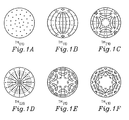
- Figs. 1A-1F disclose, for illustrative purposes, the lower order TM nmp field distributions for a circular parallel plate resonator, i.e. the TM 010 , TM 110 , TM 210 , TM 020 , TM 310 , TM 410 -modes.
- Solid lines indicate the current
- dashed lines indicate the magnetic field
- the field/current distributions are fixed in space by coupling arrangements (such as coupling loops, coupling probes, or a further resonator).
- Parallel plate resonators for example in the form of circular dielectric disks and circular patches on dielectric substrates, have found several different microwave applications.
- the resonators are seen as electrically thin if the thickness (d) is smaller than half the wavelength of the microwave ( ⁇ g ) in the resonator, d ⁇ g /2, so that no standing waves will be present along the axis of the disk.
- Electrically tunable resonators based on circular ferroelectric disks have been largely investigated for applications in tunable filters.
- the third index is 0.
- the above formula may be corrected taking fringing fields into account.
- the mode selected for the resonators is the TM 020 mode.
- the invention is however not limited to any particular mode but substantially any mode could be selected. Mode selection is among others discussed in "Microwave Device and Method Relating Thereto" with Application No. 9901190-0 as discussed earlier in the application.
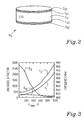
- Fig. 2 schematically illustrates an electronically tunable resonator 10 0 based on a non-linear dielectric substrate 3 0 with an extremely high dielectric constant, e.g. STO (SrTiO 3 which has a dielectric constant of more than 2000 at the temperature of liquid nitrogen (N) and a dielectric constant of about 300 at room temperature.
- an extremely high dielectric constant e.g. STO (SrTiO 3 which has a dielectric constant of more than 2000 at the temperature of liquid nitrogen (N) and a dielectric constant of about 300 at room temperature.
- STO STO
- N liquid nitrogen
- the resonant frequencies of a circular parallel plate disk resonator having a diameter of 10 mm and a thickness of 0.5 mm will be in the range of 0.2-2.0 GHz depending on the temperature and on the applied DC biasing.
- Such resonators can be excited by simple probes or loops as in/out coupling means.
- the thickness of a parallel plate resonator is much smaller than the wavelength of the microwave signal in order for the resonator to support only the lowest order TM-modes, and in order to keep the DC-voltages, which are required for the electrical tuning of the resonator with a non-linear dielectric substrate as low as possible.
- Fig. 3 schematically illustrates a diagram indicating the measured microwave performance of two resonators.
- the unloaded quality factor, Q as a function of the biasing voltage, is illustrated for a resonator in which normally conducting, i.e. non-superconducting, electrode plates are used, corresponding to Q II , and for a resonator in which HTS electrodes of YBCO are used, corresponding to lines Q I .
- the resonant frequencies are illustrated as a function of the applied biasing voltage, corresponding to F I , F II for Cu electrodes and for YBCO electrodes respectively. It can be seen that at high biasing voltages, it does not make much difference whether YBCO electrodes are used or if normally conducting (non-superconducting) electrode are used.
- the resonant frequency of a such resonator should be between 0.5-3GHz, which is the frequency region of cellular communication systems.
- a resonator apparatus comprising two coupled resonators, e.g. as described in Fig. 4 , to provide for a so called loss compensation.
- a first embodiment of the present invention is illustrated. It shows a resonator arrangement 10 comprising a resonator apparatus with a first resonator 1 and a second resonator 2, which resonators are coupled to each other.
- the first resonator comprises a circular disk resonator with a first electrode plate 12, and a linear substrate 11 with a high quality factor (Q) which is not tunable.
- the substrate material may for example comprise sapphire, LaAlO 3 or any of the other materials referred to earlier in the application.
- the first resonator 1 comprises another electrode plate 13 disposed on the other side of the linear substrate.
- the electrodes 12, 13 may comprise a "normally" conducting (i.e.
- non-superconducting, but preferably high conductivity metal such as for example Au, Ag, Cu but they may also comprise a superconducting material.
- the electrode plates 12, 13 comprise a high temperature superconducting material, e.g. YBCO.
- the resonator apparatus 10 further comprises a second resonator 2, which is tunable and comprises a substrate material 21 of e.g. a ferroelectric material, e.g. SrTiO 3 , KTaO 3 or any other of the materials as referred to earlier in the application having a growing loss factor, i.e. for which the quality factor decreases with the applied voltage as discussed above with reference to Fig. 3 .
- the second resonator 2 is a circular disk resonator with a first electrode plate 22 and a second electrode plate 13, which is the same electrode plate as the second electrode of the first resonator 1.
- the common electrode 13 forms a common ground plane for the first and second resonators 1,2.
- the first and second resonators 1,2 are coupled to each other through coupling means 5, here comprising a slot or an aperture in the common ground plane 13 allowing for distributing of electromagnetic energy between the two resonators upon application of a biasing voltage.
- biasing means 3 are provided comprising a variable voltage source which is connected to the ground plane 13 and to the first electrode 22 of the second resonator 2, such that for tuning of the resonator apparatus, the biasing voltage is applied to the second resonator 2.
- V B biasing voltage
- the biasing voltage V B When the biasing voltage V B is applied and increased, the resonant frequency of the second resonator 2 will increase.
- Electromagnetic energy will then be relocated to the first resonator 1, which means that the increased loss tangent of the second resonator, which, as discussed above, increases as the biasing voltage is increased, will have a low influence on the resonator apparatus as such. Thus, as the biasing voltage increases, more and more electromagnetic energy will be transferred or redistributed to the first resonator 1. In this manner the increased loss in the tunable second resonator 2 will be compensated for.
- the coupling slot is circular; which shape it should have depends on the mode(s) that is/are selected.
- the current lines cf. Figs 1A-1F ) should not be interrupted. Normally it functions with a circular slot for all modes. It may also be ellipsoidal. For a rectangular resonator it may be rectangular.
- the first and second resonators may also have other shapes, the same or different.
- the ground plane may also have the same size (and shape) as the first resonator or any other shape as long as it is not smaller than the first resonator.
- input coupling means 4 in the form of an antenna are shown for input of microwave signals to the microwave device for exciting the relevant mode or modes.
- any input/output coupling means can be used and the antenna is merely indicated for indication of an example on input coupling means.
- Different types of input/output coupling means are discussed in the Swedish patent application “Arrangement and Method Relating to Microwave Devices” filed on April 18, 1997 with the application No. 9701450-0 .
- the coupling means can be used for application of a biasing voltage. It also illustrates examples on coupling means that can be used while still requiring separate biasing means, as well as a number of state of the art devices.
- the present invention is not limited to any particular way of coupling microwave energy into/out of the device, the main thing being that the biasing voltage is applied to the second resonator, which is tunable, and which is coupled to another resonator which is not tunable, which resonators are coupled to one another such that redistribution of electromagnetic energy is enabled.
- the second resonator 2 may also be a thin parallel plate microwave resonator, thin here meaning that it is thin in comparison with the wavelength in the resonator, ⁇ g , more specifically d ⁇ g /2, wherein d is the thickness of the resonator 2, and ⁇ g is the wavelength in the resonator.
- ⁇ g the wavelength in the resonator.
- the apparatus could be a thin film device, although bulk substrate devices are preferred, as discussed earlier.
- Fig. 5 the equivalent circuit of the two coupled resonators 1,2 of Fig. 4 is illustrated.
- Z in represents the input impedance of the arrangement
- R 1 , C 1 represent the resistor and the capacitor of the first, non-tunable resonator 1.
- R 2 , C 2 represent the tunable components of the second resonator 2, and
- C 0 5 is the coupling capacitor coupling the first and second resonators to each other.
- Figs. 6A,6B , 7A,7B,7C follows an illustration and explanation of a simulation of the input impedance of the equivalent circuit of Fig. 5 .
- d 1 is the loss factor of the linear dielectric substrate of the first resonator
- d 2 (U) is the loss factor of the non-linear ferroelectric substrate of the second resonator as a function of the biasing voltage.
- the biasing voltage V is given in Volts, L (the inductance) in nH.
- U 0 and k are phenomenological characteristics of the ferroelectric material.
- C1 2.5 pF
- C20 120 pF
- C 0 200 pF
- L 1.59 x 10 -9
- m 0.115
- L2 0,0517 x 10 -9 H
- LO L x m
- L00 L x (1-m).
- C ⁇ 2 U C ⁇ 20 / 1 + U / U ⁇ 0 2
- d ⁇ 2 U d ⁇ 20 ⁇ 1 + k ⁇ ⁇ U / U ⁇ 0 2 .
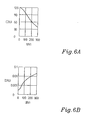
- Fig. 6A illustrates the dependence of C2(U) on the applied voltage U
- Fig. 6B illustrates the dependence of d2(U) on the applied biasing voltage.
- the input impedance of the second resonator is given by:
- Z ⁇ 2 f U i ⁇ ⁇ f ⁇ L ⁇ 2 + 10 12 i ⁇ ⁇ f ⁇ C ⁇ 2 U ⁇ 1 + i ⁇ d ⁇ 2 U
- Figs. 7A illustrate the real and imaginary parts of the input impedance at zero applied voltage.
- Figs. 7B, 7C illustrates the real and imaginary parts of the impedance at a biasing voltage of 100V and 200V respectively.
- the resonant frequency will be about 2459.4 MHz
- a biasing voltage of 100V it will be 2509.3 MHz
- for an applied biasing voltage of 200V it will be about 2530.9 MHz.
- the frequency shift ⁇ F will be 49.9 MHz for 100V and 71.5 MHz for 200 V biasing voltage.
- the loss factor of the ferroelectric, tunable substrate material will change about 30 times.
- the total quality factor change will be no more than about ⁇ 30%. If the frequency band of the resonator is about 0.5 MHz, the resonator figure of merit will be ⁇ F/ ⁇ f ⁇ 71.5/0.5 ⁇ 140. It should however be clear that Figs. 6A,6B , 7A,7B,7C merely are included for illustrative and exemplifying purposes.
- Fig. 8A shows one particular example of a first resonator 1A e.g. as in Fig. 4 , which comprises a circular disk resonator. It comprises a non-tunable, high quality linear substrate 11A, a first conducting electrode 12A, which for example may be superconducting or even high temperature superconducting, and a second electrode 13A which for example is a larger than the substrate 11A and the first electrode 12A. It may for example also have the same size as the first electrode 12A.
- This second electrode plate 13A acts as a common ground plane for the first resonator 1A and for the second resonator 2A of Fig. 8B .
- the common ground plane 13 comprises coupling means 5A for coupling the first resonator 1A and the second resonator 2A to each other.
- the second resonator 2A comprises a first electrode 22A disposed on a ferroelectric substrate e.g. of STO which is non-linear and has an (extremely) high dielectric constant.
- Biasing means comprising a variable voltage source V o 3 with connection leads is connected to the common ground plane 13A and to the first electrode plate 22A of the second resonator 2A.
- the TM 020 modes are excited via input coupling means (not shown in this figure).
- the coupling means 5A may comprise a slot which is circular or ellipsoidal, and through which electromagnetic energy from the second resonator 2A can be redistributed to the first resonator 1A upon application of a biasing voltage to the second resonator 2A.
- Figs. 9A, 9B in a manner similar to that of Figs. 8A, 8B illustrate a first resonator 1B ( Fig. 9A ) and a second resonator 2B ( Fig. 9B ) together forming an alternative resonator apparatus in which the first and second resonators 1B, 2B are square-shaped.
- the first resonator 1B like in the preceding embodiment, comprises a linear material with a high quality which is non-tunable, e.g. of LaAlO 3
- the second resonator 2B comprises a tunable ferroelectric material e.g. of STO.
- the first resonator 1B comprises a first electrode plate 12B which of course can be similar to the electrode plate of Fig. 8A with the difference that it is square-shaped, but it may also, as illustrated in the figure, comprise a very thin, (thin in order not to affect the surface impedance) superconducting layer 12B 1 covered, on the side opposite to the substrate, by a non-superconducting high conductivity film 12B 2 e.g. of Au, Ag, Cu or similar for protective purposes.
- the superconducting film is high temperature superconducting, e.g. of YBCO.
- the second resonator 2B comprises a first electrode plate 22B with a (high temperature) superconducting layer 22B 1 covered by a non-superconducting metal layer 22B 2 .
- the first and second resonator 1B, 2B like in the preceding embodiment, comprise a common ground plane, for both forming a second electrode 13B which, in this particular implementation, comprises a (high temperature) superconducting layer 13B 1 covered on either side by a very thin non-superconducting metal film 13B 2 , 13B 3 .
- the ground plane just consists of a superconducting layer.
- a biasing voltage is applied between the first and second electrodes 22B, 13B of the second resonator 2B and electromagnetic energy can be redistributed via coupling means 5B, which here comprises a rectangular slot, to the first resonator 1B.
- coupling means 5B which here comprises a rectangular slot
- the coupling means does not have to be a rectangular slot, but it can be any kind of aperture giving the desired properties as far as transfer of electromagnetic energy is concerned for the concerned modes. It may e.g. be circular or ellipsoidal as well. Still further the electrodes may consist of normal metal only.
- the inventive concept is also applicable to dual mode operating resonators, oscillators, filters whereby dual mode operation can be provided for in different manners, e.g. as disclosed in the patent application "Tunable Microwave Devices" referred to above.
- Fig. 10 for illustrative purposes shows a very simplified top view of a dual mode resonator apparatus comprising input 4C in and output 4C out coupling means and a protruding portion 6 for providing coupling enabling dual mode operation.
- a dual mode operating resonator apparatus can also be provided for by rectangularly shaped resonators or in any other appropriate manner.
- the coupling slot for coupling between the first and second resonator is illustrated by the dashed line circle.
- the inventive concept is extended to a tunable filter 100, cf. Fig. 11 .
- two resonator apparatuses 10D, 10E are provided each comprising a first resonator 1D, 1E respectively and a second resonator 2D, 2E respectively, which share a common ground plane 13F.
- the first resonators 1D,1E comprise a common substrate 11C. There may alternatively be separate substrates.
- the distance between the resonator apparatuses gives the coupling strength of the filter.
- the resonator apparatuses comprise circular disk resonators as described in for example Figs.
- Fig. 12 illustrates the equivalent circuit of a two-pole filter 100 as in Fig. 11 which is connected by a transmission line section.
- the first resonator apparatus 10D with resistance R 1D and capacitance C 1D corresponding to the first non-tunable resonator 1D and the tunable resonator 2D comprising a resistor R 2D and capacitor C 2D which resonators are coupled to each other by the coupling means 5D represented by a capacitor C 04 .
- the inductances L 04 , L 004 ; L 05 , L 005 of the resonators are also illustrated in the figure as explained earlier with reference to Fig. 6A, 6B , 7A, 7B .
- a second resonator apparatus 10E comprising a first resonator 1E and second resonator 2E with the respective non-tunable and tunable components resistance R 1E , C 1E and R 2E , C 2E respectively and connecting capacitor C 05 corresponding to coupling means 5E.
- the two-pole filter is connected by a transmission line section.
- the characteristic impedance of the external line Z 0 50 Ohm
- the characteristic impedance of the coupling line Z 01 45 Ohm
- the electrical length of the coupling line at the central frequency is 80°.
- Figs. 13A, 13B are diagrams showing simulated lines of the tunable two-pole filter of Fig. 10 .
- the insertion losses in dB and the return losses in dB correspond to the transmissions T and the reflectivity.
- ⁇ is given for three different values of a biasing voltage V.
- T1 corresponds to the transmission as a function of the frequency at zero biasing voltage
- T 2 corresponds to the transmission as a function of the frequency in GHz for a biasing voltage of 100V
- T 3 is the transmission for a biasing voltage of 200V.
- the reflectivities ⁇ 1 , ⁇ 2 , ⁇ 3 are indicated in Fig. 13B for biasing voltages 0V, 100V, 200V.
- the insertion losses and the return losses are maintained even at a higher biasing voltage.
- the average bandwidth is 15 MHz, and the range of tunability is approximately 70 MHz with an insertion loss ⁇ 0.5 dB.
- the drastically increasing loss factor of the ferroelectric material of the second resonator is largely compensated for through the application of the inventive concept.
- the resonators may be of other different shapes, they may comprise different substrate materials as discussed in the foregoing, they may comprise non-superconducting or particularly (high temperature) superconducting electrodes etc. They may also be single mode operating or dual mode operating and any appropriate type of coupling means may be provided for coupling in of electromagnetic energy to excite the desired modes, i.e. the modes which are selected, particularly the TM 020 modes. However, also other modes can be selected in any appropriate manner.
Landscapes
- Physics & Mathematics (AREA)
- Electromagnetism (AREA)
- Control Of Motors That Do Not Use Commutators (AREA)
Claims (18)
- Agencement résonant accordable comprenant un appareil résonateur (10 ; 100), des moyens de couplage d'entrée/sortie (4 ; 4Cin, 4Cout) pour coupler une énergie électromagnétique dans/hors de l'appareil résonateur, et un dispositif d'accord (3) pour l'application d'une tension/d'un champ électrique de polarisation à l'appareil résonateur, l'appareil résonateur comprenant un premier résonateur (1 ; 1A ; 1B ; 1C ; 1D ; 1E) et un deuxième résonateur (2 ; 2A ; 2B ; 2D ; 2E), dans lequel ledit deuxième résonateur est accordable et comprend un substrat ferroélectrique (21), et dans lequel ledit premier résonateur n'est pas accordable, des moyens de couplage (5 ; 5A ; 5B ; 5C ; 5D ; 5E) étant prévus pour réaliser un couplage entre lesdits premier et deuxième résonateurs, lesdits premier et deuxième résonateurs étant séparés par un plan de masse (13 ; 13A ; 13B ; 13F) qui est commun auxdits premier et deuxième résonateurs,
caractérisé en ce que
le premier résonateur (1 ; 1A ; 1B ; 1C ; 1D ; 1E) est un résonateur à plaques parallèles qui comprend un substrat disque massif ou à couches minces diélectrique (11 ; 11A ; 11B ; 11C) avec une première plaque d'électrode (12, 12A) disposée d'un côté du substrat diélectrique (11 ; 11A ; 11B ; 11C) et une deuxième plaque d'électrode (13 ; 13A ; 13B ; 13F) disposée de l'autre côté du substrat diélectrique (11 ; 11A ; 11B ; 11C), dont la permittivité électrique ne varie pas sensiblement avec la tension de polarisation appliquée,
le deuxième résonateur (2 ; 2A ; 2B ; 2D ; 2E) comprend un substrat disque massif ou à couches minces ferroélectrique accordable (21) avec une première plaque d'électrode (22 ; 22A ; 22B) disposée d'un côté du substrat ferroélectrique (21) et une deuxième plaque d'électrode (13 ; 13A ; 13B ; 13F) disposée de l'autre côté du substrat ferroélectrique (21),
ladite deuxième plaque d'électrode du deuxième résonateur (2; 2A; 2B ; 2D ; 2E) est identique à la deuxième plaque d'électrode du premier résonateur (1 ; 1A ; 1B ; 1C ; 1D ; 1E) et forme ledit plan de masse commun, et en ce que, pour accorder l'appareil résonateur, la tension/le champ électrique de polarisation est appliqué au deuxième résonateur (2 ; 2A ; 2B ; 2D ; 2E). - Agencement résonant accordable selon la revendication 1,
caractérisé en ce que
le substrat diélectrique (11 ; 11A ; 11B ; 11C) du premier résonateur comprend du LaAlO3, du MgO, du NdGaO3, de l'Al2O3 ou un saphir. - Agencement résonnant accordable selon la revendication 1 ou 2,
caractérisé en ce que le premier résonateur (1 ; 1A ; 1B ; 1C ; 1D ; 1E) est conçu pour avoir un facteur de qualité de 105 à 5.105. - Agencement résonant accordable selon la revendication 1, 2 ou 3,
caractérisé en ce que
le substrat ferroélectrique (21; 21A; 21B) du deuxième résonateur comprend du SrTiO3, du KTaO3 ou du BaSTO3. - Agencement résonant accordable selon l'une quelconque des revendications 1 à 4,
caractérise en ce que
les première et deuxième plaques d'électrode, c'est-à-dire, les premières électrodes et le plan de masse commun, consistent en un métal non supraconducteur normal, Au, Ag ou Cu. - Agencement résonant accordable selon l'une quelconque des revendications 1 à 4,
caractérisé en ce que
les première et deuxième plaques d'électrode, c'est-à-dire, les premières électrodes et le plan de masse commun, consistent en un matériau supraconducteur. - Agencement résonant accordable selon l'une quelconque des revendications 1 à 4 ou 6,
caractérisé en ce que
les première et deuxième plaques d'électrode, c'est-à-dire, les premières plaques d'électrode et le plan de masse commun, consistent et un matériau supraconducteur à température élevée. - Agencement résonant accordable selon l'une quelconque des revendications précédentes,
caractérisé en ce que
les moyens de couplage (5 ; 5A ; 5B ; 5C ; 5D ; 5E) comprennent une fente ou une ouverture dans la plaque d'électrode agissant en tant que plan de masse commun et, lors de l'application d'une tension de polarisation d'accord audit deuxième résonateur (2 ; 2A ; 2B ; 2D ; 2E), permettent une redistribution de l'énergie électromagnétique entre les deuxième et premier résonateurs. - Agencement résonant accordable selon la revendication 8,
caractérisé en ce que
le moyen de polarisation (3) comprend une source de tension variable connectée à la plaque d'électrode agissant en tant que plan de masse commun et à la première plaque d'électrode du deuxième résonateur (2), et en ce que la distribution de l'énergie électromagnétique dépend de la tension de polarisation appliquée, moyennant quoi le transfert d'énergie électromagnétique du deuxième résonateur au premier résonateur augmente alors que la tension de polarisation augmente. - Agencement résonnant accordable selon la revendication 9,
caractérisé en ce que
la fréquence de résonnance et la tangente de perte du deuxième résonateur augmentent avec l'application d'une tension de polarisation croissante, et en ce que, également, le transfert d'énergie électromagnétique par l'intermédiaire des moyens de couplage du deuxième au premier résonateur augmente, compensant automatiquement l'augmentation de la tangente de perte du deuxième résonateur en réduisant l'influence de celle-ci sur l'appareil résonateur couplé. - Agencement résonant accordable selon la revendication 1,
caractérisé en ce que
les premier et deuxième résonateurs comprennent des substrats à couches minces. - Agencement résonnant accordable selon l'une quelconque des revendications précédentes,
caractérisé en ce que
l'agencement comprend au moins deux appareils résonateurs, et en ce que le plan de masse commun (13 ; 13A ; 13B ; 13F) est commun auxdits au moins deux appareils résonateurs qui forment un filtre accordable (100). - Agencement résonant accordable selon la revendication 12.
caractérisé en ce que
les moyens de couplage comprennent, pour chaque appareil résonateur, une fente ou une ouverture (5 ; 5A ; 5B ; 5C ; 5D ; 5E) dans le plan de masse commun. - Agencement résonant accordable selon l'une quelconque des revendications précédentes,
caractérisé en ce que
chaque résonateur a une forme circulaire, carrée, rectangulaire ou ellipsoïdale. - Agencement résonant accordable selon la revendication 14,
caractérisé en ce que
l'agencement comprend un appareil résonateur bimode, et en ce que chaque résonateur comprend une protubérance (6), une découpe ou une perturbation pour permettre un fonctionnement bimode. - Procédé d'accord d'un appareil résonateur comprenant les étapes consistant à :- fournir un premier résonateur non accordable,- fournir un deuxième accordable,- fournir des moyens de couplage de sorte que les premier et deuxième résonateurs soient couplés, permettant un transfert d'énergie électromagnétique entre les premier et deuxième résonateurs,- appliquer une tension de polarisation d'accord audit deuxième résonateur, caractérisé en ce quele premier résonateur (1 ; 1A ; 1B ; 1C ; 1D ; 1E) est un résonateur à plaques parallèles, avec un substrat disque massif ou à couches minces diélectrique (11 ; 11A ; 11B ; 11C) avec une première plaque d'électrode (12, 12A) disposée d'un côté du substrat diélectrique (11 ; 11A ; 11B ; HC) et une deuxième plaque d'électrode (13 ; 13A ; 13B ; 13F) disposée de l'autre côté du substrat diélectrique (11 ; 11A ; 11 B ; 11C), dont la permittivité électrique ne varie pas sensiblement avec la tension de polarisation appliquée,
le deuxième résonateur (2 ; 2A ; 2B ; 2D ; 2E) comprend an substrat disque massif ou à couches minces ferroélectrique accordable (21) avec une première plaque d'électrode (22 ; 22A ; 22B) disposée d'un côté du substrat ferroélectrique (21) et une deuxième plaque d'électrode (13 ; 13A ; 13B ; 13F) disposée de l'autre côté du substrat ferroélectrique (21),
ladite deuxième électrode du deuxième résonateur (2 ; 2A ; 2B ; 2D ; 2E) est identique à la deuxième plaque d'électrode du premier résonateur (1 ; 1A ; 1B ; 1C ; 1D ; 1E) et forme un plan de masse commun, et en ce que le procédé consiste à :
appliquer la tension de polarisation d'accord au deuxième résonateur tout en optimisant l'application de la tension de polarisation de sorte que l'influence de l'augmentation de la tangente de perte dans le premier résonateur, ou l'appareil résonateur couple, soit compensée, en augmentant un transfert d'énergie électromagnétique au premier résonateur par des moyens de couplage. - Procède selon la revendication 16,
caractérisé en ce que
le premier résonateur comprend un substrat, massif ou à couches minces, en LaAlO3, en MgO, en NdGaO3, en Al2O3 ou en saphir, et en ce que le deuxième résonateur comprend un substrat, massif ou à couches minces, en SrTiO3, en KTaO3, les plaques d'électrode comprenant un métal normal, ou des supraconducteurs ou des supraconducteurs à température élevée. - Procédé selon l'une quelconque des revendications 16 et 17,
caractérisé en ce que
le procédé comprend l'étape consistant à :- coupler deux appareils résonateurs ou plus de sorte qu'un filtre soit réalisé,- optimiser le couplage entre les premier et deuxième résonateurs respectifs de sorte que l'augmentation du facteur de perte produite par une augmentation de la tension de polarisation, dans les substrats ferroélectriques, puisse être réduite.
Applications Claiming Priority (3)
| Application Number | Priority Date | Filing Date | Title |
|---|---|---|---|
| SE0102785A SE519705C2 (sv) | 2001-08-22 | 2001-08-22 | En avstämbar ferroelektrisk resonatoranordning |
| SE0102785 | 2001-08-22 | ||
| PCT/SE2002/001461 WO2003019715A1 (fr) | 2001-08-22 | 2002-08-16 | Systeme de resonateur ferroelectrique accordable |
Publications (2)
| Publication Number | Publication Date |
|---|---|
| EP1433218A1 EP1433218A1 (fr) | 2004-06-30 |
| EP1433218B1 true EP1433218B1 (fr) | 2011-07-20 |
Family
ID=20285083
Family Applications (1)
| Application Number | Title | Priority Date | Filing Date |
|---|---|---|---|
| EP02759031A Expired - Lifetime EP1433218B1 (fr) | 2001-08-22 | 2002-08-16 | Systeme de resonateur ferroelectrique accordable |
Country Status (8)
| Country | Link |
|---|---|
| US (1) | US7069064B2 (fr) |
| EP (1) | EP1433218B1 (fr) |
| JP (1) | JP4021844B2 (fr) |
| KR (1) | KR100907358B1 (fr) |
| CN (1) | CN1284265C (fr) |
| AT (1) | ATE517449T1 (fr) |
| SE (1) | SE519705C2 (fr) |
| WO (1) | WO2003019715A1 (fr) |
Families Citing this family (106)
| Publication number | Priority date | Publication date | Assignee | Title |
|---|---|---|---|---|
| US7825543B2 (en) * | 2005-07-12 | 2010-11-02 | Massachusetts Institute Of Technology | Wireless energy transfer |
| CN102983639B (zh) * | 2005-07-12 | 2016-01-27 | 麻省理工学院 | 无线非辐射能量传递 |
| JP4813171B2 (ja) * | 2005-12-16 | 2011-11-09 | 株式会社豊田自動織機 | ステータの製造方法及び製造装置 |
| US9130602B2 (en) | 2006-01-18 | 2015-09-08 | Qualcomm Incorporated | Method and apparatus for delivering energy to an electrical or electronic device via a wireless link |
| JP4707650B2 (ja) * | 2006-03-30 | 2011-06-22 | 富士通株式会社 | 超伝導フィルタデバイス |
| JP4855150B2 (ja) * | 2006-06-09 | 2012-01-18 | 株式会社トプコン | 眼底観察装置、眼科画像処理装置及び眼科画像処理プログラム |
| US9774086B2 (en) * | 2007-03-02 | 2017-09-26 | Qualcomm Incorporated | Wireless power apparatus and methods |
| US9421388B2 (en) | 2007-06-01 | 2016-08-23 | Witricity Corporation | Power generation for implantable devices |
| US8115448B2 (en) | 2007-06-01 | 2012-02-14 | Michael Sasha John | Systems and methods for wireless power |
| US9124120B2 (en) | 2007-06-11 | 2015-09-01 | Qualcomm Incorporated | Wireless power system and proximity effects |
| KR100933855B1 (ko) * | 2008-01-25 | 2009-12-24 | 최정심 | 공조 덕트의 피더 안테나 |
| JP2011523844A (ja) * | 2008-05-14 | 2011-08-18 | マサチューセッツ インスティテュート オブ テクノロジー | 干渉増大を含む無線エネルギー伝達装置及び方法 |
| CN101645349B (zh) * | 2008-08-07 | 2011-12-14 | 达方电子股份有限公司 | 能量传输系统 |
| US8466583B2 (en) | 2008-09-27 | 2013-06-18 | Witricity Corporation | Tunable wireless energy transfer for outdoor lighting applications |
| US8686598B2 (en) | 2008-09-27 | 2014-04-01 | Witricity Corporation | Wireless energy transfer for supplying power and heat to a device |
| US8461722B2 (en) | 2008-09-27 | 2013-06-11 | Witricity Corporation | Wireless energy transfer using conducting surfaces to shape field and improve K |
| US8587155B2 (en) | 2008-09-27 | 2013-11-19 | Witricity Corporation | Wireless energy transfer using repeater resonators |
| US9601266B2 (en) | 2008-09-27 | 2017-03-21 | Witricity Corporation | Multiple connected resonators with a single electronic circuit |
| US8901779B2 (en) | 2008-09-27 | 2014-12-02 | Witricity Corporation | Wireless energy transfer with resonator arrays for medical applications |
| US9515494B2 (en) | 2008-09-27 | 2016-12-06 | Witricity Corporation | Wireless power system including impedance matching network |
| US8922066B2 (en) | 2008-09-27 | 2014-12-30 | Witricity Corporation | Wireless energy transfer with multi resonator arrays for vehicle applications |
| US8643326B2 (en) | 2008-09-27 | 2014-02-04 | Witricity Corporation | Tunable wireless energy transfer systems |
| US8598743B2 (en) * | 2008-09-27 | 2013-12-03 | Witricity Corporation | Resonator arrays for wireless energy transfer |
| US9065423B2 (en) | 2008-09-27 | 2015-06-23 | Witricity Corporation | Wireless energy distribution system |
| US8461721B2 (en) | 2008-09-27 | 2013-06-11 | Witricity Corporation | Wireless energy transfer using object positioning for low loss |
| US8957549B2 (en) | 2008-09-27 | 2015-02-17 | Witricity Corporation | Tunable wireless energy transfer for in-vehicle applications |
| US8912687B2 (en) | 2008-09-27 | 2014-12-16 | Witricity Corporation | Secure wireless energy transfer for vehicle applications |
| US9744858B2 (en) | 2008-09-27 | 2017-08-29 | Witricity Corporation | System for wireless energy distribution in a vehicle |
| US8410636B2 (en) | 2008-09-27 | 2013-04-02 | Witricity Corporation | Low AC resistance conductor designs |
| US9105959B2 (en) | 2008-09-27 | 2015-08-11 | Witricity Corporation | Resonator enclosure |
| US9577436B2 (en) | 2008-09-27 | 2017-02-21 | Witricity Corporation | Wireless energy transfer for implantable devices |
| US8692412B2 (en) | 2008-09-27 | 2014-04-08 | Witricity Corporation | Temperature compensation in a wireless transfer system |
| US8669676B2 (en) | 2008-09-27 | 2014-03-11 | Witricity Corporation | Wireless energy transfer across variable distances using field shaping with magnetic materials to improve the coupling factor |
| US8587153B2 (en) | 2008-09-27 | 2013-11-19 | Witricity Corporation | Wireless energy transfer using high Q resonators for lighting applications |
| US9601270B2 (en) | 2008-09-27 | 2017-03-21 | Witricity Corporation | Low AC resistance conductor designs |
| US8901778B2 (en) | 2008-09-27 | 2014-12-02 | Witricity Corporation | Wireless energy transfer with variable size resonators for implanted medical devices |
| US8497601B2 (en) * | 2008-09-27 | 2013-07-30 | Witricity Corporation | Wireless energy transfer converters |
| US8324759B2 (en) | 2008-09-27 | 2012-12-04 | Witricity Corporation | Wireless energy transfer using magnetic materials to shape field and reduce loss |
| US8482158B2 (en) | 2008-09-27 | 2013-07-09 | Witricity Corporation | Wireless energy transfer using variable size resonators and system monitoring |
| US9160203B2 (en) | 2008-09-27 | 2015-10-13 | Witricity Corporation | Wireless powered television |
| US8933594B2 (en) | 2008-09-27 | 2015-01-13 | Witricity Corporation | Wireless energy transfer for vehicles |
| US8772973B2 (en) | 2008-09-27 | 2014-07-08 | Witricity Corporation | Integrated resonator-shield structures |
| US9396867B2 (en) | 2008-09-27 | 2016-07-19 | Witricity Corporation | Integrated resonator-shield structures |
| US8487480B1 (en) | 2008-09-27 | 2013-07-16 | Witricity Corporation | Wireless energy transfer resonator kit |
| US9035499B2 (en) | 2008-09-27 | 2015-05-19 | Witricity Corporation | Wireless energy transfer for photovoltaic panels |
| US8963488B2 (en) | 2008-09-27 | 2015-02-24 | Witricity Corporation | Position insensitive wireless charging |
| US8928276B2 (en) | 2008-09-27 | 2015-01-06 | Witricity Corporation | Integrated repeaters for cell phone applications |
| US8461720B2 (en) | 2008-09-27 | 2013-06-11 | Witricity Corporation | Wireless energy transfer using conducting surfaces to shape fields and reduce loss |
| US8471410B2 (en) | 2008-09-27 | 2013-06-25 | Witricity Corporation | Wireless energy transfer over distance using field shaping to improve the coupling factor |
| US8692410B2 (en) | 2008-09-27 | 2014-04-08 | Witricity Corporation | Wireless energy transfer with frequency hopping |
| US8304935B2 (en) | 2008-09-27 | 2012-11-06 | Witricity Corporation | Wireless energy transfer using field shaping to reduce loss |
| US8400017B2 (en) | 2008-09-27 | 2013-03-19 | Witricity Corporation | Wireless energy transfer for computer peripheral applications |
| US8569914B2 (en) | 2008-09-27 | 2013-10-29 | Witricity Corporation | Wireless energy transfer using object positioning for improved k |
| US9246336B2 (en) | 2008-09-27 | 2016-01-26 | Witricity Corporation | Resonator optimizations for wireless energy transfer |
| US8476788B2 (en) | 2008-09-27 | 2013-07-02 | Witricity Corporation | Wireless energy transfer with high-Q resonators using field shaping to improve K |
| US8937408B2 (en) | 2008-09-27 | 2015-01-20 | Witricity Corporation | Wireless energy transfer for medical applications |
| US9184595B2 (en) | 2008-09-27 | 2015-11-10 | Witricity Corporation | Wireless energy transfer in lossy environments |
| US8441154B2 (en) | 2008-09-27 | 2013-05-14 | Witricity Corporation | Multi-resonator wireless energy transfer for exterior lighting |
| US9106203B2 (en) | 2008-09-27 | 2015-08-11 | Witricity Corporation | Secure wireless energy transfer in medical applications |
| US8907531B2 (en) | 2008-09-27 | 2014-12-09 | Witricity Corporation | Wireless energy transfer with variable size resonators for medical applications |
| US9093853B2 (en) | 2008-09-27 | 2015-07-28 | Witricity Corporation | Flexible resonator attachment |
| US8946938B2 (en) | 2008-09-27 | 2015-02-03 | Witricity Corporation | Safety systems for wireless energy transfer in vehicle applications |
| US8552592B2 (en) | 2008-09-27 | 2013-10-08 | Witricity Corporation | Wireless energy transfer with feedback control for lighting applications |
| JP2012504387A (ja) | 2008-09-27 | 2012-02-16 | ウィトリシティ コーポレーション | 無線エネルギー伝達システム |
| US9601261B2 (en) | 2008-09-27 | 2017-03-21 | Witricity Corporation | Wireless energy transfer using repeater resonators |
| US9318922B2 (en) | 2008-09-27 | 2016-04-19 | Witricity Corporation | Mechanically removable wireless power vehicle seat assembly |
| US8629578B2 (en) | 2008-09-27 | 2014-01-14 | Witricity Corporation | Wireless energy transfer systems |
| US8947186B2 (en) | 2008-09-27 | 2015-02-03 | Witricity Corporation | Wireless energy transfer resonator thermal management |
| US9544683B2 (en) | 2008-09-27 | 2017-01-10 | Witricity Corporation | Wirelessly powered audio devices |
| US8723366B2 (en) * | 2008-09-27 | 2014-05-13 | Witricity Corporation | Wireless energy transfer resonator enclosures |
| US8362651B2 (en) | 2008-10-01 | 2013-01-29 | Massachusetts Institute Of Technology | Efficient near-field wireless energy transfer using adiabatic system variations |
| US9602168B2 (en) | 2010-08-31 | 2017-03-21 | Witricity Corporation | Communication in wireless energy transfer systems |
| US9948145B2 (en) | 2011-07-08 | 2018-04-17 | Witricity Corporation | Wireless power transfer for a seat-vest-helmet system |
| CN108110907B (zh) | 2011-08-04 | 2022-08-02 | 韦特里西提公司 | 可调谐无线电源架构 |
| KR102010943B1 (ko) | 2011-09-09 | 2019-08-14 | 위트리시티 코포레이션 | 무선 에너지 전송 시스템에서의 이물질 검출 |
| US20130062966A1 (en) | 2011-09-12 | 2013-03-14 | Witricity Corporation | Reconfigurable control architectures and algorithms for electric vehicle wireless energy transfer systems |
| US9318257B2 (en) | 2011-10-18 | 2016-04-19 | Witricity Corporation | Wireless energy transfer for packaging |
| HK1200602A1 (en) | 2011-11-04 | 2015-08-07 | WiTricity公司 | Wireless energy transfer modeling tool |
| EP2807720A4 (fr) | 2012-01-26 | 2015-12-02 | Witricity Corp | Transfert d'énergie sans fil à champs réduits |
| US9343922B2 (en) | 2012-06-27 | 2016-05-17 | Witricity Corporation | Wireless energy transfer for rechargeable batteries |
| US9287607B2 (en) | 2012-07-31 | 2016-03-15 | Witricity Corporation | Resonator fine tuning |
| US9595378B2 (en) | 2012-09-19 | 2017-03-14 | Witricity Corporation | Resonator enclosure |
| US9465064B2 (en) | 2012-10-19 | 2016-10-11 | Witricity Corporation | Foreign object detection in wireless energy transfer systems |
| US9449757B2 (en) | 2012-11-16 | 2016-09-20 | Witricity Corporation | Systems and methods for wireless power system with improved performance and/or ease of use |
| JP2016534698A (ja) | 2013-08-14 | 2016-11-04 | ワイトリシティ コーポレーションWitricity Corporation | インピーダンス同調 |
| US9780573B2 (en) | 2014-02-03 | 2017-10-03 | Witricity Corporation | Wirelessly charged battery system |
| WO2015123614A2 (fr) | 2014-02-14 | 2015-08-20 | Witricity Corporation | Détection d'objet pour des systèmes de transfert d'énergie sans fil |
| US9842687B2 (en) | 2014-04-17 | 2017-12-12 | Witricity Corporation | Wireless power transfer systems with shaped magnetic components |
| US9892849B2 (en) | 2014-04-17 | 2018-02-13 | Witricity Corporation | Wireless power transfer systems with shield openings |
| US9837860B2 (en) | 2014-05-05 | 2017-12-05 | Witricity Corporation | Wireless power transmission systems for elevators |
| CN106489082B (zh) | 2014-05-07 | 2021-09-21 | 无线电力公司 | 无线能量传送系统中的异物检测 |
| US9954375B2 (en) | 2014-06-20 | 2018-04-24 | Witricity Corporation | Wireless power transfer systems for surfaces |
| US10574091B2 (en) | 2014-07-08 | 2020-02-25 | Witricity Corporation | Enclosures for high power wireless power transfer systems |
| US9842688B2 (en) | 2014-07-08 | 2017-12-12 | Witricity Corporation | Resonator balancing in wireless power transfer systems |
| US9843217B2 (en) | 2015-01-05 | 2017-12-12 | Witricity Corporation | Wireless energy transfer for wearables |
| WO2017062647A1 (fr) | 2015-10-06 | 2017-04-13 | Witricity Corporation | Détection d'étiquette d'identification par radiofréquence (rfid) et de transpondeur dans des systèmes de transfert d'énergie sans fil |
| JP2018538517A (ja) | 2015-10-14 | 2018-12-27 | ワイトリシティ コーポレーションWitricity Corporation | 無線エネルギー伝送システムにおける位相及び振幅の検出 |
| WO2017070227A1 (fr) | 2015-10-19 | 2017-04-27 | Witricity Corporation | Détection d'objet étranger dans des systèmes de transfert d'énergie sans fil |
| CN108781002B (zh) | 2015-10-22 | 2021-07-06 | 韦特里西提公司 | 无线能量传输系统中的动态调谐 |
| US10075019B2 (en) | 2015-11-20 | 2018-09-11 | Witricity Corporation | Voltage source isolation in wireless power transfer systems |
| CN109075613B (zh) | 2016-02-02 | 2022-05-31 | 韦特里西提公司 | 控制无线电力传输系统 |
| WO2017139406A1 (fr) | 2016-02-08 | 2017-08-17 | Witricity Corporation | Commande de condensateur pwm |
| LU100258B1 (en) * | 2017-05-19 | 2019-01-04 | Iee Sa | Tunable Metamaterial Lens for Radar Sensing |
| EP3646434B1 (fr) | 2017-06-29 | 2025-01-22 | Witricity Corporation | Protection et commande de systèmes d'alimentation sans fil |
| CN111478000B (zh) * | 2020-04-21 | 2021-09-28 | 南京智能高端装备产业研究院有限公司 | 一种采用双层圆形贴片的多零点带通平衡滤波器 |
| US12024039B2 (en) | 2021-12-07 | 2024-07-02 | Arnold Chase | Vehicle self-centered charging system |
Citations (1)
| Publication number | Priority date | Publication date | Assignee | Title |
|---|---|---|---|---|
| US5935910A (en) * | 1994-08-16 | 1999-08-10 | Das; Satyendranath | High power superconductive filters |
Family Cites Families (22)
| Publication number | Priority date | Publication date | Assignee | Title |
|---|---|---|---|---|
| SE506807C2 (sv) * | 1994-05-03 | 1998-02-16 | Ericsson Telefon Ab L M | Anordning tillhandahållande svaga länkar i en supraledande film och anordning omfattande svaga länkar |
| KR0142774B1 (ko) * | 1994-12-22 | 1998-07-15 | 구자홍 | 마그네트론 |
| JP3684239B2 (ja) * | 1995-01-10 | 2005-08-17 | 株式会社 日立製作所 | 低emi電子機器 |
| SE506313C2 (sv) * | 1995-06-13 | 1997-12-01 | Ericsson Telefon Ab L M | Avstämbara mikrovågsanordningar |
| SE506303C2 (sv) * | 1995-06-13 | 1997-12-01 | Ericsson Telefon Ab L M | Anordning och förfarande avseende avstämbara anordningar |
| SE512591C2 (sv) * | 1995-06-30 | 2000-04-10 | Ericsson Telefon Ab L M | Anordning och förfarande avseende digital information |
| US6114931A (en) * | 1995-12-19 | 2000-09-05 | Telefonaktiebolaget Lm Ericsson | Superconducting arrangement with non-orthogonal degenerate resonator modes |
| US6111485A (en) * | 1995-12-19 | 2000-08-29 | Telefonaktiebolaget Lm Ericsson | Arrangement and method relating to filtering of signals |
| US5914296A (en) * | 1997-01-30 | 1999-06-22 | E. I. Du Pont De Nemours And Company | Resonators for high power high temperature superconducting devices |
| US5908811A (en) | 1997-03-03 | 1999-06-01 | Das; Satyendranath | High Tc superconducting ferroelectric tunable filters |
| SE511343C2 (sv) * | 1997-04-18 | 1999-09-13 | Ericsson Telefon Ab L M | Anordning och förfarande avseende mikrovågsanordningar |
| KR19990013489A (ko) * | 1997-07-01 | 1999-02-25 | 오카모토 유지 | 전기 벡터 퍼텐셜의 발생방법, 에너지 전파 시스템, 통신 시스템 및 통신 시스템에 있어서의 발신장치 및 수신장치 |
| US5969584A (en) * | 1997-07-02 | 1999-10-19 | Adc Solitra Inc. | Resonating structure providing notch and bandpass filtering |
| SE513354C2 (sv) * | 1998-07-17 | 2000-08-28 | Ericsson Telefon Ab L M | Omkopplingsbar induktor |
| US6114758A (en) * | 1998-08-21 | 2000-09-05 | Lucent Technologies Inc. | Article comprising a superconducting RF filter |
| SE514610C2 (sv) * | 1998-11-27 | 2001-03-19 | Ericsson Telefon Ab L M | Supraledande transistoranordning och ett förfarande relaterande därtill |
| SE513891C2 (sv) * | 1999-03-22 | 2000-11-20 | Ericsson Telefon Ab L M | Ett magnetoresistivt element och ett förfarande för att producera en kristallstruktur |
| SE9901190L (sv) * | 1999-04-01 | 2000-10-02 | Ericsson Telefon Ab L M | Mikrovågsanordningar och förfarande relaterande därtill |
| SE513809C2 (sv) * | 1999-04-13 | 2000-11-06 | Ericsson Telefon Ab L M | Avstämbara mikrovågsanordningar |
| SE9904263L (sv) * | 1999-11-23 | 2001-05-24 | Ericsson Telefon Ab L M | Supraledande substratstruktur och ett förfarande för att producera en sådan struktur |
| SE517440C2 (sv) * | 2000-06-20 | 2002-06-04 | Ericsson Telefon Ab L M | Elektriskt avstämbar anordning och ett förfarande relaterande därtill |
| SE520018C2 (sv) * | 2001-05-09 | 2003-05-06 | Ericsson Telefon Ab L M | Ferroelektriska anordningar och förfarande relaterande därtill |
-
2001
- 2001-08-22 SE SE0102785A patent/SE519705C2/sv not_active IP Right Cessation
-
2002
- 2002-08-16 JP JP2003523053A patent/JP4021844B2/ja not_active Expired - Fee Related
- 2002-08-16 KR KR1020047002530A patent/KR100907358B1/ko not_active Expired - Fee Related
- 2002-08-16 AT AT02759031T patent/ATE517449T1/de not_active IP Right Cessation
- 2002-08-16 EP EP02759031A patent/EP1433218B1/fr not_active Expired - Lifetime
- 2002-08-16 CN CNB02816279XA patent/CN1284265C/zh not_active Expired - Fee Related
- 2002-08-16 WO PCT/SE2002/001461 patent/WO2003019715A1/fr not_active Ceased
-
2004
- 2004-02-20 US US10/781,930 patent/US7069064B2/en not_active Expired - Lifetime
Patent Citations (1)
| Publication number | Priority date | Publication date | Assignee | Title |
|---|---|---|---|---|
| US5935910A (en) * | 1994-08-16 | 1999-08-10 | Das; Satyendranath | High power superconductive filters |
Also Published As
| Publication number | Publication date |
|---|---|
| CN1545747A (zh) | 2004-11-10 |
| US7069064B2 (en) | 2006-06-27 |
| SE0102785D0 (sv) | 2001-08-22 |
| KR100907358B1 (ko) | 2009-07-10 |
| JP4021844B2 (ja) | 2007-12-12 |
| EP1433218A1 (fr) | 2004-06-30 |
| WO2003019715A1 (fr) | 2003-03-06 |
| ATE517449T1 (de) | 2011-08-15 |
| CN1284265C (zh) | 2006-11-08 |
| JP2005501449A (ja) | 2005-01-13 |
| KR20040027958A (ko) | 2004-04-01 |
| US20040183622A1 (en) | 2004-09-23 |
| SE0102785L (sv) | 2003-02-23 |
| SE519705C2 (sv) | 2003-04-01 |
Similar Documents
| Publication | Publication Date | Title |
|---|---|---|
| EP1433218B1 (fr) | Systeme de resonateur ferroelectrique accordable | |
| Miranda et al. | Design and development of ferroelectric tunable microwave components for Kuand K-band satellite communication systems | |
| Konishi | Novel dielectric waveguide components-microwave applications of new ceramic materials | |
| Findikoglu et al. | Tunable and adaptive bandpass filter using a nonlinear dielectric thin film of SrTiO3 | |
| Hong | Reconfigurable planar filters | |
| US6094588A (en) | Rapidly tunable, high-temperature superconductor, microwave filter apparatus and method and radar receiver employing such filter in a simplified configuration with full dynamic range | |
| Adhikari et al. | Simultaneous electric and magnetic two-dimensionally tuned parameter-agile SIW devices | |
| US6216020B1 (en) | Localized electrical fine tuning of passive microwave and radio frequency devices | |
| Matthaei | Narrow-band, fixed-tuned, and tunable bandpass filters with zig-zag hairpin-comb resonators | |
| Atwater | Mlcrostrip Reactive Circuit Elements | |
| WO2001033660A1 (fr) | Filtres accordables a microruban accordes au moyen de varactors dielectriques | |
| US7030463B1 (en) | Tuneable electromagnetic bandgap structures based on high resistivity silicon substrates | |
| US4020429A (en) | High power radio frequency tunable circuits | |
| Aitchison et al. | Lumped-circuit elements at microwave frequencies | |
| WO1994028592A1 (fr) | Circuits hyperfrequence accordables supraconducteurs/ferroelectriques a coefficient de temperature eleve | |
| Papapolymerou et al. | A miniature low-loss slow-wave tunable ferroelectric bandpass filter from 11-14 GHz | |
| US5589440A (en) | Ferroelectric RF limiter | |
| US5869429A (en) | High Tc superconducting ferroelectric CPW tunable filters | |
| Courreges et al. | Two-Pole $ X $-Band-Tunable Ferroelectric Filters With Tunable Center Frequency, Fractional Bandwidth, and Return Loss | |
| US6111485A (en) | Arrangement and method relating to filtering of signals | |
| EP0976169A1 (fr) | Systeme et procede concernant les dispositifs a hyperfrequences | |
| JPH08125415A (ja) | 可変型超伝導遅延線 | |
| Beall et al. | Tunable high temperature superconductor microstrip resonators | |
| US6674346B2 (en) | Evanescent resonators | |
| Sheng et al. | Simulation and fabrication of broadband tunable phase shifter based on transmission line metamaterial |
Legal Events
| Date | Code | Title | Description |
|---|---|---|---|
| PUAI | Public reference made under article 153(3) epc to a published international application that has entered the european phase |
Free format text: ORIGINAL CODE: 0009012 |
|
| 17P | Request for examination filed |
Effective date: 20040322 |
|
| AK | Designated contracting states |
Kind code of ref document: A1 Designated state(s): AT BE BG CH CY CZ DE DK EE ES FI FR GB GR IE IT LI LU MC NL PT SE SK TR |
|
| AX | Request for extension of the european patent |
Extension state: AL LT LV MK RO SI |
|
| 17Q | First examination report despatched |
Effective date: 20080229 |
|
| GRAP | Despatch of communication of intention to grant a patent |
Free format text: ORIGINAL CODE: EPIDOSNIGR1 |
|
| GRAS | Grant fee paid |
Free format text: ORIGINAL CODE: EPIDOSNIGR3 |
|
| GRAL | Information related to payment of fee for publishing/printing deleted |
Free format text: ORIGINAL CODE: EPIDOSDIGR3 |
|
| GRAS | Grant fee paid |
Free format text: ORIGINAL CODE: EPIDOSNIGR3 |
|
| GRAA | (expected) grant |
Free format text: ORIGINAL CODE: 0009210 |
|
| AK | Designated contracting states |
Kind code of ref document: B1 Designated state(s): AT BE BG CH CY CZ DE DK EE ES FI FR GB GR IE IT LI LU MC NL PT SE SK TR |
|
| REG | Reference to a national code |
Ref country code: GB Ref legal event code: FG4D |
|
| REG | Reference to a national code |
Ref country code: CH Ref legal event code: EP |
|
| REG | Reference to a national code |
Ref country code: DE Ref legal event code: R096 Ref document number: 60240568 Country of ref document: DE Effective date: 20110915 |
|
| REG | Reference to a national code |
Ref country code: NL Ref legal event code: VDEP Effective date: 20110720 |
|
| REG | Reference to a national code |
Ref country code: AT Ref legal event code: MK05 Ref document number: 517449 Country of ref document: AT Kind code of ref document: T Effective date: 20110720 |
|
| PG25 | Lapsed in a contracting state [announced via postgrant information from national office to epo] |
Ref country code: SE Free format text: LAPSE BECAUSE OF FAILURE TO SUBMIT A TRANSLATION OF THE DESCRIPTION OR TO PAY THE FEE WITHIN THE PRESCRIBED TIME-LIMIT Effective date: 20110720 Ref country code: NL Free format text: LAPSE BECAUSE OF FAILURE TO SUBMIT A TRANSLATION OF THE DESCRIPTION OR TO PAY THE FEE WITHIN THE PRESCRIBED TIME-LIMIT Effective date: 20110720 Ref country code: FI Free format text: LAPSE BECAUSE OF FAILURE TO SUBMIT A TRANSLATION OF THE DESCRIPTION OR TO PAY THE FEE WITHIN THE PRESCRIBED TIME-LIMIT Effective date: 20110720 Ref country code: BE Free format text: LAPSE BECAUSE OF FAILURE TO SUBMIT A TRANSLATION OF THE DESCRIPTION OR TO PAY THE FEE WITHIN THE PRESCRIBED TIME-LIMIT Effective date: 20110720 Ref country code: PT Free format text: LAPSE BECAUSE OF FAILURE TO SUBMIT A TRANSLATION OF THE DESCRIPTION OR TO PAY THE FEE WITHIN THE PRESCRIBED TIME-LIMIT Effective date: 20111121 |
|
| PG25 | Lapsed in a contracting state [announced via postgrant information from national office to epo] |
Ref country code: CY Free format text: LAPSE BECAUSE OF FAILURE TO SUBMIT A TRANSLATION OF THE DESCRIPTION OR TO PAY THE FEE WITHIN THE PRESCRIBED TIME-LIMIT Effective date: 20110720 Ref country code: AT Free format text: LAPSE BECAUSE OF FAILURE TO SUBMIT A TRANSLATION OF THE DESCRIPTION OR TO PAY THE FEE WITHIN THE PRESCRIBED TIME-LIMIT Effective date: 20110720 Ref country code: GR Free format text: LAPSE BECAUSE OF FAILURE TO SUBMIT A TRANSLATION OF THE DESCRIPTION OR TO PAY THE FEE WITHIN THE PRESCRIBED TIME-LIMIT Effective date: 20111021 |
|
| PG25 | Lapsed in a contracting state [announced via postgrant information from national office to epo] |
Ref country code: MC Free format text: LAPSE BECAUSE OF NON-PAYMENT OF DUE FEES Effective date: 20110831 |
|
| REG | Reference to a national code |
Ref country code: CH Ref legal event code: PL |
|
| PG25 | Lapsed in a contracting state [announced via postgrant information from national office to epo] |
Ref country code: CH Free format text: LAPSE BECAUSE OF NON-PAYMENT OF DUE FEES Effective date: 20110831 Ref country code: LI Free format text: LAPSE BECAUSE OF NON-PAYMENT OF DUE FEES Effective date: 20110831 Ref country code: SK Free format text: LAPSE BECAUSE OF FAILURE TO SUBMIT A TRANSLATION OF THE DESCRIPTION OR TO PAY THE FEE WITHIN THE PRESCRIBED TIME-LIMIT Effective date: 20110720 Ref country code: CZ Free format text: LAPSE BECAUSE OF FAILURE TO SUBMIT A TRANSLATION OF THE DESCRIPTION OR TO PAY THE FEE WITHIN THE PRESCRIBED TIME-LIMIT Effective date: 20110720 |
|
| REG | Reference to a national code |
Ref country code: IE Ref legal event code: MM4A |
|
| PLBE | No opposition filed within time limit |
Free format text: ORIGINAL CODE: 0009261 |
|
| STAA | Information on the status of an ep patent application or granted ep patent |
Free format text: STATUS: NO OPPOSITION FILED WITHIN TIME LIMIT |
|
| PG25 | Lapsed in a contracting state [announced via postgrant information from national office to epo] |
Ref country code: EE Free format text: LAPSE BECAUSE OF FAILURE TO SUBMIT A TRANSLATION OF THE DESCRIPTION OR TO PAY THE FEE WITHIN THE PRESCRIBED TIME-LIMIT Effective date: 20110720 |
|
| 26N | No opposition filed |
Effective date: 20120423 |
|
| PG25 | Lapsed in a contracting state [announced via postgrant information from national office to epo] |
Ref country code: DK Free format text: LAPSE BECAUSE OF FAILURE TO SUBMIT A TRANSLATION OF THE DESCRIPTION OR TO PAY THE FEE WITHIN THE PRESCRIBED TIME-LIMIT Effective date: 20110720 |
|
| PG25 | Lapsed in a contracting state [announced via postgrant information from national office to epo] |
Ref country code: IE Free format text: LAPSE BECAUSE OF NON-PAYMENT OF DUE FEES Effective date: 20110816 |
|
| REG | Reference to a national code |
Ref country code: DE Ref legal event code: R097 Ref document number: 60240568 Country of ref document: DE Effective date: 20120423 |
|
| PG25 | Lapsed in a contracting state [announced via postgrant information from national office to epo] |
Ref country code: ES Free format text: LAPSE BECAUSE OF FAILURE TO SUBMIT A TRANSLATION OF THE DESCRIPTION OR TO PAY THE FEE WITHIN THE PRESCRIBED TIME-LIMIT Effective date: 20111031 |
|
| PG25 | Lapsed in a contracting state [announced via postgrant information from national office to epo] |
Ref country code: LU Free format text: LAPSE BECAUSE OF NON-PAYMENT OF DUE FEES Effective date: 20110816 |
|
| PG25 | Lapsed in a contracting state [announced via postgrant information from national office to epo] |
Ref country code: BG Free format text: LAPSE BECAUSE OF FAILURE TO SUBMIT A TRANSLATION OF THE DESCRIPTION OR TO PAY THE FEE WITHIN THE PRESCRIBED TIME-LIMIT Effective date: 20111020 |
|
| PG25 | Lapsed in a contracting state [announced via postgrant information from national office to epo] |
Ref country code: TR Free format text: LAPSE BECAUSE OF FAILURE TO SUBMIT A TRANSLATION OF THE DESCRIPTION OR TO PAY THE FEE WITHIN THE PRESCRIBED TIME-LIMIT Effective date: 20110720 |
|
| REG | Reference to a national code |
Ref country code: FR Ref legal event code: PLFP Year of fee payment: 14 |
|
| PGFP | Annual fee paid to national office [announced via postgrant information from national office to epo] |
Ref country code: DE Payment date: 20150827 Year of fee payment: 14 Ref country code: GB Payment date: 20150827 Year of fee payment: 14 |
|
| PGFP | Annual fee paid to national office [announced via postgrant information from national office to epo] |
Ref country code: FR Payment date: 20150817 Year of fee payment: 14 |
|
| PGFP | Annual fee paid to national office [announced via postgrant information from national office to epo] |
Ref country code: IT Payment date: 20150825 Year of fee payment: 14 |
|
| REG | Reference to a national code |
Ref country code: DE Ref legal event code: R119 Ref document number: 60240568 Country of ref document: DE |
|
| GBPC | Gb: european patent ceased through non-payment of renewal fee |
Effective date: 20160816 |
|
| REG | Reference to a national code |
Ref country code: FR Ref legal event code: ST Effective date: 20170428 |
|
| PG25 | Lapsed in a contracting state [announced via postgrant information from national office to epo] |
Ref country code: GB Free format text: LAPSE BECAUSE OF NON-PAYMENT OF DUE FEES Effective date: 20160816 Ref country code: FR Free format text: LAPSE BECAUSE OF NON-PAYMENT OF DUE FEES Effective date: 20160831 Ref country code: DE Free format text: LAPSE BECAUSE OF NON-PAYMENT OF DUE FEES Effective date: 20170301 |
|
| PG25 | Lapsed in a contracting state [announced via postgrant information from national office to epo] |
Ref country code: IT Free format text: LAPSE BECAUSE OF NON-PAYMENT OF DUE FEES Effective date: 20160816 |