EP1433545A2 - Metallblechbiegeeinheit, speziell zum Formen von Lippen - Google Patents
Metallblechbiegeeinheit, speziell zum Formen von Lippen Download PDFInfo
- Publication number
- EP1433545A2 EP1433545A2 EP03104926A EP03104926A EP1433545A2 EP 1433545 A2 EP1433545 A2 EP 1433545A2 EP 03104926 A EP03104926 A EP 03104926A EP 03104926 A EP03104926 A EP 03104926A EP 1433545 A2 EP1433545 A2 EP 1433545A2
- Authority
- EP
- European Patent Office
- Prior art keywords
- unit
- cam
- metal sheet
- pressure member
- transmission shaft
- Prior art date
- Legal status (The legal status is an assumption and is not a legal conclusion. Google has not performed a legal analysis and makes no representation as to the accuracy of the status listed.)
- Withdrawn
Links
Images


Classifications
-
- B—PERFORMING OPERATIONS; TRANSPORTING
- B21—MECHANICAL METAL-WORKING WITHOUT ESSENTIALLY REMOVING MATERIAL; PUNCHING METAL
- B21D—WORKING OR PROCESSING OF SHEET METAL OR METAL TUBES, RODS OR PROFILES WITHOUT ESSENTIALLY REMOVING MATERIAL; PUNCHING METAL
- B21D19/00—Flanging or other edge treatment, e.g. of tubes
- B21D19/08—Flanging or other edge treatment, e.g. of tubes by single or successive action of pressing tools, e.g. vice jaws
Definitions
- the present invention relates to a metal sheet bending unit, particularly for forming projecting end lips on metal sheets forming part of vehicle doors, lids, or vehicle body parts in general.
- Vehicle body parts are normally formed by means of a succession of pressing operations which, however, are not always effective when a lip on the end of the sheet is required. Moreover, any lip-forming operations call for a special-purpose press with a specific die, and are therefore relatively expensive and impair the flexibility of the production line.
- Such lips can also be formed by bending, using known bending machines in which the sheets are gripped and deformed by means of respective hydraulic actuators powered by a hydraulic system.
- Known bending machines of this type are unsatisfactory on account of the hydraulic systems, on the one hand, being fairly difficult to control to achieve the required deformation speed and sheet bending angles, and, on the other, involving high maintenance cost which is reflected in overall bending cost.
- the force exerted by the hydraulic actuators may vary, due to changes in the characteristics of the oil circulating in the system and/or oil leakage.
- a metal sheet bending unit particularly for forming lips, characterized by comprising:
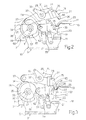
- Number 1 in Figure 1 indicates as a whole a bending machine comprising a motor reducer 2, and two bending units 3, only one of which is shown.
- Units 3 are identical and comprise respective transmission shafts 4, which are coaxial, are connected by a constant-velocity universal joint (shown partly), preferably a lamellar joint, and are powered by motor reducer 2 to rotate together about their axis 7.
- Unit 3 comprises a steel supporting frame 10, which is defined by a number of electrowelded plates, is fixed to a base (not shown), e.g. by means of screws, and supports shaft 4 hinged with the interposition of bearings for supporting relatively severe radial loads.
- Shaft 4 is rotated by motor reducer 2, which is also fixed to the base, and comprises an electric "self-braking" motor 15, preferably with an electromagnetic brake, and a reducer 16 interposed between motor 15 and shaft 4.
- frame 10 supports a gripping device 18 for retaining a metal sheet 19, for bending, in a fixed position.
- Device 18 comprises a supporting member or so-called supporting cradle 20, which is fixed releasably, e.g. by screws (not shown), to a horizontal front plate 21 of frame 10, and defines a contoured top surface 22 for supporting a complementary intermediate portion 23 of metal sheet 19.
- Device 18 also comprises a blankholder member or so-called die 24 comprising two opposite end portions 25, 26; portion 25 is housed inside a seat 27 defined by an L-shaped supporting member 28, and is fixed releasably, e.g. by screws, to member 28; and portion 26 is shaped externally to clamp portion 23 against surface 22, without permanently deforming metal sheet 19.
- a blankholder member or so-called die 24 comprising two opposite end portions 25, 26; portion 25 is housed inside a seat 27 defined by an L-shaped supporting member 28, and is fixed releasably, e.g. by screws, to member 28; and portion 26 is shaped externally to clamp portion 23 against surface 22, without permanently deforming metal sheet 19.
- Member 28 is integral with the end of a lever 29, which comprises an intermediate portion 31 hinged to two top end portions 32 of frame 10 to oscillate back and forth about an axis 33, parallel to axis 7, under the control of a cam and tappet actuating device 34.
- Device 34 comprises a disk 35 fitted in a fixed position to shaft 4 and defined radially by a contoured outer annular surface defining a cam 36, along which rolls a tappet member or cam follower defined by a roller 37 hinged to lever 29, at the opposite end to member 28.
- roller 37 is forced radially against cam 36 by a device 38 comprising a rod 39, which extends perpendicularly to axis 7 and in turn comprises two opposite end portions 41, 42.
- Portion 41 is hinged to lever 29 at a fixed point eccentric with respect to axis 33; whereas portion 42 extends through an appendix 45 integral with frame 10, and slides inside appendix 45 under the elastic action of a preloaded spiral spring 46, which is fitted to rod 39 and interposed between appendix 45 and a nut 47 screwed to the free end of portion 42.
- unit 3 also comprises a bending blade 50 in turn comprising two opposite end portions 51, 52.
- Portion 51 is fixed releasably, e.g. by screws, to the end of a supporting carriage 54, while portion 52 projects towards cradle 20.
- Carriage 54 is housed inside frame 10 in an intermediate position between cradle 20 and shaft 4, and is connected to frame 10 by an articulated parallelogram lever mechanism 55 to move back and forth, in a plane perpendicular to axis 7, under the control of a cam and tappet actuating device 57.
- Device 57 comprises a disk 58, which is fitted in a fixed position to shaft 4, is preferably formed in one piece with disk 35 to form a single body 60, and is defined radially by a contoured outer annular surface defining a cam 61, along which rolls a tappet member or cam follower defined by a roller 62 hinged to carriage 54, at the opposite end to blade 50.
- roller 62 contacts cam 61 at a point substantially aligned with axis 7 and portion 52, and is forced radially against cam 61 by a device 63, which is interposed between carriage 54 and frame 10, is similar to device 38, and is not described in detail. More specifically, in Figure 1, the component parts of device 63 are indicated using the same reference numbers as for device 38, followed by the letter "a".
- roller 37 rolls along an increasing-radius sector 71a of cam 36, which rotates lever 29 (clockwise) and so moves die 24 down into a fully closed position in which portion 23 is clamped against surface 22 ( Figure 3).
- roller 62 begins rolling along an increasing-radius sector 71b of cam 61, which causes carriage 54 to make a first shift towards cradle 20 along a substantially straight path defined by lever mechanism 55.
- roller 37 rolls along a constant-radius sector 72a of cam 36, which keeps die 24 in the closed position; while roller 62 begins rolling along an increasing-radius sector 72b of cam 61, which causes carriage 54 to make a second shift towards die 24, at a slower speed than that imposed by sector 71b.
- portion 52 of blade 50 first comes into contact with a lip 65 projecting from portion 23 of metal sheet 19, and then pushes lip 65 onto an opposing surface 66 defining die 24, while portion 23 is still clamped, so as to bend metal sheet 19 by a predetermined angle along a bend line extending between lip 65 and portion 23 and parallel to axis 7 ( Figure 4).
- roller 62 rolls along a constant-radius sector 73b, which keeps carriage 54 in a fully forward position in which lip 65 remains on opposing surface 66 to keep lip 65 bent for a given length of time with portion 23 still clamped by die 24.
- Roller 62 then rolls along a decreasing-radius sector 74b back to sector 70b to allow carriage 54 to withdraw completely; while roller 37, on reaching the end of sector 72a, rolls along a decreasing-radius sector 73a back to sector 70a to allow die 24 to withdraw into the open position.
- motor 15 brakes automatically, so that the bent metal sheet 19 can be removed, and another metal sheet for bending can be loaded onto cradle 20.
- Devices 34, 57 therefore provide for achieving, for both die 24 and blade 50, constant forces and speeds which remain unchanged between one operating cycle and the next, by comprising synchronized predetermined cam profiles which do not vary over time. Moreover, devices 34, 57 are fairly cheap to maintain, by being powered by an electric motor 15, with no hydraulic actuators.
- Unit 3 also comprises a relatively small number of component parts, and is highly reliable, by die 24 and blade 50 being operated fully mechanically, with no complex electronic or other controls, by a single transmission shaft 4, which is rotated directly by a single motor reducer 2 and supports both cams 36, 61. By using a single shaft 4 supporting both cams 36, 61, slack between the component parts of unit 3 is also greatly reduced.
- unit 3 is also extremely versatile, by being applicable to different types of metal sheet and different production lines. More specifically, cradle 20, die 24, and blade 50 can be selected from a number of different types, depending on the shape and type of metal sheet for bending, and cams 36, 61 can be selected from a number of different profiles, depending on the thickness and strength of the material for bending.
- portion 23 can be kept in the clamped position to simultaneously work metal sheet 19 on machines (not shown) adjacent to unit 3.
- Supporting die 24 by means of a rotary lever, i.e. lever 29, enables die 24 to be opened by moving portion 26 away from lip 65, without compromising the newly formed bend.
- joint 5 provides for transmitting torque between shafts 4 of the two units 3, and for perfectly synchronizing rotation of the two pairs of cams fitted to shafts 4.
- cams 36, 61 may differ from those illustrated, e.g. may be defined by contoured grooves as opposed to the outer surfaces of disks 35, 58, and/or may be operated synchronously by other than shaft 4 as described.
- member 28 and carriage 54 may be connected to frame 10 otherwise than as described, e.g. by means of guide devices.
Landscapes
- Engineering & Computer Science (AREA)
- Mechanical Engineering (AREA)
- Bending Of Plates, Rods, And Pipes (AREA)
- Folding Of Thin Sheet-Like Materials, Special Discharging Devices, And Others (AREA)
- Advancing Webs (AREA)
Applications Claiming Priority (2)
| Application Number | Priority Date | Filing Date | Title |
|---|---|---|---|
| ITTO20021115 | 2002-12-23 | ||
| ITTO20021115 ITTO20021115A1 (it) | 2002-12-23 | 2002-12-23 | Gruppo di piegatura di lamiere, in particolare per la realizzazione di alette. |
Publications (2)
| Publication Number | Publication Date |
|---|---|
| EP1433545A2 true EP1433545A2 (de) | 2004-06-30 |
| EP1433545A3 EP1433545A3 (de) | 2005-03-16 |
Family
ID=32448949
Family Applications (1)
| Application Number | Title | Priority Date | Filing Date |
|---|---|---|---|
| EP03104926A Withdrawn EP1433545A3 (de) | 2002-12-23 | 2003-12-22 | Metallblechbiegeeinheit, speziell zum Formen von Lippen |
Country Status (4)
| Country | Link |
|---|---|
| EP (1) | EP1433545A3 (de) |
| CN (1) | CN1537686A (de) |
| BR (1) | BR0306173A (de) |
| IT (1) | ITTO20021115A1 (de) |
Cited By (1)
| Publication number | Priority date | Publication date | Assignee | Title |
|---|---|---|---|---|
| CN117139446A (zh) * | 2023-10-31 | 2023-12-01 | 绵阳二四机械有限公司 | 一种屏蔽箱包覆板折弯装置 |
Families Citing this family (4)
| Publication number | Priority date | Publication date | Assignee | Title |
|---|---|---|---|---|
| KR100783834B1 (ko) * | 2006-08-21 | 2007-12-10 | 현대자동차주식회사 | 차량용 바디패널의 헤밍작업 시스템 |
| DE102014212527B3 (de) * | 2014-06-27 | 2015-11-12 | Wafios Ag | Stauchvorrichtung für eine Kettenschweißmaschine sowie Kettenschweißmaschine |
| CN105672058B (zh) * | 2016-03-31 | 2017-06-16 | 佛山市必硕机电科技有限公司 | 新型纸浆模塑产品热压机 |
| CN106012692A (zh) * | 2016-07-13 | 2016-10-12 | 佛山市必硕机电科技有限公司 | 纸浆模塑产品热压机的活动滑行板升降机构 |
Family Cites Families (4)
| Publication number | Priority date | Publication date | Assignee | Title |
|---|---|---|---|---|
| US3777529A (en) * | 1972-03-20 | 1973-12-11 | Houdaille Industries Inc | Dual bend forming device and method |
| JPS5987933A (ja) * | 1982-11-10 | 1984-05-21 | Nissan Motor Co Ltd | プレス型 |
| JPS5994536A (ja) * | 1982-11-22 | 1984-05-31 | Nissan Motor Co Ltd | プレス型 |
| JP3861578B2 (ja) * | 2000-09-22 | 2006-12-20 | 三菱自動車工業株式会社 | プレス金型装置 |
-
2002
- 2002-12-23 IT ITTO20021115 patent/ITTO20021115A1/it unknown
-
2003
- 2003-12-22 EP EP03104926A patent/EP1433545A3/de not_active Withdrawn
- 2003-12-22 BR BR0306173-6A patent/BR0306173A/pt not_active Application Discontinuation
- 2003-12-23 CN CNA2003101237707A patent/CN1537686A/zh active Pending
Cited By (2)
| Publication number | Priority date | Publication date | Assignee | Title |
|---|---|---|---|---|
| CN117139446A (zh) * | 2023-10-31 | 2023-12-01 | 绵阳二四机械有限公司 | 一种屏蔽箱包覆板折弯装置 |
| CN117139446B (zh) * | 2023-10-31 | 2024-01-02 | 绵阳二四机械有限公司 | 一种屏蔽箱包覆板折弯装置 |
Also Published As
| Publication number | Publication date |
|---|---|
| BR0306173A (pt) | 2005-05-24 |
| EP1433545A3 (de) | 2005-03-16 |
| CN1537686A (zh) | 2004-10-20 |
| ITTO20021115A1 (it) | 2004-06-24 |
Similar Documents
| Publication | Publication Date | Title |
|---|---|---|
| US8596104B2 (en) | Device and method for producing profiled bodies | |
| CA2079721C (en) | Rotary apparatus with moveable die | |
| JP3833476B2 (ja) | 物体を受取り移送するための装置 | |
| CN101646509A (zh) | 带辊弯板设备 | |
| US4043165A (en) | Three-point, air-bending sheet metal bender | |
| HK1007454B (en) | Rotary apparatus with moveable die | |
| US5983693A (en) | Rotary press with cut off apparatus | |
| EP1433545A2 (de) | Metallblechbiegeeinheit, speziell zum Formen von Lippen | |
| EP1243355B1 (de) | Werkzeug zum Formen eines negativen Eckstückes | |
| GB1599511A (en) | Apparatus for feeding workpieces in a multi-station cross-fed press | |
| US6173599B1 (en) | Leaf spring straightening apparatus | |
| EP1477246B1 (de) | Vorrichtung zum Krimpen von Metallblechen | |
| US11833569B2 (en) | Feed apparatus for transfer press | |
| JPH06155207A (ja) | クランプ装置 | |
| CN119407044B (zh) | 一种便于角度调节的折弯机 | |
| US20020106265A1 (en) | Binding apparatus and method | |
| CN121198961B (zh) | 一种收银箱加工用连续式冲压设备 | |
| US5718152A (en) | Press with gripping rails and pretensioning device | |
| JP3712900B2 (ja) | プレス機のトランスファ装置 | |
| SU1532125A1 (ru) | Устройство дл гибки заготовок | |
| KR100680233B1 (ko) | 전기압력밥솥의 내솥 마킹 장치 및 방법과 이를 이용한내솥 | |
| US5301535A (en) | Arrangement for changing the lever ratio of a two-armed rocker lever | |
| CN117226005A (zh) | 折弯设备 | |
| AU724954B2 (en) | Rotary apparatus with moveable die | |
| CN121269362A (zh) | 一种齿轮轴移送抓手 |
Legal Events
| Date | Code | Title | Description |
|---|---|---|---|
| PUAI | Public reference made under article 153(3) epc to a published international application that has entered the european phase |
Free format text: ORIGINAL CODE: 0009012 |
|
| AK | Designated contracting states |
Kind code of ref document: A2 Designated state(s): AT BE BG CH CY CZ DE DK EE ES FI FR GB GR HU IE IT LI LU MC NL PT RO SE SI SK TR |
|
| AX | Request for extension of the european patent |
Extension state: AL LT LV MK |
|
| PUAL | Search report despatched |
Free format text: ORIGINAL CODE: 0009013 |
|
| RIC1 | Information provided on ipc code assigned before grant |
Ipc: 7B 21D 37/08 B Ipc: 7B 21D 19/08 A |
|
| AK | Designated contracting states |
Kind code of ref document: A3 Designated state(s): AT BE BG CH CY CZ DE DK EE ES FI FR GB GR HU IE IT LI LU MC NL PT RO SE SI SK TR |
|
| AX | Request for extension of the european patent |
Extension state: AL LT LV MK |
|
| AKX | Designation fees paid | ||
| REG | Reference to a national code |
Ref country code: DE Ref legal event code: 8566 |
|
| STAA | Information on the status of an ep patent application or granted ep patent |
Free format text: STATUS: THE APPLICATION IS DEEMED TO BE WITHDRAWN |
|
| 18D | Application deemed to be withdrawn |
Effective date: 20050917 |