EP1434436A1 - Lecteur - Google Patents
Lecteur Download PDFInfo
- Publication number
- EP1434436A1 EP1434436A1 EP02800734A EP02800734A EP1434436A1 EP 1434436 A1 EP1434436 A1 EP 1434436A1 EP 02800734 A EP02800734 A EP 02800734A EP 02800734 A EP02800734 A EP 02800734A EP 1434436 A1 EP1434436 A1 EP 1434436A1
- Authority
- EP
- European Patent Office
- Prior art keywords
- data
- priority
- unit
- track
- input
- Prior art date
- Legal status (The legal status is an assumption and is not a legal conclusion. Google has not performed a legal analysis and makes no representation as to the accuracy of the status listed.)
- Withdrawn
Links
Images








Classifications
-
- H—ELECTRICITY
- H04—ELECTRIC COMMUNICATION TECHNIQUE
- H04N—PICTORIAL COMMUNICATION, e.g. TELEVISION
- H04N5/00—Details of television systems
- H04N5/76—Television signal recording
- H04N5/91—Television signal processing therefor
-
- G—PHYSICS
- G11—INFORMATION STORAGE
- G11B—INFORMATION STORAGE BASED ON RELATIVE MOVEMENT BETWEEN RECORD CARRIER AND TRANSDUCER
- G11B20/00—Signal processing not specific to the method of recording or reproducing; Circuits therefor
- G11B20/10—Digital recording or reproducing
- G11B20/10527—Audio or video recording; Data buffering arrangements
-
- G—PHYSICS
- G11—INFORMATION STORAGE
- G11B—INFORMATION STORAGE BASED ON RELATIVE MOVEMENT BETWEEN RECORD CARRIER AND TRANSDUCER
- G11B27/00—Editing; Indexing; Addressing; Timing or synchronising; Monitoring; Measuring tape travel
- G11B27/02—Editing, e.g. varying the order of information signals recorded on, or reproduced from, record carriers
- G11B27/031—Electronic editing of digitised analogue information signals, e.g. audio or video signals
- G11B27/034—Electronic editing of digitised analogue information signals, e.g. audio or video signals on discs
-
- H—ELECTRICITY
- H04—ELECTRIC COMMUNICATION TECHNIQUE
- H04N—PICTORIAL COMMUNICATION, e.g. TELEVISION
- H04N21/00—Selective content distribution, e.g. interactive television or video on demand [VOD]
- H04N21/20—Servers specifically adapted for the distribution of content, e.g. VOD servers; Operations thereof
- H04N21/23—Processing of content or additional data; Elementary server operations; Server middleware
- H04N21/236—Assembling of a multiplex stream, e.g. transport stream, by combining a video stream with other content or additional data, e.g. inserting a URL [Uniform Resource Locator] into a video stream, multiplexing software data into a video stream; Remultiplexing of multiplex streams; Insertion of stuffing bits into the multiplex stream, e.g. to obtain a constant bit-rate; Assembling of a packetised elementary stream
- H04N21/2368—Multiplexing of audio and video streams
-
- H—ELECTRICITY
- H04—ELECTRIC COMMUNICATION TECHNIQUE
- H04N—PICTORIAL COMMUNICATION, e.g. TELEVISION
- H04N21/00—Selective content distribution, e.g. interactive television or video on demand [VOD]
- H04N21/40—Client devices specifically adapted for the reception of or interaction with content, e.g. set-top-box [STB]; Operations thereof
- H04N21/43—Processing of content or additional data, e.g. demultiplexing additional data from a digital video stream; Elementary client operations, e.g. monitoring of home network or synchronising decoder's clock; Client middleware
- H04N21/434—Disassembling of a multiplex stream, e.g. demultiplexing audio and video streams, extraction of additional data from a video stream; Remultiplexing of multiplex streams; Extraction or processing of SI; Disassembling of packetised elementary stream
- H04N21/4341—Demultiplexing of audio and video streams
-
- H—ELECTRICITY
- H04—ELECTRIC COMMUNICATION TECHNIQUE
- H04N—PICTORIAL COMMUNICATION, e.g. TELEVISION
- H04N5/00—Details of television systems
- H04N5/76—Television signal recording
- H04N5/765—Interface circuits between an apparatus for recording and another apparatus
- H04N5/775—Interface circuits between an apparatus for recording and another apparatus between a recording apparatus and a television receiver
-
- G—PHYSICS
- G11—INFORMATION STORAGE
- G11B—INFORMATION STORAGE BASED ON RELATIVE MOVEMENT BETWEEN RECORD CARRIER AND TRANSDUCER
- G11B2220/00—Record carriers by type
- G11B2220/20—Disc-shaped record carriers
- G11B2220/21—Disc-shaped record carriers characterised in that the disc is of read-only, rewritable, or recordable type
- G11B2220/213—Read-only discs
-
- G—PHYSICS
- G11—INFORMATION STORAGE
- G11B—INFORMATION STORAGE BASED ON RELATIVE MOVEMENT BETWEEN RECORD CARRIER AND TRANSDUCER
- G11B2220/00—Record carriers by type
- G11B2220/20—Disc-shaped record carriers
- G11B2220/25—Disc-shaped record carriers characterised in that the disc is based on a specific recording technology
- G11B2220/2537—Optical discs
- G11B2220/2545—CDs
-
- G—PHYSICS
- G11—INFORMATION STORAGE
- G11B—INFORMATION STORAGE BASED ON RELATIVE MOVEMENT BETWEEN RECORD CARRIER AND TRANSDUCER
- G11B2220/00—Record carriers by type
- G11B2220/20—Disc-shaped record carriers
- G11B2220/25—Disc-shaped record carriers characterised in that the disc is based on a specific recording technology
- G11B2220/2537—Optical discs
- G11B2220/2562—DVDs [digital versatile discs]; Digital video discs; MMCDs; HDCDs
-
- H—ELECTRICITY
- H04—ELECTRIC COMMUNICATION TECHNIQUE
- H04N—PICTORIAL COMMUNICATION, e.g. TELEVISION
- H04N5/00—Details of television systems
- H04N5/76—Television signal recording
- H04N5/78—Television signal recording using magnetic recording
- H04N5/781—Television signal recording using magnetic recording on disks or drums
-
- H—ELECTRICITY
- H04—ELECTRIC COMMUNICATION TECHNIQUE
- H04N—PICTORIAL COMMUNICATION, e.g. TELEVISION
- H04N5/00—Details of television systems
- H04N5/76—Television signal recording
- H04N5/84—Television signal recording using optical recording
- H04N5/85—Television signal recording using optical recording on discs or drums
-
- H—ELECTRICITY
- H04—ELECTRIC COMMUNICATION TECHNIQUE
- H04N—PICTORIAL COMMUNICATION, e.g. TELEVISION
- H04N5/00—Details of television systems
- H04N5/76—Television signal recording
- H04N5/91—Television signal processing therefor
- H04N5/93—Regeneration of the television signal or of selected parts thereof
- H04N5/937—Regeneration of the television signal or of selected parts thereof by assembling picture element blocks in an intermediate store
Definitions
- the present invention relates to a reproduction apparatus capable of reproducing view data including a plurality of tracks in an operation to reproduce the data from the tracks at a track count according to its own reproduction processing capacity.
- special effects are utilized in order to present a plurality of pieces of information, bring about a change to a screen changeover and protect privacy on screens.
- editing techniques utilizing the special effects there are a method of recording view data, to which the special effects have been applied, onto a recording medium, and a method whereby original view data is recorded as it is on a recording medium along with a processing procedure for special effects and, at a reproduction time, the original view data is processed in accordance with the processing procedure for the special effects in order to reproduce the special effects.
- the latter method is specially referred to as a non-destructive editing process.
- This editing method can be implemented by using application software such as Quick Time, which is referred to hereafter simply as QT.
- a reproduction apparatus provided by the present invention reproduces tracks in view data within the range of the reproduction processing capacity, an image can be reproduced in a smooth operation without losing a frame.
- a first embodiment is an embodiment implementing a reproduction apparatus for reproducing an image by selecting a particular one of a variety of graphics, which are provided for an original image, in accordance with the reproduction processing capacity of the reproduction apparatus as a particular graphic to be reproduced at the same time as the original image.
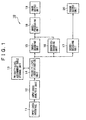
- Fig. 1 is a block diagram showing the configuration of the reproduction apparatus implemented by the first embodiment.
- the reproduction apparatus 10 implemented by the first embodiment as shown in Fig. 1 comprises an input-data interface 11, an input-data analysis unit 12, a priority-level assignment table storage unit 13, a priority-level identification unit 14, an image-decoding unit 15, a graphics-decoding unit 16, a sound-decoding unit 17, an image-processing unit 18, an image output unit 19 and a sound output unit 20.
- the input-data interface 11 is an interface for connecting the reproduction apparatus 10 to an external apparatus and inputting view data from an external source.
- the input view data is supplied to the input-data analysis unit 12.
- Examples of the external apparatus are a drive apparatus for reading out view data from a disk-shaped recording medium, a CD drive apparatus for reading out view data from a CD-ROM, a DVD drive apparatus for reading out view data from a DVD and a hard-disk drive apparatus.
- the input-data analysis unit 12 determines the substance of input view data and outputs a result of the determination to the priority-level identification unit 14 along with the view data.
- the result of the determination indicates that the input view data is video data, audio data, title graphics data, frame graphics data, shade graphics data or the like.
- the priority-level identification unit 14 determines a reproduction priority level of the input view data in accordance with a predetermined threshold value by referring to a priority-level assignment table stored in the priority-level assignment table storage unit 13. In accordance with the determined effect of the reproduction priority level, the priority-level identification unit 14 discards the view data or, alternatively, outputs the view data to the image-decoding unit 15 or the graphics-decoding unit 16. If any tow arbitrary tracks are selected from a plurality of tracks and the two tracks cannot be reproduced at the same time so that only either of the two tracks can be reproduced, the reproduction priority level is used to select one of the tracks as a track that should take precedence of the other track.
- a designer or manufacturer of the reproduction apparatus 10 determines the threshold value in advance on the basis of the reproduction processing capacity of hardware employed in the reproduction apparatus 10, and sets the threshold value in the priority-level identification unit 14. It is to be noted that the threshold value can also be stored in the priority-level assignment table storage unit 13 to be fetch later by the priority-level identification unit 14 when necessary.
- the priority-level assignment table storage unit 13 is typically a read-only memory allowing data stored therein to be erased.
- An example of such a memory which is used as a memory for storing a priority-level assignment table to be described later, is an EEPROM (Electrically Erasable Programmable Read-Only Memory).
- the image-decoding unit 15 decodes the input view data (which is video data) and outputs a result of the decoding process to the image-processing unit 18.
- the graphics-decoding unit 16 decodes the input view data (which is graphics data) and outputs a result of the decoding process to the image-processing unit 18.
- the image-processing unit 18 carries out predetermined graphic processing on an original image on the basis of input video data and input graphics data, outputting a result of the graphic processing to the image output unit 19.
- the image output unit 19 carries out signal processing corresponding to an external display unit on view data before outputting the view data.
- the sound-decoding unit 17 decodes input sound data (or input audio data) and outputs a result of the decoding process to the sound output unit 20.
- the sound output unit 20 carries out signal processing corresponding to an external audio reproduction unit on the sound data before outputting the sound data.
- Fig. 2 is a diagram showing typical input data supplied to the first embodiment.
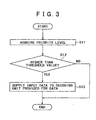
- Fig. 3 shows a flowchart representing operations carried out by the reproduction apparatus implemented by the first embodiment.
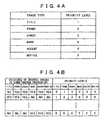
- Figs. 4A and 4B are diagrams each showing a priority-level assignment table used in the first embodiment.
- the priority-level assignment table shown in Fig. 4A is referred to hereafter as a first typical priority-level assignment table and the priority-level assignment table shown in Fig. 4B is referred to hereafter as a second typical priority-level assignment table.
- input data is supplied to the input-data analysis unit 12 by way of the input-data interface 11.
- the input data is view data comprising video data, audio data and a plurality of types of graphics data.
- Each data includes an identifier for identifying a track type used for distinguishing the substance of data from the substance of other data.
- the types of graphics data include for example a title, which is a video headline, a frame defining edges of a screen, a shade for hiding a portion of a screen beneath a shadow in order to protect privacy or for another purpose, a mark such as an arrow attached to a portion of a screen in order to draw attention to the portion, an accent added to a portion of a screen to put emphasis on the portion and a notice such as a displayed blowoff for stressing a caption or a phrase.
- a title which is a video headline
- a frame defining edges of a screen a shade for hiding a portion of a screen beneath a shadow in order to protect privacy or for another purpose
- a mark such as an arrow attached to a portion of a screen in order to draw attention to the portion
- an accent added to a portion of a screen to put emphasis on the portion and a notice such as a displayed blowoff for stressing a caption or a phrase.
- Such input data typically has a QT format.
- QT is software for managing various kinds of data along the time base.
- the QT software serves as an extended function of the OS. This function is executed to synchronize data such as a moving image, a sound and a text, and display the data without using special hardware.
- a QT file a basic data unit is called an atom.
- QT comprises a resource atom and a data atom.
- a resource atom is information required for reproducing a QT file and information required for referencing actual data.
- the data atom is a portion for storing the actual data such as video and audio data.
- Each atom includes information on a size and information on a type in addition to the data of the atom.
- QT Quality of Service
- a chunk is defined as a set of samples.
- QT is typically disclosed in, among others, Inside Macintosh: QuickTime (a Japanese version) (Addison-Wesley).
- input data comprises a resource atom 101 and a data atom 102 as shown in Fig. 2.
- the data atom 102 comprises various kinds of actual data including video data 121, audio data 122, graphics data (title) 123, which is graphics data of a title, graphics data (frame) 124, which is graphics data of a frame, graphics data (shade) 125, which is graphics data of a shade, graphics data (mark) 126, which is graphics data of a mark, graphics data (accent) 127, which is graphics data of an accent and graphics data (notice) 128, which is graphics data of a notice.
- the resource atom 101 comprises a track atom (video) 111, a track atom (audio) 112, a track atom (title) 113, a track atom (frame) 114, a track atom (shade) 115, a track atom (mark) 116, a track atom (accent) 117 and a track atom (notice) 118.
- an identifier for identifying the track type of actual data is prescribed in a track property atom, which is an atom provided in a user data atom within a track atom for actual data as an atom for prescribing attributes of a track.
- a user data atom is a QT atom for prescribing data defined by the user.
- the input-data analysis unit 12 identifies the track type of actual data by referencing an identifier prescribed in this track property atom and outputs a result of the identification to the priority-level identification unit 14.
- the priority-level identification unit 14 When the priority-level identification unit 14 receives the result of the determination and actual data, at a step S11 of the flowchart shown in Fig. 3, the priority-level identification unit 14 makes an access to the priority-level assignment table storage unit 13 to acquire a priority level.
- a priority level is a sequence number assigned to the type of each of graphics to be superposed on an original image. Typical assignment of priority levels is shown in Fig. 4A. As shown in the figure, a priority level of 1 is assigned to the title track type, a priority level of 5 is assigned to the frame track type, a priority level of 2 is assigned to the shade track type, a priority level of 6 is assigned to the mark track type, a priority level of 4 is assigned to the accent track type and a priority level of 3 is assigned to the notice track type. It is to be noted that, the smaller the sequence number representing a priority level, the higher the priority level and, conversely, the larger the sequence number, the lower the priority level. The figure does not show the fact that a highest priority level of 1 is assigned to video data 121 and audio data 122.
- the priority-level identification unit 14 determines what type of actual data is the type of the input actual data on the basis of the input result of the determination. Subsequently, the priority-level identification unit 14 obtains the priority level corresponding to the type of the actual data from a priority-level assignment table. Then, at the next step S12, the priority-level identification unit 14 compares the priority level of the actual data with a threshold value.
- the flow of the operation goes on to a step S13 at which the priority-level identification unit 14 outputs the actual data to the image-decoding unit 15, the graphics-decoding unit 16 or the sound-decoding unit 17 in dependence on the type of the actual data. If the result of the comparison indicates that the priority level of the actual data is lower than the threshold value, on the other hand, the actual data is discarded.
- the threshold value is set at a typical value of 3 according to the simultaneous reproduction processing capacity of the reproduction apparatus 10.
- video data 121, audio data 122, graphics data (title) 123 and graphics data (shade) 125 are supplied to the image-decoding unit 15, the graphics-decoding unit 16 or the sound-decoding unit 17.
- the image-processing unit 18 carries out a process to superpose the graphics data (title) 123 and the graphics data (shade) 125 on the decoded video data 121 to generate display data and output the display data to the image output unit 19.
- the threshold value is set at a typical value of 5 according to the simultaneous reproduction processing capacity of the reproduction apparatus 10.
- video data 121, audio data 122, graphics data (title) 123, graphics data (shade) 125, graphics data (accent) 127 and graphics data (notice) 128 are supplied to the image-decoding unit 15, the graphics-decoding unit 16 or the sound-decoding unit 17.
- the image-processing unit 18 carries out a process to superpose the graphics data (title) 123, the graphics data (shade) 125, the graphics data (accent) 127 and the graphics data (notice) 128 on the decoded video data 121 to generate display data and output the display data to the image output unit 19.
- actual data is reproduced in a range of the processing capacity of the reproduction apparatus 10 in accordance with a priority level.
- view data can be reproduced in a smooth operation and without losing a frame.
- actual data is reproduced in a range of the processing capacity of the reproduction apparatus 10 in accordance with a priority level, it is not necessary to produce view data by adjusting the view data to the processing capacity of the reproduction apparatus 10.
- view data common to reproduction apparatus can be utilized even if the reproduction apparatus have processing capacity different from each other.
- by assigning different priority levels to different types of graphics it is possible to reproduce an image with different graphics superposed thereon even for the same processing capacity.
- a first priority-level assignment table of Fig. 4A shows that priority levels assigned to graphics data are fixed without regard to the number of graphics to be superposed on a display at the same time.
- the actual data to be reproduced at the same time is video data 121, audio data 122 and graphics data (frame) 124 whereas the threshold value is set at 3, and the reproduction apparatus 10 still has available capacity for processing, then since the priority level of the graphics data (frame) 124 is 5, the graphics data (frame) 124 is not output to the graphics-decoding unit 16. That is to say, only the video data 121 and the audio data 122 are reproduced.
- a second priority-level assignment table shown in Fig. 4B as a substitute for the first priority-level assignment table.
- the second priority-level assignment table shown in Fig. 4B prescribes priority levels assigned to graphics to be processed at the same time in accordance with tracks of the graphics.
- the first row of the second priority-level assignment table shows priority levels assigned to graphics for a case in which the tracks of the graphics are the frame, the shade, the mark, the accent and the notice, which are simultaneously processed.
- a priority level of 1 is assigned to the frame track type
- a priority level of 5 is assigned to the shade track type
- a priority level of 2 is assigned to the mark track type
- a priority level of 3 is assigned to the accent track type
- a priority level of 4 is assigned to the notice track type.
- the second row of the second priority-level assignment table shows priority levels assigned to graphics for a case in which the tracks of the graphics are the title, the frame and the shade, which are simultaneously processed.
- a priority level of 1 is assigned to the title track type
- a priority level of 2 is assigned to the frame track type
- the priority level of 2 is also assigned to the shade track type.
- Similar assignment of priority levels to track frames is applied to the third and subsequent rows of the second priority-level assignment table.
- the last row of the second priority-level assignment table shows priority levels assigned to graphics for a case in which the tracks of the graphics are the mark, the accent and the notice, which are simultaneously processed.
- a priority level of 1 is assigned to the mark track type
- a priority level of 2 is assigned to the accent track type
- a priority level of 3 is assigned to the notice track type.
- the priority-level identification unit 14 applies the priority levels prescribed in the first row of the second priority-level assignment table in execution of the processes at the steps S12 and S13 shown in Fig. 3.
- the pieces of view data to be processed at the same time are the video data 121, the audio data 122, the graphics data (frame) 124, the graphics data (shade) 125, the graphics data (mark) 126, the graphics data (accent) 127 and graphics data (notice) 128 whereas the threshold value is set at 3, the graphics data (shade) 125, the graphics data (accent) 127 and graphics data (notice) 128 are not reproduced.
- the priority-level identification unit 14 applies the priority levels prescribed in the second row of the second priority-level assignment table in execution of the processes at the steps S12 and S13 shown in Fig. 3.
- the frame and the shade both have a priority level of 2.
- graphics data comprises a plurality of tracks.
- data comprising a plurality of tracks is not only the graphics data, but audio data, text data and other data also comprise a plurality of tracks.
- Fig. 5 is a block diagram showing the configuration of a reproduction apparatus implemented by the second embodiment.
- the reproduction apparatus 30 implemented by the second embodiment as shown in Fig. 5 comprises an input-data interface 11, an input-data analysis unit 12, a priority-level identification unit 31, a priority-level assignment table storage unit 33, an image-decoding unit 15, a graphics-decoding unit 16, a text-decoding unit 32, a sound-decoding unit 17, an image-processing unit 18, an image output unit 19 and a sound output unit 20.
- the input-data interface 11 is connected to the input-data analysis unit 12 and the input-data analysis unit 12 is connected to the priority-level identification unit 31.
- the priority-level identification unit 31 is connected to the priority-level assignment table storage unit 33, the image-decoding unit 15, the graphics-decoding unit 16, the text-decoding unit 32 and the sound-decoding unit 17.
- the image-decoding unit 15, the graphics-decoding unit 16 and the text-decoding unit 32 are connected to the image-processing unit 18.
- the text-decoding unit 32 decodes input view data (which is text data) and outputs a result of the decoding process to the image-processing unit 18.
- the image-processing unit 18 is connected to the image output unit 19 whereas the sound-decoding unit 17 is connected to the sound output unit 20.
- Fig. 6 is a diagram showing typical input data supplied to the second embodiment.
- Fig. 7 is a diagram showing a priority-level assignment table used in the second embodiment.
- input data is supplied to the input-data analysis unit 12 by way of the input-data interface 11.
- the input data is view data comprising one or more pieces of video data, one or more pieces of audio data, one or more pieces of graphics data and one or more pieces of text data.
- Each of the pieces of data includes an identifier indicating the track type of the piece of data.
- the input data comprises a resource atom 151 and a data atom 152 as shown in Fig. 6.
- the data atom 152 comprises pieces of actual data, which include video-1 data 181, audio-1 data 182, audio-2 data 183, audio-3 data 184, graphic-1 data 185, graphic-2 data 186, text-1 data 187, text-2 data 188, text-3 data 189 and text-4 data 190.
- the resource atom 151 comprises a track atom (video-1) 161, a track atom (audio-1) 162, a track atom (audio-2) 163, a track atom (audio-3) 164, a track atom (graphics-1) 165, a track atom (graphics-2) 166, a track atom (text-1) 167, a track atom (text-2) 168, a track atom (text-3) 169 and a track atom (text-4) 170.
- An identifier indicating the type of actual data is prescribed in a track property atom in a track atom for the actual data.
- the input-data analysis unit 12 determines the track type of actual data by referencing an identifier prescribed in this track property atom and outputs a result of the determination to the priority-level identification unit 31.
- the priority-level identification unit 31 When the priority-level identification unit 31 receives the result of the determination and actual data, the priority-level identification unit 31 makes an access to the priority-level assignment table storage unit 33 to acquire a priority level.
- a priority level is a sequence number assigned to each track. Typical assignment of priority levels is shown in Fig. 7. As shown in the figure, a priority level of 1 is assigned to the track atom (video-1), a priority level of 2 is assigned to the track atom (audio-1), a priority level of 5 is assigned to the track atom (audio-2), a priority level of 7 is assigned to the track atom (audio-3), a priority level of 6 is assigned to the track atom (graphics-1), a priority level of 8 is assigned to the track atom (graphics-2), a priority level of 3 is assigned to the track atom (text-1), a priority level of 4 is assigned to the track atom (text-2), a priority level of 9 is assigned to the track atom (text-3) and a priority level of 10 is assigned to the track atom (text-4). It is to be noted that, the smaller the sequence number representing a priority level, the higher the priority level and, conversely, the larger the sequence number, the lower the priority level.
- the priority-level identification unit 31 determines what type of actual data is the type of the input actual data on the basis of the input result of the determination. Subsequently, the priority-level identification unit 31 obtains the priority level corresponding to the type of the actual data from the priority-level assignment table. Then, the priority-level identification unit 31 compares the priority level of the actual data with a threshold value.
- the priority-level identification unit 31 outputs the actual data to the image-decoding unit 15, the graphics-decoding unit 16, the text-decoding unit 32 or the sound-decoding unit 17 in dependence on the type of the actual data. If the result of the comparison indicates that the priority level of the actual data is lower than the threshold value, on the other hand, the actual data is discarded.
- the threshold value is set at a typical value of 5 according to the simultaneous reproduction processing capacity of the reproduction apparatus 30.
- video-1 data 181, audio-1 data 182, the text-1 data 187 and text-2 data 188 are supplied to the image-decoding unit 15, the sound-decoding unit 17 or the text-decoding unit 32.
- the image-processing unit 18 carries out a process to superpose the text-1 data 187 and the text-2 data 188 on the decoded video-1 data 181 to generate display data and output the display data to the image output unit 19.
- the threshold value is set at a typical value of 7 according to the simultaneous reproduction processing capacity of the reproduction apparatus 30.
- video-1 data 181, audio-1 data 182, audio-2 data 183, graphic-1 data 185, text-1 data 187 and text-2 data 188 are supplied to the image-decoding unit 15, the graphics-decoding unit 16, the sound-decoding unit 17 or the text-decoding unit 32.
- the image-processing unit 18 carries out a process to superpose the graphic-1 data 185, the text-1 data 187 and the text-2 data 188 on the decoded video-1 data 181 to generate display data and output the display data to the image output unit 19.
- actual data is reproduced in a range of the processing capacity of the reproduction apparatus 30 in accordance with a priority level.
- view data can be reproduced in a smooth operation and without losing a frame.
- actual data is reproduced in a range of the processing capacity of the reproduction apparatus 30 in accordance with a priority level, it is not necessary to produce view data by adjusting the view data to the processing capacity of the reproduction apparatus 30.
- view data common to reproduction apparatus can be utilized even if the reproduction apparatus have processing capacity different from each other.
- by assigning different priority levels to different types of graphics it is possible to reproduce an image with different graphics superposed thereon even for the same processing capacity.
- the priority-level identification unit 31 selects a threshold value in accordance with types of data and compares the priority level assigned to a track with the threshold value. The priority-level identification unit 31 then determines whether data of the track is to be output to decoding units or discarded in dependence on the result of the comparison.
- priority-level determination means is provided for every type of data and the priority level assigned to input data is identified for each type of data.
- Fig. 8 is a block diagram showing the configuration of a reproduction apparatus implemented by the third embodiment.
- the reproduction apparatus 40 implemented by the third embodiment as shown in Fig. 8 comprises an input-data interface 11, an input-data analysis unit 41, a priority-level assignment table storage unit 35, an image-data storage unit 42, a graphics-data storage unit 44, a text-data storage unit 46, a sound-data storage unit 48, an image-data select unit 43, a graphics-data select unit 45, a text-data select unit 47, a sound-data select unit 49, an image-decoding unit 15, a graphics-decoding unit 16, a text-decoding unit 32, a sound-decoding unit 17, an image-processing unit 18, an image output unit 19 and a sound output unit 20.
- the input-data interface 11 is connected to the input-data analysis unit 41.
- the input-data analysis unit 41 is connected to the image-data storage unit 42, the graphics-data storage unit 44, the text-data storage unit 46 and the sound-data storage unit 48.
- the input-data analysis unit 41 supplies input data to the image-data storage unit 42, the graphics-data storage unit 44, the text-data storage unit 46 or the sound-data storage unit 48 in dependence on the type of the input data.
- the image-data storage unit 42 is a memory for storing video input data.
- the graphics-data storage unit 44 is a memory for storing graphics input data.
- the text-data storage unit 47 is a memory for storing text input data.
- the sound-data storage unit 49 is a memory for storing audio input data.
- the image-data select unit 43 searches a priority-level assignment table stored in the priority-level assignment table storage unit 35 for a priority level assigned to a type indicated by a result of the determination as a reproduction priority level of input view data, and determines the effect of the priority level by using a threshold value determined in advance.
- the image-data select unit 43 either discards the image data or supplies the image data to the image-decoding unit 15 in accordance with a result of the comparison.
- the graphics-data select unit 45 searches the priority-level assignment table stored in the priority-level assignment table storage unit 35 for a priority level assigned to a type indicated by a result of the determination as a reproduction priority level of input view data, and determines the effect of the priority level by using a threshold value determined in advance.
- the graphics-data select unit 45 either discards the graphics data or supplies the graphics data to the graphics-decoding unit 16 in accordance with a result of the comparison.
- the text-data select unit 47 searches the priority-level assignment table stored in the priority-level assignment table storage unit 35 for a priority level assigned to a type indicated by a result of the determination as a reproduction priority level of input view data, and determines the effect of the priority level by using a threshold value determined in advance.
- the text-data select unit 47 either discards the text data or supplies the text data to the text-decoding unit 32 in accordance with a result of the comparison.
- the sound-data select unit 49 searches the priority-level assignment table stored in the priority-level assignment table storage unit 35 for a priority level assigned to a type indicated by a result of the determination as a reproduction priority level of input view data, and determines the effect of the priority level by using a threshold value determined in advance.
- the sound-data select unit 49 either discards the sound data or supplies the sound data to the sound-decoding unit 17 in accordance with a result of the comparison.
- the image-decoding unit 15, the graphics-decoding unit 16 and the text-decoding unit 32 are connected to the image-processing unit 18, which is connected to the image output unit 19.
- the sound-decoding unit 17 is connected to the sound output unit 20.
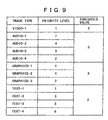
- a typical priority-level assignment table like one shown in Fig. 9 is stored in the priority-level assignment table storage unit 35. As shown in the figure, a threshold value is assigned to each data type whereas a priority level is assigned to each data sub-type.
- Fig. 9 is a diagram showing a priority-level assignment table employed in the third embodiment.
- a threshold value is assigned to each data type whereas a priority level is assigned to each track of every data type.
- a threshold value of 2 is assigned to the video data type and a priority level of 1 is assigned to the video-1 track.
- a threshold value of 3 is assigned to the audio data type whereas a priority level of 1 is assigned to the audio-1 track type, a priority level of 4 is assigned to the audio-2 track type, a priority level of 3 is assigned to the audio-3 track type and a priority level of 2 is assigned to the audio-4 track type.
- a threshold value of 3 is assigned to the graphics data type whereas a priority level of 1 is assigned to the graphics-1 track type, a priority level of 4 is assigned to the graphics-2 track type and a priority level of 2 is assigned to the graphic-3 track type.
- a threshold value of 2 is assigned to the text data type whereas a priority level of 1 is assigned to the text-1 track type, a priority level of 3 is assigned to the text-2 track type, a priority level of 5 is assigned to the text-3 track type and a priority level of 6 is assigned to the text-4 track type.
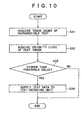
- Fig. 10 shows a flowchart representing operations carried out by a text-data select unit employed in the third embodiment.
- input data is supplied to the input-data analysis unit 41 by way of the input-data interface 11.
- the input-data analysis unit 41 determines the type of input actual data by referring to an identifier prescribed in a track property atom and supplies the input data along with the result of the determination to the image-data storage unit 42, the graphics-data storage unit 44, the text-data storage unit 46 or the sound-data storage unit 48 in dependence on the result of the determination.
- the image-data select unit 43, the graphics-data select unit 45, the text-data select unit 47 and the sound-data select unit 49 are different from each other in the types of data handled. Since the image-data select unit 43, the graphics-data select unit 45, the text-data select unit 47 and the sound-data select unit 49 carry out the same processing, however, only the operation of the text-data select unit 47 is explained below as their representative.
- step S31 the text-data select unit 47 makes an access to the priority-level assignment table storage unit 35 to acquire the track count of the reproducible text (the threshold value of the text data stored in the text-data storage unit 46).
- the text-data select unit 47 makes an access to the priority-level assignment table storage unit 35 to acquire the priority level of the text data.
- the text-data select unit 47 refers to the acquired threshold value and the acquired priority level to compare the threshold value and the priority level.
- the flow of the operation goes on to a step S34 at which the actual data of the text is output to the text-decoding unit 32. If a result of the comparison indicates that the priority level of the actual data of the text is lower than the threshold value, on the other hand, the actual data of the text is discarded.
- each data can be reproduced properly in the range of the reproduction processing capacity of the reproduction apparatus.
- a threshold value appropriate for each data type can be determined.
- a fourth embodiment is provided as an embodiment in which each data is reproduced in accordance with the priority level of the data so that the amount of unutilized remaining reproduction processing capacity is reduced to minimum.
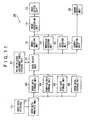
- Fig. 11 is a block diagram showing the configuration of a reproduction apparatus implemented by the fourth embodiment.
- the reproduction apparatus 50 implemented by the fourth embodiment as shown in Fig. 11 comprises an input-data interface 11, an input-data analysis unit 41, an image-data storage unit 42, a graphics-data storage unit 44, a text-data storage unit 46, a sound-data storage unit 48, a data select unit 51, a priority-level assignment table storage unit 37, an image-decoding unit 15, a graphics-decoding unit 16, a text-decoding unit 32, a sound-decoding unit 17, an image-processing unit 18, an image output unit 19 and a sound output unit 20.
- the input-data interface 11 is connected to the input-data analysis unit 41.
- the input-data analysis unit 41 is connected to the image-data storage unit 42, the graphics-data storage unit 44, the text-data storage unit 46 and the sound-data storage unit 48.
- the image-data storage unit 42, the graphics-data storage unit 44, the text-data storage unit 46 and the sound-data storage unit 48 are connected to the data select unit 51.
- the data select unit 51 supplies actual data to the image-decoding unit 15, the graphics-decoding unit 16, the text-decoding unit 32 or the sound-decoding unit 17 or, alternatively, discards the actual data in dependence on the reproduction processing capacity of the reproduction apparatus 50, the priority level of the actual data and the existence/non-existence of the priority level. If necessary, the data select unit 51 fetches a maximum reproduction processing capacity (MaxTrack) and the priority level of the actual data from the priority-level assignment table storage unit 37.
- MaxTrack maximum reproduction processing capacity
- the priority-level assignment table storage unit 37 is used as a memory for storing a priority-level assignment table showing priority levels assigned to all tracks without regard to the types of the tracks.
- Fig. 12 is a diagram showing a typical priority-level assignment table used in the fourth embodiment.
- a priority level of 1 is assigned to the video-1 track type
- a priority level of 9 is assigned to the video-2 track type
- a priority level of 6 is assigned to the audio-1 track type
- a priority level of 2 is assigned to the audio-2 track type
- a priority level of 11 is assigned to the audio-3 track type
- a priority level of 12 is assigned to the audio-4 track type
- a priority level of 4 is assigned to the graphics-1 track type
- a priority level of 10 is assigned to the graphic-2 track type
- a priority level of 5 is assigned to the graphics-3 track type
- a priority level of 15 is assigned to the graphics-4 track type
- a priority level of 17 is assigned to the graphics-5 track type
- a priority level of 3 is assigned to the text-1 track type
- a priority level of 7 is assigned to the text-2 track type
- a priority level of 8 is assigned to the text-3 track type
- a priority level of 13 is assigned to the text-4 track type
- a priority level of 14 is assigned to the text-5 track
- the image-decoding unit 15, the graphics-decoding unit 16 and the text-decoding unit 32 are connected to the image-processing unit 18.
- the image-processing unit 18 is connected to the image output unit 19.
- the sound-decoding unit 17 is connected to the sound output unit 20.
- Fig. 13 shows a flowchart representing operations carried out by the reproduction apparatus implemented by the fourth embodiment.
- input data is supplied to the input-data analysis unit 41 by way of the input-data interface 11.
- the input-data analysis unit 41 determines the type of input actual data by referring to an identifier prescribed in a track property atom and supplies the input data along with the result of the determination to the image-data storage unit 42, the graphics-data storage unit 44, the text-data storage unit 46 or the sound-data storage unit 48 in dependence on the result of the determination.
- the flowchart shown in Fig. 13 begins with a step S41 at which the data select unit 51 makes an access to the priority-level assignment table storage unit 37 to acquire MaxTrack of the reproduction apparatus 50.
- the data select unit 51 makes an access to the priority-level assignment table storage unit 37 to identify a video-data track having the highest priority level and fetches the video data for the track from the image-data storage unit 42.
- the data select unit 51 subtracts a part of reproduction processing capacity, which has been already allocated to the video data, from MaxTrack.
- the data select unit 51 makes an access to the priority-level assignment table storage unit 37 to identify an audio-data track having the highest priority level and fetches the audio data for the track from the sound-data storage unit 48.
- the data select unit 51 subtracts a part of reproduction processing capacity, which has already been allocated to the audio data, from MaxTrack.
- the data select unit 51 determines whether or not the relation MaxTrack > 0 holds true, that is, whether or not a reproduction processing capacity is left in the reproduction apparatus 50.
- the flow of the operation goes on to a step S47 at which the data select unit 51 makes an access to the priority-level assignment table storage unit 37 to select the track of actual data having the highest priority level among tracks stored in the storage units as tracks with no reproduction processing capacity allocated thereto yet.
- the data select unit 51 allocates a part of the reproduction processing capacity to the selected actual data and subtracts the allocated part of the reproduction processing capacity from MaxTrack.
- the fourth embodiment sequentially selects a data track having the highest priority level among tracks stored in the storage units as tracks with no reproduction processing capacity allocated thereto yet as long as the reproduction processing capacity is still left.
- the reproduction processing capacity of the reproduction apparatus 50 can all be utilized with no portion of the reproduction processing capacity left unused.
- the data select unit is made capable of determining a reproducible track with ease.
- the reproduction processing capacity displayed by the reproduction apparatus as reproduction processing capacity required for processing data of tracks are regarded as a capacity uniform for all the tracks. For this reason, a reproducible track is determined only on the basis of a track count.
- a reproducible track is determined by considering time it takes to carry out a process to reproduce the track.
- the fifth embodiment is capable of utilizing the reproduction processing capacity of the reproduction apparatus with an even higher degree of efficiency than the fourth embodiment.
- the reproduction apparatus implemented by the fifth embodiment is provided with a priority-level assignment table storage unit 37, which has not only a non-volatile storage circuit for storing a priority-level assignment table, but also a writable storage circuit for storing different pieces of data required in processing and a timer connected to the data select unit 51 as a timer-displaying means shown in none of the figures.
- An example of the writable storage circuit is a RAM (Random-Access Memory).
- the data select unit 51 is a component for carrying out a process represented by a flowchart shown in Fig. 14. Otherwise, since the data select unit 51 has the same configuration as the one shown in Fig. 11, the configuration of the data select unit 51 is not explained.
- an example of the unit time is the product of a time scale and a sample duration.
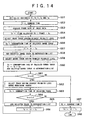
- Fig. 14 shows a flowchart representing operations carried out by a data select unit employed in the fifth embodiment.
- input data is supplied to the input-data analysis unit 41 by way of the input-data interface 11.
- the input-data analysis unit 41 determines the type of input actual data by referring to an identifier prescribed in a track property atom and supplies the input data along with the result of the determination to the image-data storage unit 42, the graphics-data storage unit 44, the text-data storage unit 46 or the sound-data storage unit 48 in dependence on the result of the determination.
- the flowchart shown in Fig. 14 begins with a step S51 at which the data select unit 51 initializes variables such as T1, T2, Tr, Tc and Ts.
- the data select unit 51 obtains the current time from the timer and sets the current time in the variable T1.
- the data select unit 51 acquires a frame rate of video data (image data) as a result of the calculation from a time-to-sample atom and a media handler atom.
- the data select unit 51 calculates a processing time allocated to a process to reproduce one frame, subtracts a compensation time Tc from the processing time and sets the result of the subtraction in the variable Tr.
- the compensation time Tc is time it takes to carry out a process including an operation to select a track.
- the variable Tr is an effective time allocated to a process to reproduce one frame.
- the compensation time Tc is stored in the priority-level assignment table storage unit 37 as an initial value determined in advance. Thereafter, the initial value is changed to a time actually required during the operation of the reproduction apparatus.
- the predetermined initial value is typically found as follows. A plurality of pieces of input data is prepared. The pieces of input data each include a track count. The number of pieces of input data is set at such a value that a process always needs to be carried out to select one of the tracks. In addition, it takes long time to identify and select a track having a high priority level. Then, the pieces of input data are each supplied to the reproduction apparatus, and the time it takes to identify and select a track having a high priority level is measured for each piece of input data. Finally, the longest time selected among the measured times is taken as a processing time.
- the data select unit 51 makes an access to the priority-level assignment table storage unit 37 to identify a video-data track having the highest priority level and fetches the video data for the track from the image-data storage unit 42.
- the data select unit 51 calculates a consumption time it takes to carry out a process to reproduce this fetched video data and sets the time in the variable Ts.
- the time it takes to carry out the reproduction process varies in dependence on the codec type of the data. For this reason, data is supplied to the reproduction apparatus, a process to reproduce the data is carried out and the processing time is measured for each codec type. Then, a statistical processing time such as an average processing time is determined from measured processing times.
- the codec type is the type of a method for encoding and decoding data. In the case of video data, an example of the codec type is the MPEG2 method.
- the data select unit 51 subtracts the variable Ts from the variable Tr and takes a difference obtained as a result of the subtraction as a new value of the variable Tr.
- the data select unit 51 adds the track of the video data fetched at the step S55 to a reproduction list.
- the reproduction list is a table stored in the priority-level assignment table storage unit 37 as a table of track IDs.
- the data select unit 51 makes an access to the priority-level assignment table storage unit 37 to identify an audio-data track having the highest priority level and fetches the audio data for the track from the sound-data storage unit 48.
- the data select unit 51 calculates a consumption time it takes to carry out a process to reproduce this fetched audio data and sets the time in the variable Ts. Then, the data select unit 51 subtracts the variable Ts from the variable Tr and takes a difference obtained as a result of the subtraction as a new value of the variable Tr. Subsequently, the data select unit 51 adds the track of the audio data fetched at the step S59 to the reproduction list.
- the data select unit 51 determines whether or not the relation Tr > 0 holds true, that is, whether or not a reproduction processing capacity is still available in the reproduction apparatus.
- the flow of the operation goes on to a step S62.
- the data select unit 51 makes an access to the priority-level assignment table storage unit 37 to select a data track having the highest priority level among tracks stored in the storage units as tracks, the properness of the reproduction process of which has not been determined.
- the data select unit 51 calculates a consumption time it takes to carry out a process to reproduce data of the selected frame and sets the time in the variable Ts.
- the data select unit 51 compares the variable Tr with the variable Ts. If the variable Tr is found greater than the variable Ts, the flow of the operation goes on to a step S65 at which the data select unit 51 adds the data track selected at the step S62 to the reproduction list. This is because data of the selected track can be reproduced within the range of the remaining reproduction processing capacity.
- the data select unit 51 subtracts the variable Ts from the variable Tr and takes a difference obtained as a result of the subtraction as a new value of the variable Tr. Subsequently, the flow of the operation goes back to the step S61.
- the flow of the operation goes on to a step S67 at which the data select unit 51 acquires the current time from the timer and sets the current time in the variable T2.
- the data select unit 51 subtracts the variable T1 from the variable T2 and sets a difference obtained as a result of the subtraction in the compensation time Tc. In this way, the compensation time Tc is changed to the time actually required by the reproduction apparatus.
- the data select unit 51 outputs data to be reproduced in accordance with the reproduction list to the image-decoding unit 15, the graphics-decoding unit 16, the text-decoding unit 32 or the sound-decoding unit 17 in dependence on the substance of the data.
- the reproduction apparatus reproduces view data.
- a data track having the highest priority level is sequentially selected among tracks stored in the storage units as tracks with no reproduction processing capacity allocated thereto yet.
- the reproduction processing capacity of the reproduction apparatus can all be even better utilized with no portion of the reproduction processing capacity left unused than the fourth embodiment.
- each track is examined in an order starting with a track having the highest priority level in order to determine whether or not the examined track can be reproduced within the range of the available capacity for the reproduction processing. If the track cannot be reproduced within the available capacity for the reproduction processing, the operation to examine tracks is ended without determining whether or not any of the other tracks can be reproduced within such a range.
- the sixth embodiment even if a track is determined to be irreproducible within the available capacity for the reproduction processing, the operation to examine remaining tracks is continued by determining whether or not the next track can be reproduced within such a range.
- the sixth embodiment is capable of utilizing the reproduction processing capacity of the reproduction apparatus with a higher degree of efficiency than the fifth embodiment.
- the reproduction apparatus implemented by the sixth embodiment is also provided with a priority-level assignment table storage unit 37, which has not only a non-volatile storage circuit for storing a priority-level assignment table, but also a writable storage circuit for storing different pieces of data required in processing and a timer connected to the data select unit 51 as a timer-displaying means shown in none of the figures.
- An example of the writable storage circuit is a RAM (Random-Access Memory).
- the data select unit 51 is designed as a component for carrying out a process represented by a flowchart shown in Fig. 15. Otherwise, since the reproduction apparatus has the same configuration as the one shown in Fig. 11, the configuration of the reproduction apparatus is not explained.
- Fig. 15 shows a flowchart representing operations carried out by a data select unit employed in the sixth embodiment.
- the data select unit 51 determines whether or not the relation Tr > 0 holds true. If the result of the determination indicates that the relation Tr > 0 holds true, that is, the reproduction processing capacity is still available in the reproduction apparatus, the flow of the operation goes on to a step S62. At this step, the data select unit 51 makes an access to the priority-level assignment table storage unit 37 to select a data track having the highest priority level among tracks stored in the storage units as tracks, the properness of the reproduction process of which has not been determined yet.
- the data select unit 51 calculates the time it takes to carry out a process to reproduce data of the selected frame and sets the time in the variable Ts.
- the data select unit 51 compares the variable Tr with the variable Ts. If the variable Tr is greater than the variable Ts, the flow of the operation goes on to a step S65 at which the data select unit 51 adds the data track selected at the step S62 to the reproduction list. This is because data of the selected track can be reproduced within the range of the remaining reproduction processing capacity.
- the data select unit 51 subtracts the variable Ts from the variable Tr and takes a difference obtained as a result of the subtraction as a new value of the variable Tr. Subsequently, the flow of the operation goes back to the step S61.
- step S61 If the determination result obtained at the step S61 indicates that the relation Tr ⁇ 0 holds true, that is, the reproduction processing capacity is no longer available in the reproduction apparatus, on the other hand, the flow of the operation goes on to a step S67 at which the data select unit 51 acquires the current time from the timer and sets the current time in the variable T2.
- the data select unit 51 subtracts the variable T1 from the variable T2 and sets a difference obtained as a result of the subtraction in the compensation time Tc. In this way, the compensation time Tc is changed to the time actually required by the reproduction apparatus.
- the data select unit 51 makes an access to the priority-level assignment table storage unit 37 to determine whether or not tracks still exist in the storage units as tracks, the properness of the reproduction process of which has not been determined yet.
- the data select unit 51 determines the existence of such tracks in order to determine whether or not a data track reproducible within the range of the remaining reproduction processing capacity exists among tracks other than the selected data track. This is because the reproduction processing capacity is no longer available as the capacity large enough for carrying out a process to reproduce the selected data track.
- the flow of the operation goes back to the step S61. If the result of the determination confirms the non-existence of a track, the properness of the reproduction process of which has not been determined yet, on the other hand, the operations of the steps S67 and S68 are carried out.
- the storage units are searched for all tracks reproducible within the range of the remaining reproduction processing capacity by taking priority levels into consideration as long as the reproduction processing capacity remains.
- the reproduction processing capacity of the reproduction apparatus can all be even better utilized with no portion of the reproduction processing capacity left unused than the fifth embodiment.
- the reproduction processing and the unit time are uniform for all tracks.
- these preconditions are not required.
- the seventh embodiment is a more general embodiment.
- Fig. 16 shows a flowchart representing operations carried out by a data select unit employed in the seventh embodiment.
- input data is supplied to the input-data analysis unit 41 by way of the input-data interface 11.
- the input-data analysis unit 41 determines the type of input actual data by referring to an identifier prescribed in a track property atom and supplies the input data along with the result of the determination to the image-data storage unit 42, the graphics-data storage unit 44, the text-data storage unit 46 or the sound-data storage unit 48 in dependence on the result of the determination.
- the flowchart shown in Fig. 16 begins with a step S81 at which the data select unit 51 initializes variables such as T1, T2, Rt, Rc, Rp, Tc and Tf.
- the data select unit 51 acquires a frame rate of video data (image data) as a result of the calculation from a time-to-sample atom and a media handler atom.
- the data select unit 51 calculates a processing time allocated to a process to reproduce one frame and sets the result of the calculation in the variable Tf.
- the variable Tf represents the time it takes to reproduce one frame.
- the data select unit 51 divides a compensation time Tc by the variable Tf and sets a result of the division in the variable Rc.
- the compensation time Tc is the time it takes to carry out processing such as a process to select a track.
- the data select unit 51 rearranges tracks in an order of priority levels typically in accordance with a priority-level assignment table.
- the data select unit 51 selects a track to be reproduced at the start time of the reproduction processing as a track reproducible within the range of the reproduction processing capacity.
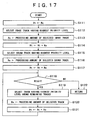
- Fig. 17 shows a flowchart representing the process to select a track to be reproduced at the start time of the reproduction processing.
- the flowchart shown in Fig. 17 begins with a step S111 at which the data select unit 51 substitutes the variable Rc to the variable Rt representing a total processing amount of the reproduction processing.
- the data select unit 51 makes an access to the priority-level assignment table storage unit 37 to identify a video-data track having the highest priority level and fetches the video data for the track from the image-data storage unit 42.
- the data select unit 51 calculates an amount of reproduction processing required to reproduce the video data fetched from the image-data storage unit 42 and sets the result of the calculation in the variable Rs.
- the amount of reproduction processing required to reproduce video data is typically a quotient obtained as a result of dividing the processing time of 1 sample (one frame) by the duration time of the sample.
- the amount of reproduction processing required to reproduce audio data is a quotient obtained as a result of dividing the processing time of 1 sample by the duration time of the sample.
- the amount of reproduction processing required to reproduce graphics data is a quotient obtained as a result of dividing the processing time of 1 sample (one frame) by 1 video frame time, which is equal to the duration time of 1 sample of video data.
- the amount of a special effect is a quotient obtained as a result of dividing the processing time of a process to reproduce 1 video frame by the time of the video frame.
- the data select unit 51 adds the value of the variable Rs to the variable Rt and takes the sum obtained as a result of the addition as a new value of the variable Rt.
- the data select unit 51 makes an access to the priority-level assignment table storage unit 37 to identify an audio-data track having the highest priority level and fetches the audio data for the track from the image-data storage unit 42.
- the data select unit 51 calculates an amount of reproduction processing required to reproduce the audio data fetched from the image-data storage unit 42 and sets the result of the calculation in the variable Rs.
- the data select unit 51 adds the value of the variable Rs to the variable Rt and takes the sum obtained as a result of the addition as a new value of the variable Rt.
- the data select unit 51 examines the value of the variable Rt to determine whether or not the variable Rt is not greater than 1.0, that is, whether or not the reproduction processing capacity is still available in the reproduction apparatus.
- the flow of the process goes on to a step S119 at which the data select unit 51 makes an access to the priority-level assignment table storage unit 37 to determine whether or not tracks still exist in the storage units as tracks, the properness of the reproduction process of which has not been determined yet.
- the data select unit 51 calculates an amount of reproduction processing required to reproduce the selected frame and sets the result of the calculation in the variable Rs.
- the data select unit 51 adds the value of the variable Rs to the variable Rt and takes the sum obtained as a result of the addition as a new value of the variable Rt. Subsequently, the flow of the process goes back to the step S121.
- step S118 If the determination result obtained at the step S118 indicates that the relation Rt > 0.1 holds true, that is, the variable Rt is greater than 1.0 implying that no reproduction processing capacity is available in the reproduction apparatus, on the other hand, the flow of the process goes on to a step S122 at which processing control is returned to a step S87 of the main routine represented by the flowchart shown in Fig. 16.
- the data select unit 51 supplies each piece of data selected as data to be reproduced at the start time of the reproduction processing to the image-decoding unit 15, the graphics-decoding unit 16, the text-decoding unit 32 or the sound-decoding unit 17 in dependence on the substance of the data, and the reproduction apparatus starts the video reproduction processing.
- the data select unit 51 determines whether or not a track, the reproduction processing of which has been ended, exists. If the result of the determination indicates that a track, the reproduction processing of which has been ended, does not exist, the flow of the operation goes back to the step S88 at which the data select unit 51 repeats the determination at this step. If the result of the determination indicates that a track, the reproduction processing of which has been ended, exists, on the other hand, the flow of the operation goes on to the step S89 at which the data select unit 51 obtains the current time from the timer and sets the current time in the variable T1.
- the data select unit 51 deletes the track, the reproduction processing of which has been ended, from the reproduction list.
- the data select unit 51 recalculates the variable Rt.
- the calculation of the variable Rt is explained as follows.
- Fig. 18 shows a flowchart representing a process to calculate the variable Rt.
- the flowchart shown in Fig. 18 begins with a step S131 at which the data select unit 51 substitutes the value of the variable Rc to the variable Rt.
- the data select unit 51 makes an access to the priority-level assignment table storage unit 37 to find the number of tracks cataloged on the reproduction list and sets the number of tracks in a variable n.
- the data select unit 51 initializes a loop variable j by setting the variable j at 0.
- the data select unit 51 compares the variable j with the variable n and, if the variable j is found smaller than the variable n, the flow of the process goes on to a step S135 at which the data select unit 51 calculates the amount of processing for the jth track cataloged on the reproduction list and sets the amount of processing in the variable Rs.
- the data select unit 51 adds the value of the variable Rs to the variable Rt and takes the sum obtained as a result of the addition as a new value of the variable Rt.
- the data select unit 51 increments the loop variable j by 1 and takes the result of the increment as a new value of the loop variable j. Subsequently, the flow of the process goes back to the step S134. In this way, the total amount of processing for the jth track cataloged on the reproduction list is recalculated.
- step S134 If the comparison result obtained at the step S134 indicates that the variable j is at least equal to the variable n, on the other hand, the flow of the process goes on to a step S138 at which the control of processing is returned to a step S91 of a main routine of the flowchart shown in Fig. 16. This is because the amount of processing has been calculated for each track remaining on the reproduction list after the deletion of the track, the reproduction processing of which has been ended, that is, because the total amount of processing has been recalculated.
- the data select unit 51 makes an access to the priority-level assignment table storage unit 37 to select a data track having the highest priority level among tracks stored in the storage units but not cataloged yet on the reproduction list.
- the data select unit 51 calculates the amount of processing required to carry out a process to reproduce the data for the selected track and sets the result of the calculation in the variable Rp.
- the data select unit 51 compares the sum obtained as a result of adding the value of the variable Rp to the variable Rt with 1.0 to determine whether or not the sum is smaller than 1.0.
- the flow of the operation goes on to a step S95 at which the selected track is added to the reproduction list. Then, at the next step S96, the data select unit 51 adds the value of the variable Rp to the variable Rt and takes the sum obtained as a result of the addition as a new value of the variable Rt. Subsequently, the flow of the operation goes back to the step S92.
- the flow of the operation goes on to a step S97 to give up the process to reproduce the data of the selected track, and the data select unit 51 obtains the current time from the timer, setting the current time in the variable T2.
- the data select unit 51 subtracts the variable T1 from the variable T2 and sets a difference obtained as a result of the subtraction in the compensation time Tc. In this way, the compensation Tc is changed to a period of time actually required by the reproduction apparatus.
- the data select unit 51 divides the compensation time Tc by the variable Tf and sets a result of the division in the variable Rc.
- the data select unit 51 makes an access to the priority-level assignment table storage unit 37 to find the priority level of each of tracks cataloged on the reproduction list as tracks to be reproduced, and supplies the data of the tracks to the image-decoding unit 15, the graphics-decoding unit 16, the text-decoding unit 32 or the sound-decoding unit 17 in accordance with the substance of the data so as to allow the reproduction apparatus to start a reproduction process. Then, the data select unit 51 returns control of processing to the step S88.
- the seventh embodiment by considering the actual amount of processing for each track, a data track having the highest priority level is sequentially selected among tracks stored in the storage units as tracks with no reproduction processing capacity allocated thereto yet every time available capacity exists for the reproduction processing even if the unit time of the reproduction processing is not uniform for all the tracks.
- the seventh embodiment is capable of better utilizing the reproduction processing capacity of the reproduction apparatus with no portion of the reproduction processing capacity left unused than the fourth embodiment.
- priority-level determination means finds the priority level of input data from a priority-level assignment table and the input data is supplied to predetermined decoding means only if the priority level of the input data is found higher than a threshold value.
- a predetermined threshold value in accordance with the reproduction processing capacity of the reproduction apparatus, the data can be reproduced within a range of the reproduction processing capacity.
- input data can be supplied to the decoding means on the basis of a reproduction table created as a list of pieces of data to be reproduced in the order of priority levels assigned to the pieces of data by utilizing the reproduction processing capacity.
- the priority levels are obtained from the priority-level assignment table showing the priority level of each input data whereas the reproduction processing capacity is defined as the amount of processing by which data can be reproduced within a predetermined period of time.
- the reproduction apparatus is capable of reproducing data within a range of the reproduction processing capacity, an image can be obtained in a smooth operation without losing any frames.
- data can be reproduced in accordance with a priority level within a range of the reproduction processing capacity so that it is possible to exhibit a special effect deemed to be important by editors and other users.
Landscapes
- Engineering & Computer Science (AREA)
- Multimedia (AREA)
- Signal Processing (AREA)
- Television Signal Processing For Recording (AREA)
- Management Or Editing Of Information On Record Carriers (AREA)
- Signal Processing For Digital Recording And Reproducing (AREA)
Applications Claiming Priority (5)
| Application Number | Priority Date | Filing Date | Title |
|---|---|---|---|
| JP2001306822 | 2001-10-02 | ||
| JP2001306822 | 2001-10-02 | ||
| JP2001383413A JP3724719B2 (ja) | 2001-10-02 | 2001-12-17 | 再生装置 |
| JP2001383413 | 2001-12-17 | ||
| PCT/JP2002/010265 WO2003032636A1 (fr) | 2001-10-02 | 2002-10-02 | Lecteur |
Publications (2)
| Publication Number | Publication Date |
|---|---|
| EP1434436A1 true EP1434436A1 (fr) | 2004-06-30 |
| EP1434436A4 EP1434436A4 (fr) | 2007-12-12 |
Family
ID=26623612
Family Applications (1)
| Application Number | Title | Priority Date | Filing Date |
|---|---|---|---|
| EP02800734A Withdrawn EP1434436A4 (fr) | 2001-10-02 | 2002-10-02 | Lecteur |
Country Status (6)
| Country | Link |
|---|---|
| US (1) | US7447421B2 (fr) |
| EP (1) | EP1434436A4 (fr) |
| JP (1) | JP3724719B2 (fr) |
| KR (1) | KR100932579B1 (fr) |
| CN (1) | CN1290322C (fr) |
| WO (1) | WO2003032636A1 (fr) |
Cited By (4)
| Publication number | Priority date | Publication date | Assignee | Title |
|---|---|---|---|---|
| CN100425065C (zh) * | 2004-11-02 | 2008-10-08 | 联发科技股份有限公司 | 数字多媒体光盘录像机、数字多媒体光盘烧录装置及其方法 |
| US7672570B2 (en) | 2003-06-18 | 2010-03-02 | Panasonic Corporation | Reproducing apparatus, program and reproducing method |
| EP1684512A4 (fr) * | 2003-10-28 | 2010-10-06 | Sony Corp | Appareil d'enregistrement de fichiers et procede d'edition d'effets video |
| GB2516825A (en) * | 2013-07-23 | 2015-02-11 | Canon Kk | Method, device, and computer program for encapsulating partitioned timed media data using a generic signaling for coding dependencies |
Families Citing this family (9)
| Publication number | Priority date | Publication date | Assignee | Title |
|---|---|---|---|---|
| JP2005136537A (ja) | 2003-10-29 | 2005-05-26 | Sony Corp | ファイル記録装置、ファイル再生装置、ファイル編集装置、ファイル記録方法、ファイル再生方法、ファイル編集方法、ファイル記録方法のプログラム、ファイル再生方法のプログラム、ファイル編集方法のプログラム、ファイル記録方法のプログラムを記録した記録媒体、ファイル再生方法のプログラムを記録した記録媒体、ファイル編集方法のプログラムを記録した記録媒体、記録媒体 |
| JP4203812B2 (ja) * | 2003-12-29 | 2009-01-07 | ソニー株式会社 | ファイル記録装置、ファイル記録方法、ファイル記録方法のプログラム、ファイル記録方法のプログラムを記録した記録媒体、ファイル再生装置、ファイル再生方法、ファイル再生方法のプログラム及びファイル再生方法のプログラムを記録した記録媒体 |
| JP4182932B2 (ja) | 2004-08-04 | 2008-11-19 | ソニー株式会社 | 記録装置および方法、再生装置および方法、記録再生装置および方法、並びにプログラム |
| US8249426B2 (en) | 2004-12-13 | 2012-08-21 | Muvee Technologies Pte Ltd | Method of automatically editing media recordings |
| JP4349277B2 (ja) * | 2004-12-24 | 2009-10-21 | 株式会社日立製作所 | 動画再生装置 |
| CN102479319A (zh) * | 2010-11-25 | 2012-05-30 | 鸿富锦精密工业(深圳)有限公司 | 影像识别方法及其控制电脑 |
| KR20150069760A (ko) * | 2013-12-16 | 2015-06-24 | 엘지전자 주식회사 | 디스플레이 디바이스 및 그 제어 방법 |
| CN112287128B (zh) * | 2020-10-23 | 2024-01-12 | 北京百度网讯科技有限公司 | 多媒体文件编辑方法、装置、电子设备和存储介质 |
| CN116528018B (zh) * | 2023-05-04 | 2025-11-14 | 上海幻电信息科技有限公司 | 音频轨切换方法、装置、计算设备及存储介质 |
Family Cites Families (4)
| Publication number | Priority date | Publication date | Assignee | Title |
|---|---|---|---|---|
| JPH10234014A (ja) | 1997-02-20 | 1998-09-02 | Matsushita Electric Ind Co Ltd | 画像復号化方法、画像復号化装置、画像多重化方法、画像多重化装置、及び記録媒体 |
| JP2001268493A (ja) | 2000-03-16 | 2001-09-28 | Seiko Epson Corp | 映像再生装置および映像再生方法ならびに情報記録媒体 |
| JP2001346193A (ja) * | 2000-05-31 | 2001-12-14 | Hitachi Kokusai Electric Inc | 監視テレビカメラシステム |
| JP2001346139A (ja) | 2000-06-05 | 2001-12-14 | Canon Inc | 情報処理方法及び装置 |
-
2001
- 2001-12-17 JP JP2001383413A patent/JP3724719B2/ja not_active Expired - Fee Related
-
2002
- 2002-10-02 WO PCT/JP2002/010265 patent/WO2003032636A1/fr not_active Ceased
- 2002-10-02 US US10/491,252 patent/US7447421B2/en not_active Expired - Fee Related
- 2002-10-02 KR KR1020047004417A patent/KR100932579B1/ko not_active Expired - Fee Related
- 2002-10-02 CN CNB028193911A patent/CN1290322C/zh not_active Expired - Fee Related
- 2002-10-02 EP EP02800734A patent/EP1434436A4/fr not_active Withdrawn
Cited By (11)
| Publication number | Priority date | Publication date | Assignee | Title |
|---|---|---|---|---|
| US7672570B2 (en) | 2003-06-18 | 2010-03-02 | Panasonic Corporation | Reproducing apparatus, program and reproducing method |
| US7881589B2 (en) | 2003-06-18 | 2011-02-01 | Panasonic Corporation | Playback apparatus, program, playback method |
| US7885516B2 (en) | 2003-06-18 | 2011-02-08 | Panasonic Corporation | Playback apparatus, program, playback method |
| US7912352B2 (en) | 2003-06-18 | 2011-03-22 | Panasonic Corporation | Playback apparatus, program and playback method |
| US8145035B2 (en) | 2003-06-18 | 2012-03-27 | Panasonic Corporation | Reproduction device, recording medium, program, and reproduction method |
| US8208795B2 (en) | 2003-06-18 | 2012-06-26 | Panasonic Corporation | Playback apparatus, program, and playback method |
| US8503867B2 (en) | 2003-06-18 | 2013-08-06 | Panasonic Corporation | Playback apparatus, program, and playback method |
| EP1684512A4 (fr) * | 2003-10-28 | 2010-10-06 | Sony Corp | Appareil d'enregistrement de fichiers et procede d'edition d'effets video |
| CN100425065C (zh) * | 2004-11-02 | 2008-10-08 | 联发科技股份有限公司 | 数字多媒体光盘录像机、数字多媒体光盘烧录装置及其方法 |
| GB2516825A (en) * | 2013-07-23 | 2015-02-11 | Canon Kk | Method, device, and computer program for encapsulating partitioned timed media data using a generic signaling for coding dependencies |
| GB2516825B (en) * | 2013-07-23 | 2015-11-25 | Canon Kk | Method, device, and computer program for encapsulating partitioned timed media data using a generic signaling for coding dependencies |
Also Published As
| Publication number | Publication date |
|---|---|
| CN1290322C (zh) | 2006-12-13 |
| JP2003179859A (ja) | 2003-06-27 |
| WO2003032636A1 (fr) | 2003-04-17 |
| US20050078939A1 (en) | 2005-04-14 |
| KR20040040476A (ko) | 2004-05-12 |
| EP1434436A4 (fr) | 2007-12-12 |
| JP3724719B2 (ja) | 2005-12-07 |
| KR100932579B1 (ko) | 2009-12-17 |
| US7447421B2 (en) | 2008-11-04 |
| CN1561635A (zh) | 2005-01-05 |
Similar Documents
| Publication | Publication Date | Title |
|---|---|---|
| EP1434436A1 (fr) | Lecteur | |
| US9414117B2 (en) | Information processing apparatus, information processing method and program | |
| US20050123886A1 (en) | Systems and methods for personalized karaoke | |
| US7796860B2 (en) | Method and system for playing back videos at speeds adapted to content | |
| EP1083567A2 (fr) | Système et procédé pour éditer de métadonnées source pour produire une séquence de métadonnées éditée | |
| US8542982B2 (en) | Image/video data editing apparatus and method for generating image or video soundtracks | |
| EP1174879A2 (fr) | Appareil et procédé de traitement de signaux d'informations et appareil d'enregistrement de signaux d'informations | |
| US20050120368A1 (en) | Automatic summarisation for a television programme suggestion engine based on consumer preferences | |
| EP1494472A1 (fr) | Dispositif d'enregistrement de donnees, support de memoire de programme et programme | |
| US20050234858A1 (en) | Recording and reproducing apparatus, reproducing apparatus, recording and reproducing method, reproducing method, program and recording medium | |
| WO2011059029A1 (fr) | Dispositif de traitement vidéo, procédé de traitement vidéo et programme de traitement vidéo | |
| JP2008532120A (ja) | ユニバーサルコンテンツidに基づくプレイリストのコンテンツアイテムの抽出 | |
| US8655874B2 (en) | Method and apparatus for acquiring and displaying image data corresponding to content data | |
| JP2005033276A (ja) | 画像再生システム及び画像再生プログラム、並びに画像再生方法 | |
| Huang et al. | A film classifier based on low-level visual features | |
| US10692536B1 (en) | Generation and use of multiclips in video editing | |
| US20050114793A1 (en) | Recording apparatus, reproducing apparatus, recording method, reproducing method, and recording medium thereof | |
| JP2007515029A (ja) | Dvビデオへのチャプターマーカー及びタイトル境界の挿入のための方法及びシステム | |
| KR20050072132A (ko) | 디지털 비디오 레코딩을 위한 장의 경계를 선택하기 위한방법 및 시스템 | |
| JP4600756B2 (ja) | 再生装置および方法 | |
| JP2020509624A (ja) | オーディオまたはビデオ内のカット間タイムバケットを決定するための方法および装置 | |
| US6742096B1 (en) | Fast startup procedure for multimode data players and/or recorders | |
| JPH09128879A (ja) | メディアの判別方法 | |
| KR20030084593A (ko) | 레코딩 매체 유지관리 지원 | |
| KR100563694B1 (ko) | 기록매체 상에 기록된 정보 파일의 파일 리스트 표시방법 |
Legal Events
| Date | Code | Title | Description |
|---|---|---|---|
| PUAI | Public reference made under article 153(3) epc to a published international application that has entered the european phase |
Free format text: ORIGINAL CODE: 0009012 |
|
| 17P | Request for examination filed |
Effective date: 20040326 |
|
| AK | Designated contracting states |
Kind code of ref document: A1 Designated state(s): AT BE BG CH CY CZ DE DK EE ES FI FR GB GR IE IT LI LU MC NL PT SE SK TR |
|
| RBV | Designated contracting states (corrected) |
Designated state(s): DE FR GB |
|
| A4 | Supplementary search report drawn up and despatched |
Effective date: 20071113 |
|
| RIC1 | Information provided on ipc code assigned before grant |
Ipc: G11B 20/10 20060101AFI20071107BHEP Ipc: H04N 7/52 20060101ALI20071107BHEP |
|
| 17Q | First examination report despatched |
Effective date: 20100308 |
|
| STAA | Information on the status of an ep patent application or granted ep patent |
Free format text: STATUS: THE APPLICATION IS DEEMED TO BE WITHDRAWN |
|
| 18D | Application deemed to be withdrawn |
Effective date: 20160503 |