EP1434442A2 - Procédé et appareil avancé pour le codage vidéo à base d'une TCD - Google Patents
Procédé et appareil avancé pour le codage vidéo à base d'une TCD Download PDFInfo
- Publication number
- EP1434442A2 EP1434442A2 EP03029085A EP03029085A EP1434442A2 EP 1434442 A2 EP1434442 A2 EP 1434442A2 EP 03029085 A EP03029085 A EP 03029085A EP 03029085 A EP03029085 A EP 03029085A EP 1434442 A2 EP1434442 A2 EP 1434442A2
- Authority
- EP
- European Patent Office
- Prior art keywords
- dct
- quantization
- weight matrix
- input image
- image data
- Prior art date
- Legal status (The legal status is an assumption and is not a legal conclusion. Google has not performed a legal analysis and makes no representation as to the accuracy of the status listed.)
- Withdrawn
Links
Images




Classifications
-
- H—ELECTRICITY
- H04—ELECTRIC COMMUNICATION TECHNIQUE
- H04N—PICTORIAL COMMUNICATION, e.g. TELEVISION
- H04N19/00—Methods or arrangements for coding, decoding, compressing or decompressing digital video signals
- H04N19/90—Methods or arrangements for coding, decoding, compressing or decompressing digital video signals using coding techniques not provided for in groups H04N19/10-H04N19/85, e.g. fractals
-
- H—ELECTRICITY
- H04—ELECTRIC COMMUNICATION TECHNIQUE
- H04N—PICTORIAL COMMUNICATION, e.g. TELEVISION
- H04N19/00—Methods or arrangements for coding, decoding, compressing or decompressing digital video signals
- H04N19/50—Methods or arrangements for coding, decoding, compressing or decompressing digital video signals using predictive coding
- H04N19/503—Methods or arrangements for coding, decoding, compressing or decompressing digital video signals using predictive coding involving temporal prediction
-
- H—ELECTRICITY
- H04—ELECTRIC COMMUNICATION TECHNIQUE
- H04N—PICTORIAL COMMUNICATION, e.g. TELEVISION
- H04N19/00—Methods or arrangements for coding, decoding, compressing or decompressing digital video signals
- H04N19/10—Methods or arrangements for coding, decoding, compressing or decompressing digital video signals using adaptive coding
- H04N19/102—Methods or arrangements for coding, decoding, compressing or decompressing digital video signals using adaptive coding characterised by the element, parameter or selection affected or controlled by the adaptive coding
- H04N19/117—Filters, e.g. for pre-processing or post-processing
-
- H—ELECTRICITY
- H04—ELECTRIC COMMUNICATION TECHNIQUE
- H04N—PICTORIAL COMMUNICATION, e.g. TELEVISION
- H04N19/00—Methods or arrangements for coding, decoding, compressing or decompressing digital video signals
- H04N19/10—Methods or arrangements for coding, decoding, compressing or decompressing digital video signals using adaptive coding
- H04N19/102—Methods or arrangements for coding, decoding, compressing or decompressing digital video signals using adaptive coding characterised by the element, parameter or selection affected or controlled by the adaptive coding
- H04N19/124—Quantisation
- H04N19/126—Details of normalisation or weighting functions, e.g. normalisation matrices or variable uniform quantisers
-
- H—ELECTRICITY
- H04—ELECTRIC COMMUNICATION TECHNIQUE
- H04N—PICTORIAL COMMUNICATION, e.g. TELEVISION
- H04N19/00—Methods or arrangements for coding, decoding, compressing or decompressing digital video signals
- H04N19/10—Methods or arrangements for coding, decoding, compressing or decompressing digital video signals using adaptive coding
- H04N19/134—Methods or arrangements for coding, decoding, compressing or decompressing digital video signals using adaptive coding characterised by the element, parameter or criterion affecting or controlling the adaptive coding
- H04N19/136—Incoming video signal characteristics or properties
-
- H—ELECTRICITY
- H04—ELECTRIC COMMUNICATION TECHNIQUE
- H04N—PICTORIAL COMMUNICATION, e.g. TELEVISION
- H04N19/00—Methods or arrangements for coding, decoding, compressing or decompressing digital video signals
- H04N19/10—Methods or arrangements for coding, decoding, compressing or decompressing digital video signals using adaptive coding
- H04N19/169—Methods or arrangements for coding, decoding, compressing or decompressing digital video signals using adaptive coding characterised by the coding unit, i.e. the structural portion or semantic portion of the video signal being the object or the subject of the adaptive coding
- H04N19/17—Methods or arrangements for coding, decoding, compressing or decompressing digital video signals using adaptive coding characterised by the coding unit, i.e. the structural portion or semantic portion of the video signal being the object or the subject of the adaptive coding the unit being an image region, e.g. an object
- H04N19/176—Methods or arrangements for coding, decoding, compressing or decompressing digital video signals using adaptive coding characterised by the coding unit, i.e. the structural portion or semantic portion of the video signal being the object or the subject of the adaptive coding the unit being an image region, e.g. an object the region being a block, e.g. a macroblock
-
- H—ELECTRICITY
- H04—ELECTRIC COMMUNICATION TECHNIQUE
- H04N—PICTORIAL COMMUNICATION, e.g. TELEVISION
- H04N19/00—Methods or arrangements for coding, decoding, compressing or decompressing digital video signals
- H04N19/60—Methods or arrangements for coding, decoding, compressing or decompressing digital video signals using transform coding
- H04N19/61—Methods or arrangements for coding, decoding, compressing or decompressing digital video signals using transform coding in combination with predictive coding
-
- H—ELECTRICITY
- H04—ELECTRIC COMMUNICATION TECHNIQUE
- H04N—PICTORIAL COMMUNICATION, e.g. TELEVISION
- H04N19/00—Methods or arrangements for coding, decoding, compressing or decompressing digital video signals
- H04N19/80—Details of filtering operations specially adapted for video compression, e.g. for pixel interpolation
Definitions
- the present invention relates to a method and apparatus to encode a motion image, and more particularly, to a method and apparatus to remove noise distortion effectively from an image input to a discrete cosine transform (DCT)-based motion image encoder.
- DCT discrete cosine transform
- a setup box has been developed that receives analog terrestrial broadcast content and encodes it using compression techniques such as MPEG 2 and MPEG 4.
- compression techniques such as MPEG 2 and MPEG 4.
- images received at a receiving site are likely to be distorted due to channel noise. For instance, white Gaussian noise may be contained in an entire image. If such an image is compressed without removal of the noise from the image, compression efficiency is lowered due to the noise.
- noise is removed from an image using a spatial noise reduction method or a temporal noise reduction method.
- FIG. 1 is a block diagram showing a general encoder that encodes motion images.
- the encoder produces a compressed bit stream containing the related data.
- a discrete cosine transform (DCT) unit 110 performs a DCT operation on input image data in units of 8 ⁇ 8 pixel blocks to remove spatial correlation.
- a quantization (Q) unit 120 performs quantization on a DCT coefficient obtained by the DCT unit 110 to accomplish high efficient loss compression.
- An inverse quantization (IQ) unit 130 inversely quantizes image data quantized by the Q unit 120.
- An inverse DCT (IDCT) unit 140 performs IDCT on image data that is inversely quantized by the IQ unit 130. After the IDCT unit 140 performs IDCT on the image data, a frame memory 150 stores the image data on a frame-by-frame basis.
- a motion estimation/motion compensation (ME/MC) unit 160 estimates a motion vector (MV) for individual macro blocks and a sum of absolute difference (SAD) corresponding to a block matching error, based on an input current image data frame and a previous image data frame that is stored in the frame memory 150.
- MV motion vector
- SAD sum of absolute difference
- VLC variable length coding
- FIG. 2 is a block diagram illustrating a motion image encoder that uses a conventional noise reduction method.
- the motion image encoder includes a general video encoder 220 as shown in FIG. 1 and a preprocessor 210.
- the preprocessor 210 removes noise from an input image using a conventional noise reduction method, and then inputs the input image to the video encoder 220.
- the preprocessor 210 rejects noise from an image using a spatial noise reduction method or a temporal noise reduction method.
- a spatial-temporal noise reduction method which is a combination of these methods, may also be used.
- FIGS. 3 and 4 are diagrams illustrating the spatial noise reduction method.
- an edge selector 310 performs high-pass filtering on the eight spatial noise reduction filtering masks shown in FIG. 4 to obtain filtering outputs, and selects a filtering direction to obtain the smallest filtering output with respect to each mask.
- a coefficient controller 320 performs low-pass filtering in the selected direction by adjusting low-pass filter coefficients in the selected filtering direction. The greater the number of masks the edge selector 310 uses, the higher the precision of directional detection, but the lower the noise reduction effect. On the contrary, the less number of masks used, the higher the noise reduction effect, but the higher the frequency of edge blurring.
- FIG. 5 is a block diagram illustrating the temporal noise reduction method.
- a motion detector 510 estimates the motion and the noise magnitude in a current image, based on an input image and a previous image stored in the frame memory 530. If the motion detector 510 determines a minor amount of motion and a major amount of noise is contained in the current image, a temporal recursive filter 520 performs strong low-pass filtering on the current image in the direction of a temporal axis. In contrast, if the motion detector 510 determines a major amount of motion and a minor amount of noise are contained in the current image, the temporal recursive filter 520 outputs the current image without low-pass filtering.
- the temporal noise reduction method is effective in processing still images. The temporal noise reduction method is disclosed in US Patent No. 5,969,777.
- the present invention also provides a motion image encoding apparatus and method that use such a noise removing method and apparatus.
- a discrete cosine transform (DCT)-based motion image encoding method uses a plurality of modified quantization weight matrices, the method comprising: selecting one of the plurality of modified quantization weight matrices based on noise information from input image data; performing DCT on the input image data; and performing quantization on the DCT input image data using the selected modified quanitzation weight matrix.
- DCT discrete cosine transform
- a DCT-based motion image encoding method comprises: creating a modified quantization weight matrix using noise information from input image data; performing DCT on the input image data; and performing quantization on the DCT input image data using the modified quantization weight matrix.
- a DCT-based motion image encoding apparatus uses a plurality of modified quantization weight matrices and comprises: a modified quantization weight matrix storage unit which stores the plurality of modified quantization weight matrices; a modified quantization weight matrix determination unit which selects one of the plurality of modified quantization weight matrices based on noise information from input image data; a DCT unit which performs DCT on the input image data; and a quantization unit which performs quantization on the DCT transformed data using the selected modified quantization weight matrix.
- a DCT-based motion image encoding apparatus comprises a modified quantization weight matrix creation unit which creates a modified quantization weight matrix based on noise information from input image data; a DCT unit which performs DCT on the input image data; and a quantization unit which performs quantization on the DCT transformed data using the created modified quantization weight matrix.
- Preprocess filtering is a major process included in motion image encoding. Noise contained in an image is removed through the preprocess filtering, thus improving encoding efficiency. To remove noise in an image, conventional preprocess filtering is generally performed in the spatial pixel domain of an encoder, whereas preprocess filtering according to an embodiment of the present invention is carried out in the discrete cosine transform (DCT) domain of an encoder.
- DCT discrete cosine transform
- approximated, generalized Wiener filtering is performed to remove noise from an image.
- the approximated Wiener filtering is realized by performing fast unitary transformation, such as DCT, on an image.
- another filtering technique may be used to filter an image in the DCT domain.
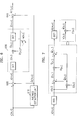
- FIG. 6 is a block diagram illustrating approximated, generalized Wiener filtering which filters non-zero-mean image data in accordance with an embodiment of the present invention.
- v denotes an input image block that contains noise, and ⁇ and denotes a row-ordered column vector of a filtered image block.
- the input image block v indicates a non-zero mean image block.
- An average estimation unit 610 estimates a mean m and of an image block, and a subtracter 620 subtracts the estimated average m and from the input image block v and outputs data z as the result.
- the data z is filtered by a filtering unit 630 and the filtering unit 630 outputs filtered data y and as the filtering result.
- An adder 640 combines the filtered data y and and the average m and of the image block and outputs desired filtered data ⁇ and as the combination result.
- Equation (2) When Equation (2) is applied to an 8 ⁇ 8 image block, the following equation is obtained: ( k , l ) may be expressed as follows: wherein ⁇ ( k , l ) denotes normalized element values that are placed along a diagonal line of AR A* T , and ⁇ 2 denotes a variance of the original image y . In general, because ⁇ 2 is an unknown value, it is replaced with a value which is obtained by subtracting a noise variance from a variance z.
- Equation (3) a zero-mean image block undergoes approximated, generalized Wiener filtering by multiplying two-dimensional DCT coefficients by ( k , l ).
- a final filtered image is obtained by combining the filtered data y and ( m , n ) and an average m and ( m , n ).
- Equation (6) reveals that the generalized Wiener filtering may be simplified using only F(k,l) and a multiplying operation.
- Equation (7) discloses that F(k,l) is determined by a signal to noise ratio (SNR), a covariance matrix, and an average matrix.
- SNR signal to noise ratio
- a matrix, which satisfies Equation (5) is selected as an average matrix S(k,l) .
- a DC value of the average matrix S(k,l) in a DCT block may be set forth as follows:
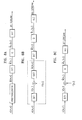
- FIGS. 8A through 8C are block diagrams illustrating the structures of a motion image encoder in which approximated, generalized Wiener filtering is performed on an intra block.
- the encoders of FIGS. 8A and 8C filter an intra block in a DCT domain, and perform quantization and variable length coding (VLC) on the filtered intra block without inverse DCT (IDCT).
- VLC variable length coding
- an intra block is simply filtered by multiplying DCT coefficients by F(k,l) , and then, each of the DCT coefficients is multiplied (or divided) by a characteristic value in a quantization table. Accordingly, the multiplication and quantization are combined to make a process.
- the approximated generalized Wiener filtering shown in FIGS. 8A through 8C may also be performed on an inter block, assuming that noise is removed from motion-compensated estimation block information p(m,n) .
- a covariance ⁇ (k,l) is determined depending on whether an input image block is an inter block or an intra block.
- F(k,l) expressed in Equation (7) is also changed according to a block type.
- Equation (9) a method of calculating an estimated variance for an intra or inter block from which an average is subtracted.
- Equation (9) is disclosed in an article entitled "Covariance Analysis of Motion-Compensated Frame Differences" listed in IEEE Trans. Circ. Syst. for Video Technol., W. Niehsen and M. Brunig, June 1999.
- An estimated variance may be calculated by applying Equation (9) to a plurality of images.
- an intra block the original image is processed on an 8 ⁇ 8 block-by-block basis.
- inter blocks are detected and collected using a full search algorithm, and an estimated variance is calculated using Equation (9).
- ⁇ 2 / z denotes a variance of a macro block (MB).
- a general motion image encoder calculates the variance ⁇ 2 / z on an MB-by-MB basis.
- 8 ⁇ 8 blocks included in the same MB are considered to have the same variances, thus reducing additional computation for variances of the respective 8 ⁇ 8 blocks.
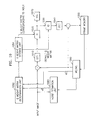
- FIG. 10 illustrates a motion image encoder using a noise reduction method according to an embodiment of the present invention.
- the motion image encoder of FIG. 10 using a noise reduction method will be described with reference to FIGS. 1 through 10.
- the motion image encoder, in FIG. 10 further includes a noise estimation unit 1080, a quantization (Q) weight matrix determination unit 1092, and a Q weight matrix storage unit 1094.
- a DCT unit 1010, an IDCT unit 1040, a frame memory 1050, a motion estimation (ME)/motion compensation (MC) unit 1060, and a variable length coding (VLC) unit 1070 have the same functionality as corresponding units of the encoder shown in FIG. 1, and therefore, their descriptions will be omitted here.
- the Q weight matrix determination unit 1092 determines a quantization (Q) weight matrix, using noise variances ⁇ 2 / n and ⁇ 2 / z which are transmitted from the noise estimation unit 1080 and the ME/MC unit 1060, respectively. Also, the Q weight matrix determination unit 1092 transmits index information regarding the Q weight matrix to the Q weight matrix storage unit 1094.
- Q quantization
- the Q weight matrix determination unit 1092 determines a Q weight matrix with noise variances ⁇ 2 / n and ⁇ 2 / z which are transmitted from the noise estimation unit 1080 and the ME/MC unit 1060, respectively.
- F(k,l) is calculated by Equation (7) in connection with Equation (8) and FIGS. 8 and 9.
- each of the DCT coefficients V(k,l) of an 8 ⁇ 8 image block is multiplied by F(k,l) to obtain W and ( k,l ), and W and(k,l) is divided by a Q weight matrix in a quantization process.
- a motion image encoder performs an integrated process in which each of the DCT coefficients V(k,l) is multiplied by F(k,l) to obtain W and ( k , l ) and W and ( k , l ) is divided by a Q weight matrix. If a position component of (k,l) for the Q weight matrix QT is Q(k,l), a position component of (k,l) for the new Q weight matrix QT' is Q(k,l)/F(k,l).
- the multiplication and division processes are combined to make a process. That is, a plurality of F matrices are predetermined using variances ⁇ 2 / n and ⁇ 2 / z , and new Q weight matrices QT' are calculated using the plurality of F matrices and stored in the Q weight matrix storage unit 1094.
- five new Q weight matrices QT' are calculated using the variances ⁇ 2 / n and ⁇ 2 / z and stored in the Q weight matrix storage unit 1094. If the variances ⁇ 2 / n and ⁇ 2 / z are determined, ⁇ 2 / n / ⁇ 2 may be calculated with these variances, using Equation (10).
- Equation (7) reveals that F(k,l) is determined by S ( k , l ), ⁇ ( k , l ), and ⁇ 2 / n / ⁇ 2 .
- S ( k , l ) is calculated using Equation (8).
- ⁇ ( k , l ) changes according to the block type, depending on whether an input image is an inter block or an intra block.
- ⁇ 2 / n / ⁇ 2 is only a variable used in determining F(k,l) .
- ⁇ 2 / n / ⁇ 2 are classified for five cases, and five new Q weight matrices QT' are created and stored in the Q weight matrix storage unit 1094.
- the Q weight matrix determination unit 1092 quantizes ⁇ 2 / n / ⁇ 2 using the variances ⁇ 2 / n and ⁇ 2 / z which are input from the noise estimation unit 1080 and the ME/MC unit 1060, respectively. Then, the Q weight matrix determination unit 1092 transmits a new Q matrix index to the Q weight matrix storage unit 1094 corresponding to the quantized ⁇ 2 / n / ⁇ 2 . If the Q weight matrices stored in the Q weight matrix storage unit 1094 are categorized into five cases based on ⁇ 2 / n / ⁇ 2 , the quantization process is performed on five levels and the Q matrix index is a value from 0 to 4.
- the Q weight matrix storage unit 1094 selects a desired Q weight matrix based on Q weight matrix index information input from the Q weight matrix determination unit 1092 and transmits the Q weight matrix to a quantization (Q) unit 1020.
- the Q unit 1020 receives the Q weight matrix and performs quantization using the Q weight matrix.
- An inverse Q unit 1030 performs inverse quantization based on the default Q weight matrix.
- New Q weight matrices may be arbitrarily determined by a user.
- the embodiment also describes removal of noise from a component Y of an input image block in a DCT domain.
- a component of the image block is selected from which noise is removed.
- a component U or V may be selected when an appropriate additional weight matrix is provided.
- FIG. 11 illustrates a motion image encoder using a noise reduction method, according to another embodiment of the present invention.
- the motion image encoder of FIG. 11 further includes a noise estimation unit 1180 and a modified quantization (Q) weight matrix creation unit 1190.
- a DCT unit 1110, an IDCT unit 1140, a frame memory 1150, an ME/MC unit 1160, and a VLC unit 1170 have the same functionality as corresponding units shown in FIG. 1, and therefore, their descriptions will be omitted here.
- the modified Q weight matrix creation unit 1190 creates a modified quantization (Q) weight matrix using variances ⁇ 2 / n and ⁇ 2 / z , which are transmitted from the noise estimation unit 1180 and the ME/MC unit 1160, respectively.
- the modified Q weight matrix is transmitted to the Q unit 1120.
- the Q unit 1120 performs quantization using the modified Q weight matrix input from the Q weight matrix creation unit 1190.
- F(k,l) is calculated using Equation (7).
- each of the DCT coefficients V(k,l) for an 8 ⁇ 8 image block is multiplied by F(k,l) to obtain W and ( k , l ), and W and ( k , l ) is divided by a Q weight matrix in the quantization process.
- the modified Q weight matrix creation unit 1190 performs an integrated process in which each of the DCT coefficients V(k,l) is multiplied by F(k,l) to obtain W and ( k , l ), and W and ( k , l ) is divided by a Q weight matrix in the quantization process. That is, multiplication and quantization are combined to create the integrated process. If a position component of (k,l) of a Q weight matrix QT is Q(k,l), a position component of (k,l) of a new Q weight matrix QT' is Q(k,l)/F(k,l).
- the modified Q weight matrix creation unit 1190 creates a modified Q weight matrix QT' using variances ⁇ 2 / n and ⁇ 2 / z and provides the matrix QT' to the Q unit 1120.
- the Q unit 1120 performs quantization on the matrix QT' .
- the inverse Q unit 1130 performs inverse quantization using the original default Q weight matrix.
- the present invention may be applied to any motion image encoding apparatus or method using a compression technique such as MPEG-1, MPEG-2, or MPEG-4.
- the invention may also be embodied as computer readable code on a computer readable recording medium.
- the computer readable recording medium is any data storage device that stores data which is read by a computer system. Examples of the computer readable recording medium include read-only memory (ROM), random-access memory (RAM), CD-ROMs, magnetic tapes, floppy disks, optical data storage devices, and the like. Also, the computer readable codes may be transmitted via a carrier wave such as the Internet. The computer readable recording medium may also be distributed over network-coupled computer systems so that the computer readable code is stored and executed in a distributed fashion.
- high-performance filtering may be realized by using a noise reduction apparatus in a DCT domain and by adding memory and logic operations to a conventional motion image encoding apparatus and method, respectively.
- a motion image encoding apparatus and method according to an embodiment of the present invention are compatible with a conventional motion image encoding apparatus and method.
Landscapes
- Engineering & Computer Science (AREA)
- Multimedia (AREA)
- Signal Processing (AREA)
- Compression Or Coding Systems Of Tv Signals (AREA)
Applications Claiming Priority (2)
| Application Number | Priority Date | Filing Date | Title |
|---|---|---|---|
| KR2002085447 | 2002-12-27 | ||
| KR1020020085447A KR20040058929A (ko) | 2002-12-27 | 2002-12-27 | Dtc 기반의 개선된 동영상 부호화 방법 및 그 장치 |
Publications (2)
| Publication Number | Publication Date |
|---|---|
| EP1434442A2 true EP1434442A2 (fr) | 2004-06-30 |
| EP1434442A3 EP1434442A3 (fr) | 2005-10-12 |
Family
ID=32464623
Family Applications (1)
| Application Number | Title | Priority Date | Filing Date |
|---|---|---|---|
| EP20030029085 Withdrawn EP1434442A3 (fr) | 2002-12-27 | 2003-12-17 | Procédé et appareil avancé pour le codage vidéo à base d'une TCD |
Country Status (5)
| Country | Link |
|---|---|
| US (1) | US20040228406A1 (fr) |
| EP (1) | EP1434442A3 (fr) |
| JP (1) | JP2004215257A (fr) |
| KR (1) | KR20040058929A (fr) |
| CN (1) | CN1232124C (fr) |
Cited By (1)
| Publication number | Priority date | Publication date | Assignee | Title |
|---|---|---|---|---|
| CN104994379A (zh) * | 2015-08-05 | 2015-10-21 | 中磊电子(苏州)有限公司 | 视频处理方法及视频处理装置 |
Families Citing this family (27)
| Publication number | Priority date | Publication date | Assignee | Title |
|---|---|---|---|---|
| KR100584552B1 (ko) * | 2003-01-14 | 2006-05-30 | 삼성전자주식회사 | 동영상 부호화 및 복호화 방법과 그 장치 |
| US7801383B2 (en) | 2004-05-15 | 2010-09-21 | Microsoft Corporation | Embedded scalar quantizers with arbitrary dead-zone ratios |
| KR100579890B1 (ko) * | 2004-12-30 | 2006-05-15 | 삼성전자주식회사 | 움직임 적응적 영상처리 장치 및 그 방법 |
| KR100689215B1 (ko) * | 2005-04-18 | 2007-03-09 | 동국대학교 산학협력단 | H.264 에서 다운 샘플링과 에지 방향성을 이용한 고속예측 모드 결정 방법 |
| US8422546B2 (en) | 2005-05-25 | 2013-04-16 | Microsoft Corporation | Adaptive video encoding using a perceptual model |
| US8130828B2 (en) | 2006-04-07 | 2012-03-06 | Microsoft Corporation | Adjusting quantization to preserve non-zero AC coefficients |
| US8503536B2 (en) | 2006-04-07 | 2013-08-06 | Microsoft Corporation | Quantization adjustments for DC shift artifacts |
| US8059721B2 (en) | 2006-04-07 | 2011-11-15 | Microsoft Corporation | Estimating sample-domain distortion in the transform domain with rounding compensation |
| US7995649B2 (en) | 2006-04-07 | 2011-08-09 | Microsoft Corporation | Quantization adjustment based on texture level |
| US7974340B2 (en) | 2006-04-07 | 2011-07-05 | Microsoft Corporation | Adaptive B-picture quantization control |
| US8711925B2 (en) | 2006-05-05 | 2014-04-29 | Microsoft Corporation | Flexible quantization |
| US8542726B2 (en) | 2006-10-17 | 2013-09-24 | Microsoft Corporation | Directional and motion-compensated discrete cosine transformation |
| KR100694166B1 (ko) * | 2006-11-28 | 2007-03-12 | 삼성전자주식회사 | 동영상 부호화 방법과 그 장치 |
| US8238424B2 (en) | 2007-02-09 | 2012-08-07 | Microsoft Corporation | Complexity-based adaptive preprocessing for multiple-pass video compression |
| US8498335B2 (en) | 2007-03-26 | 2013-07-30 | Microsoft Corporation | Adaptive deadzone size adjustment in quantization |
| US8243797B2 (en) | 2007-03-30 | 2012-08-14 | Microsoft Corporation | Regions of interest for quality adjustments |
| US8442337B2 (en) | 2007-04-18 | 2013-05-14 | Microsoft Corporation | Encoding adjustments for animation content |
| US8331438B2 (en) | 2007-06-05 | 2012-12-11 | Microsoft Corporation | Adaptive selection of picture-level quantization parameters for predicted video pictures |
| US8189933B2 (en) | 2008-03-31 | 2012-05-29 | Microsoft Corporation | Classifying and controlling encoding quality for textured, dark smooth and smooth video content |
| JP4768779B2 (ja) * | 2008-06-02 | 2011-09-07 | 株式会社東芝 | 動画像符号化/復号化の方法及び装置 |
| US8897359B2 (en) | 2008-06-03 | 2014-11-25 | Microsoft Corporation | Adaptive quantization for enhancement layer video coding |
| US8254457B2 (en) * | 2008-10-20 | 2012-08-28 | Realtek Semiconductor Corp. | Video signal processing method and apparatus thereof |
| US9123103B2 (en) * | 2013-12-26 | 2015-09-01 | Mediatek Inc. | Method and apparatus for image denoising with three-dimensional block-matching |
| CN105279742B (zh) * | 2015-11-19 | 2018-03-30 | 中国人民解放军国防科学技术大学 | 一种快速的基于分块噪声能量估计的图像去噪方法 |
| CN105279743B (zh) * | 2015-11-19 | 2018-03-30 | 中国人民解放军国防科学技术大学 | 一种基于多级dct系数的图像噪声水平估计方法 |
| US11423514B2 (en) * | 2018-08-14 | 2022-08-23 | Contrast, Inc. | Image processing noise reduction |
| EP3837635A4 (fr) | 2018-08-14 | 2022-04-27 | Contrast, Inc. | Compression d'image |
Family Cites Families (5)
| Publication number | Priority date | Publication date | Assignee | Title |
|---|---|---|---|---|
| JP2560873B2 (ja) * | 1990-02-28 | 1996-12-04 | 日本ビクター株式会社 | 直交変換符号化復号化方法 |
| US5214507A (en) * | 1991-11-08 | 1993-05-25 | At&T Bell Laboratories | Video signal quantization for an mpeg like coding environment |
| US5440344A (en) * | 1992-04-28 | 1995-08-08 | Mitsubishi Denki Kabushiki Kaisha | Video encoder using adjacent pixel difference for quantizer control |
| US5426463A (en) * | 1993-02-22 | 1995-06-20 | Rca Thomson Licensing Corporation | Apparatus for controlling quantizing in a video signal compressor |
| JPH09163373A (ja) * | 1995-12-08 | 1997-06-20 | Toshiba Corp | 雑音低減装置 |
-
2002
- 2002-12-27 KR KR1020020085447A patent/KR20040058929A/ko not_active Ceased
-
2003
- 2003-08-19 US US10/642,646 patent/US20040228406A1/en not_active Abandoned
- 2003-12-17 EP EP20030029085 patent/EP1434442A3/fr not_active Withdrawn
- 2003-12-24 JP JP2003427762A patent/JP2004215257A/ja active Pending
- 2003-12-26 CN CNB2003101247272A patent/CN1232124C/zh not_active Expired - Fee Related
Cited By (2)
| Publication number | Priority date | Publication date | Assignee | Title |
|---|---|---|---|---|
| CN104994379A (zh) * | 2015-08-05 | 2015-10-21 | 中磊电子(苏州)有限公司 | 视频处理方法及视频处理装置 |
| EP3128753A1 (fr) * | 2015-08-05 | 2017-02-08 | Sercomm Corporation | Procédé de traitement vidéo et dispositif de traitement vidéo |
Also Published As
| Publication number | Publication date |
|---|---|
| JP2004215257A (ja) | 2004-07-29 |
| US20040228406A1 (en) | 2004-11-18 |
| EP1434442A3 (fr) | 2005-10-12 |
| CN1512785A (zh) | 2004-07-14 |
| CN1232124C (zh) | 2005-12-14 |
| KR20040058929A (ko) | 2004-07-05 |
Similar Documents
| Publication | Publication Date | Title |
|---|---|---|
| EP1434442A2 (fr) | Procédé et appareil avancé pour le codage vidéo à base d'une TCD | |
| US8345745B2 (en) | Method and apparatus for encoding and/or decoding moving pictures | |
| KR100708118B1 (ko) | 복수개의 변형 곱셈 테이블을 이용한 동영상 부호화 및복호화 장치와 그 방법, 및 이를 구현하기 위한프로그램이 기록된 기록 매체 | |
| KR100708206B1 (ko) | 동영상 복호화 방법과 그 장치 | |
| KR100584622B1 (ko) | 동영상 부호화 및 복호화 방법과 그 장치 | |
| KR100622306B1 (ko) | 동영상 복호화 방법과 그 장치 | |
| KR20050098215A (ko) | 동영상 부호화 및 복호화 방법과 그 장치 | |
| KR20050098218A (ko) | 동영상 부호화 및 복호화 방법과 그 장치 | |
| KR20050098214A (ko) | 동영상 부호화 및 복호화 방법과 그 장치 |
Legal Events
| Date | Code | Title | Description |
|---|---|---|---|
| PUAI | Public reference made under article 153(3) epc to a published international application that has entered the european phase |
Free format text: ORIGINAL CODE: 0009012 |
|
| 17P | Request for examination filed |
Effective date: 20031217 |
|
| AK | Designated contracting states |
Kind code of ref document: A2 Designated state(s): AT BE BG CH CY CZ DE DK EE ES FI FR GB GR HU IE IT LI LU MC NL PT RO SE SI SK TR |
|
| AX | Request for extension of the european patent |
Extension state: AL LT LV MK |
|
| PUAL | Search report despatched |
Free format text: ORIGINAL CODE: 0009013 |
|
| AK | Designated contracting states |
Kind code of ref document: A3 Designated state(s): AT BE BG CH CY CZ DE DK EE ES FI FR GB GR HU IE IT LI LU MC NL PT RO SE SI SK TR |
|
| AX | Request for extension of the european patent |
Extension state: AL LT LV MK |
|
| AKX | Designation fees paid |
Designated state(s): DE FR GB NL |
|
| STAA | Information on the status of an ep patent application or granted ep patent |
Free format text: STATUS: THE APPLICATION IS DEEMED TO BE WITHDRAWN |
|
| 18D | Application deemed to be withdrawn |
Effective date: 20080701 |