EP1435308A1 - Ceinture de siège avec piètement de charge - Google Patents
Ceinture de siège avec piètement de charge Download PDFInfo
- Publication number
- EP1435308A1 EP1435308A1 EP04002406A EP04002406A EP1435308A1 EP 1435308 A1 EP1435308 A1 EP 1435308A1 EP 04002406 A EP04002406 A EP 04002406A EP 04002406 A EP04002406 A EP 04002406A EP 1435308 A1 EP1435308 A1 EP 1435308A1
- Authority
- EP
- European Patent Office
- Prior art keywords
- seat
- load leg
- arrangement
- set forth
- lock
- Prior art date
- Legal status (The legal status is an assumption and is not a legal conclusion. Google has not performed a legal analysis and makes no representation as to the accuracy of the status listed.)
- Withdrawn
Links
- 230000000994 depressogenic effect Effects 0.000 claims description 3
- 230000005540 biological transmission Effects 0.000 claims description 2
- 241000270728 Alligator Species 0.000 description 3
- 239000004677 Nylon Substances 0.000 description 3
- 230000006835 compression Effects 0.000 description 3
- 238000007906 compression Methods 0.000 description 3
- 229920001778 nylon Polymers 0.000 description 3
- 239000004743 Polypropylene Substances 0.000 description 2
- 230000014759 maintenance of location Effects 0.000 description 2
- 239000000463 material Substances 0.000 description 2
- 229920000515 polycarbonate Polymers 0.000 description 2
- 239000004417 polycarbonate Substances 0.000 description 2
- -1 polypropylene Polymers 0.000 description 2
- 229920001155 polypropylene Polymers 0.000 description 2
- 208000027418 Wounds and injury Diseases 0.000 description 1
- 230000004323 axial length Effects 0.000 description 1
- 230000006378 damage Effects 0.000 description 1
- 238000006073 displacement reaction Methods 0.000 description 1
- 208000014674 injury Diseases 0.000 description 1
- 239000002184 metal Substances 0.000 description 1
- 239000004033 plastic Substances 0.000 description 1
- 230000003014 reinforcing effect Effects 0.000 description 1
Images




Classifications
-
- B—PERFORMING OPERATIONS; TRANSPORTING
- B60—VEHICLES IN GENERAL
- B60N—SEATS SPECIALLY ADAPTED FOR VEHICLES; VEHICLE PASSENGER ACCOMMODATION NOT OTHERWISE PROVIDED FOR
- B60N2/00—Seats specially adapted for vehicles; Arrangement or mounting of seats in vehicles
- B60N2/24—Seats specially adapted for vehicles; Arrangement or mounting of seats in vehicles for particular purposes or particular vehicles
- B60N2/26—Seats specially adapted for vehicles; Arrangement or mounting of seats in vehicles for particular purposes or particular vehicles for children
- B60N2/28—Seats readily mountable on, and dismountable from, existing seats or other parts of the vehicle
- B60N2/2821—Seats readily mountable on, and dismountable from, existing seats or other parts of the vehicle having a seat and a base part
- B60N2/2824—Seats readily mountable on, and dismountable from, existing seats or other parts of the vehicle having a seat and a base part part of the base being supported by the vehicle frame
-
- B—PERFORMING OPERATIONS; TRANSPORTING
- B60—VEHICLES IN GENERAL
- B60N—SEATS SPECIALLY ADAPTED FOR VEHICLES; VEHICLE PASSENGER ACCOMMODATION NOT OTHERWISE PROVIDED FOR
- B60N2/00—Seats specially adapted for vehicles; Arrangement or mounting of seats in vehicles
- B60N2/24—Seats specially adapted for vehicles; Arrangement or mounting of seats in vehicles for particular purposes or particular vehicles
- B60N2/26—Seats specially adapted for vehicles; Arrangement or mounting of seats in vehicles for particular purposes or particular vehicles for children
- B60N2/28—Seats readily mountable on, and dismountable from, existing seats or other parts of the vehicle
- B60N2/2803—Adaptations for seat belts
- B60N2/2806—Adaptations for seat belts for securing the child seat to the vehicle
-
- B—PERFORMING OPERATIONS; TRANSPORTING
- B60—VEHICLES IN GENERAL
- B60N—SEATS SPECIALLY ADAPTED FOR VEHICLES; VEHICLE PASSENGER ACCOMMODATION NOT OTHERWISE PROVIDED FOR
- B60N2/00—Seats specially adapted for vehicles; Arrangement or mounting of seats in vehicles
- B60N2/24—Seats specially adapted for vehicles; Arrangement or mounting of seats in vehicles for particular purposes or particular vehicles
- B60N2/26—Seats specially adapted for vehicles; Arrangement or mounting of seats in vehicles for particular purposes or particular vehicles for children
- B60N2/28—Seats readily mountable on, and dismountable from, existing seats or other parts of the vehicle
- B60N2/2821—Seats readily mountable on, and dismountable from, existing seats or other parts of the vehicle having a seat and a base part
Definitions
- the present invention relates generally to a seat arrangement having a seat base to which a seat can be selectively engaged and disengaged, a load leg extending from one end of the seat base for engaging a vehicle floor, and a lock- off device for a seat belt.
- the present invention provides a seat base that includes a lock-off device to easily capture and securely hold a vehicle shoulder belt in position relative to the seat base to retain the seat base on the vehicle seat.
- the seat base includes alligator clamp-like members, one on either side of the base, to clamp a vehicle shoulder belt to the seat base and prevent the belt from slippling along the belt's axial direction.
- the clamp-like members thus secure the seat base to the vehicle seat via the vehicle belt.
- This seat arrangement comprises an easy to use lock-off device (300), which is adapted to receive a vehicle belt and to clamp the belt against movement in its axial direction.
- This lock-off device (300) comprises a clamp having inner and outer members (302,304) which are operatively connected with one another such that webbing of a vehicle belt, when slid and clamped between the inner and outer members, is prevented from sliding along its length.
- the inner member (302) of the above lock-off device is fixed to a surface of the base member (100), while the outer member (304) has one end immovably fastened to one end of the inner member (302) and is superimposed over the inner member so that a seat belt receiving clearance is established between the free end of the outer member (304) and a corresponding end of the inner member (302).
- the invention resides in a seat arrangement having a base member (100) to which a child's seat can selectively be attached and detached, a load leg (200) extending from one end of the base member (100) for engagement with a floor of the vehicle, and a lock-off device (300) for a seat belt, the lock-off device being characterized by an inner member (302) fixed to a surface of the base member (100); and an outer member (304) having one end immovably integral with one end of the inner member (302) and superimposed over the inner member (302) so that a tapering clearance, into which seat belt webbing can be easily slid, is established between the free end of the outer member (304) and a corresponding end of the inner member (302).
- This seat arrangement is further characterized in that the load leg (200) is pivotally mounted to the base member (100). In addition, the load leg (200) is adjustable in length.
- the load leg (200) is provided with a latch mechanism (216) to permit the load leg (200) to be locked at a selected length.
- this latch mechanism (216) has at least one pivotal latch member (218) that selectively engages openings (212A) formed in a strut (212) reciprocatively mounted in a housing (214) also forming part of the load leg (200).
- the load leg (200) includes a fold latch arrangement (232, 236) which holds the load leg (200) in an operative position until the load leg (200) is manually released.
- This fold latch arrangement (232, 236) comprises a lock member (236) that protrudes through an opening (236) formed in the base member (100) and locks the load leg (200) against pivotal movement until the lock member (236) manually depressed to a level whereat engagement between the lock member and the base member is absent.
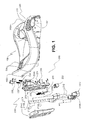
- Figs 1-8 show an embodiment of a seat arrangement for use in a vehicle in accordance with the invention.
- the seat arrangement can be used in any vehicle equipped for carrying an infant, toddler or child seats, including automobiles, sport utility vehicles, vans, trucks, planes, buses, trains, boats, and the like.
- This seat arrangement generally comprises a seat supporting base member 100 to which a child's seat (not shown) can be selectively engaged and disengaged.
- the base member 100 includes a load leg 200.
- the load leg 200 is pivotally mounted to a forward end 100A of the base member 100 and includes a foot member 210.
- the foot member 210 can have a curved lower surface 210A adapted to rest on top of a transmission tunnel of an automotive vehicle (neither shown) so that the base member 100 can be stably secured to the middle of the vehicle's rear seat at a location which is optimally located to minimize injury to a child in a side impact/collision.
- the central portion of the lower surface 210A of the foot 210 curves, the lower surface 210A becomes generally planar at either side so that, when the base member 100 is placed on the left- or right- side of the vehicle's rear seat, the foot 210 can balance on the flat surface of the rear floor pan of the vehicle and can spread out the force translated from the child's seat to the base member 100 in the event of a front collision.
- the foot 210 can be molded from polypropylene, polycarbonate or the like.
- a pair of struts 212 which can be hollow tubes, for example, extend up from the foot 210 and are slidably received within channels 213 molded into a load leg housing 214.
- the housing 214 as show in Fig. 1, consists of front and rear halves 214A, 214B that are secured together with a plurality of un-numbered fastener elements and guides.
- the tubular struts 212 slide in and out of the housing 214 within predetermined limits.
- a latch mechanism is mounted in the housing 214 in the manner best seen in Fig. 8.
- the latch mechanism 216 includes a pair of pawl-like pivotal latch members 218 with teeth 218A that engagingly extend into one of series of openings 212A formed along the inboard edges of the tubular struts 212.
- the latch members 218 are spring loaded by compression springs 220 so as to be constantly biased to pivot in a direction wherein the teeth 218A engage opposed openings 212A.
- a single, manually operable, button-like adjustment handle or member 222 is arranged to engage the latch members 218. Displacement of the adjustment handle 222 against the bias of the springs 220 (in Fig. 8, upward) induces the pivoting movement of the latch members 218 in a direction which retracts the teeth from the openings 212A.
- the tubular struts 212 can be slidably adjusted up (or down) relative to the housing 214. Release of the adjustment handle 222 permits the latch members 218 to pivot back in an engaging direction and to re-engage in the appropriate openings 212A. Although actuation of the adjustment handle 222 is necessary for upward movement of the struts 212 (to shorten the load leg), the struts 212 can be moved downward (to lengthen the load leg) without actuating the handle 222 by pulling on foot 210 in a direction away from the base member 100 with enough force to cause the teeth 218A to release from the openings 212A.
- the teeth 218A then slide along the inboard sides of the struts 212 until they reach the next set of opposed openings 212A, at which time they pivot into engagement in those openings 212A.
- the struts 212 can be ratcheted down in this manner until the load leg has been sufficiently lengthened.
- the struts 212 include retention bushings 212B that prevent the struts 212 from being pulled out of the lower end of the channels 213 in the load leg housing 214.
- the struts 212 can be pulled downward, away from the base member 100, only until bushings 212B contact ribs 219 formed in the channels 213.
- the housing 214 of the load leg 200 is pivotally supported on a pivot shaft or tube 224 which is rigidly connected at both ends to the underside of the base member 100 by way of connection brackets 226.
- a fold latch arrangement 230 is provided as part of the housing 214 of the load leg 200.
- the arrangement 230 takes the form of a pair of spring loaded block-like lock members 232 that are respectively arranged to project through a pair of openings 236 formed in the base member 100 when the load leg 200 is pivoted to its operative position, as seen in Fig. 2. Engagement between the sides of the lock members 232 and the edges of the openings 236 restrains the load leg 200 against pivotal movement.
- the load leg 200 is maintained in this operative position until such time as the lock members 232 are manually depressed to a level where engagement with the edges of the openings 236 is lost, and resistance to pivotal movement is removed. Under these conditions, the load leg 200 can be folded back to its stored position illustrated in Fig. 6.
- the above-mentioned lock members 232 of this embodiment each comprise a hollow molded member which is configured to receive one end of a compression spring 233.
- the lock members 232 also are slidably disposed in recesses 234 which are molded into the rear half 214B of the load leg housing 214.
- the lock members 232 each are formed with small retention barbs 232A on each side.
- the lock members 232 are pressed into the recesses 234, and barbs 232A are received in slots 234A. Engagement between the upper end of the slots 234A and the barbs 232A limits the maximum degree of projection of each of the lock members 232 and retains them in the recesses 234.
- the lock members 232 are made of nylon, while the front and rear halves 214A, 214B of the load leg housing 214 are molded from polypropylene, polycarbonate or the like. It is preferable to form the sliding lock members 232 of a different material from that of the housing 214 so that the lock members 232 can slide easily along the recess walls. Nylon (or similar material) provides suitable self-lubricating properties and ensures reliable operation of the lock members 232.
- the single, manually operable, button-like adjustment handle or member 222 which is associated with the latch members 218 is, in this embodiment, also made of nylon for the same reason.
- the rear or aft end of the base member 100 (viz., an end of the base member distal from that at which the load leg 200 is pivotally mounted) is provided with a pair of lock-off members 300.
- the lock off members 300 are located on either side of the base member 100 and are adapted to receive and grip seat belt webbing (not shown) of a vehicle shoulder belt. Once the seat belt is pulled into a lock off member 300, it is gripped in a manner which strongly inhibits sliding of the belt along its length or axial direction.
- a lock off member 300 is provided on either side of the base member 100 so that the base member 100 can be used on either side of, or in the middle of, a vehicle.
- the lock off members 300 are operative with either a 2-point or 3-point adult seat belt.
- the lock off devices 300 each include inner and outer members 302, 304.
- the inner member 302 is fixed to the base member 100, such as by bolts or nylock nuts, so as to be restrained against any movement relative to the base member 100.
- the outer member 304 is secured only at one end to the inner member 302 via bolts and nylock nuts, for example.
- This cantilevered attachment endows the outer member 304 with the ability to flex relative to the inner member 302 by a small amount and to act as a type of non-adjustable alligator clamp.
- a tapered clearance is defined between the "jaws' of this arrangement into which a seat belt can be pulled and easily wedged.
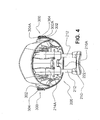
- the inboard surfaces of the inner and outer members 302, 304 additionally are provided with ribs or splines 302A, 304A which interleave and overlap by amounts selected so that, when seat belt webbing is slid between the inner and outer members, it is gripped and forced into a gently serpentine configuration to produce sufficient friction that movement of the seat belt webbing along its axial length direction is prohibited.
- the interleaving of the ribs 302A, 304A can be seen in Fig. 4.
- the invention is not limited to this arrangement.
- member 222 simplifies the adjustment operation, the present invention can have an individually operable latch operating member associated with each of the tubular legs, if so desired.
- latch members 218, while being described as being associated with separate compression spring members, could be replaced with latch members that have integrally arranged springs, such as leaf spring arrangements which are integrally or unitarily formed with the latch members.
- the latch members 218 are preferably formed of metal for the purposes of strength and safety. Alternatively, they can include a plastic covering which encompasses the integral leaf spring arrangement.
- the fold latches 230 can be replaced with a single resiliently biased member. Or, they can be replaced with a different arrangement, wherein the pivot shaft or shafts about which the load leg pivots can be supported by a pair of opposed L-shaped slots formed in the load leg housing, and wherein the upper end of the load leg housing is arranged to be inserted into a socket or recess in the lower surface of the base member of sufficient depth and size so as to lock the load leg in its operative support position.
- Folding of the leg in this different embodiment can be achieved by pulling the load leg vertically downward so that pivot shaft(s) slides down the vertical leg of the L-shaped slots.
- the L-shaped slots are selected to have a length which allows the load leg housing to clear the socket or recess. At this stage the load leg would be released and rendered pivotal. The load leg could then be maneuvered so that the pivot shaft is moved along the horizontal leg of the L-shaped groove, and the load leg assumes a folded stored configuration with respect to the base member.
- Figs. 1-8 illustrate a seat supporting base member 100 having a particular shape
- the load leg of the present invention can be used with base members of different configurations.
- the load leg can be employed on a base member with a differently-contoured upper surface to which a child's seat can be attached or with different height, width, and length dimensions.
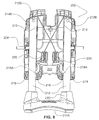
- the reinforcing ribs on the lower side of the base member seen most clearly in Fig. 5, can be arranged differently in other embodiments of the base member.
- lock off devices while being disclosed as similar to alligator jaw-like clamps, can be replaced with devices wherein the outer member-is pivotally mounted and adapted to snap snugly down on the inner member or the like, without departing from the broadest aspects of the invention.
Landscapes
- Engineering & Computer Science (AREA)
- Health & Medical Sciences (AREA)
- Child & Adolescent Psychology (AREA)
- General Health & Medical Sciences (AREA)
- Aviation & Aerospace Engineering (AREA)
- Transportation (AREA)
- Mechanical Engineering (AREA)
- Seats For Vehicles (AREA)
- Automotive Seat Belt Assembly (AREA)
- Finger-Pressure Massage (AREA)
- Professional, Industrial, Or Sporting Protective Garments (AREA)
Applications Claiming Priority (1)
| Application Number | Priority Date | Filing Date | Title |
|---|---|---|---|
| EP01118100A EP1279554B1 (fr) | 2001-07-26 | 2001-07-26 | Support de siège avec piètement de charge |
Related Parent Applications (1)
| Application Number | Title | Priority Date | Filing Date |
|---|---|---|---|
| EP01118100A Division EP1279554B1 (fr) | 2001-07-26 | 2001-07-26 | Support de siège avec piètement de charge |
Publications (1)
| Publication Number | Publication Date |
|---|---|
| EP1435308A1 true EP1435308A1 (fr) | 2004-07-07 |
Family
ID=8178139
Family Applications (2)
| Application Number | Title | Priority Date | Filing Date |
|---|---|---|---|
| EP01118100A Expired - Lifetime EP1279554B1 (fr) | 2001-07-26 | 2001-07-26 | Support de siège avec piètement de charge |
| EP04002406A Withdrawn EP1435308A1 (fr) | 2001-07-26 | 2001-07-26 | Ceinture de siège avec piètement de charge |
Family Applications Before (1)
| Application Number | Title | Priority Date | Filing Date |
|---|---|---|---|
| EP01118100A Expired - Lifetime EP1279554B1 (fr) | 2001-07-26 | 2001-07-26 | Support de siège avec piètement de charge |
Country Status (3)
| Country | Link |
|---|---|
| EP (2) | EP1279554B1 (fr) |
| AT (1) | ATE276897T1 (fr) |
| DE (1) | DE60105796T2 (fr) |
Cited By (3)
| Publication number | Priority date | Publication date | Assignee | Title |
|---|---|---|---|---|
| US8070226B2 (en) | 2009-03-24 | 2011-12-06 | Graco Children's Products Inc. | Infant car seat base |
| CN102390294A (zh) * | 2011-10-17 | 2012-03-28 | 江苏幸运宝贝安全装置制造有限公司 | 全方位立体可调式儿童车载约束系统 |
| US12030411B2 (en) | 2022-01-28 | 2024-07-09 | Britax Child Safety, Inc. | Child restraint system with posture fit mechanism |
Families Citing this family (9)
| Publication number | Priority date | Publication date | Assignee | Title |
|---|---|---|---|---|
| US20080303321A1 (en) | 2004-05-08 | 2008-12-11 | Britax Excelsior Limited | Base for a Child Safety Support |
| GB0413940D0 (en) * | 2004-06-19 | 2004-07-28 | Britax Excelsior | Child safety seat |
| GB0420414D0 (en) | 2004-09-14 | 2004-10-20 | Barker Derrick | Child car seat |
| GB2433027B (en) * | 2005-11-18 | 2010-06-23 | Wonderland Nursery Goods | Support device |
| JP6373093B2 (ja) * | 2014-07-01 | 2018-08-15 | アップリカ・チルドレンズプロダクツ合同会社 | チャイルドシートの衝撃吸収構造 |
| JP6590673B2 (ja) * | 2015-12-10 | 2019-10-16 | アップリカ・チルドレンズプロダクツ合同会社 | チャイルドシート |
| CN107839554B (zh) * | 2016-09-19 | 2024-06-28 | 珠海弘点科技有限公司 | 儿童座椅支腿结构及儿童座椅支撑座 |
| CN115675205A (zh) * | 2021-07-26 | 2023-02-03 | 明门(中国)幼童用品有限公司 | 底座组件以及儿童汽车安全座椅 |
| EP4454941A1 (fr) | 2023-04-28 | 2024-10-30 | BRITAX RÖMER Kindersicherheit GmbH | Verrou de rebond de jambe de support |
Citations (10)
| Publication number | Priority date | Publication date | Assignee | Title |
|---|---|---|---|---|
| EP0200411A2 (fr) * | 1985-05-01 | 1986-11-05 | Britax-Excelsior Limited | Siège de sécurité pour enfant |
| US4640545A (en) * | 1985-05-13 | 1987-02-03 | Wimmersperg Heinrich F Von | Lock for vehicle infant restraint |
| EP0485121A1 (fr) * | 1990-11-09 | 1992-05-13 | Britax-Excelsior Limited | Siège de securité pour enfant |
| US5277472A (en) * | 1990-09-04 | 1994-01-11 | Gerry Baby Products Company | Multi-function infant car seat including glider assembly |
| NL9500514A (nl) * | 1995-03-15 | 1996-10-01 | Mach En Metaalfab Oedremefaoe | Veiligheids-kinderzitje. |
| FR2741847A1 (fr) * | 1995-12-05 | 1997-06-06 | Baby Relax | Dispositif de fixation d'une armature support de siege ou d'un siege pour enfants dans les vehicules automobiles |
| EP0791500A2 (fr) * | 1996-02-15 | 1997-08-27 | Giuseppe Capponi | Siège d'enfants pour véhicules |
| EP0813992A2 (fr) * | 1996-06-19 | 1997-12-29 | Margarete Schräder | Siège d'enfant pour véhicules de transport de passagers |
| EP0822115A2 (fr) * | 1996-08-02 | 1998-02-04 | BRITAX RÖMER Kindersicherheit GmbH | Siège de sécurité pour enfants |
| US6000753A (en) * | 1996-12-05 | 1999-12-14 | Cosco, Inc. | Child car seat foundation |
Family Cites Families (4)
| Publication number | Priority date | Publication date | Assignee | Title |
|---|---|---|---|---|
| EP0164909B1 (fr) * | 1984-05-14 | 1988-01-07 | Ase (Uk) Limited | Siège de sécurité pour enfant |
| US5286085A (en) * | 1989-06-30 | 1994-02-15 | Takata Corporation | Restraining protective seat for infants |
| GB9414418D0 (en) * | 1994-07-16 | 1994-09-07 | Britax Excelsior | Child safety seat |
| US5820215A (en) * | 1997-04-29 | 1998-10-13 | Dreisbach; Kurt R. | Child safety seat adapter |
-
2001
- 2001-07-26 EP EP01118100A patent/EP1279554B1/fr not_active Expired - Lifetime
- 2001-07-26 AT AT01118100T patent/ATE276897T1/de not_active IP Right Cessation
- 2001-07-26 EP EP04002406A patent/EP1435308A1/fr not_active Withdrawn
- 2001-07-26 DE DE60105796T patent/DE60105796T2/de not_active Expired - Fee Related
Patent Citations (10)
| Publication number | Priority date | Publication date | Assignee | Title |
|---|---|---|---|---|
| EP0200411A2 (fr) * | 1985-05-01 | 1986-11-05 | Britax-Excelsior Limited | Siège de sécurité pour enfant |
| US4640545A (en) * | 1985-05-13 | 1987-02-03 | Wimmersperg Heinrich F Von | Lock for vehicle infant restraint |
| US5277472A (en) * | 1990-09-04 | 1994-01-11 | Gerry Baby Products Company | Multi-function infant car seat including glider assembly |
| EP0485121A1 (fr) * | 1990-11-09 | 1992-05-13 | Britax-Excelsior Limited | Siège de securité pour enfant |
| NL9500514A (nl) * | 1995-03-15 | 1996-10-01 | Mach En Metaalfab Oedremefaoe | Veiligheids-kinderzitje. |
| FR2741847A1 (fr) * | 1995-12-05 | 1997-06-06 | Baby Relax | Dispositif de fixation d'une armature support de siege ou d'un siege pour enfants dans les vehicules automobiles |
| EP0791500A2 (fr) * | 1996-02-15 | 1997-08-27 | Giuseppe Capponi | Siège d'enfants pour véhicules |
| EP0813992A2 (fr) * | 1996-06-19 | 1997-12-29 | Margarete Schräder | Siège d'enfant pour véhicules de transport de passagers |
| EP0822115A2 (fr) * | 1996-08-02 | 1998-02-04 | BRITAX RÖMER Kindersicherheit GmbH | Siège de sécurité pour enfants |
| US6000753A (en) * | 1996-12-05 | 1999-12-14 | Cosco, Inc. | Child car seat foundation |
Cited By (5)
| Publication number | Priority date | Publication date | Assignee | Title |
|---|---|---|---|---|
| US8070226B2 (en) | 2009-03-24 | 2011-12-06 | Graco Children's Products Inc. | Infant car seat base |
| CN102390294A (zh) * | 2011-10-17 | 2012-03-28 | 江苏幸运宝贝安全装置制造有限公司 | 全方位立体可调式儿童车载约束系统 |
| CN102390294B (zh) * | 2011-10-17 | 2012-11-21 | 江苏幸运宝贝安全装置制造有限公司 | 全方位立体可调式儿童车载约束系统 |
| US12030411B2 (en) | 2022-01-28 | 2024-07-09 | Britax Child Safety, Inc. | Child restraint system with posture fit mechanism |
| US12409761B2 (en) | 2022-01-28 | 2025-09-09 | Britax Child Safety, Inc. | Child restraint system with posture fit mechanism |
Also Published As
| Publication number | Publication date |
|---|---|
| EP1279554B1 (fr) | 2004-09-22 |
| DE60105796T2 (de) | 2005-11-10 |
| ATE276897T1 (de) | 2004-10-15 |
| DE60105796D1 (de) | 2004-10-28 |
| EP1279554A1 (fr) | 2003-01-29 |
Similar Documents
| Publication | Publication Date | Title |
|---|---|---|
| US6817665B2 (en) | Seat base with load leg | |
| US20080303321A1 (en) | Base for a Child Safety Support | |
| EP1623891B1 (fr) | Siège d'enfant et ceinture de sécurité | |
| EP1279554B1 (fr) | Support de siège avec piètement de charge | |
| US6979057B2 (en) | Mechanism for connecting infant car seat and base | |
| EP0164909B1 (fr) | Siège de sécurité pour enfant | |
| US6682143B2 (en) | Booster seat | |
| KR101274894B1 (ko) | 자동차 시트와 연결 가능한 유모차 | |
| CA2469994C (fr) | Necessaire de siege d'enfant pour vehicule | |
| EP1428720A2 (fr) | Système d'appui-tête articulé | |
| US20020053823A1 (en) | Infant's restraining seat | |
| US7837267B2 (en) | Lock for forward-folding backrest | |
| CN109421563B (zh) | 儿童安全座椅 | |
| KR20160058169A (ko) | 어린이 안전 시트 | |
| IL161846A (en) | Infant seat with armrests for motorcars | |
| CN119078629A (zh) | 儿童车座 | |
| US6591763B2 (en) | Collapsible seat back tray assembly | |
| US7758120B2 (en) | Compactible juvenile vehicle seat with forward-folding backrest and u-shaped backrest frame | |
| CA2314810A1 (fr) | Dispositif a siege | |
| AU5766401A (en) | Seat base with load leg | |
| EP0781686A2 (fr) | Siège d'enfant intégré | |
| US7322649B2 (en) | Child safety seat | |
| AU2006203692B2 (en) | Adjustable recline device for child safety seat | |
| US6364393B1 (en) | Device for fixing a vehicle seat | |
| JP2519761Y2 (ja) | 腰ベルトアンカ |
Legal Events
| Date | Code | Title | Description |
|---|---|---|---|
| PUAI | Public reference made under article 153(3) epc to a published international application that has entered the european phase |
Free format text: ORIGINAL CODE: 0009012 |
|
| AC | Divisional application: reference to earlier application |
Ref document number: 1279554 Country of ref document: EP Kind code of ref document: P |
|
| AK | Designated contracting states |
Kind code of ref document: A1 Designated state(s): AT BE CH CY DE DK ES FI FR GB GR IE IT LI LU MC NL PT SE TR |
|
| RIN1 | Information on inventor provided before grant (corrected) |
Inventor name: CARPENTER, JASON A. Inventor name: LONGENBECKER, MICHAEL L. Inventor name: PACELLA, JONATHAN M. |
|
| 17P | Request for examination filed |
Effective date: 20050105 |
|
| AKX | Designation fees paid |
Designated state(s): DE DK FI FR GB SE |
|
| 17Q | First examination report despatched |
Effective date: 20050418 |
|
| RAP1 | Party data changed (applicant data changed or rights of an application transferred) |
Owner name: GRACO CHILDREN'S PRODUCTS INC. |
|
| STAA | Information on the status of an ep patent application or granted ep patent |
Free format text: STATUS: THE APPLICATION IS DEEMED TO BE WITHDRAWN |
|
| 18D | Application deemed to be withdrawn |
Effective date: 20090508 |