EP1435524B1 - Batteriesensorvorrichtung - Google Patents
Batteriesensorvorrichtung Download PDFInfo
- Publication number
- EP1435524B1 EP1435524B1 EP04005840A EP04005840A EP1435524B1 EP 1435524 B1 EP1435524 B1 EP 1435524B1 EP 04005840 A EP04005840 A EP 04005840A EP 04005840 A EP04005840 A EP 04005840A EP 1435524 B1 EP1435524 B1 EP 1435524B1
- Authority
- EP
- European Patent Office
- Prior art keywords
- battery
- battery sensor
- resistance
- resistance element
- electronic unit
- Prior art date
- Legal status (The legal status is an assumption and is not a legal conclusion. Google has not performed a legal analysis and makes no representation as to the accuracy of the status listed.)
- Expired - Lifetime
Links
- 238000005476 soldering Methods 0.000 claims description 5
- 239000004020 conductor Substances 0.000 claims description 2
- 229910000679 solder Inorganic materials 0.000 description 13
- 238000010276 construction Methods 0.000 description 11
- 239000000463 material Substances 0.000 description 6
- 230000006854 communication Effects 0.000 description 4
- 238000004891 communication Methods 0.000 description 4
- 238000000034 method Methods 0.000 description 4
- RYGMFSIKBFXOCR-UHFFFAOYSA-N Copper Chemical compound [Cu] RYGMFSIKBFXOCR-UHFFFAOYSA-N 0.000 description 3
- 229910000896 Manganin Inorganic materials 0.000 description 3
- 229910052802 copper Inorganic materials 0.000 description 3
- 239000010949 copper Substances 0.000 description 3
- 239000000853 adhesive Substances 0.000 description 2
- 230000001070 adhesive effect Effects 0.000 description 2
- 238000013461 design Methods 0.000 description 2
- 230000010354 integration Effects 0.000 description 2
- 238000005259 measurement Methods 0.000 description 2
- 239000004033 plastic Substances 0.000 description 2
- 229910001369 Brass Inorganic materials 0.000 description 1
- 230000032683 aging Effects 0.000 description 1
- 230000007175 bidirectional communication Effects 0.000 description 1
- 230000005540 biological transmission Effects 0.000 description 1
- 238000009529 body temperature measurement Methods 0.000 description 1
- 239000010951 brass Substances 0.000 description 1
- 230000001276 controlling effect Effects 0.000 description 1
- 230000001419 dependent effect Effects 0.000 description 1
- 238000011161 development Methods 0.000 description 1
- 230000018109 developmental process Effects 0.000 description 1
- 238000005538 encapsulation Methods 0.000 description 1
- 238000005516 engineering process Methods 0.000 description 1
- 239000003822 epoxy resin Substances 0.000 description 1
- 238000011156 evaluation Methods 0.000 description 1
- 238000001125 extrusion Methods 0.000 description 1
- 239000003292 glue Substances 0.000 description 1
- 238000009434 installation Methods 0.000 description 1
- 238000002955 isolation Methods 0.000 description 1
- 238000012544 monitoring process Methods 0.000 description 1
- 229920000647 polyepoxide Polymers 0.000 description 1
- 238000012545 processing Methods 0.000 description 1
- 230000001105 regulatory effect Effects 0.000 description 1
- 230000006641 stabilisation Effects 0.000 description 1
- 238000011105 stabilization Methods 0.000 description 1
- 230000035882 stress Effects 0.000 description 1
- 238000003466 welding Methods 0.000 description 1
Images


Classifications
-
- H—ELECTRICITY
- H01—ELECTRIC ELEMENTS
- H01R—ELECTRICALLY-CONDUCTIVE CONNECTIONS; STRUCTURAL ASSOCIATIONS OF A PLURALITY OF MUTUALLY-INSULATED ELECTRICAL CONNECTING ELEMENTS; COUPLING DEVICES; CURRENT COLLECTORS
- H01R11/00—Individual connecting elements providing two or more spaced connecting locations for conductive members which are, or may be, thereby interconnected, e.g. end pieces for wires or cables supported by the wire or cable and having means for facilitating electrical connection to some other wire, terminal, or conductive member, blocks of binding posts
- H01R11/11—End pieces or tapping pieces for wires, supported by the wire and for facilitating electrical connection to some other wire, terminal or conductive member
- H01R11/28—End pieces consisting of a ferrule or sleeve
- H01R11/281—End pieces consisting of a ferrule or sleeve for connections to batteries
- H01R11/287—Intermediate parts between battery post and cable end piece
-
- G—PHYSICS
- G01—MEASURING; TESTING
- G01R—MEASURING ELECTRIC VARIABLES; MEASURING MAGNETIC VARIABLES
- G01R1/00—Details of instruments or arrangements of the types included in groups G01R5/00 - G01R13/00 and G01R31/00
- G01R1/20—Modifications of basic electric elements for use in electric measuring instruments; Structural combinations of such elements with such instruments
- G01R1/203—Resistors used for electric measuring, e.g. decade resistors standards, resistors for comparators, series resistors, shunts
-
- G—PHYSICS
- G01—MEASURING; TESTING
- G01R—MEASURING ELECTRIC VARIABLES; MEASURING MAGNETIC VARIABLES
- G01R31/00—Arrangements for testing electric properties; Arrangements for locating electric faults; Arrangements for electrical testing characterised by what is being tested not provided for elsewhere
- G01R31/36—Arrangements for testing, measuring or monitoring the electrical condition of accumulators or electric batteries, e.g. capacity or state of charge [SoC]
- G01R31/382—Arrangements for monitoring battery or accumulator variables, e.g. SoC
- G01R31/3842—Arrangements for monitoring battery or accumulator variables, e.g. SoC combining voltage and current measurements
-
- H—ELECTRICITY
- H01—ELECTRIC ELEMENTS
- H01M—PROCESSES OR MEANS, e.g. BATTERIES, FOR THE DIRECT CONVERSION OF CHEMICAL ENERGY INTO ELECTRICAL ENERGY
- H01M10/00—Secondary cells; Manufacture thereof
- H01M10/42—Methods or arrangements for servicing or maintenance of secondary cells or secondary half-cells
- H01M10/48—Accumulators combined with arrangements for measuring, testing or indicating the condition of cells, e.g. the level or density of the electrolyte
-
- H—ELECTRICITY
- H01—ELECTRIC ELEMENTS
- H01M—PROCESSES OR MEANS, e.g. BATTERIES, FOR THE DIRECT CONVERSION OF CHEMICAL ENERGY INTO ELECTRICAL ENERGY
- H01M50/00—Constructional details or processes of manufacture of the non-active parts of electrochemical cells other than fuel cells, e.g. hybrid cells
- H01M50/50—Current conducting connections for cells or batteries
- H01M50/572—Means for preventing undesired use or discharge
- H01M50/574—Devices or arrangements for the interruption of current
- H01M50/581—Devices or arrangements for the interruption of current in response to temperature
-
- G—PHYSICS
- G01—MEASURING; TESTING
- G01R—MEASURING ELECTRIC VARIABLES; MEASURING MAGNETIC VARIABLES
- G01R31/00—Arrangements for testing electric properties; Arrangements for locating electric faults; Arrangements for electrical testing characterised by what is being tested not provided for elsewhere
- G01R31/005—Testing of electric installations on transport means
- G01R31/006—Testing of electric installations on transport means on road vehicles, e.g. automobiles or trucks
-
- G—PHYSICS
- G01—MEASURING; TESTING
- G01R—MEASURING ELECTRIC VARIABLES; MEASURING MAGNETIC VARIABLES
- G01R31/00—Arrangements for testing electric properties; Arrangements for locating electric faults; Arrangements for electrical testing characterised by what is being tested not provided for elsewhere
- G01R31/36—Arrangements for testing, measuring or monitoring the electrical condition of accumulators or electric batteries, e.g. capacity or state of charge [SoC]
- G01R31/364—Battery terminal connectors with integrated measuring arrangements
-
- G—PHYSICS
- G01—MEASURING; TESTING
- G01R—MEASURING ELECTRIC VARIABLES; MEASURING MAGNETIC VARIABLES
- G01R31/00—Arrangements for testing electric properties; Arrangements for locating electric faults; Arrangements for electrical testing characterised by what is being tested not provided for elsewhere
- G01R31/36—Arrangements for testing, measuring or monitoring the electrical condition of accumulators or electric batteries, e.g. capacity or state of charge [SoC]
- G01R31/374—Arrangements for testing, measuring or monitoring the electrical condition of accumulators or electric batteries, e.g. capacity or state of charge [SoC] with means for correcting the measurement for temperature or ageing
-
- H—ELECTRICITY
- H01—ELECTRIC ELEMENTS
- H01M—PROCESSES OR MEANS, e.g. BATTERIES, FOR THE DIRECT CONVERSION OF CHEMICAL ENERGY INTO ELECTRICAL ENERGY
- H01M2200/00—Safety devices for primary or secondary batteries
- H01M2200/10—Temperature sensitive devices
- H01M2200/108—Normal resistors
-
- H—ELECTRICITY
- H01—ELECTRIC ELEMENTS
- H01R—ELECTRICALLY-CONDUCTIVE CONNECTIONS; STRUCTURAL ASSOCIATIONS OF A PLURALITY OF MUTUALLY-INSULATED ELECTRICAL CONNECTING ELEMENTS; COUPLING DEVICES; CURRENT COLLECTORS
- H01R13/00—Details of coupling devices of the kinds covered by groups H01R12/70 or H01R24/00 - H01R33/00
- H01R13/66—Structural association with built-in electrical component
- H01R13/665—Structural association with built-in electrical component with built-in electronic circuit
- H01R13/6683—Structural association with built-in electrical component with built-in electronic circuit with built-in sensor
-
- Y—GENERAL TAGGING OF NEW TECHNOLOGICAL DEVELOPMENTS; GENERAL TAGGING OF CROSS-SECTIONAL TECHNOLOGIES SPANNING OVER SEVERAL SECTIONS OF THE IPC; TECHNICAL SUBJECTS COVERED BY FORMER USPC CROSS-REFERENCE ART COLLECTIONS [XRACs] AND DIGESTS
- Y02—TECHNOLOGIES OR APPLICATIONS FOR MITIGATION OR ADAPTATION AGAINST CLIMATE CHANGE
- Y02E—REDUCTION OF GREENHOUSE GAS [GHG] EMISSIONS, RELATED TO ENERGY GENERATION, TRANSMISSION OR DISTRIBUTION
- Y02E60/00—Enabling technologies; Technologies with a potential or indirect contribution to GHG emissions mitigation
- Y02E60/10—Energy storage using batteries
Definitions
- the invention relates to a battery sensor.
- a battery sensor device is known, for example, from US 5,939,861.
- the battery sensor is arranged in a specially provided for this recess in the battery cover and must be attached to both poles of the battery.
- Various devices and methods are known for monitoring, controlling and regulating a motor vehicle electrical system, such as energy distribution, energy control and, in particular, charging balance of the batteries.
- a motor vehicle electrical system such as energy distribution, energy control and, in particular, charging balance of the batteries.
- at least the measured quantities battery current, battery voltage and battery temperature are usually necessary.
- To detect the battery current sensors are usually used in the connection cable to the battery.
- the battery voltage and the battery temperature are usually measured by separate sensors directly to the battery terminals or away from it.
- three completely independent devices are usually used, for which space must be created separately in each vehicle and their information usually have to be forwarded to higher-level control devices for further processing.
- shunts are used for example.
- the invention provides an integrated battery sensor is provided which can be installed in each vehicle with little additional effort with only little space required. In addition, the probability of failure is reduced by the compact design and the integration of several necessary components.
- the fastening device of the battery sensor is shown as a preferably conventional battery brass terminal consisting of a clamp body 1 and a clamping screw 2.
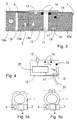
- the battery sensor 3, 4 according to the invention is essentially composed of a measuring shunt 3 and an electronic unit 4. 1 a, only the two resistance connections (10 a, 10 b, see also FIG. 2) of the measuring shunt 3 and a plastic encapsulation of the electronic unit 4, which are formed as mechanical supports, are shown.
- the battery sensor 3,4 and the fastening device 1, 2 are preferably combined to form an integrated unit.
- the fastening device 1,2 must only at a single pole of a battery, for. B. at the negative terminal connected become.
- the assembly, consisting of the fastening device 1, 2 and the battery sensor 3,4, is adapted in shape and size to the (not shown here) known, according to the Polish DIN 72311 (Teil15) specified battery pole.
- the first, shown in Fig. 1a above resistor terminal 10a is conductive
- the second, shown in Fig. 1a below resistance terminal 10b is secured in isolation over an insulating part 6 on the clamp body 1.
- the cable lug of a common connection cable can be connected.
- the (not shown here) connecting cable connects the output-side resistor terminal 10b of the Meßshunts 3 with the vehicle mass.
- Fig. 2 the assembly shown in Fig. 1a and 1b is shown in three dimensions to illustrate the construction. The same components are provided with the same reference numerals.
- the Meßshunt 3 consists of a resistive element 11 and two planar resistor terminals 10 a and 10 b.
- the resistor terminals 10a and 10b are preferably stably formed copper surfaces.
- Resistance element 11 is preferably manganin, zeranine or isohm. Copper and manganin / zeranin / lsaohm have about the same coefficient of thermal expansion as the usual board material FR4 (mixed material with epoxy resin as main component).
- This board material is preferably also for the carrier board 12 of the electronics unit 4th used, which is shown in Fig. 3 without plastic extrusion. Therefore, the carrier board 12 of the electronics unit 4 shown in FIG. 3 similar to the SMD technique via bare solder joints 14 can be attached to the resistor terminals 10a and 10b.
- the support plate 12 can also be conductively fixed by 90 ° upwardly bent short sense lines of the resistor terminals 10a and 10b on Meßshunt 3. The solder joints 14 or the terminals of the sense lines are arranged as close as possible to the resistance element 11. About the solder joints 14, the resistance element 11 is integrated circuitry in the electronics unit 4.
- the electronic unit 4 or the carrier board 12 is connected in Fig. 3 with a temperature sensor 13 for measuring the battery temperature.
- Alternative arrangements of the temperature sensor are shown in dashed lines with the reference numerals 13a and 13b.
- the temperature sensor 13 is thermally conductive, for example by means of thermal adhesive directly on the clamp body 1 is arranged. This arrangement allows a very accurate temperature measurement, but is somewhat more expensive than the arrangement of the temperature sensors 13a and 13b, which are attached to the heat-conducting resistor terminal 10b.
- the temperature sensor 13 a is simplified via connecting wires to the carrier board 12 attached.
- the temperature sensor 13b is connected, for example via solder joints with the carrier board 12 to prevent the connecting wires. For the temperature sensor 13b, however, a recess in the carrier board 12 may be necessary.
- the electronic unit 4 or the carrier board 12 has an example two-pin plug 16.
- a supply cable to the other pole of the battery, here to the positive terminal can be connected.
- a bidirectional communication line to other electronic devices in the motor vehicle can be connected.
- the communication line may also require two pins (eg when using a CAN bus).
- the communication can also be carried out by radio transmission.
- a connection via a plug 16 can also be provided with a direct connection of the connection lines to the board (for example by soldering, bonding or welding). (The alternatives are not shown here.)
- a first voltage tap 15 for measuring the battery voltage U Batt is shown, which is conductively connected to the battery terminal (eg to the negative terminal) resistance terminal 10a.
- the second voltage tap for measuring the battery voltage U Batt is formed by the pin 18 (eg to the positive pole of the battery).
- the carrier board 12 or the electronics unit 4 has a measuring, evaluation and control unit 20.
- the unit 20 detects the battery voltage U Batt , the voltage U between the two solder joints 14 and the battery temperature. From the voltage U, the battery current (I) can be calculated. For this purpose, for example, the resistance value (R) of the resistive element 11 is stored in the unit 20.
- the unit 20 preferably comprises a microprocessor and a memory. Also, the unit 20 may include conventional amplifiers and A / D converters for metering.
- the unit 20 may be any other battery indicator sizes, such as. As the state of charge or the state of aging determined. Furthermore, the unit 20 in turn can not only transmit information via the communication line, but also receive further information from other control devices and further process them with the battery sizes.
- the communication line and the supply line to the plug 16 are shown as a harness 21 combined.
- the unit 20 may drive a power switch 19 which can close or open a break present in the resistor terminal 10b.
- the battery supply of the motor vehicle can be switched off in emergencies become.
- the power switch 19 can also be integrated in one of the two connection cables to the positive pole or to the negative pole of the battery and controlled by the unit 20.
- Fig. 5a is complementarily only a second possible construction of the integrated assembly consisting of battery sensor and fastening device shown.
- the hole for the clamping screw 2 is indicated by the dotted line.
- This construction differs only in the first construction, that the battery sensor 3, 4 locally more strongly offset from the clamping screw 2 and thus is decoupled from possible tension in an attachment of the clamp body 1.
- Fig. 5b shows a Fig. 5a very similar construction in which, however, a taper is provided between the clamping body 1 and the Meßshunt 3, to avoid material stresses in the clamping body 1.
- FIGS. 6a to 7a show further design possibilities of the measuring shunt 3 according to the invention consisting of the resistance element 11 and the two resistance terminals 10a and 10b as well as the attachment of the electronics unit 4 or its carrier board 12.
- the resistor terminals 10a and 10b are preferably (as in FIG. 3) planar copper surfaces.
- the material of the resistive element 1, preferably manganin or zeranin, is arranged between the resistor terminals 10a and 10b as in FIG.
- the carrier board 12 of the electronics unit 4 (also similar to the SMD technique) is fastened via solder joints 14 to the resistor terminals 10a and 10b.
- the solder joints 14 an elongated line along the edge of the carrier board 12.
- the solder lines 14 can also be interrupted or also composed of spaced points.
- the width of the carrier board 12 is not much larger than the width of the resistance element 11; because the soldering must be provided as close to the resistance element 11.
- the construction of the Meßshunts is shown in FIG. 7a such that there is a cavity between the resistor element 11 and the carrier board 12.
- the thickness of the resistance element 11 is thus smaller than that of the resistance terminals 10a and 10b. Through this cavity, it is possible to equip the carrier board 12, if necessary, on both sides.
- the carrier board 12 may also be connected as closely as possible to the resistance element 11 by soldering points 14 on the underside of the board 12 with the resistance terminals 10a and 10b (similar to FIG. 3).
- a solid line (FIG. 6b, left) or an interrupted (FIG. 6b, right) solder line are provided for mechanical stabilization (as in FIG. 6a).
- the resistance element 11 is always integrated circuit technology in the electronics unit 4.
- the embodiment according to FIG. 6b can be combined with the construction of the measuring shunt according to FIG. 7a.
- the width of the carrier board 12 can also be greater than the width of the resistance element 11.
- solder joints (14) instead of solder joints (14) also splices (14), e.g. be provided by means of an electrically conductive and thermally conductive adhesive.
- the electronics unit 4 or the carrier board 12 of the electronics unit 4 at the planar resistor terminals 10a and 10b are secured by means of an electrically conductive material 14 (eg solder or glue).
- the soldering or splicing 14 thus serve both for electrical or circuit integration of the Meßshunts or the resistive element 11 in the electronics unit 4 and for mechanical attachment of the electronics unit 4 and the carrier board 12 on Meßshunt or at its resistor terminals 10a and 10b.
Landscapes
- Chemical & Material Sciences (AREA)
- Chemical Kinetics & Catalysis (AREA)
- Electrochemistry (AREA)
- General Chemical & Material Sciences (AREA)
- Physics & Mathematics (AREA)
- General Physics & Mathematics (AREA)
- Engineering & Computer Science (AREA)
- Manufacturing & Machinery (AREA)
- Secondary Cells (AREA)
- Measuring Instrument Details And Bridges, And Automatic Balancing Devices (AREA)
- Measuring Fluid Pressure (AREA)
- Connection Of Batteries Or Terminals (AREA)
- Measuring Pulse, Heart Rate, Blood Pressure Or Blood Flow (AREA)
- Primary Cells (AREA)
- Electrical Discharge Machining, Electrochemical Machining, And Combined Machining (AREA)
- Electric Propulsion And Braking For Vehicles (AREA)
Description
- Die Erfindung bezieht sich auf einen Batteriesensor.
- Eine Batteriesensorvorrichtung ist beispielsweise aus der US 5,939,861 bekannt. Bei dieser bekannten Vorrichtung ist der Batteriesensor in einer eigens für diesen vorgesehenen Vertiefung im Batteriedeckel angeordnet und muß an beiden Polen der Batterie befestigt werden.
- Für die Überwachung, Steuerung und Regelung eines Kraftfahrzeugbordnetzes, wie Energieverteilung, Energiesteuerung und insbesondere Ladebilanzierung der Batterien, sind diverse Vorrichtungen und Verfahren bekannt. Je nach Anwendungsfall sind üblicherweise zumindest die Meßgrößen Batteriestrom, Batteriespannung und Batterietemperatur notwendig. Zur Erfassung des Batteriestroms werden üblicherweise Sensoren in der Anschlußleitung zur Batterie verwendet. Die Batteriespannung und die Batterietemperatur werden meist mittels separater Sensoren direkt an den Batteriepolen oder entfernt davon gemessen. Nach dem Stand der Technik werden somit üblicherweise drei völlig unabhängige Einrichtungen verwendet, für die in jedem Fahrzeug gesondert Bauraum geschaffen werden muß und deren Informationen zur Weiterverarbeitung meist an übergeordnete Steuergeräte weitergeleitet werden müssen. Für die Strommeßung werden zum Beispeil Meßshunts werwendet.
- Zum weiteren technischen Hintergrund im Hinblick auf Batteriesensorvorrichtungen wird auf die DE 35 32 044 A1 und auf die WO 99/54744 A1 verwiesen. Im Hinblick auf Meßshunts wird auf die EP 605800 A1, die DE 195 10662 A1 und auf die US 3330027 A verwiesen.
- Es ist Aufgabe der Erfindung, einen einen Meßshunt und einer Elektronikeinheit umfassenden Batteriesensor eingangs genannter Art derart zu verbessern, daß die Einbaukosten und der Logistikaufwand reduziert sowie die Meßgenauigkeit erhöht werden.
- Diese Aufgabe wird durch die Merkmale des Patentanspruchs 1 gelöst. Vorteilhafte Weiterbildungen der Erfindung sind die Gegenstände der abhängigen Ansprüche.
- Durch die Erfindung wird ein integrierter Batteriesensor geschaffen, der in jedes Fahrzeug mit nur wenig Zusatzaufwand bei nur geringem erforderlichen Bauraum eingebaut werden kann. Zusätzlich wird durch die kompakte Bauform und die Integration mehrerer notwendiger Bauteile die Ausfallwahrscheinlichkeit gesenkt.
- In der Zeichnung ist ein Ausführungsbeispiel der Erfindung dargestellt. Es zeigen
- Fig. 1a
- die Draufsicht einer ersten möglichen Konstruktion des erfindungsgemäßen Batteriesensors in einer integrierten Baueinheit bestehend aus Batteriesensor und Befestigungsvorrichtung in zweidimensionaler Darstellung,
- Fig. 1b
- den Schnitt B-B durch Fig. 1a,
- Fig. 2
- die erste mögliche Konstruktion der integrierten Baueinheit bestehend aus dem erfindungsgemäßen Batteriesensor und der Befestigungsvorrichtung in dreidimensionaler Darstellung,
- Fig. 3
- eine genauere schematische Darstellung des Batteriesensors bestehend aus dem Meßshunt und der Elektronikeinheit,
- Fig. 4
- eine genauere schematische Darstellung der Elektronikeinheit,
- Fig. 5a
- schematisch eine zweite mögliche Konstruktion der integrierten Baueinheit bestehend aus Batteriesensor und Befestigungsvorrichtung in zweidimensionaler Darstellung,
- Fig. 5b
- eine leicht von Fig. 5a abgewandelte Konstruktion,
- Fig. 6a
- und eine Möglichkeit zur Befestigung der Elektronikeinheit auf dem Meßshunt,
- Fig. 6b
- weitere Möglichkeiten zur Befestigung der Elektronikeinheit auf dem Meßshunt,
- Fig. 7a
- eine mögliche Ausgestaltung des Meßshunts.
- In Fig. 1a ist die Befestigungsvorrichtung des Batteriesensors als vorzugsweise übliche Batterie-Messingklemme bestehend aus einem Klemmenkörper 1 und einer Klemmschraube 2 dargestellt. Der erfindungsgemäße Batteriesensor 3, 4 ist im wesentlichen aus einem Meßshunt 3 und einer Elektronikeinheit 4 aufgebaut. In Fig. 1a sind lediglich die zwei als mechanische Träger ausgebildeten Widerstandsanschlüsse (10a, 10b; vgl. auch Fig. 2) des Meßshunts 3 und eine Kunststoffumspritzung der Elektronikeinheit 4 zu sehen. Der Batteriesensor 3,4 und die Befestigungsvorrichtung 1, 2 sind Vorzugsweise zu einer integrierten Baueinheit zusammengefaßt. Die Befestigungsvorrichtung 1,2 muß nur an einem einzigen Pol einer Batterie, z. B. am Minuspol, angeschlossen werden. Die Baueinheit, bestehend aus der Befestigungsvorrichtung 1, 2 und dem Batteriesensor 3,4, ist in Form und Größe an die (hier nicht eigens dargestellte) bekannte, nach der polnischen DIN 72311 (Teil15) spezifizierte Batteriepolwanne angepaßt.
- Der erste, in Fig. 1a oben dargestellte Widerstandsanschluß 10a ist leitend, der zweite, in Fig. 1a unten dargestellte Widerstandsanschluß 10b ist isolierend über ein Isolierteil 6 am Klemmenkörper 1 befestigt. Am zweiten Widerstandsanschluß 10b ist beispielsweise mittels einer Schraube 5 und einer im Isolierteil 6 eingebetteten Schraubenmutter 7 (vgl. Fig. 1b) der Kabelschuh eines gewöhnlichen Anschlußkabels anschließbar. Beim vorliegenden Ausführungsbeispiel, bei dem die Klemme 1, 2 am Minuspol der Batterie angeschlossen werden soll, verbindet das (hier nicht dargestellte) Anschlußkabel den ausgangsseitigen Widerstandsanschluß 10b des Meßshunts 3 mit der Kraftfahrzeugmasse.
- In Fig. 2 ist zur Verdeutlichung der Konstruktion die in Fig. 1a und 1b dargestellte Baueinheit dreidimensional dargestellt. Die gleichen Bauteile sind mit gleichen Bezugszeichen versehen.
- In Fig. 3 sind im wesentlichen die Details des Meßshunts 3, mögliche Anordnungen eines Temperatursensors 13, 13a oder 13b und einer möglichen Verbindung dieser Bauteile mit der Elektronikeinheit 4 dargestellt. Der Meßshunt 3 besteht aus einem Widerstandselement 11 und zwei planaren Widerstandsanschlüssen 10a und 10b. Die Widerstandsanschlüsse 10a und 10b sind vorzugsweise stabil ausgebildete Kupferflächen. Das Material des
- Widerstandselements 11 ist vorzugsweise Manganin, Zeranin oder Isaohm. Kupfer und Manganin/Zeranin/lsaohm weisen in etwa den gleichen Temperaturausdehnungskoeffizienten wie das übliche Platinenmaterial FR4 (Mischmaterial mit Epoxyharz als Hauptbestandteil) auf. Dieses Platinenmaterial wird vorzugsweise auch für die Trägerplatine 12 der Elektronikeinheit 4 verwendet, die in Fig. 3 ohne Kunststoffumspritzung dargestellt ist. Daher kann die Trägerplatine 12 der Elektronikeinheit 4 gemäß Fig. 3 ähnlich der SMD-Technik über bloße Lötstellen 14 an den Widerstandsanschlüssen 10a und 10b befestigt werden. Alternativ kann die Trägerplatine 12 auch über um 90° nach oben gebogene kurze Senseleitungen der Widerstandsanschlüsse 10a und 10b am Meßshunt 3 leitend befestigt werden. Die Lötstellen 14 oder die Anschlüsse der Senseleitungen sind möglichst nahe am Widerstandselement 11 angeordnet. Über die Lötstellen 14 wird das Widerstandselement 11 schaltungstechnisch in die Elektronikeinheit 4 integriert.
- Die Elektronikeinheit 4 bzw. die Trägerplatine 12 ist in Fig. 3 mit einem Temperatursensor 13 zur Messung der Batterietemperatur verbunden. Alternative Anordnungen des Temperatursensors sind gestrichelt mit den Bezugszeichen 13a und 13 b dargestellt. Der Temperatursensor 13 ist wärmeleitend beispielsweise mittels Wärmeleitkleber direkt am Klemmenkörper 1 angeordnet. Diese Anordnung ermöglicht eine sehr genaue Temperaturmessung, ist jedoch etwas aufwendiger als die Anordnung der Temperatursensoren 13a und 13b, die wärmeleitend am Widerstandsanschluß 10b angebracht sind. Der Temperatursensor 13a ist vereinfacht über Anschlußdrähte mit der Trägerplatine 12 befestigt. Der Temperatursensor 13b ist beispielsweise über Lötstellen mit der Trägerplatine 12 verbunden, um die Anschlußdrähte zu verhindern. Für den Temperatursensor 13b ist jedoch ggf. eine Aussparung in der Trägerplatine 12 erforderlich.
- Die Elektronikeinheit 4 bzw. die Trägerplatine 12 weist einen beispielsweise zweipoligen Stecker 16 auf. Am Pin 18 des Steckers 16 ist ein Versorgungskabel zum anderen Pol der Batterie, hier zum Pluspol, anschließbar. Am Pin 17 des Steckers 16 ist beispielsweise eine bidirektionale Kommunikationsleitung zu anderen Elektronikgeräten im Kraftfahrzeug anschließbar. Alternativ kann die Kommunikationsleitung auch zwei Pins benötigen (z. B. bei Verwendung eines CAN-Buses). In einer dritten Alternative kann die Kommunikation jedoch auch per Funkübertragung vorgenommen werden. Anstelle einer Verbindung über einen Stecker 16 kann aus Platzspargründen auch eine direkte Verbindung der Anschlussleitungen mit der Platine vorgesehen werden (z. B. durch Löten, Bonden oder Schweißen). (Die Alternativen sind hier nicht dargestellt.)
- Schließlich ist in Fig. 3 und in Fig. 4 ein erster Spannungsabgriff 15 zur Messung der Batteriespannung UBatt gezeigt, der mit dem batteriepolseitigen (z. B. zum Minuspol) Widerstandsanschluß 10a leitend verbunden ist. Der zweite Spannungsabgriff zur Messung der Batteriespannung UBatt wird durch den Pin 18 gebildet (z. B. zum Pluspol der Batterie).
- In Fig. 4 sind weitere Details der Trägerplatine 12 bzw. der Elektronikeinheit 4 dargestellt. Die Trägerplatine 12 bzw. die Elektronikeinheit 4 weist eine Meß-, Auswerte- und Steuereinheit 20 auf. Die Einheit 20 erfaßt die Batteriespannung UBatt, die Spannung U zwischen den beiden Lötstellen 14 und die Batterietemperatur. Aus der Spannung U kann der Batteriestrom (I) berechnet werden. Hierzu ist beispielsweise der Widerstandswert (R) des Widerstandselements 11 in der Einheit 20 abgespeichert. Die Einheit 20 weist vorzugsweise einen Mikroprozessor und einen Speicher auf. Auch kann die Einheit 20 übliche Verstärker und A/D-Wandler zur Meßaufbereitung enthalten. Die Einheit 20 kann beliebige weitere Batterie-Indikatorgrößen, wie z. B. den Ladezustand oder den Alterungszustand, ermittelt. Weiterhin kann die Einheit 20 ihrerseits über die Kommunikationsleitung nicht nur Informationen übertragen, sondern auch weitere Informationen von anderen Steuergeräten erhalten und diese mit den Batteriegrößen weiterverarbeiten. Die Kommunikationsleitung und die Versorgungsleitung zum Stecker 16 sind als Kabelbaum 21 zusammengefaßt dargestellt.
- Abhängig von den der Einheit 20 vorliegenden Informationen kann diese einen Leistungsschalter 19 ansteuern, der eine im Widerstandsanschluß 10b vorliegende Unterbrechung schließen oder öffnen kann. Hierbei kann beispielsweise in Notfällen die Batterieversorgung des Kraftfahrzeuges abgeschaltet werden. Alternativ kann hierzu der Leistungsschalter 19 auch in einen der beiden Anschlusskabel zum Pluspol oder zum Minuspol der Batterie integriert und von der Einheit 20 angesteuert werden.
- In Fig. 5a ist ergänzend lediglich schematisch eine zweite mögliche Konstruktion der integrierten Baueinheit bestehend aus Batteriesensor und Befestigungsvorrichtung dargestellt. Hierbei wird durch die strichpunktierte Linie die Bohrung für die Klemmschraube 2 angedeutet. Diese Konstruktion weicht nur darin von der ersten Konstruktion ab, daß der Batteriesensor 3, 4 örtlich stärker von der Klemmschraube 2 abgesetzt ist und damit von möglichen Verspannungen bei einer Befestigung des Klemmkörpers 1 entkoppelt ist.
- Fig. 5b zeigt eine der Fig. 5a sehr ähnliche Konstruktion, bei der jedoch zwischen dem Klemmkörper 1 und dem Meßshunt 3 eine Verjüngung vorgesehen ist, um Materialspannungen im Klemmkörper 1 zu vermeiden.
- In den Figuren 6a bis 7a sind weitere Ausgestaltungsmöglichkeiten des Meßshunts 3 gemäß der Erfindung bestehend aus dem Widerstandselement 11 und den beiden Widerstandsanschlüssen 10a und 10b sowie der Befestigung der Elektronikeinheit 4 bzw. deren Trägerplatine 12 dargestellt. Die Widerstandsanschlüsse 10a und 10b sind vorzugsweise (wie auch in Fig. 3) planar ausgebildete Kupferflächen. Das Material des Widerstandselements 1, vorzugsweise Manganin oder Zeranin, ist wie auch in Fig. 3 zwischen den Widerstandsanschlüße 10a und 10b angeordnet.
- In den Figuren 6a bis 7a ist die Trägerplatine 12 der Elektronikeinheit 4 (auch ähnlich der SMD-Technik) über Lötstellen 14 an den Widerstandsanschlüssen 10a und 10b befestigt. Dabei bilden in Fig. 6a (und in Fig. 7a, Seitenansicht von Fig. 6a) die Lötstellen 14 eine langgezogene Linie entlang der Kante der Trägerplatine 12. Hierzu sind vorzugsweise an den Kanten der Trägerplatine zumindest zum Teil offene Leiterbahnen für die Lötstellen vorgesehen. Die Lötlinien 14 können auch unterbrochen sein bzw. sich auch aus beabstandeten Punkten zusammensetzen. Die Ausgestaltung nach Fig. 6a (bzw. Fig. 7a) setzt voraus, dass die Breite der Trägerplatine 12 nicht viel größer als die Breite des Widerstandelements 11 ist; denn die Verlötung muss möglichst nahe am Widerstandselement 11 vorgesehen werden. Gemäß der Erfindung ist die Konstruktion des Meßshunts dabei gemäß Fig. 7a derart, dass sich zwischen dem Widerstandselement 11 und der Trägerplatine 12 ein Hohlraum ergibt. Die Dicke des Widerstandselementes 11 ist also kleiner als die der Widerstandsanschlüsse 10a und 10b. Durch diesen Hohlraum ist es möglich, die Trägerplatine 12 bei Bedarf beidseitig zu bestücken.
- Alternativ kann gemäß Fig. 6b die Trägerplatine 12 auch durch Lötstellen 14 an der Unterseite der Platine 12 mit den Widerstandsanschlüssen 10a und 10b möglichst nahe am Widerstandselement 11 verbunden sein (ähnlich Fig. 3). Im Unterschied zu Fig. 3 wird hierbei zur mechanischen Stabilisierung (wie in Fig. 6a) eine durchgezogen (Fig. 6b links) oder eine unterbrochene (Fig. 6b rechts) Lötlinie vorgesehen. Über die Lötstellen 14 wird das Widerstandselement 11 immer auch schaltungstechnisch in die Elektronikeinheit 4 integriert. Die Ausgestaltung nach Fig. 6b kann mit der Konstruktion des Meßshunts gemäß Fig. 7a kombiniert werden. Bei einer Ausgestaltung nach Fig. 6b kann die Breite der Trägerplatine 12 auch größer als die Breite des Widerstandelements 11 sein.
- Bei jeder Ausgestaltung können anstelle von Lötstellen (14) auch Klebstellen (14), z.B. mittels eines elektrisch leitenden und wärmeleitenden Klebers, vorgesehen werden.
- Grundsätzlich wird demnach die Elektronikeinheit 4 bzw. die Trägerplatine 12 der Elektronikeinheit 4 an den planaren Widerstandsanschlüssen 10a und 10b mittels eines elektrisch leitenden Materials 14 (z. B. Lot oder Kleber) befestigt. Die Löt- oder Klebestellen 14 dienen somit sowohl zur elektrischen bzw. schaltungstechnischen Integration des Meßshunts bzw. des Widerstandselements 11 in die Elektronikeinheit 4 als auch zur mechanischen Befestigung der Elektronikeinheit 4 bzw. deren Trägerplatine 12 am Meßshunt bzw. an dessen Widerstandsanschlüssen 10a und 10b.
Claims (4)
- Batteriesensor (3, 4) umfassend einen Meßshunt (3) und eine Elektronikeinheit (4),- wobei der Meßshunt (3) aus zwei planaren Widerstandsanschlüssen (10a, 1Ob) und einem zwischen den Widerstandsanschlüssen (10a, 10b) angeordneten planaren Widerstandselement (11) besteht und die Dicke des Widerstandselementes (11) kleiner als die Dicke der Widerstandstandsanschlüsse (10a, 10b) ist, und- die Elektronikeinheit (4) bzw. deren Trägerplatine (12) an den Widerstandsanschlüssen (10a, 10b) mittels eines elektrisch leitenden Materials (14) befestigt ist derart, dass sich zwischen dem Widerstandselement (11) und der Trägerplatine (12) ein Hohlraum ergibt.
- Batteriesensor nach Anspruch 1, dadurch gekennzeichnet, dass der Hohlraum derart ausgebildet ist, dass die Trägerplatine beidseitig bestückbar ist.
- Batteriesensor nach einem der vorstehenden Ansprüche, dadurch gekennzeichnet, dass die Befestigung der Elektronikeinheit (4) bzw. der Trägerptatine (12) möglichst nahe am Widerstandselement (11) erfolgt.
- Batteriesensor nach einem der vorstehenden Ansprüche, dadurch gekennzeichnet, dass die Befestigung der Elektronikeinheit (4) bzw. der Trägerplatine (12) an den Widerstandsanschlüssen (10a, 10b)- und insbesondere auch die schaltungstechnische Verbindung zwischen Widerstandselement (11) und Elektronikeinheit (4) - mittels einer durchgezogenen oder unterbrochenen Lötlinie erfolgt.
Applications Claiming Priority (3)
| Application Number | Priority Date | Filing Date | Title |
|---|---|---|---|
| DE19961311A DE19961311A1 (de) | 1999-12-18 | 1999-12-18 | Batteriesensorvorrichtung |
| DE19961311 | 1999-12-18 | ||
| EP00987376A EP1238288B1 (de) | 1999-12-18 | 2000-12-09 | Batteriesensorvorrichtung |
Related Parent Applications (1)
| Application Number | Title | Priority Date | Filing Date |
|---|---|---|---|
| EP00987376A Division EP1238288B1 (de) | 1999-12-18 | 2000-12-09 | Batteriesensorvorrichtung |
Publications (2)
| Publication Number | Publication Date |
|---|---|
| EP1435524A1 EP1435524A1 (de) | 2004-07-07 |
| EP1435524B1 true EP1435524B1 (de) | 2006-06-21 |
Family
ID=7933323
Family Applications (2)
| Application Number | Title | Priority Date | Filing Date |
|---|---|---|---|
| EP04005840A Expired - Lifetime EP1435524B1 (de) | 1999-12-18 | 2000-12-09 | Batteriesensorvorrichtung |
| EP00987376A Expired - Lifetime EP1238288B1 (de) | 1999-12-18 | 2000-12-09 | Batteriesensorvorrichtung |
Family Applications After (1)
| Application Number | Title | Priority Date | Filing Date |
|---|---|---|---|
| EP00987376A Expired - Lifetime EP1238288B1 (de) | 1999-12-18 | 2000-12-09 | Batteriesensorvorrichtung |
Country Status (8)
| Country | Link |
|---|---|
| US (1) | US6787935B2 (de) |
| EP (2) | EP1435524B1 (de) |
| JP (1) | JP4996802B2 (de) |
| AT (2) | ATE331224T1 (de) |
| DE (3) | DE19961311A1 (de) |
| ES (2) | ES2222263T3 (de) |
| HK (1) | HK1052554B (de) |
| WO (1) | WO2001044825A1 (de) |
Cited By (7)
| Publication number | Priority date | Publication date | Assignee | Title |
|---|---|---|---|---|
| DE102008003338A1 (de) * | 2008-01-07 | 2009-07-09 | Robert Bosch Gmbh | Vorrichtung zum Ermitteln eines elektrischen Stroms |
| DE102008003458A1 (de) * | 2008-01-08 | 2009-07-09 | Robert Bosch Gmbh | Vorrichtung zur Ermittlung eines elektrischen Stroms |
| DE102008013407A1 (de) * | 2008-03-10 | 2009-09-17 | Robert Bosch Gmbh | Sensoranordnung für die Zustandserkennung einer Batterie |
| DE102008040243A1 (de) | 2008-07-08 | 2010-01-14 | Robert Bosch Gmbh | Polklemmenanordnung mit integriertem Shuntwiderstand |
| DE102008029476A1 (de) * | 2008-06-20 | 2010-02-18 | Robert Bosch Gmbh | Berührungslos arbeitende Strommessanordnung zur Messung eines Batteriestromes |
| DE102009001374A1 (de) | 2009-03-06 | 2010-09-09 | Robert Bosch Gmbh | Sicherheitssystem für elektronische Baugruppen, insbesondere in einem Fahrzeug |
| DE102009044992A1 (de) | 2009-09-24 | 2011-04-14 | Robert Bosch Gmbh | Verfahren zur Verbesserung der Messung mit einem Batteriesensor |
Families Citing this family (87)
| Publication number | Priority date | Publication date | Assignee | Title |
|---|---|---|---|---|
| DE19835346A1 (de) * | 1998-08-05 | 2000-02-10 | Boehringer Ingelheim Pharma | Zweiteilige Kapsel zur Aufnahme von pharmazeutischen Zubereitungen für Pulverinhalatoren |
| US6628102B2 (en) * | 2001-04-06 | 2003-09-30 | Microchip Technology Inc. | Current measuring terminal assembly for a battery |
| DE10118027B4 (de) * | 2001-04-11 | 2005-11-10 | Daimlerchrysler Ag | Batteriemessklemme mit Fremdstartstützpunkt und integrierter Meßsensorik |
| DE10118051B4 (de) * | 2001-04-11 | 2005-09-29 | Daimlerchrysler Ag | Batterienmessklemme mit Fremdstartstützpunkt |
| DE10332410B3 (de) * | 2003-07-16 | 2004-05-27 | Auto Kabel Managementgesellschaft Mbh | Kraftfahrzeugbordnetzsensorvorrichtung und Verfahren zur Herstellung einer Sensorvorrichtung |
| DE10336107B3 (de) * | 2003-08-06 | 2005-04-28 | Siemens Ag | Messwiderstand für eine Batteriesensorikeinheit und Batteriesensorikeinheit |
| DE10347111B4 (de) * | 2003-10-10 | 2013-02-21 | Continental Automotive Gmbh | Integrierte Batteriemessklemme |
| DE102004006298B4 (de) | 2004-02-09 | 2006-08-17 | Siemens Ag | Verbindungsanordnung für ein Messelement eines Batteriesensors |
| DE102004007851B4 (de) * | 2004-02-17 | 2006-03-16 | Kromberg & Schubert Gmbh & Co. Kg | Anschlussvorrichtung für eine Batterie |
| DE102004013659A1 (de) * | 2004-03-19 | 2005-10-13 | Siemens Ag | Vorrichtung zum Erfassen einer elektrischen Größe eines Akkumulators |
| DE102004033127B3 (de) * | 2004-07-08 | 2006-04-20 | Siemens Ag | Vorrichtung zum Erfassen einer elektrischen Größe eines Akkumulators und Verfahren zum Herstellen einer solchen Vorrichtung |
| JP4494895B2 (ja) * | 2004-07-20 | 2010-06-30 | 古河電気工業株式会社 | バッテリ状態検知ユニット |
| DE102004037194A1 (de) * | 2004-07-30 | 2006-03-23 | Hella Kgaa Hueck & Co. | Vorrichtung zum Messen eines elektrischen Stroms |
| DE102004037874B4 (de) * | 2004-08-04 | 2008-09-04 | Continental Automotive Gmbh | Batteriesensoranordnung |
| DE102004040575A1 (de) * | 2004-08-21 | 2006-02-23 | Abb Patent Gmbh | Einrichtung zum Messen von elektrischem Strom, Spannung und Temperatur an einem aus starrem Material bestehenden elektrischen Leiter |
| DE102004046855B3 (de) * | 2004-09-27 | 2006-04-13 | Siemens Ag | Batteriepolklemmenanordnung |
| DE102004049153A1 (de) * | 2004-09-30 | 2006-04-06 | Robert Bosch Gmbh | Leiterabschnitt für ein Gerät zum Ermitteln von elektrischen Größen |
| DE102004049251A1 (de) * | 2004-09-30 | 2006-04-06 | Robert Bosch Gmbh | Gerät zum Ermitteln von elektrischen Größen |
| DE102004053648A1 (de) * | 2004-11-03 | 2006-05-04 | Leopold Kostal Gmbh & Co. Kg | Batteriestromsensor für ein Kraftfahrzeug |
| DE102004055848B4 (de) * | 2004-11-19 | 2008-02-21 | Bayerische Motoren Werke Ag | Batteriesensorvorrichtung |
| DE102004055849A1 (de) * | 2004-11-19 | 2006-06-01 | Bayerische Motoren Werke Ag | Batteriesensorvorrichtung |
| DE102004055847B4 (de) * | 2004-11-19 | 2007-01-11 | Bayerische Motoren Werke Ag | Verfahren zur Fertigung einer Batteriesensorvorrichtung |
| FR2879751B1 (fr) * | 2004-12-20 | 2007-02-23 | Johnson Controls Tech Co | Dispositif de mesure d'un courant circulant dans un cable |
| DE102004063849A1 (de) * | 2004-12-30 | 2006-07-13 | Robert Bosch Gmbh | Energieversorgungssystem für Startvorrichtung |
| DE102005041392B4 (de) * | 2005-04-07 | 2016-02-18 | Kromberg & Schubert Kg | Anschlusseinrichtung |
| DE102005019569A1 (de) * | 2005-04-27 | 2006-11-09 | Siemens Ag | Shunt, Batteriesensor und Verfahren zur Herstellung eines Shunts |
| DE102005021959A1 (de) * | 2005-05-12 | 2006-11-23 | Leopold Kostal Gmbh & Co. Kg | Batteriestromsensor für ein Kraftfahrzeug |
| DE102005034427A1 (de) * | 2005-07-13 | 2007-01-18 | Robert Bosch Gmbh | Polgegenkontakt, insbesondere für Starterakkumulatoren von Kraftfahrzeugen |
| DE102005039587A1 (de) * | 2005-08-19 | 2007-02-22 | Robert Bosch Gmbh | Batteriesensoreinheit |
| US7385828B2 (en) * | 2006-01-27 | 2008-06-10 | Delphi Technologies, Inc. | Electronic shunt resistor assembly |
| DE102007006050B8 (de) * | 2006-02-04 | 2013-04-04 | Kromberg & Schubert Kg | Anschlusseinrichtung |
| DE102006036247A1 (de) * | 2006-02-16 | 2007-08-23 | Kromberg & Schubert Gmbh & Co. Kg | Anschlusseinrichtung |
| US7688022B2 (en) | 2006-02-17 | 2010-03-30 | Lear Corporation | Energy management system for a vehicle |
| DE102006019497B4 (de) * | 2006-04-26 | 2009-04-23 | Continental Automotive Gmbh | Sensorvorrichtung für eine Starterbatterie in einem Kraftfahrzeug |
| US20090305101A1 (en) * | 2006-04-28 | 2009-12-10 | Werner Belschner | Fuel Cell Apparatus Having a Current Sensor and a Current Sensor for a Fuel Cell Apparatus |
| DE102006029547A1 (de) * | 2006-06-26 | 2007-12-27 | Robert Bosch Gmbh | Batteriesensoreinheit und Verfahren zur Herstellung der Batteriesensoreinheit |
| DE102006038373A1 (de) * | 2006-08-12 | 2008-02-14 | Robert Bosch Gmbh | Elektrische Vorrichtung |
| US7381101B2 (en) * | 2006-08-25 | 2008-06-03 | Lear Corporation | Battery post connector |
| DE102006046137B4 (de) * | 2006-09-28 | 2019-02-14 | Continental Automotive Gmbh | Batteriesensoreinheit |
| DE102006050573B4 (de) * | 2006-10-26 | 2017-03-09 | Audi Ag | Elektrische Sicherungsvorrichtung für mit einer Batterie verbundene elektrische Verbraucher eines Fahrzeugs |
| DE102006058135A1 (de) * | 2006-12-09 | 2008-06-26 | Kromberg & Schubert Gmbh & Co. Kg | Batterieklemme |
| US7500888B2 (en) * | 2007-02-08 | 2009-03-10 | Lear Corporation | Battery post connector |
| DE102007009569B4 (de) | 2007-02-27 | 2011-06-16 | Kromberg & Schubert Gmbh & Co. Kg | Anschlusseinrichtung und Verfahren zu deren Herstellung |
| DE102007021921B4 (de) * | 2007-05-10 | 2009-03-19 | Siemens Ag | Vorrichtung zum Überwachen eines Energiespeichers |
| US8476864B2 (en) | 2007-06-13 | 2013-07-02 | Lear Corporation | Battery monitoring system |
| DE102007033182B4 (de) * | 2007-07-13 | 2012-11-29 | Auto-Kabel Management Gmbh | Kraftfahrzeugbatteriesensorelement sowie Verfahren zur Herstellung eines Kraftfahrzeugbatteriesensorelements |
| JP4442660B2 (ja) | 2007-08-10 | 2010-03-31 | 株式会社デンソー | 車両システム |
| US8174275B2 (en) * | 2007-12-19 | 2012-05-08 | Kuen-Cheng Wang | Storage battery inspecting system |
| DE102007061113A1 (de) * | 2007-12-19 | 2009-06-25 | Robert Bosch Gmbh | Sensoranordnung für die Zustandserkennung einer Batterie |
| US20090160456A1 (en) * | 2007-12-19 | 2009-06-25 | Kuen-Cheng Wang | Device for inspecting soldering spots in a storage battery |
| DE102007061111A1 (de) * | 2007-12-19 | 2009-06-25 | Robert Bosch Gmbh | Sensoranordnung und Diagnoseverfahren für die Zustandserkennung einer Batterie in einem Kraftfahrzeug |
| JP2009177903A (ja) * | 2008-01-23 | 2009-08-06 | Denso Corp | 車両システム |
| DE102008006183A1 (de) * | 2008-01-26 | 2009-07-30 | Hella Kgaa Hueck & Co. | Vorrichtung zur Strommessung |
| KR100910883B1 (ko) | 2008-01-30 | 2009-08-06 | 동아전장주식회사 | 차량용 배터리 센서의 제조 방법 |
| DE102008006866A1 (de) * | 2008-01-31 | 2009-08-06 | Hella Kgaa Hueck & Co. | Vorrichtung zur Strommessung |
| GB0805585D0 (en) | 2008-03-27 | 2008-04-30 | Ultra Electronics Ltd | Current measurement apparatus |
| DE102008029428A1 (de) | 2008-06-23 | 2009-12-24 | Iq Power Licensing Ag | Batteriedeckelkonstruktion mit Batteriepol |
| US8305034B2 (en) * | 2008-07-23 | 2012-11-06 | Lear Corporation | Battery monitoring system |
| DE102009000827A1 (de) * | 2009-02-13 | 2010-08-19 | Robert Bosch Gmbh | Vorrichtung und Verfahren zum Verbinden zumindest zwei elektrischer Anschlüsse |
| ES2381704B1 (es) | 2009-09-23 | 2013-05-08 | Cablerias Auto, S.L | Cable de bateria inteligente |
| DE102009045310A1 (de) * | 2009-10-02 | 2011-04-07 | Robert Bosch Gmbh | Anordnung mit Widerstandselementen zur Strommessung |
| JP5723139B2 (ja) | 2010-04-30 | 2015-05-27 | 矢崎総業株式会社 | 電流センサ付きバッテリターミナルユニット |
| DE102010036397A1 (de) | 2010-07-14 | 2012-01-19 | Dr. Ing. H.C. F. Porsche Aktiengesellschaft | Automatische Erkennung einer Zellchemie bzw. eines Batterietyps einer Batterie |
| EP2434583A1 (de) * | 2010-09-28 | 2012-03-28 | Liaisons Electroniques-Mecaniques Lem S.A. | Batteriestromsensor |
| JP5873626B2 (ja) * | 2010-10-06 | 2016-03-01 | 矢崎総業株式会社 | バスバー温度を正確に測定できる電流検出装置 |
| US20130073235A1 (en) * | 2011-03-17 | 2013-03-21 | Isophi Bvba | Battery monitoring devices |
| DE102011111081B4 (de) * | 2011-08-18 | 2021-08-05 | Isabellenhütte Heusler Gmbh & Co. Kg | Batteriesensor |
| DE102012210263B4 (de) | 2011-11-18 | 2024-01-11 | Robert Bosch Gmbh | Batteriezelle mit einem im Batteriezellgehäuse integrierten Temperatursensor |
| JP6094856B2 (ja) * | 2012-09-28 | 2017-03-15 | 株式会社Gsユアサ | 蓄電装置及び車両並びに接続端子 |
| ES2534391T3 (es) * | 2012-11-30 | 2015-04-22 | Isabellenhütte Heusler Gmbh & Co.Kg | Sensor de batería |
| US20140152313A1 (en) * | 2012-12-03 | 2014-06-05 | Isabellenhuette Heusler Gmbh & Co. Kg | Battery sensor |
| DE102013010166A1 (de) * | 2013-06-19 | 2015-01-08 | Auto-Kabel Management Gmbh | Polnischenintegrierter Startstrombegrenzer |
| US9226412B2 (en) * | 2013-08-02 | 2015-12-29 | Lear Corporation | Housing with air chamber for battery monitor system and method for manufacturing same |
| USD777669S1 (en) | 2014-04-19 | 2017-01-31 | Mark Taylor | Battery monitoring clip |
| USD777055S1 (en) | 2014-04-19 | 2017-01-24 | Mark Taylor | Battery monitoring clamp |
| US20170199084A1 (en) * | 2014-09-16 | 2017-07-13 | Panasonic Intellectual Property Management Co., Ltd. | Battery sensor device |
| US20160146900A1 (en) * | 2014-11-24 | 2016-05-26 | Hyundai Mobis Co., Ltd. | Battery sensor assembly for vehicle |
| DE102016210661A1 (de) * | 2016-06-15 | 2017-12-21 | Continental Automotive Gmbh | Stromsparendes Speicherkonzept für Elektronikmodule in einem Kraftfahrzeug |
| DE102017207713A1 (de) | 2017-05-08 | 2018-11-08 | Robert Bosch Gmbh | Shunt-Widerstand zur Zustandserkennung einer elektrischen Energiespeichereinheit |
| JP2019169396A (ja) * | 2018-03-23 | 2019-10-03 | ダイハツ工業株式会社 | バッテリの温度推定装置 |
| USD853309S1 (en) * | 2018-03-27 | 2019-07-09 | Mt. Ida Machining, Inc. | Automobile battery pole connector set |
| DE102018209325A1 (de) | 2018-06-12 | 2019-12-12 | Bayerische Motoren Werke Aktiengesellschaft | Messungen an Batterien |
| DE102019121980A1 (de) * | 2019-01-22 | 2020-07-23 | Roman Nachsel | Hochstrom-Bauelement |
| CN115362355B (zh) * | 2020-03-30 | 2026-01-23 | 艾思玛太阳能技术股份公司 | 用于温度测量的设备和用于电流求取的设备 |
| JP7740981B2 (ja) * | 2021-12-16 | 2025-09-17 | 古河電気工業株式会社 | バッテリ状態検出装置および情報処理システム |
| WO2023112985A1 (ja) * | 2021-12-16 | 2023-06-22 | 古河電気工業株式会社 | バッテリ状態検出装置、情報処理システム、およびデータ収集方法 |
| JP7740980B2 (ja) * | 2021-12-16 | 2025-09-17 | 古河電気工業株式会社 | 通信ユニット、バッテリ状態検出装置、情報処理システム、およびデータ収集方法 |
Family Cites Families (5)
| Publication number | Priority date | Publication date | Assignee | Title |
|---|---|---|---|---|
| DE2535245A1 (de) * | 1975-08-07 | 1977-02-24 | Bosch Gmbh Robert | Batterieladeeinrichtung |
| US4572878A (en) | 1984-12-19 | 1986-02-25 | General Motors Corporation | Battery temperature sensor and housing therefor |
| DE3532044A1 (de) * | 1985-09-09 | 1987-03-19 | Vdo Schindling | Polklemme |
| DE19503809B4 (de) * | 1995-02-06 | 2005-01-20 | Bayerische Motoren Werke Ag | Sicherungsvorrichtung für eine Stromleitung in Fahrzeugen |
| WO1999054744A1 (de) * | 1998-04-17 | 1999-10-28 | Menico Ag | Batteriemessklemme |
-
1999
- 1999-12-18 DE DE19961311A patent/DE19961311A1/de not_active Withdrawn
-
2000
- 2000-12-09 WO PCT/EP2000/012457 patent/WO2001044825A1/de not_active Ceased
- 2000-12-09 DE DE50007155T patent/DE50007155D1/de not_active Expired - Lifetime
- 2000-12-09 EP EP04005840A patent/EP1435524B1/de not_active Expired - Lifetime
- 2000-12-09 JP JP2001545861A patent/JP4996802B2/ja not_active Expired - Lifetime
- 2000-12-09 ES ES00987376T patent/ES2222263T3/es not_active Expired - Lifetime
- 2000-12-09 AT AT04005840T patent/ATE331224T1/de active
- 2000-12-09 EP EP00987376A patent/EP1238288B1/de not_active Expired - Lifetime
- 2000-12-09 ES ES04005840T patent/ES2265124T3/es not_active Expired - Lifetime
- 2000-12-09 AT AT00987376T patent/ATE271694T1/de active
- 2000-12-09 US US10/168,023 patent/US6787935B2/en not_active Expired - Lifetime
- 2000-12-09 HK HK03104924.0A patent/HK1052554B/zh not_active IP Right Cessation
- 2000-12-09 DE DE50013075T patent/DE50013075D1/de not_active Expired - Lifetime
Cited By (8)
| Publication number | Priority date | Publication date | Assignee | Title |
|---|---|---|---|---|
| DE102008003338A1 (de) * | 2008-01-07 | 2009-07-09 | Robert Bosch Gmbh | Vorrichtung zum Ermitteln eines elektrischen Stroms |
| DE102008003458A1 (de) * | 2008-01-08 | 2009-07-09 | Robert Bosch Gmbh | Vorrichtung zur Ermittlung eines elektrischen Stroms |
| DE102008013407A1 (de) * | 2008-03-10 | 2009-09-17 | Robert Bosch Gmbh | Sensoranordnung für die Zustandserkennung einer Batterie |
| DE102008029476A1 (de) * | 2008-06-20 | 2010-02-18 | Robert Bosch Gmbh | Berührungslos arbeitende Strommessanordnung zur Messung eines Batteriestromes |
| DE102008029476B4 (de) * | 2008-06-20 | 2021-01-28 | Robert Bosch Gmbh | Berührungslos arbeitende Strommessanordnung zur Messung eines Batteriestromes |
| DE102008040243A1 (de) | 2008-07-08 | 2010-01-14 | Robert Bosch Gmbh | Polklemmenanordnung mit integriertem Shuntwiderstand |
| DE102009001374A1 (de) | 2009-03-06 | 2010-09-09 | Robert Bosch Gmbh | Sicherheitssystem für elektronische Baugruppen, insbesondere in einem Fahrzeug |
| DE102009044992A1 (de) | 2009-09-24 | 2011-04-14 | Robert Bosch Gmbh | Verfahren zur Verbesserung der Messung mit einem Batteriesensor |
Also Published As
| Publication number | Publication date |
|---|---|
| US20030057770A1 (en) | 2003-03-27 |
| HK1052554B (zh) | 2005-10-07 |
| WO2001044825A1 (de) | 2001-06-21 |
| EP1238288A1 (de) | 2002-09-11 |
| HK1052554A1 (en) | 2003-09-19 |
| ES2265124T3 (es) | 2007-02-01 |
| JP4996802B2 (ja) | 2012-08-08 |
| EP1435524A1 (de) | 2004-07-07 |
| JP2003517613A (ja) | 2003-05-27 |
| WO2001044825A8 (de) | 2014-10-02 |
| ATE271694T1 (de) | 2004-08-15 |
| US6787935B2 (en) | 2004-09-07 |
| DE50013075D1 (de) | 2006-08-03 |
| EP1238288B1 (de) | 2004-07-21 |
| DE19961311A1 (de) | 2001-07-26 |
| ES2222263T3 (es) | 2005-02-01 |
| DE50007155D1 (de) | 2004-08-26 |
| ATE331224T1 (de) | 2006-07-15 |
Similar Documents
| Publication | Publication Date | Title |
|---|---|---|
| EP1435524B1 (de) | Batteriesensorvorrichtung | |
| EP1253430B1 (de) | Verfahren und Einrichtung zur Stromüberwachung in einem Stromversorgungssystem | |
| EP1644749B1 (de) | Fahrzeugbordnetzsensorvorrichtung und verfahren zur herstellung einer sensorvorrichtung | |
| EP1202024B1 (de) | Sensormodul mit Blechformteil ( magnetoresistiver Drosselklappensensor ) | |
| DE102011111081B4 (de) | Batteriesensor | |
| DE102007020882B4 (de) | Einrichtung zur Überprüfung der Befestigung einer Leiterbahnplatte an einem Träger | |
| WO2005005998A1 (de) | Messverfahren und messanordnung zum messen von strömen mit grossen dynamikbereich | |
| DE102011000943A1 (de) | Stromsensor | |
| EP1001220B1 (de) | Stabglühkerze | |
| DE102008029476B4 (de) | Berührungslos arbeitende Strommessanordnung zur Messung eines Batteriestromes | |
| DE102007018669B4 (de) | Batteriepolmessklemme mit Schutzelement sowie Verfahren zur Herstellung einer Batteriepolmessklemme | |
| EP1213189A1 (de) | Einrichtung zur Überwachung eines Bordnetzes eines Fahrzeuges | |
| DE102009034409B4 (de) | Batterieüberwachungssystem | |
| EP2737327B1 (de) | Schaltung zum leiten eines elektrischen stromes | |
| EP2823321A1 (de) | Elektronischer batteriesensor | |
| EP1921456B1 (de) | Kraftfahrzeugsensor, insbesondere Batteriesensor, mit Messwiderstand | |
| DE102007006050A1 (de) | Anschlusseinrichtung | |
| DE102008040243A1 (de) | Polklemmenanordnung mit integriertem Shuntwiderstand | |
| DE102021125023A1 (de) | Batterie mit einem Temperatursensor und Kraftfahrzeug | |
| DE102006054369A1 (de) | Sensoranordnung | |
| DE602004002075T2 (de) | Elektrischer Verbindungskasten | |
| DE102008061584A1 (de) | Batterie | |
| DE202005013773U1 (de) | Anschlusseinrichtung für eine Batterie | |
| DE102004002449B3 (de) | Batteriesensoranordnung für eine Fahrzeugbatterie | |
| EP2811313A1 (de) | Batteriesensor |
Legal Events
| Date | Code | Title | Description |
|---|---|---|---|
| PUAI | Public reference made under article 153(3) epc to a published international application that has entered the european phase |
Free format text: ORIGINAL CODE: 0009012 |
|
| 17P | Request for examination filed |
Effective date: 20040311 |
|
| AC | Divisional application: reference to earlier application |
Ref document number: 1238288 Country of ref document: EP Kind code of ref document: P |
|
| AK | Designated contracting states |
Kind code of ref document: A1 Designated state(s): AT BE CH CY DE DK ES FI FR GB GR IE IT LI LU MC NL PT SE TR |
|
| 17Q | First examination report despatched |
Effective date: 20041019 |
|
| AKX | Designation fees paid |
Designated state(s): AT BE CH CY DE DK ES FI FR GB GR IE IT LI LU MC NL PT SE TR |
|
| GRAP | Despatch of communication of intention to grant a patent |
Free format text: ORIGINAL CODE: EPIDOSNIGR1 |
|
| GRAS | Grant fee paid |
Free format text: ORIGINAL CODE: EPIDOSNIGR3 |
|
| GRAA | (expected) grant |
Free format text: ORIGINAL CODE: 0009210 |
|
| AC | Divisional application: reference to earlier application |
Ref document number: 1238288 Country of ref document: EP Kind code of ref document: P |
|
| AK | Designated contracting states |
Kind code of ref document: B1 Designated state(s): AT BE CH CY DE DK ES FI FR GB GR IE IT LI LU MC NL PT SE TR |
|
| PG25 | Lapsed in a contracting state [announced via postgrant information from national office to epo] |
Ref country code: NL Free format text: LAPSE BECAUSE OF FAILURE TO SUBMIT A TRANSLATION OF THE DESCRIPTION OR TO PAY THE FEE WITHIN THE PRESCRIBED TIME-LIMIT Effective date: 20060621 Ref country code: FI Free format text: LAPSE BECAUSE OF FAILURE TO SUBMIT A TRANSLATION OF THE DESCRIPTION OR TO PAY THE FEE WITHIN THE PRESCRIBED TIME-LIMIT Effective date: 20060621 Ref country code: IE Free format text: LAPSE BECAUSE OF FAILURE TO SUBMIT A TRANSLATION OF THE DESCRIPTION OR TO PAY THE FEE WITHIN THE PRESCRIBED TIME-LIMIT Effective date: 20060621 |
|
| REG | Reference to a national code |
Ref country code: GB Ref legal event code: FG4D Free format text: NOT ENGLISH |
|
| REG | Reference to a national code |
Ref country code: CH Ref legal event code: EP |
|
| REG | Reference to a national code |
Ref country code: CH Ref legal event code: NV Representative=s name: E. BLUM & CO. PATENTANWAELTE |
|
| REG | Reference to a national code |
Ref country code: IE Ref legal event code: FG4D Free format text: LANGUAGE OF EP DOCUMENT: GERMAN |
|
| GBT | Gb: translation of ep patent filed (gb section 77(6)(a)/1977) |
Effective date: 20060712 |
|
| REF | Corresponds to: |
Ref document number: 50013075 Country of ref document: DE Date of ref document: 20060803 Kind code of ref document: P |
|
| PG25 | Lapsed in a contracting state [announced via postgrant information from national office to epo] |
Ref country code: DK Free format text: LAPSE BECAUSE OF FAILURE TO SUBMIT A TRANSLATION OF THE DESCRIPTION OR TO PAY THE FEE WITHIN THE PRESCRIBED TIME-LIMIT Effective date: 20060921 |
|
| REG | Reference to a national code |
Ref country code: SE Ref legal event code: TRGR |
|
| PG25 | Lapsed in a contracting state [announced via postgrant information from national office to epo] |
Ref country code: PT Free format text: LAPSE BECAUSE OF FAILURE TO SUBMIT A TRANSLATION OF THE DESCRIPTION OR TO PAY THE FEE WITHIN THE PRESCRIBED TIME-LIMIT Effective date: 20061121 |
|
| NLV1 | Nl: lapsed or annulled due to failure to fulfill the requirements of art. 29p and 29m of the patents act | ||
| ET | Fr: translation filed | ||
| PG25 | Lapsed in a contracting state [announced via postgrant information from national office to epo] |
Ref country code: BE Free format text: LAPSE BECAUSE OF NON-PAYMENT OF DUE FEES Effective date: 20061231 Ref country code: MC Free format text: LAPSE BECAUSE OF NON-PAYMENT OF DUE FEES Effective date: 20061231 |
|
| REG | Reference to a national code |
Ref country code: ES Ref legal event code: FG2A Ref document number: 2265124 Country of ref document: ES Kind code of ref document: T3 |
|
| REG | Reference to a national code |
Ref country code: IE Ref legal event code: FD4D |
|
| PLBE | No opposition filed within time limit |
Free format text: ORIGINAL CODE: 0009261 |
|
| STAA | Information on the status of an ep patent application or granted ep patent |
Free format text: STATUS: NO OPPOSITION FILED WITHIN TIME LIMIT |
|
| 26N | No opposition filed |
Effective date: 20070322 |
|
| REG | Reference to a national code |
Ref country code: CH Ref legal event code: PFA Owner name: BAYERISCHE MOTOREN WERKE AKTIENGESELLSCHAFT Free format text: BAYERISCHE MOTOREN WERKE AKTIENGESELLSCHAFT#PETUELRING 130#80809 MUENCHEN (DE) -TRANSFER TO- BAYERISCHE MOTOREN WERKE AKTIENGESELLSCHAFT#PETUELRING 130#80809 MUENCHEN (DE) |
|
| BERE | Be: lapsed |
Owner name: BAYERISCHE MOTOREN WERKE A.G. Effective date: 20061231 |
|
| PG25 | Lapsed in a contracting state [announced via postgrant information from national office to epo] |
Ref country code: GR Free format text: LAPSE BECAUSE OF FAILURE TO SUBMIT A TRANSLATION OF THE DESCRIPTION OR TO PAY THE FEE WITHIN THE PRESCRIBED TIME-LIMIT Effective date: 20060922 |
|
| PG25 | Lapsed in a contracting state [announced via postgrant information from national office to epo] |
Ref country code: LU Free format text: LAPSE BECAUSE OF NON-PAYMENT OF DUE FEES Effective date: 20061209 Ref country code: TR Free format text: LAPSE BECAUSE OF FAILURE TO SUBMIT A TRANSLATION OF THE DESCRIPTION OR TO PAY THE FEE WITHIN THE PRESCRIBED TIME-LIMIT Effective date: 20060621 |
|
| PG25 | Lapsed in a contracting state [announced via postgrant information from national office to epo] |
Ref country code: CY Free format text: LAPSE BECAUSE OF FAILURE TO SUBMIT A TRANSLATION OF THE DESCRIPTION OR TO PAY THE FEE WITHIN THE PRESCRIBED TIME-LIMIT Effective date: 20060621 |
|
| REG | Reference to a national code |
Ref country code: FR Ref legal event code: PLFP Year of fee payment: 16 |
|
| REG | Reference to a national code |
Ref country code: FR Ref legal event code: PLFP Year of fee payment: 17 |
|
| REG | Reference to a national code |
Ref country code: FR Ref legal event code: PLFP Year of fee payment: 18 |
|
| PGFP | Annual fee paid to national office [announced via postgrant information from national office to epo] |
Ref country code: SE Payment date: 20191220 Year of fee payment: 20 Ref country code: DE Payment date: 20191211 Year of fee payment: 20 |
|
| PGFP | Annual fee paid to national office [announced via postgrant information from national office to epo] |
Ref country code: IT Payment date: 20191216 Year of fee payment: 20 Ref country code: FR Payment date: 20191219 Year of fee payment: 20 |
|
| PGFP | Annual fee paid to national office [announced via postgrant information from national office to epo] |
Ref country code: AT Payment date: 20191213 Year of fee payment: 20 Ref country code: CH Payment date: 20191220 Year of fee payment: 20 |
|
| PGFP | Annual fee paid to national office [announced via postgrant information from national office to epo] |
Ref country code: GB Payment date: 20191220 Year of fee payment: 20 Ref country code: ES Payment date: 20200122 Year of fee payment: 20 |
|
| REG | Reference to a national code |
Ref country code: DE Ref legal event code: R071 Ref document number: 50013075 Country of ref document: DE |
|
| REG | Reference to a national code |
Ref country code: CH Ref legal event code: PL |
|
| REG | Reference to a national code |
Ref country code: GB Ref legal event code: PE20 Expiry date: 20201208 |
|
| REG | Reference to a national code |
Ref country code: AT Ref legal event code: MK07 Ref document number: 331224 Country of ref document: AT Kind code of ref document: T Effective date: 20201209 |
|
| PG25 | Lapsed in a contracting state [announced via postgrant information from national office to epo] |
Ref country code: GB Free format text: LAPSE BECAUSE OF EXPIRATION OF PROTECTION Effective date: 20201208 |
|
| REG | Reference to a national code |
Ref country code: SE Ref legal event code: EUG |
|
| REG | Reference to a national code |
Ref country code: ES Ref legal event code: FD2A Effective date: 20220128 |
|
| PG25 | Lapsed in a contracting state [announced via postgrant information from national office to epo] |
Ref country code: ES Free format text: LAPSE BECAUSE OF EXPIRATION OF PROTECTION Effective date: 20201210 |
|
| P01 | Opt-out of the competence of the unified patent court (upc) registered |
Effective date: 20230424 |