EP1435528A2 - Verfahren zur Bodenkompensation - Google Patents
Verfahren zur Bodenkompensation Download PDFInfo
- Publication number
- EP1435528A2 EP1435528A2 EP03023640A EP03023640A EP1435528A2 EP 1435528 A2 EP1435528 A2 EP 1435528A2 EP 03023640 A EP03023640 A EP 03023640A EP 03023640 A EP03023640 A EP 03023640A EP 1435528 A2 EP1435528 A2 EP 1435528A2
- Authority
- EP
- European Patent Office
- Prior art keywords
- coil systems
- compensation
- coil
- decoupling
- systems
- Prior art date
- Legal status (The legal status is an assumption and is not a legal conclusion. Google has not performed a legal analysis and makes no representation as to the accuracy of the status listed.)
- Withdrawn
Links
Images

Classifications
-
- G—PHYSICS
- G01—MEASURING; TESTING
- G01V—GEOPHYSICS; GRAVITATIONAL MEASUREMENTS; DETECTING MASSES OR OBJECTS; TAGS
- G01V3/00—Electric or magnetic prospecting or detecting; Measuring magnetic field characteristics of the earth, e.g. declination, deviation
- G01V3/08—Electric or magnetic prospecting or detecting; Measuring magnetic field characteristics of the earth, e.g. declination, deviation operating with magnetic or electric fields produced or modified by objects or geological structures or by detecting devices
- G01V3/10—Electric or magnetic prospecting or detecting; Measuring magnetic field characteristics of the earth, e.g. declination, deviation operating with magnetic or electric fields produced or modified by objects or geological structures or by detecting devices using induction coils
- G01V3/104—Electric or magnetic prospecting or detecting; Measuring magnetic field characteristics of the earth, e.g. declination, deviation operating with magnetic or electric fields produced or modified by objects or geological structures or by detecting devices using induction coils using several coupled or uncoupled coils
- G01V3/105—Electric or magnetic prospecting or detecting; Measuring magnetic field characteristics of the earth, e.g. declination, deviation operating with magnetic or electric fields produced or modified by objects or geological structures or by detecting devices using induction coils using several coupled or uncoupled coils forming directly coupled primary and secondary coils or loops
- G01V3/107—Electric or magnetic prospecting or detecting; Measuring magnetic field characteristics of the earth, e.g. declination, deviation operating with magnetic or electric fields produced or modified by objects or geological structures or by detecting devices using induction coils using several coupled or uncoupled coils forming directly coupled primary and secondary coils or loops using compensating coil or loop arrangements
Definitions
- the invention relates to a method for soil compensation of metal detectors according to the preamble of claim 1.
- the methods and coil systems shown there aim primarily depends on areas of overlap between the primary Transmitter coil and secondary-side receiver coil a decoupling of those existing between these coil systems To achieve interaction. Soil compensation is not considered in these systems.
- the invention is therefore based on the object of improving a generic method, in particular for the PI mode, in such a way that the compensation of ground interference effects is carried out efficiently in an electronic or mechanical manner in such a way that complete ground compensation can largely be achieved.
- An essential core idea of the invention can be seen in this are, with metal detectors with coil systems, their Axes do not collide or are spaced or at an angle, for example orthogonal, to each other, first a decoupling of the interaction of the Coil systems to carry out in the range of a zero point and then a sensitive change in the coupling or coupling adaptation of the galvanically isolated to perform primary-side and secondary-side coil systems. In this way, the disturbing ground effects largely eliminated completely.
- the primary and secondary-side coil system consists of one coil each, which mutually have an overlap area and have spaced coil axes in geometric and electromagnetic terms.
- the invention can also have further possible variations with coils of two, three or even four coils.
- this ground compensation according to the invention can be achieved not only in PI mode with unipolar pulses, but also with bipolar pulses. It is also conceivable to use other active systems that work with other transmission signals.
- the electronic ground compensation can be advantageously thereby achieve the change in PI mode the pulse width or the change in the pulse frequency will change the coupling of the coil systems to reach.
- the method according to the invention therefore aims to: depending on the degree of decoupling of a galvanically isolated coil system of a metal detector, the most complete Decoupling of the soil magnetic effects in the area the zero point of the coupling between primary side and Secondary side of the metal detector is possible.
- the compensating effect and coupling change of the primary and secondary coil systems is attributed to the following effects.
- the transmitter and receiver-side coil systems which are geometrically decoupled, can first be viewed with an inner and outer field of the transmitter, which acts on the receiver-side coil system.
- the inner and outer fields are shifted in phase by 180 ° or the received pulse signal changes its direction from plus to minus. If the inner and outer field acting in the receiver coil system is the same in the induced amount, compensation or a voltage minimum occurs in the receiver coil system on the secondary side.
- the primary and secondary coil systems are therefore coupled in such a way that an opposite, equal compensation effect, in particular compensation voltage, must be effective on the receiver side, which eliminates the residual interference level of the floor.
- the coupling between the primary-side and secondary-side coil systems and processes is therefore sensitively changed so that the soil magnetic interference effects resulting from the floor are compensated for in terms of magnitude and phase or in the direction of polarity.
- the following can be observed when changing the coupling or adapting the coupling to eliminate the ground effects using a two-D coil system in which both D coils are geometrically decoupled, that is to say partially overlap. If one of the D coils is pushed over the zero point, the PI method results in a change in polarity for the received pulses. The pulses therefore change from plus to minus. The decoupling point or the point of the coupling change is therefore the area where the content of both pulses is almost symmetrical. In the case of sine systems, a phase jump of 180 ° would be determined on the receiver side.
- the method according to the invention can therefore be decoupled as desired Coil or loop systems can be realized.
- Coil or loop systems can be realized.
- compensation circuits with several coils are possible.
- a quasi mechanical coupling setting can be done by adjusting a metal part, preferably a short-circuit turn over or over the intersection (s) of the coils by moving or Twisting can be achieved.
- An electrical-electronic ground compensation and coupling change or adaptation can be achieved by a compensation circuit in which a partial amount of the transmission signal is coupled into the receiver coil in antiphase.
- the fine variation and coupling adaptation can also be achieved by changing the pulse width of the pulses used and / or the repetition frequency in PI mode.
- Compensation loops and / or compensation windings can also be used, it being possible for the amplitude in the respective winding to be controlled, for example, via a resistor.
- the invention therefore makes a kind of pre-compensation effect in PI coil systems with primary and secondary winding to benefit from the further coupling change a largely complete soil compensation to reach.
- the invention can therefore preferably be used with coil systems realize an orthogonal or spatial decoupling where, e.g. the geometric decoupling like with the double-D system, or the axes in one 90 ° to each other.
- Fig. 1 shows a schematic representation of two ring coils 10, 11, which partially overlap and one in this area Form overlap zone 14.
- the axes 12, 13 of these ring coils 10, 11 are spaced relatively far apart. It a relatively small overlap region 14 is formed here.
- Fig. 2 shows schematically the arrangement of two D-coil systems 16, 17 with an overlap area 20.
- the axes 18, 19 of the D coils 16, 17 are relatively far apart spaced.
- FIG. 3 shows the schematic arrangement of an orthogonally arranged coil system with two, for example, pivotable ring coils 21, 22.
- the axes 23, 24 of the two coils are therefore essentially perpendicular to one another. Angular arrangements deviating from this are also possible.
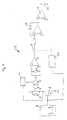
- FIG. 4 shows a schematic diagram of a block diagram of an electronic circuit 1 for a metal detector operating according to the method according to the invention.
- a transmission generator 2 generates the corresponding pulses for the process in PI mode. These pulses are given on the basis of a pulse transistor 6, which is on the emitter side at the potential -U S.
- the signal is fed to a transmitter coil 4.
- the transmitter coil 4 partially overlaps the receiver coil 5.
- a damping resistor 7 is connected in parallel with the transmitter coil 4 between the collector and the reference potential.
- an electronic compensation circuit 3 is on the one hand on the collector of the pulse transistor 6 and on the other hand on the receiving coil 5.
- the electronic compensation circuit 3 is not further developed here, since it can be implemented in a wide variety of ways as outlined briefly above.
- the signal received on the secondary side in the receiving coil 5 is fed to the plus input of an AC amplifier 8, which has a pre-attenuation with a resistor 9.
- the output signal of the AC amplifier 8 is fed via a sampling gate 10 to an integrator 28.
- the sampling gate 10 is operated via a time control 26 switched, this timing control on the other hand is controlled accordingly by the transmitter generator 2.
- the output of the integrator 28 is according to the block diagram on the plus input of a DC amplifier 29, at its Output 30 an acoustically or optically implemented detection signal issued in the case of a located metal object becomes.
Landscapes
- Physics & Mathematics (AREA)
- Engineering & Computer Science (AREA)
- Remote Sensing (AREA)
- Life Sciences & Earth Sciences (AREA)
- Electromagnetism (AREA)
- Environmental & Geological Engineering (AREA)
- Geology (AREA)
- General Life Sciences & Earth Sciences (AREA)
- General Physics & Mathematics (AREA)
- Geophysics (AREA)
- Geophysics And Detection Of Objects (AREA)
Abstract
Description
Diese im PI-Modus eingesetzten Verfahren zur Kompensation von bodenmagnetischen Störeffekten machen sich die Abtastung der Sekundärsignale zu Nutze, um über deren Auswertung eine Bodenkompensation durchzuführen.
Ein anderes Verfahren zur Kompensation störender Effekte des magnetischen Untergrundes ist aus der EP 0 816 870 A2 bekannt.
Diese vorausgehend genannten Verfahren können zwar die Bodeneffekte bei gewissen Anwendungsbereichen hinreichend zufriedenstellend kompensieren. Eine Vereinfachung der Auswertung und Verbesserung der Kompensation ist jedoch wünschenswert.
Ausgenommen hiervon sind Spulensysteme, bei denen z.B. das empfangene Spulensystem vollständig von dem sendeseitigen Spulensystem umschlossen ist.
Das primär- und sekundärseitige Spulensystem besteht im einfachsten Fall aus jeweils einer Spule, die gegenseitig einen Überlappungsbereich aufweisen und beabstandete Spulenachsen in geometrischer und elektromagnetischer Hinsicht haben.
Die Erfindung kann jedoch auch weitere Variationsmöglichkeiten mit Spulen von zwei, drei oder auch vier Spulen haben.
Denkbar ist auch der Einsatz bei anderen aktiven Systemen, die mit anderen Sendesignalen arbeiten.
Bei dieser Art von mechanischer Kompensation ist es auch denkbar, dass die Kompensation bei Metalldetektoren zur Sondierung in Bohrlöchern, z.B. entsprechend der EP 96 119 649.0 dadurch realisiert wird, dass Ferritkerne mit entsprechend großem Abstand vorgesehen werden, um die Bodeneinflüsse zu eliminieren.
Die sender- und empfängerseitigen Spulensysteme, die geometrisch entkoppelt werden, können zunächst mit einem Innenund Außenfeld des Senders betrachtet werden, das auf das empfängerseitige Spulensystem wirkt. Das Innen- und Außenfeld ist in der Phase um 180° verschoben bzw. das empfangene Pulssignal wechselt seine Richtung von Plus nach Minus. Ist das im Empfängerspulensystem wirkende Innenund Außenfeld im induzierten Betrag entgegengesetzt gleich, so tritt sekundärseitig eine Kompensation bzw. ein Spannungsminimum im Empfängerspulensystem auf.
Die Verkopplung zwischen den primärseitigen und sekundärseitigen Spulensystemen und Vorgängen wird daher feinfühlig so verändert, dass die vom Boden resultierenden bodenmagnetischen Störeffekte nach Betrag und Phase bzw. nach Polaritätsrichtung kompensiert werden.
Schiebt man eine der D-Spulen über den Nullpunkt, so ergibt sich beim PI-Verfahren eine Polaritätsänderung für die empfangenen Pulse. Die Pulse wechseln daher von Plus nach Minus. Der Entkopplungspunkt bzw. der Punkt der Verkopplungsänderung ist daher der Bereich, wo der Inhalt beider Pulse nahezu symmetrisch ist.
Bei Sinussystemen würde man empfängerseitig einen Phasensprung um 180° festellen.
Die Feinvariation und Verkopplungsadaptation kann auch durch die Veränderung von Pulsbreite der verwendeten Pulse und/oder der Wiederholfrequenz im PI-Modus erreicht werden. Auch können Kompensationsschleifen und/oder Kompensationswicklungen Verwendung finden, wobei die Amplitude in der jeweiligen Wicklung z.B. über einen Widerstand gesteuert werden kann.
- Fig. 1
- eine schematische Darstellung entkoppelter Rundspulen eines Metalldetektors;
- Fig. 2
- eine schematische Darstellung entkoppelter Spulen eines Double-D-Spulensystems;
- Fig. 3
- eine schematische Darstellung eines orthogonalen Spulensystems;
- Fig. 4
- ein Blockschaltbild eines grundsätzlichen Aufbaus der elektronischen Schaltung eines erfindungsgemäßen Metalldetektors und des dort realisierten Verfahrens.
Es sind auch hiervon abweichende Winkelanordnungen möglich.
Ein Sendegenerator 2 erzeugt die entsprecheden Pulse für das Verfahren im PI-Modus. Diese Pulse werden auf die Basis eines Pulstransistors 6, der emitterseitig auf dem Potenzial -US liegt, gegeben. Kollektorseitig wird das Signal auf eine Sendespule 4 geführt. Die Sendespule 4 überlappt partiell mit der Empfangsspule 5.
Parallel zur Sendespule 4 ist ein Bedämpfungswiderstand 7 zwischen Kollektor und Bezugspotenzial geschaltet. Weiterhin liegt eine elektronische Kompensationsschaltung 3 einerseits am Kollektor des Pulstransistors 6 und andererseits an der Empfangsspule 5.
Das sekundärseitig in der Empfangsspule 5 aufgenommene Signal wird auf den Plus-Eingang eines AC-Verstärkers 8 geführt, der eine Vorbedämpfung mit einem Widerstand 9 aufweist.
Das Ausgangssignal des AC-Verstärkers 8 wird über ein Sampling-Gate 10, einem Integrator 28 zugeführt.
Claims (6)
- Verfahren zur Bodenkompensation von im PI-Modus betriebenen Metalldetektoren zur Ortung von Metallobjekten im Boden,
mit primär- und sekundärseitigen Spulensystemen,
wobei mittels der räumlichen Achsenanordnung der Spulensysteme eine lose Wechselwirkungs-Entkopplung der Spulensysteme herbeigeführt wird,
dadurch gekennzeichnet, dass die Wechselwirkungs-Entkopplung auf einen Nullpunkt-Bereich eingestellt wird, und
dass im Nullpunkt-Bereich eine elektrische und/oder mechanische Verkopplungsänderung zur weitgehend vollständigen Bodenkompensation durchgeführt wird. - Verfahren nach Anspruch 1,
dadurch gekennzeichnet, dass überlappende oder orthogonale oder im Winkel zueinander angeordnete Spulensysteme verwendet werden. - Verfahren nach Anspruch 1 oder 2,
dadurch gekennzeichnet, dass Spulensysteme mit ein oder mehreren Spulen verwendet werden. - Verfahren nach einem der Ansprüche 1 bis 3,
dadurch gekennzeichnet, dass unipolare oder bipolare Pulse verwendet werden. - Verfahren nach einem der Ansprüche 1 bis 4,
dadurch gekennzeichnet, dass in den Schnittpunkten überlappender Spulensysteme eine Kompensations-Einrichtung, insbesondere ein Ferritkern oder ein Metallstück rotierend, platziert wird. - Verfahren nach einem der Ansprüche 1 bis 4,
dadurch gekennzeichnet, dass zur Verkopplungsänderung der Spulensysteme eine Änderung der Pulsbreite oder der Pulsfrequenz der Pulse im PI-Modus durchgeführt wird.
Applications Claiming Priority (4)
| Application Number | Priority Date | Filing Date | Title |
|---|---|---|---|
| DE10261390 | 2002-12-30 | ||
| DE10261390 | 2002-12-30 | ||
| DE10301951 | 2003-01-20 | ||
| DE10301951A DE10301951A1 (de) | 2002-12-30 | 2003-01-20 | Verfahren zur Bodenkompensation |
Publications (2)
| Publication Number | Publication Date |
|---|---|
| EP1435528A2 true EP1435528A2 (de) | 2004-07-07 |
| EP1435528A3 EP1435528A3 (de) | 2005-06-01 |
Family
ID=32509761
Family Applications (1)
| Application Number | Title | Priority Date | Filing Date |
|---|---|---|---|
| EP03023640A Withdrawn EP1435528A3 (de) | 2002-12-30 | 2003-10-17 | Verfahren zur Bodenkompensation |
Country Status (1)
| Country | Link |
|---|---|
| EP (1) | EP1435528A3 (de) |
Family Cites Families (3)
| Publication number | Priority date | Publication date | Assignee | Title |
|---|---|---|---|---|
| CA1053332A (en) * | 1976-06-11 | 1979-04-24 | Michael R. Williams | Spectral analysis electromagnetic survey system |
| EP0274450A3 (de) * | 1987-01-09 | 1989-08-02 | Kolectric Limited | Gerät zur Messung der Nähe eines Metallobjekts |
| DE19730952A1 (de) * | 1997-07-18 | 1999-01-21 | Klaus Ebinger | Verfahren und Vorrichtung zur elektromagnetischen Detektion von Objekten |
-
2003
- 2003-10-17 EP EP03023640A patent/EP1435528A3/de not_active Withdrawn
Also Published As
| Publication number | Publication date |
|---|---|
| EP1435528A3 (de) | 2005-06-01 |
Similar Documents
| Publication | Publication Date | Title |
|---|---|---|
| DE102010007620B4 (de) | Näherungssensor | |
| DE69302052T2 (de) | Elektromagnetisches Detektor System | |
| WO2010084146A1 (de) | Sensorvorrichtung für ein target, in welchem wirbelströme erzeugbar sind, und verfahren zur detektion | |
| DE8431476U1 (de) | Vorrichtung zur telemetrischen Messung der Herzpulsation und des EKG-Signals am Körper einer Person | |
| EP2433159A1 (de) | Metalldetektor | |
| DE2554799C2 (de) | Anordnung zur Erfassung seismischer Daten | |
| WO2002091021A1 (de) | Detektor zur ortung metallischer gegenstände | |
| DE60005581T2 (de) | Magnetische Positions- und Richtungserfassung | |
| EP4409311B1 (de) | Indirektes kalibrierverfahren für ein elektromagnetisches induktionsverfahren und messanordnung zur durchführung des verfahrens | |
| DE102009021804A1 (de) | Metalldetektor | |
| DE10301951A9 (de) | Verfahren zur Bodenkompensation | |
| DE102004006322A1 (de) | Abbildungsvorrichtung zur Nutzung der kernmagnetischen Resonanz | |
| EP3041727A2 (de) | Eurobalisenfahrzeugeinrichtung und verfahren zum betreiben einer eurobalisenfahrzeugeinrichtung | |
| DE10148919A1 (de) | Verfahren und Vorrichtung zur Ortung bewegter Gegenstände | |
| DE102011000302B4 (de) | Metalldetektor | |
| DE29724862U1 (de) | Induktiver Näherungsschalter | |
| DE19740774A1 (de) | Induktiver Näherungsschalter | |
| EP0505391B1 (de) | Kammgenerator sowie kalibrierungeinrichtung und verfahren zur kalibrierung von messstrecken fuer stoerfeldstaerkemessungen | |
| EP0957377B1 (de) | Vorrichtung und Verfahren zum Orten von Metallteilen | |
| EP0892285B1 (de) | Verfahren und Vorrichtung zur elektromagnetischen Detektion von Objekten | |
| WO2009130019A1 (de) | Einrichtung zur feststellung metallisch leitender teile | |
| EP0816870B1 (de) | Metalldetektor und Verfahren zum Betrieb eines Metalldetektors | |
| EP2633623A1 (de) | Induktiver naeherungsschalter | |
| DE435255C (de) | Einrichtung zum Nachweis von leitenden oder magnetisierbaren Koerpern durch Frequenzaenderung von Schwingungen | |
| CH677299A5 (en) | Signal transmission device using magnetic fields |
Legal Events
| Date | Code | Title | Description |
|---|---|---|---|
| PUAI | Public reference made under article 153(3) epc to a published international application that has entered the european phase |
Free format text: ORIGINAL CODE: 0009012 |
|
| AK | Designated contracting states |
Kind code of ref document: A2 Designated state(s): AT BE BG CH CY CZ DE DK EE ES FI FR GB GR HU IE IT LI LU MC NL PT RO SE SI SK TR |
|
| AX | Request for extension of the european patent |
Extension state: AL LT LV MK |
|
| PUAL | Search report despatched |
Free format text: ORIGINAL CODE: 0009013 |
|
| AK | Designated contracting states |
Kind code of ref document: A3 Designated state(s): AT BE BG CH CY CZ DE DK EE ES FI FR GB GR HU IE IT LI LU MC NL PT RO SE SI SK TR |
|
| AX | Request for extension of the european patent |
Extension state: AL LT LV MK |
|
| 17P | Request for examination filed |
Effective date: 20050905 |
|
| AKX | Designation fees paid |
Designated state(s): AT BE BG CH CY CZ DE DK EE ES FI FR GB GR HU IE IT LI LU MC NL PT RO SE SI SK TR |
|
| 17Q | First examination report despatched |
Effective date: 20090810 |
|
| STAA | Information on the status of an ep patent application or granted ep patent |
Free format text: STATUS: THE APPLICATION IS DEEMED TO BE WITHDRAWN |
|
| 18D | Application deemed to be withdrawn |
Effective date: 20110503 |