EP1435701A2 - Réseau optique passif - Google Patents
Réseau optique passif Download PDFInfo
- Publication number
- EP1435701A2 EP1435701A2 EP03030014A EP03030014A EP1435701A2 EP 1435701 A2 EP1435701 A2 EP 1435701A2 EP 03030014 A EP03030014 A EP 03030014A EP 03030014 A EP03030014 A EP 03030014A EP 1435701 A2 EP1435701 A2 EP 1435701A2
- Authority
- EP
- European Patent Office
- Prior art keywords
- optical
- signals
- broadcasting
- wavelength division
- division multiplexer
- Prior art date
- Legal status (The legal status is an assumption and is not a legal conclusion. Google has not performed a legal analysis and makes no representation as to the accuracy of the status listed.)
- Withdrawn
Links
Images


Classifications
-
- H—ELECTRICITY
- H04—ELECTRIC COMMUNICATION TECHNIQUE
- H04B—TRANSMISSION
- H04B10/00—Transmission systems employing electromagnetic waves other than radio-waves, e.g. infrared, visible or ultraviolet light, or employing corpuscular radiation, e.g. quantum communication
- H04B10/25—Arrangements specific to fibre transmission
-
- H—ELECTRICITY
- H04—ELECTRIC COMMUNICATION TECHNIQUE
- H04B—TRANSMISSION
- H04B10/00—Transmission systems employing electromagnetic waves other than radio-waves, e.g. infrared, visible or ultraviolet light, or employing corpuscular radiation, e.g. quantum communication
- H04B10/27—Arrangements for networking
-
- H—ELECTRICITY
- H04—ELECTRIC COMMUNICATION TECHNIQUE
- H04B—TRANSMISSION
- H04B10/00—Transmission systems employing electromagnetic waves other than radio-waves, e.g. infrared, visible or ultraviolet light, or employing corpuscular radiation, e.g. quantum communication
- H04B10/27—Arrangements for networking
- H04B10/272—Star-type networks or tree-type networks
Definitions
- the present invention relates to a passive optical network (PON), and more particularly, to a passive optical network system providing simultaneously both broadcasting service and data service.
- PON passive optical network
- the optical communication systems can transmit data at speeds of several tens of Tbps or more. Therefore, in order to provide data services at high speed and with good integrity, the construction of a FTTH (Fiber To The Home) system, which connects optical fibers directly to the subscriber terminals, is required.
- the FTTH system can provide the transmission speed and the integrity demanded for data services today and in the future.
- a passive optical network hereinafter, referred to as "PON" is being highlighted as a FTTH system, since the PON is one of the most efficient and economical networks from the viewpoint of its construction and maintenance.
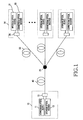
- FIG. 1 illustrates a conventional PON comprising a central office 10, an optical divider coupler 21, and a plurality of subscriber terminals 30, which are connected with one another by transmission optical fibers 40 and 50.
- the central office 10 provides optical communication service for the subscriber terminals 30 through the optical divider coupler 21. That is, the optical divider coupler 21 is connected with the central office 10 and the subscriber terminals 30 through the transmission optical fibers 40 and 50, thus being able to transmit the optical communication service provided from the central office 10 to the subscriber terminals 30.
- the central office 10 includes a downstream optical source 11 for providing an optical source needed in order to transmit data to the subscriber terminals 30 (downstream transmission), an upstream optical receiver 13 for receiving data transmitted upstream from the subscriber terminals 30, and a first wavelength division multiplexer 15 for filtering and transmitting the signals output from the downstream optical source 11 and the signals transmitted to the upstream optical receiver 13.
- the subscriber terminals 30 include an upstream optical source 31 for providing an optical source needed in order to upstream transmit data to the central office 10, a downstream optical receiver 33 for receiving data transmitted downstream from the central office 10, and a second wavelength division multiplexer 35 for filtering and transmitting the signals output from the upstream optical source 31 and the signals transmitted to the downstream optical receiver 33.
- the optical divider coupler 21 connects a central office 10 with the subscriber terminals 30.
- the analog broadcasting system must have a high CNR (carrier to noise ratio) value so as to maintain clear screen quality on the subscriber terminals. Therefore, in constructing the network system for providing the broadcasting service by the PON, the optical signals being input into the optical receivers in the subscriber terminals must necessarily maintain a very high level of output so as to maintain a proper CNR.
- CNR carrier to noise ratio
- digital broadcasting in the future requires a relatively low CNR as compared with analog broadcasting, thus enabling the subscriber terminals to have clear screen quality, though the optical signals input into the optical receivers of the subscriber terminals have a relatively low level of output.
- the output level in order to increase the capacity of the broadcasting channels, the output level must be increased of the optical signals being input into the optical receivers in the subscriber terminals in consideration of additional noise generated by the increased broadcasting signals, so that the optical signals may maintain a proper CNR.
- the PON when the broadcasting service is provided by a PON, the PON must be constructed so as to provide optical signals of a high level output for the optical receivers in the subscriber terminals,
- FIG. 2 illustrates a conventional PON for simultaneously providing both broadcasting service and data service and comprises, similar to the conventional PON illustrated in FIG. 1, a central office 10a, an optical divider coupler 21, and a plurality of subscriber terminals 30a, which are connected with one another by transmission optical fibers 40 and 50, and each component of equipment is also similar to those illustrated in FIG. 1.
- FIG. 1 and 2 differ only in that the central office 10a further comprises a broadcasting optical source 17 for a broadcasting service and an optical amplifier 19 for amplifying the signals output from the broadcasting optical source 17, and the subscriber terminals 30a further comprise a broadcasting optical receiver 37 for receiving the signals transmitted from the broadcasting optical source 17.
- the broadcasting optical source 17 modulates and outputs, according to the broadcasting signals, the optical signals of the wavelength which is distinguished from the wavelength of the optical signals outputted from the downstream optical source 11.
- a first wavelength division multiplexer 15a in the central office 10a multiplexes and outputs the optical signals, which are output from the broadcasting optical source 17 and amplified by the optical amplifier 19, and the optical signals output from the downstream optical source 11.
- a second wavelength division multiplexer 35a in the subscriber terminals 30a demultiplexes the multiplexed optical signals as described above, and separates data service signals and broadcasting service signals.
- the separated data signals and broadcasting signals are provided for subscriber terminals after being data processed by the downstream optical receiver 33 and the broadcasting optical receiver 37, respectively.
- the conventional art directly amplifies the optical signals modulated according to the broadcasting signals by inputting them into the optical amplifier 19, so as to raise the output level of the optical signals being output for broadcasting service from the central office 10a, in order to raise the output level of optical signals being input into the broadcasting optical receiver 37 in the subscriber terminals 30a.
- the noise component is rapidly raised by the nonlinear quality of optical fiber, so that it is impossible to maintain the proper CNR (carrier to noise ratio) required for the broadcasting service.
- the output level of the optical signals for broadcasting service which is amplified by the optical amplifier 19 in the central office 10a and is input to the transmission optical fiber 40, is limited below a basic value by the nonlinear quality of optical fiber.
- the number of branches of the optical divider coupler 21 must be reduced, thus it is possible to reduce the loss of the optical signals for broadcasting service.
- each PON determines the accessible number of the subscriber terminals according to the number of branches of the optical divider coupler 21, when the broadcasting service is provided by the PON as a conventional art, the number of subscriber terminals being accepted by the PON cannot help but be reduced. For this reason, more PONs must be built. Consequently, to use the conventional PON it is more costly and time consuming due to the additional construction and maintenance.
- the conventional art in order to increase the number of broadcasting channels for service according to the request of the subscriber, the conventional art must further increase the output level of the optical signals being input into the broadcasting optical receiver 37 of the subscriber terminals 30a because of the additional noise generated by the increased number of broadcasting channel signals, thus enabling the signals to be maintained within a proper CNR for clear screen quality. Therefore, it is necessary to develop a network system that can accept more broadcasting channels.
- PON passive optical network
- FIG. 3 illustrates a passive optical network in accordance with a first embodiment of the present invention.
- the passive optical network includes a central office 100, and the central office 100 comprises a pump laser 110, a broadcasting optical source 120, a downstream optical source 130, an upstream optical receiver 140 and an wavelength division multiplexer 150.
- the pump laser 110 outputs the pumping optical signals that amplify the optical signals output from the broadcasting optical source 120
- the broadcasting optical source 120 outputs the optical signals (hereinafter, referred to as “broadcasting optical signals") that provide the broadcasting service to a plurality of subscriber terminals 300
- the downstream optical source 130 outputs the optical signals (hereinafter, referred to as "downstream optical signals") that provide downstream data service to the subscriber terminals 300 through transmission optical fibers 400 and 500.
- the upstream optical receiver 140 receives the upstream data service signals transmitted from each subscriber terminal 300 and converts the received optical signals into electric signals.
- the wavelength division multiplexer 150 multiplexes the signals output from the pump laser 110, the broadcasting optical source 120 and the downstream optical source 130, and outputs the multiplexed signals outside. Also, the wavelength division multiplexer 150 filters the upstream data service signals input from the outside, and outputs the filtered signals to the upstream optical receiver 140.
- the PON comprises a local office 200
- the local office 200 comprises a first wavelength division multiplexer 210, an optical amplifier media 220, a second wavelength division multiplexer 230, and an optical divider coupler 240.
- the first wavelength division multiplexer 210 receives and demultiplexes the multiplexed signals including the pumping optical signals output from the central office 100 through a first transmission optical fiber 400, and thus divides the multiplexed signals into pumping optical signals, broadcasting optical signals and downstream optical signals. Also, the first wavelength division multiplexer 210 multiplexes the upstream optical signals transmitted from the subscriber terminals 300.
- the optical amplifier media 220 receives the pumping optical signals and the broadcasting optical signals from the first wavelength division multiplexer 210, and amplifies the broadcasting optical signals by the pumping optical signals.
- the optical amplifier media 220 is comprised an erbium-doped fiber (EDF).
- the second wavelength division multiplexer 230 multiplexes the broadcasting optical signals amplified by the optical amplifier media 220 and the downstream optical signals divided by the first wavelength division multiplexer 210. Also, the second wavelength division multiplexer 230 demultiplexes the upstream optical signals transmitted from the subscriber terminals 300, and transmits the demultiplexed signals to the first wavelength division multiplexer 210.
- the optical divider coupler 240 (preferably a 1 xN divider coupler) divides the optical signals, which are multiplexed and output by the second wavelength division multiplexer 230, to the subscriber terminals 300. Also, the optical divider coupler 240 couples the upstream optical signals transmitted from the subscriber terminals 300, and outputs the coupled signals to the second wavelength division multiplexer 230.
- an optical amplifier (for example, an erbium-doped fiber amplifier) is further arranged between the central office 100 and local office 200, so as to amplify the downstream signals output from the wavelength division multiplexer 150 in the central office 100 and the upstream signals output from the first wavelength division multiplexer 210 in the local office 200.
- an optical amplifier for example, an erbium-doped fiber amplifier
- the pumping optical signals that are output from the pump laser 110 in the central office 100, operate as a pumping output for the optical amplifier media 220 (for example, an erbium-doped fiber) in the local office 200.
- the optical amplifier media 220 for example, an erbium-doped fiber
- Each of the subscriber terminals 300 of the PON comprises an upstream optical source 310 for outputting the upstream optical signals to transmit data to the central office 100, a downstream optical receiver 320 for receiving the downstream optical signals transmitted downstream from the central office 100, a broadcasting optical receiver 330 for receiving the broadcasting optical signals transmitted downstream from the central office 100, and a wavelength division multiplexer 340 for demultiplexing the optical signals multiplexed and output from the local office 200 and then dividing the demultiplexed signals into the downstream data service signals and the broadcasting service signals.
- the wavelength division multiplexer 340 also filters a signal output from the upstream optical source 310 and transmits the filtered signal to the local office 200 through a second transmission optical fiber 500.
- the central office 100 multiplexes the downstream optical signals modulated according to data service signals for data service, the broadcasting optical signals modulated according to broadcasting service signals for broadcasting service, and the pumping optical signals with the wavelength division multiplexer 150, so as to output the multiplexed signals through the first transmission optical fiber 400.
- the wavelength division multiplexer 210 in the local office 200 demultiplexes the multiplexed signals that have been received through the first transmission optical fiber 400.
- the resulting pumping optical signals are input into the optical amplifier media 220, such that the broadcasting optical signals are amplified.
- the second wavelength division multiplexer 230 multiplexes and outputs the broadcasting optical signals amplified as described above and the downstream optical signals, and the optical divider coupler 240 transmits the multiplexed signals output from the second wavelength division multiplexer 230 to the subscriber terminals 300 through the second transmission optical fiber 500.
- the wavelength division multiplexer 340 in the subscriber terminals 300 demultiplexes the multiplexed signals input through the second transmission optical fiber 500, and transmits the demultiplexed signals to the downstream optical receiver 320 and the broadcasting optical receiver 330. Then, the receivers 320 and 330 convert the received optical signals into electric signals.
- the upstream optical source 310 in the subscriber terminals 300 outputs the upstream optical signal modulated according to data signals, and the wavelength division multiplexer 340 filters the upstream optical signals and transmits the filtered signals to the second transmission optical fiber 500.
- the upstream optical signals which have been transmitted through the second transmission optical fiber 500 to the optical divider coupler 240 in the local office 200, are coupled by the optical divider coupler 240, are multiplexed through the first and second wavelength division multiplexer 230 and 210, and are transmitted to the central office 100.
- the wavelength division multiplexer 150 demultiplexes the upstream optical signals having been received through the first transmission optical fiber 400, and then the upstream optical receiver 140 converts the demultiplexed signals into electric signals.
- FIG. 4 illustrates a PON in accordance with a second embodiment of the present invention, further including two or more broadcasting optical sources (a first broadcasting optical source 120a, a second broadcasting optical source 120b, and a third broadcasting optical source 120c) in a central office 100a, in addition to the PON illustrated in FIG. 3.
- the broadcasting optical sources 120a, 120b and 120c are constructed so as to output the broadcasting optical signals having different wavelengths from one another.
- the embodiment shown in FIG. 4 further includes a wavelength division multiplexer 160 for multiplexing the broadcasting optical signals having different wavelengths from each other as described above.
- FIG. 4 illustrates inclusion of is another wavelength division multiplexer 150a.
- subscriber terminals 300a, 300b and 300c may be constructed to comprise a plurality of broadcasting optical receivers (a first broadcasting optical receiver 330a, a second broadcasting optical receiver 330b and a third broadcasting optical receiver 330c) corresponding with the broadcasting optical sources 120a, 120b and 120c, thus enabling each subscriber terminal to selectively receive the broadcasting optical signals.
- a first subscriber terminal 300a comprises a first broadcasting optical receiver 330a
- a second subscriber terminal 300b comprises the first and a second broadcasting optical receiver 330a and 330b
- a third subscriber terminal 300c comprises the first, second and a third broadcasting optical receiver 330a, 330b and 330c.
- the PON may provide a great variety of broadcasting services to subscribers. That is, the central office 100a may transmit varied broadcasting channels with greater capacity according to the subscribers' demands, by using the broadcasting optical sources 120a, 120b and 120c.
- the first broadcasting optical source 120a provides a general and popular broadcasting service
- the second and third broadcasting optical source 120b and 120c provide a professional broadcasting service for professionals and hobbyists. Then, subscribers may selectively use the broadcasting service according to the interest of each one, with the payment of a predetermined charge
- FIG. 5 illustrates a PON in accordance with a third embodiment of the present invention comprising two or more broadcasting optical sources (a first broadcasting optical source 120a, a second broadcasting optical source 120b, and a third broadcasting optical source 120c) and two or more downstream optical sources (a first downstream optical source 130a and a second downstream optical source 130b) in a central office 100b, in addition to the PON illustrated in FIG. 3.
- the broadcasting optical sources 120a, 120b and 120c and the downstream optical sources 130a 130b are configured to output the broadcasting optical signals or the downstream optical signals having different wavelengths from one another.
- wavelength division multiplexer 160 for multiplexing the broadcasting optical signals and a wavelength division multiplexer 170 for multiplexing the downstream optical signals, such that each signal has a different wavelength from the others as described above.
- wavelength division multiplexer 150b another wavelength division multiplexer 150b is provided in this embodiment.
- subscriber terminals 300d, 300e and 300f may comprise a plurality of broadcasting optical receivers (a first broadcasting optical receiver 330a, a second broadcasting optical receiver 330b and a third broadcasting optical receiver 330c) and a plurality of downstream optical receivers (a first downstream optical receiver 320a and a second downstream optical receiver 320b), corresponding to the broadcasting optical sources 120a, 120b and 120c and the downstream optical sources 130a and 130b, thus enabling each subscriber terminal to selectively receive the broadcasting optical signals or the downstream optical signals according to the interest of the subscriber.
- broadcasting optical receivers a first broadcasting optical receiver 330a, a second broadcasting optical receiver 330b and a third broadcasting optical receiver 330c
- downstream optical receivers a first downstream optical receiver 320a and a second downstream optical receiver 320b
- a subscriber terminal 300d comprises the first downstream optical receiver 320a and the first broadcasting optical receiver 330a
- another subscriber terminal 300e comprises the first downstream optical receiver 320a and the first and second broadcasting optical receiver 330a and 330b
- another subscriber terminal 300f comprises the first and second downstream optical receiver 320a and 320b
- the second and third broadcasting optical receiver 330b and 330c comprises the first and second downstream optical receiver 320a and 320b
- the third embodiment describes a configuration of the PON that may accept greater capacity for the data service as well as the broadcasting service according to the demand of the subscribers. Therefore, the PON, such as the third embodiment illustrated in FIG. 5, can provide a data service having a greater capacity to the subscribers, by using a plurality of optical sources for the increased data service.
- the passive optical network system in accordance with the present invention amplifies the optical signals for the broadcasting service in the optical amplifier media of the local office by the pumping optical signals generated from the central office, and provides the amplified optical signals for the broadcasting service to the subscriber terminals. Therefore, the transmission loss of the optical signals for the broadcasting service, that occurs between the central office and the local office, may be mitigated, so that the output level of the optical signals, that are input to the broadcasting optical receiver of the subscriber terminals, may be maintained at a high state without reducing the number of branches of the optical divider coupler in the local office. That is, an advantage of the present invention is that it is capable of simultaneously providing broadcasting service and data service for more subscribers without reducing the number of subscribers to the PON.
- the PON according to the present invention doesn't require the cost for respectively constructing each of a data service network and a broadcasting service network and may reduce the investment cost and time in order to maintain and operate the network. For this reason, it is an advantage that the operator may efficiently provide a greater variety of services to the subscribers with low cost.
- the present invention uses a plurality of optical sources for the data service and the broadcasting service and received the optical signals generated from these optical sources by using a plurality of optical receivers in the subscriber terminals, so that the present invention may conveniently and easily provide a greater amount and variety of data services and broadcasting services.
Landscapes
- Engineering & Computer Science (AREA)
- Physics & Mathematics (AREA)
- Electromagnetism (AREA)
- Computer Networks & Wireless Communication (AREA)
- Signal Processing (AREA)
- Computing Systems (AREA)
- Optical Communication System (AREA)
- Two-Way Televisions, Distribution Of Moving Picture Or The Like (AREA)
Applications Claiming Priority (2)
| Application Number | Priority Date | Filing Date | Title |
|---|---|---|---|
| KR2003000135 | 2003-01-02 | ||
| KR10-2003-0000135A KR100516663B1 (ko) | 2003-01-02 | 2003-01-02 | 방송형-서비스와 데이터-서비스를 동시에 제공하는 수동형광 가입자 망 시스템 |
Publications (2)
| Publication Number | Publication Date |
|---|---|
| EP1435701A2 true EP1435701A2 (fr) | 2004-07-07 |
| EP1435701A3 EP1435701A3 (fr) | 2005-06-29 |
Family
ID=32501473
Family Applications (1)
| Application Number | Title | Priority Date | Filing Date |
|---|---|---|---|
| EP03030014A Withdrawn EP1435701A3 (fr) | 2003-01-02 | 2003-12-30 | Réseau optique passif |
Country Status (4)
| Country | Link |
|---|---|
| US (1) | US7418204B2 (fr) |
| EP (1) | EP1435701A3 (fr) |
| JP (1) | JP3962371B2 (fr) |
| KR (1) | KR100516663B1 (fr) |
Cited By (3)
| Publication number | Priority date | Publication date | Assignee | Title |
|---|---|---|---|---|
| WO2007018378A1 (fr) * | 2005-08-09 | 2007-02-15 | Korea Advanced Institute Of Science And Technology | Reseaux optiques passifs de multiplexage par division de longueurs d'onde pour transmission longue portee par reglage de position de source lumineuse large bande |
| WO2008001020A1 (fr) * | 2006-06-29 | 2008-01-03 | France Telecom | Réseau d'accès optique passif longue distance |
| WO2008009849A3 (fr) * | 2006-07-20 | 2008-04-17 | France Telecom | Reseau optique passif longue distance utilisant la modulation deportee d'un signal optique d'amplification |
Families Citing this family (19)
| Publication number | Priority date | Publication date | Assignee | Title |
|---|---|---|---|---|
| KR100325687B1 (ko) * | 1999-12-21 | 2002-02-25 | 윤덕용 | 주입된 비간섭성 광에 파장 잠김된 페브리-페롯 레이저다이오드를 이용한 파장분할 다중방식 광통신용 광원 |
| KR100955129B1 (ko) * | 2003-05-30 | 2010-04-28 | 정보통신연구진흥원 | 비간섭성 광대역 광원을 이용한 파장분할다중방식 수동형 광 네트워크 구현 방법 |
| US8086103B2 (en) * | 2004-04-29 | 2011-12-27 | Alcatel Lucent | Methods and apparatus for communicating dynamic optical wavebands (DOWBs) |
| US7471900B2 (en) | 2004-12-08 | 2008-12-30 | Electronics And Telecommunications Research Institute | Passive optical network system and method of transmitting broadcasting signal in same |
| KR100724937B1 (ko) * | 2005-02-04 | 2007-06-04 | 삼성전자주식회사 | 파장분할다중 방식의 수동형 광가입자 망 |
| KR100726520B1 (ko) * | 2005-05-09 | 2007-06-11 | 엘에스전선 주식회사 | 방송신호의 광전송 시스템 및 그 전송방법 |
| US20060275037A1 (en) * | 2005-06-02 | 2006-12-07 | Evans Alan F | Methods and apparatus for multiple signal amplification |
| KR100698766B1 (ko) * | 2005-09-07 | 2007-03-23 | 한국과학기술원 | 파장분할 다중방식 수동형 광 가입자 망 시스템에 사용되는장애 위치 감시 장치 및 이를 구비한 파장분할 다중방식수동형 광 가입자 망 시스템 |
| KR100785436B1 (ko) * | 2005-09-20 | 2007-12-13 | 한국과학기술원 | 방송 서비스와 통신 서비스를 융합한 파장분할 다중방식수동형 광 가입자망 |
| KR100701158B1 (ko) * | 2006-04-26 | 2007-03-28 | 한국전자통신연구원 | 펌프 광원이 단일 집적된 광송수신기 및 광송수신기 모듈 |
| US8571410B2 (en) | 2006-10-11 | 2013-10-29 | Novera Optics, Inc. | Mutual wavelength locking in WDM-PONS |
| US8224183B1 (en) * | 2006-11-28 | 2012-07-17 | At&T Intellectual Property Ii, L.P. | Method and apparatus for enabling multiple passive optical networks to share one or more sources |
| US8699881B1 (en) | 2006-11-28 | 2014-04-15 | At&T Intellectual Property Ii, L.P. | Method and apparatus for providing passive optical networks with extended reach and/or split |
| US8238751B1 (en) * | 2006-11-28 | 2012-08-07 | At&T Intellectual Property Ii, L.P. | Method and apparatus for enabling multiple optical line termination devices to share a feeder fiber |
| US8948598B2 (en) * | 2008-02-13 | 2015-02-03 | Fujitsu Limited | System and method for increasing upstream capacity in an optical network |
| FR2963864B1 (fr) * | 2010-08-13 | 2013-06-14 | Enensys Technologies | Procede de diffusion dvb-t2 avec insertion de contenu regional et dispositif utilise dans le procede |
| JP6120383B2 (ja) * | 2015-06-09 | 2017-04-26 | シンクレイヤ株式会社 | 光通信システム |
| US9847836B2 (en) * | 2016-03-01 | 2017-12-19 | Arris Enterprises Llc | Agrregator-based cost-optimized communications topology for a point-to-multipoint network |
| US11863211B2 (en) * | 2020-03-04 | 2024-01-02 | Nippon Telegraph And Telephone Corporation | Optical communication system and optical communication method |
Family Cites Families (14)
| Publication number | Priority date | Publication date | Assignee | Title |
|---|---|---|---|---|
| JPS62290219A (ja) | 1986-06-10 | 1987-12-17 | Hitachi Ltd | 双方向光伝送路網 |
| JPH02282226A (ja) | 1989-04-24 | 1990-11-19 | Nippon Telegr & Teleph Corp <Ntt> | 光分岐損失補償方式 |
| GB8928237D0 (en) | 1989-12-14 | 1990-02-21 | British Telecomm | Lossless optical component |
| US5594748A (en) * | 1995-08-10 | 1997-01-14 | Telephone Information Systems, Inc. | Method and apparatus for predicting semiconductor laser failure |
| US5742414A (en) * | 1996-09-24 | 1998-04-21 | At&T Corp. | Multiplicity of services via a wavelength division router |
| DE59712840D1 (de) * | 1996-11-08 | 2007-06-06 | Siemens Ag | Verfahren und anordnung zum multiplexen einer vielzahl digitaler datenströme zu einem digitalen gesamtdatenstrom sowie verfahren und anordnung zum demultiplexen eines digitalen gesamtdatenstroms zu einer vielzahl digitaler datenströme |
| JP3860278B2 (ja) | 1997-03-13 | 2006-12-20 | 富士通株式会社 | 遠隔励起方式の波長多重光伝送システム |
| KR100251692B1 (ko) | 1997-09-12 | 2000-04-15 | 윤종용 | 광섬유 가입자 망 |
| CA2262248A1 (fr) * | 1998-02-18 | 1999-08-18 | At&T Corp. | Distribution a longue distance de services de radiodiffusion au moyen de sources optiques a large bande et de la precompensation de la dispersion |
| DE69941306D1 (de) | 1999-10-29 | 2009-10-01 | Fujitsu Ltd | Optische übertragungsvorrichtung und optische zwischenverstärkungsvorrichtung |
| US20020063924A1 (en) | 2000-03-02 | 2002-05-30 | Kimbrough Mahlon D. | Fiber to the home (FTTH) multimedia access system with reflection PON |
| JP3811332B2 (ja) | 2000-05-24 | 2006-08-16 | 日本電信電話株式会社 | 光伝送システム |
| US6895185B1 (en) * | 2000-08-24 | 2005-05-17 | Korea Advanced Institute Of Science And Technology | Multi-purpose optical fiber access network |
| US7529485B2 (en) * | 2001-07-05 | 2009-05-05 | Enablence Usa Fttx Networks, Inc. | Method and system for supporting multiple services with a subscriber optical interface located outside a subscriber's premises |
-
2003
- 2003-01-02 KR KR10-2003-0000135A patent/KR100516663B1/ko not_active Expired - Fee Related
- 2003-06-20 US US10/600,694 patent/US7418204B2/en not_active Expired - Lifetime
- 2003-12-18 JP JP2003420512A patent/JP3962371B2/ja not_active Expired - Fee Related
- 2003-12-30 EP EP03030014A patent/EP1435701A3/fr not_active Withdrawn
Cited By (5)
| Publication number | Priority date | Publication date | Assignee | Title |
|---|---|---|---|---|
| WO2007018378A1 (fr) * | 2005-08-09 | 2007-02-15 | Korea Advanced Institute Of Science And Technology | Reseaux optiques passifs de multiplexage par division de longueurs d'onde pour transmission longue portee par reglage de position de source lumineuse large bande |
| US7596317B2 (en) | 2005-08-09 | 2009-09-29 | Korea Advanced Institute Of Science And Technology | Long-reach wavelength division multiplexing passive optical networks by using the position adjustment of broadband light source |
| WO2008001020A1 (fr) * | 2006-06-29 | 2008-01-03 | France Telecom | Réseau d'accès optique passif longue distance |
| WO2008009849A3 (fr) * | 2006-07-20 | 2008-04-17 | France Telecom | Reseau optique passif longue distance utilisant la modulation deportee d'un signal optique d'amplification |
| US8238756B2 (en) | 2006-07-20 | 2012-08-07 | France Telecom | Long-reach passive optical network using remote modulation of an amplification optical signal |
Also Published As
| Publication number | Publication date |
|---|---|
| US7418204B2 (en) | 2008-08-26 |
| JP2004215247A (ja) | 2004-07-29 |
| JP3962371B2 (ja) | 2007-08-22 |
| EP1435701A3 (fr) | 2005-06-29 |
| KR100516663B1 (ko) | 2005-09-22 |
| KR20040062327A (ko) | 2004-07-07 |
| US20040131358A1 (en) | 2004-07-08 |
Similar Documents
| Publication | Publication Date | Title |
|---|---|---|
| EP1435701A2 (fr) | Réseau optique passif | |
| US7062173B2 (en) | Optical device and wavelength division multiplexing communication system using same | |
| US4545048A (en) | Service integrated digital transmission system | |
| US6411407B1 (en) | Method for providing a bidirectional optical supervisory channel | |
| US20170272197A1 (en) | Extender For Optical Access Communication Network | |
| US5422968A (en) | Optical demultiplexing system with optical amplifiers | |
| US20060153565A1 (en) | Hybrid passive optical network | |
| US6771854B2 (en) | Optical transmission system and optical coupler/branching filter | |
| US20040136716A1 (en) | Wavelength-division-multiplexed optical source and passive optical network system employing the same | |
| US8401389B2 (en) | Method and system for compensating for optical dispersion in an optical signal | |
| US20030180045A1 (en) | System and method for optical transmission | |
| US20090148160A1 (en) | Optical diplexer module using mixed-signal multiplexer | |
| US6400478B1 (en) | Wavelength-division-multiplexed optical transmission system with expanded bidirectional transmission capacity over a single fiber | |
| US7130542B2 (en) | Modular multiplexing/demultiplexing units in optical transmission systems | |
| US8195048B2 (en) | Optical transport system architecture for remote terminal connectivity | |
| US8145062B2 (en) | Optical amplifier capable of amplifying optical signals that traverse separate transmission fibers | |
| US7486890B2 (en) | Optical transmission apparatus and method | |
| US20090269066A1 (en) | Single-Unit Integrated Transceiver Having Pump Source and Transceiver Module Using the Same | |
| JP4376014B2 (ja) | 光伝送装置 | |
| US7903974B2 (en) | Optical transmission system for transmitting signal of E-band with other bands | |
| US12562832B2 (en) | Optical communication device that transmits WDM signal and transmission control method | |
| EP1363419A2 (fr) | Multiplexeur optique bidirectionnnel d'insertion/extraction avec entrelacement bidirectionnel | |
| US7471900B2 (en) | Passive optical network system and method of transmitting broadcasting signal in same | |
| CN223744729U (zh) | 一种可扩展O band波长信号的密集波分复用传输系统 | |
| CN1643833A (zh) | 用于光通信网的分插节点 |
Legal Events
| Date | Code | Title | Description |
|---|---|---|---|
| PUAI | Public reference made under article 153(3) epc to a published international application that has entered the european phase |
Free format text: ORIGINAL CODE: 0009012 |
|
| 17P | Request for examination filed |
Effective date: 20031230 |
|
| AK | Designated contracting states |
Kind code of ref document: A2 Designated state(s): AT BE BG CH CY CZ DE DK EE ES FI FR GB GR HU IE IT LI LU MC NL PT RO SE SI SK TR |
|
| AX | Request for extension of the european patent |
Extension state: AL LT LV MK |
|
| PUAL | Search report despatched |
Free format text: ORIGINAL CODE: 0009013 |
|
| AK | Designated contracting states |
Kind code of ref document: A3 Designated state(s): AT BE BG CH CY CZ DE DK EE ES FI FR GB GR HU IE IT LI LU MC NL PT RO SE SI SK TR |
|
| AX | Request for extension of the european patent |
Extension state: AL LT LV MK |
|
| RIC1 | Information provided on ipc code assigned before grant |
Ipc: 7H 04B 10/17 B Ipc: 7H 04J 14/02 B Ipc: 7H 04B 10/207 A |
|
| AKX | Designation fees paid |
Designated state(s): DE FR GB |
|
| 17Q | First examination report despatched |
Effective date: 20060817 |
|
| GRAP | Despatch of communication of intention to grant a patent |
Free format text: ORIGINAL CODE: EPIDOSNIGR1 |
|
| STAA | Information on the status of an ep patent application or granted ep patent |
Free format text: STATUS: THE APPLICATION IS DEEMED TO BE WITHDRAWN |
|
| 18D | Application deemed to be withdrawn |
Effective date: 20090730 |