EP1435749A1 - Positionsbasierte Rufsperrung - Google Patents
Positionsbasierte Rufsperrung Download PDFInfo
- Publication number
- EP1435749A1 EP1435749A1 EP02360383A EP02360383A EP1435749A1 EP 1435749 A1 EP1435749 A1 EP 1435749A1 EP 02360383 A EP02360383 A EP 02360383A EP 02360383 A EP02360383 A EP 02360383A EP 1435749 A1 EP1435749 A1 EP 1435749A1
- Authority
- EP
- European Patent Office
- Prior art keywords
- mobile
- access terminal
- network elements
- mobile access
- network
- Prior art date
- Legal status (The legal status is an assumption and is not a legal conclusion. Google has not performed a legal analysis and makes no representation as to the accuracy of the status listed.)
- Withdrawn
Links
- 238000010295 mobile communication Methods 0.000 claims abstract description 12
- 238000004891 communication Methods 0.000 claims abstract description 9
- 230000001419 dependent effect Effects 0.000 claims abstract description 5
- 230000005540 biological transmission Effects 0.000 claims abstract description 3
- 238000000034 method Methods 0.000 claims description 17
- 230000000694 effects Effects 0.000 claims description 2
- 210000004027 cell Anatomy 0.000 description 37
- 238000013475 authorization Methods 0.000 description 4
- 230000008901 benefit Effects 0.000 description 4
- 238000004364 calculation method Methods 0.000 description 4
- 230000009849 deactivation Effects 0.000 description 4
- 238000013461 design Methods 0.000 description 3
- 230000004807 localization Effects 0.000 description 3
- 230000004913 activation Effects 0.000 description 2
- 210000004271 bone marrow stromal cell Anatomy 0.000 description 2
- 230000007257 malfunction Effects 0.000 description 2
- 230000007246 mechanism Effects 0.000 description 2
- 230000002411 adverse Effects 0.000 description 1
- 230000001413 cellular effect Effects 0.000 description 1
- 230000003247 decreasing effect Effects 0.000 description 1
- 230000001934 delay Effects 0.000 description 1
- 238000011161 development Methods 0.000 description 1
- 238000005516 engineering process Methods 0.000 description 1
- 230000003993 interaction Effects 0.000 description 1
- 238000002955 isolation Methods 0.000 description 1
- 238000004519 manufacturing process Methods 0.000 description 1
- 238000005259 measurement Methods 0.000 description 1
- 238000009877 rendering Methods 0.000 description 1
- 230000004044 response Effects 0.000 description 1
- 238000012216 screening Methods 0.000 description 1
- 230000011664 signaling Effects 0.000 description 1
- 230000001960 triggered effect Effects 0.000 description 1
Images

Classifications
-
- H—ELECTRICITY
- H04—ELECTRIC COMMUNICATION TECHNIQUE
- H04W—WIRELESS COMMUNICATION NETWORKS
- H04W48/00—Access restriction; Network selection; Access point selection
- H04W48/02—Access restriction performed under specific conditions
- H04W48/04—Access restriction performed under specific conditions based on user or terminal location or mobility data, e.g. moving direction, speed
-
- H—ELECTRICITY
- H04—ELECTRIC COMMUNICATION TECHNIQUE
- H04W—WIRELESS COMMUNICATION NETWORKS
- H04W4/00—Services specially adapted for wireless communication networks; Facilities therefor
Definitions
- the present invention relates to Network elements involved in the transmission of service requests (i.e. mobile originating calls (MOC) or terminating calls (MTC), short messages, etc.) between a mobile access terminal of a first category assigned to a communication network, and the communication network, the network elements imposing location dependent restrictions on service requests concerning said mobile access terminal, the locations being covered by said mobile communication network.
- service requests i.e. mobile originating calls (MOC) or terminating calls (MTC), short messages, etc.
- the present invention relates to a method of imposing location based restrictions on service requests of a mobile access terminal of a first category assigned to a mobile communication network, the locations being covered by said mobile communication network.
- mobile stations like handsets could cause disturbance at electronic equipment, thereby endangering human lifes in a sensitive environment.
- the use of mobile access terminals like mobile phones is sometimes not allowed at certain places, for example inside planes during parts of a flight and inside hospitals.
- the possible use of said handset could be deactivated by transmitting a deactivation signal from a base station to the handset, which deactivation signal either only deactivates said use for a predefined time-interval, or deactivates said use all the time until an activation signal originating from said base station has been received by said handset.
- the mobile access terminals need a particular design, which has not been implemented up to now. Accordingly, all mobile access terminals that are presently in use would not follow such a deactivation signal, thereby rendering the function useless for the lifetime of the existing mobile access terminals.
- the objective of the invention to provide for a functionality that prevents a mobile access terminal from causing disturbance, that does not rely on a particular design of the mobile access terminal, thereby, also including older mobile access terminals that are already in use, and that is less prone to manipulation and malfunction.
- network elements as mentioned at the outset, wherein the network elements bar forwarding service requests to or from the mobile access terminal when the position of the mobile access terminal is in a predetermined area.
- the method comprising the step of barring forwarding service requests to or from the mobile access terminal when the position of the mobile access terminal is in a predetermined area.
- the Location Based Call Barring allows to bar all service requests (i.e. mobile originating calls (MOC) or terminating calls (MTC), short messages, etc.) of a mobile access terminal if this mobile access terminal is roaming in a predetermined or pre-defined area, hereafter also referred-to as the barred area.
- MOC mobile originating calls
- MTC terminating calls
- short messages etc.
- the inventive functionality applies to all mobile subscribers roaming in the barred area, with the exception of specific subscribers or categories of subscribers as described below.
- Specific subscribers may have an "override category" in their profile, i.e. they are allowed to override location based call barring.
- There may be an exception list (mobile subscribers who are exempted from barring, e.g. police, fire brigades, priority subscribers, a specific subscriber class, or a list of specific individual subscribers).
- the network elements comprise preferably a mobile switching center MSC, a gateway mobile location center GMLC and, facultatively, a service control point SCP.
- Recent cellular systems include location service LCS and related technologies, and many architectures, protocols and procedures are still in development, such as logical LCS architecture, signalling protocol and interfaces, network location procedures and positioning procedures.
- the LCS referred to in accordance with the present invention is logically implemented on the GSM structure through the addition of one network node, the Gateway Mobile Location Center GMLC.
- the invention is not limited to the GSM structure and may be implemented in other network architectures like UMTS, CDM....
- the Gateway Mobile Location Center GMLC used in GSM contains functionality required to support LCS.
- the mobile communication network comprises at least two cells and that at least one of said cells overlaps said predetermined area.
- the "barred area" can be within one cell, or it can belong to two or more cells. It can also be part of more than one location area, which may be controlled by one or more BSCs and even MSCs. Hence, the borders of a barred area need not match the borders of a cell.
- the mobile access terminal's location is determined using standard positioning methods to achieve a position information of decreased resolution, thus enabling the network elements to check whether the mobile access terminal is in the predetermined area or not.
- the barring of forwarding service requests is activated and/or deactivated by an instance (client), e.g. deactivated by a client via said gateway mobile location center GMLC, which checks and confirms or refuses the client's respective authority.
- client e.g. deactivated by a client via said gateway mobile location center GMLC, which checks and confirms or refuses the client's respective authority.
- said gateway mobile location center GMLC activates a cell based intelligent network IN trigger in the network elements.
- This feature allows a more subscriber dependent implementation.
- the predetermined area is subscriber specific.
- a subscriber specific location barring offers additional advantages like enhanced privacy at home and less disturbance at work, if desired.
- Such a functionality would apply to a specific subscriber who has subscribed to this service.
- the barring may depend on the called party number in case of mobile originated calls or on the calling party number in case of mobile terminated calls, date and time.
- Such a functionality could be designated as a location based call screening.
- mobile terminating calls may be inhibited from specified parties (e.g. no business calls when at home).
- mobile terminating calls are only allowed from specified parties (e.g. only business calls when at work, except calls from specified party). In other words: Business related calls could be barred when the subscriber is at home. Likewise, only work-related calls could be forwarded to an office.
- the predetermined area is the area of at least one of these locations.
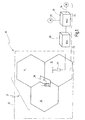
- a mobile communication system is designated in its entirety by identification reference 10.
- Mobile communication system 10 covers a cluster 12 of cells, each cell being defined by the range of coverage of a respective transceiver.
- cells 14, 16 and 18 are part of cluster 12 that is covered by mobile communication system 10.
- cluster 12 of mobile communication system 10 covers a significantly larger number of cells.
- mobile communication system 10 may be divided into three subsystems, namely into a mobile system 20, a base station system 22 and a network and switching system 24.
- Mobile system 20 is embodied by any mobile access terminal, e.g. by a mobile phone.
- the base station system 22 connects the mobile switching center with several mobile systems 20, although only one mobile system 20 is shown in Figur 1.
- the base station system 22 comprises a transmitter and a receiver in a base transceiver station BTS 26, and a base station controller BSC 28.
- Base station controller 28 handles, inter alia, the handover between several cells that are controlled by the concerned base station controller 28.
- Each base station system 22 comprises only one base station controller 28 but, in general, several base transceiver stations 26. Again, only one BTS 26 is depicted, ass being representative for a plurality of BTSs
- the network and switching system 24 switches, on the one hand, radio links in the GSM over great distances, e.g. between subscribers in different countries and, on the other hand, radio links between mobile subscribers in GSM and other networks like PSDN and ISDN.
- the mobile switching center 30 forms the center component of a network and switching system 24. Mobile switching center 30 switches between several connected base station systems 28. Further, mobile switching center 30 is connected to other network elements 36, e.g. other mobile switching centers. Dashed lines 32, 34 represent such connections. As is generally known, a mobile switching center 30 is connected to four data bases, namely to a home location register HLR, to a authentication center AOC, to a visitor location register VLR and, to an equipment identity register EIR.
- the HLR administers the mobile subscribers that are allocated to a certain network and switching system.
- the HLR stores the locations of the allocated mobile systems/subscribers as well as the services that may be utilized by a particular subscriber.
- the VLR contains information concerning the locations of mobile subscribers that are not allocated to a particular network and switching system, but that are temporarily located in an area covered by the particular network and switching system.
- identification reference 38 designates a pre-defined area in which all service requests of a mobile system 20 should be barred, if the mobile system 20 is roaming in the pre-defined area 38. Accordingly, pre-defined area 38 may also be designated as a barred area 38. Barred area 38 may, for instance, be a church, a cinema, a grave yard, a hospital, a theatre, an opera, a school and/or a restaurant. However, this enumeration is meant to list examples only and, therefore, not meant to be complete. Instead, barred area 38 may be allocated to each area, in which service requests to or from a mobile system 20 roaming in barred area 38 would be potentially disturbing.
- service requests may be barred during a presentation in a cinema, theatre, etc. or during a funeral, when the barred area 38 is a grave yard.
- service request may relate to mobile originating calls (MOC) or terminating calls (MTC) and/or short messages, etc. of a mobile station 20.
- MOC mobile originating calls
- MTC terminating calls
- Barred area 38 may be within one cell or may overlap with two or more cells. It can also be part of more than one location area 35, which may be controlled by one or more base station controllers and mobile switching centers.
- a mobile system 20 requests a service request (MOC, MTC,...) while roaming in one of the concerned cells, the location of the mobile system 20 is determined, using standard positioning methods. In figure 1, barred area 38 overlaps cells 14, 16 and 18. Accordingly, these cells are concerned. In other words, if a mobile system 20 roaming in one of these cells requests a service, the location of that particular mobile system 20 is determined with a higher resolution in order to be able to check whether mobile system 20 is within barred area 38 or not. If the position of mobile system 20 is within barred area 38, the service request of mobile system 20 is denied.
- the location determination may be performed by a position calculation function located in the mobile system 20 or in the network 24.
- Position calculation functions a per se known. See, for instance, third generation partnership project; technical specification 03.71 V8.7.0 (2002-09). Further relevant 3GPP standards are: TS36PP20.071, Location Services (LCS), Service Description, Stage 1; TS 36PP23.071, Functional Stage 2 Description of Location Services. According to the specification mentioned first, several position calculation functionalities exist. This specification mentions four position calculation functionalities, abbreviated as TA (timing advance between a mobile station and its serving base transceiver station), TOA (time of arrival position mechanism, E-OTD (enhanced observed time difference) and GPS (global positioning system positioning mechanism).
- TA timing advance between a mobile station and its serving base transceiver station
- TOA time of arrival position mechanism
- E-OTD enhanced observed time difference
- GPS global positioning system positioning mechanism
- the mobile system measures relative time of arrival of the signals from several base transceiver stations. The position of the mobile station is then determined by deducing the geometrical components of the time delays to a mobile station from the base transceiver station. Measurements are performed by the mobile station without any additional hardware.
- references is made to the above mentioned specifications, which are incorporated by reference herein. It should be noted, that the invention relates to a functionality of location based call barring rather than to a particular functionality of determining a location.
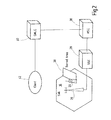
- FIG. 2 shows, schematically, a first example scenario for implementing the present invention.
- the mobile switching center 36 of figure 1 communicates with a gateway mobile location center 40, which is connected to a client 42.
- the gateway mobile location center GMLC 40 contains functionality required to support localizations. In one public land mobile network PLMN, there may be more than one GMLC.
- the barring functionality can be activated/deactivated by client 42 via GMLC 40. The authorization of client 42 to activate the barring is verified by the GMLC.
- the GMLC contains the relevant data like:
- the exception list may comprise mobile subscribers who are exempted from barring, e.g. the police, fire brigades, priority subscribers or a list of specific individual subscribers. Except for these exempted subscribers, the barring functionality applies to all mobile subscribers roaming in the barred area. Specific subscribers may have an override category in their profile enabling them to override location based call barring.
- client 42 activates location based call barring via GMLC 40.
- GMLC 40 verifies the authorization of client 42 and determines the related cells.
- the related cells may include cell 16 in figure 2.
- GMLC 40 activates the service in the related mobile switching center 36.
- Mobile switching center 36 stores a list of the concerned cells, which include, in the example shown in figure 2, cell 16.
- a location based call barring may be invocated by a mobile subscriber roaming in one of the concerned cells. For instance, mobile system 20 tries to originate a call or receive a mobile a terminating call. Cell 16, in which mobile system 20 is roaming, is known to the mobile switching center 36. Mobile switching center 36 determines that a barred area 38 belongs to this cell 16. Accordingly, mobile switching center 36 initiates a position determination concerning mobile system 20.
- mobile switching center 30 sends the position data and the relevant mobile system 20 data to GMLC 40.
- the relevant mobile system 20 data include all data that is relevant for barring determination, e.g. the identity of the subscriber, potentially an override category, etc.
- GMLC 40 than checks whether mobile system 20 is within barred area 38 or not, and checks whether the call shall be barred or not. The result is given back to mobile switching center 30, which than denies or allows the call accordingly.
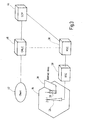
- Figure 3 represents an intelligent network (IN) based solution, in which the barring condition is verified by the service control point SCP44. This method allows a more subscriber dependant behaviour.
- the intelligent network (IN) architecture in which subscriber services are stored as service logics in a service node (SCP), is the preferred way to provide enhanced subscriber services.
- IN services are defined by the service provider who loads the service logics into a service logic data base in a service node such as a service control point 11.
- client 42 activates a location based a call barring via GMLC 40, which verifies the authorization of client 42 and determines the related cells.
- GMLC 40 activates a cell based IN trigger in the related mobile switching center 30.
- Mobile switching center 30 activates the cell based IN trigger.
- the service is also activated in service control point 44.
- the service activation may also be implemented directly in service control point 44, without involvement of GMLC 40.
- the activated service may be invocated by a subscriber (mobile system 20) roaming in one of the concerned cells, e.g. cell 16, by trying to originate a call or receiving a mobile termination call.
- mobile switching center 30 determines that a cell based IN trigger is activated for this cell. Accordingly, mobile switching center 30 triggers an IN service towards service control point 44.
- Service control point 44 requests a position of mobile system 20 via GMLC 40, using a standard positioning method. The position result is then returned to service control point 44 via GMLC 40. Service control point 44 decides whether the call is allowed or must be denied. The result is given back from service control point 44 to mobile switching center 40. Accordingly, mobile switching center 30 denies or allows the call.
- FIG 4 a fourth example scenario is depicted, in which a subscriber specific location call barring is implemented.
- the location based call barring/screening-service is activated in service control point 44 by the subscriber himself. This may be done by a standard service user interaction tools, for instant via the internet, WAP, SMS, etc.
- the authorization of the subscriber is checked by a service control point 44.
- Service control point 44 than activates the subscriber specific IN trigger in mobile switching center 30.
- the IN service is triggered for all calls of the respective subscriber.
- the location based call barring may be invocated by the concerned subscriber trying to originate a call or receiving a mobile a terminating call.
- Mobile switching center 30 than triggers an IN service toward service control point 44.
- service control point 44 requests the position of mobile system 20, that is the mobile system allocated to the concerned subscriber, via GMLC 40 using standard position methods as outlined above. The position result is than returned to service control point 44 via GMLC 40.
- Service control point 44 than decides whether the call is allowed or as to be denied. The respective result is than given back from service control point 44 to mobile switching center 30.
- Mobile switching center 30 denies or allows the call accordingly.
Landscapes
- Engineering & Computer Science (AREA)
- Computer Security & Cryptography (AREA)
- Computer Networks & Wireless Communication (AREA)
- Signal Processing (AREA)
- Mobile Radio Communication Systems (AREA)
Priority Applications (1)
| Application Number | Priority Date | Filing Date | Title |
|---|---|---|---|
| EP02360383A EP1435749A1 (de) | 2002-12-30 | 2002-12-30 | Positionsbasierte Rufsperrung |
Applications Claiming Priority (1)
| Application Number | Priority Date | Filing Date | Title |
|---|---|---|---|
| EP02360383A EP1435749A1 (de) | 2002-12-30 | 2002-12-30 | Positionsbasierte Rufsperrung |
Publications (1)
| Publication Number | Publication Date |
|---|---|
| EP1435749A1 true EP1435749A1 (de) | 2004-07-07 |
Family
ID=32479839
Family Applications (1)
| Application Number | Title | Priority Date | Filing Date |
|---|---|---|---|
| EP02360383A Withdrawn EP1435749A1 (de) | 2002-12-30 | 2002-12-30 | Positionsbasierte Rufsperrung |
Country Status (1)
| Country | Link |
|---|---|
| EP (1) | EP1435749A1 (de) |
Cited By (27)
| Publication number | Priority date | Publication date | Assignee | Title |
|---|---|---|---|---|
| WO2007019090A1 (en) * | 2005-08-03 | 2007-02-15 | Cingular Wireless Ii, Llc | Limiting services based on location |
| WO2007025409A1 (fr) * | 2005-08-30 | 2007-03-08 | Zte Corporation | Methode pour realiser une limitation de mobilite, qui repose sur un service d'un systeme de communication mobile |
| EP1791381A1 (de) * | 2005-11-25 | 2007-05-30 | Nortel Networks Limited | Ortsabhängige Steuerung von Rufzustellung in einem Mobilfunknetzwerk |
| WO2008045018A2 (en) | 2005-06-30 | 2008-04-17 | Lucent Technologies Inc. | Method of preventing detonation of a mobile-terminal-triggered explosive device |
| WO2008036070A3 (en) * | 2005-07-22 | 2008-07-03 | Lucent Technologies Inc | Network support for restricting call terminations in a security risk area |
| WO2009092693A1 (de) * | 2008-01-25 | 2009-07-30 | Vodafone Holding Gmbh | Verfahren zur unterdrückung einer nutzung eines mobilfunknetzes in einem gebiet |
| EP2034681A4 (de) * | 2006-06-15 | 2010-01-06 | Huawei Tech Co Ltd | Verfahren und system zum senden von teilnehmer-abschlussortsinformationen in einem ip-multimedia-subsystem |
| EP1592277A3 (de) * | 2004-04-30 | 2010-05-26 | Samsung Electronics Co., Ltd. | Verfahren und System zur Verwaltung der Dienstverfügbarkeit eines Anbieters in einem drahtlosen Netzwerk |
| EP2160919A4 (de) * | 2007-05-31 | 2011-01-19 | Ericsson Telefon Ab L M | Verfahren und system zur anrufverwaltung auf der basis des geographischen standorts |
| CN101227722B (zh) * | 2008-01-29 | 2011-03-02 | 中兴通讯股份有限公司 | 实现用户移动性限制的系统和方法 |
| WO2012010040A1 (zh) * | 2010-07-20 | 2012-01-26 | 中兴通讯股份有限公司 | 一种mtc设备的接入控制方法和系统 |
| CN102377881A (zh) * | 2010-08-17 | 2012-03-14 | 上海禹为通信技术有限公司 | 一种通信网话务管控的方法和系统 |
| CN102612111A (zh) * | 2012-03-26 | 2012-07-25 | 青岛百灵信息科技有限公司 | 一种基于地理位置限制移动终端通信业务执行的方法 |
| US8363594B2 (en) | 2006-11-08 | 2013-01-29 | Apple, Inc. | Address spoofing prevention |
| CN103053204A (zh) * | 2011-08-16 | 2013-04-17 | 联发科技股份有限公司 | 长期演进优化系统中的增强型存取控制 |
| US8566839B2 (en) | 2008-03-14 | 2013-10-22 | William J. Johnson | System and method for automated content presentation objects |
| US8600341B2 (en) | 2008-03-14 | 2013-12-03 | William J. Johnson | System and method for location based exchanges of data facilitating distributed locational applications |
| US8634796B2 (en) | 2008-03-14 | 2014-01-21 | William J. Johnson | System and method for location based exchanges of data facilitating distributed location applications |
| US8639267B2 (en) | 2008-03-14 | 2014-01-28 | William J. Johnson | System and method for location based exchanges of data facilitating distributed locational applications |
| US8843515B2 (en) | 2012-03-07 | 2014-09-23 | Snap Trends, Inc. | Methods and systems of aggregating information of social networks based on geographical locations via a network |
| US8897742B2 (en) | 2009-11-13 | 2014-11-25 | William J. Johnson | System and method for sudden proximal user interface |
| US8942693B2 (en) | 2008-03-14 | 2015-01-27 | William J. Johnson | System and method for targeting data processing system(s) with data |
| US9477991B2 (en) | 2013-08-27 | 2016-10-25 | Snap Trends, Inc. | Methods and systems of aggregating information of geographic context regions of social networks based on geographical locations via a network |
| US9894489B2 (en) | 2013-09-30 | 2018-02-13 | William J. Johnson | System and method for situational proximity observation alerting privileged recipients |
| US10165495B1 (en) | 2017-06-22 | 2018-12-25 | Microsoft Technology Licensing, Llc | Connectivity using a geographic phone number |
| US10368225B2 (en) | 2017-06-30 | 2019-07-30 | Microsoft Technology Licensing, Llc | Location determination for a service request |
| US10524086B2 (en) | 2017-06-23 | 2019-12-31 | Microsoft Technology Licensing, Llc | Use condition for a geographic phone number |
Citations (5)
| Publication number | Priority date | Publication date | Assignee | Title |
|---|---|---|---|---|
| US5594947A (en) * | 1994-03-10 | 1997-01-14 | Motorola, Inc. | Method for providing alternate communication services based on geographic location |
| US5778304A (en) * | 1994-03-10 | 1998-07-07 | Motorola, Inc. | Method for providing communication services based on geographic location |
| WO1999055102A1 (en) * | 1998-04-22 | 1999-10-28 | Netline Communications Technologies (Nct) Ltd. | Method and system for providing cellular communications services |
| US6233447B1 (en) * | 1997-08-08 | 2001-05-15 | Nec Corporation | Mobile communication system and a method of incoming call restriction |
| US20010031631A1 (en) * | 2000-01-12 | 2001-10-18 | Pitts Robert L. | Secure area communication arrester |
-
2002
- 2002-12-30 EP EP02360383A patent/EP1435749A1/de not_active Withdrawn
Patent Citations (5)
| Publication number | Priority date | Publication date | Assignee | Title |
|---|---|---|---|---|
| US5594947A (en) * | 1994-03-10 | 1997-01-14 | Motorola, Inc. | Method for providing alternate communication services based on geographic location |
| US5778304A (en) * | 1994-03-10 | 1998-07-07 | Motorola, Inc. | Method for providing communication services based on geographic location |
| US6233447B1 (en) * | 1997-08-08 | 2001-05-15 | Nec Corporation | Mobile communication system and a method of incoming call restriction |
| WO1999055102A1 (en) * | 1998-04-22 | 1999-10-28 | Netline Communications Technologies (Nct) Ltd. | Method and system for providing cellular communications services |
| US20010031631A1 (en) * | 2000-01-12 | 2001-10-18 | Pitts Robert L. | Secure area communication arrester |
Cited By (65)
| Publication number | Priority date | Publication date | Assignee | Title |
|---|---|---|---|---|
| EP1592277A3 (de) * | 2004-04-30 | 2010-05-26 | Samsung Electronics Co., Ltd. | Verfahren und System zur Verwaltung der Dienstverfügbarkeit eines Anbieters in einem drahtlosen Netzwerk |
| WO2008045018A3 (en) * | 2005-06-30 | 2008-07-03 | Lucent Technologies Inc | Method of preventing detonation of a mobile-terminal-triggered explosive device |
| WO2008045018A2 (en) | 2005-06-30 | 2008-04-17 | Lucent Technologies Inc. | Method of preventing detonation of a mobile-terminal-triggered explosive device |
| WO2008036070A3 (en) * | 2005-07-22 | 2008-07-03 | Lucent Technologies Inc | Network support for restricting call terminations in a security risk area |
| US9712957B2 (en) | 2005-08-03 | 2017-07-18 | At&T Mobility Ii Llc | Limiting services based on location |
| GB2448565B (en) * | 2005-08-03 | 2010-09-22 | Cingular Wireless Ii Llc | Limiting services based on location |
| GB2448565A (en) * | 2005-08-03 | 2008-10-22 | Cingular Wireless Ii Llc | Limiting services based on location |
| JP2009504091A (ja) * | 2005-08-03 | 2009-01-29 | エイティアンドティ・モビリティ・ツー・エルエルシー | 所在地に基づくサービスの制限 |
| US8832792B2 (en) | 2005-08-03 | 2014-09-09 | At&T Mobility Ii Llc | Limiting services based on location |
| WO2007019090A1 (en) * | 2005-08-03 | 2007-02-15 | Cingular Wireless Ii, Llc | Limiting services based on location |
| WO2007025409A1 (fr) * | 2005-08-30 | 2007-03-08 | Zte Corporation | Methode pour realiser une limitation de mobilite, qui repose sur un service d'un systeme de communication mobile |
| EP1791381A1 (de) * | 2005-11-25 | 2007-05-30 | Nortel Networks Limited | Ortsabhängige Steuerung von Rufzustellung in einem Mobilfunknetzwerk |
| EP2034681A4 (de) * | 2006-06-15 | 2010-01-06 | Huawei Tech Co Ltd | Verfahren und system zum senden von teilnehmer-abschlussortsinformationen in einem ip-multimedia-subsystem |
| US9210575B2 (en) | 2006-11-08 | 2015-12-08 | Apple Inc. | Address spoofing prevention |
| US8363594B2 (en) | 2006-11-08 | 2013-01-29 | Apple, Inc. | Address spoofing prevention |
| EP2160919A4 (de) * | 2007-05-31 | 2011-01-19 | Ericsson Telefon Ab L M | Verfahren und system zur anrufverwaltung auf der basis des geographischen standorts |
| US8750864B2 (en) | 2007-05-31 | 2014-06-10 | Telefonaktiebolaget L M Ericsson (Publ) | Method and system for call management based on geographical location |
| WO2009092693A1 (de) * | 2008-01-25 | 2009-07-30 | Vodafone Holding Gmbh | Verfahren zur unterdrückung einer nutzung eines mobilfunknetzes in einem gebiet |
| US8509818B2 (en) | 2008-01-25 | 2013-08-13 | Vodafone Holding Gmbh | Method for suppressing use of a mobile phone and protecting against interference field in an area in a wireless communication network |
| DE102008006231B4 (de) * | 2008-01-25 | 2013-10-10 | Vodafone Holding Gmbh | Verfahren zur Unterdrückung einer Nutzung eines Mobilfunknetzes in einem Gebiet |
| CN101227722B (zh) * | 2008-01-29 | 2011-03-02 | 中兴通讯股份有限公司 | 实现用户移动性限制的系统和方法 |
| US9204275B2 (en) | 2008-03-14 | 2015-12-01 | William J. Johnson | System and method for targeting data processing system(s) with data |
| US9088869B2 (en) | 2008-03-14 | 2015-07-21 | William J. Johnson | System and method for application search results by locational conditions |
| US8634796B2 (en) | 2008-03-14 | 2014-01-21 | William J. Johnson | System and method for location based exchanges of data facilitating distributed location applications |
| US8639267B2 (en) | 2008-03-14 | 2014-01-28 | William J. Johnson | System and method for location based exchanges of data facilitating distributed locational applications |
| US8718598B2 (en) | 2008-03-14 | 2014-05-06 | William J. Johnson | System and method for location based exchange vicinity interest specification |
| US8566839B2 (en) | 2008-03-14 | 2013-10-22 | William J. Johnson | System and method for automated content presentation objects |
| US8750823B2 (en) | 2008-03-14 | 2014-06-10 | William J. Johnson | System and method for location based exchanges of data facilitating distributed locational applications |
| US8761804B2 (en) | 2008-03-14 | 2014-06-24 | William J. Johnson | System and method for location based exchanges of data facilitating distributed locational applications |
| US10477994B2 (en) | 2008-03-14 | 2019-11-19 | William J. Johnson | System and method for location based exchanges of data facilitiating distributed locational applications |
| US10111034B2 (en) | 2008-03-14 | 2018-10-23 | Billjco Llc | System and method for sound wave triggered content |
| US8887177B2 (en) | 2008-03-14 | 2014-11-11 | William J. Johnson | System and method for automated content distribution objects |
| US8886226B2 (en) | 2008-03-14 | 2014-11-11 | William J. Johnson | System and method for timely whereabouts determination by a mobile data processing system |
| US9584993B2 (en) | 2008-03-14 | 2017-02-28 | William J. Johnson | System and method for vector processing on behalf of image aperture aim |
| US9456303B2 (en) | 2008-03-14 | 2016-09-27 | William J. Johnson | System and method for service access via hopped wireless mobile device(s) |
| US8923806B2 (en) | 2008-03-14 | 2014-12-30 | William J. Johnson | System and method for presenting application data by data processing system(s) in a vicinity |
| US8942733B2 (en) | 2008-03-14 | 2015-01-27 | William J. Johnson | System and method for location based exchanges of data facilitating distributed location applications |
| US8942693B2 (en) | 2008-03-14 | 2015-01-27 | William J. Johnson | System and method for targeting data processing system(s) with data |
| US8942732B2 (en) | 2008-03-14 | 2015-01-27 | William J. Johnson | Location based exchange operating system |
| US9014658B2 (en) | 2008-03-14 | 2015-04-21 | William J. Johnson | System and method for application context location based configuration suggestions |
| US9055406B2 (en) | 2008-03-14 | 2015-06-09 | William J. Johnson | Server-less synchronized processing across a plurality of interoperating data processing systems |
| US9078095B2 (en) | 2008-03-14 | 2015-07-07 | William J. Johnson | System and method for location based inventory management |
| US8600341B2 (en) | 2008-03-14 | 2013-12-03 | William J. Johnson | System and method for location based exchanges of data facilitating distributed locational applications |
| US9088868B2 (en) | 2008-03-14 | 2015-07-21 | William J. Johnson | Location based exchange permissions |
| US9100792B2 (en) | 2008-03-14 | 2015-08-04 | William J. Johnson | System and method for service-free location based applications |
| US9113295B2 (en) | 2008-03-14 | 2015-08-18 | William J. Johnson | System and method for location based exchange vicinity interest specification |
| US9445238B2 (en) | 2008-03-14 | 2016-09-13 | William J. Johnson | System and method for confirming data processing system target(s) |
| US9392408B2 (en) | 2008-03-14 | 2016-07-12 | William J. Johnson | System and method for location based exchanges of data facilitating distributed locational applications |
| US9253597B2 (en) | 2008-03-14 | 2016-02-02 | William J. Johnson | System and method for determining mobile users of interest |
| US8897741B2 (en) | 2009-11-13 | 2014-11-25 | William J. Johnson | System and method for mobile device usability by locational conditions |
| US8897742B2 (en) | 2009-11-13 | 2014-11-25 | William J. Johnson | System and method for sudden proximal user interface |
| WO2012010040A1 (zh) * | 2010-07-20 | 2012-01-26 | 中兴通讯股份有限公司 | 一种mtc设备的接入控制方法和系统 |
| CN102377881A (zh) * | 2010-08-17 | 2012-03-14 | 上海禹为通信技术有限公司 | 一种通信网话务管控的方法和系统 |
| CN103053204A (zh) * | 2011-08-16 | 2013-04-17 | 联发科技股份有限公司 | 长期演进优化系统中的增强型存取控制 |
| CN103053204B (zh) * | 2011-08-16 | 2016-05-25 | 联发科技股份有限公司 | 增强型存取控制方法 |
| US9155105B2 (en) | 2011-08-16 | 2015-10-06 | Mediatek Inc. | Enhanced access control in LTE advanced systems |
| US9626446B2 (en) | 2012-03-07 | 2017-04-18 | Snap Trends, Inc. | Methods and systems of advertising based on aggregated information of social networks within geographical locations via a network |
| US8843515B2 (en) | 2012-03-07 | 2014-09-23 | Snap Trends, Inc. | Methods and systems of aggregating information of social networks based on geographical locations via a network |
| CN102612111A (zh) * | 2012-03-26 | 2012-07-25 | 青岛百灵信息科技有限公司 | 一种基于地理位置限制移动终端通信业务执行的方法 |
| US9477991B2 (en) | 2013-08-27 | 2016-10-25 | Snap Trends, Inc. | Methods and systems of aggregating information of geographic context regions of social networks based on geographical locations via a network |
| US9894489B2 (en) | 2013-09-30 | 2018-02-13 | William J. Johnson | System and method for situational proximity observation alerting privileged recipients |
| US10194293B2 (en) | 2013-09-30 | 2019-01-29 | William J. Johnson | System and method for vital signs alerting privileged recipients |
| US10165495B1 (en) | 2017-06-22 | 2018-12-25 | Microsoft Technology Licensing, Llc | Connectivity using a geographic phone number |
| US10524086B2 (en) | 2017-06-23 | 2019-12-31 | Microsoft Technology Licensing, Llc | Use condition for a geographic phone number |
| US10368225B2 (en) | 2017-06-30 | 2019-07-30 | Microsoft Technology Licensing, Llc | Location determination for a service request |
Similar Documents
| Publication | Publication Date | Title |
|---|---|---|
| EP1435749A1 (de) | Positionsbasierte Rufsperrung | |
| US8750864B2 (en) | Method and system for call management based on geographical location | |
| EP1074163B1 (de) | System und verfahren zum definieren von ortbestimmungsdiensten | |
| RU2316151C2 (ru) | Обеспечение информации, относящейся к мобильной станции | |
| US6463289B1 (en) | System and method for providing restricting positioning of a target mobile station based on the calculated location estimate | |
| CN101861744B (zh) | 用户选择的基于区域的服务控制 | |
| US6167266A (en) | Method for handling of positioning triggers for batch location requests within a location services system | |
| EP1623596B1 (de) | Vorrichtung und verfahren zur bereitstellung von positionsinformationen | |
| US9028577B2 (en) | Network adapted to manage different mobile telephony services | |
| RU2470487C2 (ru) | Система и способ использования информации о роли абонента в системе мобильной связи | |
| US20080102860A1 (en) | Provision of location information | |
| US20030017843A1 (en) | Method for multple use of a radiotelephone, and radiotelephone system corresponding subscriber identification module and presence detecting device | |
| US7054615B2 (en) | System and method for providing enhanced user privacy in a mobile communications network | |
| EP1101371A1 (de) | Merkmale für notrufe und kurznachrichten | |
| EP1763963A2 (de) | Umherstreifendes grenzgateway | |
| JP2002503932A (ja) | 移動加入者のサービスプロファイルの変更 | |
| JPH08510879A (ja) | 移動無線網を駆動する方法 | |
| WO1999027716A1 (en) | Regulatory database within the intelligent network | |
| AU3751999A (en) | System and method for use of override keys for location services | |
| RU2314551C2 (ru) | Способ осуществления услуги определения местоположения в системе связи | |
| KR20010111633A (ko) | 디폴트 모드 제공 방법, 장치 및 시스템 | |
| KR19990063908A (ko) | 단축 코드 다이얼링 장치 및 전기통신 링크 설치 방법 | |
| EP1538860B1 (de) | Verfahren und Telekommunikationssystem zur Positionsbestimmung einer Ziel-Teilnehmereinrichtung unter Nutzung einer "Mobile Originating-Location Request (MO-LR)"-Prozedur | |
| WO2005029902A1 (en) | Method and telecommunications system for positioning accuracy negotiation between a location service client and a target user equipment of a subscriber | |
| EP1686823A1 (de) | Methode und Gerät zur Beschränkung der Nutzung von Kommunikationsgeräten |
Legal Events
| Date | Code | Title | Description |
|---|---|---|---|
| PUAI | Public reference made under article 153(3) epc to a published international application that has entered the european phase |
Free format text: ORIGINAL CODE: 0009012 |
|
| AK | Designated contracting states |
Kind code of ref document: A1 Designated state(s): AT BE BG CH CY CZ DE DK EE ES FI FR GB GR IE IT LI LU MC NL PT SE SI SK TR |
|
| AX | Request for extension of the european patent |
Extension state: AL LT LV MK RO |
|
| AKX | Designation fees paid | ||
| REG | Reference to a national code |
Ref country code: DE Ref legal event code: 8566 |
|
| STAA | Information on the status of an ep patent application or granted ep patent |
Free format text: STATUS: THE APPLICATION IS DEEMED TO BE WITHDRAWN |
|
| 18D | Application deemed to be withdrawn |
Effective date: 20050108 |