EP1436344B1 - Thermoplastische formmassen mit verbesserter schmelzestabilität auf basis von polyarylenethersulfonen - Google Patents
Thermoplastische formmassen mit verbesserter schmelzestabilität auf basis von polyarylenethersulfonen Download PDFInfo
- Publication number
- EP1436344B1 EP1436344B1 EP02779431A EP02779431A EP1436344B1 EP 1436344 B1 EP1436344 B1 EP 1436344B1 EP 02779431 A EP02779431 A EP 02779431A EP 02779431 A EP02779431 A EP 02779431A EP 1436344 B1 EP1436344 B1 EP 1436344B1
- Authority
- EP
- European Patent Office
- Prior art keywords
- weight
- polyarylene ether
- molding
- units
- molding compositions
- Prior art date
- Legal status (The legal status is an assumption and is not a legal conclusion. Google has not performed a legal analysis and makes no representation as to the accuracy of the status listed.)
- Expired - Lifetime
Links
- 239000000463 material Substances 0.000 title description 2
- 238000002844 melting Methods 0.000 title description 2
- 230000008018 melting Effects 0.000 title description 2
- 238000009757 thermoplastic moulding Methods 0.000 title description 2
- -1 ether sulfone Chemical class 0.000 claims abstract description 75
- 239000000203 mixture Substances 0.000 claims abstract description 51
- RTZKZFJDLAIYFH-UHFFFAOYSA-N ether Substances CCOCC RTZKZFJDLAIYFH-UHFFFAOYSA-N 0.000 claims abstract description 45
- 229920000412 polyarylene Polymers 0.000 claims abstract description 45
- 238000000465 moulding Methods 0.000 claims abstract description 42
- 239000000178 monomer Substances 0.000 claims abstract description 22
- 229920001971 elastomer Polymers 0.000 claims abstract description 18
- 239000005060 rubber Substances 0.000 claims abstract description 16
- BRPSWMCDEYMRPE-UHFFFAOYSA-N 4-[1,1-bis(4-hydroxyphenyl)ethyl]phenol Chemical compound C=1C=C(O)C=CC=1C(C=1C=CC(O)=CC=1)(C)C1=CC=C(O)C=C1 BRPSWMCDEYMRPE-UHFFFAOYSA-N 0.000 claims abstract description 11
- 239000000945 filler Substances 0.000 claims abstract description 11
- 239000000654 additive Substances 0.000 claims abstract description 8
- 239000000835 fiber Substances 0.000 claims abstract description 8
- 239000006260 foam Substances 0.000 claims abstract description 7
- 238000004519 manufacturing process Methods 0.000 claims abstract description 7
- 239000010408 film Substances 0.000 claims abstract description 5
- 230000001588 bifunctional effect Effects 0.000 claims abstract 2
- 238000002156 mixing Methods 0.000 claims description 6
- 239000000470 constituent Substances 0.000 claims 1
- 238000005516 engineering process Methods 0.000 claims 1
- 150000001875 compounds Chemical class 0.000 description 12
- 239000000047 product Substances 0.000 description 12
- 125000003118 aryl group Chemical group 0.000 description 11
- 239000000049 pigment Substances 0.000 description 11
- 125000000524 functional group Chemical group 0.000 description 9
- 239000000155 melt Substances 0.000 description 9
- 239000002253 acid Substances 0.000 description 8
- 125000004432 carbon atom Chemical group C* 0.000 description 8
- 150000002148 esters Chemical class 0.000 description 8
- 239000003365 glass fiber Substances 0.000 description 8
- SECXISVLQFMRJM-UHFFFAOYSA-N N-Methylpyrrolidone Chemical compound CN1CCCC1=O SECXISVLQFMRJM-UHFFFAOYSA-N 0.000 description 7
- 229910052799 carbon Inorganic materials 0.000 description 7
- 229920001577 copolymer Polymers 0.000 description 7
- 230000009477 glass transition Effects 0.000 description 7
- 239000002245 particle Substances 0.000 description 7
- 229920000642 polymer Polymers 0.000 description 7
- 229920001169 thermoplastic Polymers 0.000 description 7
- VZCYOOQTPOCHFL-UHFFFAOYSA-N trans-butenedioic acid Natural products OC(=O)C=CC(O)=O VZCYOOQTPOCHFL-UHFFFAOYSA-N 0.000 description 7
- SMZOUWXMTYCWNB-UHFFFAOYSA-N 2-(2-methoxy-5-methylphenyl)ethanamine Chemical compound COC1=CC=C(C)C=C1CCN SMZOUWXMTYCWNB-UHFFFAOYSA-N 0.000 description 6
- NIXOWILDQLNWCW-UHFFFAOYSA-N Acrylic acid Chemical compound OC(=O)C=C NIXOWILDQLNWCW-UHFFFAOYSA-N 0.000 description 6
- OFOBLEOULBTSOW-UHFFFAOYSA-N Malonic acid Chemical compound OC(=O)CC(O)=O OFOBLEOULBTSOW-UHFFFAOYSA-N 0.000 description 6
- CERQOIWHTDAKMF-UHFFFAOYSA-N Methacrylic acid Chemical compound CC(=C)C(O)=O CERQOIWHTDAKMF-UHFFFAOYSA-N 0.000 description 6
- GWEVSGVZZGPLCZ-UHFFFAOYSA-N Titan oxide Chemical compound O=[Ti]=O GWEVSGVZZGPLCZ-UHFFFAOYSA-N 0.000 description 6
- 239000004416 thermosoftening plastic Substances 0.000 description 6
- 239000005995 Aluminium silicate Substances 0.000 description 5
- 235000012211 aluminium silicate Nutrition 0.000 description 5
- 150000001991 dicarboxylic acids Chemical class 0.000 description 5
- 150000001993 dienes Chemical class 0.000 description 5
- NLYAJNPCOHFWQQ-UHFFFAOYSA-N kaolin Chemical compound O.O.O=[Al]O[Si](=O)O[Si](=O)O[Al]=O NLYAJNPCOHFWQQ-UHFFFAOYSA-N 0.000 description 5
- VZCYOOQTPOCHFL-UPHRSURJSA-N maleic acid Chemical compound OC(=O)\C=C/C(O)=O VZCYOOQTPOCHFL-UPHRSURJSA-N 0.000 description 5
- 239000011976 maleic acid Substances 0.000 description 5
- FPYJFEHAWHCUMM-UHFFFAOYSA-N maleic anhydride Chemical compound O=C1OC(=O)C=C1 FPYJFEHAWHCUMM-UHFFFAOYSA-N 0.000 description 5
- 238000000034 method Methods 0.000 description 5
- KAKZBPTYRLMSJV-UHFFFAOYSA-N Butadiene Chemical compound C=CC=C KAKZBPTYRLMSJV-UHFFFAOYSA-N 0.000 description 4
- OKTJSMMVPCPJKN-UHFFFAOYSA-N Carbon Chemical compound [C] OKTJSMMVPCPJKN-UHFFFAOYSA-N 0.000 description 4
- VZCYOOQTPOCHFL-OWOJBTEDSA-N Fumaric acid Chemical compound OC(=O)\C=C\C(O)=O VZCYOOQTPOCHFL-OWOJBTEDSA-N 0.000 description 4
- RRHGJUQNOFWUDK-UHFFFAOYSA-N Isoprene Chemical compound CC(=C)C=C RRHGJUQNOFWUDK-UHFFFAOYSA-N 0.000 description 4
- VYPSYNLAJGMNEJ-UHFFFAOYSA-N Silicium dioxide Chemical compound O=[Si]=O VYPSYNLAJGMNEJ-UHFFFAOYSA-N 0.000 description 4
- PPBRXRYQALVLMV-UHFFFAOYSA-N Styrene Chemical compound C=CC1=CC=CC=C1 PPBRXRYQALVLMV-UHFFFAOYSA-N 0.000 description 4
- 150000007513 acids Chemical class 0.000 description 4
- 125000003545 alkoxy group Chemical group 0.000 description 4
- 125000000217 alkyl group Chemical group 0.000 description 4
- 150000008064 anhydrides Chemical class 0.000 description 4
- 229920001400 block copolymer Polymers 0.000 description 4
- 125000003700 epoxy group Chemical group 0.000 description 4
- 230000000269 nucleophilic effect Effects 0.000 description 4
- 238000006068 polycondensation reaction Methods 0.000 description 4
- 229920000098 polyolefin Polymers 0.000 description 4
- BWHMMNNQKKPAPP-UHFFFAOYSA-L potassium carbonate Chemical compound [K+].[K+].[O-]C([O-])=O BWHMMNNQKKPAPP-UHFFFAOYSA-L 0.000 description 4
- 238000002360 preparation method Methods 0.000 description 4
- 239000000243 solution Substances 0.000 description 4
- 239000000126 substance Substances 0.000 description 4
- 125000001424 substituent group Chemical group 0.000 description 4
- 239000000454 talc Substances 0.000 description 4
- 235000012222 talc Nutrition 0.000 description 4
- 229910052623 talc Inorganic materials 0.000 description 4
- XLYOFNOQVPJJNP-UHFFFAOYSA-N water Substances O XLYOFNOQVPJJNP-UHFFFAOYSA-N 0.000 description 4
- 125000004400 (C1-C12) alkyl group Chemical group 0.000 description 3
- 239000004593 Epoxy Substances 0.000 description 3
- JOYRKODLDBILNP-UHFFFAOYSA-N Ethyl urethane Chemical compound CCOC(N)=O JOYRKODLDBILNP-UHFFFAOYSA-N 0.000 description 3
- 125000005907 alkyl ester group Chemical group 0.000 description 3
- 150000001408 amides Chemical class 0.000 description 3
- 230000015572 biosynthetic process Effects 0.000 description 3
- 239000004917 carbon fiber Substances 0.000 description 3
- 150000001732 carboxylic acid derivatives Chemical class 0.000 description 3
- 150000001733 carboxylic acid esters Chemical class 0.000 description 3
- 238000006243 chemical reaction Methods 0.000 description 3
- 239000011258 core-shell material Substances 0.000 description 3
- 238000004132 cross linking Methods 0.000 description 3
- 125000001495 ethyl group Chemical group [H]C([H])([H])C([H])([H])* 0.000 description 3
- 229910052739 hydrogen Inorganic materials 0.000 description 3
- 125000004435 hydrogen atom Chemical group [H]* 0.000 description 3
- 239000000314 lubricant Substances 0.000 description 3
- 238000005259 measurement Methods 0.000 description 3
- 125000002496 methyl group Chemical group [H]C([H])([H])* 0.000 description 3
- 229920000728 polyester Polymers 0.000 description 3
- 238000006116 polymerization reaction Methods 0.000 description 3
- 238000012545 processing Methods 0.000 description 3
- 238000007086 side reaction Methods 0.000 description 3
- 239000003381 stabilizer Substances 0.000 description 3
- 238000003786 synthesis reaction Methods 0.000 description 3
- GBXQPDCOMJJCMJ-UHFFFAOYSA-M trimethyl-[6-(trimethylazaniumyl)hexyl]azanium;bromide Chemical compound [Br-].C[N+](C)(C)CCCCCC[N+](C)(C)C GBXQPDCOMJJCMJ-UHFFFAOYSA-M 0.000 description 3
- 239000004711 α-olefin Substances 0.000 description 3
- 125000004642 (C1-C12) alkoxy group Chemical group 0.000 description 2
- MYRTYDVEIRVNKP-UHFFFAOYSA-N 1,2-Divinylbenzene Chemical compound C=CC1=CC=CC=C1C=C MYRTYDVEIRVNKP-UHFFFAOYSA-N 0.000 description 2
- IBRQUKZZBXZOBA-UHFFFAOYSA-N 1-chloro-3-(3-chlorophenyl)sulfonylbenzene Chemical compound ClC1=CC=CC(S(=O)(=O)C=2C=C(Cl)C=CC=2)=C1 IBRQUKZZBXZOBA-UHFFFAOYSA-N 0.000 description 2
- HECLRDQVFMWTQS-RGOKHQFPSA-N 1755-01-7 Chemical compound C1[C@H]2[C@@H]3CC=C[C@@H]3[C@@H]1C=C2 HECLRDQVFMWTQS-RGOKHQFPSA-N 0.000 description 2
- IMSODMZESSGVBE-UHFFFAOYSA-N 2-Oxazoline Chemical compound C1CN=CO1 IMSODMZESSGVBE-UHFFFAOYSA-N 0.000 description 2
- NIXOWILDQLNWCW-UHFFFAOYSA-M Acrylate Chemical compound [O-]C(=O)C=C NIXOWILDQLNWCW-UHFFFAOYSA-M 0.000 description 2
- NLHHRLWOUZZQLW-UHFFFAOYSA-N Acrylonitrile Chemical compound C=CC#N NLHHRLWOUZZQLW-UHFFFAOYSA-N 0.000 description 2
- ZAMOUSCENKQFHK-UHFFFAOYSA-N Chlorine atom Chemical compound [Cl] ZAMOUSCENKQFHK-UHFFFAOYSA-N 0.000 description 2
- 229910021595 Copper(I) iodide Inorganic materials 0.000 description 2
- VGGSQFUCUMXWEO-UHFFFAOYSA-N Ethene Chemical compound C=C VGGSQFUCUMXWEO-UHFFFAOYSA-N 0.000 description 2
- 239000005977 Ethylene Substances 0.000 description 2
- 239000004609 Impact Modifier Substances 0.000 description 2
- UQSXHKLRYXJYBZ-UHFFFAOYSA-N Iron oxide Chemical compound [Fe]=O UQSXHKLRYXJYBZ-UHFFFAOYSA-N 0.000 description 2
- JUJWROOIHBZHMG-UHFFFAOYSA-N Pyridine Chemical compound C1=CC=NC=C1 JUJWROOIHBZHMG-UHFFFAOYSA-N 0.000 description 2
- 235000021355 Stearic acid Nutrition 0.000 description 2
- XSQUKJJJFZCRTK-UHFFFAOYSA-N Urea Chemical compound NC(N)=O XSQUKJJJFZCRTK-UHFFFAOYSA-N 0.000 description 2
- XLOMVQKBTHCTTD-UHFFFAOYSA-N Zinc monoxide Chemical compound [Zn]=O XLOMVQKBTHCTTD-UHFFFAOYSA-N 0.000 description 2
- 150000008065 acid anhydrides Chemical class 0.000 description 2
- 125000000732 arylene group Chemical group 0.000 description 2
- 239000004202 carbamide Substances 0.000 description 2
- 125000002915 carbonyl group Chemical group [*:2]C([*:1])=O 0.000 description 2
- 239000000460 chlorine Substances 0.000 description 2
- 229910052801 chlorine Inorganic materials 0.000 description 2
- NEHMKBQYUWJMIP-UHFFFAOYSA-N chloromethane Chemical compound ClC NEHMKBQYUWJMIP-UHFFFAOYSA-N 0.000 description 2
- LSXDOTMGLUJQCM-UHFFFAOYSA-M copper(i) iodide Chemical compound I[Cu] LSXDOTMGLUJQCM-UHFFFAOYSA-M 0.000 description 2
- ZSWFCLXCOIISFI-UHFFFAOYSA-N cyclopentadiene Chemical compound C1C=CC=C1 ZSWFCLXCOIISFI-UHFFFAOYSA-N 0.000 description 2
- 238000000354 decomposition reaction Methods 0.000 description 2
- 238000002845 discoloration Methods 0.000 description 2
- 239000000975 dye Substances 0.000 description 2
- 239000000806 elastomer Substances 0.000 description 2
- 150000002118 epoxides Chemical group 0.000 description 2
- 238000001125 extrusion Methods 0.000 description 2
- 229910052731 fluorine Inorganic materials 0.000 description 2
- 239000011737 fluorine Substances 0.000 description 2
- 239000001530 fumaric acid Substances 0.000 description 2
- 239000011521 glass Substances 0.000 description 2
- VOZRXNHHFUQHIL-UHFFFAOYSA-N glycidyl methacrylate Chemical compound CC(=C)C(=O)OCC1CO1 VOZRXNHHFUQHIL-UHFFFAOYSA-N 0.000 description 2
- 150000004820 halides Chemical group 0.000 description 2
- 125000006277 halobenzyl group Chemical group 0.000 description 2
- 229910052736 halogen Inorganic materials 0.000 description 2
- 125000005843 halogen group Chemical group 0.000 description 2
- 150000002367 halogens Chemical class 0.000 description 2
- 238000010438 heat treatment Methods 0.000 description 2
- PYGSKMBEVAICCR-UHFFFAOYSA-N hexa-1,5-diene Chemical compound C=CCCC=C PYGSKMBEVAICCR-UHFFFAOYSA-N 0.000 description 2
- 125000002887 hydroxy group Chemical group [H]O* 0.000 description 2
- 150000003949 imides Chemical class 0.000 description 2
- 238000010348 incorporation Methods 0.000 description 2
- 239000004615 ingredient Substances 0.000 description 2
- XEEYBQQBJWHFJM-UHFFFAOYSA-N iron Substances [Fe] XEEYBQQBJWHFJM-UHFFFAOYSA-N 0.000 description 2
- 150000003951 lactams Chemical class 0.000 description 2
- 239000011133 lead Substances 0.000 description 2
- NUJOXMJBOLGQSY-UHFFFAOYSA-N manganese dioxide Chemical compound O=[Mn]=O NUJOXMJBOLGQSY-UHFFFAOYSA-N 0.000 description 2
- 239000006082 mold release agent Substances 0.000 description 2
- 125000004108 n-butyl group Chemical group [H]C([H])([H])C([H])([H])C([H])([H])C([H])([H])* 0.000 description 2
- GLDOVTGHNKAZLK-UHFFFAOYSA-N octadecan-1-ol Chemical compound CCCCCCCCCCCCCCCCCCO GLDOVTGHNKAZLK-UHFFFAOYSA-N 0.000 description 2
- OQCDKBAXFALNLD-UHFFFAOYSA-N octadecanoic acid Natural products CCCCCCCC(C)CCCCCCCCC(O)=O OQCDKBAXFALNLD-UHFFFAOYSA-N 0.000 description 2
- 230000003647 oxidation Effects 0.000 description 2
- 238000007254 oxidation reaction Methods 0.000 description 2
- RPQRDASANLAFCM-UHFFFAOYSA-N oxiran-2-ylmethyl prop-2-enoate Chemical compound C=CC(=O)OCC1CO1 RPQRDASANLAFCM-UHFFFAOYSA-N 0.000 description 2
- 239000004814 polyurethane Substances 0.000 description 2
- 229920002635 polyurethane Polymers 0.000 description 2
- 229910000027 potassium carbonate Inorganic materials 0.000 description 2
- 230000008569 process Effects 0.000 description 2
- 125000001436 propyl group Chemical group [H]C([*])([H])C([H])([H])C([H])([H])[H] 0.000 description 2
- 230000035484 reaction time Effects 0.000 description 2
- 239000012779 reinforcing material Substances 0.000 description 2
- 150000003839 salts Chemical class 0.000 description 2
- 235000012239 silicon dioxide Nutrition 0.000 description 2
- 239000008117 stearic acid Substances 0.000 description 2
- ISXSCDLOGDJUNJ-UHFFFAOYSA-N tert-butyl prop-2-enoate Chemical compound CC(C)(C)OC(=O)C=C ISXSCDLOGDJUNJ-UHFFFAOYSA-N 0.000 description 2
- 239000004408 titanium dioxide Substances 0.000 description 2
- 239000010456 wollastonite Substances 0.000 description 2
- 229910052882 wollastonite Inorganic materials 0.000 description 2
- JIAARYAFYJHUJI-UHFFFAOYSA-L zinc dichloride Chemical compound [Cl-].[Cl-].[Zn+2] JIAARYAFYJHUJI-UHFFFAOYSA-L 0.000 description 2
- BHHYHSUAOQUXJK-UHFFFAOYSA-L zinc fluoride Chemical compound F[Zn]F BHHYHSUAOQUXJK-UHFFFAOYSA-L 0.000 description 2
- OJOWICOBYCXEKR-APPZFPTMSA-N (1S,4R)-5-ethylidenebicyclo[2.2.1]hept-2-ene Chemical compound CC=C1C[C@@H]2C[C@@H]1C=C2 OJOWICOBYCXEKR-APPZFPTMSA-N 0.000 description 1
- RRKODOZNUZCUBN-CCAGOZQPSA-N (1z,3z)-cycloocta-1,3-diene Chemical class C1CC\C=C/C=C\C1 RRKODOZNUZCUBN-CCAGOZQPSA-N 0.000 description 1
- PRBHEGAFLDMLAL-GQCTYLIASA-N (4e)-hexa-1,4-diene Chemical compound C\C=C\CC=C PRBHEGAFLDMLAL-GQCTYLIASA-N 0.000 description 1
- 125000004169 (C1-C6) alkyl group Chemical group 0.000 description 1
- 150000005207 1,3-dihydroxybenzenes Chemical class 0.000 description 1
- OCJBOOLMMGQPQU-UHFFFAOYSA-N 1,4-dichlorobenzene Chemical compound ClC1=CC=C(Cl)C=C1 OCJBOOLMMGQPQU-UHFFFAOYSA-N 0.000 description 1
- 150000005208 1,4-dihydroxybenzenes Chemical class 0.000 description 1
- 125000001140 1,4-phenylene group Chemical group [H]C1=C([H])C([*:2])=C([H])C([H])=C1[*:1] 0.000 description 1
- KWKAKUADMBZCLK-UHFFFAOYSA-N 1-octene Chemical group CCCCCCC=C KWKAKUADMBZCLK-UHFFFAOYSA-N 0.000 description 1
- DSAYAFZWRDYBQY-UHFFFAOYSA-N 2,5-dimethylhexa-1,5-diene Chemical compound CC(=C)CCC(C)=C DSAYAFZWRDYBQY-UHFFFAOYSA-N 0.000 description 1
- HIXDQWDOVZUNNA-UHFFFAOYSA-N 2-(3,4-dimethoxyphenyl)-5-hydroxy-7-methoxychromen-4-one Chemical compound C=1C(OC)=CC(O)=C(C(C=2)=O)C=1OC=2C1=CC=C(OC)C(OC)=C1 HIXDQWDOVZUNNA-UHFFFAOYSA-N 0.000 description 1
- JJRUAPNVLBABCN-UHFFFAOYSA-N 2-(ethenoxymethyl)oxirane Chemical compound C=COCC1CO1 JJRUAPNVLBABCN-UHFFFAOYSA-N 0.000 description 1
- GOXQRTZXKQZDDN-UHFFFAOYSA-N 2-Ethylhexyl acrylate Chemical compound CCCCC(CC)COC(=O)C=C GOXQRTZXKQZDDN-UHFFFAOYSA-N 0.000 description 1
- BQBSIHIZDSHADD-UHFFFAOYSA-N 2-ethenyl-4,5-dihydro-1,3-oxazole Chemical compound C=CC1=NCCO1 BQBSIHIZDSHADD-UHFFFAOYSA-N 0.000 description 1
- 125000004810 2-methylpropylene group Chemical group [H]C([H])([H])C([H])(C([H])([H])[*:2])C([H])([H])[*:1] 0.000 description 1
- 125000003504 2-oxazolinyl group Chemical group O1C(=NCC1)* 0.000 description 1
- IKYAJDOSWUATPI-UHFFFAOYSA-N 3-[dimethoxy(methyl)silyl]propane-1-thiol Chemical compound CO[Si](C)(OC)CCCS IKYAJDOSWUATPI-UHFFFAOYSA-N 0.000 description 1
- JHWGFJBTMHEZME-UHFFFAOYSA-N 4-prop-2-enoyloxybutyl prop-2-enoate Chemical compound C=CC(=O)OCCCCOC(=O)C=C JHWGFJBTMHEZME-UHFFFAOYSA-N 0.000 description 1
- NWPQAENAYWENSD-UHFFFAOYSA-N 5-butylidenebicyclo[2.2.1]hept-2-ene Chemical compound C1C2C(=CCCC)CC1C=C2 NWPQAENAYWENSD-UHFFFAOYSA-N 0.000 description 1
- OJOWICOBYCXEKR-UHFFFAOYSA-N 5-ethylidenebicyclo[2.2.1]hept-2-ene Chemical compound C1C2C(=CC)CC1C=C2 OJOWICOBYCXEKR-UHFFFAOYSA-N 0.000 description 1
- DMGCMUYMJFRQSK-UHFFFAOYSA-N 5-prop-1-en-2-ylbicyclo[2.2.1]hept-2-ene Chemical compound C1C2C(C(=C)C)CC1C=C2 DMGCMUYMJFRQSK-UHFFFAOYSA-N 0.000 description 1
- 0 CC(CC(C)(*)C1)CC1(CC=C(C=CC)OC(C)(*)*)c(cc1)ccc1Oc(cc1)ccc1S(c1ccc(C(C)(*)*)cc1)(=O)=O Chemical compound CC(CC(C)(*)C1)CC1(CC=C(C=CC)OC(C)(*)*)c(cc1)ccc1Oc(cc1)ccc1S(c1ccc(C(C)(*)*)cc1)(=O)=O 0.000 description 1
- OYPRJOBELJOOCE-UHFFFAOYSA-N Calcium Chemical class [Ca] OYPRJOBELJOOCE-UHFFFAOYSA-N 0.000 description 1
- 229920000049 Carbon (fiber) Polymers 0.000 description 1
- 241000723347 Cinnamomum Species 0.000 description 1
- 229910021589 Copper(I) bromide Inorganic materials 0.000 description 1
- 229910021591 Copper(I) chloride Inorganic materials 0.000 description 1
- 239000004641 Diallyl-phthalate Substances 0.000 description 1
- PXGOKWXKJXAPGV-UHFFFAOYSA-N Fluorine Chemical compound FF PXGOKWXKJXAPGV-UHFFFAOYSA-N 0.000 description 1
- DGAQECJNVWCQMB-PUAWFVPOSA-M Ilexoside XXIX Chemical compound C[C@@H]1CC[C@@]2(CC[C@@]3(C(=CC[C@H]4[C@]3(CC[C@@H]5[C@@]4(CC[C@@H](C5(C)C)OS(=O)(=O)[O-])C)C)[C@@H]2[C@]1(C)O)C)C(=O)O[C@H]6[C@@H]([C@H]([C@@H]([C@H](O6)CO)O)O)O.[Na+] DGAQECJNVWCQMB-PUAWFVPOSA-M 0.000 description 1
- 229920000106 Liquid crystal polymer Polymers 0.000 description 1
- PWHULOQIROXLJO-UHFFFAOYSA-N Manganese Chemical compound [Mn] PWHULOQIROXLJO-UHFFFAOYSA-N 0.000 description 1
- CERQOIWHTDAKMF-UHFFFAOYSA-M Methacrylate Chemical compound CC(=C)C([O-])=O CERQOIWHTDAKMF-UHFFFAOYSA-M 0.000 description 1
- VVQNEPGJFQJSBK-UHFFFAOYSA-N Methyl methacrylate Chemical compound COC(=O)C(C)=C VVQNEPGJFQJSBK-UHFFFAOYSA-N 0.000 description 1
- GYCMBHHDWRMZGG-UHFFFAOYSA-N Methylacrylonitrile Chemical compound CC(=C)C#N GYCMBHHDWRMZGG-UHFFFAOYSA-N 0.000 description 1
- 241000238367 Mya arenaria Species 0.000 description 1
- 239000006057 Non-nutritive feed additive Substances 0.000 description 1
- ISWSIDIOOBJBQZ-UHFFFAOYSA-N Phenol Chemical compound OC1=CC=CC=C1 ISWSIDIOOBJBQZ-UHFFFAOYSA-N 0.000 description 1
- OAICVXFJPJFONN-UHFFFAOYSA-N Phosphorus Chemical compound [P] OAICVXFJPJFONN-UHFFFAOYSA-N 0.000 description 1
- 239000004642 Polyimide Substances 0.000 description 1
- ZLMJMSJWJFRBEC-UHFFFAOYSA-N Potassium Chemical compound [K] ZLMJMSJWJFRBEC-UHFFFAOYSA-N 0.000 description 1
- BOTDANWDWHJENH-UHFFFAOYSA-N Tetraethyl orthosilicate Chemical group CCO[Si](OCC)(OCC)OCC BOTDANWDWHJENH-UHFFFAOYSA-N 0.000 description 1
- 239000012963 UV stabilizer Substances 0.000 description 1
- 229920003291 Ultrason® E Polymers 0.000 description 1
- QYKIQEUNHZKYBP-UHFFFAOYSA-N Vinyl ether Chemical class C=COC=C QYKIQEUNHZKYBP-UHFFFAOYSA-N 0.000 description 1
- 229910000004 White lead Inorganic materials 0.000 description 1
- HCHKCACWOHOZIP-UHFFFAOYSA-N Zinc Chemical class [Zn] HCHKCACWOHOZIP-UHFFFAOYSA-N 0.000 description 1
- 239000005083 Zinc sulfide Substances 0.000 description 1
- NRTJGTSOTDBPDE-UHFFFAOYSA-N [dimethyl(methylsilyloxy)silyl]oxy-dimethyl-trimethylsilyloxysilane Chemical compound C[SiH2]O[Si](C)(C)O[Si](C)(C)O[Si](C)(C)C NRTJGTSOTDBPDE-UHFFFAOYSA-N 0.000 description 1
- 239000000853 adhesive Substances 0.000 description 1
- 230000001070 adhesive effect Effects 0.000 description 1
- 229910000288 alkali metal carbonate Inorganic materials 0.000 description 1
- 150000008041 alkali metal carbonates Chemical class 0.000 description 1
- 125000005250 alkyl acrylate group Chemical group 0.000 description 1
- XYLMUPLGERFSHI-UHFFFAOYSA-N alpha-Methylstyrene Chemical compound CC(=C)C1=CC=CC=C1 XYLMUPLGERFSHI-UHFFFAOYSA-N 0.000 description 1
- 229910052782 aluminium Inorganic materials 0.000 description 1
- 238000004458 analytical method Methods 0.000 description 1
- FAWGZAFXDJGWBB-UHFFFAOYSA-N antimony(3+) Chemical compound [Sb+3] FAWGZAFXDJGWBB-UHFFFAOYSA-N 0.000 description 1
- GHPGOEFPKIHBNM-UHFFFAOYSA-N antimony(3+);oxygen(2-) Chemical compound [O-2].[O-2].[O-2].[Sb+3].[Sb+3] GHPGOEFPKIHBNM-UHFFFAOYSA-N 0.000 description 1
- 238000013459 approach Methods 0.000 description 1
- 239000004760 aramid Substances 0.000 description 1
- 229920006231 aramid fiber Polymers 0.000 description 1
- 150000001491 aromatic compounds Chemical class 0.000 description 1
- 125000003710 aryl alkyl group Chemical group 0.000 description 1
- 150000005840 aryl radicals Chemical class 0.000 description 1
- 125000004104 aryloxy group Chemical group 0.000 description 1
- 125000004429 atom Chemical group 0.000 description 1
- 239000002585 base Substances 0.000 description 1
- 239000012965 benzophenone Substances 0.000 description 1
- 150000008366 benzophenones Chemical class 0.000 description 1
- 150000001565 benzotriazoles Chemical class 0.000 description 1
- 125000000051 benzyloxy group Chemical group [H]C1=C([H])C([H])=C(C([H])=C1[H])C([H])([H])O* 0.000 description 1
- 229910052626 biotite Inorganic materials 0.000 description 1
- QUDWYFHPNIMBFC-UHFFFAOYSA-N bis(prop-2-enyl) benzene-1,2-dicarboxylate Chemical compound C=CCOC(=O)C1=CC=CC=C1C(=O)OCC=C QUDWYFHPNIMBFC-UHFFFAOYSA-N 0.000 description 1
- 150000001649 bromium compounds Chemical class 0.000 description 1
- 125000000484 butyl group Chemical group [H]C([*])([H])C([H])([H])C([H])([H])C([H])([H])[H] 0.000 description 1
- 239000011575 calcium Substances 0.000 description 1
- 229910052791 calcium Inorganic materials 0.000 description 1
- 235000012241 calcium silicate Nutrition 0.000 description 1
- 150000001721 carbon Chemical group 0.000 description 1
- 239000006229 carbon black Substances 0.000 description 1
- 150000004649 carbonic acid derivatives Chemical class 0.000 description 1
- 125000003178 carboxy group Chemical group [H]OC(*)=O 0.000 description 1
- 150000007942 carboxylates Chemical class 0.000 description 1
- 150000001244 carboxylic acid anhydrides Chemical class 0.000 description 1
- 239000003054 catalyst Substances 0.000 description 1
- 238000010538 cationic polymerization reaction Methods 0.000 description 1
- 230000008859 change Effects 0.000 description 1
- 150000001805 chlorine compounds Chemical class 0.000 description 1
- 229910001919 chlorite Inorganic materials 0.000 description 1
- 229910052619 chlorite group Inorganic materials 0.000 description 1
- 125000001309 chloro group Chemical group Cl* 0.000 description 1
- QBWCMBCROVPCKQ-UHFFFAOYSA-N chlorous acid Chemical compound OCl=O QBWCMBCROVPCKQ-UHFFFAOYSA-N 0.000 description 1
- 229910052804 chromium Inorganic materials 0.000 description 1
- 235000017803 cinnamon Nutrition 0.000 description 1
- IVMYJDGYRUAWML-UHFFFAOYSA-N cobalt(ii) oxide Chemical compound [Co]=O IVMYJDGYRUAWML-UHFFFAOYSA-N 0.000 description 1
- 238000004040 coloring Methods 0.000 description 1
- 239000013065 commercial product Substances 0.000 description 1
- 229940125904 compound 1 Drugs 0.000 description 1
- 238000001816 cooling Methods 0.000 description 1
- 238000007334 copolymerization reaction Methods 0.000 description 1
- 239000010949 copper Substances 0.000 description 1
- OXBLHERUFWYNTN-UHFFFAOYSA-M copper(I) chloride Chemical compound [Cu]Cl OXBLHERUFWYNTN-UHFFFAOYSA-M 0.000 description 1
- NKNDPYCGAZPOFS-UHFFFAOYSA-M copper(i) bromide Chemical compound Br[Cu] NKNDPYCGAZPOFS-UHFFFAOYSA-M 0.000 description 1
- 238000005260 corrosion Methods 0.000 description 1
- 230000007797 corrosion Effects 0.000 description 1
- 238000005336 cracking Methods 0.000 description 1
- 239000013078 crystal Substances 0.000 description 1
- 125000004093 cyano group Chemical group *C#N 0.000 description 1
- 125000004122 cyclic group Chemical group 0.000 description 1
- 125000000753 cycloalkyl group Chemical group 0.000 description 1
- MGNZXYYWBUKAII-UHFFFAOYSA-N cyclohexa-1,3-diene Chemical class C1CC=CC=C1 MGNZXYYWBUKAII-UHFFFAOYSA-N 0.000 description 1
- FWLDHHJLVGRRHD-UHFFFAOYSA-N decyl prop-2-enoate Chemical class CCCCCCCCCCOC(=O)C=C FWLDHHJLVGRRHD-UHFFFAOYSA-N 0.000 description 1
- 229940117389 dichlorobenzene Drugs 0.000 description 1
- QDOXWKRWXJOMAK-UHFFFAOYSA-N dichromium trioxide Chemical compound O=[Cr]O[Cr]=O QDOXWKRWXJOMAK-UHFFFAOYSA-N 0.000 description 1
- 150000005690 diesters Chemical class 0.000 description 1
- 235000014113 dietary fatty acids Nutrition 0.000 description 1
- 150000002009 diols Chemical class 0.000 description 1
- NJLLQSBAHIKGKF-UHFFFAOYSA-N dipotassium dioxido(oxo)titanium Chemical compound [K+].[K+].[O-][Ti]([O-])=O NJLLQSBAHIKGKF-UHFFFAOYSA-N 0.000 description 1
- YGANSGVIUGARFR-UHFFFAOYSA-N dipotassium dioxosilane oxo(oxoalumanyloxy)alumane oxygen(2-) Chemical compound [O--].[K+].[K+].O=[Si]=O.O=[Al]O[Al]=O YGANSGVIUGARFR-UHFFFAOYSA-N 0.000 description 1
- 238000000635 electron micrograph Methods 0.000 description 1
- 239000000839 emulsion Substances 0.000 description 1
- CNJPFZOQZWIGIB-UHFFFAOYSA-N ethene;methyl prop-2-enoate;oxiran-2-ylmethyl 2-methylprop-2-enoate Chemical compound C=C.COC(=O)C=C.CC(=C)C(=O)OCC1CO1 CNJPFZOQZWIGIB-UHFFFAOYSA-N 0.000 description 1
- 150000002170 ethers Chemical class 0.000 description 1
- 125000001301 ethoxy group Chemical group [H]C([H])([H])C([H])([H])O* 0.000 description 1
- 238000011156 evaluation Methods 0.000 description 1
- 239000000194 fatty acid Substances 0.000 description 1
- 229930195729 fatty acid Natural products 0.000 description 1
- 239000010433 feldspar Substances 0.000 description 1
- SZVJSHCCFOBDDC-UHFFFAOYSA-N ferrosoferric oxide Chemical compound O=[Fe]O[Fe]O[Fe]=O SZVJSHCCFOBDDC-UHFFFAOYSA-N 0.000 description 1
- 239000012765 fibrous filler Substances 0.000 description 1
- 238000001914 filtration Methods 0.000 description 1
- 239000003063 flame retardant Substances 0.000 description 1
- 125000001153 fluoro group Chemical group F* 0.000 description 1
- 125000003055 glycidyl group Chemical group C(C1CO1)* 0.000 description 1
- 239000012760 heat stabilizer Substances 0.000 description 1
- KCNOEZOXGYXXQU-UHFFFAOYSA-N heptatriacontan-19-one Chemical compound CCCCCCCCCCCCCCCCCCC(=O)CCCCCCCCCCCCCCCCCC KCNOEZOXGYXXQU-UHFFFAOYSA-N 0.000 description 1
- 150000002390 heteroarenes Chemical class 0.000 description 1
- 239000001257 hydrogen Substances 0.000 description 1
- 230000006872 improvement Effects 0.000 description 1
- 239000003112 inhibitor Substances 0.000 description 1
- 238000002347 injection Methods 0.000 description 1
- 239000007924 injection Substances 0.000 description 1
- 238000009434 installation Methods 0.000 description 1
- 150000004694 iodide salts Chemical class 0.000 description 1
- 229910052742 iron Inorganic materials 0.000 description 1
- 125000000959 isobutyl group Chemical group [H]C([H])([H])C([H])(C([H])([H])[H])C([H])([H])* 0.000 description 1
- ZFSLODLOARCGLH-UHFFFAOYSA-N isocyanuric acid Chemical compound OC1=NC(O)=NC(O)=N1 ZFSLODLOARCGLH-UHFFFAOYSA-N 0.000 description 1
- 125000001449 isopropyl group Chemical group [H]C([H])([H])C([H])(*)C([H])([H])[H] 0.000 description 1
- 150000002576 ketones Chemical class 0.000 description 1
- 229910052744 lithium Inorganic materials 0.000 description 1
- 150000004668 long chain fatty acids Chemical class 0.000 description 1
- ZLNQQNXFFQJAID-UHFFFAOYSA-L magnesium carbonate Chemical compound [Mg+2].[O-]C([O-])=O ZLNQQNXFFQJAID-UHFFFAOYSA-L 0.000 description 1
- 239000001095 magnesium carbonate Substances 0.000 description 1
- 229910000021 magnesium carbonate Inorganic materials 0.000 description 1
- 229910052748 manganese Inorganic materials 0.000 description 1
- 239000011572 manganese Substances 0.000 description 1
- 239000011159 matrix material Substances 0.000 description 1
- 229910052751 metal Inorganic materials 0.000 description 1
- 239000002184 metal Substances 0.000 description 1
- 150000002739 metals Chemical class 0.000 description 1
- 125000000956 methoxy group Chemical group [H]C([H])([H])O* 0.000 description 1
- 229940050176 methyl chloride Drugs 0.000 description 1
- BFXIKLCIZHOAAZ-UHFFFAOYSA-N methyltrimethoxysilane Chemical compound CO[Si](C)(OC)OC BFXIKLCIZHOAAZ-UHFFFAOYSA-N 0.000 description 1
- 239000010445 mica Substances 0.000 description 1
- 229910052618 mica group Inorganic materials 0.000 description 1
- 238000012986 modification Methods 0.000 description 1
- 230000004048 modification Effects 0.000 description 1
- 239000012778 molding material Substances 0.000 description 1
- 150000002762 monocarboxylic acid derivatives Chemical class 0.000 description 1
- 150000002763 monocarboxylic acids Chemical class 0.000 description 1
- 229910052627 muscovite Inorganic materials 0.000 description 1
- GOQYKNQRPGWPLP-UHFFFAOYSA-N n-heptadecyl alcohol Natural products CCCCCCCCCCCCCCCCCO GOQYKNQRPGWPLP-UHFFFAOYSA-N 0.000 description 1
- 125000001280 n-hexyl group Chemical group C(CCCCC)* 0.000 description 1
- 125000001624 naphthyl group Chemical group 0.000 description 1
- 125000000449 nitro group Chemical group [O-][N+](*)=O 0.000 description 1
- 239000002667 nucleating agent Substances 0.000 description 1
- HYBLFDUGSBOMPI-UHFFFAOYSA-N octa-1,4-diene Chemical compound CCCC=CCC=C HYBLFDUGSBOMPI-UHFFFAOYSA-N 0.000 description 1
- QIQXTHQIDYTFRH-UHFFFAOYSA-N octadecanoic acid Chemical compound CCCCCCCCCCCCCCCCCC(O)=O QIQXTHQIDYTFRH-UHFFFAOYSA-N 0.000 description 1
- 125000002347 octyl group Chemical group [H]C([*])([H])C([H])([H])C([H])([H])C([H])([H])C([H])([H])C([H])([H])C([H])([H])C([H])([H])[H] 0.000 description 1
- 229910052760 oxygen Inorganic materials 0.000 description 1
- 239000003973 paint Substances 0.000 description 1
- QYZLKGVUSQXAMU-UHFFFAOYSA-N penta-1,4-diene Chemical compound C=CCC=C QYZLKGVUSQXAMU-UHFFFAOYSA-N 0.000 description 1
- WXZMFSXDPGVJKK-UHFFFAOYSA-N pentaerythritol Chemical compound OCC(CO)(CO)CO WXZMFSXDPGVJKK-UHFFFAOYSA-N 0.000 description 1
- YWAKXRMUMFPDSH-UHFFFAOYSA-N pentene Chemical group CCCC=C YWAKXRMUMFPDSH-UHFFFAOYSA-N 0.000 description 1
- 230000000737 periodic effect Effects 0.000 description 1
- 150000002989 phenols Chemical class 0.000 description 1
- 125000000951 phenoxy group Chemical group [H]C1=C([H])C([H])=C(O*)C([H])=C1[H] 0.000 description 1
- 125000001997 phenyl group Chemical group [H]C1=C([H])C([H])=C(*)C([H])=C1[H] 0.000 description 1
- 229910052698 phosphorus Inorganic materials 0.000 description 1
- 239000011574 phosphorus Substances 0.000 description 1
- 239000004597 plastic additive Substances 0.000 description 1
- 239000004014 plasticizer Substances 0.000 description 1
- 239000002798 polar solvent Substances 0.000 description 1
- 229920001484 poly(alkylene) Polymers 0.000 description 1
- 229920000110 poly(aryl ether sulfone) Polymers 0.000 description 1
- 229920000058 polyacrylate Polymers 0.000 description 1
- 229920000515 polycarbonate Polymers 0.000 description 1
- 239000004417 polycarbonate Substances 0.000 description 1
- 229920001601 polyetherimide Polymers 0.000 description 1
- 229920001721 polyimide Polymers 0.000 description 1
- 229920002959 polymer blend Polymers 0.000 description 1
- 229920006124 polyolefin elastomer Polymers 0.000 description 1
- 229920001296 polysiloxane Polymers 0.000 description 1
- 229910052700 potassium Inorganic materials 0.000 description 1
- 239000011591 potassium Substances 0.000 description 1
- 238000001556 precipitation Methods 0.000 description 1
- 125000002924 primary amino group Chemical group [H]N([H])* 0.000 description 1
- QQONPFPTGQHPMA-UHFFFAOYSA-N propylene Natural products CC=C QQONPFPTGQHPMA-UHFFFAOYSA-N 0.000 description 1
- 125000004805 propylene group Chemical group [H]C([H])([H])C([H])([*:1])C([H])([H])[*:2] 0.000 description 1
- UMJSCPRVCHMLSP-UHFFFAOYSA-N pyridine Natural products COC1=CC=CN=C1 UMJSCPRVCHMLSP-UHFFFAOYSA-N 0.000 description 1
- 239000010453 quartz Substances 0.000 description 1
- 239000012744 reinforcing agent Substances 0.000 description 1
- 239000012763 reinforcing filler Substances 0.000 description 1
- 238000007142 ring opening reaction Methods 0.000 description 1
- 150000003902 salicylic acid esters Chemical class 0.000 description 1
- 150000003336 secondary aromatic amines Chemical class 0.000 description 1
- 238000004062 sedimentation Methods 0.000 description 1
- 238000005029 sieve analysis Methods 0.000 description 1
- 150000004756 silanes Chemical class 0.000 description 1
- 150000004760 silicates Chemical class 0.000 description 1
- 239000000377 silicon dioxide Substances 0.000 description 1
- 229910052708 sodium Inorganic materials 0.000 description 1
- 239000011734 sodium Substances 0.000 description 1
- 239000007787 solid Substances 0.000 description 1
- 239000002904 solvent Substances 0.000 description 1
- 229910052596 spinel Inorganic materials 0.000 description 1
- 239000011029 spinel Substances 0.000 description 1
- 239000007858 starting material Substances 0.000 description 1
- 150000003460 sulfonic acids Chemical class 0.000 description 1
- 238000001308 synthesis method Methods 0.000 description 1
- 125000006836 terphenylene group Chemical group 0.000 description 1
- SJMYWORNLPSJQO-UHFFFAOYSA-N tert-butyl 2-methylprop-2-enoate Chemical compound CC(=C)C(=O)OC(C)(C)C SJMYWORNLPSJQO-UHFFFAOYSA-N 0.000 description 1
- 238000010998 test method Methods 0.000 description 1
- 238000012360 testing method Methods 0.000 description 1
- 125000000383 tetramethylene group Chemical group [H]C([H])([*:1])C([H])([H])C([H])([H])C([H])([H])[*:2] 0.000 description 1
- ZNOCGWVLWPVKAO-UHFFFAOYSA-N trimethoxy(phenyl)silane Chemical compound CO[Si](OC)(OC)C1=CC=CC=C1 ZNOCGWVLWPVKAO-UHFFFAOYSA-N 0.000 description 1
- 229920006337 unsaturated polyester resin Polymers 0.000 description 1
- 238000009423 ventilation Methods 0.000 description 1
- 229920001567 vinyl ester resin Polymers 0.000 description 1
- 125000000391 vinyl group Chemical group [H]C([*])=C([H])[H] 0.000 description 1
- 238000005406 washing Methods 0.000 description 1
- 230000002087 whitening effect Effects 0.000 description 1
- 239000002759 woven fabric Substances 0.000 description 1
- 239000011701 zinc Chemical class 0.000 description 1
- 229910052725 zinc Inorganic materials 0.000 description 1
- 239000011592 zinc chloride Substances 0.000 description 1
- 235000005074 zinc chloride Nutrition 0.000 description 1
- 239000011787 zinc oxide Substances 0.000 description 1
- XOOUIPVCVHRTMJ-UHFFFAOYSA-L zinc stearate Chemical class [Zn+2].CCCCCCCCCCCCCCCCCC([O-])=O.CCCCCCCCCCCCCCCCCC([O-])=O XOOUIPVCVHRTMJ-UHFFFAOYSA-L 0.000 description 1
- 229910052984 zinc sulfide Inorganic materials 0.000 description 1
- DRDVZXDWVBGGMH-UHFFFAOYSA-N zinc;sulfide Chemical compound [S-2].[Zn+2] DRDVZXDWVBGGMH-UHFFFAOYSA-N 0.000 description 1
Classifications
-
- C—CHEMISTRY; METALLURGY
- C08—ORGANIC MACROMOLECULAR COMPOUNDS; THEIR PREPARATION OR CHEMICAL WORKING-UP; COMPOSITIONS BASED THEREON
- C08L—COMPOSITIONS OF MACROMOLECULAR COMPOUNDS
- C08L81/00—Compositions of macromolecular compounds obtained by reactions forming in the main chain of the macromolecule a linkage containing sulfur with or without nitrogen, oxygen or carbon only; Compositions of polysulfones; Compositions of derivatives of such polymers
- C08L81/06—Polysulfones; Polyethersulfones
Definitions
- the present invention relates to methods for Production of these molding compositions, the use of these molding compositions for the production of molded parts, films, fibers or foams as well as Moldings, films, fibers or foams of the invention Molding compounds.
- Molding compounds based on polyarylene ether sulfones are sufficient known. They are due to their high heat and shape Chemical resistance widespread use in applications, where the materials used are thermal or chemical be heavily used. Because of her compared to others Thermoplastics high glass and softening temperatures and the comparatively high melt viscosity are thermoplastic Processing of Polyarylenethersulfone relatively high processing temperatures necessary. These high processing temperatures often lead to unwanted in the Polyarylenethersulfonschmelze Side reactions such as molecular weight increase or crosslinking.
- US Pat. No. 3,960,815 discloses branched polyarylene ether sulfones. due to the presence of aromatic compounds with at least three functional hydroxyl or halide groups in the Polyarylene ether sulfone synthesis from aromatic bishydroxylates and aromatic bishalogen compounds. These branched polyarylene ether sulfones have an improved Resistance to unsaturated polyester resins, a reduced Flammability and a lower tendency to stress corrosion cracking. The melt stability of these branched polyarylene ether sulfones but is in need of improvement.
- the present invention was based on the object, thermoplastic Molding compounds based on polyarylene ether sulfones available providing improved melt stability, i. a lower tendency to unwanted side reactions in the Melt such as molecular weight buildup, cross-linking or discoloration, exhibit.
- component A As component A according to the invention a difunctional Monomer units constructed polyarylene ether sulfone used. It can also be mixtures of two or more different ones built from difunctional monomer units Polyarylenethersulfonen be used as component A.
- the arylene groups of the polyarylene ether sulfones A may be identical or different and independently of one another represent an aromatic radical having 6 to 18 C atoms.
- suitable arylene radicals are phenylene, bisphenylene, terphenylene, 1,5-naphthylene, 1,6-naphthylene, 1,5-anthrylene, 9,10-anthrylene or 2,6-anthrylene. Of these, 1,4-phenylene and 4,4'-biphenylene are preferred.
- these aromatic radicals are not substituted. However, they can carry one or more substituents.
- Suitable substituents are, for example, alkyl, arylalkyl, aryl, nitro, cyano or alkoxy groups and heteroaromatics such as pyridine and halogen atoms.
- alkyl radicals having up to 10 carbon atoms such as methyl, ethyl, i-propyl, n-hexyl, i-hexyl, C 1 - to C 10 alkoxy radicals such as methoxy, ethoxy, n-propoxy, n-butoxy, aryl radicals with up to 20 carbon atoms, such as phenyl or naphthyl, as well as fluorine and chlorine.
- substituents which, by reaction of the polyarylene ether sulfones with a reactive compound which, in addition to a C-C double or triple bond, contains one or more carbonyl, carboxylic acid, carboxylate, acid anhydride, acid amide, acid imide, carboxylic ester, Amino, hydroxyl, epoxy, oxazoline, urethane, urea, lactam or halobenzyl groups.
- polyarylene ethers A which can be used according to the invention can be carried out, for example, on the basis of GB 1 152 035 and US Pat. No. 4,870,153, to which reference is hereby expressly made.
- Suitable process conditions for the synthesis of polyarylene ether sulfones are described, for example, in EP-A-0 113 112 and EP-A-0 135 130.
- Particularly suitable is the reaction of the monomers in aprotic polar solvents in the presence of anhydrous alkali metal carbonate.
- a particularly preferred combination is N-methylpyrrolidone as solvent and potassium carbonate as catalyst.
- the reaction in the melt is also preferred.
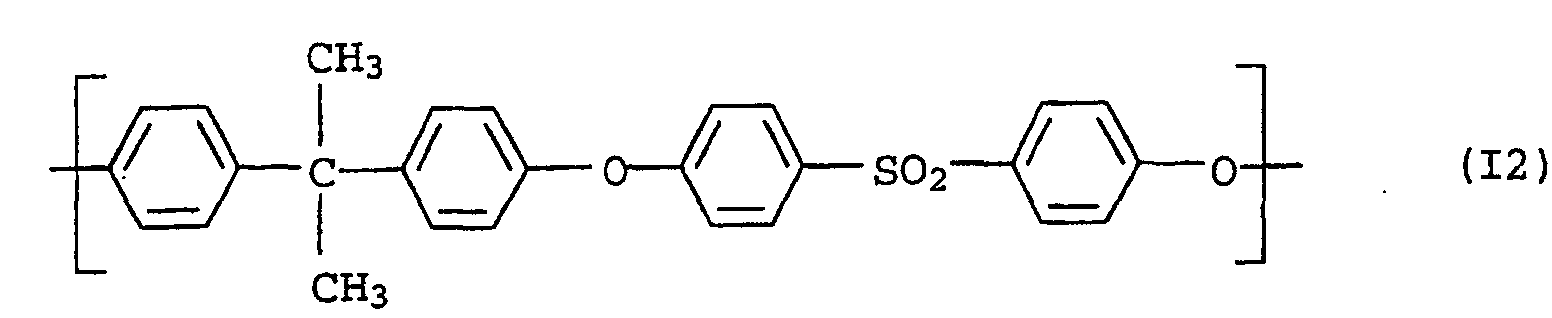
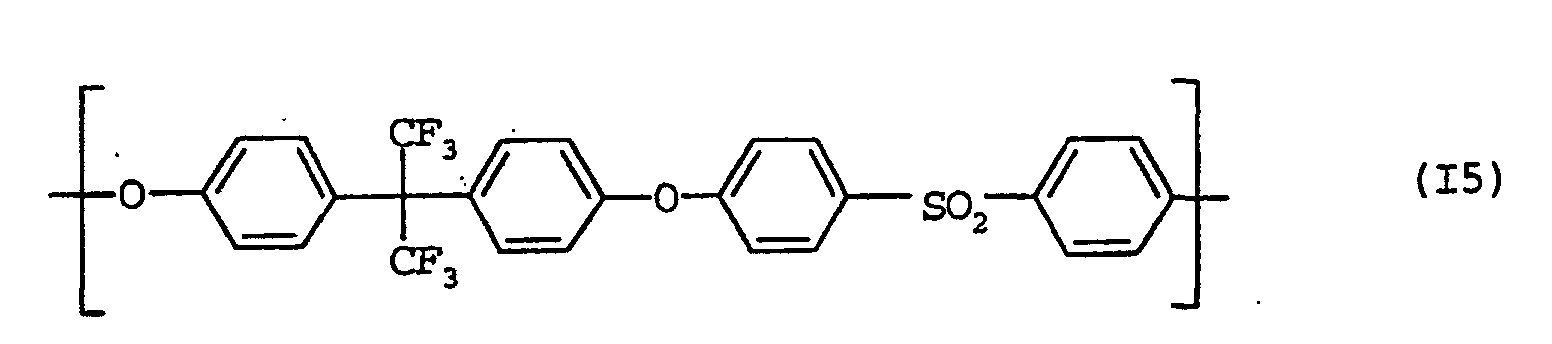
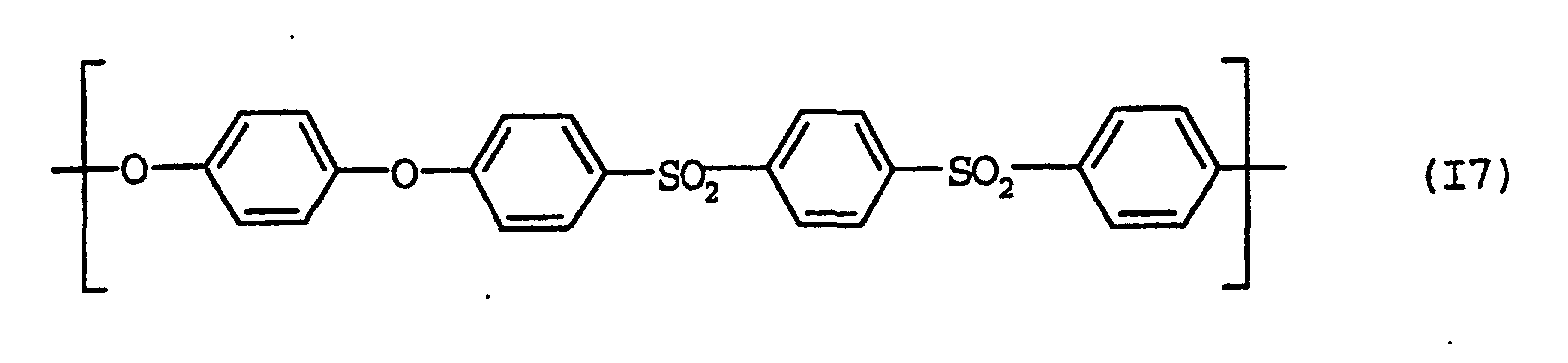
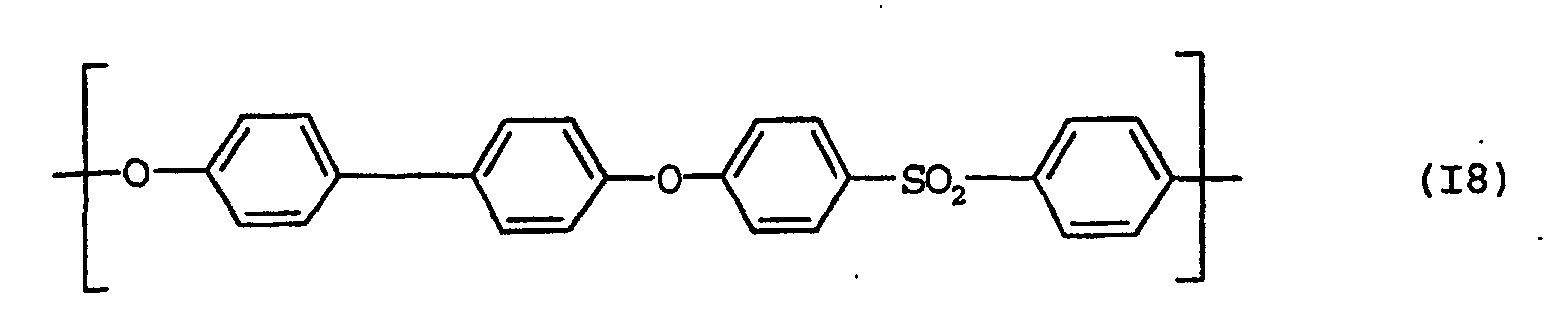
- suitable polyarylene ether sulfones A are those having at least one of the following recurring structural units I 1 to I 15 :
- Particularly preferred units of the formula I are units of the formulas I 1 and I 2 which may be present individually or in a mixture.
- the polyarylene ether sulfones may have different functional groups. These functional groups may be attached to atoms of the polymer chain or may be present as end groups of the polymer chain. These functional groups include halogen, in particular chlorine, alkoxy, especially methoxy or ethoxy, aryloxy, preferably phenoxy or benzyloxy groups. Other examples of such functional groups include hydroxy, amino, anhydride, epoxy or carboxyl groups. Of these, particular preference is given to polyarylene ether sulfones having amino, anhydride or epoxide end groups or mixtures thereof. The preparation of polyarylene ether sulfones A containing functional groups is described in DE-A1 199 61 040 and the literature mentioned therein.
- the polyarylene ether sulfones A can also be copolymers or block copolymers in which polyarylene ether sulfone segments and segments of others thermoplastic polymers, such as polyesters, aromatic Polycarbonates, polyestercarbonates, polysiloxanes, polyimides or polyetherimides.
- the molecular weights (number average) the block or the graft arms in the copolymers are in usually in the range of 1 000 to 30 000 g / mol.
- the blocks of different Structure can be arranged alternately or statistically be.
- the proportion by weight of the polyarylene ether sulfones in the co- or block copolymers is generally at least 10% by weight.
- the proportion by weight of the polyarylene ether sulfones can be up to to 97 wt .-% amount. Preference is given to copolymers or block copolymers with a weight fraction of polyarylene ether sulfones with up to 90% by weight. Particularly preferred are co- or block copolymers with 20 to 80 wt .-% polyarylene ether sulfones.
- the polyarylene ether sulfones average molecular weights M n (number average) in the range from 2500 to 60,000 g / mol and relative viscosities of from 0.15 to 0.95 dl / g.
- M n number average
- relative viscosities are measured either in 1% strength by weight N-methylpyrrolidone solution or in mixtures of phenol and dichlorobenzene at 20 ° C. and 25 ° C., respectively.
- the molding compositions of the invention contain the component B in Amounts from 1 to 20, especially from 1 to 18 wt .-%, especially preferably from 2 to 15 wt .-%, based on the total weight of A to E.
- component B of the molding compositions of the invention are branched Polyarylene ether sulfones used.
- polyarylene ether B are from the structural units already described in component A. built up, but component B additionally 0.1 to 10 wt .-%, preferably 0.5 to 7.5 wt .-%, more preferably 1.0 to 6.0% by weight, very particularly preferably 1.5 to 2.5% by weight, each based on the total weight of component B, from Containing 1,1,1-tris (4-hydroxyphenyl) ethane dissipating units.
- Preferred polyarylene ether sulfones B are included 0 to 100 mol% of recurring units of the formula I1, 0 to 100 mol% of recurring units of the formula I2, wherein the mole percent of recurring units of formulas I1 and I2 together give 100 mol%, and 0.1 to 10 wt.%, Preferably 0.5 to 7.5 wt.%, Particularly preferably 1.0 to 6.0 wt.%, Very particularly preferably 1.5 to 2.5 wt. %, based in each case on the total weight of the polyarylene ether sulfones B, 1,1,1-tris (4-hydroxyphenyl) ethane derived units.
- Polyarylene ether sulfones B are according to those already in the preparation produced by component A methods, wherein however, a corresponding portion of the difunctional monomer components, preferably the difunctional hydroxy component, by replaced the desired amount of 1,1,1-tris (4-hydroxyphenyl) ethane becomes. Synthesis methods for component B are also described in US 3,960,815 described.
- the molding compositions according to the invention can optionally contain 0 to 60% by weight. Reinforcing agents or fillers included. Preferably, 0 to 50, in particular 0 to 40 wt .-% fibrous or particulate Fillers or reinforcing materials or mixtures thereof in the contain molding compositions according to the invention.
- the quantities refer each on the total mass of components A to E.
- Preferred fibrous fillers or reinforcing materials are carbon fibers, Potassium titanate whiskers, aramid fibers and especially preferably glass fibers.
- glass fibers can this with for better compatibility with the matrix material a size, preferably a polyurethane size and a Adhesive be equipped.
- the used Carbon and glass fibers have a diameter in the range from 6 to 20 ⁇ m.
- the incorporation of the glass fibers can be both in the form of short glass fibers as well as in the form of endless strands (rovings).
- in the finished injection molded part lies the average length of the glass fibers preferably in the range of 0.08 to 0.5 mm.
- Carbon or glass fibers may also be in the form of woven fabrics, Mats or glass silk rovings are used.
- Suitable particulate fillers are amorphous silica, Carbonates such as magnesium carbonate (chalk), powdered quartz, Mica, various silicates such as clays, muscovite, biotite, Suzoite, cinnamon, talc, chlorite, phlogophite, feldspar, calcium silicates like wollastonite or aluminum silicates like kaolin, especially calcined kaolin.
- carbonates such as magnesium carbonate (chalk), powdered quartz, Mica
- various silicates such as clays, muscovite, biotite, Suzoite, cinnamon, talc, chlorite, phlogophite, feldspar, calcium silicates like wollastonite or aluminum silicates like kaolin, especially calcined kaolin.
- particulate Fillers of which at least 95% by weight, preferably at least 98% by weight of the particles have a diameter (largest dimension), determined on the finished product, of less than 45 microns, preferably less than 40 microns and their so-called Aspect ratio in the range of 1 to 25, preferably in Range from 2 to 20, determined on the finished product.
- the particle diameters may be e.g. be determined by that electron micrographs of thin sections of the Polymer mixture received and at least 25, preferably at least 50 filler particles are used for the evaluation. Similarly, the determination of particle diameter via sedimentation analysis carried out according to Transactions of ASAE, Page 491 (1983). The proportion by weight of fillers that less than 40 microns can also be measured by sieve analysis.
- the aspect ratio is the ratio of particle diameter to thickness (largest extent to smallest extent).
- Particularly preferred particulate fillers are talc, Kaolin, such as calcined kaolin or wollastonite or mixtures from two or all of these fillers. Including talcum with a proportion of at least 95 wt .-% of particles with a Diameter of less than 40 microns and an aspect ratio of 1.5 to 25, each determined on the finished product, especially prefers. Kaolin preferably has a content of at least 95 wt .-% of particles with a diameter of less than 20 microns and an aspect ratio of 1.2 to 20, each determined on the finished Product.
- the molding compositions according to the invention can be impact-modifying Contain D rubbers.
- Their share is from 0 to 40, in particular from 0 to 25 wt .-%, particularly preferably 0 to 20% by weight, based on the total weight of A to E.
- component D can also mixtures of two or more used different impact modifying rubbers become.
- Rubbers are generally polymers at room temperature To understand rubbery properties.
- Preferred rubbers which increase the toughness of the molding compositions usually have two main features: they contain an elastomeric moiety having a glass transition temperature of less than -10 ° C, preferably less than -30 ° C, and they contain at least one functional group with the polyarylene ether sulfone A or B can interact.
- suitable Examples of functional groups are carboxylic acid, carboxylic anhydride, Carboxylic acid ester, carboxylic acid amide, carboxylic acid imide, Amino, hydroxyl, epoxide, urethane or oxazoline groups.
- suitable ⁇ -olefins d 1 ethylene, propylene, 1-butylene, 1-pentylene, 1-hexylene, 1-heptylene, 1-octylene, 2-methylpropylene, 3-methyl-1-butylene and 3-ethyl 1-butylene, with ethylene and propylene being preferred.
- Suitable diene monomers d 2 are conjugated dienes having 4 to 8 C atoms, such as isoprene and butadiene, non-conjugated dienes having 5 to 25 C atoms, such as penta-1,4-diene, hexa-1,4 -diene, hexa-1,5-diene, 2,5-dimethylhexa-1,5-diene and octa-1,4-diene, cyclic dienes such as cyclopentadiene, cyclohexadienes, cyclooctadienes and dicyclopentadiene, as well as alkenylnorbornenes such as 5-ethylidene 2-norbornene, 5-butylidene-2-norbornene, 2-methallyl-5-norbornene, 2-isopropenyl-5-norbornene and tricyclodienes such as 3-methyltricyclo- (5.2.1.0.2.6) -3,8-de
- the diene content is generally 0 to 50, preferably 0.5 to 50, in particular 2 to 20 and particularly preferably 3 to 15 wt .-%, based on the total weight of the olefin polymer.
- esters d 3 are methyl, ethyl, propyl, n-butyl, i-butyl and 2-ethylhexyl, octyl and decyl acrylates or the corresponding esters of methacrylic acid. Of these, methyl, ethyl, propyl, n-butyl and 2-ethylhexyl acrylate or methacrylate are particularly preferred.
- esters d 3 instead of the esters d 3 or in addition to these, acid-functional and / or latent acid-functional monomers of ethylenically unsaturated monocarboxylic or dicarboxylic acids d 4 can also be present in the olefin polymers.
- Examples of monomers d 4 are acrylic acid, methacrylic acid, tertiary alkyl esters of these acids, in particular t-butyl acrylate and dicarboxylic acids, such as maleic acid and fumaric acid, or derivatives of these acids and their monoesters.
- Suitable latent acid-functional monomers are those compounds which form free acid groups under the polymerization conditions or during the incorporation of the olefin polymers into the molding compositions.
- Examples of these are anhydrides of dicarboxylic acids having 2 to 20 carbon atoms, in particular maleic anhydride and tertiary C 1 -C 12 alkyl esters of the abovementioned acids, in particular t-butyl acrylate and t-butyl methacrylate.
- Epoxy group-bearing monomers d 5 can be represented by the following general formulas IV and V wherein R 5 , R 6 , R 7 and R 8 are independently H or C 1 -C 6 alkyl, m is an integer of 0 to 20 and p is an integer of 0 to 10.
- R 1 to R 8 are hydrogen, m is 0 or 1 and p is 1.
- Preferred compounds d 4 and d 5 are maleic acid, fumaric acid and maleic anhydride or alkenyl glycidyl ether and vinyl glycidyl ether.
- Particularly preferred compounds of the formulas II and III or IV and V are maleic acid and maleic anhydride and epoxy group-containing, respectively Esters of acrylic acid and / or methacrylic acid, in particular Glycidyl acrylate and glycidyl methacrylate.
- olefin polymers 49.9 to 98.9 in particular 59.85 to 94.85% by weight of ethylene, and 1 to 50 in particular 5 to 40 wt .-% of an ester of acrylic or methacrylic acid 0.1 to 20.0, in particular from 0.15 to 15% by weight of glycidyl acrylate and / or glycidyl methacrylate, acrylic acid and / or maleic anhydride.
- Particularly suitable functionalized rubbers D are ethylene-methyl methacrylate-glycidyl methacrylate, Ethylene methyl acrylate glycidyl methacrylate, Ethylene-methyl acrylate-glycidyl acrylate and Ethylene-methyl methacrylate-glycidyl acrylate polymers.
- Examples of other monomers d 6 are vinyl esters or vinyl ethers or mixtures thereof.
- the preparation of the polymers described above can after methods known per se, preferably by statistical Copolymerization under high pressure and elevated temperature.
- the melt index of the copolymers is generally in the range from 1 to 80 g / 10 min (measured at 190 ° C and 2.16 kg load).
- Suitable rubbers are so-called Call core-shell graft rubbers. This is it graft rubbers made in emulsion and consisting of at least a hard and a soft component. Under a Hard component is usually understood as a polymer with a glass transition temperature of at least 25 ° C, under a soft component of a polymer having a glass transition temperature of not more than 0 ° C. These products have a structure a core (grafting base) and at least one shell (grafting pad) on, whereby the structure by the sequence of the Monomer addition results.
- the soft components are i.a. of butadiene, isoprene, alkyl acrylates, alkyl methacrylates or Siloxanes and optionally further comonomers.
- suitable Siloxane cores for example, starting from cyclic oligomers Octamethyltetrasiloxane or tetravinyltetramethyltetrasiloxane getting produced. These can, for example, with ⁇ -mercaptopropylmethyldimethoxysilane in a ring-opening cationic Polymerization, preferably in the presence of sulfonic acids, be converted to the soft siloxane cores.
- the siloxanes can also be crosslinked by e.g.
- comonomers e.g. Styrene, acrylonitrile and crosslinking or graft-active monomers having more than one polymerizable double bond such as diallyl phthalate, divinylbenzene, butanediol diacrylate or triallyl (iso) cyanurate.
- Preferred core-shell graft rubbers contain a soft Core and a hard shell or a hard core, a first soft shell and at least one more hard shell.
- the installation of functional groups such as carbonyl, carboxylic, acid anhydride, Acid amide, acid imide, carboxylic ester, amino, Hydroxyl, epoxy, oxazoline, urethane, urea, lactam or Halobenzyl groups, this is preferably carried out by the addition suitable functionalized monomers in the polymerization the last shell.
- Suitable functionalized monomers are For example, maleic acid, maleic anhydride, mono- or Diester or maleic acid, tertiary butyl (meth) acrylate, acrylic acid, Glycidyl (meth) acrylate and vinyloxazoline.
- the proportion of Monomers with functional groups is i.a. 0.1 to 25 wt .-%, preferably 0.25 to 15 wt .-%, based on the Total weight of the core-shell graft rubber.
- the weight ratio from soft to hard ingredients is i.a. 1: 9 to 9: 1, preferably 3: 7 to 8: 2.
- Such rubbers are known per se and, for example, in EP-A 208 187 described.
- polyester elastomers are understood here as segmented copolyetheresters, the long-chain Segments, which are usually of poly (alkylene) ether glycols and short-chain segments, which differ from low molecular weight Derive diols and dicarboxylic acids.
- segmented copolyetheresters the long-chain Segments, which are usually of poly (alkylene) ether glycols and short-chain segments, which differ from low molecular weight Derive diols and dicarboxylic acids.
- Hytrel® Du Pont
- Arnitel® Arnitel®
- Pelprene® Toyobo Co. Ltd.
- the molding compositions according to the invention can be used as component E additives such as processing aids, pigments, stabilizers, Contain flame retardants or mixtures of different additives.
- Usual additives are, for example, oxidation inhibitors, Means against heat decomposition and decomposition by ultraviolet light, lubricants and mold release agents, dyes and plasticizer.
- Their proportion is according to the invention from 0 to 40, preferably from 0 to 20 wt .-%, in particular 0 to 15 wt .-%, based on the total weight of components A to E.
- Component E is a stabilizer the proportion of these stabilizers usually up to 2% by weight, preferably up to 1% by weight, in particular up to 0.5% by weight, based on the total weight of A to E.
- Pigments and dyes are generally preferred in amounts up to 6 up to 5 and in particular up to 3 wt .-%, based on the Sum of A to E, included.
- the pigments for coloring thermoplastics are generally known, see, for example, R. Gumbleter and H. Müller, Taschenbuch der Kunststoffadditive, Carl Hanser Verlag, 1983, pp. 494 to 510.
- the first preferred group of pigments are white pigments, such as zinc oxide, zinc sulfide , Lead white (2 PbCO 3. Pb (OH) 2 ), lithopone, antimony white and titanium dioxide.
- white pigments such as zinc oxide, zinc sulfide , Lead white (2 PbCO 3. Pb (OH) 2 ), lithopone, antimony white and titanium dioxide.
- rutile and anatase-type of titanium dioxide, in particular the rutile form is used for the whitening of the molding compositions according to the invention.
- Black color pigments which can be used according to the invention are iron oxide black (Fe 3 O 4 ), spinel black (Cu (Cr, Fe) 2 O 4 ), manganese black (mixture of manganese dioxide, silicon dioxide and iron oxide), cobalt black and antimony black, and particularly preferably carbon black, which is usually used in the form of furnace or gas black (see G. Benzing, Pigments for paints, Expert-Verlag (1988), p. 78ff).
- inorganic colored pigments such as chrome oxide green or organic colored pigments such as azo pigments or phthalocyanines used in the invention become.
- Such pigments are generally commercially available common.
- Oxidation retarders and heat stabilizers containing the thermoplastic Compositions according to the invention can be added are e.g. Halides of metals of group I of the periodic table, e.g. Sodium, potassium, lithium halides, for example chlorides, Bromides or iodides. Furthermore, zinc fluoride and Zinc chloride can be used. Furthermore, they are sterically hindered Phenols, hydroquinones, substituted members of this group, secondary aromatic amines, optionally in combination with phosphorus-containing acids or their salts, and mixtures thereof Compounds, preferably in concentrations up to 1 wt.%, based on the weight of the mixture A to E, can be used.
- Halides of metals of group I of the periodic table e.g. Sodium, potassium, lithium halides, for example chlorides, Bromides or iodides.
- zinc fluoride and Zinc chloride can be used.
- they are sterically hindered Phenols, hydroquino
- a particularly preferred component E is the inventive Molding compositions Copper (I) chloride, copper (I) bromide or copper (I) iodide or mixtures thereof added. It is preferred Copper (I) iodide used.
- the amount used is generally up to 1.0, preferably up to 0.5 wt .-% based on the total weight of A to E.
- UV stabilizers are various substituted ones Resorcinols, salicylates, benzotriazoles and benzophenones, which are used in be used in general in amounts up to 2 wt.%.
- Lubricants and mold release agents usually in quantities up to to 1% by weight of the thermoplastic composition are added Stearic acid, stearyl alcohol, stearic acid alkyl esters and amides and esters of pentaerythritol with long-chain fatty acids. It may also be salts of calcium, zinc or aluminum Stearic acid and dialkyl ketones, e.g. Distearyl ketone used become.
- nucleating agents such as Talcum into consideration.
- the molding compositions according to the invention can be known per se Process, for example by extrusion, are produced.
- the molding compositions may e.g. be prepared by mixing the starting components in conventional mixing devices such as screw extruders, preferably twin-screw extruders, Brabender mills or Banbury mills and kneaders mixed and then extruded. Usually, the extrudate is cooled after the extrusion and crushed.
- the order of mixing the components can be varied thus two or possibly three components can be premixed, however, all components can also be mixed together.
- the molding compositions according to the invention are characterized by good mechanical properties Properties, such as high heat resistance or notched impact strength, good flowability in the Melt and good fire behavior especially by their improved Melt stability.
- the molding compositions according to the invention are suitable for the production of Moldings, films, fibers or foams, for example as Household items, electrical or electronic components or medical-technical devices are used. They are suitable in particular for the production of molded parts in the vehicle sector, especially in the automotive sector. Exemplary are suction pipes, Water boxes, housings, ventilation pipes, fastening parts, Cuffs or fan wheels to call.
- the viscosity number (VZ [ml / g]) of the polyarylene ether sulfones was determined in 1 wt .-% solution of N-methylpyrrolidone at 25 ° C.
- the glass transition temperature T g and the melting peak were determined by DSC measurements of samples in the second heating cycle at a heating rate of 20 K / min.
- the heat resistance of the samples was determined by means of the Vicat softening temperature (Vicat B [° C]). This was according to DIN 53 460 with a force of 49.05 N and a temperature increase of 50 K / h on standard small bars.
- the impact strength (a n [kJ / m 2 ]) was determined on ISO rods according to ISO 179 1eU.
- the notched impact strength (a k [kJ / m 2 ]) was determined on ISO rods according to ISO 179 1 eA.
- the flowability (MVI [ml / 10 ']) was according to DIN 53 735 at 320 ° C. and a load of 21.6 kg.
- the fire behavior of the samples was measured according to UL-94 on bars of the Thickness 0.8 mm determined.
- the polyarylene ether sulfone A1 used was one having recurring units of the formula I 1 , Ultrason® E 2010, a commercial product from BASF Aktiengesellschaft. This product is characterized by a viscosity number of 54 ml / g, measured in 1% NMP solution at 25 ° C.
- Component B1 was prepared by nucleophilic aromatic polycondensation made as follows:
- Component B2 was prepared by nucleophilic aromatic polycondensation analogous to component B1, but the reaction time of the monomers at 195 ° C was only 3 h.
- the viscosity number VZ of the product B2 was 46 ml / g, the glass transition temperature was 225 ° C.
- Component B3 was prepared by nucleophilic aromatic polycondensation analogous to component B1, but the reaction time of the monomers at 195 ° C was only 2.5 h.
- the viscosity number VZ of the product B3 was 39 ml / g, the glass transition temperature was 225 ° C.
- Component B4 (for comparison) was prepared by nucleophilic aromatic Polycondensation analogous to component B1, but were as starting materials 287.08 g of dichlorodiphenyl sulfone, 249.63 g Dihydroxydiphenylsulfone and 0.46 g of 1,1,1-tris (4-hydroxyphenyl) ethane used.
- the viscosity number VZ of the product B4 was 55 ml / g.
- Fiber diameter 10 microns were cut glass fibers with polyurethane size, Fiber diameter 10 microns, used.
- the components were in a twin-screw extruder at a melt temperature from 320 to 350 ° C mixed.
- the melt was through passed a water bath and granulated.
- the molding materials were processed at 340 ° C.
- the mold temperature was each 100 ° C.
- the molding compound 1 according to the invention and the molding compound V3 according to US 3,960,815 contained the same total amount of 1,1,1-tris (4-hydroxyphenyl) ethane.
- the molding compositions according to the invention are characterized by good mechanical properties Properties, such as high heat resistance or impact strength or notched impact strength, good flowability especially in the melt and good fire behavior by their improved melt stability.
Landscapes
- Chemical & Material Sciences (AREA)
- Health & Medical Sciences (AREA)
- Chemical Kinetics & Catalysis (AREA)
- Medicinal Chemistry (AREA)
- Polymers & Plastics (AREA)
- Organic Chemistry (AREA)
- Compositions Of Macromolecular Compounds (AREA)
- Sealing Material Composition (AREA)
Description

- t und q
- unabhängig voneinander für 0, 1, 2 oder 3 stehen,
- Q, T, und Z
- unabhängig voneinander jeweils eine chemische Bindung oder eine Gruppe, ausgewählt unter -O-, -S-, -SO2-, S=O, C=O, -N=N-, -RaC=CRb- und -CRcRd-, bedeuten, wobei
- Ra und Rb
- unabhängig voneinander jeweils für ein Wasserstoffatom oder eine C1-C12-Alkylgruppe stehen und
- Rc und Rd
- unabhängig voneinander jeweils für ein Wasserstoffatom
oder eine C1-C12-Alkyl-, C1-C12-Alkoxy- oder
C6-C18-Arylgruppe stehen, wobei Rc und Rd, wenn sie
für eine Alkyl-, Alkoxy- oder Arylgruppe stehen, unabhängig
voneinander mit Fluor- und/oder Chloratomen
substituiert sein können oder wobei Rc und Rd zusammen
mit dem C-Atom an das sie gebunden sind, eine
C3-C12-Cycloalkylgruppe bilden können, die mit einer
oder mehreren C1-C6-Alkylgruppen substituiert sein
kann,
mit der Maßgabe, daß mindestens eine der Gruppen T, Q und Z für -SO2- steht und, wenn t und q für 0 stehen, Z für -SO2- steht, - Ar und Ar1
- unabhängig voneinander jeweils für eine C6-C18-Arylengruppe steht, wobei diese mit C1-C12-Alkyl-, C6-C18-Aryl-, C1-C12-Alkoxygruppen oder Halogenatomen substituiert sein kann.






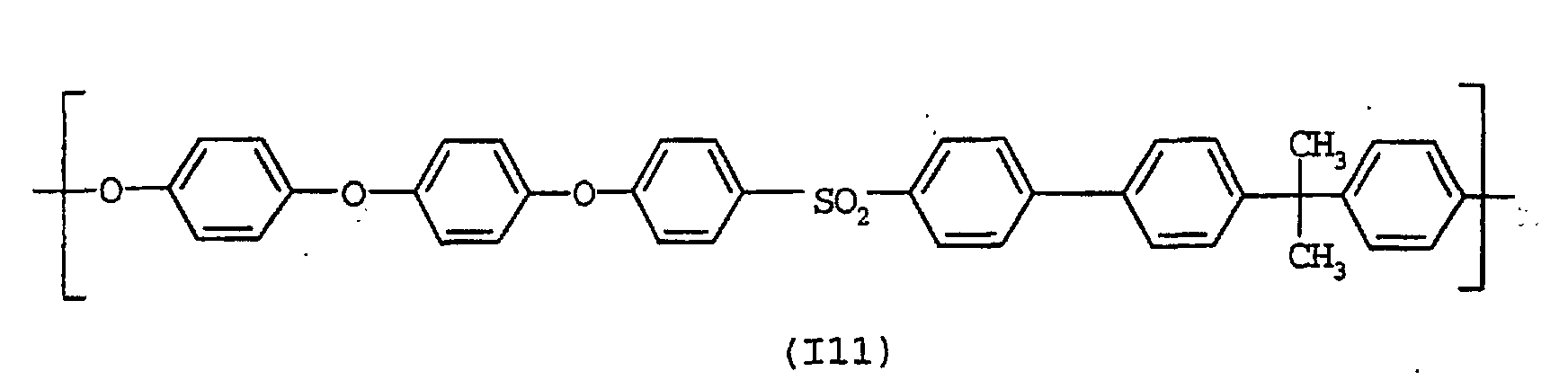
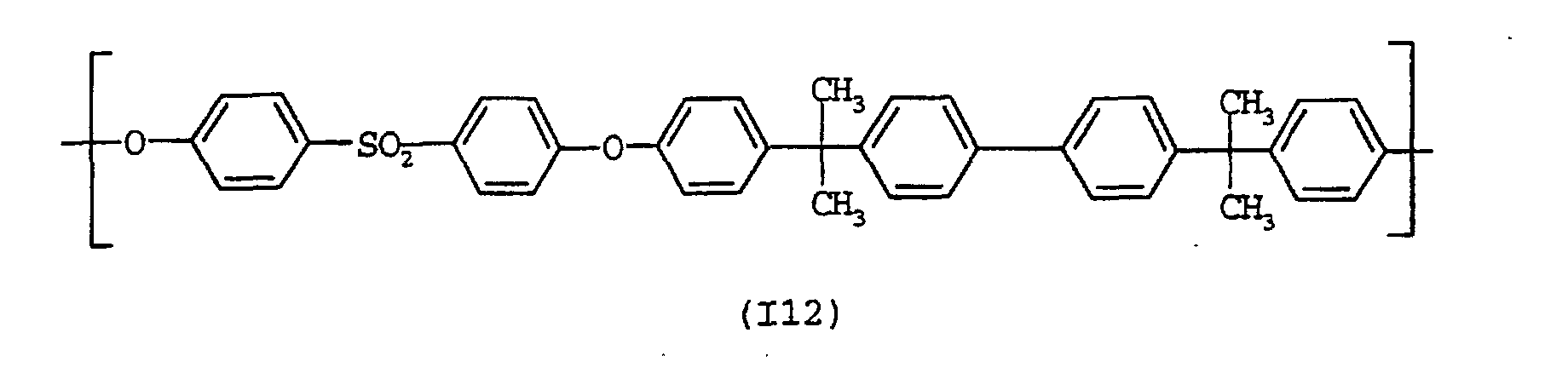
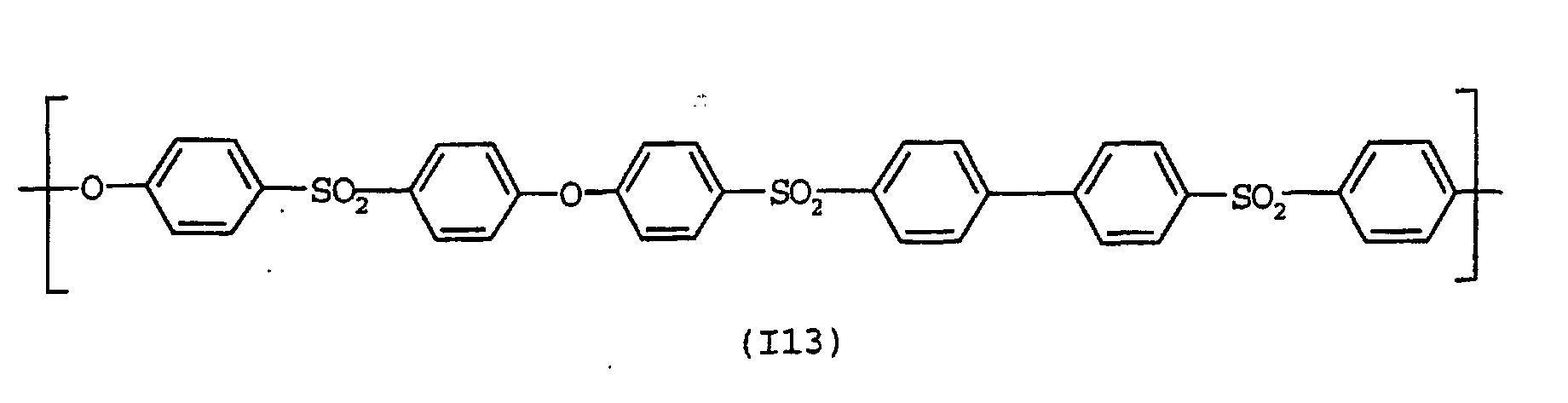
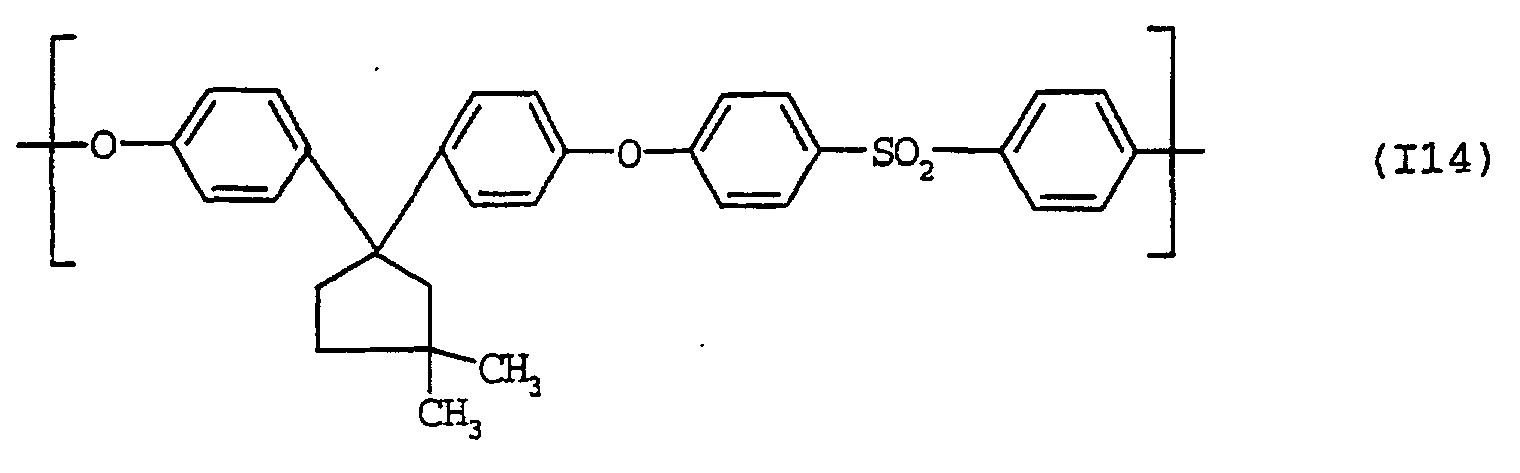

Zu diesen funktionalen Gruppen zählen Halogen-, insbesondere Chlor-, Alkoxy-, vor allem Methoxy- oder Ethoxy-, Aryloxy-, bevorzugt Phenoxy oder Benzyloxygruppen. Als weitere Beispiele für solche funktionale Gruppen sind Hydroxy-, Amino-, Anhydrid-, Epoxy- oder Carboxylgruppen zu nennen. Darunter sind Polyarylenethersulfone mit Amino-, Anhydrid oder Epoayendgruppen oder deren Mischungen besonders bevorzugt.
Die Herstellung von Polyarylenethersulfonen A enthaltend funktionale Gruppen ist in DE-A1 199 61 040 sowie der darin genannten Literatur beschrieben.
0 bis 100 Mol-% wiederkehrende Einheiten der Formel I1,
0 bis 100 Mol-% wiederkehrende Einheiten der Formel I2,
wobei die Stoffmengenprozente wiederkehrender Einheiten der Formeln I1 und I2 zusammen 100 Mol-% ergeben, und
0,1 bis 10 Gew.-%, bevorzugt 0,5 bis 7,5 Gew.-%, besonders bevorzugt 1,0 bis 6,0 Gew.-%, ganz besonders bevorzugt 1,5 bis 2,5 Gew.-%, jeweils bezogen auf das Gesamtgewicht der Polyarylenethersulfone B, sich von 1,1,1-Tris(4-hydroxyphenyl)ethan ableitende Einheiten.


| 49,9 bis 98,9, | insbesondere 59,85 bis 94,85 Gew.-% Ethylen, und |
| 1 bis 50 | insbesondere 5 bis 40 Gew.-% eines Esters der Acryl- oder Methacrylsäure |
| 0,1 bis 20,0, | insbesondere 0,15 bis 15 Gew.-% Glycidylacrylat und/oder Glycidylmethacrylat, Acrylsäure und/ oder Maleinsäureanhydrid. |
Die Viskositätszahl VZ des Produkts B2 lag bei 46 ml/g, die Glastemperatur betrug 225°C.
Die Viskositätszahl VZ des Produkts B3 lag bei 39 ml/g, die Glastemperatur betrug 225°C.

Claims (7)
- Formmassen, enthaltendwobei die Gewichtsprozente der Komponenten A bis E zusammen 100 % ergeben.A) 39 bis 99 Gew.-% mindestens eines aus difunktionellen Monomereinheiten aufgebauten Polyarylenethersulfons,B) 1 bis 20 Gew.-% mindestens eines Polyarylenethersulfons, enthaltend 0,1 bis 10 Gew.-%, bezogen auf das Gesamtgewicht der Komponente B, sich von 1,1,1-Tris(4-hydroxyphenyl)ethan ableitende Einheiten,C) 0 bis 60 Gew.-% mindestens eines Füllstoffs,D) 0 bis 40 Gew.-% mindestens eines schlagzähmodifizierenden Kautschuks undE) 0 bis 40 Gew.-% eines oder mehrerer unterschiedlicher Zusatzstoffe,
- Formmassen nach Anspruch 1, worin die Polyarylenethersulfone A
0 bis 100 Mol-% wiederkehrende Einheitenund
0 bis 100 Mol-% wiederkehrende Einheitenenthalten.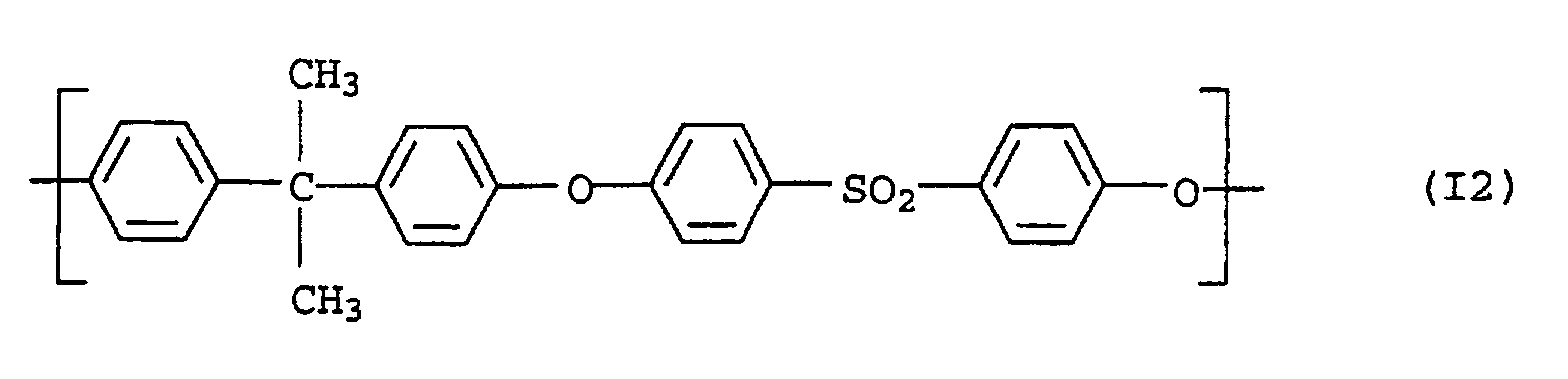
- Formmassen nach Ansprüchen 1 oder 2, worin die Polyarylenethersulfone B
0 bis 100 Mol-% wiederkehrende Einheiten der Formel I1,
0 bis 100 Mol-% wiederkehrende Einheiten der Formel I2,
wobei die Stoffmengenprozente wiederkehrender Einheiten der Formeln I1 und I2 zusammen 100 Mol-% ergeben, und
0,1 bis 10 Gew.-%, bezogen auf das Gesamtgewicht der Polyarylenethersulfone B, sich von 1,1,1-Tris(4-hydroxyphenyl)ethan ableitende Einheiten enthalten. - Verfahren zur Herstellung von Formmassen gemäß den Ansprüchen 1 bis 3, dadurch gekennzeichnet, daß die Komponenten A bis E gemischt werden.
- Verwendung der Formmassen gemäß den Ansprüchen 1 bis 3 zur Herstellung von Formteilen, Folien, Fasern oder Schäumen.
- Formteile, Folien, Fasern oder Schäume, erhältlich aus den Formmassen gemäß den Ansprüchen 1 bis 3.
- Formteile, Folien, Fasern oder Schäume gemäß Anspruch 6, die Bestandteile von Haushaltsartikeln, elektronischen Bauteilen, medizinisch-technischen Geräten oder Kraftfahrzeugbauteilen sind.
Applications Claiming Priority (3)
| Application Number | Priority Date | Filing Date | Title |
|---|---|---|---|
| DE10149871 | 2001-10-10 | ||
| DE10149871A DE10149871A1 (de) | 2001-10-10 | 2001-10-10 | Thermoplastische Formmassen mit verbesserter Schmelzstabilität auf Basis von Polyarylenethersulfonen |
| PCT/EP2002/010868 WO2003033565A1 (de) | 2001-10-10 | 2002-09-27 | Thermoplastische formmassen mit verbesserter schmelzestabilität auf basis von polyarylenethersulfonen |
Publications (2)
| Publication Number | Publication Date |
|---|---|
| EP1436344A1 EP1436344A1 (de) | 2004-07-14 |
| EP1436344B1 true EP1436344B1 (de) | 2005-01-19 |
Family
ID=7701977
Family Applications (1)
| Application Number | Title | Priority Date | Filing Date |
|---|---|---|---|
| EP02779431A Expired - Lifetime EP1436344B1 (de) | 2001-10-10 | 2002-09-27 | Thermoplastische formmassen mit verbesserter schmelzestabilität auf basis von polyarylenethersulfonen |
Country Status (7)
| Country | Link |
|---|---|
| US (1) | US7163987B2 (de) |
| EP (1) | EP1436344B1 (de) |
| JP (1) | JP4044903B2 (de) |
| AT (1) | ATE287424T1 (de) |
| DE (2) | DE10149871A1 (de) |
| ES (1) | ES2235098T3 (de) |
| WO (1) | WO2003033565A1 (de) |
Families Citing this family (23)
| Publication number | Priority date | Publication date | Assignee | Title |
|---|---|---|---|---|
| US7396895B2 (en) * | 2003-11-25 | 2008-07-08 | Xerox Corporation | Branched polyarylene ethers and processes for the preparation thereof |
| US7067608B2 (en) * | 2003-11-25 | 2006-06-27 | Xerox Corporation | Process for preparing branched polyarylene ethers |
| DE102005001599A1 (de) * | 2005-01-12 | 2006-07-20 | Basf Ag | Funktionalisierte Polyarylether |
| EP2033324B1 (de) | 2006-05-24 | 2016-04-13 | Ben Gurion University of the Negev Research and Development Authority | Membranen und herstellungsverfahren dafür |
| ATE550381T1 (de) * | 2007-06-22 | 2012-04-15 | Basf Se | Formmassen enthaltend polyarylether mit verbesserter oberflächenqualität |
| IN2010CN02651A (de) * | 2007-11-13 | 2010-10-29 | Basf Se | |
| JP2009249770A (ja) * | 2008-04-07 | 2009-10-29 | Toyobo Co Ltd | 極細繊維およびその製造方法 |
| US8492464B2 (en) * | 2008-05-23 | 2013-07-23 | Sabic Innovative Plastics Ip B.V. | Flame retardant laser direct structuring materials |
| US10119021B2 (en) | 2008-05-23 | 2018-11-06 | Sabic Global Technologies B.V. | Flame retardant laser direct structuring materials |
| EP2340273A1 (de) * | 2008-10-23 | 2011-07-06 | Basf Se | Verzweigte polyarylenether und diese enthaltende thermoplastische formmassen |
| US8710109B2 (en) | 2009-02-19 | 2014-04-29 | Ben Gurion University Of The Negev Research And Development Authority | Chemically resistant membranes, coatings and films and methods for their preparation |
| US8703862B2 (en) | 2010-05-26 | 2014-04-22 | Basf Se | Reinforced thermoplastic molding compositions based on polyarylene ethers |
| EP2390281A1 (de) * | 2010-05-26 | 2011-11-30 | Basf Se | Verstärkte thermoplastische Formmassen auf Basis von Polyarylenethern |
| US9457318B2 (en) | 2010-12-12 | 2016-10-04 | Ben-Gurion University Of The Negev Research And Development Authority | Anion exchange membranes, methods of preparation and uses |
| US9650485B2 (en) * | 2012-10-12 | 2017-05-16 | Solvay Specialty Polymers Usa, Llc. | High temperature sulfone (HTS) foam materials |
| US11136447B2 (en) * | 2016-11-15 | 2021-10-05 | Toray Industries, Inc. | Polyamide resin composition and molded article containing same |
| KR102854121B1 (ko) | 2018-09-11 | 2025-09-02 | 바스프 에스이 | 폴리아릴렌 에테르 술폰 |
| CN112673049A (zh) | 2018-09-11 | 2021-04-16 | 巴斯夫欧洲公司 | 聚亚芳基醚共聚物 |
| JP7538116B2 (ja) * | 2018-09-11 | 2024-08-21 | ビーエーエスエフ ソシエタス・ヨーロピア | ポリアリーレンエーテル |
| GB201918274D0 (en) | 2019-12-12 | 2020-01-29 | Datalase Ltd | A composition |
| WO2021219781A1 (en) | 2020-04-30 | 2021-11-04 | Datalase Ltd. | A composition |
| CN116648358A (zh) | 2020-11-10 | 2023-08-25 | 德塔莱斯有限公司 | 组合物 |
| US20240294756A1 (en) * | 2021-07-16 | 2024-09-05 | Basf Se | Thermoplastic molding composition with high temperature resistance comprising a thermotropic polymer |
Family Cites Families (6)
| Publication number | Priority date | Publication date | Assignee | Title |
|---|---|---|---|---|
| DE1595710A1 (de) * | 1966-12-21 | 1970-04-09 | Bayer Ag | Verfahren zur Herstellung von Polyarylenaethersulfonen |
| DE2305413C2 (de) * | 1973-02-03 | 1982-05-13 | Bayer Ag, 5090 Leverkusen | Verzweigte aromatische Polyaryläthersulfone |
| US4152367A (en) * | 1977-08-04 | 1979-05-01 | Bayer Aktiengesellschaft | Branched polyaryl-sulphone/polycarbonate mixtures and their use for the production of extruded films |
| DE3444339A1 (de) | 1984-12-05 | 1986-06-05 | Basf Ag, 6700 Ludwigshafen | Thermoplastische formmassen |
| US4746710A (en) * | 1985-09-06 | 1988-05-24 | Amoco Corporation | Shaped article formed from a blend of a poly(aryl ether) and a polycarbonate and/or a polyarylate |
| US5270435A (en) * | 1989-06-23 | 1993-12-14 | Ciba-Geigy Corporation | Polyarylene ethers |
-
2001
- 2001-10-10 DE DE10149871A patent/DE10149871A1/de not_active Withdrawn
-
2002
- 2002-09-27 JP JP2003536301A patent/JP4044903B2/ja not_active Expired - Fee Related
- 2002-09-27 US US10/491,481 patent/US7163987B2/en not_active Expired - Fee Related
- 2002-09-27 DE DE50202083T patent/DE50202083D1/de not_active Expired - Lifetime
- 2002-09-27 WO PCT/EP2002/010868 patent/WO2003033565A1/de not_active Ceased
- 2002-09-27 AT AT02779431T patent/ATE287424T1/de not_active IP Right Cessation
- 2002-09-27 EP EP02779431A patent/EP1436344B1/de not_active Expired - Lifetime
- 2002-09-27 ES ES02779431T patent/ES2235098T3/es not_active Expired - Lifetime
Also Published As
| Publication number | Publication date |
|---|---|
| ATE287424T1 (de) | 2005-02-15 |
| US20040242807A1 (en) | 2004-12-02 |
| DE50202083D1 (de) | 2005-02-24 |
| JP4044903B2 (ja) | 2008-02-06 |
| EP1436344A1 (de) | 2004-07-14 |
| WO2003033565A1 (de) | 2003-04-24 |
| ES2235098T3 (es) | 2005-07-01 |
| DE10149871A1 (de) | 2003-04-17 |
| US7163987B2 (en) | 2007-01-16 |
| JP2005505666A (ja) | 2005-02-24 |
Similar Documents
| Publication | Publication Date | Title |
|---|---|---|
| DE10149871A1 (de) | Thermoplastische Formmassen mit verbesserter Schmelzstabilität auf Basis von Polyarylenethersulfonen | |
| EP1276816B1 (de) | Polyarylethersulfon/polyamid-blends mit verbesserter zähigkeit und fliessfähigkeit | |
| EP2340273A1 (de) | Verzweigte polyarylenether und diese enthaltende thermoplastische formmassen | |
| EP1242538B1 (de) | Thermoplastische formmassen mit verbessertem verarbeitungsverhalten auf basis von polyarylenethersulfonen und polyamiden | |
| EP2513191B1 (de) | Verbesserte blends aus polyarylenethern und polyarylensulfiden | |
| EP0673973A1 (de) | Mischungen auf der Basis von Polyarylenethern und Polyarylensulfiden | |
| EP0791606A2 (de) | Verfahren zur Herstellung vom Ozazingruppen enthaltenden Polymeren | |
| DE3641497A1 (de) | Thermoplastische formmassen auf der basis von polyamiden und polyaryletherketonen | |
| EP0613916A1 (de) | Formmasse auf der Grundlage von Polyarylenethern mit Anhydridendgruppen | |
| DE19702588A1 (de) | Thermoplastische Formmassen mit reduzierter Wasseraufnahme | |
| EP1105437B1 (de) | Formmassen auf der basis von polyarylenethersulfonen und aliphatischen polyamiden | |
| EP0903376A2 (de) | Polyarylenether und Polyarylensulfide enthaltende Formmassen mit verbesserter Kerbschlagzähigkeit | |
| EP0630942B1 (de) | Formmassen auf der Grundlage von Polyarylenethern | |
| EP0855429A1 (de) | Thermoplastische Formmassen mit verbesserter Chemikalienresistenz | |
| DE3831243A1 (de) | Schlagzaehe polyester- und polyamidformmassen | |
| DE4407485A1 (de) | Formmasse auf der Grundlage von Polyarylenethern | |
| DE10149870A1 (de) | Thermoplastische Formmassen auf Basis von Polyarylenethersulfonen und Polyamiden | |
| WO2001064792A1 (de) | Formmassen auf der basis von polyarylenethersulfonen und polyamiden mit piperidinendgruppen | |
| EP0561197B1 (de) | Thermoplastische Formmassen auf der Basis von Polyarylethern, Polycarbonaten und Pfropfkautschuken | |
| EP0590392A2 (de) | Formmassen auf der Basis von Polyarylethern und schlagzähmodifizierten teilaromatischen Copolyamiden | |
| DE4433072A1 (de) | Thermoplastische Formmassen auf der Basis von Polyarylenethern und aromatischen Polycarbonat-Recyclaten | |
| EP0905193A2 (de) | Polyarylenether, Styrolcopolymerisate und funktionalisierte Polymere enthaltende Formmassen | |
| DE19731762A1 (de) | Thermoplastische Formmassen mit verbesserter Chemikalienresistenz | |
| DE19736973A1 (de) | Formmassen auf der Basis von Polyarylenethern und Polyamiden | |
| EP0857745A2 (de) | Verfahren zur Herstellung von Blockcopolymeren |
Legal Events
| Date | Code | Title | Description |
|---|---|---|---|
| PUAI | Public reference made under article 153(3) epc to a published international application that has entered the european phase |
Free format text: ORIGINAL CODE: 0009012 |
|
| GRAP | Despatch of communication of intention to grant a patent |
Free format text: ORIGINAL CODE: EPIDOSNIGR1 |
|
| 17P | Request for examination filed |
Effective date: 20040510 |
|
| AK | Designated contracting states |
Kind code of ref document: A1 Designated state(s): AT BE BG CH CY CZ DE DK EE ES FI FR GB GR IE IT LI LU MC NL PT SE SK TR |
|
| AX | Request for extension of the european patent |
Extension state: AL LT LV MK RO SI |
|
| RIN1 | Information on inventor provided before grant (corrected) |
Inventor name: QUEISSER, JOACHIM Inventor name: WEBER, MARTIN |
|
| GRAS | Grant fee paid |
Free format text: ORIGINAL CODE: EPIDOSNIGR3 |
|
| GRAA | (expected) grant |
Free format text: ORIGINAL CODE: 0009210 |
|
| AK | Designated contracting states |
Kind code of ref document: B1 Designated state(s): AT BE BG CH CY CZ DE DK EE ES FI FR GB GR IE IT LI LU MC NL PT SE SK TR |
|
| AX | Request for extension of the european patent |
Extension state: AL LT LV MK RO SI |
|
| PG25 | Lapsed in a contracting state [announced via postgrant information from national office to epo] |
Ref country code: IE Free format text: LAPSE BECAUSE OF FAILURE TO SUBMIT A TRANSLATION OF THE DESCRIPTION OR TO PAY THE FEE WITHIN THE PRESCRIBED TIME-LIMIT Effective date: 20050119 Ref country code: BG Free format text: LAPSE BECAUSE OF FAILURE TO SUBMIT A TRANSLATION OF THE DESCRIPTION OR TO PAY THE FEE WITHIN THE PRESCRIBED TIME-LIMIT Effective date: 20050119 Ref country code: TR Free format text: LAPSE BECAUSE OF FAILURE TO SUBMIT A TRANSLATION OF THE DESCRIPTION OR TO PAY THE FEE WITHIN THE PRESCRIBED TIME-LIMIT Effective date: 20050119 Ref country code: SK Free format text: LAPSE BECAUSE OF FAILURE TO SUBMIT A TRANSLATION OF THE DESCRIPTION OR TO PAY THE FEE WITHIN THE PRESCRIBED TIME-LIMIT Effective date: 20050119 Ref country code: FI Free format text: LAPSE BECAUSE OF FAILURE TO SUBMIT A TRANSLATION OF THE DESCRIPTION OR TO PAY THE FEE WITHIN THE PRESCRIBED TIME-LIMIT Effective date: 20050119 Ref country code: EE Free format text: LAPSE BECAUSE OF FAILURE TO SUBMIT A TRANSLATION OF THE DESCRIPTION OR TO PAY THE FEE WITHIN THE PRESCRIBED TIME-LIMIT Effective date: 20050119 Ref country code: CZ Free format text: LAPSE BECAUSE OF FAILURE TO SUBMIT A TRANSLATION OF THE DESCRIPTION OR TO PAY THE FEE WITHIN THE PRESCRIBED TIME-LIMIT Effective date: 20050119 |
|
| REG | Reference to a national code |
Ref country code: GB Ref legal event code: FG4D Free format text: NOT ENGLISH |
|
| REG | Reference to a national code |
Ref country code: CH Ref legal event code: EP |
|
| REG | Reference to a national code |
Ref country code: IE Ref legal event code: FG4D Free format text: GERMAN |
|
| REF | Corresponds to: |
Ref document number: 50202083 Country of ref document: DE Date of ref document: 20050224 Kind code of ref document: P |
|
| GBT | Gb: translation of ep patent filed (gb section 77(6)(a)/1977) |
Effective date: 20050324 |
|
| PG25 | Lapsed in a contracting state [announced via postgrant information from national office to epo] |
Ref country code: DK Free format text: LAPSE BECAUSE OF FAILURE TO SUBMIT A TRANSLATION OF THE DESCRIPTION OR TO PAY THE FEE WITHIN THE PRESCRIBED TIME-LIMIT Effective date: 20050419 Ref country code: GR Free format text: LAPSE BECAUSE OF FAILURE TO SUBMIT A TRANSLATION OF THE DESCRIPTION OR TO PAY THE FEE WITHIN THE PRESCRIBED TIME-LIMIT Effective date: 20050419 Ref country code: SE Free format text: LAPSE BECAUSE OF FAILURE TO SUBMIT A TRANSLATION OF THE DESCRIPTION OR TO PAY THE FEE WITHIN THE PRESCRIBED TIME-LIMIT Effective date: 20050419 |
|
| REG | Reference to a national code |
Ref country code: ES Ref legal event code: FG2A Ref document number: 2235098 Country of ref document: ES Kind code of ref document: T3 |
|
| REG | Reference to a national code |
Ref country code: IE Ref legal event code: FD4D |
|
| PG25 | Lapsed in a contracting state [announced via postgrant information from national office to epo] |
Ref country code: CY Free format text: LAPSE BECAUSE OF FAILURE TO SUBMIT A TRANSLATION OF THE DESCRIPTION OR TO PAY THE FEE WITHIN THE PRESCRIBED TIME-LIMIT Effective date: 20050927 Ref country code: AT Free format text: LAPSE BECAUSE OF NON-PAYMENT OF DUE FEES Effective date: 20050927 |
|
| PG25 | Lapsed in a contracting state [announced via postgrant information from national office to epo] |
Ref country code: LU Free format text: LAPSE BECAUSE OF NON-PAYMENT OF DUE FEES Effective date: 20050930 Ref country code: MC Free format text: LAPSE BECAUSE OF NON-PAYMENT OF DUE FEES Effective date: 20050930 |
|
| PLBE | No opposition filed within time limit |
Free format text: ORIGINAL CODE: 0009261 |
|
| STAA | Information on the status of an ep patent application or granted ep patent |
Free format text: STATUS: NO OPPOSITION FILED WITHIN TIME LIMIT |
|
| ET | Fr: translation filed | ||
| 26N | No opposition filed |
Effective date: 20051020 |
|
| PG25 | Lapsed in a contracting state [announced via postgrant information from national office to epo] |
Ref country code: CH Free format text: LAPSE BECAUSE OF NON-PAYMENT OF DUE FEES Effective date: 20060930 Ref country code: LI Free format text: LAPSE BECAUSE OF NON-PAYMENT OF DUE FEES Effective date: 20060930 |
|
| REG | Reference to a national code |
Ref country code: CH Ref legal event code: PL |
|
| PG25 | Lapsed in a contracting state [announced via postgrant information from national office to epo] |
Ref country code: PT Free format text: LAPSE BECAUSE OF NON-PAYMENT OF DUE FEES Effective date: 20050619 |
|
| PGFP | Annual fee paid to national office [announced via postgrant information from national office to epo] |
Ref country code: GB Payment date: 20130930 Year of fee payment: 12 |
|
| PGFP | Annual fee paid to national office [announced via postgrant information from national office to epo] |
Ref country code: IT Payment date: 20130923 Year of fee payment: 12 |
|
| PGFP | Annual fee paid to national office [announced via postgrant information from national office to epo] |
Ref country code: DE Payment date: 20131129 Year of fee payment: 12 Ref country code: FR Payment date: 20130930 Year of fee payment: 12 Ref country code: BE Payment date: 20131030 Year of fee payment: 12 |
|
| PGFP | Annual fee paid to national office [announced via postgrant information from national office to epo] |
Ref country code: ES Payment date: 20131025 Year of fee payment: 12 Ref country code: NL Payment date: 20131003 Year of fee payment: 12 |
|
| REG | Reference to a national code |
Ref country code: DE Ref legal event code: R119 Ref document number: 50202083 Country of ref document: DE |
|
| GBPC | Gb: european patent ceased through non-payment of renewal fee |
Effective date: 20140927 |
|
| REG | Reference to a national code |
Ref country code: FR Ref legal event code: ST Effective date: 20150529 |
|
| PG25 | Lapsed in a contracting state [announced via postgrant information from national office to epo] |
Ref country code: BE Free format text: LAPSE BECAUSE OF NON-PAYMENT OF DUE FEES Effective date: 20140930 Ref country code: NL Free format text: LAPSE BECAUSE OF NON-PAYMENT OF DUE FEES Effective date: 20150401 |
|
| PG25 | Lapsed in a contracting state [announced via postgrant information from national office to epo] |
Ref country code: GB Free format text: LAPSE BECAUSE OF NON-PAYMENT OF DUE FEES Effective date: 20140927 Ref country code: DE Free format text: LAPSE BECAUSE OF NON-PAYMENT OF DUE FEES Effective date: 20150401 |
|
| PG25 | Lapsed in a contracting state [announced via postgrant information from national office to epo] |
Ref country code: FR Free format text: LAPSE BECAUSE OF NON-PAYMENT OF DUE FEES Effective date: 20140930 Ref country code: IT Free format text: LAPSE BECAUSE OF NON-PAYMENT OF DUE FEES Effective date: 20140927 |
|
| REG | Reference to a national code |
Ref country code: ES Ref legal event code: FD2A Effective date: 20151027 |
|
| PG25 | Lapsed in a contracting state [announced via postgrant information from national office to epo] |
Ref country code: ES Free format text: LAPSE BECAUSE OF NON-PAYMENT OF DUE FEES Effective date: 20140928 |