EP1436412B1 - Verfahren zur modellierung den bioabbau der kohlenwasserstoffen in eines ölfeld - Google Patents
Verfahren zur modellierung den bioabbau der kohlenwasserstoffen in eines ölfeld Download PDFInfo
- Publication number
- EP1436412B1 EP1436412B1 EP02783229A EP02783229A EP1436412B1 EP 1436412 B1 EP1436412 B1 EP 1436412B1 EP 02783229 A EP02783229 A EP 02783229A EP 02783229 A EP02783229 A EP 02783229A EP 1436412 B1 EP1436412 B1 EP 1436412B1
- Authority
- EP
- European Patent Office
- Prior art keywords
- reservoir
- biodegradation
- oil
- hydrocarbons
- trap
- Prior art date
- Legal status (The legal status is an assumption and is not a legal conclusion. Google has not performed a legal analysis and makes no representation as to the accuracy of the status listed.)
- Expired - Lifetime
Links
- 150000002430 hydrocarbons Chemical class 0.000 title claims description 41
- 229930195733 hydrocarbon Natural products 0.000 title claims description 40
- 238000000034 method Methods 0.000 title claims description 22
- 230000015556 catabolic process Effects 0.000 title claims description 10
- 238000006731 degradation reaction Methods 0.000 title claims description 9
- 239000004215 Carbon black (E152) Substances 0.000 title description 18
- 238000006065 biodegradation reaction Methods 0.000 claims description 47
- 230000007704 transition Effects 0.000 claims description 39
- 239000000370 acceptor Substances 0.000 claims description 34
- 230000001580 bacterial effect Effects 0.000 claims description 34
- XLYOFNOQVPJJNP-UHFFFAOYSA-N water Substances O XLYOFNOQVPJJNP-UHFFFAOYSA-N 0.000 claims description 28
- 239000000203 mixture Substances 0.000 claims description 27
- 238000011049 filling Methods 0.000 claims description 16
- 239000003208 petroleum Substances 0.000 claims description 7
- 230000009471 action Effects 0.000 claims description 4
- 238000011161 development Methods 0.000 claims description 3
- 230000000694 effects Effects 0.000 claims description 2
- 230000000750 progressive effect Effects 0.000 claims description 2
- 238000013139 quantization Methods 0.000 claims 1
- 239000003921 oil Substances 0.000 description 66
- 241000894006 Bacteria Species 0.000 description 44
- 239000011148 porous material Substances 0.000 description 15
- 238000004364 calculation method Methods 0.000 description 14
- 230000004907 flux Effects 0.000 description 14
- 230000029058 respiratory gaseous exchange Effects 0.000 description 12
- 238000004088 simulation Methods 0.000 description 12
- 150000001875 compounds Chemical class 0.000 description 11
- 230000015572 biosynthetic process Effects 0.000 description 9
- 238000009792 diffusion process Methods 0.000 description 9
- 238000006243 chemical reaction Methods 0.000 description 7
- 230000008569 process Effects 0.000 description 6
- 229940082150 encore Drugs 0.000 description 5
- 239000012530 fluid Substances 0.000 description 5
- 230000007246 mechanism Effects 0.000 description 5
- 239000003153 chemical reaction reagent Substances 0.000 description 4
- 230000006378 damage Effects 0.000 description 4
- 239000005416 organic matter Substances 0.000 description 4
- 229910052760 oxygen Inorganic materials 0.000 description 4
- 238000009825 accumulation Methods 0.000 description 3
- 229910052799 carbon Inorganic materials 0.000 description 3
- 239000000295 fuel oil Substances 0.000 description 3
- 230000012010 growth Effects 0.000 description 3
- 244000005700 microbiome Species 0.000 description 3
- 238000007254 oxidation reaction Methods 0.000 description 3
- 241000135309 Processus Species 0.000 description 2
- 230000006978 adaptation Effects 0.000 description 2
- 230000004075 alteration Effects 0.000 description 2
- 230000003698 anagen phase Effects 0.000 description 2
- 238000013459 approach Methods 0.000 description 2
- QVGXLLKOCUKJST-UHFFFAOYSA-N atomic oxygen Chemical compound [O] QVGXLLKOCUKJST-UHFFFAOYSA-N 0.000 description 2
- 230000008901 benefit Effects 0.000 description 2
- 238000009933 burial Methods 0.000 description 2
- 230000001413 cellular effect Effects 0.000 description 2
- 230000008859 change Effects 0.000 description 2
- 238000012937 correction Methods 0.000 description 2
- 230000018109 developmental process Effects 0.000 description 2
- 238000006073 displacement reaction Methods 0.000 description 2
- 230000002349 favourable effect Effects 0.000 description 2
- 238000011065 in-situ storage Methods 0.000 description 2
- 150000002500 ions Chemical class 0.000 description 2
- 238000002156 mixing Methods 0.000 description 2
- 229910052757 nitrogen Inorganic materials 0.000 description 2
- 230000003647 oxidation Effects 0.000 description 2
- 239000001301 oxygen Substances 0.000 description 2
- 229910052698 phosphorus Inorganic materials 0.000 description 2
- 229910052700 potassium Inorganic materials 0.000 description 2
- 230000010076 replication Effects 0.000 description 2
- 229920006395 saturated elastomer Polymers 0.000 description 2
- 239000002356 single layer Substances 0.000 description 2
- 241000894007 species Species 0.000 description 2
- 239000000126 substance Substances 0.000 description 2
- 229910052717 sulfur Inorganic materials 0.000 description 2
- ZKHQWZAMYRWXGA-KQYNXXCUSA-J ATP(4-) Chemical compound C1=NC=2C(N)=NC=NC=2N1[C@@H]1O[C@H](COP([O-])(=O)OP([O-])(=O)OP([O-])([O-])=O)[C@@H](O)[C@H]1O ZKHQWZAMYRWXGA-KQYNXXCUSA-J 0.000 description 1
- ZKHQWZAMYRWXGA-UHFFFAOYSA-N Adenosine triphosphate Natural products C1=NC=2C(N)=NC=NC=2N1C1OC(COP(O)(=O)OP(O)(=O)OP(O)(O)=O)C(O)C1O ZKHQWZAMYRWXGA-UHFFFAOYSA-N 0.000 description 1
- 239000002028 Biomass Substances 0.000 description 1
- OKTJSMMVPCPJKN-UHFFFAOYSA-N Carbon Chemical compound [C] OKTJSMMVPCPJKN-UHFFFAOYSA-N 0.000 description 1
- 241001415961 Gaviidae Species 0.000 description 1
- 229920000297 Rayon Polymers 0.000 description 1
- 241001080024 Telles Species 0.000 description 1
- 240000008042 Zea mays Species 0.000 description 1
- 239000008186 active pharmaceutical agent Substances 0.000 description 1
- 230000001195 anabolic effect Effects 0.000 description 1
- 230000000721 bacterilogical effect Effects 0.000 description 1
- 239000003638 chemical reducing agent Substances 0.000 description 1
- 239000013626 chemical specie Substances 0.000 description 1
- 238000002485 combustion reaction Methods 0.000 description 1
- 239000000470 constituent Substances 0.000 description 1
- 238000000354 decomposition reaction Methods 0.000 description 1
- 230000007423 decrease Effects 0.000 description 1
- 230000003247 decreasing effect Effects 0.000 description 1
- 230000000593 degrading effect Effects 0.000 description 1
- 230000008021 deposition Effects 0.000 description 1
- 238000005553 drilling Methods 0.000 description 1
- 238000011156 evaluation Methods 0.000 description 1
- 239000004459 forage Substances 0.000 description 1
- 238000012625 in-situ measurement Methods 0.000 description 1
- 230000010354 integration Effects 0.000 description 1
- 238000011835 investigation Methods 0.000 description 1
- 238000002955 isolation Methods 0.000 description 1
- 239000010410 layer Substances 0.000 description 1
- 238000002386 leaching Methods 0.000 description 1
- 230000007774 longterm Effects 0.000 description 1
- 239000000463 material Substances 0.000 description 1
- 238000005259 measurement Methods 0.000 description 1
- 239000007800 oxidant agent Substances 0.000 description 1
- 230000001590 oxidative effect Effects 0.000 description 1
- 239000002964 rayon Substances 0.000 description 1
- 230000000717 retained effect Effects 0.000 description 1
- 239000013049 sediment Substances 0.000 description 1
- 230000004083 survival effect Effects 0.000 description 1
- 238000012360 testing method Methods 0.000 description 1
- 238000004227 thermal cracking Methods 0.000 description 1
- 235000011178 triphosphate Nutrition 0.000 description 1
- 239000001226 triphosphate Substances 0.000 description 1
- UNXRWKVEANCORM-UHFFFAOYSA-N triphosphoric acid Chemical compound OP(O)(=O)OP(O)(=O)OP(O)(O)=O UNXRWKVEANCORM-UHFFFAOYSA-N 0.000 description 1
- 238000011144 upstream manufacturing Methods 0.000 description 1
- 238000010200 validation analysis Methods 0.000 description 1
- 238000012795 verification Methods 0.000 description 1
- 239000003643 water by type Substances 0.000 description 1
Images



Classifications
-
- C—CHEMISTRY; METALLURGY
- C12—BIOCHEMISTRY; BEER; SPIRITS; WINE; VINEGAR; MICROBIOLOGY; ENZYMOLOGY; MUTATION OR GENETIC ENGINEERING
- C12Q—MEASURING OR TESTING PROCESSES INVOLVING ENZYMES, NUCLEIC ACIDS OR MICROORGANISMS; COMPOSITIONS OR TEST PAPERS THEREFOR; PROCESSES OF PREPARING SUCH COMPOSITIONS; CONDITION-RESPONSIVE CONTROL IN MICROBIOLOGICAL OR ENZYMOLOGICAL PROCESSES
- C12Q1/00—Measuring or testing processes involving enzymes, nucleic acids or microorganisms; Compositions therefor; Processes of preparing such compositions
- C12Q1/64—Geomicrobiological testing, e.g. for petroleum
Definitions
- the present invention relates to a method for modeling the biodegradation of hydrocarbons trapped in a petroleum deposit or trap, by the action of the bacterial population in an aquifer, from data relating to the reservoir studied.
- the method according to the invention makes it possible to form a very useful evaluation tool, particularly for geologists anxious to guide investigations out of areas at risk.
- biodegradation of an oil is an alteration phenomenon caused by the oxidation of certain hydrocarbon molecules by microorganisms or bacterial flora, which leads to the formation of a heavy oil so difficult to produce and commercially uneconomic. Bacteria consume these molecules as part of their breathing and to obtain the essential elements for their growth and replication. The study of this phenomenon is generating a renewed interest with the development of exploration in the deep sea where the presence of heavy oil is one of the major risks. There are currently few ways to predict and describe the risks of biodegradation, while the economic need for the development of quantitative tools is strong today.
- Biodegradation is a bio-geochemical process that is similar to cold combustion by micro-organisms.
- a bacterium capable of degrading hydrocarbon compounds can indeed be considered as a machine for consuming hydrocarbons, using electron acceptor ions (which can be compared to an oxidant) and rejecting a reducing agent.
- a first condition for the existence of biodegradation is naturally the existence of these microorganisms. They are present in the middle, either since the deposition of the sediment layer on the surface or because they were brought by meteoric waters. In the absence of petroleum organic matter or other sources of carbon (CO2, carbonated ions, etc.) the bacteria encyst and can be preserved for extremely long periods of time.
- CO2, carbonated ions, etc. the bacteria encyst and can be preserved for extremely long periods of time.
- Breathing is a permanent process while anabolism only occurs at certain times in the life of the bacteria. Only breathing has been studied because it is considered to be the most important factor in anabolism in hydrocarbon degradation. Both mechanisms are not independent though. When a bacterium realizes is anabolic process it increases its breathing because it needs a lot of energy.
- Electron acceptors Electron sources products O 2 HC CO 2 MnO 2 HC, H + CO 2 , Mn 2+ NO - 3 HC, H + CO 2 , N 2 Fe ( OH ) 3 HC, H + CO 2 , Fe 2+ S O 4 two - HC, HC + CO 2 , H 2 S Potential CO 2 HC CO 2 , CH 4
- the filling of a hydrocarbon trap with a constant flow is envisaged.
- Saturated water in electron acceptors also circulates at constant flux.
- the field has a simple parallelepipedal symmetry.
- the destruction of four n-alkanes is calculated using first-order classical kinetic laws obtained in the laboratory.
- the equation balance consists of a kinetic hydrocarbon destruction term and hydrocarbon supply terms and convective electron acceptors.
- the degradation is double, aerobic and by sulfato-reduction.
- the supply of electron acceptors is the limiting factor.
- the parameters controlling the system are the thickness of the transition zone, the flow of water under the transition zone.
- the results obtained by this type of model are little realistic. This is due to the choice of balance sheets and kinetics of reaction, these being related to the lack of knowledge of bacterial kinetics and the attack mechanisms developed by bacteria.
- the closure of the problem is ensured by a number of initial conditions and boundary conditions such as initial concentrations, source areas of diffusion, impossible transport areas, and so on.
- 3D models have been developed in which an aquifer zone is meshed and the velocity fields and the concentrations are determined within each cell.
- the method according to the invention makes it possible to model the gradual biodegradation of hydrocarbons trapped in a petroleum reservoir or trap studied, by action of a bacterial population in an aquifer, from data relating to the reservoir studied, relating to the shape and height of the reservoir, the physical characteristics of the porous medium, the thickness of the transition zone between the hydrocarbons and the water, the composition hydrocarbons, flow of electron acceptors entering the reservoir and data on the bacterial population in the aquifer, in order to determine the conditions of operation of the reservoir.
- the initial filling rate of the hydrocarbon reservoir is determined beforehand when the temperature conditions prevailing in the reservoir lend themselves to biodegradation.
- the method makes it possible to make much more realistic estimates than with the previous methods, of the distribution of the fractions composing the hydrocarbons and to better select the zones. exploitation of the deposit.
- FLUID FOLDER As a tool for implementing the model, for example, a known software platform known as FLUID FOLDER is used for the rapid simulation of traps, fluids and alteration phenomena: mixing, leaching, phase change, thermal cracking, etc.
- a trap porous zone with a curved geometry allowing the accumulation of oil
- the fluid is biodegraded within a mesh located at the water / oil transition zone of the reservoir (Fig. 1a, 1b).
- Each mesh is a unit surface parallelepiped unit that has the height of the water / oil transition zone accessible by the bacteria.
- the oil is at a variable saturation, from the base of the zone which contains only water to the top of the mesh which contains a residual quantity of water, greater than or equal to the irreducible saturation of the order of 20%.
- an average global saturation is taken into account in the mesh.
- F at ( d B d t ) K vs i not d B d t , kinetic function of the first order depending on the bacterial population and corresponding to its respiration.
- F b ( d [ Acc ] d t ) ⁇ 0 it . there . at . more . acceptor . electron . than . the . needs . of the . bacteria 1 K vs i not d [ Acc ] d t if not f ( ⁇ j VS j ) represents the number of bacteria required to cover the interface of a monolayer within the limits of the available space (it must remain at least 20% of free pore volume).
- Each compound class is assigned an absolute and relative preference coefficient.
- the absolute preference coefficient is the amount (relative to the total oil) of this class of compound consumed if the bacteria are placed in a situation where they have equal access to each class of compound. This coefficient expresses an attraction in the absolute of the bacteria towards the different classes of compounds.
- X rel_i X abs_i . [ VS i ]
- X abs_i is the absolute preference factor for hydrocarbon i .
- the bacteria only work in respiration. This means that we neglect in this model the growth phase of the bacterial population in terms of biodegradation time and amount of reagents involved in this growth phase.
- the system is reduced to a stable bacterial population at each computational step which regenerates itself and which overall with the external environment behaves like a simple system that breathes.
- the model also takes into account biodegradation kinetics that is a function of the bacterial population and not just reagents as required by Monod's law in particular. Biochemical kinetics no longer depend solely on the amount of reagents provided by the geological setting. The bacterial population influences the amount of reagents involved.
- bacteria tend to associate in biological flocs and increase the surface area of the water / oil interface.
- the simplifying assumption for the model is that these mechanisms are limited by the available volume, the porosity decreasing with depth. It is considered that the bacterial population occupies, at the droplet scale in the porous medium, the water / oil interface of a monolayer.
- the porous medium is represented by a geometrically simpler equivalent medium (Fig. 3a, 3b).
- Fig. 3a, 3b a geometrically simpler equivalent medium
- Each porous interstice is returned to a spherical cavity.
- the oil at the current saturation is gathered into a spherical drop.
- the bacterial population will be reduced in a very short time. reduced (a single generation of a few hours should suffice in practice) to adjust to the amount of available electron acceptors. In this case, and this case only, this means that in the end we return to a system whose kinetics are controlled by the electron acceptor input, and we can write the equational balances directly with a Monod-type law. known specialists linking bacterial growth rate varies with the amount of biomass present.
- this model develops a new approach that takes into account the attack strategies of the oil by the bacteria and the bacterial population present to control the reaction kinetics.
- convection is a phenomenon with constant flux for a mesh of the vertical mesh but can be variable during the filling of the following mesh located in below. Because of the geometry of the trap, if the flow remains contant when filling several consecutive meshes, the amount of oil and electron acceptors in the meshes will be variable.
- the quantity used is for the oil the annual volume arriving in the trap. This quantity is divided by the number of meshes that can be disposed laterally within the transition zone, which quantity is variable according to the geometry of the trap, to obtain the quantity of oil filling a single mesh at each unit of time.
- the value of the reference case taken for this flow is 1.4 l / year; this allows a filling of the Gaussian trap of height 100 m and width 2000 m in 100,000 years.
- the size used is the mass of electron acceptors that one ml of water passes through the aquifer in one year.
- the diffusion takes place vertically from the water column considered as an infinite medium of constant electron acceptor concentration up to the transition zone. Diffusion creates a concentration gradient within the transition zone. For simplicity, an average concentration is calculated for the entire transition zone.
- biodegradation occurs very early, from the beginning of the phase of filling the trap with the oil, because the temperature at the burial depth of the trap lends itself to an action of bacteria.
- the transition zone is fed with non-biodegraded oil with a regular flow and with water loaded with electron acceptors.
- the biodegradation front therefore moves downwards as filling progresses.
- the geometry of the trap gives the bacteria a variable filling time, longer and longer if the trap flares out.
- a biodegradation gradient will therefore be created in the oil column.
- the oil that migrates to the trap feeds the transition zone and the entire field.
- a mixture of degraded and non-degraded oil is constantly operating. As seen in Fig.6, the proportion of heavy oils increases with depth
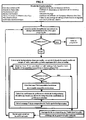
- the flowchart of FIG. 9, allows the implementation of the method in its different stages, according to scenario 2. It differs from that of FIG. 8 essentially by the direction of progression of mesh in mesh which is here from bottom to top, which changes the chains.
- scenario 1 or scenario 2 to treat the surveyed trap requires knowledge of the conditions of its formation and its deep displacements which condition the filling temperature. We make this choice according to the results of a simulation performed using a basin model such as Temis 2 or 3D or a 1D model such as Genex.
- thermodynamic calculation module Knowing the composition of the biodegraded oil, using a conventional gas-oil thermodynamic calculation module, one can calculate the density of the oil and deduce the API degree of the oils in the trap as a function of the depth.
- Figure 6 shows the results of an application of the model to a Gaussian trap and Figure 7 presents a case of real application to a petroleum field.
- the starting fluid is an oil from a South American field. This field is biodegraded and a series of samples of varying degrees of biodegradation have been provided. Within this field, moreover, the biodegradation was carried out in successive jolts, the system being fed regularly by pulses of fresh oil, sometimes degraded, sometimes not. The non-biodegraded oil mixes with the previously degraded oil.
- the exercise consisted of calibrating the different coefficients of preference and stoichiometric. Within each cell, the degraded oil was mixed with undegraded oil at a constant mixing rate of 25% to reproduce oil episodes without degradation. This approach reproduced the two biodegraded samples taken into account as shown in Figure 7.
- the biodegradation model has been described in isolation using some upstream data using a basin model. It is obvious that the software tool allowing the implementation of the method can advantageously be integrated as an add-on module in a basin modeling tool so as to directly benefit from the modeling results it can provide.
Landscapes
- Chemical & Material Sciences (AREA)
- Life Sciences & Earth Sciences (AREA)
- Organic Chemistry (AREA)
- Engineering & Computer Science (AREA)
- Zoology (AREA)
- Proteomics, Peptides & Aminoacids (AREA)
- Biotechnology (AREA)
- Wood Science & Technology (AREA)
- Health & Medical Sciences (AREA)
- Microbiology (AREA)
- General Life Sciences & Earth Sciences (AREA)
- Physics & Mathematics (AREA)
- Analytical Chemistry (AREA)
- Biophysics (AREA)
- Oil, Petroleum & Natural Gas (AREA)
- Geology (AREA)
- Immunology (AREA)
- Environmental & Geological Engineering (AREA)
- Molecular Biology (AREA)
- Chemical Kinetics & Catalysis (AREA)
- Paleontology (AREA)
- General Chemical & Material Sciences (AREA)
- Biochemistry (AREA)
- Bioinformatics & Cheminformatics (AREA)
- General Engineering & Computer Science (AREA)
- General Health & Medical Sciences (AREA)
- Genetics & Genomics (AREA)
- Measuring Or Testing Involving Enzymes Or Micro-Organisms (AREA)
- Apparatus Associated With Microorganisms And Enzymes (AREA)
- Pipeline Systems (AREA)
Claims (2)
- Verfahren zur Modellierung der progressiven Biodegradation von Kohlenwasserstoffen, die in einem Erdöllager oder untersuchten Reservoir gefangen sind, durch das Einwirken einer Bakterienpopulation in einer wasserführenden Schicht, ausgehend von Daten, die das untersuchte Reservoir betreffen, gerichtet auf die Form und die Höhe des Lagers, die physikalischen Eigenschaften des porösen Mediums, die Dichte der Übergangszone zwischen den Kohlenwasserstoffen und dem Wasser, der Zusammensetzung der Kohlenwasserstoffe der Elektronenakzeptorflüsse, die in das Lager eintreten, und Daten über die Bakterienpopulation in der wasserführenden Schicht, mit dem Ziel, die Abbaubedingungen des Lagers zu bestimmen, dadurch gekennzeichnet, dass sie umfassen:- die Diskretisierung des Lagers durch ein Netz bei dem jede Masche die Dicke der Übergangszone als Höhe hat; und- die Bestimmung der Variation der Höhe des Lagers, des Anteils an schweren Fraktionen der Kohlenwasserstoffe unter der Wirkung der Biodegradation durch progressive Anpassung im Rahmen jeder Masche der Bakterienpopulation an die verfügbare Menge an Kohlenwasserstoffen, an den verfügbaren porösen Raum, an die Menge der Elektronenakzeptoren, die im Lager vorhanden sind, und an die Degradationskapazitäten der Population.
- Verfahren nach Anspruch 1, dadurch gekennzeichnet, dass der Anfangsfüllungsgrad des Lagers mit Kohlenwasserstoffen im Voraus bestimmt wird, wenn sich die Bedingungen und insbesondere die im Lager herrschende Temperatur für die Biodegradation eignen.
Applications Claiming Priority (3)
| Application Number | Priority Date | Filing Date | Title |
|---|---|---|---|
| FR0112892 | 2001-10-05 | ||
| FR0112892A FR2830646B1 (fr) | 2001-10-05 | 2001-10-05 | Methode pour modeliser la biodegradation d'hydrocarbures dans un gisement petrolier |
| PCT/FR2002/003387 WO2003031644A2 (fr) | 2001-10-05 | 2002-10-03 | Methode pour modeliser la biodegradation d'hydrocarbures dans un gisement petrolier |
Publications (2)
| Publication Number | Publication Date |
|---|---|
| EP1436412A2 EP1436412A2 (de) | 2004-07-14 |
| EP1436412B1 true EP1436412B1 (de) | 2006-07-12 |
Family
ID=8868009
Family Applications (1)
| Application Number | Title | Priority Date | Filing Date |
|---|---|---|---|
| EP02783229A Expired - Lifetime EP1436412B1 (de) | 2001-10-05 | 2002-10-03 | Verfahren zur modellierung den bioabbau der kohlenwasserstoffen in eines ölfeld |
Country Status (7)
| Country | Link |
|---|---|
| US (1) | US7454322B2 (de) |
| EP (1) | EP1436412B1 (de) |
| JP (1) | JP2005504977A (de) |
| CA (1) | CA2462079C (de) |
| ES (1) | ES2268116T3 (de) |
| FR (1) | FR2830646B1 (de) |
| WO (1) | WO2003031644A2 (de) |
Families Citing this family (12)
| Publication number | Priority date | Publication date | Assignee | Title |
|---|---|---|---|---|
| FR2888251B1 (fr) * | 2005-07-08 | 2012-10-19 | Inst Francais Du Petrole | Methode pour evaluer la biodegradation d'hydrocarbures pieges dans une structure geologique |
| US7922893B2 (en) * | 2006-02-08 | 2011-04-12 | International Business Machines Corporation | System and method for preparing near-surface heavy oil for extraction using microbial degradation |
| GB0706659D0 (en) * | 2007-04-05 | 2007-05-16 | Statoil Asa | Reduction of airwave contribution in marine electromagnetic data |
| FR2916854B1 (fr) * | 2007-05-30 | 2009-08-21 | Inst Francais Du Petrole | Procede de construction d'un milieu poreux a l'etude de phenomenes de biodegradation |
| FR2934606B1 (fr) * | 2008-08-01 | 2010-08-13 | Inst Francais Du Petrole | Modele de bassin pour predire les changements de composition chimique d'un reservoir suite a une biodegradation |
| FR2934605B1 (fr) * | 2008-08-01 | 2010-08-13 | Inst Francais Du Petrole | Procede pour predire les changements de composition chimique d'huile d'un reservoir suite a une biodegradation |
| US20110071799A1 (en) * | 2009-09-21 | 2011-03-24 | Per Arne Slotte | Grid models |
| US8731891B2 (en) * | 2011-07-28 | 2014-05-20 | Saudi Arabian Oil Company | Cluster 3D petrophysical uncertainty modeling |
| FR3007533B1 (fr) * | 2013-06-20 | 2015-07-24 | Ifp Energies Now | Procede pour predire la quantite et la composition des fluides produits par des reactions minerales operant dans un bassin sedimentaire |
| FR3034529B1 (fr) | 2015-04-03 | 2017-05-05 | Ifp Energies Now | Procede d'exploitation des hydrocarbures d'un bassin sedimentaire, au moyen d'une simulation de bassin |
| FR3067500B1 (fr) * | 2017-06-13 | 2021-04-16 | Ifp Energies Now | Procede d'exploitation d'un bassin sedimentaire comportant des hydrocarbures, au moyen d'une modelisation de l'accumulation de la matiere organique terrestre |
| CN108230858A (zh) * | 2018-01-26 | 2018-06-29 | 中国地质大学(武汉) | 一种油气藏形成与改造作用的教学实验装置 |
Family Cites Families (3)
| Publication number | Priority date | Publication date | Assignee | Title |
|---|---|---|---|---|
| US5813798A (en) * | 1997-03-28 | 1998-09-29 | Whiffen; Greg | Piecewise continuous control of groundwater remediation |
| US7006959B1 (en) * | 1999-10-12 | 2006-02-28 | Exxonmobil Upstream Research Company | Method and system for simulating a hydrocarbon-bearing formation |
| US6766817B2 (en) * | 2001-07-25 | 2004-07-27 | Tubarc Technologies, Llc | Fluid conduction utilizing a reversible unsaturated siphon with tubarc porosity action |
-
2001
- 2001-10-05 FR FR0112892A patent/FR2830646B1/fr not_active Expired - Fee Related
-
2002
- 2002-10-03 ES ES02783229T patent/ES2268116T3/es not_active Expired - Lifetime
- 2002-10-03 JP JP2003534614A patent/JP2005504977A/ja active Pending
- 2002-10-03 CA CA2462079A patent/CA2462079C/fr not_active Expired - Fee Related
- 2002-10-03 EP EP02783229A patent/EP1436412B1/de not_active Expired - Lifetime
- 2002-10-03 US US10/491,688 patent/US7454322B2/en not_active Expired - Fee Related
- 2002-10-03 WO PCT/FR2002/003387 patent/WO2003031644A2/fr not_active Ceased
Also Published As
| Publication number | Publication date |
|---|---|
| CA2462079C (fr) | 2014-04-22 |
| CA2462079A1 (fr) | 2003-04-17 |
| FR2830646B1 (fr) | 2004-02-13 |
| JP2005504977A (ja) | 2005-02-17 |
| FR2830646A1 (fr) | 2003-04-11 |
| ES2268116T3 (es) | 2007-03-16 |
| EP1436412A2 (de) | 2004-07-14 |
| US20050015228A1 (en) | 2005-01-20 |
| WO2003031644A3 (fr) | 2003-09-25 |
| WO2003031644A2 (fr) | 2003-04-17 |
| US7454322B2 (en) | 2008-11-18 |
Similar Documents
| Publication | Publication Date | Title |
|---|---|---|
| Brankovits et al. | Methane-and dissolved organic carbon-fueled microbial loop supports a tropical subterranean estuary ecosystem | |
| EP3415957B1 (de) | Verfahren zum ausbeuten eines kohlenwasserstoffen umfassenden sedimentbeckens mithilfe von einem model der akkumulierung des organischen materials im untergrund | |
| EP1436412B1 (de) | Verfahren zur modellierung den bioabbau der kohlenwasserstoffen in eines ölfeld | |
| EP3410161B1 (de) | Verfahren zur erforschung von kohlenwasserstoffen aus dem sedimentbecken, mittels stratigraphischer modellbildung | |
| Sheldon | Causes and consequences of low atmospheric pCO2 in the Late Mesoproterozoic | |
| Burdorf et al. | The effect of oxygen availability on long‐distance electron transport in marine sediments | |
| EP3075947B1 (de) | Verfahren zur kohlenwasserstoffgewinnung in einem sedimentbecken mithilfe einer simulation des beckens | |
| EP2469306A2 (de) | Verfahren zur Lokalisierung von hydraulischen Sperrschichten innerhalb einer geologischen Gaslagerschicht | |
| Mueller et al. | Minerogenic salt marshes can function as important inorganic carbon stores | |
| Chu et al. | Earthquake-enhanced dissolved carbon cycles in ultra-deep ocean sediments | |
| Bruckberger et al. | Biodegradability of legacy crude oil contamination in Gulf War damaged groundwater wells in Northern Kuwait | |
| Rodrigue et al. | Biodegradation of MC252 polycyclic aromatic hydrocarbons and alkanes in two coastal wetlands | |
| Clayer et al. | Rates and pathways of sedimentary organic matter mineralization in two basins of a boreal lake: Emphasis on methanogenesis and methanotrophy | |
| Hovikoski et al. | Bioturbation in the hadal zone | |
| Bingham-Koslowski et al. | Widespread Late Devonian marine anoxia in eastern North America: a case study of the Kettle Point Formation black shale, southwestern Ontario | |
| Kallmeyer et al. | Microbial abundance in lacustrine sediments: a case study from Lake Van, Turkey | |
| Wu et al. | Benthic pleurocapsales (Cyanobacteria) blooms catalyzing carbonate precipitation and dolomitization following the end‐Permian mass extinction | |
| Lebrec et al. | A study of the effects of early diagenesis on the geotechnical properties of carbonate sediments (North West Shelf, Australia) | |
| Itoh et al. | Historical changes in the aquatic environment and input of polycyclic aromatic hydrocarbons over 1000 years in Lake Kitaura, Japan | |
| Sreenivasan et al. | Recognition of a cryptic maximum flooding surface in shallow marine carbonate sequences using geochemical (Y/Ho) proxy data | |
| FR2888251A1 (fr) | Methode pour evaluer la biodegradation d'hydrocarbures pieges dans une structure geologique | |
| Al-Emadi et al. | 3D modeling of the Arab formation (Maydan Mahzam field, offshore Qatar): an integrated approach | |
| EP2161342A2 (de) | Beckenmodell zur Vorraussage der Veränderungen chemischer Ölzusammensetzungen in einem Behälter infolge einer Biodegradation | |
| EP2154254B1 (de) | Verfahren zur Vorraussage der Veränderungen chemischer Ölzusammensetzungen in einem Behälter infolge einer Biodegradation | |
| Ning et al. | Phosphorus speciation, migration and transformation in seawater and sediments and potential role in starfish outbreaks of the Xisha Islands, northern South China Sea |
Legal Events
| Date | Code | Title | Description |
|---|---|---|---|
| PUAI | Public reference made under article 153(3) epc to a published international application that has entered the european phase |
Free format text: ORIGINAL CODE: 0009012 |
|
| 17P | Request for examination filed |
Effective date: 20040506 |
|
| AK | Designated contracting states |
Kind code of ref document: A2 Designated state(s): AT BE BG CH CY CZ DE DK EE ES FI FR GB GR IE IT LI LU MC NL PT SE SK TR |
|
| GRAP | Despatch of communication of intention to grant a patent |
Free format text: ORIGINAL CODE: EPIDOSNIGR1 |
|
| REG | Reference to a national code |
Ref country code: DE Ref legal event code: 8566 |
|
| GRAS | Grant fee paid |
Free format text: ORIGINAL CODE: EPIDOSNIGR3 |
|
| GRAA | (expected) grant |
Free format text: ORIGINAL CODE: 0009210 |
|
| AK | Designated contracting states |
Kind code of ref document: B1 Designated state(s): ES GB IT NL |
|
| PG25 | Lapsed in a contracting state [announced via postgrant information from national office to epo] |
Ref country code: IT Free format text: LAPSE BECAUSE OF FAILURE TO SUBMIT A TRANSLATION OF THE DESCRIPTION OR TO PAY THE FEE WITHIN THE PRESCRIBED TIME-LIMIT;WARNING: LAPSES OF ITALIAN PATENTS WITH EFFECTIVE DATE BEFORE 2007 MAY HAVE OCCURRED AT ANY TIME BEFORE 2007. THE CORRECT EFFECTIVE DATE MAY BE DIFFERENT FROM THE ONE RECORDED. Effective date: 20060712 |
|
| REG | Reference to a national code |
Ref country code: GB Ref legal event code: FG4D Free format text: NOT ENGLISH |
|
| GBT | Gb: translation of ep patent filed (gb section 77(6)(a)/1977) |
Effective date: 20060712 |
|
| REG | Reference to a national code |
Ref country code: ES Ref legal event code: FG2A Ref document number: 2268116 Country of ref document: ES Kind code of ref document: T3 |
|
| PLBE | No opposition filed within time limit |
Free format text: ORIGINAL CODE: 0009261 |
|
| STAA | Information on the status of an ep patent application or granted ep patent |
Free format text: STATUS: NO OPPOSITION FILED WITHIN TIME LIMIT |
|
| 26N | No opposition filed |
Effective date: 20070413 |
|
| PGFP | Annual fee paid to national office [announced via postgrant information from national office to epo] |
Ref country code: ES Payment date: 20071025 Year of fee payment: 6 Ref country code: NL Payment date: 20071029 Year of fee payment: 6 |
|
| PGFP | Annual fee paid to national office [announced via postgrant information from national office to epo] |
Ref country code: IT Payment date: 20071017 Year of fee payment: 6 |
|
| NLV4 | Nl: lapsed or anulled due to non-payment of the annual fee |
Effective date: 20090501 |
|
| PG25 | Lapsed in a contracting state [announced via postgrant information from national office to epo] |
Ref country code: NL Free format text: LAPSE BECAUSE OF NON-PAYMENT OF DUE FEES Effective date: 20090501 |
|
| PG25 | Lapsed in a contracting state [announced via postgrant information from national office to epo] |
Ref country code: IT Free format text: LAPSE BECAUSE OF NON-PAYMENT OF DUE FEES Effective date: 20081003 |
|
| REG | Reference to a national code |
Ref country code: ES Ref legal event code: FD2A Effective date: 20081004 |
|
| PG25 | Lapsed in a contracting state [announced via postgrant information from national office to epo] |
Ref country code: ES Free format text: LAPSE BECAUSE OF NON-PAYMENT OF DUE FEES Effective date: 20081004 |
|
| PGFP | Annual fee paid to national office [announced via postgrant information from national office to epo] |
Ref country code: GB Payment date: 20101025 Year of fee payment: 9 |
|
| GBPC | Gb: european patent ceased through non-payment of renewal fee |
Effective date: 20111003 |
|
| PG25 | Lapsed in a contracting state [announced via postgrant information from national office to epo] |
Ref country code: GB Free format text: LAPSE BECAUSE OF NON-PAYMENT OF DUE FEES Effective date: 20111003 |