EP1436484B1 - Verfahren zur verringerung oder zur vollständigen einstellung von wasserzuflüssen bei einer unterirdischen formation, und vernetzbare copolymere zu dessen durchführung - Google Patents
Verfahren zur verringerung oder zur vollständigen einstellung von wasserzuflüssen bei einer unterirdischen formation, und vernetzbare copolymere zu dessen durchführung Download PDFInfo
- Publication number
- EP1436484B1 EP1436484B1 EP02801295A EP02801295A EP1436484B1 EP 1436484 B1 EP1436484 B1 EP 1436484B1 EP 02801295 A EP02801295 A EP 02801295A EP 02801295 A EP02801295 A EP 02801295A EP 1436484 B1 EP1436484 B1 EP 1436484B1
- Authority
- EP
- European Patent Office
- Prior art keywords
- copolymer
- structural units
- solution
- water
- weight
- Prior art date
- Legal status (The legal status is an assumption and is not a legal conclusion. Google has not performed a legal analysis and makes no representation as to the accuracy of the status listed.)
- Expired - Lifetime
Links
Classifications
-
- C—CHEMISTRY; METALLURGY
- C09—DYES; PAINTS; POLISHES; NATURAL RESINS; ADHESIVES; COMPOSITIONS NOT OTHERWISE PROVIDED FOR; APPLICATIONS OF MATERIALS NOT OTHERWISE PROVIDED FOR
- C09K—MATERIALS FOR MISCELLANEOUS APPLICATIONS, NOT PROVIDED FOR ELSEWHERE
- C09K8/00—Compositions for drilling of boreholes or wells; Compositions for treating boreholes or wells, e.g. for completion or for remedial operations
- C09K8/50—Compositions for plastering borehole walls, i.e. compositions for temporary consolidation of borehole walls
- C09K8/504—Compositions based on water or polar solvents
- C09K8/506—Compositions based on water or polar solvents containing organic compounds
- C09K8/508—Compositions based on water or polar solvents containing organic compounds macromolecular compounds
- C09K8/512—Compositions based on water or polar solvents containing organic compounds macromolecular compounds containing cross-linking agents
Definitions
- WO-01/49971 discloses copolymers and a method of water barrier using these copolymers, the structural units of Vinylphosphonic acid, acrylamide and possibly also AMPS and Contain N-vinylformamide, and which are crosslinked with zirconium compounds can.
- the proportion of crosslinkable phosphonic acid and carboxyl groups must between 0.01 and 7.5 mol%.
- Another advantage is the possibility to choose a polymer that is used in the Life of its effectiveness is limited under the planned conditions.
- the effect of treatment is to modify the relative Permeabilities of a deposit not known and first treatments one Source experimental. Such treatment changes the whole Liquid streams of the deposit. This has far reaching consequences on the Formation of deposits, corrosion or the integrity of the formation. For the If these results do not show the desired effect, it is Desired to be able to reverse the treatment result.
- a Treatment that becomes ineffective after a short test period is therefore especially for the experimental implementation of the method very much advantageous.
- the molecular weights of the copolymers are preferably between 50,000 and 2 ⁇ 10 7 g / mol. Particular preference is given to molecular weights of 500,000 to 10 7 g / mol, in particular 10 6 to 8 x 10 6 g / mol.
- the pump was rinsed with polymer solution, the inlet capillary in the package was removed and the polymer pumped to the beginning of the pack.
- the Inlet pipe has been reconnected.
- the pump was on the desired pumping volume and the flow rate is set and started. While throughout the test, the pressures at the inlet and outlet were recorded (14.2 ml at 6 ml / h).
- the pump was buffered Spacer solution switched.
- An inlet line was again removed, the Rinse pump with buffer solution and pre-pump to the beginning of the pack.
- the inlet capillary was reconnected and the required volume the spacer solution at the desired flow rate (e.g., 3.5 ml at 6 ml / hr).
- the block factors for water and oil were determined.
- the values were obtained from the comparison of the relative pressure drops (or permeabilities) measured during the conditioning phase of the sand pack for oil (oil in residual water) and water (after oil flooding, S OR ), with the corresponding values after Treatment were achieved. It is important to correct the measured pressure losses in relation to the applied flow rates, as during the conditioning phase the flow rates in the form of the pumping rates are often significantly higher than after the treatment. Typically, one package was conditioned at 60 ml / hr and after treatment, flow rates of 1-2 ml / hr were used. After the treatment has been rinsed back, it was trapped for 48 hours. Thereafter, the block factors for water and for oil were determined.
- Formation water was flushed through the sand pack at a flow rate of 1-2 ml / hr.
- the actual flow rate depends on the size of the pressure drop along the packing since the pump and the relief valve are limited to 100 bar. Formation water was pumped until the pressure drop stabilized. This usually requires about two pore volumes.
Landscapes
- Life Sciences & Earth Sciences (AREA)
- General Life Sciences & Earth Sciences (AREA)
- Chemical & Material Sciences (AREA)
- Engineering & Computer Science (AREA)
- Materials Engineering (AREA)
- Organic Chemistry (AREA)
- Addition Polymer Or Copolymer, Post-Treatments, Or Chemical Modifications (AREA)
- Compositions Of Macromolecular Compounds (AREA)
- Processes Of Treating Macromolecular Substances (AREA)
Description

- R1
- Wasserstoff oder Methyl,
- R2
- C2-C10-Alkylen, und
- Me+
- ein Ammonium- oder ein Alkalimetallion bedeutet,
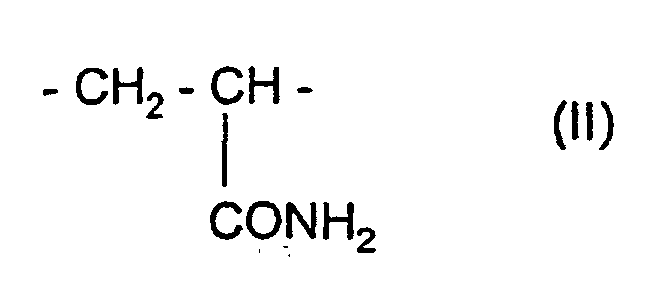
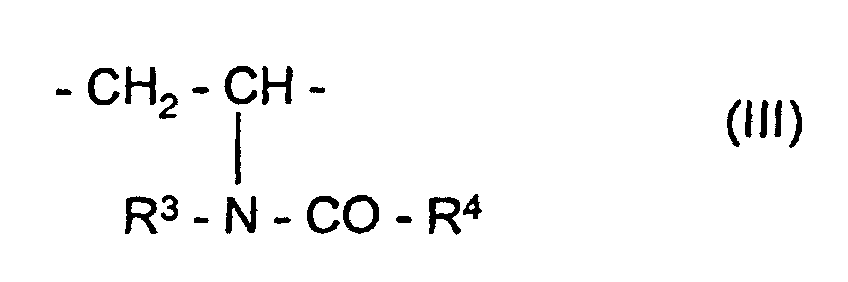
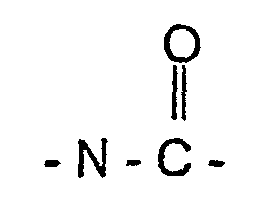
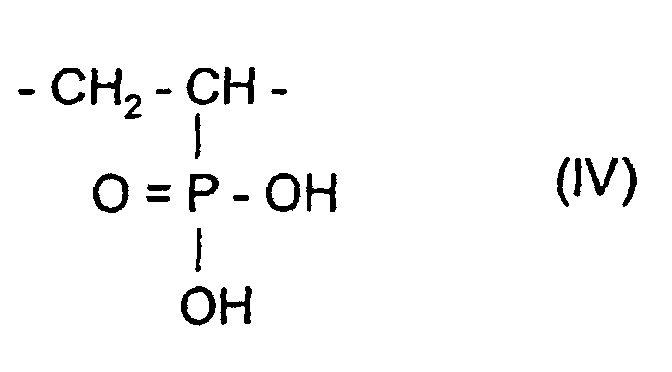
| Verwendete Abkürzungen | |
| AM | Acrylamid |
| AMPS® | 2-Acrylamido-2-methylpropansulfonsäure |
| NVCap | N-Vinylcaprolactam |
| NVF | Vinylformamid |
| NVP | N-Vinylpyrrolidon |
| VIMA | N-Vinyl-N-methyl-acetamid |
| VPS | Vinylphosphonsäure |
- 23 g Acrylamid und
- 1 g NVF hinzugefügt.
unter Rühren und Einleiten von Stickstoff wurde das Reaktionsgemisch auf 70°C erhitzt.
1 g einer wässrigen 10 %igen Dibutylamin-HCl-Lösung und
0,1 g Ammoniumpersulfat wurden zugegeben.
Die Reaktion dauerte etwa 30 Minuten wobei die Temperatur auf 70°C anstieg. Das Reaktionsgemisch wurde viskos. Es wurde unter Rühren noch 2 Std. bei 80°C nachgeheizt. Man erhielt eine klare, hochviskose Lösung. Der k-Wert betrug 193.
250 g Wasser eine Monomerlösung hergestellt. Der pH-Wert wurde mit Ammoniak (25 %ig) auf 8,5 eingestellt. 1,5 g NVF wurde der Lösung zugesetzt. Unter Rühren und Einleiten von Stickstoff wurden schließlich 1 g einer wässrigen 10 %igen Dibutylamin-HCl-Lösung und 0,1 g Ammoniumpersulfat zugegeben. Man ließ unter Stickstoffeinleitung noch 3 Min. bei erhöhter Drehzahl rühren. Die Stickstoffeinleitung wurde beendet, Einleitungsrohr und Rührer wurden hochgezogen. Nach einer Induktionszeit von ca. 30 Min. setzte die Polymerisation ein, wobei die Temperatur von 20°C auf 78°C anstieg und die Lösung in ein formstabiles Gel überging. Nach einer Nachwärmzeit von 8 h bei 60°C wurde das Gel auf Raumtemperatur abgekühlt, zerkleinert, getrocknet und gemahlen. Der K-Wert betrug ca. 240.

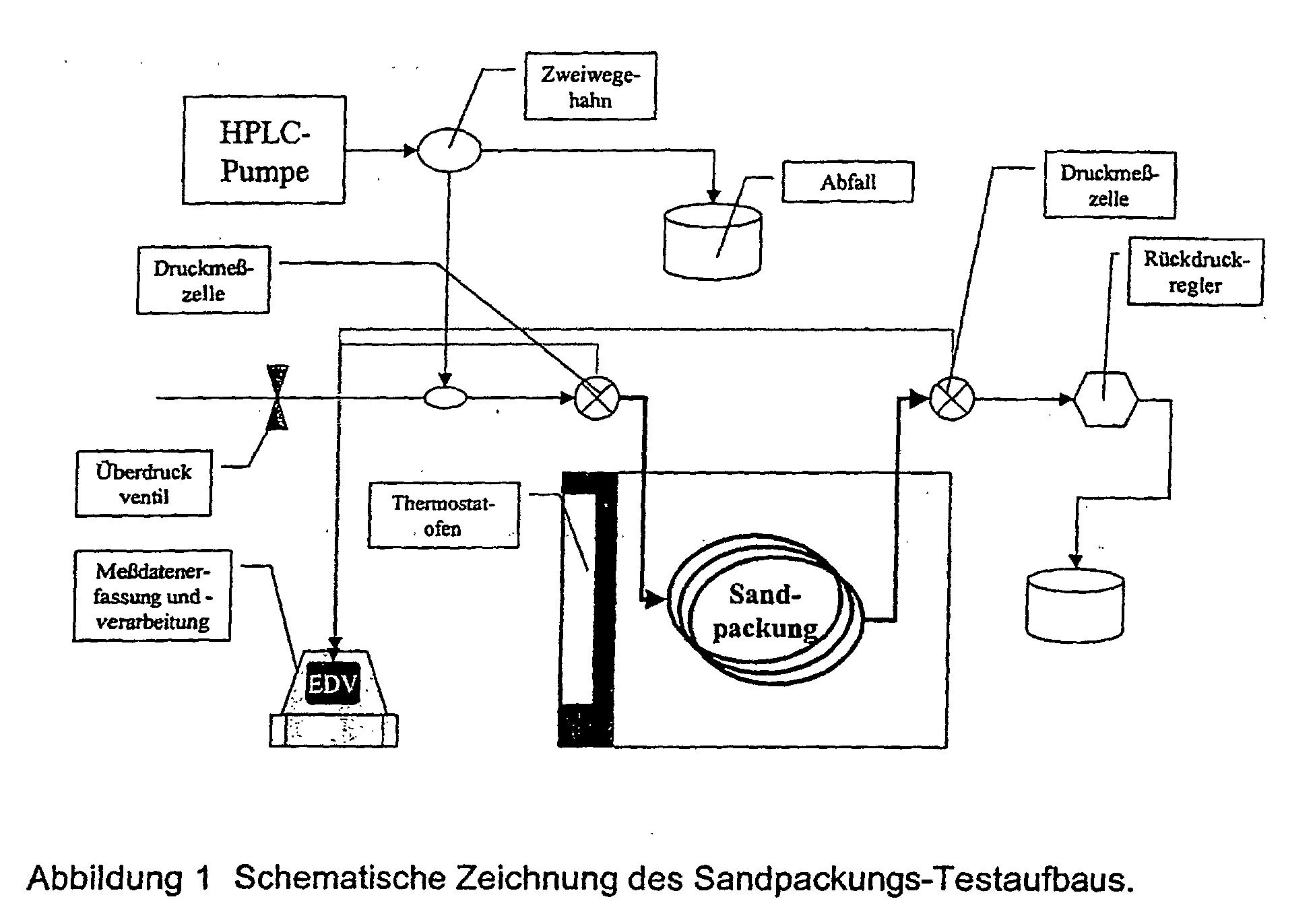
Sie dienen dem Screening von Substanzen unter reproduzierbaren Bedingungen. Diese Methode ist benutzt worden, um die erfindungsgemäßen Substanzen und Behandlungsmethoden zu prüfen und zu vergleichen. Gegenüber Durchflutungstests von Gesteinsbohrkernen (Core-Flood Tests) hat diese Methode die Vorteile, dass sie leichter reproduzierbar ist, die Materialien kommerziell erhältlich sind, die gewünschten Permeabilität frei bestimmbar und reproduzierbar einstellbar ist und durch die Länge der Packung ein größerer Radius um die Sonde simuliert werden kann als mit Core-Flood Tests. Die Vergleichbarkeit zu Core-Flood Tests konnte durch vergleichende Messungen bestätigt werden.
| Größenverteilungen der Sandfraktionen zur Vorbereitung von Sandpackungen. | |
| Sandfraktion | Größenverteilung |
| A | > 2,36 mm |
| B | 1,18 - 2,36 mm |
| C | 300 - 1180 µm |
| D | 150 - 300 µm |
| E | 90 - 150 µm |
| F | < 90 µm |
| Typische Sandzusammensetzungen für spezielle Feldanwendungen | ||
| Sandzusammensetzung | Permeabilität [D] | Beispielfeld |
| 100 % E | 4 | Amberjack (Golf von Mexico) |
| 100% D | 12 | -- |
| 80 % D : 20 % E | 10 | Harding (Nordsee) |
Vor der Konditionierung mit Rohöl wurde nun die Pumpe zunächst mit Methanol, dann mit Toluol und zuletzt mit Rohöl gespült.
- Q =
- Flussrate [ml/s]
- k =
- Permeabilität [D]
- A =
- Durchschnittsffäche der Kapillare [cm2]
- L =
- Länge der Packung,
- δp =
- Druckverlust entlang der Packung [atm]
- µ =
- Viskosität der Flüssigkeit [cP]
| Vergleichbare Volumen für Laboruntersuchungen und für den Einsatz im Feld für eine RPM-Behandlung | ||||
| Behandlungsschritt | Lösung | Konzentration | Volumen | |
| Feld [bbl] | Labor [ml] | |||
| Polymer | Polymer D | 2600 ppm | 2800 | 14,2 |
| Spacer | Gepuffertes Injektionswasser | 40 % Acetat-Puffer | 700 | 3,5 |
| Vernetzer | Gepufferter Vernetzer | 750 ppm in 40% Puffer | 2800 | 14,2 |
| Nachspülung | Injektionswasser | ----- | 2600 | weggelassen |
| Behandlungsvolumen und Pumpraten für Laboruntersuchungen zur RPM Behandlung | ||||
| Behandlungsschritt | Lösung | Konzentration | Behandlungsdetail | |
| Volumen [ml] | Pumprate [ml/min] | |||
| Polymer | Polymer D | 2600 ppm | 14,2 | 0,33 |
| Spacer | Gepuffertes Injektionswasser | 40% Acetat-Puffer | 3,5 | 0,1 |
| Vernetzer | Gepufferter Vernetzer | 750 ppm in 40% Puffer | 14,2 | 0,1 |
| Rückspülung | Injektionswasser | --- | 17,7 | 0,05 |
Nachdem die Behandlung zurück gespült worden ist, wurde sie für 48 Stunden eingeschlossen. Danach wurden die Blockfaktoren für Wasser und für Öl bestimmt.
Zunächst wurde abhängig von der Größe des entstandenen Blocks mit einer Flussrate von 1 - 2 ml/h Formationswasser durch die Sandpackung gespült. Die tatsächlich angelegte Flussrate hängt von der Größe des Druckabfalls entlang der Packung ab, da die Pumpe und die das Überdruckventil auf 100 bar limitiert sind. Formationswasser wurde gepumpt, bis sich der Druckabfall stabilisiert hat. Dazu sind üblicherweise ca. zwei Porenvolumen nötig.
| Zeit | Blockfaktor |
| [d] | [RFw] |
| 10 | 260 |
| 50 | 296 |
| 100 | 270 |
| 150 | 245 |
| Zeit | Blockfaktor |
| [d] | [RFw] |
| 2 | 270 |
| 29 | 270 |
| Zeit | Blockfaktor |
| [d] | [RFw] |
| 1 | 225 |
| 3 | 100 |
| 5 | 30 |
| Zeit | Blockfaktor |
| [d] | [RFw] |
| 1 | 35 |
| 3 | 37 |
| 5 | 38 |
| 10 | 27 |
| 15 | 25 |
| 20 | 13 |
| 25 | 9 |
| 27 | 7 |
| Zeit | Blockfaktor |
| [d] | [RFw] |
| 1 | 26 |
| 5 | 34 |
| Zeit | Blockfaktor |
| [d] | [RFw] |
| 3 | 62 |
| 7 | 54 |
| 11 | 50 |
| 15 | 47 |
| 17 | 43 |
| 23 | 28 |
| 28 | 23 |
| 33 | 19 |
| 37 | 16 |
Claims (22)
- Verfahren zur Verringerung oder vollständigen Einstellung der Wasserzuflüsse zu einer Erdöl- oder Erdgasproduktionsbohrung, indem man in diese Bohrung eine wässrige Lösung eines Copolymers einbringt, wobei das Copolymerenthält, und gleichzeitig mit dem Copolymer oder danach in die Formation bzw. Lagerstätte einen Vernetzer für das Copolymer einbringt, der wenigstens eine Zirkonium-, Chrom-, Titan- oder Aluminiumverbindung umfasst, und anschließend die Bohrung zur Gewinnung von Erdöl und/oder Erdgas in Betrieb nimmt.A) 40 - 98 Gew.-% Struktureinheiten der Formelworin

- R1
- Wasserstoff oder Methyl,
- R2
- C2-C10-Alkylen, und
- Me+
- ein Ammonium- oder ein Alkalimetallion bedeutet,
B) 0,1 bis 58 Gew.-% Struktureinheiten der Formel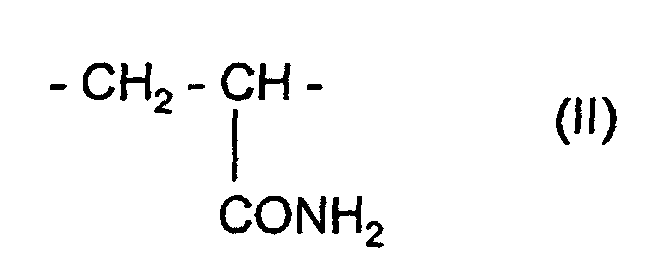 C) 0,1 bis 10 Gew.-% Struktureinheiten der Formelworin
 R3 und R4 unabhängig voneinander Wasserstoff, Methyl oder Ethyl, oder R3 undR4 zusammen eine Propylengruppe, die unter Einschluss eines Resteseinen Pyrrolidonrest oder unter Einschluss einer Pentamethylengruppe einen Caprolactamrest bildet, bedeutet, und
 D) 0,1 bis 10 Gew.-% Struktureinheiten der Formel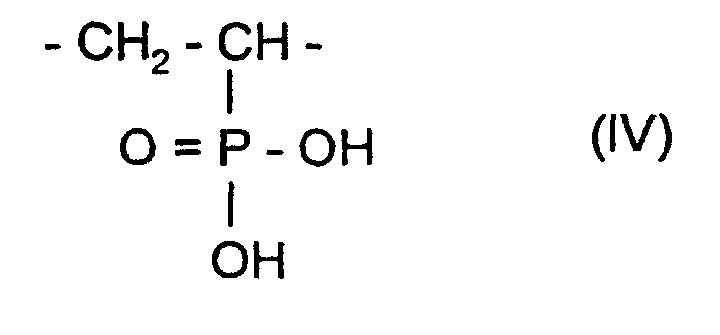
- Verfahren nach Anspruch 1, worin die Struktureinheiten der Formel 1 von 2-Acrylamido-2-methylpropan-sulfonsäure abgeleitet sind.
- Verfahren nach Anspruch 1 und/oder 2, worin das Copolymer 50 bis 98 Gew.-% der Struktureinheiten der Formel I enthält.
- Verfahren nach einem oder mehreren der Ansprüche 1 bis 3, worin die Struktureinheiten B in einer Menge von 2 bis 45 Gew.-% vorliegen.
- Verfahren nach einem oder mehreren der Ansprüche 1 bis 4, worin in den Struktureinheiten C) R3 und R4 Wasserstoff bedeuten.
- Verfahren nach einem oder mehreren der Ansprüche 1 bis 5, worin das Copolymer 0,5 bis 5 Gew.-% Struktureinheiten C) enthält.
- Verfahren nach einem oder mehreren der Ansprüche 1 bis 6, worin das Copolymer 0,5 bis 5 Gew.-% Struktureinheiten D) enthält.
- Verfahren nach einem oder mehreren der Ansprüche 1 bis 7, worin die Molekulargewichte der Copolymeren zwischen 50.000 und 2·107 g/mol liegen.
- Verfahren nach einem oder mehreren der Ansprüche 1 bis 8, worin die Struktureinheiten A), B), C) und D) sich zu 100 Gew.-% addieren.
- Verfahren nach einem oder mehreren der Ansprüche 1 bis 9, worin die zu behandelnde Formation vorgeflutet wird.
- Verfahren nach einem oder mehreren der Ansprüche 1 bis 10, worin zwischen der Einbringung des Copolymers und der Einbringung des Verntzers Wasser, Wasser in dem Salze gelöst sein können, eine Pufferlösung oder eine verdickte wässrige Polymerlösung, in der zusätzlich Salze gelöst sein können als Spacer in die Bohrung eingebracht wird.
- Verfahren nach einem oder mehreren der Ansprüche 1 bis 11, worin das Einbringen eines Spacers nach dem Einbringen des Vernetzers erfolgt.
- Verfahren nach einem oder mehreren der Ansprüche 1 bis 12, worin nach der Einbringung der Lösungen des Copolymers und des Vernetzers eine von 2 Stunden bis 10 Tagen, insbesondere 3 bis 50 Stunden dauernde Phase des Einschlusses erfolgt, bevor die Sonde wieder auf Produktion umgestellt wird.
- Verfahren nach einem oder mehreren der Ansprüche 1 bis 13, worin das Einbringen von Copolymerlösung und Vernetzer in beliebigen Mengenverhältnissen wiederholt wird, bevor oder nachdem die Sonde wieder auf Produktion zurückgeschaltet wurde.
- Verfahren nach einem oder mehreren der Ansprüche 1 bis 14, worin Teile oder auch die gesamte Polymer-Wasser-Mischung mit Vernetzer vorbehandelt injiziert wird.
- Verfahren nach einem oder mehreren der Ansprüche 1 bis 15, worin die Vernetzung des Polymers durch Einwirkung geeigneter Stoffe auf die Gelbarriere aufgehoben wird.
- Verfahren nach Anspruch 16, worin die geeigneten Stoffe Flusssäure oder ihre Vorläufer, starke Chelatbildner, EDTA, Persulfate, Perborate und Wasserstoffperoxid sind.
- Verfahren nach einem oder mehreren der Ansprüche 1 bis 17, worin als Vernetzer Verbindungen des Zirkoniums und/oder des Titans verwendet werden.
- Verfahren nach einem oder mehreren der Ansprüche 1 bis 18, worin die Konzentration des Vernetzers in der wässrigen Lösung von 0,001 bis 0,5 Gew.-% bezogen auf die Zirkonium- und/oder Titankonzentration beträgt.
- Verfahren nach einem oder mehreren der Ansprüche 1 bis 19, worin die Copolymer- sowie die Vernetzerlösung im Bereich von pH 4 bis 6, insbesondere 4,5 bis 5,5 gepuffert sind.
- Copolymer, welches Struktureinheiten A), B), C) und D) wie in einem oder mehreren der Ansprüche 1 bis 20 definiert enthält.
- Zusammensetzung, enthaltend ein Copolymer gemäß Anspruch 21, sowie mindestens eine Titan-, Chrom-, Zirkonium- oder Aluminiumverbindung.
Applications Claiming Priority (3)
| Application Number | Priority Date | Filing Date | Title |
|---|---|---|---|
| DE10150190 | 2001-10-12 | ||
| DE10150190A DE10150190A1 (de) | 2001-10-12 | 2001-10-12 | Verfahren zur Verringerung oder zur vollständigen Einstellung von Wasserzuflüssen bei einer unterirdischen Formation, und vernetzbare Copolymere zu dessen Durchführung |
| PCT/EP2002/010683 WO2003033860A2 (de) | 2001-10-12 | 2002-09-24 | Verfahren zur verringerung oder zur vollständigen einstellung von wasserzuflüssen bei einer unterirdischen formation, und vernetzbare copolymere zu dessen durchführung |
Publications (2)
| Publication Number | Publication Date |
|---|---|
| EP1436484A2 EP1436484A2 (de) | 2004-07-14 |
| EP1436484B1 true EP1436484B1 (de) | 2005-05-25 |
Family
ID=7702171
Family Applications (1)
| Application Number | Title | Priority Date | Filing Date |
|---|---|---|---|
| EP02801295A Expired - Lifetime EP1436484B1 (de) | 2001-10-12 | 2002-09-24 | Verfahren zur verringerung oder zur vollständigen einstellung von wasserzuflüssen bei einer unterirdischen formation, und vernetzbare copolymere zu dessen durchführung |
Country Status (7)
| Country | Link |
|---|---|
| US (1) | US7150319B2 (de) |
| EP (1) | EP1436484B1 (de) |
| CA (1) | CA2455642C (de) |
| DE (2) | DE10150190A1 (de) |
| ES (1) | ES2242900T3 (de) |
| NO (1) | NO325866B1 (de) |
| WO (1) | WO2003033860A2 (de) |
Families Citing this family (19)
| Publication number | Priority date | Publication date | Assignee | Title |
|---|---|---|---|---|
| GB0219037D0 (en) | 2002-08-15 | 2002-09-25 | Bp Exploration Operating | Process |
| US7098171B2 (en) * | 2003-05-13 | 2006-08-29 | Halliburton Energy Services, Inc. | Synthetic filtration control polymers for wellbore fluids |
| GB0413587D0 (en) * | 2004-06-17 | 2004-07-21 | Statoil Asa | Well treatment |
| US8076432B2 (en) * | 2004-07-07 | 2011-12-13 | Unichem Technologies, Inc. | Phosphonic compounds and methods of use thereof |
| DE102004035515A1 (de) | 2004-07-22 | 2006-02-16 | Clariant Gmbh | Thermostabiles, wasserlösliches, bei hohen Temperaturen vernetzbares Polymer |
| DE102007037466A1 (de) | 2007-08-08 | 2009-02-12 | Basf Construction Polymers Gmbh | Pfropfpolymer-Mischung |
| HUE039758T2 (hu) * | 2008-01-28 | 2019-02-28 | Baker Hughes A Ge Co Llc | Készítmények és eljárások nagy hõmérsékletû földalatti formációk kezelésére |
| US8691734B2 (en) | 2008-01-28 | 2014-04-08 | Baker Hughes Incorporated | Method of fracturing with phenothiazine stabilizer |
| US8022015B2 (en) * | 2008-01-28 | 2011-09-20 | Baker Hughes Incorporated | Method of fracturing with phenothiazine stabilizer |
| US20090192051A1 (en) * | 2008-01-28 | 2009-07-30 | Bj Services Company | High temperature stabilizer for well treatment fluids and methods of using same |
| US8763698B2 (en) | 2011-04-08 | 2014-07-01 | Basf Se | Process for producing mineral oil from underground formations |
| AU2012238764A1 (en) | 2011-04-08 | 2013-09-12 | Basf Canada Inc. | Process for producing mineral oil from underground formations |
| EP2650314A1 (de) * | 2012-04-13 | 2013-10-16 | Clariant International Ltd. | Verfahren zur Verhinderung von Sulfidablagerungen |
| BR112014030831A2 (pt) | 2012-07-06 | 2017-06-27 | Basf Se | uso de copolímeros à base de gelatina. |
| DE102013008769A1 (de) | 2013-05-23 | 2014-11-27 | Tougas Oilfield Solutions Gmbh | Temperaturstabiles, elektrolythaltiges Hydrogel und Verfahren zum Stimulieren von Erdöl- und Erdgaslagerstätten |
| EP3099759A1 (de) * | 2014-01-30 | 2016-12-07 | TouGas Oilfield Solutions GmbH | Verfahren zur erhöhung der viskosität von hydrogelen durch vernetzung von copolymeren in gegenwart von gelöstem salz |
| CA3036532A1 (en) | 2016-09-14 | 2018-03-22 | Rhodia Operations | Polymer blends for stimulation of oil & gas wells |
| WO2019121559A1 (en) * | 2017-12-20 | 2019-06-27 | Tougas Oilfield Solutions Gmbh | Crosslinkable friction reducer |
| CN109628079A (zh) * | 2018-12-26 | 2019-04-16 | 中煤科工集团重庆研究院有限公司 | 煤矿水力化措施用降阻剂 |
Family Cites Families (16)
| Publication number | Priority date | Publication date | Assignee | Title |
|---|---|---|---|---|
| US3308885A (en) * | 1965-12-28 | 1967-03-14 | Union Oil Co | Treatment of subsurface hydrocarbon fluid-bearing formations to reduce water production therefrom |
| DE1301566B (de) | 1966-11-30 | 1969-08-21 | Continental Gummi Werke Ag | Verfahren zur Herstellung von hydrolysebestaendigen Polyurethanelastomeren |
| FR2325797A1 (fr) * | 1975-09-25 | 1977-04-22 | Inst Francais Du Petrole | Procede de colmatage selectif des zones proches des puits de production d'huile ou de gaz pour diminuer les venues d'eau |
| FR2586750B1 (fr) * | 1985-08-29 | 1988-05-20 | Inst Francais Du Petrole | Procede pour la prevention de la venue d'eau dans un puits producteur d'huile et/ou de gaz |
| FR2611803B1 (fr) * | 1987-03-06 | 1989-07-07 | Inst Francais Du Petrole | Procede pour la reduction selective des venues d'eau dans les puits producteurs d'huile ou de gaz |
| US5079278A (en) * | 1989-12-13 | 1992-01-07 | Mobil Oil Corporation | Enhanced oil recovery profile control with crosslinked anionic acrylamide copolymer gels |
| US5244988A (en) * | 1989-05-17 | 1993-09-14 | Rohm And Haas Company | Maleate polymerization process |
| CA2029631A1 (en) * | 1989-11-22 | 1991-05-23 | Kathleen A. Hughes | Graft polymers as biodegradable detergent additives |
| EP0577931B1 (de) | 1992-04-10 | 1998-06-24 | Clariant GmbH | Verfahren zur Verringerung oder vollständigen Einstellung des Wasserzuflusses bei Bohrungen zur Gewinnung von Öl und/oder Kohlenwasserstoffgas |
| US6033524A (en) * | 1997-11-24 | 2000-03-07 | Nalco Chemical Company | Selective retention of filling components and improved control of sheet properties by enhancing additive pretreatment |
| AU5355599A (en) * | 1998-10-22 | 2000-05-04 | Rohm And Haas Company | Polymer compositions and a method of promoting soil release from fabrics using said polymer compositions |
| DE19926355A1 (de) * | 1999-06-10 | 2000-12-14 | Clariant Gmbh | Wasserlösliche Mischpolymere und ihre Verwendung für Exploration und Förderung von Erdöl und Erdgas |
| WO2001049971A1 (en) | 1999-12-29 | 2001-07-12 | Tr Oil Services Limited | Process for altering the relative permeability of a hydrocarbon-bearing formation |
| US6465397B1 (en) | 2000-02-11 | 2002-10-15 | Clariant Finance (Bvi) Limited | Synthetic crosslinked copolymer solutions and direct injection to subterranean oil and gas formations |
| US7056868B2 (en) * | 2001-07-30 | 2006-06-06 | Cabot Corporation | Hydrophobe associative polymers and compositions and methods employing them |
| US20040177957A1 (en) * | 2003-03-10 | 2004-09-16 | Kalfayan Leonard J. | Organosilicon containing compositions for enhancing hydrocarbon production and method of using the same |
-
2001
- 2001-10-12 DE DE10150190A patent/DE10150190A1/de not_active Withdrawn
-
2002
- 2002-09-24 EP EP02801295A patent/EP1436484B1/de not_active Expired - Lifetime
- 2002-09-24 ES ES02801295T patent/ES2242900T3/es not_active Expired - Lifetime
- 2002-09-24 US US10/492,000 patent/US7150319B2/en not_active Expired - Lifetime
- 2002-09-24 DE DE50203223T patent/DE50203223D1/de not_active Expired - Lifetime
- 2002-09-24 CA CA2455642A patent/CA2455642C/en not_active Expired - Fee Related
- 2002-09-24 WO PCT/EP2002/010683 patent/WO2003033860A2/de not_active Ceased
-
2004
- 2004-03-25 NO NO20041246A patent/NO325866B1/no not_active IP Right Cessation
Also Published As
| Publication number | Publication date |
|---|---|
| EP1436484A2 (de) | 2004-07-14 |
| NO20041246L (no) | 2004-06-10 |
| ES2242900T3 (es) | 2005-11-16 |
| DE10150190A1 (de) | 2003-04-17 |
| US20040244975A1 (en) | 2004-12-09 |
| NO20041246D0 (no) | 2004-03-25 |
| WO2003033860A2 (de) | 2003-04-24 |
| NO325866B1 (no) | 2008-08-04 |
| DE50203223D1 (de) | 2005-06-30 |
| CA2455642A1 (en) | 2003-04-24 |
| CA2455642C (en) | 2010-05-25 |
| WO2003033860A3 (de) | 2004-01-22 |
| US7150319B2 (en) | 2006-12-19 |
Similar Documents
| Publication | Publication Date | Title |
|---|---|---|
| EP1059316B1 (de) | Wasserlösliche Mischpolymere und ihre Verwendung für Exploration und Förderung von Erdöl und Erdgas | |
| DE3486230T2 (de) | Polymere verwendbar in der Rückgewinnung und Verarbeitung von Bodenschätzen. | |
| EP1436484A2 (de) | Verfahren zur verringerung oder zur vollständigen einstellung von wasserzuflüssen bei einer unterirdischen formation, und vernetzbare copolymere zu dessen durchführung | |
| DE19909231C2 (de) | Wasserlösliche Copolymere auf AMPS-Basis und ihre Verwendung als Bohrhilfsmittel | |
| DE69418969T2 (de) | Kontrolle von Wasserstrom aus unterirdischen Lagerstätten | |
| EP1045869B1 (de) | Zementationshilfsmittel | |
| EP2694618B1 (de) | Verfahren zum fördern von erdöl aus unterirdischen formationen | |
| EP2643423B1 (de) | Verfahren zur erdölförderung unter verwendung hydrophob assoziierender copolymere | |
| EP1630181B1 (de) | Thermostabiles, wasserlösliches, bei hohen Temperaturen vernetzbares Polymer | |
| EP0577931A1 (de) | Verfahren zur Verringerung oder vollständingen Einstellung des Wasserzuflusses bei Bohrungen zur Gewinnung von Öl und/oder Kohlenwasserstoffgas | |
| EP2643424A1 (de) | Verfahren zur erdölförderung unter verwendung hydrophob assoziierender copolymere | |
| DE2444108B1 (de) | Wasserbasische tonspuelung fuer tiefbohrungen und verwendung eines mischpolymerisats fuer solche spuelungen | |
| DE2657443B2 (de) | Gelförmige wäßrige Zusammensetzung zur Säuerung unterirdischer Formationen | |
| EP2382249B1 (de) | Verwendung von vinylphosphonsäure zur herstellung biologisch abbaubarer mischpolymere und deren verwendung für die exploration und förderung von erdöl und erdgas | |
| DE102005051906A1 (de) | Mischpolymer auf Basis olefinischer Sulfonsäuren | |
| US5717131A (en) | Apparatus for testing a shear thickening plugging fluid | |
| EP0078805B1 (de) | Wasserlösliche, säurstabile copolymerisate, ihre herstellung und verwendung | |
| DE4024207A1 (de) | Wassereindickende copolymere und deren verwendung | |
| WO2008000362A1 (de) | Verwendung von methacrylat-derivaten zur verdickung salzhaltiger medien | |
| EP0078266B1 (de) | Wasserlösliche vernetzbare polymerzusammensetzung, ihre herstellung und ihre verwendung | |
| DE2231163C3 (de) | Verfahren zur Herstellung eines wässrigen Gels und dessen Verwendung als Hilfsmittel bei Bohrungen in geologischen Formationen | |
| DE4338870C1 (de) | Polymerflutverfahren zur Gewinnung von Erdöl aus untertägigen Lagerstätten | |
| DE3344470A1 (de) | Fluid-loss-additive fuer tiefbohrzement | |
| DE2348400A1 (de) | Verfahren zur gewinnung von kohlenwasserstoffen unter anwenden von polymeren, die durch strahlungs-polymerisation erhalten worden sind |
Legal Events
| Date | Code | Title | Description |
|---|---|---|---|
| PUAI | Public reference made under article 153(3) epc to a published international application that has entered the european phase |
Free format text: ORIGINAL CODE: 0009012 |
|
| AK | Designated contracting states |
Kind code of ref document: A2 Designated state(s): AT BE BG CH CY CZ DE DK EE ES FI FR GB GR IE IT LI LU MC NL PT SE SK TR |
|
| 17P | Request for examination filed |
Effective date: 20040722 |
|
| GRAP | Despatch of communication of intention to grant a patent |
Free format text: ORIGINAL CODE: EPIDOSNIGR1 |
|
| RAP1 | Party data changed (applicant data changed or rights of an application transferred) |
Owner name: CLARIANT UK LIMITED |
|
| GRAS | Grant fee paid |
Free format text: ORIGINAL CODE: EPIDOSNIGR3 |
|
| GRAA | (expected) grant |
Free format text: ORIGINAL CODE: 0009210 |
|
| AK | Designated contracting states |
Kind code of ref document: B1 Designated state(s): DE ES FR GB IT NL |
|
| REG | Reference to a national code |
Ref country code: GB Ref legal event code: FG4D Free format text: NOT ENGLISH |
|
| REG | Reference to a national code |
Ref country code: IE Ref legal event code: FG4D Free format text: LANGUAGE OF EP DOCUMENT: GERMAN |
|
| REF | Corresponds to: |
Ref document number: 50203223 Country of ref document: DE Date of ref document: 20050630 Kind code of ref document: P |
|
| GBT | Gb: translation of ep patent filed (gb section 77(6)(a)/1977) |
Effective date: 20050914 |
|
| REG | Reference to a national code |
Ref country code: ES Ref legal event code: FG2A Ref document number: 2242900 Country of ref document: ES Kind code of ref document: T3 |
|
| ET | Fr: translation filed | ||
| PLBE | No opposition filed within time limit |
Free format text: ORIGINAL CODE: 0009261 |
|
| STAA | Information on the status of an ep patent application or granted ep patent |
Free format text: STATUS: NO OPPOSITION FILED WITHIN TIME LIMIT |
|
| 26N | No opposition filed |
Effective date: 20060228 |
|
| PGFP | Annual fee paid to national office [announced via postgrant information from national office to epo] |
Ref country code: NL Payment date: 20140821 Year of fee payment: 13 Ref country code: DE Payment date: 20140825 Year of fee payment: 13 |
|
| PGFP | Annual fee paid to national office [announced via postgrant information from national office to epo] |
Ref country code: ES Payment date: 20140915 Year of fee payment: 13 |
|
| PGFP | Annual fee paid to national office [announced via postgrant information from national office to epo] |
Ref country code: IT Payment date: 20140825 Year of fee payment: 13 |
|
| PGFP | Annual fee paid to national office [announced via postgrant information from national office to epo] |
Ref country code: FR Payment date: 20140910 Year of fee payment: 13 |
|
| REG | Reference to a national code |
Ref country code: DE Ref legal event code: R119 Ref document number: 50203223 Country of ref document: DE |
|
| PG25 | Lapsed in a contracting state [announced via postgrant information from national office to epo] |
Ref country code: IT Free format text: LAPSE BECAUSE OF NON-PAYMENT OF DUE FEES Effective date: 20150924 |
|
| REG | Reference to a national code |
Ref country code: NL Ref legal event code: MM Effective date: 20151001 |
|
| REG | Reference to a national code |
Ref country code: FR Ref legal event code: ST Effective date: 20160531 |
|
| PG25 | Lapsed in a contracting state [announced via postgrant information from national office to epo] |
Ref country code: DE Free format text: LAPSE BECAUSE OF NON-PAYMENT OF DUE FEES Effective date: 20160401 |
|
| PG25 | Lapsed in a contracting state [announced via postgrant information from national office to epo] |
Ref country code: FR Free format text: LAPSE BECAUSE OF NON-PAYMENT OF DUE FEES Effective date: 20150930 Ref country code: NL Free format text: LAPSE BECAUSE OF NON-PAYMENT OF DUE FEES Effective date: 20151001 |
|
| REG | Reference to a national code |
Ref country code: ES Ref legal event code: FD2A Effective date: 20170303 |
|
| PG25 | Lapsed in a contracting state [announced via postgrant information from national office to epo] |
Ref country code: ES Free format text: LAPSE BECAUSE OF NON-PAYMENT OF DUE FEES Effective date: 20150925 |
|
| PGFP | Annual fee paid to national office [announced via postgrant information from national office to epo] |
Ref country code: GB Payment date: 20170929 Year of fee payment: 16 |
|
| GBPC | Gb: european patent ceased through non-payment of renewal fee |
Effective date: 20180924 |
|
| PG25 | Lapsed in a contracting state [announced via postgrant information from national office to epo] |
Ref country code: GB Free format text: LAPSE BECAUSE OF NON-PAYMENT OF DUE FEES Effective date: 20180924 |