EP1436675B1 - Procede et dispositif de determination et/ou de production d'un systeme d'entrainement ou de pieces connues pour un systeme d'entrainement, et interface et procede de determination d'un facteur de securite de fonctionnement sb - Google Patents
Procede et dispositif de determination et/ou de production d'un systeme d'entrainement ou de pieces connues pour un systeme d'entrainement, et interface et procede de determination d'un facteur de securite de fonctionnement sb Download PDFInfo
- Publication number
- EP1436675B1 EP1436675B1 EP02772216A EP02772216A EP1436675B1 EP 1436675 B1 EP1436675 B1 EP 1436675B1 EP 02772216 A EP02772216 A EP 02772216A EP 02772216 A EP02772216 A EP 02772216A EP 1436675 B1 EP1436675 B1 EP 1436675B1
- Authority
- EP
- European Patent Office
- Prior art keywords
- load
- determined
- torque
- drive
- force
- Prior art date
- Legal status (The legal status is an assumption and is not a legal conclusion. Google has not performed a legal analysis and makes no representation as to the accuracy of the status listed.)
- Revoked
Links
Images




Classifications
-
- G—PHYSICS
- G05—CONTROLLING; REGULATING
- G05B—CONTROL OR REGULATING SYSTEMS IN GENERAL; FUNCTIONAL ELEMENTS OF SUCH SYSTEMS; MONITORING OR TESTING ARRANGEMENTS FOR SUCH SYSTEMS OR ELEMENTS
- G05B19/00—Program-control systems
- G05B19/02—Program-control systems electric
- G05B19/418—Total factory control, i.e. centrally controlling a plurality of machines, e.g. direct or distributed numerical control [DNC], flexible manufacturing systems [FMS], integrated manufacturing systems [IMS] or computer integrated manufacturing [CIM]
- G05B19/41875—Total factory control, i.e. centrally controlling a plurality of machines, e.g. direct or distributed numerical control [DNC], flexible manufacturing systems [FMS], integrated manufacturing systems [IMS] or computer integrated manufacturing [CIM] characterised by quality surveillance of production
-
- G—PHYSICS
- G05—CONTROLLING; REGULATING
- G05B—CONTROL OR REGULATING SYSTEMS IN GENERAL; FUNCTIONAL ELEMENTS OF SUCH SYSTEMS; MONITORING OR TESTING ARRANGEMENTS FOR SUCH SYSTEMS OR ELEMENTS
- G05B2219/00—Program-control systems
- G05B2219/30—Nc systems
- G05B2219/32—Operator till task planning
- G05B2219/32187—Correlation between controlling parameters for influence on quality parameters
-
- Y—GENERAL TAGGING OF NEW TECHNOLOGICAL DEVELOPMENTS; GENERAL TAGGING OF CROSS-SECTIONAL TECHNOLOGIES SPANNING OVER SEVERAL SECTIONS OF THE IPC; TECHNICAL SUBJECTS COVERED BY FORMER USPC CROSS-REFERENCE ART COLLECTIONS [XRACs] AND DIGESTS
- Y02—TECHNOLOGIES OR APPLICATIONS FOR MITIGATION OR ADAPTATION AGAINST CLIMATE CHANGE
- Y02P—CLIMATE CHANGE MITIGATION TECHNOLOGIES IN THE PRODUCTION OR PROCESSING OF GOODS
- Y02P90/00—Enabling technologies with a potential contribution to greenhouse gas [GHG] emissions mitigation
- Y02P90/02—Total factory control, e.g. smart factories, flexible manufacturing systems [FMS] or integrated manufacturing systems [IMS]
Definitions
- the invention relates to a method for determining and / or manufacturing a drive or parts for a drive and a data carrier.
- the invention has for its object to provide a more accurate, easier and optimal selection of the most suitable for the particular application drive, in particular the transmission.
- the object is achieved in the method according to claim 1 and in the disk according to the features indicated in claim 27.
- the drive is comprised of a series which comprises at least one size, wherein each size comprises at least one variant of drives, from input and / or transmitted application data and / or data of an input and / or transmitted load collective, in particular a load collective comprising several sub-groups, a value of a variable for the quantitative determination of the overload capacity is determined for each variant of the series and only variants are determined and / or manufactured whose value of the quantitative quantity fulfills a condition, in particular exceeds a critical value or is extremal.
- the advantage here is that the current design uncertainty in geared motors, especially in the limits of standard applications and in servo technology, taking into account the overload capacity of gear elements in the time-strength range is significantly reduced.
- the quantitative parameter is an operational reliability factor S B and only variants are determined and / or generated whose operational reliability factor S B exceeds condition as the value 1.
- the optimal and / or cost-effective drive if for more than one drive the reliability factor S B is greater than 1 is advantageous in that the criterion of safety with other criteria, such as cost or design, size, geometric dimensions or the like, is applicable and connectable.
- the advantage here is that the current design uncertainty in geared motors, especially in the limits of standard applications and in servo technology, taking into account the overload capacity of gear elements in the time-strength range is significantly reduced.
- four-dimensional load spectra are taken into account, with the help of which, among other things, a precise knowledge of the load from the starting dynamics arrives ..
- An important advantageous procedural character is the component-individual strength consideration instead of a general representation of the geared motor as a "black box".
- a significant advantage is further that the load capacity of the transverse force driven output shaft components is partially collective dependent and thus load-dependent. In addition, not only lateral force, in particular their amount and direction, but also the axial force can be considered.
- a significant advantage is also that a quantitative variable, namely the reliability factor S B is determined and thus based on the application or the application data a quantitative assessment of each drive of the entire series is used with changed application data, this quantitative value changes.
- the optimum drive can be determined individually for each application.
- an individual operating safety factor S Bj is determined at least in the transmission for each component j and used therefrom, the minimum of all individual reliability factors S Bj as operating safety factor S B , used or determined and issued and / or displayed for further use in order triggering or manufacturing.
- the advantage here is that a quantitative value can be determined for each component and a total value can be quantitatively determined from all these values, which quantifies the operational safety of the drive.
- the load spectrum is at least four-dimensional and comprises at least information about the time course of the variables torque, speed, axial force and shear force.
- two corresponding components executable in a further preferred embodiment is even the point of attack.
- the advantage here is that not only stationary loads with constant values can be entered but also temporal courses of the real application.
- not any fictitious maximum value for the sizes, in particular for the load collective but the real values of the sizes occurring in the respective sub-collective of the load collective ..
- the load collective comprises information about the time course load cycles for the sizes .. It is advantageous that a few characteristic numbers can be entered and used.
- the load collective comprises sub-collectives that are generated by class formation, the respective classes comprising respective value ranges of associated variables.
- a limit load characteristic is determined for each component for each component and determined by means of this limit load characteristic and at least one predetermined size, such as lateral force and / or axial force, an allowable equivalent torque .. It is advantageous that real occurring sizes by a fictitious value for allowable equivalent torque can be replaced and these torques can be processed together with the torque actually occurring to determine the operating safety factor S B.
- different diameter portions of waves and / or portions of waves having different geometry discontinuities are taken into account as separate components.
- the advantage here is that complex geometrical characteristics can be considered in a simple manner.
- the limit load characteristic can be parameterized by two parameters in a transverse force torque diagram and / or the limit load characteristic can be parameterized by four or five parameters in one Transverse force / axial force diagram,
- the advantage here is that a few parameters are sufficient to describe the limit load characteristic curve with sufficient accuracy, thus the computing time is considerably reduced.
- even closed solutions for the cutting of curves can be specified, which reduces the computing time by orders of magnitude and further simplifies the process.
- a value for permissible equivalent torque is determined from a value for lateral force by means of a limit load characteristic curve in a transverse force-torque diagram.
- the procedure is analogous to the axial force.
- a value for permissible equivalent torque is determined from a value for axial force and a value for transverse force by means of a limit load characteristic curve in an axial force lateral force diagram.
- a break cycle number is determined for each sub-collective and for each component from the associated predetermined number of load cycles, the value for torque and the respective allowable equivalent torque.
- the temperature of the environment, the maximum operating temperature and / or the desired minimum service life of the drive of the entered application data includes .. It is advantageous that the influence of the temperature of the environment is considered, because the ambient temperature impact on has the carrying capacity of different transmission elements.
- the maximum operating temperature is entered, whereby a drive with a sufficiently small heat transfer resistance from the interior of the drive or gear inside to the environment can be determined or manufactured.
- the thermal transmission load capacity in particular as a thermal limit power output and / or displayed.
- the advantage here is that the thermal limit power is comparable to the power required by the application and accordingly corresponding drives can be determined and / or manufactured.
- the interface comprises a graphical user interface and / or a data interface for inputting and outputting data, wherein load change numbers or travel diagrams can be entered.
- any person is also human Machine interface with means for graphical display usable, for example, a computer with a screen, keyboard and mouse. Since the application data comprises a large amount of data, in particular the time profiles, the application data can be entered quickly and easily with low error susceptibility by means of the graphical input option.
- travel diagrams are graphically entered, in particular using a mouse .
- the advantage here is that by dragging with the mouse curves are entered, which contain extensive amounts of data and thus still only a small amount of time required for data entry.
- the user is guided in the input such that it is caused by entering information about non-presence of axial force and / or shear force only torque and load change number and that after entering information about the presence of an axial force and / or Transverse force causes information about variables such as axial force, lateral force, torque and load change number, in particular information about the time course of all variables.
- the data input to a first computer can be executed, which can be connected via the Internet and / or other networks, such as intranet, with at least one other computer, the other computer is used to carry out the method, especially for order triggering and Integration of production.
- the advantage here is that the process is not performed on the other computer.
- the customer therefore enters his application data, in particular graphically, on his computer by means of his Internet browser, and then receives from the first computer connected via Internet a suggestion for the optimal drive. He therefore does not need to install a program on his computer, avoids the problems associated with it and always gets the latest version of the program belonging to the procedure offered.
- the provider of the program is protected against piracy ..
- the application data of a drive include data about intended masses, speeds, accelerations, delays, forces, torques, powers, geometric data, frictional forces or the like.
- special applications also include information on the service life, ambient and / or operating temperature for the application data.
- desired safety information such as minimum and / or maximum safety factor can be entered.
- the travel diagram and / or application data are first input without information on the type of installation or machine
- first the type of plant or machine is selected.
- An essential objective of the invention is thereby to obtain and / or use a quantitative means for the determination of the most suitable drive for the plant or machine. This is an essential part in the context of a Configuration and / or design of plants or machines ..
- the selection or input of data as well as the outputting of data takes place via the inventive interface of the arrangement.
- the arrangement can be executed in an embodiment according to the invention by means of a single computer system.
- the arrangement is executable by a network of computer systems, such as the entire Internet .
- the interface is associated with a first computer system and the method is executed on one or more computer systems that are connected for data exchange as a network. It is advantageous that the updating of data and / or programs is carried out at the manufacturer of the transmission series and the user of the method only needs a graphical interface that is usable for input and output of data, for example, in a connected via Internet.Rechnersystem a commercially available internet browser.
- a computer system not only a computer usable but also a portable communication device, such as a cell phone or organizer.
- the drive in various ways at various locations can be determined.
- a plant for manufacturing, which produces the specific drive is connected to said connected computer system.
- Selecting the type of plant or machine is done in an embodiment of the invention by clicking a graphical object that represents the application characteristic.
- the input of data is on the one hand by keystrokes and Alternatively, by keyboard and mouse inputs executable ..
- keyboard and mouse inputs executable .
- the changing of graphical representations, which are displayed with the display means allows.
- other input means can also be used, such as, in particular, touch-sensitive screens
- the data belonging to the respective drive load such as geometric data, minimally provided and maximum provided masses and moments of inertia
- the data for the intended operation such as provided timings of speed, acceleration, deceleration and / or the torque
- an operating safety factor S B is determined for each drive of the entire series. All drives for which the reliability factor S B is greater than 1 are proposed to the user as a result, in particular displayed or output as data files. "Under these proposed drives, it is then possible for the user to select the optimum drive for his particular application.
- the safest drive that is to say that having the greatest reliability factor, is selected or the one which satisfies further previously entered conditions, such as a required design, a desired orientation, lowest costs or the like a production plant connected to the data exchange and delivered to the place of the application for assembly,
- the values associated with the application data are specified as static values.
- the application data or a corresponding subset thereof can also be specified as dynamic values, ie, time-dependent, with the application data or the subset thus being either travel diagrams in the form of distance-time diagram, speed-distance diagram, acceleration-time diagram, Acceleration path diagram or velocity-time diagram can be entered or as temporal torque, axial force, lateral force and / or speed characteristics.
- travel diagrams in the form of distance-time diagram, speed-distance diagram, acceleration-time diagram, Acceleration path diagram or velocity-time diagram can be entered or as temporal torque, axial force, lateral force and / or speed characteristics.
- path, speed, acceleration and angle, angular velocity, angular acceleration can be used advantageously.
- the configured number of load cycles to value ranges of variables can also be entered as application data.
- the respective load change numbers can be input to a first, a second and optionally to one or more further ranges of values for torque.
- At least values of a further variable can be entered for each load change number and associated torque.
- both the components and the point of application of the transverse force can be entered as variables, as well as the axial force.
- Other sizes that can be entered are a desired service life, ambient temperature and / or operating temperature.
- a graphical user interface By means of a graphical user interface, data, in particular using a mouse, are entered.
- the mouse input is preferably used for the graphical input of a travel diagram
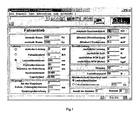
- FIG. 1 schematically shows an exemplary input mask for keyboard input. The values of the sizes are entered by means of the keyboard.
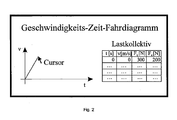
- FIG. 2 shows an exemplary input mask for graphical input using the mouse. Lines are clicked on and then deformed by dragging the mouse. In the input mask corresponding values are displayed and changed according to the drag.
- the data can also be input and output via a software, interface. Pre- and post-processing functions are thus made possible. This also makes it possible to enter real data of an application as a data file, wherein these real data are recorded by means of measuring means on a drive installed in an existing application.
- an idealized drive system is used to determine the load from the starting dynamics.
- Each application is characterized by a combination of loads acting on the transmission according to the operating mode in the method according to the invention.
- a stationary state exists when the rotational speed remains constant.
- a dynamic state is used when the drive is subject to a speed change.
- the variables include torques, number of load cycles, transverse and axial forces. Therefore, the associated load collective can be identified by points in an at least four-dimensional space. For example, a single point in this illustration describes that the corresponding value for torque, the corresponding value for axial force, and the corresponding value for lateral force with the associated load change number occur in the application according to the operating data. In this case, each value is assigned a respective value range by means of the described class division. "Torques which vary within a value range of the class division are regarded as this value associated with the class.
- n 1 , n 2 or n 3 corresponds to the number of load cycles on the output shaft. Of all sizes, only the amounts for illustration in FIG. 4 are used here.
- a permissible equivalent torque for a given number of load cycles is determined for each partial collective from the predetermined number of load cycles and the associated axial and / or transverse force.
- diagrams according to FIGS. 5, 6, 7 and 8 are produced which are calculated by means of a very large transmission database using the standards such as DIN 743, known physical equations and information from bearing manufacturers.
- An essential feature is that in the method according to the invention a closed representation is used to describe the equivalent limit load for a sub-collective for a component.
- the equivalent limit load on an output shaft should be described as a permissible torque
- a limit load curve is derived from the said gear database using the standards and known physical equations with sufficient accuracy.
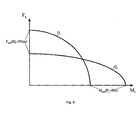
- the limit load curve represented as a lateral force / torque diagram is determined as an ellipse.
- M azul is the allowable torque
- F q (ni) the outer lateral force of a sub-collective
- F qzul (M a 0Nm) the allowable external lateral force at a torque of 0 Nm.
- the permissible torque can now be determined from the transverse force, which can also be described as an equivalent torque. Depending on the application data or load spectrum, this results in different values for this permissible torque.
- the calculation method for output shaftless bearings is illustrated in accordance with FIG. 7.
- limit load curves are entered for various output speeds, with it being possible to use straight lines.
- the speed n a is the standard output speed, ie the output speed of the transmission during mains operation.
- a gradient m of the limit load curves is determined.
- m F q ⁇ 2 - F q ⁇ 1 M 3 Max .
- m the slope of the limit load curves
- M amax is the maximum transmission output torque.
- M azul the allowable torque
- F qn aist the permissible lateral force at the operating output speed
- M a 0Nm
- F q (n j ) the outer lateral force of the sub-collective
- m is the slope of the limit load curves.
- a sufficient approximation in this document is understood to mean a tolerance that is less than 10%, but in some cases it is more expedient and advantageous to fall below a tolerance of 1%.
- the point 16 as the intersection of the line through the points 6 and 7 or 10 and 11 determined ..
- non-linear curves with finite radius of curvature can be used instead of the circle, but then have more parameters.
- the entire family of characteristics is stored with sufficiently many, so dense curves that the Corner point 17 from FIG. 8b can either be found directly on a characteristic curve or can be determined by linear interpolation.
- FIG. 5 When using solid or floating bearings as components, a diagram according to FIG. 5 is provided. From the said transmission database using the standards and known physical equations, it follows that the straight lines according to FIG. 8a are parallel through the points 6 and 7, 8 and 9 or 10 and 11 in FIG. 5. The design of the limit load characteristics is omitted the points 4, 8, 9, 10, 13, 15 and 16 of Figure 8a. For the definition of the limit load characteristics, 4 instead of 5 parameters are sufficient, because instead of the circle according to FIG. 8a a straight line can now be used which passes through the points 12 and 14 in FIG. The point 17 is therefore determined by the intersection of the straight lines through the points 12 and 14 with the parallel straight line to the straight line through the points 6 and 7 through the point F i (N vorg ) generated. Thus, even with fixed or floating bearings in a transverse force-axial force diagram, a value for allowable equivalent torque can be determined, which corresponds to the prevailing in the application of transverse and axial force for the corresponding respective sub-collective.
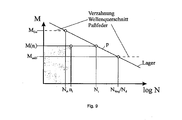
- N i N vorg ⁇ ( M azulD M n i ⁇ ) p .
- N i breaking load number
- N Vorg the predetermined load change number
- M azulD the allowable equivalent torque or damage accumulation torque
- M (n i ) the torque of the original input sub-collective
- p the slope exponent
Landscapes
- Engineering & Computer Science (AREA)
- Automation & Control Theory (AREA)
- Manufacturing & Machinery (AREA)
- Quality & Reliability (AREA)
- Physics & Mathematics (AREA)
- General Physics & Mathematics (AREA)
- General Engineering & Computer Science (AREA)
- Testing Of Devices, Machine Parts, Or Other Structures Thereof (AREA)
- Impact Printers (AREA)
- Particle Formation And Scattering Control In Inkjet Printers (AREA)
- Electrical Discharge Machining, Electrochemical Machining, And Combined Machining (AREA)
- Control Of Electric Motors In General (AREA)
- Control Of Multiple Motors (AREA)
Claims (27)
- Procédé pour la détermination et/ou la fabrication d'un entraînement ou de pièces pour un entraînement
provenant d'une gamme d'entraînements,
la gamme comprenant au moins une taille, chaque taille comprenant au moins une variante d'entraînements,
caractérisé en ce que
à partir de données d'application entrées et/ou transmises et/ou de données d'un collectif de charges, en particulier d'un collectif de charges comprenant plusieurs collectifs partiels, une valeur d'une grandeur pour la saisie quantitative de la capacité de surcharge est déterminée pour chaque variante de la série,
et en ce que seules des variantes sont déterminées et/ou fabriquées, pour lesquelles la valeur de la grandeur remplit une condition, en particulier dépasse une valeur critique ou est un extremum,
dans lequel un facteur de sûreté de fonctionnement SB est prévu comme grandeur. - Procédé selon l'une quelconque des revendications précédentes,
caractérisé en ce que
seules des variantes dont, comme condition, le facteur de sûreté de fonctionnement SB dépasse la valeur 1 sont déterminées et/ou fabriquées. - Procédé selon l'une quelconque des revendications précédentes,
caractérisé en ce que
seule celle des variantes est déterminée et/ou fabriquée qui est l'entraînement optimal et/ou de coût le plus avantageux pour l'application, en particulier selon d'autres exigences comme aussi par exemple des exigences géométriques ou, si le facteur de sûreté de fonctionnement SB est supérieur à 1 pour plus d'un entraînement, qui est l'entraînement avec la longévité la plus longue. - Procédé selon l'une quelconque des revendications précédentes,
caractérisé en ce que
le facteur de sûreté de fonctionnement SB est déterminé pour un entraînement, comprenant la boîte de vitesses et le moteur, prévu pour une charge,
un facteur de sûreté de fonctionnement SB pour l'entraînement ou au moins pour sa boîte de vitesses étant déterminé depuis un collectif de charge au moins tridimensionnel. - Procédé selon l'une quelconque des revendications précédentes,
caractérisé en ce que
au moins sur la boîte de vitesses, un facteur de sûreté de fonctionnement individuel SBj est déterminé pour chaque composant j, et de celui-ci le minimum de tous les facteurs de sûreté de fonctionnement individuels SBj est utilisé ou déterminé et sorti et/ou affiché comme facteur de sûreté de fonctionnement SB, et pour le déclenchement de la commande et pour la liaison avec la fabrication. - Procédé selon l'une quelconque des revendications précédentes,
caractérisé en ce que
le collectif de charge est au moins quadridimensionnel et comprend au moins des informations sur la variation en fonction du temps des grandeurs couple, vitesse de rotation, force axiale et force transversale. - Procédé selon l'une quelconque des revendications précédentes,
caractérisé en ce que
le collectif de charge comporte la direction et le module de la force transversale
et/ou le point d'attaque de la force transversale. - Procédé selon l'une quelconque des revendications précédentes,
caractérisé en ce que
le collectif de charge comprend comme informations sur la variation en fonction du temps le nombre d'alternances de charge pour les grandeurs. - Procédé selon l'une quelconque des revendications précédentes,
caractérisé en ce que
le collectif de charge comprend des collectifs partiels qui sont engendrés par formation de classes, les classes respectives comprenant des intervalles de valeur respectifs des grandeurs correspondantes. - Procédé selon l'une quelconque des revendications précédentes,
caractérisé en ce que
pour un collectif partiel respectif, une ligne caractéristique de charge limite est déterminée pour chaque composant et en ce qu'au moyen de cette ligne caractéristique de charge limite et d'au moins une grandeur spécifiable, comme la force transversale et/ou la force axiale, un couple admissible est déterminé. - Procédé selon l'une quelconque des revendications précédentes,
caractérisé en ce que
des tronçons d'arbres présentant différents diamètres ou des tronçons d'arbres présentant des discontinuités géométriques sont retenus comme composants séparés. - Procédé selon l'une quelconque des revendications précédentes,
caractérisé en ce que
la courbe caractéristique de charge limite est paramétrable par deux paramètres dans un diagramme force transversale-couple
et/ou
la courbe caractéristique de charge limite est paramétrable par quatre ou cinq paramètres dans un diagramme force transversale-force axiale. - Procédé selon l'une quelconque des revendications précédentes,
caractérisé en ce que
au moyen d'une courbe caractéristique de charge limite dans un diagramme force transversale-couple, une valeur pour le couple admissible équivalent est déterminée à partir d'une valeur pour la force transversale. - Procédé selon l'une quelconque des revendications précédentes,
caractérisé en ce que
au moyen d'une courbe caractéristique de charge limite dans un diagramme force axiale-couple, une valeur pour le couple admissible équivalent est déterminée à partir d'une valeur pour la force axiale. - Procédé selon l'une quelconque des revendications précédentes,
caractérisé en ce que
au moyen d'une courbe caractéristique de charge limite dans un diagramme force axiale-force transversale, une valeur pour le couple admissible équivalent est déterminée à partir d'une valeur pour la force axiale et d'une valeur pour la force transversale. - Procédé selon l'une quelconque des revendications précédentes,
caractérisé en ce que
pour chaque collectif partiel et pour chaque composant, un nombre d'alternances de charge de rupture est déterminée à partir du nombre correspondant prédéfini des alternances de charge, de la valeur pour le couple et du couple admissible équivalent respectif. - Procédé selon l'une quelconque des revendications précédentes,
caractérisé en ce que
pour la détermination du facteur de sûreté de fonctionnement SB, on utilise au moins une hypothèse d'accumulation de dommage. - Procédé selon l'une quelconque des revendications précédentes,
caractérisé en ce que
à partir de la fréquence de cycles de rupture respective et du nombre d'alternances de charge correspondant, un facteur individuel de sûreté de fonctionnement
- Procédé selon l'une quelconque des revendications précédentes,
caractérisé en ce que
la température de l'environnement, la température de service maximale et/ou la longévité minimale désirée de l'entraînement sont appréhendées par les données d'application entrées, en particulier comportant les conditions géométriques aux limites. - Procédé selon l'une quelconque des revendications précédentes,
caractérisé en ce que
la capacité de charge thermique du moteur et/ou de la boîte de vitesses est sortie et/ou est affichée, en particulier comme puissance thermique limite. - Procédé selon l'une quelconque des revendications précédentes,
caractérisé en ce que
des données sont entrées et sorties via une interface,
l'interface comprenant une interface utilisateur graphique et/ou une interface de données pour l'entrée et la sortie de données, des données d'application pouvant être entrées,
qui comprennent un collectif de charge comprenant plusieurs collectifs partiels,
au moins des données comme des valeurs ou des variations en fonction du temps pouvant être entrées pour les trois grandeurs à chaque collectif partiel. - Procédé selon l'une quelconque des revendications précédentes,
caractérisé en ce que
le collectif de charge peut être entré- par un « Tupel » appartenant au collectif de charge, comprenant respectivement le nombre d'alternances de charge, le couple et au moins une autre grandeur, et/ou- par au moins un diagramme de marche qui représente au moins deux états différents de l'application, le nombre d'alternances, le couple et au moins une autre grandeur pouvant être entrées pour chaque état. - Procédé selon l'une quelconque des revendications précédentes,
caractérisé en ce que
des diagrammes de marche peuvent être entrés graphiquement par l'interface, en particulier moyennant l'utilisation d'une souris. - Procédé selon l'une quelconque des revendications précédentes,
caractérisé en ce que
l'utilisateur est guidé lors de l'entrée de telle sorte qu'après l'entrée d'une information sur la non-existence d'une force axiale et/ou d'une force transversale, il n'est invité qu'à entrer un couple et un nombre d'alternance de charges.
et qu'après l'entrée d'une information sur la présence d'une force axiale et/ou d'une force transversale, il est invité à entrer des informations sur les grandeurs force axiale, force transversale, couple et nombre d'alternances de charges, en particulier des informations sur la variation de toutes les grandeurs en fonction du temps. - Procédé selon l'une quelconque des revendications précédentes,
caractérisé en ce que- sur un entraînement d'une application installée, des informations sur les valeurs concernant le service sont saisies en service, en particulier moyennant l'utilisation de capteurs à cet effet,- et en ce que ces valeurs sont utilisées comme données d'application ou comme données du collectif de charge- et en ce que l'entraînement optimal et/ou celui avec les coûts les plus avantageux en est déterminé et est comparé à celui présent dans l'application. - Procédé selon l'une quelconque des revendications précédentes,
caractérisé en ce que
l'entrée des données est exécutée sur un premier ordinateur qui peut être relié par Internet à au moins un autre ordinateur,
l'autre ordinateur étant utilisable pour l'exécution du procédé, en particulier aussi pour le déclenchement de la commande et/ou pour la communication avec la fabrication. - Support de données avec un programme de traitement des données qui, quand il tourne sur une installation de traitement des données, réalise un procédé selon l'une quelconque des revendications 1 à 26.
Applications Claiming Priority (5)
| Application Number | Priority Date | Filing Date | Title |
|---|---|---|---|
| DE10150034 | 2001-10-11 | ||
| DE10150034 | 2001-10-11 | ||
| DE10156330 | 2001-11-19 | ||
| DE10156330A DE10156330B4 (de) | 2001-10-11 | 2001-11-19 | Verfahren zur Bestimmung eines Einzelbetriebssicherheitsfaktors für einen Antrieb, Verfahren zur Auswahl von Antrieben für eine Anlage oder Maschine aus einer Baureihe von Antrieben und Datenträger |
| PCT/EP2002/009581 WO2003034164A1 (fr) | 2001-10-11 | 2002-08-28 | Procede et dispositif de determination et/ou de production d'un systeme d'entrainement ou de pieces conçues pour un systeme d'entrainement, et interface et procede de determination d'un facteur de securite de fonctionnement s¿b? |
Publications (2)
| Publication Number | Publication Date |
|---|---|
| EP1436675A1 EP1436675A1 (fr) | 2004-07-14 |
| EP1436675B1 true EP1436675B1 (fr) | 2008-01-23 |
Family
ID=26010341
Family Applications (1)
| Application Number | Title | Priority Date | Filing Date |
|---|---|---|---|
| EP02772216A Revoked EP1436675B1 (fr) | 2001-10-11 | 2002-08-28 | Procede et dispositif de determination et/ou de production d'un systeme d'entrainement ou de pieces connues pour un systeme d'entrainement, et interface et procede de determination d'un facteur de securite de fonctionnement sb |
Country Status (5)
| Country | Link |
|---|---|
| US (1) | US20040249493A1 (fr) |
| EP (1) | EP1436675B1 (fr) |
| AT (1) | ATE384986T1 (fr) |
| DE (1) | DE50211618D1 (fr) |
| WO (1) | WO2003034164A1 (fr) |
Families Citing this family (1)
| Publication number | Priority date | Publication date | Assignee | Title |
|---|---|---|---|---|
| DE102007041739A1 (de) * | 2007-09-04 | 2009-03-05 | Sew-Eurodrive Gmbh & Co. Kg | Vorrichtung und Verfahren zum computergestützten Konstruieren einer Anlage, Rechner mit graphischer Benutzerschnittstelle und Datenträger |
Family Cites Families (4)
| Publication number | Priority date | Publication date | Assignee | Title |
|---|---|---|---|---|
| US5943245A (en) * | 1997-07-02 | 1999-08-24 | Reliance Electric Industrial Company | Motor application and selection method and apparatus |
| US6198181B1 (en) * | 1999-11-22 | 2001-03-06 | General Electric Company | Motor design methods and motors fabricated therefrom |
| DE10012437A1 (de) | 2000-03-15 | 2001-09-20 | Volkswagen Ag | Verfahren zum Konstruieren (CAD) und/oder zum Fertigstellen (CAM) und/oder zur Qualitätsüberprüfung (CIM) eines Werkstückes |
| JP4354169B2 (ja) * | 2002-10-11 | 2009-10-28 | シャープ株式会社 | ギア駆動系設計システム |
-
2002
- 2002-08-28 EP EP02772216A patent/EP1436675B1/fr not_active Revoked
- 2002-08-28 US US10/492,506 patent/US20040249493A1/en not_active Abandoned
- 2002-08-28 DE DE50211618T patent/DE50211618D1/de not_active Expired - Lifetime
- 2002-08-28 AT AT02772216T patent/ATE384986T1/de not_active IP Right Cessation
- 2002-08-28 WO PCT/EP2002/009581 patent/WO2003034164A1/fr not_active Ceased
Also Published As
| Publication number | Publication date |
|---|---|
| DE50211618D1 (de) | 2008-03-13 |
| ATE384986T1 (de) | 2008-02-15 |
| US20040249493A1 (en) | 2004-12-09 |
| EP1436675A1 (fr) | 2004-07-14 |
| WO2003034164A1 (fr) | 2003-04-24 |
Similar Documents
| Publication | Publication Date | Title |
|---|---|---|
| DE102007038890B4 (de) | Verfahren und Vorrichtung zur Bestimmung der Lebensdauer von im Arbeitsbetrieb befindlichen Bauteilen | |
| EP2582972B1 (fr) | Procédé et dispositif empêchant une oscillation transversale d'une éolienne | |
| DE102018105314B4 (de) | Motorauswahlvorrichtung | |
| DE102013013875A1 (de) | Verfahren zum Steuern eines Roboters | |
| DE102010044644A1 (de) | Verfahren zur Kollisionserkennung für eine Antriebseinheit | |
| EP3983779B1 (fr) | Procédé et dispositif de contrôle prévisionnel de vehicule | |
| EP3094548B1 (fr) | Procédé et dispositif pour faire fonctionner un vélo à assistance électrique | |
| DE102018214099A1 (de) | Verfahren und System zur unmittelbaren Ermittlung einer theoretischen Schädigung mindestens einer Komponente einer Vorrichtung | |
| DE10156330B4 (de) | Verfahren zur Bestimmung eines Einzelbetriebssicherheitsfaktors für einen Antrieb, Verfahren zur Auswahl von Antrieben für eine Anlage oder Maschine aus einer Baureihe von Antrieben und Datenträger | |
| EP3607294B1 (fr) | Procede de commande, notamment de reglage, d'un banc d'essai du groupe motopropulseur avec une vraie boite de vitesse | |
| DE4406723A1 (de) | Verfahren zur Überwachung des Betriebszustands einer Maschine oder Anlage | |
| EP1436675B1 (fr) | Procede et dispositif de determination et/ou de production d'un systeme d'entrainement ou de pieces connues pour un systeme d'entrainement, et interface et procede de determination d'un facteur de securite de fonctionnement sb | |
| EP3994025A1 (fr) | Procédé et dispositif pour faire fonctionner un système d'entraînement d'un véhicule automobile, et système d'entraînement | |
| WO2018158181A1 (fr) | Système d'entraînement et évaluation associée | |
| DE102008027834A1 (de) | System und Verfahren zur vereinfachten Bedienung und/oder Handhabung von Automatisierungs- und/oder Prozessleitsystemen | |
| EP3786607A1 (fr) | Procédé de pronostic de dommages sur un composant d'un palier | |
| EP0098570A2 (fr) | Dispositif d'essai d'un générateur de couple | |
| EP2786110B1 (fr) | Procédé de surveillance de l'état d'un palier guidant un moteur électrique sur un arbre | |
| DE68928208T2 (de) | Regelprüfungeinrichtung und Fuzzy-Interferenzverfahren | |
| EP1803040B1 (fr) | Procede de surveillance de l'etat de charge d'un moteur d'entrainement et dispositif associe | |
| WO1994022066A1 (fr) | Systeme standard d'automatisation a logique floue pour installations industrielles | |
| EP2126536A1 (fr) | Dispositif et procédé pour un test de fonctionnement d'un frein | |
| EP3435299A1 (fr) | Procédé de planification et/ou de fonctionnement d'une installation technique | |
| DE112023005893T5 (de) | Anzeigevorrichtung und Steuerungssystem für Werkzeugmaschinen | |
| DE102008026939B4 (de) | Verfahren zur Bestimmung eines Ermüdungszustands der Lager einer elektromechanischen Lenkung |
Legal Events
| Date | Code | Title | Description |
|---|---|---|---|
| PUAI | Public reference made under article 153(3) epc to a published international application that has entered the european phase |
Free format text: ORIGINAL CODE: 0009012 |
|
| 17P | Request for examination filed |
Effective date: 20040511 |
|
| AK | Designated contracting states |
Kind code of ref document: A1 Designated state(s): AT BE BG CH CY CZ DE DK EE ES FI FR GB GR IE IT LI LU MC NL PT SE SK TR |
|
| AX | Request for extension of the european patent |
Extension state: AL LT LV MK RO SI |
|
| GRAP | Despatch of communication of intention to grant a patent |
Free format text: ORIGINAL CODE: EPIDOSNIGR1 |
|
| GRAS | Grant fee paid |
Free format text: ORIGINAL CODE: EPIDOSNIGR3 |
|
| GRAA | (expected) grant |
Free format text: ORIGINAL CODE: 0009210 |
|
| AK | Designated contracting states |
Kind code of ref document: B1 Designated state(s): AT BE BG CH CY CZ DE DK EE ES FI FR GB GR IE IT LI LU MC NL PT SE SK TR |
|
| REG | Reference to a national code |
Ref country code: GB Ref legal event code: FG4D Free format text: NOT ENGLISH |
|
| REG | Reference to a national code |
Ref country code: CH Ref legal event code: EP |
|
| REG | Reference to a national code |
Ref country code: IE Ref legal event code: FG4D Free format text: LANGUAGE OF EP DOCUMENT: GERMAN |
|
| REF | Corresponds to: |
Ref document number: 50211618 Country of ref document: DE Date of ref document: 20080313 Kind code of ref document: P |
|
| GBT | Gb: translation of ep patent filed (gb section 77(6)(a)/1977) |
Effective date: 20080415 |
|
| NLV1 | Nl: lapsed or annulled due to failure to fulfill the requirements of art. 29p and 29m of the patents act | ||
| PG25 | Lapsed in a contracting state [announced via postgrant information from national office to epo] |
Ref country code: FI Free format text: LAPSE BECAUSE OF FAILURE TO SUBMIT A TRANSLATION OF THE DESCRIPTION OR TO PAY THE FEE WITHIN THE PRESCRIBED TIME-LIMIT Effective date: 20080123 Ref country code: ES Free format text: LAPSE BECAUSE OF FAILURE TO SUBMIT A TRANSLATION OF THE DESCRIPTION OR TO PAY THE FEE WITHIN THE PRESCRIBED TIME-LIMIT Effective date: 20080504 |
|
| PG25 | Lapsed in a contracting state [announced via postgrant information from national office to epo] |
Ref country code: BG Free format text: LAPSE BECAUSE OF FAILURE TO SUBMIT A TRANSLATION OF THE DESCRIPTION OR TO PAY THE FEE WITHIN THE PRESCRIBED TIME-LIMIT Effective date: 20080423 |
|
| ET | Fr: translation filed | ||
| PG25 | Lapsed in a contracting state [announced via postgrant information from national office to epo] |
Ref country code: PT Free format text: LAPSE BECAUSE OF FAILURE TO SUBMIT A TRANSLATION OF THE DESCRIPTION OR TO PAY THE FEE WITHIN THE PRESCRIBED TIME-LIMIT Effective date: 20080623 |
|
| REG | Reference to a national code |
Ref country code: IE Ref legal event code: FD4D |
|
| PG25 | Lapsed in a contracting state [announced via postgrant information from national office to epo] |
Ref country code: SE Free format text: LAPSE BECAUSE OF FAILURE TO SUBMIT A TRANSLATION OF THE DESCRIPTION OR TO PAY THE FEE WITHIN THE PRESCRIBED TIME-LIMIT Effective date: 20080423 Ref country code: CZ Free format text: LAPSE BECAUSE OF FAILURE TO SUBMIT A TRANSLATION OF THE DESCRIPTION OR TO PAY THE FEE WITHIN THE PRESCRIBED TIME-LIMIT Effective date: 20080123 Ref country code: DK Free format text: LAPSE BECAUSE OF FAILURE TO SUBMIT A TRANSLATION OF THE DESCRIPTION OR TO PAY THE FEE WITHIN THE PRESCRIBED TIME-LIMIT Effective date: 20080123 Ref country code: NL Free format text: LAPSE BECAUSE OF FAILURE TO SUBMIT A TRANSLATION OF THE DESCRIPTION OR TO PAY THE FEE WITHIN THE PRESCRIBED TIME-LIMIT Effective date: 20080123 Ref country code: SK Free format text: LAPSE BECAUSE OF FAILURE TO SUBMIT A TRANSLATION OF THE DESCRIPTION OR TO PAY THE FEE WITHIN THE PRESCRIBED TIME-LIMIT Effective date: 20080123 Ref country code: IE Free format text: LAPSE BECAUSE OF FAILURE TO SUBMIT A TRANSLATION OF THE DESCRIPTION OR TO PAY THE FEE WITHIN THE PRESCRIBED TIME-LIMIT Effective date: 20080123 |
|
| PLBI | Opposition filed |
Free format text: ORIGINAL CODE: 0009260 |
|
| PLBI | Opposition filed |
Free format text: ORIGINAL CODE: 0009260 |
|
| PLAX | Notice of opposition and request to file observation + time limit sent |
Free format text: ORIGINAL CODE: EPIDOSNOBS2 |
|
| 26 | Opposition filed |
Opponent name: WITTENSTEIN AG Effective date: 20081023 |
|
| 26 | Opposition filed |
Opponent name: LENZE DRIVES GMBH Effective date: 20081023 Opponent name: WITTENSTEIN AG Effective date: 20081023 |
|
| PLBB | Reply of patent proprietor to notice(s) of opposition received |
Free format text: ORIGINAL CODE: EPIDOSNOBS3 |
|
| PG25 | Lapsed in a contracting state [announced via postgrant information from national office to epo] |
Ref country code: MC Free format text: LAPSE BECAUSE OF NON-PAYMENT OF DUE FEES Effective date: 20080831 |
|
| REG | Reference to a national code |
Ref country code: CH Ref legal event code: PL |
|
| PG25 | Lapsed in a contracting state [announced via postgrant information from national office to epo] |
Ref country code: EE Free format text: LAPSE BECAUSE OF FAILURE TO SUBMIT A TRANSLATION OF THE DESCRIPTION OR TO PAY THE FEE WITHIN THE PRESCRIBED TIME-LIMIT Effective date: 20080123 |
|
| PG25 | Lapsed in a contracting state [announced via postgrant information from national office to epo] |
Ref country code: CH Free format text: LAPSE BECAUSE OF NON-PAYMENT OF DUE FEES Effective date: 20080831 Ref country code: LI Free format text: LAPSE BECAUSE OF NON-PAYMENT OF DUE FEES Effective date: 20080831 |
|
| PG25 | Lapsed in a contracting state [announced via postgrant information from national office to epo] |
Ref country code: BE Free format text: LAPSE BECAUSE OF NON-PAYMENT OF DUE FEES Effective date: 20080831 Ref country code: CY Free format text: LAPSE BECAUSE OF FAILURE TO SUBMIT A TRANSLATION OF THE DESCRIPTION OR TO PAY THE FEE WITHIN THE PRESCRIBED TIME-LIMIT Effective date: 20080123 |
|
| PG25 | Lapsed in a contracting state [announced via postgrant information from national office to epo] |
Ref country code: AT Free format text: LAPSE BECAUSE OF NON-PAYMENT OF DUE FEES Effective date: 20080828 |
|
| PG25 | Lapsed in a contracting state [announced via postgrant information from national office to epo] |
Ref country code: LU Free format text: LAPSE BECAUSE OF NON-PAYMENT OF DUE FEES Effective date: 20080828 |
|
| PLAB | Opposition data, opponent's data or that of the opponent's representative modified |
Free format text: ORIGINAL CODE: 0009299OPPO |
|
| PG25 | Lapsed in a contracting state [announced via postgrant information from national office to epo] |
Ref country code: TR Free format text: LAPSE BECAUSE OF FAILURE TO SUBMIT A TRANSLATION OF THE DESCRIPTION OR TO PAY THE FEE WITHIN THE PRESCRIBED TIME-LIMIT Effective date: 20080123 |
|
| R26 | Opposition filed (corrected) |
Opponent name: LENZE DRIVES GMBH Effective date: 20081023 Opponent name: WITTENSTEIN AG Effective date: 20081023 |
|
| PG25 | Lapsed in a contracting state [announced via postgrant information from national office to epo] |
Ref country code: GR Free format text: LAPSE BECAUSE OF FAILURE TO SUBMIT A TRANSLATION OF THE DESCRIPTION OR TO PAY THE FEE WITHIN THE PRESCRIBED TIME-LIMIT Effective date: 20080424 |
|
| PLAB | Opposition data, opponent's data or that of the opponent's representative modified |
Free format text: ORIGINAL CODE: 0009299OPPO |
|
| R26 | Opposition filed (corrected) |
Opponent name: LENZE DRIVES GMBH Effective date: 20081023 Opponent name: WITTENSTEIN AG Effective date: 20081023 |
|
| PG25 | Lapsed in a contracting state [announced via postgrant information from national office to epo] |
Ref country code: IT Free format text: LAPSE BECAUSE OF NON-PAYMENT OF DUE FEES Effective date: 20090828 |
|
| PLAY | Examination report in opposition despatched + time limit |
Free format text: ORIGINAL CODE: EPIDOSNORE2 |
|
| PGRI | Patent reinstated in contracting state [announced from national office to epo] |
Ref country code: IT Effective date: 20110616 |
|
| PLAH | Information related to despatch of examination report in opposition + time limit modified |
Free format text: ORIGINAL CODE: EPIDOSCORE2 |
|
| PLBC | Reply to examination report in opposition received |
Free format text: ORIGINAL CODE: EPIDOSNORE3 |
|
| RDAF | Communication despatched that patent is revoked |
Free format text: ORIGINAL CODE: EPIDOSNREV1 |
|
| APBM | Appeal reference recorded |
Free format text: ORIGINAL CODE: EPIDOSNREFNO |
|
| APBP | Date of receipt of notice of appeal recorded |
Free format text: ORIGINAL CODE: EPIDOSNNOA2O |
|
| APBQ | Date of receipt of statement of grounds of appeal recorded |
Free format text: ORIGINAL CODE: EPIDOSNNOA3O |
|
| APAH | Appeal reference modified |
Free format text: ORIGINAL CODE: EPIDOSCREFNO |
|
| PLAB | Opposition data, opponent's data or that of the opponent's representative modified |
Free format text: ORIGINAL CODE: 0009299OPPO |
|
| R26 | Opposition filed (corrected) |
Opponent name: WITTENSTEIN AG Effective date: 20081023 |
|
| REG | Reference to a national code |
Ref country code: FR Ref legal event code: PLFP Year of fee payment: 15 |
|
| PLAB | Opposition data, opponent's data or that of the opponent's representative modified |
Free format text: ORIGINAL CODE: 0009299OPPO |
|
| R26 | Opposition filed (corrected) |
Opponent name: WITTENSTEIN SE Effective date: 20081023 |
|
| REG | Reference to a national code |
Ref country code: FR Ref legal event code: PLFP Year of fee payment: 16 |
|
| REG | Reference to a national code |
Ref country code: FR Ref legal event code: PLFP Year of fee payment: 17 |
|
| PGFP | Annual fee paid to national office [announced via postgrant information from national office to epo] |
Ref country code: DE Payment date: 20200831 Year of fee payment: 19 Ref country code: GB Payment date: 20200819 Year of fee payment: 19 Ref country code: FR Payment date: 20200715 Year of fee payment: 19 |
|
| PGFP | Annual fee paid to national office [announced via postgrant information from national office to epo] |
Ref country code: IT Payment date: 20200713 Year of fee payment: 19 |
|
| REG | Reference to a national code |
Ref country code: DE Ref legal event code: R064 Ref document number: 50211618 Country of ref document: DE Ref country code: DE Ref legal event code: R103 Ref document number: 50211618 Country of ref document: DE |
|
| APBU | Appeal procedure closed |
Free format text: ORIGINAL CODE: EPIDOSNNOA9O |
|
| RDAG | Patent revoked |
Free format text: ORIGINAL CODE: 0009271 |
|
| STAA | Information on the status of an ep patent application or granted ep patent |
Free format text: STATUS: PATENT REVOKED |
|
| REG | Reference to a national code |
Ref country code: FI Ref legal event code: MGE |
|
| 27W | Patent revoked |
Effective date: 20210311 |
|
| GBPR | Gb: patent revoked under art. 102 of the ep convention designating the uk as contracting state |
Effective date: 20210311 |
|
| REG | Reference to a national code |
Ref country code: AT Ref legal event code: MA03 Ref document number: 384986 Country of ref document: AT Kind code of ref document: T Effective date: 20210311 |