EP1437357B1 - Verfahren zur Herstellung eines Alkoxysilans - Google Patents
Verfahren zur Herstellung eines Alkoxysilans Download PDFInfo
- Publication number
- EP1437357B1 EP1437357B1 EP04000059A EP04000059A EP1437357B1 EP 1437357 B1 EP1437357 B1 EP 1437357B1 EP 04000059 A EP04000059 A EP 04000059A EP 04000059 A EP04000059 A EP 04000059A EP 1437357 B1 EP1437357 B1 EP 1437357B1
- Authority
- EP
- European Patent Office
- Prior art keywords
- component
- process according
- shown below
- groups
- reaction
- Prior art date
- Legal status (The legal status is an assumption and is not a legal conclusion. Google has not performed a legal analysis and makes no representation as to the accuracy of the status listed.)
- Expired - Lifetime
Links
- 0 CCCCC(CCC)N* Chemical compound CCCCC(CCC)N* 0.000 description 2
Classifications
-
- C—CHEMISTRY; METALLURGY
- C07—ORGANIC CHEMISTRY
- C07F—ACYCLIC, CARBOCYCLIC OR HETEROCYCLIC COMPOUNDS CONTAINING ELEMENTS OTHER THAN CARBON, HYDROGEN, HALOGEN, OXYGEN, NITROGEN, SULFUR, SELENIUM OR TELLURIUM
- C07F7/00—Compounds containing elements of Groups 4 or 14 of the Periodic Table
- C07F7/02—Silicon compounds
- C07F7/08—Compounds having one or more C—Si linkages
- C07F7/18—Compounds having one or more C—Si linkages as well as one or more C—O—Si linkages
- C07F7/1804—Compounds having Si-O-C linkages
- C07F7/1872—Preparation; Treatments not provided for in C07F7/20
- C07F7/188—Preparation; Treatments not provided for in C07F7/20 by reactions involving the formation of Si-O linkages
Definitions
- the present invention relates to a process for producing an alkoxysilane-based compound in an industrially applicable manner, which uses a secondary alcohol or a tertiary alcohol as a raw material.
- reaction of the above process proceeds substantially quantitatively, enabling an efficient production of the target compound.
- Japanese Patent publication No. 2,688,469 discloses a process for producing a (meth)acrylic functional group-containing organosilicon compound through a dehydrohalogenation reaction of (meth)acrylic acid and a haloalkyl group-containing organosilicon compound, wherein the reaction is conducted in the presence of 1,8-diazabicyclo[5.4.0]undecene-7 (hereafter referred to as "DBU”), which functions as a hydrogen halide acceptor.
- DBU 1,8-diazabicyclo[5.4.0]undecene-7
- DBU is expensive, and the use of large quantities of DBU as an industrial raw material is undesirable from a cost perspective, and in addition, a step for isolating and recovering the DBU is necessary, using filtration to separate the salt of DBU and the hydrogen halide produced in the reaction, and then washing the isolated salt with an aqueous alkali solution, and so even from a process perspective, the use of DBU is unfavorable.
- An object of the present invention is to provide a process for producing an alkoxysilane-based compound efficiently, at a high reaction rate, and under favorable cost conditions, using a secondary alcohol or a tertiary alcohol as a raw material.
- the inventors of the present invention investigated the use of DBU within the production of alkoxysilane-based compounds from a secondary alcohol or a tertiary alcohol and a halogenated organosilicon compound, based on the use of DBU in the process disclosed in the above reference publication, which is similar in so far as also being a dehydrohalogenation reaction.
- DBU dimethyl methoxysilane
- the reaction rate could be improved dramatically, and the target compound could be produced efficiently and with a high yield, and as a result of further intensive investigation based on this discovery, they were able to complete the present invention.
- each R 1 represents, independently, either an unsubstituted or substituted monovalent hydrocarbon group of 1 to 20 carbon atoms, which either contains, or does not contain, an ether linkage oxygen atom within a chain, or a group represented by a formula: R 2 O- (wherein, R 2 represents an unsubstituted or substituted monovalent hydrocarbon group of 1 to 20 carbon atoms, which either contains, or does not contain, an ether linkage oxygen atom within a chain), R 3 has an identical definition to that of R 1 above, a represents an integer of either 0 or 1, and n represents an integer of 1, 2, or 3], wherein
- the component (a), which represents a raw material compound for the process of the present invention is a secondary alcohol or a tertiary alcohol represented by a general formula (1) shown below: [wherein, each R 1 represents, independently, either an unsubstituted or substituted monovalent hydrocarbon group of 1 to 20 carbon atoms, and preferably from 5 to 15 carbon atoms (which may contain an ether linkage oxygen atom within the chain), or a group represented by a formula: R 2 O- (wherein, R 2 represents an unsubstituted or substituted monovalent hydrocarbon group of 1 to 20 carbon atoms, and preferably from 5 to 15 carbon atoms (which may contain an ether linkage oxygen atom within the chain)), and a represents either 0 or 1].
- R 1 groups include alkyl groups such as methyl groups, ethyl groups, n-propyl groups, isopropyl groups, n-butyl groups, tert-butyl groups, pentyl groups, and hexyl groups; cycloalkyl groups such as cyclopentyl groups and cyclohexyl groups; aryl groups such as phenyl groups; aralkyl groups such as benzyl groups and phenylethyl groups; alkenyl groups such as vinyl groups and allyl groups; alkynyl groups such as ethynyl groups; alkoxyalkyl groups such as methoxymethyl groups, methoxyethyl groups, ethoxyethyl groups, and (2-methoxy)ethoxymethyl groups; as well as groups in which either a portion of, or all of, the hydrogen atoms in the above groups have been substituted with halogen atoms such as chlorine atoms or
- R 1 is a group represented by the above formula R 2 O-
- specific examples of the group include alkoxy groups such as methoxy groups and ethoxy groups; alkenoxy groups such as vinyloxy groups and allyloxy groups; aryloxy groups such as phenoxy groups; alkoxyalkoxy group such as methoxymethoxy groups, methoxyethoxy groups, ethoxyethoxy groups, and (2-methoxy)ethoxymethoxy groups; as well as groups in which either a portion of, or all of, the hydrogen atoms in the above groups have been substituted with halogen atoms such as chlorine atoms or fluorine atoms, including fluorinated alkoxyalkoxy groups represented by the formulas: CF 3 O-, CF 3 O-C 2 F 4 O-, and C 3 F 7 O-C 3 F 6 O-.
- R 4 represents a hydrogen atom or an alkyl group of 1 to 15 carbon atoms. This definition also applies in the following formulas.) (wherein, p is an integer from 0 to 10) (wherein, R 5 represents a hydrogen atom or an alkyl group of 1 to 15 carbon atoms, and q is an integer from 0 to 9) (wherein, r is an integer from 0 to 6)
- the component (b) which represents a raw material compound for the process of the present invention, is a halogenated organosilicon compound represented by a general formula (2) shown below: X n ⁇ Si( ⁇ R 3 ) 4-n (2) [wherein, R 3 has the same definition as R 1 in the general formula (1) above, X represents a chlorine atom, a bromine atom, or an iodine atom, and n represents 1, 2, or 3].
- halogenated organosilicon compound represented by the above general formula (2) is shown below, although the invention is not restricted to these compounds.
- the tertiary amines used in the process of the present invention perform the function of capturing the hydrogen halide generated by the reaction between the aforementioned component (a) and the component (b), forming a salt, and accelerating the reaction.
- the component (c1) used in the process of the present invention is a tertiary amine other than those of the component (c2) described below, and specific examples include trialkylamines in which alkyl groups of 1 to 6 carbon atoms are bonded to a nitrogen atom, such as triethylamine, tripropylamine, tributylamine, trimethylamine, diethylmethylamine, and butyldimethylamine.
- Aryl-based amines such as diethylphenylamine, and heterocyclic compounds such as pyridine can also be used.
- the component (c2) used in the process of the present invention is either: 1,8-diazabicyclo[5.4.0]undecene-7 (DBU), 1,5-diazabicyclo[4.3.0]nonene-5. or a mixture of the two compounds,
- the quantities used of the alcohol of the component (a) and the halogenated organosilicon compound of the component (b) can be adjusted to any proportional combination, although using a quantity of the component (a) that is equivalent to 1.0 to 1.5 mols, and preferably from 1.0 to 1.2 mols, per 1 mol of halogen atoms within the component (b) is most effective in terms of reaction efficiency.
- the use of the tertiary amines described above is a characteristic feature of the process of the present invention, and by combining a small proportion of the DBU or the like of the component (c2) with the tertiary amine of the component (c1), the reaction rate of the dehydrohalogenation reaction can be improved dramatically.
- the quantity used of the DBU or the like of the component (c2) is preferably comparatively small, and a quantity within a range from 0.3 to 20 mol%, and preferably from 0.5 to 10 mol%, relative to the combined quantity of the component (c1) and the component (c2) is sufficient.
- the quantity of tertiary amine used as a base during the reaction is preferably within a range from 1.0 to 1.5 mols per 1 mol of halogen atoms within the component (b).
- a process for producing an alkoxysilane-based compound of the present invention is conducted in a reaction system containing the secondary alcohol or tertiary alcohol of the component (a), the halogenated organosilicon compound of the component (b), and the tertiary amines of the component (c1) and the component (c2), and there are no particular restrictions on the method used for introducing the raw materials.
- the component (c1) and the component (c2) can be added to the secondary alcohol or tertiary alcohol of the component (a), either together or separately, and this mixture then subjected to stirring and mixing while the halogenated organosilicon compound of the component (b) is added dropwise.
- the solvent is preferably a hydrocarbon-based solvent with a boiling point of 40 to 180°C, and preferably from 70 to 120°C, and specific examples of suitable solvents include hexane, heptane, octane, benzene, toluene, xylene, and petroleum ether.
- the reaction time for the process of the present invention varies depending on factors such as the quantity of raw materials, and cannot be specified, although the reaction of a conventional process that does not use the component (c2) and requires approximately 2 to 16 hours, can be completed in the much shorter time of 30 minutes to 1 hour using the process of the present invention.
- the reaction temperature There are also no particular restrictions on the reaction temperature, although values from 0 to 100°C are typical. Because the process of the present invention is an exothermic reaction, in order to increase the final reaction ratio, the system is preferably cooled to ensure the reaction temperature is maintained at no more than 60°C.
- the target alkoxysilane-based compound can be obtained using an isolation operation that is suited to the properties of the target material, such as distillation.
- a 1 liter 4-necked flask equipped with a condenser, a stirring device and a thermometer was flushed with nitrogen, and then 78 g (0.926 mols) of an alcohol represented by a formula (4) shown below, 79 g (0.784 mols) of triethylamine, 3.58 g (0.0235 mols) of DBU and 78 g of toluene were placed in the flask, and the resulting mixture was stirred.
- 200 g (0.356 mols) of a dichlorosilane represented by a formula (5) shown below: was added dropwise to the reaction system, under a nitrogen atmosphere, over a period of 30 minutes. During this addition, cooling was conducted to maintain the temperature of the reaction system at no more than 60°C.
- a 1 liter 4-necked flask equipped with a condenser, a stirring device and a thermometer was flushed with nitrogen, and then 84 g (0.994 mols) of the alcohol of the example 1 represented by the formula (4), 85 g (0.841 mols) of triethylamine, 1.27 g (0.00841 mols) of DBU and 84 g of toluene were placed in the flask, and the resulting mixture was stirred.
- 260 g (0.764 mols) of a monochlorosilane represented by a formula (7) shown below: was added dropwise to the reaction system, under a nitrogen atmosphere, over a period of 30 minutes. During this addition, cooling was conducted to maintain the temperature of the reaction system at no more than 60°C.
- the reaction rate of a secondary alcohol or a tertiary alcohol with a halogenated organosilicon compound, and the yield of the alkoxysilane-based target compound can be improved, and in addition, problems of cost are minimal.
Landscapes
- Chemical & Material Sciences (AREA)
- Organic Chemistry (AREA)
- Chemical Kinetics & Catalysis (AREA)
Claims (10)
- Verfahren zur Herstellung einer Verbindung auf Alkoxysilanbasis mit der allgemeinen Formel (3):

dadurch gekennzeichnet, dass(a) eine durch die nachstehende allgemeine Formel (1) dargestellte Alkoholverbindung
und(b) eine durch die nachstehende allgemeine Formel (2) dargestellte halogenierte Organosiliziumverbindung:einer Dehydrohalogenierungsreaktion in Gegenwart von
X n ―Si(̵R 3 ) 4-n (2)
[wobei R3 und n wie oben definiert sind und X ein Chlor-, Brom- oder Jodatom darstellt](c1) einem anderen tertiären Amin als dem nachfolgend unter (c2) beschriebenen
sowie(c2) 1,8-Diazabicyclo[5.4.0]undecen-7 und/oder 1,5-Diazabicyclo[4.3.0]nonen-5unterzogen werden. - Verfahren gemäß Anspruch 1, dadurch gekennzeichnet, dass der Anteil an der Reaktionskomponente (c2) bezogen auf die Summe der Reaktionskomponenten (c1) and (c2) im Bereich von 0,3 bis 20 Mol% liegt.
- Verfahren gemäß Anspruch 1, dadurch gekennzeichnet, dass die Reaktionskomponente (a) ein durch die nachstehende Formel dargestelltes tertiäres Alkohol ist

- Verfahren gemäß Anspruch 1, dadurch gekennzeichnet, dass die Reaktionskomponente (b) eine durch die nachstehende Formel dargestellte halogenierte Organosiliziumverbindung ist
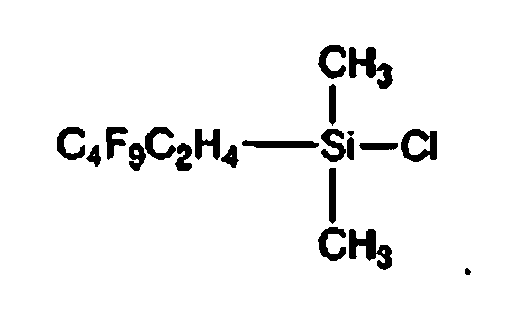
- Verfahren gemäß Anspruch 1, dadurch gekennzeichnet, dass die Reaktionskomponente (b) eine durch die nachstehende Formel dargestellte halogenierte Organosiliziumverbindung ist

- Verfahren gemäß Anspruch 1, dadurch gekennzeichnet, dass der Anteil an der Reaktionskomponente (a) bezogen auf 1 Mol Halogenatome in der Reaktionskomponente (b) im Bereich von 1,0 bis 1,5 Mol liegt
- Verfahren gemäß Anspruch 1, dadurch gekennzeichnet, dass als Reaktionskomponente (c1) mindestens ein tertiäres Amin aus der Gruppe Trialkylamine mit an das Stickstoffatom gebundenen Alkylgruppen mit 1 bis 6 Kohlenstoffatomen, Diethylphenylamin und Pyridin eingesetzt wird.
- Verfahren gemäß Anspruch 7, dadurch gekennzeichnet, dass als Trialkylamin mindestens eine Verbindung aus der Gruppe Triethylamin, Tripropylamin, Tributylamin, Trimethylamin, Diethylmethylamin und Butyldimethylamin eingesetzt wird.
- Verfahren gemäß Anspruch 1, dadurch gekennzeichnet, dass die Summe der Mengen an den Reaktionskomponenten (c1) und (c2) im Bereich von 1,0 bis 1,5 Mol bezogen auf 1 Mol Halogenatome in der Reaktionskomponente (b) liegt.
- Verfahren gemäß Anspruch 1, dadurch gekennzeichnet, dass die Reaktionskomponenten (a) und (b) einer Dehydrohalogenierungsreaktion in Gegenwart von den Reaktionskomponenten (c1) und (c2) sowie einem Lösungsmittel auf Kohlenwasserstoffbasis mit einem Siedebereich von 40 bis 180°C unterzogen werden.
Applications Claiming Priority (2)
| Application Number | Priority Date | Filing Date | Title |
|---|---|---|---|
| JP2003002792A JP4275417B2 (ja) | 2003-01-09 | 2003-01-09 | アルコキシシラン系化合物の製造方法 |
| JP2003002792 | 2003-01-09 |
Publications (2)
| Publication Number | Publication Date |
|---|---|
| EP1437357A1 EP1437357A1 (de) | 2004-07-14 |
| EP1437357B1 true EP1437357B1 (de) | 2006-08-30 |
Family
ID=32501220
Family Applications (1)
| Application Number | Title | Priority Date | Filing Date |
|---|---|---|---|
| EP04000059A Expired - Lifetime EP1437357B1 (de) | 2003-01-09 | 2004-01-05 | Verfahren zur Herstellung eines Alkoxysilans |
Country Status (4)
| Country | Link |
|---|---|
| US (1) | US7105693B2 (de) |
| EP (1) | EP1437357B1 (de) |
| JP (1) | JP4275417B2 (de) |
| DE (1) | DE602004002117T2 (de) |
Families Citing this family (4)
| Publication number | Priority date | Publication date | Assignee | Title |
|---|---|---|---|---|
| JP2007141399A (ja) * | 2005-11-21 | 2007-06-07 | Renesas Technology Corp | 半導体装置 |
| JP5612960B2 (ja) * | 2010-08-11 | 2014-10-22 | 株式会社ダイセル | フッ素含有化合物 |
| US8686176B2 (en) * | 2010-11-08 | 2014-04-01 | University Of Akron Research Foundation | Synthesis of reversibly protected silanes |
| JP7476777B2 (ja) * | 2020-11-30 | 2024-05-01 | 信越化学工業株式会社 | 含窒素オルガノキシシラン化合物の製造方法 |
Family Cites Families (2)
| Publication number | Priority date | Publication date | Assignee | Title |
|---|---|---|---|---|
| JP2688469B2 (ja) * | 1993-03-31 | 1997-12-10 | 信越化学工業株式会社 | (メタ)アクリル官能基含有有機けい素化合物の製造方法 |
| US5493044A (en) * | 1994-10-20 | 1996-02-20 | Fmc Corporation | Process for preparing alkylsilyl or arylsilyl ethers |
-
2003
- 2003-01-09 JP JP2003002792A patent/JP4275417B2/ja not_active Expired - Fee Related
-
2004
- 2004-01-05 DE DE602004002117T patent/DE602004002117T2/de not_active Expired - Lifetime
- 2004-01-05 EP EP04000059A patent/EP1437357B1/de not_active Expired - Lifetime
- 2004-01-09 US US10/753,340 patent/US7105693B2/en not_active Expired - Fee Related
Also Published As
| Publication number | Publication date |
|---|---|
| DE602004002117D1 (de) | 2006-10-12 |
| US20040143129A1 (en) | 2004-07-22 |
| JP4275417B2 (ja) | 2009-06-10 |
| DE602004002117T2 (de) | 2007-02-01 |
| JP2004210753A (ja) | 2004-07-29 |
| US7105693B2 (en) | 2006-09-12 |
| EP1437357A1 (de) | 2004-07-14 |
Similar Documents
| Publication | Publication Date | Title |
|---|---|---|
| JPS63310893A (ja) | アルコキシシランの製造方法 | |
| US9181283B2 (en) | Methods of preparing low molecular weight carbosilanes and precursors thereof | |
| US20030139621A1 (en) | Method for preparing styryl-functionalized silanes | |
| US8314263B2 (en) | Method for producing amino-organosilanes | |
| US8981138B2 (en) | Method for producing aminoorganosilanes | |
| CA2019691C (en) | Preparation of tertiary-hydrocarbylsilyl compounds | |
| EP4410797A1 (de) | Verfahren zur herstellung einer cyclischen silazanverbindung | |
| US7105693B2 (en) | Process for production of alkoxysilane-based compound | |
| US7202375B2 (en) | Bissilylamino group-bearing chlorosilane compound and preparation method, and method of preparing bissilylamino group-bearing organooxysilane compound | |
| JPS6320834B2 (de) | ||
| CN101039949B (zh) | 甲硅烷基烷氧基甲基卤化物的制备方法 | |
| EP2800752B1 (de) | Verfahren zur herstellung von diorganodialkoxysilanen | |
| US9073952B1 (en) | Synthesis method for carbosilanes | |
| US20120123143A1 (en) | Method for producing alkoxy-substituted 1,2-bissilylethanes | |
| JP6665437B2 (ja) | 第3級アルキルシラン及び第3級アルキルアルコキシシランの製造方法 | |
| EP1072603B1 (de) | Hydrosilylierung von 4-Vinyl-1-Cyclohexen | |
| KR101796758B1 (ko) | 혼합 알킬아민 및 클로로실란을 이용한 알킬아미노실란의 제조방법 | |
| JP4801135B2 (ja) | アミノアルキルシランの製造方法 | |
| JP2002012597A (ja) | 有機ケイ素化合物 | |
| JP2864985B2 (ja) | トリ(第2級アルキル)シラン化合物の製造方法 | |
| JP2538447B2 (ja) | N−tert−ブチルジアルキルシリルマレイミドの製造方法 | |
| JP4407822B2 (ja) | トリ(第2級アルキル)シラン化合物の製造方法 | |
| CN119039340A (zh) | 二乙胺基三烷氧基硅烷的制备方法 | |
| US9139603B2 (en) | [3-(2-norbornyl)-2-norbornyl]silane compound and making method | |
| JP2010235595A (ja) | アルキル化されたインドール類の製造方法 |
Legal Events
| Date | Code | Title | Description |
|---|---|---|---|
| PUAI | Public reference made under article 153(3) epc to a published international application that has entered the european phase |
Free format text: ORIGINAL CODE: 0009012 |
|
| AK | Designated contracting states |
Kind code of ref document: A1 Designated state(s): AT BE BG CH CY CZ DE DK EE ES FI FR GB GR HU IE IT LI LU MC NL PT RO SE SI SK TR |
|
| AX | Request for extension of the european patent |
Extension state: AL LT LV MK |
|
| 17P | Request for examination filed |
Effective date: 20040917 |
|
| AKX | Designation fees paid |
Designated state(s): DE FR GB |
|
| GRAP | Despatch of communication of intention to grant a patent |
Free format text: ORIGINAL CODE: EPIDOSNIGR1 |
|
| GRAS | Grant fee paid |
Free format text: ORIGINAL CODE: EPIDOSNIGR3 |
|
| GRAA | (expected) grant |
Free format text: ORIGINAL CODE: 0009210 |
|
| AK | Designated contracting states |
Kind code of ref document: B1 Designated state(s): DE FR GB |
|
| REG | Reference to a national code |
Ref country code: GB Ref legal event code: FG4D |
|
| REF | Corresponds to: |
Ref document number: 602004002117 Country of ref document: DE Date of ref document: 20061012 Kind code of ref document: P |
|
| ET | Fr: translation filed | ||
| PLBE | No opposition filed within time limit |
Free format text: ORIGINAL CODE: 0009261 |
|
| STAA | Information on the status of an ep patent application or granted ep patent |
Free format text: STATUS: NO OPPOSITION FILED WITHIN TIME LIMIT |
|
| 26N | No opposition filed |
Effective date: 20070531 |
|
| PGFP | Annual fee paid to national office [announced via postgrant information from national office to epo] |
Ref country code: DE Payment date: 20101230 Year of fee payment: 8 Ref country code: FR Payment date: 20110128 Year of fee payment: 8 |
|
| PGFP | Annual fee paid to national office [announced via postgrant information from national office to epo] |
Ref country code: GB Payment date: 20110105 Year of fee payment: 8 |
|
| GBPC | Gb: european patent ceased through non-payment of renewal fee |
Effective date: 20120105 |
|
| REG | Reference to a national code |
Ref country code: FR Ref legal event code: ST Effective date: 20120928 |
|
| PG25 | Lapsed in a contracting state [announced via postgrant information from national office to epo] |
Ref country code: GB Free format text: LAPSE BECAUSE OF NON-PAYMENT OF DUE FEES Effective date: 20120105 Ref country code: DE Free format text: LAPSE BECAUSE OF NON-PAYMENT OF DUE FEES Effective date: 20120801 |
|
| REG | Reference to a national code |
Ref country code: DE Ref legal event code: R119 Ref document number: 602004002117 Country of ref document: DE Effective date: 20120801 |
|
| PG25 | Lapsed in a contracting state [announced via postgrant information from national office to epo] |
Ref country code: FR Free format text: LAPSE BECAUSE OF NON-PAYMENT OF DUE FEES Effective date: 20120131 |