EP1437591A1 - Kits zur diagnose von nierenerkrankungen - Google Patents
Kits zur diagnose von nierenerkrankungen Download PDFInfo
- Publication number
- EP1437591A1 EP1437591A1 EP02775280A EP02775280A EP1437591A1 EP 1437591 A1 EP1437591 A1 EP 1437591A1 EP 02775280 A EP02775280 A EP 02775280A EP 02775280 A EP02775280 A EP 02775280A EP 1437591 A1 EP1437591 A1 EP 1437591A1
- Authority
- EP
- European Patent Office
- Prior art keywords
- cystatin
- concentration
- urine
- creatinine
- value
- Prior art date
- Legal status (The legal status is an assumption and is not a legal conclusion. Google has not performed a legal analysis and makes no representation as to the accuracy of the status listed.)
- Granted
Links
- 208000017169 kidney disease Diseases 0.000 title claims description 77
- DDRJAANPRJIHGJ-UHFFFAOYSA-N creatinine Chemical compound CN1CC(=O)NC1=N DDRJAANPRJIHGJ-UHFFFAOYSA-N 0.000 claims abstract description 198
- 108010061642 Cystatin C Proteins 0.000 claims abstract description 181
- 102000012192 Cystatin C Human genes 0.000 claims abstract description 181
- 229940109239 creatinine Drugs 0.000 claims abstract description 99
- 210000002700 urine Anatomy 0.000 claims abstract description 82
- 230000001434 glomerular Effects 0.000 claims abstract description 68
- 206010020772 Hypertension Diseases 0.000 claims abstract description 53
- 206010012601 diabetes mellitus Diseases 0.000 claims abstract description 39
- 238000000034 method Methods 0.000 claims description 57
- 239000000126 substance Substances 0.000 claims description 50
- 208000026980 Renal tubular disease Diseases 0.000 claims description 45
- 208000014318 renal tubule disease Diseases 0.000 claims description 45
- 238000005259 measurement Methods 0.000 claims description 37
- 238000003745 diagnosis Methods 0.000 claims description 28
- 102000004190 Enzymes Human genes 0.000 claims description 20
- 108090000790 Enzymes Proteins 0.000 claims description 20
- 238000003018 immunoassay Methods 0.000 claims description 17
- 239000003153 chemical reaction reagent Substances 0.000 claims description 9
- 238000006243 chemical reaction Methods 0.000 claims description 8
- 238000006911 enzymatic reaction Methods 0.000 claims description 7
- 229920001202 Inulin Polymers 0.000 claims description 4
- 238000003317 immunochromatography Methods 0.000 claims description 4
- JYJIGFIDKWBXDU-MNNPPOADSA-N inulin Chemical compound O[C@H]1[C@H](O)[C@@H](CO)O[C@@]1(CO)OC[C@]1(OC[C@]2(OC[C@]3(OC[C@]4(OC[C@]5(OC[C@]6(OC[C@]7(OC[C@]8(OC[C@]9(OC[C@]%10(OC[C@]%11(OC[C@]%12(OC[C@]%13(OC[C@]%14(OC[C@]%15(OC[C@]%16(OC[C@]%17(OC[C@]%18(OC[C@]%19(OC[C@]%20(OC[C@]%21(OC[C@]%22(OC[C@]%23(OC[C@]%24(OC[C@]%25(OC[C@]%26(OC[C@]%27(OC[C@]%28(OC[C@]%29(OC[C@]%30(OC[C@]%31(OC[C@]%32(OC[C@]%33(OC[C@]%34(OC[C@]%35(OC[C@]%36(O[C@@H]%37[C@@H]([C@@H](O)[C@H](O)[C@@H](CO)O%37)O)[C@H]([C@H](O)[C@@H](CO)O%36)O)[C@H]([C@H](O)[C@@H](CO)O%35)O)[C@H]([C@H](O)[C@@H](CO)O%34)O)[C@H]([C@H](O)[C@@H](CO)O%33)O)[C@H]([C@H](O)[C@@H](CO)O%32)O)[C@H]([C@H](O)[C@@H](CO)O%31)O)[C@H]([C@H](O)[C@@H](CO)O%30)O)[C@H]([C@H](O)[C@@H](CO)O%29)O)[C@H]([C@H](O)[C@@H](CO)O%28)O)[C@H]([C@H](O)[C@@H](CO)O%27)O)[C@H]([C@H](O)[C@@H](CO)O%26)O)[C@H]([C@H](O)[C@@H](CO)O%25)O)[C@H]([C@H](O)[C@@H](CO)O%24)O)[C@H]([C@H](O)[C@@H](CO)O%23)O)[C@H]([C@H](O)[C@@H](CO)O%22)O)[C@H]([C@H](O)[C@@H](CO)O%21)O)[C@H]([C@H](O)[C@@H](CO)O%20)O)[C@H]([C@H](O)[C@@H](CO)O%19)O)[C@H]([C@H](O)[C@@H](CO)O%18)O)[C@H]([C@H](O)[C@@H](CO)O%17)O)[C@H]([C@H](O)[C@@H](CO)O%16)O)[C@H]([C@H](O)[C@@H](CO)O%15)O)[C@H]([C@H](O)[C@@H](CO)O%14)O)[C@H]([C@H](O)[C@@H](CO)O%13)O)[C@H]([C@H](O)[C@@H](CO)O%12)O)[C@H]([C@H](O)[C@@H](CO)O%11)O)[C@H]([C@H](O)[C@@H](CO)O%10)O)[C@H]([C@H](O)[C@@H](CO)O9)O)[C@H]([C@H](O)[C@@H](CO)O8)O)[C@H]([C@H](O)[C@@H](CO)O7)O)[C@H]([C@H](O)[C@@H](CO)O6)O)[C@H]([C@H](O)[C@@H](CO)O5)O)[C@H]([C@H](O)[C@@H](CO)O4)O)[C@H]([C@H](O)[C@@H](CO)O3)O)[C@H]([C@H](O)[C@@H](CO)O2)O)[C@@H](O)[C@H](O)[C@@H](CO)O1 JYJIGFIDKWBXDU-MNNPPOADSA-N 0.000 claims description 4
- 229940029339 inulin Drugs 0.000 claims description 4
- 239000004816 latex Substances 0.000 claims description 4
- 229920000126 latex Polymers 0.000 claims description 4
- AKHNMLFCWUSKQB-UHFFFAOYSA-L sodium thiosulfate Chemical compound [Na+].[Na+].[O-]S([O-])(=O)=S AKHNMLFCWUSKQB-UHFFFAOYSA-L 0.000 claims description 4
- 235000019345 sodium thiosulphate Nutrition 0.000 claims description 4
- 230000004520 agglutination Effects 0.000 claims description 3
- 229940001474 sodium thiosulfate Drugs 0.000 claims description 3
- 230000001900 immune effect Effects 0.000 claims 3
- 208000037265 diseases, disorders, signs and symptoms Diseases 0.000 abstract description 29
- 208000035475 disorder Diseases 0.000 abstract description 26
- 208000007342 Diabetic Nephropathies Diseases 0.000 abstract description 16
- 208000033679 diabetic kidney disease Diseases 0.000 abstract description 16
- 231100000853 glomerular lesion Toxicity 0.000 abstract description 12
- 230000002485 urinary effect Effects 0.000 description 48
- 108090000623 proteins and genes Proteins 0.000 description 27
- 235000018102 proteins Nutrition 0.000 description 26
- 102000004169 proteins and genes Human genes 0.000 description 26
- 229940088598 enzyme Drugs 0.000 description 19
- 230000003902 lesion Effects 0.000 description 14
- 230000036772 blood pressure Effects 0.000 description 12
- 201000001474 proteinuria Diseases 0.000 description 12
- 102000015736 beta 2-Microglobulin Human genes 0.000 description 11
- 108010081355 beta 2-Microglobulin Proteins 0.000 description 11
- 230000001747 exhibiting effect Effects 0.000 description 11
- 210000005239 tubule Anatomy 0.000 description 11
- 238000013399 early diagnosis Methods 0.000 description 10
- 208000019206 urinary tract infection Diseases 0.000 description 10
- 238000001514 detection method Methods 0.000 description 9
- 230000035945 sensitivity Effects 0.000 description 9
- 239000012071 phase Substances 0.000 description 8
- 108010088751 Albumins Proteins 0.000 description 7
- 102000009027 Albumins Human genes 0.000 description 7
- 238000009826 distribution Methods 0.000 description 7
- 239000000243 solution Substances 0.000 description 7
- 239000012086 standard solution Substances 0.000 description 7
- 108010063045 Lactoferrin Proteins 0.000 description 6
- 102100032241 Lactotransferrin Human genes 0.000 description 6
- HEMHJVSKTPXQMS-UHFFFAOYSA-M Sodium hydroxide Chemical compound [OH-].[Na+] HEMHJVSKTPXQMS-UHFFFAOYSA-M 0.000 description 6
- 239000003513 alkali Substances 0.000 description 6
- 210000002565 arteriole Anatomy 0.000 description 6
- 230000006870 function Effects 0.000 description 6
- CSSYQJWUGATIHM-IKGCZBKSSA-N l-phenylalanyl-l-lysyl-l-cysteinyl-l-arginyl-l-arginyl-l-tryptophyl-l-glutaminyl-l-tryptophyl-l-arginyl-l-methionyl-l-lysyl-l-lysyl-l-leucylglycyl-l-alanyl-l-prolyl-l-seryl-l-isoleucyl-l-threonyl-l-cysteinyl-l-valyl-l-arginyl-l-arginyl-l-alanyl-l-phenylal Chemical compound C([C@H](N)C(=O)N[C@@H](CCCCN)C(=O)N[C@@H](CS)C(=O)N[C@@H](CCCNC(N)=N)C(=O)N[C@@H](CCCNC(N)=N)C(=O)N[C@@H](CC=1C2=CC=CC=C2NC=1)C(=O)N[C@@H](CCC(N)=O)C(=O)N[C@@H](CC=1C2=CC=CC=C2NC=1)C(=O)N[C@@H](CCCNC(N)=N)C(=O)N[C@@H](CCSC)C(=O)N[C@@H](CCCCN)C(=O)N[C@@H](CCCCN)C(=O)N[C@@H](CC(C)C)C(=O)NCC(=O)N[C@@H](C)C(=O)N1CCC[C@H]1C(=O)N[C@@H](CO)C(=O)N[C@@H]([C@@H](C)CC)C(=O)N[C@@H]([C@@H](C)O)C(=O)N[C@@H](CS)C(=O)N[C@@H](C(C)C)C(=O)N[C@@H](CCCNC(N)=N)C(=O)N[C@@H](CCCNC(N)=N)C(=O)N[C@@H](C)C(=O)N[C@@H](CC=1C=CC=CC=1)C(O)=O)C1=CC=CC=C1 CSSYQJWUGATIHM-IKGCZBKSSA-N 0.000 description 6
- 229940078795 lactoferrin Drugs 0.000 description 6
- 235000021242 lactoferrin Nutrition 0.000 description 6
- 238000007796 conventional method Methods 0.000 description 5
- 230000000875 corresponding effect Effects 0.000 description 5
- 210000000440 neutrophil Anatomy 0.000 description 5
- 230000002085 persistent effect Effects 0.000 description 5
- OXNIZHLAWKMVMX-UHFFFAOYSA-N picric acid Chemical compound OC1=C([N+]([O-])=O)C=C([N+]([O-])=O)C=C1[N+]([O-])=O OXNIZHLAWKMVMX-UHFFFAOYSA-N 0.000 description 5
- 230000005856 abnormality Effects 0.000 description 4
- 210000004369 blood Anatomy 0.000 description 4
- 239000008280 blood Substances 0.000 description 4
- 238000004364 calculation method Methods 0.000 description 4
- 238000002405 diagnostic procedure Methods 0.000 description 4
- 229940079593 drug Drugs 0.000 description 4
- 239000003814 drug Substances 0.000 description 4
- 230000000694 effects Effects 0.000 description 4
- 230000008595 infiltration Effects 0.000 description 4
- 238000001764 infiltration Methods 0.000 description 4
- 210000002540 macrophage Anatomy 0.000 description 4
- 238000012545 processing Methods 0.000 description 4
- 108091003079 Bovine Serum Albumin Proteins 0.000 description 3
- 238000002965 ELISA Methods 0.000 description 3
- 206010018364 Glomerulonephritis Diseases 0.000 description 3
- 102000003896 Myeloperoxidases Human genes 0.000 description 3
- 108090000235 Myeloperoxidases Proteins 0.000 description 3
- 208000001647 Renal Insufficiency Diseases 0.000 description 3
- 238000002835 absorbance Methods 0.000 description 3
- 238000004458 analytical method Methods 0.000 description 3
- 229940098773 bovine serum albumin Drugs 0.000 description 3
- 210000004027 cell Anatomy 0.000 description 3
- 239000008367 deionised water Substances 0.000 description 3
- 229910021641 deionized water Inorganic materials 0.000 description 3
- 201000010099 disease Diseases 0.000 description 3
- 238000001914 filtration Methods 0.000 description 3
- 201000006334 interstitial nephritis Diseases 0.000 description 3
- 201000006370 kidney failure Diseases 0.000 description 3
- 210000000265 leukocyte Anatomy 0.000 description 3
- 238000003118 sandwich ELISA Methods 0.000 description 3
- 210000004926 tubular epithelial cell Anatomy 0.000 description 3
- 230000002541 vasodepressive effect Effects 0.000 description 3
- 239000003071 vasodilator agent Substances 0.000 description 3
- XLYOFNOQVPJJNP-UHFFFAOYSA-N water Chemical compound O XLYOFNOQVPJJNP-UHFFFAOYSA-N 0.000 description 3
- 108010055851 Acetylglucosaminidase Proteins 0.000 description 2
- 102000002260 Alkaline Phosphatase Human genes 0.000 description 2
- 108020004774 Alkaline Phosphatase Proteins 0.000 description 2
- 102000002723 Atrial Natriuretic Factor Human genes 0.000 description 2
- 101800001288 Atrial natriuretic factor Proteins 0.000 description 2
- 101800001890 Atrial natriuretic peptide Proteins 0.000 description 2
- 101000856500 Bacillus subtilis subsp. natto Glutathione hydrolase proenzyme Proteins 0.000 description 2
- 108010049990 CD13 Antigens Proteins 0.000 description 2
- 208000022461 Glomerular disease Diseases 0.000 description 2
- 238000007375 Jaffe assay Methods 0.000 description 2
- 208000013901 Nephropathies and tubular disease Diseases 0.000 description 2
- 206010029164 Nephrotic syndrome Diseases 0.000 description 2
- 102100030122 Protein O-GlcNAcase Human genes 0.000 description 2
- 239000007983 Tris buffer Substances 0.000 description 2
- 206010048302 Tubulointerstitial nephritis Diseases 0.000 description 2
- 230000007488 abnormal function Effects 0.000 description 2
- 239000000872 buffer Substances 0.000 description 2
- NSQLIUXCMFBZME-MPVJKSABSA-N carperitide Chemical compound C([C@H]1C(=O)NCC(=O)NCC(=O)N[C@@H](CCCNC(N)=N)C(=O)N[C@@H](CCSC)C(=O)N[C@@H](CC(O)=O)C(=O)N[C@@H](CCCNC(N)=N)C(=O)N[C@H](C(NCC(=O)N[C@@H](C)C(=O)N[C@@H](CCC(N)=O)C(=O)N[C@@H](CO)C(=O)NCC(=O)N[C@@H](CC(C)C)C(=O)NCC(=O)N[C@@H](CSSC[C@@H](C(=O)N1)NC(=O)[C@H](CO)NC(=O)[C@H](CO)NC(=O)[C@H](CCCNC(N)=N)NC(=O)[C@H](CCCNC(N)=N)NC(=O)[C@H](CC(C)C)NC(=O)[C@@H](N)CO)C(=O)N[C@@H](CC(N)=O)C(=O)N[C@@H](CO)C(=O)N[C@@H](CC=1C=CC=CC=1)C(=O)N[C@@H](CCCNC(N)=N)C(=O)N[C@@H](CC=1C=CC(O)=CC=1)C(O)=O)=O)[C@@H](C)CC)C1=CC=CC=C1 NSQLIUXCMFBZME-MPVJKSABSA-N 0.000 description 2
- 230000000052 comparative effect Effects 0.000 description 2
- 238000011156 evaluation Methods 0.000 description 2
- 230000029142 excretion Effects 0.000 description 2
- 230000024924 glomerular filtration Effects 0.000 description 2
- 206010061989 glomerulosclerosis Diseases 0.000 description 2
- 239000003102 growth factor Substances 0.000 description 2
- 210000004969 inflammatory cell Anatomy 0.000 description 2
- NOESYZHRGYRDHS-UHFFFAOYSA-N insulin Chemical compound N1C(=O)C(NC(=O)C(CCC(N)=O)NC(=O)C(CCC(O)=O)NC(=O)C(C(C)C)NC(=O)C(NC(=O)CN)C(C)CC)CSSCC(C(NC(CO)C(=O)NC(CC(C)C)C(=O)NC(CC=2C=CC(O)=CC=2)C(=O)NC(CCC(N)=O)C(=O)NC(CC(C)C)C(=O)NC(CCC(O)=O)C(=O)NC(CC(N)=O)C(=O)NC(CC=2C=CC(O)=CC=2)C(=O)NC(CSSCC(NC(=O)C(C(C)C)NC(=O)C(CC(C)C)NC(=O)C(CC=2C=CC(O)=CC=2)NC(=O)C(CC(C)C)NC(=O)C(C)NC(=O)C(CCC(O)=O)NC(=O)C(C(C)C)NC(=O)C(CC(C)C)NC(=O)C(CC=2NC=NC=2)NC(=O)C(CO)NC(=O)CNC2=O)C(=O)NCC(=O)NC(CCC(O)=O)C(=O)NC(CCCNC(N)=N)C(=O)NCC(=O)NC(CC=3C=CC=CC=3)C(=O)NC(CC=3C=CC=CC=3)C(=O)NC(CC=3C=CC(O)=CC=3)C(=O)NC(C(C)O)C(=O)N3C(CCC3)C(=O)NC(CCCCN)C(=O)NC(C)C(O)=O)C(=O)NC(CC(N)=O)C(O)=O)=O)NC(=O)C(C(C)CC)NC(=O)C(CO)NC(=O)C(C(C)O)NC(=O)C1CSSCC2NC(=O)C(CC(C)C)NC(=O)C(NC(=O)C(CCC(N)=O)NC(=O)C(CC(N)=O)NC(=O)C(NC(=O)C(N)CC=1C=CC=CC=1)C(C)C)CC1=CN=CN1 NOESYZHRGYRDHS-UHFFFAOYSA-N 0.000 description 2
- 208000028867 ischemia Diseases 0.000 description 2
- 230000003907 kidney function Effects 0.000 description 2
- 239000003550 marker Substances 0.000 description 2
- 239000000463 material Substances 0.000 description 2
- 210000001616 monocyte Anatomy 0.000 description 2
- 208000009928 nephrosis Diseases 0.000 description 2
- 231100001027 nephrosis Toxicity 0.000 description 2
- 230000000704 physical effect Effects 0.000 description 2
- 230000000750 progressive effect Effects 0.000 description 2
- 210000000512 proximal kidney tubule Anatomy 0.000 description 2
- 238000011002 quantification Methods 0.000 description 2
- 210000000582 semen Anatomy 0.000 description 2
- 210000002966 serum Anatomy 0.000 description 2
- 239000000758 substrate Substances 0.000 description 2
- 239000006228 supernatant Substances 0.000 description 2
- 208000024891 symptom Diseases 0.000 description 2
- 230000009885 systemic effect Effects 0.000 description 2
- 238000012360 testing method Methods 0.000 description 2
- LENZDBCJOHFCAS-UHFFFAOYSA-N tris Chemical compound OCC(N)(CO)CO LENZDBCJOHFCAS-UHFFFAOYSA-N 0.000 description 2
- QKNYBSVHEMOAJP-UHFFFAOYSA-N 2-amino-2-(hydroxymethyl)propane-1,3-diol;hydron;chloride Chemical compound Cl.OCC(N)(CO)CO QKNYBSVHEMOAJP-UHFFFAOYSA-N 0.000 description 1
- VYWYYJYRVSBHJQ-UHFFFAOYSA-N 3,5-dinitrobenzoic acid Chemical compound OC(=O)C1=CC([N+]([O-])=O)=CC([N+]([O-])=O)=C1 VYWYYJYRVSBHJQ-UHFFFAOYSA-N 0.000 description 1
- 239000005541 ACE inhibitor Substances 0.000 description 1
- 208000021959 Abnormal metabolism Diseases 0.000 description 1
- 206010059245 Angiopathy Diseases 0.000 description 1
- 101710129690 Angiotensin-converting enzyme inhibitor Proteins 0.000 description 1
- 241000894006 Bacteria Species 0.000 description 1
- 102000004506 Blood Proteins Human genes 0.000 description 1
- 108010017384 Blood Proteins Proteins 0.000 description 1
- 101710086378 Bradykinin-potentiating and C-type natriuretic peptides Proteins 0.000 description 1
- UGFAIRIUMAVXCW-UHFFFAOYSA-N Carbon monoxide Chemical compound [O+]#[C-] UGFAIRIUMAVXCW-UHFFFAOYSA-N 0.000 description 1
- 208000035473 Communicable disease Diseases 0.000 description 1
- 102000015833 Cystatin Human genes 0.000 description 1
- 102000010834 Extracellular Matrix Proteins Human genes 0.000 description 1
- 108010037362 Extracellular Matrix Proteins Proteins 0.000 description 1
- 208000021203 Glomerular vascular disease Diseases 0.000 description 1
- WQZGKKKJIJFFOK-GASJEMHNSA-N Glucose Natural products OC[C@H]1OC(O)[C@H](O)[C@@H](O)[C@@H]1O WQZGKKKJIJFFOK-GASJEMHNSA-N 0.000 description 1
- 208000001953 Hypotension Diseases 0.000 description 1
- 102000004877 Insulin Human genes 0.000 description 1
- 108090001061 Insulin Proteins 0.000 description 1
- 102000016943 Muramidase Human genes 0.000 description 1
- 108010014251 Muramidase Proteins 0.000 description 1
- 108010062010 N-Acetylmuramoyl-L-alanine Amidase Proteins 0.000 description 1
- 241000283973 Oryctolagus cuniculus Species 0.000 description 1
- 229910019142 PO4 Inorganic materials 0.000 description 1
- 108091005804 Peptidases Proteins 0.000 description 1
- 102000004160 Phosphoric Monoester Hydrolases Human genes 0.000 description 1
- 108090000608 Phosphoric Monoester Hydrolases Proteins 0.000 description 1
- 229920001213 Polysorbate 20 Polymers 0.000 description 1
- 208000004880 Polyuria Diseases 0.000 description 1
- 239000004365 Protease Substances 0.000 description 1
- 208000008718 Pyuria Diseases 0.000 description 1
- 206010038536 Renal tubular atrophy Diseases 0.000 description 1
- 102100037486 Reverse transcriptase/ribonuclease H Human genes 0.000 description 1
- 102000004338 Transferrin Human genes 0.000 description 1
- 108090000901 Transferrin Proteins 0.000 description 1
- 230000002159 abnormal effect Effects 0.000 description 1
- 239000012445 acidic reagent Substances 0.000 description 1
- 238000007818 agglutination assay Methods 0.000 description 1
- 239000000584 angiotensin II type 2 receptor blocker Substances 0.000 description 1
- 229940044094 angiotensin-converting-enzyme inhibitor Drugs 0.000 description 1
- 238000010171 animal model Methods 0.000 description 1
- 239000005557 antagonist Substances 0.000 description 1
- 230000003466 anti-cipated effect Effects 0.000 description 1
- 239000002220 antihypertensive agent Substances 0.000 description 1
- 210000002469 basement membrane Anatomy 0.000 description 1
- 230000015572 biosynthetic process Effects 0.000 description 1
- 239000002981 blocking agent Substances 0.000 description 1
- 210000004204 blood vessel Anatomy 0.000 description 1
- 210000001736 capillary Anatomy 0.000 description 1
- 229910002091 carbon monoxide Inorganic materials 0.000 description 1
- 239000003795 chemical substances by application Substances 0.000 description 1
- 230000005493 condensed matter Effects 0.000 description 1
- 230000008602 contraction Effects 0.000 description 1
- 230000002596 correlated effect Effects 0.000 description 1
- 108050004038 cystatin Proteins 0.000 description 1
- 230000000593 degrading effect Effects 0.000 description 1
- BNIILDVGGAEEIG-UHFFFAOYSA-L disodium hydrogen phosphate Chemical compound [Na+].[Na+].OP([O-])([O-])=O BNIILDVGGAEEIG-UHFFFAOYSA-L 0.000 description 1
- XEYBHCRIKKKOSS-UHFFFAOYSA-N disodium;azanylidyneoxidanium;iron(2+);pentacyanide Chemical compound [Na+].[Na+].[Fe+2].N#[C-].N#[C-].N#[C-].N#[C-].N#[C-].[O+]#N XEYBHCRIKKKOSS-UHFFFAOYSA-N 0.000 description 1
- 210000002889 endothelial cell Anatomy 0.000 description 1
- 238000005516 engineering process Methods 0.000 description 1
- 230000007613 environmental effect Effects 0.000 description 1
- 210000002919 epithelial cell Anatomy 0.000 description 1
- 230000003628 erosive effect Effects 0.000 description 1
- 210000002744 extracellular matrix Anatomy 0.000 description 1
- 230000002349 favourable effect Effects 0.000 description 1
- JEIPFZHSYJVQDO-UHFFFAOYSA-N ferric oxide Chemical compound O=[Fe]O[Fe]=O JEIPFZHSYJVQDO-UHFFFAOYSA-N 0.000 description 1
- -1 free right chain Proteins 0.000 description 1
- 210000005086 glomerual capillary Anatomy 0.000 description 1
- 231100000852 glomerular disease Toxicity 0.000 description 1
- 239000008103 glucose Substances 0.000 description 1
- 229910001385 heavy metal Inorganic materials 0.000 description 1
- 230000002706 hydrostatic effect Effects 0.000 description 1
- 208000021822 hypotensive Diseases 0.000 description 1
- 230000001077 hypotensive effect Effects 0.000 description 1
- 229940088592 immunologic factor Drugs 0.000 description 1
- 239000000367 immunologic factor Substances 0.000 description 1
- 238000010324 immunological assay Methods 0.000 description 1
- 208000015181 infectious disease Diseases 0.000 description 1
- 230000002458 infectious effect Effects 0.000 description 1
- 229940125396 insulin Drugs 0.000 description 1
- 210000003734 kidney Anatomy 0.000 description 1
- 210000003712 lysosome Anatomy 0.000 description 1
- 230000001868 lysosomic effect Effects 0.000 description 1
- 229960000274 lysozyme Drugs 0.000 description 1
- 235000010335 lysozyme Nutrition 0.000 description 1
- 239000004325 lysozyme Substances 0.000 description 1
- 238000000691 measurement method Methods 0.000 description 1
- 210000003584 mesangial cell Anatomy 0.000 description 1
- 230000006371 metabolic abnormality Effects 0.000 description 1
- 210000000110 microvilli Anatomy 0.000 description 1
- 238000012544 monitoring process Methods 0.000 description 1
- 201000008383 nephritis Diseases 0.000 description 1
- 230000020477 pH reduction Effects 0.000 description 1
- 230000035699 permeability Effects 0.000 description 1
- NBIIXXVUZAFLBC-UHFFFAOYSA-K phosphate Chemical compound [O-]P([O-])([O-])=O NBIIXXVUZAFLBC-UHFFFAOYSA-K 0.000 description 1
- 239000010452 phosphate Substances 0.000 description 1
- 235000010486 polyoxyethylene sorbitan monolaurate Nutrition 0.000 description 1
- 239000000256 polyoxyethylene sorbitan monolaurate Substances 0.000 description 1
- 150000003180 prostaglandins Chemical class 0.000 description 1
- 230000009103 reabsorption Effects 0.000 description 1
- 238000010992 reflux Methods 0.000 description 1
- 230000001105 regulatory effect Effects 0.000 description 1
- 230000001850 reproductive effect Effects 0.000 description 1
- 238000011160 research Methods 0.000 description 1
- 230000000717 retained effect Effects 0.000 description 1
- 102000029752 retinol binding Human genes 0.000 description 1
- 108091000053 retinol binding Proteins 0.000 description 1
- 210000002460 smooth muscle Anatomy 0.000 description 1
- 229940083618 sodium nitroprusside Drugs 0.000 description 1
- XMVONEAAOPAGAO-UHFFFAOYSA-N sodium tungstate Chemical compound [Na+].[Na+].[O-][W]([O-])(=O)=O XMVONEAAOPAGAO-UHFFFAOYSA-N 0.000 description 1
- 239000007790 solid phase Substances 0.000 description 1
- 208000011580 syndromic disease Diseases 0.000 description 1
- 238000010998 test method Methods 0.000 description 1
- 239000012581 transferrin Substances 0.000 description 1
- 230000010245 tubular reabsorption Effects 0.000 description 1
- 241001478887 unidentified soil bacteria Species 0.000 description 1
- 238000011144 upstream manufacturing Methods 0.000 description 1
- 230000036325 urinary excretion Effects 0.000 description 1
- 210000001635 urinary tract Anatomy 0.000 description 1
- 208000019553 vascular disease Diseases 0.000 description 1
Images




Classifications
-
- G—PHYSICS
- G01—MEASURING; TESTING
- G01N—INVESTIGATING OR ANALYSING MATERIALS BY DETERMINING THEIR CHEMICAL OR PHYSICAL PROPERTIES
- G01N33/00—Investigating or analysing materials by specific methods not covered by groups G01N1/00 - G01N31/00
- G01N33/48—Biological material, e.g. blood, urine; Haemocytometers
- G01N33/50—Chemical analysis of biological material, e.g. blood, urine; Testing involving biospecific ligand binding methods; Immunological testing
- G01N33/70—Chemical analysis of biological material, e.g. blood, urine; Testing involving biospecific ligand binding methods; Immunological testing involving creatine or creatinine
-
- G—PHYSICS
- G01—MEASURING; TESTING
- G01N—INVESTIGATING OR ANALYSING MATERIALS BY DETERMINING THEIR CHEMICAL OR PHYSICAL PROPERTIES
- G01N33/00—Investigating or analysing materials by specific methods not covered by groups G01N1/00 - G01N31/00
- G01N33/48—Biological material, e.g. blood, urine; Haemocytometers
- G01N33/50—Chemical analysis of biological material, e.g. blood, urine; Testing involving biospecific ligand binding methods; Immunological testing
- G01N33/68—Chemical analysis of biological material, e.g. blood, urine; Testing involving biospecific ligand binding methods; Immunological testing involving proteins, peptides or amino acids
- G01N33/6893—Chemical analysis of biological material, e.g. blood, urine; Testing involving biospecific ligand binding methods; Immunological testing involving proteins, peptides or amino acids related to diseases not provided for elsewhere
-
- G—PHYSICS
- G01—MEASURING; TESTING
- G01N—INVESTIGATING OR ANALYSING MATERIALS BY DETERMINING THEIR CHEMICAL OR PHYSICAL PROPERTIES
- G01N2333/00—Assays involving biological materials from specific organisms or of a specific nature
- G01N2333/81—Protease inhibitors
- G01N2333/8107—Endopeptidase (E.C. 3.4.21-99) inhibitors
- G01N2333/8139—Cysteine protease (E.C. 3.4.22) inhibitors, e.g. cystatin
-
- G—PHYSICS
- G01—MEASURING; TESTING
- G01N—INVESTIGATING OR ANALYSING MATERIALS BY DETERMINING THEIR CHEMICAL OR PHYSICAL PROPERTIES
- G01N2800/00—Detection or diagnosis of diseases
- G01N2800/04—Endocrine or metabolic disorders
- G01N2800/042—Disorders of carbohydrate metabolism, e.g. diabetes, glucose metabolism
-
- G—PHYSICS
- G01—MEASURING; TESTING
- G01N—INVESTIGATING OR ANALYSING MATERIALS BY DETERMINING THEIR CHEMICAL OR PHYSICAL PROPERTIES
- G01N2800/00—Detection or diagnosis of diseases
- G01N2800/34—Genitourinary disorders
- G01N2800/347—Renal failures; Glomerular diseases; Tubulointerstitial diseases, e.g. nephritic syndrome, glomerulonephritis; Renovascular diseases, e.g. renal artery occlusion, nephropathy
Definitions
- the present invention relates to a kit for diagnosing a kidney disease, and in particular to a kit for reliably diagnosing the occurrence of a glomerular lesion (glomerular hypertension status) and tubulointerstitial disorder in patients with diabetes by performing combined measurement of cystatin C and creatinine in urine as measured subjects.
- a kit for diagnosing a kidney disease and in particular to a kit for reliably diagnosing the occurrence of a glomerular lesion (glomerular hypertension status) and tubulointerstitial disorder in patients with diabetes by performing combined measurement of cystatin C and creatinine in urine as measured subjects.
- Kidney diseases are classified into glomerular origin and interstitial renal tubular origin by a primary focus site of a lesion. Conventionally, various glomerular lesions have been diagnosed at a point in time when persistent proteinuria (positive in a test paper method or persistent protein of 500 mg or more/day in urine) emerged.
- the first stage nephropathy prophese
- the second stage early phase of nephropathy
- the third stage apparent nephropathy phase
- the fourth stage renal failure phase
- the fifth stage dialytic treatment phase
- this stage is not necessarily an early phase of nephropathy, and is commonly understood as a phase capable of being diagnosed by current clinical examinations.
- test methods capable of detecting abnormalities which occur at an earlier stage (first stage) than the trace amount of albumin or transferrinuria.
- the present inventor has found that infiltration of leukocytes (particularly, neutrophils and monocytes/macrophages) into glomerulus becomes a starting point of proteinuria emergence in glomerular nephritis including diabetic nephropathy, and has already filed the technology for measuring urinary lactoferrin and myeloperoxidase as a method for detecting that neutrophils infiltrates into glomerulus (Japanese Published Unexamined Patent Application No. H9-72906).
- urinary lactoferrin and myeloperoxidase are simultaneously measured and the difference (Lf-MPO) thereof is calculated as lactoferrin derived from glomerulus to make it an early diagnostic index of nephropathy.
- problems in this method include particularly that the urinary lactoferrin value is influencedby factors other than nephropathy in addition to the necessity to simultaneously measure two components. That is, lactoferrin is present in seminal plasma at a high concentration in males, and thus it has shown that a false positive is given when seminal fluid is contaminated in urine in males during their reproductive age or higher (from fifth grade primary school students and above).
- the present inventor has found a related event having the same meaning as measuring urinary lactoferrin and myeloperoxidase as the method for detecting that inflammatory cells (neutrophils, monocytes/macrophages) infiltrate into glomerulus and as a method useful for early diagnosis of nephropathy, has developed a method for measuring concentrations of urinary cystatin C and has filed an application (Japanese Published Unexamined Patent Application No. H11-64333). According to a subsequent study, it was found as an important factor in renal disorder progress that glomerular hypertension is present upstream as a phenomenon where neutrophils and macrophages infiltrate into glomerulus.
- glomerular hypertension is illustrated.
- the most important function of glomerulus is the filtration function, and blood at about 100 ml per minute and about 14 L per day is filtrated.
- This glomerular filtration requires pressure, and about 50 mmHg of hydrostatic pressure acts on the glomerular capillary.
- This intraglomerular pressure is referred to as glomerular blood pressure, and the elevation thereof is termed as glomerular hypertension.
- the glomerular blood pressure is regulated by systemic blood pressure and a ratio of afferent arteriole resistance and efferent arteriole resistance, and higher pressure than those in other capillary vessels is retained by this structure to enable filtration of a large amount of blood in the glomerulus.
- the glomerular hypertension indicates an increase of a glomerular filtration rate (GFR), i.e., increased renal function.
- GFR glomerular filtration rate
- glomerular hypertension causes of glomerular hypertension are illustrated.
- GFR glomerular excessive filtration
- glomerular hypertension is described as one of the causes.
- dilatation of the afferent arteriole is a major factor of glomerular hypertension. It is believed that dilatation factors are a contraction disorder of smooth muscle per se which composes the blood vessel and increase of vasodepressor materials.
- Candidates of vasodepressor materials include atrial natriuretic peptide (ANP), carbon monoxide (NO), vasodepressor prostaglandin and the like.
- Glomerular hypertension is also observed in glomerular nephritis when inner pressure of residual glomerulus is elevated along with advancement of a partial lesion of the glomerulus.
- glomerular hypertension Persistent elevation of glomerular blood pressure elicits endothelial cell disorder in the glomerulus and induces infiltration of platelets and macrophages.
- Various growth factors are released from these infiltrated cells, and these growth factors act on mesangial cells to increase extracellular matrix resulting in glomerulosclerosis.
- This is referred to as the glomerular hypertension hypothesis (Hostetter, TH et al., Am. J. Med., 72:375-380, 1982), and indicates that glomerular hypertension is a risk factor in advancement of progressive glomerulosclerosis and renal failure.
- hypotensive drugs which dilate the efferent arteriole along with the afferent arteriole (angiotensin converting enzyme inhibitor, angiotensin 2 receptor antagonist, long-acting Ca antagonist) are described as being effective.
- Kimura et al. have designed a method where glomerular blood pressure and afferent and efferent arteriole resistances are calculated by combining a pressure-diuresis curve, a serum protein concentration, renal clearance tests (measurement of GFR and RPF) and the like (Kimura, G. et al., Circulation Research 69:421-428, 1991).
- the measurement of glomerular blood pressure seems to be important as a method for early diagnosis of kidney disease including diabetic nephropathy and for monitoring drug efficacy upon administering a hypotensive drug.
- clinical examination relies on a method in which GFR is obtained by endogenous creatinine clearance or a method by inference from an excretion amount of trace amounts of proteins of which the majority is albumin into urine.
- cystatin C Low molecular protein with a molecular weight of 13,359 kDa and an isoelectric point of 9.3, of which concentration in blood is about 700 ⁇ g/L.
- ⁇ 2-microglobulin, lysozyme, free right chain, retinol binding protein and ⁇ -microglobulin have been used as indices of renal tubular proteinuria observed during renal tubular disorder.
- various enzymes are present in the urine and parts of the enzymes are derived from the renal tubule. Thus, activity of these urinary enzymes is increased by the renal tubular disorder, and become indices of the renal tubular disorder.
- the enzymes derived from the renal tubule are broadly divided into two. The first one is an enzyme present in lysosomes in proximal renal tubular epithelial cells and glomerular epithelial cells, N-acetyl- ⁇ -D-glucosaminidase (NAG).
- NAG N-acetyl- ⁇ -D-glucosaminidase
- the second are enzymes present at the brush border of the proximal renal tubule, alkaline phosphatase (ALP) , alanine aminopeptidase (AAP) and the like (Kaizu, K., Japan Medical Journal No. 3537, 139, 1992).
- ALP alkaline phosphatase
- AAP alanine aminopeptidase
- the tubulointerstitial lesion is a common change observed in progressive kidney diseases and that the degree of the tubulointerstitial lesion is more significantly correlated with renal function than that of the glomerular lesion.
- tubulointerstitial lesions such as infiltration of inflammatory cells, interstitial fibrosing and renal tubular atrophy are formed at interstitium by factors produced from renal tubular epithelial cells which undergo disorders (Yamasaki, K., Journal of Clinical and Experimental Medicine (Igaku No Ayumi) 190:62-67, 1999).
- the cause of the tubulointerstitial disorder involved in the glomerular lesion includes urinary proteins as a particularly clinically important factor.
- the present invention has been made by focusing on these problems, and is intended to provide a kit for reliably diagnosing kidney diseases by a novel examination method in place of the conventional method, and among others, to provide a kit for diagnosis for diagnosing diabetic nephropathy at an early stage regardless of whether or not glomerular hypertension is preliminary to a tubulointerstitial disorder and a kit for diagnosis for diagnosing the occurrence of tubulointerstitial disorder following glomerular lesion and primary tubulointerstitial disorder at an early stage.
- the kit for diagnosis of the present invention is characterized in that the kidney disease is diagnosed by measuring a cystatin C concentration and/or an endogenous or exogenous clearance substance concentration discharged in urine. That is, according to the present invention, it is possible to screen the presence or absence of the kidney disease by measuring the cystatin C concentration and/or the endogenous or exogenous clearance substance concentration discharged in urine. More preferably, it is possible to screen the presence or absence of the kidney disease by measuring the cystatin C concentration and the endogenous or exogenous clearance substance concentration discharged in urine.
- the kit for diagnosis of the present invention is characterized in that the kidney disease is screened by a measured value per se of the cystatin C concentration or by calculating a ratio of the cystatin C concentration to the clearance substance concentration and using it.
- the above clearance substance which is subject to the measurement is preferably one or more of any of creatinine, inulin or sodium thiosulfate, and is more preferably creatinine.
- immunological assay methods such as an enzyme immunoassay, a latex agglutination assay and an immunochromatography method for the above measurement of the cystatin C concentration and to use a chemical method or an enzymatic method for the measurement of the clearance substance concentration.
- the kit for diagnosis of the present invention is characterized in that the kidney disease is diagnosed by measuring the cystatin C concentration and the creatinine concentration in urine and the kit comprises at least an anti-human cystatin C antibody and a reagent for the measurement of creatinine concentration by a chemical or enzymatic method.
- the kit for diagnosis of the present invention is characterized by measuring the urinary cystatin C concentration and the creatinine concentration using urine in a large number of normal subjects, and using a cut-off value of the cystatin C concentration and a cut off value of a ratio of the cystatin C concentration to the creatinine concentration calculated from these measurement values.
- the kit for diagnosis of the present invention is used for diagnosing the presence or absence of a renal tubular disorder in patients with diabetes by measuring the cystatin C concentration to the creatinine concentration discharged into the urine (UCCR) in a large number of normal subjects and making a cut-off value calculated from these measurement values as a standard, and comprises at least an anti-human cystatin C antibody for immunologically assaying the cystatin C concentration as described above.
- the kit for diagnosis of the present invention is a kit for diagnosing the presence or absence of a renal tubular disorder in patients with diabetes by measuring the cystatin C concentration to the creatinine concentration discharged into the urine (UCCR) in a large number of normal subjects and making a cut-off value calculated from these measurement values as a standard, then being used for diagnosing the presence or absence of glomerular hypertension in the above patients with diabetes in whom no renal tubular disorder has been observed by making a cut-off value calculated from the measurement values of the concentration of cystatin C discharged in the urine in the above large number of normal subjects as a standard, and comprises at least an anti-human cystatin C antibody for immunologically assaying the cystatin C concentration as described above.
- the kit for diagnosis of the present invention is a kit for diagnosing the presence or absence of renal tubular disorder in patients with diabetes by measuring the cystatin C concentration to the creatinine concentration discharged into the urine (UCCR) in a large number of normal subjects and making a cut-off value calculated from these measurement values as a standard, then being used for diagnosing the presence or absence of glomerular hypertension in the above patients with diabetes in whom a renal tubular disorder has been observed by making a cut-off value calculated from the measurement values of the concentration of creatinine discharged in the urine in the above large number of normal subjects as a standard, and comprises at least an anti-human cystatin C antibody for immunologically assaying the cystatin C concentration as described above.
- the kit for diagnosing kidney disease makes it the gist to diagnose the kidney disease by making urine discharged from a patient a specimen and quantitatively measuring a cystatin C concentration and a clearance substance concentration present in this specimen.
- an immunoassay means such as an enzyme immunoassay method, a latex agglutination method, an immunoluminescence analysis method and an immunochromatography method known in the art for measurement of cystatin C concentration.
- the enzyme immunoassay method is especially preferably used in terms of good measuring sensitivity and ease for making into kits.
- an antibody for detecting the urinary cystatin C it is possible to use any of a polyclonal or monoclonal antibody so long as it is an antibody which reacts specifically with cystatin C.
- a polyclonal or monoclonal antibody when using the polyclonal antibody, an anti-human cystatin C polyclonal antibody can be used, and when using the monoclonal antibody, anti-human cystatin Cmonoclonal antibody can be used.
- cystatin C to enhance the detection sensitivity of cystatin C, it is possible to use two types of anti-human cystatin C antibodies which have different reaction sites to cystatin C as the antibodies for detecting cystatin C. That is, one antibody is rendered the first antibody and another is rendered the second antibody.
- the detection sensitivity of cystatin C can be enhanced by firstly reacting the first antibody with cystatin C, and then reacting the second antibody with a complex formed by this reaction to form a complex made up of the first antibody, cystatin C and the second antibody.
- first and second antibodies it is possible to use any of a polyclonal or monoclonal antibody so long as it is an antibody which reacts specifically with cystatin C.
- the enzyme immunoassay method is used as the immunoassay means, it is possible to use a labeled enzyme by binding to the above second antibody in the method known in the art.
- the immunoassay means which can be used in the present invention is not especially limited to the above means.
- a sandwich ELISA method in which urine discharged from a patient is used as a specimen and the above first and second antibodies are used is employed as a specific example means
- an outline of the detection method of cystatin C in urine is illustrated as follows. That is, it is characterized in that cystatin C is bound to the first antibody immobilized on a carrier, subsequently the second antibody binding a labeled enzyme is bound to this first antibody binding cystatin C, and a binding amount of the second antibody is measured by an enzyme-substrate reaction to quantify a concentration of cystatin C in the specimen.
- Such a sandwich ELISA method can be preferably used in the present invention because detection sensitivity is high and detection speed is fast which takes several hours.
- the obtained data are represented by absorbance, only by which the concentration of cystatin C cannot be calculated.
- the concentration of cystatin C present in the specimen can be quantitatively calculated by separately preparing standard solutions of cystatin C at different concentrations, and making a standard curve on which an absorbance is plotted for the concentration of cystatin C.
- the clearance substance subject to measurement can be appropriately selected from the above-mentioned creatinine, inulin and sodium thiosulfate.
- a quantification method of creatinine concentrations is not especially limited, and is employed from methods known in the art such as chemical methods such as a reaction developing an umber color in an alkali picric acid solution, a reaction developing a pale magenta color in alkali 3,5-dinitrobenzoic acid and a reaction developing a red color by alkali sodium nitroprusside, and an enzymatic method using a creatinine degrading enzyme in soil bacteria, and the like.
- the quantification methods of inulin and sodium thiosulfate can be employed from the methods known in the art, and are not especially limited.
- the present invention is characterized in that urine discharged from a patient is used as a specimen as the above, a ratio of a cystatin C concentration to a clearance substance concentration obtained from this is calculated, and kidney disease is diagnosed using this. Specifically, the presence or absence of renal tubular disorder is diagnosed by whether or not the ratio of cystatin C concentration to clearance substance concentration (hereinafter, referred to as "cystatin C/clearance substance ratio" if necessary) of a certain patient exhibits a higher value compared with a cut-off value of the cystatin C/clearance substance ratio previously obtained in a normal group.
- cystatin C/clearance substance ratio if necessary
- the present invention it is possible to diagnose the presence or absence of renal tubular disorder in the kidney disease by measuring the cystatin C/clearance substance ratio discharged in urine in a large number of normal subjects and making the cut-off value calculated from these measurements a standard.
- the cystatin C/clearance substance ratio is an index for diagnosing the presence or absence of renal tubular disorder in kidney disease.
- the cut-off value is a value corresponding to an upper limit value obtained by making a histogram on the basis of data of the cystatin C/clearance substance ratio for a large number of normal subjects and statistically processing it, and a standard value for determining the presence or absence of a renal tubular disorder in the kidney disease.
- a parametric method where parameters (mean value, standard deviation) are calculated from selected specimens depending on a distribution of the data and a value corresponding to the upper limit value (95%) is calculated from these values, or a non-parametric method where a curve is approximated to a histogram of selected specimens and a value corresponding to the upper limit value (97.5%) is calculated.
- cystatin C/clearance substance ratio in urine of a patient exceeds the cut-off value of the cystatin C/clearance substance ratio in urine of the above normal subject group, the patient is diagnosed to exhibit renal tubular disorder in the kidney disease.
- the cystatin C/clearance substance ratio in urine of a patient is below the cut-off value of the cystatin C/clearance substance ratio in urine of the above normal subject group, the patient is diagnosed as not exhibiting renal tubular disorder in the kidney disease.
- the presence or absence of renal tubular disorder in the kidney disease is diagnosed as follows. That is, it is possible to diagnose the presence or absence of renal tubular disorder in the kidney disease by measuring the cystatin C/creatinine ratio discharged in urine in a large number of normal subjects and making the cut-off value calculated from these measurements a standard.
- cystatin C/creatinine ratio in urine of a patient exceeds the cut-off value of the cystatin C/creatinine ratio in urine of the above normal subject group, the patient is diagnosed to exhibit renal tubular disorder in the kidney disease.
- the cystatin C/creatinine ratio in urine of a patient is below the cut-off value of the cystatin C/creatinine ratio in urine of the above normal subject group, the patient is diagnosed not to exhibit renal tubular disorder in the kidney disease.
- the present invention for a patient who is judged not to exhibit renal tubular disorder when the presence or absence of renal tubular disorder in the kidney disease is diagnosed using the above cystatin C/creatinine ratio as the index, it is possible to further diagnose the presence or absence of glomerular hypertension in the kidney disease using the cystatin C concentration as the index. That is, the presence or absence of glomerular hypertension in the kidney disease is diagnosed by whether or not the cystatin C concentration of the patient shows a significantly higher value compared with the cut-off value of cystatin C concentration in normal subjects previously obtained.
- the present invention it is possible to diagnose the presence or absence of glomerular hypertension in the kidney disease for a patient in whom renal tubular disorder in the kidney disease has not been observed by measuring the concentration of cystatin C discharged in urine in a large number of normal subjects and making the cut-off value calculated from these measurements the standard.
- the concentration of cystatin C is an index to diagnose the presence or absence of glomerular hypertension in the kidney disease for a patient in whom renal tubular disorder in the kidney disease has not been observed.
- the cut-off value is a value corresponding to an upper limit value obtained by making a histogram on the basis of data of the cystatin C concentration for a large number of normal subjects and statistically processing it, and a standard value for determining the presence or absence of glomerular hypertension in the kidney disease. Furthermore, for the cut-off value, it is possible to appropriately employ the parametric or non-parametric method depending on data distribution aforementioned.
- cystatin C concentration in urine of a patient exceeds the cut-off value of the cystatin C concentration in urine of the above normal subj ect group, the patient is diagnosed to exhibit glomerular hypertension in the kidney disease.
- cystatin C concentration in urine of a patient is below the cut-off value of the cystatin C concentration in urine of the above normal subject group, the patient is diagnosed not to exhibit glomerular hypertension in the kidney disease.
- the present invention for a patient who is judged to exhibit renal tubular disorder when the presence or absence of renal tubular disorder in the kidney disease is diagnosed using the above cystatin C/creatinine ratio as the index, it is possible to further diagnose the presence or absence of glomerular hypertension in the kidney disease using the clearance substance concentration as the index. That is, the presence or absence of glomerular hypertension in the kidney disease is diagnosed by whether or not the clearance substance concentration of the patient shows a significantly higher value compared with the cut-off value of clearance substance concentration in the normal subjects previously obtained.
- the present invention it is possible to diagnose the presence or absence of glomerular hypertension in the kidney disease for a patient in whom renal tubular disorder in the kidney disease has been observed by measuring the concentration of clearance substance discharged in urine in a large number of normal subjects and making the cut-off value calculated from these measurements the standard.
- the concentration of clearance substance is an index to diagnose the presence or absence of glomerular hypertension in the kidney disease for the patient in whom renal tubular disorder in the kidney disease has been observed.
- the cut-off value is a value corresponding to an upper limit value obtained by making a histogram on the basis of data of the clearance substance concentration for a large number of normal subjects and statistically processing it, and a standard value for determining the presence or absence of glomerular hypertension in the kidney disease.
- the cut-off value it is possible to appropriately employ the parametric or non-parametric method depending on the data distribution aforementioned.
- the clearance substance concentration in urine of a patient exceeds the cut-off value of the clearance substance concentration in urine of the above normal subject group, the patient is diagnosed to exhibit glomerular hypertension in the kidney disease.
- the clearance substance concentration in urine of a patient is below the cut-off value of the clearance substance concentration in urine of the above normal subject group, the patient is diagnosed as not exhibiting glomerular hypertension in the kidney disease.
- the presence or absence of glomerular hypertension in the kidney disease is diagnosed as follows. That is, it is possible to diagnose the presence or absence of glomerular hypertension in the kidney disease by measuring the creatinine concentration discharged in urine in a large number of normal subjects and making the cut-off value calculated from these measurements a standard.
- the creatinine concentration in urine of a patient exceeds the cut-off value of the creatinine concentration in urine of the above normal subject group, the patient is diagnosed to exhibit glomerular hypertension in the kidney disease.
- the creatinine concentration in urine of a patient is below the cut-off value of the creatinine concentration in urine of the above normal subject group, the patient is diagnosed as not exhibiting glomerular hypertension in the kidney disease.
- the present invention first it is possible to reliably diagnose the presence or absence of renal tubular disorder in the kidney disease by making the cystatin C/clearance substance ratio the index. Also, in the present invention, it is possible to reliably diagnose the presence or absence of glomerular hypertension by making the cystatin C concentration the index for a patient in whom renal tubular disorder has not been observed in the above diagnosis. Further, in the present invention, it is possible to reliably diagnose the presence or absence of glomerular hypertension by making the clearance substance concentration the index for a patient in whom renal tubular disorder has been observed in the above diagnosis.
- the kit for diagnosis of the present invention at least comprises an immunoassay means for detecting the aforementioned cystatin C.
- an immunoassay means for detecting the aforementioned cystatin C.
- a means known in the art such as an enzyme immunoassay method, a latex agglutination method, an immunoluminescence analysis method and an immunochromatography method.
- the enzyme immunoassay method is especially preferably used in terms of good measuring sensitivity and ease in making into kits.
- an antibody for detecting urinary cystatin C it is possible to use any of a polyclonal or monoclonal antibody so long as it is an antibody which reacts specifically with cystatin C.
- an anti-human cystatin C polyclonal antibody when using the polyclonal antibody, an anti-human cystatin C polyclonal antibody can be used, and when using the monoclonal antibody, an anti-human cystatin C monoclonal antibody can be used.
- such antibodies are preferably used in a reagent form or in an immobilized form onto a carrier such as a microplate.
- the immunoassay means when a sandwich ELISA method is employed as the immunoassay means, it is preferable to use two types of anti-human cystatin C antibodies which have different reaction sites to cystatin C, and to render one antibody the first antibody and another the second antibody.
- the above first antibody is preferably used in an immobilized form onto a carrier such as a microplate, and the above second antibody in a reagent form.
- the kit for diagnosis of the present invention comprises standard solutions for quantifying the concentrations of cystatin C.
- standard solutions for quantifying the concentrations of cystatin C By comprising such standard solutions, labor to separately prepare the standard solutions of cystatin C is saved.
- a reagent for measuring the concentration of clearance substance by the chemical or enzymatic method in addition to the aforementioned immunoassay means or the standard solutions for quantifying the concentration of cystatin C.
- Such reagents are not especially limited so long as they are usually used in the above chemical or enzymatic method known in the art.
- reagents selected from a deproteinizing reagent, a picric acid reagent and a sodium hydroxide solution.
- the present inventor carefully observing excretion dynamics of cystatin C into urine and consequently discovering the fact that cystatin C is discharged into urine retaining a good correlation with creatinine which is a clearance substance regardless of being urinary protein positive or negative, the present invention has been completed.
- Cystatin C is a low molecular protein with a molecular weight of 13, 000 and the protein with an isoelectric point of 9.3 which is the strongest positive charge among proteins present in urine.
- a gene and promoters thereof of cystatin C are housekeeping types, and cystatin C is always produced and secreted from nucleated cells throughout the body at a constant rate without being affected by environmental variations which occur outside or inside of cells. Therefore, the concentration in serum is constant from infants to adults without being affected by prerenal effects, cystatin C is a free type without forming a complex with other components in serum, and thus cystatin C is suitable for physical property as a marker of GFR.
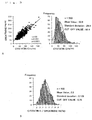
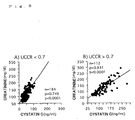
- Fig. 1 shows a correlation of the urinary cystatin C concentration with the creatinine concentration in a urinary protein negative group and positive group.
- cystatin C due to being processed first and foremost by a protein reabsorption mechanism at the proximal renal tubule, i.e., acidification of endocytosis-lysosomeproteolytic system by reason of its characteristic of strongly- basic, cystatin C is discharged retaining good correlation with creatinine which is unabsorbed at the renal tubule, regardless of the presence or absence of urinary proteins. Therefore, cystatin C has a physical property capable of reflecting the emergence of renal tubular protein urine most sensitively compared with ⁇ l-microglobulin and ⁇ 2-microglobulin currently measured as an evaluation method of the renal tubular function.
- cystatin C concentration/creatinine concentration ratio (hereinafter, referred to as "cystatin C/creatinine ratio" or "UCCR") in respective specimens. Then, using these data, a cut-off value of the cystatin C/creatinine ratio in urine of the normal subjects is calculated.
- This cystatin C/creatinine ratio is an index for diagnosing the presence or absence of renal tubular disorder in patients with diabetes.
- cut-off values for the cystatin C concentration and the creatinine concentration in urine of normal subjects are also calculated.
- This cystatin C value is an index for diagnosing the presence or absence of glomerular hypertension in patients with diabetes in whom a renal tubular disorder is not observed.
- the creatinine value is an index for diagnosing the presence or absence of glomerular hypertension in patients with diabetes in whom a renal tubular disorder is observed.
- an index obtained from a subject shows a value equal to or higher than the cut-off value obtained from a large number of normal volunteers, the subject is diagnosed to exhibit symptoms which the index indicates.
- the diagnosis of kidney disease is carried out by appropriately combining three cut-off values.
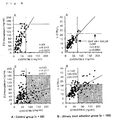
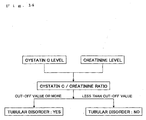
- Fig. 2 shows procedures for early diagnosis of diabetic nephropathy.
- the cystatin C concentration and the creatinine concentration are measured in a patient with diabetes to calculate the cystatin C/creatinine ratio.
- the cystatin C/creatinine ratio is equal to or higher than the cut-off value
- the patient is diagnosed to have a renal tubular disorder.
- the creatinine value shows a value equal to or higher than the cut-off value
- the patient is diagnosed to exhibit glomerular hypertension in addition to the renal tubular disorder.
- the creatinine value shows a value equal to or lower than the cut-off value
- the patient is diagnosed to be diabetic nephropathy exhibiting no glomerular hypertension and having the renal tubular disorder.
- the cystatin C/creatinine ratio shows a value equal to or lower than the cut-off value and no renal tubular disorder is observed
- the cystatin C value shows a value equal to or higher than the cut-off value
- the patient is diagnosed to be diabetic nephropathy exhibiting the glomerular hypertension.
- the cystatin C value shows a value equal to or lower than the cut-off value
- the patient is diagnosed not to be diabetic nephropathy exhibiting the glomerular hypertension.
- a urinary cystatin C value was carried out by an enzyme-linked immunosorbent assay (ELISA) using a 96-well microplate (Nunc-Immuno Plate: Poly Sorp).
- ELISA enzyme-linked immunosorbent assay
- Rabbit polyclonal anti-human cystatin C antibody (DAKO) used for a solid phase was diluted at 5 ⁇ g/ml using 0.05 mol/L tris hydrochloric acid buffer (pH 8.4), and 100 ⁇ l of aliquot was dispensed in each well to absorb by reacting at 4°C for 24 hours.
- the urinary creatinine was measured by utilizing a Jaffe reaction which produces an orange red colored condensed matter by reacting creatinine with picric acid in an alkali solution.
- a deproteinizing agent 200 ⁇ l (containing sodium tungstate phosphate) was added to 50 ⁇ l of urine diluted at 21 times with deionized water, stirred, left at room temperature for 10 min, and the supernatant was separated by centrifuge (2,500 rpm, 10 min).
- a picric acid solution 22 mmol/L, 50 ⁇ l
- 0.75 N sodium hydroxide solution 50 ⁇ l were added to 100 ⁇ l of this supernatant, and left at 25°C for 20 min.
- the color was compared at a wavelength of 510 nm using a colorimeter for a microplate (Sanko Junyaku), and the concentration of urinary creatinine was calculated from a standard curve of creatinine standard solutions simultaneously measured.
- FIG. 3A A setting example of a cut-off value of the urinary cystatin C concentration using 550 samples of normal urine is shown in Fig. 3A.
- Fig. 3B Acalculation example of a cut-off value of the cystatin C/creatinine ratio is shown in Fig. 3B.
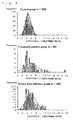
- Fig. 5 Examples of transitional changes of the cystatin C/creatinine ratio in patients with nephrosis exhibiting persistent proteinuria and a patient with tubulointerstitial nephritis are shown in Fig. 5.
- cystatin C is far superior in disease detection sensitivity than ⁇ 2-microglobulin and ⁇ -GTP as is shown in Fig. 6.
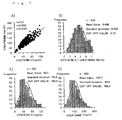
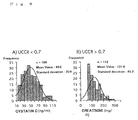
- Fig. 7 shows calculation examples of the cut-off values of the cystatin C concentration, creatinine concentration and cystatin C/creatinine ratio (UCCR) in 335 samples of normal urine considered as being normal in renal tubular and glomerular functions.
- Fig. 7A shows the relation of the cystatin C concentration and the creatinine concentration in urine in the normal group.
- Fig. 7B shows the distribution and the cut-off value of the cystatin C/creatinine ratio in the normal group. According to Fig. 7B, the cut-off value is calculated as 0.70.
- Fig. 7C shows the distribution and the cut-off value of the urinary cystatin C concentration in the normal group, and according to Fig. 7C, the cut-off value is calculated as 100. 5.
- Fig. 7D shows the distribution and the cut-off value of the urinary creatinine concentration in the normal group, and according to Fig. 7D, the cut-off value is calculated as 194.3.
- Examples of early discovery of diabetic nephropathy are shown using 296 samples of urine from patients diagnosed as diabetic.
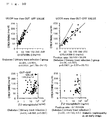
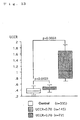
- Fig. 10 shows comparative data of distributions of the urinary cystatin C/creatinine ratio and the ⁇ 2-microglobulin/creatinine ratio from urine in the same cases.
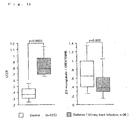
- urinary protein is a risk factor of the tubulointerstitial disorder
- protein concentration 96.6mg/dl ⁇ 64.2 mg/dl, mean value ⁇ standard deviation
- the kit for diagnosing kidney diseases of the present invention it is possible to make an early diagnose of the presence or absence of a glomerular lesion and tubulointerstitial disorder by especially measuring urinary cystatin C and creatinine of patients with diabetes in combination.
Landscapes
- Life Sciences & Earth Sciences (AREA)
- Health & Medical Sciences (AREA)
- Engineering & Computer Science (AREA)
- Molecular Biology (AREA)
- Biomedical Technology (AREA)
- Chemical & Material Sciences (AREA)
- Hematology (AREA)
- Immunology (AREA)
- Urology & Nephrology (AREA)
- Cell Biology (AREA)
- Biochemistry (AREA)
- Biotechnology (AREA)
- Food Science & Technology (AREA)
- Medicinal Chemistry (AREA)
- Physics & Mathematics (AREA)
- Analytical Chemistry (AREA)
- Microbiology (AREA)
- General Health & Medical Sciences (AREA)
- General Physics & Mathematics (AREA)
- Pathology (AREA)
- Proteomics, Peptides & Aminoacids (AREA)
- Investigating Or Analysing Biological Materials (AREA)
- External Artificial Organs (AREA)
Applications Claiming Priority (3)
| Application Number | Priority Date | Filing Date | Title |
|---|---|---|---|
| JP2001306445 | 2001-10-02 | ||
| JP2001306445 | 2001-10-02 | ||
| PCT/JP2002/010233 WO2003031967A1 (fr) | 2001-10-02 | 2002-10-01 | Kits de diagnostic de maladies renales |
Publications (3)
| Publication Number | Publication Date |
|---|---|
| EP1437591A1 true EP1437591A1 (de) | 2004-07-14 |
| EP1437591A4 EP1437591A4 (de) | 2006-05-10 |
| EP1437591B1 EP1437591B1 (de) | 2009-06-10 |
Family
ID=19126083
Family Applications (1)
| Application Number | Title | Priority Date | Filing Date |
|---|---|---|---|
| EP02775280A Expired - Lifetime EP1437591B1 (de) | 2001-10-02 | 2002-10-01 | Methode zur diagnose von nierenerkrankungen |
Country Status (5)
| Country | Link |
|---|---|
| US (1) | US20040241774A1 (de) |
| EP (1) | EP1437591B1 (de) |
| AT (1) | ATE433571T1 (de) |
| DE (1) | DE60232595D1 (de) |
| WO (1) | WO2003031967A1 (de) |
Cited By (1)
| Publication number | Priority date | Publication date | Assignee | Title |
|---|---|---|---|---|
| CN103068401A (zh) * | 2010-06-24 | 2013-04-24 | 墨累古尔本合作有限公司 | 治疗方法 |
Families Citing this family (14)
| Publication number | Priority date | Publication date | Assignee | Title |
|---|---|---|---|---|
| WO2008092214A1 (en) * | 2007-02-02 | 2008-08-07 | Minomic International Limited | Biomarkers for diabetes |
| CA2682543A1 (en) * | 2007-03-26 | 2008-10-02 | The University Of Chicago | Immunoassays and characterization of biomolecular interactions using self- assembled monolayers |
| EP2479571A3 (de) * | 2007-03-26 | 2012-09-26 | Novartis AG | Prognostische Biomarker der renalen Sicherheit und Biomarker-Signatur zur Überwachung der Nierenfunktion |
| KR100882471B1 (ko) | 2007-06-22 | 2009-02-09 | 고려대학교 산학협력단 | 당뇨병성 신증 진단용 바이오 마커 조성물 |
| RU2348038C1 (ru) * | 2007-06-26 | 2009-02-27 | Государственное образовательное учреждение высшего профессионального образования "Воронежская государственная медицинская академия им. Н.Н. Бурденко Федерального агентства по здравоохранению и социальному развитию" | Способ диагностики диабетической нефропатии на доклинической стадии |
| WO2010145880A1 (en) * | 2009-04-30 | 2010-12-23 | Roche Diagnostics Gmbh | Means and methods for diagnosing a diabetes mellitus associated kidney damage in individuals in need of a suitable therapy |
| EP3845904A1 (de) | 2010-06-03 | 2021-07-07 | Idexx Laboratories, Inc. | Marker für nierenerkrankung |
| CN102590497B (zh) * | 2012-01-13 | 2014-01-01 | 宁波美康生物科技股份有限公司 | 胱氨酸蛋白酶抑制剂c检测试剂盒 |
| CN103018465A (zh) * | 2012-12-16 | 2013-04-03 | 北京利德曼生化股份有限公司 | 一种人胱抑素c化学发光定量检测方法 |
| JP6196034B2 (ja) | 2012-12-20 | 2017-09-13 | ライオン株式会社 | 高血糖リスク判定用マーカーペプチドおよびその用途 |
| CN105388298A (zh) * | 2015-10-30 | 2016-03-09 | 山东博科生物产业有限公司 | 一种胱抑素c纳米胶乳免疫比浊法检测试剂盒 |
| AU2018313853A1 (en) | 2017-08-08 | 2020-01-02 | Fresenius Medical Care Holdings, Inc. | Systems and methods for treating and estimating progression of chronic kidney disease |
| CN109613256A (zh) * | 2018-11-21 | 2019-04-12 | 杭州康知生物科技有限公司 | 尿四种微量蛋白定量联检荧光免疫层析试剂盒及制备方法 |
| SE2430014A1 (en) * | 2024-01-18 | 2025-05-27 | P & M Venge Ab | Urinary biomarker of kidney function |
Family Cites Families (3)
| Publication number | Priority date | Publication date | Assignee | Title |
|---|---|---|---|---|
| US5733787A (en) * | 1996-06-17 | 1998-03-31 | Bayer Corporation | Method for the detection of creatinine |
| JP3342819B2 (ja) * | 1997-08-20 | 2002-11-11 | 株式会社いかがく | 腎症の早期診断用キット |
| JP2000193662A (ja) * | 1998-12-25 | 2000-07-14 | Tomakomai Rinsho Kensa Center:Kk | 尿中シスタチンc測定試薬及び診断方法並びにキット |
-
2002
- 2002-10-01 DE DE60232595T patent/DE60232595D1/de not_active Expired - Lifetime
- 2002-10-01 AT AT02775280T patent/ATE433571T1/de not_active IP Right Cessation
- 2002-10-01 US US10/489,923 patent/US20040241774A1/en not_active Abandoned
- 2002-10-01 WO PCT/JP2002/010233 patent/WO2003031967A1/ja not_active Ceased
- 2002-10-01 EP EP02775280A patent/EP1437591B1/de not_active Expired - Lifetime
Non-Patent Citations (3)
| Title |
|---|
| IMANISHI M ET AL: "Glomerular hypertension as one cause of albuminuria in Type II diabetic patients" DIABETOLOGIA, vol. 42, no. 8, August 1999 (1999-08), pages 999-1005, XP002371671 ISSN: 0012-186X * |
| See also references of WO03031967A1 * |
| TIAN S ET AL: "Cystatin C measurement and its practical use in patients with various renal diseases" CLINICAL NEPHROLOGY, vol. 48, no. 2, 1997, pages 104-108, XP009063131 ISSN: 0301-0430 * |
Cited By (2)
| Publication number | Priority date | Publication date | Assignee | Title |
|---|---|---|---|---|
| CN103068401A (zh) * | 2010-06-24 | 2013-04-24 | 墨累古尔本合作有限公司 | 治疗方法 |
| EP2585103A4 (de) * | 2010-06-24 | 2013-09-25 | Murray Goulburn Coop Co Ltd | Behandlungsverfahren |
Also Published As
| Publication number | Publication date |
|---|---|
| EP1437591A4 (de) | 2006-05-10 |
| US20040241774A1 (en) | 2004-12-02 |
| WO2003031967A1 (fr) | 2003-04-17 |
| EP1437591B1 (de) | 2009-06-10 |
| DE60232595D1 (de) | 2009-07-23 |
| ATE433571T1 (de) | 2009-06-15 |
Similar Documents
| Publication | Publication Date | Title |
|---|---|---|
| EP1437591B1 (de) | Methode zur diagnose von nierenerkrankungen | |
| CN101163971B (zh) | 测定作为肾病诊断标记物的嗜中性粒细胞明胶酶相关性脂笼蛋白 | |
| EP2281203B1 (de) | Marker für implantatfehler und mortalität | |
| CN103946709B (zh) | 基于l-fabp诊断急性事件后或外科手术后的肾损伤 | |
| EP2137538B1 (de) | Diagnostischer test auf nierenverletzung | |
| CN110716047B (zh) | 一种肾病早筛小型全自动分析仪配套的尿液检测试剂盒 | |
| CN102762985A (zh) | 使用热休克蛋白72作为敏感生物标志物来检测急性肾损伤的诊断方法 | |
| US20100233740A1 (en) | Use of urinary ngal to distinguish kidney disease and predict mortality in subjects with cirrhosis | |
| US20130149725A1 (en) | Methods and compositions for diagnosis of urosepsis and urinary tract infection | |
| EP2442105A1 (de) | Testverfahren für nierenerkrankungen | |
| JP3398372B1 (ja) | 腎疾患の診断用キット | |
| US20130230870A1 (en) | Use of urinary ngal to diagnose unilateral and bilateral urinary obstruction | |
| JP3569577B2 (ja) | 腎・尿路系疾患の鑑別診断用キット | |
| JP2000193662A (ja) | 尿中シスタチンc測定試薬及び診断方法並びにキット | |
| JP6083937B2 (ja) | 急性腎障害の検査方法 | |
| JP3342819B2 (ja) | 腎症の早期診断用キット | |
| CN114578064B (zh) | 检测caf22的试剂在制备评估肾小管损伤的组合物中的应用 | |
| Abdelwahab et al. | Studying the role of cadherin-11 as a novel biomarker of kidney fibrosis. | |
| US20250314663A1 (en) | Methods for treating acute kidney injury | |
| Dimeski et al. | Biochemical tests for diagnosing and evaluation stages of chronic kidney disease | |
| CN108414775A (zh) | 中性粒细胞明胶酶相关脂质运载蛋白检测试剂盒 | |
| Elbraky | Journal of Nephropathology | |
| WO2022192751A2 (en) | Urine test predicts kidney injury and death in covid-19 | |
| Afifi et al. | Urinary Alpha Glutathione S-Transferase and Pi-glutathione S-Transferase as Early Markers of Tubulointerstitial Fibrosis in Children with Idiopathic Nephrotic Syndrome. | |
| CN119193802A (zh) | 一种基于磁分离的滚环扩增超灵敏检测GSK3β的方法 |
Legal Events
| Date | Code | Title | Description |
|---|---|---|---|
| PUAI | Public reference made under article 153(3) epc to a published international application that has entered the european phase |
Free format text: ORIGINAL CODE: 0009012 |
|
| 17P | Request for examination filed |
Effective date: 20040503 |
|
| AK | Designated contracting states |
Kind code of ref document: A1 Designated state(s): AT BE BG CH CY CZ DE DK EE ES FI FR GB GR IE IT LI LU MC NL PT SE SK TR |
|
| AX | Request for extension of the european patent |
Extension state: AL LT LV MK RO SI |
|
| A4 | Supplementary search report drawn up and despatched |
Effective date: 20060328 |
|
| RIC1 | Information provided on ipc code assigned before grant |
Ipc: G01N 33/493 20060101AFI20030423BHEP Ipc: G01N 33/70 20060101ALI20060317BHEP Ipc: G01N 33/68 20060101ALI20060317BHEP |
|
| 17Q | First examination report despatched |
Effective date: 20060710 |
|
| RTI1 | Title (correction) |
Free format text: METHOD FOR DIAGNOSING KIDNEY DISEASES |
|
| GRAP | Despatch of communication of intention to grant a patent |
Free format text: ORIGINAL CODE: EPIDOSNIGR1 |
|
| GRAS | Grant fee paid |
Free format text: ORIGINAL CODE: EPIDOSNIGR3 |
|
| GRAA | (expected) grant |
Free format text: ORIGINAL CODE: 0009210 |
|
| AK | Designated contracting states |
Kind code of ref document: B1 Designated state(s): AT BE BG CH CY CZ DE DK EE ES FI FR GB GR IE IT LI LU MC NL PT SE SK TR |
|
| REG | Reference to a national code |
Ref country code: GB Ref legal event code: FG4D |
|
| REG | Reference to a national code |
Ref country code: CH Ref legal event code: EP |
|
| REG | Reference to a national code |
Ref country code: IE Ref legal event code: FG4D |
|
| REF | Corresponds to: |
Ref document number: 60232595 Country of ref document: DE Date of ref document: 20090723 Kind code of ref document: P |
|
| RAP2 | Party data changed (patent owner data changed or rights of a patent transferred) |
Owner name: IKAGAKU CO., LTD. |
|
| PG25 | Lapsed in a contracting state [announced via postgrant information from national office to epo] |
Ref country code: AT Free format text: LAPSE BECAUSE OF FAILURE TO SUBMIT A TRANSLATION OF THE DESCRIPTION OR TO PAY THE FEE WITHIN THE PRESCRIBED TIME-LIMIT Effective date: 20090610 Ref country code: FI Free format text: LAPSE BECAUSE OF FAILURE TO SUBMIT A TRANSLATION OF THE DESCRIPTION OR TO PAY THE FEE WITHIN THE PRESCRIBED TIME-LIMIT Effective date: 20090610 |
|
| NLT2 | Nl: modifications (of names), taken from the european patent patent bulletin |
Owner name: IKAGAKU CO., LTD. Effective date: 20090909 |
|
| NLV1 | Nl: lapsed or annulled due to failure to fulfill the requirements of art. 29p and 29m of the patents act | ||
| PG25 | Lapsed in a contracting state [announced via postgrant information from national office to epo] |
Ref country code: NL Free format text: LAPSE BECAUSE OF FAILURE TO SUBMIT A TRANSLATION OF THE DESCRIPTION OR TO PAY THE FEE WITHIN THE PRESCRIBED TIME-LIMIT Effective date: 20090610 Ref country code: SE Free format text: LAPSE BECAUSE OF FAILURE TO SUBMIT A TRANSLATION OF THE DESCRIPTION OR TO PAY THE FEE WITHIN THE PRESCRIBED TIME-LIMIT Effective date: 20090910 |
|
| PG25 | Lapsed in a contracting state [announced via postgrant information from national office to epo] |
Ref country code: ES Free format text: LAPSE BECAUSE OF FAILURE TO SUBMIT A TRANSLATION OF THE DESCRIPTION OR TO PAY THE FEE WITHIN THE PRESCRIBED TIME-LIMIT Effective date: 20090921 Ref country code: EE Free format text: LAPSE BECAUSE OF FAILURE TO SUBMIT A TRANSLATION OF THE DESCRIPTION OR TO PAY THE FEE WITHIN THE PRESCRIBED TIME-LIMIT Effective date: 20090610 Ref country code: CZ Free format text: LAPSE BECAUSE OF FAILURE TO SUBMIT A TRANSLATION OF THE DESCRIPTION OR TO PAY THE FEE WITHIN THE PRESCRIBED TIME-LIMIT Effective date: 20090610 |
|
| PG25 | Lapsed in a contracting state [announced via postgrant information from national office to epo] |
Ref country code: SK Free format text: LAPSE BECAUSE OF FAILURE TO SUBMIT A TRANSLATION OF THE DESCRIPTION OR TO PAY THE FEE WITHIN THE PRESCRIBED TIME-LIMIT Effective date: 20090610 Ref country code: BE Free format text: LAPSE BECAUSE OF FAILURE TO SUBMIT A TRANSLATION OF THE DESCRIPTION OR TO PAY THE FEE WITHIN THE PRESCRIBED TIME-LIMIT Effective date: 20090610 |
|
| PG25 | Lapsed in a contracting state [announced via postgrant information from national office to epo] |
Ref country code: PT Free format text: LAPSE BECAUSE OF FAILURE TO SUBMIT A TRANSLATION OF THE DESCRIPTION OR TO PAY THE FEE WITHIN THE PRESCRIBED TIME-LIMIT Effective date: 20091010 Ref country code: BG Free format text: LAPSE BECAUSE OF FAILURE TO SUBMIT A TRANSLATION OF THE DESCRIPTION OR TO PAY THE FEE WITHIN THE PRESCRIBED TIME-LIMIT Effective date: 20090910 |
|
| PLBE | No opposition filed within time limit |
Free format text: ORIGINAL CODE: 0009261 |
|
| STAA | Information on the status of an ep patent application or granted ep patent |
Free format text: STATUS: NO OPPOSITION FILED WITHIN TIME LIMIT |
|
| PG25 | Lapsed in a contracting state [announced via postgrant information from national office to epo] |
Ref country code: DK Free format text: LAPSE BECAUSE OF FAILURE TO SUBMIT A TRANSLATION OF THE DESCRIPTION OR TO PAY THE FEE WITHIN THE PRESCRIBED TIME-LIMIT Effective date: 20090610 |
|
| 26N | No opposition filed |
Effective date: 20100311 |
|
| PG25 | Lapsed in a contracting state [announced via postgrant information from national office to epo] |
Ref country code: MC Free format text: LAPSE BECAUSE OF NON-PAYMENT OF DUE FEES Effective date: 20091031 |
|
| REG | Reference to a national code |
Ref country code: CH Ref legal event code: PL |
|
| REG | Reference to a national code |
Ref country code: FR Ref legal event code: ST Effective date: 20100630 |
|
| PG25 | Lapsed in a contracting state [announced via postgrant information from national office to epo] |
Ref country code: FR Free format text: LAPSE BECAUSE OF NON-PAYMENT OF DUE FEES Effective date: 20091102 |
|
| PG25 | Lapsed in a contracting state [announced via postgrant information from national office to epo] |
Ref country code: LI Free format text: LAPSE BECAUSE OF NON-PAYMENT OF DUE FEES Effective date: 20091031 Ref country code: GR Free format text: LAPSE BECAUSE OF FAILURE TO SUBMIT A TRANSLATION OF THE DESCRIPTION OR TO PAY THE FEE WITHIN THE PRESCRIBED TIME-LIMIT Effective date: 20090911 Ref country code: IE Free format text: LAPSE BECAUSE OF NON-PAYMENT OF DUE FEES Effective date: 20091001 Ref country code: CH Free format text: LAPSE BECAUSE OF NON-PAYMENT OF DUE FEES Effective date: 20091031 |
|
| PG25 | Lapsed in a contracting state [announced via postgrant information from national office to epo] |
Ref country code: IT Free format text: LAPSE BECAUSE OF FAILURE TO SUBMIT A TRANSLATION OF THE DESCRIPTION OR TO PAY THE FEE WITHIN THE PRESCRIBED TIME-LIMIT Effective date: 20090610 |
|
| PG25 | Lapsed in a contracting state [announced via postgrant information from national office to epo] |
Ref country code: LU Free format text: LAPSE BECAUSE OF NON-PAYMENT OF DUE FEES Effective date: 20091001 |
|
| PG25 | Lapsed in a contracting state [announced via postgrant information from national office to epo] |
Ref country code: TR Free format text: LAPSE BECAUSE OF FAILURE TO SUBMIT A TRANSLATION OF THE DESCRIPTION OR TO PAY THE FEE WITHIN THE PRESCRIBED TIME-LIMIT Effective date: 20090610 |
|
| PG25 | Lapsed in a contracting state [announced via postgrant information from national office to epo] |
Ref country code: CY Free format text: LAPSE BECAUSE OF FAILURE TO SUBMIT A TRANSLATION OF THE DESCRIPTION OR TO PAY THE FEE WITHIN THE PRESCRIBED TIME-LIMIT Effective date: 20090610 |
|
| PGFP | Annual fee paid to national office [announced via postgrant information from national office to epo] |
Ref country code: DE Payment date: 20181009 Year of fee payment: 17 |
|
| PGFP | Annual fee paid to national office [announced via postgrant information from national office to epo] |
Ref country code: GB Payment date: 20181025 Year of fee payment: 17 |
|
| REG | Reference to a national code |
Ref country code: DE Ref legal event code: R119 Ref document number: 60232595 Country of ref document: DE |
|
| PG25 | Lapsed in a contracting state [announced via postgrant information from national office to epo] |
Ref country code: DE Free format text: LAPSE BECAUSE OF NON-PAYMENT OF DUE FEES Effective date: 20200501 |
|
| GBPC | Gb: european patent ceased through non-payment of renewal fee |
Effective date: 20191001 |
|
| PG25 | Lapsed in a contracting state [announced via postgrant information from national office to epo] |
Ref country code: GB Free format text: LAPSE BECAUSE OF NON-PAYMENT OF DUE FEES Effective date: 20191001 |