EP1439195A2 - Polymères hydrosolubles résiduels a faible teneur en monomères et leurs utilisations - Google Patents
Polymères hydrosolubles résiduels a faible teneur en monomères et leurs utilisations Download PDFInfo
- Publication number
- EP1439195A2 EP1439195A2 EP04075332A EP04075332A EP1439195A2 EP 1439195 A2 EP1439195 A2 EP 1439195A2 EP 04075332 A EP04075332 A EP 04075332A EP 04075332 A EP04075332 A EP 04075332A EP 1439195 A2 EP1439195 A2 EP 1439195A2
- Authority
- EP
- European Patent Office
- Prior art keywords
- test
- polymer
- acrylic acid
- grams
- equal
- Prior art date
- Legal status (The legal status is an assumption and is not a legal conclusion. Google has not performed a legal analysis and makes no representation as to the accuracy of the status listed.)
- Withdrawn
Links
Classifications
-
- C—CHEMISTRY; METALLURGY
- C08—ORGANIC MACROMOLECULAR COMPOUNDS; THEIR PREPARATION OR CHEMICAL WORKING-UP; COMPOSITIONS BASED THEREON
- C08F—MACROMOLECULAR COMPOUNDS OBTAINED BY REACTIONS ONLY INVOLVING CARBON-TO-CARBON UNSATURATED BONDS
- C08F2/00—Processes of polymerisation
- C08F2/12—Polymerisation in non-solvents
- C08F2/16—Aqueous medium
-
- C—CHEMISTRY; METALLURGY
- C11—ANIMAL OR VEGETABLE OILS, FATS, FATTY SUBSTANCES OR WAXES; FATTY ACIDS THEREFROM; DETERGENTS; CANDLES
- C11D—DETERGENT COMPOSITIONS; USE OF SINGLE SUBSTANCES AS DETERGENTS; SOAP OR SOAP-MAKING; RESIN SOAPS; RECOVERY OF GLYCEROL
- C11D3/00—Other compounding ingredients of detergent compositions covered in group C11D1/00
- C11D3/16—Organic compounds
- C11D3/37—Polymers
- C11D3/3746—Macromolecular compounds obtained by reactions only involving carbon-to-carbon unsaturated bonds
- C11D3/3757—(Co)polymerised carboxylic acids, -anhydrides, -esters in solid and liquid compositions
-
- B—PERFORMING OPERATIONS; TRANSPORTING
- B01—PHYSICAL OR CHEMICAL PROCESSES OR APPARATUS IN GENERAL
- B01D—SEPARATION
- B01D61/00—Processes of separation using semi-permeable membranes, e.g. dialysis, osmosis or ultrafiltration; Apparatus, accessories or auxiliary operations specially adapted therefor
- B01D61/02—Reverse osmosis; Hyperfiltration ; Nanofiltration
- B01D61/025—Reverse osmosis; Hyperfiltration
-
- B—PERFORMING OPERATIONS; TRANSPORTING
- B01—PHYSICAL OR CHEMICAL PROCESSES OR APPARATUS IN GENERAL
- B01D—SEPARATION
- B01D61/00—Processes of separation using semi-permeable membranes, e.g. dialysis, osmosis or ultrafiltration; Apparatus, accessories or auxiliary operations specially adapted therefor
- B01D61/14—Ultrafiltration; Microfiltration
- B01D61/145—Ultrafiltration
-
- B—PERFORMING OPERATIONS; TRANSPORTING
- B01—PHYSICAL OR CHEMICAL PROCESSES OR APPARATUS IN GENERAL
- B01D—SEPARATION
- B01D61/00—Processes of separation using semi-permeable membranes, e.g. dialysis, osmosis or ultrafiltration; Apparatus, accessories or auxiliary operations specially adapted therefor
- B01D61/14—Ultrafiltration; Microfiltration
- B01D61/16—Feed pretreatment
-
- B—PERFORMING OPERATIONS; TRANSPORTING
- B01—PHYSICAL OR CHEMICAL PROCESSES OR APPARATUS IN GENERAL
- B01D—SEPARATION
- B01D65/00—Accessories or auxiliary operations, in general, for separation processes or apparatus using semi-permeable membranes
- B01D65/02—Membrane cleaning or sterilisation ; Membrane regeneration
-
- B—PERFORMING OPERATIONS; TRANSPORTING
- B01—PHYSICAL OR CHEMICAL PROCESSES OR APPARATUS IN GENERAL
- B01D—SEPARATION
- B01D65/00—Accessories or auxiliary operations, in general, for separation processes or apparatus using semi-permeable membranes
- B01D65/08—Prevention of membrane fouling or of concentration polarisation
-
- C—CHEMISTRY; METALLURGY
- C08—ORGANIC MACROMOLECULAR COMPOUNDS; THEIR PREPARATION OR CHEMICAL WORKING-UP; COMPOSITIONS BASED THEREON
- C08F—MACROMOLECULAR COMPOUNDS OBTAINED BY REACTIONS ONLY INVOLVING CARBON-TO-CARBON UNSATURATED BONDS
- C08F2/00—Processes of polymerisation
- C08F2/04—Polymerisation in solution
- C08F2/10—Aqueous solvent
-
- C—CHEMISTRY; METALLURGY
- C08—ORGANIC MACROMOLECULAR COMPOUNDS; THEIR PREPARATION OR CHEMICAL WORKING-UP; COMPOSITIONS BASED THEREON
- C08F—MACROMOLECULAR COMPOUNDS OBTAINED BY REACTIONS ONLY INVOLVING CARBON-TO-CARBON UNSATURATED BONDS
- C08F2/00—Processes of polymerisation
- C08F2/38—Polymerisation using regulators, e.g. chain terminating agents, e.g. telomerisation
-
- C—CHEMISTRY; METALLURGY
- C08—ORGANIC MACROMOLECULAR COMPOUNDS; THEIR PREPARATION OR CHEMICAL WORKING-UP; COMPOSITIONS BASED THEREON
- C08F—MACROMOLECULAR COMPOUNDS OBTAINED BY REACTIONS ONLY INVOLVING CARBON-TO-CARBON UNSATURATED BONDS
- C08F20/00—Homopolymers and copolymers of compounds having one or more unsaturated aliphatic radicals, each having only one carbon-to-carbon double bond, and only one being terminated by only one carboxyl radical or a salt, anhydride, ester, amide, imide or nitrile thereof
- C08F20/02—Monocarboxylic acids having less than ten carbon atoms, Derivatives thereof
- C08F20/04—Acids, Metal salts or ammonium salts thereof
- C08F20/06—Acrylic acid; Methacrylic acid; Metal salts or ammonium salts thereof
-
- C—CHEMISTRY; METALLURGY
- C08—ORGANIC MACROMOLECULAR COMPOUNDS; THEIR PREPARATION OR CHEMICAL WORKING-UP; COMPOSITIONS BASED THEREON
- C08F—MACROMOLECULAR COMPOUNDS OBTAINED BY REACTIONS ONLY INVOLVING CARBON-TO-CARBON UNSATURATED BONDS
- C08F22/00—Homopolymers and copolymers of compounds having one or more unsaturated aliphatic radicals each having only one carbon-to-carbon double bond, and at least one being terminated by a carboxyl radical and containing at least one other carboxyl radical in the molecule; Salts, anhydrides, esters, amides, imides or nitriles thereof
- C08F22/04—Anhydrides, e.g. cyclic anhydrides
-
- C—CHEMISTRY; METALLURGY
- C11—ANIMAL OR VEGETABLE OILS, FATS, FATTY SUBSTANCES OR WAXES; FATTY ACIDS THEREFROM; DETERGENTS; CANDLES
- C11D—DETERGENT COMPOSITIONS; USE OF SINGLE SUBSTANCES AS DETERGENTS; SOAP OR SOAP-MAKING; RESIN SOAPS; RECOVERY OF GLYCEROL
- C11D3/00—Other compounding ingredients of detergent compositions covered in group C11D1/00
- C11D3/16—Organic compounds
- C11D3/37—Polymers
- C11D3/3746—Macromolecular compounds obtained by reactions only involving carbon-to-carbon unsaturated bonds
-
- B—PERFORMING OPERATIONS; TRANSPORTING
- B01—PHYSICAL OR CHEMICAL PROCESSES OR APPARATUS IN GENERAL
- B01D—SEPARATION
- B01D2311/00—Details relating to membrane separation process operations and control
- B01D2311/04—Specific process operations in the feed stream; Feed pretreatment
-
- B—PERFORMING OPERATIONS; TRANSPORTING
- B01—PHYSICAL OR CHEMICAL PROCESSES OR APPARATUS IN GENERAL
- B01D—SEPARATION
- B01D2321/00—Details relating to membrane cleaning, regeneration, sterilization or to the prevention of fouling
- B01D2321/16—Use of chemical agents
- B01D2321/168—Use of other chemical agents
-
- C—CHEMISTRY; METALLURGY
- C02—TREATMENT OF WATER, WASTE WATER, SEWAGE, OR SLUDGE
- C02F—TREATMENT OF WATER, WASTE WATER, SEWAGE, OR SLUDGE
- C02F5/00—Softening water; Preventing scale; Adding scale preventatives or scale removers to water, e.g. adding sequestering agents
- C02F5/08—Treatment of water with complexing chemicals or other solubilising agents for softening, scale prevention or scale removal, e.g. adding sequestering agents
- C02F5/10—Treatment of water with complexing chemicals or other solubilising agents for softening, scale prevention or scale removal, e.g. adding sequestering agents using organic substances
Definitions
- the invention relates to again homopolymers and / or copolymers, in aqueous solution of mono ethylenically unsaturated monomers such as acrylic and / or vinyl monomers making it possible to obtain levels residual monomers less than or equal to each at 300 ppm measured by ratio to the product in the state at a concentration at least equal to 38% whatever the monomer and at the end of the polymerization, that is to say without having to treat them later.
- the invention also relates to their use as a grinding agent and / or dispersion in aqueous suspension of mineral materials, or even as sequestering or inhibiting precipitation and / or mineral incrustations especially on the heat transfer surfaces of industrial installations or domestic or as a fluidizing agent for aqueous suspensions based fresh or saline water commonly used as drilling fluids in civil engineering, building, public works, prospecting and petroleum extraction or even as a stabilizer for zeolite suspensions as well as an anti-scale and dispersing agent which does not destabilize the degree chlorometric of hypochlorite compounds present in the formulations detergents containing it as well as as a builder of detergent compositions or still as a water retention agent in the paper industry.
- the invention finally relates to said aqueous suspensions of mineral materials stable over time and highly concentrated in mineral matter and their use in the field of paper, paint, detergent formulations and cleaners, and any other field using said suspensions such than in particular ceramic or drilling fluids.
- the acrylic and / or vinyl monomers such as in particular acrylic acid, methacrylic acid, maleic anhydride or else acrylamide as well as to copolymerize in solution in water, the acid acrylic with other monoethylenically unsaturated monomers such as by example maleic anhydride, itaconic acid, acrylamide, acrylamido acid methyl propane sulfonic, acrylic esters but none of these processes fully satisfied with trends and / or regulatory constraints relating to the environment and in particular those concerning the rate of residual monomers in the polymer used or else on their coloring or their smell.
- the Applicant has found a process for obtaining new homopolymers and / or copolymers, in aqueous solution of at least one of monomers or comonomers chosen from acrylic and / or methacrylic acid, itaconic, crotonic, fumaric, maleic anhydride or isocrotonic, aconitic, mesaconic, sinapic, undecylenic, angelic and / or their esters respective, acrylamido methyl propane sulfonic acid, acrolein, acrylamide and / or methacrylamide, methacrylamido propyl trimethyl ammonium chloride or sulfate, trimethyl ammonium ethyl chloride or sulfate methacrylate, as well as their acrylate and acrylamide counterparts quaternized or not and / or the dimethyldiallylchloride, sodium methallylsulfonate
- Another object of the invention is to provide a grinding and / or dispersing agent in aqueous suspension of mineral materials allowing to reach aqueous dispersions of mineral particles which are highly concentrated in mineral matter and have a low viscosity and stable over time, even without agitation.
- Another object of the invention is to provide a sequestering agent or inhibitor of precipitation and / or mineral incrustations when the weight molecular of said homopolymers and / or copolymers is sufficiently low to be adapted to the said application.
- an additional object of the invention is to obtain an agent fluidizer for aqueous suspensions used as drilling fluids or for develop a stabilizer for aqueous suspensions of zeolites as well as to obtain an anti-scale and dispersing agent which does not destabilize the degree chlorometric of the hypochlorite compounds present in the compositions detergents containing it or even a builder.
- Another object of the invention relates to the use of these suspensions aqueous minerals in the areas of mass loading and coating of paper as well as paint, ceramics, detergency and sludge drilling.
- the copolymerization reaction is carried out, what that is the weight ratio of the monomers by the use as filler all or part of the amount of the compound in the reactor vessel bottom containing the phosphorus atom with an oxidation state of less than 5 chosen from sodium hypophosphite or hypophosphorous acid in a quantity determined by function of the desired molecular weight for the polymer, in the presence optionally all or part of the monomer (s) to be polymerized in the acid state or possibly partially or totally neutralized by means of a solution basic supplemented in general with a quantity of water necessary for obtain a homogeneous solution.
- the bases used can be sodium hydroxide, hydroxide potassium, or lithium, or magnesium or calcium.
- molecular weight of the desired copolymer is not directly a function of the amount of water oxygen used but rather the phosphorus level involved as well as the concentration of the medium.
- homopolymer of acrylic acid, acid methacrylic or maleic acid is produced in the process according to the invention by using the monomer, hydrogen peroxide, the compound containing a phosphorus atom with an oxidation state of less than 5, water and possibly one or more bases mentioned above and more particularly by the injection of the hydrogen peroxide in the heated reactor previously charged with all or part of the amount of the monomer to be polymerized, of the compound containing the atom phosphorus chosen from sodium hypophosphite or hypophosphorous acid in an amount determined according to the desired molecular weight as well as a amount of water required to obtain a homogeneous solution and this presence of one or more bases mentioned above.
- the polymer obtained is cooled and then recovered as is to be used in this form.
- neutralizing agents having a monovalent function or a function versatile such as for example those chosen from the group consisting of alkaline cations, in particular sodium, potassium, ammonium or amines primary, secondary or tertiary aliphatic and / or cyclic such as by example ethanolamines (mono-, di-, triethanolamine), mono and diethylamine, cyclohexylamine, methylcyclohexylamine or even those chosen from the group consisting of divalent alkaline earth cations, in particular the magnesium and calcium, or even zinc, as well as trivalent cations, including aluminum in particular, or, by certain valence cations more high as well as primary and secondary, aliphatic and / or cyclic amines such as for example mono and diethylamines, cyclo and methylcyclohexylamines and combinations thereof.
- neutralizing agents having a monovalent function or a function versatile such as for example those chosen from the group consisting of alkaline c
- the polymer obtained can also be treated by any known means to eliminate it. water and isolate it in the form of a fine powder and use it in this form.
- the new polymers obtained according to the invention are characterized in that the level of residual monomers is less than or equal for each to 300 ppm measured relative to the product as is at a dry matter concentration at less than 38% whatever the monomer composition.
- the level of residual monomers is determined by an HPLC method with internal calibration using an HPLC assembly equipped with a visible UV detector allowing work between 180 and 220 nanometers and a Microbondapak chromatographic column.
- the homopolymers and / or copolymers according to the invention and intended to be used according to the invention as a dispersing and / or grinding agent or else as a fluidizer for drilling muds or as a rheology modifier for detergent compositions generally have a specific viscosity at most equal to 10, and preferably at most equal to 3.
- the polymer and / or copolymer according to the invention obtained by the process of the invention is used in the treatment of industrial water and / or domestic in order to give these environments anti-scale and anti-corrosion effects for example or else is implemented in the field of reverse osmosis and ultrafiltration in order to complex cations present, its specific viscosity is between 0.10 and 10.
- the capillary tube is generally chosen in such a way that the flow time of the bipermuted water or NaCl solution, devoid of polymer and / or copolymer, i.e. approximately 90 to 100 seconds, thus giving specific viscosity measurements with very good accuracy.
- the disintegration operation of the mineral substance to be dispersed consists of prepare with stirring an aqueous solution of the dispersing agent according to the invention into which is introduced the mineral substance to be dispersed which can be of very diverse origins such as natural calcium carbonate or synthetic, dolomites, calcium sulphate, titanium dioxide, pigments lamellars such as for example mica, kaolin, i.e. all substances minerals which must be suspended and dispersed to be usable in applications as diverse as paper coating, pigmentation of paints, ceramics, drilling fluids or even detergency.
- the mineral substance to be dispersed which can be of very diverse origins such as natural calcium carbonate or synthetic, dolomites, calcium sulphate, titanium dioxide, pigments lamellars such as for example mica, kaolin, i.e. all substances minerals which must be suspended and dispersed to be usable in applications as diverse as paper coating, pigmentation of paints, ceramics, drilling fluids or even detergency.
- the operation of grinding the mineral substance to be refined consists in grinding the mineral substance with a grinding body in very small particles fines in an aqueous medium containing the grinding agent.
- a aqueous suspension of the mineral substance to be ground the grains of which have a initial dimension at most equal to 50 microns, in an amount such that the dry concentration of said suspension is at least 70% by weight.
- the ground body of particle size advantageously between 0.20 and 4 millimeters.
- the body grinder is usually in the form of particles of material also various than silicon oxide, aluminum oxide, zirconium oxide or mixtures thereof, as well as high hardness synthetic resins, steels, or other.
- An example of the composition of such grinding bodies is given by the patent FR 2 303 681 which describes grinding elements formed from 30 to 70% by weight zirconium oxide, 0.1 to 5% aluminum oxide and 5 to 20% oxide silicon.
- the grinding substance is preferably added to the suspension in an amount such as the weight ratio between this grinding material and the mineral substance to grind either at least 2/1, this ratio preferably being between the limits 3/1 and 5/1.
- the mixture of the suspension and the grinding substance is then subjected to the action mechanical brewing, such as that which occurs in a conventional mill microelements.
- the grinding and / or dispersing agent according to the invention is also introduced into the within the mixture formed by the aqueous suspension of mineral substances and by the grinding material at a rate of 0.2 to 2% by weight of the dried fraction of the said polymers in relation to the dry mass of the mineral substance to be refined.
- the time necessary to achieve an excellent fineness of the mineral substance after grinding varies according to the nature and quantity of the substances, mineral to grind, and depending on the stirring method used and the temperature of the medium during the grinding operation.
- the purpose of this example is to illustrate obtaining homopolymers of acrylic acid in the absence of any metal or metal salt and by simultaneous and parallel addition of acrylic acid and hydrogen peroxide in a polymerization reactor previously heated and filled with a compound charge water, possibly part or all of the hypophosphite or the necessary hypophosphorous acid and possibly part of the acid acrylic possibly partially neutralized by soda.
- the polyacrylate thus obtained corresponds to a homopolymer according to the invention with a specific viscosity equal to 0.64 and a material concentration 50.6% dry with a residual acrylic acid content of 260 ppm measured compared to the product as it is and according to the aforementioned HPLC method.
- This test is carried out with the same equipment, the same operating mode and the same quantities of reagent as test n ° 1 except for the quantity of water oxygenated to 130 volumes introduced which drops from 3.46% by weight relative to acrylic acid at 6.9% by weight.
- This test is carried out with the same equipment, the same operating mode and the same amounts of reagent as the previous test except the amount of water oxygenated which corresponds to 3.46% of the total amount of acrylic acid.
- base stock a charge, called base stock, is prepared at ambient temperature and composed of 35 grams of sodium hypophosphite and 500 grams of water.
- This test is identical to the previous test except that one quarter only the amount of sodium hypophosphite is loaded into the reactor as a base.
- the polyacrylic acid obtained according to the process of the invention is clear and colorless with a specific viscosity equal to 0.53.
- polyacrylate obtained with the same procedure as previously described is a clear and colorless polyacrylate according to the invention, of viscosity specific equal to 1.52.
- This test carried out using the same equipment as that used in the tests previous, implements, a base containing 340 grams of water and the quarter of the total mass of sodium hypophosphite corresponding to 0.012 atom of phosphorus per mole of acrylic acid as well as two fillers introduced in one containing 400 grams of 100% acrylic acid, 200 grams of water and the rest of the total mass of sodium hypophosphite corresponding to 0.012 atom of phosphorus per mole of acrylic acid, the other containing 3.3 grams of hydrogen peroxide at 130 volumes and 250 grams of water.
- Polyacrylic acid obtained with the same procedure as above described is a clear and colorless polyacrylic acid obtained according to the invention, of specific viscosity equal to 2.4.
- the polyacrylic acid obtained is a polyacrylic acid according to the invention, clear and colorless, with a specific viscosity of 3.0.
- the polyacrylic acid obtained is a polyacrylic acid according to the invention, clear and colorless, with a specific viscosity of 4.8.
- a load is prepared at room temperature called base stock and made up of 600 grams of water and a quarter of the amount hypophosphorous acid corresponding to 0.09 phosphorus atom per mole acrylic acid to be polymerized.
- the polyacrylate thus obtained corresponds to a homopolymer according to the invention with a specific viscosity equal to 0.79 and a material concentration 46.6% dry with a residual acrylic acid content of less than 10 ppm measured against a product in the state and according to the abovementioned HPLC method.
- the purpose of this example is to illustrate the process, according to the invention, for obtaining homopolymers of acrylic acid in the absence of any metal or metal salt and by simultaneous and parallel addition of acrylic acid and hydrogen peroxide in a polymerization reactor previously heated and filled with a compound charge water, all the necessary hypophosphite and part of the acid acrylic partially neutralized with lime or hydroxide magnesium.
- the polyacrylate thus obtained corresponds to a homopolymer according to the invention with a specific viscosity equal to 0.55 and a material concentration 38% dry with a residual acrylic acid content of less than 30 ppm measured by report to the product in the state and according to the abovementioned HPLC method.
- the purpose of this example is to illustrate obtaining of maleic anhydride homopolymers in the absence of any metal or salt metallic or even persalts.
- This test is carried out with the same equipment, the same operating mode and the same quantities of reagent as test n ° 17 by doubling the quantity of oxygen added for 2 hours.
- the purpose of this example is to illustrate, obtaining copolymers of acrylic acid and maleic acid by addition of hydrogen peroxide the absence of any metal or metal salt.
- the purpose of this example is to illustrate the possibility of varying the viscosity specific for a copolymer of given monomeric composition.
- This test corresponds to the monomeric composition and to the operating mode of test n ° 25 with 1.5 times more by weight of sodium hypophosphite distributed for a quarter at the bottom of the tank and for three quarters in parallel addition and with four times more oxygenated water.
- This test corresponds to the same composition by weight of monomer as that of the previous test with three times less sodium hypophosphite and half the hydrogen peroxide.
- This example illustrates the production of other copolymers according to the invention.
- an acrylic acid-acid copolymer is obtained.
- methacrylic by adding two fillers, one containing 25 grams of water oxygenated to 130 volumes and 75 grams of water and the other 300 grams of acid acrylic, 300 grams of methacrylic acid plus 75% of the amount total sodium hypophosphite corresponding to 0.064 atom of phosphorus per mole of monomers to be polymerized, in a reactor containing, 456 grams of water and the remaining quarter of the total amount of sodium hypophosphite.
- a maleic anhydride-acid copolymer is obtained.
- methacrylic by using the same procedure as in the test # 21 by replacing acrylic acid with methacrylic acid.
- the two loads are prepared for introduce in parallel for two hours.
- a load called base stock composed of 185 grams of water, total amount of sodium hypophosphite corresponding to 0.045 atom of phosphorus per mole of monomers to be polymerized and 145 grams of methallyl 100% sodium sulfonate (MTAS).
- the two loads are prepared for introduce in parallel for two hours.
- the two loads are prepared for introduce in parallel for two hours.
- This amount corresponds to 0.025 phosphorus atom per mole of monomers to polymerize.
- the purpose of this example is to illustrate the use of the polymers according to the invention as a dispersing agent for mineral matter in an aqueous medium and more particularly as a dispersing agent for kaolin in water.
- rain is introduced under stirring 500 grams of kaolin in a one-liter beaker containing 258 grams of water, 1.10 grams dry of the dispersing agent to be tested and the amount of soda to 50% necessary to obtain a pH of around 7.2 - 7.5.
- the different dispersing agents tested are:
- This test constitutes the control test in which no dispersing agent is present in the beaker.
- Reading Table 1 shows that the copolymers obtained according to the process of the invention can result in aqueous dispersions of kaolin industrially usable and therefore can be used as a dispersion of mineral materials.
- the purpose of this example is to illustrate the use of the polymers according to the invention obtained by the process of the invention as a material dispersing agent minerals in an aqueous medium used in the paper industry and more particularly as a dispersing agent for calcium carbonate in water.
- the different dispersing agents are:
- This test constitutes the control test in which no dispersing agent is present in the beaker.
- the different dispersing agents tested are:
- This test constitutes the control test in which no dispersing agent is present in the beaker.
- Reading Tables 2 and 3 highlights the effectiveness of the copolymers of the invention obtained according to the process of the invention as a dispersing agent for mineral materials.
- an aqueous suspension of calcium carbonate was prepared from the Orgon deposit (France), with a particle size less than 10 microns.
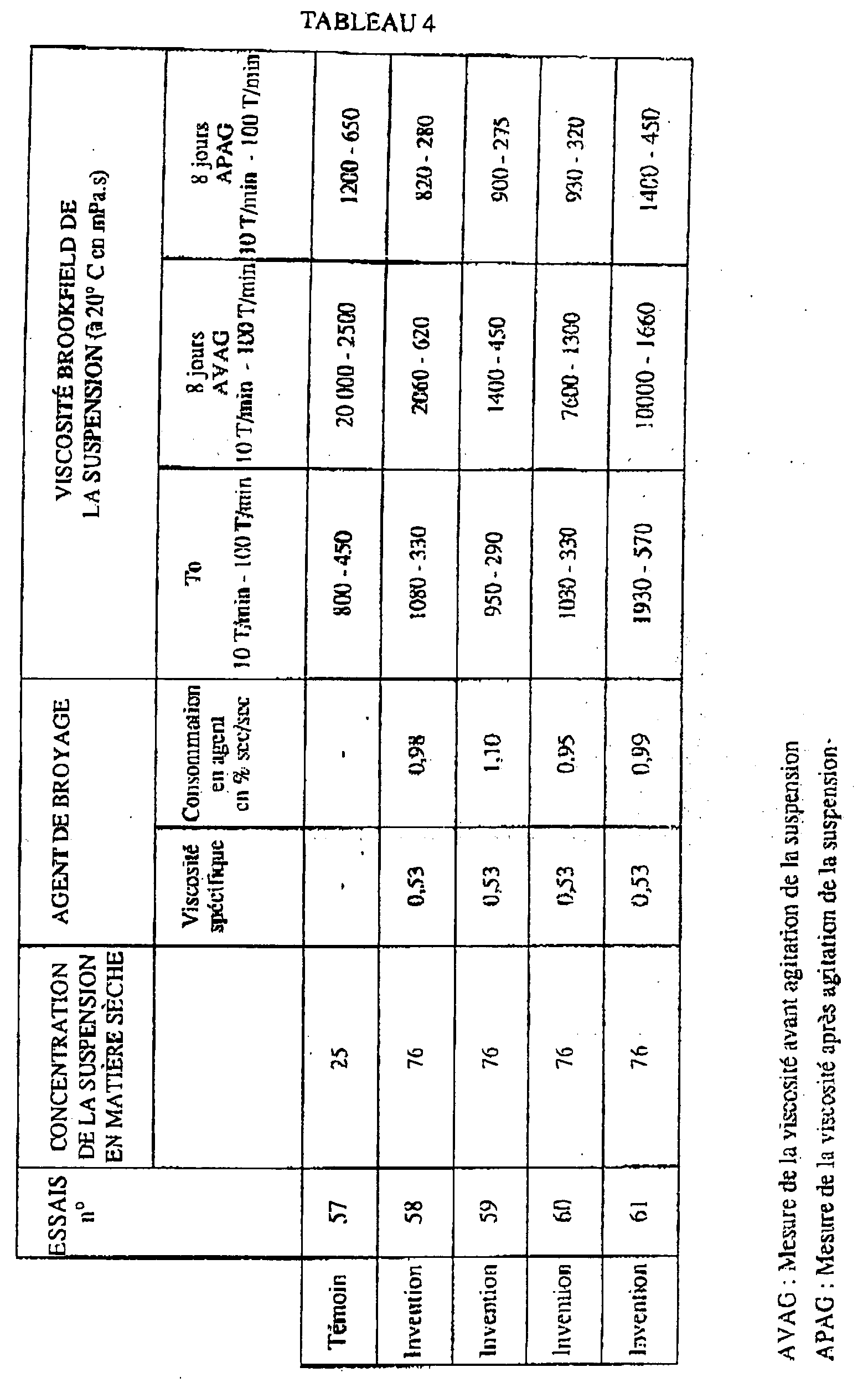
- the aqueous suspension has a dry matter concentration of 76% by weight per relative to the total mass with the exception of the control test for which the suspension has a dry matter concentration of 25% by weight relative to the total mass.
- the grinding agent is introduced into this suspension according to the quantities indicated in the table below, expressed in percent by dry weight relative to to the mass of dry calcium carbonate to be ground.
- the suspension circulates in a Dyno-Mill type mill with fixed cylinder and rotating impeller, the grinding body of which consists of corundum balls diameter in the range 0.6 millimeter to 1.0 millimeter.
- the total volume occupied by the grinding body is 1,150 cubic centimeters while that its mass is 2 900 g.
- the grinding chamber has a volume of 1,400 cubic centimeters.
- the circumferential speed of the mill is 10 meters per second.
- the calcium carbonate suspension is recycled at the rate of 18 liters per hour.
- the outlet of the Dyno-Mill is fitted with a 200 micron mesh separator allowing to separate the suspension resulting from the grinding and the grinding body.
- the temperature during each grinding test is maintained at approximately 60 ° C.
- Reading Table 4 highlights the effectiveness of the polymers of the invention obtained by the process according to the invention as a suspension grinding agent aqueous mineral material with a high concentration of dry matter.
- This example relates to the use of various polymers according to the invention in a interior matt water-based paint to assess their dispersing effectiveness and ability to increase the water resistance of dry films, i.e. to assess stability rheological and water resistance of various interior matt paints obtained.
- This test is the control test in which no dispersing agent is added.
- the rheological stability over time and in temperature of the formulations is determined by measuring Brookfield viscosities at 10 rpm and 25 ° C of these formulations after storage without stirring for 24 hours at temperature ambient, then after a week's storage in an oven at 50 ° C and finally after storage for one month in the same oven at 50 ° C.
- the notation M appearing for the control test means that the vortex around the axis agitation has completely disappeared, causing poor homogenization middle.
- This test consists in determining using the GARDNER model M 105-A abrasimeter (DIN 53778 approved), the number of round trips made by a calibrated brush according to DIN 53778, by rubbing on a previously dried paint film on a LENETA card with a thickness of 100 micrometers in the presence of a detergent solution to completely abrade this film of paint.
- Reading Table 5 shows that only matt aqueous paints materials containing the polymers according to the invention exhibit both good rheological stability, i.e. Brookfield viscosities at 10 rpm 25 ° C below 60,000 mPa.s after one month of storage at 50 ° C, ease of at least fairly good pasting (AB) and increased wet abrasion resistance compared to the witness without dispersing agent.
- the purpose of this example is to illustrate the use of the polymers according to the invention in water treatment as an anti-scale agent, by measuring the delay in precipitation of alkaline earth ions and more particularly of carbonate calcium contained in natural or artificial waters saline or not in the presence said polymers.
- Tests No. 68 and 69 illustrating the invention correspond to the implementation respectively of the copolymers of tests 23 and 22.
- TH hydrotimetric titer
- Reading Table 6 highlights the effectiveness of the polymers of the invention obtained by the process according to the invention as an anti-pie agent.
- This example relates to chlorinated alkaline formulations used, inter alia, as a detergent bleach and disinfectant but could also relate to other bleaching formulations commonly encountered in detergency.
- the mixture is added with stirring and in a 200 ml beaker. containing 50.65 grams of water, 29.35 grams of bleach at 36.96 degrees chlorometric and 15 grams of 50% soda.
- hypochlorites present in 20 ml of the diluted chlorinated alkaline composition.
- This dosage of hypochlorites is carried out by the Bunsen method based on the principle of oxidation of iodide ions by hypochlorite ions. Iodine then released is titrated with a 0.1 N sodium thiosulfate solution which allows us to access by calculation the chlorometric degree of the chlorinated alkaline composition.
- control test No. 68 serves as a reference value and constitutes the 100% hypochlorite present in the formulation.
- a chlorometric degree is determined by the same dosing method after 24 hours and 8 days.
- Reading Table 7 above highlights the evolution of the degree chlorometric of each of the solutions and to illustrate that the polymers according to the invention, obtained by the process of the invention, make it possible not to destabilize the chlorometric degree of the chlorinated alkaline composition.
- This example relates to the use of polymer according to the invention as agent fluidizer of a drilling fluid whose aqueous phase is fresh water.
- a drilling mud is prepared according to the following protocol:
- C.M C. Technique low viscosity meeting the OCMA-DFCP2-1980 standard
- the pH of the medium is checked and corrected with a sodium hydroxide solution so that it is between 9.5 and 10.
- the sludge thus prepared is subjected to a shearing action by means of a Sylverson Type L.R2 agitator, fitted with a high shear grid with a diameter 35 millimeters.
- the mud is again agitated by means of the aforementioned Rayneri turbine for approximately 5 minutes.
- Test No. 73 constitutes the control test and the same adjuvanted mud using 7.5 g a sodium polyacrylate with a specific viscosity equal to 0.4 and constituting the fluidizer deemed the best of the prior art.
- Test No. 74 constitutes the control test according to the invention and relates to the same sludge adjuvanted with 7.5 g of active ingredient sodium polyacrylate according to the invention obtained in test No. 3 with a specific viscosity equal to 0.41.
- the rheological characteristics are checked. 20 ° C using a FANN 35 viscometer, and the API filtrate is measured under 100 psi and for 30 minutes according to the method well known to those skilled in the art.
- the rheological characteristics controlled are the apparent viscosity (Va), the plastic viscosity (Vp), Yield Value (Yv), gel 0 and gel at 10 as they are defined in the book “rheology manual of drilling fluids and slag from cement "- Technip edition - 1979.
- Reading Table 8 reveals that the sludge containing the polyacrylate according to the invention has a rheological behavior equivalent to that of mud additivated by a polyacrylate according to the prior art.
- This example relates to the use of polymer according to the invention in the field of ceramic.
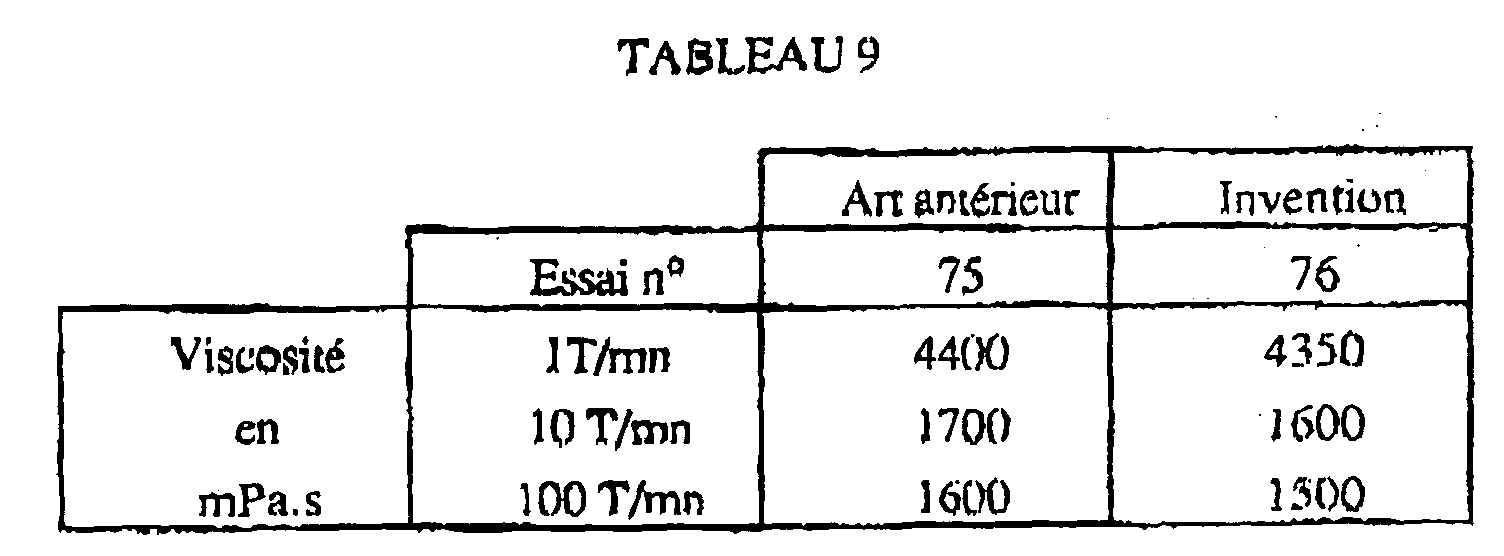
- a slip dispersion is prepared by the implementation for test No. 75 of a sodium polyacrylate with a specific viscosity equal to 0.4 according to the prior art and for test No. 76 of the sodium polyacrylate of test No. 3 according to the invention.
- Brookfield viscosities are measured using a Brookfield viscometer type RVT at 1 RPM, 10 RPM, 100 Tours / minute.
- Reading Table 9 reveals that the dispersion of slip containing the polyacrylate according to the invention has a rheological behavior equivalent to that of a slip containing the polyacrylate according to the prior art.
- This example relates to the use of polymer according to the invention as an agent for water retention in the paper industry.
- the water retention agent is a sodium polyacrylate of the art anterior with a specific viscosity equal to 5.0 and for test No. 78 according to the invention, the water retention agent is a sodium polyacrylate according to the invention of the test n ° 13 and specific viscosity equal to 4.8.
- a coating sauce is prepared by adding to a 1000 ml beaker, with a quantity of water necessary to reach a concentration final coating color equal to 68%, and a suspension of carbonate calcium (of particle size such that 90% of these particles have a dimension less than 2 micrometers) corresponding to a weight of 500 grams of carbonate dry calcium.
- the coating sauce is subjected to a pressure of 100 psi (7 bar) in an API filter press fitted with a permeable surface.
- Reading Table 10 reveals that a polymer according to the invention can be used as a retention agent in the paper industry.
Landscapes
- Chemical & Material Sciences (AREA)
- Chemical Kinetics & Catalysis (AREA)
- Engineering & Computer Science (AREA)
- Water Supply & Treatment (AREA)
- Organic Chemistry (AREA)
- Health & Medical Sciences (AREA)
- Medicinal Chemistry (AREA)
- Polymers & Plastics (AREA)
- Life Sciences & Earth Sciences (AREA)
- Oil, Petroleum & Natural Gas (AREA)
- Wood Science & Technology (AREA)
- Nanotechnology (AREA)
- Addition Polymer Or Copolymer, Post-Treatments, Or Chemical Modifications (AREA)
- Polymers With Sulfur, Phosphorus Or Metals In The Main Chain (AREA)
- Paper (AREA)
- Polymerisation Methods In General (AREA)
- Separation, Recovery Or Treatment Of Waste Materials Containing Plastics (AREA)
- Polymerization Catalysts (AREA)
Abstract
Description
Les homopolymères et/ou copolymères selon l'invention et destinés à être utilisés selon l'invention comme agent de dispersion et/ou de broyage ou bien encore comme fluidifiant pour boues de forage on comme modificateur de rhéologie de compositions détergentes ont généralement une viscosité spécifique au plus égale à 10, et de préférence au plus égale à 3.
- une charge appelée pied de cuve composée de 130 grammes d'eau, 30 grammes d'acide acrylique à 100 %, 30 grammes de soude à 50 % et de la totalité de la masse d'hypophosphite de sodium correspondant à 0,024 atome de phosphore par mole d'acide acrylique
- deux charges introduites en parallèle contenant l'une 467 grammes d'acide acrylique à 100 % et l'autre 10 grammes d'eau oxygénée à 130 volumes et 190 grammes d'eau.
Le polymaléate obtenu par le procédé de l'invention est un polymaléate selon l'invention, limpide, incolore, de viscosité spécifique égale à 0,12 qui, après neutralistidon jusqu'à pH = 8,6 avec de la soude à 50 %, a une concentration en matière sèche de 45,2 % et une teneur en anhydride maléique résiduel égale à 90 ppm mesurée par rapport au produit en l'état et selon la même méthode que celle, des essais précédents.


- pour l'essai n° 57 illustrant l'essai témoin, une simple mise en suspension du cabonate de calcium dans l'eau à 25 % sans ajout d'agent dispersant.
- pour l'essai n° 58 illustrant l'invention, le polyacrylate de l'essai n° 5 totalement neutralisé par de la soude et de l'hydroxyde de magnésium dans un rapport correspondant à une neutralisation 50 % sodium - 50 % magnésium.
- pour l'essai n° 59 illustrant l'invention, l'acide polyacrylique de l'essai n° 9 totalement neutralisé par de la soude et de l'hydroxyde de magnésium dans un rapport correspondant à une neutralisation 50 % sodium - 50 % magnésium.
- pour l'essai n° 60 illustrant l'invention, le polyacrylate de l'essai n° 5 totalement neutralisé par de la soude et de la chaux dans un rapport correspondant à une neutralisation 70 % sodium - 30 % culcium.
- pour l'essai n° 61 illustrant l'invention, le polyacrylate de l'essai n° 9 totalement neutralisé par de la soude et de la chaux dans un rapport correspondant à une neutralisation 70 % sodium - 30 % calcium.
| 2 g | d'un biocide commercialisé par la société RIEDEL DE HAEN sous le nom de MERGAL K6N |
| 1 g | d'un antimousse commercialisé par la société BYK saus le nom de BYK 034 |
| 41 g | d'oxyde de titane rutile commercialisé par la société THANN et MULHOUSE sous le nom RL 68 |
| 327,9 g | de carbonate de calcium naturel commercialisé par la société OMYA sous le nom DURCAL 2 |
| 215,2 g | de carbonate de calcium naturel commercialisé par la société OMYA sous le nom HYDROCARB |
| 82 g | d'un liant styrène-acrylique en dispersion commercialisé par la société RHONE-POULENC sous le nom de RHODOPAS DS 910 |
| 10,2 g | de monoéthylène glycol |
| 10,2 g | de White Spirit |
| 1,3 g | d'ammoniaque à 28 % |
| 13,6 g | d'un épaississant commercialisé par COATEX sous le nom VISCOATEX 46 |
| qsp 1000 g | en eau. |
- TB lorsque le vortex aura conservé une dimension et une forme constantes tout au long de l'incorporation des charges et/ou pigments minéraux traduisant ainsi une très bonne fluidité de la composition obtenue
- B lorsque la dimension du vortex aura légèrement diminué au cours de l'incorporation des charges et/ou pigments minéraux
- AB lorsque le vortex devient tout petit au cours de l'incorporation des charges et/ou pigments minéraux mais permet tout de même une homogénéisation des divers composants de la formulation.


- d'une embase percée d'un trou et dotée d'un ajutage par lequel s'écoule le filtrat. Cette embase supporte un tamis métallique de 60 à 80 mesh sur lequel est placé le papier filtre de 90 mm de diamètre (FANN ® référence N 87000100 Box de la société FANN INSTRUMENT Company),
- d'un cylindre de diamètre intérieur de 76,2 mm et 128 mm de hauteur,
- d'un couvercle muni d'une arrivée de gaz comprimé, dont l'étanchéité avec le cylindre est assurée à l'aide d'un joint plat, du même type que ceux placés sur l'embase.

Claims (13)
- Homopolymères et/ou copolymères, en solution aqueuse, de monomères éthyléniquement insaturés caractérisés en ce que le taux de monomères résiduels est inférieur ou égal pour chacun des monomères à 300 ppm mesuré par rapport au produit en l'état à une concentration en matière sèche au moins égale à 38 % quelle que soit la composition en monomère.
- Homopolymères et/ou copolymères selon la revendication 1 caractérisés en ce que les monomères éthyléniquement insaturés sont choisis parmi l'acide acrylique et/ou méthacrylique, itaconique, crotonique, fumarique, anhydride maléique ou encore, isocrotonique, aconitique, mésaconique, sinapique, undécylénique, angélique, et/ou leurs esters respectifs et/ou l'acide acrylamido méthyl propane sulfonique, l'acroléine, l'acrylamide, et/ou méthacrylamide, le méthacrylamido propyl triméthyl ammonium chlorure ou sulfate, le méthacrylate de triméthyl ammonium éthyl chlorure ou sulfate, ainsi que leurs homologues en acrylate er en acrylamide quaternisés ou non et/ou le diméthyldiallylchlorure, le méthallylsulfonate de sodium, le phosphate de méthacrylate ou acrylate d'éthylène ou propylène glycol, la vinylpyrrolidone et préférentiellement parmi l'acide acrylique et/ou méthacrylique et/ou l'anhydride maléique, les acrylates d'éthyle ou butyle, le méthacrylate de méthyle, l'acrylamide, le phosphate de méthacrylate d'éthylène glycol.
- Polymère en solution aqueuse selon la revendication 1 ou 2 caractérisé en ce qu'il est sous forme totalement acide.
- Polymère en solution aqueuse selon l'une quelconque des revendications 1 à 3 caractérisé en ce qu'il est partiellement ou totalement neutralisé par un ou plusieurs agents de neutralisation disposant d'une fonction monovalente choisis dans le groupe constitué par les cations alcalins, et de préférence parmi le sodium, le potassium, l'ammonium ou les amines primaires, secondaires ou tertiaires aliphatiques et/ou cycliques ou bien encore par un ou plusieurs agents de neutralisation d'une fonction polyvalente choisis dans le groupe constitué par les cations divalents alcalino-terreux de préférence le magnésium et le calcium, ou encore le zinc, de même que par les cations trivalents, dont en particulier l'aluminium, ou encore, par certains cations de valence plus élevée ainsi que des amines primaires et secondaires, aliphatiques et/ou cycliques ainsi que leurs combinaisons.
- Polymère en solution aqueuse selon l'une quelconque des revendications 1 à 4 caractérisé en ce qu'il a une viscosité spécifique au plus égale à 10 et préférentiellement au plus égale à 3.
- Utilisation du polymère en solution aqueuse selon l'une des revendications 1 à 5 comme agent de broyage et/ou de dispersion de matériaux minéraux en milieu aqueux.
- Utilisation du polymère en solution aqueuse selon l'une quelconque des revendications 1 à 5 comme agent de rétention d'eau dans l'industrie papetière.
- Utilisation du polymère en solution aqueuse selon l'une quelconque des revendications 1 à 5 comme agent séquestrant ou inhibiteur de précipitation et/ou d'incrustations minérales dans le traitement des eaux industrielles et/ou domestiques.
- Utilisation du polymère en solution aqueuse selon l'une quelconque des revendications 1 à 5 comme agent anti-tartre et anti-corrosion dans le domaine de l'osmose inverse et de l'ultrafiltration.
- Utilisation du polymère en solution aqueuse selon l'une quelconque des revendications 1 à 5 comme agent fluidifiant des fluides de forage.
- Utilisation du polymère en solution aqueuse selon l'une quelconque des revendications 1 à 5 dans le domaine de la détergence comme agent anti-tartre et dispersant ne déstabilisant pas le degré chlorométrique des hypochlorites présents dans les formulations détergentes ou comme agent stabilisant des zéolithes ou bien encore comme builder.
- Suspensions aqueuses de matériaux minéraux contenant le polymère selon l'une quelconque des revendications 1 à 5.
- Utilisation des suspensions aqueuses de matériaux minéraux selon la revendication 12 dans le domaine du papier, de la peinture, de la céramique, des fluides de forage et de la détergence.
Applications Claiming Priority (3)
| Application Number | Priority Date | Filing Date | Title |
|---|---|---|---|
| FR9609345 | 1996-07-19 | ||
| FR9609345A FR2751335B1 (fr) | 1996-07-19 | 1996-07-19 | Procede d'obtention de polymere hydrosolubles, polymeres obtenus et leurs utilisations |
| EP97420113A EP0819704B1 (fr) | 1996-07-19 | 1997-07-10 | Procédé d'obtention de polymères hydrosolubles |
Related Parent Applications (1)
| Application Number | Title | Priority Date | Filing Date |
|---|---|---|---|
| EP97420113A Division EP0819704B1 (fr) | 1996-07-19 | 1997-07-10 | Procédé d'obtention de polymères hydrosolubles |
Publications (2)
| Publication Number | Publication Date |
|---|---|
| EP1439195A2 true EP1439195A2 (fr) | 2004-07-21 |
| EP1439195A3 EP1439195A3 (fr) | 2004-08-18 |
Family
ID=9494455
Family Applications (2)
| Application Number | Title | Priority Date | Filing Date |
|---|---|---|---|
| EP04075332A Withdrawn EP1439195A3 (fr) | 1996-07-19 | 1997-07-10 | Polymères hydrosolubles résiduels a faible teneur en monomères et leurs utilisations |
| EP97420113A Expired - Lifetime EP0819704B1 (fr) | 1996-07-19 | 1997-07-10 | Procédé d'obtention de polymères hydrosolubles |
Family Applications After (1)
| Application Number | Title | Priority Date | Filing Date |
|---|---|---|---|
| EP97420113A Expired - Lifetime EP0819704B1 (fr) | 1996-07-19 | 1997-07-10 | Procédé d'obtention de polymères hydrosolubles |
Country Status (28)
| Country | Link |
|---|---|
| US (3) | US5891972A (fr) |
| EP (2) | EP1439195A3 (fr) |
| KR (1) | KR980009289A (fr) |
| CN (1) | CN1145647C (fr) |
| AR (1) | AR007909A1 (fr) |
| AT (1) | ATE282050T1 (fr) |
| AU (1) | AU731444B2 (fr) |
| BG (1) | BG64285B1 (fr) |
| BR (1) | BR9704025A (fr) |
| CA (1) | CA2209512C (fr) |
| CO (1) | CO4790111A1 (fr) |
| CZ (1) | CZ293132B6 (fr) |
| DE (1) | DE69731512T2 (fr) |
| DK (1) | DK0819704T3 (fr) |
| ES (1) | ES2232855T3 (fr) |
| FR (1) | FR2751335B1 (fr) |
| HU (1) | HU218735B (fr) |
| ID (1) | ID19854A (fr) |
| MX (1) | MX210213B (fr) |
| MY (1) | MY136218A (fr) |
| NO (1) | NO317445B1 (fr) |
| NZ (1) | NZ328273A (fr) |
| PL (1) | PL192750B1 (fr) |
| PT (1) | PT819704E (fr) |
| RU (1) | RU2217439C2 (fr) |
| SK (1) | SK284465B6 (fr) |
| TR (1) | TR199700662A2 (fr) |
| TW (1) | TW428007B (fr) |
Cited By (3)
| Publication number | Priority date | Publication date | Assignee | Title |
|---|---|---|---|---|
| EP2107087A1 (fr) * | 2008-03-31 | 2009-10-07 | Rohm and Haas Company | Processus de broyage de minéraux dans une dispersion aqueuse en utilisant un agent de dispersion comportant des homopolymères et/ou copolymères d'acide (méth)acrylique |
| CN103045224A (zh) * | 2013-01-08 | 2013-04-17 | 陕西科技大学 | 一种含有季铵盐结构的稠油降粘剂的制备方法 |
| CN112111039A (zh) * | 2019-06-19 | 2020-12-22 | 中国石油化工股份有限公司 | 一种分散剂、其制备方法及应用 |
Families Citing this family (46)
| Publication number | Priority date | Publication date | Assignee | Title |
|---|---|---|---|---|
| EP2319398B1 (fr) * | 1998-06-03 | 2019-01-16 | Masimo Corporation | Stéréo-oxymètre de pouls |
| US7169293B2 (en) * | 1999-08-20 | 2007-01-30 | Uop Llc | Controllable space velocity reactor and process |
| FR2798661B1 (fr) * | 1999-09-16 | 2001-11-02 | Coatex Sa | Procede d'obtention de polymeres hydrosolubles, polymeres obtenus et leurs utilisations |
| FR2810261B1 (fr) * | 2000-06-15 | 2002-08-30 | Coatex Sa | Utilisation de copolymeres faiblement anioniques comme agent dispersant et/ou d'aide au broyage de suspension aqueuse de matieres minerales, suspensions aqueuses obtenues et leurs utilisations |
| FR2818166B1 (fr) * | 2000-12-20 | 2003-10-31 | Coatex Sas | Agent d'aide au broyage et/ou de dispersion de materiaux mineraux en suspension aqueuse. suspensions aqueuses obtenues et leurs utilisations |
| US6933349B2 (en) | 2001-03-21 | 2005-08-23 | Owens Corning Fiberglas Technology, Inc. | Low odor insulation binder from phosphite terminated polyacrylic acid |
| US20030073586A1 (en) * | 2001-10-03 | 2003-04-17 | Martin Crossman | Scale control composition for high scaling environments |
| US7144431B2 (en) * | 2001-10-18 | 2006-12-05 | The Procter & Gamble Company | Textile finishing composition and methods for using same |
| US7018422B2 (en) * | 2001-10-18 | 2006-03-28 | Robb Richard Gardner | Shrink resistant and wrinkle free textiles |
| US7169742B2 (en) * | 2001-10-18 | 2007-01-30 | The Procter & Gamble Company | Process for the manufacture of polycarboxylic acids using phosphorous containing reducing agents |
| US6989035B2 (en) | 2001-10-18 | 2006-01-24 | The Procter & Gamble Company | Textile finishing composition and methods for using same |
| US6841198B2 (en) * | 2001-10-18 | 2005-01-11 | Strike Investments, Llc | Durable press treatment of fabric |
| US7008457B2 (en) * | 2001-10-18 | 2006-03-07 | Mark Robert Sivik | Textile finishing composition and methods for using same |
| FR2835840B1 (fr) * | 2002-02-08 | 2006-05-05 | Coatex Sas | Agent liant et modificateur de rheologie de suspensions aqueuses de matieres minerales. grains obtenus et leurs utilisations . |
| US7063983B2 (en) * | 2002-05-31 | 2006-06-20 | Owens Corning Fiberglas Technology, Inc. | Method for determining cure in a polycarboxylic acid bindered material |
| US7185516B2 (en) * | 2002-05-31 | 2007-03-06 | Owens Corning Fiberglas Technology, Inc. | Washwater neutralization system for glass forming line |
| FR2842814B1 (fr) * | 2002-07-26 | 2004-10-22 | Coatex Sas | Procede de polymerisation radicalaire controlee de l'acide acrylique et de ses sels, les polymeres obtenus, et leurs applications. |
| US7384881B2 (en) * | 2002-08-16 | 2008-06-10 | H.B. Fuller Licensing & Financing, Inc. | Aqueous formaldehyde-free composition and fiberglass insulation including the same |
| DE10300460A1 (de) * | 2003-01-07 | 2004-07-15 | Basf Ag | Verfahren zur Herstellung stabiler wässriger Polymerisatdispersionen auf Basis von konjugierten aliphatischen Dienen und vinylaromatischen Verbindungen |
| CA2558266C (fr) | 2004-03-05 | 2017-10-17 | Gen-Probe Incorporated | Reactifs, procedes et kits utilise dans la desactivation d'acides nucleiques |
| AT503114B1 (de) * | 2006-01-24 | 2007-08-15 | Daniel Bader | Biozide zusammensetzung enthaltend eine poly(aldehydo)carbonsäure, eine silberverbindung und eine quartäre ammoniumverbindung |
| US8080488B2 (en) * | 2008-03-10 | 2011-12-20 | H. B. Fuller Company | Wound glass filament webs that include formaldehyde-free binder compositions, and methods of making and appliances including the same |
| FR2944786B1 (fr) * | 2009-04-27 | 2011-07-15 | Coatex Sas | Utilisation d'homopolymeres de l'acide maleique et de ses sels comme agents inhibiteurs de tartre et anti-adherence. |
| KR101837788B1 (ko) * | 2010-07-01 | 2018-03-12 | 바스프 에스이 | 모노카복실산과 디카복실산의 공중합체, 그의 제조 및 용도 |
| FR2963939B1 (fr) | 2010-08-19 | 2013-11-15 | Coatex Sas | Utilisation en sauces de couchage papetieres de polymeres (meth)acryliques peignes amphiphiles et non hydrosolubles |
| FR2963934B1 (fr) | 2010-08-19 | 2013-10-25 | Coatex Sas | Polymeres (meth)acryliques peignes amphiphiles et non hydrosolubles |
| US9587130B2 (en) * | 2010-09-24 | 2017-03-07 | Hewlett-Packard Development Company, L.P. | Anti-kogation agents |
| FR2972349B1 (fr) | 2011-03-07 | 2013-04-05 | Coatex Sas | Formulation cosmetique contenant un copolymere amphiphile non hydrosoluble comme agent epaississant. |
| CN102660250B (zh) * | 2012-04-17 | 2014-10-15 | 西南石油大学 | 一种阳离子疏水缔合聚合物驱油剂及其制备方法 |
| US9416294B2 (en) | 2012-04-30 | 2016-08-16 | H.B. Fuller Company | Curable epoxide containing formaldehyde-free compositions, articles including the same, and methods of using the same |
| US8791198B2 (en) | 2012-04-30 | 2014-07-29 | H.B. Fuller Company | Curable aqueous composition |
| CN103406067B (zh) * | 2013-07-31 | 2016-03-16 | 中科院广州化学有限公司 | —种聚羧酸分散剂及其制备方法与应用 |
| CN103554362B (zh) * | 2013-10-18 | 2016-03-16 | 中国科学院广州化学研究所 | 一种马来酸酐共聚物分散剂及其制备方法与应用 |
| WO2015125802A1 (fr) * | 2014-02-19 | 2015-08-27 | 三井化学株式会社 | COPOLYMÈRE DE PROPYLÈNE/α-OLÉFINE MODIFIÉ PAR GREFFAGE ET SON PROCÉDÉ DE PRODUCTION |
| FR3032700B1 (fr) * | 2015-02-12 | 2021-01-22 | Snf Sas | Procede pour le traitement de suspensions de particules solides dans l'eau a l'aide de polymeres amphoteres |
| JP6623613B2 (ja) * | 2015-08-18 | 2019-12-25 | 東亞合成株式会社 | 水溶性重合体組成物及びその製造方法、並びにその利用 |
| CN105174501A (zh) * | 2015-09-16 | 2015-12-23 | 天津亿利科能源科技发展股份有限公司 | 用于油田污水处理系统的阻垢除垢剂及其制备方法 |
| CN105254040B (zh) * | 2015-11-03 | 2017-11-14 | 新疆德蓝股份有限公司 | 一种油田回注水用缓蚀阻垢剂及其制备方法 |
| WO2018081964A1 (fr) | 2016-11-02 | 2018-05-11 | Basf Se | Polymères d'acide acrylique neutralisés par des ions sodium et calcium et présentant une étroite distribution des masses moléculaires |
| JP6901292B2 (ja) * | 2017-03-15 | 2021-07-14 | 株式会社Adeka | 水溶性組成物、その硬化物の製造方法、およびその硬化物、並びにアシルホスフィン酸塩 |
| EP3567158A1 (fr) * | 2018-05-10 | 2019-11-13 | ImerTech | Compositions utiles pour le blanchiment et leurs procédés de préparation et d'utilisation |
| WO2020167600A1 (fr) | 2019-02-11 | 2020-08-20 | Dow Global Technologies Llc | Procédé de polymérisation par transfert d'iode inverse et compositions en résultant |
| WO2020167599A1 (fr) | 2019-02-11 | 2020-08-20 | Dow Global Technologies Llc | Procédé de polymérisation par transfert d'iode et compositions obtenues à partir de ce dernier |
| US20200277547A1 (en) | 2019-02-28 | 2020-09-03 | Ecolab Usa Inc. | Stabilizing system for laundry emulsions |
| US12351779B2 (en) | 2020-12-04 | 2025-07-08 | Ecolab Usa Inc. | Stability and viscosity in high active high caustic laundry emulsion with low HLB surfactant |
| CN121648747B (zh) * | 2026-02-02 | 2026-05-05 | 湖南湘新碧水源环境科技有限公司 | 用于mbr膜生物反应器的低损伤高效清洗剂配方 |
Family Cites Families (15)
| Publication number | Priority date | Publication date | Assignee | Title |
|---|---|---|---|---|
| GB578849A (en) * | 1943-09-06 | 1946-07-15 | Distillers Co Yeast Ltd | Improved polymerisation process |
| US2957931A (en) * | 1949-07-28 | 1960-10-25 | Socony Mobil Oil Co Inc | Synthesis of compounds having a carbonphosphorus linkage |
| US2789099A (en) * | 1953-09-04 | 1957-04-16 | Union Carbide & Carbon Corp | Polymerization of acrylic acid in aqueous solution |
| JPS556761B2 (fr) * | 1972-05-30 | 1980-02-19 | ||
| JPS53127586A (en) * | 1977-04-13 | 1978-11-07 | Toagosei Chem Ind Co Ltd | Production of acrylamide polymer |
| DE3434139A1 (de) * | 1984-09-18 | 1986-03-20 | Basf Ag, 6700 Ludwigshafen | Verfahren zur herstellung von carboxylgruppen enthaltenden polymerisaten |
| DE3603392A1 (de) * | 1986-02-05 | 1987-08-06 | Basf Ag | Verfahren zur herstellung von polymerisaten der acrylsaeure oder methacrylsaeure |
| JPH0234694A (ja) * | 1988-07-25 | 1990-02-05 | Nippon Shokubai Kagaku Kogyo Co Ltd | 洗剤添加剤 |
| US5185413A (en) * | 1989-05-16 | 1993-02-09 | Mitsubishi Petrochemical Company Limited | Process for producing highly water-absortive polymers |
| JP2922216B2 (ja) * | 1989-05-16 | 1999-07-19 | 三菱化学株式会社 | 高吸水性ポリマー製造法 |
| US5077361A (en) * | 1989-06-26 | 1991-12-31 | Rohm And Haas Company | Low molecular weight water soluble phosphinate and phosphonate containing polymers |
| US5216099A (en) * | 1989-06-26 | 1993-06-01 | Rohm And Haas Company | Low molecular weight water soluble phosphinate and phosphonate containing polymers |
| US4989673A (en) * | 1989-07-14 | 1991-02-05 | Marathon Oil Company | Lost circulation fluid for oil field drilling operations |
| US5256746A (en) * | 1991-04-25 | 1993-10-26 | Rohm And Haas Company | Low molecular weight monoalkyl substituted phosphinate and phosphonate copolymers |
| US5294686A (en) * | 1993-03-29 | 1994-03-15 | Rohm And Haas Company | Process for efficient utilization of chain transfer agent |
-
1996
- 1996-07-19 FR FR9609345A patent/FR2751335B1/fr not_active Expired - Fee Related
-
1997
- 1997-06-30 SK SK891-97A patent/SK284465B6/sk unknown
- 1997-07-05 TW TW086109495A patent/TW428007B/zh not_active IP Right Cessation
- 1997-07-07 CA CA002209512A patent/CA2209512C/fr not_active Expired - Fee Related
- 1997-07-07 MX MX9705087A patent/MX210213B/es not_active IP Right Cessation
- 1997-07-08 NZ NZ328273A patent/NZ328273A/xx unknown
- 1997-07-10 DK DK97420113T patent/DK0819704T3/da active
- 1997-07-10 EP EP04075332A patent/EP1439195A3/fr not_active Withdrawn
- 1997-07-10 PT PT97420113T patent/PT819704E/pt unknown
- 1997-07-10 AT AT97420113T patent/ATE282050T1/de not_active IP Right Cessation
- 1997-07-10 DE DE69731512T patent/DE69731512T2/de not_active Expired - Fee Related
- 1997-07-10 ES ES97420113T patent/ES2232855T3/es not_active Expired - Lifetime
- 1997-07-10 EP EP97420113A patent/EP0819704B1/fr not_active Expired - Lifetime
- 1997-07-11 NO NO19973244A patent/NO317445B1/no not_active IP Right Cessation
- 1997-07-14 CZ CZ19972228A patent/CZ293132B6/cs not_active IP Right Cessation
- 1997-07-17 AR ARP970103213A patent/AR007909A1/es active IP Right Grant
- 1997-07-17 BG BG101784A patent/BG64285B1/bg unknown
- 1997-07-17 CO CO97040542A patent/CO4790111A1/es unknown
- 1997-07-18 AU AU28759/97A patent/AU731444B2/en not_active Ceased
- 1997-07-18 TR TR97/00662A patent/TR199700662A2/xx unknown
- 1997-07-18 RU RU97112503/04A patent/RU2217439C2/ru not_active IP Right Cessation
- 1997-07-18 HU HU9701230A patent/HU218735B/hu not_active IP Right Cessation
- 1997-07-18 PL PL321197A patent/PL192750B1/pl unknown
- 1997-07-18 BR BR9704025A patent/BR9704025A/pt not_active IP Right Cessation
- 1997-07-18 MY MYPI97003250A patent/MY136218A/en unknown
- 1997-07-18 CN CNB971180555A patent/CN1145647C/zh not_active Expired - Fee Related
- 1997-07-18 ID IDP972492A patent/ID19854A/id unknown
- 1997-07-18 KR KR1019970033409A patent/KR980009289A/ko active Granted
- 1997-07-21 US US08/897,572 patent/US5891972A/en not_active Expired - Fee Related
-
1998
- 1998-12-24 US US09/219,887 patent/US6063884A/en not_active Expired - Fee Related
-
1999
- 1999-07-06 US US09/348,666 patent/US6184321B1/en not_active Expired - Fee Related
Cited By (4)
| Publication number | Priority date | Publication date | Assignee | Title |
|---|---|---|---|---|
| EP2107087A1 (fr) * | 2008-03-31 | 2009-10-07 | Rohm and Haas Company | Processus de broyage de minéraux dans une dispersion aqueuse en utilisant un agent de dispersion comportant des homopolymères et/ou copolymères d'acide (méth)acrylique |
| CN103045224A (zh) * | 2013-01-08 | 2013-04-17 | 陕西科技大学 | 一种含有季铵盐结构的稠油降粘剂的制备方法 |
| CN112111039A (zh) * | 2019-06-19 | 2020-12-22 | 中国石油化工股份有限公司 | 一种分散剂、其制备方法及应用 |
| CN112111039B (zh) * | 2019-06-19 | 2022-05-20 | 中国石油化工股份有限公司 | 一种分散剂、其制备方法及应用 |
Also Published As
Similar Documents
| Publication | Publication Date | Title |
|---|---|---|
| EP0819704B1 (fr) | Procédé d'obtention de polymères hydrosolubles | |
| EP1294476B1 (fr) | Utilisation de copolymeres faiblement anioniques comme agent dispersant et d'aide au broyage de suspension aqueuse de matieres minerales | |
| MXPA97005087A (en) | Procedure for obtaining hydrosoluble polymers, polymers obtained and their u | |
| EP0892111B1 (fr) | Suspensions aqueuses de matières minérales et leurs utilisations | |
| EP0542644B1 (fr) | Agent de broyage et/ou de dispersion à base de polymères et/ou copolymères neutralisés en partie par du magnésium pour suspensions aqueuses de matériaux minéraux en vue d'applications pigmentaires | |
| FR2766106A1 (fr) | Utilisation d'un copolymere a structure tensio-active comme agent dispersant et/ou d'aide au broyage | |
| EP1240203A1 (fr) | Procede d'obtention de polymeres hydrosolubles polymeres obtenus et leurs utilisations | |
| US5747619A (en) | Water-soluble, carboxyl-containing copolymers, the preparation thereof and the use thereof as scale inhibitor | |
| EP1708803A2 (fr) | Utilisation de polymeres hydrosolubles structures obtenus par polymerisation radicalaire controlee comme dispersant et agent d'aide au broyage de matieres minerales | |
| JPH08507802A (ja) | アスパラギン酸を主体とする共重縮合体、その製造方法およびその使用 | |
| FR2683538A1 (fr) | Procede de broyage en suspension aqueuse en presence d'un agent de broyage neutralise en partie par du magnesium. | |
| FR2683537A1 (fr) | Agent de broyage et/ou de dispersion a base de polymeres et/ou copolymeres neutralises en partie par du magnesium pour suspensions aqueuses de materiaux mineraux en vue d'applications pigmentaires. | |
| KR100512653B1 (ko) | 수용성중합체의제조방법,그방법에의해제조된중합체,및이의사용방법 | |
| CA3018451A1 (fr) | Copolymere hydrosoluble et son utilisation comme dispersant pour suspension de particules | |
| JPS6012894B2 (ja) | サチンホワイト用分散剤 |
Legal Events
| Date | Code | Title | Description |
|---|---|---|---|
| PUAI | Public reference made under article 153(3) epc to a published international application that has entered the european phase |
Free format text: ORIGINAL CODE: 0009012 |
|
| PUAL | Search report despatched |
Free format text: ORIGINAL CODE: 0009013 |
|
| AC | Divisional application: reference to earlier application |
Ref document number: 0819704 Country of ref document: EP Kind code of ref document: P |
|
| AK | Designated contracting states |
Kind code of ref document: A2 Designated state(s): AT BE CH DE DK ES FI FR GB GR IE IT LI LU NL PT SE |
|
| AK | Designated contracting states |
Kind code of ref document: A3 Designated state(s): AT BE CH DE DK ES FI FR GB GR IE IT LI LU NL PT SE |
|
| RIN1 | Information on inventor provided before grant (corrected) |
Inventor name: SUAU, JEAN-MARC Inventor name: EGRAZ, JEAN-BERNARD Inventor name: KENSICHER, YVES |
|
| AKX | Designation fees paid | ||
| REG | Reference to a national code |
Ref country code: DE Ref legal event code: 8566 |
|
| STAA | Information on the status of an ep patent application or granted ep patent |
Free format text: STATUS: THE APPLICATION IS DEEMED TO BE WITHDRAWN |
|
| 18D | Application deemed to be withdrawn |
Effective date: 20050221 |