EP1439708A2 - Transmisson et réception de contenu progressif avec des champs isolés pour la conversion vers afficheur entrelacé - Google Patents
Transmisson et réception de contenu progressif avec des champs isolés pour la conversion vers afficheur entrelacé Download PDFInfo
- Publication number
- EP1439708A2 EP1439708A2 EP04001025A EP04001025A EP1439708A2 EP 1439708 A2 EP1439708 A2 EP 1439708A2 EP 04001025 A EP04001025 A EP 04001025A EP 04001025 A EP04001025 A EP 04001025A EP 1439708 A2 EP1439708 A2 EP 1439708A2
- Authority
- EP
- European Patent Office
- Prior art keywords
- field
- video
- frames
- isolated
- film
- Prior art date
- Legal status (The legal status is an assumption and is not a legal conclusion. Google has not performed a legal analysis and makes no representation as to the accuracy of the status listed.)
- Ceased
Links
Images




Classifications
-
- H—ELECTRICITY
- H04—ELECTRIC COMMUNICATION TECHNIQUE
- H04N—PICTORIAL COMMUNICATION, e.g. TELEVISION
- H04N21/00—Selective content distribution, e.g. interactive television or video on demand [VOD]
- H04N21/20—Servers specifically adapted for the distribution of content, e.g. VOD servers; Operations thereof
- H04N21/23—Processing of content or additional data; Elementary server operations; Server middleware
- H04N21/236—Assembling of a multiplex stream, e.g. transport stream, by combining a video stream with other content or additional data, e.g. inserting a URL [Uniform Resource Locator] into a video stream, multiplexing software data into a video stream; Remultiplexing of multiplex streams; Insertion of stuffing bits into the multiplex stream, e.g. to obtain a constant bit-rate; Assembling of a packetised elementary stream
- H04N21/23608—Remultiplexing multiplex streams, e.g. involving modifying time stamps or remapping the packet identifiers
-
- H—ELECTRICITY
- H04—ELECTRIC COMMUNICATION TECHNIQUE
- H04N—PICTORIAL COMMUNICATION, e.g. TELEVISION
- H04N21/00—Selective content distribution, e.g. interactive television or video on demand [VOD]
- H04N21/40—Client devices specifically adapted for the reception of or interaction with content, e.g. set-top-box [STB]; Operations thereof
- H04N21/43—Processing of content or additional data, e.g. demultiplexing additional data from a digital video stream; Elementary client operations, e.g. monitoring of home network or synchronising decoder's clock; Client middleware
- H04N21/4302—Content synchronisation processes, e.g. decoder synchronisation
- H04N21/4307—Synchronising the rendering of multiple content streams or additional data on devices, e.g. synchronisation of audio on a mobile phone with the video output on the TV screen
- H04N21/43072—Synchronising the rendering of multiple content streams or additional data on devices, e.g. synchronisation of audio on a mobile phone with the video output on the TV screen of multiple content streams on the same device
-
- H—ELECTRICITY
- H04—ELECTRIC COMMUNICATION TECHNIQUE
- H04N—PICTORIAL COMMUNICATION, e.g. TELEVISION
- H04N7/00—Television systems
- H04N7/01—Conversion of standards, e.g. involving analogue television standards or digital television standards processed at pixel level
- H04N7/0112—Conversion of standards, e.g. involving analogue television standards or digital television standards processed at pixel level one of the standards corresponding to a cinematograph film standard
-
- H—ELECTRICITY
- H04—ELECTRIC COMMUNICATION TECHNIQUE
- H04N—PICTORIAL COMMUNICATION, e.g. TELEVISION
- H04N7/00—Television systems
- H04N7/01—Conversion of standards, e.g. involving analogue television standards or digital television standards processed at pixel level
- H04N7/0117—Conversion of standards, e.g. involving analogue television standards or digital television standards processed at pixel level involving conversion of the spatial resolution of the incoming video signal
- H04N7/012—Conversion between an interlaced and a progressive signal
-
- Y—GENERAL TAGGING OF NEW TECHNOLOGICAL DEVELOPMENTS; GENERAL TAGGING OF CROSS-SECTIONAL TECHNOLOGIES SPANNING OVER SEVERAL SECTIONS OF THE IPC; TECHNICAL SUBJECTS COVERED BY FORMER USPC CROSS-REFERENCE ART COLLECTIONS [XRACs] AND DIGESTS
- Y10—TECHNICAL SUBJECTS COVERED BY FORMER USPC
- Y10S—TECHNICAL SUBJECTS COVERED BY FORMER USPC CROSS-REFERENCE ART COLLECTIONS [XRACs] AND DIGESTS
- Y10S348/00—Television
- Y10S348/911—Line doubler adapted for reproducing programme originally from film, e.g. 24 frames per second
Definitions
- MPEG Moving Pictures Experts Group
- an integral value of fps or an integral value of FPS may be an approximation including, within its scope, a range of equivalent values.
- the expression 30 FPS may be used to refer to rates such as, for example, approximately 29.97 FPS or approximately 30 FPS.
- the expression 24 FPS may be used to refer to rates such as, for example, approximately 23.976 FPS or approximately 24 FPS.
- the expression 60 fps may be used to refer to rates such as, for example, approximately 59.94 fps or approximately 60 fps.
- Film material produced at 24 FPS is routinely converted to 60 fps in many applications. Broadcast networks usually encode and transmit movies that were originally filmed at 24 FPS and not at 60 fps. However, at the receiver, the decoded video at 24 FPS is often converted to 60 fps for interlaced display.
- a conventional process for converting 24 FPS to 60 fps sampling includes the Telecine Process (named after the original type of machine used to perform the conversion from film to video). It is also known as the 3:2 pull-down process.
- the Telecine Process inserts repeated fields derived from the original film frames in such a way that 5 video frames (i.e., 10 fields) are produced for every 4 original film frames.
- FIG. 1 illustrates one example of a process 12 that performs a 3:2 pull-down.
- the original film sequence 10 filmed at 24 FPS is converted to a video sequence 14 at 30 FPS, or equivalently 60 fps.
- a mechanism of handling 3:2 pull-down for film material in digital video systems is usually referred as film mode.
- the Telecine Process or 3:2 pull-down process is supported in the MPEG-2 Video compression standard.
- the frame rate encoded in the sequence header is 30 FPS for interlaced display, even though the video is actually coded as a 24 FPS film sequence.
- the encoder also conveys, to the decoder, proper display timing based on the frame rate of 30 FPS.
- the flags top_field_first and repeat_first_field in the picture coding extension header are used for indicating how a picture should be displayed. These two flags are mandated as MPEG-2 syntax elements that are carried all the time and are followed by decoder. However, such inflexibility may not be desirable, particularly, when the type of display device can vary from, for example, an interlaced television to a progressive monitor. Furthermore, the encoder does not know the type of display employed at the decoder end.
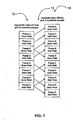
- FIG. 1 illustrates the mapping between the film states and these 3:2 pull-down flags in MPEG-2 Video.
- the decoder In MPEG-2, the decoder generally follows the top_field_first and repeat_first_field flags to display film state B and D frames for three field times to re-construct the 3:2 pull-down pattern. The decoder re-displays the first field to create the third field. This is because, in the 3:2 pull-down algorithm, the first field is repeated every other picture to convert film material at 24 FPS to video mode at 30 FPS. Film state A and C pictures are displayed for only two field times. A film mode sequence of four pictures will therefore be displayed as a total of 10 field times. In this way, the decoded video is displayed at the correct video picture rate of 30 FPS
- the flags top_field_first and repeat_first_field along with the frame rate can also be applied to derive Decoding Time Stamps (DTS) and Presentation Time Stamps (PTS) for some pictures.
- DTS Decoding Time Stamps
- PTS Presentation Time Stamps
- the flags i.e., top_field_first and repeat_first_field
- top_field_first and repeat_first_field are used to achieve proper timing for decoding and displaying the coded 24 FPS film material to generate output video at 30 FPS.
- the 3:2 pull-down process or the film mode is supported in a different manner and not supported by, for example, new video compression standards (e.g., MPEG-4 Advanced Video Coding (AVC)) as well as with some of the existing video transport standards (e.g., MPEG-2 Systems).
- new video compression standards e.g., MPEG-4 Advanced Video Coding (AVC)
- AVC MPEG-4 Advanced Video Coding
- decoding time and presentation time may be indicated via syntax elements that differ from DTS specifications and PTS specifications found in MPEG-2 Systems.
- DTS and PTS may be interpreted as including, within their meaning, decoding time or buffer removal time and presentation time or display time, respectively, regardless of how they may be encoded in the bitstream.
- Some aspects of the present invention may relate to a system and a method of encoding progressive content with isolated fields for conversion to interlaced display. Some applications within the scope of the present invention may find use, for example, in digital video compression systems and methods.
- the present invention may provide an encoder that is adapted to encode film material as video with an intended field polarity and an explicit 3:2 pull-down operation for interlaced display (e.g., a 30 FPS display).
- An isolated field with the intended field polarity (e.g., top field) may be coded between two frames to achieve 3:2 pull-down for coding the film material.
- the polarities of all fields of all frames may be inferred from the field polarities of the isolated frames since the field polarities alternate for normal interlaced display of video.
- Frames do not have to indicate field polarities; however, they may do so in video coding standards that support the indication of field polarity of frames.
- the field polarities of the frames may be implied by the polarities of the isolated fields.
- the present invention may provide that DTS and PTS may be generated for both coded frames and fields in the encoder.
- the encoder may insert isolated fields as appropriate to achieve the desired decoding and display timing, for example, according to the result of a 3:2 pull-down process.
- the encoder may encode progressive frames with interspersed isolated fields in a manner similar to the content that is received by the encoder.
- decoding and presentation times may be derived from the decoding and presentation times of previous pictures (e.g., frame frames or field pictures) by using the frame rate or the field rate indicated in the stream.
- decoding and presentation times may be derived from the decoding and presentation times of previous pictures by using only the frame or the field rate indicated in the stream.
- a system for facilitating a display of a video comprises:
- FIG. 1 illustrates an embodiment of a 3:2 Pull Down process.
- FIG. 2 illustrates an embodiment of a mapping between film mode states and 3:2 pull-down flags.
- FIG. 3 illustrates an embodiment of a pattern of frames and fields according to the present invention.
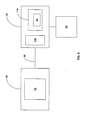
- FIG. 4 illustrates an embodiment of a system that facilitates the display of video according to the present invention.
- FIG. 5 illustrates an embodiment of a system that facilitates the display of video according to the present invention.
- FIG. 6 illustrates a flowchart showing an embodiment of a process that facilitates the display of video according to the present invention.
- FIG. 7 illustrates a flowchart showing an embodiment of a decoding process according to the present invention.
- Some aspects of the present invention may relate to a system and a method that encodes progressive content with isolated fields for conversion to interlaced display. Some applications within the scope of the present invention may find use in, for example, digital video compression systems and methods. Some embodiments according to the present invention may be suitable for use in and compatible with some MPEG standards (e.g., an MPEG-4 AVC standard as described in, for example, document JVT-E146d37ncm.doc, entitled “Joint Video Specification (ITU-T Rec. H.264 ISO/EEC 14496-10 AVC)", incorporated herein by reference in its entirety).
- MPEG standards e.g., an MPEG-4 AVC standard as described in, for example, document JVT-E146d37ncm.doc, entitled “Joint Video Specification (ITU-T Rec. H.264 ISO/EEC 14496-10 AVC)", incorporated herein by reference in its entirety).
- Some aspects of the present invention may relate to providing a system and a method that realizes a 3:2 pull-down process or a film mode for at least some video compression systems and methods.
- Some embodiments according to the present invention may be suitable for use in and compatible with some MPEG standards (e.g., MPEG-4 AVC) including some existing video transport standards (e.g., MPEG-2 Systems).
- FIGS. 4 and 5 show respective block diagrams illustrating embodiments of systems that facilitate the display of video according to the present invention.
- a transmitter 40 may be coupled to a receiver 50 via a network 60.
- the receiver 50 may, in turn, be coupled to a display 90.
- the transmitter 40 may include, for example, an encoder 70.
- the receiver 50 may include, for example, a decoder 80.
- FIG. 5 shows another embodiment for the receiver 50 including, for example, a transport processor 100 and a multimedia processor 110.
- the transport processor 100 may be coupled to the network 60 and to the multimedia processor 110.
- the multimedia processor 110 may be coupled to the display 90 and may include, for example, the decoder 80.
- the decoder 80 may be separate from the multimedia processor 110.
- the transport processor 100 and multimedia processor 110 may be integrated at least in part.
- the transport processor 100 and the multimedia processor 110 form a single integrated chip. The present invention contemplates other degrees of integration and separation.
- FIG. 6 illustrates a flowchart showing an embodiment of a process that facilitates the display of video according to the present invention.
- the encoder 70 of the receiver 50 may encode, for example, film material as video material with an intended field polarity and with an explicit 3:2 pull-down operation for interlaced display via the display 90.
- the encoder 70 may insert one or more isolated fields with the intended field polarity (e.g., a top field or a bottom field) between two frames to achieve 3:2 pull-down for coding the film material.
- the field polarities of the fields in all of the frames may be inferred from the field polarities of the isolated frames.
- the bitstream (e.g., a video bitstream) may be transmitted over a network (e.g., cable television, satellite, digital television, broadcast, Ethernet, Internet, wireless network, etc.) to the receiver 50.
- the transport processor 100 may parse the received bitstream and may output the parsed bitstream to the multimedia processor 110.
- the multimedia processor 110 which may include, for example, the decoder 80, may extract or may determine timing information and may decode the bitstream. If not present, the timing information for a particular frame or a particular field may be determined from the timing information from one or more previous frames or one or more previous fields.
- the multimedia processor 110 may use a frame rate or field rate indicated in the bitstream to determine timing information for a particular frame or a particular field.
- the decoded bitstream may then be displayed on the display 90 using, for example, the extracted or determined timing information.
- the multimedia processor 110 may use the time stamp information in determining the timing for displaying pictures (e.g., frame pictures, field pictures, etc.)
- Compressed digital video may include, for example, coded frames and coded fields.
- coded fields occur in pairs (i.e., an isolated field is not allowed between two frames).
- each picture of a film mode sequence in MPEG-2 is always coded as a frame.
- the isolated fields may be used to code some pictures in film mode.
- the present invention may be used with the MPEG-4 AVC standard.
- An isolated field with the indicated field polarity e.g., top field or bottom field
- the frames may or may not have the field order indicated explicitly. The order of the fields of the frames may be implied, for example, by the polarity of the isolated fields.
- the film mode states correspond, for example, to frame types A, B, C and D of the 3:2 pull-down process as illustrated in FIGS. 1 and 2.
- An embodiment of the operation of an encoder according to the present invention is illustrated in FIG. 3.
- a picture 20 is coded as a frame whose top field precedes its bottom field in time.
- a first picture 22 is coded as a frame whose top field precedes its bottom field in time followed by a second picture 24 coded as a field.
- the coded field in the second picture 24 represents the top field of the film mode state B. In one embodiment, it is predicted from the top field of the preceding frame picture in state B.
- a picture 26 is coded as a frame whose bottom field precedes its top field in time.
- a first picture 28 is coded as a frame whose bottom field precedes its top field in time followed by a second picture 30 coded as a field.
- This coded field represents the bottom field of the film mode state D. In one embodiment, it is predicted from the bottom field of the preceding frame picture in state D.
- FIG. 7 shows a flowchart illustrating an embodiment of a decoding process according to the present invention.
- the decoder determines whether or not the decoder selects 3:2 pull-down content (e.g., 30 FPS).
- the encoder may explicitly encode a 24 FPS film sequence into a 30 FPS (or, equivalently, 60 fields per second) video sequence for transmission.
- the decoder chooses to use 3:2 pull-down format (e.g., the decoder may be coupled to an interlaced display with a format and a frame rate compatible with those indicated in the bitstream) then, in step 190, the encoded video sequence may be directly decoded and presented on the display without using the flags such as, for example, top_field_first and repeat_first_field as in MPEG-2 Video.
- the interlaced format of the content is displayed in step 200. If the decoder chooses not to use the 3:2 pull-down format then, in step 210, the decoder detects and removes the isolated fields.
- the decoder may choose not to use the 3:2 pull-down format if, for example, the decoder is coupled to a progressive display, or if a display has a different format or frame rate from those indicated in the bitstream.
- Such isolated fields may be detected by the decoder since, for example, the field is isolated and the field is predicted from a previous frame.
- the coded frames may then be displayed in a progressive format or the content may be converted to match the display which may be, for example, interlaced with a different size or a frame rate from the rate resulting from the use of the isolated fields.
- film material may be encoded with the indicated frame rate being the interlaced display frame rate (e.g., 30 FPS) without using flags such as, for example, top_field_first and repeat_first_field.
- the time-stamping process for the decoding time stamp (DTS) and the presentation time stamp (PTS) in MPEG-2 Systems may be slightly different than that for MPEG-2 Video.
- DTS and PTS are typically generated for coded frames in the encoder by examining the corresponding film states.
- DTS and PTS may be generated for coded pictures in the encoder without knowing the film mode states of the pictures.
- DTS and PTS may be generated for either coded frame pictures or field pictures in which the field picture may be isolated (e.g., not necessarily in pairs).
- the decoder can infer the correct decoding and presentation times for that picture from the decoding and presentation times of previous pictures (e.g., frame pictures or field pictures) in combination with only using frame rate or field rate, without using a repeat_first_field flag or the equivalent.
- previous pictures e.g., frame pictures or field pictures
- some embodiments according to the present invention do not complicate the video buffer model in the Hypothetical Reference Decoder portion of the video standard, since the frame rate and buffer removal times are consistent with or without the use of a film mode.
- the present invention may not indicate any field polarity of the frames when the isolated fields are included.
- the field polarity of all of the frames may be determined by the polarities of the isolated fields.
Landscapes
- Engineering & Computer Science (AREA)
- Multimedia (AREA)
- Signal Processing (AREA)
- Compression Or Coding Systems Of Tv Signals (AREA)
- Television Systems (AREA)
Applications Claiming Priority (4)
| Application Number | Priority Date | Filing Date | Title |
|---|---|---|---|
| US349634 | 1994-12-02 | ||
| US44107203P | 2003-01-17 | 2003-01-17 | |
| US441072P | 2003-01-17 | ||
| US10/349,634 US7236207B2 (en) | 2002-01-22 | 2003-01-22 | System and method of transmission and reception of progressive content with isolated fields for conversion to interlaced display |
Publications (2)
| Publication Number | Publication Date |
|---|---|
| EP1439708A2 true EP1439708A2 (fr) | 2004-07-21 |
| EP1439708A3 EP1439708A3 (fr) | 2006-01-25 |
Family
ID=32599697
Family Applications (1)
| Application Number | Title | Priority Date | Filing Date |
|---|---|---|---|
| EP04001025A Ceased EP1439708A3 (fr) | 2003-01-17 | 2004-01-19 | Transmisson et réception de contenu progressif avec des champs isolés pour la conversion vers afficheur entrelacé |
Country Status (2)
| Country | Link |
|---|---|
| US (4) | US7236207B2 (fr) |
| EP (1) | EP1439708A3 (fr) |
Families Citing this family (16)
| Publication number | Priority date | Publication date | Assignee | Title |
|---|---|---|---|---|
| US7236207B2 (en) * | 2002-01-22 | 2007-06-26 | Broadcom Corporation | System and method of transmission and reception of progressive content with isolated fields for conversion to interlaced display |
| US7724827B2 (en) * | 2003-09-07 | 2010-05-25 | Microsoft Corporation | Multi-layer run level encoding and decoding |
| US7961786B2 (en) * | 2003-09-07 | 2011-06-14 | Microsoft Corporation | Signaling field type information |
| US8064520B2 (en) | 2003-09-07 | 2011-11-22 | Microsoft Corporation | Advanced bi-directional predictive coding of interlaced video |
| US8107531B2 (en) | 2003-09-07 | 2012-01-31 | Microsoft Corporation | Signaling and repeat padding for skip frames |
| US8077778B2 (en) * | 2003-10-31 | 2011-12-13 | Broadcom Corporation | Video display and decode utilizing off-chip processor and DRAM |
| US7474841B2 (en) * | 2003-11-21 | 2009-01-06 | Canon Kabushiki Kaisha | Image processing apparatus and its control method, and computer program and computer-readable storage medium |
| KR100630923B1 (ko) * | 2004-10-13 | 2006-10-02 | 삼성전자주식회사 | 영상신호변환장치 및 영상신호변환방법 |
| JP4396496B2 (ja) * | 2004-12-02 | 2010-01-13 | 株式会社日立製作所 | フレームレート変換装置、及び映像表示装置、並びにフレームレート変換方法 |
| US20110032332A1 (en) * | 2009-08-07 | 2011-02-10 | Darren Neuman | Method and system for multiple progressive 3d video format conversion |
| WO2011072016A1 (fr) * | 2009-12-08 | 2011-06-16 | Broadcom Corporation | Procédé et système destinés à prendre en charge de multiples formats vidéo 3-d |
| US20120051442A1 (en) * | 2010-08-31 | 2012-03-01 | Cristarella Sarah J | Video Processor Configured to Correct Field Placement Errors in a Video Signal |
| EP4250740A3 (fr) | 2011-06-15 | 2023-10-18 | Panasonic Intellectual Property Corporation of America | Dispositif de codage vidéo et procédé de codage vidéo |
| KR20140035408A (ko) | 2011-06-17 | 2014-03-21 | 파나소닉 주식회사 | 동화상 복호화 장치 및 동화상 복호화 방법 |
| KR101331097B1 (ko) * | 2012-05-23 | 2013-11-19 | 주식회사 코아로직 | 필름 영상을 티브이 영상으로 변환하기 위한 방법 및 장치 |
| US9516330B2 (en) * | 2013-02-06 | 2016-12-06 | Broadcom Corporation | Virtual field buffer based decoding |
Citations (1)
| Publication number | Priority date | Publication date | Assignee | Title |
|---|---|---|---|---|
| EP1215912A1 (fr) * | 1995-08-23 | 2002-06-19 | Sony Corporation | Codage et décodage d'images animées |
Family Cites Families (22)
| Publication number | Priority date | Publication date | Assignee | Title |
|---|---|---|---|---|
| DE4213551A1 (de) | 1992-04-24 | 1993-10-28 | Thomson Brandt Gmbh | Verfahren und Vorrichtung zur Film-Mode-Detektion |
| US5461420A (en) * | 1992-09-18 | 1995-10-24 | Sony Corporation | Apparatus for coding and decoding a digital video signal derived from a motion picture film source |
| GB2272816B (en) * | 1992-11-17 | 1996-07-24 | Sony Broadcast & Communication | Video signal processing |
| US5390135A (en) | 1993-11-29 | 1995-02-14 | Hewlett-Packard | Parallel shift and add circuit and method |
| US5781184A (en) | 1994-09-23 | 1998-07-14 | Wasserman; Steve C. | Real time decompression and post-decompress manipulation of compressed full motion video |
| US5864368A (en) * | 1995-02-28 | 1999-01-26 | Sony Corporation | Picture signal editing and encoding method and apparatus, signal recording medium and picture signal decoding method and apparatus |
| US5757435A (en) * | 1995-12-08 | 1998-05-26 | C-Cube Microsystems, Inc. | MPEG-2 inverse telecine circuit |
| US6222589B1 (en) * | 1996-08-08 | 2001-04-24 | Yves C. Faroudja | Displaying video on high-resolution computer-type monitors substantially without motion discontinuities |
| US5943251A (en) | 1996-11-18 | 1999-08-24 | Samsung Electronics Co., Ltd. | Adder which handles multiple data with different data types |
| US6118491A (en) | 1997-02-20 | 2000-09-12 | Lsi Logic Corporation | System and method for enforcing interlaced field synchronization in the presence of broken alternation in an MPEG video datastream |
| US6441813B1 (en) * | 1997-05-16 | 2002-08-27 | Kabushiki Kaisha Toshiba | Computer system, and video decoder used in the system |
| US6069664A (en) | 1997-06-04 | 2000-05-30 | Matsushita Electric Industrial Co., Ltd. | Method and apparatus for converting a digital interlaced video signal from a film scanner to a digital progressive video signal |
| JP3573396B2 (ja) | 1997-06-20 | 2004-10-06 | 富士通株式会社 | 動画像復号方法及び装置 |
| US6111610A (en) * | 1997-12-11 | 2000-08-29 | Faroudja Laboratories, Inc. | Displaying film-originated video on high frame rate monitors without motions discontinuities |
| US6670996B2 (en) * | 1998-08-20 | 2003-12-30 | Intel Corporation | Apparatus and method for display of progressive and interland video content |
| WO2000013418A1 (fr) * | 1998-08-26 | 2000-03-09 | Sony Corporation | Processeur de donnees video et procede de traitement, codeur de donnees video et procede de codage |
| US6867814B2 (en) * | 2000-04-18 | 2005-03-15 | Silicon Image, Inc. | Method, system and article of manufacture for identifying the source type and quality level of a video sequence |
| JP4481444B2 (ja) | 2000-06-30 | 2010-06-16 | 株式会社東芝 | 画像符号化装置 |
| US6839094B2 (en) * | 2000-12-14 | 2005-01-04 | Rgb Systems, Inc. | Method and apparatus for eliminating motion artifacts from video |
| US7068719B2 (en) | 2001-06-01 | 2006-06-27 | General Instrument Corporation | Splicing of digital video transport streams |
| US7236207B2 (en) * | 2002-01-22 | 2007-06-26 | Broadcom Corporation | System and method of transmission and reception of progressive content with isolated fields for conversion to interlaced display |
| JP4162629B2 (ja) | 2004-06-01 | 2008-10-08 | 三洋電機株式会社 | デコーダ装置 |
-
2003
- 2003-01-22 US US10/349,634 patent/US7236207B2/en not_active Expired - Lifetime
-
2004
- 2004-01-19 EP EP04001025A patent/EP1439708A3/fr not_active Ceased
-
2007
- 2007-05-24 US US11/753,347 patent/US8009231B2/en not_active Expired - Fee Related
- 2007-05-24 US US11/753,307 patent/US7876380B2/en not_active Expired - Fee Related
-
2011
- 2011-01-25 US US13/012,988 patent/US8441573B2/en not_active Expired - Fee Related
Patent Citations (1)
| Publication number | Priority date | Publication date | Assignee | Title |
|---|---|---|---|---|
| EP1215912A1 (fr) * | 1995-08-23 | 2002-06-19 | Sony Corporation | Codage et décodage d'images animées |
Also Published As
| Publication number | Publication date |
|---|---|
| US20070280358A1 (en) | 2007-12-06 |
| US7236207B2 (en) | 2007-06-26 |
| US7876380B2 (en) | 2011-01-25 |
| US8441573B2 (en) | 2013-05-14 |
| US20030137600A1 (en) | 2003-07-24 |
| US8009231B2 (en) | 2011-08-30 |
| US20070285563A1 (en) | 2007-12-13 |
| EP1439708A3 (fr) | 2006-01-25 |
| US20110206111A1 (en) | 2011-08-25 |
Similar Documents
| Publication | Publication Date | Title |
|---|---|---|
| US8441573B2 (en) | System and method of transmission and reception of progressive content with isolated fields for conversion to interlaced display | |
| US8160134B2 (en) | Encoding system and method, decoding system and method, multiplexing apparatus and method, and display system and method | |
| US6671323B1 (en) | Encoding device, encoding method, decoding device, decoding method, coding system and coding method | |
| EP0854654B1 (fr) | Communication de données VBI dans des flux de données de télévision numérique | |
| CN1197366C (zh) | 将mpeg-2比特流转换成smpte-259兼容比特流的方法和设备 | |
| EP0854648A2 (fr) | Générateur de signaux pour l'insertion de données dans des signaux de télévision numérique | |
| US20140226729A1 (en) | Digital closed caption transport in standalone stream | |
| US20180054636A1 (en) | Transmission apparatus, transmission method, reception apparatus, and reception method | |
| US11843822B2 (en) | Transmission apparatus, transmission method, encoding apparatus, encoding method, reception apparatus, and reception method | |
| JP5118794B2 (ja) | Mpegと他のデータフォーマットに適したプログレッシブビデオシーケンスの送信 | |
| WO2007119171A2 (fr) | Récepteur vidéo présentant des attributs vidéo avec des données vidéo | |
| US9497452B2 (en) | System and method of transmission and reception of video using compressed differential time stamps | |
| EP1439707A2 (fr) | Transmission et afficheur vidéo progressif avec indications pour afficheur entrelacé | |
| US8582031B2 (en) | System and method of transmission and display of progressive video with hints for interlaced display | |
| WO2003063402A2 (fr) | Systeme et procede d'emission et de reception de contenu progressif avec champs isoles aux fins de conversion pour affichage entrelace | |
| WO2003063510A1 (fr) | Systeme et procede d'emission et d'affichage de video progressive avec optimisations pour affichage entrelace | |
| CA2390904A1 (fr) | Methodes et appareil de reglage dynamique de codes f d'en-tete d'image numerique | |
| JP3584460B2 (ja) | ビットストリーム変換装置および方法、並びに提供媒体 | |
| HK1013209A (en) | Waveform generator for insertion of data into digital television signals | |
| JP2006109513A (ja) | 符号化装置および方法、並びに記録媒体 |
Legal Events
| Date | Code | Title | Description |
|---|---|---|---|
| PUAI | Public reference made under article 153(3) epc to a published international application that has entered the european phase |
Free format text: ORIGINAL CODE: 0009012 |
|
| AK | Designated contracting states |
Kind code of ref document: A2 Designated state(s): AT BE BG CH CY CZ DE DK EE ES FI FR GB GR HU IE IT LI LU MC NL PT RO SE SI SK TR |
|
| AX | Request for extension of the european patent |
Extension state: AL LT LV MK |
|
| PUAL | Search report despatched |
Free format text: ORIGINAL CODE: 0009013 |
|
| AK | Designated contracting states |
Kind code of ref document: A3 Designated state(s): AT BE BG CH CY CZ DE DK EE ES FI FR GB GR HU IE IT LI LU MC NL PT RO SE SI SK TR |
|
| AX | Request for extension of the european patent |
Extension state: AL LT LV MK |
|
| RIC1 | Information provided on ipc code assigned before grant |
Ipc: H04N 7/24 19950101ALI20051207BHEP Ipc: H04N 7/26 19950101AFI20040415BHEP |
|
| 17P | Request for examination filed |
Effective date: 20060725 |
|
| AKX | Designation fees paid |
Designated state(s): DE FR GB |
|
| 17Q | First examination report despatched |
Effective date: 20060922 |
|
| RAP1 | Party data changed (applicant data changed or rights of an application transferred) |
Owner name: BROADCOM CORPORATION |
|
| STAA | Information on the status of an ep patent application or granted ep patent |
Free format text: STATUS: THE APPLICATION HAS BEEN REFUSED |
|
| 18R | Application refused |
Effective date: 20131125 |