EP1440668A1 - Instrument dentaire pour l'extraction d'un objet d'un canal radiculaire - Google Patents
Instrument dentaire pour l'extraction d'un objet d'un canal radiculaire Download PDFInfo
- Publication number
- EP1440668A1 EP1440668A1 EP03001416A EP03001416A EP1440668A1 EP 1440668 A1 EP1440668 A1 EP 1440668A1 EP 03001416 A EP03001416 A EP 03001416A EP 03001416 A EP03001416 A EP 03001416A EP 1440668 A1 EP1440668 A1 EP 1440668A1
- Authority
- EP
- European Patent Office
- Prior art keywords
- open end
- end part
- dental instrument
- instrument according
- area
- Prior art date
- Legal status (The legal status is an assumption and is not a legal conclusion. Google has not performed a legal analysis and makes no representation as to the accuracy of the status listed.)
- Granted
Links
- 210000004746 tooth root Anatomy 0.000 title description 4
- 210000004262 dental pulp cavity Anatomy 0.000 claims abstract description 14
- 238000000605 extraction Methods 0.000 claims description 19
- 210000004268 dentin Anatomy 0.000 claims description 8
- 230000000694 effects Effects 0.000 claims description 4
- 239000000463 material Substances 0.000 claims description 4
- 238000000034 method Methods 0.000 description 6
- 238000011282 treatment Methods 0.000 description 3
- 229910001220 stainless steel Inorganic materials 0.000 description 2
- 239000010935 stainless steel Substances 0.000 description 2
- 235000011437 Amygdalus communis Nutrition 0.000 description 1
- 208000004434 Calcinosis Diseases 0.000 description 1
- RYGMFSIKBFXOCR-UHFFFAOYSA-N Copper Chemical compound [Cu] RYGMFSIKBFXOCR-UHFFFAOYSA-N 0.000 description 1
- 241000220304 Prunus dulcis Species 0.000 description 1
- 229910000831 Steel Inorganic materials 0.000 description 1
- HZEWFHLRYVTOIW-UHFFFAOYSA-N [Ti].[Ni] Chemical compound [Ti].[Ni] HZEWFHLRYVTOIW-UHFFFAOYSA-N 0.000 description 1
- 235000020224 almond Nutrition 0.000 description 1
- 230000000903 blocking effect Effects 0.000 description 1
- 230000002308 calcification Effects 0.000 description 1
- 239000010949 copper Substances 0.000 description 1
- 229910052802 copper Inorganic materials 0.000 description 1
- 230000005489 elastic deformation Effects 0.000 description 1
- 229910001000 nickel titanium Inorganic materials 0.000 description 1
- 238000005476 soldering Methods 0.000 description 1
- 239000010959 steel Substances 0.000 description 1
- 238000003466 welding Methods 0.000 description 1
Images



Classifications
-
- A—HUMAN NECESSITIES
- A61—MEDICAL OR VETERINARY SCIENCE; HYGIENE
- A61C—DENTISTRY; APPARATUS OR METHODS FOR ORAL OR DENTAL HYGIENE
- A61C5/00—Filling or capping teeth
- A61C5/40—Implements for surgical treatment of the roots or nerves of the teeth; Nerve needles; Methods or instruments for medication of the roots
- A61C5/46—Nerve extractors, e.g. needles; Means for removing broken parts of endodontic instruments
Definitions
- the present invention relates to a dental instrument for extraction an object, including a broken dental instrument, of a root canal.
- Dental root treatments are increasingly performed by mechanized instrumentation.
- the dentist used a series of manual files, preferably an stainless steel, which he used in rotary movements alternating with axial movements.
- Today the trend is to use a succession of Nickel-titanium rotary files, according to a defined sequence. This technique cleans the root canal while respecting the original canal path, in a minimum of time and respecting the basic principles of endodontics.
- the safety of using these instruments depends very much on the case clinic, dentist training and of course conditions of use. This last point is important for the instrument manufacturer. Conditions of use are related to the pressure exerted in the channel as well as to the size, speed of rotation and time of use of the instrument.
- extraction instruments comprising a rod terminated by a clamp making it possible to grasp an instrument broken in a dental root canal.
- the clamp consists of arms elastic bands that can be put in and held in a pinch position the instrument broken by a restraint system consisting of a movable sleeve relative to the rod and which, when moved in a specific direction, exerts pressure on the elastic arms.
- the present invention aims to remedy these drawbacks and proposes, for do this a dental instrument for extracting an object from a root canal, comprising a rod having an open end portion intended to receive the less part of the object, this open end part being able to be deformed to allow the object to be gripped by pinching then its extraction from the root canal, characterized in that the open end part is tubular and is able to deform plastically, in a way which results in a reduction of its internal section, under the effect of a determined constraint.
- the tubular shape of the part open end and its ability to deform plastically no pinch position hold and hold system is not required.
- the plastic deformation is implemented directly by the practitioner, typically by applying the stress determined from one end of the instrument opposite the open end portion and in such a way that this constraint determined goes against a reaction force exerted by dentin on the open end part.
- the determined stress is for example a torsion, exerted when the open end part is locked in rotation in the dentin, at least in the direction of torsion, or an axial pressure, exerted when the open end part is in axial abutment in the dentin.
- the extraction instrument according to the invention has for advantage of being able to exert a significant pinching force, making it possible to release broken instruments stuck in the root canal, even when the open end part has a small wall thickness.
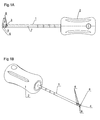
- a dental instrument for extraction of an object, including a broken instrument, of a root canal includes a tubular rod 1 and a handle 2 integral with one another.
- the end part distal 3 of the rod 1, opposite the handle 2, is open at its face front 4 to allow passage inside the rod 1 of one end of the object to extract.
- the distal end portion 3 further comprises, close to the face open front 4, a so-called “weakened” zone 5 having on its surface outer oblong openings 6, preferably through.
- zone 5 comprises three series of three openings inclined to 45 ° to the axis 7 of the rod 1. For convenience, only one of these series has been shown. These three series are identical and distributed uniformly (at 120 °) on the periphery of the zone 5. These openings 6 allow the distal end part 3 to deform plastically, that is to say inelastic way, and in a way which results in a reduction of the section internal of zone 5, under the effect of a torsional stress applied to the rod 1.
- the distal end portion 3 also comprises on the front face 4, regularly distributed around the opening of the latter, teeth 8, at number of three in the example illustrated, allowing the rod 1 to be anchored in the dentin to block the instrument in rotation during the above-mentioned twist.
- the rod 1 is typically made of stainless steel. However, others materials, especially metallic, may be suitable, provided they can undergo permanent non-elastic deformation.
- the thickness of the wall of the rod 1 is very small, typically 0.1 mm.
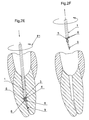
- Figures 2A to 2F show a method of extracting a broken instrument a root canal, using the instrument shown in Figures 1A and 1B.
- the broken instrument housed in the root canal is a file 9 comprising on its outer surface a helical edge 10.
- a first step in the process consists in determining the diameter of the upper end, designated by 11, of the broken instrument part 9 which has remained in the channel by measuring the diameter of the corresponding end of the part broken instrument left outside the mouth, then choose an instrument extraction whose internal diameter of rod 1 is slightly greater than diameter thus determined.
- Figure 2A we widen the root canal to the upper end 11 of the broken instrument using a cutter 12 having a diameter substantially equal to the external diameter of the rod 1 of the extraction instrument and whose distal end, 13, is planar.
- Figure 2A shows the end of this step where the flat end 13 of the cutter 12 abuts against the upper end 11 of the broken instrument. The space thus created in the channel will allow the extraction instrument to guide itself towards the broken instrument without risk of misdirection and of being centered in relation to this instrument broken.
- FIG. 2C shows the space obtained, designated by 16, once the drill bit 14 has been removed.
- the extraction instrument is made to penetrate the root canal until its distal end portion 3 is housed in space 16 and thus surrounds the upper end 11 of the broken instrument (Figure 2D).
- the teeth 8 of the rod 1 are planted in the dentin so as to block them in rotation.
- the distal end portion 3 is deformed to reduce its internal section and thus grasp by pinching the upper end 11 of the broken instrument ( Figure 2E). Thanks to this plastic deformation, the part end 3 remains in its deformed state after the application of the stress of twist and therefore maintains its clamping force without the need to provide a special blocking system.
- the broken instrument thus seized, one can remove it by rotating it in its unscrewing direction ( Figure 2F), which corresponds to the aforementioned direction F1 of torsion of the rod 1.
- the extraction instrument, with the broken instrument to which it remains linked, is then discarded.
- the drill bit 14 is the instrument 1-2 extraction itself, that is to say that we use the extraction instrument, with its teeth 8, to create the space 16 around the upper end 11 of the broken instrument. To do this, we dig into the dentin with a movement of rotation and axial pressure slow enough not to cause deformation of the distal end portion 3. Once the space 16 has been created, apply faster movement to the instrument to cause twisting and therefore the pinching of the object 9 (FIG. 2E).
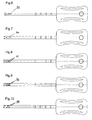
- Figures 3 to 13 show extraction instruments according to other embodiments of the invention, which can be used in the same process than the one described above.
- the openings of oblong deformations are not inclined, as in the example of the figures 1A and 1B, but parallel to the axis of the rod 1.
- These oblong openings can have different shapes, for example rectangular (Figure 3, item 6a), rectangular with rounded edges ( Figure 4, item 6b), almond shaped ( Figures 5 and 7, marks 6c and 6e) or triangular (figure 6, mark 6d).
- the number of these openings may vary and be for example equal to nine (three sets of three openings, evenly distributed along the periphery of the end portion distal; Figures 3-5) or three (three openings evenly distributed along the periphery of the distal end portion; Figures 6, 7).
- the openings of deformation can also consist of holes of variable shape, by example round, star or square, staggered (figures 8-10, marks 6f-6h).
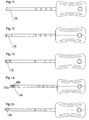
- the end part distal of the instrument stem has, instead of deformation, an area 5a with reduced wall thickness compared to the rest of the rod.
- This zone with reduced wall thickness has the same internal diameter as the rest of the stem.
- this area constitutes a weakened area which, under the effect of a torsional stress, deforms by way resulting in a reduction of its internal section.
- Figure 12 illustrates an extraction instrument based on the same principle than that of figure 11, but in which the thickness of the wall of the zone weakened 5b is variable and has a minimum in the central part of the area 5b.
- the weakened zone 5c has the same thickness of wall and the same internal diameter as the rest of the rod, but is made in one more malleable material than that in which the rest of the rod is made.
- the area weakened 5c is for example made of copper and the rest of the steel rod stainless.
- the weakened zone 5c is fixed to the rest of the rod, for example by welding or soldering.
- the weakened zone is constituted by a zone of the distal end part of the rod previously treated thermally to make it more malleable than the rest of the rod.
- Figure 14 shows another embodiment, in which the area weakened 5d has on its internal surface a narrowing 50d defining a cone 51 d flared towards the opening of the distal end part and whose function is to get stuck around the top end of the broken instrument at the like a Morse taper.
- This cone 51 d can thus serve as a locking means in rotation of the distal end of the instrument stem, instead of teeth 8, in the case where the broken instrument is itself locked in rotation in the channel.
- Figure 15 shows yet another embodiment, in which, at the difference from all the embodiments described above, the weakened area 5th is designed to deform under the action not of a torsional stress but of an axial pressure constraint, exerted manually by through the handle of the instrument when the rod is in axial abutment in the space around the upper end of the broken instrument.
- the weakened zone 5e has a zigzag wall which, under the action of the axial pressure, compresses, thus reducing the internal section of the area weakened.
Landscapes
- Health & Medical Sciences (AREA)
- Engineering & Computer Science (AREA)
- Biomedical Technology (AREA)
- Neurology (AREA)
- Neurosurgery (AREA)
- Nuclear Medicine, Radiotherapy & Molecular Imaging (AREA)
- Surgery (AREA)
- Oral & Maxillofacial Surgery (AREA)
- Dentistry (AREA)
- Epidemiology (AREA)
- Life Sciences & Earth Sciences (AREA)
- Animal Behavior & Ethology (AREA)
- General Health & Medical Sciences (AREA)
- Public Health (AREA)
- Veterinary Medicine (AREA)
- Dental Tools And Instruments Or Auxiliary Dental Instruments (AREA)
Abstract
Description
- les figures 1A et 1B montrent respectivement en vue de profil et en perspective un instrument dentaire selon un premier mode de réalisation de l'invention ;
- les figures 2A à 2F sont des vues en coupe schématiques montrant un procédé d'extraction d'un instrument cassé d'un canal radiculaire dentaire, utilisant l'instrument représenté aux figures 1A et 1B ; et
- les figures 3 à 15 sont des vues de profil (partiellement coupées en ce qui concerne les figures 13 à 15) montrant des instruments dentaires selon d'autres modes de réalisation de l'invention.
Claims (18)
- Instrument dentaire pour l'extraction d'un objet d'un canal radiculaire, comprenant une tige (1) ayant une partie d'extrémité ouverte (3) destinée à recevoir au moins une partie de l'objet (9), cette partie d'extrémité ouverte (3) pouvant être déformée pour permettre le saisissement de l'objet (9) par pincement puis son extraction du canal radiculaire, caractérisé en ce que la partie d'extrémité ouverte (3) est tubulaire et est apte à se déformer plastiquement, d'une manière qui entraíne une réduction de sa section interne, sous l'effet d'une contrainte déterminée.
- Instrument dentaire selon la revendication 1, caractérisé en ce que la contrainte déterminée est une torsion.
- Instrument dentaire selon la revendication 2, caractérisé en ce que la paroi de la partie d'extrémité ouverte (3) présente dans une zone déterminée, constituant une zone affaiblie (5) destinée à subir la déformation plastique, au moins une ouverture de déformation (6).
- Instrument dentaire selon la revendication 3, caractérisé en ce que la ou les ouvertures de déformation (6) sont traversantes.
- Instrument dentaire selon la revendication 3 ou 4, caractérisé en ce que la paroi de la partie d'extrémité ouverte (3) présente dans la zone déterminée des ouvertures de déformation (6) inclinées à 45° par rapport à l'axe (7) de la tige (1).
- Instrument dentaire selon la revendication 5, caractérisé en ce que la paroi de la partie d'extrémité ouverte (3) présente dans la zone déterminée trois séries, uniformément réparties le long de la périphérie de la partie d'extrémité ouverte (3), de trois ouvertures de déformation (6) inclinées à 45° par rapport à l'axe (7) de la tige (1).
- Instrument dentaire selon la revendication 3 ou 4, caractérisé en ce que la paroi de la partie d'extrémité ouverte présente dans la zone déterminée des ouvertures de déformation oblongues (6a-6e) parallèles à l'axe de la tige.
- Instrument dentaire selon la revendication 3 ou 4, caractérisé en ce que la paroi de la partie d'extrémité ouverte présente dans la zone déterminée des trous de déformation (6f-6h) disposés en quinconce.
- Instrument dentaire selon la revendication 2, caractérisé en ce que la paroi de la partie d'extrémité ouverte comprend une zone (5a ; 5b) à épaisseur réduite par rapport au reste de la tige, cette zone (5a ; 5b) constituant une zone affaiblie destinée à subir la déformation plastique.
- Instrument dentaire selon la revendication 2, caractérisé en ce que la partie d'extrémité ouverte comprend une zone (5c) réalisée en un matériau moins dur que le matériau dans lequel est réalisé le reste de la tige, cette zone (5c) constituant une zone affaiblie destinée à subir la déformation plastique.
- Instrument dentaire selon la revendication 2, caractérisé en ce que la partie d'extrémité ouverte comprend une zone préalablement traitée thermiquement pour la rendre moins résistante que le reste de la tige, cette zone constituant une zone affaiblie destinée à subir la déformation plastique.
- Instrument dentaire selon l'une quelconque des revendications 2 à 11, caractérisé en ce qu'il comprend des moyens (8) pour bloquer en rotation la partie d'extrémité ouverte (3) dans la dentine, au moins dans le sens de la torsion, lors de l'application de la torsion.
- Instrument dentaire selon la revendication 12, caractérisé en ce que lesdits moyens de blocage comprennent des dents (8) situées sur la face frontale (4) de la partie d'extrémité ouverte (3).
- Instrument dentaire selon la revendication 12, caractérisé en ce que lesdits moyens de blocage comprennent une portion de surface interne de la partie d'extrémité ouverte, cette portion de surface interne présentant une forme conique (51 d) évasée vers l'ouverture de la partie d'extrémité ouverte de façon à pouvoir venir se coincer autour d'une extrémité de l'objet.
- Instrument dentaire selon la revendication 1, caractérisé en ce que la contrainte déterminée est une pression axiale.
- Instrument dentaire selon la revendication 15, caractérisé en ce que la partie d'extrémité ouverte comprend une zone (5e) à paroi en zigzag.
- Instrument dentaire selon l'une quelconque des revendications 1 à 16, caractérisé en ce qu'il comprend des dents (8) situées sur la face frontale (4) de la partie d'extrémité ouverte (3), autour de l'ouverture de la partie d'extrémité ouverte (3), et pouvant servir à creuser dans la dentine.
- Instrument dentaire selon l'une quelconque des revendications 1 à 17, caractérisé en ce qu'il comprend en outre un manche (2).
Priority Applications (4)
| Application Number | Priority Date | Filing Date | Title |
|---|---|---|---|
| DE60302996T DE60302996T2 (de) | 2003-01-22 | 2003-01-22 | Dentales Werkzeug zum Herausziehen eines Gegenstandes aus einem Zahnwurzelkanal |
| EP03001416A EP1440668B1 (fr) | 2003-01-22 | 2003-01-22 | Instrument dentaire pour l'extraction d'un objet d'un canal radiculaire |
| US10/736,422 US7021935B2 (en) | 2003-01-22 | 2003-12-15 | Dental instrument for the extraction of an object from a root canal |
| JP2004013753A JP4727933B2 (ja) | 2003-01-22 | 2004-01-22 | 根管から物体を摘出するための歯科医療器具 |
Applications Claiming Priority (1)
| Application Number | Priority Date | Filing Date | Title |
|---|---|---|---|
| EP03001416A EP1440668B1 (fr) | 2003-01-22 | 2003-01-22 | Instrument dentaire pour l'extraction d'un objet d'un canal radiculaire |
Publications (2)
| Publication Number | Publication Date |
|---|---|
| EP1440668A1 true EP1440668A1 (fr) | 2004-07-28 |
| EP1440668B1 EP1440668B1 (fr) | 2005-12-28 |
Family
ID=32524182
Family Applications (1)
| Application Number | Title | Priority Date | Filing Date |
|---|---|---|---|
| EP03001416A Expired - Lifetime EP1440668B1 (fr) | 2003-01-22 | 2003-01-22 | Instrument dentaire pour l'extraction d'un objet d'un canal radiculaire |
Country Status (4)
| Country | Link |
|---|---|
| US (1) | US7021935B2 (fr) |
| EP (1) | EP1440668B1 (fr) |
| JP (1) | JP4727933B2 (fr) |
| DE (1) | DE60302996T2 (fr) |
Cited By (1)
| Publication number | Priority date | Publication date | Assignee | Title |
|---|---|---|---|---|
| US7367804B2 (en) | 2006-08-25 | 2008-05-06 | Ultradent Products, Inc. | Endodontic instrument extractor tool manufactured from a shape memory material and related kits and methods |
Families Citing this family (11)
| Publication number | Priority date | Publication date | Assignee | Title |
|---|---|---|---|---|
| BR8302151U (pt) * | 2003-08-25 | 2005-04-12 | Nilton Jorge Berger Del Zotto | Aperfeiçoamento construtivo introduzido em aparelho para remoção de fragmentos de instrumentos endodÈnticos do interior do conduto radicular do orgão dental |
| US7179084B1 (en) * | 2005-08-16 | 2007-02-20 | Kometas Athas N | Apparatus and method to remove dental implant |
| TWI387446B (zh) * | 2010-12-07 | 2013-03-01 | Metal Ind Res & Dev Ct | 根管阻塞物移除器具 |
| KR101344570B1 (ko) * | 2013-06-14 | 2013-12-26 | 김형우 | 치아 신경치료용 엔도파일 |
| US9839492B2 (en) * | 2013-09-05 | 2017-12-12 | Heriberto Bujanda Wong | Ultrasonic ring tip to activate endodontic instruments |
| CN104688361A (zh) * | 2015-02-14 | 2015-06-10 | 四川大学 | 一种取出根管内分离器械的装置及其取出方法 |
| US10813719B1 (en) | 2017-06-07 | 2020-10-27 | Sherif Radwan | Method and extraction device for removal of broken root canal file fragment |
| US11083539B2 (en) * | 2019-10-23 | 2021-08-10 | Ola Adel Saied Farrag | Endodontic instrument |
| US20230093957A1 (en) * | 2020-03-20 | 2023-03-30 | Dana YOUSIF AL RAEESI | Instrument to bypass fractured fragments of endodontic rotary file in root canal of a tooth |
| CN112603566B (zh) * | 2021-02-03 | 2021-11-26 | 首都医科大学附属北京口腔医院 | 一种牙科用根管内折断器械的锚取工具 |
| US11642192B1 (en) * | 2022-10-10 | 2023-05-09 | Giftedness And Creativity Company | Tool for extracting broken endodontic instrument |
Citations (3)
| Publication number | Priority date | Publication date | Assignee | Title |
|---|---|---|---|---|
| FR1213369A (fr) * | 1959-01-20 | 1960-03-31 | Instrument pour dentiste | |
| DE9203692U1 (de) | 1992-03-19 | 1992-05-14 | Saulin, Vitali, 4400 Münster | Klemmgriff zur Entfernung eines abgebrochenen Zahnwurzelkanal-Instrumentes aus dem Zahnwurzelkanal |
| DE10023195A1 (de) | 2000-05-11 | 2001-11-15 | Hager & Meisinger Gmbh | Instrument zum Greifen in einem Zahnwurzelkanal |
Family Cites Families (12)
| Publication number | Priority date | Publication date | Assignee | Title |
|---|---|---|---|---|
| US3322124A (en) * | 1964-11-25 | 1967-05-30 | Donald W Ireland | Method and apparatus for retrieving metallic objects from teeth, flesh, bone and thelike |
| US4247285A (en) * | 1979-04-23 | 1981-01-27 | Roig Greene Jose L | Root canal working |
| JPS5672861A (en) * | 1979-11-19 | 1981-06-17 | Emu Esu Kk | Electrode for removing residual metallic piece in pulp canal of tooth |
| US4746292A (en) * | 1987-04-02 | 1988-05-24 | Johnson William B | Tool and method for removing a parted endodontic file |
| US5085586A (en) * | 1990-08-28 | 1992-02-04 | Johnson William B | Method and apparatus for installing a post in a tooth having an existing endodontic obturator therein |
| US5173049A (en) * | 1991-03-01 | 1992-12-22 | Endo Technic Corporation | Removing a post embedded in a tooth |
| US5275563A (en) * | 1992-09-02 | 1994-01-04 | Essential Dental Systems, Inc. | Dental post extracting drill |
| US5951286A (en) * | 1998-02-09 | 1999-09-14 | Rhodes; Charles R. | Device for the removal of installed dowel pins |
| US5879160A (en) * | 1998-06-03 | 1999-03-09 | Ruddle; Clifford J. | Root canal obstruction removal system |
| US6280197B1 (en) * | 2000-01-04 | 2001-08-28 | Doron Benado | Method and apparatus for the withdrawal of dental post |
| US6227855B1 (en) * | 2000-05-19 | 2001-05-08 | Teresa R. Hickok | Instrument removal system |
| JP2004024621A (ja) * | 2002-06-26 | 2004-01-29 | Dentech:Kk | 根管治療器具の破片抜き取り方法及びその工具 |
-
2003
- 2003-01-22 DE DE60302996T patent/DE60302996T2/de not_active Expired - Lifetime
- 2003-01-22 EP EP03001416A patent/EP1440668B1/fr not_active Expired - Lifetime
- 2003-12-15 US US10/736,422 patent/US7021935B2/en not_active Expired - Fee Related
-
2004
- 2004-01-22 JP JP2004013753A patent/JP4727933B2/ja not_active Expired - Fee Related
Patent Citations (3)
| Publication number | Priority date | Publication date | Assignee | Title |
|---|---|---|---|---|
| FR1213369A (fr) * | 1959-01-20 | 1960-03-31 | Instrument pour dentiste | |
| DE9203692U1 (de) | 1992-03-19 | 1992-05-14 | Saulin, Vitali, 4400 Münster | Klemmgriff zur Entfernung eines abgebrochenen Zahnwurzelkanal-Instrumentes aus dem Zahnwurzelkanal |
| DE10023195A1 (de) | 2000-05-11 | 2001-11-15 | Hager & Meisinger Gmbh | Instrument zum Greifen in einem Zahnwurzelkanal |
Cited By (1)
| Publication number | Priority date | Publication date | Assignee | Title |
|---|---|---|---|---|
| US7367804B2 (en) | 2006-08-25 | 2008-05-06 | Ultradent Products, Inc. | Endodontic instrument extractor tool manufactured from a shape memory material and related kits and methods |
Also Published As
| Publication number | Publication date |
|---|---|
| DE60302996D1 (de) | 2006-02-02 |
| DE60302996T2 (de) | 2006-08-10 |
| JP2004337588A (ja) | 2004-12-02 |
| US7021935B2 (en) | 2006-04-04 |
| US20040142302A1 (en) | 2004-07-22 |
| JP4727933B2 (ja) | 2011-07-20 |
| EP1440668B1 (fr) | 2005-12-28 |
Similar Documents
| Publication | Publication Date | Title |
|---|---|---|
| EP0616161B1 (fr) | Raccord à connexion instantanée à griffe | |
| EP1440668B1 (fr) | Instrument dentaire pour l'extraction d'un objet d'un canal radiculaire | |
| EP3573568B1 (fr) | Ensemble de composants pour la restauration prothetique dentaire | |
| WO2012038435A1 (fr) | Instrument endodontique dont la partie active présente une fente formant passage pour un fluide | |
| FR2517537A1 (fr) | Ancrage dentaire et outil dentaire pour former un canal dans une dent | |
| WO1993006787A1 (fr) | Implant dentaire multibloc | |
| EP2958511B1 (fr) | Appareil d'orthodontie vestibulaire | |
| FR2549713A1 (fr) | Ancrage dentaire filete | |
| EP0421907A1 (fr) | Dispositif de serrage, respectivement de desserage, de la queue de fraise d'un instrument de dentisterie | |
| FR2621465A1 (fr) | Brosse interdentaire | |
| CA2953255A1 (fr) | Instrument endodontique pour l'alesage de canaux radiculaires | |
| EP2967757B1 (fr) | Instrument endodontique, notamment pour l'alesage d'un canal radiculaire. | |
| FR2571608A1 (fr) | Tenon dentaire pour le maintien d'une suprastructure prothetique | |
| EP1251792B1 (fr) | Clef de descellement | |
| EP1615580B1 (fr) | Instrument pour l´alesage de canaux radiculaires | |
| CH615825A5 (en) | Paste carrier for the introduction of obturation pastes into root canals of teeth during treatment | |
| FR2516784A1 (fr) | Nouvel implant, outil pour la mise en place de celui-ci et procede de realisations implantaires | |
| FR2684867A1 (fr) | Instrument canalaire pour l'application de pate d'obturation dentaire et procede d'obturation canalaire le mettant en óoeuvre. | |
| FR2964852A1 (fr) | Instrument endodontique presentant, le long d'une portion de decoupe, une ame porteuse s'etendant selon une trajectoire helicoidale | |
| CA2515797C (fr) | Instrument dentaire mecanise | |
| FR2582931A1 (fr) | Broche dentaire pour le maintien d'une couche de liaison sur une dent | |
| FR2866225A1 (fr) | Dispositif destine a etre utilise lors de la reconstitution dentaire | |
| EP2332486A1 (fr) | Guide de perçage et moyens de stabilisation de ce guide | |
| WO2011051584A1 (fr) | Instrument de traitement des canaux radiculaires | |
| WO2014191694A1 (fr) | Instrument canalaire de section ovoïde ou ovale |
Legal Events
| Date | Code | Title | Description |
|---|---|---|---|
| PUAI | Public reference made under article 153(3) epc to a published international application that has entered the european phase |
Free format text: ORIGINAL CODE: 0009012 |
|
| AK | Designated contracting states |
Kind code of ref document: A1 Designated state(s): AT BE BG CH CY CZ DE DK EE ES FI FR GB GR HU IE IT LI LU MC NL PT SE SI SK TR |
|
| AX | Request for extension of the european patent |
Extension state: AL LT LV MK RO |
|
| 17P | Request for examination filed |
Effective date: 20040821 |
|
| GRAP | Despatch of communication of intention to grant a patent |
Free format text: ORIGINAL CODE: EPIDOSNIGR1 |
|
| GRAS | Grant fee paid |
Free format text: ORIGINAL CODE: EPIDOSNIGR3 |
|
| AKX | Designation fees paid |
Designated state(s): CH DE FR GB LI |
|
| GRAA | (expected) grant |
Free format text: ORIGINAL CODE: 0009210 |
|
| AK | Designated contracting states |
Kind code of ref document: B1 Designated state(s): CH DE FR GB LI |
|
| REG | Reference to a national code |
Ref country code: GB Ref legal event code: FG4D Free format text: NOT ENGLISH |
|
| REG | Reference to a national code |
Ref country code: CH Ref legal event code: EP |
|
| REG | Reference to a national code |
Ref country code: CH Ref legal event code: NV Representative=s name: MICHELI & CIE INGENIEURS-CONSEILS |
|
| REF | Corresponds to: |
Ref document number: 60302996 Country of ref document: DE Date of ref document: 20060202 Kind code of ref document: P |
|
| GBT | Gb: translation of ep patent filed (gb section 77(6)(a)/1977) |
Effective date: 20060327 |
|
| PLBE | No opposition filed within time limit |
Free format text: ORIGINAL CODE: 0009261 |
|
| STAA | Information on the status of an ep patent application or granted ep patent |
Free format text: STATUS: NO OPPOSITION FILED WITHIN TIME LIMIT |
|
| 26N | No opposition filed |
Effective date: 20060929 |
|
| REG | Reference to a national code |
Ref country code: FR Ref legal event code: PLFP Year of fee payment: 14 |
|
| PGFP | Annual fee paid to national office [announced via postgrant information from national office to epo] |
Ref country code: CH Payment date: 20151216 Year of fee payment: 14 |
|
| PGFP | Annual fee paid to national office [announced via postgrant information from national office to epo] |
Ref country code: DE Payment date: 20160120 Year of fee payment: 14 |
|
| PGFP | Annual fee paid to national office [announced via postgrant information from national office to epo] |
Ref country code: FR Payment date: 20160121 Year of fee payment: 14 Ref country code: GB Payment date: 20160120 Year of fee payment: 14 |
|
| REG | Reference to a national code |
Ref country code: DE Ref legal event code: R079 Ref document number: 60302996 Country of ref document: DE Free format text: PREVIOUS MAIN CLASS: A61C0005020000 Ipc: A61C0005400000 |
|
| REG | Reference to a national code |
Ref country code: DE Ref legal event code: R119 Ref document number: 60302996 Country of ref document: DE |
|
| REG | Reference to a national code |
Ref country code: CH Ref legal event code: PL |
|
| GBPC | Gb: european patent ceased through non-payment of renewal fee |
Effective date: 20170122 |
|
| REG | Reference to a national code |
Ref country code: FR Ref legal event code: ST Effective date: 20170929 |
|
| PG25 | Lapsed in a contracting state [announced via postgrant information from national office to epo] |
Ref country code: CH Free format text: LAPSE BECAUSE OF NON-PAYMENT OF DUE FEES Effective date: 20170131 Ref country code: LI Free format text: LAPSE BECAUSE OF NON-PAYMENT OF DUE FEES Effective date: 20170131 Ref country code: FR Free format text: LAPSE BECAUSE OF NON-PAYMENT OF DUE FEES Effective date: 20170131 |
|
| PG25 | Lapsed in a contracting state [announced via postgrant information from national office to epo] |
Ref country code: GB Free format text: LAPSE BECAUSE OF NON-PAYMENT OF DUE FEES Effective date: 20170122 Ref country code: DE Free format text: LAPSE BECAUSE OF NON-PAYMENT OF DUE FEES Effective date: 20170801 |