EP1440731A2 - Ce/Cu/Mn-Katalysatoren und Verfahren zu deren Herstellung - Google Patents
Ce/Cu/Mn-Katalysatoren und Verfahren zu deren Herstellung Download PDFInfo
- Publication number
- EP1440731A2 EP1440731A2 EP03025650A EP03025650A EP1440731A2 EP 1440731 A2 EP1440731 A2 EP 1440731A2 EP 03025650 A EP03025650 A EP 03025650A EP 03025650 A EP03025650 A EP 03025650A EP 1440731 A2 EP1440731 A2 EP 1440731A2
- Authority
- EP
- European Patent Office
- Prior art keywords
- catalyst
- catalysts
- catalyst according
- hydrogen
- vol
- Prior art date
- Legal status (The legal status is an assumption and is not a legal conclusion. Google has not performed a legal analysis and makes no representation as to the accuracy of the status listed.)
- Granted
Links
Images






Classifications
-
- B—PERFORMING OPERATIONS; TRANSPORTING
- B01—PHYSICAL OR CHEMICAL PROCESSES OR APPARATUS IN GENERAL
- B01D—SEPARATION
- B01D53/00—Separation of gases or vapours; Recovering vapours of volatile solvents from gases; Chemical or biological purification of waste gases, e.g. engine exhaust gases, smoke, fumes, flue gases, aerosols
- B01D53/34—Chemical or biological purification of waste gases
- B01D53/92—Chemical or biological purification of waste gases of engine exhaust gases
- B01D53/94—Chemical or biological purification of waste gases of engine exhaust gases by catalytic processes
- B01D53/944—Simultaneously removing carbon monoxide, hydrocarbons or carbon making use of oxidation catalysts
-
- B—PERFORMING OPERATIONS; TRANSPORTING
- B01—PHYSICAL OR CHEMICAL PROCESSES OR APPARATUS IN GENERAL
- B01D—SEPARATION
- B01D53/00—Separation of gases or vapours; Recovering vapours of volatile solvents from gases; Chemical or biological purification of waste gases, e.g. engine exhaust gases, smoke, fumes, flue gases, aerosols
- B01D53/34—Chemical or biological purification of waste gases
- B01D53/74—General processes for purification of waste gases; Apparatus or devices specially adapted therefor
- B01D53/86—Catalytic processes
- B01D53/864—Removing carbon monoxide or hydrocarbons
-
- B—PERFORMING OPERATIONS; TRANSPORTING
- B01—PHYSICAL OR CHEMICAL PROCESSES OR APPARATUS IN GENERAL
- B01J—CHEMICAL OR PHYSICAL PROCESSES, e.g. CATALYSIS OR COLLOID CHEMISTRY; THEIR RELEVANT APPARATUS
- B01J23/00—Catalysts comprising metals or metal oxides or hydroxides, not provided for in group B01J21/00
- B01J23/002—Mixed oxides other than spinels, e.g. perovskite
-
- B—PERFORMING OPERATIONS; TRANSPORTING
- B01—PHYSICAL OR CHEMICAL PROCESSES OR APPARATUS IN GENERAL
- B01J—CHEMICAL OR PHYSICAL PROCESSES, e.g. CATALYSIS OR COLLOID CHEMISTRY; THEIR RELEVANT APPARATUS
- B01J23/00—Catalysts comprising metals or metal oxides or hydroxides, not provided for in group B01J21/00
- B01J23/70—Catalysts comprising metals or metal oxides or hydroxides, not provided for in group B01J21/00 of the iron group metals or copper
- B01J23/76—Catalysts comprising metals or metal oxides or hydroxides, not provided for in group B01J21/00 of the iron group metals or copper combined with metals, oxides or hydroxides provided for in groups B01J23/02 - B01J23/36
- B01J23/84—Catalysts comprising metals or metal oxides or hydroxides, not provided for in group B01J21/00 of the iron group metals or copper combined with metals, oxides or hydroxides provided for in groups B01J23/02 - B01J23/36 with arsenic, antimony, bismuth, vanadium, niobium, tantalum, polonium, chromium, molybdenum, tungsten, manganese, technetium or rhenium
- B01J23/889—Manganese, technetium or rhenium
- B01J23/8892—Manganese
-
- B—PERFORMING OPERATIONS; TRANSPORTING
- B01—PHYSICAL OR CHEMICAL PROCESSES OR APPARATUS IN GENERAL
- B01D—SEPARATION
- B01D2255/00—Catalysts
- B01D2255/20—Metals or compounds thereof
- B01D2255/206—Rare earth metals
-
- B—PERFORMING OPERATIONS; TRANSPORTING
- B01—PHYSICAL OR CHEMICAL PROCESSES OR APPARATUS IN GENERAL
- B01D—SEPARATION
- B01D2255/00—Catalysts
- B01D2255/20—Metals or compounds thereof
- B01D2255/207—Transition metals
- B01D2255/2073—Manganese
-
- B—PERFORMING OPERATIONS; TRANSPORTING
- B01—PHYSICAL OR CHEMICAL PROCESSES OR APPARATUS IN GENERAL
- B01D—SEPARATION
- B01D2255/00—Catalysts
- B01D2255/20—Metals or compounds thereof
- B01D2255/207—Transition metals
- B01D2255/20761—Copper
-
- B—PERFORMING OPERATIONS; TRANSPORTING
- B01—PHYSICAL OR CHEMICAL PROCESSES OR APPARATUS IN GENERAL
- B01D—SEPARATION
- B01D2258/00—Sources of waste gases
-
- B—PERFORMING OPERATIONS; TRANSPORTING
- B01—PHYSICAL OR CHEMICAL PROCESSES OR APPARATUS IN GENERAL
- B01J—CHEMICAL OR PHYSICAL PROCESSES, e.g. CATALYSIS OR COLLOID CHEMISTRY; THEIR RELEVANT APPARATUS
- B01J2523/00—Constitutive chemical elements of heterogeneous catalysts
-
- Y—GENERAL TAGGING OF NEW TECHNOLOGICAL DEVELOPMENTS; GENERAL TAGGING OF CROSS-SECTIONAL TECHNOLOGIES SPANNING OVER SEVERAL SECTIONS OF THE IPC; TECHNICAL SUBJECTS COVERED BY FORMER USPC CROSS-REFERENCE ART COLLECTIONS [XRACs] AND DIGESTS
- Y02—TECHNOLOGIES OR APPLICATIONS FOR MITIGATION OR ADAPTATION AGAINST CLIMATE CHANGE
- Y02A—TECHNOLOGIES FOR ADAPTATION TO CLIMATE CHANGE
- Y02A50/00—TECHNOLOGIES FOR ADAPTATION TO CLIMATE CHANGE in human health protection, e.g. against extreme weather
- Y02A50/20—Air quality improvement or preservation, e.g. vehicle emission control or emission reduction by using catalytic converters
Definitions
- the invention relates to a mixed oxide catalyst, on the one hand for the selective oxidation of CO in hydrogen-rich Gas mixtures, especially for fuel cells, on the other hand for reducing the CO content in oxygen-containing gas mixtures, e.g. Automotive and industrial exhaust gases is suitable.
- Fuel cells represent a future key technology represents, e.g. for the automotive industry, for stationary electricity, for the provision of heat, as well as for portable devices with an output of up to 250 watts.
- fuel cells have a higher energy Efficiency as internal combustion engines, and they achieve one System efficiency of 70 to 80% (including the use of the Waste heat) in power plants, compared with an efficiency of 30 to 37% when burned.
- Polymer electrolyte membrane (PEM) fuel cells are compact and have the advantage of one high power density and lower operating temperature.
- Pt, Pt / Ru the electrodes
- CO hydrogen-rich Gas mixtures
- Fine cleaning to remove the CO down to the ppm range (10 to 100 ppm) is done by selective oxidation with the addition of a small amount of oxygen.
- a highly selective catalyst that is able to completely oxidize CO at the lowest possible temperatures, without oxidizing the hydrogen.
- Mixed oxide catalysts containing copper have also been used to remove CO from oxygen-containing gas mixtures, for example from automobile exhaust gases and from industrial exhaust gases. Their activity in the oxidation of CO at temperatures below 200 ° C is lower than that of noble metal catalysts. Some mixed oxides (hopcalite-like Cu / Mn catalysts) are sensitive to water vapor and CO 2 in the gas mixture, ie they are more easily poisoned by water vapor and CO 2 compared to the noble metal catalysts, which is why their activity for successful use as three-way catalysts (TWC ) or as a Diesel Oxidation Catalyst (DOC) was not sufficient.
- TWC three-way catalysts
- DOC Diesel Oxidation Catalyst
- the mixed oxide catalysts according to the invention are characterized in that they are about 15 to 30 at% Cu, about 55 to. Contain 77 at.% Mn and about 7.5 to 10 at.% Ce.
- the catalysts of the invention surprisingly enable over a wide temperature range (140 to 200 ° C) Lowering the CO content in hydrogen-rich gas mixtures less than about 50 ppm, preferably less than about 10 ppm.
- the catalysts according to the invention are insensitive to water vapor and CO 2 when removing CO from oxygen-containing gas mixtures and show a lower activity for undesired reactions, for example the oxidation of sulfur to sulfates.
- the Cu / Mn / Ce mixed oxide catalysts according to the invention were based on their activity in the selective oxidation of CO in hydrogen-rich Gas mixtures tested that are similar to reforming gas were composed.
- the best catalysts were in the Location, CO at 145 to 180 ° C completely without any noticeable oxidation of hydrogen to oxidize. So these catalysts are to prevent poisoning of fuel cell electrodes suitable by CO, without significant oxidation of the Hydrogen occurs.
- the experiments have also shown that the Cu / Ce / Mn mixed oxide catalysts for the oxidation of CO in oxygen-rich Gas mixtures, e.g. in diesel exhaust, very good are suitable.
- a preferred catalyst is by the following composition characterized: about 5 to 40 at .-% Ce, about 5 to 60 at .-% Cu, about 30 to 90 at% Mn; preferably about 7.5 to 10 at.% Ce, about 15 to 30 at% Cu, about 55 to 77 at% Mn.
- the most active catalysts are Cu / Mn / Ce mixed oxide catalysts, which can also contain lanthanum oxide and have the following composition: Ce 7.5 to 10 at .-% La 0 to 5 at .-% Cu 15 to 30 at .-% Mn 55 to 70 at .-%
- Ce can be wholly or partially (up to 90 at .-%) by Pr and / or Zr to be replaced.
- the mixed oxide catalyst preferably comprises however Ce.
- Cu can be partially (up to 10 at%) by Co, Fe, Ni and / or Zn can be replaced. In both cases, the activity picks up not significantly.
- Catalyst can on different supports, preferably zirconium oxide, be upset.
- they can be obtained by mixed precipitation of the nitrates of copper (Cu (NO 3 ) 2 x 3 H 2 O), manganese (Mn (NO 3 ) 2 x 4 H 2 O), and cerium (Ce (NO 3 ) 3 x 6 H 2 O) and optionally the lanthanum (LaCl 3 x 7 H 2 O), which are present in dissolved form, are prepared with NaHCO 3 .
- the nitrates of copper and cerium are dissolved together in a small amount of distilled water, and the solution obtained is used for wet impregnation of precipitated MnO 2 at room temperature, after which the product is dried at about 100 ° C and calcined in a stream of air (e.g. 3 hours at 400 ° C.
- the supported Cu / Ce / Mn catalysts can be produced by wet impregnation of the support, for example zirconium oxide, the solutions of the nitrates of copper, cerium and manganese being applied to the support.
- the catalytically active constituents can be fixed on the support as hydroxocarbonates.
- the products are then dried at 100 ° C. and calcined in an air stream (for example 3 hours at 400 ° C.).
- the mixed oxide catalysts according to the invention have an amorphous structure, as can be seen from the XRD spectra.
- the calcination temperature is chosen to be less than 500 ° C, which is why a perovskite structure cannot form.
- the first discrete mineral phase is cerium oxide. Two tiny peaks appear at 138 ° and 141.5 °.
- Cu 1.5 Mn 1.5 O 4 forms the most important phase, which has a structure that is very different from that of perovskite.
- manganese has an oxidation state of 3 1/3. This means that at least some of the manganese ions are present in the high oxidation state +4 (MnO 2 ). Calcination at temperatures above 500 ° C leads to a complex mixture of tenorite (CuO), Cu-Mn spinel (CuMn 2 O 4 ) and Fluorite (CeO 2 ).
- This gas mixture corresponds to a diesel exhaust gas mixture.
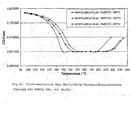
- FIG. 3a shows the optimal Ce content of the Cu / Ce / Mn catalyst at a fixed Cu / Mn ratio of 0.5, the same Conditions as used in Fig. 1.
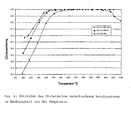
- Fig. 4 shows the behavior of Cu / Ce / Mn catalysts with the same composition, but which were produced by different methods.
- a catalyst with 10 at.% Ce, 30 at.% Cu and 60 at.% Mn was prepared by mixed precipitation of the nitrates with NaHCO 3 according to the above procedure, while another Cu / Ce / Mn catalyst by impregnation of MnO 2 was produced with copper and cerium nitrate, the atomic ratio Cu / Ce / Mn being 30/10/60.
- the reaction conditions were the same as in Fig. 1.
- FIG. 5 shows the activity of mixed oxide catalysts with 30 at.% Cu, 10 at.% Ce and 60 at.% Mn on a ZrO 2 support with a BET surface area of about 40 m 2 / g (manufacturer Johnson -Matthey), using the same reaction mixture as in Fig. 1; however, a space velocity (SV) of 2300 h -1 was used.
- the supported catalyst contained 20% by weight of active catalyst components.
- FIG. 6 shows the CO oxidation activity of catalysts 1.2 at.% Na, 30 at.% Cu, 10 at.% Ce and 58.8 at.% Mn or a catalyst with 0.6 at.% K, 30 at.% Cu, 10 at.% Ce and 59.4 at% Mn compared to the activity of a catalyst with 30 at% Cu, 10 at% Ce and 60 at% Mn, the same Conditions as used in Fig. 1.
- FIG. 7 shows the activity of a catalyst with 2.5 at.% Sr, 30 at% Cu, 7.5 at% Ce and 60 at% Mn, a catalyst with 2.5 at.% Ba, 30 at.% Cu, 7.5 at.% Ce and 60 at.% Mn as well a catalyst with 5 at.% La, 10 at.% Ce, 27.5 at.% Cu and 57.5 at .-% Mn in the form of mixed oxides compared with the activity of a mixed oxide catalyst with 30 at.% Cu, 10 at .-% Ce and 60 at .-% Mn, with the same reaction conditions as applied in Fig. 1.
- Fig. 8 shows the activity of the catalysts in which the copper exchanged with other transition metals (Co, Fe, Ni, Zn and Cr) with the same reaction conditions as in Fig. 1 were applied.
- Fig. 9 shows a catalyst in which the Ce in whole or in part was replaced by Pr or Zr, with the same reaction conditions as applied in Fig. 1.
- the results show that when cerium oxide is added to Cu / Mn mixed oxide catalysts a far higher activity in selective Oxidation of CO (compared to the activity of Cu / Mn or Cu / Ce systems) with a hydrogen excess and is achieved at low temperatures.
- the Cu / Ce / Mn mixed oxide catalyst shows a synergistic effect compared to the pure oxides and the binary Cu / Mn and Cu / Ce catalysts. 1 is the hopcalite-like Cu / Mn catalyst active at temperatures above 100 ° C, but a complete oxidation of the CO could only be achieved at 190 ° C be, with a reduction of the catalyst already in close to 200 ° C was observed.
- the binary Cu / Mn catalysts have a very low temperature range for the selective oxidation of CO in hydrogen-rich Have gas mixtures.
- the Cu / Ce catalyst was even less active and was not able to completely remove the CO even at 200 ° C to oxidize.
- the Cu / Ce / Mn mixed oxide catalyst according to the invention shows a clear activity even at temperatures below 100 ° C., as shown in FIG. 1. Complete oxidation of the CO was achieved at 145 ° C, with the H 2 oxidation being negligibly small. This shows that Cu / Ce / -Mn mixed oxide catalysts can selectively oxidize the CO at low temperatures compared to the binary oxides (at 145 to 200 ° C).
- the ternary Cu / -Ce / Mn mixed oxide catalyst at a Ce concentration of 7.5 up to 10 at .-% and a Cu concentration of 15 to 30 at .-% can be optimized.
- the Cu / Ce / Mn mixed oxide catalysts can be produced in different ways. However, mixed precipitation using NaHCO 3 as the precipitation agent and impregnation of MnO 2 with Cu and Ce salts are most favorable. As shown in FIG. 4, the samples produced by these two methods have a high and comparable activity with the same composition.
- the Cu / Ce / Mn catalysts according to the invention can be used as such or as supported catalysts.
- aluminum oxide, silicon oxide or zirconium oxide (less preferably cerium oxide) can be used as the carrier.
- zirconium oxide less preferably cerium oxide
- the best activity was observed with a Cu / Ce / Mn catalyst on ZrO 2 .
- the activity of this supported catalyst is shown in Fig. 5. It is believed that the zirconium oxide stabilizes the higher valence state of the Mn, which is soluble in the lattice of the ZrO 2 .
- the addition of Zr to a Cu / Ce / Mn mixed oxide catalyst does not lead to a decrease in activity, as can be seen from FIG. 9.
- the catalyst can by small amounts of basic Oxides e.g. modified from alkali, alkaline earth and rare earth metals be, making its resistance to reduction improved by hydrogen at temperatures above 200 ° C is, so the temperature range in which the catalyst can be used, can be expanded.
- Fig. 6 results in the addition of small amounts of alkali compounds an increase in the effectiveness of the catalyst at and over 200 ° C for the quaternary oxides, while for the ternary Cu / Ce / Mn catalyst at temperatures above 200 ° C the CO occurred again.
- the addition of alkaline earth or rare earth metals (La) gives a less pronounced effect according to FIG. 7, however can also improve the catalyst behavior here elevated temperatures are observed.
- the above Components do not increase activity and decrease this at higher concentrations.
- cerium oxide in the mixed oxide catalyst according to the invention is very important.
- Ceria is one of the 3-way catalysts Precious metals known for their oxygen storage capacity. The reason for this is the possible change in the oxidation state of Ce (IV) to Ce (III).
- the catalysts of the invention are also suitable for the removal of CO in oxygen-containing gases and in the presence of CO 2 and H 2 O. Such gases are typical of diesel exhaust gases.
- CO 2 and H 2 O gases are typical of diesel exhaust gases.
- complete oxidation of the CO was achieved at 100 ° C. using the Cu / Ce / Mn mixed oxide catalyst, the CO concentration being at a space velocity (SV) of 110,000 h -1 and at a reaction temperature of 145 ° C was only 10 ppm. This is why this economically favorable catalyst is very suitable for removing CO from automobile exhaust gases. Its activity is comparable to that of platinum or palladium-containing catalysts, which are used as automotive exhaust gas catalysts, but which can easily be poisoned by sulfur compounds.
Landscapes
- Chemical & Material Sciences (AREA)
- Engineering & Computer Science (AREA)
- Chemical Kinetics & Catalysis (AREA)
- Environmental & Geological Engineering (AREA)
- Materials Engineering (AREA)
- Health & Medical Sciences (AREA)
- Analytical Chemistry (AREA)
- General Chemical & Material Sciences (AREA)
- Oil, Petroleum & Natural Gas (AREA)
- Biomedical Technology (AREA)
- Organic Chemistry (AREA)
- Combustion & Propulsion (AREA)
- Catalysts (AREA)
- Organic Low-Molecular-Weight Compounds And Preparation Thereof (AREA)
- Exhaust Gas Treatment By Means Of Catalyst (AREA)
Abstract
Verfahren zur Herstellung des Katalysators durch Mischfällung mit einem alkalischen Fällungsmittel oder durch Imprägnierung von MnO2 oder einem Träger wird auch beschrieben. Die selektive Oxidation von CO in wasserstoffreichen Gasgemischen oder in Automobilabgasen und industriellen Abgasen wird auch beschrieben.
Description
| Ce | 7,5 bis 10 at.-% |
| La | 0 bis 5 at.-% |
| Cu | 15 bis 30 at.-% |
| Mn | 55 bis 70 at.-% |
0,9 Vol.-% O2
28,5 Vol.-% H2O
14,5 Vol.-% CO2
52,0 Vol. -% H2
3,5 Vol.-% N2
(Methanreformiergasgemisch nach der Wassergas-Shift-Reaktion) oder ein Gasgemisch mit der folgenden Zusammensetzung geleitet:
10,0 Vol.-% O2
5,3 Vol.-% H2O
6,4 vol.-% CO2
Rest N2
Claims (11)
- Mischoxid-Katalysator, insbesondere zur selektiven Oxidation von CO in wasserstoffreichen Gasgemischen, oder in sauerstoffhaltigen Gasgemischen in Gegenwart von Wasser und Kohlendioxid, enthaltend etwa 5 bis 40 at.-% Ce, etwa 5 bis 60 at.-% Cu, etwa 30 bis 90 at.-% Mn.
- Katalysator nach Anspruch 1, gekennzeichnet durch die folgende Zusammensetzung: etwa 7,5 bis 10 at.-% Ce, etwa 15 bis 30 at.-% Cu, etwa 55 bis 77 at.-% Mn.
- Katalysator nach Anspruch 1 oder 2, gekennzeichnet durch einen Gehalt an Lanthan (als La2O3) in Mengen von 2,0 bis 5,0 at.-%.
- Katalysator nach einem der Ansprüche 1 bis 3, gekennzeichnet durch Zusätze von Alkali-, Erdalkali- oder Seltenerdmetalloxide oder Verbindungen in Mengen von etwa 0,2 bis 5 at.-%.
- Katalysator nach einem der Ansprüche 1 bis 4, dadurch gekennzeichnet, dass das Kupfer (bis zu 10 at.-%) durch Cobalt, Eisen, Nickel und/oder Zink ersetzt ist.
- Katalysator nach einem der Ansprüche 1 bis 4, dadurch gekennzeichnet, dass das Cer ganz oder teilweise durch Zirkon und/oder Praseodym ersetzt ist.
- Katalysator nach einem der Ansprüche 1 bis 6, dadurch gekennzeichnet, dass die katalytisch wirksamen Bestandteile auf einem Träger, vorzugsweise ZrO2 aufgebracht sind.
- Verfahren zur Herstellung der Katalysatoren nach einem der Ansprüche 1 bis 7, dadurch gekennzeichnet, dass man(a) aus den Salzen von Cu, Mn, Ce und gegebenenfalls La durch Mischfällung mit einem alkalischen Fällungsmittel, wie NaHCO3 oder Na2CO3 einen Niederschlag erzeugt, den Niederschlag trocknet und calciniert;(b) MnO2 mit einer Lösung der Salze des Cu, Ce und gegebenenfalls des La imprägniert und das erhaltene Produkt trocknet und calciniert; oder(c) -einen Träger, vorzugsweise Zirkonoxid, mit einer Lösung der Salze des Cu, Ce, Mn und gegebenenfalls es La imprägniert, die Salze gegebenenfalls mit Hilfe eines Fällungsmittels auf dem Träger fixiert und das erhaltene Produkt trocknet und calciniert.
- Verfahren zur selektiven Oxidation von CO in wasserstoffreichen Gasgemischen, insbesondere für Brennstoffzellen, dadurch gekennzeichnet, dass man das wasserstoffreiche Gas unter Zusatz von Sauerstoff in einer dem CO entsprechenden stöchometrischen Konzentration über einen Katalysator nach einem der Ansprüche 1 oder 7 leitet.
- Verfahren nach Anspruch 9, dadurch gekennzeichnet, dass man das wasserstoffreiche Gas mit der Zusammensetzung 0,2 bis 1,0 Vol.-% CO, 10,0 bis 20,0 Vol.-% CO2, 15 bis 30 Vol.-% H2O, Rest H2; oder H2 und N2, verdünnt mit O2 oder Luft, im Verhältnis O2/CO von etwa 1,0 bis 1,5, bei etwa 100 bis 200°C, vorzugsweise bei etwa 155 bis 190°C, mit einer Raumgeschwindigkeit von etwa 1000 h-1 bis 15000 h-1, vorzugsweise mit etwa 5000 h-1 bis 7500 h-1 über den Katalysator leitet.
- Verfahren zur Oxidation von CO in einem sauerstoffhaltigen Gemisch in Gegenwart von Wasser und Kohlendioxid, insbesondere zur Nachbehandlung von Automobilabgasen, dadurch gekennzeichnet, dass man das sauerstoffhaltige Gasgemisch über einen Katalysator nach einem der Ansprüche 1 bis 7, gegebenenfalls im Gemisch mit einem anderen Oxidationskatalysator, leitet.
Applications Claiming Priority (2)
| Application Number | Priority Date | Filing Date | Title |
|---|---|---|---|
| DE10252103 | 2002-11-08 | ||
| DE10252103A DE10252103A1 (de) | 2002-11-08 | 2002-11-08 | Ce/Cu/Mn-Katalysatoren |
Publications (3)
| Publication Number | Publication Date |
|---|---|
| EP1440731A2 true EP1440731A2 (de) | 2004-07-28 |
| EP1440731A3 EP1440731A3 (de) | 2005-02-02 |
| EP1440731B1 EP1440731B1 (de) | 2008-05-14 |
Family
ID=32185384
Family Applications (1)
| Application Number | Title | Priority Date | Filing Date |
|---|---|---|---|
| EP03025650A Expired - Lifetime EP1440731B1 (de) | 2002-11-08 | 2003-11-07 | Ce/Cu/Mn-Katalysatoren und Verfahren zu deren Herstellung |
Country Status (5)
| Country | Link |
|---|---|
| US (1) | US7329627B2 (de) |
| EP (1) | EP1440731B1 (de) |
| AT (1) | ATE395132T1 (de) |
| CA (1) | CA2448734A1 (de) |
| DE (2) | DE10252103A1 (de) |
Cited By (1)
| Publication number | Priority date | Publication date | Assignee | Title |
|---|---|---|---|---|
| CN102513122A (zh) * | 2011-11-15 | 2012-06-27 | 广东工业大学 | 一种Cu、Ce掺杂型氧化锰催化剂及其制备方法和应用 |
Families Citing this family (48)
| Publication number | Priority date | Publication date | Assignee | Title |
|---|---|---|---|---|
| EP1807173A1 (de) * | 2004-10-14 | 2007-07-18 | Catalytic Solutions, Inc. | Platingruppenmetallfreie katalysatoren zur herabsetzung der zündtemperatur von partikeln auf einem dieselpartikelfilter |
| DE102005047597A1 (de) * | 2005-10-05 | 2007-04-12 | Degussa Ag | Mangandioxid-Katalysator zur Hydrolyse von Carbonsäurenitrilen |
| KR100778504B1 (ko) * | 2006-02-14 | 2007-11-28 | 삼성에스디아이 주식회사 | 연료 전지 시스템의 개질기용 일산화탄소 산화 촉매, 그의제조 방법 및 그를 포함하는 연료 전지 시스템 |
| JP2008119685A (ja) * | 2006-11-15 | 2008-05-29 | Samsung Sdi Co Ltd | 燃料電池用燃料酸化触媒とその製造方法、燃料電池システムの改質部及び燃料電池システム |
| KR101275787B1 (ko) * | 2006-11-15 | 2013-06-14 | 삼성에스디아이 주식회사 | 산화 촉매, 이의 제조 방법, 및 이를 포함하는 개질기 및연료 전지 시스템 |
| JP5408518B2 (ja) * | 2007-04-18 | 2014-02-05 | 日産自動車株式会社 | Pm酸化触媒及びその製造方法 |
| DE102007037796A1 (de) | 2007-08-10 | 2009-02-12 | Süd-Chemie AG | Verfahren zur Entfernung von CO, H2 und/oder CH4 aus dem Anodenabgas einer Brennstoffzelle mit Mischoxidkatalysatoren umfassend Cu, Mn und gegebenenfalls mindestens ein Seltenerdmetall |
| EP2184105A1 (de) | 2008-11-05 | 2010-05-12 | Süd Chemie - Catalysts Italia S.R.L. | Mischoxid-Katalysatoren |
| EP2640496B1 (de) | 2010-11-18 | 2015-06-17 | Sud-Chemie, Inc. | Verfahren zur entfernung von co, h2 und ch4 aus einem anodenabgas einer brennstoffzelle und katalysatorsystem zur entfernung dieser gase |
| KR20120085079A (ko) * | 2011-01-21 | 2012-07-31 | 삼성전자주식회사 | 복합금속 산화물 촉매, 상기 촉매를 구비한 필터 모듈 및 이를 구비한 공기청정기 |
| KR20140077937A (ko) * | 2011-09-23 | 2014-06-24 | 슈빈 인코포레이티드 | 혼합상 산화물 촉매 |
| US8962702B2 (en) | 2011-12-08 | 2015-02-24 | Saudi Basic Industries Corporation | Mixed oxide based catalyst for the conversion of carbon dioxide to syngas and method of preparation and use |
| US9216383B2 (en) | 2013-03-15 | 2015-12-22 | Clean Diesel Technologies, Inc. | System and method for two and three way ZPGM catalyst |
| US9259716B2 (en) | 2013-03-15 | 2016-02-16 | Clean Diesel Technologies, Inc. | Oxidation catalyst systems compositions and methods thereof |
| US20140271387A1 (en) * | 2013-03-15 | 2014-09-18 | Cdti | Optimal Composition of Copper-Manganese Spinel in ZPGM Catalyst for TWC Applications |
| US8858903B2 (en) * | 2013-03-15 | 2014-10-14 | Clean Diesel Technology Inc | Methods for oxidation and two-way and three-way ZPGM catalyst systems and apparatus comprising same |
| US9511353B2 (en) | 2013-03-15 | 2016-12-06 | Clean Diesel Technologies, Inc. (Cdti) | Firing (calcination) process and method related to metallic substrates coated with ZPGM catalyst |
| US9227177B2 (en) | 2013-03-15 | 2016-01-05 | Clean Diesel Technologies, Inc. | Coating process of Zero-PGM catalysts and methods thereof |
| US9511355B2 (en) | 2013-11-26 | 2016-12-06 | Clean Diesel Technologies, Inc. (Cdti) | System and methods for using synergized PGM as a three-way catalyst |
| US9511350B2 (en) | 2013-05-10 | 2016-12-06 | Clean Diesel Technologies, Inc. (Cdti) | ZPGM Diesel Oxidation Catalysts and methods of making and using same |
| US9545626B2 (en) | 2013-07-12 | 2017-01-17 | Clean Diesel Technologies, Inc. | Optimization of Zero-PGM washcoat and overcoat loadings on metallic substrate |
| US8853121B1 (en) * | 2013-10-16 | 2014-10-07 | Clean Diesel Technology Inc. | Thermally stable compositions of OSM free of rare earth metals |
| US20150105245A1 (en) * | 2013-10-16 | 2015-04-16 | Cdti | Zero-PGM Catalyst with Oxygen Storage Capacity for TWC Systems |
| US9511358B2 (en) | 2013-11-26 | 2016-12-06 | Clean Diesel Technologies, Inc. | Spinel compositions and applications thereof |
| US20150148222A1 (en) * | 2013-11-26 | 2015-05-28 | Clean Diesel Technologies Inc. (CDTI) | Effect of Support Oxides on Optimal Performance and Stability of ZPGM Catalyst Systems |
| EP2878359B1 (de) * | 2013-11-29 | 2016-04-13 | Umicore Ag & Co. Kg | Verwendung gemischter Oxide als Sauerstoffspeicherungskomponenten |
| EP2878368B1 (de) * | 2013-11-29 | 2019-05-22 | Umicore Ag & Co. Kg | Sauerstoffspeicherungsmaterial |
| EP3155070A1 (de) | 2014-04-03 | 2017-04-19 | Saudi Basic Industries Corporation | Verfahren zur umwandlung von methanstromreformierendem synthesegas mit co2 |
| US9373710B2 (en) | 2014-05-15 | 2016-06-21 | Infineon Technologies Ag | Insulated gate bipolar transistor |
| US9427730B2 (en) * | 2014-11-17 | 2016-08-30 | Clean Diesel Technologies, Inc. | Bimetallic synergized PGM catalyst systems for TWC application |
| US20160310933A1 (en) * | 2015-04-23 | 2016-10-27 | Ut-Battelle, Llc | Catalyst for low temperature emission control and methods for using same |
| EP3193165A1 (de) | 2016-01-18 | 2017-07-19 | C. Gerhardt GmbH & Co. KG | Verfahren zur elementaranalyse |
| US10392980B2 (en) | 2017-03-22 | 2019-08-27 | Ford Global Technologies, Llc | Methods and systems for a diesel oxidation catalyst |
| US10598061B2 (en) | 2017-03-22 | 2020-03-24 | Ford Global Technologies, Llc | Methods and systems for a diesel oxidation catalyst |
| WO2019042910A1 (en) | 2017-08-29 | 2019-03-07 | Rhodia Operations | MIXED OXIDE WITH ENHANCED REDOX PROPERTIES |
| WO2019042911A1 (en) | 2017-08-29 | 2019-03-07 | Rhodia Operations | USE OF A MIXED OXIDE TO ABSORB NOX |
| CN109261144B (zh) * | 2017-11-09 | 2021-08-31 | 烟台百川汇通科技有限公司 | 用于含氯有机废气处理工艺的催化剂 |
| CN112888658B (zh) | 2018-08-24 | 2024-04-16 | 罗地亚经营管理公司 | 微孔铝钛硅酸盐结晶沸石,其制备方法和应用 |
| JP7226343B2 (ja) * | 2020-01-08 | 2023-02-21 | トヨタ自動車株式会社 | 酸素吸蔵材料 |
| CN111644182A (zh) * | 2020-03-05 | 2020-09-11 | 王金波 | 一种用于高空速条件下快速催化氧化co的蜂窝陶瓷整体催化剂及其制备方法 |
| CN114653375B (zh) * | 2020-12-23 | 2024-05-14 | 中国科学院江西稀土研究院 | 一种脱除烧结烟气中co的催化剂及其制备方法 |
| CN113401946B (zh) * | 2021-07-16 | 2022-09-06 | 中国科学院兰州化学物理研究所 | 一种光吸收材料及其制备方法 |
| CN114558576B (zh) * | 2022-03-10 | 2023-04-07 | 中国科学院山西煤炭化学研究所 | 一种掺杂型CuM2O4多功能催化剂、其制备方法及应用 |
| CN116920783B (zh) * | 2022-03-29 | 2025-11-11 | 国家能源投资集团有限责任公司 | 脱除氢气中残留的co的精脱剂及其制备方法和应用 |
| CN116920782B (zh) * | 2022-03-29 | 2025-11-25 | 国家能源投资集团有限责任公司 | 一种精脱氢气中co的脱除剂及其制备方法和应用 |
| CN115646510B (zh) * | 2022-10-25 | 2024-04-16 | 中国石油大学(华东) | Co选择性氧化反应的催化剂及其制备方法 |
| CN118594561A (zh) * | 2024-06-25 | 2024-09-06 | 山东石油化工学院 | 一种nh3-scr催化剂及其制备方法和应用 |
| CN119680587A (zh) * | 2024-12-17 | 2025-03-25 | 中国石油化工股份有限公司 | 一种三元金属酸性催化剂的制备方法 |
Family Cites Families (16)
| Publication number | Priority date | Publication date | Assignee | Title |
|---|---|---|---|---|
| CS194704B2 (en) * | 1973-05-09 | 1979-12-31 | Hoechst Ag | Catalyst on carrier and process for preparing thereof |
| US3914389A (en) * | 1974-03-22 | 1975-10-21 | American Cyanamid Co | Lanthanum oxidation catalyst and method for utilizing the same |
| CA1105240A (en) * | 1977-03-18 | 1981-07-21 | Ikuo Kobayashi | Method for purification of air containing carbon monoxide |
| JPH0813686B2 (ja) * | 1988-06-01 | 1996-02-14 | 松下電器産業株式会社 | 金属複合酸化物 |
| ATE145837T1 (de) * | 1990-09-18 | 1996-12-15 | Csir | Katalysator für die methanolsynthese |
| US5271916A (en) | 1991-07-08 | 1993-12-21 | General Motors Corporation | Device for staged carbon monoxide oxidation |
| GB9315679D0 (en) * | 1993-07-29 | 1993-09-15 | Rover Group | Base metal catalyst,catalytic support and two-stage process for the purification of vehicle exhaust gases |
| US6037514A (en) * | 1994-01-14 | 2000-03-14 | Eltron Research, Inc. | Solid state proton and electron mediating membrane and use in catalytic membrane reactors |
| US5821185A (en) * | 1994-01-14 | 1998-10-13 | Eltron Research, Inc. | Solid state proton and electron mediating membrane and use in catalytic membrane reactors |
| US5502019A (en) * | 1994-07-15 | 1996-03-26 | Philip Morris Incorporated | Conversion of carbon monoxide using cobalt-based metal oxide catalysts |
| US6060420A (en) * | 1994-10-04 | 2000-05-09 | Nissan Motor Co., Ltd. | Composite oxides of A-site defect type perovskite structure as catalysts |
| US5977017A (en) * | 1996-04-10 | 1999-11-02 | Catalytic Solutions, Inc. | Perovskite-type metal oxide compounds |
| JPH11104491A (ja) | 1997-10-06 | 1999-04-20 | Nippon Chem Ind Co Ltd | COおよびNOxの酸化触媒 |
| JP2001000841A (ja) | 1999-06-23 | 2001-01-09 | Central Glass Co Ltd | 一酸化炭素ガスの除害方法 |
| US20020061277A1 (en) * | 2000-09-25 | 2002-05-23 | Engelhard Corporation | Non-pyrophoric water-gas shift reaction catalysts |
| IT1319198B1 (it) * | 2000-10-11 | 2003-09-26 | Sued Chemie Mt Srl | Catalizzatori per ossidazione. |
-
2002
- 2002-11-08 DE DE10252103A patent/DE10252103A1/de not_active Withdrawn
-
2003
- 2003-11-07 AT AT03025650T patent/ATE395132T1/de not_active IP Right Cessation
- 2003-11-07 CA CA002448734A patent/CA2448734A1/en not_active Abandoned
- 2003-11-07 EP EP03025650A patent/EP1440731B1/de not_active Expired - Lifetime
- 2003-11-07 DE DE50309836T patent/DE50309836D1/de not_active Expired - Fee Related
- 2003-11-07 US US10/704,477 patent/US7329627B2/en not_active Expired - Fee Related
Cited By (1)
| Publication number | Priority date | Publication date | Assignee | Title |
|---|---|---|---|---|
| CN102513122A (zh) * | 2011-11-15 | 2012-06-27 | 广东工业大学 | 一种Cu、Ce掺杂型氧化锰催化剂及其制备方法和应用 |
Also Published As
| Publication number | Publication date |
|---|---|
| US7329627B2 (en) | 2008-02-12 |
| DE10252103A1 (de) | 2004-05-27 |
| US20040151647A1 (en) | 2004-08-05 |
| DE50309836D1 (de) | 2008-06-26 |
| CA2448734A1 (en) | 2004-05-08 |
| ATE395132T1 (de) | 2008-05-15 |
| EP1440731A3 (de) | 2005-02-02 |
| EP1440731B1 (de) | 2008-05-14 |
Similar Documents
| Publication | Publication Date | Title |
|---|---|---|
| EP1440731B1 (de) | Ce/Cu/Mn-Katalysatoren und Verfahren zu deren Herstellung | |
| DE69917746T2 (de) | Dreiwegkatalysator | |
| DE102012000280B4 (de) | Verfahren zur Begünstigung der Oxidation von NO zu NO2 in einem Abgasstrom eines im Betrieb befindlichen Dieselmo-tors. | |
| DE112013004202B4 (de) | Abgasreinigungskatalysator | |
| DE2342909C3 (de) | Katalysator zur Reduktion von Stickstoffoxiden | |
| DE60110079T2 (de) | Katalysator zum abbau von distickstoffoxid sowie methode zur durchführung von verfahren, welche die bildung von distickstoffoxid beinhalten | |
| DE3856024T2 (de) | Verfahren zur Behandlung von Abgasen mit einem Kupfer- und Ceroxid enthaltenden Katalysator | |
| DE3619337C2 (de) | ||
| DE69707303T2 (de) | Ammoniakoxydation | |
| DE102011121222B4 (de) | Produkt umfassend einen Partikelfilter, der einen Perowskit-Katalysator und ein NOx-Speichermaterial umfasst, und Verwendung desselben | |
| DE60122204T2 (de) | Dreiwegekatalysator-zusammensetzung mit manganhaltiger sauerstoffspeicherkomponente | |
| DE19805259B4 (de) | Sauerstoff speicherndes Zer-Komplexoxid | |
| DE60215411T2 (de) | Abgasreinigungssystem | |
| DE102004040032B4 (de) | Abgasbehandlungskatalysator und Abgasbehandlungsverfahren | |
| EP1101528A2 (de) | Verfahren zur Herstellung eines Stickoxid-Speichermaterials und damit hergestelltes Speichermaterial | |
| DE60108033T2 (de) | Oxidationskatalysatoren | |
| DE102014102023A1 (de) | Oxidationskatalysator für einen verbrennungsmotor | |
| DE19546481C2 (de) | Katalysator und Verfahren zu dessen Herstellung und Verwendung desselben | |
| EP3576871B1 (de) | Mangandotierte nickel-katalysatoren zur methanisierung von kohlmonoxid and kohldioxid | |
| EP2969937A1 (de) | Verfahren zur oxidation von ammoniak und dafür geeignete anlage | |
| DE69907808T2 (de) | Katalysator zur selektiven Reduktion von Stickstoffoxiden | |
| DE102011120869A1 (de) | Verfahren zur Zubereitung von perowskitoxidbasierten Katalysatorpartikeln | |
| DE69118024T2 (de) | Katalysator zur Reinigung von Abgasen | |
| DE102013210557A1 (de) | Katalysatorzusammensetzung | |
| DE2155338C2 (de) | Verwendung eines die Elemente Ni, Co und/oder Fe sowie Ru, Ti und/oder Mn und gegebenenfalls La, Sr und/oder Ba in oxidischer Form enthaltenden Trägerkatalysators zur Oxidation brennbarer Bestandteile von Gasgemischen |
Legal Events
| Date | Code | Title | Description |
|---|---|---|---|
| PUAI | Public reference made under article 153(3) epc to a published international application that has entered the european phase |
Free format text: ORIGINAL CODE: 0009012 |
|
| 17P | Request for examination filed |
Effective date: 20031107 |
|
| AK | Designated contracting states |
Kind code of ref document: A2 Designated state(s): AT BE BG CH CY CZ DE DK EE ES FI FR GB GR HU IE IT LI LU MC NL PT RO SE SI SK TR |
|
| AX | Request for extension of the european patent |
Extension state: AL LT LV MK |
|
| RIN1 | Information on inventor provided before grant (corrected) |
Inventor name: CHIGAPOV, ALBERT DR. Inventor name: HUEBNER, PETER Inventor name: KOY, JUERGEN DR. Inventor name: HEINZEL, DR. ANGELIKA Inventor name: SUSDORF, ALEXANDER Inventor name: WANNINGER, KLAUS DR. |
|
| PUAL | Search report despatched |
Free format text: ORIGINAL CODE: 0009013 |
|
| AK | Designated contracting states |
Kind code of ref document: A3 Designated state(s): AT BE BG CH CY CZ DE DK EE ES FI FR GB GR HU IE IT LI LU MC NL PT RO SE SI SK TR |
|
| AX | Request for extension of the european patent |
Extension state: AL LT LV MK |
|
| AKX | Designation fees paid |
Designated state(s): AT BE BG CH CY CZ DE DK EE ES FI FR GB GR HU IE IT LI LU MC NL PT RO SE SI SK TR |
|
| RAP1 | Party data changed (applicant data changed or rights of an application transferred) |
Owner name: FORD-WERKE AKTIENGESELLSCHAFT Owner name: FRAUNHOFER-GESELLSCHAFT ZUR FOERDERUNG DER ANGEWAN Owner name: SUED-CHEMIE AG |
|
| 17Q | First examination report despatched |
Effective date: 20060420 |
|
| GRAP | Despatch of communication of intention to grant a patent |
Free format text: ORIGINAL CODE: EPIDOSNIGR1 |
|
| GRAS | Grant fee paid |
Free format text: ORIGINAL CODE: EPIDOSNIGR3 |
|
| GRAA | (expected) grant |
Free format text: ORIGINAL CODE: 0009210 |
|
| AK | Designated contracting states |
Kind code of ref document: B1 Designated state(s): AT BE BG CH CY CZ DE DK EE ES FI FR GB GR HU IE IT LI LU MC NL PT RO SE SI SK TR |
|
| REG | Reference to a national code |
Ref country code: GB Ref legal event code: FG4D Free format text: NOT ENGLISH |
|
| REG | Reference to a national code |
Ref country code: CH Ref legal event code: EP |
|
| REG | Reference to a national code |
Ref country code: IE Ref legal event code: FG4D Free format text: LANGUAGE OF EP DOCUMENT: GERMAN |
|
| REF | Corresponds to: |
Ref document number: 50309836 Country of ref document: DE Date of ref document: 20080626 Kind code of ref document: P |
|
| PG25 | Lapsed in a contracting state [announced via postgrant information from national office to epo] |
Ref country code: SI Free format text: LAPSE BECAUSE OF FAILURE TO SUBMIT A TRANSLATION OF THE DESCRIPTION OR TO PAY THE FEE WITHIN THE PRESCRIBED TIME-LIMIT Effective date: 20080514 |
|
| PG25 | Lapsed in a contracting state [announced via postgrant information from national office to epo] |
Ref country code: ES Free format text: LAPSE BECAUSE OF FAILURE TO SUBMIT A TRANSLATION OF THE DESCRIPTION OR TO PAY THE FEE WITHIN THE PRESCRIBED TIME-LIMIT Effective date: 20080825 Ref country code: FI Free format text: LAPSE BECAUSE OF FAILURE TO SUBMIT A TRANSLATION OF THE DESCRIPTION OR TO PAY THE FEE WITHIN THE PRESCRIBED TIME-LIMIT Effective date: 20080514 |
|
| NLV1 | Nl: lapsed or annulled due to failure to fulfill the requirements of art. 29p and 29m of the patents act | ||
| PG25 | Lapsed in a contracting state [announced via postgrant information from national office to epo] |
Ref country code: NL Free format text: LAPSE BECAUSE OF FAILURE TO SUBMIT A TRANSLATION OF THE DESCRIPTION OR TO PAY THE FEE WITHIN THE PRESCRIBED TIME-LIMIT Effective date: 20080514 |
|
| REG | Reference to a national code |
Ref country code: IE Ref legal event code: FD4D |
|
| PG25 | Lapsed in a contracting state [announced via postgrant information from national office to epo] |
Ref country code: IE Free format text: LAPSE BECAUSE OF FAILURE TO SUBMIT A TRANSLATION OF THE DESCRIPTION OR TO PAY THE FEE WITHIN THE PRESCRIBED TIME-LIMIT Effective date: 20080514 Ref country code: SE Free format text: LAPSE BECAUSE OF FAILURE TO SUBMIT A TRANSLATION OF THE DESCRIPTION OR TO PAY THE FEE WITHIN THE PRESCRIBED TIME-LIMIT Effective date: 20080814 Ref country code: CZ Free format text: LAPSE BECAUSE OF FAILURE TO SUBMIT A TRANSLATION OF THE DESCRIPTION OR TO PAY THE FEE WITHIN THE PRESCRIBED TIME-LIMIT Effective date: 20080514 Ref country code: DK Free format text: LAPSE BECAUSE OF FAILURE TO SUBMIT A TRANSLATION OF THE DESCRIPTION OR TO PAY THE FEE WITHIN THE PRESCRIBED TIME-LIMIT Effective date: 20080514 Ref country code: PT Free format text: LAPSE BECAUSE OF FAILURE TO SUBMIT A TRANSLATION OF THE DESCRIPTION OR TO PAY THE FEE WITHIN THE PRESCRIBED TIME-LIMIT Effective date: 20081014 |
|
| PGFP | Annual fee paid to national office [announced via postgrant information from national office to epo] |
Ref country code: DE Payment date: 20080919 Year of fee payment: 6 |
|
| PG25 | Lapsed in a contracting state [announced via postgrant information from national office to epo] |
Ref country code: RO Free format text: LAPSE BECAUSE OF FAILURE TO SUBMIT A TRANSLATION OF THE DESCRIPTION OR TO PAY THE FEE WITHIN THE PRESCRIBED TIME-LIMIT Effective date: 20080514 Ref country code: SK Free format text: LAPSE BECAUSE OF FAILURE TO SUBMIT A TRANSLATION OF THE DESCRIPTION OR TO PAY THE FEE WITHIN THE PRESCRIBED TIME-LIMIT Effective date: 20080514 |
|
| PLBE | No opposition filed within time limit |
Free format text: ORIGINAL CODE: 0009261 |
|
| STAA | Information on the status of an ep patent application or granted ep patent |
Free format text: STATUS: NO OPPOSITION FILED WITHIN TIME LIMIT |
|
| 26N | No opposition filed |
Effective date: 20090217 |
|
| PG25 | Lapsed in a contracting state [announced via postgrant information from national office to epo] |
Ref country code: EE Free format text: LAPSE BECAUSE OF FAILURE TO SUBMIT A TRANSLATION OF THE DESCRIPTION OR TO PAY THE FEE WITHIN THE PRESCRIBED TIME-LIMIT Effective date: 20080514 Ref country code: BG Free format text: LAPSE BECAUSE OF FAILURE TO SUBMIT A TRANSLATION OF THE DESCRIPTION OR TO PAY THE FEE WITHIN THE PRESCRIBED TIME-LIMIT Effective date: 20080814 |
|
| PGFP | Annual fee paid to national office [announced via postgrant information from national office to epo] |
Ref country code: FR Payment date: 20081106 Year of fee payment: 6 |
|
| BERE | Be: lapsed |
Owner name: FORD-WERKE A.G. Effective date: 20081130 Owner name: FRAUNHOFER-GESELLSCHAFT ZUR FORDERUNG DER ANGEWAN Effective date: 20081130 Owner name: SUD-CHEMIE A.G. Effective date: 20081130 |
|
| PG25 | Lapsed in a contracting state [announced via postgrant information from national office to epo] |
Ref country code: MC Free format text: LAPSE BECAUSE OF NON-PAYMENT OF DUE FEES Effective date: 20081130 |
|
| PGFP | Annual fee paid to national office [announced via postgrant information from national office to epo] |
Ref country code: GB Payment date: 20081008 Year of fee payment: 6 |
|
| REG | Reference to a national code |
Ref country code: CH Ref legal event code: PL |
|
| PG25 | Lapsed in a contracting state [announced via postgrant information from national office to epo] |
Ref country code: IT Free format text: LAPSE BECAUSE OF FAILURE TO SUBMIT A TRANSLATION OF THE DESCRIPTION OR TO PAY THE FEE WITHIN THE PRESCRIBED TIME-LIMIT Effective date: 20080514 |
|
| PG25 | Lapsed in a contracting state [announced via postgrant information from national office to epo] |
Ref country code: BE Free format text: LAPSE BECAUSE OF NON-PAYMENT OF DUE FEES Effective date: 20081130 |
|
| PG25 | Lapsed in a contracting state [announced via postgrant information from national office to epo] |
Ref country code: CH Free format text: LAPSE BECAUSE OF NON-PAYMENT OF DUE FEES Effective date: 20081130 Ref country code: LI Free format text: LAPSE BECAUSE OF NON-PAYMENT OF DUE FEES Effective date: 20081130 |
|
| PG25 | Lapsed in a contracting state [announced via postgrant information from national office to epo] |
Ref country code: AT Free format text: LAPSE BECAUSE OF NON-PAYMENT OF DUE FEES Effective date: 20081107 |
|
| GBPC | Gb: european patent ceased through non-payment of renewal fee |
Effective date: 20091107 |
|
| PG25 | Lapsed in a contracting state [announced via postgrant information from national office to epo] |
Ref country code: CY Free format text: LAPSE BECAUSE OF FAILURE TO SUBMIT A TRANSLATION OF THE DESCRIPTION OR TO PAY THE FEE WITHIN THE PRESCRIBED TIME-LIMIT Effective date: 20080514 Ref country code: LU Free format text: LAPSE BECAUSE OF NON-PAYMENT OF DUE FEES Effective date: 20081107 Ref country code: HU Free format text: LAPSE BECAUSE OF FAILURE TO SUBMIT A TRANSLATION OF THE DESCRIPTION OR TO PAY THE FEE WITHIN THE PRESCRIBED TIME-LIMIT Effective date: 20081115 |
|
| REG | Reference to a national code |
Ref country code: FR Ref legal event code: ST Effective date: 20100730 |
|
| PG25 | Lapsed in a contracting state [announced via postgrant information from national office to epo] |
Ref country code: TR Free format text: LAPSE BECAUSE OF FAILURE TO SUBMIT A TRANSLATION OF THE DESCRIPTION OR TO PAY THE FEE WITHIN THE PRESCRIBED TIME-LIMIT Effective date: 20080514 |
|
| PG25 | Lapsed in a contracting state [announced via postgrant information from national office to epo] |
Ref country code: GR Free format text: LAPSE BECAUSE OF FAILURE TO SUBMIT A TRANSLATION OF THE DESCRIPTION OR TO PAY THE FEE WITHIN THE PRESCRIBED TIME-LIMIT Effective date: 20080815 Ref country code: FR Free format text: LAPSE BECAUSE OF NON-PAYMENT OF DUE FEES Effective date: 20091130 |
|
| PG25 | Lapsed in a contracting state [announced via postgrant information from national office to epo] |
Ref country code: DE Free format text: LAPSE BECAUSE OF NON-PAYMENT OF DUE FEES Effective date: 20100601 |
|
| PG25 | Lapsed in a contracting state [announced via postgrant information from national office to epo] |
Ref country code: GB Free format text: LAPSE BECAUSE OF NON-PAYMENT OF DUE FEES Effective date: 20091107 |