EP1443318A1 - Dispositif et procédé pour contrôler la translocation d'un biopolymère à travers un nanopore - Google Patents
Dispositif et procédé pour contrôler la translocation d'un biopolymère à travers un nanopore Download PDFInfo
- Publication number
- EP1443318A1 EP1443318A1 EP03028285A EP03028285A EP1443318A1 EP 1443318 A1 EP1443318 A1 EP 1443318A1 EP 03028285 A EP03028285 A EP 03028285A EP 03028285 A EP03028285 A EP 03028285A EP 1443318 A1 EP1443318 A1 EP 1443318A1
- Authority
- EP
- European Patent Office
- Prior art keywords
- electrode
- nanopore
- electrodes
- biopolymer
- electrical connection
- Prior art date
- Legal status (The legal status is an assumption and is not a legal conclusion. Google has not performed a legal analysis and makes no representation as to the accuracy of the status listed.)
- Withdrawn
Links
- 229920001222 biopolymer Polymers 0.000 title claims abstract description 104
- 238000000034 method Methods 0.000 title claims abstract description 39
- 230000005945 translocation Effects 0.000 title claims description 29
- 230000033001 locomotion Effects 0.000 claims abstract description 29
- 230000005684 electric field Effects 0.000 claims abstract description 12
- 239000000758 substrate Substances 0.000 claims description 28
- 230000005641 tunneling Effects 0.000 claims description 18
- 108090000623 proteins and genes Proteins 0.000 claims description 8
- 229920000642 polymer Polymers 0.000 claims description 5
- 108020004707 nucleic acids Proteins 0.000 claims description 4
- 102000039446 nucleic acids Human genes 0.000 claims description 4
- 150000007523 nucleic acids Chemical class 0.000 claims description 4
- 108090000765 processed proteins & peptides Proteins 0.000 claims description 4
- 150000001720 carbohydrates Chemical class 0.000 claims description 3
- 235000014633 carbohydrates Nutrition 0.000 claims description 3
- 102000004196 processed proteins & peptides Human genes 0.000 claims description 3
- 102000004169 proteins and genes Human genes 0.000 claims description 3
- 150000002632 lipids Chemical class 0.000 claims description 2
- 238000012544 monitoring process Methods 0.000 claims description 2
- 229920001184 polypeptide Polymers 0.000 claims description 2
- 102000016611 Proteoglycans Human genes 0.000 claims 1
- 108010067787 Proteoglycans Proteins 0.000 claims 1
- 230000000694 effects Effects 0.000 description 13
- 150000002500 ions Chemical class 0.000 description 11
- 239000000463 material Substances 0.000 description 11
- 125000003729 nucleotide group Chemical group 0.000 description 11
- 239000002245 particle Substances 0.000 description 10
- 239000000243 solution Substances 0.000 description 10
- 238000001514 detection method Methods 0.000 description 9
- 239000002773 nucleotide Substances 0.000 description 9
- 238000006073 displacement reaction Methods 0.000 description 8
- 239000011148 porous material Substances 0.000 description 7
- 230000008569 process Effects 0.000 description 7
- 230000003993 interaction Effects 0.000 description 6
- 230000003287 optical effect Effects 0.000 description 6
- 238000009396 hybridization Methods 0.000 description 5
- 238000005259 measurement Methods 0.000 description 5
- 229910052751 metal Inorganic materials 0.000 description 5
- 239000002184 metal Substances 0.000 description 5
- 108091006146 Channels Proteins 0.000 description 4
- 108020004414 DNA Proteins 0.000 description 4
- 238000004949 mass spectrometry Methods 0.000 description 4
- 238000012163 sequencing technique Methods 0.000 description 4
- XKRFYHLGVUSROY-UHFFFAOYSA-N Argon Chemical compound [Ar] XKRFYHLGVUSROY-UHFFFAOYSA-N 0.000 description 3
- 229910052581 Si3N4 Inorganic materials 0.000 description 3
- 150000001413 amino acids Chemical class 0.000 description 3
- 239000002299 complementary DNA Substances 0.000 description 3
- 238000013461 design Methods 0.000 description 3
- 238000010586 diagram Methods 0.000 description 3
- 150000002739 metals Chemical class 0.000 description 3
- 238000002493 microarray Methods 0.000 description 3
- 230000003534 oscillatory effect Effects 0.000 description 3
- 108091033319 polynucleotide Proteins 0.000 description 3
- 102000040430 polynucleotide Human genes 0.000 description 3
- 239000002157 polynucleotide Substances 0.000 description 3
- 239000000523 sample Substances 0.000 description 3
- 108091032973 (ribonucleotides)n+m Proteins 0.000 description 2
- 108090000862 Ion Channels Proteins 0.000 description 2
- 102000004310 Ion Channels Human genes 0.000 description 2
- XEEYBQQBJWHFJM-UHFFFAOYSA-N Iron Chemical compound [Fe] XEEYBQQBJWHFJM-UHFFFAOYSA-N 0.000 description 2
- PXHVJJICTQNCMI-UHFFFAOYSA-N Nickel Chemical compound [Ni] PXHVJJICTQNCMI-UHFFFAOYSA-N 0.000 description 2
- 108091034117 Oligonucleotide Proteins 0.000 description 2
- VYPSYNLAJGMNEJ-UHFFFAOYSA-N Silicium dioxide Chemical compound O=[Si]=O VYPSYNLAJGMNEJ-UHFFFAOYSA-N 0.000 description 2
- XUIMIQQOPSSXEZ-UHFFFAOYSA-N Silicon Chemical compound [Si] XUIMIQQOPSSXEZ-UHFFFAOYSA-N 0.000 description 2
- 229910052786 argon Inorganic materials 0.000 description 2
- -1 carbohydrates) Chemical class 0.000 description 2
- 238000012512 characterization method Methods 0.000 description 2
- 239000004020 conductor Substances 0.000 description 2
- 239000000470 constituent Substances 0.000 description 2
- 201000010099 disease Diseases 0.000 description 2
- 208000037265 diseases, disorders, signs and symptoms Diseases 0.000 description 2
- 238000005530 etching Methods 0.000 description 2
- 230000006870 function Effects 0.000 description 2
- 230000002068 genetic effect Effects 0.000 description 2
- 150000004676 glycans Chemical class 0.000 description 2
- 238000010884 ion-beam technique Methods 0.000 description 2
- 239000012528 membrane Substances 0.000 description 2
- 230000000704 physical effect Effects 0.000 description 2
- 230000001902 propagating effect Effects 0.000 description 2
- 230000004044 response Effects 0.000 description 2
- 229910052710 silicon Inorganic materials 0.000 description 2
- 239000010703 silicon Substances 0.000 description 2
- HQVNEWCFYHHQES-UHFFFAOYSA-N silicon nitride Chemical compound N12[Si]34N5[Si]62N3[Si]51N64 HQVNEWCFYHHQES-UHFFFAOYSA-N 0.000 description 2
- 239000000126 substance Substances 0.000 description 2
- 102000040650 (ribonucleotides)n+m Human genes 0.000 description 1
- 101001007348 Arachis hypogaea Galactose-binding lectin Proteins 0.000 description 1
- 238000012935 Averaging Methods 0.000 description 1
- OKTJSMMVPCPJKN-UHFFFAOYSA-N Carbon Chemical compound [C] OKTJSMMVPCPJKN-UHFFFAOYSA-N 0.000 description 1
- 229910000531 Co alloy Inorganic materials 0.000 description 1
- RYGMFSIKBFXOCR-UHFFFAOYSA-N Copper Chemical compound [Cu] RYGMFSIKBFXOCR-UHFFFAOYSA-N 0.000 description 1
- 229910000881 Cu alloy Inorganic materials 0.000 description 1
- 102000053602 DNA Human genes 0.000 description 1
- 229910000640 Fe alloy Inorganic materials 0.000 description 1
- FYYHWMGAXLPEAU-UHFFFAOYSA-N Magnesium Chemical compound [Mg] FYYHWMGAXLPEAU-UHFFFAOYSA-N 0.000 description 1
- 229910000861 Mg alloy Inorganic materials 0.000 description 1
- 229910000990 Ni alloy Inorganic materials 0.000 description 1
- 229910001128 Sn alloy Inorganic materials 0.000 description 1
- 229910000756 V alloy Inorganic materials 0.000 description 1
- HCHKCACWOHOZIP-UHFFFAOYSA-N Zinc Chemical compound [Zn] HCHKCACWOHOZIP-UHFFFAOYSA-N 0.000 description 1
- 229910001297 Zn alloy Inorganic materials 0.000 description 1
- JLCPHMBAVCMARE-UHFFFAOYSA-N [3-[[3-[[3-[[3-[[3-[[3-[[3-[[3-[[3-[[3-[[3-[[5-(2-amino-6-oxo-1H-purin-9-yl)-3-[[3-[[3-[[3-[[3-[[3-[[5-(2-amino-6-oxo-1H-purin-9-yl)-3-[[5-(2-amino-6-oxo-1H-purin-9-yl)-3-hydroxyoxolan-2-yl]methoxy-hydroxyphosphoryl]oxyoxolan-2-yl]methoxy-hydroxyphosphoryl]oxy-5-(5-methyl-2,4-dioxopyrimidin-1-yl)oxolan-2-yl]methoxy-hydroxyphosphoryl]oxy-5-(6-aminopurin-9-yl)oxolan-2-yl]methoxy-hydroxyphosphoryl]oxy-5-(6-aminopurin-9-yl)oxolan-2-yl]methoxy-hydroxyphosphoryl]oxy-5-(6-aminopurin-9-yl)oxolan-2-yl]methoxy-hydroxyphosphoryl]oxy-5-(6-aminopurin-9-yl)oxolan-2-yl]methoxy-hydroxyphosphoryl]oxyoxolan-2-yl]methoxy-hydroxyphosphoryl]oxy-5-(5-methyl-2,4-dioxopyrimidin-1-yl)oxolan-2-yl]methoxy-hydroxyphosphoryl]oxy-5-(4-amino-2-oxopyrimidin-1-yl)oxolan-2-yl]methoxy-hydroxyphosphoryl]oxy-5-(5-methyl-2,4-dioxopyrimidin-1-yl)oxolan-2-yl]methoxy-hydroxyphosphoryl]oxy-5-(5-methyl-2,4-dioxopyrimidin-1-yl)oxolan-2-yl]methoxy-hydroxyphosphoryl]oxy-5-(6-aminopurin-9-yl)oxolan-2-yl]methoxy-hydroxyphosphoryl]oxy-5-(6-aminopurin-9-yl)oxolan-2-yl]methoxy-hydroxyphosphoryl]oxy-5-(4-amino-2-oxopyrimidin-1-yl)oxolan-2-yl]methoxy-hydroxyphosphoryl]oxy-5-(4-amino-2-oxopyrimidin-1-yl)oxolan-2-yl]methoxy-hydroxyphosphoryl]oxy-5-(4-amino-2-oxopyrimidin-1-yl)oxolan-2-yl]methoxy-hydroxyphosphoryl]oxy-5-(6-aminopurin-9-yl)oxolan-2-yl]methoxy-hydroxyphosphoryl]oxy-5-(4-amino-2-oxopyrimidin-1-yl)oxolan-2-yl]methyl [5-(6-aminopurin-9-yl)-2-(hydroxymethyl)oxolan-3-yl] hydrogen phosphate Polymers Cc1cn(C2CC(OP(O)(=O)OCC3OC(CC3OP(O)(=O)OCC3OC(CC3O)n3cnc4c3nc(N)[nH]c4=O)n3cnc4c3nc(N)[nH]c4=O)C(COP(O)(=O)OC3CC(OC3COP(O)(=O)OC3CC(OC3COP(O)(=O)OC3CC(OC3COP(O)(=O)OC3CC(OC3COP(O)(=O)OC3CC(OC3COP(O)(=O)OC3CC(OC3COP(O)(=O)OC3CC(OC3COP(O)(=O)OC3CC(OC3COP(O)(=O)OC3CC(OC3COP(O)(=O)OC3CC(OC3COP(O)(=O)OC3CC(OC3COP(O)(=O)OC3CC(OC3COP(O)(=O)OC3CC(OC3COP(O)(=O)OC3CC(OC3COP(O)(=O)OC3CC(OC3COP(O)(=O)OC3CC(OC3COP(O)(=O)OC3CC(OC3CO)n3cnc4c(N)ncnc34)n3ccc(N)nc3=O)n3cnc4c(N)ncnc34)n3ccc(N)nc3=O)n3ccc(N)nc3=O)n3ccc(N)nc3=O)n3cnc4c(N)ncnc34)n3cnc4c(N)ncnc34)n3cc(C)c(=O)[nH]c3=O)n3cc(C)c(=O)[nH]c3=O)n3ccc(N)nc3=O)n3cc(C)c(=O)[nH]c3=O)n3cnc4c3nc(N)[nH]c4=O)n3cnc4c(N)ncnc34)n3cnc4c(N)ncnc34)n3cnc4c(N)ncnc34)n3cnc4c(N)ncnc34)O2)c(=O)[nH]c1=O JLCPHMBAVCMARE-UHFFFAOYSA-N 0.000 description 1
- 230000005856 abnormality Effects 0.000 description 1
- 125000000539 amino acid group Chemical group 0.000 description 1
- 238000013459 approach Methods 0.000 description 1
- 230000000903 blocking effect Effects 0.000 description 1
- 239000008280 blood Substances 0.000 description 1
- 210000004369 blood Anatomy 0.000 description 1
- 239000007853 buffer solution Substances 0.000 description 1
- 229910052799 carbon Inorganic materials 0.000 description 1
- 239000003575 carbonaceous material Substances 0.000 description 1
- 230000008859 change Effects 0.000 description 1
- 239000010941 cobalt Substances 0.000 description 1
- GUTLYIVDDKVIGB-UHFFFAOYSA-N cobalt atom Chemical compound [Co] GUTLYIVDDKVIGB-UHFFFAOYSA-N 0.000 description 1
- 230000001427 coherent effect Effects 0.000 description 1
- 150000001875 compounds Chemical class 0.000 description 1
- 239000010949 copper Substances 0.000 description 1
- 238000000151 deposition Methods 0.000 description 1
- 230000008021 deposition Effects 0.000 description 1
- 230000004069 differentiation Effects 0.000 description 1
- 238000005516 engineering process Methods 0.000 description 1
- 230000008020 evaporation Effects 0.000 description 1
- 238000001704 evaporation Methods 0.000 description 1
- 230000001747 exhibiting effect Effects 0.000 description 1
- 125000000524 functional group Chemical group 0.000 description 1
- 239000001257 hydrogen Substances 0.000 description 1
- 229910052739 hydrogen Inorganic materials 0.000 description 1
- 238000005286 illumination Methods 0.000 description 1
- 238000001727 in vivo Methods 0.000 description 1
- 230000010354 integration Effects 0.000 description 1
- 125000005647 linker group Chemical group 0.000 description 1
- 239000011777 magnesium Substances 0.000 description 1
- 238000004519 manufacturing process Methods 0.000 description 1
- 230000007246 mechanism Effects 0.000 description 1
- 230000003278 mimic effect Effects 0.000 description 1
- 239000000203 mixture Substances 0.000 description 1
- 230000004001 molecular interaction Effects 0.000 description 1
- 230000008450 motivation Effects 0.000 description 1
- 230000005405 multipole Effects 0.000 description 1
- QJGQUHMNIGDVPM-UHFFFAOYSA-N nitrogen group Chemical group [N] QJGQUHMNIGDVPM-UHFFFAOYSA-N 0.000 description 1
- 239000002777 nucleoside Substances 0.000 description 1
- 150000003833 nucleoside derivatives Chemical class 0.000 description 1
- 230000010355 oscillation Effects 0.000 description 1
- 238000000059 patterning Methods 0.000 description 1
- 125000002467 phosphate group Chemical group [H]OP(=O)(O[H])O[*] 0.000 description 1
- 238000000206 photolithography Methods 0.000 description 1
- 239000004033 plastic Substances 0.000 description 1
- 229920003023 plastic Polymers 0.000 description 1
- 229920001282 polysaccharide Polymers 0.000 description 1
- 239000005017 polysaccharide Substances 0.000 description 1
- 238000005036 potential barrier Methods 0.000 description 1
- 125000006239 protecting group Chemical group 0.000 description 1
- 238000012552 review Methods 0.000 description 1
- 239000004065 semiconductor Substances 0.000 description 1
- 230000035945 sensitivity Effects 0.000 description 1
- 238000000926 separation method Methods 0.000 description 1
- 239000000377 silicon dioxide Substances 0.000 description 1
- 239000007787 solid Substances 0.000 description 1
- 150000003408 sphingolipids Chemical class 0.000 description 1
- 238000004544 sputter deposition Methods 0.000 description 1
- 230000003068 static effect Effects 0.000 description 1
- 238000009424 underpinning Methods 0.000 description 1
- GPPXJZIENCGNKB-UHFFFAOYSA-N vanadium Chemical compound [V]#[V] GPPXJZIENCGNKB-UHFFFAOYSA-N 0.000 description 1
- 239000011701 zinc Substances 0.000 description 1
Images


Classifications
-
- G—PHYSICS
- G01—MEASURING; TESTING
- G01N—INVESTIGATING OR ANALYSING MATERIALS BY DETERMINING THEIR CHEMICAL OR PHYSICAL PROPERTIES
- G01N33/00—Investigating or analysing materials by specific methods not covered by groups G01N1/00 - G01N31/00
- G01N33/48—Biological material, e.g. blood, urine; Haemocytometers
- G01N33/483—Physical analysis of biological material
- G01N33/487—Physical analysis of biological material of liquid biological material
- G01N33/48707—Physical analysis of biological material of liquid biological material by electrical means
- G01N33/48721—Investigating individual macromolecules, e.g. by translocation through nanopores
-
- B—PERFORMING OPERATIONS; TRANSPORTING
- B82—NANOTECHNOLOGY
- B82Y—SPECIFIC USES OR APPLICATIONS OF NANOSTRUCTURES; MEASUREMENT OR ANALYSIS OF NANOSTRUCTURES; MANUFACTURE OR TREATMENT OF NANOSTRUCTURES
- B82Y15/00—Nanotechnology for interacting, sensing or actuating, e.g. quantum dots as markers in protein assays or molecular motors
-
- B—PERFORMING OPERATIONS; TRANSPORTING
- B82—NANOTECHNOLOGY
- B82Y—SPECIFIC USES OR APPLICATIONS OF NANOSTRUCTURES; MEASUREMENT OR ANALYSIS OF NANOSTRUCTURES; MANUFACTURE OR TREATMENT OF NANOSTRUCTURES
- B82Y30/00—Nanotechnology for materials or surface science, e.g. nanocomposites
-
- B—PERFORMING OPERATIONS; TRANSPORTING
- B82—NANOTECHNOLOGY
- B82Y—SPECIFIC USES OR APPLICATIONS OF NANOSTRUCTURES; MEASUREMENT OR ANALYSIS OF NANOSTRUCTURES; MANUFACTURE OR TREATMENT OF NANOSTRUCTURES
- B82Y5/00—Nanobiotechnology or nanomedicine, e.g. protein engineering or drug delivery
Definitions
- the invention relates generally to the field of biopolymers and more particularly to an apparatus and method for control of the movement of a biopolymer during translocation of a nanopore.
- Manipulating matter at the nanometre (nm) scale is important for many electronic, chemical and biological advances (See Li et al., "Ion beam sculpting at nanometer length scales", Nature, 412 : 166-169, 2001).
- a number of sequencing techniques have been proposed at the micrometer and nanometer scale in response to the human genome project. These techniques have been largely developed to help characterize and understand expression of genes in vivo.
- a popular technique uses micro arrays and hybridization of cDNA to determine the presence or absence of a particular target gene. A target gene and probe are exposed in solution and bind if relative hybridization sequences match. Hybridization is indicative of the presence of the sequence or target gene.
- a dye may be employed with the target or probe to then determine existence and efficiency of hybridizations.
- Micro arrays provide the promise of being able to accurately and concurrently screen for a variety of diseases in a particular patient. Theoretically, a patient should be able to enter a hospital, have blood taken, DNA extracted and genes sequenced. The sequencing methods provide for a genetic blue print of the individual. This provides patient specific information to doctors regarding susceptibility towards disease or existence of genetic abnormalities.
- a few major drawbacks of the micro array technique concern difficulty in manufacturing as well as the long time for effective hybridizations between probe and target (generally overnight to maintain high specificity). In addition, the large amounts of genomic DNA in a patient would require an inordinate amount of time and work.
- a voltage gradient can drive single-stranded biopolymers through a transmembrane channel, or nanopore (See Kasianowicz et al., "Characterization of individual polynucleotide molecules using a membrane channel", Proc. Natl. Acad. Sci. USA, 93 : 13770-13773, 1996).
- the extended biopolymer molecule will block a substantial portion of the otherwise open nanopore channel. This blockage leads to a decrease in the ionic current flow of the buffer solution through the nanopore during the biopolymer translocation.
- the passage of a single biopolymer can be monitored by recording the translocation duration and the blockage current, yielding plots with predictable stochastic sensing patterns.
- the lengths of the individual biopolymers can be determined from the translocation time. Furthermore, the differing physical and chemical properties of the individual bases of the biopolymer strand can in principle generate a measurable and reproducible modulation of the blockage current that allows an identification of the specific base sequence of the translocating biopolymer.
- Another method for detecting a biopolymer translocating through a nanopore has been proposed. This technique is based upon quantum mechanical tunneling currents through the portion of the translocating strand as it passes between a pair of electrodes. Measuring the magnitude of the tunneling current would be an electronic method of detecting the presence of a translocating biopolymer, and if the conditions were adequately controlled and the measurements sufficiently sensitive, the sequence of constituent bases could also be determined.
- lateral displacement of the translocating biopolymer can have two significant effects. First, if the biopolymer is moved away from the center of the nanopore, interactions with the walls of the nanopore itself would cause additional drag, causing the speed of the translocation to decrease. This variability would cause the measurement of the biopolymer length determined from the calibrated translocation time to be in error. In fact, it is not inconceivable that the translocating biopolymer could move far enough off the nanopore center that it could actually bind intermittently along the walls of the pore channel, either through molecular interactions or purely conformational binding of the biopolymer strand.
- the second significant effect that a lateral displacement of the translocating molecule would have is the potential change in the ionic blockage current. It is well known that the shape of an aperture can have significant effects on hydrodynamic flow. It is also self-evident that these effects become even more significant in the molecular flow regime, where the molecular size is on the order of the aperture. For this reason, it is expected that lateral displacement within the nanopore of the translocating biopolymer will cause significant variability in the magnitude of the measured ionic blockage current, making more difficult the job of differentiating the various bases by their blocking efficiencies, as described above.
- the second detection scheme which consists of measuring quantum mechanical tunneling currents through the portion of the translocating biopolymer as it passes between a pair of electrodes
- lateral displacement of the translocating strand can have two significant effects.
- the first detection scheme if the biopolymer is moved away from the center of the nanopore, interactions with the walls of the nanopore itself would cause additional drag, causing the speed of the translocation to decrease. This variability would cause the measurement of the biopolymer length determined from the calibrated translocation time to be in error.
- the tunneling current has an exponential dependence upon the height and width of the quantum mechanical potential barrier to the tunneling process. This dependence implies an extreme sensitivity to the precise location in the pore of the translocating molecule.
- the invention provides a method and apparatus for controlling movement of a biopolymer through a nanopore.
- the apparatus of the invention comprises a first electrode, a second electrode adjacent to the first electrode, a third electrode adjacent to the second electrode and a fourth electrode adjacent to the third electrode.
- the first electrode and third electrodes are in electrical connection and define a first set of electrodes.
- the second electrode and the fourth electrode are in electrical connection and define a second set of electrodes.
- a DC voltage and radio frequency voltage is applied to the first set of electrodes, while an opposite DC voltage and phase shifted radio frequency voltage is applied to the second set of electrodes to produce an electric field between the first set of electrodes and the second set of electrodes.
- the electric field that is created is used to control movement of a biopolymer as it translocates through a nanopore.
- a plurality of electrodes or sets of electrodes may be used with the present invention.
- the electrodes may be positioned in a variety of arrangements or locations to define the nanopore or an optional substrate may be employed that comprises at least one nanopore.
- the invention also provides a method for controlling the movement of a biopolymer through a nanopore, comprising applying a DC voltage and radio frequency voltage to a first set of electrodes, applying an opposite DC voltage and phase shifted radio frequency voltage to a second set of electrodes to produce an electric field between the first set of electrodes and the second set of electrodes to control movement of a biopolymer as it translocates through a nanopore.
- the method may comprise the use of one or more sets of electrodes or substrates.
- a “biopolymer” is a polymer of one or more types of repeating units. Biopolymers are typically found in biological systems and particularly include polysaccharides (such as carbohydrates), peptides (which term is used to include polypeptides and proteins) and biopolymers as well as their analogs such as those compounds composed of or containing amino acid analogs or non-amino acid groups, or nucleotide analogs or non-nucleotide groups.
- Biopolymers in which the conventional backbone has been replaced with a non-naturally occurring or synthetic backbone, and nucleic acids (or synthetic or naturally occurring analogs) in which one or more of the conventional bases has been replaced with a group (natural or synthetic) capable of participating in hydrogen bonding interactions, such as Watson-Crick type, Wobble type and the like.
- Biopolymers include single or multiple stranded configurations, where one or more of the strands may or may not be completely aligned with another.
- nucleotide refers to a sub-unit of a nucleic acid and has a phosphate group, a 5 carbon sugar and a nitrogen containing base, as well as functional analogs (whether synthetic or naturally occurring) of such sub-units which in the polymer form (as a biopolymer) can hybridize with naturally occurring biopolymers in a sequence specific manner analogous to that of two naturally occurring biopolymers.
- Biopolymers include DNA (including cDNA), RNA, oligonucleotides, and PNA and other biopolymers as described in U.S. Patent No. 5,948,902 and references cited therein (all of which are also incorporated herein by reference), regardless of the source.
- oligonucleotide generally refers to a nucleotide multimer of about 10 to 100 nucleotides in length, while a “biopolymer” includes a nucleotide multimer having any number of nucleotides.
- a “biomonomer” references a single unit, which can be linked with the same or other biomonomers to form a biopolymer (e.g. , a single amino acid or nucleotide with two linking groups one or both of which may have removable protecting groups).
- substrate or “substrate surface” are synonymous and refer to the material an electrode may be attached, comprise or be embedded in.
- movement shall have broad based meaning.
- the term shall include lateral, forward, backward, linear and sideways advancements or displacements of a biopolymer or portions of a biopolymer through a nanopore.
- a biopolymer "in” a nanopore may mean that the whole biopolymer is within the opening of the nanopore or only a small portion of the biopolymer is located near the nanopore with a substantial portion protruding exterior to the nanopore.
- Nanopore refers to any pore or hole between at least a pair of electrodes or a hole in a solid substrate. Nanopores can range in size and can range from 1 nm to around 300 nm. Most effective nanopores have been roughly 2-20 nm.
- portion or "portion of a biopolymer” refers to a part, subunit, monomeric unit, portion of a monomeric unit, atom, portion of an atom, cluster of atoms, charge or charged unit.
- adjacent refers to anything that is near, next to or adjoining.
- a nanopore may be near an electrode, it may be next to the electrode, or it may be adjoining the electrode. This would include spacing in linear, two-dimensional and three-dimensional space.
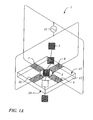
- the present invention provides a biopolymer translocation apparatus 1 that is capable of preventing lateral movement of a biopolymer 5 translocating a nanpore 3.
- the biopolymer translocation apparatus 1 comprises a first electrode 7, a second electrode 8, a third electrode 9, a fourth electrode 10 and a first voltage source 11.
- the second electrode 8 is adjacent to the first electrode 7.
- the third electrode 9 is adjacent to the second electrode 8 and the fourth electrode 10 is adjacent to the third electrode 9.
- the first electrode 7 and the third electrode 9 define a first set of electrodes and are electrically connected.
- the second electrode 8 and the fourth electrode 10 define a second set of electrodes and are electrically connected.
- the present invention may employ a plurality of electrodes or sets of electrodes as further discussed below.
- the first electrode 7, second electrode 8, third electrode 9 and fourth electrode 10 are positioned to define the nanpore 3.
- Optional substrate 12 may also comprise the nanopore 3.
- the first electrode 7, the second electrode 8, the third electrode 9 and the fourth electrode 10 may be positioned or deposited on, or comprise a portion of the optional substrate 12.
- the substrate 12 may have a top surface 17 and a bottom surface 19.
- the substrate 12 may comprise a variety of materials known in the art for designing nanopores. Such materials may comprise silicon, silica, solid-state material such as Si 3 N 4 , carbon based materials, plastics, metals, or other materials known in the art for etching or fabricating semiconductor or electrically conducting materials.
- the substrate 12 may comprise various shapes and sizes. However, it must be large enough and of sufficient width to be capable of forming the nanopore 3 through it.
- the first electrode 7, the second electrode 8, the third electrode 9 and the fourth electrode 10 may comprise a variety of electrically conductive materials. Such materials include electrically conductive metals and alloys of tin, copper, zinc, iron, magnesium, cobalt, nickel, and vanadium. Other materials well known in the art that provide for electrical conduction may also be employed.
- the first electrode 7 When the first electrode 7 is deposited on or comprises a portion of the substrate 12, it may be positioned in any location relative to the second electrode 8 and the fourth electrode 10.
- the electrodes 7, 8, 9 and 10 may be designed in a variety of shapes and sizes.
- the first voltage source 11 is electrically connected to the first electrode 7, the second electrode 8, the third electrode 9 and the fourth electrode 10.
- each of the electrodes may be spaced along a longitudinal axis with a direct current (DC) voltage and a superimposed radio frequency (RF) potential.
- the first electrode 7 and the third electrode 9 are connected and define a first set of electrodes and are at the same DC and RF potential, while the second electrode 8 and the fourth electrode 10 are electrically connected and define a second set of electrodes with an opposite DC voltage and RF potential phase shifted by 180 degrees.
- the invention should not be interpreted to be limited to two sets of electrodes. Other sets of electrodes or a plurality of sets of electrodes would be possible with the present invention.
- the apparatus comprises a set of e.g. four, six, eight or more electrodes
- a different design may be employed. For instance, an RF voltage Vcos ⁇ of amplitude V and frequency ⁇ /2 ⁇ is applied to the first electrode 7, with alternate electrodes having equal amplitude and opposite phase.
- the apparatus can be optionally operated by applying voltages of U+Vcos ⁇ and - [U+Vcos ⁇ ] to alternate electrodes as is well known in the art for quadrupole mass filters.
- U is a DC voltage.
- U, V and ⁇ are chosen for given dimensions and biopolymer mass to charge ratio ranges in the manner commonly known in the art for quadrupole mass filters.
- the nanopore 3 may be positioned anywhere on the substrate 12.
- the nanopore may range in size from Inm to as large as 300 nm. In most cases, effective nanopores for identifying and sequencing biopolymers would be in the range of around 2-20 nms. These size nanopores are just large enough to allow for tranlocation of a biopolymer.
- the nanopore 3 may be created using any methods well known in the art. For instance, the nanopore 3, may be sculpted in the substrate 12, using ion argon beam sputtering, etching, photolithography, or other methods and techniques well known in the art.
- the biopolymer 5 may comprise a variety of shapes, sizes and materials.
- the biopolymer 5 may be a nucleotide, biopolymer, protein, peptide, amino acid, nucleic acid, nucleoside, carbohydrate, glycan, lipid, sphingolipid, proteoglycan, antibody, etc..
- the shape or size of the molecule is not important, but it must be capable of tanslocation through the nanopore 3.
- both single stranded and double stranded RNA and DNA may be used as a biopolymer 5.
- the biopolymer 5 may contain groups or functional groups that are charged.
- metals or materials may be added, doped or intercalated within the biopolymer 5 to provide a net dipole, a charge or allow for conductivity through the biomolecule.
- the first electrode 7, the second electrode 8, the third electrode 9 and the fourth electrode 10 are all positioned on the top surface 17 of the substrate 12 adjacent to the nanopore 3.
- the electrode 7 is positioned adjacent to the electrode 8.
- the electrode 8 is positioned adjacent to the electrode 9.
- the electrode 9 is positioned adjacent to the electrode 10.
- Each of the electrodes 7-10 is positioned in the same plane adjacent to the nanopore 3.
- the electrode 7 and the electrode 9 are electrically connected to define a first set of electrodes.
- the electrode 8 and the electrode 10 are electrically connected to define a second set of electrodes.
- Electrodes 7', 8', 9' and 10' may comprise, be part of or be attached to the substrate 12.
- electrodes 7',8', 9' and 10' are positioned on the bottom surface 19 of substrate 12 adjacent to the nanopore 3, wherein each of said electrodes is positioned adjacent to said nanopore 3 to create a quadrupole field through the length of said nanopore 3.
- the first electrode 7 is electrically connected to the fifth electrode 7'.
- the second electrode 8 is electrically connected to the sixth electrode 8'.
- the third electrode 9 is electrically connected to the seventh electrode 9'.
- the fourth electrode 10 is electrically connected to the eighth electrode 10'. Similar to the design above, the electrodes 7,7' are electrically connected to the 9,9' electrodes to define a first set of electrodes. In addition, the 8,8' and 10, 10' electrodes are electrically connected to define a second set of electrodes.
- FIGS. 2A and 2B further embodiments of the present invention are depicted. These embodiments are similar to FIGS. 1A and 1B, but contain a second voltage source 15 coupled to a current measuring device 13 for monitoring quantum tunneling through opposing electrodes and for detection of portions of the biopolymer 5.
- the second voltage source 15 and current measuring device 13 may be used to monitor quantum tunneling in either a static voltage or ramped voltage mode.
- the method of the present invention provides a method for controlling the lateral movement of a biopolymer as it translocates a nanopore.
- the method comprises applying a DC voltage and radio frequency voltage to a first set of electrodes, applying an opposite DC voltage and phase shifted radio frequency voltage to a second set of electrodes to produce an electric field between the first set of electrodes and the second set of electrodes, and controlling the movement of a biopolymer using the electric field as the biopolymer translocates a nanopore. How the actual apparatus and method prevent the lateral movement of a biopolymer will now be described in greater detail.
- an RF-quadrupole field can be used to focus and guide a charged particle along a specified propagation direction.
- a typical application of this phenomenon is in the area of mass spectrometry, where devices employing RF-quadrupole fields guide particles of specified charge-to-mass ratios down a propagation channel, and cause particles of different charge-to-mass ratios to be expelled from this region.
- the specified charge-to-mass ratio is determined by the geometry and parameters of the RF-field. In a typical device, four rods form a quadrupole field in cross-section. As described further in the Appendix, for appropriate parameter choice, the RF field produces an effective potential that tends to force the charged particle toward the central axis.
- the particle travels down this axis with an oscillatory transverse motion under the effects of the transverse effective harmonic potential. If there are dissipative effects, as the particle travels down the propagation axis, the transverse oscillations are damped out, and the trajectory smoothly settles on the axis.
- FIGS. 1-2 show the apparatus of the present invention that is used to implement this effect.
- the set of four electrodes is used to create an approximate quadrupole field in the nanopore opening.
- the RF-field parameters (to be discussed later) are chosen to guide particles with the charge-to-mass ratio of the biopolymers.
- the effective potential generated provides a continuous force guiding the translocating strand to the center of the nanopore. This mitigates the set of problems catalogued above.
- restriction of lateral movement allows an unimpeded uniform translocation, as well as symmetric and controlled tunneling current environment.
- a DC tunneling voltage can be superimposed upon an opposing pair of electrodes that contribute to generating the quadrupole field.
- Equations (A6) and (A7) in the Appendix describe the transverse forces on the charged particle or a segment of a charged biopolymer strand. For the single particle, it describes the transverse forces as it travels down the length of the device. For the biopolymer, it describes the restoring force exhibited on the moving strand at a fixed spatial point.
- Equation (A10) can be used to estimate the RF-voltage parameters required to have the effective forces generate net focusing for a biopolymer strand.
- it is seen from the stability plot (FIG. 4) that it is required that q u ⁇ 0.91 to have stable trajectories, or net focusing 0.91 > q u 4 e mr 2 0 ⁇ 2 V
- e is the electronic charge
- m is the effective mass of the relevant portion of the biopolymer strand
- r 0 is the radius of the quadrupole aperture
- ⁇ and V are the angular frequency and amplitude of the RF voltage, respectively.
- the current nanopores would support an r 0 of approximately 10 angstroms.
- a typical nucleotide base has a mass of roughly 400 amu, although the effective mass for a base that is part of a continuous strand would be significantly larger, and depend upon the rigidity of the total structure. For estimation purposes it will be assumed that the effective mass is approximately five times that of an individual base. With these parameter values, the requirement for stability (focusing) as expressed in the equation (1) is given by V F 2 ⁇ 2 ⁇ 10 -10 where V is given in volts and F is the RF frequency in MHz.
- the quadruple would tend to guide the polynucleotide strand toward the center of the nanopore for an RF voltage amplitude satisfying the constraint V ⁇ 200 ⁇ V .
- the RF-voltage parameters are achievable for the configurations previously described.
- the present invention is designed to obviate the previously discussed problems.
- the quadrupole fields force the biopolymer toward the center of the nanopore. This mitigates the problem of non-uniform translocation events due to intermittent interaction of the biopolymer with the nanopore walls.
- Another use of the present invention quadrupole structure is based upon operating the quadrupole with parameters chosen to have the strand dynamics to be in the unstable regime, as defined in FIG. 4. For the parameters specified in the example described above, this would correspond to adjusting the amplitude of the RF-voltage above the level of the equation (3), i.e. V > 200 ⁇ V.
- the lateral motion of the translocating biopolymer would be unstable, forcing it away from the center of the nanopore. For appropriate parameter choices, this would "pin" the biopolymer against the wall of the nanopore. Depending upon the structure of the nanopore walls, this could cause the translocation process to be halted in a controlled fashion.
- This ability to stop and resume translocation of the biopolymer in a controlled way has a number of useful applications. It could be used to slow down the rate of translocation, allowing more time for the base detection measurements. It could also be used to hold a portion of the biopolymer in place while the measurement was allowed to focus on one particular portion of the biopolymer.
- the invention is not limited to these particular embodiments.
- the electrodes may have any generalized shape that produces approximate quadruple fields in the nanopore.
- multiple electrode sets can be employed. For example, electrode sets can be used on both sides of the nanopore, causing the quadrupole field to be more accurately maintained over the entire length of the nanopore. Additionally, higher multipole fields can be used, such as octupole fields.
- These embodiments have stability diagrams similar to the one described above and can be exploited in similar ways. This is the case even if the stability diagrams of these embodiments are less sharply defined.
- the nanopore can be made in a thin (500 nm) freestanding silicon nitride (SiN 3 ) membrane supported on a silicon frame.
- FIB focused Ion Beam
- a single initial pore of roughly 500 nM diameter can be created in the membrane.
- illumination of the pore region with a beam of 3 KeV Argon ion sputters material and slowly closes the hole to the desired dimension of roughly 2 nM in diameter See Li et al., Nature, 412 : 166-169, 2001).
- Metal electrodes are formed by patterning and evaporation, or other deposition means, to generate the quadrupole structure. Wire bonding to the metal electrodes allows connection to the RF voltage source.
- the RF voltage source has the modest requirements of several hundred microvolts at a frequency of 1.0 GHz.
- a second example of the present invention would be similar to the first, however, and additional set of four electrodes are deposited on the opposing face of the substrate.
- the second set of electrodes are wired bonded in parallel to the RF voltage source, allowing coherent generation of the quadruple fields over the length of the nanopore.
- a typical RF-quadrupole application in the area of mass spectrometry employs a set of four parallel rod electrodes.
- the quadrupole fields are translationally invariant along the direction of the ion trajectories.
- the shapes of the equipotential surfaces can be easily determined.
- the fields are uniform along the z-axis, except for the regions near the end of the rods, which will be neglected for this discussion.
- the ions will have stable (propagating) or unstable (non-propagating) trajectories as they travel down the RF-quadrupole device.
- This physical effect is exploited in mass spectrometry, to make instruments that selectively pass specified charge-to-mass ratio ions.
- the devices are tuned to the desired charge-to-mass ration by the adjustment of any combination of the voltage parameters.
- Equation (A21) describes the effective dynamics for the time-averaged macromotion of an ion in an RF-guadrupole field. Its solutions are simple harmonic functions, in response to an effective potential which generates a harmonic restoring force. This effective restoring force pulls the ions toward the axis of symmetry at the center of the quadruple field region.
Landscapes
- Engineering & Computer Science (AREA)
- Chemical & Material Sciences (AREA)
- Nanotechnology (AREA)
- Health & Medical Sciences (AREA)
- Life Sciences & Earth Sciences (AREA)
- Physics & Mathematics (AREA)
- Biomedical Technology (AREA)
- Molecular Biology (AREA)
- General Health & Medical Sciences (AREA)
- Crystallography & Structural Chemistry (AREA)
- Medicinal Chemistry (AREA)
- Biophysics (AREA)
- General Physics & Mathematics (AREA)
- Analytical Chemistry (AREA)
- Biotechnology (AREA)
- Biochemistry (AREA)
- Urology & Nephrology (AREA)
- Hematology (AREA)
- Immunology (AREA)
- Pathology (AREA)
- Spectroscopy & Molecular Physics (AREA)
- Bioinformatics & Cheminformatics (AREA)
- Food Science & Technology (AREA)
- General Engineering & Computer Science (AREA)
- Medical Informatics (AREA)
- Pharmacology & Pharmacy (AREA)
- Composite Materials (AREA)
- Condensed Matter Physics & Semiconductors (AREA)
- Materials Engineering (AREA)
- Investigating Or Analyzing Materials By The Use Of Electric Means (AREA)
Applications Claiming Priority (2)
| Application Number | Priority Date | Filing Date | Title |
|---|---|---|---|
| US355347 | 2003-01-31 | ||
| US10/355,347 US7282130B2 (en) | 2003-01-31 | 2003-01-31 | Apparatus and method for control of biopolymer translocation through a nanopore |
Publications (1)
| Publication Number | Publication Date |
|---|---|
| EP1443318A1 true EP1443318A1 (fr) | 2004-08-04 |
Family
ID=32655572
Family Applications (1)
| Application Number | Title | Priority Date | Filing Date |
|---|---|---|---|
| EP03028285A Withdrawn EP1443318A1 (fr) | 2003-01-31 | 2003-12-10 | Dispositif et procédé pour contrôler la translocation d'un biopolymère à travers un nanopore |
Country Status (3)
| Country | Link |
|---|---|
| US (1) | US7282130B2 (fr) |
| EP (1) | EP1443318A1 (fr) |
| JP (1) | JP2004233353A (fr) |
Cited By (10)
| Publication number | Priority date | Publication date | Assignee | Title |
|---|---|---|---|---|
| EP1574837A1 (fr) * | 2004-03-10 | 2005-09-14 | Agilent Technologies Inc. a Delaware Corporation | Méthode et dispositif pour le séquencage de polymères par détection de la variation d'une conductance tunnel |
| EP1643234A1 (fr) * | 2004-09-30 | 2006-04-05 | Agilent Technologies Inc. (a Delaware Corporation) | Résonance tunnel dans un biopolymère utilisant une source de tension de grille |
| EP1643235A1 (fr) * | 2004-09-30 | 2006-04-05 | Agilent Technologies Inc. (a Delaware Corporation) | Résonance tunnel dans un biopolymère utilisant une source de tension de grille |
| EP1657539A1 (fr) * | 2004-10-22 | 2006-05-17 | Agilent Technologies, Inc. (a Delaware Corporation) | Nanostructure à résonance tunnel utilisant une source de tension de grille |
| EP1712893A1 (fr) * | 2005-04-14 | 2006-10-18 | Agilent Technologies, Inc., A Delaware Corporation | Capteur planaire à effet tunnel résonant et ses procédé de fabrication et d'usage. |
| WO2008071982A3 (fr) * | 2006-12-15 | 2008-07-31 | Imp Innovations Ltd | Systèmes d'électrodes et leur utilisation dans la caractérisation de molécules |
| WO2009045472A1 (fr) * | 2007-10-02 | 2009-04-09 | President And Fellows Of Harvard College | Capture, recapture, et piègeage de molécules avec un nanopore |
| CN104713932A (zh) * | 2015-03-24 | 2015-06-17 | 清华大学 | 一种交流模式的多参数纳米孔单分子分析仪 |
| US9274097B2 (en) | 2005-04-06 | 2016-03-01 | President And Fellows Of Harvard College | Molecular characterization with molecular speed control |
| US11035847B2 (en) | 2017-06-29 | 2021-06-15 | President And Fellows Of Harvard College | Deterministic stepping of polymers through a nanopore |
Families Citing this family (48)
| Publication number | Priority date | Publication date | Assignee | Title |
|---|---|---|---|---|
| US8202689B2 (en) * | 2005-05-11 | 2012-06-19 | The Regents Of The University Of California | Nanofabrication processes and devices for the controlled assembly of functionalized nanostructures |
| JP2007033219A (ja) * | 2005-07-26 | 2007-02-08 | Niigata Univ | 非極性分子の誘電測定法 |
| US20080079442A1 (en) * | 2006-08-31 | 2008-04-03 | Joshua Posamentier | Quantum tunneling biometric identification methods and apparatuses |
| AU2008236694B2 (en) | 2007-04-04 | 2014-01-23 | The Regents Of The University Of California | Compositions, devices, systems, and methods for using a nanopore |
| WO2008124706A2 (fr) | 2007-04-06 | 2008-10-16 | Arizona Board Of Regents Acting For And On Behalf Of Arizona State University | Dispositifs et procédés pour une caractérisation de molécule cible |
| WO2009046094A1 (fr) | 2007-10-01 | 2009-04-09 | Nabsys, Inc. | Séquençage de biopolymère par hybridation de sondes pour former des complexes ternaires et alignement de plage variable |
| WO2010014235A1 (fr) * | 2008-08-01 | 2010-02-04 | Brown University | Système et procédé pour déterminer des molécules par spectrométrie de masse et techniques connexes |
| JP5717634B2 (ja) | 2008-09-03 | 2015-05-13 | ナブシス, インコーポレイテッド | 流体チャネル内の生体分子および他の分析物の電圧感知のための、長手方向に変位されるナノスケールの電極の使用 |
| US8262879B2 (en) | 2008-09-03 | 2012-09-11 | Nabsys, Inc. | Devices and methods for determining the length of biopolymers and distances between probes bound thereto |
| US9650668B2 (en) | 2008-09-03 | 2017-05-16 | Nabsys 2.0 Llc | Use of longitudinally displaced nanoscale electrodes for voltage sensing of biomolecules and other analytes in fluidic channels |
| US8968540B2 (en) | 2008-10-06 | 2015-03-03 | Arizona Board Of Regents, A Body Corporate Of The State Of Arizona Acting For And On Behalf Of Arizona State University | Trans-base tunnel reader for sequencing |
| US8455260B2 (en) | 2009-03-27 | 2013-06-04 | Massachusetts Institute Of Technology | Tagged-fragment map assembly |
| US8246799B2 (en) | 2009-05-28 | 2012-08-21 | Nabsys, Inc. | Devices and methods for analyzing biomolecules and probes bound thereto |
| CN101694474B (zh) * | 2009-10-22 | 2012-10-10 | 浙江大学 | 一种纳米孔电学传感器 |
| US8324914B2 (en) | 2010-02-08 | 2012-12-04 | Genia Technologies, Inc. | Systems and methods for characterizing a molecule |
| US8603303B2 (en) * | 2010-03-15 | 2013-12-10 | International Business Machines Corporation | Nanopore based device for cutting long DNA molecules into fragments |
| US8039250B2 (en) * | 2010-03-15 | 2011-10-18 | International Business Machines Corporation | Piezoelectric-based nanopore device for the active control of the motion of polymers through the same |
| US8715933B2 (en) | 2010-09-27 | 2014-05-06 | Nabsys, Inc. | Assay methods using nicking endonucleases |
| US8535512B2 (en) * | 2010-09-30 | 2013-09-17 | California Institute Of Technology | Devices and methods for sequencing nucleic acids |
| WO2012067911A1 (fr) | 2010-11-16 | 2012-05-24 | Nabsys, Inc. | Procédés de séquençage d'une biomolécule par détection de positions relatives de sondes hybridées |
| US8986524B2 (en) | 2011-01-28 | 2015-03-24 | International Business Machines Corporation | DNA sequence using multiple metal layer structure with different organic coatings forming different transient bondings to DNA |
| US20120193231A1 (en) | 2011-01-28 | 2012-08-02 | International Business Machines Corporation | Dna sequencing using multiple metal layer structure with organic coatings forming transient bonding to dna bases |
| US8852407B2 (en) | 2011-01-28 | 2014-10-07 | International Business Machines Corporation | Electron beam sculpting of tunneling junction for nanopore DNA sequencing |
| US11274341B2 (en) | 2011-02-11 | 2022-03-15 | NABsys, 2.0 LLC | Assay methods using DNA binding proteins |
| CA2829833C (fr) | 2011-03-15 | 2019-04-09 | President And Fellows Of Harvard College | Fabrication commandee de nano-pores dans des materiaux semi-conducteurs nanometriques |
| JP5670278B2 (ja) | 2011-08-09 | 2015-02-18 | 株式会社日立ハイテクノロジーズ | ナノポア式分析装置 |
| CN104024849A (zh) | 2011-08-12 | 2014-09-03 | 生命科技公司 | 用于高通量聚糖分析的装置、方法、计算机程序产品和试剂盒 |
| EP2562135A1 (fr) * | 2011-08-22 | 2013-02-27 | ETH Zurich | Procédé de fabrication et d'alignement de nanofils et applications d'un tel procédé |
| JP6054604B2 (ja) * | 2011-12-20 | 2016-12-27 | 株式会社日立製作所 | マイクロ・ナノ流体解析デバイスおよびその製造方法 |
| US10029915B2 (en) | 2012-04-04 | 2018-07-24 | International Business Machines Corporation | Functionally switchable self-assembled coating compound for controlling translocation of molecule through nanopores |
| EP2906720A4 (fr) | 2012-10-10 | 2016-06-01 | Univ Arizona | Systèmes et dispositifs pour détecter des molécules et leur procédé de fabrication |
| US9194860B2 (en) * | 2012-11-13 | 2015-11-24 | International Business Machines Corporation | Integrated nanopore and paul trap mechanism for DNA capture and motion control |
| US9914966B1 (en) | 2012-12-20 | 2018-03-13 | Nabsys 2.0 Llc | Apparatus and methods for analysis of biomolecules using high frequency alternating current excitation |
| WO2014113557A1 (fr) | 2013-01-18 | 2014-07-24 | Nabsys, Inc. | Liaison améliorée d'une sonde |
| EP2971180A4 (fr) * | 2013-03-13 | 2016-11-23 | Univ Arizona State | Systèmes, dispositifs et procédés permettant une commande de translocation |
| US9046511B2 (en) | 2013-04-18 | 2015-06-02 | International Business Machines Corporation | Fabrication of tunneling junction for nanopore DNA sequencing |
| US9182369B2 (en) | 2013-06-19 | 2015-11-10 | Globalfoundries Inc. | Manufacturable sub-3 nanometer palladium gap devices for fixed electrode tunneling recognition |
| US9188578B2 (en) | 2013-06-19 | 2015-11-17 | Globalfoundries Inc. | Nanogap device with capped nanowire structures |
| US10041930B2 (en) * | 2013-06-28 | 2018-08-07 | Globalfoundries Inc. | Tunneling junction to distinguish targeted DNA segment |
| WO2015131073A1 (fr) | 2014-02-27 | 2015-09-03 | Arizona Board Of Regents Acting For And On Behalf Of Arizona State University | Molécules de lecture à base de triazole et procédés pour leur synthèse et leur utilisation |
| US9557294B2 (en) | 2014-12-19 | 2017-01-31 | Genia Technologies, Inc. | Nanopore-based sequencing with varying voltage stimulus |
| US9863904B2 (en) | 2014-12-19 | 2018-01-09 | Genia Technologies, Inc. | Nanopore-based sequencing with varying voltage stimulus |
| BR112017021256A2 (pt) | 2015-04-03 | 2018-06-26 | Abbott Laboratories | dispositivos e métodos para a análise de amostras |
| WO2016161402A1 (fr) | 2015-04-03 | 2016-10-06 | Abbott Laboratories | Dispositifs et procédés d'analyse d'échantillon |
| WO2017004463A1 (fr) | 2015-07-01 | 2017-01-05 | Abbott Laboratories | Dispositifs et procédés d'analyse d'échantillon |
| US10126262B2 (en) | 2015-09-24 | 2018-11-13 | Genia Technologies, Inc. | Differential output of analog memories storing nanopore measurement samples |
| WO2018067878A1 (fr) | 2016-10-05 | 2018-04-12 | Abbott Laboratories | Dispositifs et procédés d'analyse d'échantillon |
| WO2025111147A1 (fr) | 2023-11-21 | 2025-05-30 | Abbott Laboratories | Réseau bidimensionnel de gouttelettes matricielles |
Citations (8)
| Publication number | Priority date | Publication date | Assignee | Title |
|---|---|---|---|---|
| US6051380A (en) * | 1993-11-01 | 2000-04-18 | Nanogen, Inc. | Methods and procedures for molecular biological analysis and diagnostics |
| US6245508B1 (en) * | 1993-11-01 | 2001-06-12 | Nanogen, Inc. | Method for fingerprinting utilizing an electronically addressable array |
| WO2002042496A2 (fr) * | 2000-11-27 | 2002-05-30 | The Regents Of The University Of California | Procedes et dispositifs de caracterisation de molecules d'acide nucleique bicatenaire |
| US20020119455A1 (en) * | 1997-02-12 | 2002-08-29 | Chan Eugene Y. | Methods and products for analyzing polymers |
| US20020197618A1 (en) * | 2001-01-20 | 2002-12-26 | Sampson Jeffrey R. | Synthesis and amplification of unstructured nucleic acids for rapid sequencing |
| WO2003000920A2 (fr) * | 2001-06-21 | 2003-01-03 | President And Fellows Of Harvard College | Procedes de caracterisation de molecules d'acide nucleique |
| WO2003003446A2 (fr) * | 2001-06-27 | 2003-01-09 | President And Fellows Of Harvard College | Controle de caracteristiques dimensionnelle a semiconducteurs |
| US6627067B1 (en) * | 1999-06-22 | 2003-09-30 | President And Fellows Of Harvard College | Molecular and atomic scale evaluation of biopolymers |
Family Cites Families (2)
| Publication number | Priority date | Publication date | Assignee | Title |
|---|---|---|---|---|
| US7968305B2 (en) * | 2001-03-24 | 2011-06-28 | Aviva Biosciences Corporation | Biochips including ion transport detecting structures and methods of use |
| TWI234584B (en) * | 2002-08-16 | 2005-06-21 | Univ Nat Taiwan Normal | Nucleic acid sequencing method |
-
2003
- 2003-01-31 US US10/355,347 patent/US7282130B2/en not_active Expired - Lifetime
- 2003-12-10 EP EP03028285A patent/EP1443318A1/fr not_active Withdrawn
-
2004
- 2004-01-26 JP JP2004017229A patent/JP2004233353A/ja active Pending
Patent Citations (8)
| Publication number | Priority date | Publication date | Assignee | Title |
|---|---|---|---|---|
| US6051380A (en) * | 1993-11-01 | 2000-04-18 | Nanogen, Inc. | Methods and procedures for molecular biological analysis and diagnostics |
| US6245508B1 (en) * | 1993-11-01 | 2001-06-12 | Nanogen, Inc. | Method for fingerprinting utilizing an electronically addressable array |
| US20020119455A1 (en) * | 1997-02-12 | 2002-08-29 | Chan Eugene Y. | Methods and products for analyzing polymers |
| US6627067B1 (en) * | 1999-06-22 | 2003-09-30 | President And Fellows Of Harvard College | Molecular and atomic scale evaluation of biopolymers |
| WO2002042496A2 (fr) * | 2000-11-27 | 2002-05-30 | The Regents Of The University Of California | Procedes et dispositifs de caracterisation de molecules d'acide nucleique bicatenaire |
| US20020197618A1 (en) * | 2001-01-20 | 2002-12-26 | Sampson Jeffrey R. | Synthesis and amplification of unstructured nucleic acids for rapid sequencing |
| WO2003000920A2 (fr) * | 2001-06-21 | 2003-01-03 | President And Fellows Of Harvard College | Procedes de caracterisation de molecules d'acide nucleique |
| WO2003003446A2 (fr) * | 2001-06-27 | 2003-01-09 | President And Fellows Of Harvard College | Controle de caracteristiques dimensionnelle a semiconducteurs |
Cited By (17)
| Publication number | Priority date | Publication date | Assignee | Title |
|---|---|---|---|---|
| US7279337B2 (en) | 2004-03-10 | 2007-10-09 | Agilent Technologies, Inc. | Method and apparatus for sequencing polymers through tunneling conductance variation detection |
| EP1574837A1 (fr) * | 2004-03-10 | 2005-09-14 | Agilent Technologies Inc. a Delaware Corporation | Méthode et dispositif pour le séquencage de polymères par détection de la variation d'une conductance tunnel |
| EP1643234A1 (fr) * | 2004-09-30 | 2006-04-05 | Agilent Technologies Inc. (a Delaware Corporation) | Résonance tunnel dans un biopolymère utilisant une source de tension de grille |
| EP1643235A1 (fr) * | 2004-09-30 | 2006-04-05 | Agilent Technologies Inc. (a Delaware Corporation) | Résonance tunnel dans un biopolymère utilisant une source de tension de grille |
| US8563237B2 (en) | 2004-09-30 | 2013-10-22 | Agilent Technologies, Inc. | Biopolymer resonant tunneling with a gate voltage source |
| EP1657539A1 (fr) * | 2004-10-22 | 2006-05-17 | Agilent Technologies, Inc. (a Delaware Corporation) | Nanostructure à résonance tunnel utilisant une source de tension de grille |
| US9274097B2 (en) | 2005-04-06 | 2016-03-01 | President And Fellows Of Harvard College | Molecular characterization with molecular speed control |
| US10228348B2 (en) | 2005-04-06 | 2019-03-12 | President And Fellows Of Harvard College | Molecular characterization device |
| EP1712893A1 (fr) * | 2005-04-14 | 2006-10-18 | Agilent Technologies, Inc., A Delaware Corporation | Capteur planaire à effet tunnel résonant et ses procédé de fabrication et d'usage. |
| WO2008071982A3 (fr) * | 2006-12-15 | 2008-07-31 | Imp Innovations Ltd | Systèmes d'électrodes et leur utilisation dans la caractérisation de molécules |
| US8273532B2 (en) | 2007-10-02 | 2012-09-25 | President And Fellows Of Harvard College | Capture, recapture, and trapping of molecules with a nanopore |
| WO2009045472A1 (fr) * | 2007-10-02 | 2009-04-09 | President And Fellows Of Harvard College | Capture, recapture, et piègeage de molécules avec un nanopore |
| CN104713932A (zh) * | 2015-03-24 | 2015-06-17 | 清华大学 | 一种交流模式的多参数纳米孔单分子分析仪 |
| CN104713932B (zh) * | 2015-03-24 | 2017-03-29 | 清华大学 | 一种交流模式的多参数纳米孔单分子分析仪 |
| US11035847B2 (en) | 2017-06-29 | 2021-06-15 | President And Fellows Of Harvard College | Deterministic stepping of polymers through a nanopore |
| US12140587B2 (en) | 2017-06-29 | 2024-11-12 | President And Fellows Of Harvard College | Deterministic stepping of polymers through a nanopore |
| US12416625B2 (en) | 2017-06-29 | 2025-09-16 | President And Fellows Of Harvard College | Deterministic control of polymer molecule translocation through a nanopore |
Also Published As
| Publication number | Publication date |
|---|---|
| JP2004233353A (ja) | 2004-08-19 |
| US7282130B2 (en) | 2007-10-16 |
| US20040149580A1 (en) | 2004-08-05 |
Similar Documents
| Publication | Publication Date | Title |
|---|---|---|
| EP1443318A1 (fr) | Dispositif et procédé pour contrôler la translocation d'un biopolymère à travers un nanopore | |
| US7410564B2 (en) | Apparatus and method for biopolymer identification during translocation through a nanopore | |
| US8969091B2 (en) | Study of polymer molecules and conformations with a nanopore | |
| JP6274455B2 (ja) | 分子を操作するための方法およびシステム | |
| CN102753708B (zh) | Dna测序方法以及用于实现所述方法的检测器和系统 | |
| US7258838B2 (en) | Solid state molecular probe device | |
| Meller | Dynamics of polynucleotide transport through nanometre-scale pores | |
| US6905586B2 (en) | DNA and RNA sequencing by nanoscale reading through programmable electrophoresis and nanoelectrode-gated tunneling and dielectric detection | |
| US7582490B2 (en) | Controlled fabrication of gaps in electrically conducting structures | |
| EP1592641B1 (fr) | Fabrication regulee de trous dans des structures conductrices d'electricite | |
| JP2013090576A (ja) | 核酸分析デバイス及びそれを用いた核酸分析装置 | |
| US8492714B2 (en) | System and method for trapping and measuring a charged particle in a liquid | |
| KR20010032068A (ko) | 미소전극 배열 | |
| US10094805B2 (en) | Increasing the capture zone by nanostructure patterns | |
| AU2004223493A1 (en) | Nanopores, methods for using same, methods for making same and methods for characterizing biomolecules using same | |
| WO2011160989A1 (fr) | Dispositif nanofluidique à effet de champ pour le contrôle du transport d'adn dans un nanocanal comprenant un ensemble d'électrodes | |
| Farshad et al. | Molecular dynamics simulation study of transverse and longitudinal ionic currents in solid-state nanopore DNA sequencing | |
| WO2017087908A1 (fr) | Dispositifs à nanocanal et procédés d'analyse de molécules | |
| JP2020502538A (ja) | 分子分析及び同定のための方法及び装置 | |
| Zlatanova et al. | Stretching and imaging single DNA molecules and chromatin | |
| Yin et al. | Nanopore fabrication via transient high electric field controlled breakdown and detection of single RNA molecules | |
| WO2023233345A1 (fr) | Système et procédé de balayage à base de nanopores | |
| Can et al. | A Perspective on graphene junctions for recognition tunneling | |
| Meng et al. | Single nucleobase identification for transversally-confined ssDNA using longitudinal ionic currents | |
| Lee | Nanoelectrode-gated detection of individual molecules with potential for rapid DNA sequencing |
Legal Events
| Date | Code | Title | Description |
|---|---|---|---|
| PUAI | Public reference made under article 153(3) epc to a published international application that has entered the european phase |
Free format text: ORIGINAL CODE: 0009012 |
|
| 17P | Request for examination filed |
Effective date: 20040430 |
|
| AK | Designated contracting states |
Kind code of ref document: A1 Designated state(s): AT BE BG CH CY CZ DE DK EE ES FI FR GB GR HU IE IT LI LU MC NL PT RO SE SI SK TR |
|
| AX | Request for extension of the european patent |
Extension state: AL LT LV MK |
|
| AKX | Designation fees paid |
Designated state(s): DE FR GB |
|
| RBV | Designated contracting states (corrected) |
Designated state(s): DE FR GB |
|
| RAP1 | Party data changed (applicant data changed or rights of an application transferred) |
Owner name: AGILENT TECHNOLOGIES, INC. |
|
| STAA | Information on the status of an ep patent application or granted ep patent |
Free format text: STATUS: THE APPLICATION IS DEEMED TO BE WITHDRAWN |
|
| 18D | Application deemed to be withdrawn |
Effective date: 20080701 |