EP1443393A2 - Elévation à la puissance sur une courbe elliptique pouvant contrer une attaque différentielle basée sur des fautes - Google Patents
Elévation à la puissance sur une courbe elliptique pouvant contrer une attaque différentielle basée sur des fautes Download PDFInfo
- Publication number
- EP1443393A2 EP1443393A2 EP04250443A EP04250443A EP1443393A2 EP 1443393 A2 EP1443393 A2 EP 1443393A2 EP 04250443 A EP04250443 A EP 04250443A EP 04250443 A EP04250443 A EP 04250443A EP 1443393 A2 EP1443393 A2 EP 1443393A2
- Authority
- EP
- European Patent Office
- Prior art keywords
- elliptic curve
- exponentiation
- unit
- point
- result
- Prior art date
- Legal status (The legal status is an assumption and is not a legal conclusion. Google has not performed a legal analysis and makes no representation as to the accuracy of the status listed.)
- Granted
Links
Images


Classifications
-
- G—PHYSICS
- G06—COMPUTING OR CALCULATING; COUNTING
- G06F—ELECTRIC DIGITAL DATA PROCESSING
- G06F7/00—Methods or arrangements for processing data by operating upon the order or content of the data handled
- G06F7/60—Methods or arrangements for performing computations using a digital non-denominational number representation, i.e. number representation without radix; Computing devices using combinations of denominational and non-denominational quantity representations, e.g. using difunction pulse trains, STEELE computers, phase computers
- G06F7/72—Methods or arrangements for performing computations using a digital non-denominational number representation, i.e. number representation without radix; Computing devices using combinations of denominational and non-denominational quantity representations, e.g. using difunction pulse trains, STEELE computers, phase computers using residue arithmetic
- G06F7/724—Finite field arithmetic
- G06F7/725—Finite field arithmetic over elliptic curves
-
- G—PHYSICS
- G06—COMPUTING OR CALCULATING; COUNTING
- G06F—ELECTRIC DIGITAL DATA PROCESSING
- G06F2207/00—Indexing scheme relating to methods or arrangements for processing data by operating upon the order or content of the data handled
- G06F2207/72—Indexing scheme relating to groups G06F7/72 - G06F7/729
- G06F2207/7219—Countermeasures against side channel or fault attacks
- G06F2207/7271—Fault verification, e.g. comparing two values which should be the same, unless a computational fault occurred
Definitions
- the present invention relates to a computation processing technique using an elliptic curve, and in particular relates to a technique for countering Differential Fault Attack (DFA).
- DFA Differential Fault Attack
- Public key cryptography has conventionally been known as a method for realizing confidentiality of information, authentication of information, etc.
- a pair of a secret key exclusively held by the user and a public key that is made public is generated. Encryption is performed using the public key, and decryption is performed using the secret key.
- public key cryptography which does not require a secret key to be shared by a plurality of users, is often employed in such applications that require high security.
- Typical examples of public key cryptography include RSA cryptography and elliptical curve cryptography.
- the security of public key cryptography is based on the discrete logarithm problem.
- Typical examples of the discrete logarithm problem are problems defined over finite fields and problems defined over elliptic curves.
- the following describes a discrete logarithm problem defined over an elliptic curve.
- E(GF(p)) is an elliptic curve defined over a finite field GF(p), with an element G on the elliptic curve E being set as a base point when the order of the elliptic curve E is exactly divided by a large prime.
- p is a prime and GF(p) is a finite field that includes p elements.
- the symbol "*" represents repeated additions of a point, i.e., an element, on the elliptic curve, and such computation involving "*” is referred to as the "computation of an elliptic curve exponentiation".
- the security of public key cryptography is based on extreme difficulty of the discrete logarithm problem for the finite field GF(p) including a large number of elements.
- a secret key is usually held by such means as an IC card that does not allow revealing of the key to third parties.
- Japanese Laid-Open Patent Application No. 2002-261751 refers to the emergence of attacks of unauthorized obtaining of secret information by analyzing various information output from an IC card or the like.
- One type of such attacks is the DFA.
- the DFA is made by a third party intentionally causing a failure in an IC card that is being engaged in decryption processing, by applying overcurrent or the like.
- the IC card then outputs a value that had been computed before the occurrence of the failure.
- the third party collects a large number of values output from the IC card by repeating this.
- the third party then obtains secret information by analyzing the collected values.
- Japanese Laid-Open Patent Application No. H11-8616 discloses an IC card particularly designed to deal with the DFA.
- This IC card includes a coprocessor, and can realize rapid processing of exponential remainder computation for generating digital signature according to RSA cryptography, by Chinese remainder theorem, using a prime factor of a public key n .
- This IC card can compute, at the same time with data generated in the computation process of Chinese remainder theorem, error-detecting code for the data. The IC card then can compute error-detecting code again for the data when the digital signature is generated, and compare the computed error-detecting code with the stored error-detecting code.
- the object of the present invention is to provide an elliptic curve exponentiation apparatus that can counter the DFA when an elliptic curve exponentiation technique is used, and also to provide an elliptic curve exponentiation method, a computer program for computation of an elliptic curve exponentiation, and an information security apparatus.
- the obtained exponentiation-result-point k*Q is output only when the judgment unit judges that the exponentiation-result-point k*Q is on the elliptic curve E . Therefore, the apparatus does not output an incomplete computation result even if being subjected to the DFA.
- the elliptic curve exponentiation apparatus may further include a second storage unit operable to store therein a coefficient b that is a constant term of the elliptic curve E .
- the judgment unit may judge whether the obtained exponentiation-result-point k*Q is on the elliptic curve E , using the coefficient a stored in the first storage unit and the coefficient b stored in the second storage unit.
- the coefficient a stored in the first storage unit and the coefficient b stored in the second storage unit are used. This ensures a correct judgment as to whether the exponentiation-result-point k*Q is on the elliptic curve E .
- the elliptic curve exponentiation apparatus may further include a constant term coefficient obtaining unit operable to obtain the coefficient b , and write the obtained coefficient b into the second storage unit.
- the coefficient b that is a constant term of the elliptic curve E is obtained and is written into the second storage unit.
- a value of the constant term coefficient b therefore, a different elliptic curve can be set. Accordingly, an elliptic curve does not need to be fixed but various elliptic curves can be used, thereby enabling the versatility featured by elliptic curve cryptography to be maintained.
- the elliptic curve exponentiation apparatus may further include an x term coefficient obtaining unit operable to obtain the coefficient a , and write the obtained coefficient a into the first storage unit.
- the coefficient a that is an x term of the elliptic curve E is obtained and is written into the first storage unit.
- a value of the coefficient a on the x term therefore, a different elliptic curve can be set. Accordingly, an elliptic curve does not need to be fixed but various elliptic curves can be used in the same manner as that described above.
- the computation unit may compute coordinates (Qx, Qy) as the exponentiation-result-point k*Q
- the judgment unit may compute ( Qy ) 2 and ( Qx ) 3 +a ⁇ Qx+b, compare a computation result of (Qy) 2 and a computation result of ( Qx ) 3 +a ⁇ Qx+b, and when the computation result of (Qy) 2 and the computation result of (Qx) 3 +a ⁇ Qx+b match, judge that the exponentiation-result-point k*Q is on the elliptic curve E .
- the elliptic curve exponentiation apparatus may further include an error message output unit operable to output a message indicating that an error has occurred, when the judgment unit judges that the exponentiation-result-point k*Q is not on the elliptic curve E .
- the judgment unit may judge whether the point Q and the exponentiation-result-point k*Q are on a same elliptic curve, instead of judging whether the exponentiation-result-point k*Q is on the elliptic curve E , and the output unit may output the exponentiation-result-point k*Q when the judgment unit judges that the point Q and the exponentiation-result-point k* Q are on the same elliptic curve, instead of when the judgment unit judges that the exponentiation-result-point k*Q is on the elliptic curve E .
- the judgment is performed as to whether the point Q and the exponentiation-result-point k*Q are on the same elliptic curve.
- the exponentiation-result-point k*Q is output only when the point Q and the exponentiation-result-point k*Q are judged to be on the same elliptic curve. Therefore, the apparatus does not output an incomplete computation result even if being subjected to the DFA.
- the information obtaining unit may obtain coordinates (Qx, Qy) as the point Q
- the computation unit may compute coordinates (Qx', Qy') as the exponentiation-result-point k*Q
- the information security apparatus outputs the exponentiation-result-point k * Q only when the judgment unit judges that the exponentiation-result-point k*Q is on the elliptic curve E . Therefore, the apparatus does not output an incomplete computation result even if being subjected to the DFA.
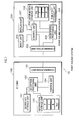
- the point issuing system 10 is roughly composed of an IC card 100 and a point issuing apparatus 200 as shown in FIG. 1.
- the IC card 100 is loaded in the point issuing apparatus 200 by the user of the point issuing apparatus 200, so that the point issuing apparatus 200 generates points, encrypts the generated points, and transmits the encrypted points to the IC card 100.
- the points are "bonus information" provided from the seller or the service provider to the user when the user purchases a commodity or uses service. For next commodity purchase or service use, the user can use the points as part of all of its payment to the seller or the service provider.
- the IC card 100 receives the encrypted points, decrypts the encrypted points to obtain decrypted points, and internally stores the decrypted points.
- the point issuing apparatus 200 is roughly composed of a public key storage unit 201, an encryption processing unit 202, a communication unit 203, a control unit 204, an information storage unit 205, an input unit 206, and a display unit 207 as shown in FIG. 1.
- the point issuing apparatus 200 is not only an apparatus for generating points, encrypting the points and writing the encrypted points to the IC card 100, but also serves as a cash register used for a commodity sale. To be specific, the point issuing apparatus 200 performs such operations as calculation of a sales amount, displaying of the sales amount, printing of a receipt, internal storing of the generated points, and keeping of money paid by the user.
- the point issuing apparatus 200 specifically is a computer system including a microprocessor, a ROM, a RAM, a hard disk unit, a display unit, and a keyboard.
- a computer program is stored in the RAM or the hard disk unit.
- the functions of the point issuing apparatus 200 are realized by the microprocessor operating in accordance with the computer program.
- the information storage unit 205 stores a base point B on an elliptic curve E(Fp) defined over a residue field Fp with a prime p being a modulus, the prime, and the elliptic curve E(Fp) . Also, the information storage unit 205 has an area for storing the generated points Pm .
- the public key storage unit 201 stores a public key kp generated in correspondence with a secret key ks described later.
- the control unit 204 generates points Pm as the bonus information, and writes the generated points Pm to the information storage unit 205.
- the control unit 204 then outputs an instruction to the encryption processing unit 202, to encrypt the points Pm and transmit the encrypted points Pm to the IC card 100.
- the encryption processing unit 202 is roughly composed of an encryption control unit 211 and an elliptic curve computation unit 212 as shown in FIG. 2.
- the elliptic curve computation unit 212 includes an exponent input unit 221, a computation value input unit 222, an x term holding unit 223, an elliptic curve exponentiation unit 224, and a computation result output unit 225.
- the encryption control unit 211 receives, from the control unit 204, an instruction to encrypt the points Pm and transmit the encrypted points Pm to the IC card 100.
- the encryption control unit 211 reads the public key kp from the public key storage unit 201.
- the encryption control unit 211 then outputs, as an exponent, the generated random number r to the exponent input unit 221, and outputs, as a computation value, the read public key kp to the computation value input unit 222.
- the encryption control unit 211 receives, as a computation result, the exponentiation-result-point r*kp from the computation result output unit 225.
- the encryption control unit 211 then transmits the first ciphertext s1 and the second ciphertext s2 to the IC card 100 via the communication unit 203.
- the exponent input unit 221 receives the exponent from the encryption control unit 211, and outputs the received exponent to the elliptic curve exponentiation unit 224.
- the computation value input unit 222 receives the computation value from the encryption control unit 211, and outputs the received computation value to the elliptic curve exponentiation unit 224.
- the coefficient a may be - 3 .
- the elliptic curve exponentiation unit 224 receives the exponent from the exponent input unit 221, the computation value from the computation value input unit 222, and the coefficient a from the x term holding unit 223.
- the elliptic curve exponentiation unit 224 computes (exponent) * (computation value), and outputs, as a computation result, its exponentiation-result-point to the computation result output unit 225.
- the computation result output unit 225 receives the exponentiation-result-point from the elliptic curve exponentiation unit 224, and outputs the received exponentiation-result-point to the encryption control unit 211.
- the communication unit 203 transmits and receives information to and from the IC card 100, based on control provided by the encryption processing unit 202 or the control unit 204.
- the input unit 206 receives an input of information or an instruction from the user of the point issuing apparatus 200, and outputs the received information or instruction to the control unit 204.
- the display unit 207 displays various types of information based on control provided by the control unit 204.
- the IC card 100 is roughly composed of a secret key storage unit 101, a decryption processing unit 102, a communication unit 103, a control unit 104, and an information storage unit 105 as shown in FIG. 1.
- the IC card 100 specifically is a computer system including a microprocessor, a ROM, and a RAM. A computer program is stored in the RAM. The functions of the IC card 100 are realized by the microprocessor operating in accordance with the computer program.
- the information storage unit 105 stores the prime p , the elliptic curve E(Fp) , and the base point B . Also, the information storage unit 105 has an area for storing the decrypted points Pm '.
- the secret key storage unit 101 stores the secret key ks.
- the communication unit 103 receives the first ciphertext s1 and the second ciphertext s2 from the point issuing apparatus 200. Upon receipt of the first ciphertext s1 and the second ciphertext s2 , the communication unit 103 gives a notification of the reception to the control unit 104. The communication unit 103 outputs the ciphertext s1 and the ciphertext s2 received, to the decryption processing unit 102.
- the control unit 104 receives the notification of the reception of the first ciphertext s1 and the second ciphertext s2 from the communication unit 103. Upon receipt of the notification, the control unit 104 outputs, to the decryption processing unit 102, an instruction to decrypt the first ciphertext s1 and the second ciphertext s2 to obtain decrypted points.
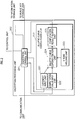
- the decryption processing unit 102 is roughly composed of a decryption control unit 111 and an elliptic curve computation unit 112.
- the elliptic curve computation unit 112 is roughly composed of an exponent input unit 121, a computation value input unit 122, a primary expressing holding unit 123, an elliptic curve exponentiation unit 124, a computation result output unit 125, a constant term holding unit 126, and a computation result verification unit 127.
- the decryption control unit 111 receives, from the control unit 104, an instruction to decrypt the first ciphertext s1 and the second ciphertext s2 , to obtain decrypted points. Also, the decryption control unit 111 receives the first ciphertext s1 and the second ciphertext s2 from the communication unit 103.
- the decryption control unit 111 Upon receipt of the instruction, the decryption control unit 111 reads the secret key ks from the secret key storage unit 101. Following this, the decryption control unit 111 outputs, as a computation value, the received first ciphertext s1 to the computation value input unit 122, and outputs, as an exponent, the read secret key ks to the exponent input unit 121. The decryption control unit 111 receives error occurrence information indicating whether an error has occurred, from the computation result output unit 125. When the received error occurrence information indicates that an error has occurred, the decryption control unit 111 aborts the subsequent decryption processing.
- the decrypted points Pm' match the points Pm.
- the decryption control unit 111 writes the decrypted points Pm ' to the information storage unit 105.
- the exponent input unit 121 receives the exponent k from the decryption control unit 111, and outputs the received exponent k to the elliptic curve exponentiation unit 124.
- the computation value input unit 122 receives the computation value Q from the decryption control unit 111, and outputs the received computation value Q to the elliptic curve exponentiation unit 124.
- the elliptic curve exponentiation unit 124 receives the exponent k from the exponent input unit 121, the computation value Q from the computation value input unit 222, and the coefficient a from the x term holding unit 123.
- the computation result output unit 125 receives the error occurrence information from the elliptic curve exponentiation unit 124, and outputs the received error occurrence information to the decryption control unit 111. Also, the computation result output unit 125 receives the exponentiation-result-point from the elliptic curve exponentiation unit 124, and outputs the received exponentiation-result-point to the decryption control unit 111.
- the decryption processing unit 102 of the IC card 100 generates the secret key ks, and writes the generated secret key ks to the secret key storage unit 101 (step S101).
- the computation of the elliptic curve exponentiation is performed by the elliptic curve exponentiation unit 124 (step S102).
- the decryption processing unit 102 transmits the generated public key kp to the point issuing apparatus 200 via the communication unit 103 (step S103).
- the encryption processing unit 202 of the point issuing apparatus 200 receives the public key kp from the IC card 100 via the communication unit 203, and writes the received public key kp to the public key storage unit 201 (step S104).
- the IC card 100 generates the secret key ks , generates the public key kp based on the generated secret key ks, and transmits the generated public key kp to the point issuing apparatus 200, this may be modified as follows.
- the IC card 100 may generate the secret key ks, and internally store the generated secret key ks.
- the key management apparatus then may obtain the secret key ks from the IC card 100, generate the public key kp using the obtained secret key ks in the same manner as that described above, and transmit the generated public key kp to the point issuing apparatus 200.
- the control unit 204 of the point issuing apparatus 200 generates the points Pm, writes the generated points Pm to the information storage unit 205, and outputs, to the encryption processing unit 202, an instruction to encrypt the points Pm and transmit the encrypted points Pm to the IC card 100 (S111).
- the encryption control unit 211 Upon receipt of the instruction, the encryption control unit 211 generates the random number r (step S112).
- the encryption control unit 211 reads the base point B from the information storage unit 205, and outputs, as an exponent, the generated random number r to the exponent input unit 221, and outputs, as a computation value, the read base point B to the computation value input unit 222.
- the encryption control unit 211 reads the public key kp from the public key storage unit 201, outputs, as an exponent, the generated random number r to the exponent input unit 221, and outputs, as a computation value, the read public key kp to the computation value input unit 222.
- the encryption control unit 211 receives, as a computation result, the exponentiation-result-point r*kp from the computation result output unit 225.
- the encryption control unit 211 transmits the first ciphertext s1 and the second ciphertext s2 to the IC card 100 via the communication unit 203 (step S115).
- the decryption control unit 111 receives the first ciphertext s1 and the second ciphertext s2 from the point issuing apparatus 200 via the communication unit 103 (step S115).
- the decryption control unit 111 then reads the secret key ks from the secret key storage unit 101, outputs, as a computation value, the received first ciphertext s1 to the computation value input unit 122, and outputs, as an exponent, the read secret key ks to the exponent input unit 121.
- the elliptic curve exponentiation unit 124 computes ks*s1.
- step S117 When the received error occurrence information indicates that an error has occurred (step S117), the decryption control unit 111 ends the processing. When the received error occurrence information indicates that an error has not occurred (step S117), the decryption control unit 111 writes the decrypted points Pm' obtained by the computation, to the information storage unit 105 (step S118).
- the exponent input unit 121 receives the exponent k from the decryption control unit 111, and outputs the received exponent k to the elliptic curve exponentiation unit 124 (step S121).
- the computation value input unit 122 receives the computation value Q from the decryption control unit 111, and outputs the received computation value Q to the elliptic curve exponentiation unit 124 (step S122).
- the computation result output unit 125 outputs the error occurrence information and the exponentiation-result-point to the decryption control unit 111 (step S127).
- the computation result output unit 125 outputs the error occurrence information to the decryption control unit 111 (step S128).
- the point issuing system 10a has the same construction as the point issuing system 10 except the following.
- the point issuing system 10a includes an IC card 100a (not shown) instead of the IC card 100.
- the IC card 100a includes a decryption processing unit 102a (not shown) instead of the decryption processing unit 102.
- the decryption processing unit 102a includes an elliptic curve computation unit 112a instead of the elliptic curve computation unit 112.
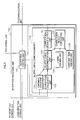
- the elliptic curve computation unit 112a is roughly composed of an exponent input unit 121, a computation value input unit 122, an x term holding unit 123, an elliptic curve exponentiation unit 124, a computation result output unit 125, a constant term holding unit 126, a computation result verification unit 127, and a constant term input unit 128 as shown in FIG. 6.
- the decryption control unit 111 reads the coefficient b , which is a constant term, from the information storage unit 105 when the elliptic curve computation unit 112a performs computation of an exponentiation, and outputs the read coefficient b to the constant term input unit 128 of the elliptic curve computation unit 112a.
- the constant term input unit 128 receives the coefficient b from the decryption control unit 111, and writes the received coefficient b to the constant term holding unit 126.
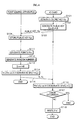
- the operation of the point issuing system 10a is the same as the operation of the point issuing system 10 except its operation part relating to computation of an elliptic curve exponentiation. Therefore,thefollowing describes the operation of the elliptic curve computation unit 112a for the computation of an elliptic curve exponentiation, with reference to a flowchart shown in FIG. 7. Further, the operation for the computation of an elliptic curve exponentiation by the elliptic curve computation unit 112a is similar to the corresponding operation by the elliptic curve computation unit 112 shown in FIG. 5. Therefore, the following describes such an operation, focusing on its differences from the operation shown in FIG. 5.
- the constant term input unit 128 receives the coefficient b from the decryption control unit 111 (step S131), and writes the received coefficient b to the constant term holding unit 126 ( step S132 ) .
- the processing advances to step S124 and subsequent steps.
- the point issuing system 10b has the same construction as the point issuing system 10 except the following.
- the point issuing system 10b includes an IC card 100b (not shown) instead of the IC card 100.
- the IC card 100b includes a decryption processing unit 102b (not shown) instead of the decryption processing unit 102.
- the decryption processing unit 102b includes an elliptic curve computation unit 112b instead of the elliptic curve computation unit 112.
- the elliptic curve computation unit 112b is roughly composed of an exponent input unit 121, a computation value input unit 122, an x term holding unit 123, an elliptic curve exponentiation unit 124, a computation result output unit 125, a constant term holding unit 126, a computation result verification unit 127, and a constant term computation unit 129 as shown in FIG. 8.
- the constant term computation unit 129 writes the computed coefficient b to the constant term holding unit 126.
- the operation of the point issuing system 10b is the same as the operation of the point issuing system 10 except its operation part relating to computation of an elliptic curve exponentiation. Therefore, the following describes the operation of the elliptic curve computation unit 112b for the computation of an elliptic curve exponentiation, with reference to a flowchart shown in FIG. 9. Further, the operation for the computation of an elliptic curve exponentiation by the elliptic curve computation unit 112b is similar to the corresponding operation by the elliptic curve computation unit 112 shown in FIG. 5. Therefore, the following describes such an operation, focusing on its differences from the operation shown in FIG. 5.
- step S124b is provided instead of step S124.
- the computation result verification unit 127 receives the coefficient a from the x term holding unit 123 (step S124b).
- the computation result verification unit 127 receives the coefficient b from the constant term holding unit 126 (step S143). The processing then advances to step S125 and subsequent steps.
- the digital signature system is roughly composed of a user A apparatus, a user B apparatus, and a management center apparatus (all not shown).
- the user A apparatus, the user B apparatus, and the management center apparatus are connected to one another via the Internet.
- the user A apparatus, the user B apparatus, and the management center apparatus are each specif ically a computer system including a microprocessor, a ROM, a RAM, a hard disk unit, a display unit, a keyboard, and a mouse.
- a computer program is stored in the RAM or the hard disk unit.
- the functions of each of the user A apparatus, the user B apparatus, and the management center apparatus are realized by the microprocessor operating in accordance with the computer program.
- the user A apparatus sends a message, together with digital signature data, to the user B apparatus.
- the user B apparatus receives the message together with the digital signature data, and performs signature verification using the received digital signature data.
- the user A apparatus, the user B apparatus, and the management center apparatus each include an elliptic curve computation unit that is the same as the elliptic curve computation unit 112 described above. With the use of this elliptic curve computation unit, the user A apparatus, the user B apparatus, and the management center apparatus each perform computation of an elliptic curve exponentiation, which is described below. It should be noted here that the elliptic curve computation unit included in each of the user A apparatus, the user B apparatus, and the management center apparatus may alternatively be the same as the elliptic curve computation unit 112a, or as the elliptic curve computation unit 112b.
- the user A apparatus generates a secret key XA (step S201).
- an elliptic curve E(Fp) is defined over a residue field Fp with a prime p being a modulus.
- the order of E is q
- G is a base point on the elliptic curve E(Fp).
- the management center apparatus publicizes the prime p , the elliptic curve E(Fp) , and the base point G (step S203), and sends the public key YA to the user B apparatus via the Internet (step S204).
- the user B apparatus obtains the prime p , the elliptic curve E(Fp) , and the base point G , and receives the public key YA (step S204), and internally stores the received public key YA (step S205).
- the user A apparatus also obtains the prime p , the elliptic curve E(Fp), and the base point G .
- m represents a message sent from the user A apparatus to the user B apparatus.
- the user A apparatus sends the obtained signature data (R1, S) and the message m , to the user B apparatus (step S214).
- the user B apparatus receives the signature data ( R1 , S) and the message m from the user A apparatus (step S214).
- the user B apparatus then computes S*R1 and m*G+rx*YA (step S215), and judges whether an error has occurred.
- step S216 the user B apparatus ends the processing.
- step S217 the user B apparatus determines that the verification is successful and the user A apparatus is valid.
- step S217 the user B apparatus determines that the verification is unsuccessful and the user A apparatus is not valid.
- the following describes a key sharing system (not shown) as a third embodiment of the present invention.
- the key sharing system is roughly composed of a user A apparatus, a user B apparatus, and a management center apparatus (all not shown).
- the user A apparatus, the user B apparatus, and the management center apparatus are connected to one another via the Internet.
- the user A apparatus, the user B apparatus, and the management center apparatus are each specif ically a computer system including a microprocessor, a ROM, and a RAM.
- the functions of each of the user A apparatus, the user B apparatus, and the management center apparatus are realized by the microprocessor operating in accordance with a computer program stored in the ROM or the RAM.
- the user A apparatus and the user B apparatus each obtain the same shared key, without revealing the key to third parties.
- the user A apparatus, the user B apparatus, and the management center apparatus each include an elliptic curve computation unit that is the same as the elliptic curve computation unit 112 described above. With the use of this elliptic curve computation unit, the user A apparatus, the user B apparatus, and the management center apparatus each perform computation of an elliptic curve exponentiation, which is described below. It should be noted here that the elliptic curve computation unit included in each of the user A apparatus, the user B apparatus, and the management center apparatus may alternatively be the same as the elliptic curve computation unit 112a, or as the elliptic curve computation unit 112b.
- the management center apparatus selects the elliptic curve E(Fp) and the base point G (step S311), and publicizes the prime p, the elliptic curve E(Fp), and the base point G (step S312).
- the elliptic curve E(Fp) is defined over the residue field Fp with the prime p being a modulus.
- G is a base point on the elliptic curve E(Fp ).
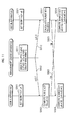
- the elliptic curve exponentiation apparatus includes a first input unit for inputting coordinates (Qx, Qy) for the point Q , and the exponent k , a second input unit for inputting the coefficient b that is a constant term and is a parameter for the elliptic curve, an elliptic curve coefficient holding unit for holding a fixed value for the coefficient a that is an x term and is a parameter for the elliptic curve, a computation unit for computing the exponentiation-result-point kQ using each value input by the first input unit and the coefficient a held by the elliptic curve coefficient holding unit, a judgment unit for judging whether the coordinates for the exponentiation-result-point kQ computed by the computation unit are on the elliptic curve, using the coefficient b input by the second input unit and the coefficient a held by the elliptic curve coefficient holding unit, and an output unit for outputting the exponentiation-result-point kQ computed
- the elliptic curve exponentiation unit may include, instead of the second input unit, a constant term coefficient computation unit that computes the coefficient b on the constant term using the coordinates for the point Q and the coefficient a , and the judgment unit may use the coefficient b computed by the constant term coefficient computation unit instead of the coefficient b on the constant term input by the second input unit.
- the present invention relates to an elliptic curve cryptography apparatus that performs, using elliptic curve cryptography, processes of: encryption of a plaintext; decryption of a ciphertext; generation of a signature for a plaintext; signature verification for a plaintext and a signature; and recovery of a plaintext from a signature.
- the elliptic curve cryptography apparatus uses the above elliptic curve exponentiation apparatus for the computation processing of an elliptic curve exponentiation in each of the above-described processes.
- the computation of an elliptic curve exponentiation that can counter the DFA can be realized without fixing an elliptic curve. Accordingly, compared with conventional elliptic curve exponentiation apparatuses that can counter the DFA with their elliptic curves being fixed, the elliptic curve exponentiation of the present invention is highly versatile. Therefore, the single elliptic curve exponentiation apparatus of the present invention can be used for multiple applications such as secret communication, digital signature, and key sharing.
- the elliptic curve exponentiation apparatus of the present invention can compute an elliptic curve exponentiation with countering the DFA simply by inputting the exponent k and the computation value Q , without fixing an elliptic curve. Accordingly, the elliptic curve exponentiation apparatus of the present invention maintaining its versatility can counter the DFA, with the use of the same input/output method as used in conventional elliptic curve exponentiation apparatuses.
- the present invention can be applied to such cases where in the billing industry information about an amount of money or other information are transmitted confidentially from the sender to the receiver without being revealed to third parties. Further, the present invention can be applied when the validity of such information is to be verified.
- the billing industry to which the present invention is applied includes not only the financial industry consisting of banks, securities, insurance companies, etc., but also other general industries involving such transactions as commodity sale. Further, each apparatus constituting such a billing system is manufactured and sold by the electric equipment manufacturing industry.
- the encryption apparatus and the playback apparatus constituting the content distribution system of the present invention are manufactured and sold by the electric equipment manufacturing industry.
- the content distribution system is commercially utilized repeatedly and continuously in the information provision industry where digital works such as music, movies, and novels are provided from the content provider to the user by selling or renting such digital works.
Landscapes
- Physics & Mathematics (AREA)
- Engineering & Computer Science (AREA)
- General Physics & Mathematics (AREA)
- Mathematical Analysis (AREA)
- Mathematical Optimization (AREA)
- Pure & Applied Mathematics (AREA)
- Computational Mathematics (AREA)
- Theoretical Computer Science (AREA)
- Computing Systems (AREA)
- Mathematical Physics (AREA)
- General Engineering & Computer Science (AREA)
- Storage Device Security (AREA)
- Financial Or Insurance-Related Operations Such As Payment And Settlement (AREA)
- Error Detection And Correction (AREA)
Applications Claiming Priority (2)
| Application Number | Priority Date | Filing Date | Title |
|---|---|---|---|
| JP2003018760 | 2003-01-28 | ||
| JP2003018760 | 2003-01-28 |
Publications (3)
| Publication Number | Publication Date |
|---|---|
| EP1443393A2 true EP1443393A2 (fr) | 2004-08-04 |
| EP1443393A3 EP1443393A3 (fr) | 2006-04-26 |
| EP1443393B1 EP1443393B1 (fr) | 2008-01-02 |
Family
ID=32652844
Family Applications (1)
| Application Number | Title | Priority Date | Filing Date |
|---|---|---|---|
| EP04250443A Expired - Lifetime EP1443393B1 (fr) | 2003-01-28 | 2004-01-28 | Elévation à la puissance sur une courbe elliptique pouvant contrer une attaque différentielle basée sur des fautes |
Country Status (3)
| Country | Link |
|---|---|
| US (1) | US7388957B2 (fr) |
| EP (1) | EP1443393B1 (fr) |
| DE (1) | DE602004010942T2 (fr) |
Cited By (3)
| Publication number | Priority date | Publication date | Assignee | Title |
|---|---|---|---|---|
| WO2007087911A3 (fr) * | 2006-01-20 | 2007-10-18 | Siemens Ag | Procédé, dispositif et système de vérification de points déterminés sur une courbe elliptique |
| WO2007113697A3 (fr) * | 2006-04-06 | 2007-12-21 | Nxp Bv | Procédé de déchiffrement |
| US7991162B2 (en) | 2007-09-14 | 2011-08-02 | University Of Ottawa | Accelerating scalar multiplication on elliptic curve cryptosystems over prime fields |
Families Citing this family (11)
| Publication number | Priority date | Publication date | Assignee | Title |
|---|---|---|---|---|
| EP1608196A1 (fr) * | 2004-06-18 | 2005-12-21 | Matsushita Electric Industrial Co., Ltd. | Détection de notifications dans un système de communication |
| US7742596B2 (en) * | 2004-08-24 | 2010-06-22 | General Dynamics C4 Systems, Inc. | Reliable elliptic curve cryptography computation |
| JP5147412B2 (ja) | 2005-01-21 | 2013-02-20 | サーティコム コーポレーション | 楕円曲線乱数生成 |
| KR100817048B1 (ko) * | 2005-03-05 | 2008-03-26 | 삼성전자주식회사 | 여러 가지 포인트 표현을 기반으로 한 ecc에서 dfa대책을 위한 암호화 방법 및 장치 |
| KR100850202B1 (ko) * | 2006-03-04 | 2008-08-04 | 삼성전자주식회사 | Ecc 패스트 몽고매리 전력 래더 알고리즘을 이용하여dfa 에 대응하는 암호화 방법 |
| US7885406B2 (en) * | 2006-10-10 | 2011-02-08 | Microsoft Corporation | Computing endomorphism rings of Abelian surfaces over finite fields |
| US8433064B2 (en) * | 2009-12-15 | 2013-04-30 | Microsoft Corporation | Secret encryption with public or delegated comparison |
| US9525548B2 (en) | 2010-10-21 | 2016-12-20 | Microsoft Technology Licensing, Llc | Provisioning techniques |
| US8805434B2 (en) | 2010-11-23 | 2014-08-12 | Microsoft Corporation | Access techniques using a mobile communication device |
| US20120143769A1 (en) * | 2010-12-02 | 2012-06-07 | Microsoft Corporation | Commerce card |
| US9509686B2 (en) | 2010-12-03 | 2016-11-29 | Microsoft Technology Licensing, Llc | Secure element authentication |
Family Cites Families (3)
| Publication number | Priority date | Publication date | Assignee | Title |
|---|---|---|---|---|
| JPH118616A (ja) | 1997-06-17 | 1999-01-12 | Dainippon Printing Co Ltd | 故障利用攻撃対応icカード |
| JP2002261751A (ja) | 2001-03-02 | 2002-09-13 | Hitachi Ltd | 暗号処理方法 |
| JP2003255831A (ja) | 2002-02-28 | 2003-09-10 | Hitachi Ltd | 楕円曲線スカラー倍計算方法及び装置 |
-
2004
- 2004-01-23 US US10/763,958 patent/US7388957B2/en not_active Expired - Fee Related
- 2004-01-28 EP EP04250443A patent/EP1443393B1/fr not_active Expired - Lifetime
- 2004-01-28 DE DE602004010942T patent/DE602004010942T2/de not_active Expired - Lifetime
Cited By (6)
| Publication number | Priority date | Publication date | Assignee | Title |
|---|---|---|---|---|
| WO2007087911A3 (fr) * | 2006-01-20 | 2007-10-18 | Siemens Ag | Procédé, dispositif et système de vérification de points déterminés sur une courbe elliptique |
| DE102006002891B4 (de) * | 2006-01-20 | 2009-06-04 | Siemens Ag | Verfahren, Vorrichtung und System zum Verifizieren von auf einer elliptischen Kurve ermittelten Punkten |
| US7774160B2 (en) | 2006-01-20 | 2010-08-10 | Siemens Aktiengesellschaft | Method, device, and system for verifying points determined on an elliptic curve |
| WO2007113697A3 (fr) * | 2006-04-06 | 2007-12-21 | Nxp Bv | Procédé de déchiffrement |
| US8065531B2 (en) | 2006-04-06 | 2011-11-22 | Nxp B.V. | Decryption method |
| US7991162B2 (en) | 2007-09-14 | 2011-08-02 | University Of Ottawa | Accelerating scalar multiplication on elliptic curve cryptosystems over prime fields |
Also Published As
| Publication number | Publication date |
|---|---|
| EP1443393A3 (fr) | 2006-04-26 |
| DE602004010942T2 (de) | 2008-05-21 |
| DE602004010942D1 (de) | 2008-02-14 |
| US7388957B2 (en) | 2008-06-17 |
| EP1443393B1 (fr) | 2008-01-02 |
| US20040247115A1 (en) | 2004-12-09 |
Similar Documents
| Publication | Publication Date | Title |
|---|---|---|
| US11895231B2 (en) | Adaptive attack resistant distributed symmetric encryption | |
| CN111095332B (zh) | 用于保护隐私的社交媒体广告的方法和系统 | |
| US7940927B2 (en) | Information security device and elliptic curve operating device | |
| EP2359291B1 (fr) | Procédé et dispositif de gestion de contenu numérique | |
| US20100153273A1 (en) | Systems for performing transactions at a point-of-sale terminal using mutating identifiers | |
| WO2012004838A1 (fr) | Procédé de fourniture de service | |
| US20250021631A1 (en) | Systems and methods for whitebox device binding | |
| CN109995781B (zh) | 数据的传输方法、装置、介质以及设备 | |
| US7388957B2 (en) | Elliptic curve exponentiation apparatus that can counter differential fault attack, and information security apparatus | |
| JP2004503969A (ja) | 認証媒体の暗号化鍵及びコンピュータハードウェアの固有情報に基づく可変的な暗号化鍵システムを利用する認証方法、並びに、その認証方法を格納し、その有効期間及び権限を示すための認証媒体 | |
| CN101874244A (zh) | 使用电子标签的验证系统和方法 | |
| EP1531579A2 (fr) | Dispositif de génération d'une clé publique RSA, dispositif de déchiffrage RSA, et dispositif de signature RSA | |
| EP1939838A1 (fr) | Dispositif et procede de securite des informations, programme informatique, support d enregistrement lisible sur ordinateur et circuit integre | |
| CN114531224B (zh) | 地址的生成方法、区块链信息的处理方法以及相关设备 | |
| Park et al. | Blockchain-based secure and fair IoT data trading system with bilateral authorization | |
| CN111079190A (zh) | 区块链供应链交易隐藏动态监管系统及方法 | |
| US20050102523A1 (en) | Smartcard with cryptographic functionality and method and system for using such cards | |
| EP1120726A1 (fr) | Dispositif et procede de traitement d'informations et support de fourniture d'informations | |
| JP4634046B2 (ja) | 故障利用攻撃に対抗できる楕円べき倍演算装置及び情報セキュリティ装置 | |
| JP2003255831A (ja) | 楕円曲線スカラー倍計算方法及び装置 | |
| CA2288767A1 (fr) | Generateur pseudo-aleatoire base sur une fonction de hachage pour systemes cryptographiques necessitant le tirage d'aleas | |
| JP2005165290A (ja) | Rsa公開鍵生成装置、rsa復号装置及びrsa署名装置 | |
| Pang et al. | A secure agent-mediated payment protocol | |
| Fan et al. | Anonymous fair transaction protocols based on electronic cash | |
| Stamenkovska et al. | Some general traits of the e-cash system and a review of a compact e-cash scheme with practical and complete tracing |
Legal Events
| Date | Code | Title | Description |
|---|---|---|---|
| PUAI | Public reference made under article 153(3) epc to a published international application that has entered the european phase |
Free format text: ORIGINAL CODE: 0009012 |
|
| AK | Designated contracting states |
Kind code of ref document: A2 Designated state(s): AT BE BG CH CY CZ DE DK EE ES FI FR GB GR HU IE IT LI LU MC NL PT RO SE SI SK TR |
|
| AX | Request for extension of the european patent |
Extension state: AL LT LV MK |
|
| RIN1 | Information on inventor provided before grant (corrected) |
Inventor name: MATSUZAKI, NATSUME Inventor name: ONO, TAKATOSHI |
|
| PUAL | Search report despatched |
Free format text: ORIGINAL CODE: 0009013 |
|
| AK | Designated contracting states |
Kind code of ref document: A3 Designated state(s): AT BE BG CH CY CZ DE DK EE ES FI FR GB GR HU IE IT LI LU MC NL PT RO SE SI SK TR |
|
| AX | Request for extension of the european patent |
Extension state: AL LT LV MK |
|
| 17P | Request for examination filed |
Effective date: 20060904 |
|
| 17Q | First examination report despatched |
Effective date: 20061005 |
|
| AKX | Designation fees paid |
Designated state(s): DE FR GB |
|
| 17Q | First examination report despatched |
Effective date: 20061005 |
|
| GRAP | Despatch of communication of intention to grant a patent |
Free format text: ORIGINAL CODE: EPIDOSNIGR1 |
|
| GRAS | Grant fee paid |
Free format text: ORIGINAL CODE: EPIDOSNIGR3 |
|
| GRAA | (expected) grant |
Free format text: ORIGINAL CODE: 0009210 |
|
| AK | Designated contracting states |
Kind code of ref document: B1 Designated state(s): DE FR GB |
|
| REG | Reference to a national code |
Ref country code: GB Ref legal event code: FG4D |
|
| REF | Corresponds to: |
Ref document number: 602004010942 Country of ref document: DE Date of ref document: 20080214 Kind code of ref document: P |
|
| ET | Fr: translation filed | ||
| PLBE | No opposition filed within time limit |
Free format text: ORIGINAL CODE: 0009261 |
|
| STAA | Information on the status of an ep patent application or granted ep patent |
Free format text: STATUS: NO OPPOSITION FILED WITHIN TIME LIMIT |
|
| RAP2 | Party data changed (patent owner data changed or rights of a patent transferred) |
Owner name: PANASONIC CORPORATION |
|
| 26N | No opposition filed |
Effective date: 20081003 |
|
| REG | Reference to a national code |
Ref country code: FR Ref legal event code: PLFP Year of fee payment: 13 |
|
| REG | Reference to a national code |
Ref country code: FR Ref legal event code: PLFP Year of fee payment: 14 |
|
| REG | Reference to a national code |
Ref country code: FR Ref legal event code: PLFP Year of fee payment: 15 |
|
| PGFP | Annual fee paid to national office [announced via postgrant information from national office to epo] |
Ref country code: FR Payment date: 20181213 Year of fee payment: 16 |
|
| PGFP | Annual fee paid to national office [announced via postgrant information from national office to epo] |
Ref country code: DE Payment date: 20190115 Year of fee payment: 16 Ref country code: GB Payment date: 20190123 Year of fee payment: 16 |
|
| REG | Reference to a national code |
Ref country code: DE Ref legal event code: R119 Ref document number: 602004010942 Country of ref document: DE |
|
| GBPC | Gb: european patent ceased through non-payment of renewal fee |
Effective date: 20200128 |
|
| PG25 | Lapsed in a contracting state [announced via postgrant information from national office to epo] |
Ref country code: FR Free format text: LAPSE BECAUSE OF NON-PAYMENT OF DUE FEES Effective date: 20200131 Ref country code: DE Free format text: LAPSE BECAUSE OF NON-PAYMENT OF DUE FEES Effective date: 20200801 Ref country code: GB Free format text: LAPSE BECAUSE OF NON-PAYMENT OF DUE FEES Effective date: 20200128 |