EP1444642B1 - Procede et appareil permettant de decoder des caracteres manuscrits - Google Patents
Procede et appareil permettant de decoder des caracteres manuscrits Download PDFInfo
- Publication number
- EP1444642B1 EP1444642B1 EP02801225A EP02801225A EP1444642B1 EP 1444642 B1 EP1444642 B1 EP 1444642B1 EP 02801225 A EP02801225 A EP 02801225A EP 02801225 A EP02801225 A EP 02801225A EP 1444642 B1 EP1444642 B1 EP 1444642B1
- Authority
- EP
- European Patent Office
- Prior art keywords
- character
- segmentation
- model
- input
- stroke
- Prior art date
- Legal status (The legal status is an assumption and is not a legal conclusion. Google has not performed a legal analysis and makes no representation as to the accuracy of the status listed.)
- Expired - Lifetime
Links
Images
Classifications
-
- G—PHYSICS
- G06—COMPUTING OR CALCULATING; COUNTING
- G06V—IMAGE OR VIDEO RECOGNITION OR UNDERSTANDING
- G06V10/00—Arrangements for image or video recognition or understanding
- G06V10/70—Arrangements for image or video recognition or understanding using pattern recognition or machine learning
- G06V10/74—Image or video pattern matching; Proximity measures in feature spaces
- G06V10/75—Organisation of the matching processes, e.g. simultaneous or sequential comparisons of image or video features; Coarse-fine approaches, e.g. multi-scale approaches; using context analysis; Selection of dictionaries
-
- G—PHYSICS
- G06—COMPUTING OR CALCULATING; COUNTING
- G06V—IMAGE OR VIDEO RECOGNITION OR UNDERSTANDING
- G06V30/00—Character recognition; Recognising digital ink; Document-oriented image-based pattern recognition
- G06V30/10—Character recognition
- G06V30/14—Image acquisition
- G06V30/142—Image acquisition using hand-held instruments; Constructional details of the instruments
- G06V30/1423—Image acquisition using hand-held instruments; Constructional details of the instruments the instrument generating sequences of position coordinates corresponding to handwriting
-
- G—PHYSICS
- G06—COMPUTING OR CALCULATING; COUNTING
- G06V—IMAGE OR VIDEO RECOGNITION OR UNDERSTANDING
- G06V30/00—Character recognition; Recognising digital ink; Document-oriented image-based pattern recognition
- G06V30/10—Character recognition
- G06V30/24—Character recognition characterised by the processing or recognition method
- G06V30/242—Division of the character sequences into groups prior to recognition; Selection of dictionaries
- G06V30/244—Division of the character sequences into groups prior to recognition; Selection of dictionaries using graphical properties, e.g. alphabet type or font
Definitions
- the present invention relates to a method of interpreting and decoding handwritten data entry into a computer or other processing device, and in particular, to a method of handwriting recognition which involves decomposing individual characters into one or more primitive sub-strokes, where applicable.
- Prior art processing devices such as handheld computers, are available which decode user instructions based on handwritten data inputs. Other devices force the user to enter data using a pseudo-handwritten format.
- a pseudo-handwritten format is produced by Palm Computers and use a proprietary input format known as Graffiti. This input format allows the user of a handheld computer to enter data into the device by moving a plastic stylus in predefined motions over a touchscreen area, where each character has an associated 'stroke', which in many cases resembles the actual character.
- Such systems offer advantages where the portable device is too small to have a usefully sized keyboard, but they require the user to learn an artificial 'language' in order to enter data.
- Most pattern or character recognition systems perform some kind of segmentation of an input signal to identify the fundamental primitives of the data and to minimize the level of noise in the input. Segmentation is also performed to reduce the amount of information used during feature extraction, and allows pattern recognition to occur on more abstract features of the input signal.
- segmentation techniques have been described by the research community, including simple approaches based on the properties of the human motor system Examples include segmenting at curvature maxima, critical points, and velocity extrema, or a combination of these techniques (e.g. looking for points where curvature extrema and velocity minima coincide).
- Other research has proposed using ballistic gesture detection, independent component analysis of the strokes, and regularity and singularity concepts for the segmentation of strokes.
- Perception based criteria for segmentation include X and Y extrema, cusps, and stroke intersections.
- stroke segmentation can improve the accuracy of a handwriting recognition system under certain conditions, it can also be a major source of recognition errors.
- Most motor-based stroke segmentation algorithms apply some kind of numeric threshold when selecting segmentation points, resulting in the possibly inconsistent splitting of strokes that are poorly formed.
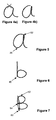
- Figure 2b shows the incorrect segmentation based on curvature extrema of a badly written letter 'a'.
- stroke segmentation is being used to partition or segment the circular body of the 'a' from the more linear stem using the extreme curvature at the top of the stem as a segmentation point.
- Figure 2a shows the correct segmentation point (as indicated by the cross).
- Figure 2b has a curvature extremum inside the circular body, and is missing the expected cusp that marks the beginning of the letter stem, resulting in the incorrect segmentation of the stroke.
- Velocity is also used for segmentation, since handwriting is generated by a series of ballistic movements (i.e. accelerating from the start to a peak velocity, then decelerating at the target point). Sections of high velocity are generally straight, while low velocity usually occurs at the extrema of curvature. However, velocity is also subject to thresholding problems, and additionally, the user may pause while writing a stroke, leading to an invalid segmentation point.
- Figure 3 the sampled points, indicated by squares, for a letter 'a' are shown. The velocity of the pen can be derived from the spacing between the samples (assuming a constant sampling rate), so a large spacing indicates high velocity, while samples that are close together indicate lower velocity.
- the low velocity (and high curvature) regions can be seen as clusters of samples in the cusp at the top of the stem, as well as in the small hook at the bottom of the stem.
- Perceptual segmentation techniques such as using Y-extrema as segmentation points, generally do not suffer from thresholding problems, since no numeric value is required to determine if a point is a local extremum. However, these techniques also suffer from inconsistent segmentation.
- Figure 4a the letter 'a' is segmented, indicated by a cross, at a Y-extremum located near the start of the stroke.
- the second letter 'a' shown in Figure 4b
- Figure 4b while clearly the same letter as the first, does not contain a Y-extremum at this position, as the stroke tends to level off.
- US Patent 6,275,611 describes a character recognition system that segments strokes at points where "local angle change is a maxima and exceeds a set threshold". See also " Handwriting Recognition Device, Method and Alphabet, With Strokes Grouped Into Stroke Sub-Structures", August 14, 2001 .. A full description of the segmentation algorithm is given in US Patent 5,740,273 .
- US Patent 5,889,889 discloses the performance of stroke segmentation in a handwritten character recognizer by detecting points that "are identified by such criteria as abruptness of direction changes, as well as by pen lifts". This discloses the same segmentation procedure in a system designed to represent handwritten input in a parametric form for compression and reconstruction, segmenting strokes at "corners and cusps, where direction changes abruptly”. See also US Patent Specification No. 6,044,174 .
- US Patent Specification No. 5,610,996 discloses the use of a series of arcs as primitives for recognition, where "the arcs begin and end at Y-extrema points on the sample text.” This document also discloses the use of alternative segmentation schemes, such as X-extrema, and combined X-Y extrema.
- US Patent Specification No. 4,024,500 discloses the use of X- and Y-extrema to segment cursive strokes in to characters (rather than ballistic sub-stroke primitives).
- US Patent Specification No. 5,577,135 discloses the segmentation of strokes at Y-extrema, resulting in a series of up- and down-strokes that are used in a Hidden Markov Model (HMM) recognition system.
- HMM Hidden Markov Model
- strokes are "segmented into letters or sub-character primitives according to defined boundary conditions such as pen ups and cusps".
- the present invention provides a method of performing written character recognition, including sequentially comparing a given input character with one of a series of stored character models, wherein the step of comparing further includes the steps of: decomposing the given input character into one or more segments in accordance with a segmentation scheme associated with the present character model; evaluating said segment or segments against a segment model associated with the present character model, such that the evaluation produces a score which measures the degree of conformity with the model; repeating said step of comparing for a plurality of character models in the series of character models; and selecting the character model which is assigned the highest score and classifying the input character as the character associated with that character model.
- the character for recognition is one of a letter, a number or a punctuation mark.
- the present character model is rejected as a possible match for the given input character.
- the evaluation procedure assigns a score which rewards closer conformance to an ideal.
- the evaluation procedure uses fuzzy logic rules.
- each character model may have associated with it a plurality of segmentation schemes to facilitate recognition of different forms of the same character.
- different rules for decomposing the input character into one or more segments may be defined for different character models.
- Apparatus which includes an input surface responsive to the movement of a stylus thereupon for producing an input stimulus; a memory; a processor for receiving said input stimulus and processing said input stimulus, wherein said processor is adapted to perform the method in accordance with a broad form of the invention.
- a stroke segmentation procedure for handwritten character recognition is disclosed. Changing the segmentation algorithm depending on the model being evaluated results in a consistent and robust set of stroke primitives that can be used for feature extraction and classification. An example fuzzy logic classifier that uses this segmentation procedure is also described.
- the present invention provides a method for performing handwritten character recognition. Also provided is an apparatus for performing the method.
- an apparatus for performing the method In the figures, incorporated to illustrate the features of the present invention, like reference numerals are used to identify like parts throughout the figures.
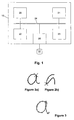
- Methods according to embodiments of the invention can be performed using a processing system an example of which is shown in Figure 1 .
- the processing system 10 generally includes at least a processor 20, a memory 21, and an input device 22, such as a graphics tablet and/or touchscreen, an output device 23, such as a display, coupled together via a bus 24 as shown.
- An external interface is also provided as shown at 25, for coupling the processing system to a store 11, such as a database.
- a stylus may be used to allow a user to input text to the system 10.
- the processing system is adapted to allow model and rule data to be stored in and/or retrieved from the database 11.
- This allows the processor to receive handwriting data via the input 22, process the handwriting data and compare this to the data stored in the store.
- This in turn allows the processing system to recognise the characters included in the handwritten text.
- the processing system 10 may be any form of processing system such as a computer, a laptop, server, specialised hardware, or the like.
- a graphic symbol may have a different meanings depending on local context; for example, ambiguous letter formations may be interpreted differently based on syntactic or semantic information (such as a dictionary or character grammar). Similarly, the individual strokes and sub-strokes that comprise an individual letter need to be interpreted in terms of the local context to ensure the correct interpretation is made.
- Embodiments of the invention which use model-specific stroke segmentation, delay the segmentation of handwritten strokes, allowing it to be integrated with the classification procedure. This results in more information about the type of segmentation points expected by the letter model to be used by the segmentation process.
- the metric used to segment the strokes is based on the expected structure of the current character from a series that is being recognized, thus a single global segmentation procedure is not used.
- the processor executing a program to perform an embodiment of the invention, first checks whether the input letter is an 'a', and will attempt to segment the input according to what is expected for an 'a'. It then continues to check the input against some or all possible data entries, for example, 'b'-'z', scoring each attempt. In this way, the result having the closest match is classified as the input letter.
- a suitable scoring scheme is disclosed later.
- each letter may take account of the various ways in which a particular letter may be written. For instance, some people write the letter 'z' to look like an upper case 'N' on its side, while others write it to so that it resembles the number'3'.
- Recognition begins with some simple preprocessing to remove noise from the signal. This may include techniques such as smoothing of the sampled points (if the sampling process is noisy) and removing hooks from the beginning and end of the strokes, which would otherwise confuse the recognition process.
- the points may also be normalized by removing duplicate points or re-sampling to enforce a minimum distance between samples.
- Each letter model defined in the handwriting classifier defines a segmentation procedure that will be performed on the input strokes.
- the segmentation produces a set of segmentation points that will be used to partition the stroke into a series of sub-strokes.
- the algorithm works on a single stroke at a time.
- Segmentation proceeds with the algorithm iterating through the samples until it has identified a potential segmentation point as defined by the current letter model. If the correct point cannot be found, the algorithm returns a failure, indicating that the input does not conform to the structure expected by the letter model. Otherwise, if the two sub-strokes created by splitting the stroke at this point will be larger than l min , the stroke is split at that point and processing continues with the remainder of the stroke. If either sub-stroke is smaller than l min , the segmentation point is ignored, and processing continues. When all segmentation points have been correctly identified, the procedure ends and indicates to the recognizer that segmentation was successful.
- letter models can use any arbitrary segmentation technique as indicated by the expected structure of the handwritten letter, and some models may not require any stroke segmentation. For example, simple models for 'c' and 'o' may simply match the input directly, without attempting to reduce the strokes to sub-stroke primitives. Generally, there is no information to be derived from the segmentation of these single ballistic gestures, and allowing matching against the un-segmented strokes can avoid the problems that can be generated by traditional segmentation techniques (e.g. the smooth velocity-curvature profile can cause segmentation to occur at an arbitrary point depending on the style of the writer).
- traditional segmentation techniques e.g. the smooth velocity-curvature profile can cause segmentation to occur at an arbitrary point depending on the style of the writer.
- Figure 5 shows the critical points 30, 32 used for the segmentation of a single-stroke allograph of the letter 'a'.
- the segmentation algorithm initially searches for the first Y-minimum 30 then attempts to find a Y-maximum 32 after this point 30. If the Y-maximum is found, the point is marked as a segmentation point. Note that the Y-minimum 30 is not used for segmentation, but simply to ensure that the correct Y-maximum 32 point is found. Without first searching for an initial Y-minimum 30, an incorrect Y-maximum could be located (as show in Figure 4b )). Also note that this procedure will find the correct segmentation point for all the examples discussed with regard to Figures 1 -3 above.
- Figure 6 shows the segmentation for a model of the letter 'b'.
- the first segmentation point is found at the first Y-minimum 50. Following this, a Y-maximum 52 is found, followed by an X-minimum 54, which is used as the second segmentation point.
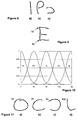
- Figure 8 shows the segmented letter.
- Figure 9 shows the segmentation of a two-stroke allograph of the letter 'E'.
- X-minima to detect segmentation points 60 and 62 may not be successful, especially if the letter is somewhat rotated or angled.
- Y-minima will not necessarily produce the correct segmentation.
- the two points of highest angular change in the first stroke can be used for segmentation. Note that an angular threshold is not required to find these points, since the two highest points of curvature can be easily found by sorting the curvature values at each point. More sophisticated processing is possible; for example, ensuring the segmentation points produce sub-strokes of roughly equal lengths.
- arbitrarily complex model-specific segmentation based on any structural feature of the input stroke can be performed to ensure the correct segmentation points are consistently found.
- the segmentation procedure described above for the letter 'a' will work for all letter models that follow the basic structure of having a curved region followed by a cusp, followed by a down-stroke (e.g. some allographs of 'd', 'g', 'u', 'y', etc.)
- a down-stroke e.g. some allographs of 'd', 'g', 'u', 'y', etc.
- the sub-strokes found can be stored for later use when matching these similarly structured models.
- the feature vectors can be stored to prevent repeated feature extraction.
- a secondary data-structure can be created to cache the values by storing a distance and curvature value with each point on the stroke.
- model-specific stroke segmentation can by used in the recognition of handwritten characters. While the example is based on a fuzzy-logic based classifier, it is apparent to the skilled person that this technique can be used with any classifier type that can utilize stroke segmentation, and the procedure can be easily incorporated into structural (such as elastic-matching) and statistical classifiers.
- Fuzzy logic classifiers work by assigning an input signal a degree of membership to a fuzzy model depending on how well the features match the fuzzy rules that describe the model. Suitable Fuzzy logic classifiers for handwritten character recognition are described further in: " A New Fuzzy Geometric Representation for On-Line Isolated Character Recognition", International Conference on Pattern Recognition (ICPR98), pp. 1121-1123, 1998 ; and " Fuzzy Feature Description of Handwriting Patterns", Pattern Recognition, Vol. 30, No. 10, pp. 1591-1604, 1997 .
- a fuzzy logic rule for defining straight lines may contain the following sets: vertical lines (VL), horizontal lines (HL), lines of positive slant (PS), and lines negative slant (NS). Clearly, most lines will not fit perfectly within these restricted sets and will usually have a degree of membership to more than one of these sets. Thus, fuzzy logic defines a logical set notation where set membership is gradual rather than discrete.
- Figure 10 illustrates a set of possible group membership functions for straight lines, as defined by normalized orientation (in degrees).
- Figure 10 shows a series of bell-like curves.
- VL meaning Vertical Line
- VL defined a set of lines which, when compared to a true horizontal line, have angles approximately in the range from a little below 45° to a little over 135°, with those closest to 90° having a higher weighting. Similar curves are shown for Horizontal Lines (HL), Negative Sloping Lines (NS) and Positive Slanting Lines (PS).
- HL Horizontal Lines
- NS Negative Sloping Lines
- PS Positive Slanting Lines
- the example fuzzy logic classifier consists of a set of rules that define individual letter models. These rules match stroke and sub-stroke primitives against a set of generic stroke shapes. The rules also include relative position information used to distinguish letters that are composed of similar primitives.
- the linguistic primitives used include an 'o'-like curve (OC) shown in Figure 11a ), a 'c'-like curve (CC) shown in Figure 11b ), a 'd'-like curve (DC) shown in Figure 11c ), and a vertical curve to the right (RVC) shown in Figure 11d ).
- a degree of membership in these primitive sets is calculated based on a simple structural analysis of the strokes using the following information: the absolute stroke curvature, the position of the start and end points in relation to the bounding box of the stroke, and the orientation of the line between the start and end points.
- the positional primitives LEFT, RIGHT, TOP, CENTRE, and BOTTOM indicate stroke position within the bounding box of the letter, and the straight-line primitives described above (VL, HL, PS, NS) are also used.
- ' symbol indicates a fuzzy OR
- the '&' symbol indicates a fuzzy AND
- parenthesis indicate logical precedence
- a comma indicates sub-stroke composition using a fuzzy AND (i.e. the expression on the left of the comma is evaluated using the first sub-stroke, the expression on the right is evaluated using the second sub-stroke, with the results combined using a fuzzy AND).
- the first rule can be read as follows: an 'a' letter is an 'o'-like curve or a 'c'-like curve located to the left and centered vertically in the letter, followed by a vertical line or a vertical curve to the right, located at the right of the letter. It is noted that there may be many alternate rules for each letter, modeling the stylistic variability of handwriting.
- each rule is associated with a model-specific segmentation rule that is executed against the input strokes before the rule is evaluated:
- MAX Y represents a search for the next Y-maximum.
- MIN Y represents the search for the next Y-minimum.
- the ⁇ symbol indicates that the point defined on the left is found first but not used for segmentation; rather it is found to ensure the subsequent point is correctly located. Note that the classification of the 'c' model requires only a single stroke, and thus no segmentation is performed for that model.
- the 'k' model is shown as an example of a rule containing multiple segmentation points, found in the order specified.
- the sub-strokes are classified by degree of membership in the generic stroke classes. These membership values are then used to evaluate the structure rules, giving an indication of how well the input matches the letter model. Each letter model is similarly evaluated, and the input is classified as the class of the model that gives the highest fuzzy membership value.
- each input is tested against each rule, and each rule further defines the segmentation approach to be taken in the expectation that the input character is the same as the character being tested for. If the segmentation for a particular character model cannot be performed because the input character does not conform to the character being tested for by the rule, then a zero or low score will be attached to that attempt at classification.
- the invention may also be said broadly to consist in the parts, elements and features referred to or indicated in the specification of the application, individually or collectively, in any or all combinations of two or more of said parts, elements or features, and where specific integers are mentioned herein which have known equivalents in the art to which the invention relates, such known equivalents are deemed to be incorporated herein as if individually set forth.
Landscapes
- Engineering & Computer Science (AREA)
- Computer Vision & Pattern Recognition (AREA)
- Theoretical Computer Science (AREA)
- Physics & Mathematics (AREA)
- General Physics & Mathematics (AREA)
- Multimedia (AREA)
- Evolutionary Computation (AREA)
- Software Systems (AREA)
- Computing Systems (AREA)
- Databases & Information Systems (AREA)
- Health & Medical Sciences (AREA)
- General Health & Medical Sciences (AREA)
- Medical Informatics (AREA)
- Artificial Intelligence (AREA)
- Character Discrimination (AREA)
- Facsimile Image Signal Circuits (AREA)
- Input From Keyboards Or The Like (AREA)
- Electronic Switches (AREA)
- Character Input (AREA)
- Vending Machines For Individual Products (AREA)
Claims (8)
- Procédé de mise en oeuvre d'une reconnaissance de caractère écrit, comprenant le fait de comparer successivement un caractère entré individuel donné à une série de modèles de caractères mémorisés, l'étape de comparaison englobant en outre les étapes consistant à :décomposer le caractère entré donné en un ou plusieurs segments conformément à un schéma de segmentation associé au modèle du caractère présent, ledit schéma de segmentation comprenant des règles de décomposition du caractère entré pour obtenir lesdits un ou plusieurs segments ;évaluer ledit segment ou lesdits segments par rapport à un modèle de segment associé au modèle du caractère présent, de telle sorte que l'évaluation produit un score qui mesure le degré de conformité au modèle ;répéter ladite étape de comparaison pour plusieurs modèles de caractères dans la série de modèles de caractères ; et
sélectionner le modèle de caractère auquel est attribué le score le plus élevé et classer le caractère entré comme étant le caractère associé à ce modèle de caractère,
lesdits schémas de segmentation n'étant pas tous identiques. - Procédé selon la revendication 1, dans lequel le caractère de reconnaissance est une lettre, un chiffre ou un signe de ponctuation.
- Procédé selon la revendication 1 ou 2, dans lequel l'étape consistant à décomposer le caractère entré en un ou plusieurs segments est mise en oeuvre de telle sorte que chaque segment possède une longueur minimale conforme à l'équation suivante :

dans laquellelmin = la longueur minimale du segmentpi = les coordonnées du point in = le nombre de points dans le traitλ = le seuil de longueur minimale. - Procédé selon l'une quelconque des revendications précédentes, dans lequel, lorsque le caractère entré donné ne peut être segmenté conformément au schéma de segmentation associé au modèle caractère présent, le modèle de caractère présent est rejeté comme correspondant possible pour le caractère entré donné.
- Procédé selon l'une quelconque des revendications précédentes, dans lequel la procédure d'évaluation attribue un score qui décerne une conformité plus étroite à un idéal.
- Procédé selon la revendication 5, dans lequel la procédure d'évaluation utilise des règles de logique floue.
- Procédé selon l'une quelconque des revendications précédentes, dans lequel à chaque modèle de caractère peuvent être associés plusieurs schémas de segmentation dans le but de faciliter la reconnaissance de différentes formes du même caractère.
- Appareil pour la mise en oeuvre d'une reconnaissance de caractères manuscrits, l'appareil englobant:• une surface d'entrée sensible au mouvement d'un stylet sur ladite surface pour la production d'un stimulus d'entrée ;• une mémoire ;• un processeur pour la réception dudit stimulus d'entrée et pour traiter ledit stimulus d'entrée, ledit processeur étant conçu pour la mise en oeuvre du procédé selon l'une quelconque des revendications 1 à 7.
Applications Claiming Priority (3)
| Application Number | Priority Date | Filing Date | Title |
|---|---|---|---|
| AUPR8245A AUPR824501A0 (en) | 2001-10-15 | 2001-10-15 | Methods and systems (npw003) |
| AUPR824501 | 2001-10-15 | ||
| PCT/AU2002/001393 WO2003034325A1 (fr) | 2001-10-15 | 2002-10-15 | Procede et appareil permettant de decoder des caracteres manuscrits |
Publications (3)
| Publication Number | Publication Date |
|---|---|
| EP1444642A1 EP1444642A1 (fr) | 2004-08-11 |
| EP1444642A4 EP1444642A4 (fr) | 2006-07-26 |
| EP1444642B1 true EP1444642B1 (fr) | 2008-02-20 |
Family
ID=3832070
Family Applications (1)
| Application Number | Title | Priority Date | Filing Date |
|---|---|---|---|
| EP02801225A Expired - Lifetime EP1444642B1 (fr) | 2001-10-15 | 2002-10-15 | Procede et appareil permettant de decoder des caracteres manuscrits |
Country Status (12)
| Country | Link |
|---|---|
| US (6) | US7359551B2 (fr) |
| EP (1) | EP1444642B1 (fr) |
| JP (1) | JP4274941B2 (fr) |
| KR (1) | KR100651762B1 (fr) |
| CN (1) | CN100533470C (fr) |
| AT (1) | ATE386989T1 (fr) |
| AU (3) | AUPR824501A0 (fr) |
| CA (1) | CA2463230C (fr) |
| DE (1) | DE60225170T2 (fr) |
| IL (1) | IL161383A0 (fr) |
| WO (1) | WO2003034325A1 (fr) |
| ZA (1) | ZA200402925B (fr) |
Families Citing this family (36)
| Publication number | Priority date | Publication date | Assignee | Title |
|---|---|---|---|---|
| US20030202097A1 (en) | 2000-10-26 | 2003-10-30 | Autoliv Development Ab | Night vision arrangement |
| AUPR824501A0 (en) * | 2001-10-15 | 2001-11-08 | Silverbrook Research Pty. Ltd. | Methods and systems (npw003) |
| US7995095B2 (en) | 2001-10-18 | 2011-08-09 | Autoliv Development Ab | Night vision device for a vehicle |
| US20050281467A1 (en) * | 2003-01-24 | 2005-12-22 | Stahovich Thomas F | Recognizing multi-stroke symbols |
| AU2003900865A0 (en) * | 2003-02-26 | 2003-03-13 | Silverbrook Research Pty Ltd | Methods, systems and apparatus (NPW010) |
| CN100405389C (zh) * | 2004-08-06 | 2008-07-23 | 摩托罗拉公司 | 从划线标记识别字符的方法和装置 |
| US20090300554A1 (en) * | 2008-06-03 | 2009-12-03 | Nokia Corporation | Gesture Recognition for Display Zoom Feature |
| KR101080255B1 (ko) * | 2009-07-21 | 2011-11-08 | (주)펜앤프리 | 필기 패턴에 따른 필기 정보 입력 장치 및 필기 정보 입력 방법 |
| CN101916378B (zh) * | 2010-07-20 | 2013-01-09 | 青岛海信网络科技股份有限公司 | 易混淆字符的识别方法及装置 |
| US8363947B2 (en) | 2010-07-31 | 2013-01-29 | International Business Machines Corporation | Handwritten character recognition based on frequency variations in characters |
| US8768062B2 (en) * | 2010-11-09 | 2014-07-01 | Tata Consulting Services Limited | Online script independent recognition of handwritten sub-word units and words |
| US20120281919A1 (en) * | 2011-05-06 | 2012-11-08 | King Abdul Aziz City For Science And Technology | Method and system for text segmentation |
| CN102968265B (zh) * | 2011-09-01 | 2015-12-16 | 晨星软件研发(深圳)有限公司 | 将触控点转换为输入文字的方法及触控装置 |
| US8311973B1 (en) | 2011-09-24 | 2012-11-13 | Zadeh Lotfi A | Methods and systems for applications for Z-numbers |
| US11074495B2 (en) | 2013-02-28 | 2021-07-27 | Z Advanced Computing, Inc. (Zac) | System and method for extremely efficient image and pattern recognition and artificial intelligence platform |
| US9916538B2 (en) | 2012-09-15 | 2018-03-13 | Z Advanced Computing, Inc. | Method and system for feature detection |
| US11195057B2 (en) | 2014-03-18 | 2021-12-07 | Z Advanced Computing, Inc. | System and method for extremely efficient image and pattern recognition and artificial intelligence platform |
| US11914674B2 (en) | 2011-09-24 | 2024-02-27 | Z Advanced Computing, Inc. | System and method for extremely efficient image and pattern recognition and artificial intelligence platform |
| US8873813B2 (en) | 2012-09-17 | 2014-10-28 | Z Advanced Computing, Inc. | Application of Z-webs and Z-factors to analytics, search engine, learning, recognition, natural language, and other utilities |
| US9569439B2 (en) | 2011-10-31 | 2017-02-14 | Elwha Llc | Context-sensitive query enrichment |
| US9082005B2 (en) * | 2012-03-19 | 2015-07-14 | Disney Enterprises, Inc. | Smart scribbles for sketch segmentation |
| JP5284523B1 (ja) * | 2012-09-05 | 2013-09-11 | 株式会社東芝 | 情報処理システム、プログラムおよび情報処理システムの処理方法 |
| US9330331B2 (en) | 2013-11-11 | 2016-05-03 | Wipro Limited | Systems and methods for offline character recognition |
| US9286527B2 (en) | 2014-02-20 | 2016-03-15 | Google Inc. | Segmentation of an input by cut point classification |
| US9524440B2 (en) * | 2014-04-04 | 2016-12-20 | Myscript | System and method for superimposed handwriting recognition technology |
| US9384403B2 (en) | 2014-04-04 | 2016-07-05 | Myscript | System and method for superimposed handwriting recognition technology |
| US20160154555A1 (en) * | 2014-12-02 | 2016-06-02 | Lenovo (Singapore) Pte. Ltd. | Initiating application and performing function based on input |
| CN104537347A (zh) * | 2014-12-25 | 2015-04-22 | 安徽寰智信息科技股份有限公司 | 一种基于云端分析和模型匹配的唇形识别文字输入方法 |
| US10402734B2 (en) * | 2015-08-26 | 2019-09-03 | Google Llc | Temporal based word segmentation |
| CN105512692B (zh) * | 2015-11-30 | 2019-04-09 | 华南理工大学 | 基于blstm的联机手写数学公式符号识别方法 |
| US10163004B2 (en) * | 2017-03-30 | 2018-12-25 | Konica Minolta Laboratory U.S.A., Inc. | Inferring stroke information from an image |
| US10748031B1 (en) | 2019-05-22 | 2020-08-18 | Read-Ink Corporation | Handwriting recognition systems and methods |
| CN110503101A (zh) * | 2019-08-23 | 2019-11-26 | 北大方正集团有限公司 | 字形评价方法、装置、设备及计算机可读存储介质 |
| CN110866499B (zh) * | 2019-11-15 | 2022-12-13 | 爱驰汽车有限公司 | 手写文本识别方法、系统、设备及介质 |
| CN114612774A (zh) * | 2022-02-25 | 2022-06-10 | 共达地创新技术(深圳)有限公司 | 目标检测及其模型构建方法、电子设备和存储介质 |
| KR102581822B1 (ko) * | 2023-04-18 | 2023-09-26 | (주)핸듀 | 교육용 프로그램에서 문자를 인식하는 방법 |
Family Cites Families (42)
| Publication number | Priority date | Publication date | Assignee | Title |
|---|---|---|---|---|
| US3755780A (en) * | 1971-06-28 | 1973-08-28 | Pattern Analysis & Recognition | Method for recognizing characters |
| JPS51115718A (en) * | 1975-02-24 | 1976-10-12 | Pioneer Electronic Corp | Bi-directional catv system |
| US4345245A (en) * | 1979-11-26 | 1982-08-17 | Eltra Corporation | Method and apparatus for arranging segmented character groups in a digital typesetter |
| US4731857A (en) * | 1984-06-29 | 1988-03-15 | International Business Machines Corporation | Recognition system for run-on handwritten characters |
| US4837842A (en) * | 1986-09-19 | 1989-06-06 | Holt Arthur W | Character and pattern recognition machine and method |
| US4864618A (en) | 1986-11-26 | 1989-09-05 | Wright Technologies, L.P. | Automated transaction system with modular printhead having print authentication feature |
| US5051736A (en) | 1989-06-28 | 1991-09-24 | International Business Machines Corporation | Optical stylus and passive digitizing tablet data input system |
| CA2077970C (fr) * | 1991-11-19 | 1999-02-23 | Daniel P. Huttenlocher | Reconnaissance optique des mots d'apres la forme |
| US5852434A (en) | 1992-04-03 | 1998-12-22 | Sekendur; Oral F. | Absolute optical position determination |
| US5477012A (en) | 1992-04-03 | 1995-12-19 | Sekendur; Oral F. | Optical position determination |
| US5491758A (en) * | 1993-01-27 | 1996-02-13 | International Business Machines Corporation | Automatic handwriting recognition using both static and dynamic parameters |
| JP2682416B2 (ja) | 1993-12-24 | 1997-11-26 | 日本電気株式会社 | 図形認識装置 |
| US5745599A (en) * | 1994-01-19 | 1998-04-28 | Nippon Telegraph And Telephone Corporation | Character recognition method |
| DE4407998C2 (de) * | 1994-03-10 | 1996-03-14 | Ibm | Verfahren und Vorrichtung zur Erkennung eines Musters auf einem Beleg |
| US20050192727A1 (en) * | 1994-05-09 | 2005-09-01 | Automotive Technologies International Inc. | Sensor Assemblies |
| US7103460B1 (en) * | 1994-05-09 | 2006-09-05 | Automotive Technologies International, Inc. | System and method for vehicle diagnostics |
| US5652412A (en) | 1994-07-11 | 1997-07-29 | Sia Technology Corp. | Pen and paper information recording system |
| US5652414A (en) * | 1994-08-18 | 1997-07-29 | Otis Elevator Company | Elevator active guidance system having a coordinated controller |
| DE29521538U1 (de) * | 1994-09-09 | 1997-06-26 | Motorola, Inc., Schaumburg, Ill. | Vorrichtung zum Erkennen der Grenze zwischen Zeichen in einem handgeschriebenen Text |
| JP3027321B2 (ja) * | 1994-09-27 | 2000-04-04 | 財団法人工業技術研究院 | 拘束のない手書き英数字のオンライン認識の方法及び装置 |
| US5661506A (en) | 1994-11-10 | 1997-08-26 | Sia Technology Corporation | Pen and paper information recording system using an imaging pen |
| JP3445680B2 (ja) | 1995-03-10 | 2003-09-08 | シャープ株式会社 | 手書き認識装置 |
| US5706364A (en) * | 1995-04-28 | 1998-01-06 | Xerox Corporation | Method of producing character templates using unsegmented samples |
| JPH0935001A (ja) | 1995-07-21 | 1997-02-07 | Oki Electric Ind Co Ltd | 筆記文字認識方法および認識装置 |
| US6081261A (en) | 1995-11-01 | 2000-06-27 | Ricoh Corporation | Manual entry interactive paper and electronic document handling and processing system |
| US5692073A (en) | 1996-05-03 | 1997-11-25 | Xerox Corporation | Formless forms and paper web using a reference-based mark extraction technique |
| US5713478A (en) * | 1996-10-23 | 1998-02-03 | Habisohn; Chris X. | Method for deactivating swing control with a timer |
| US6518950B1 (en) | 1997-10-07 | 2003-02-11 | Interval Research Corporation | Methods and systems for providing human/computer interfaces |
| US6092065A (en) * | 1998-02-13 | 2000-07-18 | International Business Machines Corporation | Method and apparatus for discovery, clustering and classification of patterns in 1-dimensional event streams |
| WO1999050787A1 (fr) | 1998-04-01 | 1999-10-07 | Xerox Corporation | Fonctions interreseaux par liaison de documents imprimes et de documents electroniques |
| US6285786B1 (en) * | 1998-04-30 | 2001-09-04 | Motorola, Inc. | Text recognizer and method using non-cumulative character scoring in a forward search |
| US6256410B1 (en) * | 1998-07-30 | 2001-07-03 | International Business Machines Corp. | Methods and apparatus for customizing handwriting models to individual writers |
| US6249605B1 (en) * | 1998-09-14 | 2001-06-19 | International Business Machines Corporation | Key character extraction and lexicon reduction for cursive text recognition |
| US6964374B1 (en) | 1998-10-02 | 2005-11-15 | Lucent Technologies Inc. | Retrieval and manipulation of electronically stored information via pointers embedded in the associated printed material |
| CN1145872C (zh) * | 1999-01-13 | 2004-04-14 | 国际商业机器公司 | 手写汉字自动分割和识别方法以及使用该方法的系统 |
| US6658151B2 (en) * | 1999-04-08 | 2003-12-02 | Ricoh Co., Ltd. | Extracting information from symbolically compressed document images |
| US6678415B1 (en) * | 2000-05-12 | 2004-01-13 | Xerox Corporation | Document image decoding using an integrated stochastic language model |
| US7336827B2 (en) * | 2000-11-08 | 2008-02-26 | New York University | System, process and software arrangement for recognizing handwritten characters |
| JP4136316B2 (ja) * | 2001-01-24 | 2008-08-20 | 富士通株式会社 | 文字列認識装置 |
| AUPR824501A0 (en) * | 2001-10-15 | 2001-11-08 | Silverbrook Research Pty. Ltd. | Methods and systems (npw003) |
| US7672507B2 (en) * | 2004-01-30 | 2010-03-02 | Hewlett-Packard Development Company, L.P. | Image processing methods and systems |
| US7089099B2 (en) * | 2004-07-30 | 2006-08-08 | Automotive Technologies International, Inc. | Sensor assemblies |
-
2001
- 2001-10-15 AU AUPR8245A patent/AUPR824501A0/en not_active Abandoned
-
2002
- 2002-10-15 CN CNB028204743A patent/CN100533470C/zh not_active Expired - Fee Related
- 2002-10-15 EP EP02801225A patent/EP1444642B1/fr not_active Expired - Lifetime
- 2002-10-15 AT AT02801225T patent/ATE386989T1/de not_active IP Right Cessation
- 2002-10-15 DE DE60225170T patent/DE60225170T2/de not_active Expired - Lifetime
- 2002-10-15 JP JP2003536980A patent/JP4274941B2/ja not_active Expired - Fee Related
- 2002-10-15 US US10/492,168 patent/US7359551B2/en not_active Expired - Fee Related
- 2002-10-15 KR KR1020047005558A patent/KR100651762B1/ko not_active Expired - Fee Related
- 2002-10-15 WO PCT/AU2002/001393 patent/WO2003034325A1/fr not_active Ceased
- 2002-10-15 IL IL16138302A patent/IL161383A0/xx not_active IP Right Cessation
- 2002-10-15 CA CA002463230A patent/CA2463230C/fr not_active Expired - Fee Related
- 2002-10-15 AU AU2002333064A patent/AU2002333064B2/en not_active Ceased
-
2004
- 2004-04-19 ZA ZA200402925A patent/ZA200402925B/en unknown
-
2006
- 2006-10-04 AU AU2006225217A patent/AU2006225217B2/en not_active Ceased
-
2008
- 2008-02-14 US US12/031,615 patent/US7697761B2/en not_active Expired - Fee Related
-
2010
- 2010-03-30 US US12/750,587 patent/US7848574B2/en not_active Expired - Fee Related
- 2010-11-08 US US12/941,807 patent/US8009914B2/en not_active Expired - Fee Related
-
2011
- 2011-08-07 US US13/204,703 patent/US8280168B2/en not_active Expired - Fee Related
-
2012
- 2012-09-09 US US13/607,768 patent/US20120328195A1/en not_active Abandoned
Also Published As
| Publication number | Publication date |
|---|---|
| US20120328195A1 (en) | 2012-12-27 |
| AU2006225217B2 (en) | 2008-02-28 |
| US20100189352A1 (en) | 2010-07-29 |
| US8009914B2 (en) | 2011-08-30 |
| AUPR824501A0 (en) | 2001-11-08 |
| WO2003034325A1 (fr) | 2003-04-24 |
| CN100533470C (zh) | 2009-08-26 |
| US20080144938A1 (en) | 2008-06-19 |
| US7697761B2 (en) | 2010-04-13 |
| DE60225170T2 (de) | 2009-03-05 |
| US7848574B2 (en) | 2010-12-07 |
| US20050175241A1 (en) | 2005-08-11 |
| JP4274941B2 (ja) | 2009-06-10 |
| DE60225170D1 (de) | 2008-04-03 |
| KR100651762B1 (ko) | 2006-12-01 |
| JP2005505868A (ja) | 2005-02-24 |
| CA2463230C (fr) | 2009-07-28 |
| ZA200402925B (en) | 2005-02-23 |
| EP1444642A1 (fr) | 2004-08-11 |
| KR20050036864A (ko) | 2005-04-20 |
| AU2006225217A1 (en) | 2006-10-26 |
| AU2002333064B2 (en) | 2006-07-20 |
| US20110052066A1 (en) | 2011-03-03 |
| EP1444642A4 (fr) | 2006-07-26 |
| CN1571979A (zh) | 2005-01-26 |
| IL161383A0 (en) | 2004-09-27 |
| ATE386989T1 (de) | 2008-03-15 |
| US20110293181A1 (en) | 2011-12-01 |
| US7359551B2 (en) | 2008-04-15 |
| CA2463230A1 (fr) | 2003-04-24 |
| US8280168B2 (en) | 2012-10-02 |
Similar Documents
| Publication | Publication Date | Title |
|---|---|---|
| EP1444642B1 (fr) | Procede et appareil permettant de decoder des caracteres manuscrits | |
| AU2002333064A1 (en) | A method and apparatus for decoding handwritten characters | |
| Tagougui et al. | Online Arabic handwriting recognition: a survey | |
| AU737039B2 (en) | Methods and apparatuses for handwriting recognition | |
| Parui et al. | Online handwritten Bangla character recognition using HMM | |
| Sharma et al. | Online handwritten Gurmukhi character recognition using elastic matching | |
| Calhoun et al. | Recognizing multi-stroke symbols | |
| US6018591A (en) | Scribble matching | |
| WO1997044758A9 (fr) | Procedes et appareils de reconnaissance de l'ecriture manuscrite | |
| Kosmala et al. | On-line handwritten formula recognition using hidden Markov models and context dependent graph grammars | |
| Manke et al. | A connectionist recognizer for on-line cursive handwriting recognition | |
| ZA200507772B (en) | Written character recognition using character models | |
| Pavlidis et al. | On-line handwriting recognition using physics-based shape metamorphosis | |
| Sim et al. | On-line recognition of cursive Korean characters using DP matching and fuzzy concept | |
| Ford | Online recognition of connected handwriting | |
| Vuori | Adaptive On-line Recognition of Handwriting | |
| JPH0443316B2 (fr) | ||
| Kim et al. | Matching algorithm for hangul recognition based on PDA | |
| Lavirotte et al. | On-Line Handwritten Formula Recognition using Hidden Markov Models and Context Dependent Graph Grammars |
Legal Events
| Date | Code | Title | Description |
|---|---|---|---|
| PUAI | Public reference made under article 153(3) epc to a published international application that has entered the european phase |
Free format text: ORIGINAL CODE: 0009012 |
|
| 17P | Request for examination filed |
Effective date: 20040513 |
|
| AK | Designated contracting states |
Kind code of ref document: A1 Designated state(s): AT BE BG CH CY CZ DE DK EE ES FI FR GB GR IE IT LI LU MC NL PT SE SK TR |
|
| AX | Request for extension of the european patent |
Extension state: AL LT LV MK RO SI |
|
| A4 | Supplementary search report drawn up and despatched |
Effective date: 20060628 |
|
| 17Q | First examination report despatched |
Effective date: 20061009 |
|
| 17Q | First examination report despatched |
Effective date: 20061009 |
|
| GRAP | Despatch of communication of intention to grant a patent |
Free format text: ORIGINAL CODE: EPIDOSNIGR1 |
|
| GRAS | Grant fee paid |
Free format text: ORIGINAL CODE: EPIDOSNIGR3 |
|
| GRAA | (expected) grant |
Free format text: ORIGINAL CODE: 0009210 |
|
| AK | Designated contracting states |
Kind code of ref document: B1 Designated state(s): AT BE BG CH CY CZ DE DK EE ES FI FR GB GR IE IT LI LU MC NL PT SE SK TR |
|
| REG | Reference to a national code |
Ref country code: GB Ref legal event code: FG4D |
|
| REG | Reference to a national code |
Ref country code: CH Ref legal event code: EP |
|
| REG | Reference to a national code |
Ref country code: IE Ref legal event code: FG4D |
|
| REF | Corresponds to: |
Ref document number: 60225170 Country of ref document: DE Date of ref document: 20080403 Kind code of ref document: P |
|
| PG25 | Lapsed in a contracting state [announced via postgrant information from national office to epo] |
Ref country code: ES Free format text: LAPSE BECAUSE OF FAILURE TO SUBMIT A TRANSLATION OF THE DESCRIPTION OR TO PAY THE FEE WITHIN THE PRESCRIBED TIME-LIMIT Effective date: 20080531 Ref country code: FI Free format text: LAPSE BECAUSE OF FAILURE TO SUBMIT A TRANSLATION OF THE DESCRIPTION OR TO PAY THE FEE WITHIN THE PRESCRIBED TIME-LIMIT Effective date: 20080220 |
|
| NLV1 | Nl: lapsed or annulled due to failure to fulfill the requirements of art. 29p and 29m of the patents act | ||
| PG25 | Lapsed in a contracting state [announced via postgrant information from national office to epo] |
Ref country code: AT Free format text: LAPSE BECAUSE OF FAILURE TO SUBMIT A TRANSLATION OF THE DESCRIPTION OR TO PAY THE FEE WITHIN THE PRESCRIBED TIME-LIMIT Effective date: 20080220 |
|
| ET | Fr: translation filed | ||
| PG25 | Lapsed in a contracting state [announced via postgrant information from national office to epo] |
Ref country code: BE Free format text: LAPSE BECAUSE OF FAILURE TO SUBMIT A TRANSLATION OF THE DESCRIPTION OR TO PAY THE FEE WITHIN THE PRESCRIBED TIME-LIMIT Effective date: 20080220 |
|
| PG25 | Lapsed in a contracting state [announced via postgrant information from national office to epo] |
Ref country code: NL Free format text: LAPSE BECAUSE OF FAILURE TO SUBMIT A TRANSLATION OF THE DESCRIPTION OR TO PAY THE FEE WITHIN THE PRESCRIBED TIME-LIMIT Effective date: 20080220 Ref country code: SK Free format text: LAPSE BECAUSE OF FAILURE TO SUBMIT A TRANSLATION OF THE DESCRIPTION OR TO PAY THE FEE WITHIN THE PRESCRIBED TIME-LIMIT Effective date: 20080220 Ref country code: PT Free format text: LAPSE BECAUSE OF FAILURE TO SUBMIT A TRANSLATION OF THE DESCRIPTION OR TO PAY THE FEE WITHIN THE PRESCRIBED TIME-LIMIT Effective date: 20080721 Ref country code: SE Free format text: LAPSE BECAUSE OF FAILURE TO SUBMIT A TRANSLATION OF THE DESCRIPTION OR TO PAY THE FEE WITHIN THE PRESCRIBED TIME-LIMIT Effective date: 20080520 Ref country code: CZ Free format text: LAPSE BECAUSE OF FAILURE TO SUBMIT A TRANSLATION OF THE DESCRIPTION OR TO PAY THE FEE WITHIN THE PRESCRIBED TIME-LIMIT Effective date: 20080220 Ref country code: DK Free format text: LAPSE BECAUSE OF FAILURE TO SUBMIT A TRANSLATION OF THE DESCRIPTION OR TO PAY THE FEE WITHIN THE PRESCRIBED TIME-LIMIT Effective date: 20080220 |
|
| PLBE | No opposition filed within time limit |
Free format text: ORIGINAL CODE: 0009261 |
|
| STAA | Information on the status of an ep patent application or granted ep patent |
Free format text: STATUS: NO OPPOSITION FILED WITHIN TIME LIMIT |
|
| 26N | No opposition filed |
Effective date: 20081121 |
|
| PG25 | Lapsed in a contracting state [announced via postgrant information from national office to epo] |
Ref country code: EE Free format text: LAPSE BECAUSE OF FAILURE TO SUBMIT A TRANSLATION OF THE DESCRIPTION OR TO PAY THE FEE WITHIN THE PRESCRIBED TIME-LIMIT Effective date: 20080220 Ref country code: BG Free format text: LAPSE BECAUSE OF FAILURE TO SUBMIT A TRANSLATION OF THE DESCRIPTION OR TO PAY THE FEE WITHIN THE PRESCRIBED TIME-LIMIT Effective date: 20080520 |
|
| PG25 | Lapsed in a contracting state [announced via postgrant information from national office to epo] |
Ref country code: MC Free format text: LAPSE BECAUSE OF NON-PAYMENT OF DUE FEES Effective date: 20081031 |
|
| REG | Reference to a national code |
Ref country code: CH Ref legal event code: PL |
|
| PG25 | Lapsed in a contracting state [announced via postgrant information from national office to epo] |
Ref country code: CY Free format text: LAPSE BECAUSE OF FAILURE TO SUBMIT A TRANSLATION OF THE DESCRIPTION OR TO PAY THE FEE WITHIN THE PRESCRIBED TIME-LIMIT Effective date: 20080220 |
|
| PG25 | Lapsed in a contracting state [announced via postgrant information from national office to epo] |
Ref country code: IT Free format text: LAPSE BECAUSE OF FAILURE TO SUBMIT A TRANSLATION OF THE DESCRIPTION OR TO PAY THE FEE WITHIN THE PRESCRIBED TIME-LIMIT Effective date: 20080220 |
|
| PG25 | Lapsed in a contracting state [announced via postgrant information from national office to epo] |
Ref country code: LI Free format text: LAPSE BECAUSE OF NON-PAYMENT OF DUE FEES Effective date: 20081031 Ref country code: CH Free format text: LAPSE BECAUSE OF NON-PAYMENT OF DUE FEES Effective date: 20081031 |
|
| PG25 | Lapsed in a contracting state [announced via postgrant information from national office to epo] |
Ref country code: LU Free format text: LAPSE BECAUSE OF NON-PAYMENT OF DUE FEES Effective date: 20081015 |
|
| PG25 | Lapsed in a contracting state [announced via postgrant information from national office to epo] |
Ref country code: TR Free format text: LAPSE BECAUSE OF FAILURE TO SUBMIT A TRANSLATION OF THE DESCRIPTION OR TO PAY THE FEE WITHIN THE PRESCRIBED TIME-LIMIT Effective date: 20080220 |
|
| PG25 | Lapsed in a contracting state [announced via postgrant information from national office to epo] |
Ref country code: GR Free format text: LAPSE BECAUSE OF FAILURE TO SUBMIT A TRANSLATION OF THE DESCRIPTION OR TO PAY THE FEE WITHIN THE PRESCRIBED TIME-LIMIT Effective date: 20080521 |
|
| PGFP | Annual fee paid to national office [announced via postgrant information from national office to epo] |
Ref country code: DE Payment date: 20120430 Year of fee payment: 10 Ref country code: IE Payment date: 20120430 Year of fee payment: 10 |
|
| PGFP | Annual fee paid to national office [announced via postgrant information from national office to epo] |
Ref country code: FR Payment date: 20120601 Year of fee payment: 10 Ref country code: GB Payment date: 20120430 Year of fee payment: 10 |
|
| GBPC | Gb: european patent ceased through non-payment of renewal fee |
Effective date: 20121015 |
|
| REG | Reference to a national code |
Ref country code: IE Ref legal event code: MM4A |
|
| REG | Reference to a national code |
Ref country code: FR Ref legal event code: ST Effective date: 20130628 |
|
| PG25 | Lapsed in a contracting state [announced via postgrant information from national office to epo] |
Ref country code: GB Free format text: LAPSE BECAUSE OF NON-PAYMENT OF DUE FEES Effective date: 20121015 Ref country code: DE Free format text: LAPSE BECAUSE OF NON-PAYMENT OF DUE FEES Effective date: 20130501 Ref country code: IE Free format text: LAPSE BECAUSE OF NON-PAYMENT OF DUE FEES Effective date: 20121015 |
|
| REG | Reference to a national code |
Ref country code: DE Ref legal event code: R119 Ref document number: 60225170 Country of ref document: DE Effective date: 20130501 |
|
| PG25 | Lapsed in a contracting state [announced via postgrant information from national office to epo] |
Ref country code: FR Free format text: LAPSE BECAUSE OF NON-PAYMENT OF DUE FEES Effective date: 20121031 |