EP1445257B1 - 2h-1-benzopyranverbindungen zur verwendung in einem photochromen material - Google Patents
2h-1-benzopyranverbindungen zur verwendung in einem photochromen material Download PDFInfo
- Publication number
- EP1445257B1 EP1445257B1 EP02781787A EP02781787A EP1445257B1 EP 1445257 B1 EP1445257 B1 EP 1445257B1 EP 02781787 A EP02781787 A EP 02781787A EP 02781787 A EP02781787 A EP 02781787A EP 1445257 B1 EP1445257 B1 EP 1445257B1
- Authority
- EP
- European Patent Office
- Prior art keywords
- group
- groups
- ring
- chromene compound
- represented
- Prior art date
- Legal status (The legal status is an assumption and is not a legal conclusion. Google has not performed a legal analysis and makes no representation as to the accuracy of the status listed.)
- Expired - Lifetime
Links
- 0 COC(C=CC1=C(C2C3C=C4)c5ccc(*)cc5C2(c2ccc5)c6cccc7ccc5c2c67)=CC1=C3OC4(c1ccccc1)c(cc1)ccc1N1CCOCC1 Chemical compound COC(C=CC1=C(C2C3C=C4)c5ccc(*)cc5C2(c2ccc5)c6cccc7ccc5c2c67)=CC1=C3OC4(c1ccccc1)c(cc1)ccc1N1CCOCC1 0.000 description 4
Images

Classifications
-
- C—CHEMISTRY; METALLURGY
- C07—ORGANIC CHEMISTRY
- C07D—HETEROCYCLIC COMPOUNDS
- C07D491/00—Heterocyclic compounds containing in the condensed ring system both one or more rings having oxygen atoms as the only ring hetero atoms and one or more rings having nitrogen atoms as the only ring hetero atoms, not provided for by groups C07D451/00 - C07D459/00, C07D463/00, C07D477/00 or C07D489/00
- C07D491/02—Heterocyclic compounds containing in the condensed ring system both one or more rings having oxygen atoms as the only ring hetero atoms and one or more rings having nitrogen atoms as the only ring hetero atoms, not provided for by groups C07D451/00 - C07D459/00, C07D463/00, C07D477/00 or C07D489/00 in which the condensed system contains two hetero rings
- C07D491/06—Peri-condensed systems
-
- C—CHEMISTRY; METALLURGY
- C07—ORGANIC CHEMISTRY
- C07D—HETEROCYCLIC COMPOUNDS
- C07D311/00—Heterocyclic compounds containing six-membered rings having one oxygen atom as the only hetero atom, condensed with other rings
- C07D311/02—Heterocyclic compounds containing six-membered rings having one oxygen atom as the only hetero atom, condensed with other rings ortho- or peri-condensed with carbocyclic rings or ring systems
- C07D311/78—Ring systems having three or more relevant rings
-
- C—CHEMISTRY; METALLURGY
- C07—ORGANIC CHEMISTRY
- C07D—HETEROCYCLIC COMPOUNDS
- C07D311/00—Heterocyclic compounds containing six-membered rings having one oxygen atom as the only hetero atom, condensed with other rings
- C07D311/02—Heterocyclic compounds containing six-membered rings having one oxygen atom as the only hetero atom, condensed with other rings ortho- or peri-condensed with carbocyclic rings or ring systems
- C07D311/94—Heterocyclic compounds containing six-membered rings having one oxygen atom as the only hetero atom, condensed with other rings ortho- or peri-condensed with carbocyclic rings or ring systems condensed with rings other than six-membered or with ring systems containing such rings
-
- C—CHEMISTRY; METALLURGY
- C07—ORGANIC CHEMISTRY
- C07D—HETEROCYCLIC COMPOUNDS
- C07D311/00—Heterocyclic compounds containing six-membered rings having one oxygen atom as the only hetero atom, condensed with other rings
- C07D311/96—Heterocyclic compounds containing six-membered rings having one oxygen atom as the only hetero atom, condensed with other rings spiro-condensed with carbocyclic rings or ring systems
-
- C—CHEMISTRY; METALLURGY
- C07—ORGANIC CHEMISTRY
- C07D—HETEROCYCLIC COMPOUNDS
- C07D493/00—Heterocyclic compounds containing oxygen atoms as the only ring hetero atoms in the condensed system
- C07D493/02—Heterocyclic compounds containing oxygen atoms as the only ring hetero atoms in the condensed system in which the condensed system contains two hetero rings
- C07D493/06—Peri-condensed systems
-
- G—PHYSICS
- G02—OPTICS
- G02B—OPTICAL ELEMENTS, SYSTEMS OR APPARATUS
- G02B1/00—Optical elements characterised by the material of which they are made; Optical coatings for optical elements
- G02B1/04—Optical elements characterised by the material of which they are made; Optical coatings for optical elements made of organic materials, e.g. plastics
-
- G—PHYSICS
- G03—PHOTOGRAPHY; CINEMATOGRAPHY; ANALOGOUS TECHNIQUES USING WAVES OTHER THAN OPTICAL WAVES; ELECTROGRAPHY; HOLOGRAPHY
- G03C—PHOTOSENSITIVE MATERIALS FOR PHOTOGRAPHIC PURPOSES; PHOTOGRAPHIC PROCESSES, e.g. CINE, X-RAY, COLOUR, STEREO-PHOTOGRAPHIC PROCESSES; AUXILIARY PROCESSES IN PHOTOGRAPHY
- G03C1/00—Photosensitive materials
- G03C1/72—Photosensitive compositions not covered by the groups G03C1/005 - G03C1/705
- G03C1/73—Photosensitive compositions not covered by the groups G03C1/005 - G03C1/705 containing organic compounds
Definitions
- the present invention relates to a novel chromene compound and to the use of the chromene compound.
- Photochromism is a phenomenon that is drawing attention in recent several years and is a reversible action of a compound which quickly changes its color (called color development) when it is irradiated with light containing ultraviolet rays such as sunlight or light of a mercury lamp and resumes its initial color (called color fading) when it is no longer irradiated with light but is placed in a dark place.
- the compound having this property is called photochromic compound.
- One of the applications of the photochromic compound may be a dimmer material for lenses of sunglasses.
- the photochromic compound When used for the above application, the photochromic compound must satisfy the following photochromic properties:
- This chromene compound however, has only one absorption band. Therefore, this chromene compound is not capable of developing a color tone of a neutral tint and, besides, exhibits a slow fading rate.
- this chromene compound develops a neutral tint of brown color while developing a small initial color involving, however, a problem of a slow fading rate.
- This chromene compound exhibits a largefading rate. Due to a large difference in the absorption intensity between the two absorption bands, however, this chromene compound is capable of developing a single blue color only.
- the present invention provides.a chromene compound that exhibits a small initial color, a large fading rate, a good resistance and that develops a color tone of a neutral tint.
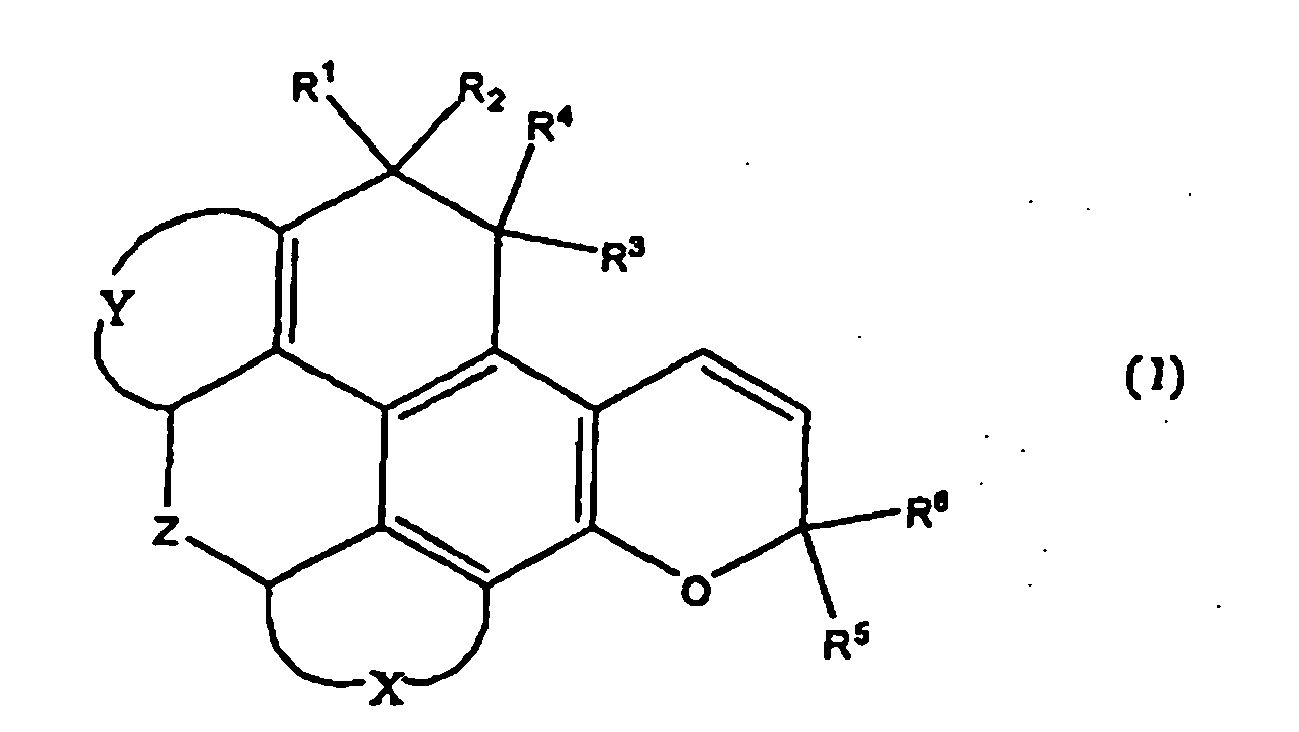
- the present invention provides a chromene compound represented by the following formula (1),
- a photochromic material comprising a chromene compound represented by the above general formula (1), and a photochromic optical material containing the chromene compound.
- the trivalent cyclic groups represented by the following formulas (2) and (3), in the above-mentioned general formula (1) are, independently from each other, aromatic hydrocarbon groups derived from a benzene ring, or aromatic heterocyclic groups having nitrogen as a heteroatom.
- the aromatic hydrocarbon groups are preferably those having 6 to 18 carbon atoms (without including carbon atoms of the substituent).
- the preferred aromatic hydrocarbon groups there can be exemplified trivalent groups derived from a benzene ring such as benzene, naphthalene and phenanthrene, and trivalent groups derived from a condensed ring formed by the condensation of 2 to 4 benzene rings.
- a trivalent group derived from a benzene ring is particularly desired.
- the aromatic heterocyclic group is a trivalent group comprising an aromatic heterocyclic ring selected from a 5-membered ring or a 6-membered ring containing nitrogen atom; a condensed heterocyclic ring in which the above 5-membered or 6-membered heterocyclic ring is condensed with a benzene ring; or a condensed heterocyclic ring in which the aromatic hydrocarbon ring such as benzene ring is condensed with the above heterocyclic ring of the 5-membered ring or the 6-membered ring.
- a nitrogen-containing heterocyclic ring such as pyridine, quinoline, dihydroquinoline, pyrrole and indole.
- the above-mentioned aromatic hydrocarbon groups and the aromatic heterocyclic groups may have a substituent (hereinafter written as Rsb).
- substituent (Rsb) there can be exemplified hydroxyl group; alkyl group; cycloalkyl group; alkoxy group; aralkyl group; aralkoxy group; amino group; substituted amino group; cyano group; nitro group; aryl group; heteroaryl group; halogen atom; halogenoalkyl group; halogenoalkoxy group; and heterocyclic group having a nitrogen atom as a hetero atom, and is bonded to the aromatic hydrocarbon group or to the aromatic heterocyclic group via the nitrogen atom.
- the alkyl group is usually the one have 1 to 4 carbon atoms.
- Preferred examples of the alkyl group include methyl group, ethyl group, n-propyl group, isopropyl group, n-butyl group, sec-butyl group, and tert-butyl group.
- the cycloalkyl group is usually an alkyl group having 3 to 12 carbon atoms.
- Preferred examples of the alkyl group include cyclopropyl group, cyclobutyl group, cyclopentyl group, cyclohexyl group, cycloheptyl group and cyclooctyl group.
- the alkoxy group is usually the one having 1 to 5 carbon atoms.
- Concrete examples of the preferred alkoxy group include methoxy group, ethoxy group, n-propoxy group, isopropoxy group, n-butoxy group, sec-butoxy group and tert-butoxy group.
- the aralkyl group is usually the one having 7 to 11 carbon atoms.
- Preferred examples of the aralkyl group include benzyl group, phenylethyl group, phenylpropyl group and phenylbutyl group.
- the aralkoxy group is the one having 6 to 10 carbon atoms.
- Preferred examples of the aralkoxy group include phenoxy group and naphthoxy group.
- the substituted amino group is an amino group having an alkyl group or an aryl group as the substituted group, such as an alkylamino group, a dialkylamino group, an arylamino group or a diarylamino group.
- the preferred substituted amino group include methylamino group, ethylamino group, phenylamino group, dimethylamino group, diethylamino group and diphenylamino group.
- the aryl group is preferably the one having 6 to 10 carbon atoms, such as phenyl group and naphthyl group.
- the heteroaryl group is preferably the one containing oxygen atom, sulfur atom or nitrogen atom as a hetero atom, and having 4 to 12 atoms for forming a ring.
- Preferred examples of the heteroaryl group include thienyl group, furyl group, pyrrolinyl group, pyridyl group, benzothienyl group, benzofuranyl group and benzopyrrolinyl group.
- halogen atom there can be exemplified a fluorine atom, a chlorine atom, a bromine atom or an iodine atom.
- halogenoalkyl group there can be exemplified the above-mentioned alkyl groups of which 1 or 2 or more hydrogen atoms are substituted by fluorine atoms, chlorine atoms or bromine atoms.
- Preferred examples of the halogenoalkyl group include fluoromethyl group, difluoromethyl group and trifluoromethyl group.
- halogenoalkoxy group there can be exemplified the above-mentioned alkoxy groups of which 1 or 2 or more hydrogen atoms are substituted with fluorine atoms, chlorine atoms or bromine atoms.
- Particularly preferred examples of the halogenoalkoxy group include fluoromethoxy group, difluoromethoxy group and trifluoromethoxy group.
- the heterocyclic group which is the substitutent (Rsb) has a nitrogen atom as a hetero atom, and is bonded to the ring of the above-mentioned aromatic hydrocarbon group or of the aromatic heterocyclic group through the nitrogen atom. It is desired that the number of carbon atoms constituting the heterocyclic ring as the substituent (Rsb) is, usually, 2 to 10 and, particularly, 2 to 6.
- the heterocyclic ring which is the substituent (Rsb) may further include hetero atoms such as oxygen atoms, sulfur atoms or nitrogen atoms in addition to nitrogen atoms bonded to the ring of the aromatic hydrocarbon group or of the aromatic heterocyclic group.
- the heterocyclic ring as the substituent (Rsb) may further have a substituent (here, the substituent may be the same as those exemplified for the substituent (Rsb)).
- heterocyclic group which serves as the above-mentioned substituent (Rsb) include morpholino group, piperidino group, pyrrolydinyl group, piperadino group and indolinyl group.
- substituent (Rsb) is, particularly preferably, a alkyl group; alkoxy group; aralkyl group; amino group; substituted amino group; halogen atom; halogenoalkyl group; or heterocyclic group having nitrogen atom as a hetero atom, and is bonded via the nitrogen atom.
- the trivalent group represented by the above-mentioned formula (2) or (3) is the one derived from a benzene ring that is described below, it is desired that the alkoxy group is bonded to the fifth position thereof or a nitrogen atom (hetero atom) of the substituted or unsubstituted heterocyclic group is bonded to the fifth position thereof from the standpoint of improving the color density.
- the divalent group Z (-Z-) is represented by the following formula (4) or (5),
- the groups represented by R 7 , R 8 and R 9 are, independently from each other, alkylene groups
- the groups represented by B and B' are, independently from each other, imino groups, substituted imino groups, oxy groups, thio groups, carbonyl groups, cycloalkylene groups, cycloalkylidene groups, or arylene groups
- m, n, p and q are 0 or 1.
- the alkylene groups represented by R 7 to R 9 are, desirably, those having 1 to 6 carbon atoms.
- Preferred examples of the alkylene group include straight-chain or branched-chain groups, such as methylene group, ethylene group, trimethylene group, tetramethylene group, propylene group, tetramethylethylene group and isopropylidene group.
- the substituted imino groups represented B and B' are the ones represented by -NR'-, wherein the group R' may be the one that complies with the substituent (Rsb). Particularly preferred group R' may be an alkyl group with 1 to 6 carbon atoms, such as methyl group, ethyl group or propyl group, or a benzyl group.
- cycloalkylene groups represented by B and B' there can be exemplified those having 3 to 20 carbon atoms and, preferably, 4 to 12 carbon atoms, such as cyclopropylene group, cyclobutylene group, cyclopentylene group, cyclohexylene group, cycloheptylene group, cyclooctylene group, cyclononylene group and cyclodecylene group.
- cycloalkylidene groups represented by B and B' there can be exemplified those having 4 to 20 carbon atoms and, preferably, 4 to 12 carbon atoms, such as cyclobutylidene group, cyclopentylidene group, cyclohexylidene group, cycloheptylidene group, cyclooctylidene group and cyclononylidene group.
- arylene groups represented by B and B' there can be exemplified those having 6 to 18 carbon atoms.
- Concrete examples of the arylene group include phenylene group, naphthylene group and phenanthrylene group.
- arylene groups represented by B and B' there can be exemplified those in which 1 or 2 or more hydrogen atoms in the arylene group are substituted by the alkyl group, alkoxy group, aralkyl group, aralkoxy group, amino group, substituted amino group, cycano group or nitro group, which are the same as those descirbed with reference to the above-mentioned substituent (Rsb).
- the above-mentioned divalent group Z exhibits the effect of increasing the fading rate and to develop a color tone of a neutral tint.
- the groups B and B' are oxy groups, imino groups, substituted imino groups, cycloalkylene groups, cycloalkylidene groups, or arylene groups.
- Groups R 1 to R 4 are oxy groups, imino groups, substituted imino groups, cycloalkylene groups, cycloalkylidene groups, or arylene groups.
- the groups R 1 , R 2 , R 3 and R 4 are, independently from each other, hydrogen atoms, hydroxyl groups, alkyl groups, alkoxy groups, aralkyl groups, aralkoxy groups, amino groups, substituted amino groups, cyano groups, nitro groups, halogen atoms, halogenoalkyl groups or halogenoalkoxy groups.
- substituents those that overlap on the groups described as the above substituents (Rsb) are the same as such groups.
- R 1 and R 2 together and R 3 and R 4 together may form a ring, and either R 1 or R 2 and either R 3 or R 4 together may form a ring.
- the thus formed ring may be an aliphatic hydrocarbon ring. Further, these rings may have a substituent, and the number of atoms forming the ring is, desirably, from 3 to 20.
- aliphatic hydrocarbon ring there can be exemplified monocyclic rings having 3 to 20 carbon atoms, such as cyclopropane ring, cyclobutane ring, cyclopentane ring, cyclohexane ring, cycloheptane ring, cyclooctane ring, cyclononane ring, cyclodecane ring, cycloundecane ring, cyclododecane ring, cyclotridecane ring and cyclopentadodecane ring, or crosslinked aliphatic rings having 6 to 20 carbon atoms, such as bicyclo[2,2,1]heptane ring, bicycle[2,2,2]octane ring, bicyclo[3,2,0]heptane ring, bicyclo[3,1,1]heptane ring, bicyclo[3,2,1]octane ring and adamantane
- the aliphatic hydrocarbon ring may have a substituent which may be an alkyl group, a cycloalkyl group, an alkoxy group, an amino group or a substituted amino group described above as the substituent (Rsb). There is no particular limitation on the positions and the number of the substituents.
- the substituent is a crosslinked aliphatic hydrocarbon ring having 7 to 18 carbon atoms among the above-mentioned rings, such as bicyclo[2,2,1]heptane ring, bicyclo[2,2,2]octane ring, bicyclo [3,2,1] octane ring, bicyclo[3,3,1]nonane ring or adamantane ring, or a crosslinked heterocyclic ring having 6 to 18 carbon atoms for forming a ring, such as aza-bicyclo[2,2,2]octane ring, decahydrocyclopentaazepine ring, or aza-bicyclo[3,2,1]octane ring.
- a crosslinked aliphatic hydrocarbon ring having 7 to 18 carbon atoms among the above-mentioned rings such as bicyclo[2,2,1]heptane ring, bicyclo[2,2,2]octane ring,
- R 1 to R 4 are hydrogen atoms, alkyl groups, alkoxy groups or halogenoalkyl groups, R 1 and R 2 together and/or R 3 and R 4 together are forming rings, or either R 1 or R 2 and either R 3 or R 4 together are forming a ring.
- the effect of quick fading rate is particularly favorably exhibited when a ring is formed by R 1 to R 4 , which is more desirable.
- the effect of the present invention is exhibited most distinctly when the ring is formed by the atoms of a number of 5 to 12.
- R 5 and R 6 are, independently from each other, alkyl groups, aryl groups which may have a substituent, or heteroaryl groups.
- R 5 and R 6 together may form a ring.
- alkyl group, aryl group, or heteroaryl group are the same as those groups described as the substituents (Rsb).
- the ring formed by R 5 and R 6 may be any one of aliphatic hydrocarbon ring, heterocyclic ring or aromatic hydrocarbon ring.
- Preferred examples of the aliphatic hydrocarbon ring include crosslinked rings having 6 to 18 carbon atoms, such as bicyclo[2,2,1]heptane ring, bicyclo[2,2,2]octane ring, bicyclo[3,2,1]octane ring and bicyclo[3.3.1]nonane ring.
- heterocyclic ring examples include crosslinked rings having 6 to 18 carbon atoms, such as aza-bicyclo[2,2,2]octane ring, decahydrocyclopentaazepine ring, and aza-bicyclo[3,2,1]octane ring
- aromatic hydrocarbon ring examples include those having 10 to 18 carbon atoms, such as fluorene ring and phenanthrene ring.
- the ring formed by R 5 and R 6 may have a substituent which may be alkyl group, alkoxy group, aryl group, hydroxyl group or halogen atom like the ones described concerning the substituent (Rsb).
- R 5 or R 6 is any one of the groups (i) to (iv) described below.
- the preferred substituted phenyl group examples include 4-(N,N-dimethyllamino)phenyl group, 4-(N,N,-diethylamino)phenyl group, 4-(N,N-diphenylamino)phenyl group, 4-morpholinophenyl group, 4-piperidinophenyl group, 4-methoxyphenyl group, 4-ethoxyphenyl group, 4-propoxyphenyl group, 4-butoxyphenyl group, 4-cyclohexylphenyl group, and 3,4-dimethoxyphenyl group.
- the aryl group is the one other than the phenylgroup, it is desired that the number of the substituent is 1.
- substituted aryl group examples include 4-(N,N-dimethylamino)thienyl group, 4-(N,N-diethylamino)furyl group, 4-(N,N-diphenylamino)thienyl group, 4-morpholinopyrrolinyl group, 6-piperidinobenzothienyl group, and 6-(N,N-dimethylamino)benzofuranyl group. Chromene compounds.
- the compound of the present invention expressed by the above-mentioned general formula (1) usually exists as a colorless sold at normal temperature and under normal pressure, and can be confirmed by the following means 1 to 3.
- the chromene compound of the present invention represented by the above-mentioned general formula (1) exhibits excellent photochromic properties such as small initial color, large fading rate, excellent light resistance while developing a color tone of a neutral tint.
- the chromene compounds of the present invention the most excellent photochromic characteristics are exhibited by the following compounds.
- the chromene compound of the present invention can be produced by, for example, a method described below (in the general formulas (8) and (9) representing a naphthol derivative and a propargyl alcohol used in the following production process, the groups R 1 to R 6 , rings X and Y, and the divalent group Z are as defined in the general formula (1)).
- a chromene compound represented by the above general formula (1) is obtained by reacting a naphthol derivative represented by the following general formula (8), with a propargyl alcohol derivative represented by the following general formula (9), in the presence of an acid catalyst.
- the naphthol derivative and the propargyl alcohol derivative are usually used at a ratio satisfying molar ratios of 1:10 to 10:1.
- the acid catalyst further, there is used sulfuric acid, benzenesulfonic acid, p-toluenebenzenesulfonic acid or acidic alumina in an amount of from 0.1 to 10 parts by weight per the toal amount of 100 parts by weight of the naphthol derivative and the propargyl alcohol derivative.
- the reaction temperature is usually 0 to 200°C
- the solvent is a non-protonic organic solvent, such as N-methylpyrrolidone, dimethylformamide, tetrahydrofurane, benzene or toluene.
- the chromene compound of the present invention obtained through the above reaction dissolves well in a general organic solvent such as toluene, chloroform or tetrahydrofurane.
- a solution obtained by dissolving the chromene compound in the above solvent is, usually, colorless and transparent, and exhibits a favorable reversible photochromic action quickly developing a color when it is irradiated with sunlight or ultraviolet rays and quickly returning to the initial colorless state when it is shut off the light.
- the above photochromic action of the chromene compound of the present invention is similarly exhibited even in a high-molecular solid matrix.
- the high-molecular solid matrix may be the one in which the chromene compound of the present invention disperses homogeneously.
- Optically preferred examples include such thermoplastic resins as polymethylacrylate, polyethylacrylate, polymethylmethacrylate, polyethylmethacrylate, polystyrene, polyacrylonitrile, polyvinyl alcohol, polyacrylamide, poly(2-hydroxyethyl methacrylate), polydimethylsiloxane, polyethylene glycol monoallyl ether, and polycarbonate.
- a curable resin obtained by polymerizing a radically polymerizable polyfunctional monomer can be used as a high-molecular solid matrix.
- the radically polymerizable polyfunctional monomer include polyvalent acrylic acid and polyvalent methacrylic acid ester compounds, such as ethylene glycol diacrylate, ethylene glycol dimethacrylate, diethylene glycol dimethacrylate, triethylene glycol dimethacrylate, tetraethylene glycolate dimethacrylate, ethylene glycol bisglycidyl methacrylate, polyethylene glycol diacrylate, urethane oligomer hexaacrylate, bisphenol A dimethacrylate, trimethylolpropane trimethacrylate, 2,2-bis(4-methacryloyloxyethoxyphenyl)propane, and 2,2-bis(3,5-dibromo-4-methacryloyloxyethoxyphenyl)propane; polyvalent allyl compounds,
- a copolymer of the above radically polymerizable polyfunctional monomer and a monofunctional radical polymer can be used as a high-molecular solid matrix.
- the monofunctional radical polymer there can be exemplified unsaturated carboxylic acid, such as acrylic acid, methacrylic acid and maleic anhydride; acrylic acid and methacrylic acid ester compounds, such as methyl acrylate, methyl methacrylate, benzyl methacrylate, phenyl methacrylate and 2-hydroxyethyl methacrylate; fumaric acid ester compounds such as diethyl fumarate and diphenyl fumarate; thioacrylic acid and thiomethacrylic acid ester compounds, such as methyl thioacrylate, benzyl thioacrylate and benzyl thiomethacrylate; and vinyl compounds, such as styrene, chlorostyrene, methylstyrene, vinylnaphthalene, ⁇ -methylstyrene
- a photopolymerization initiator benzoin, benzoinmethyl ether, benzoinbutyl ether, benzophenol, acetophenone 4,4'-dichlorobenzophenone, diethoxyacetophenone, 2-hydroxy-2-methyl-1-phenylpropane-1-on, benzylmethylketal, 1-(4-isopropylphenyl)-2-hydroxy-2-methylpropane-1-on, 1-hydroxycyclohexylphenyl ketone, 2-isopropylthioxanthone, bis(2,6-dimethoxybenzoyl-2,4,4-trimethyl-pentyl phosphineoxide, bis(2,4-6-trimethylbenzoyl)-phenyl phosphineoxide, 2,4,6-trimethylbenzoyldiphenyl phos
- the method of dispersing the chromene compound of the present invention in the above-mentioned high-molecular solid matrix there is no particular limitation on the method of dispersing the chromene compound of the present invention in the above-mentioned high-molecular solid matrix, and there can be used a generally employed method.
- a method of kneading the thermoplastic resin and the chromene compound together in a molten state to disperse the chromene compound in the resin a method of dissolving a chromene compound in the polymerizable monomer, adding a polymerization catalyst thereto, and effecting the polymerization with heat or light to disperse the chromene compound in the resin, or a method of dyeing the surfaces of the thermoplastic resin and of the curable resin with a chromene compound, so that the chromene compound disperses in the resin.
- the chromene compound of the present invention can be used as a photochromic material over a wide range, such as various memory materials to substitute for silver salt photosensitive materials, i.e., can be used as a copying material, a photosensitive material for printing, a memory material for cathode-ray tubes, a photosensitive material for lasers and as a photosensitive material for holography.
- the photochromic material using the chromene compound of the present invention can be utilized as a photochromic lens material, an optical filter material, a display material, an actinometer and as an ornamental material.
- the' chromene compound of the present invention can be used by any method so far as there is obtained a homogeneous dimming property.
- the chromene compound of the present invention is used by a variety of methods such as a method by which a polymer film in which the chromene compound of the present invention is homogeneously dispersed, is sandwiched in the lens or is laminated thereon; a method by which the chromene compound of the invention is dispersed in the polymerizable monomer and is polymerized according to a predetermined method to obtain a photochromic lens; a method by which the chromene compound of the present invention is dispersed in the polymerizable monomer to prepare a photochromic monomer composition, and the monomer composition is applied to the surfaces of a non-photochromic lens material to obtain a lens on which a photochromic film is laminated; a method by which the chromene compound of the present invention is dissolved in, for example, a silicone oil
- the chromene compound of the present invention exhibits a high fading rate in a solution or in a high-molecular solid matrix. Besides, in a state of not being irradiated with light, the chromene compound of the invention exhibits little color. Even after used for extended periods of time, the chromene compound of the invention exhibits little color yet maintaining good photochromic property. For example, the photochromic lens using the chromene compound of the present invention quickly resumes its initial color tone when it is brought indoors from outdoors and, further exhibits little color even after used for extended periods of time, thus featuring good light resistance.
- the chromene compound of the present invention When placed in a state of developing color, further, the chromene compound of the present invention exhibits two absorption bands of from 420 to 520 nm and from 520 to 620 nm, producing a small difference in the intensity of absorption between the two bands and a ratio of color densities of usually in a range of from 0.7 to 1.5. It is, therefore, possible to develop a color tone of a neutral tint such as grey or brown even by using a single compound.
- Measurement of the proton nuclear magnetic resonance spectrum indicated a peak of 16 H based on an alkylene group near ⁇ 1.0 to 4.0 ppm, and peaks of 17H based on an aromatic proton and on an alkene proton near ⁇ 5.6 to 9.0 ppm.
- measurement of a 13C-nuclear magnetic resonance spectrum indicated a peak based on a carbon atom of an aromatic ring near ⁇ 110 to 160 ppm, a peak based on a carbon atom of an alkene near ⁇ 80 to 140 ppm, and a peak based on a carbon atom of an alkyl at ⁇ 20 to 60 ppm.
- Fig. 1 shows a 1 H-NMR spectrum of the compound that was obtained.
- the mixture was poured into a mold constituted by glass plates and a gasket of an ethylene/vinyl acetate copolymer, and was cast-polymerized.
- the polymerization was conducted by using an air furnace while gradually raising the temperature from 30°C to 90 °C over 18 hours, and the temperature of 90°C was maintained for 2 hours. After the polymerization, the polymer was taken out from the glass mold.
- the obtained polymer (sample having a thickness of 2 mm) was irradiated with light by using a xenon lamp L-2480 (300W) SHL-100 manufactured by Hamamatsu Photonics Co. through an aeromass filter (manufactured by Coning Co.) at a temperature of 20 ⁇ 1°C at beam intensities on the polymer surface of 2.4 mW/cm 2 (365 nm) and 24 ⁇ W/cm 2 (245 nm) for 120 seconds to develop color and to measure the photochromic properties of the sample.
- the photochromic properties were evaluated by the following methods, and were as shown in Tables 9 and 10.
- Examples 1 to 14 and 16 to 22 using the chromene compounds of the present invention are superior in three effects, i.e., fading rate, initial color and color density ratio, to those of Comparative Examples 1 to 3.
Landscapes
- Chemical & Material Sciences (AREA)
- Organic Chemistry (AREA)
- Physics & Mathematics (AREA)
- General Physics & Mathematics (AREA)
- Optics & Photonics (AREA)
- Engineering & Computer Science (AREA)
- Materials Engineering (AREA)
- Nitrogen Condensed Heterocyclic Rings (AREA)
- Plural Heterocyclic Compounds (AREA)
- Heterocyclic Carbon Compounds Containing A Hetero Ring Having Oxygen Or Sulfur (AREA)
- Pyrane Compounds (AREA)
Claims (9)
- Chromenverbindung der folgenden allgemeinen Formel (1)
 wobei R1, R2, R3 und R4 jeweils unabhängig voneinander Wasserstoffatome, Hydroxylgruppen, Alkylgruppen, Alkoxygruppen, Aralkylgruppen, Aralkoxygruppen, Aminogruppen, substituierte Aminogruppen, Cyanogruppen, Nitrogruppen, Halogenatome, Halogenalkylgruppen oder Halogenalkoxygruppen bedeuten,R1 und R2 zusammen sowie R3 und R4 zusammen aliphatische monocyclische oder aliphatische vernetzte Ringe bilden können undentweder R1 oder R2 und entweder R3 oder R4 zusammen einen aliphatischen monocyclischen oder aliphatischen vernetzten Ring bilden können,R5 und R6 jeweils unabhängig voneinander Alkylgruppen, Arylgruppen, die einen Substituenten aufweisen können, oder Heteroarylgruppen bedeuten oder R5 und R6 zusammen einen Ring bilden könen,eine dreiwertige cyclische Gruppe der folgenden Forml (2)
 und eine dreiwertige cyclische Gruppe der folgenden Formel (3)
 jeweils unabhängig voneinander aromatische Kohlenwasserstoffgruppen, die sich von einem Benzolring ableiten, oder aromatische heterocyclische Gruppen mit Stickstoff als Heteroatom, wobei die aromatischen Kohlenwasserstoffgruppen und aromatischen heterocyclischen Gruppen als Substituenten eine Hydroxylgruppe, eine Alkylgruppe, eine Cycloalkylgruppe, eine Alkoxygruppe, eine Aralkylgruppe, eine Aralkoxygruppe, eine Aminogruppe, eine substituierte Aminogruppe, eine Cyanogruppe, eine Nitrogruppe, eine Arylgruppe, eine Heteroarylgruppe, ein Halogenatom, eine Halogenalkylgruppe, eine Halogenalkoxygruppe, eine heterocyclische Gruppe, die ein Stickstoffatom als Heteroatom aufweist und über das Stickstoffatom gebunden ist, oder eine Gruppe der folgenden Formeln (6a) und (7a) aufweisen
-O-(C2H4O)2-V (6a)
-O(C2H4O)2-Ph-C[(CH3)2]-Ph-O(C2H4O)2-V (7a)
wobei V die Bedeutung -CO-C(CH3)=CH2 hat und Ph eine p-Phenylengruppe bedeutet, undeine zweiwertige Gruppe Z durch die folgenden Formeln (4) oder (5) wiedergeben wird
-(R7)m-B-(R8)n- (4)

- Chromenverbindung nach Anspruch 1, wobei in den Formeln (4) and (5) die durch R7, R8 und R9 wiedergebenen Gruppen jeweils unabhängig voneinander Alkylengruppen mit 1 bis 6 Kohlenstoffatomen bedeuten und die durch B und B' wiedergegebenen Gruppen jeweils unabhängig voneinander Iminogruppen, substituierte Iminogruppen, Oxygruppen, Cycloalkylengruppen, Cycloalkylidengruppen oder Arylengruppen bedeuten.
- Chomenverbindung nach Anspruch 1, wobei R1, R2, R3 und R4 jeweils unabhängig voneinander Wasserstoffatome, Alkylgruppen, Alkoxygruppen oder Halogenalkylgruppen bedeuten.
- Chromenverbindung nach Anspruch 1, wobei R1 und R2 zusammen und/oder R3 und R4 zusammen die aliphatischen monocyclischen Ringe oder aliphatischen vernetzten Ringe bilden.
- Chromenverbindung nach Anspruch 1, wobei entweder R1 oder R2 und entweder R3 oder R4 zusammen den aliphatischen monocyclischen Ring oder aliphatischen vernetzten Ring bilden.
- Chromenverbindung nach Anspruch 1, wobei R5 und R6 substituierte Arylgruppen bedeuten, wobei es sich beim Substituenten um eine Hydroxylgruppe, eine Alkylgruppe, eine Cycloalkylgruppe, eine Alkoxygruppe, eine Aralkylgruppe, eine Aralkoxygruppe, eine Aminogruppe, eine substituierte Aminogruppe, eine Cyanogruppe, eine Nitrogruppe, eine Arylgruppe, eine Heteroarylgruppe, ein Halogenatom, eine Halogenalkylgruppe, eine Halogenalkoxygruppe oder eine heterocyclische Gruppe, die ein Stickstoffatom als Heteroatom aufweist und über das Stickstoffatom gebunden ist, handelt.
- Chromenverbindung nach Anspruch 1, wobei R5 und R6 folgendes bedeuten:(i) Arylgruppen;(ii) eine substituierte Arylgruppe, die als Substituenten eine substituierte Aminogruppe, Alkylgruppe, Cycloalkylgruppe oder Alkoxygruppe aufweist; oder(iii) eine substituierte Arylgruppe, bei der es sich beim Substituenten um eine heterocyclische Gruppe handelt, die ein Stickstoffatom als Heteroatom aufweist und über das Stickstoffatom an die Arylgruppe gebunden ist.
- Photochromes Material, umfassend eine Chromenverbindung nach Anspruch 1.
- Photochromes optisches Material, enthaltend eine Chromenverbindung nach Anspruch 1.
Applications Claiming Priority (3)
| Application Number | Priority Date | Filing Date | Title |
|---|---|---|---|
| JP2001352333 | 2001-11-16 | ||
| JP2001352333 | 2001-11-16 | ||
| PCT/JP2002/011935 WO2003042203A1 (en) | 2001-11-16 | 2002-11-15 | Chromene compound |
Publications (3)
| Publication Number | Publication Date |
|---|---|
| EP1445257A1 EP1445257A1 (de) | 2004-08-11 |
| EP1445257A4 EP1445257A4 (de) | 2005-02-09 |
| EP1445257B1 true EP1445257B1 (de) | 2010-03-10 |
Family
ID=19164526
Family Applications (1)
| Application Number | Title | Priority Date | Filing Date |
|---|---|---|---|
| EP02781787A Expired - Lifetime EP1445257B1 (de) | 2001-11-16 | 2002-11-15 | 2h-1-benzopyranverbindungen zur verwendung in einem photochromen material |
Country Status (9)
| Country | Link |
|---|---|
| US (1) | US6875878B2 (de) |
| EP (1) | EP1445257B1 (de) |
| JP (1) | JP4369754B2 (de) |
| KR (1) | KR20040052470A (de) |
| AU (1) | AU2002349677B2 (de) |
| DE (1) | DE60235643D1 (de) |
| ES (1) | ES2342367T3 (de) |
| TW (1) | TW200302828A (de) |
| WO (1) | WO2003042203A1 (de) |
Families Citing this family (18)
| Publication number | Priority date | Publication date | Assignee | Title |
|---|---|---|---|---|
| JP5442258B2 (ja) * | 2005-11-10 | 2014-03-12 | ローデンストック.ゲゼルシャフト.ミット.ベシュレンクテル.ハフツング | 光互変性スピロジヒドロフェナントロピラン |
| US8123987B2 (en) | 2006-01-25 | 2012-02-28 | Tokuyama Corporation | Chromene compounds |
| US20090126248A1 (en) * | 2007-07-03 | 2009-05-21 | Burnstein Tracey E | Personalizeable display frames |
| JP2010270191A (ja) | 2009-05-20 | 2010-12-02 | Tokuyama Corp | コーティング組成物および光学物品 |
| US9234984B2 (en) | 2010-08-06 | 2016-01-12 | Tokuyama Corporation | Photochromic composition |
| US9377664B2 (en) | 2011-04-13 | 2016-06-28 | Tokuyama Corporation | Photocromic composition |
| US9513407B2 (en) | 2011-04-18 | 2016-12-06 | Tokuyama Corporation | Photochromic composition and optical article using photochromic composition |
| WO2013058218A1 (ja) | 2011-10-17 | 2013-04-25 | 株式会社トクヤマ | (メタ)アクリレート化合物、及び該(メタ)アクリレート化合物を含むフォトクロミック硬化性組成物 |
| AU2012359356B2 (en) | 2011-12-26 | 2016-07-14 | Tokuyama Corporation | Photochromic composition |
| CN104254584A (zh) | 2012-04-27 | 2014-12-31 | 株式会社德山 | 光致变色固化性组合物 |
| JP6355209B2 (ja) | 2013-03-04 | 2018-07-11 | 株式会社トクヤマ | フォトクロミック硬化性組成物、その硬化体及びその硬化体を含む積層体 |
| EP2966144B1 (de) | 2013-03-04 | 2017-10-25 | Tokuyama Corporation | Photochrome härtbare zusammensetzung |
| SG11202009885XA (en) | 2018-04-12 | 2020-11-27 | Tokuyama Corp | Photochromic optical article and method for manufacturing same |
| CN113646281A (zh) | 2019-04-03 | 2021-11-12 | 株式会社德山 | 光致变色光学物品及其制造方法 |
| CN114846047B (zh) | 2020-02-28 | 2024-08-30 | 株式会社德山 | 湿气固化型聚氨酯组合物及层叠体 |
| EP4163270A4 (de) | 2020-05-28 | 2024-07-03 | Tokuyama Corporation | Verbindung für optisches material, härtbare zusammensetzung, gehärteter körper und optischer artikel |
| US20240100810A1 (en) | 2021-01-25 | 2024-03-28 | Tokuyama Corporation | Resin composition, optical laminate, optical article, lens and eyeglasses |
| EP4289831A4 (de) * | 2021-02-08 | 2025-01-22 | Hoya Lens Thailand Ltd. | Photochrome verbindung, photochrome zusammensetzung, photochromer artikel und brille |
Family Cites Families (4)
| Publication number | Priority date | Publication date | Assignee | Title |
|---|---|---|---|---|
| DE3120402A1 (de) * | 1981-05-22 | 1982-12-16 | Hoechst Ag, 6000 Frankfurt | Neue cumarinverbindungen, verfahren zu ihrer herstellung und ihre verwendung als farbstoffe |
| FR2783249B1 (fr) * | 1998-09-11 | 2001-06-22 | Flamel Tech Sa | Naphtopyranes anneles en c5-c6, leur preparation et les compositions et matrices (co)polymeres les renfermant |
| FR2794749A1 (fr) * | 1999-06-10 | 2000-12-15 | Corning Sa | Benzopyranes anneles en c7-c8 avec un heterocycle aromatique et les compositions et matrices (co) polymeres les renfermant |
| AU2002253675B2 (en) * | 2001-05-02 | 2008-05-08 | Tokuyama Corporation | Chromene compound |
-
2002
- 2002-11-12 TW TW091133118A patent/TW200302828A/zh unknown
- 2002-11-15 WO PCT/JP2002/011935 patent/WO2003042203A1/ja not_active Ceased
- 2002-11-15 US US10/466,214 patent/US6875878B2/en not_active Expired - Fee Related
- 2002-11-15 EP EP02781787A patent/EP1445257B1/de not_active Expired - Lifetime
- 2002-11-15 DE DE60235643T patent/DE60235643D1/de not_active Expired - Lifetime
- 2002-11-15 ES ES02781787T patent/ES2342367T3/es not_active Expired - Lifetime
- 2002-11-15 KR KR10-2003-7009398A patent/KR20040052470A/ko not_active Withdrawn
- 2002-11-15 JP JP2003544039A patent/JP4369754B2/ja not_active Expired - Fee Related
- 2002-11-15 AU AU2002349677A patent/AU2002349677B2/en not_active Ceased
Also Published As
| Publication number | Publication date |
|---|---|
| KR20040052470A (ko) | 2004-06-23 |
| US20040242856A1 (en) | 2004-12-02 |
| JP4369754B2 (ja) | 2009-11-25 |
| DE60235643D1 (de) | 2010-04-22 |
| US6875878B2 (en) | 2005-04-05 |
| EP1445257A4 (de) | 2005-02-09 |
| TW200302828A (en) | 2003-08-16 |
| AU2002349677B2 (en) | 2007-11-15 |
| WO2003042203A1 (en) | 2003-05-22 |
| ES2342367T3 (es) | 2010-07-06 |
| JPWO2003042203A1 (ja) | 2005-03-10 |
| EP1445257A1 (de) | 2004-08-11 |
Similar Documents
| Publication | Publication Date | Title |
|---|---|---|
| EP1674460B1 (de) | Chromenverbindung | |
| EP1655293B1 (de) | Chromenverbindung und diese enthaltende Artikel | |
| US7048876B2 (en) | Chromene compound | |
| CN102471303B (zh) | 色烯化合物 | |
| EP2684886B1 (de) | Chromenverbindung | |
| KR101826641B1 (ko) | 크로멘 화합물 | |
| KR101864188B1 (ko) | 크로멘 화합물 및 경화성 조성물 | |
| AU2007208628B2 (en) | Chromene compounds | |
| US6875878B2 (en) | Chromene compound | |
| US6340765B1 (en) | Chromene compound | |
| JP2005187420A (ja) | クロメン化合物 | |
| JP2005112772A (ja) | クロメン化合物 | |
| JP2005289812A (ja) | クロメン化合物 | |
| JP2003277381A (ja) | クロメン化合物 | |
| JP5721544B2 (ja) | クロメン化合物 | |
| JP2004339184A (ja) | クロメン化合物 | |
| HK1194363A (en) | Chromene compound and curable composition |
Legal Events
| Date | Code | Title | Description |
|---|---|---|---|
| PUAI | Public reference made under article 153(3) epc to a published international application that has entered the european phase |
Free format text: ORIGINAL CODE: 0009012 |
|
| 17P | Request for examination filed |
Effective date: 20030717 |
|
| AK | Designated contracting states |
Kind code of ref document: A1 Designated state(s): AT BE BG CH CY CZ DE DK EE ES FI FR GB GR IE IT LI LU MC NL PT SE SK TR |
|
| A4 | Supplementary search report drawn up and despatched |
Effective date: 20041230 |
|
| 17Q | First examination report despatched |
Effective date: 20070529 |
|
| GRAP | Despatch of communication of intention to grant a patent |
Free format text: ORIGINAL CODE: EPIDOSNIGR1 |
|
| RTI1 | Title (correction) |
Free format text: 2H-1-BENZOPYRAN COMPOUNDS FOR USE IN A PHOTOCHROMIC MATERIAL |
|
| RAP1 | Party data changed (applicant data changed or rights of an application transferred) |
Owner name: TOKUYAMA CORPORATION |
|
| GRAS | Grant fee paid |
Free format text: ORIGINAL CODE: EPIDOSNIGR3 |
|
| GRAA | (expected) grant |
Free format text: ORIGINAL CODE: 0009210 |
|
| AK | Designated contracting states |
Kind code of ref document: B1 Designated state(s): DE ES FR GB IT |
|
| REG | Reference to a national code |
Ref country code: GB Ref legal event code: FG4D |
|
| REF | Corresponds to: |
Ref document number: 60235643 Country of ref document: DE Date of ref document: 20100422 Kind code of ref document: P |
|
| REG | Reference to a national code |
Ref country code: ES Ref legal event code: FG2A Ref document number: 2342367 Country of ref document: ES Kind code of ref document: T3 |
|
| PLBE | No opposition filed within time limit |
Free format text: ORIGINAL CODE: 0009261 |
|
| STAA | Information on the status of an ep patent application or granted ep patent |
Free format text: STATUS: NO OPPOSITION FILED WITHIN TIME LIMIT |
|
| 26N | No opposition filed |
Effective date: 20101213 |
|
| PGFP | Annual fee paid to national office [announced via postgrant information from national office to epo] |
Ref country code: DE Payment date: 20101110 Year of fee payment: 9 |
|
| PGFP | Annual fee paid to national office [announced via postgrant information from national office to epo] |
Ref country code: IT Payment date: 20101120 Year of fee payment: 9 Ref country code: GB Payment date: 20101110 Year of fee payment: 9 |
|
| PGFP | Annual fee paid to national office [announced via postgrant information from national office to epo] |
Ref country code: FR Payment date: 20111118 Year of fee payment: 10 Ref country code: ES Payment date: 20111122 Year of fee payment: 10 |
|
| GBPC | Gb: european patent ceased through non-payment of renewal fee |
Effective date: 20121115 |
|
| REG | Reference to a national code |
Ref country code: FR Ref legal event code: ST Effective date: 20130731 |
|
| PG25 | Lapsed in a contracting state [announced via postgrant information from national office to epo] |
Ref country code: IT Free format text: LAPSE BECAUSE OF NON-PAYMENT OF DUE FEES Effective date: 20121115 |
|
| REG | Reference to a national code |
Ref country code: DE Ref legal event code: R119 Ref document number: 60235643 Country of ref document: DE Effective date: 20130601 |
|
| PG25 | Lapsed in a contracting state [announced via postgrant information from national office to epo] |
Ref country code: DE Free format text: LAPSE BECAUSE OF NON-PAYMENT OF DUE FEES Effective date: 20130601 |
|
| PG25 | Lapsed in a contracting state [announced via postgrant information from national office to epo] |
Ref country code: FR Free format text: LAPSE BECAUSE OF NON-PAYMENT OF DUE FEES Effective date: 20121130 Ref country code: GB Free format text: LAPSE BECAUSE OF NON-PAYMENT OF DUE FEES Effective date: 20121115 |
|
| REG | Reference to a national code |
Ref country code: ES Ref legal event code: FD2A Effective date: 20140527 |
|
| PG25 | Lapsed in a contracting state [announced via postgrant information from national office to epo] |
Ref country code: ES Free format text: LAPSE BECAUSE OF NON-PAYMENT OF DUE FEES Effective date: 20121116 |