EP1445279A1 - Composition d'élastomère thermoplastique et article moulé par celle-ci - Google Patents
Composition d'élastomère thermoplastique et article moulé par celle-ci Download PDFInfo
- Publication number
- EP1445279A1 EP1445279A1 EP04002365A EP04002365A EP1445279A1 EP 1445279 A1 EP1445279 A1 EP 1445279A1 EP 04002365 A EP04002365 A EP 04002365A EP 04002365 A EP04002365 A EP 04002365A EP 1445279 A1 EP1445279 A1 EP 1445279A1
- Authority
- EP
- European Patent Office
- Prior art keywords
- molded member
- thermoplastic elastomer
- olefin
- feeling
- compression
- Prior art date
- Legal status (The legal status is an assumption and is not a legal conclusion. Google has not performed a legal analysis and makes no representation as to the accuracy of the status listed.)
- Granted
Links
Images



Classifications
-
- C—CHEMISTRY; METALLURGY
- C08—ORGANIC MACROMOLECULAR COMPOUNDS; THEIR PREPARATION OR CHEMICAL WORKING-UP; COMPOSITIONS BASED THEREON
- C08L—COMPOSITIONS OF MACROMOLECULAR COMPOUNDS
- C08L23/00—Compositions of homopolymers or copolymers of unsaturated aliphatic hydrocarbons having only one carbon-to-carbon double bond; Compositions of derivatives of such polymers
- C08L23/02—Compositions of homopolymers or copolymers of unsaturated aliphatic hydrocarbons having only one carbon-to-carbon double bond; Compositions of derivatives of such polymers not modified by chemical after-treatment
- C08L23/16—Ethylene-propylene or ethylene-propylene-diene copolymers
-
- C—CHEMISTRY; METALLURGY
- C08—ORGANIC MACROMOLECULAR COMPOUNDS; THEIR PREPARATION OR CHEMICAL WORKING-UP; COMPOSITIONS BASED THEREON
- C08L—COMPOSITIONS OF MACROMOLECULAR COMPOUNDS
- C08L23/00—Compositions of homopolymers or copolymers of unsaturated aliphatic hydrocarbons having only one carbon-to-carbon double bond; Compositions of derivatives of such polymers
- C08L23/02—Compositions of homopolymers or copolymers of unsaturated aliphatic hydrocarbons having only one carbon-to-carbon double bond; Compositions of derivatives of such polymers not modified by chemical after-treatment
- C08L23/18—Homopolymers or copolymers of hydrocarbons having four or more carbon atoms
-
- C—CHEMISTRY; METALLURGY
- C08—ORGANIC MACROMOLECULAR COMPOUNDS; THEIR PREPARATION OR CHEMICAL WORKING-UP; COMPOSITIONS BASED THEREON
- C08L—COMPOSITIONS OF MACROMOLECULAR COMPOUNDS
- C08L2205/00—Polymer mixtures characterised by other features
- C08L2205/03—Polymer mixtures characterised by other features containing three or more polymers in a blend
-
- C—CHEMISTRY; METALLURGY
- C08—ORGANIC MACROMOLECULAR COMPOUNDS; THEIR PREPARATION OR CHEMICAL WORKING-UP; COMPOSITIONS BASED THEREON
- C08L—COMPOSITIONS OF MACROMOLECULAR COMPOUNDS
- C08L23/00—Compositions of homopolymers or copolymers of unsaturated aliphatic hydrocarbons having only one carbon-to-carbon double bond; Compositions of derivatives of such polymers
- C08L23/02—Compositions of homopolymers or copolymers of unsaturated aliphatic hydrocarbons having only one carbon-to-carbon double bond; Compositions of derivatives of such polymers not modified by chemical after-treatment
- C08L23/10—Homopolymers or copolymers of propene
-
- C—CHEMISTRY; METALLURGY
- C08—ORGANIC MACROMOLECULAR COMPOUNDS; THEIR PREPARATION OR CHEMICAL WORKING-UP; COMPOSITIONS BASED THEREON
- C08L—COMPOSITIONS OF MACROMOLECULAR COMPOUNDS
- C08L23/00—Compositions of homopolymers or copolymers of unsaturated aliphatic hydrocarbons having only one carbon-to-carbon double bond; Compositions of derivatives of such polymers
- C08L23/02—Compositions of homopolymers or copolymers of unsaturated aliphatic hydrocarbons having only one carbon-to-carbon double bond; Compositions of derivatives of such polymers not modified by chemical after-treatment
- C08L23/10—Homopolymers or copolymers of propene
- C08L23/12—Polypropene
Definitions
- the present invention relates to a thermoplastic elastomer composition and a molded member made of the same, and more particularly, it relates to, for example, a thermoplastic elastomer composition applicable to a surface material of the trim of vehicles including cars.
- trim of a vehicle such as a car
- a material obtained by laminating, with polyurethane foam sandwiched therebetween, a surface material of a vinyl chloride-based resin on a substrate of an ABS resin, a modified polyphenylene ether resin, polypropylene (hereinafter referred to as PP) or the like has been used.
- thermoplastic elastomer including PP and olefin-based rubber
- thermoplastic elastomer in which poly(1-butene) is substituted for part of PP from a viewpoint of resistance against a scratch.
- the TPO is clammy when its surface is touched with a hand, and is difficult to practically use because of its poor tactile quality (namely, because it is unpleasant to touch).
- examination is being made to coat a TPO surface material, but the coating disadvantageously increases the fabrication cost.
- the present invention was devised in consideration of the aforementioned situations, and an object of the invention is providing a thermoplastic elastomer composition that has a tactile quality equivalent to or higher than that of a vinyl chloride-based resin and a molded member made of the same without largely increasing the fabrication cost.
- thermoplastic elastomer composition of this invention includes 2 through 14 mass% of polypropylene (PP); 19 through 35 mass% of poly(1-butene) (PB-1); and 30 through 52 mass% of olefin-based rubber including an ethylene - propylene - diene monomer and having an SP value of 7.5 through 8.5.
- thermoplastic elastomer composition a weight ratio of PB-1/(PP + PB-1) is 56 through 90% and a weight ratio of PB-1/(PP + (PB-1) + olefin-based rubber) is 25 through 47%.
- the PB-1 has a smaller elastic modulus and is softer than the PP. Therefore, when the PB-1 is substituted for part of the PP, hardness feeling can be improved, namely, the resultant composition feels softer.
- the PP has an SP (Solubility Parameter) value of 8.1, which is substantially the same as that of the PB-1, that is, 8.3. Therefore, compatibility between (i.e., easiness in mixing) the PP and the PB-1 is high, and hence, these components are well mixed with each other so as to homogenize a layer of the resin component. As a result, the hardness feeling can be definitely improved.
- the olefin-based rubber has an SP value substantially the same as the SP value of the PP (which is 8.1), the compatibility between (i.e., easiness in mixing) the PP and the olefin-based rubber can be improved, so that the rubber component can be finely dispersed in the resin component. As a result, humidity feeling can be improved. In other words, the resultant composition does not feel clammy but feels dry.
- the content of the PP is preferably 2 through 14 mass%. Since the PB-1 is a liquid, if the content of the PP, that is, a solid, is too small, a molded member made of the thermoplastic elastomer composition cannot keep its shape. On the other hand, if the content of the PP is too large, the surface of the molded member becomes hard and hence the hardness feeling is degraded.
- the content of the PB-1 is preferably 19 through 35 mass%. If the content of the PB-1 is too small, the surface of the molded member made of the thermoplastic elastomer composition becomes hard and hence the hardness feeling is degraded. On the other hand, if the content of the PB-1 is too large, the molded member cannot keep its shape.
- the content of the olefin-based rubber is preferably 30 through 52 mass%. If the content of the olefin-based rubber is too small, the surface of the molded member made of the thermoplastic elastomer composition becomes hard and hence the hardness feeling is degraded, and on the contrary, if the content is too large, the surface feels clammy and the humidity feeling is degraded.
- the proportions among the PP, the PB-1 and the olefin-based rubber in the thermoplastic elastomer composition satisfy the weight ratio of PB-1/(PP+(PB-1)) of 56 through 90% and the weight ratio of PB-1/(PP+(PB-1)+olefin-based rubber) of 25 through 47%.
- the humidity feeling and the hardness feeling which are feeling factors the most largely affecting the tactile quality of the molded member, can be consistent with each other.
- clammy feeling can be avoided as well as soft touch can be secured definitely at high level.
- the tactile quality equivalent to or higher than that of a vinyl chloride-based resin can be attained.
- the olefin-based rubber may further include ethylene octane rubber.
- the olefin-based rubber preferably has a particle size of 0.3 ⁇ m or more.
- the particle size of the rubber is too small, the impact resistance of the molded member made of the thermoplastic elastomer composition is lowered.
- the rubber particle size is set to 0.3 ⁇ m or more, there is no need to refine the rubber, and hence the fabrication cost can be lowered.
- the molded member of this invention is obtained by molding the aforementioned thermoplastic elastomer composition.
- an average coefficient of friction on a surface thereof is 0.27 or less, and the molded member has a displacement - load characteristic in which a compression work load is 0.022 gf ⁇ cm/cm 2 or more in a region of a maximum load per cm 2 of 30 gf or less.
- the humidity feeling and the hardness feeling of the molded member depend upon its friction characteristic and its compression characteristic.
- this definition is based on the finding that the tactile quality can be quantitatively measured for determining the degree of the tactile quality through quantification of these characteristics. Specifically, when the average coefficient of friction that affects the humidity feeling falls in the aforementioned range, the tactile quality (humidity feeling) equivalent to or higher than that of a vinyl chloride-based resin can be stably attained. Also, when the compression work load that affects the hardness feeling falls in the aforementioned range, the tactile quality (hardness feeling) equivalent to or higher than that of a vinyl chloride-based resin can be stably attained.
- a compression recovery property of the molded member is preferably 53 through 65% in the region in the displacement - load characteristic.
- the tactile quality equivalent to or higher than that of a vinyl chloride-based resin can be stably attained.
- a compression recovery work load is 0.012 gf ⁇ cm/cm 2 or more and compression distortion is 0.0019 cm or more in the region in the displacement - load characteristic.
- the compression characteristics i.e., the compression recovery work load and the compression distortion
- the tactile quality equivalent to or higher than that of a vinyl chloride-based resin can be stably attained.
- the olefin-based rubber preferably has a particle size of 0.3 ⁇ m or more, and the olefin-based rubber preferably has a maximum particle size of 3 ⁇ m or less in a surface portion of the molded member.
- the maximum particle size of the olefin-based rubber in the surface portion of the molded member is preferably 3 ⁇ m or less.
- the humidity feeling of the molded member can be improved.
- the molded member is suitably used as a trim material for a vehicle because it has a tactile quality equivalent to or higher than that of a vinyl chloride-based resin.
- organoleptic evaluation on the basis of the actual tactile sense of a human being carried out for quantitatively evaluating the pleasantness and the characteristic of the touch (tactile quality) of a surface of trim of vehicles, that is, a molded member, will be described.
- a group evaluation group consisting of 30 members of all ages and both sexes is set, so that the tactile quality of each of a variety of trim surface materials can be evaluated by this evaluation group for obtaining data about the tactile quality.
- a subject makes two motions, namely, a subject rubs the surface of a sample and pushes the sample.
- the rubbing motion corresponds to a friction characteristic of a surface material
- the pushing motion corresponds to a compression characteristic of the surface material.
- the friction characteristic seems to correspond to an index of the humidity feeling and the texture feeling, and the friction characteristic of each sample is measured by using a test apparatus 1 (a KES friction tester) whose structure is roughly shown in FIG. 1 .
- a sample S is placed and fixed on a sample table 2 , and a contactor 4 provided on the tip of an arm 3 is allowed to come in contact with the surface of the sample S .
- the contactor 4 includes a large number of piano wires, and these piano wires are in contact with the surface of the sample S .
- a friction sensor 5 is disposed on the base of the arm 3 on which a weight 6 is placed.
- the table 2 is moved on a horizontal plane, so as to cause frictional force between the surface of the sample S and the piano wires, which is measured with the friction sensor 5 .
- the friction characteristic of the sample S can be measured. It is noted that the frictional force to be caused can be changed by changing the weight 6 placed on the arm 3 .
- the load in a unit area applied by the weight 6 is set to 2.0 x 10 4 Pa, and the moving rate of the table 2 is set to 1 mm/sec.
- the load in a unit area applied when a subject touches (rubs) the sample S is approximately 2.0 x 10 4 Pa and the moving rate is 10 mm/sec. or less at most.
- the compression characteristic seems to correspond to an index of the hardness feeling.
- hardness gage according to JIS-A a method for measuring the hardness feeling of a sample is defined.
- this method is employed, measurement results correlated to the organoleptic evaluation test results cannot be obtained. This is probably because the tip of a presser used in the measurement according to JIS-A is so thin that the compression load applied in a unit area of the surface of the sample S is excessively as large as 2.0 x 10 7 Pa.
- a test apparatus 11 (a KES compression tester) whose structure is roughly shown in FIG. 2 is used for measuring the compression characteristic of each sample. Specifically, with a sample S placed on a fixed table 12 , the surface of the sample S is pressed with a presser 13 having a flat lower face so as to measure the compression characteristic with a compression sensor 14 . In this case, the compression load in a unit area is set to 3.0 x 10 3 Pa. When this measurement method is employed, data positively correlated to the organoleptic evaluation test results are obtained.
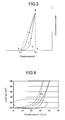
- this apparatus is used for measuring a displacement - load characteristic of each sample S , and respective parameters of a compression work load, a compression recovery work load, a compression recovery property, compression rigidity, compression distortion and a compression distortion factor are calculated on the basis of a characteristic curve of the displacement - load characteristic.
- FIG. 3 shows a modeled displacement - load characteristic curve.
- T1 indicates an initial thickness of the sample
- T2 indicates the thickness of the sample obtained under the maximum load (3.0 x 10 3 Pa, 30 gf/cm 2 ).
- the humidity feeling and the hardness feeling particularly largely affect the tactile quality of the surface of a surface material, and therefore, it is necessary to use a material having these feelings well balanced in order to obtain a surface material with a high tactile quality.
- the humidity feeling and the hardness feeling are adjusted so as to be well balanced in conventional thermoplastic elastomer (TPO) by balancing a rubber component and a PP (polypropylene) component.
- TPO thermoplastic elastomer
- the rubber component is increased so as to make the thermoplastic elastomer as soft as a vinyl chloride-based resin, the resultant feels too clammy, and when the rubber component is reduced so as to make the thermoplastic elastomer as moist as a vinyl chloride-based resin, the resultant feels too hard. Accordingly, it is difficult to attain a high tactile quality by balancing these feelings through adjustment of the rubber component and the PP component.
- thermoplastic elastomer to include a third component.
- thermoplastic elastomer when gel silicone rubber is included in thermoplastic elastomer as the third component so that the silicone rubber can be disposed on the surface, the humidity feeling and the hardness feeling can be consistent.
- the cost is disadvantageously increased.
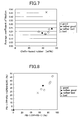
- the compression characteristic is more largely deformed under a small load in a vinyl chloride-based resin (shown with a solid curve in FIG. 4 ) than in an experimental sample of TPO (shown with an alternate long and short dash curve in FIG. 4 ).
- the hardness feeling of a surface material depends upon an initial rise in the relationship between the distortion and the pressure.
- the hardness feeling is improved by modifying a resin component. This is because when the hardness feeling is improved by adjusting the content of a rubber component, the humidity feeling is degraded.
- PB-1 that has a lower elastic modulus and is softer than PP is substituted for part of PP.
- the hardness feeling can be improved without degrading the humidity feeling.
- PB-1 has an SP value of 8.3, which is substantially the same as the SP value ofPP, that is, 8.1. Therefore, the PP and the PB-1 are homogeneously mixed, so that the hardness feeling can be definitely improved.
- the humidity feeling is improved by improving the quality of a rubber component. This is because when the humidity feeling is improved by adjusting the content of the rubber component, the hardness feeling is degraded.
- a rubber component employed in this embodiment is olefin-based rubber including EPDM (ethylene - propylene - diene monomer).
- the EPDM has an SP value of 8.0, which is substantially the same as those of the PP and the PB-1. Therefore, the EPDM has high compatibility with the resin component and is finely dispersed in the resin.
- compatibility between a rubber component and a resin component is poor, large rubber masses are formed in the surface portion, resulting in increasing the clammy feeling and degrading the humidity feeling on the surface.
- the humidity feeling can be improved without degrading the hardness feeling by finely dispersing the rubber component in the resin.
- the olefin-based rubber may further include EOR (ethylene octane rubber).
- EOR ethylene octane rubber
- the EOR may be added in the same step as the EPDM. Therefore, when the EOR is employed, the fabrication cost can be lowered. Also, the EOR has an SP value of 8.1, and hence has higher compatibility with the resin component than the EPDM. Therefore, even when the EOR is included, the humidity feeling is not degraded.
- thermoplastic elastomer composition preferable contents of the PP, the PB-1, the EPDM and the EOR in the thermoplastic elastomer composition and preferable characteristic values of a molded member made of the thermoplastic elastomer composition.
- eight kinds of thermoplastic elastomer of Examples 1 through 6 and Comparative Examples 1 and 2 respectively having different contents of the PP, the PB-1, the EPDM and the EOR are fabricated.
- the compositions of these thermoplastic elastomer are listed in Table 1 below. It is noted that the content of each component is shown in weight % (wt%) in Table 1 and FIGS. 5 through 7 and 10 described later.
- Comparative Example 2 corresponds to thermoplastic elastomer including no PB-1.
- Examples 1 and 6 and Comparative Examples 1 and 2 correspond to thermoplastic elastomer including no EOR.
- the mineral oil and the silicone oil are included from viewpoints of a mixing property of the components and a molding property of the molded member.
- a member sample is fabricated by using each of the aforementioned thermoplastic elastomer, and each sample is subjected to the organoleptic evaluation test.
- the results are shown in Table 2 below.
- each sample is ranked as one of four grades of "good”, “rather good”, “rather bad” and "bad".
- FIG. 5 is a diagram obtained by plotting the results of the organoleptic examination test of the samples of Examples 1 through 6 and Comparative Examples 1 and 2 on a PP content (wt%) - average coefficient of friction plane.
- the contents of the PP in the thermoplastic elastomer that are evaluated as "good” or “rather good” in the organoleptic evaluation are 14 wt% or less. This is probably because when the content of the PP is too large, the surface of the resultant member is so hard that the hardness feeling is degraded.
- the PB-1 is a liquid, when the content of the PP is too small, the resultant member cannot keep its shape. From this point of view, the content of the PP is preferably 2 wt% or more. Accordingly, the content of the PP is preferably 2 through 14 wt%.
- FIG. 6 is a diagram obtained by plotting the results of the organoleptic evaluation test on a PB-1 content (wt%) - average coefficient of friction plane.
- the contents of the PB-1 in the thermoplastic elastomer that are evaluated as "good” or “rather good” in the organoleptic evaluation are 19 wt% or more. This is probably because when the content of the PB-1 is too small, the surface of the resultant member is so hard that the hardness feeling is degraded. Also, when the content of the PB-1 is too large, the resultant member cannot keep its shape. From this point of view, the content of the PB-1 is preferably 35 wt% or less. Accordingly, the content of the PB-1 is preferably 19 through 35 wt%.
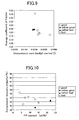
- FIG. 7 is a diagram obtained by plotting the results of the organoleptic evaluation test on an olefin-based rubber (EPDM + EOR) content (wt%) - average coefficient of friction plane.
- the contents of the olefin-based rubber in the thermoplastic elastomer that are evaluated as "good” or "rather good” in the organoleptic evaluation are 30 through 52 wt%. This is probably because when the content of the olefin-based rubber is too small, the surface of the resultant member is so hard that the hardness feeling is degraded, and when the content of the olefin-based rubber is too large, the surface of the resultant member feels so clammy that the humidity feeling is degraded.
- thermoplastic elastomer evaluated as "good” or “rather good” in the organoleptic evaluation have the ratio PB-1/(PP + PB-1) of 56 through 90% and the ratio PB-1/(PP + PB-1 + olefin-based rubber) of 25 through 47%.
- thermoplastic elastomer composition preferably has the following composition:
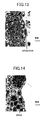
- FIG. 9 is a diagram obtained by plotting the results of the organoleptic evaluation test on a compression work load - average coefficient of friction plane.
- the molded members evaluated as "good" in the organoleptic evaluation test have an average coefficient of friction of 0.27 or less and a compression work load of 0.022 gf ⁇ cm/cm 2 (0.022 x 10 -2 N ⁇ cm/cm 2 ) or more.
- FIG. 10 is a diagram obtained by plotting the results of the organoleptic evaluation test on a PP content - compression recovery property plane. On the basis of FIG. 10 , the molded members evaluated as "good” in the organoleptic evaluation test have a compression recovery property of 53 through 65% with variation in the test considered.
- FIG. 11 is a diagram obtained by plotting the results of the organoleptic evaluation test on a compression distortion - compression recovery work load plane.
- the molded members evaluated as "good" in the organoleptic evaluation have a compression recovery work load of 0.012 gf ⁇ cm/cm 2 (0.012 x 10 -2 N ⁇ cm/cm 2 ) or more and compression distortion of 0.0019 cm or more.
- the preferable characteristic values of the molded member are as follows:
- FIGS. 12 and 13 are photomicrographs of enlarged surface portions of the molded members made of the thermoplastic elastomer of Examples 1 and 2, which are evaluated as "good” in the organoleptic evaluation
- FIG. 14 is a photomicrograph of an enlarged surface portion of the molded member made of the thermoplastic elastomer of Comparative Example 1, which is evaluated as "bad” in the organoleptic evaluation.
- Table 2 above lists the minimum rubber particle sizes and the maximum rubber particle sizes in the surface portions of Examples 1 and 2 and Comparative Example 1.
- the maximum rubber particle size in the surface portion of the member is preferably 3 ⁇ m or less.
- the degradation of the humidity feeling can be suppressed.
- the rubber particle size is preferably smaller from the viewpoint of the humidity feeling, when the rubber particle sizes in the thermoplastic elastomer are too small, the impact resistance of the resultant molded member is lowered. Therefore, the rubber particle size is preferably 0.3 ⁇ m or more.
- the surface material for the trim of a vehicle of this embodiment can be fabricated with very high production efficiency by, for example, injection molding.
- the material is also effectively applicable to other products, such as a console lid, an instrument panel and switches, or to other products molded by processing other than the injection molding.
- the surface material (i.e., the molded member with a thermoplastic property) of this embodiment can be used for fabricating a module trim component for a car, such as a lift gate module, a trim module or a door module, with large strength and a high tactile quality by injection molding the thermoplastic elastomer material as a first layer on a top surface of a molded member and by injection molding continuous glass fiber reinforced PP as a second layer on a reverse face of the molded member.
Landscapes
- Chemical & Material Sciences (AREA)
- Health & Medical Sciences (AREA)
- Chemical Kinetics & Catalysis (AREA)
- Medicinal Chemistry (AREA)
- Polymers & Plastics (AREA)
- Organic Chemistry (AREA)
- Compositions Of Macromolecular Compounds (AREA)
- Vehicle Interior And Exterior Ornaments, Soundproofing, And Insulation (AREA)
- Manufacture Of Macromolecular Shaped Articles (AREA)
Applications Claiming Priority (2)
| Application Number | Priority Date | Filing Date | Title |
|---|---|---|---|
| JP2003030533 | 2003-02-07 | ||
| JP2003030533A JP4186642B2 (ja) | 2003-02-07 | 2003-02-07 | 熱可塑性エラストマー組成物及びその成形部材 |
Publications (2)
| Publication Number | Publication Date |
|---|---|
| EP1445279A1 true EP1445279A1 (fr) | 2004-08-11 |
| EP1445279B1 EP1445279B1 (fr) | 2007-07-25 |
Family
ID=32653007
Family Applications (1)
| Application Number | Title | Priority Date | Filing Date |
|---|---|---|---|
| EP04002365A Expired - Lifetime EP1445279B1 (fr) | 2003-02-07 | 2004-02-03 | Composition d'élastomère thermoplastique et article moulé par celle-ci |
Country Status (4)
| Country | Link |
|---|---|
| US (1) | US7148291B2 (fr) |
| EP (1) | EP1445279B1 (fr) |
| JP (1) | JP4186642B2 (fr) |
| DE (1) | DE602004007699T2 (fr) |
Cited By (2)
| Publication number | Priority date | Publication date | Assignee | Title |
|---|---|---|---|---|
| EP1683836A1 (fr) * | 2005-01-21 | 2006-07-26 | Mazda Motor Corporation | Composition d'élastomère thermoplastique et article moulé par celle-ci |
| EP1867678A1 (fr) * | 2006-06-16 | 2007-12-19 | Mazda Motor Corporation | Composition en élastomère thermoplastique et élément moulé obtenu par son moulage |
Families Citing this family (5)
| Publication number | Priority date | Publication date | Assignee | Title |
|---|---|---|---|---|
| JP2006101935A (ja) * | 2004-09-30 | 2006-04-20 | Mazda Motor Corp | 表皮部材 |
| JP6668770B2 (ja) * | 2015-01-19 | 2020-03-18 | 東レ株式会社 | 触感に優れたフィルム |
| EP3333222A1 (fr) * | 2016-12-12 | 2018-06-13 | SABIC Global Technologies B.V. | Composition comprenant un copolymère de propylène hétérophasique |
| CN108276675A (zh) * | 2018-01-31 | 2018-07-13 | 武汉金发科技有限公司 | 一种易折叠、高复原性聚丙烯复合材料及其制备方法 |
| JP2023137852A (ja) * | 2022-03-18 | 2023-09-29 | 三井化学株式会社 | 熱可塑性エラストマー組成物、射出成形体および自動車内装部品 |
Citations (4)
| Publication number | Priority date | Publication date | Assignee | Title |
|---|---|---|---|---|
| US3658752A (en) * | 1969-07-22 | 1972-04-25 | Gen Tire & Rubber Co | Method of making stable blends of chemically dissimilar elastomers and plastics |
| EP0699522A1 (fr) * | 1994-09-05 | 1996-03-06 | Mitsui Petrochemical Industries, Ltd. | Feuille de revêtement pour pavillon de véhicule et produit stratifié utilisant celui-ci |
| US6242525B1 (en) * | 1997-11-06 | 2001-06-05 | Borealis Gmbh | Thermoplastic elastomers of high strength and elasticity and of good dyeability and polymer blends of high strength produced therefrom |
| US6340531B1 (en) * | 1994-07-20 | 2002-01-22 | Kojima Press Industry Co., Ltd. | Interior trim for automobile |
Family Cites Families (4)
| Publication number | Priority date | Publication date | Assignee | Title |
|---|---|---|---|---|
| US4978717A (en) * | 1989-04-19 | 1990-12-18 | Exxon Chemical Patents Inc. | Thermoelastic composition of ethylene-1-olefin copolymer and rubber |
| JP3535640B2 (ja) | 1995-12-25 | 2004-06-07 | 三井化学株式会社 | 熱可塑性エラストマー組成物 |
| US6777476B2 (en) * | 2002-03-09 | 2004-08-17 | Hyundai Motor Company | Polypropylene resin composition |
| US6800693B2 (en) * | 2002-12-13 | 2004-10-05 | Asahi Kasei Kabushiki Kaisha | Olefin polymer composition |
-
2003
- 2003-02-07 JP JP2003030533A patent/JP4186642B2/ja not_active Expired - Fee Related
-
2004
- 2004-01-20 US US10/760,754 patent/US7148291B2/en not_active Expired - Fee Related
- 2004-02-03 DE DE602004007699T patent/DE602004007699T2/de not_active Expired - Lifetime
- 2004-02-03 EP EP04002365A patent/EP1445279B1/fr not_active Expired - Lifetime
Patent Citations (4)
| Publication number | Priority date | Publication date | Assignee | Title |
|---|---|---|---|---|
| US3658752A (en) * | 1969-07-22 | 1972-04-25 | Gen Tire & Rubber Co | Method of making stable blends of chemically dissimilar elastomers and plastics |
| US6340531B1 (en) * | 1994-07-20 | 2002-01-22 | Kojima Press Industry Co., Ltd. | Interior trim for automobile |
| EP0699522A1 (fr) * | 1994-09-05 | 1996-03-06 | Mitsui Petrochemical Industries, Ltd. | Feuille de revêtement pour pavillon de véhicule et produit stratifié utilisant celui-ci |
| US6242525B1 (en) * | 1997-11-06 | 2001-06-05 | Borealis Gmbh | Thermoplastic elastomers of high strength and elasticity and of good dyeability and polymer blends of high strength produced therefrom |
Cited By (2)
| Publication number | Priority date | Publication date | Assignee | Title |
|---|---|---|---|---|
| EP1683836A1 (fr) * | 2005-01-21 | 2006-07-26 | Mazda Motor Corporation | Composition d'élastomère thermoplastique et article moulé par celle-ci |
| EP1867678A1 (fr) * | 2006-06-16 | 2007-12-19 | Mazda Motor Corporation | Composition en élastomère thermoplastique et élément moulé obtenu par son moulage |
Also Published As
| Publication number | Publication date |
|---|---|
| DE602004007699D1 (de) | 2007-09-06 |
| JP4186642B2 (ja) | 2008-11-26 |
| US20040157998A1 (en) | 2004-08-12 |
| US7148291B2 (en) | 2006-12-12 |
| JP2004238551A (ja) | 2004-08-26 |
| DE602004007699T2 (de) | 2008-04-30 |
| EP1445279B1 (fr) | 2007-07-25 |
Similar Documents
| Publication | Publication Date | Title |
|---|---|---|
| EP2905574B1 (fr) | Feuille de capteur de type capacitif, son procédé de fabrication et capteur | |
| EP2381233B1 (fr) | Capteur de courbure et procédé de mesure d'une forme déformée | |
| Sengers et al. | Distribution of oil in olefinic thermoplastic elastomer blends | |
| EP1445279B1 (fr) | Composition d'élastomère thermoplastique et article moulé par celle-ci | |
| Moon et al. | Study on seating comfort of polyurethane multilayer seat cushions | |
| KR20230077641A (ko) | 차량 내장재의 쿠션감에 대한 평가를 정량화하는 방법 및 시스템 | |
| Schön et al. | Quantitative mapping of surface elastic moduli in silica-reinforced rubbers and rubber blends across the length scales by AFM | |
| JP3720449B2 (ja) | 樹脂組成物及び成形品 | |
| JP3581940B2 (ja) | 遮音制振材 | |
| JP3593184B2 (ja) | 感圧センサー | |
| EP1683836A1 (fr) | Composition d'élastomère thermoplastique et article moulé par celle-ci | |
| EP1867678B1 (fr) | Composition en élastomère thermoplastique et élément moulé obtenu par son moulage | |
| Blair et al. | Automotive Seating Comfort: Investigating the Polyurethane Foam Contribution-Phase 1 | |
| JP3000417B2 (ja) | 制振性樹脂組成物 | |
| JP2002293955A (ja) | 熱可塑性を有する成形部材 | |
| Souza et al. | Surface treatment to reduce squeak noise in vinyl parts | |
| Ivaneiko et al. | Multiscale modeling approach to dynamic-mechanical behavior of elastomer nanocomposites | |
| Blair et al. | Measurement of High resiliency moulded foam properties as a function of climatic conditions | |
| EP4099000B1 (fr) | Procédés d'évaluation de performance de friction d'une composition de caoutchouc et procédé de fabrication d'un pneu | |
| JP7450506B2 (ja) | ゴム組成物のバウンドラバー解析方法 | |
| Tsou et al. | Cure state distributions in rubbers by dynamic nano-indentation | |
| Casati et al. | The contribution of molded polyurethane foam characteristics to comfort and durability of car seats | |
| KR100475948B1 (ko) | 동특성 및 내열내구력이 우수한 방진고무 조성물 | |
| KR100569412B1 (ko) | 자동차용 제진재료 조성물 | |
| JP3029639B2 (ja) | 自動車用内装表皮材 |
Legal Events
| Date | Code | Title | Description |
|---|---|---|---|
| PUAI | Public reference made under article 153(3) epc to a published international application that has entered the european phase |
Free format text: ORIGINAL CODE: 0009012 |
|
| AK | Designated contracting states |
Kind code of ref document: A1 Designated state(s): AT BE BG CH CY CZ DE DK EE ES FI FR GB GR HU IE IT LI LU MC NL PT RO SE SI SK TR |
|
| AX | Request for extension of the european patent |
Extension state: AL LT LV MK |
|
| 17P | Request for examination filed |
Effective date: 20050204 |
|
| AKX | Designation fees paid |
Designated state(s): DE |
|
| 17Q | First examination report despatched |
Effective date: 20050623 |
|
| RBV | Designated contracting states (corrected) |
Designated state(s): DE |
|
| GRAP | Despatch of communication of intention to grant a patent |
Free format text: ORIGINAL CODE: EPIDOSNIGR1 |
|
| GRAS | Grant fee paid |
Free format text: ORIGINAL CODE: EPIDOSNIGR3 |
|
| GRAA | (expected) grant |
Free format text: ORIGINAL CODE: 0009210 |
|
| AK | Designated contracting states |
Kind code of ref document: B1 Designated state(s): DE |
|
| REF | Corresponds to: |
Ref document number: 602004007699 Country of ref document: DE Date of ref document: 20070906 Kind code of ref document: P |
|
| PLBE | No opposition filed within time limit |
Free format text: ORIGINAL CODE: 0009261 |
|
| STAA | Information on the status of an ep patent application or granted ep patent |
Free format text: STATUS: NO OPPOSITION FILED WITHIN TIME LIMIT |
|
| 26N | No opposition filed |
Effective date: 20080428 |
|
| PGFP | Annual fee paid to national office [announced via postgrant information from national office to epo] |
Ref country code: DE Payment date: 20150127 Year of fee payment: 12 |
|
| REG | Reference to a national code |
Ref country code: DE Ref legal event code: R119 Ref document number: 602004007699 Country of ref document: DE |
|
| PG25 | Lapsed in a contracting state [announced via postgrant information from national office to epo] |
Ref country code: DE Free format text: LAPSE BECAUSE OF NON-PAYMENT OF DUE FEES Effective date: 20160901 |