EP1445310A1 - Verfahren zur fermentativen Herstellung von L-Methionin - Google Patents
Verfahren zur fermentativen Herstellung von L-Methionin Download PDFInfo
- Publication number
- EP1445310A1 EP1445310A1 EP04001958A EP04001958A EP1445310A1 EP 1445310 A1 EP1445310 A1 EP 1445310A1 EP 04001958 A EP04001958 A EP 04001958A EP 04001958 A EP04001958 A EP 04001958A EP 1445310 A1 EP1445310 A1 EP 1445310A1
- Authority
- EP
- European Patent Office
- Prior art keywords
- methionine
- yjeh
- gene
- strain
- fermentation
- Prior art date
- Legal status (The legal status is an assumption and is not a legal conclusion. Google has not performed a legal analysis and makes no representation as to the accuracy of the status listed.)
- Granted
Links
Classifications
-
- C—CHEMISTRY; METALLURGY
- C12—BIOCHEMISTRY; BEER; SPIRITS; WINE; VINEGAR; MICROBIOLOGY; ENZYMOLOGY; MUTATION OR GENETIC ENGINEERING
- C12P—FERMENTATION OR ENZYME-USING PROCESSES TO SYNTHESISE A DESIRED CHEMICAL COMPOUND OR COMPOSITION OR TO SEPARATE OPTICAL ISOMERS FROM A RACEMIC MIXTURE
- C12P13/00—Preparation of nitrogen-containing organic compounds
- C12P13/04—Alpha- or beta- amino acids
- C12P13/12—Methionine; Cysteine; Cystine
Definitions
- the invention relates to a method for producing L-methionine by fermentation.
- the amino acid methionine plays a prominent role in of animal nutrition.
- Methionine is one of the essential amino acids, those in vertebrate metabolism not through biosynthesis can be produced. Accordingly, the Animal husbandry ensures that methionine is in sufficient quantities Amounts ingested with food. Because methionine in classic feed plants (such as soy or cereals) often too low, especially for pigs and poultry Amounts are available to ensure optimal animal nutrition it is advantageous to add methionine to the Mix animal feed.
- methionine in classic feed plants such as soy or cereals
- methionine in addition to L-cysteine (or L-cystine) the decisive sulfur source represents in metabolism. The animal metabolism is able to convert methionine into cysteine but not vice versa.
- methionine is produced on a scale of> 100,000 tons per year made by chemical synthesis. This will start with Acrolein and methyl mercaptan to 3-methylthiopropionaldehyde implemented, which in turn with cyanide, ammonia and carbon monoxide leads to hydantoin. This can ultimately lead to Razemat, an equimolar mixture of the two stereoisomers D- or L-methionine are hydrolyzed. Because the biologically active Shape of the molecule represents only the L shape, the D-shape contained in the feed must be in the metabolism only converted into the active L-form by deamination and transamination become.
- Such amino acid overproducing microorganisms can through classic mutation / selection processes and / or through modern, targeted, recombinant techniques ("metabolic engineering") be generated.
- genes or Alleles identified by their change, activation or inactivation cause amino acid overproduction.
- genes / alleles are then identified using molecular biological techniques introduced or inactivated into a microorganism strain, so that an optimal overproduction is achieved. Frequently leads however only the combination of several, different Measures for a really efficient production.
- the biosynthesis of L-methionine in microorganisms is very complex.
- the amino acid body of the molecule is derived from L-aspartate from that via aspartyl semialdehyde / aspartyl phosphate L-homoserine is implemented.
- This molecule is then used in three enzymatic steps (via O-succinyl homoserine and Cystathionine) the hydroxyl group is replaced by a thiol group, which mobilizes from a cysteine molecule and homocysteine is formed.
- the final step of biosynthesis is finally by methylation of the thiol group L-methionine educated.
- the methyl group is derived from the serine metabolism from.
- methionine is thus used in microbial metabolism in turn from the amino acids aspartate, serine and cysteine synthesized and therefore required in comparison to other amino acids a high complexity of biosynthesis.
- Next to the Main strand of synthesis (aspartate - homoserine - homocysteine) also the cysteine biosynthesis and thus the complex fixation of inorganic sulfur as well as the C1 metabolism be optimally coordinated.
- the object of the present invention is a microorganism strain to provide an overproduction of L-methionine enables.
- Another task is a process for the production of L-methionine by means of the invention To provide microorganism strain.
- the first-mentioned task is solved by a microorganism strain, can be produced from an original strain, characterized in that that he has increased activity over the parent strain the yjeH gene product or a gene product of a yjeH homolog having.
- the yjeH gene from Escherichia coli was used as part of genome sequencing (Blattner et al. 1997, Science 277: 1453-1462) as open reading frame identifies and codes for a protein with 418 amino acids. So far, the yjeH gene could not be physiological Function. Also a database search for proteins with sequence homology (FASTA algorithm by GCG Wisconsin Package, Genetics Computer Group (GCG) Madison, Wisconsin) provides little information because of the significant similarities only displayed for proteins whose Function is also unknown.
- the yjeH gene and the yjeH gene product are through the sequences SEQ ID No. 1 or SEQ ID No. 2 characterized.
- yjeH homologues to grasp such genes during analysis with the BESTFIT algorithm (GCG Wisconsin Package, Genetics Computer Group (GCG) Madison, Wisconsin) a sequence identity of greater than 30%, preferably greater than 53%. Especially a sequence identity of greater than 70% is preferred.
- Proteins with a sequence identity greater than 30 are also % (BESTFIT algorithm (GCG Wisconsin Package, Genetics Computer Group (GCG) Madison, Wisconsin), preferably greater than 53%, as YjeH homologous proteins. Particularly preferred is a sequence identity greater than 70%.
- allelic variants of the yjeH gene there are also allelic variants of the yjeH gene to understand, in particular functional variants that differ by deletion, insertion or substitution of nucleotides from the in SEQ ID No. 1 derived sequence, where the enzymatic activity of the respective gene product preserved.
- Microorganisms according to the invention one compared to the parent strain have increased activity of the yjeH gene product, can be generated using standard molecular biology techniques become.
- microorganisms are suitable as starting strains, which have the biosynthetic pathway for L-methionine, recombinant Processes are accessible and can be cultivated by fermentation are.
- Such microorganisms can be fungi, yeasts or Bacteria. It is preferably bacteria of the phylogenetic group of Eubacteria. Particularly preferred are microorganisms of the Enterobacteriaceae family and in particular of the species Escherichia coli.
- the increase in the activity of the yjeH gene product in the invention Microorganism is reinforced, for example, by a Expression of the yjeH gene reached.
- the number of copies the yjeH gene can be elevated in a microorganism and / or the expression of the yjeH gene be increased. Under increased expression preferably to understand that the yjeH gene at least is expressed twice as strongly as in the parent strain.
- the increase in the number of copies of the yjeH gene in a microorganism can be carried out using methods known to the person skilled in the art become.
- the yjeH gene can be found in plasmid vectors with multiple copies per cell (e.g. pUC19, pBR322, pACYC184 for Escherichia coli) cloned and into the microorganism be introduced.
- the yjeH gene can be repeated be integrated into the chromosome of a microorganism.
- the known systems can be used as an integration method temperate bacteriophages, integrative plasmids or integration via homologous recombination (e.g. Hamilton et al., 1989, J. Bacteriol. 171: 4617-4622).
- control region for the expression of a plasmid-encoded yjeH gene can be the natural promoter and operator region of the Serve gens.
- yjeH gene can, however, in particular also be done using other promoters.
- Appropriate Promoter systems such as those in Escherichia coli constitutive GAPDH promoter of the gapA gene or the inducible one are lac, tac, trc, lambda, ara or tet promoters known to the person skilled in the art (Makrides S.C., 1996, Microbiol. Rev. 60: 512-538). Such constructs can be known per se Way to be used on plasmids or chromosomally.
- an increased expression can thereby be achieved be that translation start signals such.
- Microorganism strains with the modifications mentioned are preferred embodiments of the invention.
- a yjeH gene is cloned into plasmid vectors for example by specific amplification using the polymerase chain reaction using specific primers, that capture the complete yjeH gene, and subsequent Ligation with vector DNA fragments.
- vectors for cloning a yjeH gene plasmids which are already promoters for the amplified Expression included, for example the constitutive GAPDH promoter of the Escherichia coli gapA gene.
- the invention thus also relates to a plasmid, which is characterized in that is that it contains a yjeH gene with a promoter.
- vectors that are already preferred contain a gene / allele, the use of which is diminished Leads to inhibition of L-methionine metabolism, such as a mutated metA allele (described in the application DE-A-10247437).
- a gene / allele the use of which is diminished Leads to inhibition of L-methionine metabolism, such as a mutated metA allele (described in the application DE-A-10247437).
- Such vectors allow direct Production of microorganism strains according to the invention with high amino acid overproduction from any Microorganism strain, because such a plasmid is also a decrease the inhibition of feedback of the methionine metabolism in one Microorganism causes.
- the invention thus also relates to a plasmid, which is characterized in that is that it's a genetic element for deregulation of the methionine metabolism and a yjeH gene with one Contains promoter.
- the yjeH-containing plasmids are introduced into microorganisms and for example by means of antibiotic resistance plasmid-bearing clones selected.
- the invention thus also relates to methods of manufacture of a microorganism strain according to the invention, characterized in that that an inventive strain in a parent strain Plasmid is introduced.
- the invention thus also relates to a method for the production of L-methionine, which is characterized in that a microorganism strain according to the invention in a fermentation is used and the L-methionine produced from the Fermentation approach is separated.
- the microorganism strain is grown in the fermenter as a continuous culture, as a batch culture or preferably as a fed-batch culture.
- a C source is particularly preferred metered in continuously during fermentation.
- the dosage of the C source is preferred in a form which ensures that the content of C source in the fermenter during the fermentation was kept in a range of 0.1-50 g / l becomes. A range from 0.5 to 10 is particularly preferred g / l.
- N source are preferred as the N source in the process according to the invention.
- Ammonia, ammonium salts or protein hydrolyzates are used. When using ammonia as a correction agent for pH statization this N source becomes regular during fermentation replenished.
- Salts of the elements phosphorus, Chlorine, sodium, magnesium, nitrogen, potassium, calcium, iron and in traces (i.e. in ⁇ M concentrations) salts of the elements Molybdenum, boron, cobalt, manganese, zinc and nickel can be added.
- Organic acids e.g. acetate, citrate
- Amino acids e.g. leucine
- vitamins e.g. B1, B12
- Yeast extract As complex sources of nutrients e.g. Yeast extract, corn steep liquor, Soy flour or malt extract are used.
- the incubation temperature for mesophilic microorganisms is preferably 15-45 ° C, particularly preferably 30-37 ° C.
- the fermentation is preferably carried out under aerobic growth conditions carried out.
- the entry of oxygen into the fermenter done with compressed air or with pure oxygen.
- the pH of the fermentation medium is during the fermentation preferably in the pH range from 5.0 to 8.5, particularly preferred is a pH of 7.0.
- L-methionine For the production of L-methionine can be used during fermentation a source of sulfur can be added. Prefer to come sulfates or thiosulfates are used.
- Microorganisms that fermented according to the method described secrete in a batch or fedbatch process after a growth phase in a period of 10 to 150 hours of L-methionine in the culture medium.
- the L-methionine produced can be taken with common measures Amino acid isolation can be obtained from fermenter broths (e.g. Ion exchange process, crystallization etc.).
- a basic vector was first constructed with the constitutive GAPDH promoter of the gapA gene for the glyceraldehyde-3-dehydrogenase from Escherichia coli.
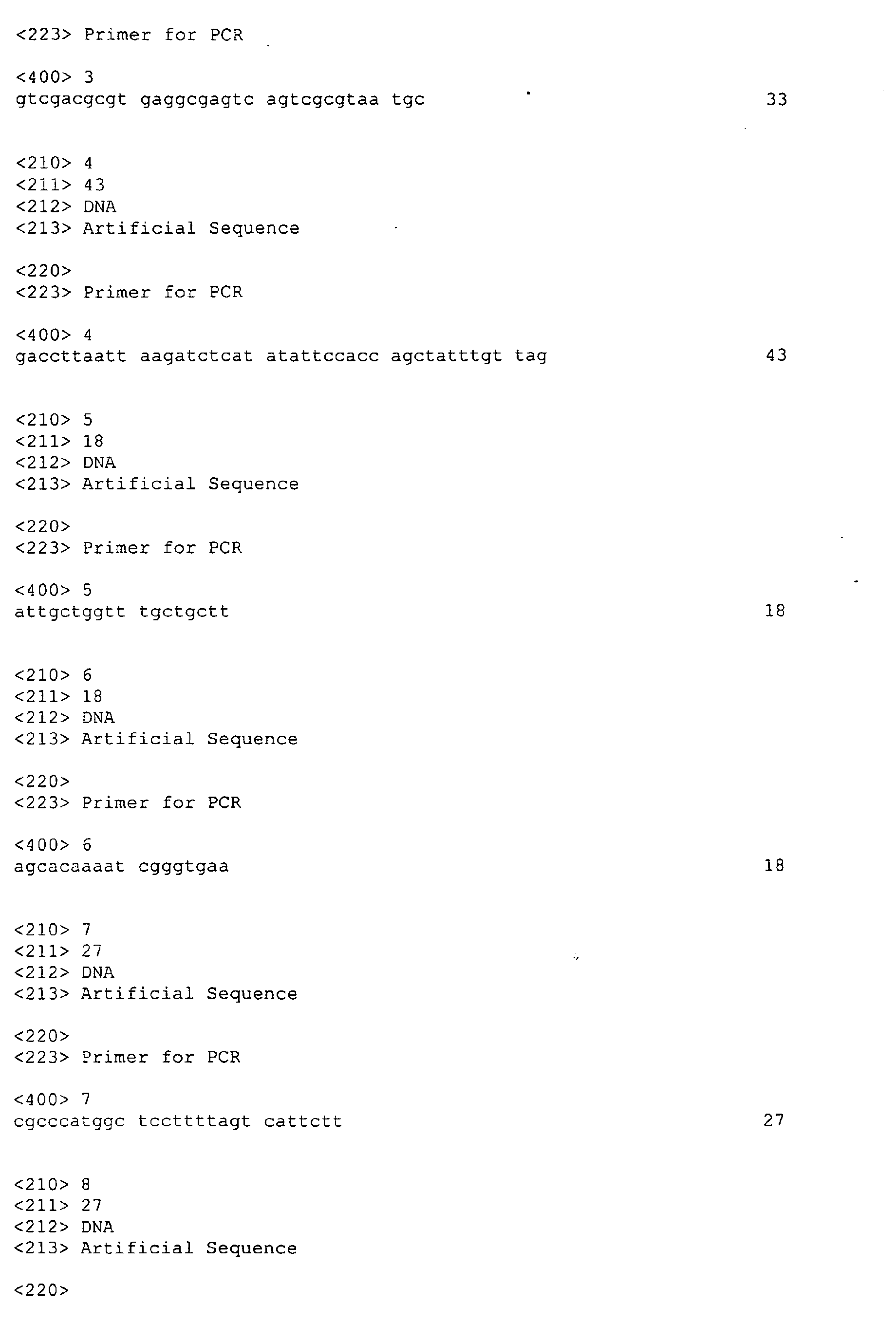
- a polymerase chain reaction with the primers was carried out and chromosomal DNA of E. coli strain W3110 (ATCC27325).
- the resulting DNA fragment was purified with the aid of agarose gel electrophoresis and then isolated (Qiaquick Gel Extraction Kit, Qiagen, Hilden, D).
- the fragment was then treated with the restriction enzymes PacI and MluI and cut into the pACYC184- vector, also cut with PacI / MluI.
- LH deposited according to the Budapest Treaty with the German Collection for Microorganisms and Cell Cultures, Braunschweig on August 18, 1995 under number DSM 10172.
- the new construct was named pKP228.
- the yjeH gene from Escherichia coli strain W3110 was amplified using the polymerase chain reaction.
- the oligonucleotides served as specific primers and and chromosomal DNA of the E. coli strain W3110 (ATCC27325) as a template.
- the resulting DNA fragment was purified by agarose gel electrophoresis and isolated (Qiaquick Gel Extraction Kit, Qiagen, Hilden, Germany).
- the cloning was carried out by blunt end ligation with a BglII-cut vector pKP228, the 5 'overhanging ends of which were filled in with Klenow enzyme.
- the yjeH gene is placed behind the GAPDH promoter in such a way that the transcription can be initiated from there.
- the resulting vector is called pKP450.
- pKP451 In order to produce a control plasmid with metA allele, but without the yjeH gene, the yjeH gene was deleted from pKP451.
- pKP451 was cut with Ecl136II and PacI, the overhanging ends were digested with Klenow enzyme and the vector was religated.
- the plasmid obtained in this way is called pKP446AC.
- the metJ / B genes were generated by polymerase chain reaction with the primers and and chromosomal DNA from Escherichia coli W3110 (ATCC27325) amplified.
- the 3.73 kilobase-containing fragment was purified, digested with the restriction endonuclease NotI and cloned into the NotI-cut vector pACYC184-LH (see Example 1).
- a kanamycin resistance cassette was then inserted into the metJ gene at the internal AflIII site. For this purpose, it was first digested with AflIII and smooth ends were produced with Klenow enzyme.
- the kanamycin cassette was again obtained from the vector pUK4K (Amersham Pharmacia Biotech, Freiburg, D) by PvuII restriction and inserted into the metJ gene by ligation. From the vector pKP440 produced in this way, the metJ :: kan cassette was then obtained as a linear fragment by NotI restriction and was used according to the method of Winans et al. (J. Bacteriol. 1985, 161: 1219-1221) chromosomally integrated into the recBC / sbcB strain JC7623 (E.coli Genetic Stock Center CGSC5188).
- the metJ :: kan mutation was finally transduced into the wild-type strain W3110 (ATCC27325) by P1 transduction (Miller, 1972, Cold Spring Harbor Laboratory, New York, pp. 201-205) and the strain W3110 ⁇ J was thus generated.
- the strain W3110 ⁇ J was transformed with the yjeH-carrying plasmids and the control plasmids, respectively, and corresponding transformants were selected with tetracycline.
- 20 ml LB medium (10 g / l tryptone, 5 g / l yeast extract, 10 g / l NaCl), which also contained 15 mg / l tetracycline, were inoculated with the production strains and at 30 ° C. and Incubated 150 rpm in a shaker.
- SM1 medium (12 g / l K 2 HPO 4 ; 3 g / l KH 2 PO 4 ; 5 g / l (NH 4 ) 2 SO 4 ; 0.3 g / l MgSO 4 x 7 H 2 O; 0.015 g / l CaCl 2 x 2 H 2 O; 0.002 g / l FeSO 4 x 7 H 2 O; 1 g / l Na 3 citrate x 2 H 2 O; 0.1 g / l NaCl; 1 ml / l trace element solution consisting of 0.15 g / l Na 2 MoO 4 x 2 H 2 O; 2.5 g / l Na 3 BO 3 ; 0.7 g / l CoCl 2 x 6 H 2 O ; 0.25 g / l CuSO 4 x 5 H 2 O; 1.6 g / l MnCl 2 x 4 H 2
- a Biostat B device from Braun Biotech (Melsungen, D) with a maximum culture volume of 2 l was used as the fermenter.
- the fermenter with 900 ml SM1 -Medium containing 15 g / l glucose, 10 g / l tryptone, 5 g / l yeast extract, 3 g / l Na 2 S 2 O 3 x5H 2 0, 0.5 mg / l vitamin B 1 , 30 mg / l Vitamin B 12 and 15 mg / l tetracycline was supplemented, inoculated.
- the culture was gassed with sterilized compressed air at 5 vol / vol / min and stirred with a stirrer speed of 400 rpm. After the oxygen saturation had dropped to a value of 50%, the speed was increased up to a value of 1500 rpm using a control device in order to obtain 50% oxygen saturation (determined using a pO 2 probe, calibrated to 100% saturation at 900 rpm). As soon as the glucose content in the fermenter had dropped from an initial 15 g / l to approx. 5-10 g / l, a 56% glucose solution was added.
- Feeding was carried out at a flow rate of 6-12 ml / h, the glucose concentration in the fermenter being kept constant between 0.5-10 g / l.
- the glucose determination was carried out using the glucose analyzer from YSI (Yellow Springs, Ohio, USA).
- the fermentation time was 48 hours. After this time, samples were taken and the cells were separated from the culture medium by centrifugation.
- the resulting culture supernatants were analyzed by reversed phase HPLC on a LUNA 5 ⁇ C18 (2) column (Phenomenex, Aillesburg, Germany) at a flow rate of 0.5 ml / min. Diluted phosphoric acid (0.1 ml concentrated phosphoric acid / 1) was used as the eluent.
- Table 1 shows the levels of L-methionine achieved in the culture supernatant. tribe Genotype (plasmid) L-methionine [g / l] W3110 ⁇ J / pKP228 - ⁇ 0.1 g / l W3110 ⁇ J / pKP450 yjeH 0.8 g / l W3110 ⁇ J / pKP451 metA fbr yjeH 4.8 g / l W3110 ⁇ J / pKP446AC metA fbr 0.9 g / l fbr: feedback resistant
Landscapes
- Organic Chemistry (AREA)
- Chemical & Material Sciences (AREA)
- Engineering & Computer Science (AREA)
- Zoology (AREA)
- Life Sciences & Earth Sciences (AREA)
- Wood Science & Technology (AREA)
- Chemical Kinetics & Catalysis (AREA)
- Microbiology (AREA)
- General Chemical & Material Sciences (AREA)
- Biotechnology (AREA)
- Health & Medical Sciences (AREA)
- Biochemistry (AREA)
- Bioinformatics & Cheminformatics (AREA)
- General Engineering & Computer Science (AREA)
- General Health & Medical Sciences (AREA)
- Genetics & Genomics (AREA)
- Preparation Of Compounds By Using Micro-Organisms (AREA)
- Micro-Organisms Or Cultivation Processes Thereof (AREA)
Abstract
Description
- metA-Allele wie beschrieben in einer Anmeldung des gleichen Anmelders vom 11.10.2002 oder in JP2000139471A. Diese metA-Allele kodieren für O-Homoserin-Transsuccinylasen, die einer verminderten Feedback-Hemmung durch L-Methionin unterliegen. Dadurch wird die Bildung von O-Succinylhomoserin weitgehend vom Methionin-Spiegel der Zelle entkoppelt.
- metJ-Deletion wie beschrieben in JP2000139471A
Das metJ-Gen kodiert für einen zentralen Genregulator des Methioninstoffwechsels und spielt somit eine entscheidende Rolle bei der Expressionskontrolle der Methionin-Biosynthesegene.
- eine metJ-Deletion(wie in JP2000139471A beschrieben) oder
- Allele, die eine verbesserte Serin-Bereitstellung bewirken, wie feedbackresistente serA-Varianten (wie beispielsweise in EP0620853B1 oder EP0931833A2 beschrieben)
- oder Gene, die eine verbesserte Cystein-Bereitstellung bewirken, wie feedbackresistente cysE-Varianten (wie beispielsweise in WO 97/15673 beschrieben)


Um ein Kontrollplasmid mit metA-Allel, aber ohne yjeH-Gen, herzustellen, wurde das yjeH-Gen aus pKP451 deletiert. Dazu wurde pKP451 mit Ecl136II und PacI geschnitten, die überhängenden Enden mit Klenow-Enzym abgedaut und der Vektor religiert. Das so erhaltene Plasmid trägt die Bezeichnung pKP446AC.


Nach der Verifizierung der metJ::kan-Insertion wurde der Stamm W3110ΔJ jeweils mit den yjeH-tragenden Plasmiden bzw. den Kontrollplasmiden transformiert und entsprechende Transformanten mit Tetracyclin selektiert.
| Stamm | Genotyp (Plasmid) | L-Methionin [g/l] |
| W3110ΔJ / pKP228 | - | < 0,1 g/l |
| W3110ΔJ / pKP450 | yjeH | 0,8 g/l |
| W3110ΔJ / pKP451 | metAfbr yjeH | 4,8 g/l |
| W3110ΔJ / pKP446AC | metAfbr | 0,9 g/l |
| fbr: feedbackresistent |



Claims (15)
- Mikroorganismenstamm, der zur fermentativen Herstellung von L-Methionin geeignet ist, herstellbar aus einem Ausgangsstamm, dadurch gekennzeichnet, dass er eine gegenüber dem Ausgangsstamm erhöhte Aktivität eines yjeH-Genprodukts oder eines Genprodukts eines yjeH-Homologs aufweist.
- Mikroorganismenstamm gemäß Anspruch 1, dadurch gekennzeichnet, dass es sich um einen Pilz, eine Hefe oder ein Bakterium, vorzugsweise aus der Familie Enterobacteriaceae, insbesondere bevorzugt der Art Escherichia coli, handelt.
- Mikroorganismenstamm gemäß Anspruch 1 oder 2, dadurch gekennzeichnet, dass die Kopienzahl das yjeH-Gens in dem Mikroorganismus erhöht ist oder die Expression des yjeH-Gens durch Einsatz geeigneter Promotoren oder Translationssignale gesteigert wurde.
- Mikroorganismenstamm gemäß Anspruch 3, dadurch gekennzeichnet, dass der Promotor ausgewählt ist aus der Gruppe konstitutiver GAPDH-Promotor des gapA-Gens, induzierbarer lac-, tac-, trc-, lambda-, ara und tet-Promotor.
- Mikroorganismenstamm gemäß einem der Ansprüche 1 bis 4, dadurch gekennzeichnet, dass es sich um einen Escherichia coli Stamm handelt, bei dem die erhöhte Aktivität eines yjeH-Genprodukts auf der Erhöhung der Kopienzahl des yjeH-Gens in einem pACYC-Derivat beruht.
- Plasmid, dadurch gekennzeichnet, dass es ein yjeH-Gen mit einem Promotor enthält.
- Plasmid gemäß Anspruch 6, dadurch gekennzeichnet, dass es zusätzlich ein genetisches Element zur Deregulierung des Methioninstoffwechsels enthält.
- Verfahren zur Herstellung eines Mikroorganismenstammes gemäß einem der Ansprüche 1 bis 5, dadurch gekennzeichnet, dass in einen Ausgangsstamm ein Plasmid gemäß Anspruch 6 oder 7 eingebracht wird.
- Verfahren zur Herstellung von L-Methionin, dadurch gekennzeichnet, dass ein Mikroorganismenstamm gemäß einem der Ansprüche 1 bis 5 in einer Fermentation eingesetzt und L-Methionin aus dem Fermentationsansatz abgetrennt wird.
- Verfahren gemäß Anspruch 9, dadurch gekennzeichnet, dass der Mikroorganismenstamm in einem Fermenter als kontinuierliche Kultur, als batch-Kultur oder vorzugsweise als fed-batch-Kultur angezogen wird.
- Verfahren nach Anspruch 9 oder 10, dadurch gekennzeichnet, dass eine C-Quelle während der Fermentation kontinuierlich zudosiert wird.
- Verfahren nach einem der Ansprüche 9 bis 11, dadurch gekennzeichnet, dass als C-Quelle Zucker, Zuckeralkohole oder organische Säuren dienen.
- Verfahren nach einem der Ansprüche 9 bis 12, dadurch gekennzeichnet, dass die Dosierung der C-Quelle in einer Form erfolgt, die gewährleistet, dass der Gehalt an C-Quelle im Fermenter während der Fermentation in einem Bereich von 0,1 - 50 g/l, besonders bevorzugt ist ein Bereich von 0,5 - 10 g/l, gehalten wird.
- Verfahren nach einem der Ansprüche 9 bis 13, dadurch gekennzeichnet, dass als N-Quelle Ammoniak, Ammoniumsalze oder Proteinhydrolysate verwendet werden.
- Verfahren nach einem der Ansprüche 9 bis 14, dadurch gekennzeichnet, dass die Fermentation unter aeroben Wachstumsbedingungen erfolgt.
Applications Claiming Priority (2)
| Application Number | Priority Date | Filing Date | Title |
|---|---|---|---|
| DE10305774 | 2003-02-06 | ||
| DE10305774A DE10305774A1 (de) | 2003-02-06 | 2003-02-06 | Verfahren zur fermentativen Herstellung von L-Methionin |
Publications (3)
| Publication Number | Publication Date |
|---|---|
| EP1445310A1 true EP1445310A1 (de) | 2004-08-11 |
| EP1445310B1 EP1445310B1 (de) | 2006-05-17 |
| EP1445310B2 EP1445310B2 (de) | 2016-06-29 |
Family
ID=32603233
Family Applications (1)
| Application Number | Title | Priority Date | Filing Date |
|---|---|---|---|
| EP04001958.0A Expired - Lifetime EP1445310B2 (de) | 2003-02-06 | 2004-01-29 | Verfahren zur fermentativen Herstellung von L-Methionin |
Country Status (9)
| Country | Link |
|---|---|
| US (1) | US20090298135A1 (de) |
| EP (1) | EP1445310B2 (de) |
| JP (1) | JP2004236660A (de) |
| CN (1) | CN100510057C (de) |
| AT (1) | ATE326523T1 (de) |
| CA (1) | CA2456483A1 (de) |
| DE (2) | DE10305774A1 (de) |
| ES (1) | ES2268504T3 (de) |
| RU (1) | RU2280687C2 (de) |
Cited By (3)
| Publication number | Priority date | Publication date | Assignee | Title |
|---|---|---|---|---|
| WO2007077041A1 (en) * | 2006-01-04 | 2007-07-12 | Metabolic Explorer | Process for the preparation of methionine and its precursors homoserine or succinylhomoserine employing a microorganism with enhanced sulfate permease expression |
| WO2012098042A1 (de) | 2011-01-20 | 2012-07-26 | Evonik Degussa Gmbh | Verfahren zur fermentativen herstellung schwefelhaltiger aminosäuren |
| RU2676137C2 (ru) * | 2014-06-05 | 2018-12-26 | СиДжей ЧейлДжеданг Корпорейшн | Микроорганизм для продуцирования О-ацетилгомосерина и способ получения О-ацетилгомосерина с использованием этого микроорганизма |
Families Citing this family (18)
| Publication number | Priority date | Publication date | Assignee | Title |
|---|---|---|---|---|
| US20070026505A1 (en) * | 2005-06-17 | 2007-02-01 | Madden Kevin T | Amino acid and metabolite biosynthesis |
| CA2657135C (en) | 2006-07-27 | 2016-03-15 | Wyeth | High-cell density fed-batch fermentation process for producing recombinant protein |
| KR20080061801A (ko) * | 2006-12-28 | 2008-07-03 | 씨제이제일제당 (주) | L-메티오닌 생산능을 향상시키는 폴리펩타이드, 상기 폴리펩타이드를 과발현하는 미생물 및 상기 미생물을 이용한 l- 메티오닌 생산방법 |
| US7851180B2 (en) * | 2008-04-04 | 2010-12-14 | Cj Cheiljedang Corporation | Microorganism producing L-methionine precursor and the method of producing L-methionine precursor using the microorganism |
| BR112012016908B1 (pt) * | 2009-12-30 | 2020-03-31 | Evonik Degussa Gmbh | Linhagens e métodos para a produção de metionina |
| EP2628792A1 (de) | 2012-02-17 | 2013-08-21 | Evonik Industries AG | Zelle mit verringerter ppGppase-Aktivität |
| PL2700715T3 (pl) | 2012-08-20 | 2019-03-29 | Evonik Degussa Gmbh | Sposób fermentacyjnego wytwarzania L-aminokwasów z zastosowaniem ulepszonych szczepów z rodziny Enterobacteriaceae |
| AU2013318047A1 (en) | 2012-09-19 | 2015-03-12 | Genentech, Inc. | Methods and compositions for preventing norleucine misincorporation into proteins |
| KR101555749B1 (ko) * | 2013-10-23 | 2015-09-25 | 씨제이제일제당 (주) | O-숙시닐호모세린 생산 미생물 및 이를 이용한 o-숙시닐호모세린의 생산방법 |
| KR101555750B1 (ko) * | 2013-10-23 | 2015-09-25 | 씨제이제일제당 (주) | O-숙시닐호모세린 생산 미생물 및 이를 이용한 o-숙시닐호모세린의 생산방법 |
| KR101565213B1 (ko) * | 2013-10-23 | 2015-11-03 | 씨제이제일제당 (주) | O-숙시닐호모세린 생산 미생물 및 이를 이용한 o-숙시닐호모세린의 생산방법 |
| ES2906229T3 (es) * | 2015-06-04 | 2022-04-13 | Cj Cheiljedang Corp | Microorganismo productor de O-acetil-homoserina, y método para producir O-acetil-homoserina mediante el uso de este |
| KR101851452B1 (ko) | 2016-07-18 | 2018-04-24 | 씨제이제일제당 (주) | O-아세틸-호모세린을 생산하는 미생물 및 이를 이용하여 o-아세틸-호모세린을 생산하는 방법 |
| WO2019011942A1 (en) | 2017-07-11 | 2019-01-17 | Adisseo France S.A.S. | YEAST PRODUCING METHIONINE |
| JP7491312B2 (ja) * | 2018-12-27 | 2024-05-28 | 味の素株式会社 | 腸内細菌科の細菌の発酵による塩基性l-アミノ酸またはその塩の製造方法 |
| KR102472559B1 (ko) | 2019-06-28 | 2022-12-01 | 씨제이제일제당 주식회사 | 황 함유 아미노산 또는 그 유도체의 제조방법 |
| KR102472558B1 (ko) | 2019-06-28 | 2022-12-01 | 씨제이제일제당 주식회사 | 황 함유 아미노산 또는 그 유도체 제조방법 |
| CN116590209A (zh) | 2023-06-13 | 2023-08-15 | 浙江工业大学 | 一种产d-泛酸的基因工程菌、构建方法及应用 |
Citations (2)
| Publication number | Priority date | Publication date | Assignee | Title |
|---|---|---|---|---|
| EP0885962A1 (de) * | 1997-06-19 | 1998-12-23 | Consortium für elektrochemische Industrie GmbH | Mikroorganismen und Verfahren zur fermentativen Herstellung von L-Cystein, L-Cystin, N-Acetyl-Serin oder Thiazolindinderivaten |
| JP2000139471A (ja) * | 1998-11-17 | 2000-05-23 | Ajinomoto Co Inc | 発酵法によるl−メチオニンの製造法 |
Family Cites Families (6)
| Publication number | Priority date | Publication date | Assignee | Title |
|---|---|---|---|---|
| RU2133772C1 (ru) * | 1993-08-24 | 1999-07-27 | Адзиномото Ко., Инк. | Модифицированная фосфоенолпируваткарбоксилаза, фрагмент днк, штамм escherichia coli, рекомбинантная днк, способ получения аминокислоты (варианты), способ селекции клеток escherichia coli, способ получения модифицированной фосфоенолпируваткарбоксилазы, способ получения фрагмента днк и способ получения микроорганизма |
| DE10109689A1 (de) * | 2000-08-02 | 2002-02-21 | Degussa | Neue für das metE-Gen kodierende Nukleotidsequenzen |
| DE10109687A1 (de) * | 2000-08-02 | 2002-02-21 | Degussa | Neue für das metH-Gen kodierende Nukleotidsequenzen |
| DE10136986A1 (de) * | 2000-09-03 | 2002-03-21 | Degussa | Für Gene cysD, cysN, cysK, cysE und cysH kodierende Nukleotidsequenzen |
| DE10105686A1 (de) * | 2001-02-08 | 2002-09-05 | Infineon Technologies Ag | Verfahren zum Herstellen einer Kondensatoranordnung für eine Halbleiterspeichereinrichtung |
| DE10126164A1 (de) * | 2001-05-30 | 2002-12-05 | Degussa | Für das metD-gen kodierende Nukleotidsequenzen |
-
2003
- 2003-02-06 DE DE10305774A patent/DE10305774A1/de not_active Withdrawn
-
2004
- 2004-01-29 AT AT04001958T patent/ATE326523T1/de active
- 2004-01-29 ES ES04001958T patent/ES2268504T3/es not_active Expired - Lifetime
- 2004-01-29 DE DE502004000547T patent/DE502004000547D1/de not_active Expired - Lifetime
- 2004-01-29 EP EP04001958.0A patent/EP1445310B2/de not_active Expired - Lifetime
- 2004-01-30 CA CA002456483A patent/CA2456483A1/en not_active Abandoned
- 2004-01-30 US US10/768,528 patent/US20090298135A1/en not_active Abandoned
- 2004-02-04 JP JP2004028554A patent/JP2004236660A/ja active Pending
- 2004-02-06 CN CNB200410003833XA patent/CN100510057C/zh not_active Expired - Fee Related
- 2004-02-06 RU RU2004103494/13A patent/RU2280687C2/ru not_active IP Right Cessation
Patent Citations (2)
| Publication number | Priority date | Publication date | Assignee | Title |
|---|---|---|---|---|
| EP0885962A1 (de) * | 1997-06-19 | 1998-12-23 | Consortium für elektrochemische Industrie GmbH | Mikroorganismen und Verfahren zur fermentativen Herstellung von L-Cystein, L-Cystin, N-Acetyl-Serin oder Thiazolindinderivaten |
| JP2000139471A (ja) * | 1998-11-17 | 2000-05-23 | Ajinomoto Co Inc | 発酵法によるl−メチオニンの製造法 |
Non-Patent Citations (5)
| Title |
|---|
| BLATTNER ET AL: "Reference No.: A64720", SCIENCE, AMERICAN ASSOCIATION FOR THE ADVANCEMENT OF SCIENCE,, US, vol. 277, 5 September 1997 (1997-09-05), pages 1453 - 1462, XP002108437, ISSN: 0036-8075 * |
| BURLAND V ET AL: "ANALYSIS OF THE ESCHERICHIA COLI GENOME VI: DNA SEQUENCE OF THE REGION FROM 92.8 THROUGH 100 MINUTES", NUCLEIC ACIDS RESEARCH, OXFORD UNIVERSITY PRESS, SURREY, GB, vol. 23, no. 12, 25 June 1995 (1995-06-25), pages 2105 - 2119, XP000612159, ISSN: 0305-1048 * |
| HAMILTON ET AL: "NEW METHOD FOR GENERATING DELETIONS AND GENE REPLACEMENT IN ESCHERICHIA COLI", JOURNAL OF BACTERIOLOGY, WASHINGTON, DC, US, vol. 171, no. 9, September 1989 (1989-09-01), pages 4617 - 4622, XP002119417, ISSN: 0021-9193 * |
| MAKRIDES: "Strategies for Achieving High-Level Expression of Genes in Escherichia coli", MICROBIOLOGICAL REVIEWS, AMERICAN SOCIETY FOR MICROBIOLOGY, WASHINGTON, DC, US, vol. 60, no. 3, 1 September 1996 (1996-09-01), pages 512 - 538, XP002095235, ISSN: 0146-0749 * |
| PATENT ABSTRACTS OF JAPAN vol. 2000, no. 08 6 October 2000 (2000-10-06) * |
Cited By (7)
| Publication number | Priority date | Publication date | Assignee | Title |
|---|---|---|---|---|
| WO2007077041A1 (en) * | 2006-01-04 | 2007-07-12 | Metabolic Explorer | Process for the preparation of methionine and its precursors homoserine or succinylhomoserine employing a microorganism with enhanced sulfate permease expression |
| US8389250B2 (en) | 2006-01-04 | 2013-03-05 | Metabolic Explorer | Methods for producing methionine by culturing a microorganism modified to enhance production of cysteine |
| US9187775B2 (en) | 2006-01-04 | 2015-11-17 | Metabolic Explorer | Methods for producing methionine by culturing a microorganism modified to enhance production of cysteine |
| WO2012098042A1 (de) | 2011-01-20 | 2012-07-26 | Evonik Degussa Gmbh | Verfahren zur fermentativen herstellung schwefelhaltiger aminosäuren |
| EP2665826B1 (de) | 2011-01-20 | 2017-11-01 | Evonik Degussa GmbH | Verfahren zur fermentativen herstellung schwefelhaltiger aminosäuren |
| RU2676137C2 (ru) * | 2014-06-05 | 2018-12-26 | СиДжей ЧейлДжеданг Корпорейшн | Микроорганизм для продуцирования О-ацетилгомосерина и способ получения О-ацетилгомосерина с использованием этого микроорганизма |
| RU2710323C2 (ru) * | 2014-06-05 | 2019-12-25 | СиДжей ЧейлДжеданг Корпорейшн | Микроорганизм для продуцирования O-ацетилгомосерина и способ получения O-ацетилгомосерина с использованием этого микроорганизма |
Also Published As
| Publication number | Publication date |
|---|---|
| JP2004236660A (ja) | 2004-08-26 |
| DE10305774A1 (de) | 2004-08-26 |
| CN1539983A (zh) | 2004-10-27 |
| RU2280687C2 (ru) | 2006-07-27 |
| RU2004103494A (ru) | 2005-07-27 |
| ATE326523T1 (de) | 2006-06-15 |
| EP1445310B1 (de) | 2006-05-17 |
| DE502004000547D1 (de) | 2006-06-22 |
| EP1445310B2 (de) | 2016-06-29 |
| ES2268504T3 (es) | 2007-03-16 |
| US20090298135A1 (en) | 2009-12-03 |
| CN100510057C (zh) | 2009-07-08 |
| CA2456483A1 (en) | 2004-08-06 |
Similar Documents
| Publication | Publication Date | Title |
|---|---|---|
| EP1382684B1 (de) | Verfahren zur fermentativen Herstellung von Aminosäuren und Aminosäure-Derivaten der Phosphoglycerat-Familie | |
| EP1445310B2 (de) | Verfahren zur fermentativen Herstellung von L-Methionin | |
| EP1220940B2 (de) | Verfahren zur fermentativen herstellung von l-cystein oder l-cystein-derivaten | |
| EP0858510B1 (de) | Verfahren zur herstellung von o-acetylserin, l-cystein und l-cystein-verwandten produkten | |
| DE602004008183T2 (de) | Verfahren zur Herstellung von L-Cystein unter Verwendung eines zur Gattung Escherichia gehörenden Bakteriums | |
| EP2700715B1 (de) | Verfahren zur fermentativen Herstellung von L-Aminosäuren unter Verwendung von verbesserten Stämmen der Familie Enterobacteriaceae | |
| EP2665826B1 (de) | Verfahren zur fermentativen herstellung schwefelhaltiger aminosäuren | |
| EP2726625B1 (de) | Verfahren zur fermentativen produktion von natürlichem l-cystein | |
| DE10331291A1 (de) | Varianten der 3-Phosphoglyceratdehydrogenase mit reduzierter Hemmung durch L-Serin und dafür codierende Gene | |
| EP1570066B1 (de) | Feedback-resistente homoserin-transsuccinylasen mit modifiziertem c-terminus | |
| DE102013209274A1 (de) | Mikroorganismus und Verfahren zur fermentativen Überproduktion von Gamma-Glutamylcystein und Derivaten dieses Dipeptids | |
| DE102011075656A1 (de) | Verfahren zur fermentativen Produktion von L-Cystin | |
| EP2089525B1 (de) | Allele des oxyr-gens aus coryneformen bakterien | |
| EP1700864A1 (de) | Verfahren zur fermentativen Herstellung von S-Adenosylmethionin | |
| EP1783230B1 (de) | Feedback-resistente Homoserin-Transsuccinylasen | |
| KR20080024226A (ko) | L-트레오닌의 생산 방법 | |
| DE102004009454A1 (de) | Verfahren zur fermentativen Herstellung von L-Aminosäuren unter Verwendung von rekombinanten Mikroorganismen | |
| EP1659174A2 (de) | Allele des metK-Gens aus coryneformen Bakterien | |
| EP2895597B1 (de) | Verfahren zur fermentativen produktion von l-cystein und derivaten dieser aminosäure | |
| DE102012208359A1 (de) | Verfahren zur fermentativen Produktion von L-Cystein und Derivaten dieser Aminosäure |
Legal Events
| Date | Code | Title | Description |
|---|---|---|---|
| PUAI | Public reference made under article 153(3) epc to a published international application that has entered the european phase |
Free format text: ORIGINAL CODE: 0009012 |
|
| 17P | Request for examination filed |
Effective date: 20040129 |
|
| AK | Designated contracting states |
Kind code of ref document: A1 Designated state(s): AT BE BG CH CY CZ DE DK EE ES FI FR GB GR HU IE IT LI LU MC NL PT RO SE SI SK TR |
|
| AX | Request for extension of the european patent |
Extension state: AL LT LV MK |
|
| AKX | Designation fees paid |
Designated state(s): AT BE BG CH CY CZ DE DK EE ES FI FR GB GR HU IE IT LI LU MC NL PT RO SE SI SK TR |
|
| GRAP | Despatch of communication of intention to grant a patent |
Free format text: ORIGINAL CODE: EPIDOSNIGR1 |
|
| GRAS | Grant fee paid |
Free format text: ORIGINAL CODE: EPIDOSNIGR3 |
|
| GRAA | (expected) grant |
Free format text: ORIGINAL CODE: 0009210 |
|
| AK | Designated contracting states |
Kind code of ref document: B1 Designated state(s): AT BE BG CH CY CZ DE DK EE ES FI FR GB GR HU IE IT LI LU MC NL PT RO SE SI SK TR |
|
| PG25 | Lapsed in a contracting state [announced via postgrant information from national office to epo] |
Ref country code: IT Free format text: LAPSE BECAUSE OF FAILURE TO SUBMIT A TRANSLATION OF THE DESCRIPTION OR TO PAY THE FEE WITHIN THE PRESCRIBED TIME-LIMIT;WARNING: LAPSES OF ITALIAN PATENTS WITH EFFECTIVE DATE BEFORE 2007 MAY HAVE OCCURRED AT ANY TIME BEFORE 2007. THE CORRECT EFFECTIVE DATE MAY BE DIFFERENT FROM THE ONE RECORDED. Effective date: 20060517 Ref country code: RO Free format text: LAPSE BECAUSE OF FAILURE TO SUBMIT A TRANSLATION OF THE DESCRIPTION OR TO PAY THE FEE WITHIN THE PRESCRIBED TIME-LIMIT Effective date: 20060517 Ref country code: SI Free format text: LAPSE BECAUSE OF FAILURE TO SUBMIT A TRANSLATION OF THE DESCRIPTION OR TO PAY THE FEE WITHIN THE PRESCRIBED TIME-LIMIT Effective date: 20060517 Ref country code: FI Free format text: LAPSE BECAUSE OF FAILURE TO SUBMIT A TRANSLATION OF THE DESCRIPTION OR TO PAY THE FEE WITHIN THE PRESCRIBED TIME-LIMIT Effective date: 20060517 Ref country code: CZ Free format text: LAPSE BECAUSE OF FAILURE TO SUBMIT A TRANSLATION OF THE DESCRIPTION OR TO PAY THE FEE WITHIN THE PRESCRIBED TIME-LIMIT Effective date: 20060517 |
|
| REG | Reference to a national code |
Ref country code: GB Ref legal event code: FG4D Free format text: NOT ENGLISH |
|
| REG | Reference to a national code |
Ref country code: CH Ref legal event code: EP |
|
| REG | Reference to a national code |
Ref country code: IE Ref legal event code: FG4D Free format text: LANGUAGE OF EP DOCUMENT: GERMAN |
|
| REF | Corresponds to: |
Ref document number: 502004000547 Country of ref document: DE Date of ref document: 20060622 Kind code of ref document: P |
|
| PG25 | Lapsed in a contracting state [announced via postgrant information from national office to epo] |
Ref country code: SE Free format text: LAPSE BECAUSE OF FAILURE TO SUBMIT A TRANSLATION OF THE DESCRIPTION OR TO PAY THE FEE WITHIN THE PRESCRIBED TIME-LIMIT Effective date: 20060817 Ref country code: DK Free format text: LAPSE BECAUSE OF FAILURE TO SUBMIT A TRANSLATION OF THE DESCRIPTION OR TO PAY THE FEE WITHIN THE PRESCRIBED TIME-LIMIT Effective date: 20060817 |
|
| GBT | Gb: translation of ep patent filed (gb section 77(6)(a)/1977) |
Effective date: 20060829 |
|
| PG25 | Lapsed in a contracting state [announced via postgrant information from national office to epo] |
Ref country code: PT Free format text: LAPSE BECAUSE OF FAILURE TO SUBMIT A TRANSLATION OF THE DESCRIPTION OR TO PAY THE FEE WITHIN THE PRESCRIBED TIME-LIMIT Effective date: 20061017 |
|
| ET | Fr: translation filed | ||
| PGFP | Annual fee paid to national office [announced via postgrant information from national office to epo] |
Ref country code: IE Payment date: 20070129 Year of fee payment: 4 |
|
| PG25 | Lapsed in a contracting state [announced via postgrant information from national office to epo] |
Ref country code: MC Free format text: LAPSE BECAUSE OF NON-PAYMENT OF DUE FEES Effective date: 20070131 |
|
| PGFP | Annual fee paid to national office [announced via postgrant information from national office to epo] |
Ref country code: BE Payment date: 20070301 Year of fee payment: 4 |
|
| PLBI | Opposition filed |
Free format text: ORIGINAL CODE: 0009260 |
|
| REG | Reference to a national code |
Ref country code: ES Ref legal event code: FG2A Ref document number: 2268504 Country of ref document: ES Kind code of ref document: T3 |
|
| PLAX | Notice of opposition and request to file observation + time limit sent |
Free format text: ORIGINAL CODE: EPIDOSNOBS2 |
|
| 26 | Opposition filed |
Opponent name: METABOLIC EXPLORER Effective date: 20070215 |
|
| NLR1 | Nl: opposition has been filed with the epo |
Opponent name: METABOLIC EXPLORER |
|
| REG | Reference to a national code |
Ref country code: GB Ref legal event code: 732E |
|
| REG | Reference to a national code |
Ref country code: CH Ref legal event code: PUE Owner name: WACKER CHEMIE AG Free format text: CONSORTIUM FUER ELEKTROCHEMISCHE INDUSTRIE GMBH#ZIELSTATTSTRASSE 20#81379 MUENCHEN (DE) -TRANSFER TO- WACKER CHEMIE AG#HANNS-SEIDEL-PLATZ 4#81737 MUENCHEN (DE) |
|
| PLAF | Information modified related to communication of a notice of opposition and request to file observations + time limit |
Free format text: ORIGINAL CODE: EPIDOSCOBS2 |
|
| NLS | Nl: assignments of ep-patents |
Owner name: WACKER CHEMIE AG Effective date: 20070516 |
|
| REG | Reference to a national code |
Ref country code: FR Ref legal event code: TP |
|
| PLBB | Reply of patent proprietor to notice(s) of opposition received |
Free format text: ORIGINAL CODE: EPIDOSNOBS3 |
|
| BECA | Be: change of holder's address |
Owner name: *WACKER CHEMIE A.G.HANNS-SEIDEL-PLATZ 4, D-81737 M Effective date: 20060517 |
|
| BECH | Be: change of holder |
Owner name: *WACKER CHEMIE A.G. Effective date: 20060517 |
|
| PG25 | Lapsed in a contracting state [announced via postgrant information from national office to epo] |
Ref country code: GR Free format text: LAPSE BECAUSE OF FAILURE TO SUBMIT A TRANSLATION OF THE DESCRIPTION OR TO PAY THE FEE WITHIN THE PRESCRIBED TIME-LIMIT Effective date: 20060818 |
|
| PG25 | Lapsed in a contracting state [announced via postgrant information from national office to epo] |
Ref country code: BG Free format text: LAPSE BECAUSE OF FAILURE TO SUBMIT A TRANSLATION OF THE DESCRIPTION OR TO PAY THE FEE WITHIN THE PRESCRIBED TIME-LIMIT Effective date: 20060817 |
|
| BERE | Be: lapsed |
Owner name: *WACKER CHEMIE A.G. Effective date: 20080131 |
|
| PG25 | Lapsed in a contracting state [announced via postgrant information from national office to epo] |
Ref country code: EE Free format text: LAPSE BECAUSE OF FAILURE TO SUBMIT A TRANSLATION OF THE DESCRIPTION OR TO PAY THE FEE WITHIN THE PRESCRIBED TIME-LIMIT Effective date: 20060517 |
|
| PG25 | Lapsed in a contracting state [announced via postgrant information from national office to epo] |
Ref country code: IE Free format text: LAPSE BECAUSE OF NON-PAYMENT OF DUE FEES Effective date: 20080129 |
|
| PG25 | Lapsed in a contracting state [announced via postgrant information from national office to epo] |
Ref country code: BE Free format text: LAPSE BECAUSE OF NON-PAYMENT OF DUE FEES Effective date: 20080131 |
|
| PG25 | Lapsed in a contracting state [announced via postgrant information from national office to epo] |
Ref country code: CY Free format text: LAPSE BECAUSE OF FAILURE TO SUBMIT A TRANSLATION OF THE DESCRIPTION OR TO PAY THE FEE WITHIN THE PRESCRIBED TIME-LIMIT Effective date: 20060517 Ref country code: LU Free format text: LAPSE BECAUSE OF NON-PAYMENT OF DUE FEES Effective date: 20070129 |
|
| PG25 | Lapsed in a contracting state [announced via postgrant information from national office to epo] |
Ref country code: TR Free format text: LAPSE BECAUSE OF FAILURE TO SUBMIT A TRANSLATION OF THE DESCRIPTION OR TO PAY THE FEE WITHIN THE PRESCRIBED TIME-LIMIT Effective date: 20060517 Ref country code: HU Free format text: LAPSE BECAUSE OF FAILURE TO SUBMIT A TRANSLATION OF THE DESCRIPTION OR TO PAY THE FEE WITHIN THE PRESCRIBED TIME-LIMIT Effective date: 20061118 |
|
| APBM | Appeal reference recorded |
Free format text: ORIGINAL CODE: EPIDOSNREFNO |
|
| APBP | Date of receipt of notice of appeal recorded |
Free format text: ORIGINAL CODE: EPIDOSNNOA2O |
|
| APAH | Appeal reference modified |
Free format text: ORIGINAL CODE: EPIDOSCREFNO |
|
| APBQ | Date of receipt of statement of grounds of appeal recorded |
Free format text: ORIGINAL CODE: EPIDOSNNOA3O |
|
| PLAB | Opposition data, opponent's data or that of the opponent's representative modified |
Free format text: ORIGINAL CODE: 0009299OPPO |
|
| R26 | Opposition filed (corrected) |
Opponent name: METABOLIC EXPLORER Effective date: 20070215 |
|
| PGFP | Annual fee paid to national office [announced via postgrant information from national office to epo] |
Ref country code: AT Payment date: 20130111 Year of fee payment: 10 |
|
| REG | Reference to a national code |
Ref country code: AT Ref legal event code: MM01 Ref document number: 326523 Country of ref document: AT Kind code of ref document: T Effective date: 20140129 |
|
| PG25 | Lapsed in a contracting state [announced via postgrant information from national office to epo] |
Ref country code: AT Free format text: LAPSE BECAUSE OF NON-PAYMENT OF DUE FEES Effective date: 20140129 |
|
| PGFP | Annual fee paid to national office [announced via postgrant information from national office to epo] |
Ref country code: NL Payment date: 20150129 Year of fee payment: 12 |
|
| PGFP | Annual fee paid to national office [announced via postgrant information from national office to epo] |
Ref country code: ES Payment date: 20150128 Year of fee payment: 12 Ref country code: SK Payment date: 20150128 Year of fee payment: 12 Ref country code: IT Payment date: 20150126 Year of fee payment: 12 Ref country code: CH Payment date: 20150121 Year of fee payment: 12 |
|
| REG | Reference to a national code |
Ref country code: FR Ref legal event code: PLFP Year of fee payment: 13 |
|
| APBU | Appeal procedure closed |
Free format text: ORIGINAL CODE: EPIDOSNNOA9O |
|
| PUAH | Patent maintained in amended form |
Free format text: ORIGINAL CODE: 0009272 |
|
| STAA | Information on the status of an ep patent application or granted ep patent |
Free format text: STATUS: PATENT MAINTAINED AS AMENDED |
|
| 27A | Patent maintained in amended form |
Effective date: 20160629 |
|
| AK | Designated contracting states |
Kind code of ref document: B2 Designated state(s): AT BE BG CH CY CZ DE DK EE ES FI FR GB GR HU IE IT LI LU MC NL PT RO SE SI SK TR |
|
| REG | Reference to a national code |
Ref country code: DE Ref legal event code: R102 Ref document number: 502004000547 Country of ref document: DE |
|
| REG | Reference to a national code |
Ref country code: CH Ref legal event code: AELC |
|
| REG | Reference to a national code |
Ref country code: CH Ref legal event code: PL |
|
| REG | Reference to a national code |
Ref country code: SK Ref legal event code: MM4A Ref document number: E 708 Country of ref document: SK Effective date: 20160129 |
|
| REG | Reference to a national code |
Ref country code: NL Ref legal event code: MM Effective date: 20160201 |
|
| PG25 | Lapsed in a contracting state [announced via postgrant information from national office to epo] |
Ref country code: CH Free format text: LAPSE BECAUSE OF NON-PAYMENT OF DUE FEES Effective date: 20160131 Ref country code: LI Free format text: LAPSE BECAUSE OF NON-PAYMENT OF DUE FEES Effective date: 20160131 |
|
| PG25 | Lapsed in a contracting state [announced via postgrant information from national office to epo] |
Ref country code: NL Free format text: LAPSE BECAUSE OF NON-PAYMENT OF DUE FEES Effective date: 20160201 Ref country code: SK Free format text: LAPSE BECAUSE OF NON-PAYMENT OF DUE FEES Effective date: 20160129 |
|
| PG25 | Lapsed in a contracting state [announced via postgrant information from national office to epo] |
Ref country code: IT Free format text: LAPSE BECAUSE OF NON-PAYMENT OF DUE FEES Effective date: 20160129 |
|
| REG | Reference to a national code |
Ref country code: FR Ref legal event code: PLFP Year of fee payment: 14 |
|
| PG25 | Lapsed in a contracting state [announced via postgrant information from national office to epo] |
Ref country code: ES Free format text: LAPSE BECAUSE OF FAILURE TO SUBMIT A TRANSLATION OF THE DESCRIPTION OR TO PAY THE FEE WITHIN THE PRESCRIBED TIME-LIMIT Effective date: 20160629 |
|
| REG | Reference to a national code |
Ref country code: FR Ref legal event code: PLFP Year of fee payment: 15 |
|
| PGFP | Annual fee paid to national office [announced via postgrant information from national office to epo] |
Ref country code: FR Payment date: 20190123 Year of fee payment: 16 Ref country code: GB Payment date: 20190121 Year of fee payment: 16 Ref country code: DE Payment date: 20190123 Year of fee payment: 16 |
|
| REG | Reference to a national code |
Ref country code: DE Ref legal event code: R119 Ref document number: 502004000547 Country of ref document: DE |
|
| GBPC | Gb: european patent ceased through non-payment of renewal fee |
Effective date: 20200129 |
|
| PG25 | Lapsed in a contracting state [announced via postgrant information from national office to epo] |
Ref country code: GB Free format text: LAPSE BECAUSE OF NON-PAYMENT OF DUE FEES Effective date: 20200129 Ref country code: DE Free format text: LAPSE BECAUSE OF NON-PAYMENT OF DUE FEES Effective date: 20200801 Ref country code: FR Free format text: LAPSE BECAUSE OF NON-PAYMENT OF DUE FEES Effective date: 20200131 |