EP1445937A2 - Laserdruckgerät - Google Patents
Laserdruckgerät Download PDFInfo
- Publication number
- EP1445937A2 EP1445937A2 EP04250617A EP04250617A EP1445937A2 EP 1445937 A2 EP1445937 A2 EP 1445937A2 EP 04250617 A EP04250617 A EP 04250617A EP 04250617 A EP04250617 A EP 04250617A EP 1445937 A2 EP1445937 A2 EP 1445937A2
- Authority
- EP
- European Patent Office
- Prior art keywords
- laser diode
- sync signal
- offset value
- sensor
- laser
- Prior art date
- Legal status (The legal status is an assumption and is not a legal conclusion. Google has not performed a legal analysis and makes no representation as to the accuracy of the status listed.)
- Ceased
Links
Images






Classifications
-
- H—ELECTRICITY
- H04—ELECTRIC COMMUNICATION TECHNIQUE
- H04N—PICTORIAL COMMUNICATION, e.g. TELEVISION
- H04N1/00—Scanning, transmission or reproduction of documents or the like, e.g. facsimile transmission; Details thereof
- H04N1/04—Scanning arrangements, i.e. arrangements for the displacement of active reading or reproducing elements relative to the original or reproducing medium, or vice versa
- H04N1/047—Detection, control or error compensation of scanning velocity or position
- H04N1/053—Detection, control or error compensation of scanning velocity or position in main scanning direction, e.g. synchronisation of line start or picture elements in a line
-
- H—ELECTRICITY
- H04—ELECTRIC COMMUNICATION TECHNIQUE
- H04N—PICTORIAL COMMUNICATION, e.g. TELEVISION
- H04N1/00—Scanning, transmission or reproduction of documents or the like, e.g. facsimile transmission; Details thereof
- H04N1/04—Scanning arrangements, i.e. arrangements for the displacement of active reading or reproducing elements relative to the original or reproducing medium, or vice versa
- H04N1/113—Scanning arrangements, i.e. arrangements for the displacement of active reading or reproducing elements relative to the original or reproducing medium, or vice versa using oscillating or rotating mirrors
- H04N1/1135—Scanning arrangements, i.e. arrangements for the displacement of active reading or reproducing elements relative to the original or reproducing medium, or vice versa using oscillating or rotating mirrors for the main-scan only
-
- H—ELECTRICITY
- H04—ELECTRIC COMMUNICATION TECHNIQUE
- H04N—PICTORIAL COMMUNICATION, e.g. TELEVISION
- H04N1/00—Scanning, transmission or reproduction of documents or the like, e.g. facsimile transmission; Details thereof
- H04N1/04—Scanning arrangements, i.e. arrangements for the displacement of active reading or reproducing elements relative to the original or reproducing medium, or vice versa
- H04N1/12—Scanning arrangements, i.e. arrangements for the displacement of active reading or reproducing elements relative to the original or reproducing medium, or vice versa using the sheet-feed movement or the medium-advance or the drum-rotation movement as the slow scanning component, e.g. arrangements for the main-scanning
-
- H—ELECTRICITY
- H04—ELECTRIC COMMUNICATION TECHNIQUE
- H04N—PICTORIAL COMMUNICATION, e.g. TELEVISION
- H04N1/00—Scanning, transmission or reproduction of documents or the like, e.g. facsimile transmission; Details thereof
- H04N1/04—Scanning arrangements, i.e. arrangements for the displacement of active reading or reproducing elements relative to the original or reproducing medium, or vice versa
- H04N1/19—Scanning arrangements, i.e. arrangements for the displacement of active reading or reproducing elements relative to the original or reproducing medium, or vice versa using multi-element arrays
- H04N1/191—Scanning arrangements, i.e. arrangements for the displacement of active reading or reproducing elements relative to the original or reproducing medium, or vice versa using multi-element arrays the array comprising a one-dimensional [1D] array
- H04N1/1911—Simultaneously or substantially simultaneously scanning picture elements on more than one main scanning line, e.g. scanning in swaths
-
- H—ELECTRICITY
- H04—ELECTRIC COMMUNICATION TECHNIQUE
- H04N—PICTORIAL COMMUNICATION, e.g. TELEVISION
- H04N2201/00—Indexing scheme relating to scanning, transmission or reproduction of documents or the like, and to details thereof
- H04N2201/024—Indexing scheme relating to scanning, transmission or reproduction of documents or the like, and to details thereof deleted
- H04N2201/02406—Arrangements for positioning elements within a head
- H04N2201/02439—Positioning method
-
- H—ELECTRICITY
- H04—ELECTRIC COMMUNICATION TECHNIQUE
- H04N—PICTORIAL COMMUNICATION, e.g. TELEVISION
- H04N2201/00—Indexing scheme relating to scanning, transmission or reproduction of documents or the like, and to details thereof
- H04N2201/04—Scanning arrangements
- H04N2201/047—Detection, control or error compensation of scanning velocity or position
- H04N2201/04701—Detection of scanning velocity or position
- H04N2201/0471—Detection of scanning velocity or position using dedicated detectors
-
- H—ELECTRICITY
- H04—ELECTRIC COMMUNICATION TECHNIQUE
- H04N—PICTORIAL COMMUNICATION, e.g. TELEVISION
- H04N2201/00—Indexing scheme relating to scanning, transmission or reproduction of documents or the like, and to details thereof
- H04N2201/04—Scanning arrangements
- H04N2201/047—Detection, control or error compensation of scanning velocity or position
- H04N2201/04701—Detection of scanning velocity or position
- H04N2201/04732—Detecting at infrequent intervals, e.g. once or twice per line for main-scan control
-
- H—ELECTRICITY
- H04—ELECTRIC COMMUNICATION TECHNIQUE
- H04N—PICTORIAL COMMUNICATION, e.g. TELEVISION
- H04N2201/00—Indexing scheme relating to scanning, transmission or reproduction of documents or the like, and to details thereof
- H04N2201/04—Scanning arrangements
- H04N2201/047—Detection, control or error compensation of scanning velocity or position
- H04N2201/04701—Detection of scanning velocity or position
- H04N2201/04744—Detection of scanning velocity or position by detecting the scanned beam or a reference beam
-
- H—ELECTRICITY
- H04—ELECTRIC COMMUNICATION TECHNIQUE
- H04N—PICTORIAL COMMUNICATION, e.g. TELEVISION
- H04N2201/00—Indexing scheme relating to scanning, transmission or reproduction of documents or the like, and to details thereof
- H04N2201/04—Scanning arrangements
- H04N2201/047—Detection, control or error compensation of scanning velocity or position
- H04N2201/04753—Control or error compensation of scanning position or velocity
- H04N2201/04758—Control or error compensation of scanning position or velocity by controlling the position of the scanned image area
- H04N2201/04767—Control or error compensation of scanning position or velocity by controlling the position of the scanned image area by controlling the timing of the signals, e.g. by controlling the frequency o phase of the pixel clock
- H04N2201/04781—Controlling the phase of the signals
- H04N2201/04786—Controlling a start time, e.g. for output of a line of data
-
- H—ELECTRICITY
- H04—ELECTRIC COMMUNICATION TECHNIQUE
- H04N—PICTORIAL COMMUNICATION, e.g. TELEVISION
- H04N2201/00—Indexing scheme relating to scanning, transmission or reproduction of documents or the like, and to details thereof
- H04N2201/04—Scanning arrangements
- H04N2201/047—Detection, control or error compensation of scanning velocity or position
- H04N2201/04753—Control or error compensation of scanning position or velocity
- H04N2201/04794—Varying the control or compensation during the scan, e.g. using continuous feedback or from line to line
Definitions
- the present invention relates to a laser printing apparatus comprising first and second lasers, scanning means for scanning the laser beams from the lasers across a photoelectric member, control means for modulating the lasers beams in dependence on alternate lines of an image signal, and beam detecting means for detecting the beams at predetermined positions during scanning thereof by the scanning means.
- Laser printers are widely available and, due to the development of laser printer technology, two-line optical scanning-type laser printers have been widely adopted, rather than one-line optical scanning-type laser printers.
- Two-line optical scanning-type laser printers have much greater print speeds than one-line optical scanning-type laser printers.
- two laser diodes are required in order to scan two lines at a time, which means that there is a positional difference between the respective laser diodes. This causes an error to be produced in the vertical alignment of the two lines, although the print speed is improved.
- a laser printing apparatus is characterised in that the control mean means is configured to determine the scan delay between the first and second light beams in dependence on the output of the beam detecting means and delaying the modulation of one of the laser beams with respect to the modulation of the other in dependence on said scan delay such that the starts of the image lines on the photoelectric member are in alignment.
- the vertical error between the scanning lines generated due to the positional difference between the two laser diodes in the two-line optical scanning type laser printer can be compensated for.
- the beam detecting means is configured to detect the beams at the start of each scan.
- the beam detecting means comprises a single sensor located to detect both beams.
- control means is configured to determine said delay by, enabling both laser beams for a scan such that both are detected by the sensor during the scan, enabling only one laser beam for a scan such that only the enabled laser beam is detected by the sensor during the scan, determining the difference between the durations of the outputs of the sensor during said scans.
- control means is configured to determine said delay by:
- steps (a) and (b) are performed in the same scan period and steps (d) and (e) are performed in the same scan period.
- steps (a) and (b) are performed in successive scans and steps (d) and (e) are performed in successive scan periods.
- the scanning-line alignment compensation apparatus of Figure 1 comprises a laser diode control unit 100, a LSU 200 and a compensation unit 300.
- the laser diode control unit 100 receives first and second video data that are compensated by first and second offset values from the compensation unit 300, and outputs control signals for controlling the first and second laser diodes 210-1, 210-2 of the LSU 200 in response to the compensated first and second video data.
- the LSU 200 is a laser scanning device, and comprises the first and second laser diodes 210-1, 210-2, horizontal synchronising mirrors 208-1, 208-2 and first and second sync signal detection sensors 209-1, 209-2.
- the first and second laser diodes 210-1, 210-2 are controlled by control signals output from the laser diode control unit 100.
- the first and second sync signal detection sensors 209-1, 209-2 generate sync signals in response to detecting the light beams output from the first and second laser diodes 210-1, 210-2.
- the resulting sync signals are output to the compensation unit 300.
- the compensation unit 300 comprises a clock unit (or counting clock generation unit) 310, a first offset value calculation unit 320, a second offset value calculation unit 330 and a video data compensation unit 340.
- the clock unit 310 outputs a clock signal (or counting clock) using an inverter.
- the clock unit 310 may use a ring oscillator clock.
- the output of the clock signal, by means of the clock unit 310 using the inverter, is well known in the art, and a detailed explanation thereof will be omitted.
- the first offset value calculation unit 320 uses the clock signal to calculate a first offset value, which is based on the positional difference between the first and second laser diodes 210-1, 210-2.
- the second offset value calculation unit 330 uses the clock signal to calculate a second offset value, which is the difference between a pulse period of a sync signal generated in response to the detection of a light beam from the first laser diode 210-1 and a video clock.
- the video data compensation unit 340 receives the first and second offset values, and compensates the first and second video data.
- the compensated first and second video data are output to the laser diode control unit 100.
- the LSU 200 comprises the first and second laser diodes 210-1, 210-2, collimator lenses 201-1, 201-2, a cylinder lens 202, a polygonal mirror 203, a motor 204, an f ⁇ lens 205, the horizontal synchronous mirrors 208-1, 208-2 and the first and second sync signal detection sensors (or beam detecting means) 209-1, 209-2.
- the first and second laser diodes 210-1, 210-2 are light sources and are controlled the control signals output from the laser diode control unit 100.
- the collimator lenses 201-1, 201-2 convert the light beams emitted from the laser diodes 210-1, 210-2 into parallel light.
- the cylinder lens 202 converts the beams of parallel light from the collimator lenses 201-1, 201-2 into linear light beams in a horizontal direction with respect to a sub-scanning direction.
- the polygonal mirror 203 which is driven at a constant speed by the motor 204, rotates and scans the linear light beams in the horizontal direction from the cylinder lens 202 at a constant line speed.
- the f ⁇ lens 205 has a constant refractive index with respect to an optical axis, and refracts the light beams, which are reflected from the polygonal mirror 203, in a main scanning direction.
- the f ⁇ lens 205 compensates for an aberration of the light beams reflected from the polygonal mirror 203 to focus the reflected light beams on a scanning surface.
- a reflective mirror 206 reflects the light beams passing through the f ⁇ lens 205 in a specified direction to make the reflected light beams incident on the surface of a photoreceptor drum (or photosensitive drum or photoelectric member) 207 that is an image-forming surface.
- the horizontal synchronising mirrors 208-1, 208-2 reflect the light beams passing through the f ⁇ lens 205 in the horizontal direction (i.e. towards the synchronisation signal detection sensors 209-1, 209-2).
- two horizontal synchronising mirrors 208-1, 208-2 are provided.
- the first and second synchronisation signal detection sensors 209-1, 209-2 respectively receive the light beams reflected from the horizontal synchronising mirrors 208-1, 208-2.
- the sync signals output from the first and second sync signal detection sensors 209-1, 209-2 are used to synchronise the scanning of the light beams from the first and second laser diodes 210-1, 210-2.
- two sync signal detection sensors are provided (i.e. a first sync signal detection sensor 209-1, and a second sync signal detection sensor 209-2), corresponding respectively to the two horizontal synchronising mirrors 208-1, 208-2.
- a scanning-line is formed when a light beam is reflected from a surface of the polygonal mirror 203 as it rotates, such that the light beam is incident on the photoreceptor drum 207 in a main scanning direction.
- another scanning-line, corresponding to video data is formed in a sub-scanning direction, that is perpendicular to the main scanning direction, on the photoreceptor drum 207.
- the light beams reflected from the horizontal synchronising mirrors 208-1, 208-2 are respectively detected by the first and second sync signal detection sensors 209-1, 209-2, and are then synchronized with each other, such that the scanning start positions of the respective scanning-lines are kept constant, and an image is formed with a small scanning-line deviation.
- the first laser diode 210-1 is turned on/off to perform the alignment compensation
- the second laser diode 210-2 is also turned on/off to perform the alignment compensation.
- respective light beams are emitted from the first and second diodes 210-1, 210-2.
- a first control period, corresponding to the first sync signal detection sensor 209-1, is defined as a first sync signal detection sensor period
- a second control period, corresponding to the second sync signal detection sensor 209-2 is defined as a second sync signal detection sensor period.
- a sync signal is generated in response to the detection of a light beam from the first laser diode 210-1 by means of the first and/or the second sync signal detection sensors 209-1 and 209-2 in dependence on whether the first laser diode 210-1 is driven in the first and/or the second sync signal detection sensor period.
- a sync signal is generated in response to the detection of a light beam from the second laser diode 210-2 by means of the first and/or the second sync signal detection sensors 209-1 and 209-2 in dependence on whether the second laser diode 210-1 is driven in the first and/or the second sync signal detection sensor period
- a first composite sync signal (or first sync signal) is calculated based on the respective sync signals generated in response to the light beams emitted from the first and second laser diodes 210-1, 210-2.
- the respective composite sync signals described hereinafter are obtained from the sync signals that are generated in response to the light beams emitted from the first and second laser diodes 210-1, 210-2 by using OR gates.
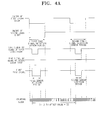
- the first (or preceding) period of the pulse, detected by the first sync signal detection sensor 209-1, is defined as a first sensor detection period
- the following period of the pulse, detected by the second sync signal detection sensor 209-2 is defined as a second sensor detection period, based on the light beams emitted from the first and second laser diodes 210-1, 210-2.
- sync signals generated in response to the detection of the light beams from the first and second laser diodes 210-1, 210-2 are generated when the first and second laser diodes 210-1, 210-2 are driven in the first sync signal detection sensor period.
- the first composite sync signal, detected during the first sync signal detection sensor period forms the first sensor detection period.
- the sync signals generated in response to the detection of the light beams from the first and second laser diodes 210-1, 210-2 are generated when the first laser diode 210-1 is driven and the second laser diode 210-2 is not driven. Also, the first composite sync signal, detected during the second sync signal detection sensor period, forms the second sensor detection period.
- the counted value is defined as a (1-1)-th offset value.
- the (1-1)-th offset value is 72.
- the calculation of the second composite sync signal is similar to the calculation of the first composite sync signal as shown in Figure 4A.
- the calculation of the second composite sync signal differs from the calculation of the first composite sync signal in that in the second sync signal detection sensor period, the sync signals generated using the first and second laser diodes 210-1, 210-2 are generated when the second laser diode 210-2 is driven and the first laser diode 210-1 is not driven.
- the second sensor detection period is formed.
- the counted value is defined as a (1-2)-th offset value.
- the (1-2)-th offset value is 75.
- the difference between the (1-1)-th offset value and the (1-2)-th offset value, as calculated above, is defined as the first offset value.
- the first offset value is 3.
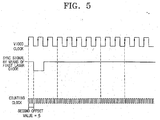
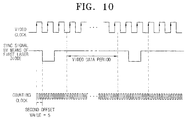
- a video clock is output from a video clock unit (not illustrated), and is synchronized with the video data. Then, the video clock and the video data synchronized with the video clock are input to the compensation unit 300.
- the section between the start point of the video clock, as shown in Figure 5, and the start point of the pulse period in the sync signal generated using the first laser diode 210-1 as described above, is counted using the clock signal generated from the clock unit 310.
- This counted value is defined as the second offset value.
- the second offset value is 5.
- Alignment compensation of the scanning-lines is performed before a printing operation starts, when the laser printer is operated by a user.
- the light beams are output during the first sync signal detection sensor period by driving the first and second laser diodes 210-1, 210-2 in the LSU 200, and the first sensor detection period is detected using the first sync signal detection sensor 209-1, as described above.
- the second sync signal detection sensor period which occurs after a specified time, a light beam is output by driving only the first laser diode 210-1, and the second sensor detection period is detected using the second sync signal detection sensor 209-2, as described above.
- the light beams are output in the first sync signal detection sensor period by driving the first and second laser diodes 210-1, 210-2, and the first sensor detection period is detected using the first sync signal detection sensor 209-1.
- the second sync signal detection sensor period which occurs after a specified time, a light beam is output by driving only the second laser diode 210-2, and the second sensor detection period is detected using the second sync signal detection sensor 209-2, as described above.
- the first and second composite sync signals which have second sensor detection periods that differ from each other, are output from the LSU 200 to the compensation unit 300, and the sync signal generated based on the light beam from the first laser diode 210-1 is output to the compensation unit 300.
- the first offset value calculation unit 320 of the compensation unit 300 which receives the first and second composite sync signals, calculates the (1-1)-th offset value of 72 and the (1-2)-th offset value of 75 based on the first sensor detection period and the second sensor detection period in the first and second composite sync signals using the clock signal. Then, the first offset value calculation unit 320 calculates the first offset value of 3, and outputs the first offset value to the video data compensation unit 340.
- the second offset value calculation unit 330 which receives the sync signal generated in response to light emitted from the first laser diode 210-1 and the video clock output from the video clock unit (not illustrated), calculates the second offset value of 5 based on the pulse period of the sync signal based on the first laser diode 210-1 and the video clock, and outputs the second offset value to the video data compensation unit 340.
- the video data compensation unit 340 receives the first and second offset values, the video clock, and the first and second video data synchronized with the video clock.
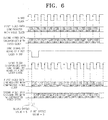
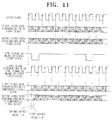
- the video data compensation unit 340 compensates the video clock using the first and second offset values of 3 and 5, and compensates the first and second video data synchronized with the compensated video clock.
- the video clock is delayed by the second offset value of 5.
- the first video data are then synchronized with the delayed video clock. That is, the input first video data are delayed by the second offset value of 5.
- the video clock which has been delayed by the second offset value of 5, is delayed again by the first offset value of 3.
- the second video data are then synchronized with the video clock after it has been delayed again. That is, the input second video data are delayed by the first and second offset values of 3 and 5.
- the compensated first and second video data are output to the laser diode control unit 100.
- the laser diode control unit 100 calculates a control signal based on the compensated first and second video data.
- the calculated control signal is transmitted to the LSU 200, to control the emission of light from the first and second laser diodes 210-1, 210-2. Accordingly, the vertical alignment error between the scanning lines due to the positional difference between the laser diodes 210-1, 210-2 is compensated for.
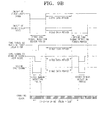
- the first offset value is calculated by generating the first and second composite sync signals, but in the embodiment shown in Figure 7, the first offset value is calculated by generating only one composite sync signal as shown in Figure 8, or alternatively the first offset value is calculated by generating the first and second composite sync signals, as shown in Figures 9A and 9B.
- first and second sync signal detection sensor periods in the embodiment shown in Figures 4A and 4B have different meanings from the first and second sync signal detection sensor periods in the embodiments shown in Figure 8 and in Figures 9A and 9B. That is, in Figures 4A and 4B, because two neighbouring sync signal detection sensors 209-1, 209-2 are provided, the first and second sync signal detection sensor periods are provided in the same scanning-line, and the first sync signal detection sensor period corresponds to the first sync signal detection sensor 209-1, while the second sync signal detection sensor period corresponds to the second sync signal detection sensor 209-2.
- the first sync signal detection sensor period corresponds to the sync signal detection sensor 209 in a first (or preceding) scanning-line
- the second sync signal detection sensor period corresponds to the sync signal detection sensor 209 in the following line (i.e. the next line).
- the first sync signal detection sensor period is a period for the sync signal detection sensor 209 in a first scanning-line
- the second sync signal detection sensor period is a period for the sync signal detection sensor 209 in the following line.
- the sync signal generated using the first laser diode 210-1 is generated using the sync signal detection sensor 209 in response to the light beam emitted from the first laser diode 210-1.
- the sync signal generated using the second laser diode 210-2 is generated using the sync signal detection sensor 209 in response to the light beam emitted from the second laser diode 210-2.
- sync signals generated using the first and second laser diodes 210-1, 210-2 are generated when the first and second laser diodes 210-1, 210-2 are respectively driven in the first sync signal detection sensor period. Also, the composite sync signal, which forms the first sensor detection period, is detected.
- the sync signals generated using the first and second laser diodes 210-1, 210-2 are generated when the first laser diode 210-1 is driven and the second laser diode 210-2 is not driven. Also, the composite sync signal, which forms the second sensor detection period, is detected.
- the first sensor detection period is counted using the clock signal generated by the clock unit 310.
- the counted result is defined as a (1-1)-th offset value.
- the (1-1)-th offset value is 14.
- the second sensor detection period is counted using the clock signal generated by the clock unit 310.
- the counted result is defined as a (1-2)-th offset value.
- the (1-2)-th offset value is 10.
- the difference between the (1-1)-th offset value and the (1-2)-th offset value as calculated above is defined as the first offset value.
- the first offset value is 4.
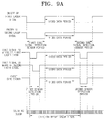
- sync signals generated using the first and second laser diodes 210-1, 210-2 are generated when the first and second laser diodes 210-1, 210-2 are driven in the first sync signal detection sensor period. Also, the first composite sync signal, which forms the first sensor detection period, is detected.
- the sync signals generated using the first and second laser diodes 210-1, 210-2 are generated when the first laser diode 210-1 is driven and the second laser diode 210-2 is not driven.
- the first composite sync signal, which forms the second sensor detection period, is detected.
- the section between the start point of the first sensor detection period and the start point of the second sensor detection period is counted using the clock signal generated by the clock unit 310.
- the difference is defined as a (1-1)-th offset value.
- the (1-1)-th offset value is 525 in the example shown in Figure 9A.
- the calculation of the second composite sync signal is similar to the calculation of the first composite sync signal as shown in Figure 9A.
- the calculation of the second composite sync signal differs from the calculation of the first composite sync signal in that in the second sync signal detection sensor period, the sync signals generated using the first and second laser diodes 210-1, 210-2 are generated when the second laser diode 210-2 is driven and the first laser diode 210-1 is not driven. Then, the second sensor detection period is formed.
- the section between the start point of the first sensor detection period and the start point of the second sensor detection period is counted using the clock signal generated by the clock unit 310.
- the difference is defined as a (1-2)-th offset value.
- the (1-2)-th offset value is 529.
- the difference between the (1-1)-th offset value and the (1-2)-th offset value as calculated above is defined as the first offset value.
- the first offset value is 4.
- the section between the start point of the video clock and the start point of the first (or preceding) pulse period in the sync signal generated using the first laser diode 210-1 is counted using the clock signal generated by the clock unit 310.
- This counted value is defined as the second offset value.
- the second offset value is 5.
- the composite sync signal having the first and second sensor detection periods is generated and output to the compensation unit 300.
- the first offset value calculation unit 320 of the compensation unit 300 which receives the composite sync signal, calculates the (1-1)-th offset value of 14 and the (1-2)-th offset value of 10 based on the first sensor detection period and the second sensor detection period in the composite sync signal using the clock signal. Then, the first offset value calculation unit 320 calculates the first offset value of 4, which is the difference between the (1-1)-th offset value and the (1-2)-th offset value, and outputs the first offset value to the video data compensation unit 340.
- the first and second composite sync signals which have different second sensor detection periods, are generated and output to the compensation unit 300.
- the first offset value calculation unit 320 of the compensation unit 300 which receives the first and second composite sync signals, calculates the (1-1)-th offset value of 525 and the (1-2)-th offset value of 529 based on the first sensor detection period and the second sensor detection period in the first and second composite sync signals using the clock signal.
- the first offset value calculation unit 320 calculates and outputs the first offset value of 4, which is the difference between the (1-1)-th offset value and the (1-2)-th offset value, to the video data compensation unit 340.
- the vertical alignment error between the two scanning-lines due to the positional difference between the first and second laser diodes 210-1, 210-2 is compensated for based on the compensated first and second video data.
- the light beams are emitted from the first and second laser diodes 210-1, 210-2 in the LSU 200 (step S410).
- the light beams emitted from the first and second laser diodes 210-1, 210-2 are detected using the sync signal detection sensors 209, 209-1, 209-2 provided in the LSU 200 to generate the sync signals.
- one or two sync signals may be generated (step S420).
- the sync signals are input to the first and second offset value calculation units 320, 330 to calculate the first and second offset values.
- the video clock is also input to the second offset value calculation unit 330 (step S430).
- the calculated first and second offset values are input to the video data compensation unit 340, and the first and second video data are compensated for using the input first and second offset values. Specifically, the first video data is compensated by the second offset value, and the second video data is compensated by the first and second offset values (step S440).
- the compensated first and second video data are output to the laser diode control unit 100, and the laser diode control unit 100 outputs control signals, corresponding to the compensated first and second video data, to the LSU 200.
- the output control signals control the light emission from the first and second laser diodes 210-1, 210-2 of the LSU 200 (step S450).
- a scanning-line alignment compensation apparatus and method wherein the vertical error between the scanning-lines generated due to the positional difference between the two laser diodes in the two-line optical scanning laser printer can be compensated for is provided. Accordingly, the misalignment of printed lines, which is a problem occurring in two-line type laser printers, can be solved.
Landscapes
- Engineering & Computer Science (AREA)
- Multimedia (AREA)
- Signal Processing (AREA)
- Laser Beam Printer (AREA)
- Facsimile Scanning Arrangements (AREA)
- Mechanical Optical Scanning Systems (AREA)
Applications Claiming Priority (4)
| Application Number | Priority Date | Filing Date | Title |
|---|---|---|---|
| KR20030007277 | 2003-02-05 | ||
| KR2003007277 | 2003-02-05 | ||
| KR10-2003-0034948A KR100519972B1 (ko) | 2003-02-05 | 2003-05-30 | 레이저프린터의 주사라인간 배열보정장치 및 배열보정방법 |
| KR2003034948 | 2003-05-30 |
Publications (2)
| Publication Number | Publication Date |
|---|---|
| EP1445937A2 true EP1445937A2 (de) | 2004-08-11 |
| EP1445937A3 EP1445937A3 (de) | 2006-12-27 |
Family
ID=32658681
Family Applications (1)
| Application Number | Title | Priority Date | Filing Date |
|---|---|---|---|
| EP04250617A Ceased EP1445937A3 (de) | 2003-02-05 | 2004-02-05 | Laserdruckgerät |
Country Status (3)
| Country | Link |
|---|---|
| US (1) | US7209158B2 (de) |
| EP (1) | EP1445937A3 (de) |
| CN (1) | CN100385341C (de) |
Cited By (1)
| Publication number | Priority date | Publication date | Assignee | Title |
|---|---|---|---|---|
| CN103676420A (zh) * | 2012-09-04 | 2014-03-26 | 建兴电子科技股份有限公司 | 具有相位检测及补偿功能的激光扫描式投影装置 |
Families Citing this family (5)
| Publication number | Priority date | Publication date | Assignee | Title |
|---|---|---|---|---|
| JP4566723B2 (ja) * | 2004-12-08 | 2010-10-20 | キヤノン株式会社 | レーザスキャナ及びそれを適用する画像形成装置 |
| US7760392B2 (en) * | 2006-08-22 | 2010-07-20 | Lexmark International, Inc. | Variation of synchronization gain based upon laser power |
| CN108803007B (zh) * | 2017-10-31 | 2021-01-01 | 成都理想境界科技有限公司 | 一种模式控制方法及激光扫描装置 |
| GB2565006B (en) * | 2018-11-09 | 2021-09-08 | O2Micro International Ltd | Battery protection systems |
| CN114559750B (zh) * | 2022-03-25 | 2023-02-17 | 北京高德品创科技有限公司 | 适配激光二极管的方法及装置、固件及图像成形装置 |
Citations (1)
| Publication number | Priority date | Publication date | Assignee | Title |
|---|---|---|---|---|
| DE19808937A1 (de) | 1997-03-03 | 1998-10-22 | Ricoh Kk | Synchrones Einstellverfahren, Apparat und Computerprogramm für ein optisches Vielstrahlsystem |
Family Cites Families (10)
| Publication number | Priority date | Publication date | Assignee | Title |
|---|---|---|---|---|
| US4393387A (en) * | 1979-09-14 | 1983-07-12 | Canon Kabushiki Kaisha | Beam recording apparatus effecting the recording by a plurality of beams |
| JP3191231B2 (ja) | 1993-04-15 | 2001-07-23 | コニカ株式会社 | 画像形成装置の主走査方向ビームずれ補正装置 |
| JP2912556B2 (ja) * | 1994-10-25 | 1999-06-28 | 富士通株式会社 | 像形成装置における露光方法及び像形成装置 |
| JPH09318895A (ja) | 1996-05-29 | 1997-12-12 | Konica Corp | 画像形成装置 |
| JPH1010446A (ja) * | 1996-06-20 | 1998-01-16 | Matsushita Electric Ind Co Ltd | マルチ光ビーム走査の同期検出方法及びマルチ光ビーム走査装置 |
| JP3913357B2 (ja) * | 1998-03-25 | 2007-05-09 | 株式会社リコー | マルチビーム光走査装置および画像形成装置 |
| US5966231A (en) * | 1998-08-07 | 1999-10-12 | Lexmark International, Inc. | Method and apparatus for aligning multiple laser beams |
| JP2000089146A (ja) * | 1998-09-17 | 2000-03-31 | Ricoh Co Ltd | マルチビーム記録装置 |
| JP2000137179A (ja) * | 1998-10-30 | 2000-05-16 | Sharp Corp | 画像記録装置 |
| JP2001197271A (ja) * | 2000-01-14 | 2001-07-19 | Brother Ind Ltd | マルチビームスキャナ |
-
2004
- 2004-01-30 US US10/766,885 patent/US7209158B2/en not_active Expired - Fee Related
- 2004-02-05 EP EP04250617A patent/EP1445937A3/de not_active Ceased
- 2004-02-05 CN CNB2004100036620A patent/CN100385341C/zh not_active Expired - Fee Related
Patent Citations (1)
| Publication number | Priority date | Publication date | Assignee | Title |
|---|---|---|---|---|
| DE19808937A1 (de) | 1997-03-03 | 1998-10-22 | Ricoh Kk | Synchrones Einstellverfahren, Apparat und Computerprogramm für ein optisches Vielstrahlsystem |
Cited By (2)
| Publication number | Priority date | Publication date | Assignee | Title |
|---|---|---|---|---|
| CN103676420A (zh) * | 2012-09-04 | 2014-03-26 | 建兴电子科技股份有限公司 | 具有相位检测及补偿功能的激光扫描式投影装置 |
| CN103676420B (zh) * | 2012-09-04 | 2015-08-19 | 光宝科技股份有限公司 | 具有相位检测及补偿功能的激光扫描式投影装置 |
Also Published As
| Publication number | Publication date |
|---|---|
| US20040183893A1 (en) | 2004-09-23 |
| CN100385341C (zh) | 2008-04-30 |
| US7209158B2 (en) | 2007-04-24 |
| EP1445937A3 (de) | 2006-12-27 |
| CN1519662A (zh) | 2004-08-11 |
Similar Documents
| Publication | Publication Date | Title |
|---|---|---|
| KR100555000B1 (ko) | 화상 형성 장치 | |
| JP4521800B2 (ja) | 画像形成装置 | |
| US7212224B2 (en) | Pixel clock creation method, pixel clock creation device, optical scanning device, and image forming apparatus | |
| JP3535686B2 (ja) | マルチビームレーザ走査装置 | |
| JPH06300980A (ja) | 画像形成装置の主走査方向ビームずれ補正装置 | |
| EP1445937A2 (de) | Laserdruckgerät | |
| JP2002096502A (ja) | 画像形成装置 | |
| US7724275B2 (en) | Image forming apparatus and control method thereof | |
| US7379084B2 (en) | Image forming apparatus | |
| US6879334B2 (en) | Image forming apparatus capable of controlling write start position of each beam | |
| US20020135822A1 (en) | Clock-generating circuit and image-forming apparatus having a function of canceling scanning unevenness caused by polygon mirror | |
| US20070046769A1 (en) | Apparatus to adjust alignment between scanning lines of laser printer and method thereof | |
| KR100519972B1 (ko) | 레이저프린터의 주사라인간 배열보정장치 및 배열보정방법 | |
| JP3638204B2 (ja) | 多色画像形成装置 | |
| JP2002139690A (ja) | 光ビーム走査装置および画像形成装置 | |
| JP2004354626A (ja) | 画像形成装置及び該装置における水平同期信号発生方法 | |
| JP2003103829A (ja) | 画像形成装置及びレジスト調整方法 | |
| JP3207988B2 (ja) | 画像形成装置 | |
| JP3753837B2 (ja) | 多色画像形成装置 | |
| JP4349024B2 (ja) | 画像形成装置 | |
| JP3116611B2 (ja) | 自動レジ補正機能を有するデジタル複写機 | |
| JP2007229963A (ja) | 画像形成装置 | |
| JP2001051216A (ja) | 光ビーム走査制御回路及びそれを用いた光学ユニット並びに画像形成装置 | |
| JP2002052756A (ja) | 画像形成方法および画像形成装置 | |
| KR20050077307A (ko) | 레이져 프린터의 수평주사라인 배열보정을 위한 비디오콘트롤러 및 방법 |
Legal Events
| Date | Code | Title | Description |
|---|---|---|---|
| PUAI | Public reference made under article 153(3) epc to a published international application that has entered the european phase |
Free format text: ORIGINAL CODE: 0009012 |
|
| AK | Designated contracting states |
Kind code of ref document: A2 Designated state(s): AT BE BG CH CY CZ DE DK EE ES FI FR GB GR HU IE IT LI LU MC NL PT RO SE SI SK TR |
|
| AX | Request for extension of the european patent |
Extension state: AL LT LV MK |
|
| PUAL | Search report despatched |
Free format text: ORIGINAL CODE: 0009013 |
|
| AK | Designated contracting states |
Kind code of ref document: A3 Designated state(s): AT BE BG CH CY CZ DE DK EE ES FI FR GB GR HU IE IT LI LU MC NL PT RO SE SI SK TR |
|
| AX | Request for extension of the european patent |
Extension state: AL LT LV MK |
|
| 17P | Request for examination filed |
Effective date: 20070518 |
|
| 17Q | First examination report despatched |
Effective date: 20070612 |
|
| AKX | Designation fees paid |
Designated state(s): DE FR GB NL |
|
| RAP1 | Party data changed (applicant data changed or rights of an application transferred) |
Owner name: SAMSUNG ELECTRONICS CO., LTD. |
|
| STAA | Information on the status of an ep patent application or granted ep patent |
Free format text: STATUS: THE APPLICATION HAS BEEN REFUSED |
|
| 18R | Application refused |
Effective date: 20120906 |