EP1447939A2 - Réseau sans fil auto-configurant, adaptatif et tridimensionnel - Google Patents
Réseau sans fil auto-configurant, adaptatif et tridimensionnel Download PDFInfo
- Publication number
- EP1447939A2 EP1447939A2 EP04250149A EP04250149A EP1447939A2 EP 1447939 A2 EP1447939 A2 EP 1447939A2 EP 04250149 A EP04250149 A EP 04250149A EP 04250149 A EP04250149 A EP 04250149A EP 1447939 A2 EP1447939 A2 EP 1447939A2
- Authority
- EP
- European Patent Office
- Prior art keywords
- network
- wireless
- access points
- data
- access point
- Prior art date
- Legal status (The legal status is an assumption and is not a legal conclusion. Google has not performed a legal analysis and makes no representation as to the accuracy of the status listed.)
- Granted
Links
Images







Classifications
-
- H—ELECTRICITY
- H04—ELECTRIC COMMUNICATION TECHNIQUE
- H04W—WIRELESS COMMUNICATION NETWORKS
- H04W88/00—Devices specially adapted for wireless communication networks, e.g. terminals, base stations or access point devices
- H04W88/08—Access point devices
-
- H—ELECTRICITY
- H04—ELECTRIC COMMUNICATION TECHNIQUE
- H04L—TRANSMISSION OF DIGITAL INFORMATION, e.g. TELEGRAPHIC COMMUNICATION
- H04L63/00—Network architectures or network communication protocols for network security
- H04L63/04—Network architectures or network communication protocols for network security for providing a confidential data exchange among entities communicating through data packet networks
- H04L63/0428—Network architectures or network communication protocols for network security for providing a confidential data exchange among entities communicating through data packet networks wherein the data content is protected, e.g. by encrypting or encapsulating the payload
-
- H—ELECTRICITY
- H04—ELECTRIC COMMUNICATION TECHNIQUE
- H04B—TRANSMISSION
- H04B7/00—Radio transmission systems, i.e. using radiation field
- H04B7/24—Radio transmission systems, i.e. using radiation field for communication between two or more posts
- H04B7/26—Radio transmission systems, i.e. using radiation field for communication between two or more posts at least one of which is mobile
- H04B7/2603—Arrangements for wireless physical layer control
- H04B7/2606—Arrangements for base station coverage control, e.g. by using relays in tunnels
Definitions
- the present invention relates generally to wireless networks, and more particularly to methods and apparatus for configuring, expanding and maintaining a wireless network for home or office use.
- wireless networks have emerged as flexible and cost-effective alternatives to conventional wired local area networks (LANs).
- LANs local area networks
- people are gravitating toward use of laptops and handheld devices that they can carry with them while they do their jobs or move from the living room to the bedroom.
- This has led industry manufacturers to view wireless technologies as an attractive alternative to Ethernet-type LANs for home and office consumer electronics devices, such as laptop computers, Digital Versatile Disk (“DVD”) players, television sets, and other media devices.
- wireless networks obviate the need for physical wires, they can be installed relatively easily.
- Wireless communication systems adapted for use in homes and office buildings typically include an access point coupled to an interactive data network (e.g., Internet) through a high-speed connection, such as a digital subscriber line (DSL) or cable modem.
- the access point is usually configured to have sufficient signal strength to transmit data to and receive data from remote terminals or client devices located throughout the building.
- a portable computer in a house may include a PCMCIA card with a wireless transceiver that allows it to receive and transmit data via the access point.
- Data exchanged between wireless client devices and access points is generally sent in packet format. Data packets may carry information such as source address, destination address, synchronization bits, data, error correcting codes, etc.
- Wired communication protocols for transmitting packets of information between wireless devices and access points have been adopted throughout the world.
- IEEE specification 802.11 and the Bluetooth wireless protocol have been widely used for industrial applications.
- IEEE specification 802.11, and Industrial, Scientific, and Medical (ISM) band networking protocols typically operate in the 2.4GHz or 5GHz frequency bands.
- HIPERLAN a standard known as HIPERLAN is widely used.
- the Wireless Asynchronous Transfer Mode (WATM) standard is another protocol under development. This latter standard defines the format of a transmission frame, within which control and data transfer functions can take place. The format and length of transmission frames may be fixed or dynamically variable.
- High-bandwidth data transmissions can be degraded by the presence of structural obstacles (e.g., walls, floors, concrete, multiple stories, etc.), large appliances (e.g., refrigerator, oven, furnace, etc.), human traffic, conflicting devices (e.g., wireless phones, microwave ovens, neighboring networks, X10 cameras, etc.), as well as by the physical distance between the access point and the mobile terminal or other device.
- structural obstacles e.g., walls, floors, concrete, multiple stories, etc.
- large appliances e.g., refrigerator, oven, furnace, etc.
- conflicting devices e.g., wireless phones, microwave ovens, neighboring networks, X10 cameras, etc.
- an IEEE 802.11b compliant wireless transceiver may have a specified data rate of 11.0 megabits per second (Mbps), but the presence of walls in the transmission path can cause the effective data rate to drop to about 1.0Mbps or less. Degradation of the video signal can also lead to repeated transmission retries, causing the video image to appear choppy.
- D-Link Systems, Inc. manufactures a 2.4GHz wireless product that can be configured to perform either as a wireless access point, as a point-to-point bridge with another access point, as a point-to-multi-point wireless bridge, as a wireless client, or as a wireless repeater.
- the product functions to re-transmit packets received from a primary access point.
- the problem with these types of wireless repeaters is that they retransmit at the same frequency as the primary access point device. Consequently, because the primary access point and repeaters share the same channel, the bandwidth of the network is effectively reduced for each repeater installed.
- Still another attempted solution to the problem of wireless transmission of video data is to lower the bandwidth of the video through data compression.
- This technique involves compressing the video data prior to transmission, then decompressing the data after it has been received.
- the main drawback with compression/decompression techniques is that they tend to compromise the quality of the video image, which is unacceptable to most viewers. This approach also suffers from the problem of lost connections during transmission.
- a network for wireless transmission of data to a destination device comprising a wireless router coupled to receive the data from a data source, the wireless router including a first transceiver to transmit the data on a first frequency channel; a wireless repeater having a second transceiver to receive the data on the first frequency channel and a third transceiver to re-transmit the data on a second frequency channel different than the first frequency channel; and a wireless receiver having a fourth transceiver to receive the data on the second frequency channel from the wireless repeater, the receiver being coupled to the destination device.
- the first, second, third, and fourth transceivers may for instance operate in either a 2.4GHz frequency band or a 5GHz frequency band.
- One or more additional wireless repeaters may be provided, each having an upstream transceiver to receive the data and a downstream transceiver to re-transmit the data, the one or more additional wireless repeaters being disposed so as to extend a range of the network between the wireless router and the wireless receiver.
- Each of the one or more additional repeaters may further comprise an additional transceiver to transmit the data to one or more additional destination devices located in a nearby vicinity.
- Means may be provided for self-configuring the first and second frequency channels of the wireless router and the wireless repeater.
- the first, second, third, and fourth transceivers may operate in compliance with an 802.11x standard.
- the destination device may for instance comprise a television or a computer.
- a network for wireless transmission of a data stream in a building comprising: a plurality of access points, including: a first access point coupled to receive the data stream from a source, the first access point transmitting the data stream at a first data rate; a plurality of additional access points distributed about the building, each of the one or more additional access points including an upstream transceiver to receive the data stream on a first channel and a downstream transceiver to re-transmit the data stream at substantially the first data rate on a second channel.
- the first access point may comprise a wireless tuner having a transceiver that transmits in a 5GHz frequency band.
- the first data rate for instance may be 30Mbps or greater.
- Each of the additional access points may further comprise an additional transceiver for communications with one or more wireless destination devices located in a nearby vicinity.
- the additional transceiver may for instance operate in a 2.4GHz frequency band.
- the network may further comprise: a computer-executable program to configure the access points to operate in accordance with a set of channels that provides an optimal performance result.
- the computer-executable program may run on a processor of the first access point.
- the first access point and the additional access points mat for example be arranged in a tree topology.
- the set of channels mat for example occupy either a 2.4GHz frequency band or a 5GHz frequency band.
- a network for real-time wireless transmission of high bandwidth data comprising: a plurality of access points, each of the access points having a first transceiver configured to transmit the data to one or more wireless destination devices located in a nearby vicinity, and to receive data transmitted from the one or more wireless destination devices, the first transceiver operating in a first frequency band, the plurality of access points including: a first access point coupled to receive the data from a source, the first access point having a second transceiver that transmits the data downstream across the network in a second frequency band at a specified data rate, the second frequency band including a plurality of channels; a plurality of repeaters arranged in a topology, wherein each of the repeaters having an upstream transceiver to receive the data on one channel and a downstream transceiver to re-transmit the data on a different channel at substantially the specified data rate; and means for allocating specific channels to the access points to provide an optimal performance result.
- the first frequency band may for example be a 2.4GHz band.
- the first access point may comprise a satellite tuner or a cable television tuner.
- the network may further comprise a receiver to receive the data from one of the wireless repeaters and to output the data to the one or more wireless destination devices.
- the second frequency band may for example comprise a 5GHz frequency band.
- One example of a specified data rate is 30Mbps or greater.
- Each of the repeaters may comprise circuitry that determines transmission signal quality between the repeater and another access point, the circuitry including an output display panel that provides a visual indication of the transmission signal quality.
- a network for real-time wireless transmission of high bandwidth data comprising: a plurality of access points, each of the access points having a first transceiver configured to transmit the data to one or more client devices located in a nearby vicinity, and to receive the data transmitted from the one or more client devices, the first transceiver operating in a first frequency band, the plurality of access points including: a first access point coupled to receive the data from a source, the first access point having a second transceiver that transmits the data downstream across the network in a second frequency band at a specified data rate, the second frequency band including a plurality of channels; a plurality of repeaters arranged in a tree topology, each of the repeaters having an upstream transceiver to receive the data on one channel and a downstream transceiver to re-transmit the data on a different channel at substantially the specified data rate; and a computer-executable program, execution of the computer-executable program causing the access points to be configured to
- the network may further comprise means for adapting the network to an interference source by re-execution of the computer-executable program to re-configure the access points to operate in accordance with a new set of channels.
- the first access point may comprise for instance a wireless satellite tuner or a wireless cable television tuner.
- the network may further comprising a receiver to receive the data from one of the wireless repeaters and to output the media content to a destination device.
- the second frequency band may comprise, for example, a 5GHz frequency band and/or the specified data rate may be 30Mbps or greater.
- Each of the repeaters may comprise circuitry that determines transmission signal quality between the repeater and another access point, the circuitry including an output display panel that provides a visual indication of the transmission signal quality.
- a system for high-bandwidth wireless transmission of data to a plurality of destination devices disposed about a building comprising: first and second wireless networks, each wireless network comprising: a plurality of access points, each of the access points having a first transceiver configured to transmit the data to one or more wireless client devices located in a nearby vicinity, and to receive the data transmitted from the one or more wireless client devices, the first transceiver operating in a first frequency band, the plurality of access points including: a first access point coupled to receive the data from a source, the first access point having a second transceiver that transmits the data in a second frequency band at a specified data rate, the second frequency band including a plurality of channels; a plurality of repeaters arranged in a topology, wherein each of the repeaters has an upstream transceiver to receive the data on one channel and a downstream transceiver to re-transmit the data on a different channel at substantially the specified data rate.
- each network may further comprise a computer-executable program, execution of the computer-executable program causing the access points to be configured to operate in accordance with a set of channels.
- Each of the first and second wireless networks may further comprise a wireless receiver to receive the data from one of the wireless repeaters and to output the data to one of the destination devices.
- the second frequency band may for instance comprise a 5GHz frequency band and/or the first data rate may be 30Mbps or greater.
- a network for wireless transmission of a data stream in a building comprising: a plurality of access points each access point having a first transmission range of maximum bandwidth and a second transmission range of signal interference, the access points being arranged in a topology wherein each access point is spaced-apart from a nearest neighboring access point by a first distance less than the first transmission range, the plurality of access points including: a first access point coupled to receive the data stream from a source, the first access point transmitting the data stream on a first channel of a first frequency band at a first data rate, the first frequency band having a plurality of channels; one or more additional access points to receive the data stream and to re-transmit the data stream at substantially the first data rate; wherein each of the access points transmits on one of the plurality of channels, any pair of the access points transmitting on a same channel being separated by a distance greater than the second transmission range.
- the one or more additional access points may be arranged to re-transmit the data stream in the first frequency band.
- the first access point may comprise a wireless satellite tuner or a wireless data router.
- the one or more additional access points may each comprise an upstream transceiver to receive the data stream on a particular channel and a downstream transceiver to re-transmit the data stream on a different channel.
- the first frequency band may for instance comprise a 5GHz frequency band and/or the first data rate may be, for example, 30Mbps or greater.
- the present invention is a self-configuring, adaptive wireless local area network (WLAN) that utilizes cellular techniques to extend the range of transmission without degrading bandwidth.
- WLAN wireless local area network
- the wireless network of the present invention is thus ideally suited for transmitting video programs (e.g., digitally-encoded video broadcast services, pay-per-view television, on-demand video services, etc.) throughout a house or other building, thereby creating a "media-live" environment.
- video programs e.g., digitally-encoded video broadcast services, pay-per-view television, on-demand video services, etc.
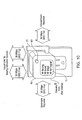
- a wireless home media network 10 comprises a source video access point 11 coupled to a broadband connection.
- the broadband connection may provide video content from a Direct Broadcast Satellite (DBS) or digital cable service provider.
- DBS Direct Broadcast Satellite
- Additional wireless access points may be physically located in a distributed manner throughout the home or building to provide connectivity among a variety of home media devices configured for wireless communications. As shown in
- these home media devices may include a laptop personal computer 12, DVD player 13, wireless-ready television 14, and wireless-linked receiver 15 coupled to either a standard definition or high-definition television (SDTV/HDTV) 16.
- Other types of devices such as personal digital assistants (PDAs), may also be coupled to network 10 for receiving and/or transmitting data.
- PDAs personal digital assistants
- Practitioners in the art will appreciate that many client media devices such as personal computers, televisions, PDAs, etc., have the capability of detecting the operating frequency of the access point within a particular micro-cellular transmission range.
- wireless network 10 provides reliable, full home coverage at throughputs supporting multiple simultaneous video streams, e.g., two HDTV streams at approximately 30Mbps; eight SDTV streams at about 16Mbps.
- a plurality of access points is utilized in a wireless network to provide relatively short transmission ranges that preserve bandwidth and achieve high reliability.
- the wireless network of the present invention implements a three-dimensional ("3-D") topology in which communications between an access point and mobile terminals or client media devices in a particular region occur at a frequency which is different than the communication frequency of a neighboring region.
- the 2.4GHz and 5GHz frequency bands are utilized for wireless transmissions.
- the 2.4GHz band provides three nonoverlapping channels
- the 5GHz band provides twelve nonoverlapping channels for simultaneous transmission traffic.
- the wireless network of the present invention achieves full range coverage in the home without bandwidth loss by utilizing a different channel for each data packet hop. This feature allows repeater data packets to overlap in time, as discussed in more detail below.
- Figure 2A is a diagram illustrating the two-dimensional propagation characteristics through open air associated with an access point 20 operating in the 2.4GHz band and transmitting on a particular channel, i.e., channel 1.
- Inner circle 21 represents the range of maximum bandwidth
- outer circle 22 represents the range at which the signal from access point 20 ceases to interfere with other signals in the same channel.
- Figure 2B shows an access point 30 operating in the 5GHz band with maximum bandwidth and interference ranges represented by circles 31 and 32, respectively.
- both access points 20 and 30 have a relatively short range at maximum bandwidth, but have a fairly wide interfering signal range.
- access point 30 has a shorter interference range than access point 20.
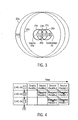
- FIG 3 is an example of wireless signal repeating in accordance with one embodiment of the present invention.
- each of the access points 20a-20c transmits on a different channel.
- access point 20a is shown operating on channel #1 in the 2.4GHz band; access point 20b operates on channel #6; and access point 20c operates on channel #11 in the same band.
- the inner circles 21a-21c each denotes the ranges of maximum bandwidth associated with access points 20a-20c, respectively.
- the outer circles 22a-22c denotes the same-channel interference signal range associated with access points 20a-20c, respectively.
- each of the access points is advantageously located at a distance within the maximum bandwidth range of its nearest neighboring access point.
- the destination media device 25 is disposed within the maximum bandwidth range of its nearest access point 20c.
- access points 20b and 20c function as signal repeaters to facilitate transmission of data from source access point 20a to destination device 25.
- each of the access points 20a-20c repeats transmission of data packets on a different frequency channel than any of its neighboring access points within signal interference range. Access points located beyond the interference range of a channel may reuse that same channel.
- a source data packet 1 is transmitted by access point 20a on channel #1.
- Access point 20b repeats transmission of this data packet on channel #6.
- Access point 20c again repeats transmission of data packet 1; this time on channel #11.
- Destination media device 25 receives data packet 1 from access point 20c on channel #11.
- access point 20a may immediately transmit a second source data packet ("packet 2"), followed by a third source data packet, a fourth data packet, and so on.
- Packet 2 a second source data packet
- packet 3 a third source data packet
- fourth data packet a fourth data packet
- Each of these data packets are repeated across the network in a pipeline manner by access points 20b and 20c, as shown in Figure 4.
- Pipelining of data packets across channels facilitates transmission of video data without loss of bandwidth.
- the wireless network of the present invention has no limitation on how far the transmission of data can extend, as long as there are a sufficient number of channels available.
- each hop normally can extend about 50 feet at maximum bandwidth, three hops on three different channels (one source plus two repeaters) can cover a distance of about 150 feet from source to destination.
- the license-free 5GHz band e.g., 5725MHz to 5850MHz
- each hop in the 5 GHz band will typically extend about 50 feet at maximum bandwidth, but the large number of channels permits hops to extend indefinitely. That is, in a wireless network operating in the 5GHz band according to the present invention, repeaters extend far enough for channel reuse. This means that hops can extend the range of transmission from source to destination without limitation.
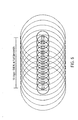
- Figure 5 is an example showing a network configuration in which each hop extends about 50 feet, so that ten hops cover about 500 feet.
- any channel beyond its interference range may be reused.
- the smaller inner circles representing the range of maximum bandwidth around the access points that operate on the same channel frequency (e.g., channel #1) are separated by a considerable distance ( ⁇ 400 feet).
- -each- access point is shown spaced-apart from its nearest neighboring access point by a distance less than the maximum bandwidth range (i.e., small circle) of its nearest neighbor.
- any two access points transmitting on the same channel are shown separated from each by a distance greater than the interference signal range.
- Access points that re-use the same channel are separated by a distance greater than their respective signal interference ranges.
- the large spatial separation between access points using the same frequency channel means that transmission problems due to channel interference between access points operating on the same channel are virtually nonexistent in the wireless network of the present invention.
- different frequency bands may also be used during data transmission across the wireless network of the present invention.
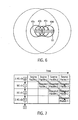
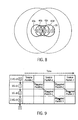
- 5GHz repeaters may be utilized to form an arbitrary length backbone for 2.4GHz data traffic. This situation is illustrated in the example of Figures 6 & 7, which shows source access point 40a transmitting data packets to a 2.4GHz destination 55 using 5GHz repeaters 40b & 40c. Note that source point 40a and repeater 40d (transmitting to destination device 55) both operate in the 2.4GHz band, but utilize different channels, i.e., channels #6 and # 11, respectively, to prevent bandwidth loss.
- Another possibility is to use a 5GHz device at the destination and a 2.4GHz access point at the source or vice-versa.
- the network is configured for communications with source-to-destination frequency band transitions of 2.4GHz to 5GHz, or 5GHz to 2.4GHz, or 2.4GHz to 2.4GHz on different channels (all utilizing 5GHz for repeaters in-between), the network can provide an arbitrary length backbone for 2.4 gigahertz traffic, despite the fact there are only three 2.4GHz channels available.
- the wireless network of the present invention is not limited to data transmissions confined to a single frequency band.
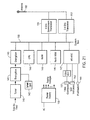
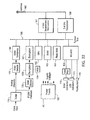
- FIG 11 is a circuit block diagram of the internal architecture of repeater unit 60.
- Repeater unit 60 comprises a transformer/power supply 61 that provides supply voltages to the various internal electronic components, which include a CPU 62, a RAM 63, a Flash ROM 64, and input/output application specific integrated circuitry (I/O ASIC) 66, each of which is shown coupled to a system bus 65.
- I/O ASIC input/output application specific integrated circuitry
- transceivers 74-76 are also coupled to system bus 65.
- transceivers 74-76 are also coupled to system bus 65.
- Each of transceivers 74-76 is coupled to an antenna 77. Additional transceivers operating at different frequencies may be included in repeater unit 60.
- CPU 62 controls the re-transmission of the received data packets, utilizing RAM 63 for both program execution, and for buffering of the packets as they are received from the upstream side, i.e., nearest the source, before they are sent out to the downstream side, i.e., toward the destination.
- Flash ROM 64 may be used to hold software and encryption key information associated with secure transmissions, for example, to insure that the network users are authorized users of satellite or cable subscriber services.
- a 1394 connector interface 70 provides a Firewire® port (coupled through a 1394 PHY physical interface 73) to I/O ASIC 66. Also coupled to I/O ASIC 66 is a pushbutton switch 69 and an LED indicator panel 71. Pushbutton switch 69 may be utilized in conjunction with interface 70 to authenticate repeater unit 60 for use in the network after the wireless receiver or source access point has been initially installed.
- Figure 10 further shows that the upstream repeater in the network comprises a wireless transceiver that operates in compliance with IEEE specification 802.11a to run with an effective throughput of 36Mbps utilizing large packets of approximately 2500 bytes each.
- IEEE 802.11 a is a standard that permits use at more than one channel at a time.
- 802.11a wireless transceiver that operates on a different frequency channel. It should be understood that the present invention is not limited to these particular transceiver types or frequency bands.
- transceivers may utilize other types of transceivers; for instance, transceivers that operate in compliance with specifications that are compatible with IEEE specification 802.11a, 802.11b, or 802.11g, or which otherwise provide for wireless transmissions at high-bandwidths.
- IEEE specification 802.11a, 802.11b, 802.11g, and Industrial, Scientific, and Medical (ISM) band networking protocols are denoted as "802.11x”.
- wireless network -protocols could be utilized as well.
- the network of the present invention could be implemented using transceivers compatible with HIPERLAN2, which runs with an effective throughput of about 42Mbps.
- each wireless repeater may provide wireless communications to one or more local devices.
- Figure 12 illustrates three repeaters 60a-60c configured in a network wherein each repeater may provide a communication link to nearby wireless devices, such as laptop computers or wireless televisions, etc.
- Repeater units 60 may be installed in the wireless network of the present invention after the source access point (e.g., source video receiver) has been made operational.
- a new repeater unit 60 is first connected to the source access point or an existing repeater (one that is already plugged into an outlet and coupled to the wireless network) using a Firewire cable.
- the Firewire cable is connected between the existing repeater or source access point and the new repeater.
- Power is provided over the Firewire cable from the existing repeater or access point to the new repeater to activate the internal circuitry of the new repeater, so that encryption key information may be exchanged to allow the new repeater to securely connect to the network. Execution of program instructions for the exchange of encryption information may be initiated by the person performing the installation pressing pushbutton switch 69, located on the front side of repeater unit 60 in Figure 10.
- the Firewire cable between the two devices may be disconnected.
- the repeater unit with the newly activated encryption key may then be plugged into an electrical outlet in any location of the home or building where the user wants the network to extend.
- LED indicator panel 71 1 provides an indication of transmission signal strength to the upstream receiver, and may be advantageously used to locate repeater unit 60 to extend the network in a home or building. If, for example, the LED output indicates a strong signal, the installer may wish to remove the repeater unit from its present wall outlet location to a location farther away from the nearest existing repeater or access point. If, upon moving to a new location, LED indicator panel 71 outputs a "weak” or a "no signal” reading, this means that the new repeater is too far away from existing connection points of the network. In either case, the installer should move the repeater unit back closer to an existing repeater or access point until a "good” or "strong” signal strength is indicated.
- Another option is to provide an audio indication of the transmission signal quality, instead of a visual indication.
- the source access point e.g., video receiver
- the source access point detects the presence a newly-activated repeater unit, it automatically self-configures the cellular repeater wireless network. This aspect of the present invention will be explained in greater detail below.
- the example network shown in Figure 13 illustrates the unlimited range at full bandwidth feature of one embodiment of the present invention.
- a video access point 80 is shown running at 36Mbps to transmit information and video data downstream to a destination television 81 containing a wireless receiver located in a distant room.
- the video data may originate from a data service connection, such as a Direct Broadcast Satellite (DBS), DSL, or cable television (CATV), provided to access point 80.
- DBS Direct Broadcast Satellite
- CATV cable television
- Repeaters 60a and 60b function as intermediary access points to distribute the video content to client media devices in their local vicinity, and to repeat downstream data packets received on the upstream side. As can be seen, each repeater transmits at 36Mbps so the effective throughput received at destination television 81 remains at 36Mbps, i.e., without bandwidth loss.
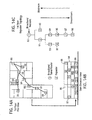
- Figures 14A & 14B show a plan view and a side elevation view, respectively, of a floor plan of a building 84 installed with four separate, secure wireless networks according to one embodiment of the present invention.
- Figure 14C illustrates the repeater topology for the network installed on the first floor plan shown in Figures 14A & 14B.
- Source access points e.g., video tuners or data routers
- Source access points e.g., video tuners or data routers
- Additional access points i.e., repeaters
- squares with the number inside the square similarly designating the channel used for signal transmissions.
- each source access point 85-88 is shown connected to a broadband network (e.g., cable, DSL, etc.), with each source access points functioning as a broadband tuner/ router.
- a broadband network e.g., cable, DSL, etc.
- each source access points functioning as a broadband tuner/ router.
- four separate wireless networks are shown installed on separate floors of building 84.
- access point 85 transmits video data packets on channel #1 to repeaters 91 and 92, which then both repeat the received data packets on channel #2.
- Repeaters 93 and 94 (both on channel #3) are shown branching off of repeater 91.
- Repeater 95 (channel #4) is coupled to the network through repeater 93.
- Repeater 96 (channel #4) branches off of repeater 94;
- repeater 97 (channel #1) branches off of repeater 96;
- repeater 98 channel #2) branches off of repeater 97 to complete the first floor topology.
- repeater 97 is able to reuse channel #1 since it is located a relatively far distance from source access point 85, which uses the same channel.
- the side elevation view of Figure 14B shows there are no devices on the second floor network above repeater 97 that use channel #1. For the same reasons, repeater 98 is able to reuse channel #2.
- access point 85 only needs one transceiver to create the repeating wireless network shown in Figures 14A-14C.
- the internal transceiver of access point 85 transmits on channel #1, which transmission is then received by the upstream transceivers of repeaters 91 and 92.
- Repeater 91 transmits using its downstream transceiver on channel #2, which is then picked up by the two upstream transceivers of repeaters 93 and 94, each of which, in turn, transmits on their downstream transceiver to repeaters 95 and 96, respectively, and so on.
- access point 98 only transmits downstream to destination media devices, not to another access point. That is, access point 98 does not function as a repeater; rather, access point 98 simply communicates with the destination media devices in its local area.
- each access point in the topology tree does not need an arbitrary number of transceivers to repeat data messages across the network; an upstream transceiver and a downstream transceiver suffices.
- an additional 2.4GHz band transceiver may be included, for example, to provide communications with 802.11b or 802.11g compatible devices. It should be understood, however, that there is no specific limit on the number or type of transceivers incorporated in the access points or repeaters utilized in the wireless network of the present invention.
- a processor in the source access point executes a program or algorithm that determines an optimal set of frequency channels allocated for use by each access point or repeater.
- An optimal set of channels is one that does not include over-lapping channels and avoids channels used by other interfering devices in the same locality.
- An optimal channel configuration may also be selected that maximizes channel re-use. Further, once a set of the channels has been chosen for use by the access points, modulated power can be reduced to the minimum needed to achieve maximum bandwidth across each link so as to reduce signal reflections.
- the wireless network of the present invention may also adapt to changes to the network by reconfiguring the channel assignments, such as when new repeaters are added, existing ones removed, or when the network experiences disturbances caused by other interfering devices (e.g., from a neighboring network).
- the first floor wireless network has been configured such that the channels used by each of the access points do not interfere with other devices located on other floors of building 84.
- the side elevation view of Figure 14B shows that interference sources are present in the upper stories of building 84 above the wireless network created by source access point 85.
- the first floor network has configured itself to use channel #1, #2, #3 and #4.
- the circuitry for controlling the self-configuration process may either be centralized in the source access point or distributed throughout the access points comprising the wireless network. In either case, the system may proceed through a process of iteration, wherein every possible combination of channels allocated to the access points may be tried in order to find an optimal combination of frequency channels. In one embodiment, the network hops through the frequency channels automatically so that an optimal combination of frequencies may be determined. Within a matter of seconds, the network may complete iterating through all permutations of channels to identify which combination of frequencies produces the best result.
- One example of a best result is the highest average bandwidth from source to each destination. Another best result may be defined as one which optimizes bandwidth to certain destination devices. For instance, if a particular destination device (e.g., a video receiver) requires higher bandwidth than other destination devices, then allocation of channels may be optimized to provide higher bandwidth in the network path to the particular destination device at the expense of lower bandwidth to other devices.
- the system of the present invention also functions to keep modulated power in the network to a minimum. It may be necessary in some instances, for example when transmitting through many walls to a maximum range, to use a lot of power. In other instances, a repeater is located nearby and there may be few walls to transmit through, so less transmission power is required.
- the access points may transmit at maximum power to establish a maximum range of communication. However, once communications have been established with all of the repeaters in the network, the power output may be reduced to a level that provides adequate signal transmission characteristics (i.e., a threshold signal strength), but no more. In other words, the network may throttle power output, keeping it only as high as it needs to be to create a strong signal to the next repeater.
- One benefit of such an operation is that it reduces signal reflections that may interfere with the reception quality. Another benefit is less power consumption.
- Another benefit of the power management feature of the present invention is that by having a given channel propagate less distance, you create the opportunity to reuse that channel in the network at an earlier point in the topology than if transmissions were at maximum power.
- the wireless network of the present invention automatically detects channel conflicts that arise, and adapts the network to the conflict by reconfiguring itself to avoid the conflict. That is, the access points monitor the signal quality of the wireless transmissions on a continual basis. Any disturbance or conflict that causes signal transmissions to fall below an acceptable quality level may trigger an adaptive reconfiguration process.
- Figures 15A and 15B show plan and side elevation views, respectively, of the wireless network previously shown in Figures 14A & 14B, but with a disturbance generated by the activation of a cordless phone (shown by square 101 operating on channel #2) in building 84.
- the interference caused by cordless phone 101 is within the range of repeaters 91 1 and 92, thereby affecting the transmissions of those repeaters.
- the network automatically detects the channel conflict and reconfigures itself to overcome the interference.
- Figures 16A and 16B illustrate the network of Figures 15A and 15B after reconfiguration to overcome the channel conflict caused by cordless phone 101.
- building 84 is populated with many existing channels in use. Because of the channel usage in the upper stories, the network cannot simply swap out the channels used by repeaters 91 & 92 with a different one. Instead, in this example, the wireless network of the present invention replaces channel #1 of source access point 85 with channel #5. That permits channel #1 to replace channel #2 in both repeaters 91 & 92.
- the wireless network also replaces channel #1 of repeater 97 with channel #8. Note that channel #8 can be used for repeater 97 because its only other use in building 84 is on the fourth floor at the opposite end of the structure.
- Repeater 98 is also shown reconfigured to use channel #1 instead of channel #2.
- the adaptation process discussed above may be performed in a similar manner to the self-configuration process previously described. That is, all of the different possible combinations of channels may be tried until the network identifies an optimal combination that works to overcome the channel conflict without creating any new conflicts.
- the adaptation process may rely upon an algorithm that does not attempt to change or move channels which have already been established. In the example of Figures 16A and 16B, for instance, channel #3, used by repeaters 93 & 94, and channel #4, used by repeaters 95 & 96, are left in place. In other words, regardless of the origin of a channel conflict, the network of the present invention adapts to the disturbance by reconfiguring itself to optimize performance.
- Figures 17A & 17B illustrate the conflict previously shown in Figures 15A & 15B, wherein a cordless phone 101 is activated, except with an additional channel conflict created by a wireless camera 102 operating on channel #5.
- the network has adapted by reusing the same channel in consecutive branches of the repeater topology, as shown in Figures 18A & 18B.
- Figures 18A & 18B show the reconfigured wireless network with repeaters 91 and 92 using channel #3. Because repeaters 93 and 94 also operate on channel #3 the bandwidth of the network is reduced by 50%.
- simultaneous wireless networks may be created to run at the same time. Simultaneous wireless networks may be desirable in certain applications, say, where there are three HDTV sets each operating at 15Mbps. If the backbone of the primary network operates at 36Mbps, the available bandwidth is insufficient to accommodate all three screens.
- the solution provided by the present invention is to install a second video tuner (i.e., a second source access point) and double up the number of repeaters through each branch of the rest of the topology.
- Figure 19 is a floor plan showing two simultaneous wireless networks operating in a building 84 to increase bandwidth. Such an arrangement is ideally suited to support multiple HDTV video streams.
- access points 110 and 120 each comprise a wireless video tuner or router with a broadband connection. Access point 110 is shown operating on channel #1 and access point 120 is shown operating on channel #5. In this case, separate paths are created to the upper left and lower left sections of the floor plan.
- the path from access point 110 includes repeaters 111, 112 and 113 on respective channels #2, #3 and #4. Meanwhile, the path from access point 120 is implemented using repeaters 121, 122, 123, 124 and 125 on channels #6, #7, #8, #9 and #10, respectively.
- bandwidth can be increased arbitrarily in the arrangement of Figure 19.
- three, four, or more simultaneously running wireless networks may be implemented in a home or office environment to arbitrarily increase bandwidth to meet increasing data rate demands. If an adequate number of channels is available (e.g., allowing extension of the network across a sufficient distance for channel reuse), there is no limitation on the bandwidth that can be achieved in accordance with the present invention.
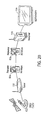
- FIG. 20 shows a wireless network according to one embodiment of the present invention which includes a tuner 130 coupled to receive real-time streaming media from a source, such as DBS or CATV.
- Tuner 130 transmits the media content provided by the source, possibly through one or more repeaters, to a destination device, which in this example, comprises a wireless receiver 133, connected to a standard definition television 134.
- the media content provided by the source is, of course, encrypted. Only authorized users or subscribers are permitted access to the media content.
- Tuner 130 typically receives the media data from the cable or satellite provider in a digitally encrypted form. This encryption is maintained through the wireless network to SDTV 134.
- Wireless receiver 133 is a trusted device; that is, it is secured during installation by exchange of encryption key information. Consequently, receiver 133 is able to decrypt the media content when it arrives across the network from tuner 130. Thus, data security is preserved across the entire span of the wireless network, potentially over many repeater hops, so that interlopers or unscrupulous hackers are prevented from gaining unauthorized use of the wireless local area network.
- the wireless network of the present invention may also transmit presentation layer data and information, such as overlay graphics and remote controls for interactive experiences.
- presentation layer data and information such as overlay graphics and remote controls for interactive experiences.
- the network may also carry information both upstream and downstream.
- tuner 130 may also digitize analog video, decode it, and compress the received source data prior to transmission across the wireless network, in addition to receiving compressed digital video.
- receiver 133 decompresses the data as it is received.
- decompression circuitry may be incorporated into television 134 (or into an add-on box) that performs the same task.
- Receiver 133, or a wireless-enabled television 134 may identify itself as a device that requires high bandwidth to the upstream wireless repeaters 60 and tuner 130. When the network reconfigures itself to avoid an interference source, it may take this requirement into consideration during channel allocation to optimize bandwidth in the network path from tuner 130 to receiver 133 or wireless-enabled television 134.
- tuner 130 decrypts the real-time media stream as it is received from the satellite or cable service provider, and then re-encrypts that same data using a different encryption scheme that is appropriate for the wireless local area network.
- tuner 130 only devices properly enabled by the network are authorized to play media content received via that network.
- the wireless network in this embodiment of the present invention is a single or uni-cast signal, it can only be received by a properly enabled receiver that is authorized with appropriate encryption key information. In other words, the media content transmitted across the network from source to destination is not simply available to anyone who happens to have a receiver.
- Still another possibility is for the cable or satellite company to grant an entitlement to tuner 130 that allows a certain limited number of streams (e.g., three or four) to be transmitted in a particular household or office environment, regardless of the number of media client devices that actually receive the media content. This is simply another way to restrict distribution of the media content.
- a certain limited number of streams e.g., three or four
- tuner 130 receives video data packets from a DBS or digital cable TV source and buffers the packets in its internal RAM (see Figure 21).
- the video data packets may then be grouped together into a larger packet.
- an MPEG-2 transmission may have 188-byte packets, which would result in low efficiency over a 802.11x transport.
- 802.11x efficiency can be achieved.
- Many conventional 802.11x networks incur a high probability of a transmission error when transmitting such large packets over long distances.
- the wireless network of the present invention is capable of achieving a high effective throughput (e.g., as much as 36Mbps or greater) at low error rates.
- a high effective throughput e.g., as much as 36Mbps or greater
- one embodiment of the present invention is capable of achieving approximately 32Mbps effective throughput, transmitting 2.256-Kbyte packets across an 802.11x network of arbitrary length with a bit error rate of about 10-7 or less.
- Another feature of the present invention is the ability to serendipitously provide connectivity to any user who happens to be within the range of the wireless network. If, for instance, a wireless repeater or access point is mounted near a window or on the rooftop of a building, the outdoor range of the wireless network may be extended to a nearby park or other buildings (e.g., a café or coffee-house).
- a user who has a laptop computer configured with an existing wireless transmitter and receiver, and who happens to be within the range of the wireless network could connect to the Internet; view a video program; listen to an audio program; or store media content on its disk drive for retrieval and play at a later time (assuming proper entitlements).
- the present invention provides ever greater mobility by allowing portable computer users to take media content with them.
- Media content may also be downloaded from the wireless network for archival storage on a wireless disk server.
- the wireless network of the present invention is client device independent. It does not matter to the network what type of device is at the destination end receiving the transmitted media content.
- Video and graphics content carried on the WLAN of the present invention can play on multiple types of television, computers (e.g., Macintosh® or PC), different MP3 players, PDAs, digital cameras, etc.
- any PC or Mac equipped with a 2.4GHz band wireless card can detect the presence of the wireless network. Once it has detected the running wireless network, it may download a driver that contains the necessary security and protocol information for accessing the media content.
- Readily available software such as RealPlayer®, QuickTime®, or Windows@ MediaPlayer, may be used to play content provided through the network.
- FIG. 21 a circuit block diagram showing the architecture of a DBS tuner according to one embodiment of the present invention is shown. Similar to the architecture of the repeater unit shown in Figure 11, a CPU 144, a RAM 145, a Flash ROM 146, and I/O ASIC 147 are coupled to a system bus 150. A 5GHz band downstream transceiver 156 and a 2.4GHz band transceiver 157, both of which are connected to antenna 160, are also coupled to system bus 150. (An upstream transceiver is not needed at the source end.)
- Data from the satellite feed is received by a tuner 140 and output to decryption circuitry 141, which may be configured to receive the latest encryption key information from a smart card 142.
- the decrypted digital stream output from block 141 is then re-encrypted by encryption circuitry 143 prior to being sent over the wireless network.
- the re-encryption is a type of encryption appropriate for the wireless network, not one that is locked into the satellite encryption scheme.
- FIG. 21 The architectural diagram of Figure 21 is also shown including connector, indicator, and pushbutton blocks 151-153, as previously described in conjunction with Figure 11.
- a power supply unit 159 provides a supply voltage to the internal electronic components of the tuner.
- Figure 22 is a circuit block diagram illustrating the basic architecture of a cable television tuner in accordance with one embodiment of the present invention. Practitioners in the art will appreciate that the architecture of Figure 22 is somewhat more complicated due to the presence of both analog and digital signal channels. Elements 161-172 are basically the same as the corresponding components of the DBS tuner described above.
- Tuner 175 receives the cable feed and separates the received signal into analog or digital channels, depending on whether the tuner is tuned to an analog or digital cable channel. If it is an analog channel, the video content is first decoded by block 177 and then compressed (e.g., MPEG2 or MPEG4) by circuit block 180 prior to downstream transmission. If it is a digital channel, a QAM demodulator circuit 176 is used to demodulate the received signal prior to decryption by block 178.
- a point of deployment (POD) module 179 which includes the decryption keys for the commercial cable system, is shown coupled to decryption block 178. After decryption, the streaming media content is re-encrypted by block 181 before transmission downstream on the wireless network.
- POD point of deployment
- Figure 22 shows a one-way cable system.
- a two-way cable system further includes a modulator for communications back up the cable, as, for example, when a user orders a pay-per-view movie.
- FIG. 23 is a circuit block diagram illustrating the basic architecture of a wireless receiver in accordance with one embodiment of the present invention.
- the wireless receiver shown in Figure 23 includes a CPU 185, a RAM 186, and a Flash ROM 187 coupled to a system bus 188.
- a power supply unit 184 provides a supply voltage to each of the circuit elements shown.
- a 5GHz band upstream transceiver 189 is also shown in Figure 23 coupled to an antenna 190 and to system bus 188.
- a single transceiver is all that is required since the receiver of Figure 23 does not transmit downstream and it outputs directly to a display device such as a television.
- the 5GHz band offers the advantage of more available channels.
- I/O ASIC circuitry 192 coupled to bus 188 includes the graphics, audio, decryption, and I/O chips (commercially available from manufacturers such as Broadcom Corporation and ATI Technologies, Inc.) needed to generate the output signals for driving the display device.
- I/O ASIC 192 may also provide outputs to a DVI connector 196 (for HDTV), analog audio/video (A/V) outputs 197, an SP/DIF output 198 (an optical signal for surround sound and digital audio), and an infrared receiver port 199 for receiving commands from a remote control unit.
- DVI connector 196 for HDTV
- A/V analog audio/video
- SP/DIF output 198 an optical signal for surround sound and digital audio
- infrared receiver port 199 for receiving commands from a remote control unit.
- elements of the present invention may also be provided as a computer program product which may include a machine-readable medium having stored thereon instructions which may be used to program a computer (or other electronic device) to perform a process.
- the machine-readable medium may include, but is not limited to, floppy diskettes, optical disks, CD-ROMs, and magneto-optical disks, ROMs, RAMs, EPROMs, EEPROMs, magnet or optical cards, propagation media or other type of media/machine-readable medium suitable for storing electronic instructions.
- elements of the present invention may be downloaded as a computer program product, wherein the program may be transferred from a remote computer (e.g., a server) to a requesting computer (e.g., a client) by way of data signals embodied in a carrier wave or other propagation medium via a communication link (e.g., a modem or network connection).
- a remote computer e.g., a server
- a requesting computer e.g., a client
- a communication link e.g., a modem or network connection
Landscapes
- Engineering & Computer Science (AREA)
- Computer Security & Cryptography (AREA)
- Computer Networks & Wireless Communication (AREA)
- Signal Processing (AREA)
- Computer Hardware Design (AREA)
- Computing Systems (AREA)
- General Engineering & Computer Science (AREA)
- Mobile Radio Communication Systems (AREA)
- Small-Scale Networks (AREA)
Applications Claiming Priority (2)
| Application Number | Priority Date | Filing Date | Title |
|---|---|---|---|
| US367197 | 2003-02-14 | ||
| US10/367,197 US7590084B2 (en) | 2003-02-14 | 2003-02-14 | Self-configuring, adaptive, three-dimensional, wireless network |
Publications (3)
| Publication Number | Publication Date |
|---|---|
| EP1447939A2 true EP1447939A2 (fr) | 2004-08-18 |
| EP1447939A3 EP1447939A3 (fr) | 2008-01-23 |
| EP1447939B1 EP1447939B1 (fr) | 2017-09-20 |
Family
ID=32681749
Family Applications (1)
| Application Number | Title | Priority Date | Filing Date |
|---|---|---|---|
| EP04250149.4A Expired - Lifetime EP1447939B1 (fr) | 2003-02-14 | 2004-01-14 | Réseau sans fil auto-configurant, adaptatif et tridimensionnel |
Country Status (4)
| Country | Link |
|---|---|
| US (5) | US7590084B2 (fr) |
| EP (1) | EP1447939B1 (fr) |
| JP (1) | JP2004248289A (fr) |
| CA (1) | CA2447453C (fr) |
Cited By (2)
| Publication number | Priority date | Publication date | Assignee | Title |
|---|---|---|---|---|
| GB2416646A (en) * | 2004-07-28 | 2006-02-01 | Toshiba Res Europ Ltd | Wireless repeater for the continuous streaming of audio and/or video data |
| WO2022077503A1 (fr) * | 2020-10-16 | 2022-04-21 | 华为技术有限公司 | Procédé, appareil et système de projection sur écran sans fil |
Families Citing this family (124)
| Publication number | Priority date | Publication date | Assignee | Title |
|---|---|---|---|---|
| US20020002039A1 (en) | 1998-06-12 | 2002-01-03 | Safi Qureshey | Network-enabled audio device |
| US6480510B1 (en) | 1998-07-28 | 2002-11-12 | Serconet Ltd. | Local area network of serial intelligent cells |
| US8266657B2 (en) | 2001-03-15 | 2012-09-11 | Sling Media Inc. | Method for effectively implementing a multi-room television system |
| US6263503B1 (en) | 1999-05-26 | 2001-07-17 | Neal Margulis | Method for effectively implementing a wireless television system |
| US6956826B1 (en) | 1999-07-07 | 2005-10-18 | Serconet Ltd. | Local area network for distributing data communication, sensing and control signals |
| US6690677B1 (en) | 1999-07-20 | 2004-02-10 | Serconet Ltd. | Network for telephony and data communication |
| US8019836B2 (en) * | 2002-01-02 | 2011-09-13 | Mesh Comm, Llc | Wireless communication enabled meter and network |
| US6549616B1 (en) | 2000-03-20 | 2003-04-15 | Serconet Ltd. | Telephone outlet for implementing a local area network over telephone lines and a local area network using such outlets |
| IL135744A (en) | 2000-04-18 | 2008-08-07 | Mosaid Technologies Inc | Telephone communication system over a single telephone line |
| US6842459B1 (en) | 2000-04-19 | 2005-01-11 | Serconet Ltd. | Network combining wired and non-wired segments |
| IL144158A (en) | 2001-07-05 | 2011-06-30 | Mosaid Technologies Inc | Socket for connecting an analog telephone to a digital communications network that carries digital voice signals |
| IL161190A0 (en) | 2001-10-11 | 2004-08-31 | Serconet Ltd | Outlet with analog signal adapter, method for use thereof and a network using said outlet |
| IL152824A (en) | 2002-11-13 | 2012-05-31 | Mosaid Technologies Inc | A socket that can be connected to and the network that uses it |
| US8840475B2 (en) * | 2002-12-10 | 2014-09-23 | Ol2, Inc. | Method for user session transitioning among streaming interactive video servers |
| US8832772B2 (en) * | 2002-12-10 | 2014-09-09 | Ol2, Inc. | System for combining recorded application state with application streaming interactive video output |
| US8468575B2 (en) * | 2002-12-10 | 2013-06-18 | Ol2, Inc. | System for recursive recombination of streaming interactive video |
| US9032465B2 (en) | 2002-12-10 | 2015-05-12 | Ol2, Inc. | Method for multicasting views of real-time streaming interactive video |
| US7849491B2 (en) * | 2002-12-10 | 2010-12-07 | Onlive, Inc. | Apparatus and method for wireless video gaming |
| US8893207B2 (en) * | 2002-12-10 | 2014-11-18 | Ol2, Inc. | System and method for compressing streaming interactive video |
| US9138644B2 (en) | 2002-12-10 | 2015-09-22 | Sony Computer Entertainment America Llc | System and method for accelerated machine switching |
| US8387099B2 (en) * | 2002-12-10 | 2013-02-26 | Ol2, Inc. | System for acceleration of web page delivery |
| US9108107B2 (en) | 2002-12-10 | 2015-08-18 | Sony Computer Entertainment America Llc | Hosting and broadcasting virtual events using streaming interactive video |
| US8711923B2 (en) | 2002-12-10 | 2014-04-29 | Ol2, Inc. | System and method for selecting a video encoding format based on feedback data |
| US8495678B2 (en) | 2002-12-10 | 2013-07-23 | Ol2, Inc. | System for reporting recorded video preceding system failures |
| US7558525B2 (en) | 2002-12-10 | 2009-07-07 | Onlive, Inc. | Mass storage repository for a wireless network |
| US20090118019A1 (en) | 2002-12-10 | 2009-05-07 | Onlive, Inc. | System for streaming databases serving real-time applications used through streaming interactive video |
| US8526490B2 (en) | 2002-12-10 | 2013-09-03 | Ol2, Inc. | System and method for video compression using feedback including data related to the successful receipt of video content |
| US9077991B2 (en) | 2002-12-10 | 2015-07-07 | Sony Computer Entertainment America Llc | System and method for utilizing forward error correction with video compression |
| US8949922B2 (en) | 2002-12-10 | 2015-02-03 | Ol2, Inc. | System for collaborative conferencing using streaming interactive video |
| US8549574B2 (en) * | 2002-12-10 | 2013-10-01 | Ol2, Inc. | Method of combining linear content and interactive content compressed together as streaming interactive video |
| US8661496B2 (en) * | 2002-12-10 | 2014-02-25 | Ol2, Inc. | System for combining a plurality of views of real-time streaming interactive video |
| US7684752B2 (en) | 2002-12-10 | 2010-03-23 | Onlive, Inc. | Wireless network providing distributed video / data services |
| US8964830B2 (en) | 2002-12-10 | 2015-02-24 | Ol2, Inc. | System and method for multi-stream video compression using multiple encoding formats |
| US9003461B2 (en) * | 2002-12-10 | 2015-04-07 | Ol2, Inc. | Streaming interactive video integrated with recorded video segments |
| US9446305B2 (en) | 2002-12-10 | 2016-09-20 | Sony Interactive Entertainment America Llc | System and method for improving the graphics performance of hosted applications |
| US8366552B2 (en) | 2002-12-10 | 2013-02-05 | Ol2, Inc. | System and method for multi-stream video compression |
| US10201760B2 (en) | 2002-12-10 | 2019-02-12 | Sony Interactive Entertainment America Llc | System and method for compressing video based on detected intraframe motion |
| US9192859B2 (en) | 2002-12-10 | 2015-11-24 | Sony Computer Entertainment America Llc | System and method for compressing video based on latency measurements and other feedback |
| US9061207B2 (en) | 2002-12-10 | 2015-06-23 | Sony Computer Entertainment America Llc | Temporary decoder apparatus and method |
| US9314691B2 (en) | 2002-12-10 | 2016-04-19 | Sony Computer Entertainment America Llc | System and method for compressing video frames or portions thereof based on feedback information from a client device |
| US7590084B2 (en) * | 2003-02-14 | 2009-09-15 | Onlive, Inc. | Self-configuring, adaptive, three-dimensional, wireless network |
| US7333829B2 (en) * | 2003-03-24 | 2008-02-19 | Quorum Systems | Multi-mode wireless bridge system and method using a single-radio transceiver |
| TW200420025A (en) * | 2003-03-25 | 2004-10-01 | Gemtek Technology Co Ltd | Wireless network architecture |
| US7065350B2 (en) * | 2003-03-28 | 2006-06-20 | Sony Corporation | Apparatus and method for communicating a wireless data signal in a building |
| TWI224445B (en) * | 2003-04-15 | 2004-11-21 | Benq Corp | Method and system creating link inside wireless network |
| US9179495B1 (en) * | 2003-07-08 | 2015-11-03 | Hewlett-Packard Development Company, L.P. | Implementing “all wireless” network over WiFi equipment using “scheduled TDMA” |
| IL157787A (en) | 2003-09-07 | 2010-12-30 | Mosaid Technologies Inc | Modular outlet for data communications network |
| US7676194B2 (en) * | 2003-08-22 | 2010-03-09 | Rappaport Theodore S | Broadband repeater with security for ultrawideband technologies |
| BRPI0414099A (pt) * | 2003-09-03 | 2006-10-31 | Behzad Mohebbi | impulsionador celular de faixa curta |
| DE10341873A1 (de) * | 2003-09-05 | 2005-04-07 | Local-Web Ag | Verfahren und Vorrichtung für den Aufbau von Verbindungen zwischen Kommunikationsendgeräten und drahtlose Übertragungsstrecken aufweisenden Daten- und/oder Kommunikationsnetzen, wie bspw. Wireless Local Area Networks (WLAN) und/oder Mobilfunknetzen, sowie ein entsprechendes Computerprogramm und ein entsprechendes computerlesbares Speichermedium |
| KR100547849B1 (ko) * | 2003-12-05 | 2006-01-31 | 삼성전자주식회사 | 고속 개인용 무선 네트워크에서의 브릿지 디바이스를선정하기 위한 프레임 구조와 그에 따른 선정 방법 |
| IL159838A0 (en) | 2004-01-13 | 2004-06-20 | Yehuda Binder | Information device |
| IL160417A (en) * | 2004-02-16 | 2011-04-28 | Mosaid Technologies Inc | Unit added to the outlet |
| GB0406091D0 (en) * | 2004-03-17 | 2004-04-21 | Koninkl Philips Electronics Nv | Radio repeater |
| US7522688B2 (en) * | 2004-04-27 | 2009-04-21 | The Sapling Company, Inc. | Wireless clock system and method |
| US8028323B2 (en) | 2004-05-05 | 2011-09-27 | Dryden Enterprises, Llc | Method and system for employing a first device to direct a networked audio device to obtain a media item |
| US8028038B2 (en) | 2004-05-05 | 2011-09-27 | Dryden Enterprises, Llc | Obtaining a playlist based on user profile matching |
| IL161869A (en) | 2004-05-06 | 2014-05-28 | Serconet Ltd | A system and method for carrying a signal originating is wired using wires |
| US7502587B2 (en) * | 2004-05-28 | 2009-03-10 | Echostar Technologies Corporation | Method and device for band translation |
| US9998802B2 (en) | 2004-06-07 | 2018-06-12 | Sling Media LLC | Systems and methods for creating variable length clips from a media stream |
| US7917932B2 (en) | 2005-06-07 | 2011-03-29 | Sling Media, Inc. | Personal video recorder functionality for placeshifting systems |
| US7769756B2 (en) * | 2004-06-07 | 2010-08-03 | Sling Media, Inc. | Selection and presentation of context-relevant supplemental content and advertising |
| US7647614B2 (en) | 2004-06-07 | 2010-01-12 | Sling Media, Inc. | Fast-start streaming and buffering of streaming content for personal media player |
| US7975062B2 (en) | 2004-06-07 | 2011-07-05 | Sling Media, Inc. | Capturing and sharing media content |
| US8099755B2 (en) | 2004-06-07 | 2012-01-17 | Sling Media Pvt. Ltd. | Systems and methods for controlling the encoding of a media stream |
| US8346605B2 (en) | 2004-06-07 | 2013-01-01 | Sling Media, Inc. | Management of shared media content |
| US20060045056A1 (en) * | 2004-08-31 | 2006-03-02 | O'hara Robert B Jr | Border access point protocol facilitating wireless client macro-mobility |
| JP4464238B2 (ja) * | 2004-09-30 | 2010-05-19 | 富士通株式会社 | 無線中継装置、無線中継方法、情報通信システム |
| US7873058B2 (en) | 2004-11-08 | 2011-01-18 | Mosaid Technologies Incorporated | Outlet with analog signal adapter, a method for use thereof and a network using said outlet |
| US7359363B2 (en) * | 2005-01-30 | 2008-04-15 | Cisco Technology, Inc. | Reduced power auto-configuration |
| US7957334B2 (en) * | 2005-03-15 | 2011-06-07 | The University Of Electro-Communications | Communication system, a repeater terminal in a communication system and a communication method |
| US7535238B2 (en) * | 2005-04-29 | 2009-05-19 | Applied Materials, Inc. | In-line electron beam test system |
| US7801478B2 (en) * | 2005-05-03 | 2010-09-21 | Marvell International Technology Ltd. | Systems for and methods of remote host-based media presentation |
| US8132214B2 (en) | 2008-04-03 | 2012-03-06 | Echostar Technologies L.L.C. | Low noise block converter feedhorn |
| US8001245B2 (en) * | 2005-06-01 | 2011-08-16 | International Business Machines Corporation | System and method for autonomically configurable router |
| US20070133455A1 (en) * | 2005-12-13 | 2007-06-14 | Ravi Kuchibhotla | System and method for multicasting through short range mobile-to-mobile communication |
| US7813451B2 (en) | 2006-01-11 | 2010-10-12 | Mobileaccess Networks Ltd. | Apparatus and method for frequency shifting of a wireless signal and systems using frequency shifting |
| US7907561B2 (en) * | 2006-02-28 | 2011-03-15 | Dell Products L.P. | System and method for integrating devices into a wireless network |
| US8768343B2 (en) * | 2006-03-31 | 2014-07-01 | Zebra Enterprise Solutions Corp | Wireless local area network receiver and associated method |
| US9362976B2 (en) | 2006-04-26 | 2016-06-07 | Zih Corp. | Wireless local area network system and receiver adapted for use thereof and associated method |
| US8363590B2 (en) | 2006-05-31 | 2013-01-29 | Qualcomm Incorporated | Physical layer repeater with roaming support based on multiple identifiers |
| US7841946B2 (en) | 2006-06-29 | 2010-11-30 | Spawn Labs, Inc. | System for remote game access |
| US20080192658A1 (en) * | 2007-02-09 | 2008-08-14 | Kuo Ching Chiang | Media distribution system with wireless local area network module |
| CN101843011A (zh) * | 2007-10-11 | 2010-09-22 | 奈克斯蒂维蒂有限公司 | 用于cdma unii链路的中继器 |
| WO2009053910A2 (fr) | 2007-10-22 | 2009-04-30 | Mobileaccess Networks Ltd. | Système de communication utilisant des fils à faible bande passante |
| US9168457B2 (en) | 2010-09-14 | 2015-10-27 | Sony Computer Entertainment America Llc | System and method for retaining system state |
| US8175649B2 (en) | 2008-06-20 | 2012-05-08 | Corning Mobileaccess Ltd | Method and system for real time control of an active antenna over a distributed antenna system |
| US8291139B2 (en) * | 2008-01-10 | 2012-10-16 | Micron Technology, Inc. | Asymmetric chip-to-chip interconnect |
| US10895898B2 (en) * | 2008-04-16 | 2021-01-19 | Deka Products Limited Partnership | Management of remotely controlled devices |
| US8214468B2 (en) * | 2008-05-15 | 2012-07-03 | Dell Products L.P. | System and method for configuring devices for wireless communication |
| TWI389509B (zh) * | 2008-06-25 | 2013-03-11 | Alpha Networks Inc | 自動完成設定之網路系統、網際網路協定元件以及網路系統之自動設定方法 |
| WO2010089719A1 (fr) | 2009-02-08 | 2010-08-12 | Mobileaccess Networks Ltd. | Système de communication utilisant des câbles transportant des signaux ethernet |
| JP4897900B2 (ja) | 2010-02-24 | 2012-03-14 | 株式会社バッファロー | 無線lanシステム、アクセスポイント装置、アクセスポイント装置の検出方法及びそのプログラム |
| EP2400812B1 (fr) * | 2010-06-24 | 2019-11-27 | 9Solutions Oy | Mise en réseau bluetooth |
| WO2013142662A2 (fr) | 2012-03-23 | 2013-09-26 | Corning Mobile Access Ltd. | Puce(s) de circuit intégré à radiofréquence (rfic) servant à fournir des fonctionnalités de système d'antenne à répartition, et composants, systèmes, et procédés connexes |
| US9201826B2 (en) * | 2012-04-23 | 2015-12-01 | Qualcomm Incorporated | Extensible WSE hub to support a multi-hop tree of USB hubs or peripherals over a wireless link |
| KR101979270B1 (ko) * | 2012-06-08 | 2019-08-28 | 엘지전자 주식회사 | 영상표시장치, 이동 단말기, 및 그 동작방법 |
| US9398344B2 (en) * | 2012-06-08 | 2016-07-19 | Lg Electronics Inc. | Image display apparatus, mobile terminal and method for operating the same |
| GB201211013D0 (en) * | 2012-06-21 | 2012-08-01 | Alshihi Harib D | System for providing location relevant information |
| US8998719B1 (en) | 2012-12-14 | 2015-04-07 | Elbo, Inc. | Network-enabled game controller |
| JP6416195B2 (ja) * | 2013-03-15 | 2018-10-31 | ドックオン エージー | 固有周波数復調能力を備えた周波数選択性対数増幅器 |
| WO2015038191A1 (fr) * | 2013-09-12 | 2015-03-19 | Dockon Ag | Système amplificateur détecteur logarithmique destiné à être utilisé comme récepteur sélectif à haute sensibilité sans conversion de fréquence |
| US11183974B2 (en) | 2013-09-12 | 2021-11-23 | Dockon Ag | Logarithmic detector amplifier system in open-loop configuration for use as high sensitivity selective receiver without frequency conversion |
| US11082014B2 (en) | 2013-09-12 | 2021-08-03 | Dockon Ag | Advanced amplifier system for ultra-wide band RF communication |
| US9473288B2 (en) | 2013-11-26 | 2016-10-18 | Motorola Solutions, Inc. | System for enabling duplex communication on portable radios |
| US10051724B1 (en) | 2014-01-31 | 2018-08-14 | Apple Inc. | Structural ground reference for an electronic component of a computing device |
| US9525222B2 (en) | 2014-04-11 | 2016-12-20 | Apple Inc. | Reducing or eliminating board-to-board connectors |
| US9497717B2 (en) * | 2014-05-23 | 2016-11-15 | Ruckus Wireless, Inc. | Out-of-band acknowledgement of wireless communication |
| US9924513B2 (en) * | 2014-07-23 | 2018-03-20 | Belkin International Inc. | Band-switching operations in a mesh network environment |
| US10284299B2 (en) | 2014-06-02 | 2019-05-07 | Belkin International, Inc. | Optimizing placement of a wireless range extender |
| US9666967B2 (en) * | 2014-07-28 | 2017-05-30 | Apple Inc. | Printed circuit board connector for non-planar configurations |
| US10802108B2 (en) | 2014-07-31 | 2020-10-13 | Symbol Technologies, Llc | Two pass detection technique for non-echo pulsed ranging |
| US9184960B1 (en) | 2014-09-25 | 2015-11-10 | Corning Optical Communications Wireless Ltd | Frequency shifting a communications signal(s) in a multi-frequency distributed antenna system (DAS) to avoid or reduce frequency interference |
| EP3254439A4 (fr) * | 2015-02-03 | 2018-09-05 | Visa International Service Association | Système et procédé de communication multicanal sécurisés |
| US10945664B1 (en) | 2015-09-30 | 2021-03-16 | Apple, Inc. | Protective case with coupling gasket for a wearable electronic device |
| US10091264B2 (en) * | 2015-12-26 | 2018-10-02 | Intel Corporation | Technologies for streaming device role reversal |
| EP3361775A1 (fr) * | 2017-02-08 | 2018-08-15 | Nokia Solutions and Networks Oy | Dispositif de sélection de canal et procédé pour un réseau wi-fi prolongé |
| JP6955880B2 (ja) * | 2017-03-17 | 2021-10-27 | 株式会社東芝 | 無線通信システムおよび無線通信方法 |
| JP6516784B2 (ja) * | 2017-03-29 | 2019-05-22 | 本田技研工業株式会社 | 無線通信装置及びこれを用いた無線通信システム |
| WO2018176471A1 (fr) * | 2017-04-01 | 2018-10-04 | 华为技术有限公司 | Procédé et appareil de sélection de canal |
| US10771336B2 (en) | 2017-09-22 | 2020-09-08 | Futurewei Technologies, Inc. | Topology-aware controller associations in software-defined networks |
| US10554500B2 (en) * | 2017-10-04 | 2020-02-04 | Futurewei Technologies, Inc. | Modeling access networks as trees in software-defined network controllers |
| US11166222B2 (en) * | 2019-08-02 | 2021-11-02 | AR & NS Investment, LLC | Communication by a repeater system including a network of radio frequency (RF) repeater devices |
| US12554806B2 (en) * | 2023-09-14 | 2026-02-17 | Bank Of America Corporation | Digital watermarking for automated vishing prevention |
Citations (2)
| Publication number | Priority date | Publication date | Assignee | Title |
|---|---|---|---|---|
| EP1094642A2 (fr) | 1996-12-18 | 2001-04-25 | Radiant Networks Plc | Système et procédé de communications |
| WO2002078369A1 (fr) | 2001-03-26 | 2002-10-03 | Tropos Networks | Procede et systeme permettant d'augmenter le debit de donnees dans un reseau sans fil a plusieurs bonds |
Family Cites Families (138)
| Publication number | Priority date | Publication date | Assignee | Title |
|---|---|---|---|---|
| US4539706A (en) | 1983-02-03 | 1985-09-03 | General Electric Company | Mobile vehicular repeater system which provides up-link acknowledgement signal to portable transceiver at end of transceiver transmission |
| US6614768B1 (en) | 1989-04-28 | 2003-09-02 | Broadcom Corporation | Enhanced mobility and address resolution in a wireless premises based network |
| GB8910997D0 (en) | 1989-05-12 | 1989-06-28 | Tunstall Telecom Ltd | Radio transmission system |
| US5058199A (en) | 1990-05-02 | 1991-10-15 | Motorola, Inc. | Inter-truncked radio systems bridge protocol |
| DE4034843C2 (de) * | 1990-11-02 | 1997-04-17 | Keiper Recaro Gmbh Co | Lehneneinstellbeschlag für Fahrzeugsitze, insbesondere Kraftfahrzeugsitze |
| US5222246A (en) | 1990-11-02 | 1993-06-22 | General Electric Company | Parallel amplifiers with combining phase controlled from combiner difference port |
| JPH0530000A (ja) | 1991-07-18 | 1993-02-05 | Fujitsu Ltd | 移動体通信方式 |
| US5357604A (en) | 1992-01-30 | 1994-10-18 | A/N, Inc. | Graphics processor with enhanced memory control circuitry for use in a video game system or the like |
| EP0571138A3 (fr) | 1992-05-20 | 1995-03-29 | Codemasters Ltd | Cartouche mémoire et interface pour console de jeu vidéo. |
| FR2703199B1 (fr) * | 1993-03-26 | 1995-06-02 | Matra Communication | Procédé de transmission radio-électrique utilisant des stations répétrices à retournement de spectre. |
| AU2123995A (en) | 1994-03-18 | 1995-10-09 | Micropolis Corporation | On-demand video server system |
| US5586257A (en) * | 1994-05-05 | 1996-12-17 | Perlman; Stephen G. | Network architecture to support multiple site real-time video games |
| US5574979A (en) | 1994-06-03 | 1996-11-12 | Norand Corporation | Periodic interference avoidance in a wireless radio frequency communication system |
| US5606359A (en) | 1994-06-30 | 1997-02-25 | Hewlett-Packard Company | Video on demand system with multiple data sources configured to provide vcr-like services |
| US6092117A (en) | 1994-09-02 | 2000-07-18 | Packard Bell Nec | System and method for automatically reconnecting a wireless interface device to a host computer |
| US5654747A (en) | 1994-12-29 | 1997-08-05 | International Business Machines Corporation | Intelligent multimedia set-top control method and apparatus in which billing signals are communicated to an information network upon presentation of downloaded media programs |
| US6009096A (en) | 1994-12-30 | 1999-12-28 | At&T Corp. | Wireless services distribution system |
| NO960306L (no) | 1995-01-27 | 1996-07-29 | Nec Corp | Anordning ved mobil satelittkommunikasjon |
| US5618045A (en) | 1995-02-08 | 1997-04-08 | Kagan; Michael | Interactive multiple player game system and method of playing a game between at least two players |
| US6122482A (en) | 1995-02-22 | 2000-09-19 | Global Communications, Inc. | Satellite broadcast receiving and distribution system |
| US5640386A (en) | 1995-06-06 | 1997-06-17 | Globalstar L.P. | Two-system protocol conversion transceiver repeater |
| US5608412A (en) | 1995-06-07 | 1997-03-04 | General Electric Company | Protocol and mechanism for mutter mode communication for stationary master tracking unit |
| US5890055A (en) | 1995-07-28 | 1999-03-30 | Lucent Technologies Inc. | Method and system for connecting cells and microcells in a wireless communications network |
| US6132306A (en) | 1995-09-06 | 2000-10-17 | Cisco Systems, Inc. | Cellular communication system with dedicated repeater channels |
| US5732076A (en) | 1995-10-26 | 1998-03-24 | Omnipoint Corporation | Coexisting communication systems |
| US5742680A (en) | 1995-11-13 | 1998-04-21 | E Star, Inc. | Set top box for receiving and decryption and descrambling a plurality of satellite television signals |
| US5915020A (en) | 1995-11-21 | 1999-06-22 | Hughes Electronics Corporation | Portable satellite earth station |
| US6212681B1 (en) * | 1995-12-01 | 2001-04-03 | Matsushita Electric Industrial Co., Ltd. | Information processing apparatus and method therefor in a data transfer network |
| US5999808A (en) * | 1995-12-12 | 1999-12-07 | Aeris Communications, Inc. | Wireless gaming method |
| US6160993A (en) | 1996-02-23 | 2000-12-12 | Scientific-Atlanta, Inc. | Method and apparatus for command and control of remote systems using low earth orbit satellite communications |
| US6166703A (en) | 1996-02-27 | 2000-12-26 | Thomson Licensing S.A. | Combination satellite and VHF/UHF receiving antenna |
| US5959592A (en) | 1996-03-18 | 1999-09-28 | Echostar Engineering Corporation | "IF" bandstacked low noise block converter combined with diplexer |
| US5883884A (en) * | 1996-04-22 | 1999-03-16 | Roger F. Atkinson | Wireless digital communication system having hierarchical wireless repeaters with autonomous hand-off |
| US6175854B1 (en) * | 1996-06-11 | 2001-01-16 | Ameritech Services, Inc. | Computer system architecture and method for multi-user, real-time applications |
| US6757913B2 (en) | 1996-07-15 | 2004-06-29 | Gregory D. Knox | Wireless music and data transceiver system |
| KR19980036429A (ko) | 1996-11-18 | 1998-08-05 | 김광호 | 광 디스크 플레이어의 트레이 |
| JPH10257009A (ja) * | 1997-03-10 | 1998-09-25 | Oki Electric Ind Co Ltd | 無線中継方法及び無線中継機 |
| US6708029B2 (en) | 1997-06-02 | 2004-03-16 | Hughes Electronics Corporation | Broadband communication system for mobile users in a satellite-based network |
| US5987376A (en) | 1997-07-16 | 1999-11-16 | Microsoft Corporation | System and method for the distribution and synchronization of data and state information between clients in a distributed processing system |
| US6484012B1 (en) | 1997-08-04 | 2002-11-19 | Wireless Facilities, Inc. | Inter-band communication repeater system |
| US6188571B1 (en) | 1997-11-03 | 2001-02-13 | Aiwa Raid Technology, Inc. | High density RAID subsystem with highly integrated controller |
| US6404775B1 (en) | 1997-11-21 | 2002-06-11 | Allen Telecom Inc. | Band-changing repeater with protocol or format conversion |
| US6424817B1 (en) | 1998-02-04 | 2002-07-23 | California Amplifier, Inc. | Dual-polarity low-noise block downconverter systems and methods |
| CA2248745C (fr) | 1998-02-13 | 2005-08-23 | Arista Interactive Llc | Unites de commande de jeu sans fil |
| US6944139B1 (en) | 1998-03-27 | 2005-09-13 | Worldspace Management Corporation | Digital broadcast system using satellite direct broadcast and terrestrial repeater |
| US6788882B1 (en) | 1998-04-17 | 2004-09-07 | Timesurf, L.L.C. | Systems and methods for storing a plurality of video streams on re-writable random-access media and time-and channel- based retrieval thereof |
| US6374078B1 (en) * | 1998-04-17 | 2002-04-16 | Direct Wireless Corporation | Wireless communication system with multiple external communication links |
| US6208636B1 (en) | 1998-05-28 | 2001-03-27 | Northpoint Technology, Ltd. | Apparatus and method for processing signals selected from multiple data streams |
| US6379038B1 (en) * | 1998-06-22 | 2002-04-30 | Ralph A. Felice | Temperature determining device and process |
| US6412112B1 (en) | 1998-06-30 | 2002-06-25 | Webtv Networks, Inc. | System for transmitting digital data through a lossy channel |
| US6600730B1 (en) | 1998-08-20 | 2003-07-29 | Hughes Electronics Corporation | System for distribution of satellite signals from separate multiple satellites on a single cable line |
| US6323909B1 (en) | 1998-10-28 | 2001-11-27 | Hughes Electronics Corporation | Method and apparatus for transmitting high definition television programming using a digital satellite system transport and MPEG-2 packetized elementary streams (PES) |
| US6409602B1 (en) * | 1998-11-06 | 2002-06-25 | New Millenium Gaming Limited | Slim terminal gaming system |
| US6584080B1 (en) | 1999-01-14 | 2003-06-24 | Aero-Vision Technologies, Inc. | Wireless burstable communications repeater |
| US6577849B1 (en) | 1999-02-03 | 2003-06-10 | Motorola, Inc. | Method and apparatus for providing additional information about a broadcast |
| IL145096A0 (en) * | 1999-02-25 | 2002-06-30 | Berkeley Concept Res Corp | Multichannel distributed wireless repeater network |
| JP3808660B2 (ja) | 1999-03-31 | 2006-08-16 | 株式会社東芝 | 通信システム及び端末装置 |
| US6597891B2 (en) | 1999-04-05 | 2003-07-22 | International Business Machines Corporation | Combining online browsing and on-demand data broadcast for selecting and downloading digital content |
| IL129345A (en) | 1999-04-06 | 2004-05-12 | Broadcom Corp | Video encoding and video/audio/data multiplexing device |
| US6473858B1 (en) | 1999-04-16 | 2002-10-29 | Digeo, Inc. | Method and apparatus for broadcasting data with access control |
| US6263503B1 (en) | 1999-05-26 | 2001-07-17 | Neal Margulis | Method for effectively implementing a wireless television system |
| US7289478B1 (en) | 1999-07-30 | 2007-10-30 | At&T Corp. | Method and apparatus for a fixed wireless broadband access and wireless LAN integration |
| JP2001111575A (ja) | 1999-08-03 | 2001-04-20 | Matsushita Electric Ind Co Ltd | 無線lanクロスチャネル変換リピータ装置及び無線端末装置 |
| US6690657B1 (en) * | 2000-02-25 | 2004-02-10 | Berkeley Concept Research Corporation | Multichannel distributed wireless repeater network |
| KR20050044939A (ko) | 1999-08-27 | 2005-05-13 | 노키아 코포레이션 | Dvb-t용 이동 멀티미디어 단말기 및 대규모와 소규모셀 통신 |
| US6430233B1 (en) * | 1999-08-30 | 2002-08-06 | Hughes Electronics Corporation | Single-LNB satellite data receiver |
| US6205185B1 (en) | 1999-09-01 | 2001-03-20 | Sony Corporation Of Japan | Self configuring multi-dwelling satellite receiver system |
| EP1087570B1 (fr) | 1999-09-22 | 2009-06-24 | Sony Corporation | Transmission de données d'information avec code correcteur d'erreurs et instant d'émission effectif |
| JP3653215B2 (ja) | 1999-10-01 | 2005-05-25 | シャープ株式会社 | 衛星放送受信システム、ならびに衛星放送受信システムで用いられるローノイズブロックダウンコンバータおよび衛星放送受信機 |
| US6347216B1 (en) | 1999-11-04 | 2002-02-12 | Xm Satellite Radio Inc. | Method and system for providing geographic specific services in a satellite communications network |
| US6564003B2 (en) | 1999-11-04 | 2003-05-13 | Xm Satellite Radio Inc. | Method and apparatus for composite data stream storage and playback |
| AU2001234463A1 (en) * | 2000-01-14 | 2001-07-24 | Andrew Corporation | Repeaters for wireless communication systems |
| AU2001231175A1 (en) | 2000-01-26 | 2001-08-07 | Vyyo, Ltd. | Quality of service scheduling scheme for a broadband wireless access system |
| US6741841B1 (en) | 2000-01-28 | 2004-05-25 | Rockwell Collins | Dual receiver for a on-board entertainment system |
| US6415700B1 (en) * | 2000-02-18 | 2002-07-09 | Illinois Tool Works Inc. | Drop speed adjustment assembly for a bread slicer |
| JP2001244864A (ja) | 2000-02-29 | 2001-09-07 | Hitachi Ltd | 無線中継システム |
| US6836658B1 (en) | 2000-03-03 | 2004-12-28 | Ems Technologies, Inc. | High data rate satellite communications system and method |
| US6811113B1 (en) | 2000-03-10 | 2004-11-02 | Sky Calypso, Inc. | Internet linked environmental data collection system and method |
| US6631410B1 (en) | 2000-03-16 | 2003-10-07 | Sharp Laboratories Of America, Inc. | Multimedia wired/wireless content synchronization system and method |
| US6650869B2 (en) | 2000-04-14 | 2003-11-18 | Hughes Electronics Corporation | System and method for managing return channel bandwidth in a two-way satellite system |
| US6667994B1 (en) | 2000-06-09 | 2003-12-23 | Scientific-Atlanta, Inc. | Multiplexing digital communication system |
| US7487112B2 (en) | 2000-06-29 | 2009-02-03 | Barnes Jr Melvin L | System, method, and computer program product for providing location based services and mobile e-commerce |
| US20020028655A1 (en) * | 2000-07-14 | 2002-03-07 | Rosener Douglas K. | Repeater system |
| US6728514B2 (en) * | 2000-09-08 | 2004-04-27 | Wi-Lan Inc. | Scalable wireless network topology systems and methods |
| US20030054827A1 (en) | 2000-09-11 | 2003-03-20 | Schmidl Timothy M. | Wireless communication channel selection using passive interference avoidance techniques |
| JP2002099458A (ja) * | 2000-09-25 | 2002-04-05 | Pioneer Electronic Corp | データ通信システム |
| FI20002129A7 (fi) | 2000-09-28 | 2002-03-29 | Nokia Corp | Menetelmä ja järjestely paikallisen laajakaistaisen datavirran langattomaksi jakamiseksi |
| US7904542B1 (en) | 2000-10-17 | 2011-03-08 | Sprint Communications Company L.P. | Probe device for testing broadband wireless system |
| US6745050B1 (en) | 2000-10-23 | 2004-06-01 | Massachusetts Institute Of Technology | Multichannel multiuser detection |
| US6785511B1 (en) * | 2000-10-25 | 2004-08-31 | Tyco Electronics Corporation | Wireless vehicular repeater system |
| US6390926B1 (en) * | 2000-11-06 | 2002-05-21 | Delphi Technologies, Inc. | Retainer assembly for tripot joint |
| US6874029B2 (en) | 2000-11-22 | 2005-03-29 | Leap Wireless International, Inc. | Method and system for mediating interactive services over a wireless communications network |
| US7027633B2 (en) | 2000-11-30 | 2006-04-11 | Foran David J | Collaborative diagnostic systems |
| JP3913054B2 (ja) * | 2001-01-15 | 2007-05-09 | 富士フイルム株式会社 | ハロゲン化銀写真乳剤 |
| US7113745B2 (en) | 2001-02-21 | 2006-09-26 | Ericsson Inc. | Method to achieve diversity in a communication network |
| US6886029B1 (en) | 2001-03-13 | 2005-04-26 | Panamsat Corporation | End to end simulation of a content delivery system |
| JP3812357B2 (ja) * | 2001-03-30 | 2006-08-23 | 住友電気工業株式会社 | 光ファイバ母材の延伸方法及び延伸装置 |
| US20020154055A1 (en) | 2001-04-18 | 2002-10-24 | Robert Davis | LAN based satellite antenna/satellite multiswitch |
| US6671186B2 (en) | 2001-04-20 | 2003-12-30 | Hewlett-Packard Development Company, L.P. | Electromagnetic interference shield |
| US20020157115A1 (en) | 2001-04-24 | 2002-10-24 | Koninklijke Philips Electronics N.V. | Wireless communication point of deployment module for use in digital cable compliant devices |
| TW551550U (en) * | 2001-06-04 | 2003-09-01 | First Int Computer Inc | Notebook computer having small type display panel |
| US20020181190A1 (en) * | 2001-06-05 | 2002-12-05 | Callado Romulo Monteiro | Laptop with separable touch sensitive display |
| US20020188955A1 (en) | 2001-06-11 | 2002-12-12 | Thompson Calvin Eugene | Digital video recording and playback system for television |
| KR100819493B1 (ko) | 2001-09-28 | 2008-04-07 | 엘지전자 주식회사 | 무선랜을 이용한 엠펙 데이터 송수신 장치 |
| US20040192193A1 (en) * | 2001-10-09 | 2004-09-30 | Silvester Kelan C. | Mobile signal relay for cellular transmission in remote areas |
| US20030079016A1 (en) | 2001-10-23 | 2003-04-24 | Sheng (Ted) Tai Tsao | Using NAS appliance to build a non-conventional distributed video server |
| DE60228636D1 (de) | 2001-11-21 | 2008-10-09 | Mineral Lassen Llc | Zusammenschaltung drahtloser Kommunikationsvorrichtungen |
| US6853197B1 (en) | 2001-12-03 | 2005-02-08 | Atheros Communications, Inc. | Method and apparatus for insuring integrity of a connectorized antenna |
| US6985753B2 (en) | 2001-12-07 | 2006-01-10 | Dashsmart Investments Llc | Portable navigation and communication systems |
| US20030124977A1 (en) | 2001-12-28 | 2003-07-03 | Smith Dwight Randall | Self-positioning wireless transceiver system and method |
| US7634795B2 (en) | 2002-01-11 | 2009-12-15 | Opentv, Inc. | Next generation television receiver |
| US6795421B1 (en) | 2002-02-12 | 2004-09-21 | Nokia Corporation | Short-range RF access point design enabling services to master and slave mobile devices |
| US8972589B2 (en) | 2002-03-01 | 2015-03-03 | Enterasys Networks, Inc. | Location-based access control in a data network |
| US7024224B2 (en) | 2002-03-05 | 2006-04-04 | Microsoft Corporation | Detachable radio module |
| US6968153B1 (en) * | 2002-03-13 | 2005-11-22 | Nokia Corporation | Apparatus, method and system for a Bluetooth repeater |
| US20030181162A1 (en) | 2002-03-20 | 2003-09-25 | Michael Matula | " Satellite set-top box for mobile applications " |
| US7079808B2 (en) | 2002-04-18 | 2006-07-18 | International Business Machines Corporation | Light socket wireless repeater and controller |
| US7428440B2 (en) | 2002-04-23 | 2008-09-23 | Realnetworks, Inc. | Method and apparatus for preserving matrix surround information in encoded audio/video |
| US7010265B2 (en) | 2002-05-22 | 2006-03-07 | Microsoft Corporation | Satellite receiving system with transmodulating outdoor unit |
| US8370744B2 (en) | 2002-06-19 | 2013-02-05 | Microsoft Corporation | User interface for operating a computer from a distance |
| DE60322541D1 (de) | 2002-06-21 | 2008-09-11 | Qualcomm Inc | Zwischenverstärker für drahtlose lokale netzwerke |
| US7072627B2 (en) | 2002-06-27 | 2006-07-04 | Microsoft Corporation | Method and apparatus for adjusting signal component strength |
| US20040121648A1 (en) | 2002-07-26 | 2004-06-24 | V-Squared Networks | Network device for communicating information |
| US20040034865A1 (en) | 2002-08-13 | 2004-02-19 | Barrett Peter T. | Program guide for previous program broadcasts |
| US20040043819A1 (en) | 2002-09-03 | 2004-03-04 | Daniel Willis | Gaming system emulating a set top box |
| US20040203694A1 (en) | 2002-10-21 | 2004-10-14 | Wong Samuel L.C. | Reconfigurable wireless-enabled network device |
| US7230935B2 (en) | 2002-10-24 | 2007-06-12 | Widefi, Inc. | Physical layer repeater with selective use of higher layer functions based on network operating conditions |
| US7878908B2 (en) * | 2002-11-14 | 2011-02-01 | Nintendo Co., Ltd. | Multiplexed secure video game play distribution |
| US20040094194A1 (en) | 2002-11-15 | 2004-05-20 | Aldoretta David P. | Solar panel unit |
| US7558525B2 (en) * | 2002-12-10 | 2009-07-07 | Onlive, Inc. | Mass storage repository for a wireless network |
| US7684752B2 (en) * | 2002-12-10 | 2010-03-23 | Onlive, Inc. | Wireless network providing distributed video / data services |
| US7493078B2 (en) * | 2002-12-10 | 2009-02-17 | Onlive, Inc. | Antenna assembly for satellite and wireless services |
| AU2003300938A1 (en) | 2002-12-16 | 2004-07-29 | Widefi, Inc. | Improved wireless network repeater |
| US7321578B2 (en) * | 2002-12-31 | 2008-01-22 | Carlos Rios | Multiprotocol WLAN access point devices |
| US7590084B2 (en) * | 2003-02-14 | 2009-09-15 | Onlive, Inc. | Self-configuring, adaptive, three-dimensional, wireless network |
| US7593361B2 (en) * | 2003-02-14 | 2009-09-22 | Onlive, Inc. | Method of operation for a three-dimensional, wireless network |
| US7215660B2 (en) * | 2003-02-14 | 2007-05-08 | Rearden Llc | Single transceiver architecture for a wireless network |
| US7366178B2 (en) * | 2005-09-13 | 2008-04-29 | Lucent Technologies Inc. | Method and apparatus for scheduling data packet transmission over a multihop wireless backhaul network |
-
2003
- 2003-02-14 US US10/367,197 patent/US7590084B2/en not_active Expired - Lifetime
- 2003-04-04 US US10/407,445 patent/US7567527B2/en not_active Expired - Lifetime
- 2003-06-27 US US10/608,594 patent/US8116258B2/en active Active
- 2003-07-14 US US10/618,931 patent/US8125940B2/en active Active
- 2003-10-30 CA CA2447453A patent/CA2447453C/fr not_active Expired - Lifetime
-
2004
- 2004-01-14 EP EP04250149.4A patent/EP1447939B1/fr not_active Expired - Lifetime
- 2004-02-12 JP JP2004034573A patent/JP2004248289A/ja active Pending
- 2004-07-12 US US10/889,326 patent/US8385258B2/en not_active Expired - Lifetime
Patent Citations (2)
| Publication number | Priority date | Publication date | Assignee | Title |
|---|---|---|---|---|
| EP1094642A2 (fr) | 1996-12-18 | 2001-04-25 | Radiant Networks Plc | Système et procédé de communications |
| WO2002078369A1 (fr) | 2001-03-26 | 2002-10-03 | Tropos Networks | Procede et systeme permettant d'augmenter le debit de donnees dans un reseau sans fil a plusieurs bonds |
Cited By (3)
| Publication number | Priority date | Publication date | Assignee | Title |
|---|---|---|---|---|
| GB2416646A (en) * | 2004-07-28 | 2006-02-01 | Toshiba Res Europ Ltd | Wireless repeater for the continuous streaming of audio and/or video data |
| GB2416646B (en) * | 2004-07-28 | 2006-11-08 | Toshiba Res Europ Ltd | Wireless relay |
| WO2022077503A1 (fr) * | 2020-10-16 | 2022-04-21 | 华为技术有限公司 | Procédé, appareil et système de projection sur écran sans fil |
Also Published As
| Publication number | Publication date |
|---|---|
| US20050176452A1 (en) | 2005-08-11 |
| US7567527B2 (en) | 2009-07-28 |
| US7590084B2 (en) | 2009-09-15 |
| US8116258B2 (en) | 2012-02-14 |
| CA2447453C (fr) | 2011-08-23 |
| US20040160986A1 (en) | 2004-08-19 |
| CA2447453A1 (fr) | 2004-08-13 |
| US20040246936A1 (en) | 2004-12-09 |
| JP2004248289A (ja) | 2004-09-02 |
| US8385258B2 (en) | 2013-02-26 |
| EP1447939B1 (fr) | 2017-09-20 |
| US20040160907A1 (en) | 2004-08-19 |
| US20050073968A1 (en) | 2005-04-07 |
| EP1447939A3 (fr) | 2008-01-23 |
| US8125940B2 (en) | 2012-02-28 |
Similar Documents
| Publication | Publication Date | Title |
|---|---|---|
| EP1447939B1 (fr) | Réseau sans fil auto-configurant, adaptatif et tridimensionnel | |
| US7593361B2 (en) | Method of operation for a three-dimensional, wireless network | |
| US7215660B2 (en) | Single transceiver architecture for a wireless network | |
| US10797783B2 (en) | Broadband repeater with security for ultrawideband technologies | |
| US6754176B1 (en) | Scheme for managing overlapping wireless computer networks | |
| US20040158649A1 (en) | System, method and apparatuses for hybrid coax-wireless multimedia networks using 802.11 technology | |
| CN103517462A (zh) | 在家庭 moca 骨干网上的分布式无线扩展器 | |
| KR100591752B1 (ko) | 독립된 복수의 전송 채널을 갖는 무선 통신 시스템 | |
| US8181208B1 (en) | Media server and network for coaxial cable supporting legacy set top boxes | |
| US9743383B1 (en) | Hybrid wireless-wireline communications system and method | |
| Cordeiro et al. | The last mile: Wireless technologies for broadband and home networks |
Legal Events
| Date | Code | Title | Description |
|---|---|---|---|
| PUAI | Public reference made under article 153(3) epc to a published international application that has entered the european phase |
Free format text: ORIGINAL CODE: 0009012 |
|
| AK | Designated contracting states |
Kind code of ref document: A2 Designated state(s): AT BE BG CH CY CZ DE DK EE ES FI FR GB GR HU IE IT LI LU MC NL PT RO SE SI SK TR |
|
| AX | Request for extension of the european patent |
Extension state: AL LT LV MK |
|
| RAP1 | Party data changed (applicant data changed or rights of an application transferred) |
Owner name: REARDON LLC |
|
| RIN1 | Information on inventor provided before grant (corrected) |
Inventor name: REARDON LLC |
|
| RAP1 | Party data changed (applicant data changed or rights of an application transferred) |
Owner name: ONLIVE, INC. |
|
| RIN1 | Information on inventor provided before grant (corrected) |
Inventor name: PERLMAN, STEPHAN G. |
|
| PUAL | Search report despatched |
Free format text: ORIGINAL CODE: 0009013 |
|
| AK | Designated contracting states |
Kind code of ref document: A3 Designated state(s): AT BE BG CH CY CZ DE DK EE ES FI FR GB GR HU IE IT LI LU MC NL PT RO SE SI SK TR |
|
| AX | Request for extension of the european patent |
Extension state: AL LT LV MK |
|
| 17P | Request for examination filed |
Effective date: 20080429 |
|
| 17Q | First examination report despatched |
Effective date: 20080804 |
|
| AKX | Designation fees paid |
Designated state(s): AT BE BG CH CY CZ DE DK EE ES FI FR GB GR HU IE IT LI LU MC NL PT RO SE SI SK TR |
|
| RAP1 | Party data changed (applicant data changed or rights of an application transferred) |
Owner name: OL2, INC. |
|
| RAP1 | Party data changed (applicant data changed or rights of an application transferred) |
Owner name: OL2, INC. |
|
| RAP1 | Party data changed (applicant data changed or rights of an application transferred) |
Owner name: SONY COMPUTER ENTERTAINMENT AMERICA LLC |
|
| GRAP | Despatch of communication of intention to grant a patent |
Free format text: ORIGINAL CODE: EPIDOSNIGR1 |
|
| RIC1 | Information provided on ipc code assigned before grant |
Ipc: H04B 7/26 20060101ALN20170322BHEP Ipc: H04W 88/08 20090101ALI20170322BHEP Ipc: H04L 12/28 20060101AFI20170322BHEP |
|
| INTG | Intention to grant announced |
Effective date: 20170403 |
|
| GRAS | Grant fee paid |
Free format text: ORIGINAL CODE: EPIDOSNIGR3 |
|
| RAP1 | Party data changed (applicant data changed or rights of an application transferred) |
Owner name: SONY INTERACTIVE ENTERTAINMENT AMERICA LLC |
|
| GRAA | (expected) grant |
Free format text: ORIGINAL CODE: 0009210 |
|
| AK | Designated contracting states |
Kind code of ref document: B1 Designated state(s): AT BE BG CH CY CZ DE DK EE ES FI FR GB GR HU IE IT LI LU MC NL PT RO SE SI SK TR |
|
| REG | Reference to a national code |
Ref country code: GB Ref legal event code: FG4D |
|
| REG | Reference to a national code |
Ref country code: CH Ref legal event code: EP |
|
| REG | Reference to a national code |
Ref country code: AT Ref legal event code: REF Ref document number: 930904 Country of ref document: AT Kind code of ref document: T Effective date: 20171015 |
|
| REG | Reference to a national code |
Ref country code: IE Ref legal event code: FG4D |
|
| REG | Reference to a national code |
Ref country code: DE Ref legal event code: R096 Ref document number: 602004051813 Country of ref document: DE |
|
| REG | Reference to a national code |
Ref country code: NL Ref legal event code: FP |
|
| REG | Reference to a national code |
Ref country code: FR Ref legal event code: PLFP Year of fee payment: 15 |
|
| PG25 | Lapsed in a contracting state [announced via postgrant information from national office to epo] |
Ref country code: FI Free format text: LAPSE BECAUSE OF FAILURE TO SUBMIT A TRANSLATION OF THE DESCRIPTION OR TO PAY THE FEE WITHIN THE PRESCRIBED TIME-LIMIT Effective date: 20170920 Ref country code: SE Free format text: LAPSE BECAUSE OF FAILURE TO SUBMIT A TRANSLATION OF THE DESCRIPTION OR TO PAY THE FEE WITHIN THE PRESCRIBED TIME-LIMIT Effective date: 20170920 |
|
| REG | Reference to a national code |
Ref country code: AT Ref legal event code: MK05 Ref document number: 930904 Country of ref document: AT Kind code of ref document: T Effective date: 20170920 |
|
| PG25 | Lapsed in a contracting state [announced via postgrant information from national office to epo] |
Ref country code: BG Free format text: LAPSE BECAUSE OF FAILURE TO SUBMIT A TRANSLATION OF THE DESCRIPTION OR TO PAY THE FEE WITHIN THE PRESCRIBED TIME-LIMIT Effective date: 20171220 Ref country code: GR Free format text: LAPSE BECAUSE OF FAILURE TO SUBMIT A TRANSLATION OF THE DESCRIPTION OR TO PAY THE FEE WITHIN THE PRESCRIBED TIME-LIMIT Effective date: 20171221 |
|
| PG25 | Lapsed in a contracting state [announced via postgrant information from national office to epo] |
Ref country code: RO Free format text: LAPSE BECAUSE OF FAILURE TO SUBMIT A TRANSLATION OF THE DESCRIPTION OR TO PAY THE FEE WITHIN THE PRESCRIBED TIME-LIMIT Effective date: 20170920 Ref country code: ES Free format text: LAPSE BECAUSE OF FAILURE TO SUBMIT A TRANSLATION OF THE DESCRIPTION OR TO PAY THE FEE WITHIN THE PRESCRIBED TIME-LIMIT Effective date: 20170920 Ref country code: CZ Free format text: LAPSE BECAUSE OF FAILURE TO SUBMIT A TRANSLATION OF THE DESCRIPTION OR TO PAY THE FEE WITHIN THE PRESCRIBED TIME-LIMIT Effective date: 20170920 |
|
| PG25 | Lapsed in a contracting state [announced via postgrant information from national office to epo] |
Ref country code: IT Free format text: LAPSE BECAUSE OF FAILURE TO SUBMIT A TRANSLATION OF THE DESCRIPTION OR TO PAY THE FEE WITHIN THE PRESCRIBED TIME-LIMIT Effective date: 20170920 Ref country code: AT Free format text: LAPSE BECAUSE OF FAILURE TO SUBMIT A TRANSLATION OF THE DESCRIPTION OR TO PAY THE FEE WITHIN THE PRESCRIBED TIME-LIMIT Effective date: 20170920 Ref country code: SK Free format text: LAPSE BECAUSE OF FAILURE TO SUBMIT A TRANSLATION OF THE DESCRIPTION OR TO PAY THE FEE WITHIN THE PRESCRIBED TIME-LIMIT Effective date: 20170920 Ref country code: EE Free format text: LAPSE BECAUSE OF FAILURE TO SUBMIT A TRANSLATION OF THE DESCRIPTION OR TO PAY THE FEE WITHIN THE PRESCRIBED TIME-LIMIT Effective date: 20170920 |
|
| REG | Reference to a national code |
Ref country code: DE Ref legal event code: R097 Ref document number: 602004051813 Country of ref document: DE |
|
| PLBE | No opposition filed within time limit |
Free format text: ORIGINAL CODE: 0009261 |
|
| STAA | Information on the status of an ep patent application or granted ep patent |
Free format text: STATUS: NO OPPOSITION FILED WITHIN TIME LIMIT |
|
| PG25 | Lapsed in a contracting state [announced via postgrant information from national office to epo] |
Ref country code: DK Free format text: LAPSE BECAUSE OF FAILURE TO SUBMIT A TRANSLATION OF THE DESCRIPTION OR TO PAY THE FEE WITHIN THE PRESCRIBED TIME-LIMIT Effective date: 20170920 |
|
| 26N | No opposition filed |
Effective date: 20180621 |
|
| REG | Reference to a national code |
Ref country code: CH Ref legal event code: PL |
|
| PG25 | Lapsed in a contracting state [announced via postgrant information from national office to epo] |
Ref country code: LU Free format text: LAPSE BECAUSE OF NON-PAYMENT OF DUE FEES Effective date: 20180114 |
|
| REG | Reference to a national code |
Ref country code: IE Ref legal event code: MM4A |
|
| REG | Reference to a national code |
Ref country code: BE Ref legal event code: MM Effective date: 20180131 |
|
| PG25 | Lapsed in a contracting state [announced via postgrant information from national office to epo] |
Ref country code: LI Free format text: LAPSE BECAUSE OF NON-PAYMENT OF DUE FEES Effective date: 20180131 Ref country code: SI Free format text: LAPSE BECAUSE OF FAILURE TO SUBMIT A TRANSLATION OF THE DESCRIPTION OR TO PAY THE FEE WITHIN THE PRESCRIBED TIME-LIMIT Effective date: 20170920 Ref country code: CH Free format text: LAPSE BECAUSE OF NON-PAYMENT OF DUE FEES Effective date: 20180131 Ref country code: BE Free format text: LAPSE BECAUSE OF NON-PAYMENT OF DUE FEES Effective date: 20180131 |
|
| PG25 | Lapsed in a contracting state [announced via postgrant information from national office to epo] |
Ref country code: IE Free format text: LAPSE BECAUSE OF NON-PAYMENT OF DUE FEES Effective date: 20180114 |
|
| PG25 | Lapsed in a contracting state [announced via postgrant information from national office to epo] |
Ref country code: MC Free format text: LAPSE BECAUSE OF FAILURE TO SUBMIT A TRANSLATION OF THE DESCRIPTION OR TO PAY THE FEE WITHIN THE PRESCRIBED TIME-LIMIT Effective date: 20170920 |
|
| PG25 | Lapsed in a contracting state [announced via postgrant information from national office to epo] |
Ref country code: TR Free format text: LAPSE BECAUSE OF FAILURE TO SUBMIT A TRANSLATION OF THE DESCRIPTION OR TO PAY THE FEE WITHIN THE PRESCRIBED TIME-LIMIT Effective date: 20170920 |
|
| PG25 | Lapsed in a contracting state [announced via postgrant information from national office to epo] |
Ref country code: HU Free format text: LAPSE BECAUSE OF FAILURE TO SUBMIT A TRANSLATION OF THE DESCRIPTION OR TO PAY THE FEE WITHIN THE PRESCRIBED TIME-LIMIT; INVALID AB INITIO Effective date: 20040114 Ref country code: PT Free format text: LAPSE BECAUSE OF FAILURE TO SUBMIT A TRANSLATION OF THE DESCRIPTION OR TO PAY THE FEE WITHIN THE PRESCRIBED TIME-LIMIT Effective date: 20170920 |
|
| PG25 | Lapsed in a contracting state [announced via postgrant information from national office to epo] |
Ref country code: CY Free format text: LAPSE BECAUSE OF FAILURE TO SUBMIT A TRANSLATION OF THE DESCRIPTION OR TO PAY THE FEE WITHIN THE PRESCRIBED TIME-LIMIT Effective date: 20170920 |
|
| PGFP | Annual fee paid to national office [announced via postgrant information from national office to epo] |
Ref country code: FR Payment date: 20230125 Year of fee payment: 20 |
|
| PGFP | Annual fee paid to national office [announced via postgrant information from national office to epo] |
Ref country code: GB Payment date: 20230127 Year of fee payment: 20 Ref country code: DE Payment date: 20230127 Year of fee payment: 20 |
|
| P01 | Opt-out of the competence of the unified patent court (upc) registered |
Effective date: 20230519 |
|
| PGFP | Annual fee paid to national office [announced via postgrant information from national office to epo] |
Ref country code: NL Payment date: 20230126 Year of fee payment: 20 |
|
| P02 | Opt-out of the competence of the unified patent court (upc) changed |
Effective date: 20230527 |
|
| REG | Reference to a national code |
Ref country code: DE Ref legal event code: R071 Ref document number: 602004051813 Country of ref document: DE |
|
| REG | Reference to a national code |
Ref country code: NL Ref legal event code: MK Effective date: 20240113 |
|
| REG | Reference to a national code |
Ref country code: GB Ref legal event code: PE20 Expiry date: 20240113 |
|
| PG25 | Lapsed in a contracting state [announced via postgrant information from national office to epo] |
Ref country code: GB Free format text: LAPSE BECAUSE OF EXPIRATION OF PROTECTION Effective date: 20240113 |