EP1448620B1 - Geträgerte diphosphorliganden und ihre verwendung in der katalyse - Google Patents
Geträgerte diphosphorliganden und ihre verwendung in der katalyse Download PDFInfo
- Publication number
- EP1448620B1 EP1448620B1 EP02791322A EP02791322A EP1448620B1 EP 1448620 B1 EP1448620 B1 EP 1448620B1 EP 02791322 A EP02791322 A EP 02791322A EP 02791322 A EP02791322 A EP 02791322A EP 1448620 B1 EP1448620 B1 EP 1448620B1
- Authority
- EP
- European Patent Office
- Prior art keywords
- group
- polymer
- aryl
- supported
- pol
- Prior art date
- Legal status (The legal status is an assumption and is not a legal conclusion. Google has not performed a legal analysis and makes no representation as to the accuracy of the status listed.)
- Expired - Lifetime
Links
- 239000003446 ligand Substances 0.000 title claims abstract description 98
- 229910052698 phosphorus Inorganic materials 0.000 title abstract description 21
- 239000011574 phosphorus Substances 0.000 title abstract description 18
- OAICVXFJPJFONN-UHFFFAOYSA-N Phosphorus Chemical compound [P] OAICVXFJPJFONN-UHFFFAOYSA-N 0.000 title abstract description 15
- 238000006555 catalytic reaction Methods 0.000 title description 8
- 239000003054 catalyst Substances 0.000 claims abstract description 76
- 238000000034 method Methods 0.000 claims abstract description 73
- 230000008569 process Effects 0.000 claims abstract description 57
- 238000007037 hydroformylation reaction Methods 0.000 claims abstract description 28
- 238000006317 isomerization reaction Methods 0.000 claims abstract description 27
- PXHVJJICTQNCMI-UHFFFAOYSA-N Nickel Chemical compound [Ni] PXHVJJICTQNCMI-UHFFFAOYSA-N 0.000 claims abstract description 25
- 229910052751 metal Inorganic materials 0.000 claims abstract description 25
- 239000002184 metal Substances 0.000 claims abstract description 25
- 238000005669 hydrocyanation reaction Methods 0.000 claims abstract description 17
- 229910052759 nickel Inorganic materials 0.000 claims abstract description 9
- 238000005984 hydrogenation reaction Methods 0.000 claims abstract description 7
- 239000000203 mixture Substances 0.000 claims description 99
- -1 benzyl halide Chemical class 0.000 claims description 71
- 229920000642 polymer Polymers 0.000 claims description 66
- 125000000217 alkyl group Chemical group 0.000 claims description 39
- VSCWAEJMTAWNJL-UHFFFAOYSA-K aluminium trichloride Chemical compound Cl[Al](Cl)Cl VSCWAEJMTAWNJL-UHFFFAOYSA-K 0.000 claims description 32
- 125000003118 aryl group Chemical group 0.000 claims description 28
- 150000002009 diols Chemical class 0.000 claims description 27
- 150000004703 alkoxides Chemical class 0.000 claims description 22
- 229910052723 transition metal Inorganic materials 0.000 claims description 21
- 150000003624 transition metals Chemical class 0.000 claims description 21
- 239000011203 carbon fibre reinforced carbon Substances 0.000 claims description 16
- 239000002904 solvent Substances 0.000 claims description 16
- JIAARYAFYJHUJI-UHFFFAOYSA-L zinc dichloride Chemical compound [Cl-].[Cl-].[Zn+2] JIAARYAFYJHUJI-UHFFFAOYSA-L 0.000 claims description 16
- PPBRXRYQALVLMV-UHFFFAOYSA-N Styrene Chemical compound C=CC1=CC=CC=C1 PPBRXRYQALVLMV-UHFFFAOYSA-N 0.000 claims description 13
- 229910052739 hydrogen Inorganic materials 0.000 claims description 13
- 238000004519 manufacturing process Methods 0.000 claims description 13
- 239000011592 zinc chloride Substances 0.000 claims description 13
- RTZKZFJDLAIYFH-UHFFFAOYSA-N Diethyl ether Chemical compound CCOCC RTZKZFJDLAIYFH-UHFFFAOYSA-N 0.000 claims description 12
- BHEPBYXIRTUNPN-UHFFFAOYSA-N hydridophosphorus(.) (triplet) Chemical compound [PH] BHEPBYXIRTUNPN-UHFFFAOYSA-N 0.000 claims description 12
- WBAXCOMEMKANRN-UHFFFAOYSA-N 2-methylbut-3-enenitrile Chemical compound C=CC(C)C#N WBAXCOMEMKANRN-UHFFFAOYSA-N 0.000 claims description 11
- 239000002841 Lewis acid Substances 0.000 claims description 10
- 125000000524 functional group Chemical group 0.000 claims description 10
- 150000007517 lewis acids Chemical class 0.000 claims description 10
- KCXMKQUNVWSEMD-UHFFFAOYSA-N benzyl chloride Chemical group ClCC1=CC=CC=C1 KCXMKQUNVWSEMD-UHFFFAOYSA-N 0.000 claims description 9
- 125000004432 carbon atom Chemical group C* 0.000 claims description 9
- MYRTYDVEIRVNKP-UHFFFAOYSA-N 1,2-Divinylbenzene Chemical compound C=CC1=CC=CC=C1C=C MYRTYDVEIRVNKP-UHFFFAOYSA-N 0.000 claims description 8
- 125000001797 benzyl group Chemical group [H]C1=C([H])C([H])=C(C([H])=C1[H])C([H])([H])* 0.000 claims description 8
- 150000004292 cyclic ethers Chemical class 0.000 claims description 8
- DVWQNBIUTWDZMW-UHFFFAOYSA-N 1-naphthalen-1-ylnaphthalen-2-ol Chemical compound C1=CC=C2C(C3=C4C=CC=CC4=CC=C3O)=CC=CC2=C1 DVWQNBIUTWDZMW-UHFFFAOYSA-N 0.000 claims description 7
- 229920001577 copolymer Polymers 0.000 claims description 7
- 150000002148 esters Chemical group 0.000 claims description 7
- 150000002170 ethers Chemical group 0.000 claims description 7
- 150000004820 halides Chemical class 0.000 claims description 7
- SLBOQBILGNEPEB-UHFFFAOYSA-N 1-chloroprop-2-enylbenzene Chemical compound C=CC(Cl)C1=CC=CC=C1 SLBOQBILGNEPEB-UHFFFAOYSA-N 0.000 claims description 6
- KLZUFWVZNOTSEM-UHFFFAOYSA-K Aluminium flouride Chemical compound F[Al](F)F KLZUFWVZNOTSEM-UHFFFAOYSA-K 0.000 claims description 6
- WTEOIRVLGSZEPR-UHFFFAOYSA-N boron trifluoride Chemical compound FB(F)F WTEOIRVLGSZEPR-UHFFFAOYSA-N 0.000 claims description 6
- 125000005842 heteroatom Chemical group 0.000 claims description 6
- VNDYJBBGRKZCSX-UHFFFAOYSA-L zinc bromide Chemical compound Br[Zn]Br VNDYJBBGRKZCSX-UHFFFAOYSA-L 0.000 claims description 6
- 229920003060 Poly(vinyl benzyl chloride) Polymers 0.000 claims description 5
- 150000001298 alcohols Chemical group 0.000 claims description 5
- 150000001408 amides Chemical group 0.000 claims description 5
- 229940073608 benzyl chloride Drugs 0.000 claims description 5
- 150000002978 peroxides Chemical class 0.000 claims description 5
- 239000007795 chemical reaction product Substances 0.000 claims description 4
- 229910015844 BCl3 Inorganic materials 0.000 claims description 3
- 229910015900 BF3 Inorganic materials 0.000 claims description 3
- VTLYFUHAOXGGBS-UHFFFAOYSA-N Fe3+ Chemical compound [Fe+3] VTLYFUHAOXGGBS-UHFFFAOYSA-N 0.000 claims description 3
- 229910005267 GaCl3 Inorganic materials 0.000 claims description 3
- 229910021578 Iron(III) chloride Inorganic materials 0.000 claims description 3
- 229910021627 Tin(IV) chloride Inorganic materials 0.000 claims description 3
- 229910007932 ZrCl4 Inorganic materials 0.000 claims description 3
- PQLAYKMGZDUDLQ-UHFFFAOYSA-K aluminium bromide Chemical compound Br[Al](Br)Br PQLAYKMGZDUDLQ-UHFFFAOYSA-K 0.000 claims description 3
- FAPDDOBMIUGHIN-UHFFFAOYSA-K antimony trichloride Chemical compound Cl[Sb](Cl)Cl FAPDDOBMIUGHIN-UHFFFAOYSA-K 0.000 claims description 3
- VMPVEPPRYRXYNP-UHFFFAOYSA-I antimony(5+);pentachloride Chemical compound Cl[Sb](Cl)(Cl)(Cl)Cl VMPVEPPRYRXYNP-UHFFFAOYSA-I 0.000 claims description 3
- 229920002678 cellulose Polymers 0.000 claims description 3
- UPWPDUACHOATKO-UHFFFAOYSA-K gallium trichloride Chemical compound Cl[Ga](Cl)Cl UPWPDUACHOATKO-UHFFFAOYSA-K 0.000 claims description 3
- CKHJYUSOUQDYEN-UHFFFAOYSA-N gallium(3+) Chemical compound [Ga+3] CKHJYUSOUQDYEN-UHFFFAOYSA-N 0.000 claims description 3
- RBTARNINKXHZNM-UHFFFAOYSA-K iron trichloride Chemical compound Cl[Fe](Cl)Cl RBTARNINKXHZNM-UHFFFAOYSA-K 0.000 claims description 3
- ISWSIDIOOBJBQZ-UHFFFAOYSA-M phenolate Chemical compound [O-]C1=CC=CC=C1 ISWSIDIOOBJBQZ-UHFFFAOYSA-M 0.000 claims description 3
- 229940031826 phenolate Drugs 0.000 claims description 3
- 150000003839 salts Chemical group 0.000 claims description 3
- HPGGPRDJHPYFRM-UHFFFAOYSA-J tin(iv) chloride Chemical compound Cl[Sn](Cl)(Cl)Cl HPGGPRDJHPYFRM-UHFFFAOYSA-J 0.000 claims description 3
- FAQYAMRNWDIXMY-UHFFFAOYSA-N trichloroborane Chemical compound ClB(Cl)Cl FAQYAMRNWDIXMY-UHFFFAOYSA-N 0.000 claims description 3
- DUNKXUFBGCUVQW-UHFFFAOYSA-J zirconium tetrachloride Chemical compound Cl[Zr](Cl)(Cl)Cl DUNKXUFBGCUVQW-UHFFFAOYSA-J 0.000 claims description 3
- 239000001913 cellulose Substances 0.000 claims description 2
- 150000003512 tertiary amines Chemical class 0.000 claims description 2
- CPELXLSAUQHCOX-UHFFFAOYSA-M Bromide Chemical compound [Br-] CPELXLSAUQHCOX-UHFFFAOYSA-M 0.000 claims 1
- XMBWDFGMSWQBCA-UHFFFAOYSA-N hydrogen iodide Chemical compound I XMBWDFGMSWQBCA-UHFFFAOYSA-N 0.000 claims 1
- 239000011968 lewis acid catalyst Substances 0.000 claims 1
- JOXIMZWYDAKGHI-UHFFFAOYSA-N toluene-4-sulfonic acid Chemical compound CC1=CC=C(S(O)(=O)=O)C=C1 JOXIMZWYDAKGHI-UHFFFAOYSA-N 0.000 claims 1
- ITMCEJHCFYSIIV-UHFFFAOYSA-M triflate Chemical compound [O-]S(=O)(=O)C(F)(F)F ITMCEJHCFYSIIV-UHFFFAOYSA-M 0.000 claims 1
- 150000002894 organic compounds Chemical class 0.000 abstract description 11
- 230000003197 catalytic effect Effects 0.000 abstract description 7
- WYURNTSHIVDZCO-UHFFFAOYSA-N Tetrahydrofuran Chemical compound C1CCOC1 WYURNTSHIVDZCO-UHFFFAOYSA-N 0.000 description 70
- WEVYAHXRMPXWCK-UHFFFAOYSA-N Acetonitrile Chemical compound CC#N WEVYAHXRMPXWCK-UHFFFAOYSA-N 0.000 description 69
- 239000007787 solid Substances 0.000 description 52
- HBAHZZVIEFRTEY-UHFFFAOYSA-N 2-heptylcyclohex-2-en-1-one Chemical compound CCCCCCCC1=CCCCC1=O HBAHZZVIEFRTEY-UHFFFAOYSA-N 0.000 description 37
- 229920001367 Merrifield resin Polymers 0.000 description 37
- OKKJLVBELUTLKV-UHFFFAOYSA-N Methanol Chemical compound OC OKKJLVBELUTLKV-UHFFFAOYSA-N 0.000 description 36
- YLQBMQCUIZJEEH-UHFFFAOYSA-N tetrahydrofuran Natural products C=1C=COC=1 YLQBMQCUIZJEEH-UHFFFAOYSA-N 0.000 description 35
- 238000006243 chemical reaction Methods 0.000 description 33
- 238000002360 preparation method Methods 0.000 description 28
- CFEYBLWMNFZOPB-UHFFFAOYSA-N Allylacetonitrile Natural products C=CCCC#N CFEYBLWMNFZOPB-UHFFFAOYSA-N 0.000 description 27
- VLKZOEOYAKHREP-UHFFFAOYSA-N n-Hexane Chemical compound CCCCCC VLKZOEOYAKHREP-UHFFFAOYSA-N 0.000 description 27
- YMWUJEATGCHHMB-UHFFFAOYSA-N Dichloromethane Chemical compound ClCCl YMWUJEATGCHHMB-UHFFFAOYSA-N 0.000 description 24
- YXFVVABEGXRONW-UHFFFAOYSA-N Toluene Chemical compound CC1=CC=CC=C1 YXFVVABEGXRONW-UHFFFAOYSA-N 0.000 description 24
- UVKXJAUUKPDDNW-NSCUHMNNSA-N (e)-pent-3-enenitrile Chemical compound C\C=C\CC#N UVKXJAUUKPDDNW-NSCUHMNNSA-N 0.000 description 21
- 239000000047 product Substances 0.000 description 20
- 239000010948 rhodium Substances 0.000 description 19
- GDLCVAIEPUCSCE-UHFFFAOYSA-N chloro-bis(2-methylphenoxy)phosphane Chemical compound CC1=CC=CC=C1OP(Cl)OC1=CC=CC=C1C GDLCVAIEPUCSCE-UHFFFAOYSA-N 0.000 description 17
- 238000000921 elemental analysis Methods 0.000 description 17
- 150000001875 compounds Chemical class 0.000 description 16
- IMFACGCPASFAPR-UHFFFAOYSA-N tributylamine Chemical compound CCCCN(CCCC)CCCC IMFACGCPASFAPR-UHFFFAOYSA-N 0.000 description 16
- 238000001914 filtration Methods 0.000 description 14
- WSLDOOZREJYCGB-UHFFFAOYSA-N 1,2-Dichloroethane Chemical compound ClCCCl WSLDOOZREJYCGB-UHFFFAOYSA-N 0.000 description 13
- GSRUZHHLGCHAPQ-UHFFFAOYSA-N chloro-bis(2-propan-2-ylphenoxy)phosphane Chemical compound CC(C)C1=CC=CC=C1OP(Cl)OC1=CC=CC=C1C(C)C GSRUZHHLGCHAPQ-UHFFFAOYSA-N 0.000 description 12
- IJGRMHOSHXDMSA-UHFFFAOYSA-N Atomic nitrogen Chemical group N#N IJGRMHOSHXDMSA-UHFFFAOYSA-N 0.000 description 10
- KAKZBPTYRLMSJV-UHFFFAOYSA-N Butadiene Chemical compound C=CC=C KAKZBPTYRLMSJV-UHFFFAOYSA-N 0.000 description 10
- 150000002825 nitriles Chemical class 0.000 description 10
- CSCPPACGZOOCGX-UHFFFAOYSA-N Acetone Chemical compound CC(C)=O CSCPPACGZOOCGX-UHFFFAOYSA-N 0.000 description 9
- HZNVUJQVZSTENZ-UHFFFAOYSA-N 2,3-dichloro-5,6-dicyano-1,4-benzoquinone Chemical compound ClC1=C(Cl)C(=O)C(C#N)=C(C#N)C1=O HZNVUJQVZSTENZ-UHFFFAOYSA-N 0.000 description 8
- 150000001299 aldehydes Chemical class 0.000 description 8
- 150000002430 hydrocarbons Chemical class 0.000 description 8
- OJMIONKXNSYLSR-UHFFFAOYSA-N phosphorous acid Chemical compound OP(O)O OJMIONKXNSYLSR-UHFFFAOYSA-N 0.000 description 8
- 229910052703 rhodium Inorganic materials 0.000 description 8
- MHOVAHRLVXNVSD-UHFFFAOYSA-N rhodium atom Chemical compound [Rh] MHOVAHRLVXNVSD-UHFFFAOYSA-N 0.000 description 8
- 229930195733 hydrocarbon Natural products 0.000 description 7
- 239000012808 vapor phase Substances 0.000 description 7
- 239000004912 1,5-cyclooctadiene Substances 0.000 description 6
- UHOVQNZJYSORNB-UHFFFAOYSA-N Benzene Chemical compound C1=CC=CC=C1 UHOVQNZJYSORNB-UHFFFAOYSA-N 0.000 description 6
- XEKOWRVHYACXOJ-UHFFFAOYSA-N Ethyl acetate Chemical compound CCOC(C)=O XEKOWRVHYACXOJ-UHFFFAOYSA-N 0.000 description 6
- JFDZBHWFFUWGJE-UHFFFAOYSA-N benzonitrile Chemical compound N#CC1=CC=CC=C1 JFDZBHWFFUWGJE-UHFFFAOYSA-N 0.000 description 6
- MVPPADPHJFYWMZ-UHFFFAOYSA-N chlorobenzene Chemical compound ClC1=CC=CC=C1 MVPPADPHJFYWMZ-UHFFFAOYSA-N 0.000 description 6
- 150000002739 metals Chemical class 0.000 description 6
- 150000002816 nickel compounds Chemical class 0.000 description 6
- BASFCYQUMIYNBI-UHFFFAOYSA-N platinum Chemical compound [Pt] BASFCYQUMIYNBI-UHFFFAOYSA-N 0.000 description 6
- 239000000376 reactant Substances 0.000 description 6
- NAKULVHTLLHKDD-UHFFFAOYSA-N 2-naphthalen-2-ylnaphthalen-1-ol Chemical compound C1=CC=CC2=CC(C3=C(C4=CC=CC=C4C=C3)O)=CC=C21 NAKULVHTLLHKDD-UHFFFAOYSA-N 0.000 description 5
- VEXZGXHMUGYJMC-UHFFFAOYSA-M Chloride anion Chemical compound [Cl-] VEXZGXHMUGYJMC-UHFFFAOYSA-M 0.000 description 5
- 239000003153 chemical reaction reagent Substances 0.000 description 5
- 230000000694 effects Effects 0.000 description 5
- 239000000463 material Substances 0.000 description 5
- 229910052757 nitrogen Inorganic materials 0.000 description 5
- 239000000725 suspension Substances 0.000 description 5
- 230000009466 transformation Effects 0.000 description 5
- KWKAKUADMBZCLK-UHFFFAOYSA-N 1-octene Chemical compound CCCCCCC=C KWKAKUADMBZCLK-UHFFFAOYSA-N 0.000 description 4
- FRQSVNHXKTZEJA-UHFFFAOYSA-N 2-(2-hydroxy-3,5,6-trimethylphenyl)-3,4,6-trimethylphenol Chemical compound CC1=CC(C)=C(O)C(C=2C(=C(C)C=C(C)C=2C)O)=C1C FRQSVNHXKTZEJA-UHFFFAOYSA-N 0.000 description 4
- PZVOOXOMADTHHD-UHFFFAOYSA-N 2-(2-hydroxy-4,6-dimethylphenyl)-3,5-dimethylphenol Chemical compound OC1=CC(C)=CC(C)=C1C1=C(C)C=C(C)C=C1O PZVOOXOMADTHHD-UHFFFAOYSA-N 0.000 description 4
- UGFAIRIUMAVXCW-UHFFFAOYSA-N Carbon monoxide Chemical compound [O+]#[C-] UGFAIRIUMAVXCW-UHFFFAOYSA-N 0.000 description 4
- RFFFKMOABOFIDF-UHFFFAOYSA-N Pentanenitrile Chemical compound CCCCC#N RFFFKMOABOFIDF-UHFFFAOYSA-N 0.000 description 4
- 150000001336 alkenes Chemical class 0.000 description 4
- XXROGKLTLUQVRX-UHFFFAOYSA-N allyl alcohol Chemical compound OCC=C XXROGKLTLUQVRX-UHFFFAOYSA-N 0.000 description 4
- 229910002091 carbon monoxide Inorganic materials 0.000 description 4
- DQTRYXANLKJLPK-UHFFFAOYSA-N chlorophosphonous acid Chemical class OP(O)Cl DQTRYXANLKJLPK-UHFFFAOYSA-N 0.000 description 4
- 125000004122 cyclic group Chemical group 0.000 description 4
- HGCIXCUEYOPUTN-UHFFFAOYSA-N cyclohexene Chemical compound C1CCC=CC1 HGCIXCUEYOPUTN-UHFFFAOYSA-N 0.000 description 4
- 238000004817 gas chromatography Methods 0.000 description 4
- 239000001257 hydrogen Substances 0.000 description 4
- 239000007791 liquid phase Substances 0.000 description 4
- QWVGKYWNOKOFNN-UHFFFAOYSA-N o-cresol Chemical compound CC1=CC=CC=C1O QWVGKYWNOKOFNN-UHFFFAOYSA-N 0.000 description 4
- JRZJOMJEPLMPRA-UHFFFAOYSA-N olefin Natural products CCCCCCCC=C JRZJOMJEPLMPRA-UHFFFAOYSA-N 0.000 description 4
- 239000012071 phase Substances 0.000 description 4
- JRTIUDXYIUKIIE-KZUMESAESA-N (1z,5z)-cycloocta-1,5-diene;nickel Chemical compound [Ni].C\1C\C=C/CC\C=C/1.C\1C\C=C/CC\C=C/1 JRTIUDXYIUKIIE-KZUMESAESA-N 0.000 description 3
- RFFLAFLAYFXFSW-UHFFFAOYSA-N 1,2-dichlorobenzene Chemical compound ClC1=CC=CC=C1Cl RFFLAFLAYFXFSW-UHFFFAOYSA-N 0.000 description 3
- UWPCLDHZOQJKEQ-UHFFFAOYSA-N 2-(2-hydroxy-3,4-dimethyl-6-propan-2-ylphenyl)-5,6-dimethyl-3-propan-2-ylphenol Chemical compound CC(C)C1=CC(C)=C(C)C(O)=C1C1=C(C(C)C)C=C(C)C(C)=C1O UWPCLDHZOQJKEQ-UHFFFAOYSA-N 0.000 description 3
- XNDOOEKEJJRKAR-UHFFFAOYSA-N 2-(2-hydroxy-3-methyl-6-propan-2-ylphenyl)-6-methyl-3-propan-2-ylphenol Chemical compound CC(C)C1=CC=C(C)C(O)=C1C1=C(C(C)C)C=CC(C)=C1O XNDOOEKEJJRKAR-UHFFFAOYSA-N 0.000 description 3
- ZOBDIPZXNXLAFZ-UHFFFAOYSA-N 3-propan-2-yl-2-(5,6,7,8-tetrahydronaphthalen-2-yl)-5,6,7,8-tetrahydronaphthalen-1-ol Chemical compound C1CCCC2=CC(C3=C(O)C=4CCCCC=4C=C3C(C)C)=CC=C21 ZOBDIPZXNXLAFZ-UHFFFAOYSA-N 0.000 description 3
- NCAKSFGGPPBXSP-UHFFFAOYSA-N 5-tert-butyl-2-(4-tert-butyl-2-hydroxy-3-methyl-6-propan-2-ylphenyl)-6-methyl-3-propan-2-ylphenol Chemical compound CC(C)C1=CC(C(C)(C)C)=C(C)C(O)=C1C1=C(C(C)C)C=C(C(C)(C)C)C(C)=C1O NCAKSFGGPPBXSP-UHFFFAOYSA-N 0.000 description 3
- XDTMQSROBMDMFD-UHFFFAOYSA-N Cyclohexane Chemical compound C1CCCCC1 XDTMQSROBMDMFD-UHFFFAOYSA-N 0.000 description 3
- UFHFLCQGNIYNRP-UHFFFAOYSA-N Hydrogen Chemical compound [H][H] UFHFLCQGNIYNRP-UHFFFAOYSA-N 0.000 description 3
- KFZMGEQAYNKOFK-UHFFFAOYSA-N Isopropanol Chemical compound CC(C)O KFZMGEQAYNKOFK-UHFFFAOYSA-N 0.000 description 3
- ZMXDDKWLCZADIW-UHFFFAOYSA-N N,N-Dimethylformamide Chemical compound CN(C)C=O ZMXDDKWLCZADIW-UHFFFAOYSA-N 0.000 description 3
- CUJRVFIICFDLGR-UHFFFAOYSA-N acetylacetonate Chemical compound CC(=O)[CH-]C(C)=O CUJRVFIICFDLGR-UHFFFAOYSA-N 0.000 description 3
- BTGRAWJCKBQKAO-UHFFFAOYSA-N adiponitrile Chemical compound N#CCCCCC#N BTGRAWJCKBQKAO-UHFFFAOYSA-N 0.000 description 3
- QVGXLLKOCUKJST-UHFFFAOYSA-N atomic oxygen Chemical group [O] QVGXLLKOCUKJST-UHFFFAOYSA-N 0.000 description 3
- CREMABGTGYGIQB-UHFFFAOYSA-N carbon carbon Chemical compound C.C CREMABGTGYGIQB-UHFFFAOYSA-N 0.000 description 3
- 125000004093 cyano group Chemical group *C#N 0.000 description 3
- 239000003085 diluting agent Substances 0.000 description 3
- 238000004821 distillation Methods 0.000 description 3
- 238000009826 distribution Methods 0.000 description 3
- 238000000605 extraction Methods 0.000 description 3
- 230000002349 favourable effect Effects 0.000 description 3
- 229920000578 graft copolymer Polymers 0.000 description 3
- 239000012535 impurity Substances 0.000 description 3
- 239000007788 liquid Substances 0.000 description 3
- 150000002736 metal compounds Chemical class 0.000 description 3
- 229910052760 oxygen Inorganic materials 0.000 description 3
- 239000001301 oxygen Substances 0.000 description 3
- 229910052697 platinum Inorganic materials 0.000 description 3
- 239000011541 reaction mixture Substances 0.000 description 3
- 150000003284 rhodium compounds Chemical class 0.000 description 3
- 238000000926 separation method Methods 0.000 description 3
- 239000007858 starting material Substances 0.000 description 3
- 238000000844 transformation Methods 0.000 description 3
- XLYOFNOQVPJJNP-UHFFFAOYSA-N water Substances O XLYOFNOQVPJJNP-UHFFFAOYSA-N 0.000 description 3
- 235000005074 zinc chloride Nutrition 0.000 description 3
- WUCQRXWCJPCWTQ-NSCUHMNNSA-N (e)-pent-3-enal Chemical compound C\C=C\CC=O WUCQRXWCJPCWTQ-NSCUHMNNSA-N 0.000 description 2
- SCYULBFZEHDVBN-UHFFFAOYSA-N 1,1-Dichloroethane Chemical compound CC(Cl)Cl SCYULBFZEHDVBN-UHFFFAOYSA-N 0.000 description 2
- WDCYWAQPCXBPJA-UHFFFAOYSA-N 1,3-dinitrobenzene Chemical compound [O-][N+](=O)C1=CC=CC([N+]([O-])=O)=C1 WDCYWAQPCXBPJA-UHFFFAOYSA-N 0.000 description 2
- VYXHVRARDIDEHS-UHFFFAOYSA-N 1,5-cyclooctadiene Chemical compound C1CC=CCCC=C1 VYXHVRARDIDEHS-UHFFFAOYSA-N 0.000 description 2
- AFFLGGQVNFXPEV-UHFFFAOYSA-N 1-decene Chemical compound CCCCCCCCC=C AFFLGGQVNFXPEV-UHFFFAOYSA-N 0.000 description 2
- CRSBERNSMYQZNG-UHFFFAOYSA-N 1-dodecene Chemical compound CCCCCCCCCCC=C CRSBERNSMYQZNG-UHFFFAOYSA-N 0.000 description 2
- RRQYJINTUHWNHW-UHFFFAOYSA-N 1-ethoxy-2-(2-ethoxyethoxy)ethane Chemical compound CCOCCOCCOCC RRQYJINTUHWNHW-UHFFFAOYSA-N 0.000 description 2
- GQEZCXVZFLOKMC-UHFFFAOYSA-N 1-hexadecene Chemical compound CCCCCCCCCCCCCCC=C GQEZCXVZFLOKMC-UHFFFAOYSA-N 0.000 description 2
- LIKMAJRDDDTEIG-UHFFFAOYSA-N 1-hexene Chemical compound CCCCC=C LIKMAJRDDDTEIG-UHFFFAOYSA-N 0.000 description 2
- HFDVRLIODXPAHB-UHFFFAOYSA-N 1-tetradecene Chemical compound CCCCCCCCCCCCC=C HFDVRLIODXPAHB-UHFFFAOYSA-N 0.000 description 2
- WGLLSSPDPJPLOR-UHFFFAOYSA-N 2,3-dimethylbut-2-ene Chemical compound CC(C)=C(C)C WGLLSSPDPJPLOR-UHFFFAOYSA-N 0.000 description 2
- HFYCDVOOWCSIRN-UHFFFAOYSA-N 2-(2-hydroxy-4-methyl-6-propan-2-ylphenyl)-5-methyl-3-propan-2-ylphenol Chemical compound CC(C)C1=CC(C)=CC(O)=C1C1=C(O)C=C(C)C=C1C(C)C HFYCDVOOWCSIRN-UHFFFAOYSA-N 0.000 description 2
- GTSOVVNWTWWGTG-UHFFFAOYSA-N 2-[2-hydroxy-3-methyl-4,6-di(propan-2-yl)phenyl]-6-methyl-3,5-di(propan-2-yl)phenol Chemical compound OC1=C(C)C(C(C)C)=CC(C(C)C)=C1C1=C(C(C)C)C=C(C(C)C)C(C)=C1O GTSOVVNWTWWGTG-UHFFFAOYSA-N 0.000 description 2
- BKOOMYPCSUNDGP-UHFFFAOYSA-N 2-methylbut-2-ene Chemical compound CC=C(C)C BKOOMYPCSUNDGP-UHFFFAOYSA-N 0.000 description 2
- JMMZCWZIJXAGKW-UHFFFAOYSA-N 2-methylpent-2-ene Chemical compound CCC=C(C)C JMMZCWZIJXAGKW-UHFFFAOYSA-N 0.000 description 2
- ROLXEZSIIQQWRL-UHFFFAOYSA-N 6-oxohexanenitrile Chemical compound O=CCCCCC#N ROLXEZSIIQQWRL-UHFFFAOYSA-N 0.000 description 2
- HGINCPLSRVDWNT-UHFFFAOYSA-N Acrolein Chemical compound C=CC=O HGINCPLSRVDWNT-UHFFFAOYSA-N 0.000 description 2
- XKRFYHLGVUSROY-UHFFFAOYSA-N Argon Chemical compound [Ar] XKRFYHLGVUSROY-UHFFFAOYSA-N 0.000 description 2
- QGZGQLRPDGPQAI-SLKLWNSISA-N C/C=C(\C(\C1C=CC=CC1O)=C/C=C)/O Chemical compound C/C=C(\C(\C1C=CC=CC1O)=C/C=C)/O QGZGQLRPDGPQAI-SLKLWNSISA-N 0.000 description 2
- OKSUCCKLAIZTQH-UHFFFAOYSA-N Cl[P] Chemical compound Cl[P] OKSUCCKLAIZTQH-UHFFFAOYSA-N 0.000 description 2
- VQTUBCCKSQIDNK-UHFFFAOYSA-N Isobutene Chemical compound CC(C)=C VQTUBCCKSQIDNK-UHFFFAOYSA-N 0.000 description 2
- BAPJBEWLBFYGME-UHFFFAOYSA-N Methyl acrylate Chemical compound COC(=O)C=C BAPJBEWLBFYGME-UHFFFAOYSA-N 0.000 description 2
- KDLHZDBZIXYQEI-UHFFFAOYSA-N Palladium Chemical compound [Pd] KDLHZDBZIXYQEI-UHFFFAOYSA-N 0.000 description 2
- XYFCBTPGUUZFHI-UHFFFAOYSA-N Phosphine Chemical compound P XYFCBTPGUUZFHI-UHFFFAOYSA-N 0.000 description 2
- 239000004793 Polystyrene Substances 0.000 description 2
- 229910019603 Rh2O3 Inorganic materials 0.000 description 2
- UIIMBOGNXHQVGW-UHFFFAOYSA-M Sodium bicarbonate Chemical compound [Na+].OC([O-])=O UIIMBOGNXHQVGW-UHFFFAOYSA-M 0.000 description 2
- WNLRTRBMVRJNCN-UHFFFAOYSA-N adipic acid Chemical compound OC(=O)CCCCC(O)=O WNLRTRBMVRJNCN-UHFFFAOYSA-N 0.000 description 2
- 230000029936 alkylation Effects 0.000 description 2
- 238000005804 alkylation reaction Methods 0.000 description 2
- 238000004458 analytical method Methods 0.000 description 2
- RDOXTESZEPMUJZ-UHFFFAOYSA-N anisole Chemical compound COC1=CC=CC=C1 RDOXTESZEPMUJZ-UHFFFAOYSA-N 0.000 description 2
- IMHDGJOMLMDPJN-UHFFFAOYSA-N biphenyl-2,2'-diol Chemical compound OC1=CC=CC=C1C1=CC=CC=C1O IMHDGJOMLMDPJN-UHFFFAOYSA-N 0.000 description 2
- LVGLLYVYRZMJIN-UHFFFAOYSA-N carbon monoxide;rhodium Chemical compound [Rh].[Rh].[Rh].[Rh].[O+]#[C-].[O+]#[C-].[O+]#[C-].[O+]#[C-].[O+]#[C-].[O+]#[C-].[O+]#[C-].[O+]#[C-].[O+]#[C-].[O+]#[C-].[O+]#[C-].[O+]#[C-] LVGLLYVYRZMJIN-UHFFFAOYSA-N 0.000 description 2
- YCIMNLLNPGFGHC-UHFFFAOYSA-N catechol Chemical compound OC1=CC=CC=C1O YCIMNLLNPGFGHC-UHFFFAOYSA-N 0.000 description 2
- 235000010980 cellulose Nutrition 0.000 description 2
- 239000003638 chemical reducing agent Substances 0.000 description 2
- JHIVVAPYMSGYDF-UHFFFAOYSA-N cyclohexanone Chemical compound O=C1CCCCC1 JHIVVAPYMSGYDF-UHFFFAOYSA-N 0.000 description 2
- LPIQUOYDBNQMRZ-UHFFFAOYSA-N cyclopentene Chemical compound C1CC=CC1 LPIQUOYDBNQMRZ-UHFFFAOYSA-N 0.000 description 2
- 150000004816 dichlorobenzenes Chemical class 0.000 description 2
- USIUVYZYUHIAEV-UHFFFAOYSA-N diphenyl ether Chemical compound C=1C=CC=CC=1OC1=CC=CC=C1 USIUVYZYUHIAEV-UHFFFAOYSA-N 0.000 description 2
- JBKVHLHDHHXQEQ-UHFFFAOYSA-N epsilon-caprolactam Chemical compound O=C1CCCCCN1 JBKVHLHDHHXQEQ-UHFFFAOYSA-N 0.000 description 2
- 238000010438 heat treatment Methods 0.000 description 2
- NAQMVNRVTILPCV-UHFFFAOYSA-N hexane-1,6-diamine Chemical compound NCCCCCCN NAQMVNRVTILPCV-UHFFFAOYSA-N 0.000 description 2
- 239000011261 inert gas Substances 0.000 description 2
- 229910052741 iridium Inorganic materials 0.000 description 2
- GKOZUEZYRPOHIO-UHFFFAOYSA-N iridium atom Chemical compound [Ir] GKOZUEZYRPOHIO-UHFFFAOYSA-N 0.000 description 2
- KJALUUCEMMPKAC-ONEGZZNKSA-N methyl (e)-pent-3-enoate Chemical compound COC(=O)C\C=C\C KJALUUCEMMPKAC-ONEGZZNKSA-N 0.000 description 2
- QPJVMBTYPHYUOC-UHFFFAOYSA-N methyl benzoate Chemical compound COC(=O)C1=CC=CC=C1 QPJVMBTYPHYUOC-UHFFFAOYSA-N 0.000 description 2
- TVMXDCGIABBOFY-UHFFFAOYSA-N n-Octanol Natural products CCCCCCCC TVMXDCGIABBOFY-UHFFFAOYSA-N 0.000 description 2
- VAMFXQBUQXONLZ-UHFFFAOYSA-N n-alpha-eicosene Natural products CCCCCCCCCCCCCCCCCCC=C VAMFXQBUQXONLZ-UHFFFAOYSA-N 0.000 description 2
- LYGJENNIWJXYER-UHFFFAOYSA-N nitromethane Chemical compound C[N+]([O-])=O LYGJENNIWJXYER-UHFFFAOYSA-N 0.000 description 2
- CCCMONHAUSKTEQ-UHFFFAOYSA-N octadec-1-ene Chemical compound CCCCCCCCCCCCCCCCC=C CCCMONHAUSKTEQ-UHFFFAOYSA-N 0.000 description 2
- 230000001590 oxidative effect Effects 0.000 description 2
- ISBHMJZRKAFTGE-UHFFFAOYSA-N pent-2-enenitrile Chemical compound CCC=CC#N ISBHMJZRKAFTGE-UHFFFAOYSA-N 0.000 description 2
- YWAKXRMUMFPDSH-UHFFFAOYSA-N pentene Chemical compound CCCC=C YWAKXRMUMFPDSH-UHFFFAOYSA-N 0.000 description 2
- 238000005191 phase separation Methods 0.000 description 2
- 150000002989 phenols Chemical class 0.000 description 2
- 125000001997 phenyl group Chemical group [H]C1=C([H])C([H])=C(*)C([H])=C1[H] 0.000 description 2
- 125000004437 phosphorous atom Chemical group 0.000 description 2
- 229920002223 polystyrene Polymers 0.000 description 2
- 230000009467 reduction Effects 0.000 description 2
- 238000010992 reflux Methods 0.000 description 2
- 229920005989 resin Polymers 0.000 description 2
- 239000011347 resin Substances 0.000 description 2
- 238000002390 rotary evaporation Methods 0.000 description 2
- 125000005490 tosylate group Chemical group 0.000 description 2
- WUCQRXWCJPCWTQ-UHFFFAOYSA-N trans-3-pentenal Natural products CC=CCC=O WUCQRXWCJPCWTQ-UHFFFAOYSA-N 0.000 description 2
- UIUWNILCHFBLEQ-NSCUHMNNSA-N trans-pent-3-enoic acid Chemical compound C\C=C\CC(O)=O UIUWNILCHFBLEQ-NSCUHMNNSA-N 0.000 description 2
- 150000008648 triflates Chemical class 0.000 description 2
- 238000005406 washing Methods 0.000 description 2
- DAFHKNAQFPVRKR-UHFFFAOYSA-N (3-hydroxy-2,2,4-trimethylpentyl) 2-methylpropanoate Chemical compound CC(C)C(O)C(C)(C)COC(=O)C(C)C DAFHKNAQFPVRKR-UHFFFAOYSA-N 0.000 description 1
- ALSTYHKOOCGGFT-KTKRTIGZSA-N (9Z)-octadecen-1-ol Chemical compound CCCCCCCC\C=C/CCCCCCCCO ALSTYHKOOCGGFT-KTKRTIGZSA-N 0.000 description 1
- ILPBINAXDRFYPL-HWKANZROSA-N (E)-2-octene Chemical compound CCCCC\C=C\C ILPBINAXDRFYPL-HWKANZROSA-N 0.000 description 1
- YCTDZYMMFQCTEO-FNORWQNLSA-N (E)-3-octene Chemical compound CCCC\C=C\CC YCTDZYMMFQCTEO-FNORWQNLSA-N 0.000 description 1
- ILPBINAXDRFYPL-HYXAFXHYSA-N (Z)-2-octene Chemical compound CCCCC\C=C/C ILPBINAXDRFYPL-HYXAFXHYSA-N 0.000 description 1
- YCTDZYMMFQCTEO-ALCCZGGFSA-N (Z)-3-octene Chemical compound CCCC\C=C/CC YCTDZYMMFQCTEO-ALCCZGGFSA-N 0.000 description 1
- ISBHMJZRKAFTGE-ONEGZZNKSA-N (e)-pent-2-enenitrile Chemical group CC\C=C\C#N ISBHMJZRKAFTGE-ONEGZZNKSA-N 0.000 description 1
- POILWHVDKZOXJZ-ARJAWSKDSA-M (z)-4-oxopent-2-en-2-olate Chemical group C\C([O-])=C\C(C)=O POILWHVDKZOXJZ-ARJAWSKDSA-M 0.000 description 1
- RYPKRALMXUUNKS-HYXAFXHYSA-N (z)-hex-2-ene Chemical compound CCC\C=C/C RYPKRALMXUUNKS-HYXAFXHYSA-N 0.000 description 1
- RYHBNJHYFVUHQT-UHFFFAOYSA-N 1,4-Dioxane Chemical compound C1COCCO1 RYHBNJHYFVUHQT-UHFFFAOYSA-N 0.000 description 1
- 229940106006 1-eicosene Drugs 0.000 description 1
- FIKTURVKRGQNQD-UHFFFAOYSA-N 1-eicosene Natural products CCCCCCCCCCCCCCCCCC=CC(O)=O FIKTURVKRGQNQD-UHFFFAOYSA-N 0.000 description 1
- 125000006018 1-methyl-ethenyl group Chemical group 0.000 description 1
- ZSDQQJHSRVEGTJ-UHFFFAOYSA-N 2-(6-amino-1h-indol-3-yl)acetonitrile Chemical compound NC1=CC=C2C(CC#N)=CNC2=C1 ZSDQQJHSRVEGTJ-UHFFFAOYSA-N 0.000 description 1
- OBETXYAYXDNJHR-UHFFFAOYSA-N 2-Ethylhexanoic acid Chemical compound CCCCC(CC)C(O)=O OBETXYAYXDNJHR-UHFFFAOYSA-N 0.000 description 1
- RYPKRALMXUUNKS-UHFFFAOYSA-N 2-Hexene Natural products CCCC=CC RYPKRALMXUUNKS-UHFFFAOYSA-N 0.000 description 1
- KBVDKMYIVHHRON-UHFFFAOYSA-N 2-ethenylpentanenitrile Chemical compound CCCC(C=C)C#N KBVDKMYIVHHRON-UHFFFAOYSA-N 0.000 description 1
- WYGBYUCRAQJFAF-UHFFFAOYSA-N 2-ethylbut-3-enenitrile Chemical compound CCC(C=C)C#N WYGBYUCRAQJFAF-UHFFFAOYSA-N 0.000 description 1
- MHNNAWXXUZQSNM-UHFFFAOYSA-N 2-methylbut-1-ene Chemical compound CCC(C)=C MHNNAWXXUZQSNM-UHFFFAOYSA-N 0.000 description 1
- RYPKRALMXUUNKS-HWKANZROSA-N 2E-hexene Chemical compound CCC\C=C\C RYPKRALMXUUNKS-HWKANZROSA-N 0.000 description 1
- QUMSUJWRUHPEEJ-UHFFFAOYSA-N 4-Pentenal Chemical compound C=CCCC=O QUMSUJWRUHPEEJ-UHFFFAOYSA-N 0.000 description 1
- OCKGFTQIICXDQW-ZEQRLZLVSA-N 5-[(1r)-1-hydroxy-2-[4-[(2r)-2-hydroxy-2-(4-methyl-1-oxo-3h-2-benzofuran-5-yl)ethyl]piperazin-1-yl]ethyl]-4-methyl-3h-2-benzofuran-1-one Chemical compound C1=C2C(=O)OCC2=C(C)C([C@@H](O)CN2CCN(CC2)C[C@H](O)C2=CC=C3C(=O)OCC3=C2C)=C1 OCKGFTQIICXDQW-ZEQRLZLVSA-N 0.000 description 1
- KBMSFJFLSXLIDJ-UHFFFAOYSA-N 6-aminohexanenitrile Chemical compound NCCCCCC#N KBMSFJFLSXLIDJ-UHFFFAOYSA-N 0.000 description 1
- SLXKOJJOQWFEFD-UHFFFAOYSA-N 6-aminohexanoic acid Chemical compound NCCCCCC(O)=O SLXKOJJOQWFEFD-UHFFFAOYSA-N 0.000 description 1
- RKNWJMHQLOIGIH-UHFFFAOYSA-N 6-chlorobenzo[d][1,3,2]benzodioxaphosphepine Chemical compound C12=CC=CC=C2OP(Cl)OC2=C1C=CC=C2 RKNWJMHQLOIGIH-UHFFFAOYSA-N 0.000 description 1
- NLHHRLWOUZZQLW-UHFFFAOYSA-N Acrylonitrile Chemical compound C=CC#N NLHHRLWOUZZQLW-UHFFFAOYSA-N 0.000 description 1
- ZTQSAGDEMFDKMZ-UHFFFAOYSA-N Butyraldehyde Chemical class CCCC=O ZTQSAGDEMFDKMZ-UHFFFAOYSA-N 0.000 description 1
- 239000004215 Carbon black (E152) Substances 0.000 description 1
- 0 Cc(c1ccc2OC)cccc1c2-c(c(CC*1CC1)*(C)cc1)c1O* Chemical compound Cc(c1ccc2OC)cccc1c2-c(c(CC*1CC1)*(C)cc1)c1O* 0.000 description 1
- RYGMFSIKBFXOCR-UHFFFAOYSA-N Copper Chemical compound [Cu] RYGMFSIKBFXOCR-UHFFFAOYSA-N 0.000 description 1
- XTHFKEDIFFGKHM-UHFFFAOYSA-N Dimethoxyethane Chemical compound COCCOC XTHFKEDIFFGKHM-UHFFFAOYSA-N 0.000 description 1
- VVQNEPGJFQJSBK-UHFFFAOYSA-N Methyl methacrylate Chemical compound COC(=O)C(C)=C VVQNEPGJFQJSBK-UHFFFAOYSA-N 0.000 description 1
- 229910000792 Monel Inorganic materials 0.000 description 1
- 229920002292 Nylon 6 Polymers 0.000 description 1
- 229920002302 Nylon 6,6 Polymers 0.000 description 1
- CTQNGGLPUBDAKN-UHFFFAOYSA-N O-Xylene Chemical compound CC1=CC=CC=C1C CTQNGGLPUBDAKN-UHFFFAOYSA-N 0.000 description 1
- ISWSIDIOOBJBQZ-UHFFFAOYSA-N Phenol Chemical compound OC1=CC=CC=C1 ISWSIDIOOBJBQZ-UHFFFAOYSA-N 0.000 description 1
- 239000005062 Polybutadiene Substances 0.000 description 1
- 229910021604 Rhodium(III) chloride Inorganic materials 0.000 description 1
- VYPSYNLAJGMNEJ-UHFFFAOYSA-N Silicium dioxide Chemical compound O=[Si]=O VYPSYNLAJGMNEJ-UHFFFAOYSA-N 0.000 description 1
- BQCADISMDOOEFD-UHFFFAOYSA-N Silver Chemical compound [Ag] BQCADISMDOOEFD-UHFFFAOYSA-N 0.000 description 1
- NINIDFKCEFEMDL-UHFFFAOYSA-N Sulfur Chemical compound [S] NINIDFKCEFEMDL-UHFFFAOYSA-N 0.000 description 1
- 125000002777 acetyl group Chemical group [H]C([H])([H])C(*)=O 0.000 description 1
- 125000005595 acetylacetonate group Chemical group 0.000 description 1
- 125000005396 acrylic acid ester group Chemical group 0.000 description 1
- 235000011037 adipic acid Nutrition 0.000 description 1
- 239000001361 adipic acid Substances 0.000 description 1
- 150000001338 aliphatic hydrocarbons Chemical class 0.000 description 1
- 230000002152 alkylating effect Effects 0.000 description 1
- 229910045601 alloy Inorganic materials 0.000 description 1
- 239000000956 alloy Substances 0.000 description 1
- XYLMUPLGERFSHI-UHFFFAOYSA-N alpha-Methylstyrene Chemical group CC(=C)C1=CC=CC=C1 XYLMUPLGERFSHI-UHFFFAOYSA-N 0.000 description 1
- AZDRQVAHHNSJOQ-UHFFFAOYSA-N alumane Chemical class [AlH3] AZDRQVAHHNSJOQ-UHFFFAOYSA-N 0.000 description 1
- 229960002684 aminocaproic acid Drugs 0.000 description 1
- 229910052786 argon Inorganic materials 0.000 description 1
- 150000004945 aromatic hydrocarbons Chemical class 0.000 description 1
- 125000004429 atom Chemical group 0.000 description 1
- 238000005574 benzylation reaction Methods 0.000 description 1
- 239000006227 byproduct Substances 0.000 description 1
- 238000003965 capillary gas chromatography Methods 0.000 description 1
- SHZIWNPUGXLXDT-UHFFFAOYSA-N caproic acid ethyl ester Natural products CCCCCC(=O)OCC SHZIWNPUGXLXDT-UHFFFAOYSA-N 0.000 description 1
- GGRQQHADVSXBQN-FGSKAQBVSA-N carbon monoxide;(z)-4-hydroxypent-3-en-2-one;rhodium Chemical compound [Rh].[O+]#[C-].[O+]#[C-].C\C(O)=C\C(C)=O GGRQQHADVSXBQN-FGSKAQBVSA-N 0.000 description 1
- 150000001728 carbonyl compounds Chemical class 0.000 description 1
- 150000007942 carboxylates Chemical group 0.000 description 1
- 230000015556 catabolic process Effects 0.000 description 1
- 239000013522 chelant Substances 0.000 description 1
- 239000003251 chemically resistant material Substances 0.000 description 1
- USJRLGNYCQWLPF-UHFFFAOYSA-N chlorophosphane Chemical class ClP USJRLGNYCQWLPF-UHFFFAOYSA-N 0.000 description 1
- IAQRGUVFOMOMEM-ARJAWSKDSA-N cis-but-2-ene Chemical compound C\C=C/C IAQRGUVFOMOMEM-ARJAWSKDSA-N 0.000 description 1
- 229910017052 cobalt Inorganic materials 0.000 description 1
- 239000010941 cobalt Substances 0.000 description 1
- GUTLYIVDDKVIGB-UHFFFAOYSA-N cobalt atom Chemical compound [Co] GUTLYIVDDKVIGB-UHFFFAOYSA-N 0.000 description 1
- 230000000052 comparative effect Effects 0.000 description 1
- 238000010276 construction Methods 0.000 description 1
- 238000001816 cooling Methods 0.000 description 1
- 229910052802 copper Inorganic materials 0.000 description 1
- 239000010949 copper Substances 0.000 description 1
- URYYVOIYTNXXBN-UPHRSURJSA-N cyclooctene Chemical compound C1CCC\C=C/CC1 URYYVOIYTNXXBN-UPHRSURJSA-N 0.000 description 1
- 239000004913 cyclooctene Substances 0.000 description 1
- 230000009849 deactivation Effects 0.000 description 1
- 238000006731 degradation reaction Methods 0.000 description 1
- 230000001419 dependent effect Effects 0.000 description 1
- 230000006866 deterioration Effects 0.000 description 1
- 238000006471 dimerization reaction Methods 0.000 description 1
- 229940069096 dodecene Drugs 0.000 description 1
- QYDYPVFESGNLHU-UHFFFAOYSA-N elaidic acid methyl ester Natural products CCCCCCCCC=CCCCCCCCC(=O)OC QYDYPVFESGNLHU-UHFFFAOYSA-N 0.000 description 1
- 238000007336 electrophilic substitution reaction Methods 0.000 description 1
- 125000001495 ethyl group Chemical group [H]C([H])([H])C([H])([H])* 0.000 description 1
- 239000005350 fused silica glass Substances 0.000 description 1
- 239000007789 gas Substances 0.000 description 1
- 239000008246 gaseous mixture Substances 0.000 description 1
- 239000011521 glass Substances 0.000 description 1
- PCHJSUWPFVWCPO-UHFFFAOYSA-N gold Chemical compound [Au] PCHJSUWPFVWCPO-UHFFFAOYSA-N 0.000 description 1
- 229910052737 gold Inorganic materials 0.000 description 1
- 239000010931 gold Substances 0.000 description 1
- 229910052736 halogen Inorganic materials 0.000 description 1
- 150000002367 halogens Chemical group 0.000 description 1
- 229910000856 hastalloy Inorganic materials 0.000 description 1
- 239000001307 helium Substances 0.000 description 1
- 229910052734 helium Inorganic materials 0.000 description 1
- SWQJXJOGLNCZEY-UHFFFAOYSA-N helium atom Chemical compound [He] SWQJXJOGLNCZEY-UHFFFAOYSA-N 0.000 description 1
- 150000004678 hydrides Chemical class 0.000 description 1
- 150000002431 hydrogen Chemical class 0.000 description 1
- 125000001449 isopropyl group Chemical group [H]C([H])([H])C([H])(*)C([H])([H])[H] 0.000 description 1
- 239000003350 kerosene Substances 0.000 description 1
- 150000002576 ketones Chemical class 0.000 description 1
- 238000002386 leaching Methods 0.000 description 1
- 125000005397 methacrylic acid ester group Chemical group 0.000 description 1
- UZKWTJUDCOPSNM-UHFFFAOYSA-N methoxybenzene Substances CCCCOC=C UZKWTJUDCOPSNM-UHFFFAOYSA-N 0.000 description 1
- 229940095102 methyl benzoate Drugs 0.000 description 1
- QYDYPVFESGNLHU-KHPPLWFESA-N methyl oleate Chemical compound CCCCCCCC\C=C/CCCCCCCC(=O)OC QYDYPVFESGNLHU-KHPPLWFESA-N 0.000 description 1
- 229940073769 methyl oleate Drugs 0.000 description 1
- XJRBAMWJDBPFIM-UHFFFAOYSA-N methyl vinyl ether Chemical compound COC=C XJRBAMWJDBPFIM-UHFFFAOYSA-N 0.000 description 1
- 239000002480 mineral oil Substances 0.000 description 1
- 235000010446 mineral oil Nutrition 0.000 description 1
- SYSQUGFVNFXIIT-UHFFFAOYSA-N n-[4-(1,3-benzoxazol-2-yl)phenyl]-4-nitrobenzenesulfonamide Chemical class C1=CC([N+](=O)[O-])=CC=C1S(=O)(=O)NC1=CC=C(C=2OC3=CC=CC=C3N=2)C=C1 SYSQUGFVNFXIIT-UHFFFAOYSA-N 0.000 description 1
- HNBDRPTVWVGKBR-UHFFFAOYSA-N n-pentanoic acid methyl ester Natural products CCCCC(=O)OC HNBDRPTVWVGKBR-UHFFFAOYSA-N 0.000 description 1
- LIINGNMKNRSOGW-UHFFFAOYSA-N oct-7-enal Chemical compound C=CCCCCCC=O LIINGNMKNRSOGW-UHFFFAOYSA-N 0.000 description 1
- 239000003921 oil Substances 0.000 description 1
- 229940055577 oleyl alcohol Drugs 0.000 description 1
- XMLQWXUVTXCDDL-UHFFFAOYSA-N oleyl alcohol Natural products CCCCCCC=CCCCCCCCCCCO XMLQWXUVTXCDDL-UHFFFAOYSA-N 0.000 description 1
- 125000000962 organic group Chemical group 0.000 description 1
- 125000002524 organometallic group Chemical group 0.000 description 1
- 229910052763 palladium Inorganic materials 0.000 description 1
- HVAMZGADVCBITI-UHFFFAOYSA-N pent-4-enoic acid Chemical compound OC(=O)CCC=C HVAMZGADVCBITI-UHFFFAOYSA-N 0.000 description 1
- RGSFGYAAUTVSQA-UHFFFAOYSA-N pentamethylene Natural products C1CCCC1 RGSFGYAAUTVSQA-UHFFFAOYSA-N 0.000 description 1
- 230000000737 periodic effect Effects 0.000 description 1
- 229930015698 phenylpropene Chemical group 0.000 description 1
- 150000003003 phosphines Chemical class 0.000 description 1
- AQSJGOWTSHOLKH-UHFFFAOYSA-N phosphite(3-) Chemical class [O-]P([O-])[O-] AQSJGOWTSHOLKH-UHFFFAOYSA-N 0.000 description 1
- IYDGMDWEHDFVQI-UHFFFAOYSA-N phosphoric acid;trioxotungsten Chemical compound O=[W](=O)=O.O=[W](=O)=O.O=[W](=O)=O.O=[W](=O)=O.O=[W](=O)=O.O=[W](=O)=O.O=[W](=O)=O.O=[W](=O)=O.O=[W](=O)=O.O=[W](=O)=O.O=[W](=O)=O.O=[W](=O)=O.OP(O)(O)=O IYDGMDWEHDFVQI-UHFFFAOYSA-N 0.000 description 1
- FAIAAWCVCHQXDN-UHFFFAOYSA-N phosphorus trichloride Chemical compound ClP(Cl)Cl FAIAAWCVCHQXDN-UHFFFAOYSA-N 0.000 description 1
- 229920002857 polybutadiene Polymers 0.000 description 1
- 239000002952 polymeric resin Substances 0.000 description 1
- 239000002243 precursor Substances 0.000 description 1
- HJWLCRVIBGQPNF-UHFFFAOYSA-N prop-2-enylbenzene Chemical group C=CCC1=CC=CC=C1 HJWLCRVIBGQPNF-UHFFFAOYSA-N 0.000 description 1
- QQONPFPTGQHPMA-UHFFFAOYSA-N propylene Natural products CC=C QQONPFPTGQHPMA-UHFFFAOYSA-N 0.000 description 1
- 125000004805 propylene group Chemical group [H]C([H])([H])C([H])([*:1])C([H])([H])[*:2] 0.000 description 1
- 239000012429 reaction media Substances 0.000 description 1
- 230000035484 reaction time Effects 0.000 description 1
- SONJTKJMTWTJCT-UHFFFAOYSA-K rhodium(iii) chloride Chemical compound [Cl-].[Cl-].[Cl-].[Rh+3] SONJTKJMTWTJCT-UHFFFAOYSA-K 0.000 description 1
- 238000005070 sampling Methods 0.000 description 1
- 229930195734 saturated hydrocarbon Natural products 0.000 description 1
- 229910052709 silver Inorganic materials 0.000 description 1
- 239000004332 silver Substances 0.000 description 1
- 229910052708 sodium Inorganic materials 0.000 description 1
- 239000011734 sodium Substances 0.000 description 1
- 235000017557 sodium bicarbonate Nutrition 0.000 description 1
- 229910000030 sodium bicarbonate Inorganic materials 0.000 description 1
- 229910001220 stainless steel Inorganic materials 0.000 description 1
- 239000010935 stainless steel Substances 0.000 description 1
- 238000003756 stirring Methods 0.000 description 1
- 125000003011 styrenyl group Chemical group [H]\C(*)=C(/[H])C1=C([H])C([H])=C([H])C([H])=C1[H] 0.000 description 1
- 239000000126 substance Substances 0.000 description 1
- 238000006467 substitution reaction Methods 0.000 description 1
- 229910052717 sulfur Inorganic materials 0.000 description 1
- 239000011593 sulfur Substances 0.000 description 1
- 229920003002 synthetic resin Polymers 0.000 description 1
- 125000000383 tetramethylene group Chemical group [H]C([H])([*:1])C([H])([H])C([H])([H])C([H])([H])[*:2] 0.000 description 1
- IAQRGUVFOMOMEM-ONEGZZNKSA-N trans-but-2-ene Chemical compound C\C=C\C IAQRGUVFOMOMEM-ONEGZZNKSA-N 0.000 description 1
- RIOQSEWOXXDEQQ-UHFFFAOYSA-N triphenylphosphine Chemical compound C1=CC=CC=C1P(C=1C=CC=CC=1)C1=CC=CC=C1 RIOQSEWOXXDEQQ-UHFFFAOYSA-N 0.000 description 1
- 229930195735 unsaturated hydrocarbon Natural products 0.000 description 1
- 239000008096 xylene Substances 0.000 description 1
- PAPBSGBWRJIAAV-UHFFFAOYSA-N ε-Caprolactone Chemical compound O=C1CCCCCO1 PAPBSGBWRJIAAV-UHFFFAOYSA-N 0.000 description 1
Classifications
-
- C—CHEMISTRY; METALLURGY
- C08—ORGANIC MACROMOLECULAR COMPOUNDS; THEIR PREPARATION OR CHEMICAL WORKING-UP; COMPOSITIONS BASED THEREON
- C08F—MACROMOLECULAR COMPOUNDS OBTAINED BY REACTIONS ONLY INVOLVING CARBON-TO-CARBON UNSATURATED BONDS
- C08F8/00—Chemical modification by after-treatment
- C08F8/40—Introducing phosphorus atoms or phosphorus-containing groups
-
- B—PERFORMING OPERATIONS; TRANSPORTING
- B01—PHYSICAL OR CHEMICAL PROCESSES OR APPARATUS IN GENERAL
- B01J—CHEMICAL OR PHYSICAL PROCESSES, e.g. CATALYSIS OR COLLOID CHEMISTRY; THEIR RELEVANT APPARATUS
- B01J31/00—Catalysts comprising hydrides, coordination complexes or organic compounds
- B01J31/16—Catalysts comprising hydrides, coordination complexes or organic compounds containing coordination complexes
- B01J31/165—Polymer immobilised coordination complexes, e.g. organometallic complexes
- B01J31/1658—Polymer immobilised coordination complexes, e.g. organometallic complexes immobilised by covalent linkages, i.e. pendant complexes with optional linking groups, e.g. on Wang or Merrifield resins
-
- B—PERFORMING OPERATIONS; TRANSPORTING
- B01—PHYSICAL OR CHEMICAL PROCESSES OR APPARATUS IN GENERAL
- B01J—CHEMICAL OR PHYSICAL PROCESSES, e.g. CATALYSIS OR COLLOID CHEMISTRY; THEIR RELEVANT APPARATUS
- B01J31/00—Catalysts comprising hydrides, coordination complexes or organic compounds
- B01J31/16—Catalysts comprising hydrides, coordination complexes or organic compounds containing coordination complexes
- B01J31/18—Catalysts comprising hydrides, coordination complexes or organic compounds containing coordination complexes containing nitrogen, phosphorus, arsenic or antimony as complexing atoms, e.g. in pyridine ligands, or in resonance therewith, e.g. in isocyanide ligands C=N-R or as complexed central atoms
- B01J31/1845—Catalysts comprising hydrides, coordination complexes or organic compounds containing coordination complexes containing nitrogen, phosphorus, arsenic or antimony as complexing atoms, e.g. in pyridine ligands, or in resonance therewith, e.g. in isocyanide ligands C=N-R or as complexed central atoms the ligands containing phosphorus
-
- B—PERFORMING OPERATIONS; TRANSPORTING
- B01—PHYSICAL OR CHEMICAL PROCESSES OR APPARATUS IN GENERAL
- B01J—CHEMICAL OR PHYSICAL PROCESSES, e.g. CATALYSIS OR COLLOID CHEMISTRY; THEIR RELEVANT APPARATUS
- B01J31/00—Catalysts comprising hydrides, coordination complexes or organic compounds
- B01J31/16—Catalysts comprising hydrides, coordination complexes or organic compounds containing coordination complexes
- B01J31/18—Catalysts comprising hydrides, coordination complexes or organic compounds containing coordination complexes containing nitrogen, phosphorus, arsenic or antimony as complexing atoms, e.g. in pyridine ligands, or in resonance therewith, e.g. in isocyanide ligands C=N-R or as complexed central atoms
- B01J31/1845—Catalysts comprising hydrides, coordination complexes or organic compounds containing coordination complexes containing nitrogen, phosphorus, arsenic or antimony as complexing atoms, e.g. in pyridine ligands, or in resonance therewith, e.g. in isocyanide ligands C=N-R or as complexed central atoms the ligands containing phosphorus
- B01J31/185—Phosphites ((RO)3P), their isomeric phosphonates (R(RO)2P=O) and RO-substitution derivatives thereof
-
- B—PERFORMING OPERATIONS; TRANSPORTING
- B01—PHYSICAL OR CHEMICAL PROCESSES OR APPARATUS IN GENERAL
- B01J—CHEMICAL OR PHYSICAL PROCESSES, e.g. CATALYSIS OR COLLOID CHEMISTRY; THEIR RELEVANT APPARATUS
- B01J31/00—Catalysts comprising hydrides, coordination complexes or organic compounds
- B01J31/16—Catalysts comprising hydrides, coordination complexes or organic compounds containing coordination complexes
- B01J31/18—Catalysts comprising hydrides, coordination complexes or organic compounds containing coordination complexes containing nitrogen, phosphorus, arsenic or antimony as complexing atoms, e.g. in pyridine ligands, or in resonance therewith, e.g. in isocyanide ligands C=N-R or as complexed central atoms
- B01J31/1845—Catalysts comprising hydrides, coordination complexes or organic compounds containing coordination complexes containing nitrogen, phosphorus, arsenic or antimony as complexing atoms, e.g. in pyridine ligands, or in resonance therewith, e.g. in isocyanide ligands C=N-R or as complexed central atoms the ligands containing phosphorus
- B01J31/1875—Phosphinites (R2P(OR), their isomeric phosphine oxides (R3P=O) and RO-substitution derivatives thereof)
-
- C—CHEMISTRY; METALLURGY
- C07—ORGANIC CHEMISTRY
- C07C—ACYCLIC OR CARBOCYCLIC COMPOUNDS
- C07C45/00—Preparation of compounds having >C = O groups bound only to carbon or hydrogen atoms; Preparation of chelates of such compounds
- C07C45/49—Preparation of compounds having >C = O groups bound only to carbon or hydrogen atoms; Preparation of chelates of such compounds by reaction with carbon monoxide
- C07C45/50—Preparation of compounds having >C = O groups bound only to carbon or hydrogen atoms; Preparation of chelates of such compounds by reaction with carbon monoxide by oxo-reactions
-
- C—CHEMISTRY; METALLURGY
- C07—ORGANIC CHEMISTRY
- C07F—ACYCLIC, CARBOCYCLIC OR HETEROCYCLIC COMPOUNDS CONTAINING ELEMENTS OTHER THAN CARBON, HYDROGEN, HALOGEN, OXYGEN, NITROGEN, SULFUR, SELENIUM OR TELLURIUM
- C07F9/00—Compounds containing elements of Groups 5 or 15 of the Periodic Table
- C07F9/02—Phosphorus compounds
- C07F9/06—Phosphorus compounds without P—C bonds
- C07F9/08—Esters of oxyacids of phosphorus
- C07F9/141—Esters of phosphorous acids
- C07F9/145—Esters of phosphorous acids with hydroxyaryl compounds
-
- C—CHEMISTRY; METALLURGY
- C08—ORGANIC MACROMOLECULAR COMPOUNDS; THEIR PREPARATION OR CHEMICAL WORKING-UP; COMPOSITIONS BASED THEREON
- C08C—TREATMENT OR CHEMICAL MODIFICATION OF RUBBERS
- C08C19/00—Chemical modification of rubber
- C08C19/24—Incorporating phosphorus atoms into the molecule
-
- C—CHEMISTRY; METALLURGY
- C08—ORGANIC MACROMOLECULAR COMPOUNDS; THEIR PREPARATION OR CHEMICAL WORKING-UP; COMPOSITIONS BASED THEREON
- C08F—MACROMOLECULAR COMPOUNDS OBTAINED BY REACTIONS ONLY INVOLVING CARBON-TO-CARBON UNSATURATED BONDS
- C08F114/00—Homopolymers of compounds having one or more unsaturated aliphatic radicals, each having only one carbon-to-carbon double bond, and at least one being terminated by a halogen
- C08F114/02—Monomers containing chlorine
- C08F114/04—Monomers containing two carbon atoms
- C08F114/06—Vinyl chloride
-
- C—CHEMISTRY; METALLURGY
- C08—ORGANIC MACROMOLECULAR COMPOUNDS; THEIR PREPARATION OR CHEMICAL WORKING-UP; COMPOSITIONS BASED THEREON
- C08F—MACROMOLECULAR COMPOUNDS OBTAINED BY REACTIONS ONLY INVOLVING CARBON-TO-CARBON UNSATURATED BONDS
- C08F14/00—Homopolymers and copolymers of compounds having one or more unsaturated aliphatic radicals, each having only one carbon-to-carbon double bond, and at least one being terminated by a halogen
-
- B—PERFORMING OPERATIONS; TRANSPORTING
- B01—PHYSICAL OR CHEMICAL PROCESSES OR APPARATUS IN GENERAL
- B01J—CHEMICAL OR PHYSICAL PROCESSES, e.g. CATALYSIS OR COLLOID CHEMISTRY; THEIR RELEVANT APPARATUS
- B01J2231/00—Catalytic reactions performed with catalysts classified in B01J31/00
- B01J2231/30—Addition reactions at carbon centres, i.e. to either C-C or C-X multiple bonds
- B01J2231/32—Addition reactions to C=C or C-C triple bonds
- B01J2231/321—Hydroformylation, metalformylation, carbonylation or hydroaminomethylation
-
- B—PERFORMING OPERATIONS; TRANSPORTING
- B01—PHYSICAL OR CHEMICAL PROCESSES OR APPARATUS IN GENERAL
- B01J—CHEMICAL OR PHYSICAL PROCESSES, e.g. CATALYSIS OR COLLOID CHEMISTRY; THEIR RELEVANT APPARATUS
- B01J2231/00—Catalytic reactions performed with catalysts classified in B01J31/00
- B01J2231/30—Addition reactions at carbon centres, i.e. to either C-C or C-X multiple bonds
- B01J2231/32—Addition reactions to C=C or C-C triple bonds
- B01J2231/322—Hydrocyanation
-
- B—PERFORMING OPERATIONS; TRANSPORTING
- B01—PHYSICAL OR CHEMICAL PROCESSES OR APPARATUS IN GENERAL
- B01J—CHEMICAL OR PHYSICAL PROCESSES, e.g. CATALYSIS OR COLLOID CHEMISTRY; THEIR RELEVANT APPARATUS
- B01J2231/00—Catalytic reactions performed with catalysts classified in B01J31/00
- B01J2231/30—Addition reactions at carbon centres, i.e. to either C-C or C-X multiple bonds
- B01J2231/32—Addition reactions to C=C or C-C triple bonds
- B01J2231/323—Hydrometalation, e.g. bor-, alumin-, silyl-, zirconation or analoguous reactions like carbometalation, hydrocarbation
-
- B—PERFORMING OPERATIONS; TRANSPORTING
- B01—PHYSICAL OR CHEMICAL PROCESSES OR APPARATUS IN GENERAL
- B01J—CHEMICAL OR PHYSICAL PROCESSES, e.g. CATALYSIS OR COLLOID CHEMISTRY; THEIR RELEVANT APPARATUS
- B01J2231/00—Catalytic reactions performed with catalysts classified in B01J31/00
- B01J2231/50—Redistribution or isomerisation reactions of C-C, C=C or C-C triple bonds
- B01J2231/52—Isomerisation reactions
-
- B—PERFORMING OPERATIONS; TRANSPORTING
- B01—PHYSICAL OR CHEMICAL PROCESSES OR APPARATUS IN GENERAL
- B01J—CHEMICAL OR PHYSICAL PROCESSES, e.g. CATALYSIS OR COLLOID CHEMISTRY; THEIR RELEVANT APPARATUS
- B01J2231/00—Catalytic reactions performed with catalysts classified in B01J31/00
- B01J2231/60—Reduction reactions, e.g. hydrogenation
- B01J2231/64—Reductions in general of organic substrates, e.g. hydride reductions or hydrogenations
- B01J2231/641—Hydrogenation of organic substrates, i.e. H2 or H-transfer hydrogenations, e.g. Fischer-Tropsch processes
-
- B—PERFORMING OPERATIONS; TRANSPORTING
- B01—PHYSICAL OR CHEMICAL PROCESSES OR APPARATUS IN GENERAL
- B01J—CHEMICAL OR PHYSICAL PROCESSES, e.g. CATALYSIS OR COLLOID CHEMISTRY; THEIR RELEVANT APPARATUS
- B01J2531/00—Additional information regarding catalytic systems classified in B01J31/00
- B01J2531/80—Complexes comprising metals of Group VIII as the central metal
- B01J2531/82—Metals of the platinum group
- B01J2531/822—Rhodium
-
- B—PERFORMING OPERATIONS; TRANSPORTING
- B01—PHYSICAL OR CHEMICAL PROCESSES OR APPARATUS IN GENERAL
- B01J—CHEMICAL OR PHYSICAL PROCESSES, e.g. CATALYSIS OR COLLOID CHEMISTRY; THEIR RELEVANT APPARATUS
- B01J2531/00—Additional information regarding catalytic systems classified in B01J31/00
- B01J2531/80—Complexes comprising metals of Group VIII as the central metal
- B01J2531/82—Metals of the platinum group
- B01J2531/824—Palladium
-
- B—PERFORMING OPERATIONS; TRANSPORTING
- B01—PHYSICAL OR CHEMICAL PROCESSES OR APPARATUS IN GENERAL
- B01J—CHEMICAL OR PHYSICAL PROCESSES, e.g. CATALYSIS OR COLLOID CHEMISTRY; THEIR RELEVANT APPARATUS
- B01J2531/00—Additional information regarding catalytic systems classified in B01J31/00
- B01J2531/80—Complexes comprising metals of Group VIII as the central metal
- B01J2531/82—Metals of the platinum group
- B01J2531/827—Iridium
-
- B—PERFORMING OPERATIONS; TRANSPORTING
- B01—PHYSICAL OR CHEMICAL PROCESSES OR APPARATUS IN GENERAL
- B01J—CHEMICAL OR PHYSICAL PROCESSES, e.g. CATALYSIS OR COLLOID CHEMISTRY; THEIR RELEVANT APPARATUS
- B01J2531/00—Additional information regarding catalytic systems classified in B01J31/00
- B01J2531/80—Complexes comprising metals of Group VIII as the central metal
- B01J2531/82—Metals of the platinum group
- B01J2531/828—Platinum
-
- B—PERFORMING OPERATIONS; TRANSPORTING
- B01—PHYSICAL OR CHEMICAL PROCESSES OR APPARATUS IN GENERAL
- B01J—CHEMICAL OR PHYSICAL PROCESSES, e.g. CATALYSIS OR COLLOID CHEMISTRY; THEIR RELEVANT APPARATUS
- B01J2531/00—Additional information regarding catalytic systems classified in B01J31/00
- B01J2531/80—Complexes comprising metals of Group VIII as the central metal
- B01J2531/84—Metals of the iron group
- B01J2531/845—Cobalt
-
- B—PERFORMING OPERATIONS; TRANSPORTING
- B01—PHYSICAL OR CHEMICAL PROCESSES OR APPARATUS IN GENERAL
- B01J—CHEMICAL OR PHYSICAL PROCESSES, e.g. CATALYSIS OR COLLOID CHEMISTRY; THEIR RELEVANT APPARATUS
- B01J2531/00—Additional information regarding catalytic systems classified in B01J31/00
- B01J2531/80—Complexes comprising metals of Group VIII as the central metal
- B01J2531/84—Metals of the iron group
- B01J2531/847—Nickel
Definitions
- the invention relates to processed for preparing polymer-supported diols and polymer supported bis(phosphorus) ligands that are useful for a variety of catalytic processes.
- the ligands are useful in the hydroformylation and isomerization of unsaturated organic compounds.
- Phosphorus ligands are ubiquitous in catalysis, finding use for a number of commercially important chemical transformations.
- Phosphorus ligands commonly encountered in catalysis include phosphines (A), and phosphites (B), shown below.
- R can be virtually any organic group.
- Monophosphine and monophosphite ligands are compounds which contain a single phosphorus atom which serves as a donor to a metal.
- Bisphosphine, bisphosphite, and bis(phosphorus) ligands in general, contain two phosphorus donor atoms and normally form cyclic chelate structures with transition metals.
- Bidentate bisphosphite ligands have been shown to be useful in the hydrocyanation of monoolefinic and diolefinic compounds, as well as for the isomerization of non-conjugated 2-alkyl-3-monoalkenenitriles to 3- and/or 4-monoalkene linear nitriles. See, for example, US 5,512,695 , US 5,512,696 and WO 9514659 . Bidentate phosphite ligands have also been shown to be particularly useful ligands in the hydrocyanation of activated ethylenically unsaturated compounds. See, for example, Baker, M. J., and Pringle, P. G., J. Chem. Soc., Chem. Commun., 1292, 1991 ; Baker et al., J. Chem. Soc., Chem, Commun., 803, 1991 ; WO 93,03839 .
- Bidentate phosphite ligands are also useful for alkene hydroformylation reactions.
- US 5,235,113 describes a hydroformylation process in which an organic bidentate ligand containing two phosphorus atoms linked with an organic dihydroxyl bridging group is used in a homogeneous hydroformylation catalyst system also comprising rhodium.
- This patent describes a process for preparing aldehydes by hydroformylation of alkenically unsaturated organic compounds, for example 1-octene or dimerized butadiene, using the above catalyst system.
- phosphite ligands have been disclosed with rhodium in the hydroformylation of functionalized ethylenically unsaturated compounds: Cuny et al., J. Am. Chem. Soc., 1993, 115, 2066 . These prior art examples demonstrate the utility of bisphosphite ligands in catalysis.
- Binaphthol and diol-derived bisphosphite ligands have also been attached to solid supports and used for a number of catalytic processes to give moderate to good results ( WO 9906146 and WO 9962855 ).
- Lewis acid catalyzed benzylation of phenols is known in the art (see Abdurasuleva, A.R.; Akhmedov, K.N.; Turaeva, M.K., Zh. Org. Khim., 1970, 6, 2108 ).
- Alkylation of phenols by olefins is also well-known in the art (see March, J. Advanced Organic Chem, 4th Ed., p 536, 1992 and the references therein).
- isopropyl aromatics can be converted to 1-methylethenyl aromatics by 2,3-dichloro-5,6-dicyano-1,4-benzoquinone (DDQ) treatment, (see Shishido, K.; Yamashita, A.; Hirova, K.; Fukumoto, K., J. Chem. Soc., Trans. Perkin I, 1990, 469 ).
- Warshasky et al disclosed alkylating catechol with a chloromethylated styrenedivinylbenzene copolymer (see Warshasky, A.; Kahama, N. Polym. Prep., Am. Chem. Soc., Div. Polym. Chem. 1980, 21, 114 ).
- Alkylation of phenol with low molecular weight polybutadiene is also disclosed (see JP 11335439 and DE 2503867 ).
- the present invention offers advantages that would be helpful in overcoming the drawbacks of the prior art.
- Disclosed herein are processes for the reaction of either benzyl halide-containing polymer or olefin-containing polymers with diols to form ligand compositions.
- All of the ligand compositions of the present invention have carbon-carbon bond linkage between the polymer support and diol (backbone) moiety.
- the carbon-carbon linkage unlike functional group linkage, improves the stability of the ligand composition and the catalysts prepared therefrom.
- the ligand compositions of the present invention are used to prepare catalysts that are useful for catalytic processes.
- the catalysts of the present invention are useful for isomerization, hydrogenation, hydrocyanation, and hydroformytation.
- the present catalysts are stable, and therefore are more easily separated from the product phase by distillation or extraction than are catalysts having functional group linkages.
- Another embodiment of this invention is a polymer-supported diol as prepared and disclosed herein.
- a further embodiment of this invention is a process for preparing a polymer-supported bis(phosphorous) ligand (2) having the formula, wherein:
- Yet another embodiment of this invention is a polymer-supported bis(phosphorous) ligand as prepared and disclosed herein.
- Yet another embodiment of this invention is a process for preparing a polymer-supported transition metal catalyst composition of the formula wherein
- Yet another embodiment of this invention is a catalyst composition as disclosed and prepared herein.
- Yet another embodiment of this invention is an isomerization, hydrogenation, hydrocyanation or hydroformylation process using a catalyst composition as disclosed and prepared herein.
- Yet another embodiment of this invention is an isomerization process comprising reacting an unsaturated organic nitrile compound in the presence of the catalyst composition of formula (3) and at least one Group VIII metal wherein the unsaturated organic nitrile contains less than 500 ppm of peroxides.
- This process may be run in either the liquid or vapor phase.
- the polymer-supported catalysts provide significantly improved selectivities and yields in these processes.
- Disclosed herein first is a process for preparing support diol compositions followed by a second process for preparing polymer supported bis(phosphorous) ligands via electrophilic substitution reactions.
- the aims of the second process are achieved by construction of a chelating ligand covalently bonded to an insoluble polymer, which is preferably a polymer support.
- an insoluble polymer which is preferably a polymer support.
- Poly as used hereinafter we mean, at all times, "insoluble polymer” or "polymer support”.
- the ligand is grafted onto the Pol via a carbon-carbon linkage.
- the catalysts of the present invention that are made from these supported compositions are advantageous over similar catalysts having functional groups. These catalysts have a higher activity than catalysts having functional group linkages.
- the catalyst compositions disclosed herein are useful in isomerization, hydrocyanation, hydrogenation and hydroformylation processes.
- the first step is the preparation of a diol group covalently attached to an insoluble polymer or a polymer support, as exemplified by the following structure: wherein, Pol, as used hereinafter in the structures represents an insoluble polymer or a polymer support.
- Q means any biphenol or binaphthol that binds the diol moiety to the polymer by carbon-carbon linkage.
- the preparation of materials of Formula 1 involves Lewis acid catalyzed grafting biphenols (C) onto benzyl halide-containing polymers. It is preferred to graft biphenols onto benzyl chloride-containing polymers, such as Merrifield resin [copolymer of styrene and vinylbenzyl chloride crosslinked by 0.2% to 5% of divinylbenzene], poly(vinylbenzyl chloride), and copolymer of styrene and vinylbenzyl chloride modified cellulose.
- benzyl chloride-containing polymers such as Merrifield resin [copolymer of styrene and vinylbenzyl chloride crosslinked by 0.2% to 5% of divinylbenzene], poly(vinylbenzyl chloride), and copolymer of styrene and vinylbenzyl chloride modified cellulose.
- the reaction is catalyzed by a variety of Lewis acids, such as AlBr 3 , AlCl 3 , AlF 3 , AlCl x F (3-x), GaCl 3 , FeCl 3 , SbCl 5 , ZrCl 4 , SnCl 4 , BCl 3 , BF 3 , SbCl 3 , BF 3 •OEt 2 , BPh 3 , ZnCl 2 , alkoxide or phenolate of AI(III), Ga(III), Fe(III), Sb(III), Zr(IV), Sn(IV), and B(III), and other salt forms of these metals, such as triflates or tosylates.
- Lewis acids such as AlBr 3 , AlCl 3 , AlF 3 , AlCl x F (3-x), GaCl 3 , FeCl 3 , SbCl 5 , ZrCl 4 , SnCl 4 , BCl 3 , BF 3
- the Lewis acid is ZnCl 2 or AlCl 3 .
- the grafting temperature is from about 10°C to about 150°C, preferably about 25°C to about 100°C.
- Solvents that are useful are those that are inert to the grafting reaction and that are able to swell the polymer. These include methylene chloride, 1,2-dichloroethane, chlorobenzene, dichlorobenzenes, nitromethane, and dinitrobenzene.
- the unreacted benzyl chloride group may interfere with the application of the grafted polymer.
- the unreacted benzyl chloride groups could be removed by treatment of the grafted polymer with AlCl 3 in toluene during reflux. Unreacted biphenol may be removed and recovered by washing the polymer with a solvent that is suitable as grafting medium, such as methylene chloride and dichloroethane.
- Each R is independently selected from the group consisting of H, C 1 to C 20 branched or straight chain alkyl and benzyl, C 1 to C 20 cycloalkyl, C 6 to C 20 aryl, OR 1 , CO 2 R 1 , and cyclic ether, wherein neighboring R 1 groups could be connected to form a ring structure and wherein each R 1 is independently selected from the group consisting of C 1 to C 20 branched or straight chain alkyl, C 1 to C 20 cycloalkyl, and C 6 to C 20 aryl; and wherein x and y each independently are 0-3 and x and y each independently are 0-4 if at least one of R x or R y contains an aromatic ring.
- Bz is used herein to represent the term "benzyl halide”.
- the preparation of materials of Formula II involves in Lewis acid catalyzed grafting binaphthols (D) onto benzyl chloride-containing polymers, such as Merrifield resin [copolymer of styrene and vinylbenzyl chloride crosslinked by 0.2% to 5% of divinylbenzene], poly(vinylbenzyl chloride), and copolymer of styrene and vinylbenzyl chloride modified celluloses.
- benzyl chloride-containing polymers such as Merrifield resin [copolymer of styrene and vinylbenzyl chloride crosslinked by 0.2% to 5% of divinylbenzene], poly(vinylbenzyl chloride), and copolymer of styrene and vinylbenzyl chloride modified celluloses.
- the reaction is catalyzed by a variety of Lewis acids, such as AlBr 3 , AlCl 3 , AlF 3 , AlCl x F (3-x) , GaCl 3 , FeCl 3 , SbCl 5 , ZrCl 4 , SnCl 4 , BCl 3 , BF 3 , SbCl 3 , BF 3 ⁇ OEt 2 , BPh 3 , ZnCl 2 , ZnBr 2 , Znl 2 , alkoxide or phenolate of Al(III), Ga(III), Fe(III), Sb(III), Zr(IV), Sn(IV), and B(III), and other salt forms of these metals, such as triflates or tosylates.
- the Lewis acid is ZnCl 2 or AlCl 3 .
- Et we mean ethyl.
- the grafting temperature is from about 10°C to about 150°C, preferably, about 25°C to about 100°C.
- Solvents which are inert to the grafting reaction and able to swell the polymer, are used for the grafting. These include methylene chloride, 1,2-dichloroethane, chlorobenzene, dichlorobenzenes, nitromethane, and dinitrobenzene.
- the unreacted benzyl chloride group may interfere with the application of the grafted polymer.
- the unreacted benzyl chloride groups could be removed by the treatment with AlCl 3 in toluene at reflux. Unreacted binaphthol may be removed and recovered by washing the polymer with proper solvents, such as methylene chloride or dichloroethane or solvents suitable as the grafting medium.
- Each R is independently selected from the group consisting of H, C 1 to C 20 branched or straight chain alkyl and benzyl, C 1 to C 20 cycloalkyl, , C 6 to C 20 aryl, OR 1 , CO 2 R 1 , and cyclic ether; wherein each R 1 is independently selected from the group consisting of C 1 to C 20 branched or straight chain alkyl, C 1 to C 20 cycloalkyl, and C 6 to C 20 aryl, and wherein x and y each independently are 0-5 and x and y each independently are 0-6 if at least one of R x or R y contains an aromatic ring, and combinations thereof.
- each R 1 is independently selected from the group consisting of C 1 to C 20 branched or straight chain alkyl, and C 1 to C 20 cycloalkyl; y is 0-5 and y is 0-6 if at least one of R x or R y contains aromatic ring(s).
- Polymer-supported bis(phosphorus) ligands have been prepared by a variety of methods known in the art, for example, see descriptions in WO 93,03839 ; U.S. 4,769,498 and U.S. 4,668,651 .
- the transformation involves the reaction of a phosphorus halide, typically but not limited to chloride, with the diol to form P-O bonds.
- the group X may contain from 1 to 50 carbon atoms. It may also optionally contain heteroatoms such as oxygen, nitrogen, halogen, and the like, and also functional groups such as ethers, alcohols, esters, amides, as well as others.
- the groups X may or may not be linked to form a cyclic structure.
- the PX 2 moiety may form a ring and X may also be alkoxide, aryloxide, alkyl, aryl, or a combination of them.
- dialkyl chlorophosphines and diaryl chlorophosphines are commercially available, or may be prepared by methods known in the art, for example, J. Am. Chem. Soc. 1994, 116, 9869 .
- Phosphorochloridites may be prepared by a variety of methods known in the art, for example, see descriptions in Polymer 1992, 33, 161 ; Inorg. Syn. 1966, 8, 68 ; U.S. 5,210,260 ; Z. Anorg. Allg. Chem. 1986, 535, 221 .
- 2,2'-biphenol with phosphorus trichloride gives 1,1'-biphenyl-2,2'-diylphosphorochloridite.
- the present invention for preparing the polymer supported bis(phosphorous) ligand of Formula 2 is accomplished by performing additional steps to the process for preparing the polymer supported diol.
- the composition represented by Formula 1 is reacted with chlorophosphorus reagents in the presence of a base to give a polymer-supported bis(phosphorus) ligand.
- Bases that are useful in the preparation of these bis(phosphorous) ligands are tertiary amines.
- the process for preparing the supported diol compositions as disclosed hereinabove, followed by the process for preparing the ligand compositions of the present invention result in compositions that have electron-donating groups.
- the presence of these species in the ligands, and ultimately the polymer-supported transition metal catalyst compositions that are made therefrom, are useful, inter alia, in isomerization processes.
- the transition metal catalysts which are a subject of this invention are defined by the formula shown below: wherein Q and X are the same as defined above.
- M is a transition metal capable of carrying out catalytic transformations.
- M may additionally contain labile ligands which are either displaced during the catalytic reaction, or take an active part in the catalytic transformation. Any of the transition metals may be considered in this regard.
- the preferred metals are those comprising groups VIII, IX and X of the Periodic Table.
- the catalytic transformations possible with these catalysts comprise, but are not limited to, isomerization, hydrogenation, hydroformylation and hydrocyanation.
- the most preferred metal for hydrocyanation and isomerization is nickel, and the preferred metals for hydrogenation, and hydroformylation are rhodium, cobalt, iridium, palladium and platinum, the most preferred being rhodium.
- the zero-valent nickel compounds useful in the present invention can be prepared or generated according to techniques well known in the art, as described, for example, U.S. 3,496,217 ; 3,631,191 ; 3,846,461 ; 3,847,959 ; and 3,903,120 .
- Zero-valent nickel compounds that contain ligands which can be displaced by the organophosporus ligands are a preferred source of zero-valent nickel.
- Such preferred zero-valent nickel compounds are Ni(COD) 2 (COD is 1,5-cyclooctadiene), Ni ⁇ P(O-o-C 6 H 4 CH 3 ) 3 ⁇ 2 (C 2 H 4 ), and Ni(P(O-oC 6 H 4 CH 3 ) 3 ) 3 .
- divalent nickel compounds may be combined with a reducing agent, to serve as a source of zero-valent nickel in the reaction.
- Suitable divalent nickel compounds include compounds of the formula NiY 2 where Y is halide, carboxylate, or acetylacetonate.
- Suitable reducing agents include metal borohydrides, metal aluminum hydrides, metal alkyls, Li, Na, K, or H 2 .
- the process described above produces a polymer-supported catalyst composition of the formula wherein Pol and Q are connected via a carbon-carbon bond; Q is an organic ring structure; Pol is an insoluble polymer support; X is selected from the group of alkoxide, aryloxide, alkyl or aryl; and M is a catalytically active transition metal; which is a combination of a polymer-supported bis(phosphorous) ligand as described above with a catalytically active transition metal, M.
- the chelating ligand compositions of the present invention can be used to form catalysts, which may be used for the isomerization of branched nitriles to linear nitriles.
- the isomerization comprises contacting an alkenyl nitrile with a catalyst disclosed above under conditions sufficient to isomerize the alkenyl nitrile.
- the process can be run with or without a Lewis acid.
- suitable alkenyl nitriles include, but are not limited to, 2-alkyl-3-monoalkenenitriles, 3-alkenenitriles, or combinations thereof.
- the isomerization can be carried out under conditions which depend to a certain extent on the particular catalyst being used, the alkenyl nitrile, the volatility of the reagents and products, and the desired rate.
- An improved process is to use branched nitriles containing less than 500 ppm of peroxides.
- the branched nitriles contain less than 100 ppm of peroxides.
- temperatures of about -25°C to about 200°C can be used, with 0°C to about 175°C being preferred.
- a 2-alkyl-3-monoalkenenitrile can be obtained other available sources.
- the olefinic double bond in the 2-alkyl-3-monoalkenenitriles used as starting materials in the isomerization cannot be conjugated to the triple bond of the cyano group.
- Suitable starting 2-alkyl-3-monoalkenenitriles can also carry groups that do not attack the catalyst, for example, another cyano group.
- the starting 2-alkyl-3-monoalkenenitriles contain from 5 to 8 carbon atoms, excluding any additional substitution.
- 2-Methyl-3-butenenitrile is an especially important starting material, because it is isomerized to produce 3-pentene nitrile, which in turn is used to produce adiponitrile.
- Other representative nitrile starting materials include 2-ethyl-3-butenenitrile and 2-propyl-3-butenenitrile.
- the isomerization products are 3-pentenenitrile and 4-pentenenitrile.
- the isomerization process of this invention can be carried out, for example, at atmospheric pressure and at any temperature in the range of 10-200°C, preferably in the range of 60-150°C.
- the pressure is not critical, however, and can be above or below atmospheric pressure, if desired.
- Any of the conventional batch or continuous flow procedures may be used either in the liquid phase or in the vapor phase (with respect to the relatively volatile 2-methyl-3-butenenitrile reactant and linear pentenenitrile products).
- the reactor may be of any mechanically and chemically resistant material, and is usually of glass or an inert metal or alloy, such as nickel, copper, silver, gold, platinum, stainless steel, Monel ® or Hastelloy ® .
- the process can be carried out in the absence or in the presence of a solvent or diluent.
- a solvent or diluent that is inert to, or nondestructive of, the catalyst can be used.
- Suitable solvents include aliphatic or aromatic hydrocarbons (hexane, cyclohexane, benzene), ethers (diethyl ether, tetrahydrofuran, dioxane, glycol dimethyl ether, anisole), esters (ethyl acetate, methyl benzoate, nitriles (acetonitrile, benzonitrile), or combinations of two or more thereof.
- a non-oxidizing environment is desirable in order to retard oxidative deactivation of the catalyst. Accordingly, an inert atmosphere, e.g., nitrogen, is preferably used, although air can be used.
- an inert atmosphere e.g., nitrogen
- the catalyst (complex of Group VIII metal, preferably nickel, and chelating ligand) is essentially nonvolatile, whereas the 2-methyl-3-butenenitrile reactant and the linear pentenenitrile products are relatively volatile. Accordingly, in a continuous flow procedure, the catalyst can be a component of the flowing system in a liquid or slurry-liquid-phase operation. It can also be in a mobile non-flowing liquid state in a semi-vapor phase operation, or it may be in a fixed-bed state in a conventional flowing vapor-phase operation or flowing liquid-phase operation.
- the time required for the isomerization process to obtain a practical level of conversion of, for example, 2-alkyl-3-monoalkenenitrile, to linear alkenenitrile is dependent upon the temperature of reaction, i.e., operation at lower temperature generally requires a longer time than operation at a higher temperature.
- a practical reaction time can be in the range of a few seconds to many hours (e.g., 2 seconds to about 24 hours), depending on the particular conditions and method of operation.
- the molar ratio of 2-alkyl-3-monoalkenenitrile to catalyst is generally greater than 1:1, usually in the range from about 5:1 to 20,000:1, preferably 100:1 to 5,000:1, for a batch or continuous operation.
- the polymeric ligands of the present invention may be used to form catalysts which may be used for hydroformylation of internal monoethenically unsaturated organic compounds with 2 to 20 carbon atoms or cyclic monoethenically unsaturated compounds with 5 to 20 carbon atoms to produce corresponding aldehydes.
- the catalyst comprises a Group VIII metal or Group VIII metal compound combined with at least one polymeric ligand of the present invention.
- Preferred Group VIII metals for hydroformylation reactions are rhodium, iridium, and platinum, the most preferred being rhodium.
- the Group VIII metal may be in the form of a compound, such as a hydride, halide, organic acid salt, ketonate, inorganic acid salt, oxide, carbonyl compound, amine compound, or combinations of two or more thereof.
- Preferred Group VIII metal compounds are lr 4 (CO) 12 , IrSO 4 , RhCl 3 , Rh(NO 3 ) 3 , Rh(OAc) 3 , Rh 2 O 3 , Rh(acac)(CO) 2 , [Rh(OAc)(COD)] 2 , Rh 4 (CO) 12 , Rh 6 (CO) 16 , RhH(CO)(Ph 3 P) 3 , [Rh(OAc)(CO) 2 ] 2 , [RhCl(COD)] 2 , and combinations of two or more thereof ("acac” is an acetylacetonate group; "OAc” is an acetyl group; "COD” is 1,5-cyclooctadiene; and "
- Rhodium compounds suitable for hydroformylation can be prepared or generated according to techniques well known in the art, as described, for example, in PCT Patent Application WO 9530680 , U.S. Patent 3,907,847 , and J. Am. Chem. Soc. 1993, 115, 2066 .
- Rhodium compounds that contain ligands which can be displaced by the present polymeric phosphite ligands, are a preferred source of rhodium.
- Rh(CO) 2 acac
- Rh(CO) 2 C 4 H 9 COCHCO-t-C 4 H 9
- Rh 2 O 3 Rh 4 (CO) 12
- Rh 6 (CO) 16 Rh(O 2 CCH 3 ) 2
- Rh(2-ethylhexanoate) examples of such preferred rhodium compounds.
- the amount of transition metal in the catalyst can be any amount, so long as favorable results can be obtained with respect to catalyst activity and process economy.
- the molar ratio of polymeric ligand to transition metal generally can be from about 1:1 to about 100:1, preferably from about 1:1 to about 20:1 (based on moles phosphorus per mole metal).
- suitable ethenically unsaturated organic compounds include, but are not limited to, linear terminal olefinic hydrocarbons, for example, ethylene, propylene, 1-butene, 1-pentene, 1-hexene, 1-octene, 1-nonene, 1-decene, 1-tetradecene, 1-hexadecene, 1-octadecene, 1-eicosene and 1-dodecene; cyclic olefinic hydrocarbons, for example, cyclohexene, cyclopentene, branched terminal olefinic hydrocarbons, for example, isobutene and 2-methyl-1-butene; linear internal olefinic hydrocarbons, for example, cis- and trans-2-butene, cis- and trans-2-
- Suitable olefinic compounds also include those substituted with an unsaturated hydrocarbon group, including olefinic compounds containing an aromatic substituent such as styrene, alphamethylstyrene and allylbenzene.
- the unsaturated organic compound can also be substituted with one or more functional groups containing a heteroatom, such as oxygen, sulfur, nitrogen or phosphorus.
- a heteroatom such as oxygen, sulfur, nitrogen or phosphorus.
- these heteroatom-substituted ethenically unsaturated organic compounds include vinyl methyl ether, methyl oleate, oleyl alcohol, 3-pentenenitrile, 4-pentenenitrile, 3-pentenoic acid, 4-pentenoic acid, methyl 3-pentenoate, 7-octen-1-al, acrylonitrile, acrylic acid esters, methyl acrylate, methacrylic acid esters, methyl methacrylate, acrolein, allyl alcohol, 3-pentenal, 4-pentenal, and combinations of two or more thereof.
- the hydroformylation process of the invention can be illustrated as follows:
- R 6 is H, -CN, -CO 2 R 7 , -C(O)NR 7 R 7 , -CHO, -OR 7 , OH, or combinations of two or more thereof; y is an integer from 0 to 12; and x is an integer from 0 to 12.
- Each R 7 is independently selected from the group consisting of H, C 1 to C 20 branched or straight chain alkyl, C 1 to C 20 cycloalkyl, and C 6 to C 20 aryl.
- Particularly preferred unsaturated organic compounds are 3-pentenenitrile, 3-pentenoic acid, 3-pentenal, allyl alcohol, and alkyl 3-pentenoate, such as methyl 3-pentenoate, and combinations of two or more thereof.
- the linear aldehyde compound prepared by the present process starting with one of these compounds can be used advantageously in the preparation of caprolactam, hexamethylenediamine, 6-aminocaproic acid, 6-aminocapronitrile or adipic acid, which are precursors for Nylon-6 and/or Nylon-6,6.
- the hydroformylation process of the invention also can be carried out with a mixture that comprises two or more unsaturated organic compounds.
- 3-pentenenitrile can be present in a mixture containing 4-pentenenitrile. Because the 4- isomer reacts in a similar fashion as the corresponding 3-isomer to the desired linear aldehyde, a mixture of isomers can be used directly in the present process.
- the 3-pentenenitrile may be present in mixtures containing impurities that do not interfere with the hydroformylation reaction.
- An example of such an impurity is 2-pentenenitrile.
- hydroformylation process of the invention can be carried out by any means known to one skilled in the art, such as, for example, the one disclosed in U.S. Patent 4,769,498 .
- the process can be carried out under any condition sufficient to effect the production of a desired aldehyde.
- the temperature can be from about 0°C to 200°C, preferably from about 50 to 150°C, and more preferably from 85° to 110°C.
- the pressure may vary from normal pressure to 5 MPa, preferably from 0.1 to 2 MPa.
- the pressure is, as a rule, equal to the combined hydrogen and carbon monoxide partial pressures.
- Inert gases also may be present; the pressure may vary from normal pressure to 15 MPa when inert gases are present.
- the molar ratio of hydrogen to carbon monoxide is generally between 10:1 and 1:10, and preferably between 6:1 and 1:2. It is most preferred that a 1:1 ratio of carbon monoxide and hydrogen is used.
- the amount of catalyst is selected so that favorable results can be obtained with respect to catalyst activity and process economy.
- concentration of transition metal in the reaction medium which comprises an unsaturated organic compound, a catalyst composition, and solvent (if present) can be between 10 and 10,000 ppm and more preferably between 50 and 1,000 ppm, calculated as free metal.
- the molar ratio of the present polymeric ligand to transition metal is selected so that favorable results can be obtained with respect to catalyst activity and desired aldehyde selectivity. This ratio generally is from about 1 to 100 and preferably from 1 to 20 (moles phosphorus per mole metal).
- the solvent may be the mixture of reactants of the hydroformylation reaction itself, such as the starting unsaturated compound, the aldehyde product and/or by-products.
- suitable solvents include saturated hydrocarbons (for example, kerosene, mineral oil, or cyclohexane), ethers (for example, diphenyl ether or tetrahydrofuran), ketones (for example, acetone, cyclohexanone), nitriles (for example, acetonitrile, adiponitrile or benzonitrile), aromatics (for example, toluene, benzene, or xylene), esters (for example, methyl valerate, caprolactone), Texanol ® (Union Carbide), dimethylformamide, or combinations of two or more thereof.
- saturated hydrocarbons for example, kerosene, mineral oil, or cyclohexane
- ethers for example, diphenyl ether or te
- the hydroformylation process can be run in solution or in the gas phase.
- the preferred temperature range is from about 50°C to about 180°C, most preferably from about 90°C to 110°C.
- the temperature must be chosen so as to maintain all of the reactants and products in the vapor phase, but low enough to prevent deterioration of the catalyst.
- the particular preferred temperature depends to some extent on the catalyst being used, the olefinic compound being used, and the desired reaction rate.
- the operating pressure is not particularly critical and can be from about 0.101 to 1.01 MPa.
- the pressure and temperature combination must be chosen so as to maintain reactants and products in the vapor phase.
- a given catalyst is loaded into a reactor, such as a tubular reactor, taking care to avoid exposure of air-sensitive catalysts to oxygen from the air.
- the reaction products are generally liquid at room temperature and are conveniently recovered by cooling.
- the reactor effluent can be directly connected to a sampling valve and can be analyzed by gas chromatography.
- Aldehydic products such as linear and branched butyraldehydes obtained from hydroformylation of propylene, can be quantitatively separated and analyzed using a 30 M DB-Wax ® capillary GC column.
- EXAMPLE 12 GRAFTING 3,3',4,4',6.6'-HEXAMETHYL-2,2'-BIPHENOL ONTO POLYVINYLBENZYL CHLORIDE
- EXAMPLE 12A PREPARATION OF POLYMER-SUPPORTED LIGAND (SL 14) FROM THE REACTION OF 3,3',4,4'-6.6'-HEXAMETHYL-2,2'-BIPHENOL GRAFTED POLYVINYLBENZYL CHLORIDE AND DI(2-METHYLPHENYL) PHOSPHOROCHLORIDITE
- EXAMPLE 13A GRAFTING 3,3'-DIISOPROPYL-6,6'-DIMETHYL-2,2'-BIPHENOL ONTO THE POLYMER FROM EXAMPLE 13
- EXAMPLE 13B PREPARATION POLYMER-SUPPORTED LIGAND (SL 15) FROM THE REACTION OF RESIN FROM EXAMPLE 16A AND DI(2-METHYLPHENYL) PHOSPHOROCHLORIDITE
- EXAMPLE 14A PREPARATION OF POLYMER-SUPPORTED LIGAND (SL 16) FROM THE REACTION OF 2,2'-BINAPHTHOL GRAFTED POLYVINYLBENZYL CHLORIDE AND DI(2-METHYLPHENYL) PHOSPHOROCHLORIDITE
- EXAMPLE 15 HYDROCYANATION AND ISOMERIZATION PROCESSES- RESULTS WITH POLYMER-SUPPORTED CATALYST FROM EXAMPLE 4A (SL 4)
- a catalyst suspension was prepared by adding 0.0039 g of Ni(COD) 2 (0.014 mmol) in 0.320 mL toluene to 0.038 g of SL 4 (0.021 mmol) in 0.200 mL toluene in a vial.
- the reaction mixture was diluted with ethyl ether and the product distribution analyzed by GC using 2-ethoxyethyl ether as an internal standard. Analysis showed that 25% of the starting pentenenitriles had been converted to dinitrile product (68% yield based on HCN.) The selectivity to the linear ADN isomer was 96.3%.
- EXAMPLE 16 GENERAL SCOUTING PROCEDURE (SEMIBATCH): HYDROCYANATION RESULTS WITH POLYMER-SUPPORTED CATALYST FROM EXAMPLE 12A (SL 14)
- the nickel catalyst was prepared by treating 400 mg of the off-white solid from example 12A with 63 mg of Ni(COD)2 in 4 mL of THF. After stirring for 2-3 hours, the solvent was removed under vacuum.
- a three necked flask was charged with 0.284 g of the above nickel catalyst, 19 mg of zinc chloride and 5 mL of 3-pentenenitrile.
- the hydrocyanation reaction was done at a nitrogen flow rate of 12 cc/min with the oil bath at 50°C for 180 minutes and then 70°C for 120 minutes.
- GC analysis indicated 87% of the pentenenitriles have converted to dinitriles with an adiponitrile distribution of 93%.
- EXAMPLE 17 GENERAL SCOUTING PROCEDURE HYDROFORMYLATION OF 3-PENTENENITRILE WITH POLYMERIC PHOSPHITE FROM EXAMPLE 2A:
- the reactor was cooled and depressurized and a sample of the reaction mixture was analyzed by gas chromatography on an HP 5890A Chromatograph with a DB5 fused silica capillary column (30 meters, 0.32 mm I.D.) purchased from J. B. Scientific.
- GC analysis 76.1 % conversion; selectivity to 5-formylvaleronitrile: 82.7 % on a mole basis; linearity of aldehydes produced: 95.3 %.
Landscapes
- Chemical & Material Sciences (AREA)
- Organic Chemistry (AREA)
- Chemical Kinetics & Catalysis (AREA)
- Inorganic Chemistry (AREA)
- Health & Medical Sciences (AREA)
- Engineering & Computer Science (AREA)
- Materials Engineering (AREA)
- Medicinal Chemistry (AREA)
- Polymers & Plastics (AREA)
- General Chemical & Material Sciences (AREA)
- Life Sciences & Earth Sciences (AREA)
- Biochemistry (AREA)
- General Health & Medical Sciences (AREA)
- Molecular Biology (AREA)
- Organic Low-Molecular-Weight Compounds And Preparation Thereof (AREA)
- Low-Molecular Organic Synthesis Reactions Using Catalysts (AREA)
- Catalysts (AREA)
- Addition Polymer Or Copolymer, Post-Treatments, Or Chemical Modifications (AREA)
- Polymers With Sulfur, Phosphorus Or Metals In The Main Chain (AREA)
Claims (22)
- Verfahren zur Herstellung eines polymergeträgerten Diols mit der Formel:
 wobei Pol und Q über eine Kohlenstoff-Kohlenstoff-Bindung verbunden sind;Q eine organische Ringstruktur ist; undPol ein unlöslicher Polymerträger ist,wobei das Verfahren eine säurekatalysierte Anpolymerisation eines Diols an ein benzylhalogenidhaltiges Polymer aufweist;
wobei das Diol aus der Gruppe ausgewählt ist, die aus den folgenden Verbindungen besteht:(a) Biphenol, C,wobei jedes R unabhängig voneinander aus der Gruppe ausgewählt ist, die aus H, einem verzweigten oder geradkettigen C1- bis C20-Alkyl und Benzyl, C1- bis C20-Cycloalkyl, C6- bis C20-Aryl, OR1, CO2R1 und cyclischem Ether besteht, wobei benachbarte R1-Gruppen wahlweise zu einer Ringstruktur verbunden sind; wobei jedes R1 unabhängig voneinander aus der Gruppe ausgewählt ist, die aus einem verzweigten oder geradkettigen C1- bis C20-Alkyl, C1- bis C20-Cycloalkyl und C6- bis C20-Aryl besteht; und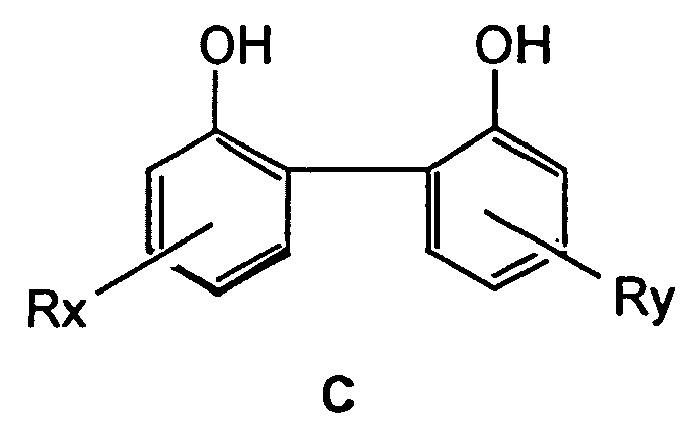
wobei x und y jeweils unabhängig voneinander gleich 0 - 3 sind, und wobei x und y jeweils unabhängig voneinander gleich 0 - 4 sind, wenn mindestens eine der Komponenten Rx oder Ry einen aromatischen Ring enthält; und (b) Binaphthol, D,
- Verfahren nach Anspruch 1, wobei jedes R unabhängig voneinander aus der Gruppe ausgewählt ist, die aus verzweigtem C1- bis C20-Alkyl, geradkettigem C1- bis C20-Alkyl und C1- bis C20-Cycloalkyl besteht.
- Verfahren nach Anspruch 1, wobei das benzylhalogenidhaltige Polymer ein benzylchloridhaltiges Polymer ist und das Verfahren bei einer Temperatur von etwa 10°C bis etwa 150°C in einem Lösungsmittel durch einen Lewis-Säurekatalysator ausgeführt wird.
- Verfahren nach Anspruch 3, wobei das benzylchloridhaltige Polymer aus der Gruppe ausgewählt ist, die aus Poly(vinylbenzylchlorid), einem Copolymer von Styrol und Vinylbenzylchlorid, einem mit 0,2% bis 5% Divinylbenzol vernetzten Copolymer von Styrol und Vinylbenzylchlorid und einer mit Poly(vinylbenzylchlorid) modifizierten Cellulose besteht.
- Verfahren nach Anspruch 3, wobei die Lewis-Säure aus der Gruppe ausgewählt ist, die aus AlBr3, AlCl3, AlF3, AlClxF(3-x), GaCl3, FeCl3, SbCl5, ZrCl4, SnCl4, BCl3, BF3, SbCl3, BF3·OEt2, BPh3, ZnCl2, ZnBr2, ZnI2, Alkoxid, Phenolat, Triflat und Tosylat von Al(III), Ga(III), Fe(III), Sb(III), Zr(IV), Sn(IV) und B(III) und Bromid- und Iodid-Salzformen besteht.
- Verfahren nach Anspruch 7, wobei die Lewis-Säure ZnCl2 oder AlCl3 ist.
- Polymergeträgertes Diol mit der Formel:

mit einem an ein benzylhalogenidhaltiges Polymer anpolymerisierten Diol;
wobei das Diol aus der Gruppe ausgewählt ist, die aus den folgenden Verbindungen besteht:(a) Biphenol, C,
wobei jedes R1 unabhängig voneinander aus der Gruppe ausgewählt ist, die aus einem verzweigten oder geradkettigen C1- bis C20-Alkyl, C1- bis C20-Cycloalkyl und C6- bis C20-Aryl besteht; und wobei x und y jeweils unabhängig voneinander gleich 0 - 3 sind, und wobei x und y jeweils unabhängig voneinander gleich 0-4 sind, wenn mindestens eine der Komponenten Rx oder Ry einen aromatischen Ring enthält; und(b) Binaphthol, D,wobei jedes R unabhängig voneinander aus der Gruppe ausgewählt ist, die aus H, einem verzweigten oder geradkettigen C1- bis C20-Alkyl und Benzyl, C1- bis C20-Cycloalkyl, C6- bis C20-Aryl, OR1, CO2R1 und cyclischem Ether besteht, wobei jedes R1 unabhängig voneinander aus der Gruppe ausgewählt ist, die aus einem verzweigten oder geradkettigen C1- bis C20-Alkyl, C1- bis C20-Cycloalkyl und C6- bis C20-Aryl besteht; wobei x und y jeweils unabhängig voneinander gleich 0 - 5 sind, und wobei x und y jeweils unabhängig voneinander gleich 0 - 6 sind, wenn mindestens eine der Komponenten Rx oder Ry einen aromatischen Ring enthält, und Kombinationen davon.
- Verfahren zur Herstellung eines polymergeträgerten Bis(phosphor)-Liganden (2) mit der Formel:

wobei das Verfahren das Inkontaktbringen des polymergeträgerten Diols nach Anspruch 7 mit einem Phosphorhalogenid mit der Formel PYnX3-n in Gegenwart einer Base aufweist,
wobei Y ein Halogenid ist; X aus der Gruppe ausgewählt ist, die aus Alkoxid, Aryloxid, Alkyl und Aryl besteht; und n = 3, 2 oder 1 ist; und
wobei, wenn X ein Alkoxid, Aryloxid, Alkyl oder Aryl ist, X 1 bis 50 Kohlenstoffatome, Heteroatome oder funktionelle Gruppen enthalten kann, die aus der Gruppe ausgewählt sind, die aus Ethern, Alkoholen, Estern und Amiden besteht. - Verfahren nach Anspruch 8, wobei die Base ein tertiäres Amin ist.
- Polymergeträgerter Bis(phosphor)-Ligand (2) mit der Formel

wobei der Ligand das Reaktionsprodukt des polymergeträgerten Diols nach Anspruch 7 mit einem Phosphorhalogenid mit der Formel PYnX3 aufweist,
wobei Y ein Halogenid ist; X aus der Gruppe ausgewählt ist, die aus Alkoxid, Aryloxid, Alkyl und Aryl besteht; und n = 3, 2 oder 1 ist; und
wobei, wenn X ein Alkoxid, Aryloxid, Alkyl oder Aryl ist, X 1 bis 50 Kohlenstoffatome, Heteroatome oder funktionelle Gruppen enthalten kann, die aus der Gruppe ausgewählt sind, die aus Ethern, Alkoholen, Estern und Amiden besteht. - Verfahren zur Herstellung einer polymergeträgerten Katalysatorzusammensetzung mit der Formel

wobei das Verfahren die Kombination des polymergeträgerten Bis(phosphor-)Liganden nach Anspruch 10 mit einem katalytisch aktiven Übergangsmetall M aufweist. - Verfahren nach Anspruch 11, wobei M Nickel ist.
- Polymergeträgerte Katalysatorzusammensetzung mit der Formel

die eine Kombination des polymergeträgerten Bis(phosphor)-Liganden nach Anspruch 10 mit einem katalytisch aktiven Übergangsmetall M aufweist. - Zusammensetzung nach Anspruch 13, wobei M Nickel ist.
- Isomerisierungsverfahren mit Verwendung der Katalysatorzusammensetzung nach Anspruch 13.
- Isomerisierungsverfahren, wobei eine Alkenylnitrilverbindung in Gegenwart der Katalysatorzusammensetzung nach Anspruch 13 zur Reaktion gebracht wird.
- Verfahren nach Anspruch 16, wobei die Alkenylnitrilyerbindung weniger als 500 ppm Peroxide enthält.
- Isomerisierungsverfahren nach Anspruch 16, wobei die Alkenylnitrilverbindung weniger als 100 ppm Peroxide enthält.
- Isomerisierungsverfahren nach Anspruch 16, 17 oder 18, wobei die Alkenylnitrilverbindung 2-Methyl-3-butennitril und das Metall Nickel ist.
- Hydrierungsverfahren mit Verwendung der Katalysatorzusammensetzung nach Anspruch 13.
- Hydrocyanierungsverfahren mit Verwendung der Katalysatorzusammensetzung nach Anspruch 13.
- Hydroformylierungsverfahren mit Verwendung der Katalysatorzusammensetzung nach Anspruch 13.
Applications Claiming Priority (3)
| Application Number | Priority Date | Filing Date | Title |
|---|---|---|---|
| US33336501P | 2001-11-26 | 2001-11-26 | |
| US333365P | 2001-11-26 | ||
| PCT/US2002/037967 WO2003046019A1 (en) | 2001-11-26 | 2002-11-26 | Supported bis(phosphorus)ligands and their use in the catalysis |
Publications (2)
| Publication Number | Publication Date |
|---|---|
| EP1448620A1 EP1448620A1 (de) | 2004-08-25 |
| EP1448620B1 true EP1448620B1 (de) | 2008-06-04 |
Family
ID=23302477
Family Applications (1)
| Application Number | Title | Priority Date | Filing Date |
|---|---|---|---|
| EP02791322A Expired - Lifetime EP1448620B1 (de) | 2001-11-26 | 2002-11-26 | Geträgerte diphosphorliganden und ihre verwendung in der katalyse |
Country Status (14)
| Country | Link |
|---|---|
| US (1) | US6984604B2 (de) |
| EP (1) | EP1448620B1 (de) |
| JP (1) | JP4313674B2 (de) |
| KR (1) | KR100952265B1 (de) |
| CN (1) | CN1289539C (de) |
| AT (1) | ATE397627T1 (de) |
| AU (1) | AU2002365409A1 (de) |
| BR (1) | BR0215095A (de) |
| CA (1) | CA2468127A1 (de) |
| DE (1) | DE60226998D1 (de) |
| ES (1) | ES2307808T3 (de) |
| MX (1) | MXPA04004936A (de) |
| PL (1) | PL371465A1 (de) |
| WO (1) | WO2003046019A1 (de) |
Cited By (11)
| Publication number | Priority date | Publication date | Assignee | Title |
|---|---|---|---|---|
| US7880028B2 (en) | 2006-07-14 | 2011-02-01 | Invista North America S.A R.L. | Process for making 3-pentenenitrile by hydrocyanation of butadiene |
| US7897801B2 (en) | 2003-05-12 | 2011-03-01 | Invista North America S.A R.L. | Process for the preparation of dinitriles |
| US7919646B2 (en) | 2006-07-14 | 2011-04-05 | Invista North America S.A R.L. | Hydrocyanation of 2-pentenenitrile |
| US7973174B2 (en) | 2005-10-18 | 2011-07-05 | Invista North America S.A.R.L. | Process of making 3-aminopentanenitrile |
| US7977502B2 (en) | 2008-01-15 | 2011-07-12 | Invista North America S.A R.L. | Process for making and refining 3-pentenenitrile, and for refining 2-methyl-3-butenenitrile |
| US8088943B2 (en) | 2008-01-15 | 2012-01-03 | Invista North America S.A R.L. | Hydrocyanation of pentenenitriles |
| US8101790B2 (en) | 2007-06-13 | 2012-01-24 | Invista North America S.A.R.L. | Process for improving adiponitrile quality |
| US8178711B2 (en) | 2006-03-17 | 2012-05-15 | Invista North America S.A R.L. | Method for the purification of triorganophosphites by treatment with a basic additive |
| US8247621B2 (en) | 2008-10-14 | 2012-08-21 | Invista North America S.A.R.L. | Process for making 2-secondary-alkyl-4,5-di-(normal-alkyl)phenols |
| US8338636B2 (en) | 2009-08-07 | 2012-12-25 | Invista North America S.A R.L. | Hydrogenation and esterification to form diesters |
| US8373001B2 (en) | 2003-02-10 | 2013-02-12 | Invista North America S.A R.L. | Method of producing dinitrile compounds |
Families Citing this family (20)
| Publication number | Priority date | Publication date | Assignee | Title |
|---|---|---|---|---|
| US20030100803A1 (en) * | 2001-11-26 | 2003-05-29 | Lu Helen S.M. | 3-Alkylated-5,5',6,6',7,7,'8,8'-octahydro-2,2'-binaphthols and 3,3'-dialkylated-5,5',6,6',7,7',8,8'-octahydro-2,2'-binaphthols and processes for making them |
| FR2849027B1 (fr) * | 2002-12-23 | 2005-01-21 | Rhodia Polyamide Intermediates | Procede de synthese de composes comprenant des fonctions nitriles a partir de composes a insaturations ethyleniques |
| KR101113201B1 (ko) * | 2003-02-19 | 2012-04-12 | 나트릭스 세퍼레이션즈, 인코포레이티드 | 지지된 다공성 젤을 함유하는 복합재 |
| FR2854892B1 (fr) * | 2003-05-12 | 2005-06-24 | Rhodia Polyamide Intermediates | Procede de fabrication de dinitriles |
| EP1758671B9 (de) * | 2004-04-08 | 2014-02-19 | Natrix Separations Inc. | Membranstapel |
| WO2005120701A1 (en) * | 2004-06-07 | 2005-12-22 | Mcmaster University | Stable composite material comprising supported porous gels |
| US7709674B2 (en) * | 2006-07-14 | 2010-05-04 | Invista North America S.A R.L | Hydrocyanation process with reduced yield losses |
| WO2008013009A1 (fr) * | 2006-07-25 | 2008-01-31 | National University Corporation Hokkaido University | Catalyseur complexe métallique supporté par polymère |
| EP2146930A2 (de) | 2007-05-14 | 2010-01-27 | INVISTA Technologies S.à.r.l. | Hocheffizienter reaktor und entsprechendes verfahren |
| EP2257516A4 (de) * | 2008-03-19 | 2012-12-12 | Invista Tech Sarl | Verfahren zur herstellung von cyclododecatrien und verfahren zur herstellung von laurolacton |
| US8066027B2 (en) * | 2008-07-30 | 2011-11-29 | Sprague Alden C | Vacuum activated closed loop system |
| US20100059443A1 (en) | 2008-09-02 | 2010-03-11 | Natrix Separations Inc. | Chromatography Membranes, Devices Containing Them, and Methods of Use Thereof |
| KR101687771B1 (ko) | 2009-10-15 | 2017-01-02 | 한화케미칼 주식회사 | 탈수소화가능한 지지체에 전이금속을 도입한 지지체-전이금속하이드라이드 복합체의 개선된 제조방법 및 그의 중간체 |
| US8167490B2 (en) | 2009-04-22 | 2012-05-01 | Reynolds Consumer Products Inc. | Multilayer stretchy drawstring |
| JP5256498B2 (ja) * | 2009-05-08 | 2013-08-07 | 国立大学法人名古屋大学 | 高分子配位子、アルミニウム錯体及びポリラクチドの製造方法 |
| KR20120093349A (ko) * | 2009-11-13 | 2012-08-22 | 나트릭스 세퍼레이션즈, 인코포레이티드 | 소수성 상호반응 크로마토그래피용 막 및 그의 사용방법 |
| EP2593224A4 (de) * | 2010-07-07 | 2014-01-29 | Conocophillips Co | Heterogene träger für homogene katalysatoren |
| AU2012255721A1 (en) | 2011-05-17 | 2014-01-09 | Natrix Separations Inc. | Layered tubular membranes for chromatography, and methods of use thereof |
| WO2016098533A1 (ja) * | 2014-12-18 | 2016-06-23 | 三菱瓦斯化学株式会社 | シアン酸エステル化合物及びその製造方法、樹脂組成物、並びに、硬化物 |
| CN117264093A (zh) * | 2023-11-23 | 2023-12-22 | 山东海化集团有限公司 | 一种合成溴化聚苯乙烯的方法 |
Family Cites Families (22)
| Publication number | Priority date | Publication date | Assignee | Title |
|---|---|---|---|---|
| US3391115A (en) * | 1962-04-27 | 1968-07-02 | Interchem Corp | Coating compositions containing phenol modified polydiene resinse and metal driers |
| US3496215A (en) | 1965-11-23 | 1970-02-17 | Du Pont | Hydrocyanation of olefins using selected nickel phosphite catalysts |
| FR2146806A5 (en) * | 1967-11-17 | 1973-03-02 | Reichhold Albert Chemie Ag | Unsatd resin prodn |
| US3655723A (en) | 1969-10-31 | 1972-04-11 | Du Pont | Hydrocyanation of olefins |
| US3631191A (en) | 1970-04-08 | 1971-12-28 | Du Pont | Synthesis of zero valent nickel-tetrakis triaryl phosphite complexes |
| US3766237A (en) | 1972-01-25 | 1973-10-16 | Du Pont | Hydrocyanation of olefins |
| JPS5034090A (de) * | 1973-07-27 | 1975-04-02 | ||
| JPS5034089A (de) * | 1973-07-27 | 1975-04-02 | ||
| DE2503867A1 (de) | 1974-02-01 | 1975-08-14 | Continental Oil Co | Alkyliertes butadienpolymerisat, verfahren zu seiner herstellung und seine verwendung |
| JPS5194487A (ja) * | 1975-02-19 | 1976-08-19 | Denshikokanseisenjobutsuno seizohoho | |
| DE4000625A1 (de) * | 1989-08-30 | 1991-03-07 | Bayer Ag | Verfahren zur herstellung von kautschuken |
| DE59205529D1 (de) | 1991-01-25 | 1996-04-11 | Ciba Geigy Ag | Silangruppen enthaltende Diphosphine, immobilisierte Diophoshine und deren Verwendung als Hydrierkatalysatoren |
| US5360938A (en) | 1991-08-21 | 1994-11-01 | Union Carbide Chemicals & Plastics Technology Corporation | Asymmetric syntheses |
| DK0730574T3 (da) | 1993-11-23 | 1999-05-25 | Du Pont | Fremgangsmåder og katalysatorsammensætninger til hydrocyanering af monoolefiner |
| US5512695A (en) | 1994-04-14 | 1996-04-30 | E. I. Du Pont De Nemours And Company | Bidentate phosphite and nickel catalyst compositions for hydrocyanation of monoolefins |
| CN1072980C (zh) * | 1994-04-14 | 2001-10-17 | 纳幕尔杜邦公司 | 用于单烯烃氢氰化的双配位亚磷酸酯和镍的催化剂复合物 |
| US6156810A (en) * | 1996-08-01 | 2000-12-05 | Exxon Chemical Patents, Inc. | Solid nucleophilic reagent for conversion of benzylic halogen functionality on polymers to other functionalities |
| JP3892932B2 (ja) * | 1997-03-11 | 2007-03-14 | 高砂香料工業株式会社 | ビニル基を有する光学活性ホスフィン誘導体、それをモノマーとするポリマー、及びそれらの遷移金属錯体 |
| US6121184A (en) * | 1997-07-29 | 2000-09-19 | E. I. Du Pont De Nemours And Company | Supported bis(phosphorus) ligands |
| US6229052B1 (en) * | 1998-05-29 | 2001-05-08 | E. I. Du Pont De Nemours And Company | Hydroformylation of olefins using supported bis(phosphorus) ligands |
| US6307107B1 (en) * | 1999-09-20 | 2001-10-23 | E.I. Du Pont De Nemours And Company | Hydroformylation of acyclic monoethylenically unsaturated compounds to corresponding terminal aldehydes |
| DE10002973A1 (de) * | 2000-01-24 | 2001-07-26 | Degussa | Polymere Diphosphinliganden für homogen lösliche Hydrierkatalysatoren, Verfahren zu deren Herstellung und Verwendung |
-
2002
- 2002-11-26 JP JP2003547467A patent/JP4313674B2/ja not_active Expired - Fee Related
- 2002-11-26 PL PL02371465A patent/PL371465A1/xx unknown
- 2002-11-26 BR BR0215095-6A patent/BR0215095A/pt not_active Application Discontinuation
- 2002-11-26 CN CNB028275136A patent/CN1289539C/zh not_active Expired - Fee Related
- 2002-11-26 EP EP02791322A patent/EP1448620B1/de not_active Expired - Lifetime
- 2002-11-26 KR KR1020047007957A patent/KR100952265B1/ko not_active Expired - Fee Related
- 2002-11-26 AT AT02791322T patent/ATE397627T1/de not_active IP Right Cessation
- 2002-11-26 CA CA002468127A patent/CA2468127A1/en not_active Abandoned
- 2002-11-26 AU AU2002365409A patent/AU2002365409A1/en not_active Abandoned
- 2002-11-26 WO PCT/US2002/037967 patent/WO2003046019A1/en not_active Ceased
- 2002-11-26 DE DE60226998T patent/DE60226998D1/de not_active Expired - Lifetime
- 2002-11-26 ES ES02791322T patent/ES2307808T3/es not_active Expired - Lifetime
- 2002-11-26 MX MXPA04004936A patent/MXPA04004936A/es active IP Right Grant
- 2002-11-26 US US10/305,230 patent/US6984604B2/en not_active Expired - Fee Related
Cited By (12)
| Publication number | Priority date | Publication date | Assignee | Title |
|---|---|---|---|---|
| US8373001B2 (en) | 2003-02-10 | 2013-02-12 | Invista North America S.A R.L. | Method of producing dinitrile compounds |
| US7897801B2 (en) | 2003-05-12 | 2011-03-01 | Invista North America S.A R.L. | Process for the preparation of dinitriles |
| US7973174B2 (en) | 2005-10-18 | 2011-07-05 | Invista North America S.A.R.L. | Process of making 3-aminopentanenitrile |
| US8178711B2 (en) | 2006-03-17 | 2012-05-15 | Invista North America S.A R.L. | Method for the purification of triorganophosphites by treatment with a basic additive |
| US7880028B2 (en) | 2006-07-14 | 2011-02-01 | Invista North America S.A R.L. | Process for making 3-pentenenitrile by hydrocyanation of butadiene |
| US7919646B2 (en) | 2006-07-14 | 2011-04-05 | Invista North America S.A R.L. | Hydrocyanation of 2-pentenenitrile |
| US8394981B2 (en) | 2006-07-14 | 2013-03-12 | Invista North America S.A R.L. | Hydrocyanation of 2-pentenenitrile |
| US8101790B2 (en) | 2007-06-13 | 2012-01-24 | Invista North America S.A.R.L. | Process for improving adiponitrile quality |
| US7977502B2 (en) | 2008-01-15 | 2011-07-12 | Invista North America S.A R.L. | Process for making and refining 3-pentenenitrile, and for refining 2-methyl-3-butenenitrile |
| US8088943B2 (en) | 2008-01-15 | 2012-01-03 | Invista North America S.A R.L. | Hydrocyanation of pentenenitriles |
| US8247621B2 (en) | 2008-10-14 | 2012-08-21 | Invista North America S.A.R.L. | Process for making 2-secondary-alkyl-4,5-di-(normal-alkyl)phenols |
| US8338636B2 (en) | 2009-08-07 | 2012-12-25 | Invista North America S.A R.L. | Hydrogenation and esterification to form diesters |
Also Published As
| Publication number | Publication date |
|---|---|
| WO2003046019A1 (en) | 2003-06-05 |
| CN1617892A (zh) | 2005-05-18 |
| JP4313674B2 (ja) | 2009-08-12 |
| US20030153691A1 (en) | 2003-08-14 |
| KR100952265B1 (ko) | 2010-04-09 |
| ES2307808T3 (es) | 2008-12-01 |
| MXPA04004936A (es) | 2004-08-11 |
| ATE397627T1 (de) | 2008-06-15 |
| DE60226998D1 (de) | 2008-07-17 |
| US6984604B2 (en) | 2006-01-10 |
| AU2002365409A1 (en) | 2003-06-10 |
| CA2468127A1 (en) | 2003-06-05 |
| EP1448620A1 (de) | 2004-08-25 |
| BR0215095A (pt) | 2004-11-16 |
| JP2005510588A (ja) | 2005-04-21 |
| KR20040054807A (ko) | 2004-06-25 |
| PL371465A1 (en) | 2005-06-13 |
| CN1289539C (zh) | 2006-12-13 |
Similar Documents
| Publication | Publication Date | Title |
|---|---|---|
| US6984604B2 (en) | Supported bis(phosphorus) ligands and their use in the catalysis | |
| EP1214975B1 (de) | Geträgerte Bisphosphor Liganden; deren Verwendung in Hydrocaynierungsverfahren | |
| EP1448298B1 (de) | Polymeres phosphor enthaltende zusammensetzungen und ihre verwendung in der hydrocyanierung, hydroformylierung und isomerisierung ungesättigter nitrile | |
| JP4309057B2 (ja) | 担持されたビス(リン)配位子を用いるオレフィンのヒドロホルミル化 | |
| EP1448668B1 (de) | Polymere phosphorhaltige zusammensetzungen und deren verwendung in hydrocyanierungs-, isomerisierungs- und hydroformylierungs-reaktionen | |
| US6171997B1 (en) | Hydrocyanation of diolefins and isomerization of nonconjugated 2-aklyl-3-monoalkenenitriles | |
| US6399534B2 (en) | Bidentate organic phosphite ligands and compositions | |
| US6284865B1 (en) | Polymeric phosphite composition and hydrocyanation of unsaturated organic compounds and the isomerization of unsaturated nitriles | |
| US6362354B1 (en) | Phosphonite ligands, catalyst compositions and hydroformylation process utilizing same | |
| EP1445019B1 (de) | Hydroformylierung von ungesättigten Verbindungen unter Verwendung von polymerischen Phosphitliganden |
Legal Events
| Date | Code | Title | Description |
|---|---|---|---|
| PUAI | Public reference made under article 153(3) epc to a published international application that has entered the european phase |
Free format text: ORIGINAL CODE: 0009012 |
|
| 17P | Request for examination filed |
Effective date: 20040521 |
|
| AK | Designated contracting states |
Kind code of ref document: A1 Designated state(s): AT BE BG CH CY CZ DE DK EE ES FI FR GB GR IE IT LI LU MC NL PT SE SK TR |
|
| AX | Request for extension of the european patent |
Extension state: AL LT LV MK RO SI |
|
| GRAP | Despatch of communication of intention to grant a patent |
Free format text: ORIGINAL CODE: EPIDOSNIGR1 |
|
| RAP1 | Party data changed (applicant data changed or rights of an application transferred) |
Owner name: INVISTA TECHNOLOGIES S.A.R.L. |
|
| GRAS | Grant fee paid |
Free format text: ORIGINAL CODE: EPIDOSNIGR3 |
|
| GRAA | (expected) grant |
Free format text: ORIGINAL CODE: 0009210 |
|
| AK | Designated contracting states |
Kind code of ref document: B1 Designated state(s): AT BE BG CH CY CZ DE DK EE ES FI FR GB GR IE IT LI LU MC NL PT SE SK TR |
|
| REG | Reference to a national code |
Ref country code: GB Ref legal event code: FG4D |
|
| REG | Reference to a national code |
Ref country code: CH Ref legal event code: EP |
|
| REF | Corresponds to: |
Ref document number: 60226998 Country of ref document: DE Date of ref document: 20080717 Kind code of ref document: P |
|
| REG | Reference to a national code |
Ref country code: IE Ref legal event code: FG4D |
|
| PG25 | Lapsed in a contracting state [announced via postgrant information from national office to epo] |
Ref country code: FI Free format text: LAPSE BECAUSE OF FAILURE TO SUBMIT A TRANSLATION OF THE DESCRIPTION OR TO PAY THE FEE WITHIN THE PRESCRIBED TIME-LIMIT Effective date: 20080604 |
|
| PG25 | Lapsed in a contracting state [announced via postgrant information from national office to epo] |
Ref country code: AT Free format text: LAPSE BECAUSE OF FAILURE TO SUBMIT A TRANSLATION OF THE DESCRIPTION OR TO PAY THE FEE WITHIN THE PRESCRIBED TIME-LIMIT Effective date: 20080604 |
|
| REG | Reference to a national code |
Ref country code: ES Ref legal event code: FG2A Ref document number: 2307808 Country of ref document: ES Kind code of ref document: T3 |
|
| PG25 | Lapsed in a contracting state [announced via postgrant information from national office to epo] |
Ref country code: SE Free format text: LAPSE BECAUSE OF FAILURE TO SUBMIT A TRANSLATION OF THE DESCRIPTION OR TO PAY THE FEE WITHIN THE PRESCRIBED TIME-LIMIT Effective date: 20080904 Ref country code: PT Free format text: LAPSE BECAUSE OF FAILURE TO SUBMIT A TRANSLATION OF THE DESCRIPTION OR TO PAY THE FEE WITHIN THE PRESCRIBED TIME-LIMIT Effective date: 20081104 Ref country code: CZ Free format text: LAPSE BECAUSE OF FAILURE TO SUBMIT A TRANSLATION OF THE DESCRIPTION OR TO PAY THE FEE WITHIN THE PRESCRIBED TIME-LIMIT Effective date: 20080604 |
|
| PG25 | Lapsed in a contracting state [announced via postgrant information from national office to epo] |
Ref country code: SK Free format text: LAPSE BECAUSE OF FAILURE TO SUBMIT A TRANSLATION OF THE DESCRIPTION OR TO PAY THE FEE WITHIN THE PRESCRIBED TIME-LIMIT Effective date: 20080604 |
|
| PLBE | No opposition filed within time limit |
Free format text: ORIGINAL CODE: 0009261 |
|
| STAA | Information on the status of an ep patent application or granted ep patent |
Free format text: STATUS: NO OPPOSITION FILED WITHIN TIME LIMIT |
|
| PG25 | Lapsed in a contracting state [announced via postgrant information from national office to epo] |
Ref country code: DK Free format text: LAPSE BECAUSE OF FAILURE TO SUBMIT A TRANSLATION OF THE DESCRIPTION OR TO PAY THE FEE WITHIN THE PRESCRIBED TIME-LIMIT Effective date: 20080604 Ref country code: EE Free format text: LAPSE BECAUSE OF FAILURE TO SUBMIT A TRANSLATION OF THE DESCRIPTION OR TO PAY THE FEE WITHIN THE PRESCRIBED TIME-LIMIT Effective date: 20080604 Ref country code: BG Free format text: LAPSE BECAUSE OF FAILURE TO SUBMIT A TRANSLATION OF THE DESCRIPTION OR TO PAY THE FEE WITHIN THE PRESCRIBED TIME-LIMIT Effective date: 20080904 |
|
| 26N | No opposition filed |
Effective date: 20090305 |
|
| REG | Reference to a national code |
Ref country code: GB Ref legal event code: 732E Free format text: REGISTERED BETWEEN 20090507 AND 20090513 |
|
| PG25 | Lapsed in a contracting state [announced via postgrant information from national office to epo] |
Ref country code: MC Free format text: LAPSE BECAUSE OF NON-PAYMENT OF DUE FEES Effective date: 20081130 |
|
| REG | Reference to a national code |
Ref country code: CH Ref legal event code: PL |
|
| REG | Reference to a national code |
Ref country code: IE Ref legal event code: MM4A |
|
| PG25 | Lapsed in a contracting state [announced via postgrant information from national office to epo] |
Ref country code: IE Free format text: LAPSE BECAUSE OF NON-PAYMENT OF DUE FEES Effective date: 20081126 Ref country code: CH Free format text: LAPSE BECAUSE OF NON-PAYMENT OF DUE FEES Effective date: 20081130 Ref country code: LI Free format text: LAPSE BECAUSE OF NON-PAYMENT OF DUE FEES Effective date: 20081130 |
|
| PGFP | Annual fee paid to national office [announced via postgrant information from national office to epo] |
Ref country code: ES Payment date: 20091201 Year of fee payment: 8 |
|
| PGFP | Annual fee paid to national office [announced via postgrant information from national office to epo] |
Ref country code: NL Payment date: 20091104 Year of fee payment: 8 |
|
| PGFP | Annual fee paid to national office [announced via postgrant information from national office to epo] |
Ref country code: GB Payment date: 20091125 Year of fee payment: 8 Ref country code: IT Payment date: 20091119 Year of fee payment: 8 |
|
| PGFP | Annual fee paid to national office [announced via postgrant information from national office to epo] |
Ref country code: BE Payment date: 20091130 Year of fee payment: 8 |
|
| PG25 | Lapsed in a contracting state [announced via postgrant information from national office to epo] |
Ref country code: LU Free format text: LAPSE BECAUSE OF NON-PAYMENT OF DUE FEES Effective date: 20081126 Ref country code: CY Free format text: LAPSE BECAUSE OF FAILURE TO SUBMIT A TRANSLATION OF THE DESCRIPTION OR TO PAY THE FEE WITHIN THE PRESCRIBED TIME-LIMIT Effective date: 20080604 |
|
| PG25 | Lapsed in a contracting state [announced via postgrant information from national office to epo] |
Ref country code: TR Free format text: LAPSE BECAUSE OF FAILURE TO SUBMIT A TRANSLATION OF THE DESCRIPTION OR TO PAY THE FEE WITHIN THE PRESCRIBED TIME-LIMIT Effective date: 20080604 |
|
| PG25 | Lapsed in a contracting state [announced via postgrant information from national office to epo] |
Ref country code: GR Free format text: LAPSE BECAUSE OF FAILURE TO SUBMIT A TRANSLATION OF THE DESCRIPTION OR TO PAY THE FEE WITHIN THE PRESCRIBED TIME-LIMIT Effective date: 20080905 |
|
| BERE | Be: lapsed |
Owner name: INVISTA TECHNOLOGIES S.A.R.L. Effective date: 20101130 |
|
| REG | Reference to a national code |
Ref country code: NL Ref legal event code: V1 Effective date: 20110601 |
|
| GBPC | Gb: european patent ceased through non-payment of renewal fee |
Effective date: 20101126 |
|
| PG25 | Lapsed in a contracting state [announced via postgrant information from national office to epo] |
Ref country code: NL Free format text: LAPSE BECAUSE OF NON-PAYMENT OF DUE FEES Effective date: 20110601 Ref country code: BE Free format text: LAPSE BECAUSE OF NON-PAYMENT OF DUE FEES Effective date: 20101130 |
|
| PG25 | Lapsed in a contracting state [announced via postgrant information from national office to epo] |
Ref country code: GB Free format text: LAPSE BECAUSE OF NON-PAYMENT OF DUE FEES Effective date: 20101126 |
|
| PG25 | Lapsed in a contracting state [announced via postgrant information from national office to epo] |
Ref country code: IT Free format text: LAPSE BECAUSE OF NON-PAYMENT OF DUE FEES Effective date: 20101126 |
|
| REG | Reference to a national code |
Ref country code: ES Ref legal event code: FD2A Effective date: 20120110 |
|
| PG25 | Lapsed in a contracting state [announced via postgrant information from national office to epo] |
Ref country code: ES Free format text: LAPSE BECAUSE OF NON-PAYMENT OF DUE FEES Effective date: 20101127 |
|
| REG | Reference to a national code |
Ref country code: FR Ref legal event code: PLFP Year of fee payment: 14 |
|
| PGFP | Annual fee paid to national office [announced via postgrant information from national office to epo] |
Ref country code: DE Payment date: 20151118 Year of fee payment: 14 |
|
| REG | Reference to a national code |
Ref country code: FR Ref legal event code: PLFP Year of fee payment: 15 |
|
| PGFP | Annual fee paid to national office [announced via postgrant information from national office to epo] |
Ref country code: FR Payment date: 20161014 Year of fee payment: 15 |
|
| REG | Reference to a national code |
Ref country code: DE Ref legal event code: R119 Ref document number: 60226998 Country of ref document: DE |
|
| PG25 | Lapsed in a contracting state [announced via postgrant information from national office to epo] |
Ref country code: DE Free format text: LAPSE BECAUSE OF NON-PAYMENT OF DUE FEES Effective date: 20170601 |
|
| REG | Reference to a national code |
Ref country code: FR Ref legal event code: ST Effective date: 20180731 |
|
| PG25 | Lapsed in a contracting state [announced via postgrant information from national office to epo] |
Ref country code: FR Free format text: LAPSE BECAUSE OF NON-PAYMENT OF DUE FEES Effective date: 20171130 |