EP1449864B1 - Kristalline polyglykolsäure, polyglykolsäurezusammensetzung und herstellungsverfahren dafür - Google Patents
Kristalline polyglykolsäure, polyglykolsäurezusammensetzung und herstellungsverfahren dafür Download PDFInfo
- Publication number
- EP1449864B1 EP1449864B1 EP02775429A EP02775429A EP1449864B1 EP 1449864 B1 EP1449864 B1 EP 1449864B1 EP 02775429 A EP02775429 A EP 02775429A EP 02775429 A EP02775429 A EP 02775429A EP 1449864 B1 EP1449864 B1 EP 1449864B1
- Authority
- EP
- European Patent Office
- Prior art keywords
- polyglycolic acid
- temperature
- heating
- crystalline
- crystallization
- Prior art date
- Legal status (The legal status is an assumption and is not a legal conclusion. Google has not performed a legal analysis and makes no representation as to the accuracy of the status listed.)
- Expired - Lifetime
Links
- 229920000954 Polyglycolide Polymers 0.000 title claims abstract description 265
- 239000004633 polyglycolic acid Substances 0.000 title claims abstract description 262
- 239000000203 mixture Substances 0.000 title claims abstract description 72
- 238000004519 manufacturing process Methods 0.000 title claims abstract description 14
- 238000000034 method Methods 0.000 title claims description 51
- 238000010438 heat treatment Methods 0.000 claims abstract description 112
- 238000002844 melting Methods 0.000 claims abstract description 101
- 230000008018 melting Effects 0.000 claims abstract description 101
- 238000002425 crystallisation Methods 0.000 claims abstract description 89
- 230000008025 crystallization Effects 0.000 claims abstract description 89
- 239000012760 heat stabilizer Substances 0.000 claims abstract description 24
- 230000009477 glass transition Effects 0.000 claims abstract description 22
- 238000001816 cooling Methods 0.000 claims description 44
- 229920000642 polymer Polymers 0.000 claims description 30
- 238000006116 polymerization reaction Methods 0.000 claims description 21
- 239000007787 solid Substances 0.000 claims description 20
- RKDVKSZUMVYZHH-UHFFFAOYSA-N 1,4-dioxane-2,5-dione Chemical compound O=C1COC(=O)CO1 RKDVKSZUMVYZHH-UHFFFAOYSA-N 0.000 claims description 18
- 150000001875 compounds Chemical class 0.000 claims description 16
- 239000013078 crystal Substances 0.000 claims description 16
- 238000007151 ring opening polymerisation reaction Methods 0.000 claims description 16
- 125000004122 cyclic group Chemical group 0.000 claims description 11
- -1 phosphorus compound Chemical class 0.000 claims description 11
- OJMIONKXNSYLSR-UHFFFAOYSA-N phosphorous acid Chemical compound OP(O)O OJMIONKXNSYLSR-UHFFFAOYSA-N 0.000 claims description 10
- 125000005907 alkyl ester group Chemical group 0.000 claims description 9
- 230000007704 transition Effects 0.000 claims description 9
- 229910019142 PO4 Inorganic materials 0.000 claims description 8
- 239000003963 antioxidant agent Substances 0.000 claims description 8
- WXZMFSXDPGVJKK-UHFFFAOYSA-N pentaerythritol Chemical group OCC(CO)(CO)CO WXZMFSXDPGVJKK-UHFFFAOYSA-N 0.000 claims description 8
- 235000021317 phosphate Nutrition 0.000 claims description 8
- 150000003018 phosphorus compounds Chemical class 0.000 claims description 8
- 230000003078 antioxidant effect Effects 0.000 claims description 7
- 125000002887 hydroxy group Chemical group [H]O* 0.000 claims description 7
- 238000004898 kneading Methods 0.000 claims description 7
- 239000006078 metal deactivator Substances 0.000 claims description 7
- 150000003013 phosphoric acid derivatives Chemical class 0.000 claims description 7
- 239000007790 solid phase Substances 0.000 claims description 7
- MZZYGYNZAOVRTG-UHFFFAOYSA-N 2-hydroxy-n-(1h-1,2,4-triazol-5-yl)benzamide Chemical group OC1=CC=CC=C1C(=O)NC1=NC=NN1 MZZYGYNZAOVRTG-UHFFFAOYSA-N 0.000 claims description 6
- 229910001385 heavy metal Inorganic materials 0.000 claims description 6
- 238000002156 mixing Methods 0.000 claims description 2
- NJHVXCSESBEOEB-UHFFFAOYSA-N (2,6-ditert-butyl-4-methylphenyl) dihydrogen phosphite Chemical compound CC1=CC(C(C)(C)C)=C(OP(O)O)C(C(C)(C)C)=C1 NJHVXCSESBEOEB-UHFFFAOYSA-N 0.000 claims 1
- MSKNHYKUZCSREG-UHFFFAOYSA-N (2,6-ditert-butylphenyl) dihydrogen phosphite Chemical compound CC(C)(C)C1=CC=CC(C(C)(C)C)=C1OP(O)O MSKNHYKUZCSREG-UHFFFAOYSA-N 0.000 claims 1
- NBIIXXVUZAFLBC-UHFFFAOYSA-K phosphate Chemical compound [O-]P([O-])([O-])=O NBIIXXVUZAFLBC-UHFFFAOYSA-K 0.000 claims 1
- 239000010452 phosphate Substances 0.000 claims 1
- 229910052698 phosphorus Inorganic materials 0.000 claims 1
- 239000011574 phosphorus Substances 0.000 claims 1
- 239000010410 layer Substances 0.000 description 94
- AEMRFAOFKBGASW-UHFFFAOYSA-N Glycolic acid Polymers OCC(O)=O AEMRFAOFKBGASW-UHFFFAOYSA-N 0.000 description 18
- 238000009740 moulding (composite fabrication) Methods 0.000 description 18
- 229920005989 resin Polymers 0.000 description 13
- 239000011347 resin Substances 0.000 description 13
- 239000012299 nitrogen atmosphere Substances 0.000 description 11
- 239000000835 fiber Substances 0.000 description 10
- 229920001519 homopolymer Polymers 0.000 description 10
- 239000000155 melt Substances 0.000 description 9
- 239000012790 adhesive layer Substances 0.000 description 8
- 230000004888 barrier function Effects 0.000 description 8
- 239000007789 gas Substances 0.000 description 8
- 238000003475 lamination Methods 0.000 description 8
- 238000010128 melt processing Methods 0.000 description 8
- 239000008188 pellet Substances 0.000 description 8
- 238000001125 extrusion Methods 0.000 description 7
- 239000002667 nucleating agent Substances 0.000 description 7
- 238000012545 processing Methods 0.000 description 7
- 229910052782 aluminium Inorganic materials 0.000 description 6
- XAGFODPZIPBFFR-UHFFFAOYSA-N aluminium Chemical group [Al] XAGFODPZIPBFFR-UHFFFAOYSA-N 0.000 description 6
- 230000000694 effects Effects 0.000 description 6
- 238000005259 measurement Methods 0.000 description 6
- 238000000465 moulding Methods 0.000 description 6
- 230000000052 comparative effect Effects 0.000 description 5
- 239000005457 ice water Substances 0.000 description 5
- 238000001746 injection moulding Methods 0.000 description 5
- 229920005992 thermoplastic resin Polymers 0.000 description 5
- CSCPPACGZOOCGX-UHFFFAOYSA-N Acetone Chemical compound CC(C)=O CSCPPACGZOOCGX-UHFFFAOYSA-N 0.000 description 4
- VYPSYNLAJGMNEJ-UHFFFAOYSA-N Silicium dioxide Chemical compound O=[Si]=O VYPSYNLAJGMNEJ-UHFFFAOYSA-N 0.000 description 4
- 239000000654 additive Substances 0.000 description 4
- WNLRTRBMVRJNCN-UHFFFAOYSA-N adipic acid Chemical compound OC(=O)CCCCC(O)=O WNLRTRBMVRJNCN-UHFFFAOYSA-N 0.000 description 4
- 239000003054 catalyst Substances 0.000 description 4
- 229920001577 copolymer Polymers 0.000 description 4
- 230000008021 deposition Effects 0.000 description 4
- 230000001771 impaired effect Effects 0.000 description 4
- JVTAAEKCZFNVCJ-UHFFFAOYSA-N lactic acid Chemical compound CC(O)C(O)=O JVTAAEKCZFNVCJ-UHFFFAOYSA-N 0.000 description 4
- 239000000178 monomer Substances 0.000 description 4
- 239000002861 polymer material Substances 0.000 description 4
- 238000003825 pressing Methods 0.000 description 4
- 239000002356 single layer Substances 0.000 description 4
- ZHROMWXOTYBIMF-UHFFFAOYSA-M sodium;1,3,7,9-tetratert-butyl-11-oxido-5h-benzo[d][1,3,2]benzodioxaphosphocine 11-oxide Chemical compound [Na+].C1C2=CC(C(C)(C)C)=CC(C(C)(C)C)=C2OP([O-])(=O)OC2=C1C=C(C(C)(C)C)C=C2C(C)(C)C ZHROMWXOTYBIMF-UHFFFAOYSA-M 0.000 description 4
- 238000005979 thermal decomposition reaction Methods 0.000 description 4
- 230000004580 weight loss Effects 0.000 description 4
- VPVXHAANQNHFSF-UHFFFAOYSA-N 1,4-dioxan-2-one Chemical compound O=C1COCCO1 VPVXHAANQNHFSF-UHFFFAOYSA-N 0.000 description 3
- SSADPHQCUURWSW-UHFFFAOYSA-N 3,9-bis(2,6-ditert-butyl-4-methylphenoxy)-2,4,8,10-tetraoxa-3,9-diphosphaspiro[5.5]undecane Chemical compound CC(C)(C)C1=CC(C)=CC(C(C)(C)C)=C1OP1OCC2(COP(OC=3C(=CC(C)=CC=3C(C)(C)C)C(C)(C)C)OC2)CO1 SSADPHQCUURWSW-UHFFFAOYSA-N 0.000 description 3
- 0 CCCCIc1cc(C)cc(I*)c1OP1*C(C)(*P(O)Oc2c(C(CCC)I)cc(C)cc2*I)*1 Chemical compound CCCCIc1cc(C)cc(I*)c1OP1*C(C)(*P(O)Oc2c(C(CCC)I)cc(C)cc2*I)*1 0.000 description 3
- LYCAIKOWRPUZTN-UHFFFAOYSA-N Ethylene glycol Chemical compound OCCO LYCAIKOWRPUZTN-UHFFFAOYSA-N 0.000 description 3
- 229920006257 Heat-shrinkable film Polymers 0.000 description 3
- 239000003795 chemical substances by application Substances 0.000 description 3
- 239000011248 coating agent Substances 0.000 description 3
- 238000000576 coating method Methods 0.000 description 3
- 238000004040 coloring Methods 0.000 description 3
- 239000002131 composite material Substances 0.000 description 3
- 238000009998 heat setting Methods 0.000 description 3
- 239000000463 material Substances 0.000 description 3
- 239000012785 packaging film Substances 0.000 description 3
- 229920006280 packaging film Polymers 0.000 description 3
- 238000005453 pelletization Methods 0.000 description 3
- 239000004014 plasticizer Substances 0.000 description 3
- 238000006068 polycondensation reaction Methods 0.000 description 3
- 229920001225 polyester resin Polymers 0.000 description 3
- 239000004645 polyester resin Substances 0.000 description 3
- ZNLAHAOCFKBYRH-UHFFFAOYSA-N 1,4-dioxane-2,3-dione Chemical compound O=C1OCCOC1=O ZNLAHAOCFKBYRH-UHFFFAOYSA-N 0.000 description 2
- ALRHLSYJTWAHJZ-UHFFFAOYSA-N 3-hydroxypropionic acid Chemical compound OCCC(O)=O ALRHLSYJTWAHJZ-UHFFFAOYSA-N 0.000 description 2
- YEJRWHAVMIAJKC-UHFFFAOYSA-N 4-Butyrolactone Chemical compound O=C1CCCO1 YEJRWHAVMIAJKC-UHFFFAOYSA-N 0.000 description 2
- JRFXQKZEGILCCO-UHFFFAOYSA-N 5,5-dimethyl-1,3-dioxan-2-one Chemical compound CC1(C)COC(=O)OC1 JRFXQKZEGILCCO-UHFFFAOYSA-N 0.000 description 2
- OZJPLYNZGCXSJM-UHFFFAOYSA-N 5-valerolactone Chemical compound O=C1CCCCO1 OZJPLYNZGCXSJM-UHFFFAOYSA-N 0.000 description 2
- IJGRMHOSHXDMSA-UHFFFAOYSA-N Atomic nitrogen Chemical compound N#N IJGRMHOSHXDMSA-UHFFFAOYSA-N 0.000 description 2
- VTYYLEPIZMXCLO-UHFFFAOYSA-L Calcium carbonate Chemical compound [Ca+2].[O-]C([O-])=O VTYYLEPIZMXCLO-UHFFFAOYSA-L 0.000 description 2
- OAKJQQAXSVQMHS-UHFFFAOYSA-N Hydrazine Chemical compound NN OAKJQQAXSVQMHS-UHFFFAOYSA-N 0.000 description 2
- ATJFFYVFTNAWJD-UHFFFAOYSA-N Tin Chemical compound [Sn] ATJFFYVFTNAWJD-UHFFFAOYSA-N 0.000 description 2
- 239000008186 active pharmaceutical agent Substances 0.000 description 2
- 230000000996 additive effect Effects 0.000 description 2
- 239000001361 adipic acid Substances 0.000 description 2
- 235000011037 adipic acid Nutrition 0.000 description 2
- PNEYBMLMFCGWSK-UHFFFAOYSA-N aluminium oxide Inorganic materials [O-2].[O-2].[O-2].[Al+3].[Al+3] PNEYBMLMFCGWSK-UHFFFAOYSA-N 0.000 description 2
- 235000013405 beer Nutrition 0.000 description 2
- 229920002988 biodegradable polymer Polymers 0.000 description 2
- 239000004621 biodegradable polymer Substances 0.000 description 2
- 229920006167 biodegradable resin Polymers 0.000 description 2
- 238000000071 blow moulding Methods 0.000 description 2
- WERYXYBDKMZEQL-UHFFFAOYSA-N butane-1,4-diol Chemical compound OCCCCO WERYXYBDKMZEQL-UHFFFAOYSA-N 0.000 description 2
- 239000011575 calcium Substances 0.000 description 2
- BVKZGUZCCUSVTD-UHFFFAOYSA-N carbonic acid Chemical class OC(O)=O BVKZGUZCCUSVTD-UHFFFAOYSA-N 0.000 description 2
- 229910052681 coesite Inorganic materials 0.000 description 2
- 229910052593 corundum Inorganic materials 0.000 description 2
- 229910052906 cristobalite Inorganic materials 0.000 description 2
- 238000002474 experimental method Methods 0.000 description 2
- 235000013305 food Nutrition 0.000 description 2
- 239000004310 lactic acid Substances 0.000 description 2
- 235000014655 lactic acid Nutrition 0.000 description 2
- JJTUDXZGHPGLLC-UHFFFAOYSA-N lactide Chemical compound CC1OC(=O)C(C)OC1=O JJTUDXZGHPGLLC-UHFFFAOYSA-N 0.000 description 2
- QIQXTHQIDYTFRH-UHFFFAOYSA-N octadecanoic acid Chemical compound CCCCCCCCCCCCCCCCCC(O)=O QIQXTHQIDYTFRH-UHFFFAOYSA-N 0.000 description 2
- CSWFWSPPZMEYAY-UHFFFAOYSA-N octadecyl dihydrogen phosphite Chemical compound CCCCCCCCCCCCCCCCCCOP(O)O CSWFWSPPZMEYAY-UHFFFAOYSA-N 0.000 description 2
- 230000000704 physical effect Effects 0.000 description 2
- BASFCYQUMIYNBI-UHFFFAOYSA-N platinum Chemical compound [Pt] BASFCYQUMIYNBI-UHFFFAOYSA-N 0.000 description 2
- 239000011541 reaction mixture Substances 0.000 description 2
- 239000000377 silicon dioxide Substances 0.000 description 2
- 229910052682 stishovite Inorganic materials 0.000 description 2
- LEDMRZGFZIAGGB-UHFFFAOYSA-L strontium carbonate Chemical compound [Sr+2].[O-]C([O-])=O LEDMRZGFZIAGGB-UHFFFAOYSA-L 0.000 description 2
- 229910000018 strontium carbonate Inorganic materials 0.000 description 2
- 239000000126 substance Substances 0.000 description 2
- KDYFGRWQOYBRFD-UHFFFAOYSA-N succinic acid Chemical compound OC(=O)CCC(O)=O KDYFGRWQOYBRFD-UHFFFAOYSA-N 0.000 description 2
- 238000012360 testing method Methods 0.000 description 2
- FWPIDFUJEMBDLS-UHFFFAOYSA-L tin(II) chloride dihydrate Chemical compound O.O.Cl[Sn]Cl FWPIDFUJEMBDLS-UHFFFAOYSA-L 0.000 description 2
- 229910052905 tridymite Inorganic materials 0.000 description 2
- YFHICDDUDORKJB-UHFFFAOYSA-N trimethylene carbonate Chemical compound O=C1OCCCO1 YFHICDDUDORKJB-UHFFFAOYSA-N 0.000 description 2
- 238000007666 vacuum forming Methods 0.000 description 2
- XLYOFNOQVPJJNP-UHFFFAOYSA-N water Substances O XLYOFNOQVPJJNP-UHFFFAOYSA-N 0.000 description 2
- 229910001845 yogo sapphire Inorganic materials 0.000 description 2
- PAPBSGBWRJIAAV-UHFFFAOYSA-N ε-Caprolactone Chemical compound O=C1CCCCCO1 PAPBSGBWRJIAAV-UHFFFAOYSA-N 0.000 description 2
- PUPZLCDOIYMWBV-UHFFFAOYSA-N (+/-)-1,3-Butanediol Chemical compound CC(O)CCO PUPZLCDOIYMWBV-UHFFFAOYSA-N 0.000 description 1
- VDFVNEFVBPFDSB-UHFFFAOYSA-N 1,3-dioxane Chemical compound C1COCOC1 VDFVNEFVBPFDSB-UHFFFAOYSA-N 0.000 description 1
- ULKFLOVGORAZDI-UHFFFAOYSA-N 3,3-dimethyloxetan-2-one Chemical compound CC1(C)COC1=O ULKFLOVGORAZDI-UHFFFAOYSA-N 0.000 description 1
- FHUDZSGRYLAEKR-UHFFFAOYSA-N 3-hydroxybutanoic acid;4-hydroxybutanoic acid Chemical compound CC(O)CC(O)=O.OCCCC(O)=O FHUDZSGRYLAEKR-UHFFFAOYSA-N 0.000 description 1
- YHTLGFCVBKENTE-UHFFFAOYSA-N 4-methyloxan-2-one Chemical compound CC1CCOC(=O)C1 YHTLGFCVBKENTE-UHFFFAOYSA-N 0.000 description 1
- IWHLYPDWHHPVAA-UHFFFAOYSA-N 6-hydroxyhexanoic acid Chemical compound OCCCCCC(O)=O IWHLYPDWHHPVAA-UHFFFAOYSA-N 0.000 description 1
- RSWGJHLUYNHPMX-UHFFFAOYSA-N Abietic-Saeure Natural products C12CCC(C(C)C)=CC2=CCC2C1(C)CCCC2(C)C(O)=O RSWGJHLUYNHPMX-UHFFFAOYSA-N 0.000 description 1
- 239000004278 EU approved seasoning Substances 0.000 description 1
- 102000004190 Enzymes Human genes 0.000 description 1
- 108090000790 Enzymes Proteins 0.000 description 1
- 235000010469 Glycine max Nutrition 0.000 description 1
- OFOBLEOULBTSOW-UHFFFAOYSA-N Malonic acid Chemical compound OC(=O)CC(O)=O OFOBLEOULBTSOW-UHFFFAOYSA-N 0.000 description 1
- JKIJEFPNVSHHEI-UHFFFAOYSA-N Phenol, 2,4-bis(1,1-dimethylethyl)-, phosphite (3:1) Chemical compound CC(C)(C)C1=CC(C(C)(C)C)=CC=C1OP(OC=1C(=CC(=CC=1)C(C)(C)C)C(C)(C)C)OC1=CC=C(C(C)(C)C)C=C1C(C)(C)C JKIJEFPNVSHHEI-UHFFFAOYSA-N 0.000 description 1
- 239000004743 Polypropylene Substances 0.000 description 1
- KHPCPRHQVVSZAH-HUOMCSJISA-N Rosin Natural products O(C/C=C/c1ccccc1)[C@H]1[C@H](O)[C@@H](O)[C@@H](O)[C@@H](CO)O1 KHPCPRHQVVSZAH-HUOMCSJISA-N 0.000 description 1
- 229910021626 Tin(II) chloride Inorganic materials 0.000 description 1
- 229910021627 Tin(IV) chloride Inorganic materials 0.000 description 1
- 229910021536 Zeolite Inorganic materials 0.000 description 1
- 239000006096 absorbing agent Substances 0.000 description 1
- 239000000853 adhesive Substances 0.000 description 1
- 230000001070 adhesive effect Effects 0.000 description 1
- 239000003905 agrochemical Substances 0.000 description 1
- 235000013334 alcoholic beverage Nutrition 0.000 description 1
- 150000001298 alcohols Chemical class 0.000 description 1
- 125000001931 aliphatic group Chemical group 0.000 description 1
- 229920003232 aliphatic polyester Polymers 0.000 description 1
- 125000000217 alkyl group Chemical group 0.000 description 1
- AZDRQVAHHNSJOQ-UHFFFAOYSA-N alumane Chemical class [AlH3] AZDRQVAHHNSJOQ-UHFFFAOYSA-N 0.000 description 1
- WNROFYMDJYEPJX-UHFFFAOYSA-K aluminium hydroxide Chemical compound [OH-].[OH-].[OH-].[Al+3] WNROFYMDJYEPJX-UHFFFAOYSA-K 0.000 description 1
- 239000003708 ampul Substances 0.000 description 1
- 229910052787 antimony Inorganic materials 0.000 description 1
- 229940058905 antimony compound for treatment of leishmaniasis and trypanosomiasis Drugs 0.000 description 1
- 150000001463 antimony compounds Chemical class 0.000 description 1
- 229910000410 antimony oxide Inorganic materials 0.000 description 1
- GSCLMSFRWBPUSK-UHFFFAOYSA-N beta-Butyrolactone Chemical compound CC1CC(=O)O1 GSCLMSFRWBPUSK-UHFFFAOYSA-N 0.000 description 1
- VEZXCJBBBCKRPI-UHFFFAOYSA-N beta-propiolactone Chemical compound O=C1CCO1 VEZXCJBBBCKRPI-UHFFFAOYSA-N 0.000 description 1
- 238000009835 boiling Methods 0.000 description 1
- 229910000019 calcium carbonate Inorganic materials 0.000 description 1
- 125000004432 carbon atom Chemical group C* 0.000 description 1
- 235000014171 carbonated beverage Nutrition 0.000 description 1
- 150000007942 carboxylates Chemical class 0.000 description 1
- 239000002537 cosmetic Substances 0.000 description 1
- 150000001923 cyclic compounds Chemical class 0.000 description 1
- 230000018044 dehydration Effects 0.000 description 1
- 238000006297 dehydration reaction Methods 0.000 description 1
- 238000011033 desalting Methods 0.000 description 1
- 239000002274 desiccant Substances 0.000 description 1
- 239000003599 detergent Substances 0.000 description 1
- 238000011161 development Methods 0.000 description 1
- 239000000539 dimer Substances 0.000 description 1
- HNPSIPDUKPIQMN-UHFFFAOYSA-N dioxosilane;oxo(oxoalumanyloxy)alumane Chemical compound O=[Si]=O.O=[Al]O[Al]=O HNPSIPDUKPIQMN-UHFFFAOYSA-N 0.000 description 1
- 238000009820 dry lamination Methods 0.000 description 1
- 238000001035 drying Methods 0.000 description 1
- 239000008157 edible vegetable oil Substances 0.000 description 1
- 235000012438 extruded product Nutrition 0.000 description 1
- 235000011194 food seasoning agent Nutrition 0.000 description 1
- 235000011389 fruit/vegetable juice Nutrition 0.000 description 1
- 229920001903 high density polyethylene Polymers 0.000 description 1
- 239000004700 high-density polyethylene Substances 0.000 description 1
- 239000012943 hotmelt Substances 0.000 description 1
- 239000003317 industrial substance Substances 0.000 description 1
- 238000002347 injection Methods 0.000 description 1
- 239000007924 injection Substances 0.000 description 1
- 229910052500 inorganic mineral Inorganic materials 0.000 description 1
- 238000011835 investigation Methods 0.000 description 1
- 235000008960 ketchup Nutrition 0.000 description 1
- 150000002596 lactones Chemical class 0.000 description 1
- 238000010030 laminating Methods 0.000 description 1
- 239000008268 mayonnaise Substances 0.000 description 1
- 235000010746 mayonnaise Nutrition 0.000 description 1
- 229910052751 metal Inorganic materials 0.000 description 1
- 239000002184 metal Substances 0.000 description 1
- 229910044991 metal oxide Inorganic materials 0.000 description 1
- 150000004706 metal oxides Chemical class 0.000 description 1
- 244000005700 microbiome Species 0.000 description 1
- 239000011707 mineral Substances 0.000 description 1
- 229920005615 natural polymer Polymers 0.000 description 1
- 229910052757 nitrogen Inorganic materials 0.000 description 1
- XZZXKVYTWCYOQX-UHFFFAOYSA-J octanoate;tin(4+) Chemical compound [Sn+4].CCCCCCCC([O-])=O.CCCCCCCC([O-])=O.CCCCCCCC([O-])=O.CCCCCCCC([O-])=O XZZXKVYTWCYOQX-UHFFFAOYSA-J 0.000 description 1
- WWZKQHOCKIZLMA-UHFFFAOYSA-N octanoic acid Chemical compound CCCCCCCC(O)=O WWZKQHOCKIZLMA-UHFFFAOYSA-N 0.000 description 1
- 230000003287 optical effect Effects 0.000 description 1
- VTRUBDSFZJNXHI-UHFFFAOYSA-N oxoantimony Chemical compound [Sb]=O VTRUBDSFZJNXHI-UHFFFAOYSA-N 0.000 description 1
- 239000005022 packaging material Substances 0.000 description 1
- 238000004806 packaging method and process Methods 0.000 description 1
- 239000002245 particle Substances 0.000 description 1
- SGNLDVYVSFANHW-UHFFFAOYSA-N pentane-2,4-dione;zirconium Chemical compound [Zr].CC(=O)CC(C)=O SGNLDVYVSFANHW-UHFFFAOYSA-N 0.000 description 1
- 229920003023 plastic Polymers 0.000 description 1
- 239000004033 plastic Substances 0.000 description 1
- 239000013502 plastic waste Substances 0.000 description 1
- 229910052697 platinum Inorganic materials 0.000 description 1
- 229920000728 polyester Polymers 0.000 description 1
- 229920000098 polyolefin Polymers 0.000 description 1
- 229920001155 polypropylene Polymers 0.000 description 1
- 229920005633 polypropylene homopolymer resin Polymers 0.000 description 1
- 238000004886 process control Methods 0.000 description 1
- 229960000380 propiolactone Drugs 0.000 description 1
- 238000010791 quenching Methods 0.000 description 1
- 230000000171 quenching effect Effects 0.000 description 1
- 238000004064 recycling Methods 0.000 description 1
- 238000003303 reheating Methods 0.000 description 1
- 239000011369 resultant mixture Substances 0.000 description 1
- 238000005096 rolling process Methods 0.000 description 1
- 235000019992 sake Nutrition 0.000 description 1
- 229920006395 saturated elastomer Polymers 0.000 description 1
- 235000015067 sauces Nutrition 0.000 description 1
- 238000004826 seaming Methods 0.000 description 1
- SNAQARSCIHDMGI-UHFFFAOYSA-M sodium;bis(4-tert-butylphenyl) phosphate Chemical compound [Na+].C1=CC(C(C)(C)C)=CC=C1OP([O-])(=O)OC1=CC=C(C(C)(C)C)C=C1 SNAQARSCIHDMGI-UHFFFAOYSA-M 0.000 description 1
- 239000002689 soil Substances 0.000 description 1
- 239000003381 stabilizer Substances 0.000 description 1
- 235000011150 stannous chloride Nutrition 0.000 description 1
- 125000004079 stearyl group Chemical group [H]C([*])([H])C([H])([H])C([H])([H])C([H])([H])C([H])([H])C([H])([H])C([H])([H])C([H])([H])C([H])([H])C([H])([H])C([H])([H])C([H])([H])C([H])([H])C([H])([H])C([H])([H])C([H])([H])C([H])([H])C([H])([H])[H] 0.000 description 1
- 239000001384 succinic acid Substances 0.000 description 1
- 239000002344 surface layer Substances 0.000 description 1
- 230000002194 synthesizing effect Effects 0.000 description 1
- 150000003606 tin compounds Chemical class 0.000 description 1
- AXZWODMDQAVCJE-UHFFFAOYSA-L tin(II) chloride (anhydrous) Chemical compound [Cl-].[Cl-].[Sn+2] AXZWODMDQAVCJE-UHFFFAOYSA-L 0.000 description 1
- HPGGPRDJHPYFRM-UHFFFAOYSA-J tin(iv) chloride Chemical compound Cl[Sn](Cl)(Cl)Cl HPGGPRDJHPYFRM-UHFFFAOYSA-J 0.000 description 1
- 150000003609 titanium compounds Chemical class 0.000 description 1
- KHPCPRHQVVSZAH-UHFFFAOYSA-N trans-cinnamyl beta-D-glucopyranoside Natural products OC1C(O)C(O)C(CO)OC1OCC=CC1=CC=CC=C1 KHPCPRHQVVSZAH-UHFFFAOYSA-N 0.000 description 1
- 238000009816 wet lamination Methods 0.000 description 1
- 235000015041 whisky Nutrition 0.000 description 1
- 235000014101 wine Nutrition 0.000 description 1
- 239000010457 zeolite Substances 0.000 description 1
- 150000003755 zirconium compounds Chemical class 0.000 description 1
Images

Classifications
-
- C—CHEMISTRY; METALLURGY
- C08—ORGANIC MACROMOLECULAR COMPOUNDS; THEIR PREPARATION OR CHEMICAL WORKING-UP; COMPOSITIONS BASED THEREON
- C08G—MACROMOLECULAR COMPOUNDS OBTAINED OTHERWISE THAN BY REACTIONS ONLY INVOLVING UNSATURATED CARBON-TO-CARBON BONDS
- C08G63/00—Macromolecular compounds obtained by reactions forming a carboxylic ester link in the main chain of the macromolecule
- C08G63/02—Polyesters derived from hydroxycarboxylic acids or from polycarboxylic acids and polyhydroxy compounds
- C08G63/06—Polyesters derived from hydroxycarboxylic acids or from polycarboxylic acids and polyhydroxy compounds derived from hydroxycarboxylic acids
-
- C—CHEMISTRY; METALLURGY
- C08—ORGANIC MACROMOLECULAR COMPOUNDS; THEIR PREPARATION OR CHEMICAL WORKING-UP; COMPOSITIONS BASED THEREON
- C08G—MACROMOLECULAR COMPOUNDS OBTAINED OTHERWISE THAN BY REACTIONS ONLY INVOLVING UNSATURATED CARBON-TO-CARBON BONDS
- C08G63/00—Macromolecular compounds obtained by reactions forming a carboxylic ester link in the main chain of the macromolecule
- C08G63/02—Polyesters derived from hydroxycarboxylic acids or from polycarboxylic acids and polyhydroxy compounds
- C08G63/06—Polyesters derived from hydroxycarboxylic acids or from polycarboxylic acids and polyhydroxy compounds derived from hydroxycarboxylic acids
- C08G63/08—Lactones or lactides
-
- C—CHEMISTRY; METALLURGY
- C08—ORGANIC MACROMOLECULAR COMPOUNDS; THEIR PREPARATION OR CHEMICAL WORKING-UP; COMPOSITIONS BASED THEREON
- C08G—MACROMOLECULAR COMPOUNDS OBTAINED OTHERWISE THAN BY REACTIONS ONLY INVOLVING UNSATURATED CARBON-TO-CARBON BONDS
- C08G63/00—Macromolecular compounds obtained by reactions forming a carboxylic ester link in the main chain of the macromolecule
- C08G63/78—Preparation processes
- C08G63/80—Solid-state polycondensation
-
- C—CHEMISTRY; METALLURGY
- C08—ORGANIC MACROMOLECULAR COMPOUNDS; THEIR PREPARATION OR CHEMICAL WORKING-UP; COMPOSITIONS BASED THEREON
- C08G—MACROMOLECULAR COMPOUNDS OBTAINED OTHERWISE THAN BY REACTIONS ONLY INVOLVING UNSATURATED CARBON-TO-CARBON BONDS
- C08G63/00—Macromolecular compounds obtained by reactions forming a carboxylic ester link in the main chain of the macromolecule
- C08G63/88—Post-polymerisation treatment
-
- C—CHEMISTRY; METALLURGY
- C08—ORGANIC MACROMOLECULAR COMPOUNDS; THEIR PREPARATION OR CHEMICAL WORKING-UP; COMPOSITIONS BASED THEREON
- C08K—Use of inorganic or non-macromolecular organic substances as compounding ingredients
- C08K5/00—Use of organic ingredients
- C08K5/49—Phosphorus-containing compounds
- C08K5/51—Phosphorus bound to oxygen
- C08K5/52—Phosphorus bound to oxygen only
- C08K5/527—Cyclic esters
Definitions
- Polyglycolic acid is known to be degraded by microorganisms or enzymes present in the natural world such as soil and sea because it contains aliphatic ester linkages in its molecular chain. In recent years, the disposal of plastic waste has become a great problem with the increase of plastic products.
- Polyglycolic acid can be produced by dehydration polycondensation of glycolic acid, dealcoholization polycondensation of an alkyl glycolate, desalting polycondensation of a glycolic acid salt or the like.
- melt stability of polyglycolic acid is insufficient, forming or molding conditions such as forming or molding temperature are limited to narrow ranges, and the quality of the resulting formed or molded product is easy to be deteriorated.
- a still further object of the present invention is to provide a process for controlling the crystallinity of polyglycolic acid
- a process for controlling the crystallinity of crystalline polyglycolic acid comprising applying heat history to the crystalline polyglycolic acid for 1 to 100 minutes within a temperature range higher than the melting point Tm thereof, but not higher than (Tm + 100°C)
- the polyglycolic acid can be produced by subjecting glycolide, which is a bimolecular cyclic ester of glycolic acid to ring-opening polymerization.
- the cyclic compounds such as lactide, caprolactone, trimethylene carbonate, p-dioxanone and 5,5-dimethyl-1,3-dioxane-2-one; and the hydroxycarboxylic acids such as lactic acid are preferred in that they are easy to be copolymerized, and a copolymer excellent in physical properties is easy to be obtained.
- a polymerizer for the crystalline polyglycolic acid may be suitably selected from among various kinds of apparatus such as extruder type, vertical type having a paddle blade, vertical type having a helical ribbon blade, holizontal type such as an extruder type or kneader type, ampoule type tube and flat plate (such as quadrangle, especially, rectangle) type.
- a difference (Tm - Tc 2 ) between the melting point Tm defined as a maximum point of an endothermic peak attributable to melting of a crystal detected in the course of heating at a heating rate of 10°C/min by means of DSC and the crystallization temperature Tc 2 defined as a maximum point of an exothermic peak attributable to crystallization detected in the course of cooling from a molten state at a cooling rate of 10°C/min is not lower than 35°C.
- the numerical values indicating the thermal properties in the present invention are values measured by means of a differential scanning calorimeter (DSC; TC-10A) manufactured by METTLER INSTRUMENT AG. Description is given in the light of a more specific measuring method.
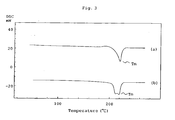
- the melting point in the present invention means a temperature indicating a maximum point of an endothermic peak attributable to melting of a crystal, which appears on a calorimetric curve when heated from 50°C at a heating rate of 10°C/min under a nitrogen atmosphere by means of DSC [Fig. 1 (a)] .
- the crystallization temperature Tc 2 in the present invention means a temperature indicating a maximum point of an exothermic peak attributable to crystallization, which appears on a calorimetric curve when heated from 50°C to a temperature higher by 30°C than the melting point, at which the peak attributable to the melting of a crystal disappears, at a heating rate of 10°C/min under a nitrogen atmosphere by means of DSC, held for 2 minutes at that temperature and then cooled at a cooling rate of 10°C/min [Fig. 1(b)].
- the crystallization temperature Tc 1 in the present invention means a temperature indicating a maximum point of an exothermic peak attributable to crystallization, which appears on a calorimetric curve when heating an amorphous film in a transparent solid state, which has been obtained by preheating polyglycolic acid at 240°C for 30 seconds, pressing it for 15 seconds under a pressure of 5 MPa to prepare a film (sheet) and immediately pouring this film into ice water to cool it, from -50°C at a heating rate of 10°C/min under a nitrogen atmosphere by means of DSC [Fig. 1(c)].
- the glass transition temperature Tg in the present invention means a temperature at a second-order transition point (on set), which appears on a calorimetric curve when heating an amorphous film in a transparent solid state, which has been obtained by preheating polyglycolic acid at 240°C for 30 seconds, pressing it for 15 seconds under a pressure of 5 MPa to prepare a film (sheet) and immediately pouring this film into ice water to cool it, from -50°C at a heating rate of 10°C/min under a nitrogen atmosphere by means of DSC [Fig. 1(c)].
- the polyglycolic acid modified in thermal properties such as crystallinity in the present invention is crystalline polyglycolic acid, wherein a temperature difference (Tm - Tc 2 ) between the melting point Tm and the crystallization temperature Tc 2 is not lower than 35°C, preferably not lower than 40°C, more preferably not lower than 50°C, particularly preferably not lower than 60°C. If this temperature difference is too small, such a polyglycolic acid is easy to crystallize on cooling from a molten state in its melt processing, and so it is difficult to provide a transparent sheet, film, fiber or the like. When the polyglycolic acid is subjected to extrusion processing, it is preferred that this temperature difference be greater. The upper limit of this temperature difference is generally about 100°C, often about 90°C though it varies according to the composition of the polyglycolic acid.
- the polyglycolic acid modified in thermal properties as described above can be produced by applying heat history to polyglycolic acid at a high temperature of not lower than (the melting point Tm of the polyglycolic acid + 38°C).
- the temperature of the heat history is preferably a temperature higher by at least 40°C than the melting point Tm.
- the upper limit of the temperature of the heat history is generally (the melting point Tm + 100°C).
- the temperature of the heat history is preferably a temperature range of from (the melting point Tm + 38°C) to (Tm + 100°C), more preferably a temperature range of from (Tm + 40°C) to (Tm + 80°C), particularly preferably a temperature range of from (Tm + 45°C) to (Tm + 70°C) .
- the temperature of the heat history is preferably 262 to 322°C, more preferably 265 to 310°C, particularly preferably 270 to 300°C.
- the temperature of the heat history is desirably preset to at most 322°C in view of occurrence of thermal decomposition and coloring, and the like. Similarly, if the temperature of the heat history is too low, it is difficult to make the temperature difference between the crystallization temperature Tc 1 and the glass transition temperature Tg sufficiently great.
- the heat history is preferably applied in a short period of time because thermal decomposition and coloring are easy to be incurred.
- the time for which the heat history is applied is within a range of preferably from 1 to 100 minutes, more preferably from 2 to 30 minutes. If the time for which the heat history is applied is too short, the heat history becomes insufficient, and there is a possibility that thermal properties of the resulting polyglycolic acid, such as crystallinity, may not be sufficiently modified.
- a method for applying the heat history to the polyglycolic acid include (i) a method in which a polymer formed upon polymerization is heated to the temperature of heat history, (ii) a method in which the polyglycolic acid is melted and kneaded at the temperature of heat history, (iii) a method in which the polyglycolic acid is melt-extruded at the temperature of heat history to form pellets, (iv) a method in which the forming or molding temperature is controlled to the temperature of heat history, and (v) a method composed of a combination of these methods.
- the method in which the polyglycolic acid is melted and kneaded at the temperature of heat history and the method in which the polyglycolic acid is melt-extruded at the temperature of heat history to form pellets are preferred.
- the melting temperature of the polyglycolic acid is controlled, whereby polyglycolic acid controlled in crystallinity can be obtained without greatly changing the process.
- the polyglycolic acid can be pelletized at an ordinary melting temperature (in the case of a homopolymer, about 230 to 250°C) after that.
- the "solid phase polymerization” means an operation of heat-treatment conducted while maintaining the solid state at a temperature lower than the melting point of the polyglycolic acid.
- the solid phase polymerization low molecular weight components such as unreacted monomer and oligomer are volatilized and removed.
- the solid phase polymerization is conducted for preferably 1-100 hours, more preferably 2-50 hours and most preferably 3-30 hours.
- the crystallization temperature of the polymer can be controlled by controlling the temperature of the heat history. Accordingly, polyglycolic acids having respective crystallization temperatures suitable for various molding or forming methods such as injection molding and extrusion can be separately produced by a polymerization process.
- a process for controlling the crystallinity of the polyglycolic acid may be mentioned a process comprising preparing polyglycolic acid through the steps of:
- Polyglycolic acid controlled in crystallinity can be obtained by controlling the heating temperature in the step (4).
- the heating is generally conducted within a temperature range higher than the melting point Tm, but not higher than (Tm + 100°C) though the temperature varies according to the melting point of the polyglycolic acid.
- Tm + 100°C melting point
- the heating is conducted within a temperature range higher than 220°C, but not higher than 320°C.
- the relationship between the heating temperature and the crystallinity can be simply confirmed by measuring the crystallization temperature Tc 2 by DSC.
- the determining method of the heating temperature by means of DSC may be a useful means for development and process control because it can be determined by an extremely small amount of a sample and a short period of time.
- a polyglycolic acid composition excellent in melt stability can be provided by adding a heat stabilizer to crystalline polyglycolic acid. More specifically, according to the present invention, there is provided a polyglycolic acid composition comprising crystalline polyglycolic acid and a heat stabilizer, wherein a difference (T 2 - T 1 ) between the temperature T 2 at 3%-weight loss on heating of the polyglycolic acid composition and the temperature T 1 at 3%-weight loss on heating of the crystalline polyglycolic acid is not lower than 5°C.
- thermo history is applied to a polyglycolic acid composition comprising crystalline polyglycolic acid and a heat stabilizer at a temperature of not lower than (the melting point Tm of the crystalline polyglycolic acid + 38°C), whereby a polyglycolic acid composition which comprises crystalline polyglycolic acid, wherein
- crystalline polyglycolic acid which is excellent in melt stability, and wherein a difference (Tc 1 - Tg) between the crystallization temperature Tc 1 defined as a maximum point of an exothermic peak attributable to crystallization detected in the course of heating an amorphous sheet at a heating rate of 10°C/min by means of DSC and the glass transition temperature Tg defined as a temperature at a second-order transition point on a calorimetric curve detected in said course is not lower than 40°C.
- Polyglycolic acid is insufficient in melt stability and tends to generate gasses upon its melt processing.
- a temperature at which the weight loss upon heating reaches 3% is about 300°C.
- additives such as a catalyst deactivator, a nucleating agent, a plasticizer and an antioxidant deteriorate the melt stability of polyglycolic acid.
- Such a heat stabilizer can be selected from among heavy metal deactivators, phosphates having a pentaerythritol skeleton structure, phosphorus compounds having at least one hydroxyl group and at least one long-chain alkyl ester group. These compounds may be used either singly or in any combination thereof.
- phosphates having the pentaerythritol skeleton structure include cyclic neopentanetetraylbis(2,6-di-tert-butyl-4-methylphenyl)phosphite represented by the formula (1): cyclic neopentanetetraylbis(2,6-di-tert-butylphenyl)-phosphite represented by the formula (2): a phosphite antioxidant represented by the formula (3): and cyclic neopentanetetraylbis (octadecyl) phosphite represented by the formula (4):
- phosphorus compounds having at least one hydroxyl group and at least one long-chain alkyl ester group represented by the formula (IV):
- the number of carbon atoms in the long-chain alkyl is preferably within a range of 8 to 24.
- Specific examples of such phosphorus compounds include mono- or di-stearyl acid phosphate represented by the formula (5):
- Example of the heavy metal deactivators include 2-hydroxy-N-1H-1,2,4-triazol-3-yl-benzamide represented by the formula (6) : and bis[2-(2-hydroxybenzoyl)hydrazin]dodecanediacid represented by the formula (7):
- the polyglycolic acid compositions according to the present invention are far excellent in melt stability, the compositions will hereinafter be mainly described.
- the crystalline polyglycolic acid according to the present invention is also formed or molded and processed like the compositions and applied to like uses.
- a film is generally produced by melt-extruding pellets formed of a polyglycolic acid composition through a flat die such as a T-die or a circular die.
- a stretched film is produced by forming a sheet by melt-extruding pellets formed of the composition, stretching the sheet while cooling it or optionally reheating and stretching the sheet after cooled, and then optionally heat-setting it.
- a film forming process is mentioned a process in which a sheet is melt-extruded by means of a flat die, and the sheet is then subjected to uniaxial stretching, successively biaxial stretching or simultaneously biaxial stretching by a roll method, a tenter or a combination thereof.
- a process of biaxially stretching the sheet by tubular film extrusion using a circular die may also be adopted.
- the stretched film may be a single layer or be laminated on other resin layers, paper and/or the like as needed.
- Laminating processes include lamination, coating and co-extrusion. Dry processes such as deposition of aluminum may also be applied.
- a layer of the composition according to the present invention is an intermediate layer and other resin layers as inner and outer layers.
- the layer structure include at least a 3-layer structure of outer layer/intermediate layer/inner layer.
- An adhesive layer may also be arranged between the respective adjacent layers as needed.
- a layer formed of, for example, a resin capable of being sealed or a resin excellent in impact resistance, abuse resistance, heat resistance (for example, resistance to boiling, resistance to retorting) or the like may be arranged according to the desired function.
- the outer, intermediate and inner layers may be separately arranged as a multi-layer.
- Examples of the laminate by the lamination include those respectively having the following layer structures:
- the outer, intermediate and inner layers may be separately formed as a single layer or a multi-layer.
- An adhesive layer is arranged between the respective adjacent layers as needed.
- stretched film(s) be contained as a part or the whole of the films, and at leas one of the stretched film be a stretched film formed of the composition according to the present invention.
- the intermediate layer be a stretched film formed of the composition according to the present invention.
- a deposition layer of a metal or metal oxide, such as aluminum deposition layer may be additionally arranged to the outermost layer or intermediate layer.
- a film formed of the polyglycolic acid composition according to the present invention is preferably a stretched film, not an unstretched film from the viewpoint of film strength, optical properties or the like.
- the films are used as packaging films for food, sundries, sanitary goods, medical instruments, industrial parts, electronic parts, precision instruments, etc. or agricultural films.
- the packaging films may be formed into bags such as sucks or pouches.
- a flat film or a film opened from a wide tubular blown film may be formed into a bag after forming a tube by center seaming.
- the film may also be applied to an automatic packaging machine by which contents can be packed while forming it into a bag.
- the sheet is produced by melt-extruding pellets formed of the polyglycolic acid composition into a sheet through a flat die or circular die.
- the sheet may be a single layer or be laminated for use on other resin layers, paper and/or the like as needed.
- the sheet may be applied to various packaging materials relatively thicker than the film.
- the sheet may be formed and processed into containers such as trays relatively shallow in draw ratio or cups relatively deep in draw ratio by a sheet forming method such as vacuum forming.
- each layer may be formed as a sheet, but at least one of an outer layer, an inner layer, an intermediate layer, etc. may be formed as a stretched film. It is preferable from the viewpoint of gas barrier properties that the intermediate layer be a layer formed of the polyglycolic acid composition according to the present invention.
- An adhesive layer may also be arranged between the respective adjacent layers as needed.
- An deposition layer may also be added.
- the injection-molded product can be produced by feeding pellets formed of the polyglycolic acid composition to an injection molding machine equipped with a mold for injection molding and then injection-molding them.
- the injection-molded product is molded from the polyglycolic acid alone. However, it may be coated with another resin layer as needed.
- the injection-molded product is used as, for example, sundries (for examples, tableware, boxes-cases, hollow bottles, kitchenware and flower pots), writing utensils, appliances (various kinds of cabinets), range containers, cup containers, etc.
- strings formed of a biodegradable resin comprising the polyglycolic acid for example, fishing lines may be produced. Since a thermoplastic resin composed of the polyglycolic acid is relatively hard, it is preferable to provide a composite string comprising this resin as a core and another thermoplastic resin, for example, a relatively soft biodegradable resin, as a sheath.
- the hollow molded products include hollow containers (for example, bottles) having gas barrier properties.
- a stretch blow molded container is preferred.
- a process for producing the stretch blow molded container may be adopted a process disclosed in Japanese Patent Application Laid-Open No. 10-337771 , or the like.
- the hollow molded products include single-layer containers formed of the polyglycolic acid composition. However, they may be provided as multi-layer containers with other resin layers. In the case of a multi-layer container, a layer of the polyglycolic acid composition excellent in gas barrier properties is generally arranged as an intermediate layer. Accordingly, examples of the layer structure of the multi-layer container include at least a 3-layer structure of outer layer/intermediate layer/inner layer. An adhesive layer may be arranged between the respective adjacent layers as needed.
- Examples of uses of the hollow molded products include containers for drinks such as carbonated beverage, cooling drinks, juices and mineral water; container for food; containers for seasonings such as soy, sauce, ketchup, mayonnaise, edible oil and mixtures thereof; containers for alcoholic drinks such as beer, sake, whiskey and wine; containers for detergents; containers for cosmetics; containers for agricultural chemicals; containers for gasoline; containers for alcohols; etc.
- drinks such as carbonated beverage, cooling drinks, juices and mineral water
- container for food containers for seasonings such as soy, sauce, ketchup, mayonnaise, edible oil and mixtures thereof
- containers for alcoholic drinks such as beer, sake, whiskey and wine
- containers for detergents containers for cosmetics
- containers for agricultural chemicals containers for gasoline
- containers for alcohols etc.
- a container obtained by using a layer of the polyglycolic acid composition as an intermediate layer and arranging layers of a high density polyethylene resin on both sides thereof through an adhesive layer as needed may also be used as a gasoline tank.
- a container obtained by arranging layers of a polypropylene resin such as a homopolypropylene resin or copolypropylene resin on both sides of the polyglycolic acid composition layer may also be provided for uses of which heat resistance, transparency and the like are required.
- a container having at least a 3-layer structure composed of polyester resin/polyglycolic acid composition/polyester resin or a layer structure that other thermoplastic resin layers and adhesive layers are suitably arranged in addition to these layers is excellent in gas barrier properties and transparency, it is suitable for use as a bottle for beer or the like.
- An intermediate layer composed of a blend of a polyester resin and the polyglycolic acid composition may also be additionally formed.
- a blend of the polyglycolic acid composition with another thermoplastic resin co-extruded or co-injected therewith may be preferably used as an intermediate layer, surface layer or adhesive layer, so far as it does not incur particular disadvantage for properties of the intended use. The use of this blend is useful from the viewpoint of environment such as recycling.
- the polyglycolic acid compositions according to the present invention can be molded into foamed products.
- a layer of the polyglycolic acid composition may be arranged as a foamed layer.
- a desiccating agent, water-absorbing agent or the like may also be incorporated into a resin forming each layer.
- a deoxidizer-containing layer may be arranged in the laminate or multi-layer structure.
- the adhesive layer optionally used in the laminate or multi-layer structure are used the adhesives described in Japanese Patent Application Laid-Open No. 10-138371 , such as epoxidated polyolefins, or the like.
- the melting point Tm was found from an endothermic peak attributable to the melting of the crystal upon the first heating, and the crystallization temperature Tc 2 was found from an exothermic peak attributable to crystallization upon the first cooling.
- the measuring results including the crystallization temperatures Tc 2 and the crystallization enthalpies (J/g) found from the area of the crystallization peak when the predetermined temperature was changed to 240, 250, 260, 270, 280, 290 and 300°C are shown in Table 1. Table 1 Run No.
- the polyglycolic acid was held for 2 minutes at the predetermined temperature B, it was cooled to -50°C at a cooling rate of 10°C/min (second cooling).
- the predetermined temperatures A and B in the first heating and second heating were changed to 250°C and 250°C, 250°C and 280°C, and 280°C and 250°C, respectively, to conduct experiments.
- a glass-made test tube was charged with 100 g of glycolide and 4 mg of tin dichloride dihydrate, and the contents were stirred at 200°C for 1 hour and then left at rest for 3 hours to conduct ring-opening polymerization. After completion of the polymerization, the reaction mixture was cooled, and a polymer formed was then taken out, ground and washed with acetone. The polymer was then vacuum-dried at 30°C to collect the polymer. This polymer was put into a Laboplast Mill equipped with a roller mixer manufactured by Toyo Seiki Seisakusho, Ltd., which was preset to 280°C, and melted and kneaded for 10 minutes.
Landscapes
- Chemical & Material Sciences (AREA)
- Health & Medical Sciences (AREA)
- Chemical Kinetics & Catalysis (AREA)
- Medicinal Chemistry (AREA)
- Polymers & Plastics (AREA)
- Organic Chemistry (AREA)
- Polyesters Or Polycarbonates (AREA)
- Compositions Of Macromolecular Compounds (AREA)
- Processes Of Treating Macromolecular Substances (AREA)
- Biological Depolymerization Polymers (AREA)
- Heterocyclic Carbon Compounds Containing A Hetero Ring Having Oxygen Or Sulfur (AREA)
- Organic Low-Molecular-Weight Compounds And Preparation Thereof (AREA)
- Manufacture Of Macromolecular Shaped Articles (AREA)
- Heterocyclic Compounds That Contain Two Or More Ring Oxygen Atoms (AREA)
Claims (8)
- Polyglykolsäurezusammensetzung umfassend kristalline Polyglykolsäure und einen Wärmestabilisator, wobei der Wärmestabilisator mindestens eine Verbindung ist ausgewählt aus der Gruppe bestehend aus Schwermetalldeaktivatoren, Phosphaten, die eine Pentaerythritskelettstruktur aufweisen, und Phosphorverbindungen, die mindestens eine Hydroxygruppe und mindestens eine langkettige Alkylestergruppe aufweisen, und wobei ein Unterschied (T2 - T1) zwischen der Temperatur T2 bei einem 3 %-igen Gewichtsverlust beim Erhitzen der Polyglykolsäurezusammensetzung und der Temperatur T1 bei einem 3 %-igen Gewichtverlust beim Erhitzen der kristallinen Polyglykolsäure nicht geringer als 5 °C ist.
- Polyglykolsäurezsammensetzung nach Anspruch 1, wobei die kristalline Polyglykolsäure kristalline Polyglykolsäure ist, wobei(a) ein Unterschied (Tm - Tc2) zwischen dem Schmelzpunkt Tm, der als Maximalpunkt eines endothermen Peaks definiert wird, der dem Schmelzen eines Kristalls zuzuschreiben ist, das im Laufe des Erhitzens mit einer Erhitzungsrate von 10 °C/min mit Hilfe eines Differenzial-Scanning-Kalorimeters festgestellt wird, und der Kristallisationstemperatur Tc2, die als Maximalpunkt eines exothermen Peaks definiert wird, der der Kristallisation zuzuschreiben ist, die im Laufe des Kühlens von einem geschmolzenen Zustand mit einer Kühlungsrate von 10 °C/min festgestellt wird, nicht geringer als 35°C ist, und(b) ein Unterschied (Tc1 - Tg) zwischen der Kristallisationstemperatur Tc1, die als Maximalpunkt eines exothermen Peaks definiert wird, der der Kristallisation zuzuschreiben ist, die im Laufe des Erhitzens einer amorphen Platte mit einer Erhitzungsrate von 10 °C/min mit Hilfe eines Differenzial-Scanning-Kalorimeters festgestellt wird, und der Glasübergangstemperatur Tg, die als Temperatur bei einem Übergangspunkt zweiter Ordnung auf einer kalorimetrischen Kurve definiert ist, die im Laufe dieser Bestimmung erfasst wird, nicht geringer als 40 °C ist.
- Polyglykolsäurezusammensetzung nach Anspruch 1, wobei ein Anteil des eingearbeiteten Wärmestabilisators 0,001 bis 5 Gewichtsteile pro 100 Gewichtsteile der kristallinen Polyglykolsäure beträgt.
- Polyglykolsäurezusammensetzung nach Anspruch 1, wobei der Metalldeaktivator 2-Hydroxy-N-1H-1,2,4-triazol-3-yl-benzamid oder Bis[2-(2-hydroxybenzoyl)hydrazin]dodecandisäure ist.
- Polyglykolsäurezusammensetzung nach Anspruch 1, wobei das Phosphat, das die Pentaerythritskelettstruktur aufweist, cyclisches Neopentantetraylbis(2,6-di-tert-butyl-4-methylphenyl)phosphit, das durch die Formel (1):


- Polyglykolsäurezusammensetzung nach Anspruch 1, wobei die Phosphorverbindung, die mindestens eine Hydroxygruppe und mindestens eine langkettige Alkylestergruppe aufweist, Mono- oder Distearylsäurephosphat ist, das durch die Formel (5):

- Verfahren zur Herstellung einer Polyglykolsäurezusammensetzung, die kristalline Polyglykolsäure umfasst, wobei(i) ein Unterschied (Tm - Tc2) zwischen dem Schmelzpunkt Tm, der als Maximalpunkt eines endothermen Peaks definiert wird, der dem Schmelzen eines Kristalls zuzuschreiben ist, das im Laufe des Erhitzens mit einer Erhitzungsrate von 10°C/min mit Hilfe eines Differenzial-Scanning-Kalorimeters festgestellt wird, und der Kristallisationstemperatur Tc2, die als Maximalpunkt eines exothermen Peaks definiert wird, der der Kristallisation zuzuschreiben ist, die im Laufe des Kühlens von einem geschmolzenen Zustand mit einer Kühlungsrate von 10 °C/min festgestellt wird, nicht geringer als 35 °C ist und wobei(ii) ein Unterschied (T2 - T1) zwischen der Temperatur T2 bei einem 3 %-igen Gewichtsverlust beim Erhitzen der Polyglykolsäurezusammensetzung und der Temperatur T1 bei einem 3 %-igen Gewichtverlust beim Erhitzen der Polyglykolsäure nicht geringer als 5 °C ist,wobei das Verfahren das Aufbringen eines Wärmeentwicklungsgangs auf eine Polyglykolsäurezusammensetzung, die eine kristalline Polyglykolsäure und einen Wärmestabilisator enthält, bei einer Temperatur von nicht weniger als (dem Schmelzpunkt Tm der kristallinen Polyglykolsäure + 38°C) umfasst und wobei der Wärmestabilisator mindestens eine Verbindung ist ausgewählt aus der Gruppe bestehend aus Schwermetalldeaktivatoren, Phosphaten, die eine Pentaerythritskelettstruktur aufweisen, und Phosphorverbindungen, die mindestens eine Hydroxygruppe und mindestens eine langkettige Alkylestergruppe aufweisen.
- Herstellungsverfahren der Polyglykolsäurezusammensetzung nach Anspruch 7, das das Herstellen von kristalliner Polyglykolsäure durch folgende Schritte umfasst:(1) Unterwerfen von Glykolid einer Ringöffnungspolymerisation in einem geschmolzenen Zustand,(2) Umwandeln des gebildeten Polymers aus dem geschmolzenen Zustand in einen festen Zustand und(3) Unterwerfen des Polymers im festen Zustand, falls erwünscht, einer Festphasenpolymerisation und daraufhin Aufbringen eines Wärmeentwicklungsgangs auf die kristalline Polyglykolsäure im festen Zustand durch den Schritt des:(4) Mischens der kristallinen Polyglykolsäure im festen Zustand mit dem Wärmestabilisator und Schmelzens und Knetens der so gebildeten Mischung innerhalb des Temperaturbereichs von (dem Schmelzpunkt Tm der kristallinen Polyglykolsäure + 38 °C) bis (Tm + 100 °C).
Priority Applications (1)
| Application Number | Priority Date | Filing Date | Title |
|---|---|---|---|
| EP07117951A EP1914258B1 (de) | 2001-10-31 | 2002-10-30 | Kristalline Polyglykolsäure, Polyglykolsäurezusammensetzung und Herstellungsverfahren dafür |
Applications Claiming Priority (7)
| Application Number | Priority Date | Filing Date | Title |
|---|---|---|---|
| JP2001335443 | 2001-10-31 | ||
| JP2001335443 | 2001-10-31 | ||
| JP2002007839 | 2002-01-16 | ||
| JP2002007839 | 2002-01-16 | ||
| US10/132,578 US6951956B2 (en) | 2001-10-31 | 2002-04-25 | Crystalline polyglycolic acid, polyglycolic acid composition and production process thereof |
| US132578 | 2002-04-25 | ||
| PCT/JP2002/011287 WO2003037956A1 (en) | 2001-10-31 | 2002-10-30 | Crystalline polyglycolic acid, polyglycolic acid composition and processes for production of both |
Related Child Applications (1)
| Application Number | Title | Priority Date | Filing Date |
|---|---|---|---|
| EP07117951A Division EP1914258B1 (de) | 2001-10-31 | 2002-10-30 | Kristalline Polyglykolsäure, Polyglykolsäurezusammensetzung und Herstellungsverfahren dafür |
Publications (3)
| Publication Number | Publication Date |
|---|---|
| EP1449864A1 EP1449864A1 (de) | 2004-08-25 |
| EP1449864A4 EP1449864A4 (de) | 2005-04-20 |
| EP1449864B1 true EP1449864B1 (de) | 2009-12-02 |
Family
ID=19150431
Family Applications (2)
| Application Number | Title | Priority Date | Filing Date |
|---|---|---|---|
| EP02775429A Expired - Lifetime EP1449864B1 (de) | 2001-10-31 | 2002-10-30 | Kristalline polyglykolsäure, polyglykolsäurezusammensetzung und herstellungsverfahren dafür |
| EP07117951A Expired - Lifetime EP1914258B1 (de) | 2001-10-31 | 2002-10-30 | Kristalline Polyglykolsäure, Polyglykolsäurezusammensetzung und Herstellungsverfahren dafür |
Family Applications After (1)
| Application Number | Title | Priority Date | Filing Date |
|---|---|---|---|
| EP07117951A Expired - Lifetime EP1914258B1 (de) | 2001-10-31 | 2002-10-30 | Kristalline Polyglykolsäure, Polyglykolsäurezusammensetzung und Herstellungsverfahren dafür |
Country Status (10)
| Country | Link |
|---|---|
| US (2) | US20030125508A1 (de) |
| EP (2) | EP1449864B1 (de) |
| JP (2) | JP4256779B2 (de) |
| KR (1) | KR100935823B1 (de) |
| CN (2) | CN1827686B (de) |
| AT (2) | ATE450556T1 (de) |
| AU (1) | AU2002343784C1 (de) |
| CA (2) | CA2710098C (de) |
| DE (2) | DE60238453D1 (de) |
| WO (1) | WO2003037956A1 (de) |
Families Citing this family (52)
| Publication number | Priority date | Publication date | Assignee | Title |
|---|---|---|---|---|
| US20050214489A1 (en) * | 2002-05-24 | 2005-09-29 | Hiroyuki Sato | Multilayer stretched product |
| EP1550549B1 (de) * | 2002-05-29 | 2011-08-24 | Kureha Corporation | Behälter für biologisch abbaubare, wärmebeständige harte harzformmassen |
| TWI247782B (en) * | 2003-01-10 | 2006-01-21 | Mitsui Chemicals Inc | Polyester resins composition |
| JP4925555B2 (ja) * | 2003-03-28 | 2012-04-25 | 株式会社クレハ | ポリグリコール酸系樹脂組成物およびその成形物 |
| WO2005072944A1 (ja) * | 2004-01-30 | 2005-08-11 | Kureha Corporation | 中空容器およびその製造方法 |
| EP1736498B1 (de) * | 2004-03-18 | 2010-07-14 | Kureha Corporation | Verfahren zur herstellung von aliphatischem polyester mit verringertem restgehalt an cyclischem ester |
| JP4652332B2 (ja) * | 2004-06-25 | 2011-03-16 | 株式会社クレハ | ポリグリコール酸樹脂系多層シートの製造方法 |
| JP4640765B2 (ja) * | 2004-09-03 | 2011-03-02 | 株式会社Adeka | ポリ乳酸系樹脂組成物、成形品及びその製造方法 |
| US20080107847A1 (en) * | 2004-09-08 | 2008-05-08 | Kazuyuki Yamane | Multilayered Polyglycolic-Acid-Resin Sheet |
| JP2006122484A (ja) * | 2004-10-29 | 2006-05-18 | Sanshin Kako Kk | 生分解樹脂製食器 |
| ATE504630T1 (de) * | 2005-03-08 | 2011-04-15 | Kureha Corp | Zusammensetzung auf basis von aliphatischem polyesterharz |
| JP4871266B2 (ja) * | 2005-03-28 | 2012-02-08 | 株式会社クレハ | ポリグリコール酸樹脂系積層シート及びそれからなる包装容器 |
| US7976919B2 (en) * | 2005-04-01 | 2011-07-12 | Kureha Corporation | Multilayer blow molded container and production process thereof |
| WO2006118007A1 (ja) * | 2005-04-28 | 2006-11-09 | Techno Polymer Co., Ltd. | 熱可塑性樹脂組成物及び成形品 |
| JP4987260B2 (ja) * | 2005-07-12 | 2012-07-25 | 株式会社クレハ | ポリグリコール酸樹脂成形物 |
| WO2007034805A1 (ja) * | 2005-09-21 | 2007-03-29 | Kureha Corporation | ポリグリコール酸樹脂組成物の製造方法 |
| CN101296994B (zh) * | 2005-10-28 | 2011-07-06 | 株式会社吴羽 | 聚乙醇酸树脂粒状体组合物及其制备方法 |
| US8318837B2 (en) | 2005-11-24 | 2012-11-27 | Kureha Corporation | Method for controlling water resistance of polyglycolic acid resin |
| JP5164576B2 (ja) * | 2005-12-02 | 2013-03-21 | 株式会社クレハ | ポリグリコール酸樹脂組成物 |
| JP5595639B2 (ja) | 2006-01-30 | 2014-09-24 | 株式会社クレハ | 脂肪族ポリエステル組成物の製造方法 |
| ES2445337T3 (es) | 2006-07-07 | 2014-03-03 | Kureha Corporation | Composición de poliéster alifático y método para producir la misma |
| ATE539102T1 (de) | 2006-10-31 | 2012-01-15 | Surmodics Pharmaceuticals Inc | Kugelförmige polymer-partikel |
| KR20090111313A (ko) * | 2007-01-22 | 2009-10-26 | 가부시키가이샤 쿠레하 | 방향족 폴리에스테르계 수지 조성물 |
| WO2008090867A1 (ja) * | 2007-01-22 | 2008-07-31 | Kureha Corporation | 芳香族ポリエステル系樹脂組成物 |
| EP2142353A1 (de) | 2007-04-18 | 2010-01-13 | Smith & Nephew PLC | Expansionsformen von formgedächtnis-polymeren |
| ATE547129T1 (de) * | 2007-04-19 | 2012-03-15 | Smith & Nephew Inc | Multimodale formgedächtnis-polymere |
| EP2150288B1 (de) * | 2007-04-19 | 2011-04-13 | Smith & Nephew, Inc. | Graft-fixierung |
| CN101429325B (zh) * | 2007-11-05 | 2012-01-18 | 东丽纤维研究所(中国)有限公司 | 结晶改性聚乳酸共混物及其成型制品 |
| JP4972012B2 (ja) * | 2008-02-28 | 2012-07-11 | 株式会社クレハ | 逐次二軸延伸ポリグリコール酸フィルム、その製造方法、及び多層フィルム |
| CA2735372C (en) * | 2008-09-16 | 2017-05-16 | Rutgers, The State University Of New Jersey | Bioresorbable polymers synthesized from monomer analogs of natural metabolites |
| US8899317B2 (en) | 2008-12-23 | 2014-12-02 | W. Lynn Frazier | Decomposable pumpdown ball for downhole plugs |
| US8079413B2 (en) | 2008-12-23 | 2011-12-20 | W. Lynn Frazier | Bottom set downhole plug |
| US9458287B2 (en) | 2009-02-23 | 2016-10-04 | Kureha Corporation | Aliphatic polyester manufacturing method |
| JP5559482B2 (ja) * | 2009-02-23 | 2014-07-23 | 株式会社クレハ | 脂肪族ポリエステルの製造方法 |
| JP5406569B2 (ja) * | 2009-03-12 | 2014-02-05 | 株式会社クレハ | ポリグリコール酸系樹脂組成物およびその成形体 |
| US9562415B2 (en) | 2009-04-21 | 2017-02-07 | Magnum Oil Tools International, Ltd. | Configurable inserts for downhole plugs |
| US9127527B2 (en) | 2009-04-21 | 2015-09-08 | W. Lynn Frazier | Decomposable impediments for downhole tools and methods for using same |
| US9163477B2 (en) | 2009-04-21 | 2015-10-20 | W. Lynn Frazier | Configurable downhole tools and methods for using same |
| US9181772B2 (en) | 2009-04-21 | 2015-11-10 | W. Lynn Frazier | Decomposable impediments for downhole plugs |
| US9109428B2 (en) | 2009-04-21 | 2015-08-18 | W. Lynn Frazier | Configurable bridge plugs and methods for using same |
| US9062522B2 (en) | 2009-04-21 | 2015-06-23 | W. Lynn Frazier | Configurable inserts for downhole plugs |
| WO2011152199A1 (ja) * | 2010-06-04 | 2011-12-08 | 株式会社クレハ | 耐水性を改善したポリグリコール酸含有樹脂組成物 |
| US20130131209A1 (en) * | 2010-08-03 | 2013-05-23 | Kureha Corporation | Polyglycolic Acid Particle, Production Process of Polyglycolic Acid Particle, and Use Thereof |
| JP5871574B2 (ja) * | 2011-11-15 | 2016-03-01 | 株式会社クレハ | 塩基性悪臭物質吸収性不織布、及び塩基性悪臭物質の低減方法 |
| JP5873317B2 (ja) * | 2011-12-14 | 2016-03-01 | 株式会社クレハ | 生分解性脂肪族ポリエステル繊維から形成される抗菌性不織布、及び抗菌方法 |
| WO2013183363A1 (ja) | 2012-06-07 | 2013-12-12 | 株式会社クレハ | 炭化水素資源回収ダウンホールツール用部材 |
| JP6144562B2 (ja) | 2013-07-22 | 2017-06-07 | 株式会社クレハ | 脂肪族ポリエステルの製造方法 |
| CN111087581B (zh) * | 2018-10-23 | 2022-07-12 | 中国石油化工股份有限公司 | 聚乙醇酸的制备方法 |
| CA3116435C (en) | 2018-10-29 | 2023-08-22 | Pujing Chemical Industry Co., Ltd | Polyglycolic acid resin and production process thereof |
| EP3873987A4 (de) * | 2018-10-29 | 2022-06-15 | Pujing Chemical Industry Co., Ltd | Polyglycolidcopolymerzusammensetzung und herstellung davon |
| WO2020087219A1 (en) | 2018-10-29 | 2020-05-07 | Pujing Chemical Industry Co., Ltd | Integrated preparation process for producing polyglycolic acid products |
| CN117341321B (zh) * | 2022-06-28 | 2026-04-21 | 中国石油化工股份有限公司 | 一种粘接力提高的生物可降解薄膜及其制备方法 |
Family Cites Families (16)
| Publication number | Priority date | Publication date | Assignee | Title |
|---|---|---|---|---|
| US2668162A (en) | 1952-03-20 | 1954-02-02 | Du Pont | Preparation of high molecular weight polyhydroxyacetic ester |
| US3297033A (en) | 1963-10-31 | 1967-01-10 | American Cyanamid Co | Surgical sutures |
| SE9100610D0 (sv) * | 1991-03-04 | 1991-03-04 | Procordia Ortech Ab | Bioresorbable material for medical use |
| JP3731838B2 (ja) | 1996-04-30 | 2006-01-05 | 株式会社クレハ | ポリグリコール酸配向フィルム及びその製造方法 |
| JP3731839B2 (ja) * | 1996-04-30 | 2006-01-05 | 株式会社クレハ | ポリグリコール酸射出成形物及びその製造方法 |
| JP4073052B2 (ja) * | 1996-04-30 | 2008-04-09 | 株式会社クレハ | ポリグリコール酸シート及びその製造方法 |
| JP3809850B2 (ja) | 1996-05-09 | 2006-08-16 | 株式会社クレハ | 延伸ブロー容器及びその製造方法 |
| DE69725208T2 (de) * | 1996-05-09 | 2004-07-15 | Kureha Kagaku Kogyo K.K. | Streckblasgeformter Behälter und Verfahren zu seiner Herstellung |
| US6001439A (en) | 1996-05-09 | 1999-12-14 | Kureha Kagaku Kogyo K.K. | Stretch blow molded container and production process thereof |
| JP3913847B2 (ja) | 1996-07-19 | 2007-05-09 | 株式会社クレハ | ガスバリヤー性複合フィルム |
| KR100451402B1 (ko) * | 1996-07-19 | 2004-10-06 | 구레하 가가쿠 고교 가부시키가이샤 | 가스 배리어성 복합필름 |
| JP3838757B2 (ja) | 1996-09-13 | 2006-10-25 | 株式会社クレハ | ガスバリヤー性多層中空容器 |
| US6673403B1 (en) * | 1996-09-13 | 2004-01-06 | Kureha Kagaku Kogyo K.K. | Gas-barrier, multi-layer hollow container |
| KR20010021756A (ko) * | 1997-07-11 | 2001-03-15 | 로버트 더블유. 크레인 | 신규한 중합 조성물 |
| GB9803636D0 (en) * | 1998-02-20 | 1998-04-15 | Kobe Steel Europ Ltd | Improved stabiliser for biodegradable polyester processing |
| JP2000053758A (ja) * | 1998-08-04 | 2000-02-22 | Mitsui Chemicals Inc | ポリヒドロキシカルボン酸の製造方法 |
-
2001
- 2001-11-02 US US10/002,792 patent/US20030125508A1/en not_active Abandoned
-
2002
- 2002-04-25 US US10/132,578 patent/US6951956B2/en not_active Expired - Lifetime
- 2002-10-30 CN CN2006100025907A patent/CN1827686B/zh not_active Expired - Fee Related
- 2002-10-30 DE DE60238453T patent/DE60238453D1/de not_active Expired - Lifetime
- 2002-10-30 EP EP02775429A patent/EP1449864B1/de not_active Expired - Lifetime
- 2002-10-30 AU AU2002343784A patent/AU2002343784C1/en not_active Ceased
- 2002-10-30 KR KR1020047005783A patent/KR100935823B1/ko not_active Expired - Fee Related
- 2002-10-30 AT AT02775429T patent/ATE450556T1/de not_active IP Right Cessation
- 2002-10-30 WO PCT/JP2002/011287 patent/WO2003037956A1/ja not_active Ceased
- 2002-10-30 EP EP07117951A patent/EP1914258B1/de not_active Expired - Lifetime
- 2002-10-30 CA CA2710098A patent/CA2710098C/en not_active Expired - Fee Related
- 2002-10-30 AT AT07117951T patent/ATE489415T1/de not_active IP Right Cessation
- 2002-10-30 DE DE60234632T patent/DE60234632D1/de not_active Expired - Lifetime
- 2002-10-30 CN CNB02825936XA patent/CN1280333C/zh not_active Expired - Fee Related
- 2002-10-30 JP JP2003540231A patent/JP4256779B2/ja not_active Expired - Fee Related
- 2002-10-30 CA CA2464635A patent/CA2464635C/en not_active Expired - Fee Related
-
2008
- 2008-09-29 JP JP2008249936A patent/JP4704456B2/ja not_active Expired - Fee Related
Also Published As
| Publication number | Publication date |
|---|---|
| ATE450556T1 (de) | 2009-12-15 |
| AU2002343784C1 (en) | 2008-09-11 |
| CA2464635A1 (en) | 2003-05-08 |
| WO2003037956A1 (en) | 2003-05-08 |
| CA2710098C (en) | 2012-10-23 |
| JPWO2003037956A1 (ja) | 2005-02-17 |
| EP1449864A1 (de) | 2004-08-25 |
| EP1449864A4 (de) | 2005-04-20 |
| JP4256779B2 (ja) | 2009-04-22 |
| CN1608093A (zh) | 2005-04-20 |
| US20030125508A1 (en) | 2003-07-03 |
| US20030125431A1 (en) | 2003-07-03 |
| DE60234632D1 (de) | 2010-01-14 |
| DE60238453D1 (de) | 2011-01-05 |
| AU2002343784B2 (en) | 2008-01-31 |
| CA2464635C (en) | 2011-03-22 |
| ATE489415T1 (de) | 2010-12-15 |
| CN1280333C (zh) | 2006-10-18 |
| EP1914258A1 (de) | 2008-04-23 |
| US6951956B2 (en) | 2005-10-04 |
| JP4704456B2 (ja) | 2011-06-15 |
| KR100935823B1 (ko) | 2010-01-08 |
| WO2003037956A9 (en) | 2004-05-21 |
| EP1914258B1 (de) | 2010-11-24 |
| CA2710098A1 (en) | 2003-05-08 |
| CN1827686A (zh) | 2006-09-06 |
| KR20040060940A (ko) | 2004-07-06 |
| CN1827686B (zh) | 2010-05-12 |
| JP2009030068A (ja) | 2009-02-12 |
Similar Documents
| Publication | Publication Date | Title |
|---|---|---|
| EP1914258B1 (de) | Kristalline Polyglykolsäure, Polyglykolsäurezusammensetzung und Herstellungsverfahren dafür | |
| US8110138B2 (en) | Poly(hydroxyalkanoic acid) and thermoformed articles | |
| CN100413906C (zh) | 聚羟基羧酸及其生产工艺 | |
| US4330661A (en) | Copolyesters, method of making same and packaging materials | |
| TWI766045B (zh) | 聚酯容器以及其製備方法 | |
| AU2021218226B2 (en) | Light barrier compositions and articles comprising same | |
| US20120193835A1 (en) | Method for producing laminate | |
| EP1790677A1 (de) | Verfahren zur Herstellung einer aliphatischen Polyesterzusammensetzung | |
| EP1507663B1 (de) | Mehrschichtiges, gestrecktes produkt | |
| US8349955B2 (en) | Poly(hydroxyalkanoic acid) plasticized with poly(trimethylene ether) glycol | |
| US20050214489A1 (en) | Multilayer stretched product | |
| KR20090008809A (ko) | 고분자량을 가지는 폴리에스테르 블렌드의 제조방법 및이를 이용하여 제조된 폴리에스테르 블렌드 | |
| JP2016124966A (ja) | ポリエステルのペレットを含有する混合ペレット及び樹脂組成物 | |
| JP4326828B2 (ja) | グリコール酸系共重合体の組成物 | |
| IMSOMBUT | SYNTHESIS AND CHARACTERIZATION OF Ɛ-CAPROLACTONE OLIGOMERS FOR USE AS PLASTICIZERS OF POLY (L-LACTIDE) FILMS | |
| JP2004300390A (ja) | グリコール酸系重合体組成物 |
Legal Events
| Date | Code | Title | Description |
|---|---|---|---|
| PUAI | Public reference made under article 153(3) epc to a published international application that has entered the european phase |
Free format text: ORIGINAL CODE: 0009012 |
|
| 17P | Request for examination filed |
Effective date: 20040428 |
|
| AK | Designated contracting states |
Kind code of ref document: A1 Designated state(s): AT BE BG CH CY CZ DE DK EE ES FI FR GB GR IE IT LI LU MC NL PT SE SK TR |
|
| AX | Request for extension of the european patent |
Extension state: AL LT LV MK RO SI |
|
| A4 | Supplementary search report drawn up and despatched |
Effective date: 20050303 |
|
| RIC1 | Information provided on ipc code assigned before grant |
Ipc: 7C 08G 63/88 B Ipc: 7B 29C 49/00 B Ipc: 7C 08G 63/08 A Ipc: 7C 08K 5/527 B Ipc: 7C 08L 67/04 B Ipc: 7C 08K 5/52 B Ipc: 7C 08K 3/26 B Ipc: 7B 65D 1/02 B |
|
| 17Q | First examination report despatched |
Effective date: 20050602 |
|
| RAP1 | Party data changed (applicant data changed or rights of an application transferred) |
Owner name: KUREHA CORPORATION |
|
| 17Q | First examination report despatched |
Effective date: 20050602 |
|
| GRAP | Despatch of communication of intention to grant a patent |
Free format text: ORIGINAL CODE: EPIDOSNIGR1 |
|
| RTI1 | Title (correction) |
Free format text: CRYSTALLINE POLYGLYCOLIC ACID,POLYGLYCOLIC ACID COMPOSITION AND PROCESSES FOR PRODUCTION OF BOTH |
|
| GRAS | Grant fee paid |
Free format text: ORIGINAL CODE: EPIDOSNIGR3 |
|
| GRAA | (expected) grant |
Free format text: ORIGINAL CODE: 0009210 |
|
| AK | Designated contracting states |
Kind code of ref document: B1 Designated state(s): AT BE BG CH CY CZ DE DK EE ES FI FR GB GR IE IT LI LU MC NL PT SE SK TR |
|
| REG | Reference to a national code |
Ref country code: GB Ref legal event code: FG4D |
|
| REG | Reference to a national code |
Ref country code: CH Ref legal event code: EP |
|
| REG | Reference to a national code |
Ref country code: IE Ref legal event code: FG4D |
|
| REF | Corresponds to: |
Ref document number: 60234632 Country of ref document: DE Date of ref document: 20100114 Kind code of ref document: P |
|
| REG | Reference to a national code |
Ref country code: NL Ref legal event code: VDEP Effective date: 20091202 |
|
| PG25 | Lapsed in a contracting state [announced via postgrant information from national office to epo] |
Ref country code: SE Free format text: LAPSE BECAUSE OF FAILURE TO SUBMIT A TRANSLATION OF THE DESCRIPTION OR TO PAY THE FEE WITHIN THE PRESCRIBED TIME-LIMIT Effective date: 20091202 Ref country code: FI Free format text: LAPSE BECAUSE OF FAILURE TO SUBMIT A TRANSLATION OF THE DESCRIPTION OR TO PAY THE FEE WITHIN THE PRESCRIBED TIME-LIMIT Effective date: 20091202 |
|
| PG25 | Lapsed in a contracting state [announced via postgrant information from national office to epo] |
Ref country code: CY Free format text: LAPSE BECAUSE OF FAILURE TO SUBMIT A TRANSLATION OF THE DESCRIPTION OR TO PAY THE FEE WITHIN THE PRESCRIBED TIME-LIMIT Effective date: 20091202 |
|
| PG25 | Lapsed in a contracting state [announced via postgrant information from national office to epo] |
Ref country code: AT Free format text: LAPSE BECAUSE OF FAILURE TO SUBMIT A TRANSLATION OF THE DESCRIPTION OR TO PAY THE FEE WITHIN THE PRESCRIBED TIME-LIMIT Effective date: 20091202 |
|
| PG25 | Lapsed in a contracting state [announced via postgrant information from national office to epo] |
Ref country code: NL Free format text: LAPSE BECAUSE OF FAILURE TO SUBMIT A TRANSLATION OF THE DESCRIPTION OR TO PAY THE FEE WITHIN THE PRESCRIBED TIME-LIMIT Effective date: 20091202 Ref country code: PT Free format text: LAPSE BECAUSE OF FAILURE TO SUBMIT A TRANSLATION OF THE DESCRIPTION OR TO PAY THE FEE WITHIN THE PRESCRIBED TIME-LIMIT Effective date: 20100402 Ref country code: ES Free format text: LAPSE BECAUSE OF FAILURE TO SUBMIT A TRANSLATION OF THE DESCRIPTION OR TO PAY THE FEE WITHIN THE PRESCRIBED TIME-LIMIT Effective date: 20100313 Ref country code: EE Free format text: LAPSE BECAUSE OF FAILURE TO SUBMIT A TRANSLATION OF THE DESCRIPTION OR TO PAY THE FEE WITHIN THE PRESCRIBED TIME-LIMIT Effective date: 20091202 Ref country code: BG Free format text: LAPSE BECAUSE OF FAILURE TO SUBMIT A TRANSLATION OF THE DESCRIPTION OR TO PAY THE FEE WITHIN THE PRESCRIBED TIME-LIMIT Effective date: 20100302 |
|
| PG25 | Lapsed in a contracting state [announced via postgrant information from national office to epo] |
Ref country code: SK Free format text: LAPSE BECAUSE OF FAILURE TO SUBMIT A TRANSLATION OF THE DESCRIPTION OR TO PAY THE FEE WITHIN THE PRESCRIBED TIME-LIMIT Effective date: 20091202 Ref country code: BE Free format text: LAPSE BECAUSE OF FAILURE TO SUBMIT A TRANSLATION OF THE DESCRIPTION OR TO PAY THE FEE WITHIN THE PRESCRIBED TIME-LIMIT Effective date: 20091202 Ref country code: CZ Free format text: LAPSE BECAUSE OF FAILURE TO SUBMIT A TRANSLATION OF THE DESCRIPTION OR TO PAY THE FEE WITHIN THE PRESCRIBED TIME-LIMIT Effective date: 20091202 |
|
| PLBE | No opposition filed within time limit |
Free format text: ORIGINAL CODE: 0009261 |
|
| STAA | Information on the status of an ep patent application or granted ep patent |
Free format text: STATUS: NO OPPOSITION FILED WITHIN TIME LIMIT |
|
| PG25 | Lapsed in a contracting state [announced via postgrant information from national office to epo] |
Ref country code: GR Free format text: LAPSE BECAUSE OF FAILURE TO SUBMIT A TRANSLATION OF THE DESCRIPTION OR TO PAY THE FEE WITHIN THE PRESCRIBED TIME-LIMIT Effective date: 20100303 |
|
| 26N | No opposition filed |
Effective date: 20100903 |
|
| PG25 | Lapsed in a contracting state [announced via postgrant information from national office to epo] |
Ref country code: DK Free format text: LAPSE BECAUSE OF FAILURE TO SUBMIT A TRANSLATION OF THE DESCRIPTION OR TO PAY THE FEE WITHIN THE PRESCRIBED TIME-LIMIT Effective date: 20091202 |
|
| PG25 | Lapsed in a contracting state [announced via postgrant information from national office to epo] |
Ref country code: MC Free format text: LAPSE BECAUSE OF NON-PAYMENT OF DUE FEES Effective date: 20101031 |
|
| REG | Reference to a national code |
Ref country code: CH Ref legal event code: PL |
|
| PG25 | Lapsed in a contracting state [announced via postgrant information from national office to epo] |
Ref country code: CH Free format text: LAPSE BECAUSE OF NON-PAYMENT OF DUE FEES Effective date: 20101031 Ref country code: LI Free format text: LAPSE BECAUSE OF NON-PAYMENT OF DUE FEES Effective date: 20101031 |
|
| PG25 | Lapsed in a contracting state [announced via postgrant information from national office to epo] |
Ref country code: IE Free format text: LAPSE BECAUSE OF NON-PAYMENT OF DUE FEES Effective date: 20101030 |
|
| PG25 | Lapsed in a contracting state [announced via postgrant information from national office to epo] |
Ref country code: LU Free format text: LAPSE BECAUSE OF NON-PAYMENT OF DUE FEES Effective date: 20101030 |
|
| PG25 | Lapsed in a contracting state [announced via postgrant information from national office to epo] |
Ref country code: TR Free format text: LAPSE BECAUSE OF FAILURE TO SUBMIT A TRANSLATION OF THE DESCRIPTION OR TO PAY THE FEE WITHIN THE PRESCRIBED TIME-LIMIT Effective date: 20091202 |
|
| PGFP | Annual fee paid to national office [announced via postgrant information from national office to epo] |
Ref country code: IT Payment date: 20121016 Year of fee payment: 11 |
|
| PG25 | Lapsed in a contracting state [announced via postgrant information from national office to epo] |
Ref country code: IT Free format text: LAPSE BECAUSE OF NON-PAYMENT OF DUE FEES Effective date: 20131030 |
|
| REG | Reference to a national code |
Ref country code: FR Ref legal event code: PLFP Year of fee payment: 14 |
|
| REG | Reference to a national code |
Ref country code: FR Ref legal event code: PLFP Year of fee payment: 15 |
|
| REG | Reference to a national code |
Ref country code: FR Ref legal event code: PLFP Year of fee payment: 16 |
|
| REG | Reference to a national code |
Ref country code: FR Ref legal event code: PLFP Year of fee payment: 17 |
|
| PGFP | Annual fee paid to national office [announced via postgrant information from national office to epo] |
Ref country code: DE Payment date: 20181019 Year of fee payment: 17 |
|
| PGFP | Annual fee paid to national office [announced via postgrant information from national office to epo] |
Ref country code: FR Payment date: 20181022 Year of fee payment: 17 Ref country code: GB Payment date: 20181019 Year of fee payment: 17 |
|
| REG | Reference to a national code |
Ref country code: DE Ref legal event code: R119 Ref document number: 60234632 Country of ref document: DE |
|
| PG25 | Lapsed in a contracting state [announced via postgrant information from national office to epo] |
Ref country code: DE Free format text: LAPSE BECAUSE OF NON-PAYMENT OF DUE FEES Effective date: 20200501 |
|
| GBPC | Gb: european patent ceased through non-payment of renewal fee |
Effective date: 20191030 |
|
| PG25 | Lapsed in a contracting state [announced via postgrant information from national office to epo] |
Ref country code: GB Free format text: LAPSE BECAUSE OF NON-PAYMENT OF DUE FEES Effective date: 20191030 Ref country code: FR Free format text: LAPSE BECAUSE OF NON-PAYMENT OF DUE FEES Effective date: 20191031 |