EP1450129A1 - Systeme d'identification de position automatique d'un robot et procede d'identification - Google Patents
Systeme d'identification de position automatique d'un robot et procede d'identification Download PDFInfo
- Publication number
- EP1450129A1 EP1450129A1 EP02783642A EP02783642A EP1450129A1 EP 1450129 A1 EP1450129 A1 EP 1450129A1 EP 02783642 A EP02783642 A EP 02783642A EP 02783642 A EP02783642 A EP 02783642A EP 1450129 A1 EP1450129 A1 EP 1450129A1
- Authority
- EP
- European Patent Office
- Prior art keywords
- localization
- self
- result
- search
- observation
- Prior art date
- Legal status (The legal status is an assumption and is not a legal conclusion. Google has not performed a legal analysis and makes no representation as to the accuracy of the status listed.)
- Withdrawn
Links
Images




Classifications
-
- G—PHYSICS
- G05—CONTROLLING; REGULATING
- G05D—SYSTEMS FOR CONTROLLING OR REGULATING NON-ELECTRIC VARIABLES
- G05D1/00—Control of position, course, altitude or attitude of land, water, air or space vehicles, e.g. using automatic pilots
- G05D1/02—Control of position or course in two dimensions
- G05D1/021—Control of position or course in two dimensions specially adapted to land vehicles
- G05D1/0231—Control of position or course in two dimensions specially adapted to land vehicles using optical position detecting means
-
- G—PHYSICS
- G06—COMPUTING OR CALCULATING; COUNTING
- G06V—IMAGE OR VIDEO RECOGNITION OR UNDERSTANDING
- G06V20/00—Scenes; Scene-specific elements
- G06V20/10—Terrestrial scenes
-
- G—PHYSICS
- G05—CONTROLLING; REGULATING
- G05D—SYSTEMS FOR CONTROLLING OR REGULATING NON-ELECTRIC VARIABLES
- G05D1/00—Control of position, course, altitude or attitude of land, water, air or space vehicles, e.g. using automatic pilots
- G05D1/02—Control of position or course in two dimensions
- G05D1/021—Control of position or course in two dimensions specially adapted to land vehicles
- G05D1/0231—Control of position or course in two dimensions specially adapted to land vehicles using optical position detecting means
- G05D1/0246—Control of position or course in two dimensions specially adapted to land vehicles using optical position detecting means using a video camera in combination with image processing means
-
- G—PHYSICS
- G05—CONTROLLING; REGULATING
- G05D—SYSTEMS FOR CONTROLLING OR REGULATING NON-ELECTRIC VARIABLES
- G05D1/00—Control of position, course, altitude or attitude of land, water, air or space vehicles, e.g. using automatic pilots
- G05D1/02—Control of position or course in two dimensions
- G05D1/021—Control of position or course in two dimensions specially adapted to land vehicles
- G05D1/0268—Control of position or course in two dimensions specially adapted to land vehicles using internal positioning means
- G05D1/0272—Control of position or course in two dimensions specially adapted to land vehicles using internal positioning means comprising means for registering the travel distance, e.g. revolutions of wheels
-
- G—PHYSICS
- G05—CONTROLLING; REGULATING
- G05D—SYSTEMS FOR CONTROLLING OR REGULATING NON-ELECTRIC VARIABLES
- G05D1/00—Control of position, course, altitude or attitude of land, water, air or space vehicles, e.g. using automatic pilots
- G05D1/02—Control of position or course in two dimensions
- G05D1/021—Control of position or course in two dimensions specially adapted to land vehicles
- G05D1/0268—Control of position or course in two dimensions specially adapted to land vehicles using internal positioning means
- G05D1/0274—Control of position or course in two dimensions specially adapted to land vehicles using internal positioning means using mapping information stored in a memory device
Definitions
- This invention relates a self-localization system and a self-localization method for an intelligent traveling robot, which can travel freely (along no particular route) in a working space, and more particularly to a self-localization system and a self-localization method for a robot by which the self-localization of the robot is performed based on sensor information of the robot and movement information of the robot itself.
- the present invention relates to a self-localization system and a self-localization method for a robot by which the self-localization of the robot is performed using a result of a search of a landmark in an environment including an artificial landmark as a clue, and particularly to a self-localization system and a self-localization method for a robot by which self-localization is performed using both of a global search wherein a search is performed in comparatively short search time over a wide range and a local search wherein long search time is required although the accuracy is high.
- robot A mechanical apparatus, which performs a movement similar to a motion of a human using electric or magnetic action, is called “robot”. It is said that the term robot originates from a Slav word ROBOTA (slave machine). In our country, the robot began to be popularized in the end of the 1960s. However, most of the robots were industrial robots such as manipulators and transporting robots intended to achieve automation and unmanning of manufacturing works in factories.
- Principal applications of traveling robots having wheels or movable legs involve vicarious execution of various works in industrial activities or productive activities and co-existence or symbiosis with humans who act intelligently on the basis of a conversion with a user.
- the former signifies that a robot performs a critical work or a difficult work at a site into which a human cannot step readily such as a maintenance work in a nuclear power plant, a heat power plant, or a petrochemical plant, a transporting or assembling work of parts in a manufacturing factory, cleaning of a high-rise building, or rescue at a fire site or a like place.
- the robot is utilized in a free space same as that of a human and effects autonomous thinking and motion control to implement higher and more realistic communication.
- self-localization of a traveling robot is a technique very significant for allowing a robot to perform a service such as, for example, a delivery service. This is because it is inefficient that a traveling robot takes a wrong route to a destination even if it can restore a correct route. There is the possibility even that such a hazard as collision with an obstacle or advancement into a dangerous zone may be invited.
- a landmark usually has visually identifiable visibility information formed on a surface thereof.
- a robot can geographically search the self-localization based on relative position information from the visually recognized landmark.
- a system which applies, for example, Markov localization or an extended Kalman filter, has been proposed as a searching or self-localization system in an environment including an artificial landmark.
- a searching apparatus using the Markov localization stores the self-localization in an environment as a self-localization probability density distribution on discrete grids and estimates, if it observes a landmark set in the environment, the self-localization based on a relative position from the landmark to update the self-localization probability density distribution. Further, if the searching apparatus observes motion information of the searching apparatus itself, then it updates the self-localization probability density based on the motion information. Then, that one of the grids that has the highest value of the self-localization probability density distribution at each time is determined as an estimation result of the self-localization.
- a searching apparatus using an extended Kalman filter stores the self-localization as actually measured values of state variables [x, y, ⁇ ]. Then, if the searching apparatus observes a landmark set in an environment, then it estimates the self-localization based on the relative position from the landmark. Further, if the searching apparatus observes motion information of the searching apparatus itself, then it estimates a state amount based on the motion information.
- the former searching apparatus applying the Markov localization is characterized principally in that, although the accuracy of an identification solution is rough, the convergence speed of the solution is high. Therefore, the inventors of the present invention consider that a searching apparatus of the type described is suitable for a global search. Further, the Markov localization is robust against noise of a sensor. In other words, even if a sensor value includes noise, a substantially fixed self-localization result can be obtained with the Markov localization.
- the latter searching apparatus applying an extended Kalman filter is characterized principally in that, although the convergence speed of a solution is low, the accuracy of the identification solution is fine. Therefore, the inventors of the present invention consider that a searching apparatus of the type just described is suitable for a local search. Further, although the extended Kalman filter is robust against sensor information, it is poor in robustness against sensor noise and requires a long period of time for resetting.
- a searching apparatus using the Markov localization exhibits considerable characters of a global searching apparatus and is low in the convergence speed of a solution.
- the accuracy of the identification solution relies upon the roughness of the discrete grids and usually a solution having a high accuracy is not obtained.
- the self-localization cannot be found accurately. This sometimes gives rise to such a trouble that the destination cannot be reached accurately or it cannot be discriminated whether or not the destination is reached actually.
- a searching apparatus using an extended Kalman filter exhibits considerable characters of a local searching apparatus and is very high in the accuracy of an identification solution.
- the searching apparatus is low in the convergence performance and lacks in robustness (toughness) against noise of observation information. Where the convergence speed is low, much time is required for initial localization upon starting of self-localization, and, if the position is moved unintentionally by external force (an abduction or kidnapping problem), then very much time is required before a correct solution is obtained.
- It is another object of the present invention is to provide a superior self-localization system and self-localization method for a robot by which the self-localization can be suitably performed by using a result of a search of a landmark in an environment including an artificial landmark as a clue.
- the present invention has been made in view of the subjects described above, and there is provided a self-localization system or a self-localization method for a robot which includes a moving mechanism and can travel in an environment including:
- the first search means or step may apply Markov localization to store the position of the robot in the environment as a self-localization probability density distribution on discrete grids, and estimate the self-localization based on a relative position of the robot from the landmark in response to the observation result of the landmark by the external observation means to update the self-localization probability density distribution, update the self-localization probability density based on the observation result of the motion information of the robot by the internal observation means, and output that one of the grids which has the highest value of the self-localization probability density distribution at each time as an estimation result of the self-localization.
- a search that applies the Markov localization is characterized principally in that it is robust against sensor noise and the convergence speed of the solution is high although the accuracy of an identification solution is rough, and is suitable for a global search.
- the second search means or step may apply an extended Kalman filter including a state model, which defines a relationship between the motion information of the robot by the internal observation means and the self-localization, and an observation model, which defines a relationship between the self-localization and the observation information of the landmark by the external observation means, to estimate the self-localization based on the motion information of the robot by the internal observation means and the observation information of the landmark by the external observation means.
- an extended Kalman filter including a state model, which defines a relationship between the motion information of the robot by the internal observation means and the self-localization
- an observation model which defines a relationship between the self-localization and the observation information of the landmark by the external observation means
- a search that applies the extended Kalman filter is characterized principally in that it is superior in the robustness against a decrease of sensor information and is fine in the accuracy of the identification solution although it is poor in the robustness against sensor noise and is low in the convergence speed of a solution, and is suitable for a local search.
- the control means or step may evaluate the validity of the external observation result by the external observation means based on the search result by the first search means and limit inputting the external observation result to the second search means in response to a fact that the evaluation does not satisfy a predetermined reference.
- the validity of the external observation result by the external observation means or step may be evaluated depending upon whether or not the probability with which the landmark is observed by the external observation means or step at the self-localization estimated by the first search means or step exceeds a predetermined threshold value.
- the probability with which the landmark is observed at the estimated self-localization is lower than the threshold value, then it is predicted that the solution does not exhibit sufficient convergence due to sensor noise. Accordingly, even if a search is performed based on the extended Kalman filter section, which is poorer in the robustness against sensor noise, a self-localization result having a high accuracy cannot be obtained. Therefore, inputting the external observation result to the second search means or step may be limited in response to a fact that the evaluation does not satisfy a predetermined reference to skip the search based on the extended Kalman filter whose convergence speed is low.
- control means may verify the validity of the search result by the second search means and output the search result as the self-localization result in response to a fact that the evaluation satisfies a predetermined reference, but re-initialize the second search means in response to another fact that the evaluation does not satisfy the predetermined reference.
- the probability density distribution that is the estimation result of the self-localization by the second search means or step may be compared with the probability density distribution that is the estimation result of the self-localization by the first search means or step to verify the validity based on the similarity between them. For example, a chi-square test can be utilized as the similarity of the distributions. Since the Markov localization is more robust against sensor noise than the extended Kalman filter, if the two probability density distributions are not similar to each other, then it is estimated that the search result based on the extended Kalman filter, which is lower in the robustness against sensor noise, is not valid. Further, the extended Kalman filter requires longer time for resetting. Therefore, the second search means or step may be re-initialized in response to a fact that the evaluation does not satisfy a predetermined reference.
- the self-localization estimation result by the second search means or step may be outputted as a search result of the entire system.
- the robustness of the Markov localization against sensor noise may be utilized to evaluate the validity of the external observation result regarding the landmark and/or the validity of the self-localization estimation result of the extended Kalman filter and finally output the self-localization estimation result by the extended Kalman filter, which is superior in the robustness against a decrease of sensor information, as the self-localization result of the entire system.
- the external observation means may include image inputting means for capturing the landmark and image recognition means for recognizing the landmark and the distance to the landmark based on an input image from the image inputting means.
- the external observation means may include a range finder or a like element for measuring the distance to the landmark.
- the landmark may be formed from a member having visually discernible identification information formed on a surface thereof.
- a tubular pole painted with two or more colors, a flat plate painted with two or more colors or a like member may be applied.
- FIG. 1 schematically shows a functional configuration of a traveling robot 1 used in carrying out the present invention.
- the traveling robot 1 includes a control unit 20, which performs supervisory control of operation of the entire traveling robot 1 and other data processing, an inputting and outputting section 40, a driving section 50, and a power supply section 60.
- control unit 20 which performs supervisory control of operation of the entire traveling robot 1 and other data processing
- inputting and outputting section 40 which performs supervisory control of operation of the entire traveling robot 1 and other data processing
- a driving section 50 a driving section 50
- a power supply section 60 the components are described.
- the inputting and outputting section 40 includes, as inputting elements, a CCD camera 15, which corresponds to the eye of the traveling robot 1, a microphone 16, which corresponds to the ear, a touch sensor 18 disposed at such a location as the head or the back for sensing a touch of a user, pad switches disposed on the soles, and other various sensors corresponding to the five senses.
- the inputting and outputting section 40 includes, as outputting elements, a speaker 17, which corresponds to the mouth, an LED indicator (eye lamp) 19, which uses a combination of flickering or a timing of lighting to form an expression of the face, and other suitable elements.
- the outputting elements can represent a user feedback from the traveling robot 1 in a form other than mechanical movement patterns by the legs and so forth.
- the CCD camera 15 can function as external observation means for observing, for example, a landmark disposed at any location in a working space.
- the traveling robot 1 may include a range finder or a like element as external observation means except (or together with) the CCD camera 15.
- the driving section 50 is a functional block implementing mechanical movements of the traveling robot 1 in accordance with a predetermined movement pattern commanded by the control unit 20 and includes driving units provided for individual shafts for rolling, pitching, and yawing movements of articulations such as a neck articulation 7, a tail articulation 8, hip joints 11A to 11D, and knee joints 12A to 12D.
- the traveling robot 1 has n degrees of freedom, and accordingly, the driving section 50 includes n driving units.
- Each of the driving units includes a combination of a motor 51 for performing rotational motion around a predetermined axis, an encoder 52 for detecting the rotational position of the motor 51, and a driver 53 for adaptively controlling the rotational position and/or the rotational speed of the motor 51 based on an output of the encoder 52.
- the encoder 52 disposed for each of the driving units can function as internal observation means for observing motion information of the robot itself.
- the power supply section 60 is a functional module for feeding electric circuits and other electric elements in the traveling robot 1 as can be recognized from the term.
- the traveling robot 1 according to the present embodiment is of the autonomous driving type using a battery, and the power supply section 60 includes a chargeable battery 61 and a charging/discharging control section 62 for managing the charging/discharging state of the chargeable battery 61.
- the chargeable battery 61 is formed as a "battery pack" that includes, for example, a package of a plurality of nickel-cadmium battery cells like a cartridge.
- the charging/discharging control section 62 measures the terminal voltage and/or the charging/discharging current amount or amounts of the chargeable battery 61 or the ambient temperature and so forth of the battery 61 to grasp the remaining capacity of the battery 61 to determine the starting timing or the ending timing of charging.
- the charging starting and ending timings determined by the charging/discharging control section 62 are conveyed to the control unit 20 and used to make triggers for the traveling robot 1 to start and end the charging operation.
- the control unit 20 corresponds to the "brain” and is installed, for example, in the head or the body of the traveling robot 1.
- FIG. 2 illustrates the configuration of the control unit 20 more particularly.
- the control unit 20 is configured such that a CPU (Central Processing Unit) 21 as a main controller is connected to memories, other circuit components, and peripheral equipments by a bus.
- the bus 27 is a common signal transmission line including a data bus, an address bus, a control bus, and other necessary buses.
- Each of the apparatus on the bus 27 has a unique address (memory address or I/O address) allocated thereto.
- the CPU 21 can communicate with a particular one of the apparatus on the bus 28 by designating the address of the apparatus.
- the RAM (Random Access Memory) 22 is a writable memory formed from a volatile memory such as a DRAM (Dynamic RAM) and is used to load program codes to be executed by the CPU 21 or to temporarily store work data by an executed program.
- DRAM Dynamic RAM
- the ROM (Read Only Memory) 23 is a read only memory in which programs and data are permanently stored.
- Program codes stored in the ROM 23 include a self-diagnosis test program to be executed upon connection of the power supply to the traveling robot 1 and a motion control program for defining motions of the traveling robot 1.
- Control programs of the traveling robot 1 include a "sensor input processing program” for processing a sensor input of the CCD camera 15, the microphone 16, or a like element, a “behavior instruction program” for producing a behavior or movement pattern of the traveling robot 1 based on sensor inputs and a predetermined movement model, a “driving control program” for controlling driving of the motors, a sound output of the speaker 17, and so forth in accordance with the movement pattern thus produced, and a "self-localization program” for searching a geographical location of the traveling robot 1 itself using more than one landmark disposed in the working space as a clue.
- the driving control program may be configured so as to present motions having a high degree of entertainment property such as "hand”, “wait”, “sit down”, and utterance of howling of an animal such as “bow-wow” in addition to an ordinary walking movement or running movement.
- the self-localization program performs global and local self-localization processes based on external observation information such as a landmark observed by the CCD camera 15 and motion information of the traveling robot 1 itself observed by the encoder 52. Details of a mechanism of the self-localization are hereinafter described.
- the non-volatile memory 24 is formed from a memory element allowing electrical erasure and rewriting such as, for example, an EEPROM (Electrically Erasable and Programmable ROM) and is used to store data, which are to be updated successively, in a nonvolatile fashion.
- the data to be successively updated include a production number and security information such as a cryptographic key.
- the interface 25 is an apparatus for connecting the control unit 20 and external apparatus to each other to allow data exchange between them.
- the interface 25 inputs and outputs data to and from, for example, the CCD camera 15, microphone 16, and speaker 17.
- the interface 25 further inputs and outputs data and commands to and from the drivers 53-1, ... in the driving section 50.
- the interface 25 may include a general purpose interface for connection to a peripheral equipment of a computer such as a serial interface such as an RS (Recommended Standard) -232C, a parallel interface such as an IEEE (Institute of Electrical and Electronics Engineers) 1284, a USB (Universal Serial Bus) interface, and i-Link (IEEE 1394) interface, a SCSI (Small Computer System Interface) interface, or a memory card interface (card slot) for accepting a memory stick, and perform transfer of a program or data to or from a locally connected external equipment.
- a serial interface such as an RS (Recommended Standard) -232C
- a parallel interface such as an IEEE (Institute of Electrical and Electronics Engineers) 1284, a USB (Universal Serial Bus) interface, and i-Link (IEEE 1394) interface
- SCSI Serial Computer System Interface
- memory card interface card slot
- the interface 25 may include an infrared communication (IrDA) interface and perform radio communication with an external apparatus.
- IrDA infrared communication
- control unit 20 includes a radio communication interface 26, a network interface card (NIC) 27, and other required elements.
- the control unit 20 can perform data communication with various external host computers through proximity radio data communication such as the Bluetooth, a radio network such as an IEEE 802.11b network, or a wide area network such as the Internet.
- the traveling robot 1 includes a self-localization system for searching a location of the traveling robot 1 at present in the working space within which the traveling robot 1 itself moves autonomously.
- the self-localization system is actually implemented by program codes executed by the CPU 21 in the control unit 20.
- the self-localization system is based on observation of more than one landmark disposed in the working space.
- the system performs a searching process based on an external observation result regarding observation of the landmarks and an internal observation result regarding observation of motion information of the traveling robot 1 itself.
- the traveling robot 1 determines the state of the traveling robot 1, that is a likelihood of the self-localization 1, based on a history of an external observation result s of sensor inputs and so forth and a history of an internal observation result a of encoder outputs of the articulation actuators.
- the self-localization system employs both of a "global search", which is rough in the accuracy of an identification solution but is high in the convergence speed of a solution and a "local search”, which is low in the convergence speed of a solution but is fine in the accuracy of an identification solution.
- the Markov localization is applied to the global search while an extended Kalman filter is applied to the local search.
- the traveling robot 1 stores the position of the traveling robot 1 itself in the working space as a self-localization probability density distribution on discrete grids, and if it observes a landmark positioned in the working space, then it estimates the self-localization thereof based on the observation information "s" of the landmark, that is, a relative position thereof from the landmark and updates the self-localization probability density distribution. Further, if the traveling robot 1 observes the motion information "a" of the traveling robot 1 itself, then it updates the self-localization probability density based on the motion information "a". Then, at each time, that one of the grids having the highest value of the self-localization probability density distribution is determined as an estimation result of the self-localization.
- grids (x, y) are provided in a substantially equidistantly spaced relationship from each other, and the probability p(1) with which the robot exists is managed for the position 1 (localization) of each grid.
- the presence probability p(1) is updated in response to an input of a movement (move) of the robot, that is, the internal observation information "a”, and observation of a landmark, that is, the external observation information "S".
- the presence probability p(1) relies upon a presence probability p(l') in a preceding state of the robot, that is, a preceding self-localization l', and a transition probability p(l
- the presence probability p(1) of the robot at each grid can be updated in accordance with the following expression:
- the presence probability p(1) with which the robot exists in the state relies upon the presence probability p(1) and the transition probability p(s
- FIG. 3 illustrates the self-localization probability density distribution on the grids determined by the Markov localization.
- the probability density at each grid is represented by a density in colors.
- a grid having the densest color, that is, a grid having the highest value of the self-localization probability density distribution, is determined as an estimation result of the self-localization.
- the self-localization by the Markov localization is characterized principally in that it is robust against noise of a sensor, and although the accuracy of an identification solution is rough, the convergence speed of the solution is high.
- the extended Kalman filter stores the self-localization as actually measured values of the state variables [x, y, ⁇ ] and estimates, if it observes a landmark provided in the environment, the self-localization based on the relative position from the landmark. Further, if the extended Kalman filter observes motion information of the traveling robot 1, then it performs estimation of the state amount based on the motion information.
- FIG. 4 schematically shows a configuration of the extended Kalman filter.
- the extended Kalman filter includes a state model defying a relationship between the motion information "a" of the robot itself and the state, that is, the self-localization 1, and an observation model defying a relationship between the self-localization 1 and the observation information "s" of a landmark.
- the state model includes a transition function F(1, a) that provides a theoretical state 1 when the robot performs a motion a in the state, that is, at the self-localization 1. Since actually a noise component w is superposed on the theoretical state 1, the state 1 of the robot converges as given by the following expression by the state model: l ⁇ F(l, a) + w
- the observation model includes an observation function H(Env, 1) that provides a theoretical value s of observation regarding a certain known environment Env (for example, the position of a landmark) when the robot is in the state, that is, at the self-localization i. Since actually a noise component v is superposed on the theoretical value of observation, the observation value s converges as given by the following expression by the observation model: s ⁇ H(ENV,1) + v
- the motion information "a” is known as an internal observation result and the observation information "s" of a landmark is known as an external observation result. Accordingly, the self-localization of the robot can result in a problem that the state 1 of the robot is estimated from the motion information "a" of the robot and the observation information "s".
- the motion a, state 1, and observation s of the robot are represented individually as Gaussian distributions given below:
- the state 1 of the robot at a certain point of time is estimated as a Gaussian distribution having a certain median and a certain covariance.
- the median and the covariance regarding the estimated value of the state 1 can be updated in accordance with the following expressions: where Jacobian matrix given by ⁇ F 1 : ⁇ F / ⁇ 1 Jacobian matrix given by ⁇ F a : ⁇ F / ⁇ a
- observation information "s" of a landmark is observed when the state 1 of the robot at a certain point of time is estimated as a Gaussian distribution having a certain median and a certain covariance
- the median and the covariance regarding the estimated value of the state 1 can be updated as given by the following expressions: l and ⁇ l and+ Wv ⁇ ⁇ l ⁇ ⁇ l - W ⁇ v W T
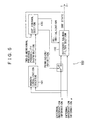
- FIG. 5 schematically shows a functional configuration of the self-localization system 100 according to the present embodiment using both of the Markov localization and the extended Kalman filter.
- the self-localization system 100 includes a Markov localization section (ML) 101, an extended Kalman filter section (EKF) 102, and an EKF control section 103 for controlling operation of the extended Kalman filter section 103.
- ML Markov localization section
- EKF extended Kalman filter section
- EKF control section 103 for controlling operation of the extended Kalman filter section 103.
- the Markov localization section 101 stores the position of the robot itself in the working space as a self-localization probability density distribution on discrete grids, and receives external observation information "s" regarding observation of a landmark and internal observation information "a” regarding a motion of the robot itself as inputs thereto to update the self-localization probability density distribution. Then, at each time, the Markov localization section 101 outputs that one of the grids having the highest value of the self-localization probability density distribution as an estimation result of the self-localization to the EKF control section 103.
- the extended Kalman filter section 102 includes a state model, which defines a relationship between the motion information "a" and the state, that is, the self-localization l of the robot itself, and an observation model, which defines a relationship between the self-localization l and observation information "s" of a landmark.
- the extended Kalman filter section 102 considers the self-localization of the robot as a problem that the state l of the robot is estimated based on the motion information "a" and the observation information "s" of the robot and estimates the state l of the robot at a certain point of time as a Gaussian distribution having a certain median and a certain covariance.
- the extended Kalman filter section 102 updates the median and the covariance regarding the estimated value of the state l in accordance with the expressions (6) given hereinabove.
- the extended Kalman filter section 102 updates the median and the covariance regarding the estimated value of the state l in accordance with the expressions (8) given hereinabove. Since the extended Kalman filter is superior in the robustness against a decrease of sensor information, the estimation result of the extended Kalman filter section 102 is determined as an output of the entire system 100.
- the EKF control section 103 controls operation of the extended Kalman filter section 103 in response to the output result of the Markov localization section 101. More particularly, the EKF control section 103 verifies the validity regarding the observation information "s" of a landmark based on the self-localization estimation result of the Markov localization section 101. The validity of the observation information "s" can be discriminated depending upon whether or not the probability p(s
- mlp) with which the Markov localization section 101 observes a landmark at the grid position "mlp" is lower than the predetermined threshold value parameter thresh obs , then it is inferred that even the Markov localization section 101, which is robust against sensor noise, does not exhibit sufficient convergence of the identification solution due to sensor noise. In such an instance, even if the extended Kalman filter section 102, which is poor in the robustness against sensor noise, estimates the self-localization, a solution having a high accuracy cannot be obtained, and rather, only time for arithmetic operation is wasted.
- a switch 104 is used to intercept the input of the external observation information "s", that is, observation information of a landmark, to the extended Kalman filter section 102 to stop updating of the self-localization estimated value in the extended Kalman filter section 102.
- the EKF control section 103 also verifies the validity of the self-localization estimation result of the extended Kalman filter section 102.
- the validity of the self-localization estimation result can be determined by a distribution comparison test with the presence probability p(l) outputted from the Markov localization section 101 by using the estimated median and covariance of the state l.
- An example of the distribution comparison test is a chi-square-test.
- the EKF control section 103 performs re-initialization of the extended Kalman filter section 102. This is because the extended Kalman filter requires much time for resetting.
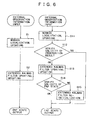
- FIG. 6 illustrates operation characteristics of the self-localization system 100 in the form of flow charts.
- step S1 If internal observation information "a" regarding a movement of the robot 1 is inputted to the self-localization system 100, then the Markov localization section 101 first performs an updating process of the self-localization estimated value using the expression (1) given hereinabove (step S1). Then, the extended Kalman filter section 102 performs an updating process of the self-localization estimated value using the expressions (6) given hereinabove (step S2).
- step S11 the Markov localization section 101 first performs an updating process of the self-localization estimated value using the expression (2) given hereinabove.
- An output result of the Markov localization section 101 is inputted to the EKF control section 103, by which the validity of the observation information "s" is verified (step S12).
- the validity of the observation information "s” can be determined depending upon whether or not the probability p(s
- mlp) with which the Markov localization section 101 observes a landmark at the grid position "mlp" is lower than the predetermined threshold value parameter thresh obs , then it is inferred that even the Markov localization section 101, which is robust against sensor noise, does not exhibit sufficient convergence of the identification solution due to sensor noise. In such an instance, even if the extended Kalman filter section 102, which is poor in the robustness against sensor noise, estimates the self-localization, a solution having a high accuracy cannot be obtained, and rather, only time for arithmetic operation is wasted.
- the switch 104 is used to intercept the input of the external observation information "s", that is, observation information of a landmark, to the extended Kalman filter section 102 to stop updating of the self-localization estimated value in the extended Kalman filter section 102.
- the extended Kalman filter section 102 further performs an updating process using the expressions (8) given hereinabove (step S13).
- a result of the self-localization estimation by the extended Kalman filter section 102 is inputted to the EKF control section 103, by which the validity of it is verified (step S14).
- the validity of the self-localization estimation result by the extended Kalman filter section 102 can be discriminated by a distribution comparison test with the presence probability p(l) outputted from the Markov localization section 101 by using the estimated median and covariance of the state l.
- An example of the distribution comparison test is a chi-square-test.
- the EKF control section 103 performs re-initialization of the extended Kalman filter section 102 (step S15). This is because the extended Kalman filter requires much time for resetting.
- experiment examples in a case wherein each of the Markov localization and the extended Kalman filter is applied by itself to perform self-localization and another case wherein the Markov localization and the extended Kalman filter are used in combination in accordance with the present invention to perform self-localization are compared and verified.
- six landmarks are disposed at different locations in the working space of a field size of 3 ⁇ 2 m, and the total measurement time is 58 minutes, the number of landmark observations (that is, the number of times by which observation information "s" is inputted) is 48,636, and the robot motion step number (that is, the number of times by which motion information "a” is inputted) is 8,334.
- FIG. 7 illustrates comparison and verification with regard to the robustness against a reduction of sensor information in cases wherein the Markov localization and the extended Kalman filter are individually applied by themselves to perform self-localization and another case wherein the Markov localization and the extended Kalman filter are used in combination to perform self-localization in accordance with the present invention.
- the extended Kalman filter is applied by itself and where the Markov localization and the extended Kalman filter are used in combination to perform self-localization in accordance with the present invention, even if the number of sensor inputting times decreases, the observation error does not exhibit a significant variation. In contrast, where the Markov localization is applied by itself, the observation error exhibits a significant increase as the number of sensor inputting times decreases. Accordingly, it can be recognized that the extended Kalman filter is high in the robustness against a decrease of sensor information, and where the number of times of observation is small, the extended Kalman filter can achieve self-localization of a higher accuracy than the Markov localization.
- FIG. 8 illustrates comparison and verification with regard to the robustness against sensor noise in cases wherein the Markov localization and the extended Kalman filter are individually applied by themselves to perform self-localization and another case wherein the Markov localization and the extended Kalman filter are used in combination to perform self-localization in accordance with the present invention.
- the Markov localization is applied by itself and where the Markov localization and the extended Kalman filter are used in combination to perform self-localization in accordance with the present invention, even if the sensor noise increases, the observation error does not exhibit a significant variation. In contrast, where the extended Kalman filter is applied by itself, the observation error exhibits a significant increase as the sensor noise increases. Accordingly, it can be recognized that the Markov localization is high in the robustness against sensor noise, and where there is much sensor noise, the Markov localization can achieve self-localization of a higher accuracy than the extended Kalman filter.
- FIG. 9 illustrates comparison and verification with regard to the time required for resetting in cases wherein the Markov localization and the extended Kalman filter are individually applied by themselves to perform self-localization and another case wherein the Markov localization and the extended Kalman filter are used in combination to perform self-localization in accordance with the present invention.
- the time required for resetting is comparatively short.
- the extended Kalman filter is applied by itself, considerably long time is required for resetting. Accordingly, when resetting is required, preferably the Markov localization is applied. Further, if the extended Kalman filter is used, then preferably re-initialization is performed rather than resetting.
- a superior self-localization system and self-localization method for a robot can be provided by which high-speed robust self-localization with a high degree of accuracy can be performed for the robot, which includes a moving mechanism such as wheels or movable legs and behaves while it recognizes the position or the posture of the robot itself.
- a superior self-localization system and self-localization method for a robot can be provided by which the self-localization can be suitably performed by using a result of a search of a landmark in an environment including an artificial landmark as a clue.
- a superior self-localization system and self-localization method for a robot can be provided by which both of a global search, which searches in a comparatively short period of search time over a wide range, and a local search, which requires much search time although the search accuracy is high, can be used to achieve high-speed and robust self-localization with a high degree of accuracy.
Landscapes
- Engineering & Computer Science (AREA)
- Physics & Mathematics (AREA)
- Radar, Positioning & Navigation (AREA)
- General Physics & Mathematics (AREA)
- Automation & Control Theory (AREA)
- Aviation & Aerospace Engineering (AREA)
- Remote Sensing (AREA)
- Electromagnetism (AREA)
- Multimedia (AREA)
- Theoretical Computer Science (AREA)
- Computer Vision & Pattern Recognition (AREA)
- Manipulator (AREA)
- Control Of Position, Course, Altitude, Or Attitude Of Moving Bodies (AREA)
- Length Measuring Devices By Optical Means (AREA)
Applications Claiming Priority (3)
| Application Number | Priority Date | Filing Date | Title |
|---|---|---|---|
| JP2001365752A JP3968501B2 (ja) | 2001-11-30 | 2001-11-30 | ロボットの自己位置同定システム及び自己位置同定方法 |
| JP2001365752 | 2001-11-30 | ||
| PCT/JP2002/012367 WO2003046478A1 (fr) | 2001-11-30 | 2002-11-27 | Systeme d'identification de position automatique d'un robot et procede d'identification |
Publications (2)
| Publication Number | Publication Date |
|---|---|
| EP1450129A1 true EP1450129A1 (fr) | 2004-08-25 |
| EP1450129A4 EP1450129A4 (fr) | 2005-01-12 |
Family
ID=19175740
Family Applications (1)
| Application Number | Title | Priority Date | Filing Date |
|---|---|---|---|
| EP02783642A Withdrawn EP1450129A4 (fr) | 2001-11-30 | 2002-11-27 | Systeme d'identification de position automatique d'un robot et procede d'identification |
Country Status (4)
| Country | Link |
|---|---|
| US (1) | US7263412B2 (fr) |
| EP (1) | EP1450129A4 (fr) |
| JP (1) | JP3968501B2 (fr) |
| WO (1) | WO2003046478A1 (fr) |
Cited By (3)
| Publication number | Priority date | Publication date | Assignee | Title |
|---|---|---|---|---|
| WO2008111692A1 (fr) * | 2007-03-13 | 2008-09-18 | Research Institute Of Industrial Science & Technology | Point de repère pour déterminer la position d'un robot mobile, appareil et procédé utilisant ce point de repère |
| KR101081859B1 (ko) | 2008-04-28 | 2011-11-09 | 한양대학교 산학협력단 | 동적 환경에서의 위치 추정 방법 및 그 장치 |
| CN102566574A (zh) * | 2012-01-20 | 2012-07-11 | 北人机器人系统(苏州)有限公司 | 一种基于激光传感的机器人轨迹生成方法及装置 |
Families Citing this family (45)
| Publication number | Priority date | Publication date | Assignee | Title |
|---|---|---|---|---|
| US7373270B2 (en) * | 2003-03-26 | 2008-05-13 | Sony Corporation | Diagnosing device for stereo camera mounted on robot, and diagnostic method of stereo camera mounted on robot apparatus |
| US7188048B2 (en) * | 2003-06-25 | 2007-03-06 | Lockheed Martin Corporation | Refining stochastic grid filter |
| JP3994950B2 (ja) * | 2003-09-19 | 2007-10-24 | ソニー株式会社 | 環境認識装置及び方法、経路計画装置及び方法、並びにロボット装置 |
| KR100506097B1 (ko) * | 2004-02-04 | 2005-08-03 | 삼성전자주식회사 | 자기장 지도 생성 방법 및 장치와 이를 활용한 이동체의포즈 확인 방법 및 장치 |
| KR100763234B1 (ko) * | 2004-06-11 | 2007-10-04 | 삼성전자주식회사 | 주행 상태를 감지하는 시스템 및 방법 |
| JP4479372B2 (ja) * | 2004-06-25 | 2010-06-09 | ソニー株式会社 | 環境地図作成方法、環境地図作成装置、及び移動型ロボット装置 |
| US7908040B2 (en) * | 2004-07-15 | 2011-03-15 | Raytheon Company | System and method for automated search by distributed elements |
| JP2006220521A (ja) * | 2005-02-10 | 2006-08-24 | Hitachi Ltd | 自己位置計測装置及び自己位置計測方法を実行するためのプログラム |
| EP2829939B1 (fr) * | 2005-12-02 | 2019-11-13 | iRobot Corporation | Système de navigation par robot autonome parcourant une zone |
| KR100757839B1 (ko) * | 2006-04-04 | 2007-09-11 | 삼성전자주식회사 | 제어시스템, 제어시스템을 갖는 이동로봇장치 및 그제어방법 |
| JP4984650B2 (ja) * | 2006-05-30 | 2012-07-25 | トヨタ自動車株式会社 | 移動装置及び移動装置の自己位置推定方法 |
| JP4882575B2 (ja) * | 2006-07-27 | 2012-02-22 | トヨタ自動車株式会社 | 自己位置推定装置 |
| JP2008065562A (ja) * | 2006-09-06 | 2008-03-21 | Sony Corp | 情報処理装置、および同定処理方法、並びにコンピュータ・プログラム |
| JP2008185417A (ja) * | 2007-01-29 | 2008-08-14 | Sony Corp | 情報処理装置、および情報処理方法、並びにコンピュータ・プログラム |
| JP4696088B2 (ja) * | 2007-03-20 | 2011-06-08 | 富士通株式会社 | 自律移動体および移動方法 |
| KR101409990B1 (ko) * | 2007-09-14 | 2014-06-23 | 삼성전자주식회사 | 로봇의 위치를 계산하기 위한 장치 및 방법 |
| KR101415879B1 (ko) | 2008-01-04 | 2014-07-07 | 삼성전자 주식회사 | 이동 로봇을 도킹시키는 방법 및 장치 |
| US20090299929A1 (en) * | 2008-05-30 | 2009-12-03 | Robert Kozma | Methods of improved learning in simultaneous recurrent neural networks |
| US8508590B2 (en) * | 2010-03-02 | 2013-08-13 | Crown Equipment Limited | Method and apparatus for simulating a physical environment to facilitate vehicle operation and task completion |
| US8538577B2 (en) * | 2010-03-05 | 2013-09-17 | Crown Equipment Limited | Method and apparatus for sensing object load engagement, transportation and disengagement by automated vehicles |
| US8400471B2 (en) * | 2010-03-08 | 2013-03-19 | Empire Technology Development, Llc | Interpretation of constrained objects in augmented reality |
| KR101251184B1 (ko) * | 2010-08-05 | 2013-04-08 | 서울대학교산학협력단 | 구동 명령을 이용한 비젼 트래킹 시스템 및 방법 |
| KR101194576B1 (ko) * | 2010-12-16 | 2012-10-25 | 삼성중공업 주식회사 | 풍력 터빈 조립 및 관리 로봇 및 이를 포함하는 풍력 터빈 시스템 |
| US9188982B2 (en) | 2011-04-11 | 2015-11-17 | Crown Equipment Limited | Method and apparatus for efficient scheduling for multiple automated non-holonomic vehicles using a coordinated path planner |
| US8655588B2 (en) | 2011-05-26 | 2014-02-18 | Crown Equipment Limited | Method and apparatus for providing accurate localization for an industrial vehicle |
| US8548671B2 (en) | 2011-06-06 | 2013-10-01 | Crown Equipment Limited | Method and apparatus for automatically calibrating vehicle parameters |
| US8589012B2 (en) | 2011-06-14 | 2013-11-19 | Crown Equipment Limited | Method and apparatus for facilitating map data processing for industrial vehicle navigation |
| US8594923B2 (en) | 2011-06-14 | 2013-11-26 | Crown Equipment Limited | Method and apparatus for sharing map data associated with automated industrial vehicles |
| US8799201B2 (en) | 2011-07-25 | 2014-08-05 | Toyota Motor Engineering & Manufacturing North America, Inc. | Method and system for tracking objects |
| US20140058634A1 (en) | 2012-08-24 | 2014-02-27 | Crown Equipment Limited | Method and apparatus for using unique landmarks to locate industrial vehicles at start-up |
| US9056754B2 (en) | 2011-09-07 | 2015-06-16 | Crown Equipment Limited | Method and apparatus for using pre-positioned objects to localize an industrial vehicle |
| US8798840B2 (en) | 2011-09-30 | 2014-08-05 | Irobot Corporation | Adaptive mapping with spatial summaries of sensor data |
| CN102521475A (zh) * | 2011-11-01 | 2012-06-27 | 河南省电力公司计量中心 | 一种运动设备的运动轨迹描绘方法 |
| JP6233706B2 (ja) | 2013-04-02 | 2017-11-22 | パナソニックIpマネジメント株式会社 | 自律移動装置及び自律移動装置の自己位置推定方法 |
| CN104331078B (zh) * | 2014-10-31 | 2017-01-11 | 东北大学 | 一种基于位置映射算法的多机器人协作定位方法 |
| JP6187499B2 (ja) * | 2015-02-19 | 2017-08-30 | Jfeスチール株式会社 | 自律移動ロボットの自己位置推定方法、自律移動ロボット、及び自己位置推定用ランドマーク |
| JP6187500B2 (ja) * | 2015-02-19 | 2017-08-30 | Jfeスチール株式会社 | 自律移動ロボットの自己位置推定方法、自律移動ロボット、及び自己位置推定用ランドマーク |
| EP3384318B1 (fr) * | 2015-12-02 | 2022-05-18 | Husqvarna AB | Navigation améliorée pour véhicule par la mise en oeuvre de deux modes de fonctionnement |
| US10572802B1 (en) * | 2018-11-15 | 2020-02-25 | University Of South Florida | Learning state-dependent sensor measurement models for localization |
| CN110509312B (zh) * | 2019-08-29 | 2021-03-26 | 炬星科技(深圳)有限公司 | 机器人配置更新方法、电子设备及计算机可读存储介质 |
| US11577395B2 (en) | 2020-02-17 | 2023-02-14 | Toyota Research Institute, Inc. | Systems for determining location using robots with deformable sensors |
| JP7512839B2 (ja) * | 2020-10-26 | 2024-07-09 | オムロン株式会社 | 制御装置、ロボット、制御方法、プログラム |
| CN113096153A (zh) * | 2021-03-09 | 2021-07-09 | 山西三友和智慧信息技术股份有限公司 | 一种基于深度强化学习仿人足球机器人的实时主动视觉方法 |
| US12304088B2 (en) | 2021-05-06 | 2025-05-20 | Toyota Research Institute, Inc. | Systems and methods for calibrating deformable sensors |
| CN115256399B (zh) * | 2022-08-26 | 2025-05-13 | 上海工程技术大学 | 一种用于移动机械臂的低自由度目标搜寻及到达控制方法 |
Family Cites Families (6)
| Publication number | Priority date | Publication date | Assignee | Title |
|---|---|---|---|---|
| JPH06201813A (ja) * | 1992-12-28 | 1994-07-22 | Hitachi Ltd | 移動体の位置評定方法および装置 |
| KR950015327A (ko) | 1993-11-16 | 1995-06-16 | 배순훈 | 계단형 소거 헤드 및 그 구동 회로 |
| JP3390237B2 (ja) * | 1993-12-21 | 2003-03-24 | 株式会社日立製作所 | プロセス制御方法および装置 |
| DE69700544T2 (de) * | 1996-03-06 | 2000-05-04 | Gmd - Forschungszentrum Informationstechnik Gmbh | Autonomes mobiles robotersystem für sensor- und kartengestützte navigation in einem leitungsnetzwerk |
| WO2003096054A2 (fr) * | 2002-05-10 | 2003-11-20 | Honda Giken Kogyo Kabushiki Kaisha | Suivi en temps reel d'une cible imprevisible parmi des obstacles inconnus |
| KR100493159B1 (ko) * | 2002-10-01 | 2005-06-02 | 삼성전자주식회사 | 이동체의 효율적 자기 위치 인식을 위한 랜드마크 및 이를이용한 자기 위치 인식 장치 및 방법 |
-
2001
- 2001-11-30 JP JP2001365752A patent/JP3968501B2/ja not_active Expired - Fee Related
-
2002
- 2002-11-27 US US10/470,456 patent/US7263412B2/en not_active Expired - Fee Related
- 2002-11-27 EP EP02783642A patent/EP1450129A4/fr not_active Withdrawn
- 2002-11-27 WO PCT/JP2002/012367 patent/WO2003046478A1/fr not_active Ceased
Non-Patent Citations (2)
| Title |
|---|
| GUTMANN J-S ET AL: "An experimental comparison of localization methods" INTELLIGENT ROBOTS AND SYSTEMS, 1998. PROCEEDINGS., 1998 IEEE/RSJ INTERNATIONAL CONFERENCE ON VICTORIA, BC, CANADA 13-17 OCT. 1998, NEW YORK, NY, USA,IEEE, US, 13 October 1998 (1998-10-13), pages 736-743, XP010311481 ISBN: 0-7803-4465-0 * |
| See also references of WO03046478A1 * |
Cited By (6)
| Publication number | Priority date | Publication date | Assignee | Title |
|---|---|---|---|---|
| WO2008111692A1 (fr) * | 2007-03-13 | 2008-09-18 | Research Institute Of Industrial Science & Technology | Point de repère pour déterminer la position d'un robot mobile, appareil et procédé utilisant ce point de repère |
| US8368759B2 (en) | 2007-03-13 | 2013-02-05 | Research Institute Of Industrial Science & Technology | Landmark for position determination of mobile robot and apparatus and method using it |
| CN101669144B (zh) * | 2007-03-13 | 2013-09-18 | 浦项产业科学研究院 | 用于移动式机器人的位置确定的路标和使用该路标的设备与方法 |
| KR101081859B1 (ko) | 2008-04-28 | 2011-11-09 | 한양대학교 산학협력단 | 동적 환경에서의 위치 추정 방법 및 그 장치 |
| CN102566574A (zh) * | 2012-01-20 | 2012-07-11 | 北人机器人系统(苏州)有限公司 | 一种基于激光传感的机器人轨迹生成方法及装置 |
| CN102566574B (zh) * | 2012-01-20 | 2014-12-31 | 北人机器人系统(苏州)有限公司 | 一种基于激光传感的机器人轨迹生成方法及装置 |
Also Published As
| Publication number | Publication date |
|---|---|
| WO2003046478A1 (fr) | 2003-06-05 |
| US20040249504A1 (en) | 2004-12-09 |
| JP2003166824A (ja) | 2003-06-13 |
| US7263412B2 (en) | 2007-08-28 |
| JP3968501B2 (ja) | 2007-08-29 |
| EP1450129A4 (fr) | 2005-01-12 |
Similar Documents
| Publication | Publication Date | Title |
|---|---|---|
| US7263412B2 (en) | Robot self-position identification system and self-position identification method | |
| EP1541295A1 (fr) | Dispositif d'identification d'environnements, procede d'identification d'environnements et dispositif robotise | |
| JP3994950B2 (ja) | 環境認識装置及び方法、経路計画装置及び方法、並びにロボット装置 | |
| US7386163B2 (en) | Obstacle recognition apparatus and method, obstacle recognition program, and mobile robot apparatus | |
| Zalama et al. | Adaptive behavior navigation of a mobile robot | |
| Herrero-Perez et al. | Modeling distributed transportation systems composed of flexible automated guided vehicles in flexible manufacturing systems | |
| JP2004110802A (ja) | 環境同定装置、環境同定方法、プログラム及び記録媒体、並びにロボット装置 | |
| JP2001277163A (ja) | ロボットの制御装置及び制御方法 | |
| JP2004298977A (ja) | 行動制御装置、行動制御方法及び行動制御プログラム、並びに移動型ロボット装置 | |
| Calzado et al. | SAMI: interactive, multi-sense robot architecture | |
| Xu et al. | Magnetic locating AGV navigation based on Kalman filter and PID control | |
| DeFazio et al. | Seeing-eye quadruped navigation with force responsive locomotion control | |
| Kadonoff et al. | Arbitration of multiple control strategies for mobile robots | |
| Chung et al. | Development of the multi-functional indoor service robot PSR systems | |
| Mazo et al. | Experiences in assisted mobility: the SIAMO project | |
| Yuan et al. | Multirobot-based nanoassembly planning with automated path generation | |
| KR102366333B1 (ko) | 로봇용 인공지능 플랫폼 제공 방법 | |
| Tsai et al. | Cooperative Localization Using Fuzzy Decentralized Extended Information Filtering for Homogenous Omnidirectional Mobile Multi-robot System. | |
| Popa et al. | Deployment algorithms and indoor experimental vehicles for studying mobile wireless sensor networks | |
| Tripicchio et al. | Autonomous navigation of mobile robots: from basic sensing to problem solving | |
| Chen et al. | Integrated multi-behavior mobile robot navigation using decentralized control | |
| Fungtammasan et al. | Adaptive coverage control for dynamic pattern generation | |
| Gowthami et al. | Wireless Gesture-Driven Navigation for Autonomous Robots: An Innovative Human-Machine Interface Approach | |
| Atienza et al. | A flexible control architecture for mobile robots: an application for a walking robot | |
| Jayesh et al. | Human-Aware Robot Collaborative Task Planning Using Artificial Potential Field and DQN Reinforcement Learning |
Legal Events
| Date | Code | Title | Description |
|---|---|---|---|
| PUAI | Public reference made under article 153(3) epc to a published international application that has entered the european phase |
Free format text: ORIGINAL CODE: 0009012 |
|
| 17P | Request for examination filed |
Effective date: 20030716 |
|
| AK | Designated contracting states |
Kind code of ref document: A1 Designated state(s): AT BE BG CH CY CZ DE DK EE ES FI FR GB GR IE IT LI LU MC NL PT SE SK TR |
|
| RTI1 | Title (correction) |
Free format text: ROBOT SELF-POSITION IDENTIFICATION SYSTEM AND SELF-POSITION IDENTIFICATION METHOD |
|
| A4 | Supplementary search report drawn up and despatched |
Effective date: 20041126 |
|
| STAA | Information on the status of an ep patent application or granted ep patent |
Free format text: STATUS: THE APPLICATION IS DEEMED TO BE WITHDRAWN |
|
| 18D | Application deemed to be withdrawn |
Effective date: 20060601 |