EP1450352A2 - Méthode pour la quantification à codage en treillis contrainte par bloc et son application dans une méthode et un dispositif pour la quantification des paramètres LSF dans un système de codage de la parole - Google Patents
Méthode pour la quantification à codage en treillis contrainte par bloc et son application dans une méthode et un dispositif pour la quantification des paramètres LSF dans un système de codage de la parole Download PDFInfo
- Publication number
- EP1450352A2 EP1450352A2 EP04250863A EP04250863A EP1450352A2 EP 1450352 A2 EP1450352 A2 EP 1450352A2 EP 04250863 A EP04250863 A EP 04250863A EP 04250863 A EP04250863 A EP 04250863A EP 1450352 A2 EP1450352 A2 EP 1450352A2
- Authority
- EP
- European Patent Office
- Prior art keywords
- lsf coefficient
- vector
- prediction
- quantized
- trellis
- Prior art date
- Legal status (The legal status is an assumption and is not a legal conclusion. Google has not performed a legal analysis and makes no representation as to the accuracy of the status listed.)
- Granted
Links
Images




Classifications
-
- G—PHYSICS
- G10—MUSICAL INSTRUMENTS; ACOUSTICS
- G10L—SPEECH ANALYSIS TECHNIQUES OR SPEECH SYNTHESIS; SPEECH RECOGNITION; SPEECH OR VOICE PROCESSING TECHNIQUES; SPEECH OR AUDIO CODING OR DECODING
- G10L19/00—Speech or audio signals analysis-synthesis techniques for redundancy reduction, e.g. in vocoders; Coding or decoding of speech or audio signals, using source filter models or psychoacoustic analysis
- G10L19/04—Speech or audio signals analysis-synthesis techniques for redundancy reduction, e.g. in vocoders; Coding or decoding of speech or audio signals, using source filter models or psychoacoustic analysis using predictive techniques
-
- G—PHYSICS
- G10—MUSICAL INSTRUMENTS; ACOUSTICS
- G10L—SPEECH ANALYSIS TECHNIQUES OR SPEECH SYNTHESIS; SPEECH RECOGNITION; SPEECH OR VOICE PROCESSING TECHNIQUES; SPEECH OR AUDIO CODING OR DECODING
- G10L19/00—Speech or audio signals analysis-synthesis techniques for redundancy reduction, e.g. in vocoders; Coding or decoding of speech or audio signals, using source filter models or psychoacoustic analysis
- G10L19/02—Speech or audio signals analysis-synthesis techniques for redundancy reduction, e.g. in vocoders; Coding or decoding of speech or audio signals, using source filter models or psychoacoustic analysis using spectral analysis, e.g. transform vocoders or subband vocoders
- G10L19/0212—Speech or audio signals analysis-synthesis techniques for redundancy reduction, e.g. in vocoders; Coding or decoding of speech or audio signals, using source filter models or psychoacoustic analysis using spectral analysis, e.g. transform vocoders or subband vocoders using orthogonal transformation
-
- G—PHYSICS
- G10—MUSICAL INSTRUMENTS; ACOUSTICS
- G10L—SPEECH ANALYSIS TECHNIQUES OR SPEECH SYNTHESIS; SPEECH RECOGNITION; SPEECH OR VOICE PROCESSING TECHNIQUES; SPEECH OR AUDIO CODING OR DECODING
- G10L19/00—Speech or audio signals analysis-synthesis techniques for redundancy reduction, e.g. in vocoders; Coding or decoding of speech or audio signals, using source filter models or psychoacoustic analysis
- G10L19/04—Speech or audio signals analysis-synthesis techniques for redundancy reduction, e.g. in vocoders; Coding or decoding of speech or audio signals, using source filter models or psychoacoustic analysis using predictive techniques
- G10L19/06—Determination or coding of the spectral characteristics, e.g. of the short-term prediction coefficients
Definitions
- the present invention relates to a speech coding system, and more particularly, to a method and apparatus for quantizing line spectral frequency (LSF) using block-constrained Trellis coded quantization (BC-TCQ).
- LSF line spectral frequency
- BC-TCQ block-constrained Trellis coded quantization
- LPC linear predictive coding
- IMT-2000 International Mobile Telecommunications-2000
- the IS-96A Qualcomm code excited linear prediction (QCELP) coder which is the speech coding method used in the CDMA mobile communications system, uses 25% of the total bits for LPC quantization, and Nokia's AMR_WB speech coder uses a maximum of 27.3% to a minimum of 9.6% of the total bits in 9 different modes for LPC quantization.
- QELP Qualcomm code excited linear prediction
- LPC coefficients should be converted into other parameters having a good compression characteristic and then quantized.
- reflection coefficients or LSFs are used.
- an LSF value has a characteristic very closely related to the frequency characteristic of voice
- most of the recently developed voice compression apparatuses employ a LSF quantization method.
- LSF prediction methods include using an auto-regressive (AR) filter and using a moving average (MA) filter.
- AR auto-regressive
- MA moving average
- the AR filter method has good prediction performance, but has a drawback that at the decoder side, the impact of a coefficient transmission error can spread into subsequent frames.
- the MA filter method has prediction performance that is typically lower than that of the AR filter method, the MA filter has an advantage that the impact of a transmission error is constrained temporally.
- speech compression apparatuses such as AMR, AMR_WB, and selectable mode vocoder (SMV) apparatuses that are used in an environment where transmission errors frequently occur, such as wireless communications, use the MA filter method of predicting LSF.
- prediction methods using correlation between neighbor LSF element values in a frame, in addition to LSF value prediction between frames have been developed. Since the LSF values must always be sequentially ordered for a stable filter, if this method is employed additional quantization efficiency can be obtained.
- Quantization methods for LSF prediction error can be broken down into scalar quantization and vector quantization (VQ).
- VQ vector quantization
- the vector quantization method is more widely used than the scalar quantization method because VQ requires fewer bits to achieve the same encoding performance.
- quantization of entire vectors at one time is not feasible because the size of the VQ codebook table is too large and codebook searching takes too much time.
- SVQ split vector quantization
- the size of the vector codebook table becomes 10 x2 20 .
- the size of the vector table becomes just 5 x 2 10 x 2.
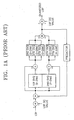
- FIG. 1a shows an LSF quantizer used in an AMR wideband speech coder having a multi-stage split vector quantization (S-MSVQ) structure
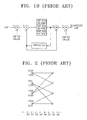
- FIG. 1 b shows an LSF quantizer used in an AMR narrowband speech coder having an SVQ structure.
- S-MSVQ split vector quantization
- the size of the vector table decreases and the memory can be saved and search time can decrease, but the performance is degraded because the correlation between vector values is not fully utilized.
- 10-dimensional vector quantization is divided into 10 1-dimensional vectors, it becomes scalar quantization.
- LSF is directly quantized, acceptable quantization performance can be obtained using 24 bits per vector.
- each sub-vector is independently quantized, correlation between sub-vectors cannot be fully utilized and the entire vector cannot be optimized.
- VQ methods including a method by which vector quantization is performed in a plurality of steps, a selective vector quantization method by which two tables are used for selective quantization, and a link split vector quantization method by which a table is selected by checking a boundary value of each sub-vector.
- a line spectral frequency (LSF) coefficient quantization method in a speech coding system comprising: removing the direct current (DC) component in an input LSF coefficient vector; generating a first prediction error vector by performing inter-frame and intra-frame prediction of the LSF coefficient vector, in which the DC component is removed, quantizing the first prediction error vector by using BC-TCQ algorithm, and then, by performing intra-frame and inter-frame prediction compensation, generating a quantized first LSF coefficient vector; generating a second prediction error vector by performing intra-frame prediction of the LSF coefficient vector, in which the DC component is removed, quantizing the second prediction error vector by using the BC-TCQ algorithm, and then, by performing intra-frame prediction compensation, generating a quantized second LSF coefficient vector; and selectively outputting a vector having a shorter Euclidian distance to the input LSF coefficient vector between the generated quantized first and second LSF coefficient vectors.
- DC direct current
- an LSF coefficient quantization apparatus in a speech coding system comprising: a first subtracter which removes the DC component in an input LSF coefficient vector and provides the LSF coefficient vector, in which the DC component is removed; a memory-based Trellis coded quantization unit which generates a first prediction error vector by performing inter-frame and intra-frame prediction for the LSF coefficient vector provided by the first subtracter, in which the DC component is removed, quantizes the first prediction error vector by using the BC-TCQ algorithm, and then, by performing intra-frame and inter-frame prediction compensation, generates a quantized first LSF coefficient vector; a non-memory Trellis coded quantization unit which generates a second prediction error vector by performing intra-frame prediction for the LSF coefficient vector, in which the DC component is removed, quantizes the second prediction error vector by using BC-TCQ algorithm, and then, by performing intra-frame prediction compensation, generates a quantized second LSF coefficient vector; and a switching unit which selectively outputs
- the invention thus provides a block-constrained Trellis coded quantization method by which when an input signal and coefficients are quantized in a speech coding system, the required memory size and the amount of computation and complexity in a codebook search process are greatly decreased, and good signal to noise ratio (SNR) performance is provided.
- SNR signal to noise ratio
- the TCQ method is characterized in that it requires a smaller memory size and a smaller amount of computation.
- the most important characteristic of the TCQ method is quantization of an object signal by using a structured codebook which is constructed based on a signal set expansion concept.
- a Trellis coding quantizer uses an extended set of quantization levels, and codes an object signal at a desired transmission bit rate.
- the Viterbi algorithm is used to encode an object signal. At a transmission rate of R bits per sample, an output level is selected among 2 R+1 levels when encoding each sample.
- FIG. 2 is a diagram showing an output signal and Trellis structure for an input signal having a uniform distribution when 2 bits are allocated for a sample. Eight output signals are distributed, in an interleaved manner, in the sub-codebooks of D0, D1, D2, and D3, as shown in FIG. 2.
- output signal ( x and ) minimizing distortion ( d ( x,x and )) is determined by using the Viterbi algorithm, and the output signal ( x and ) determined by the Viterbi algorithm is expressed using 1-bit/sample information to indicate a corresponding Trellis path and (R-1)-bits/sample information to indicate a codeword determined in the sub-codebook allocated to the corresponding Trellis path.
- Trellis path information is used as an input to a rate-1/2 convolutional encoder, and the corresponding output bits of the convolutional encoder specify the sub-codebook.
- Trellis path information requires one bit of path information in each stage and initial state information.
- the number of additional bits required to express initial state information is log 2 N when the Trellis has N states.
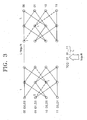
- FIG. 3 is a diagram showing the overhead information of TCQ for a 4-state Trellis structure.
- initial state information '01' should be additionally transmitted in addition to L bits of path information to specify L stages.
- the object signal should be coded by using the remaining available bits excluding log 2 N bits among entire transmission bits in each block, which is the cause of its performance degradation.
- Nikneshan and Kandani suggested a tail-biting (TB)-TCQ algorithm. Their algorithm puts constraints on the selection of an initial trellis state and a last state in a Trellis path.
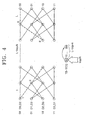
- FIG. 4 is a diagram showing a Trellis path (thick dotted lines) quantized and selected by TB-TCQ method suggested by Nikneshan and Kandani. Since transmission of path change information in the last log 2 N stage is not needed, Trellis path information can be transmitted by using a total of L bits, and additional bits are not needed like the traditional TCQ. That is, the TB-TCQ algorithm suggested by Nikneshan and Kandani solves the overhead problem of the conventional TCQ. However, from a quantization complexity point of view, the single Viterbi encoding process needed by the TCQ should be performed as many times as the number of allowed initial Trellis states.
- FIG. 5 is a diagram showing Trellis paths (thick solid lines) that can be selected in each of a total of four Viterbi encoding processes in order to find an optimal Trellis path by using TB-algorithm suggested by Nikneshan and Kandani.
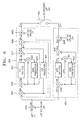
- FIG. 6 is a block diagram showing the structure of a line spectral frequency (LSF) coefficient quantization apparatus according to a preferred embodiment of the present invention in a speech coding system.
- the LSF coefficient quantization apparatus comprises a first subtracter 610, a memory-based Trellis coded quantization unit 620, a non-memory Trellis coded quantization unit 630 connected in parallel with the memory-based coded quantization unit 620, and a switching unit 640.
- the memory-based Trellis coded quantization unit 620 comprises a first predictor 621, a second predictor 624, a second subtracter 622, a third subtracter 625, first through fourth adders 623, 627, 628, and 629, and a first block-constrained Trellis coded quantization unit (BC-TCQ) 626.
- the non-memory coded quantization unit 630 comprises fifth through seventh adders 631, 635, and 636, a fourth subtracter 633, a third predictor 633, and a second BC-TCQ 634.
- the first subtracter 610 subtracts the DC component ( f DC ( n )) of an input LSF coefficient vector ( f ( n )) from the LSF coefficient vector and the LSF coefficient vector ( x ( n )), in which the DC component is removed, is applied as input to the memory-based Trellis coded quantization unit 620 and the non-memory Trellis coded quantization unit 630 at the same time.
- the memory-based Trellis coded quantization unit 620 receives the LSF coefficient vector ( x ( n )), in which the DC component is removed, generates prediction error vector ( t i ( n )) by performing inter-frame prediction and intra-frame prediction, quantizes the prediction error vector ( t i ( n )) by using the BC-TCQ algorithm to be explained later, and then, by performing intra-frame and inter-frame prediction compensation, generates the quantized and prediction-compensated LSF coefficient vector ( x and ( n )), and provides the final quantized LSF coefficient vector ( f and 1 ( n )), which is obtained by adding the quantized and prediction-compensated LSF coefficient vector ( x and ( n )) and the DC component ( f DC ( n )) of the LSF coefficient vector, and is applied as input to the switching unit 640.
- the second subtracter 622 obtains prediction error vector ( e ( n )) of the current frame (n) by subtracting the prediction value provided by the first predictor 621 from the LSF coefficient vector ( x ( n )), in which the DC component is removed.
- AR prediction for example a first-order AR prediction algorithm is applied and the second predictor 624 generates a prediction value obtained by multiplying prediction factor ( ⁇ i ) for the i-th element by the (i-1)-th element value ( ê i -1 ( n )) which is quantized by the first BC-TCQ 626 and intra-frame prediction-compensated by the first adder 623.
- the third subtracter 625 obtains the prediction error vector of i-th element value ( t i ( n )) by subtracting the prediction value provided by the second predictor 624 from the i-th element value ( e i ( n )) in prediction error vector ( e ( n )) of the current frame (n) provided by the second subtracter 622.
- the first BC-TCQ 626 generates the quantized prediction error vector with i-th element value ( t and i ( n )), by performing quantization of the prediction error vector with i-th element value ( t i ( n )), which is provided by the second subtracter 625, by using the BC-TCQ algorithm.
- the second adder 627 adds the prediction value of the second predictor 624 to the quantized prediction error vector with i-th element value ( t and i ( n )) provided by the first BC-TCQ 626, and by doing so, performs intra-frame prediction compensation for the quantized prediction error vector with i-th element value ( t and i ( n )) and generates the i-th element value ( ê i ( n )) of the quantized inter-frame prediction error vector.
- the element value of each order forms the quantized prediction error vector ( ê ( n )) of the current frame.
- the third adder 628 generates the quantized LSF coefficient vector ( x and ( n )), by adding the prediction value of the first predictor 612 to the quantized inter-frame prediction error vector ( ê ( n )) of the current frame provided by the second adder 627, that is, by performing inter-frame prediction compensation for the quantized prediction error vector ( ê ( n )) of the current frame.
- the fourth adder 629 generates the quantized LSF coefficient vector ( f and 1 ( n )), by adding DC component ( f DC ( n )) of the LSF coefficient vector to the quantized LSF coefficient vector ( x and ( n )) provided by the third adder 628.
- the finally quantized LSF coefficient vector ( f and 1 ( n )) is provided to one end of the switching unit 640.
- the non-memory Trellis coded quantization unit 630 receives the LSF coefficient vector ( x ( n )), in which the DC component is removed, performs intra-frame prediction, generates prediction error vector ( t i ( n )), quantizes the prediction error vector ( t i ( n )) by using the BC-TCQ algorithm, which will be explained later, then performs intra-frame prediction compensation, and generates the quantized and prediction-compensated LSF coefficient vector ( x and ( n )).
- the non-memory Trellis coded quantization unit 630 provides the switching unit 640 with the finally quantized LSF coefficient vector ( f and 2 ( n )), which is obtained by adding quantized and prediction-compensated LSF coefficient vector ( x and ( n )) and DC component ( f DC ( n )) of the LSF coefficient vector.
- AR prediction for example, a first-order AR prediction algorithm is used in the third predictor 632 and the third predictor 632 generates a prediction value obtained by multiplying prediction element ( ⁇ i ) for the i-th element by the intra-frame prediction error vector with (i-1)-th element ( x and i -1 ( n )) which is quantized by the second BC-TCQ 634 and then intra-frame prediction-compensated by the fifth adder 631.
- the fourth subtracter 633 generates the prediction error vector with i-th element ( t i ( n )) by subtracting the prediction value provided by the third predictor 632 from the i-th element ( x i ( n )) of the LSF coefficient vector ( x ( n )), in which the DC component is removed, provided by the first subtracter 610.
- the second BC-TCQ 634 generates the quantized prediction error vector of i-th element value ( t and i ( n )), by performing quantization of the prediction error vector of i-th element ( t i ( n )), which is provided by the fourth subtracter 633, by using the BC-TCQ algorithm.
- the sixth adder 635 adds the prediction value of the third predictor 632 to the quantized prediction error vector of i-th element value ( t and i ( n )) provided by the second BC-TCQ 634, and by doing so, performs intra-frame prediction compensation for the quantized prediction error vector of i-th element value ( t and i ( n )) and generates the quantized and prediction-compensated LSF coefficient vector of i-th element value ( x and i ( n )).
- the LSF coefficient vector of the element values of each order forms the quantized prediction error vector ( ê ( n )) of the current frame.
- the seventh adder 636 generates the quantized LSF coefficient vector ( f and 2 ( n )), by adding the quantized LSF coefficient vector ( x and ( n )) provided by the sixth adder 635 to the DC component ( f DC ( n )) of the LSF coefficient vector.
- the finally quantized LSF coefficient vector ( f and 2 ( n )) is provided to one end of the switching unit 640.
- the switching unit 640 selects one that has a shorter Euclidian distance from the input LSF coefficient vector ( f ( n )), and outputs the selected LSF coefficient vector.
- the fourth adder 629 and the seventh adder 636 are disposed in the memory-based Trellis coded quantization unit 620 and the non-memory Trellis coded quantization unit 630, respectively.
- the fourth adder 629 and the seventh adder 636 may be removed and instead, one adder is disposed at the output end of the switching unit 640 so that the DC component ( f DC ( n )) of the LSF coefficient vector can be added to the quantized LSF coefficient vector ( x and ( n )) which is selectively output from the switching unit 640.
- N 2 v
- v denotes the number of binary state variables in the encoder finite state machine
- the initial states of Trellis paths that can be selected are limited to 2 k (0 ⁇ k ⁇ v) among the total of N states, and the number of states of the last stage are limited to 2 v-k (0 ⁇ k ⁇ v) among a total of N states, and dependent on the initial states of the Trellis path.
- the N survivor paths determined under the initial state constraint are found from the first stage to stage L-log 2 N (here, L denotes the number of entire stages, and N denotes the number of entire Trellis states), and then, in the encoding over the remaining v stages, only Trellis paths are considered in which terminate in a state of the last stage selected among 2 v-k (0 ⁇ k ⁇ v) states determined according to each initial state. Among the considered Trellis paths, an optimum Trellis path is selected and transmitted.
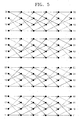
- FIG. 7 is a diagram showing Trellis paths that are considered when using the BC-TCQ algorithm with k being 1 and a Trellis structure with a total of 4 states.
- constraints are given such that the initial states of Trellis paths that can be selected are '00' and '10' among 4 states, and the state of the last stage is '00' or '01' when the initial state is '00' and '10' or '11' when the initial state is '10'.
- Trellis paths that can be selected in the remaining stages are marked by thick dotted lines with the states of the last stage being '00' and '01'.
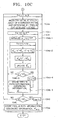
- the Viterbi encoding process in the j-th stage in FIG. 8 or FIG. 10a will first be explained.
- step 101 initialization of the entire distance ( ⁇ 0 / p ) at state p in stage 0 is performed, and in steps 102 and 103, N survivor paths are determined from the first stage to stage L-log 2 N (here, L denotes the number of entire stages and N denotes the number of entire Trellis states).
- y i',p ⁇ D j i ', p ) d i",p min( d ( e ", y i", p )
- D j / i',p denotes a sub-codebook allocated to a branch between state p in the j-th stage and state i' in the (j-1)-th stage
- D j / i',p denotes a sub-codebook allocated to a branch between state p in the j-th stage and state i" in the (j-1)-th stage
- y i',p and y i",p denote code vectors in D j / i',p and D j / i'',p , respectively.
- step 104 in the remaining v stages, the only Trellis paths considered are those for which the state of the last stage is selected among 2 v-k (0 ⁇ k ⁇ v) states determined according to each initial state are considered.
- step 104a the initial state each of N survivor paths determined as in the step 103 and 2 v-k (0 ⁇ k ⁇ v) Trellis paths in the last v stages are determined in step 104a.
- steps 104b through 104e for each of 2 v-k (0 ⁇ k ⁇ v) states defined according to each initial state value in the entire N survivor paths, information on a Trellis path that has the shortest distance between an input sequence and a quantized sequence in a path determined to the last state, and the codeword information are obtained.
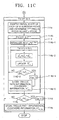
- Constraints on the initial state and last state are the same as in the BC-TCQ encoding process in the memory-based Trellis coded quantization unit 620, but inter-frame prediction of input samples is not used.
- step 11 initialization of the entire distance ( ⁇ 0 / p ) at state p in stage 0 is performed, and in steps 112 and 113, N survivor paths are determined from the first stage to stage L-log 2 N (here, L denotes the number of entire stages and N denotes the number of entire Trellis states). That is, in step 112a, for N states from the first stage to stage L-log 2 N, quantization distortion ( d i',p ,d i",p ) is obtained as the following equations 5 and 6 by using sub-codebooks allocated to two branches connected to state p in j-th stage, and stored in distance metric ( d i',p ,d i",p ):
- D j / i',p denotes a sub-codebook allocated to a branch between state p in j-th stage and state i' in (j-1)-th stage
- D j / i'',p denotes a sub-codebook allocated to a branch between state p in j-th stage and state i" in (j-1)-th stage
- y i',p and y i",p denote code vectors in D j / i',p and D j / i'',p , respectively.
- a process for selecting one between two Trellis paths connected to state p in j-th stage and an accumulated distortion update process are performed as the following equation 7 and according to the result, a path is selected and x and j / p , is updated (step 112b-1 and 112b-2 in step 112b):
- ⁇ j p min( ⁇ j -1 i' + d i',p , + ⁇ j -1 i'' + d i",p )
- step 114 The operation sequence and functions of the next step, step 114, are the same as that of the step 104 shown in FIG. 10c.
- the BC-TCQ algorithm enables quantization by a single Viterbi encoding process such that the additional complexity in the TB-TCQ algorithm can be avoided.
- FIG. 12 is a flowchart explaining an LSF coefficient quantization method according to the present invention in a speech coding system.
- the method comprises DC component removing step 121, memory-based Trellis coded quantization step 122, non-memory Trellis coded quantization step 123, switching step 124 and DC component restoration step 125.
- DC component restoration step 125 can be implemented by including the step into the memory-based Trellis coded quantization step 122 and the non-memory Trellis coded quantization step 123.
- step 121 the DC component ( f DC ( n )) of an input LSF coefficient vector ( f ( n )) is subtracted from the LSF coefficient vector and the LSF coefficient vector ( x ( n )) in which the DC component is removed is generated.
- step 122 the LSF coefficient vector ( x ( n )), in which the DC component is removed in the step 121, is received, and by performing inter-frame and intra-frame predictions, prediction error vector ( t i ( n )) is generated.
- the prediction error vector ( t i ( n )) is quantized by using the BC-TCQ algorithm, and then, by performing intra-frame and inter-frame prediction compensation, quantized LSF coefficient vector ( x and ( n )) is generated, and Euclidian distance ( d memory ) between quantized LSF coefficient vector ( x and ( n )) and the LSF coefficient vector ( x ( n )), in which the DC component is removed, is obtained.
- step 122a MA prediction, for example, 4-dimensional MA inter-frame prediction, is applied to the LSF coefficient vector ( x ( n )), in which the DC component is removed in the step 121, and prediction error vector ( e ( n )) of the current frame (n) is obtained.
- the step 122a can be expressed as the following equation 8:
- AR prediction for example, 1-dimensional AR intra-frame prediction
- e i ( n ) the prediction error vector ( e ( n )) of the current frame (n) obtained in the step 122a
- prediction error vector ( t i ( n )) of the i-th element value is obtained.
- ⁇ i denotes the prediction factor of i-th element
- ê i -1 ( n ) denotes the (i-1 )-th element value which is quantized using the BC-TCQ algorithm and then, intra-frame prediction-compensated.
- the prediction error vector with i-th element value ( t i ( n )) obtained by the equation 9 is quantized using the BC-TCQ algorithm and the quantized prediction error vector of i-th element value ( t and i ( n )) is obtained.
- Intra-frame prediction compensation is performed for the quantized prediction error vector with i-th element value ( t and i ( n )) and the LSF coefficient vector with i-th element value ( ê i ( n )) is obtained.
- LSF coefficient vector of the element value of each order forms quantized inter-frame prediction error vector ( ê ( n )) of the current frame.
- step 122c inter-frame prediction compensation is performed for quantized inter-frame prediction error vector ( ê ( n )) of the current frame obtained in the step 122b and quantized LSF coefficient vector ( x and ( n )) is obtained.
- the step 122c can be expressed as the following equation 11:
- step 123 the LSF coefficient vector ( x ( n )), in which the DC component is removed in the step 121, is received, and by performing intra-frame prediction, prediction error vector ( t i ( n )) is generated.
- the prediction error vector ( t i ( n )) is quantized by using the BC-TCQ algorithm and intra-frame prediction compensated, and by doing so, quantized LSF coefficient vector ( x and ( n )) is generated. Euclidian distance ( d memoryless ) between quantized LSF coefficient vector ( x and ( n )) and the LSF coefficient vector ( x ( n )), in which the DC component is removed, is obtained.
- step 123a AR prediction, for example, 1-dimensional AR intra-frame prediction, is applied to the LSF coefficient vector ( x ( n )), with i-th element ( x i ( n )), in which the DC component is removed in the step 121, and intra-frame prediction error vector with i-th element ( t i ( n )) is obtained.
- ⁇ i denotes the prediction factor of the i-th element
- x and i -1 ( n ) denotes intra-frame prediction error vector of the (i-1)-th element which is quantized by BC-TCQ algorithm and then, intra-frame prediction-compensated.
- the intra-frame prediction error vector with i-th element ( t i ( n )) obtained by the equation 12 is quantized using the BC-TCQ algorithm and the quantized intra-frame prediction error vector with i-th element ( t and i ( n )) is obtained.
- Intra-frame prediction compensation is performed for the quantized intra-frame prediction error vector with i-th element ( t and i ( n )) and the quantized LSF coefficient vector with i-th element value ( x and i ( n )) is obtained.
- the quantized LSF coefficient vector of the element value of each order forms the quantized LSF coefficient vector ( x and ( n )) of the current frame.
- step 124 Euclidian distances ( d memory , d memoryless ), obtained in steps 122d and 123b, respectively, are compared and the quantized LSF coefficient vector ( x ( n )) with the smaller Euclidian distance is selected.
- step 125 the DC component ( f DC ( n )) of the LSF coefficient vector is added to the quantized LSF coefficient vector ( x and ( n )) selected in the step 124 and finally the quantized LSF coefficient vector ( f and ( n )) is obtained.
- the present invention may be embodied in a code, which can be read by a computer, on a computer readable recording medium.
- the computer readable recording medium includes all kinds of recording apparatuses on which computer readable data are stored.
- the computer readable recording media includes storage media such as magnetic storage media (e.g., ROM's, floppy disks, hard disks, etc.), optically readable media (e.g., CD-ROMs, DVDs, etc.) and carrier waves (e.g., transmissions over the Internet). Also, the computer readable recording media can be scattered on computer systems connected through a network and can store and execute a computer readable code in a distributed mode. Also, function programs, codes and code segments for implementing the present invention can be easily inferred by programmers in the art of the present invention.
- SNR quantization signal-to-noise ratio
- the following table 2 shows complexity comparison between BC-TCQ algorithm proposed in the present invention and TB-TCQ algorithm, when the block length of the source is 16 in the table 1. Operation TB-TCQ BC-TCQ Remarks Addition 5184 696 86.57% decrease Multiplication 64 64 - Comparison 2302 223 90.32% decrease
- the complexity of the BC-TCQ algorithm according to the present invention greatly decreased compared to that of the TB-TCQ algorithm.
- the codebook used in the performance comparison experiment has 32 output levels and the encoding rate is 3 bits per sample.
- voice samples for wideband speech provided by NTT were used.
- the total length of the voice samples is 13 minutes, and the samples include male Korean, female Korean, male English and female English.
- the same process as the AMR_WB speech coder was applied to the preprocessing process before an LSF quantizer, and comparison of spectral distortion (SD) performances, the amounts of computation, and the required memory sizes are shown in tables 5 and 6.
- SD spectral distortion
- AMR_WB S-MSVQ Present invention SD Average SD(dB) 0.7933 0.6979 2 ⁇ 4 dB(%) 0.4099 0.1660 > 4dB(%) 0.0026 0
- AMR_WB Present invention Remarks Computation amount Addition 15624 3784 76% decrease Multiplication 8832 2968 66% decrease Comparison 3570 2335 35% decrease Memory requirement 5280 1056 80% decrease
- the present invention showed a decrease of 0.0954 in average SD, and a decrease of 0.2439 in the number of outlier quantization areas between 2dB-4dB, compared to AMR_WB S-MSVQ. Also, the present invention showed a great decrease in the amount of computation needed in addition, multiplication, and comparison that are required for codebook search, and accordingly, the memory requirement also decreased correspondingly.
- the memory size required for quantization and the amount of computation in the codebook search process can be greatly reduced.
Landscapes
- Engineering & Computer Science (AREA)
- Physics & Mathematics (AREA)
- Computational Linguistics (AREA)
- Signal Processing (AREA)
- Health & Medical Sciences (AREA)
- Audiology, Speech & Language Pathology (AREA)
- Human Computer Interaction (AREA)
- Acoustics & Sound (AREA)
- Multimedia (AREA)
- Spectroscopy & Molecular Physics (AREA)
- Compression, Expansion, Code Conversion, And Decoders (AREA)
Applications Claiming Priority (2)
| Application Number | Priority Date | Filing Date | Title |
|---|---|---|---|
| KR2003010484 | 2003-02-19 | ||
| KR10-2003-0010484A KR100486732B1 (ko) | 2003-02-19 | 2003-02-19 | 블럭제한된 트렐리스 부호화 양자화방법과 음성부호화시스템에있어서 이를 채용한 라인스펙트럼주파수 계수양자화방법 및 장치 |
Publications (3)
| Publication Number | Publication Date |
|---|---|
| EP1450352A2 true EP1450352A2 (fr) | 2004-08-25 |
| EP1450352A3 EP1450352A3 (fr) | 2005-05-18 |
| EP1450352B1 EP1450352B1 (fr) | 2008-01-23 |
Family
ID=32733145
Family Applications (1)
| Application Number | Title | Priority Date | Filing Date |
|---|---|---|---|
| EP04250863A Expired - Lifetime EP1450352B1 (fr) | 2003-02-19 | 2004-02-18 | Méthode pour la quantification à codage en treillis contrainte par bloc et son application dans une méthode et un dispositif pour la quantification des paramètres LSF dans un système de codage de la parole |
Country Status (5)
| Country | Link |
|---|---|
| US (1) | US7630890B2 (fr) |
| EP (1) | EP1450352B1 (fr) |
| JP (1) | JP4750366B2 (fr) |
| KR (1) | KR100486732B1 (fr) |
| DE (1) | DE602004011411T2 (fr) |
Cited By (3)
| Publication number | Priority date | Publication date | Assignee | Title |
|---|---|---|---|---|
| EP2700072A4 (fr) * | 2011-04-21 | 2016-01-20 | Samsung Electronics Co Ltd | Appareil de quantification de coefficients de codage prédictif linéaire, appareil de codage de son, appareil de déquantification de coefficients de codage prédictif linéaire, appareil de décodage de son et dispositif électronique s'y rapportant |
| CN105719654A (zh) * | 2011-04-21 | 2016-06-29 | 三星电子株式会社 | 用于语音信号或音频信号的解码设备和方法及量化设备 |
| US20220130403A1 (en) * | 2014-05-07 | 2022-04-28 | Samsung Electronics Co., Ltd. | Method and device for quantizing linear predictive coefficient, and method and device for dequantizing same |
Families Citing this family (13)
| Publication number | Priority date | Publication date | Assignee | Title |
|---|---|---|---|---|
| KR100647290B1 (ko) * | 2004-09-22 | 2006-11-23 | 삼성전자주식회사 | 합성된 음성의 특성을 이용하여 양자화/역양자화를선택하는 음성 부호화/복호화 장치 및 그 방법 |
| KR100813260B1 (ko) * | 2005-07-13 | 2008-03-13 | 삼성전자주식회사 | 코드북 탐색 방법 및 장치 |
| KR100728056B1 (ko) * | 2006-04-04 | 2007-06-13 | 삼성전자주식회사 | 다중 경로 트랠리스 부호화 양자화 방법 및 이를 이용한다중 경로 트랠리스 부호화 양자화 장치 |
| KR100903110B1 (ko) * | 2007-04-13 | 2009-06-16 | 한국전자통신연구원 | 트렐리스 부호 양자화 알고리듬을 이용한 광대역 음성 부호화기용 lsf 계수 양자화 장치 및 방법 |
| KR101671005B1 (ko) * | 2007-12-27 | 2016-11-01 | 삼성전자주식회사 | 트렐리스를 이용한 양자화 부호화 및 역양자화 복호화 방법및 장치 |
| CN102089810B (zh) | 2008-07-10 | 2013-05-08 | 沃伊斯亚吉公司 | 多基准线性预测系数滤波器量化和逆量化设备及方法 |
| CN110289005B (zh) | 2013-06-21 | 2024-02-09 | 弗朗霍夫应用科学研究促进协会 | 用于产生舒缓噪声的自适应频谱形状的装置及方法 |
| KR102392003B1 (ko) | 2014-03-28 | 2022-04-28 | 삼성전자주식회사 | 선형예측계수 양자화방법 및 장치와 역양자화 방법 및 장치 |
| KR102343453B1 (ko) | 2014-03-28 | 2021-12-27 | 삼성전자주식회사 | 음향 신호의 렌더링 방법, 장치 및 컴퓨터 판독 가능한 기록 매체 |
| KR102742778B1 (ko) | 2014-07-28 | 2024-12-16 | 삼성전자주식회사 | 신호 부호화방법 및 장치와 신호 복호화방법 및 장치 |
| MY180423A (en) * | 2014-07-28 | 2020-11-28 | Samsung Electronics Co Ltd | Signal encoding method and apparatus, and signal decoding method and apparatus |
| US10680749B2 (en) * | 2017-07-01 | 2020-06-09 | Intel Corporation | Early-termination of decoding convolutional codes |
| US11451840B2 (en) * | 2018-06-18 | 2022-09-20 | Qualcomm Incorporated | Trellis coded quantization coefficient coding |
Family Cites Families (19)
| Publication number | Priority date | Publication date | Assignee | Title |
|---|---|---|---|---|
| US5012518A (en) * | 1989-07-26 | 1991-04-30 | Itt Corporation | Low-bit-rate speech coder using LPC data reduction processing |
| US5659659A (en) * | 1993-07-26 | 1997-08-19 | Alaris, Inc. | Speech compressor using trellis encoding and linear prediction |
| WO1995010760A2 (fr) * | 1993-10-08 | 1995-04-20 | Comsat Corporation | Codeurs vocaux a bas debit binaire ameliores et procedes pour leur utilisation |
| JPH0944730A (ja) * | 1995-07-31 | 1997-02-14 | Hitachi Ltd | 自動現金取引装置 |
| US5774839A (en) * | 1995-09-29 | 1998-06-30 | Rockwell International Corporation | Delayed decision switched prediction multi-stage LSF vector quantization |
| US5683930A (en) * | 1995-12-06 | 1997-11-04 | Micron Technology Inc. | SRAM cell employing substantially vertically elongated pull-up resistors and methods of making, and resistor constructions and methods of making |
| US5826225A (en) * | 1996-09-18 | 1998-10-20 | Lucent Technologies Inc. | Method and apparatus for improving vector quantization performance |
| TW408298B (en) * | 1997-08-28 | 2000-10-11 | Texas Instruments Inc | Improved method for switched-predictive quantization |
| US6125149A (en) * | 1997-11-05 | 2000-09-26 | At&T Corp. | Successively refinable trellis coded quantization |
| US6148283A (en) * | 1998-09-23 | 2000-11-14 | Qualcomm Inc. | Method and apparatus using multi-path multi-stage vector quantizer |
| KR100311473B1 (ko) * | 1999-01-20 | 2001-11-02 | 구자홍 | 트렐리스 기반의 적응적 양자화기에서 최적경로 추적 방법 |
| IL129752A (en) * | 1999-05-04 | 2003-01-12 | Eci Telecom Ltd | Telecommunication method and system for using same |
| DE19926649A1 (de) * | 1999-06-11 | 2000-12-14 | Philips Corp Intellectual Pty | Anordnung zur Trelliscodierung |
| US6504877B1 (en) * | 1999-12-14 | 2003-01-07 | Agere Systems Inc. | Successively refinable Trellis-Based Scalar Vector quantizers |
| KR100324204B1 (ko) * | 1999-12-24 | 2002-02-16 | 오길록 | 예측분할벡터양자화 및 예측분할행렬양자화 방식에 의한선스펙트럼쌍 양자화기의 고속탐색방법 |
| KR20020075592A (ko) * | 2001-03-26 | 2002-10-05 | 한국전자통신연구원 | 광대역 음성 부호화기용 lsf 양자화기 |
| FI111887B (fi) * | 2001-12-17 | 2003-09-30 | Nokia Corp | Menetelmä ja järjestely trelliksen läpikäymisen tehostamiseksi |
| JP3557413B2 (ja) * | 2002-04-12 | 2004-08-25 | 松下電器産業株式会社 | Lspパラメータ復号化装置及び復号化方法 |
| KR100463577B1 (ko) * | 2002-11-01 | 2004-12-29 | 한국전자통신연구원 | 음성 부호화기용 선스펙트럼주파수 벡터 양자화 장치 |
-
2003
- 2003-02-19 KR KR10-2003-0010484A patent/KR100486732B1/ko not_active Expired - Lifetime
-
2004
- 2004-02-18 EP EP04250863A patent/EP1450352B1/fr not_active Expired - Lifetime
- 2004-02-18 DE DE602004011411T patent/DE602004011411T2/de not_active Expired - Lifetime
- 2004-02-19 JP JP2004042551A patent/JP4750366B2/ja not_active Expired - Lifetime
- 2004-02-19 US US10/780,899 patent/US7630890B2/en active Active
Cited By (11)
| Publication number | Priority date | Publication date | Assignee | Title |
|---|---|---|---|---|
| EP2700072A4 (fr) * | 2011-04-21 | 2016-01-20 | Samsung Electronics Co Ltd | Appareil de quantification de coefficients de codage prédictif linéaire, appareil de codage de son, appareil de déquantification de coefficients de codage prédictif linéaire, appareil de décodage de son et dispositif électronique s'y rapportant |
| CN105719654A (zh) * | 2011-04-21 | 2016-06-29 | 三星电子株式会社 | 用于语音信号或音频信号的解码设备和方法及量化设备 |
| AU2012246798B2 (en) * | 2011-04-21 | 2016-11-17 | Samsung Electronics Co., Ltd | Apparatus for quantizing linear predictive coding coefficients, sound encoding apparatus, apparatus for de-quantizing linear predictive coding coefficients, sound decoding apparatus, and electronic device therefor |
| US9626980B2 (en) | 2011-04-21 | 2017-04-18 | Samsung Electronics Co., Ltd. | Method of quantizing linear predictive coding coefficients, sound encoding method, method of de-quantizing linear predictive coding coefficients, sound decoding method, and recording medium and electronic device therefor |
| US9626979B2 (en) | 2011-04-21 | 2017-04-18 | Samsung Electronics Co., Ltd. | Apparatus for quantizing linear predictive coding coefficients, sound encoding apparatus, apparatus for de-quantizing linear predictive coding coefficients, sound decoding apparatus, and electronic device therefore |
| AU2017200829B2 (en) * | 2011-04-21 | 2018-04-05 | Samsung Electronics Co., Ltd. | Apparatus for quantizing linear predictive coding coefficients, sound encoding apparatus, apparatus for de-quantizing linear predictive coding coefficients, sound decoding apparatus, and electronic device therefor |
| US10224051B2 (en) | 2011-04-21 | 2019-03-05 | Samsung Electronics Co., Ltd. | Apparatus for quantizing linear predictive coding coefficients, sound encoding apparatus, apparatus for de-quantizing linear predictive coding coefficients, sound decoding apparatus, and electronic device therefore |
| US10229692B2 (en) | 2011-04-21 | 2019-03-12 | Samsung Electronics Co., Ltd. | Method of quantizing linear predictive coding coefficients, sound encoding method, method of de-quantizing linear predictive coding coefficients, sound decoding method, and recording medium and electronic device therefor |
| CN105719654B (zh) * | 2011-04-21 | 2019-11-05 | 三星电子株式会社 | 用于语音信号或音频信号的解码设备和方法及量化设备 |
| US20220130403A1 (en) * | 2014-05-07 | 2022-04-28 | Samsung Electronics Co., Ltd. | Method and device for quantizing linear predictive coefficient, and method and device for dequantizing same |
| US11922960B2 (en) * | 2014-05-07 | 2024-03-05 | Samsung Electronics Co., Ltd. | Method and device for quantizing linear predictive coefficient, and method and device for dequantizing same |
Also Published As
| Publication number | Publication date |
|---|---|
| EP1450352A3 (fr) | 2005-05-18 |
| US7630890B2 (en) | 2009-12-08 |
| KR100486732B1 (ko) | 2005-05-03 |
| EP1450352B1 (fr) | 2008-01-23 |
| KR20040074561A (ko) | 2004-08-25 |
| JP2004252462A (ja) | 2004-09-09 |
| DE602004011411T2 (de) | 2009-01-15 |
| US20040230429A1 (en) | 2004-11-18 |
| DE602004011411D1 (de) | 2008-03-13 |
| JP4750366B2 (ja) | 2011-08-17 |
Similar Documents
| Publication | Publication Date | Title |
|---|---|---|
| USRE49363E1 (en) | Variable bit rate LPC filter quantizing and inverse quantizing device and method | |
| EP1450352B1 (fr) | Méthode pour la quantification à codage en treillis contrainte par bloc et son application dans une méthode et un dispositif pour la quantification des paramètres LSF dans un système de codage de la parole | |
| EP1019907B1 (fr) | Codage de signal vocal | |
| JPH08263099A (ja) | 符号化装置 | |
| MXPA05006664A (es) | Metodo y dispositivo para la cuantizacion robusta de vector predictivo de parametros de prediccion lineal en la codificacion de conversacion a velocidad variable de bits. | |
| US5659659A (en) | Speech compressor using trellis encoding and linear prediction | |
| US6988067B2 (en) | LSF quantizer for wideband speech coder | |
| KR20080092770A (ko) | 트렐리스 부호 양자화 알로리즘을 이용한 광대역 음성부호화기용 lsf 계수 양자화 장치 및 방법 | |
| US8706481B2 (en) | Multi-path trellis coded quantization method and multi-path coded quantizer using the same | |
| KR100341398B1 (ko) | 씨이엘피형 보코더의 코드북 검색 방법 | |
| JPH08179800A (ja) | 音声符号化装置 | |
| KR20010084468A (ko) | 음성 부호화기의 lsp 양자화기를 위한 고속 탐색 방법 | |
| JP3700310B2 (ja) | ベクトル量子化装置及びベクトル量子化方法 | |
| Shin et al. | Low-complexity predictive trellis coded quantization of wideband speech LSF parameters | |
| JPH0612097A (ja) | 音声の予測符号化方法および装置 | |
| Nurminen | Multi-mode quantization of adjacent speech parameters using a low-complexity prediction scheme. | |
| JPH09269798A (ja) | 音声符号化方法および音声復号化方法 | |
| HK1153840B (en) | Multi-reference lpc filter quantization and inverse quantization device and method |
Legal Events
| Date | Code | Title | Description |
|---|---|---|---|
| PUAI | Public reference made under article 153(3) epc to a published international application that has entered the european phase |
Free format text: ORIGINAL CODE: 0009012 |
|
| AK | Designated contracting states |
Kind code of ref document: A2 Designated state(s): AT BE BG CH CY CZ DE DK EE ES FI FR GB GR HU IE IT LI LU MC NL PT RO SE SI SK TR |
|
| AX | Request for extension of the european patent |
Extension state: AL HR LT LV MK |
|
| RIN1 | Information on inventor provided before grant (corrected) |
Inventor name: SON, CHANG-YONG Inventor name: KANG, SANG-WON Inventor name: FISCHER, THOMAS R. Inventor name: SHIN, YONG-WON |
|
| PUAL | Search report despatched |
Free format text: ORIGINAL CODE: 0009013 |
|
| AK | Designated contracting states |
Kind code of ref document: A3 Designated state(s): AT BE BG CH CY CZ DE DK EE ES FI FR GB GR HU IE IT LI LU MC NL PT RO SE SI SK TR |
|
| AX | Request for extension of the european patent |
Extension state: AL HR LT LV MK |
|
| 17P | Request for examination filed |
Effective date: 20050907 |
|
| AKX | Designation fees paid |
Designated state(s): DE FR GB |
|
| GRAP | Despatch of communication of intention to grant a patent |
Free format text: ORIGINAL CODE: EPIDOSNIGR1 |
|
| GRAS | Grant fee paid |
Free format text: ORIGINAL CODE: EPIDOSNIGR3 |
|
| GRAA | (expected) grant |
Free format text: ORIGINAL CODE: 0009210 |
|
| AK | Designated contracting states |
Kind code of ref document: B1 Designated state(s): DE FR GB |
|
| REG | Reference to a national code |
Ref country code: GB Ref legal event code: FG4D |
|
| REF | Corresponds to: |
Ref document number: 602004011411 Country of ref document: DE Date of ref document: 20080313 Kind code of ref document: P |
|
| ET | Fr: translation filed | ||
| PLBE | No opposition filed within time limit |
Free format text: ORIGINAL CODE: 0009261 |
|
| STAA | Information on the status of an ep patent application or granted ep patent |
Free format text: STATUS: NO OPPOSITION FILED WITHIN TIME LIMIT |
|
| 26N | No opposition filed |
Effective date: 20081024 |
|
| REG | Reference to a national code |
Ref country code: FR Ref legal event code: PLFP Year of fee payment: 13 |
|
| REG | Reference to a national code |
Ref country code: FR Ref legal event code: PLFP Year of fee payment: 14 |
|
| REG | Reference to a national code |
Ref country code: FR Ref legal event code: PLFP Year of fee payment: 15 |
|
| PGFP | Annual fee paid to national office [announced via postgrant information from national office to epo] |
Ref country code: FR Payment date: 20230123 Year of fee payment: 20 |
|
| PGFP | Annual fee paid to national office [announced via postgrant information from national office to epo] |
Ref country code: GB Payment date: 20230119 Year of fee payment: 20 Ref country code: DE Payment date: 20230117 Year of fee payment: 20 |
|
| P01 | Opt-out of the competence of the unified patent court (upc) registered |
Effective date: 20230520 |
|
| REG | Reference to a national code |
Ref country code: DE Ref legal event code: R071 Ref document number: 602004011411 Country of ref document: DE |
|
| REG | Reference to a national code |
Ref country code: GB Ref legal event code: PE20 Expiry date: 20240217 |
|
| PG25 | Lapsed in a contracting state [announced via postgrant information from national office to epo] |
Ref country code: GB Free format text: LAPSE BECAUSE OF EXPIRATION OF PROTECTION Effective date: 20240217 |