EP1452230A1 - Katalysator für die Dampfreformierung von Dimethylether und Verfahren für seine Herstellung - Google Patents
Katalysator für die Dampfreformierung von Dimethylether und Verfahren für seine Herstellung Download PDFInfo
- Publication number
- EP1452230A1 EP1452230A1 EP03028792A EP03028792A EP1452230A1 EP 1452230 A1 EP1452230 A1 EP 1452230A1 EP 03028792 A EP03028792 A EP 03028792A EP 03028792 A EP03028792 A EP 03028792A EP 1452230 A1 EP1452230 A1 EP 1452230A1
- Authority
- EP
- European Patent Office
- Prior art keywords
- catalyst
- dimethyl ether
- sol
- steam reforming
- reforming
- Prior art date
- Legal status (The legal status is an assumption and is not a legal conclusion. Google has not performed a legal analysis and makes no representation as to the accuracy of the status listed.)
- Ceased
Links
Images



Classifications
-
- B—PERFORMING OPERATIONS; TRANSPORTING
- B01—PHYSICAL OR CHEMICAL PROCESSES OR APPARATUS IN GENERAL
- B01J—CHEMICAL OR PHYSICAL PROCESSES, e.g. CATALYSIS OR COLLOID CHEMISTRY; THEIR RELEVANT APPARATUS
- B01J23/00—Catalysts comprising metals or metal oxides or hydroxides, not provided for in group B01J21/00
- B01J23/70—Catalysts comprising metals or metal oxides or hydroxides, not provided for in group B01J21/00 of the iron group metals or copper
- B01J23/72—Copper
-
- B—PERFORMING OPERATIONS; TRANSPORTING
- B01—PHYSICAL OR CHEMICAL PROCESSES OR APPARATUS IN GENERAL
- B01J—CHEMICAL OR PHYSICAL PROCESSES, e.g. CATALYSIS OR COLLOID CHEMISTRY; THEIR RELEVANT APPARATUS
- B01J21/00—Catalysts comprising the elements, oxides, or hydroxides of magnesium, boron, aluminium, carbon, silicon, titanium, zirconium, or hafnium
- B01J21/02—Boron or aluminium; Oxides or hydroxides thereof
- B01J21/04—Alumina
-
- B—PERFORMING OPERATIONS; TRANSPORTING
- B01—PHYSICAL OR CHEMICAL PROCESSES OR APPARATUS IN GENERAL
- B01J—CHEMICAL OR PHYSICAL PROCESSES, e.g. CATALYSIS OR COLLOID CHEMISTRY; THEIR RELEVANT APPARATUS
- B01J23/00—Catalysts comprising metals or metal oxides or hydroxides, not provided for in group B01J21/00
- B01J23/70—Catalysts comprising metals or metal oxides or hydroxides, not provided for in group B01J21/00 of the iron group metals or copper
- B01J23/74—Iron group metals
- B01J23/745—Iron
-
- B—PERFORMING OPERATIONS; TRANSPORTING
- B01—PHYSICAL OR CHEMICAL PROCESSES OR APPARATUS IN GENERAL
- B01J—CHEMICAL OR PHYSICAL PROCESSES, e.g. CATALYSIS OR COLLOID CHEMISTRY; THEIR RELEVANT APPARATUS
- B01J23/00—Catalysts comprising metals or metal oxides or hydroxides, not provided for in group B01J21/00
- B01J23/70—Catalysts comprising metals or metal oxides or hydroxides, not provided for in group B01J21/00 of the iron group metals or copper
- B01J23/76—Catalysts comprising metals or metal oxides or hydroxides, not provided for in group B01J21/00 of the iron group metals or copper combined with metals, oxides or hydroxides provided for in groups B01J23/02 - B01J23/36
- B01J23/80—Catalysts comprising metals or metal oxides or hydroxides, not provided for in group B01J21/00 of the iron group metals or copper combined with metals, oxides or hydroxides provided for in groups B01J23/02 - B01J23/36 with zinc, cadmium or mercury
-
- B—PERFORMING OPERATIONS; TRANSPORTING
- B01—PHYSICAL OR CHEMICAL PROCESSES OR APPARATUS IN GENERAL
- B01J—CHEMICAL OR PHYSICAL PROCESSES, e.g. CATALYSIS OR COLLOID CHEMISTRY; THEIR RELEVANT APPARATUS
- B01J23/00—Catalysts comprising metals or metal oxides or hydroxides, not provided for in group B01J21/00
- B01J23/70—Catalysts comprising metals or metal oxides or hydroxides, not provided for in group B01J21/00 of the iron group metals or copper
- B01J23/76—Catalysts comprising metals or metal oxides or hydroxides, not provided for in group B01J21/00 of the iron group metals or copper combined with metals, oxides or hydroxides provided for in groups B01J23/02 - B01J23/36
- B01J23/84—Catalysts comprising metals or metal oxides or hydroxides, not provided for in group B01J21/00 of the iron group metals or copper combined with metals, oxides or hydroxides provided for in groups B01J23/02 - B01J23/36 with arsenic, antimony, bismuth, vanadium, niobium, tantalum, polonium, chromium, molybdenum, tungsten, manganese, technetium or rhenium
- B01J23/889—Manganese, technetium or rhenium
-
- B—PERFORMING OPERATIONS; TRANSPORTING
- B01—PHYSICAL OR CHEMICAL PROCESSES OR APPARATUS IN GENERAL
- B01J—CHEMICAL OR PHYSICAL PROCESSES, e.g. CATALYSIS OR COLLOID CHEMISTRY; THEIR RELEVANT APPARATUS
- B01J23/00—Catalysts comprising metals or metal oxides or hydroxides, not provided for in group B01J21/00
- B01J23/70—Catalysts comprising metals or metal oxides or hydroxides, not provided for in group B01J21/00 of the iron group metals or copper
- B01J23/76—Catalysts comprising metals or metal oxides or hydroxides, not provided for in group B01J21/00 of the iron group metals or copper combined with metals, oxides or hydroxides provided for in groups B01J23/02 - B01J23/36
- B01J23/84—Catalysts comprising metals or metal oxides or hydroxides, not provided for in group B01J21/00 of the iron group metals or copper combined with metals, oxides or hydroxides provided for in groups B01J23/02 - B01J23/36 with arsenic, antimony, bismuth, vanadium, niobium, tantalum, polonium, chromium, molybdenum, tungsten, manganese, technetium or rhenium
- B01J23/889—Manganese, technetium or rhenium
- B01J23/8892—Manganese
-
- B—PERFORMING OPERATIONS; TRANSPORTING
- B01—PHYSICAL OR CHEMICAL PROCESSES OR APPARATUS IN GENERAL
- B01J—CHEMICAL OR PHYSICAL PROCESSES, e.g. CATALYSIS OR COLLOID CHEMISTRY; THEIR RELEVANT APPARATUS
- B01J35/00—Catalysts, in general, characterised by their form or physical properties
- B01J35/60—Catalysts, in general, characterised by their form or physical properties characterised by their surface properties or porosity
-
- B—PERFORMING OPERATIONS; TRANSPORTING
- B01—PHYSICAL OR CHEMICAL PROCESSES OR APPARATUS IN GENERAL
- B01J—CHEMICAL OR PHYSICAL PROCESSES, e.g. CATALYSIS OR COLLOID CHEMISTRY; THEIR RELEVANT APPARATUS
- B01J37/00—Processes, in general, for preparing catalysts; Processes, in general, for activation of catalysts
- B01J37/02—Impregnation, coating or precipitation
- B01J37/03—Precipitation; Co-precipitation
- B01J37/036—Precipitation; Co-precipitation to form a gel or a cogel
-
- B—PERFORMING OPERATIONS; TRANSPORTING
- B01—PHYSICAL OR CHEMICAL PROCESSES OR APPARATUS IN GENERAL
- B01J—CHEMICAL OR PHYSICAL PROCESSES, e.g. CATALYSIS OR COLLOID CHEMISTRY; THEIR RELEVANT APPARATUS
- B01J38/00—Regeneration or reactivation of catalysts, in general
- B01J38/04—Gas or vapour treating; Treating by using liquids vaporisable upon contacting spent catalyst
- B01J38/42—Gas or vapour treating; Treating by using liquids vaporisable upon contacting spent catalyst using halogen-containing material
- B01J38/46—Gas or vapour treating; Treating by using liquids vaporisable upon contacting spent catalyst using halogen-containing material fluorine-containing
-
- C—CHEMISTRY; METALLURGY
- C01—INORGANIC CHEMISTRY
- C01B—NON-METALLIC ELEMENTS; COMPOUNDS THEREOF; METALLOIDS OR COMPOUNDS THEREOF NOT COVERED BY SUBCLASS C01C
- C01B3/00—Hydrogen; Gaseous mixtures containing hydrogen; Separation of hydrogen from mixtures containing it; Purification of hydrogen; Reversible storage of hydrogen
- C01B3/02—Production of hydrogen; Production of gaseous mixtures containing hydrogen
- C01B3/32—Production of hydrogen; Production of gaseous mixtures containing hydrogen by reaction of gaseous or liquid organic compounds with gasifying agents, e.g. water, carbon dioxide or air
- C01B3/323—Catalytic reaction of gaseous or liquid organic compounds other than hydrocarbons with gasifying agents
- C01B3/326—Catalytic reaction of gaseous or liquid organic compounds other than hydrocarbons with gasifying agents characterised by the catalysts
-
- B—PERFORMING OPERATIONS; TRANSPORTING
- B01—PHYSICAL OR CHEMICAL PROCESSES OR APPARATUS IN GENERAL
- B01J—CHEMICAL OR PHYSICAL PROCESSES, e.g. CATALYSIS OR COLLOID CHEMISTRY; THEIR RELEVANT APPARATUS
- B01J35/00—Catalysts, in general, characterised by their form or physical properties
- B01J35/60—Catalysts, in general, characterised by their form or physical properties characterised by their surface properties or porosity
- B01J35/64—Pore diameter
- B01J35/647—2-50 nm
-
- B—PERFORMING OPERATIONS; TRANSPORTING
- B01—PHYSICAL OR CHEMICAL PROCESSES OR APPARATUS IN GENERAL
- B01J—CHEMICAL OR PHYSICAL PROCESSES, e.g. CATALYSIS OR COLLOID CHEMISTRY; THEIR RELEVANT APPARATUS
- B01J35/00—Catalysts, in general, characterised by their form or physical properties
- B01J35/60—Catalysts, in general, characterised by their form or physical properties characterised by their surface properties or porosity
- B01J35/66—Pore distribution
- B01J35/67—Pore distribution monomodal
-
- C—CHEMISTRY; METALLURGY
- C01—INORGANIC CHEMISTRY
- C01B—NON-METALLIC ELEMENTS; COMPOUNDS THEREOF; METALLOIDS OR COMPOUNDS THEREOF NOT COVERED BY SUBCLASS C01C
- C01B2203/00—Integrated processes for the production of hydrogen or synthesis gas
- C01B2203/02—Processes for making hydrogen or synthesis gas
- C01B2203/0205—Processes for making hydrogen or synthesis gas containing a reforming step
- C01B2203/0227—Processes for making hydrogen or synthesis gas containing a reforming step containing a catalytic reforming step
- C01B2203/0233—Processes for making hydrogen or synthesis gas containing a reforming step containing a catalytic reforming step the reforming step being a steam reforming step
-
- C—CHEMISTRY; METALLURGY
- C01—INORGANIC CHEMISTRY
- C01B—NON-METALLIC ELEMENTS; COMPOUNDS THEREOF; METALLOIDS OR COMPOUNDS THEREOF NOT COVERED BY SUBCLASS C01C
- C01B2203/00—Integrated processes for the production of hydrogen or synthesis gas
- C01B2203/10—Catalysts for performing the hydrogen forming reactions
- C01B2203/1041—Composition of the catalyst
- C01B2203/1076—Copper or zinc-based catalysts
-
- C—CHEMISTRY; METALLURGY
- C01—INORGANIC CHEMISTRY
- C01B—NON-METALLIC ELEMENTS; COMPOUNDS THEREOF; METALLOIDS OR COMPOUNDS THEREOF NOT COVERED BY SUBCLASS C01C
- C01B2203/00—Integrated processes for the production of hydrogen or synthesis gas
- C01B2203/12—Feeding the process for making hydrogen or synthesis gas
- C01B2203/1205—Composition of the feed
- C01B2203/1211—Organic compounds or organic mixtures used in the process for making hydrogen or synthesis gas
-
- Y—GENERAL TAGGING OF NEW TECHNOLOGICAL DEVELOPMENTS; GENERAL TAGGING OF CROSS-SECTIONAL TECHNOLOGIES SPANNING OVER SEVERAL SECTIONS OF THE IPC; TECHNICAL SUBJECTS COVERED BY FORMER USPC CROSS-REFERENCE ART COLLECTIONS [XRACs] AND DIGESTS
- Y02—TECHNOLOGIES OR APPLICATIONS FOR MITIGATION OR ADAPTATION AGAINST CLIMATE CHANGE
- Y02P—CLIMATE CHANGE MITIGATION TECHNOLOGIES IN THE PRODUCTION OR PROCESSING OF GOODS
- Y02P20/00—Technologies relating to chemical industry
- Y02P20/50—Improvements relating to the production of bulk chemicals
- Y02P20/52—Improvements relating to the production of bulk chemicals using catalysts, e.g. selective catalysts
-
- Y—GENERAL TAGGING OF NEW TECHNOLOGICAL DEVELOPMENTS; GENERAL TAGGING OF CROSS-SECTIONAL TECHNOLOGIES SPANNING OVER SEVERAL SECTIONS OF THE IPC; TECHNICAL SUBJECTS COVERED BY FORMER USPC CROSS-REFERENCE ART COLLECTIONS [XRACs] AND DIGESTS
- Y02—TECHNOLOGIES OR APPLICATIONS FOR MITIGATION OR ADAPTATION AGAINST CLIMATE CHANGE
- Y02P—CLIMATE CHANGE MITIGATION TECHNOLOGIES IN THE PRODUCTION OR PROCESSING OF GOODS
- Y02P20/00—Technologies relating to chemical industry
- Y02P20/50—Improvements relating to the production of bulk chemicals
- Y02P20/584—Recycling of catalysts
Definitions
- the present invention relates to a reforming catalyst capable of steam-reforming a fuel such as dimethyl ether to produce hydrogen, and especially, to a reforming catalyst prepared by a sol-gel method and excellent particularly in low temperature activity.
- DME Dimethyl ether
- Fuel cell generation is actuated using hydrogen and oxygen as a fuel, therefore, when a DME fuel is used, a DME reforming catalyst producing hydrogen efficiently from DME is necessary.
- Cu-Zn-based catalysts are widely known as a catalyst for obtaining a mixed gas rich in hydrogen by steam-reforming of methanol and DME.
- a mixed gas after reforming has low hydrogen concentration and manifests low reforming efficiency.
- an impregnation method as described in Japanese Patent Provisional Publication No. 2001-96159 is listed.
- a carrier made of an inorganic oxide such as alumina (Al 2 O 3 ) or silica (SiO 2 ) is impregnated in a catalyst metal solution to support a catalyst metal
- a catalyst metal is supported only on the surface of a catalyst layer, showing poor dispersion.
- decrease in a reforming ability is a caused sometimes by sintering (aggregation) of an active metal by heat.
- a catalyst is prepared by precipitation of a metal oxide or metal hydroxide by adding an acid or alkali to an aqueous solution of an inorganic metal salt.
- a co-precipitation method there occur sometimes problems where impurities contained in a raw material can not be excluded easily, that salts used in precipitation are liable to be incorporated as impurities and that a homogeneous catalyst can not be prepared easily due to irregularity in the pH in growth of a precipitation.
- the present inventors have disclosed a Cu/Al 2 O 3 -based catalyst prepared by a sol-gel method in Japanese Patent Provisional Publication No. 2002-263504.
- This catalyst shows an excellent reforming ability at temperatures of 275°C or more, however, further improvement has been required at lower temperatures 200°C to 275°C.
- the present invention has an object of providing a dimethyl ether steam reforming catalyst capable of obtaining an excellent reforming ability even at low temperatures such as 200°C to 275°C, at which a reaction does not occur easily with a normal catalyst.
- a dimethyl ether steam reforming catalyst capable of steam-reforming dimethyl ether to obtain hydrogen, comprising active alumina, Cu, and at least one element selected from the group consisting of Mn and Fe, the catalyst being prepared by a sol-gel method, and the catalyst having a porous structure.
- a dimethyl ether steam reforming catalyst capable of steam-reforming dimethyl ether to obtain hydrogen, comprising active alumina, Cu, and at least one element selected from the group consisting of Mn, Fe and Zn, the catalyst being prepared by a sol-gel method, and the catalyst having a porous structure, wherein the total content of said Cu and said at least one element is 25 wt% to 35 wt%.
- a method for producing a method for producing a dimethyl ether steam reforming catalyst capable of steam-reforming dimethyl ether to obtain hydrogen comprising the steps of: adding an acid, a Cu salt and at least one salt selected from the group consisting of Mn salts, Fe salts and Zn salts to an aluminum alkoxide to produce a sol; drying the resulting sol by evaporation to produce a gel; calcinating the resulting gel to obtain a solid; and reducing the resulting solid.
- a catalyst prepared by a sol-gel method according to the present invention has a feature that a catalyst metal is highly dispersed and is not easily sintered (aggregated). Furthermore, by inclusion of Mn, Fe or Zn, Copper being active in DME steam reforming reaction can be increasingly dispersed and highly active Cu and Cu + can be kept stable. By this, according to the present invention, an excellent reforming ability can be obtained even at low temperatures such as 200°C to 275°C, at which a reaction does not occur easily with a normal catalyst.
- a catalyst prepared by a sol-gel method according to the present invention can have a large pore diameter without reducing the specific surface area by inclusion of Mn, Fe, and/or Zn. Pores of 80 ⁇ to 200 ⁇ are most suitable for DME reforming and can provide an excellent reforming ability even at low temperatures.
- the catalyst preparation method by a sol-gel method is a method in which an acid is added to a metal alkoxide and the like to control the pH to preferably 1 to 3, causing a hydrolysis reaction to prepare a uniform sol, which is further dried by evaporation utilizing an evaporator and the like to cause gelling.
- a catalyst can be prepared according to a procedure as described later by applying the above-mentioned method.
- the dimethyl ether steam reforming catalyst of the present invention can be produced by a sol-gel method, for example, according to the following steps:
- an acid, a Cu salt and at least one salt selected from the group consisting of Mn salts, Fe salts and Zn salts are added to an aluminum alkoxide to produce a sol.
- an aluminum alkoxide is dispersed in an aqueous solution containing a salt of Mn and the like, then, an acid is added to this solution to control the pH to preferably 1 to 3, causing a hydrolysis reaction of an aluminum alkoxide to prepare a uniform sol.
- an acid is added to an aluminum alkoxide to control the pH to preferably 1 to 3, causing a hydrolysis reaction of an aluminum alkoxide to prepare a uniform sol, and an aqueous solution containing a salt of Mn and the like is added to the sol.
- this hydrolysis reaction is preferably conducted under the following conditions.
- a solvent include, but are not particularly limited to, water, alcohols (for example, ethylene glycol, ethanol, methanol, propanol, and butanol) and the like.
- the amount of a solvent is preferably 500 g to 2000 g per 100 g of an aluminum alkoxide.
- ethylene glycol, butylenes glycol, ethanolamine, ethylene oxide or the like as a solvent in an amount of 10 g to 1000 g per 100 g of an aluminum alkoxide.
- the reaction temperature is preferably 10°C to 90°C.
- the pH is controlled to 1 to 3 as described above. The concentration of a salt of Cu and the like will be described later.
- Al(OR) 3 aluminum alkoxide
- OR is isopropoxide (-OCH(CH 3 ) 2 ), butoxide (-OC 4 H 9 ) or ethoxide (-OC 2 H 5 )
- aluminum triethoxide Al(C 2 H 5 O) 3
- active alumina functions as a catalyst and simultaneously acts also as a carrier for Cu and the like, in the present invention.
- the present invention can also contain zeolite, silica alumina and the like as a carrier.
- the acid for controlling pH and accelerating hydrolysis is not particularly restricted, and preferable are nitric acid and the like.
- the above-mentioned Cu salt is not particularly restricted, and preferable are copper nitrate (Cu(NO 3 ) 2 ), copper acetate (Cu(CH 3 COO) 2 ), copper acetylacetonate (Cu(CH 3 COCHCOCH 3 ) 2 ) and the like.
- the above-mentioned Mn salt may be Mn of any oxidation number such as 2-valent, 4-valent, 6-valent or 7-valent and the like and is not particularly restricted, and preferable are manganese nitrate (Mn(NO 3 ) 2 ), manganese acetate (Mn(CH 3 COO) 2 ), manganese acetylacetonate (Mn(CH 3 COCHCOCH 3 ) 3 ) and the like.
- the above-mentioned Fe salt may be Fe of any oxidation number such as 2-valent or 3-valent and is not particularly restricted, and preferable are iron nitrate (Fe(NO 3 )), iron acetate (Fe(CH 3 COO) 2 ), iron acetylacetonate (Fe(CH 3 COCHCOCH 3 ) 3 ) and the like.
- the above-mentioned Zn salt is not particularly restricted, and preferable are zinc nitrate (Zn(NO 3 ) 2 ), zinc acetate (Zn(CH 3 COO) 2 ), zinc acetylacetonate (Zn(CH 3 COCHCOCH 3 ) 2 ) and the like.
- sol is used almost synonymously with colloid solution, and means a condition of dispersing into liquid showing flowability and providing active Brownian motion of particles.
- the above-mentioned sol is dried by evaporation to produce a gel which is further calcinated to provide a solid.
- the above-mentioned sol is dried by evaporation under reduced pressure utilizing an evaporator and the like to provide a gel which is further dried and calcinated.
- the drying temperature is 70°C to 200°C and the calcination temperature is 400°C to 550°C to convert alumina into ⁇ -alumina of high activity.
- an average particle size of 1000 ⁇ m or less is established after drying and before calcination. Gelling can be confirmed by, for example, solidification in an evaporator and, in some cases, pulverization.
- the above-mentioned solid is reduced.
- the above-mentioned solid is reduced under a hydrogen atmosphere.
- reducing copper it is preferable to conduct reduction under a hydrogen atmosphere of 0.1 atom to 1.0 atom, at 250°C to 450°C for 1 to 10 hours.
- a hydrogen atmosphere of 0.1 atom to 1.0 atom, at 250°C to 450°C for 1 to 10 hours.
- Cu 2+ can be reduced to Cu 0 and Cu + .
- Resulting nitric acid, isopropanol and the like are removed in a process of drying by evaporation and a process of calcination.
- a catalyst prepared by a sol-gel method has low crystallinity, and the crystallite diameter can be decreased.
- a sol-gel method can make the degree of dispersion of a catalyst metal supported high, and the particle diameter of a metal small. Furthermore, since a catalyst metal is supported in a carrier in a condition as incorporated into the carrier, a catalyst can be obtained, which forms a network with a carrier, making sintering difficult, while, also making heat durability extremely excellent. There is also a feature that impurities, which can not be easily excluded by a co-precipitation method, can be easily purified by distillation or sublimation in a sol-gel method, furthermore, a catalyst uniform at a fine level can be obtained.
- reforming is conducted by a two-stage reaction as represented by the following equations (2) and (3): CH 3 OCH 3 + H 2 O ⁇ 2CH 3 OH CH 3 OH + H 2 O ⁇ CO 2 + 3H 2
- active alumina prepared by a sol-gel method is excellent for the reaction of the above-mentioned equation (2), and the reaction of the above-mentioned equation (3) is excellent when Cu is contained as a catalyst metal.
- Cu of 25 wt% indicates that the weight of Cu contained in a catalyst in terms of metal is 25% based on the total weight of a catalyst, provided it is hypothesized that a catalyst contains active alumina, Cu and at least one element selected from the group consisting of Mn, Fe and Zn, namely, that a nitric acid portion resulted from a salt, and the like are removed.
- the present invention is characterized in that at least one element selected from Mn, Fe and Zn is contained, for further enhancing the ability of a catalyst composed mainly of Cu and active alumina, and in particular, for obtaining an excellent reforming ability even at lower temperatures of 200°C to 275°C, at which activity is not obtained easily with conventional catalysts.
- the reforming ability increases due to an increase in the absolute amount of Cu, however, partially, it becomes a Cu surplus condition deteriorating Cu dispersion, resulting in that all the ability of Cu supported cannot be exhibited completely.
- the dispersibility of Cu can be enhanced and Cu and Cu + believed to be catalytically active can be kept stable.
- the effect of Cu supported can be extracted to the maximum, and a reforming catalyst excellent in low temperature activity can be obtained. Since a catalyst prepared by an impregnation method and the like supports most of a catalyst metal on its surface, a catalyst is immediately oxidized into CuO even if a reduction is conducted. In contrast, in the case of a catalyst prepared by a sol-gel method, a catalyst metal enters into a crystal, and is supported under high dispersion by Mn, Fe, Zn, therefore, the condition of Cu can be kept stable.
- the Mn content when Mn is contained, the Mn content is 0.1 wt% to 1.0 wt% (preferably 0.2 wt% to 0.8 wt%), when Fe is contained, the Fe content is 0.5 wt% to 2.0 wt% (preferably 0.7 wt% to 1.5 wt%), and when Zn is contained, the Zn content is 0.1 wt% to 7.0 wt% (preferably 0.2 wt% to 4.0 wt%), and in such a case the above-mentioned effect can be obtained more sufficiently.
- the reason for this is that when lower than each indicated concentration range, a sufficient effect resulted from the inclusion is not obtained in some cases. In contrast, when over the indicated concentration range, in some cases, an increase in bonds of Mn-Mn, Fe-Fe or Zn-Zn causes a decrease in specific surface area and the like, lowering in a reforming ability.
- the catalyst of the present invention is characterized in that the pore diameter of the catalyst increases by inclusion of at least one element selected from Mn, Fe and Zn.
- a catalyst prepared by an impregnation method, co-precipitation method or the like shows a decrease in specific surface area when the pore diameter increases, while, the catalyst of the present invention does not show a decrease in specific surface area even when the pore diameter increases, and in contrast, shows an increase in specific surface area.
- the catalyst of the present invention shows a further increase in the reforming ability by an increase in specific surface area.
- the number of pores having pore diameters of 80 ⁇ to 200 ⁇ is largest by inclusion of Mn, Fe and/or Zn.
- the ratio of the volume of pores having pore diameters of 80 ⁇ to 200 ⁇ is 35% or more (the ratio of pores having pore diameters of 100 ⁇ to 150 ⁇ is 20% or more) based on total pore volume. It is believed that in the case of pores of 80 ⁇ to 200 A, DME can easily enter into the pores, and the reaction of the above-mentioned equation (2) is most accelerated, resultantly, an excellent reforming ability is obtained even at lower temperatures of 200°C to 275°C.
- Pore distribution pore volume per unit weight for pore diameter
- pore volume per unit weight for pore diameter can be measured by conducting de-gas treatment at 150°C for 5 hours by Autosorb-1 manufactured by Quantachrome and then performing N 2 adsorption.
- dimethyl ether steam reforming catalysts of the present invention examples of dimethyl ether steam reforming catalysts of the present invention and a method for producing the same will be shown below. Furthermore, comparative examples are used to show effectiveness of the catalytic function of a dimethyl ether steam reforming catalyst of the present invention.
- Al[OCH(CH 3 ) 2 ] 3 aluminum isopropoxide
- AIP aluminum isopropoxide
- a copper nitrate aqueous solution (Cu content is 0 g, 0.300 g, 0.600 g, 0.900 g, 1.200 g, 1.500 g, depending on the Cu supporting amount), furthermore, 10 mL of ethylene glycol was added to this, and the mixture was stirred at 80°C for 1 hour or more. Then, 10 mmol/L nitric acid was added in portions to accelerate hydrolysis, and the pH was controlled finally to 1 to 2, to obtain a clear sol. This liquid was stirred for 30 minutes or more remaining at 80°C, then, dried by evaporation by heating at 80°C to 180°C using an evaporator and an oil bath, obtaining a gelled solid and powder.
- This gel was dried at 180°C for approximately 12 hours, ground in an agate mortar to 150 ⁇ m or less, further calcinated at 500°C for 5 hours, then, reduced under a hydrogen atmosphere, to prepare catalysts each of 3.00 g having a Cu content in Cu/Al 2 O 3 according to a sol-gel method of 0, 10, 20, 30, 40 or 50 wt%, respectively.
- Cu content is 0.9000 g, 0.8982 g, 0.8955 g, 0.8910 g, 0.8865 g, 0.8730 g, depending on the Cu supporting amount
- Mn content is 0 g, 0.0018 g, 0.0045 g, 0.0090 g, 0.0135 g, 0.0270 g, depending on the Mn supporting amount
- This gel was dried at 180°C for approximately 12 hours, ground in an agate mortar to 150 ⁇ m or less, further calcinated at 500°C for 5 hours, then, reduced under a hydrogen atmosphere, to prepare Cu-Mn/Al 2 O 3 according to a sol-gel method, obtaining catalysts each of 3.00 g having a total concentration of Cu and Mn of 30 wt% and having a Mn concentration of 0, 0.2, 0.5, 1.0, 1.5 or 3.0 wt%, respectively.
- Cu content is 0.9000 g, 0.8955 g, 0.8937 g, 0.8910 g, 0.8865 g, 0.8730 g, depending on the Cu supporting amount
- iron nitrate aqueous solution Fe content is 0 g, 0.0045 g, 0.0063 g, 0.0090 g, 0.0135 g, 0.0270 g, depending on the Fe supporting amount
- 10 mL of ethylene glycol was added to this, and the mixture was stirred at 80°C for 1 hour or more.
- This gel was dried at 180°C for approximately 12 hours, ground in an agate mortar to 150 ⁇ m or less, further calcinated at 500°C for 5 hours, then, reduced under a hydrogen atmosphere, to prepare Cu-Fe/Al 2 O 3 according to a sol-gel method, obtaining catalysts each of 3.00 g having a total concentration of Cu and Fe of 30 wt% and having a Fe concentration of 0, 0.5, 0.7, 1.0, 1.5 or 3.0 wt%, respectively.
- Cu content is 0.9000 g, 0.8955 g, 0.8910 g, 0.8820 g, 0.8730 g, 0.8550 g, 0.8190 g depending on the Cu supporting amount
- Zn content is 0 g, 0.0045 g, 0.0090 g, 0.0180 g, 0.0270 g, 0.0450 g, 0.0810 g depending on the Zn supporting amount
- 10 mL of ethylene glycol was added to this, and the mixture was stirred at 80°C for 1 hour or more.
- This gel was dried at 180°C for approximately 12 hours, ground in an agate mortar to 150 ⁇ m or less, further calcinated at 500°C for 5 hours, then, reduced under a hydrogen atmosphere, to prepare Cu-Zn/Al 2 O 3 according to a sol-gel method, obtaining catalysts each of 3.00 g having a total concentration of Cu and Zn of 30 wt% and having a Zn concentration of 0, 0.5, 1.0, 2.0, 3.0, 5.0 or 9.0 wt%, respectively.
- the reaction tube containing the catalyst was heated by an electric furnace to control the reaction temperature to 250°C.
- Fig. 1 shows the hydrogen production rate for the Cu content of the catalyst prepared in Experiment Example 1 (this is content published in The Chemical Society of Japan, 81st Spring Annual Meeting (2002)). By this, it is known that when Cu is contained in an amount of 25 wt% to 35 wt% (preferably 30 wt%), the hydrogen production rate is fast and reforming ability is excellent.
- Fig. 2 shows the hydrogen production rate for the Mn content of the Cu-Mn(30 wt%)/Al 2 O 3 catalyst prepared in Example 1.
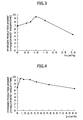
- Fig. 3 shows the hydrogen production rate for the Fe content of the Cu-Fe(30 wt%)/Al 2 O 3 catalyst prepared in Example 2.
- Fig. 4 shows the hydrogen production rate for the Zn content of the Cu-Zn(30 wt%)/Al 2 O 3 catalyst prepared in Example 3.
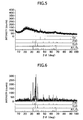
- X-ray diffraction measurement was conducted for the Cu-Zn(27-3 wt%)/Al 2 O 3 catalyst prepared by a sol-gel method in Example 3 and the Cu-Zn(25-25 wt%)/Al 2 O 3 catalyst prepared by an impregnation method in Comparative Example 1.
- Fig. 5 shows the results of Cu-Zn(27-3 wt%)/Al 2 O 3 (sol-gel)
- Fig. 6 shows the results of Cu-Zn(25-25 wt%)/Al 2 O 3 (impregnation).
- the catalyst prepared by a sol-gel method shows completely broader X-ray strength, teaching lower crystallinity, as compared with the catalyst prepared by an impregnation method.
- the catalyst prepared by a sol-gel method has an advantage in that a more uniform catalyst at a fine level can be obtained as compared with the catalyst prepared by an impregnation method.
- a CuO peak is observed in Fig. 6 (impregnation method), while only a Cu peak is observed in Fig. 5 (sol-gel method).
- the adsorption amount of a CO gas was measured at 0°C using each 0.1 g of the Cu-Mn(30 wt%)/Al 2 O 3 catalysts (6 kinds, depending on the Mn content) prepared in Example 1.
- the apparatus used in this experiment is connected also to a close circulation type apparatus made of Pyrex, therefore, the CO adsorption amount and the like under a reduced condition can be measured without exposing the catalyst in air before the reaction.
- a known amount of CO gas was introduced into a catalyst layer cooled to 0°C, and based on its pressure variation, the CO adsorption amount onto the catalyst was calculated. This operation was repeated several times at 100 mmHg to 250 mmHg, and the total amount was used as the CO adsorption amount onto this catalyst.
- Pore distribution (pore volume per unit weight for pore diameter) and specific surface area (surface area per unit weight) were measured by Autosorb-1 manufactured by Quantachrome using each 0.2 g of the Cu-Mn(30 wt%)/Al 2 O 3 catalysts (6 kinds, depending on the Mn content) prepared in Example 1.
- This apparatus conducts measurement by effecting de-gassing treatment at 150°C for 5 hours, then, performing adsorption of N 2 .
- the results of pore distribution are shown in Fig. 8, and the results of specific surface area are shown in Fig. 9.
- Fig. 8 the results of specific surface area
- the reason for this is hypothesized that in the case of catalysts obtained by an impregnation method and the like, the specific surface area decreases and simultaneously the pore diameter increases normally because of sintering (aggregation) and the like, while in the case of the catalysts according to the present invention, Mn contained caused a bond anomaly on bonding of Cu, Al, O and a lattice defect.
- the catalyst of the present invention is excellent in reforming ability and further excellent also in heat durability.
Landscapes
- Chemical & Material Sciences (AREA)
- Organic Chemistry (AREA)
- Engineering & Computer Science (AREA)
- Chemical Kinetics & Catalysis (AREA)
- Materials Engineering (AREA)
- Dispersion Chemistry (AREA)
- Health & Medical Sciences (AREA)
- General Health & Medical Sciences (AREA)
- Combustion & Propulsion (AREA)
- Inorganic Chemistry (AREA)
- Catalysts (AREA)
- Hydrogen, Water And Hydrids (AREA)
Applications Claiming Priority (2)
| Application Number | Priority Date | Filing Date | Title |
|---|---|---|---|
| JP2003054413A JP3951127B2 (ja) | 2003-02-28 | 2003-02-28 | ジメチルエーテル水蒸気改質触媒およびその製造方法 |
| JP2003054413 | 2003-02-28 |
Publications (2)
| Publication Number | Publication Date |
|---|---|
| EP1452230A1 true EP1452230A1 (de) | 2004-09-01 |
| EP1452230A8 EP1452230A8 (de) | 2004-11-17 |
Family
ID=32767864
Family Applications (1)
| Application Number | Title | Priority Date | Filing Date |
|---|---|---|---|
| EP03028792A Ceased EP1452230A1 (de) | 2003-02-28 | 2003-12-13 | Katalysator für die Dampfreformierung von Dimethylether und Verfahren für seine Herstellung |
Country Status (3)
| Country | Link |
|---|---|
| US (1) | US7241718B2 (de) |
| EP (1) | EP1452230A1 (de) |
| JP (1) | JP3951127B2 (de) |
Cited By (8)
| Publication number | Priority date | Publication date | Assignee | Title |
|---|---|---|---|---|
| WO2008145387A3 (de) * | 2007-05-31 | 2009-03-12 | Sued Chemie Ag | Katalysator zur selektiven hydrierung acetylenischer kohlenwasserstoffe und verfahren zu seiner herstellung |
| EP1901844A4 (de) * | 2005-06-15 | 2011-09-21 | Univ Ohio State | Katalysator zur herstellung von wasserstoff aus einer konvertierungsreaktion |
| US8466082B2 (en) | 2007-05-31 | 2013-06-18 | Sued-Chemie Ip Gmbh & Co. Kg | PD/AU shell catalyst containing HFO2, processes for the preparation and use thereof |
| US8586780B2 (en) | 2007-05-31 | 2013-11-19 | Sued-Chemie Ip Gmbh & Co. Kg | Doped Pd/Au shell catalyst, method for producing the same and use thereof |
| US8927452B2 (en) | 2007-05-31 | 2015-01-06 | Sud-Chemie Ag | Method for producing a shell catalyst and corresponding shell catalyst |
| WO2016130580A1 (en) * | 2015-02-10 | 2016-08-18 | The Regents Of The University Of California | Method of fabricating tungsten scandate nano-composite powder for cathodes |
| US9617187B2 (en) | 2008-11-30 | 2017-04-11 | Sud-Chemie Ag | Catalyst support, process for its preparation and use |
| US10150099B2 (en) | 2007-05-31 | 2018-12-11 | Alfred Hagemeyer | Zirconium oxide-doped catalyst support, method for producing the same and catalyst containing a zirconium oxide-doped catalyst support |
Families Citing this family (5)
| Publication number | Priority date | Publication date | Assignee | Title |
|---|---|---|---|---|
| JP2005095738A (ja) * | 2003-09-24 | 2005-04-14 | Mitsubishi Gas Chem Co Inc | 固体酸含有被覆層を有するジメチルエーテル水蒸気改質用触媒 |
| JP5633953B2 (ja) | 2006-01-31 | 2014-12-03 | コヴィディエン リミテッド パートナーシップ | 超柔軟発泡体 |
| JP2007246369A (ja) * | 2006-03-17 | 2007-09-27 | Toshiba Corp | 水素製造装置、水素製造システム及び水素製造方法 |
| KR100810739B1 (ko) | 2006-07-31 | 2008-03-06 | 한국화학연구원 | 합성가스로부터 메탄올 및 디메틸에테르 동시 제조용 촉매및 이의 제조방법 |
| JP2010069453A (ja) * | 2008-09-22 | 2010-04-02 | Sumitomo Chemical Co Ltd | ジメチルエーテル改質触媒 |
Citations (4)
| Publication number | Priority date | Publication date | Assignee | Title |
|---|---|---|---|---|
| US4375424A (en) * | 1981-10-21 | 1983-03-01 | Shell Oil Company | Catalyst for the preparation of dimethyl ether |
| EP0978314A1 (de) * | 1997-10-07 | 2000-02-09 | Nkk Corporation | Katalysator zur produktion von wasserstoff oder synthese gas und vrefahren zurproduktion von synthesegas |
| DE10048160A1 (de) * | 1999-09-29 | 2001-05-10 | Daihatsu Motor Co Ltd | Dimethylether-Reformierkatalysator und Brennstoffzellenvorrichtung |
| EP1174408A1 (de) * | 1996-05-13 | 2002-01-23 | Nkk Corporation | Katalysator für die Herstellung von Dimethylether, Verfahren zur Katalysatorherstellung und Verfahren zur Herstellung von Dimethylether |
Family Cites Families (26)
| Publication number | Priority date | Publication date | Assignee | Title |
|---|---|---|---|---|
| US3554930A (en) * | 1968-11-22 | 1971-01-12 | Sinclair Oil Corp | Supported bimetallic alloy catalysts having high surface areas |
| US3661806A (en) * | 1970-01-05 | 1972-05-09 | Grace W R & Co | Exhaust gas oxidation catalyst and process |
| US3701739A (en) * | 1970-12-14 | 1972-10-31 | Little Inc A | Method for forming mixed oxide heterogenous catalysts |
| GB1390182A (en) * | 1971-03-16 | 1975-04-09 | Johnson Matthey Co Ltd | Catalysis |
| US3988263A (en) * | 1974-10-02 | 1976-10-26 | Union Oil Company Of California | Thermally stable coprecipitated catalysts useful for methanation and other reactions |
| US4129523A (en) * | 1976-11-03 | 1978-12-12 | Imperial Chemical Industries Limited | Catalysts containing active metallic copper |
| AU535073B2 (en) * | 1979-12-17 | 1984-03-01 | Unisearch Limited | Methanol synthesis catalyst and use thereof |
| AU4695985A (en) * | 1984-09-04 | 1986-03-13 | Mitsubishi Jukogyo Kabushiki Kaisha | Process for reforming methanol |
| US5175064A (en) * | 1991-05-09 | 1992-12-29 | California Institute Of Technology | Fuel cells based on oxidation of organics over metal exchanged β-aluminas |
| US5990040A (en) * | 1995-01-11 | 1999-11-23 | United Catalysts Inc. | Promoted and stabilized copper oxide and zinc oxide catalyst and preparation |
| US5905180A (en) * | 1996-01-22 | 1999-05-18 | Regents Of The University Of Minnesota | Catalytic oxidative dehydrogenation process and catalyst |
| JPH10174870A (ja) | 1996-12-18 | 1998-06-30 | Nkk Corp | 水素製造触媒及び水素の製造方法 |
| US6479428B1 (en) * | 1998-07-27 | 2002-11-12 | Battelle Memorial Institute | Long life hydrocarbon conversion catalyst and method of making |
| JP2001046872A (ja) * | 1999-08-11 | 2001-02-20 | Mitsubishi Heavy Ind Ltd | メタノール改質触媒、メタノール改質触媒の製造方法及びメタノール改質方法 |
| US6451864B1 (en) * | 1999-08-17 | 2002-09-17 | Battelle Memorial Institute | Catalyst structure and method of Fischer-Tropsch synthesis |
| JP2001096159A (ja) | 1999-09-29 | 2001-04-10 | Daihatsu Motor Co Ltd | ジメチルエーテル改質触媒および燃料電池装置 |
| AU3968101A (en) * | 1999-11-03 | 2001-06-04 | Plug Power, L.L.C. | Thermal regulating catalyst composition |
| US6583084B2 (en) * | 2000-07-18 | 2003-06-24 | Mitsui Chemicals, Inc. | Catalyst for steam reforming of methanol and method for producing hydrogen therewith |
| JP2002233756A (ja) | 2001-02-07 | 2002-08-20 | Mitsubishi Heavy Ind Ltd | 燃料改質触媒の製造方法及びその製造方法による燃料改質触媒 |
| DE10111198A1 (de) * | 2001-03-08 | 2002-09-19 | Basf Ag | Methanolreformierungskatalysator mit verringertem Volumenschwund |
| DE10111197A1 (de) * | 2001-03-08 | 2002-09-19 | Basf Ag | Verfahren zur Herstellung von Katalysatoren mit geringem Volumenschwund |
| JP4106645B2 (ja) | 2001-03-14 | 2008-06-25 | スズキ株式会社 | ジメチルエーテル水蒸気改質触媒製造方法とそれによる触媒 |
| EP1487740A1 (de) * | 2002-03-13 | 2004-12-22 | Conocophillips Company | Katalysatorstrukturen mit kontrollierter porenstruktur und verfahren zur herstellung von synthesegas |
| US6627572B1 (en) * | 2002-03-22 | 2003-09-30 | Sud-Chemie Inc. | Water gas shift catalyst |
| US6693057B1 (en) * | 2002-03-22 | 2004-02-17 | Sud-Chemie Inc. | Water gas shift catalyst |
| US6903050B2 (en) * | 2002-10-28 | 2005-06-07 | Engelhard Corporation | Method of preparation of non-pyrophoric copper-alumina catalysts |
-
2003
- 2003-02-28 JP JP2003054413A patent/JP3951127B2/ja not_active Expired - Lifetime
- 2003-12-08 US US10/730,638 patent/US7241718B2/en not_active Expired - Fee Related
- 2003-12-13 EP EP03028792A patent/EP1452230A1/de not_active Ceased
Patent Citations (4)
| Publication number | Priority date | Publication date | Assignee | Title |
|---|---|---|---|---|
| US4375424A (en) * | 1981-10-21 | 1983-03-01 | Shell Oil Company | Catalyst for the preparation of dimethyl ether |
| EP1174408A1 (de) * | 1996-05-13 | 2002-01-23 | Nkk Corporation | Katalysator für die Herstellung von Dimethylether, Verfahren zur Katalysatorherstellung und Verfahren zur Herstellung von Dimethylether |
| EP0978314A1 (de) * | 1997-10-07 | 2000-02-09 | Nkk Corporation | Katalysator zur produktion von wasserstoff oder synthese gas und vrefahren zurproduktion von synthesegas |
| DE10048160A1 (de) * | 1999-09-29 | 2001-05-10 | Daihatsu Motor Co Ltd | Dimethylether-Reformierkatalysator und Brennstoffzellenvorrichtung |
Cited By (9)
| Publication number | Priority date | Publication date | Assignee | Title |
|---|---|---|---|---|
| EP1901844A4 (de) * | 2005-06-15 | 2011-09-21 | Univ Ohio State | Katalysator zur herstellung von wasserstoff aus einer konvertierungsreaktion |
| WO2008145387A3 (de) * | 2007-05-31 | 2009-03-12 | Sued Chemie Ag | Katalysator zur selektiven hydrierung acetylenischer kohlenwasserstoffe und verfahren zu seiner herstellung |
| US8466082B2 (en) | 2007-05-31 | 2013-06-18 | Sued-Chemie Ip Gmbh & Co. Kg | PD/AU shell catalyst containing HFO2, processes for the preparation and use thereof |
| US8586780B2 (en) | 2007-05-31 | 2013-11-19 | Sued-Chemie Ip Gmbh & Co. Kg | Doped Pd/Au shell catalyst, method for producing the same and use thereof |
| US8927452B2 (en) | 2007-05-31 | 2015-01-06 | Sud-Chemie Ag | Method for producing a shell catalyst and corresponding shell catalyst |
| US10150099B2 (en) | 2007-05-31 | 2018-12-11 | Alfred Hagemeyer | Zirconium oxide-doped catalyst support, method for producing the same and catalyst containing a zirconium oxide-doped catalyst support |
| US9617187B2 (en) | 2008-11-30 | 2017-04-11 | Sud-Chemie Ag | Catalyst support, process for its preparation and use |
| WO2016130580A1 (en) * | 2015-02-10 | 2016-08-18 | The Regents Of The University Of California | Method of fabricating tungsten scandate nano-composite powder for cathodes |
| US10714292B2 (en) | 2015-02-10 | 2020-07-14 | The Regents Of The University Of California | Method of fabricating tungsten scandate nano-composite powder for cathodes |
Also Published As
| Publication number | Publication date |
|---|---|
| US7241718B2 (en) | 2007-07-10 |
| EP1452230A8 (de) | 2004-11-17 |
| JP2004261709A (ja) | 2004-09-24 |
| US20040192547A1 (en) | 2004-09-30 |
| JP3951127B2 (ja) | 2007-08-01 |
Similar Documents
| Publication | Publication Date | Title |
|---|---|---|
| CN110327933B (zh) | 二氧化碳加氢制备甲醇的催化剂及其制备方法和应用 | |
| JP4351913B2 (ja) | セリア基の混合金属酸化物構造、その作成方法および使用 | |
| US7871957B2 (en) | Catalyst support of mixed cerium zirconium titanium oxide, including use and method of making | |
| US7642210B2 (en) | Zirconia porous body and manufacturing method thereof | |
| US7241718B2 (en) | Dimethyl ether steam reforming catalyst and method for producing the same | |
| EP1161992B1 (de) | Verfahren zur Herstellung neuer Katalysatoren für oxydative Dampfreformierung von Methanol | |
| Jokar et al. | Catalytic performance of copper oxide supported α-MnO2 nanowires for the CO preferential oxidation in H2-rich stream | |
| Zhu et al. | Catalytic oxidation of CO on mesoporous codoped ceria catalysts: Insights into correlation of physicochemical property and catalytic activity | |
| CN108043406B (zh) | 一种乙酸自热重整制氢的助剂促进水滑石衍生钴基催化剂 | |
| CN117483008A (zh) | 一种双金属Ce-Cu-MOFs衍生催化剂的制备方法及应用 | |
| Gabelica et al. | Thermal degradation of iron chelate complexes adsorbed on mesoporous silica and alumina | |
| CN117380208B (zh) | 一种脱除富氢气体中CO的CuO负载型LaCeOx催化剂及其制备方法和应用 | |
| JP3896796B2 (ja) | メタノール改質触媒とその製造方法 | |
| Issa et al. | Mixed oxides of cerium and manganese as catalysts for total oxidation of ethyl acetate: effect of preparation procedure | |
| Derekaya et al. | Total Oxidation of Methane over the LaNi1− x M x O3 (M: Mn, Ag, Cu, Co) Perovskites | |
| KR102255059B1 (ko) | 수열합성법을 이용한 대기오염 정화용 고효율 세리아 촉매의 제조방법 | |
| Derekaya et al. | Effects of preparation method on the characterization and CO oxidation activities of the carbon-supported CuO–CeO2 catalysts | |
| Yang et al. | Preparation of ordered mesoporous nanocrystalline ceria and ceria-zirconia for soot oxidation | |
| KR102905105B1 (ko) | 백금이 도핑된 CaTiO3 페로브스카이트 촉매의 제조방법 및 그 방법에 의하여 제조된 촉매 | |
| CN120861075B (zh) | 一种金属掺杂ZIFs衍生Co基催化剂的制备方法、产品及应用 | |
| CN120961192A (zh) | 一种用于合成bdo的催化剂及其制备方法 | |
| CN120754857A (zh) | 一种负载型甲醇水蒸气重整制氢复合催化剂及其制备方法 | |
| CN121945083A (zh) | 基于溶胶-凝胶法制备的Sr掺杂Co/CeO2催化剂及其制备方法 | |
| CN119186571A (zh) | 一种铜锌镍催化剂及其制备方法和应用 | |
| CN120473513A (zh) | 三元混合金属氧化物催化剂及其制备方法、应用 |
Legal Events
| Date | Code | Title | Description |
|---|---|---|---|
| PUAI | Public reference made under article 153(3) epc to a published international application that has entered the european phase |
Free format text: ORIGINAL CODE: 0009012 |
|
| 17P | Request for examination filed |
Effective date: 20040107 |
|
| AK | Designated contracting states |
Kind code of ref document: A1 Designated state(s): AT BE BG CH CY CZ DE DK EE ES FI FR GB GR HU IE IT LI LU MC NL PT RO SE SI SK TR |
|
| AX | Request for extension of the european patent |
Extension state: AL LT LV MK |
|
| RAP1 | Party data changed (applicant data changed or rights of an application transferred) |
Owner name: SUZUKI MOTOR CORPORATION Owner name: PRESIDENT OF SHIZUOKA UNIVERSITY |
|
| RAP1 | Party data changed (applicant data changed or rights of an application transferred) |
Owner name: SUZUKI MOTOR CORPORATION Owner name: PRESIDENT OF SHIZUOKA UNIVERSITY |
|
| AKX | Designation fees paid |
Designated state(s): DE |
|
| RBV | Designated contracting states (corrected) |
Designated state(s): DE |
|
| 17Q | First examination report despatched |
Effective date: 20071018 |
|
| RAP1 | Party data changed (applicant data changed or rights of an application transferred) |
Owner name: SUZUKI MOTOR CORPORATION |
|
| STAA | Information on the status of an ep patent application or granted ep patent |
Free format text: STATUS: THE APPLICATION HAS BEEN REFUSED |
|
| 18R | Application refused |
Effective date: 20120209 |