EP1452510A1 - Aluminiumnitridwerkstoffe und Teile für die Halbleiterherstellung - Google Patents
Aluminiumnitridwerkstoffe und Teile für die Halbleiterherstellung Download PDFInfo
- Publication number
- EP1452510A1 EP1452510A1 EP04251025A EP04251025A EP1452510A1 EP 1452510 A1 EP1452510 A1 EP 1452510A1 EP 04251025 A EP04251025 A EP 04251025A EP 04251025 A EP04251025 A EP 04251025A EP 1452510 A1 EP1452510 A1 EP 1452510A1
- Authority
- EP
- European Patent Office
- Prior art keywords
- aluminum
- europium
- phase
- aluminum nitride
- composite oxide
- Prior art date
- Legal status (The legal status is an assumption and is not a legal conclusion. Google has not performed a legal analysis and makes no representation as to the accuracy of the status listed.)
- Granted
Links
Images




Classifications
-
- C—CHEMISTRY; METALLURGY
- C04—CEMENTS; CONCRETE; ARTIFICIAL STONE; CERAMICS; REFRACTORIES
- C04B—LIME, MAGNESIA; SLAG; CEMENTS; COMPOSITIONS THEREOF, e.g. MORTARS, CONCRETE OR LIKE BUILDING MATERIALS; ARTIFICIAL STONE; CERAMICS; REFRACTORIES; TREATMENT OF NATURAL STONE
- C04B35/00—Shaped ceramic products characterised by their composition; Ceramics compositions; Processing powders of inorganic compounds preparatory to the manufacturing of ceramic products
- C04B35/622—Forming processes; Processing powders of inorganic compounds preparatory to the manufacturing of ceramic products
- C04B35/64—Burning or sintering processes
- C04B35/645—Pressure sintering
-
- H—ELECTRICITY
- H02—GENERATION; CONVERSION OR DISTRIBUTION OF ELECTRIC POWER
- H02K—DYNAMO-ELECTRIC MACHINES
- H02K1/00—Details of the magnetic circuit
- H02K1/06—Details of the magnetic circuit characterised by the shape, form or construction
- H02K1/12—Stationary parts of the magnetic circuit
-
- C—CHEMISTRY; METALLURGY
- C04—CEMENTS; CONCRETE; ARTIFICIAL STONE; CERAMICS; REFRACTORIES
- C04B—LIME, MAGNESIA; SLAG; CEMENTS; COMPOSITIONS THEREOF, e.g. MORTARS, CONCRETE OR LIKE BUILDING MATERIALS; ARTIFICIAL STONE; CERAMICS; REFRACTORIES; TREATMENT OF NATURAL STONE
- C04B35/00—Shaped ceramic products characterised by their composition; Ceramics compositions; Processing powders of inorganic compounds preparatory to the manufacturing of ceramic products
- C04B35/515—Shaped ceramic products characterised by their composition; Ceramics compositions; Processing powders of inorganic compounds preparatory to the manufacturing of ceramic products based on non-oxide ceramics
- C04B35/58—Shaped ceramic products characterised by their composition; Ceramics compositions; Processing powders of inorganic compounds preparatory to the manufacturing of ceramic products based on non-oxide ceramics based on borides, nitrides, i.e. nitrides, oxynitrides, carbonitrides or oxycarbonitrides or silicides
- C04B35/581—Shaped ceramic products characterised by their composition; Ceramics compositions; Processing powders of inorganic compounds preparatory to the manufacturing of ceramic products based on non-oxide ceramics based on borides, nitrides, i.e. nitrides, oxynitrides, carbonitrides or oxycarbonitrides or silicides based on aluminium nitride
-
- C—CHEMISTRY; METALLURGY
- C04—CEMENTS; CONCRETE; ARTIFICIAL STONE; CERAMICS; REFRACTORIES
- C04B—LIME, MAGNESIA; SLAG; CEMENTS; COMPOSITIONS THEREOF, e.g. MORTARS, CONCRETE OR LIKE BUILDING MATERIALS; ARTIFICIAL STONE; CERAMICS; REFRACTORIES; TREATMENT OF NATURAL STONE
- C04B35/00—Shaped ceramic products characterised by their composition; Ceramics compositions; Processing powders of inorganic compounds preparatory to the manufacturing of ceramic products
- C04B35/622—Forming processes; Processing powders of inorganic compounds preparatory to the manufacturing of ceramic products
- C04B35/626—Preparing or treating the powders individually or as batches ; preparing or treating macroscopic reinforcing agents for ceramic products, e.g. fibres; mechanical aspects section B
- C04B35/62605—Treating the starting powders individually or as mixtures
- C04B35/6261—Milling
-
- C—CHEMISTRY; METALLURGY
- C04—CEMENTS; CONCRETE; ARTIFICIAL STONE; CERAMICS; REFRACTORIES
- C04B—LIME, MAGNESIA; SLAG; CEMENTS; COMPOSITIONS THEREOF, e.g. MORTARS, CONCRETE OR LIKE BUILDING MATERIALS; ARTIFICIAL STONE; CERAMICS; REFRACTORIES; TREATMENT OF NATURAL STONE
- C04B35/00—Shaped ceramic products characterised by their composition; Ceramics compositions; Processing powders of inorganic compounds preparatory to the manufacturing of ceramic products
- C04B35/622—Forming processes; Processing powders of inorganic compounds preparatory to the manufacturing of ceramic products
- C04B35/626—Preparing or treating the powders individually or as batches ; preparing or treating macroscopic reinforcing agents for ceramic products, e.g. fibres; mechanical aspects section B
- C04B35/62605—Treating the starting powders individually or as mixtures
- C04B35/62625—Wet mixtures
-
- C—CHEMISTRY; METALLURGY
- C04—CEMENTS; CONCRETE; ARTIFICIAL STONE; CERAMICS; REFRACTORIES
- C04B—LIME, MAGNESIA; SLAG; CEMENTS; COMPOSITIONS THEREOF, e.g. MORTARS, CONCRETE OR LIKE BUILDING MATERIALS; ARTIFICIAL STONE; CERAMICS; REFRACTORIES; TREATMENT OF NATURAL STONE
- C04B2235/00—Aspects relating to ceramic starting mixtures or sintered ceramic products
- C04B2235/02—Composition of constituents of the starting material or of secondary phases of the final product
- C04B2235/30—Constituents and secondary phases not being of a fibrous nature
- C04B2235/32—Metal oxides, mixed metal oxides, or oxide-forming salts thereof, e.g. carbonates, nitrates, (oxy)hydroxides, chlorides
- C04B2235/3205—Alkaline earth oxides or oxide forming salts thereof, e.g. beryllium oxide
- C04B2235/3206—Magnesium oxides or oxide-forming salts thereof
-
- C—CHEMISTRY; METALLURGY
- C04—CEMENTS; CONCRETE; ARTIFICIAL STONE; CERAMICS; REFRACTORIES
- C04B—LIME, MAGNESIA; SLAG; CEMENTS; COMPOSITIONS THEREOF, e.g. MORTARS, CONCRETE OR LIKE BUILDING MATERIALS; ARTIFICIAL STONE; CERAMICS; REFRACTORIES; TREATMENT OF NATURAL STONE
- C04B2235/00—Aspects relating to ceramic starting mixtures or sintered ceramic products
- C04B2235/02—Composition of constituents of the starting material or of secondary phases of the final product
- C04B2235/30—Constituents and secondary phases not being of a fibrous nature
- C04B2235/32—Metal oxides, mixed metal oxides, or oxide-forming salts thereof, e.g. carbonates, nitrates, (oxy)hydroxides, chlorides
- C04B2235/3205—Alkaline earth oxides or oxide forming salts thereof, e.g. beryllium oxide
- C04B2235/3208—Calcium oxide or oxide-forming salts thereof, e.g. lime
-
- C—CHEMISTRY; METALLURGY
- C04—CEMENTS; CONCRETE; ARTIFICIAL STONE; CERAMICS; REFRACTORIES
- C04B—LIME, MAGNESIA; SLAG; CEMENTS; COMPOSITIONS THEREOF, e.g. MORTARS, CONCRETE OR LIKE BUILDING MATERIALS; ARTIFICIAL STONE; CERAMICS; REFRACTORIES; TREATMENT OF NATURAL STONE
- C04B2235/00—Aspects relating to ceramic starting mixtures or sintered ceramic products
- C04B2235/02—Composition of constituents of the starting material or of secondary phases of the final product
- C04B2235/30—Constituents and secondary phases not being of a fibrous nature
- C04B2235/32—Metal oxides, mixed metal oxides, or oxide-forming salts thereof, e.g. carbonates, nitrates, (oxy)hydroxides, chlorides
- C04B2235/3217—Aluminum oxide or oxide forming salts thereof, e.g. bauxite, alpha-alumina
-
- C—CHEMISTRY; METALLURGY
- C04—CEMENTS; CONCRETE; ARTIFICIAL STONE; CERAMICS; REFRACTORIES
- C04B—LIME, MAGNESIA; SLAG; CEMENTS; COMPOSITIONS THEREOF, e.g. MORTARS, CONCRETE OR LIKE BUILDING MATERIALS; ARTIFICIAL STONE; CERAMICS; REFRACTORIES; TREATMENT OF NATURAL STONE
- C04B2235/00—Aspects relating to ceramic starting mixtures or sintered ceramic products
- C04B2235/02—Composition of constituents of the starting material or of secondary phases of the final product
- C04B2235/30—Constituents and secondary phases not being of a fibrous nature
- C04B2235/32—Metal oxides, mixed metal oxides, or oxide-forming salts thereof, e.g. carbonates, nitrates, (oxy)hydroxides, chlorides
- C04B2235/3217—Aluminum oxide or oxide forming salts thereof, e.g. bauxite, alpha-alumina
- C04B2235/3222—Aluminates other than alumino-silicates, e.g. spinel (MgAl2O4)
-
- C—CHEMISTRY; METALLURGY
- C04—CEMENTS; CONCRETE; ARTIFICIAL STONE; CERAMICS; REFRACTORIES
- C04B—LIME, MAGNESIA; SLAG; CEMENTS; COMPOSITIONS THEREOF, e.g. MORTARS, CONCRETE OR LIKE BUILDING MATERIALS; ARTIFICIAL STONE; CERAMICS; REFRACTORIES; TREATMENT OF NATURAL STONE
- C04B2235/00—Aspects relating to ceramic starting mixtures or sintered ceramic products
- C04B2235/02—Composition of constituents of the starting material or of secondary phases of the final product
- C04B2235/30—Constituents and secondary phases not being of a fibrous nature
- C04B2235/32—Metal oxides, mixed metal oxides, or oxide-forming salts thereof, e.g. carbonates, nitrates, (oxy)hydroxides, chlorides
- C04B2235/3224—Rare earth oxide or oxide forming salts thereof, e.g. scandium oxide
-
- C—CHEMISTRY; METALLURGY
- C04—CEMENTS; CONCRETE; ARTIFICIAL STONE; CERAMICS; REFRACTORIES
- C04B—LIME, MAGNESIA; SLAG; CEMENTS; COMPOSITIONS THEREOF, e.g. MORTARS, CONCRETE OR LIKE BUILDING MATERIALS; ARTIFICIAL STONE; CERAMICS; REFRACTORIES; TREATMENT OF NATURAL STONE
- C04B2235/00—Aspects relating to ceramic starting mixtures or sintered ceramic products
- C04B2235/02—Composition of constituents of the starting material or of secondary phases of the final product
- C04B2235/30—Constituents and secondary phases not being of a fibrous nature
- C04B2235/38—Non-oxide ceramic constituents or additives
- C04B2235/3852—Nitrides, e.g. oxynitrides, carbonitrides, oxycarbonitrides, lithium nitride, magnesium nitride
-
- C—CHEMISTRY; METALLURGY
- C04—CEMENTS; CONCRETE; ARTIFICIAL STONE; CERAMICS; REFRACTORIES
- C04B—LIME, MAGNESIA; SLAG; CEMENTS; COMPOSITIONS THEREOF, e.g. MORTARS, CONCRETE OR LIKE BUILDING MATERIALS; ARTIFICIAL STONE; CERAMICS; REFRACTORIES; TREATMENT OF NATURAL STONE
- C04B2235/00—Aspects relating to ceramic starting mixtures or sintered ceramic products
- C04B2235/02—Composition of constituents of the starting material or of secondary phases of the final product
- C04B2235/30—Constituents and secondary phases not being of a fibrous nature
- C04B2235/38—Non-oxide ceramic constituents or additives
- C04B2235/3852—Nitrides, e.g. oxynitrides, carbonitrides, oxycarbonitrides, lithium nitride, magnesium nitride
- C04B2235/3865—Aluminium nitrides
-
- C—CHEMISTRY; METALLURGY
- C04—CEMENTS; CONCRETE; ARTIFICIAL STONE; CERAMICS; REFRACTORIES
- C04B—LIME, MAGNESIA; SLAG; CEMENTS; COMPOSITIONS THEREOF, e.g. MORTARS, CONCRETE OR LIKE BUILDING MATERIALS; ARTIFICIAL STONE; CERAMICS; REFRACTORIES; TREATMENT OF NATURAL STONE
- C04B2235/00—Aspects relating to ceramic starting mixtures or sintered ceramic products
- C04B2235/02—Composition of constituents of the starting material or of secondary phases of the final product
- C04B2235/30—Constituents and secondary phases not being of a fibrous nature
- C04B2235/38—Non-oxide ceramic constituents or additives
- C04B2235/3852—Nitrides, e.g. oxynitrides, carbonitrides, oxycarbonitrides, lithium nitride, magnesium nitride
- C04B2235/3865—Aluminium nitrides
- C04B2235/3869—Aluminium oxynitrides, e.g. AlON, sialon
-
- C—CHEMISTRY; METALLURGY
- C04—CEMENTS; CONCRETE; ARTIFICIAL STONE; CERAMICS; REFRACTORIES
- C04B—LIME, MAGNESIA; SLAG; CEMENTS; COMPOSITIONS THEREOF, e.g. MORTARS, CONCRETE OR LIKE BUILDING MATERIALS; ARTIFICIAL STONE; CERAMICS; REFRACTORIES; TREATMENT OF NATURAL STONE
- C04B2235/00—Aspects relating to ceramic starting mixtures or sintered ceramic products
- C04B2235/02—Composition of constituents of the starting material or of secondary phases of the final product
- C04B2235/30—Constituents and secondary phases not being of a fibrous nature
- C04B2235/38—Non-oxide ceramic constituents or additives
- C04B2235/3852—Nitrides, e.g. oxynitrides, carbonitrides, oxycarbonitrides, lithium nitride, magnesium nitride
- C04B2235/3886—Refractory metal nitrides, e.g. vanadium nitride, tungsten nitride
-
- C—CHEMISTRY; METALLURGY
- C04—CEMENTS; CONCRETE; ARTIFICIAL STONE; CERAMICS; REFRACTORIES
- C04B—LIME, MAGNESIA; SLAG; CEMENTS; COMPOSITIONS THEREOF, e.g. MORTARS, CONCRETE OR LIKE BUILDING MATERIALS; ARTIFICIAL STONE; CERAMICS; REFRACTORIES; TREATMENT OF NATURAL STONE
- C04B2235/00—Aspects relating to ceramic starting mixtures or sintered ceramic products
- C04B2235/02—Composition of constituents of the starting material or of secondary phases of the final product
- C04B2235/30—Constituents and secondary phases not being of a fibrous nature
- C04B2235/38—Non-oxide ceramic constituents or additives
- C04B2235/3895—Non-oxides with a defined oxygen content, e.g. SiOC, TiON
-
- C—CHEMISTRY; METALLURGY
- C04—CEMENTS; CONCRETE; ARTIFICIAL STONE; CERAMICS; REFRACTORIES
- C04B—LIME, MAGNESIA; SLAG; CEMENTS; COMPOSITIONS THEREOF, e.g. MORTARS, CONCRETE OR LIKE BUILDING MATERIALS; ARTIFICIAL STONE; CERAMICS; REFRACTORIES; TREATMENT OF NATURAL STONE
- C04B2235/00—Aspects relating to ceramic starting mixtures or sintered ceramic products
- C04B2235/02—Composition of constituents of the starting material or of secondary phases of the final product
- C04B2235/50—Constituents or additives of the starting mixture chosen for their shape or used because of their shape or their physical appearance
- C04B2235/54—Particle size related information
- C04B2235/5418—Particle size related information expressed by the size of the particles or aggregates thereof
- C04B2235/5445—Particle size related information expressed by the size of the particles or aggregates thereof submicron sized, i.e. from 0,1 to 1 micron
-
- C—CHEMISTRY; METALLURGY
- C04—CEMENTS; CONCRETE; ARTIFICIAL STONE; CERAMICS; REFRACTORIES
- C04B—LIME, MAGNESIA; SLAG; CEMENTS; COMPOSITIONS THEREOF, e.g. MORTARS, CONCRETE OR LIKE BUILDING MATERIALS; ARTIFICIAL STONE; CERAMICS; REFRACTORIES; TREATMENT OF NATURAL STONE
- C04B2235/00—Aspects relating to ceramic starting mixtures or sintered ceramic products
- C04B2235/70—Aspects relating to sintered or melt-casted ceramic products
- C04B2235/72—Products characterised by the absence or the low content of specific components, e.g. alkali metal free alumina ceramics
- C04B2235/721—Carbon content
-
- C—CHEMISTRY; METALLURGY
- C04—CEMENTS; CONCRETE; ARTIFICIAL STONE; CERAMICS; REFRACTORIES
- C04B—LIME, MAGNESIA; SLAG; CEMENTS; COMPOSITIONS THEREOF, e.g. MORTARS, CONCRETE OR LIKE BUILDING MATERIALS; ARTIFICIAL STONE; CERAMICS; REFRACTORIES; TREATMENT OF NATURAL STONE
- C04B2235/00—Aspects relating to ceramic starting mixtures or sintered ceramic products
- C04B2235/70—Aspects relating to sintered or melt-casted ceramic products
- C04B2235/74—Physical characteristics
- C04B2235/77—Density
-
- C—CHEMISTRY; METALLURGY
- C04—CEMENTS; CONCRETE; ARTIFICIAL STONE; CERAMICS; REFRACTORIES
- C04B—LIME, MAGNESIA; SLAG; CEMENTS; COMPOSITIONS THEREOF, e.g. MORTARS, CONCRETE OR LIKE BUILDING MATERIALS; ARTIFICIAL STONE; CERAMICS; REFRACTORIES; TREATMENT OF NATURAL STONE
- C04B2235/00—Aspects relating to ceramic starting mixtures or sintered ceramic products
- C04B2235/70—Aspects relating to sintered or melt-casted ceramic products
- C04B2235/74—Physical characteristics
- C04B2235/78—Grain sizes and shapes, product microstructures, e.g. acicular grains, equiaxed grains, platelet-structures
-
- C—CHEMISTRY; METALLURGY
- C04—CEMENTS; CONCRETE; ARTIFICIAL STONE; CERAMICS; REFRACTORIES
- C04B—LIME, MAGNESIA; SLAG; CEMENTS; COMPOSITIONS THEREOF, e.g. MORTARS, CONCRETE OR LIKE BUILDING MATERIALS; ARTIFICIAL STONE; CERAMICS; REFRACTORIES; TREATMENT OF NATURAL STONE
- C04B2235/00—Aspects relating to ceramic starting mixtures or sintered ceramic products
- C04B2235/70—Aspects relating to sintered or melt-casted ceramic products
- C04B2235/74—Physical characteristics
- C04B2235/78—Grain sizes and shapes, product microstructures, e.g. acicular grains, equiaxed grains, platelet-structures
- C04B2235/786—Micrometer sized grains, i.e. from 1 to 100 micron
-
- C—CHEMISTRY; METALLURGY
- C04—CEMENTS; CONCRETE; ARTIFICIAL STONE; CERAMICS; REFRACTORIES
- C04B—LIME, MAGNESIA; SLAG; CEMENTS; COMPOSITIONS THEREOF, e.g. MORTARS, CONCRETE OR LIKE BUILDING MATERIALS; ARTIFICIAL STONE; CERAMICS; REFRACTORIES; TREATMENT OF NATURAL STONE
- C04B2235/00—Aspects relating to ceramic starting mixtures or sintered ceramic products
- C04B2235/70—Aspects relating to sintered or melt-casted ceramic products
- C04B2235/80—Phases present in the sintered or melt-cast ceramic products other than the main phase
-
- C—CHEMISTRY; METALLURGY
- C04—CEMENTS; CONCRETE; ARTIFICIAL STONE; CERAMICS; REFRACTORIES
- C04B—LIME, MAGNESIA; SLAG; CEMENTS; COMPOSITIONS THEREOF, e.g. MORTARS, CONCRETE OR LIKE BUILDING MATERIALS; ARTIFICIAL STONE; CERAMICS; REFRACTORIES; TREATMENT OF NATURAL STONE
- C04B2235/00—Aspects relating to ceramic starting mixtures or sintered ceramic products
- C04B2235/70—Aspects relating to sintered or melt-casted ceramic products
- C04B2235/96—Properties of ceramic products, e.g. mechanical properties such as strength, toughness, wear resistance
-
- C—CHEMISTRY; METALLURGY
- C04—CEMENTS; CONCRETE; ARTIFICIAL STONE; CERAMICS; REFRACTORIES
- C04B—LIME, MAGNESIA; SLAG; CEMENTS; COMPOSITIONS THEREOF, e.g. MORTARS, CONCRETE OR LIKE BUILDING MATERIALS; ARTIFICIAL STONE; CERAMICS; REFRACTORIES; TREATMENT OF NATURAL STONE
- C04B2235/00—Aspects relating to ceramic starting mixtures or sintered ceramic products
- C04B2235/70—Aspects relating to sintered or melt-casted ceramic products
- C04B2235/96—Properties of ceramic products, e.g. mechanical properties such as strength, toughness, wear resistance
- C04B2235/9607—Thermal properties, e.g. thermal expansion coefficient
Definitions
- the invention relates to an aluminum nitride material and a member for use in the production of semiconductors.
- the volume resistivity of the substrate of the chuck may preferably be 10 8 to 10 13 ⁇ ⁇ c m for improving adsorption force and speed of response. It is therefore desirable to control the volume resistivity of the substrate within 10 8 to 10 13 ⁇ ⁇ c m in a temperature range intended for use, in the development of an electrostatic chuck.
- the assignee filed Japanese patent publication 9-315, 867A and disclosed a method of adding a trace amount of yttrium oxide into aluminum nitride having a high purity to control the volume resistivity at room temperature at a value between 10 8 to 10 13 ⁇ ⁇ c m.
- An object of the present invention is to provide a novel aluminum nitride based material having a low volume resistivity at room temperature.
- a first aspect of the present invention provides an aluminum nitride material comprising aluminum nitride as a main component and europium in a content of 0.03 mole percent or more calculated as the oxide (Eu 2 O 3 ).
- the material has aluminum nitride and europium-aluminum composite oxide phases.
- a second aspect of the present invention provides an aluminum nitride material comprising aluminum nitride as a main component and europium and samarium in a total content of 0.09 mole percent or more calculated as the oxides.
- the material has aluminum nitride phase and a composite oxide phase containing at least europium and aluminum.
- the inventors have found that the volume resistivity of an aluminum nitride material can be reduced by adding a predetermined amount of europium in the material to generate a composite oxide phase containing europium and aluminum.
- the inventors have further found that the volume resistivity of an aluminum nitride material can be reduced by adding predetermined amounts of europium and samarium in the material to generate a composite oxide phase containing at lease europium and aluminum. It is further proved that the dependency of the volume resistivity of the material on an applied voltage can be reduced.
- the aluminum nitride material may preferably be an aluminum nitride sintered body.
- the content of aluminum in the aluminum nitride material should be enough for forming aluminum nitride grains as the main phase.
- the content may preferably be not lower than 35 weight percent, and more preferably be not lower than 50 weight percent, of the material.
- the content of europium calculated as the oxide is 0.03 mole percent or higher.
- the content may preferably be 0.05 mole percent or higher, and more preferably be 0.1 mole percent or higher, for reducing the volume resistivity.
- the content of europium calculated as the oxide may preferably be 10 mole percent or lower, and more preferably be 5 mole percent or lower, for improving the thermal conductivity of the aluminum nitride material.
- the molar ratio of the content of europium calculated as the oxide to that of alumina may preferably be 0.2 or lower.
- V represents a voltage applied on the material
- I represents a leakage current when a voltage of "V” is applied on the material
- k represents a constant
- ⁇ represents a non linear index. From the viewpoint of reducing ⁇ value, (Eu 2 O 3 /Al 2 O 3 ) may more preferably be 0.075 or lower.
- (Eu 2 O 3 /Al 2 O 3 ) is not particularly defined, and may normally be 0.03 or higher.
- (Eu 2 O 3 /Al 2 O 3 ) is lower than 0.03, the volume resistivity tends to be increased.
- a total of the contents of europium and samarium is 0.09 mole percent or higher.
- the total of the contents calculated as the oxides may preferably be 0.15 mole percent or higher and more preferably be 0.2 mole percent or higher, for reducing the volume resistivity.
- a total of the contents of europium and samarium calculated as the oxides may preferably be 10 mole percent or lower, and more preferably be 5 mole percent or lower.
- the molar ratio of the contents of europium to samarium calculated as the oxides in raw material may preferably be 0.2 or higher. It is thus possible to reduce ⁇ value at 1.4 or lower.
- (Eu 2 O 3 /Sm 2 O 3 ) may preferably be 0.6 or higher, more preferably 1.0 or higher, and most preferably 1.5 or higher.
- the contents of europium and samarium calculated as the oxides are calculated based on the chemical analysis values of europium and samarium contained in an aluminum nitride material.
- the total oxygen content in the material is determined by infrared absorptiometry.
- the oxygen contents in Eu 2 O 3 , Sm 2 O 3 and MgO are subtracted from the measured total oxygen content to calculate the remaining oxygen.
- the content of Al 2 O 3 is calculated under the provision that all the remaining oxygen atoms constitute Al 2 O 3 .
- Such non-ohmic voltage-current behavior is not desirable for a member for use in a system for producing semiconductors, such as a semiconductor susceptor embedding an electrostatic chuck electrode.
- a dielectric layer is provided between the electrostatic chuck electrode and the surface.
- the thickness of the dielectric layer is not constant and has some degree of deviation or change.
- the voltage applied between the electrode and surface is constant at the same time.
- the applied electric field (V/mm) is smaller in a region where the dielectric layer is thicker, and the field (V/mm) is larger in a region where the dielectric layer is thinner.
- the aluminum nitride material of the present invention may exhibit an extremely low ⁇ and ohmic resistance property depending on the conditions.
- the aluminum nitride material has a volume resistivity at room temperature of 10 13 ⁇ ⁇ c m or lower, and possibly 10 12 ⁇ ⁇ c m or lower, at an applied voltage of 500 V/mm.
- the europium-aluminum composite oxide phase has network-like microstructure. That is, the europium-aluminum composite oxide phase is formed along the interfaces (intergranular phase) between aluminum nitride grains so that the phase surrounds the grains to form fine network like structure.
- the mean grain diameter of aluminum nitride grains in the material may preferably be 3 ⁇ m or larger, and more preferably be 5 ⁇ m or larger.
- the mean grain diameter may preferably be 20 ⁇ m or smaller.
- the aluminum nitride material according to the first aspect of the present invention contains an europium-aluminum composite oxide phase.
- the phase may preferably include each or both of EuAl 11 O 18 and EuAl 12 O 19 phases. These crystalline phases have peak tops in a range of 18.5 to 19.0 ° in an X-ray diffraction chart.
- the material may contain the other crystalline phases such as EuAl 2 O 4 and Al 5 O 6 N phases.
- the aluminum nitride material according to the second aspect of the present invention contains a composite oxide phase containing at least europium and aluminum.
- the composite oxide phase may be an europium-aluminum composite oxide phase or an europium-samarium-aluminum composite oxide phase.
- the specific composition of the europium-aluminum composite oxide phase is not limited, the phase may be EuAl 11 O 18 or EuAl 12 O 19 phase.
- the specific composition of the europium-samarium-aluminum composite oxide phase is not limited, the phase may be (Re)Al 11 O 18 , (Re)Al 12 O 19 , or Mg(Re)Al 12 O 19 phase (Re represents Eu and Sm).
- the material may further includes a samarium-aluminum composite oxide phase in addition to the europium-aluminum composite oxide and europium-samarium-aluminum composite oxide phases. These crystalline phases have peak tops in a range of 18.5 to 19.0 ° in an X-ray diffraction chart.
- the aluminum nitride material may further includes the other crystalline phases such as EuAl 2 O 4 , SmAlO 3 , Al 5 O 6 N, and MgAl 2 O, phases.
- the relative density of the aluminum nitride material may preferably be 95 % or higher.
- the aluminum nitride material may contain a rare earth element other than samarium and europium.
- additional elements include scandium, yttrium, lanthanum, cerium, praseodymium, neodymium, promethium, gadolinium, terbium, dysprosium, holmium, erbium, thulium, ytterbium and lutetium.
- the raw material of aluminum nitride may be produced by various processes, including direct nitriding, reduction nitriding and gaseous phase synthesis from an alkyl aluminum.
- Materials of europium and samarium are added to aluminum nitride raw material. Such materials include europium oxide and samarium oxide.
- a compound which forms samarium oxide or europium oxide upon heating may be added to the raw material of aluminum nitride.
- the precursor includes europium nitrate, samarium nitrate, europium sulfate, samarium sulfate, europium oxalate and samarium oxalate.
- the precursors may be added as powder. Alternatively, each precursor may be dissolved into a solvent to obtain solution, which is then added to the raw material. It is possible to uniformly disperse europium or samarium in the intergranular phase between aluminum nitride grains by dissolving the precursors in a solvent.
- the raw material may be shaped by any known methods including dry press, doctor blade, extrusion, casting and tape forming methods.
- powder of aluminum nitride raw material may be dispersed into a solvent and the compound of a rare earth element described above may be added in a form of oxide powder or solution.
- a mixing step it is possible to simply agitate the formulation.
- the raw powder contains aggregates, it is possible to use a mixing and grinding machine, such as a pot mill, trommel and attrition mill, for grinding the aggregates.
- a mixing and grinding machine such as a pot mill, trommel and attrition mill, it is enough to carry out the mixing and grinding step for a short (minimum) time required for the grinding the grains.
- a binder component such as polyvinyl alcohol, may be added.
- the solvent used for the mixing step may be volatilized, preferably by spray dry method.
- the grain distribution of the dried grains may preferably be adjusted by passing the grains through a mesh.
- the material may be pressed using a mold to provide a disk-shaped body.
- the pressure for pressing raw material is not particularly limited, as long as the shaped body may be handled without causing any fracture.
- the pressure may preferably be not lower than 100 kgf / cm 2 .
- the powdery material may be supplied into a die for hot pressing without particularly shaping the powdery material.
- the sintered body according to the invention may preferably be produced by sintering at ambient pressure or hot pressing, preferably at a pressure of 50 kgf/ cm 2 or larger.
- the material according to the invention may preferably be used for various members in a system for producing semiconductors, such as systems for treating silicon wafers and for manufacturing liquid crystal displays.
- the member for producing semiconductors according to the invention may preferably be an anti-corrosion member, such as a susceptor for a system for producing semiconductors.
- the inventive member is also suitable for an article having the above anti-corrosion member and a metal member embedded within the anti-corrosion member.
- Such anti-corrosion member includes a susceptor, a ring and a dome set in a system for producing semiconductors.
- a resistance heating element, an electrode for an electrostatic chuck and an electrode for generating high-frequency wave may be embedded within the susceptor.
- the aluminum nitride material according to the invention has a low electrical resistivity as described above, and therefore suitable as a substrate of an electrostatic chuck.
- An electrostatic chuck electrode is embedded within the substrate of the chuck. It is possible to further embed a resistance-heating element, an electrode for generating plasma or the like within the substrate.
- the material contains an element belonging to IIA group of the Periodic Table in an amount of 0.01 to 2 mole percent calculated as the oxide. It is thus possible to lower a sintering temperature and to reduce the grain diameters so as to further improve the strength of the sintered body.
- the element may preferably be Mg and /or Ca. Further, the content of the element belonging to IIA group of the Periodic Table may preferably be 0.1 mole percent or higher, or, 1.2 mole percent or lower.
- the material contains an element belonging to IVA group of the Periodic Table in an amount of 0.01 to 10 mole percent calculated as the nitride. It is thus possible to control the volume resistivity at a higher precision.
- Such elements may preferably be Ti, Zr or Hf, and may most preferably be Ti.
- the content of the element belonging to IVA group of the Periodic Table may more preferably be 0.5 mole percent or more on the above viewpoint, or, 4 mole percent or lower.
- the material includes a columnar aggregate having an intergranular and crystalline phases.
- the intergranular phase includes at least one of (Re)Al 11 O 18 , (Re)Al 12 O 19 , and Mg(Re)Al 12 O 19 phases (Re represents Eu and Sm).
- the crystalline phase includes at least one of aluminum nitride, aluminum oxide, aluminum oxynitride and aluminum-magnesium composite oxide.
- the intergranular phase forms network microstructure in the aggregate.
- the aggregate When a polished surface of the material is observed as a backscattering electron image in a magnitude of 100 to 1000, the aggregate has an aspect ratio of 2 or more and a length of 10 to 1000 ⁇ m.
- the volume resistivity of the material can be further reduced by increasing the length of the aggregate, and can be elevated by reducing the length of the aggregate.
- Aluminum nitride sintered bodies were produced and the properties were evaluated as follows.
- Each powder was weighed as shown in table 1. Weighed powders were then subjected to wet blending using isopropyl alcohol as a solvent, a nylon pot and nylon media for 4 hours to obtain slurry. After the blending, the slurry was collected and dried at 110 °C. The thus dried powder was then subjected to heat treatment in an atmosphere at 450 °C for 5 hours to remove carbon content contaminated during the wet blending to produce raw mixed powder. The compositions (molar percent) were calculated ignoring the contents of impurities in AlN, Eu 2 O 3 and Al 2 O 3 powders.
- AlN powder produced by reduction nitriding an oxygen content of 0.87 weight percent
- Commercial powder of europium oxide with a purity of 99.9 percent or more and a mean grain diameter of 1.1 ⁇ m was used.
- the powdery raw materials were weighed as shown in table 1, and then formulated as described in the step (1a) to obtain formulated powder.
- the compositions (molar percent) of the formulated powder were calculated ignoring the contents of impurities in AlN, Eu 2 O 3 , Al 2 O 3 , MgO, CaCO 3 , and TiN powders.
- Each formulated powder obtained in (1) was then shaped by means of uniaxial pressing at a pressure of 200 kgf / cm 2 to obtain a disk-shaped body with a diameter ⁇ of 50 mm or 100 mm and a thickness of 20 mm, which was then contained within a mold made of graphite for sintering.
- Each shaped body was sintered by hot pressing at a pressure of 200 kgf / cm 2 , a temperature and a holding time period shown in table 1 and then cooled. During the sintering, the shaped body was set in vacuum from room temperature to 1000 °C and then nitrogen gas was introduced at a pressure of 1.5 kgf / cm 2 from 1000 °C to each sintering temperature.
- the contents are measured by chemical analysis.
- the total content of oxygen in the sintered body is obtained.
- the oxygen contents in Re 2 O 3 , MgO and CaO are then subtracted from the total content of oxygen to calculate the remaining oxygen.
- the content of Al 2 O 3 is calculated under the provision that all the remaining oxygen atoms constitute Al 2 O 3 .
- the test sample has the following parts: a plate with 50 mm ⁇ 50 mm ⁇ 1 mm; a main electrode with a diameter of 20 mm; a guard electrode with an inner diameter of 30 mm and outer diameter of 40 mm; and an applying electrode with a diameter of 45 mm.
- the electrodes are formed of silver.
- the applied voltage is 500 V/mm.
- a current is read one minute after the application of voltage so that the volume resistivity is calculated.
- the sintered body is polished to obtain a polished surface.
- the microstructure on the surface is observed using an electron microscope to measure the grain diameter values of AlN grains. An average of 30 values is calculated.
- the sintered body is polished to obtain a polished surface.
- the microstructure on the surface is observed using an electron microscope to measure the lengths of the columnar aggregates. An average of 30 values of the lengths is calculated.
- the volume resistivity at room temperature is reduced to a value not higher than 10 13 ⁇ ⁇ c m and the non linear constant " ⁇ " is reduced to a value not higher than 1.4, by adding Al 2 O 3 and reducing a molar ratio Eu 2 O 3 / Al 2 O 3 .
- the volume resistivity at room temperature is reduced to a value not higher than 10 13 ⁇ ⁇ c m by reducing a molar ratio Re 2 O 3 / Al 2 O 3 .
- the non-linear constant " ⁇ " is reduced to a value not higher than 1.3, by increasing a molar ratio Eu 2 O 3 / Sm 2 O 3 to 1 or higher.
- Fig. 1 is a phase diagram of Eu 2 O 3 -Al 2 O 3 system (Phase Diagrams for Ceramists 1975 Supplement, Fig. 4367). The presence of EuAl 11 O 18 phase is confirmed in the phase diagram,
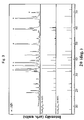
- Fig. 2 is an X-ray diffraction profile of a sample according to example 6.
- EuAl 11 O 18 or EuAl 12 O 19 phase and Al 5 O 6 N phase are confirmed other than AlN phase. Since the JCPDS card of EuAl 11 O 18 phase is not presented, the peak profile of CeAl 11 O 18 phase is shown. Although the positions of peaks of the sample according to example 6 are substantially identical with those of the card of EuAl 12 O 19 phase, a few peaks (for example near 16 ° ) of the sample are not shown in the card of EuAl 12 O 19 phase. Characteristic diffraction peak tops of an europium-aluminum composite oxide phase are found at an angle of diffraction in a range of 18.5 to 19.0 ° .
- Fig.3 is an X-ray diffraction profile of a sample of example 11. EuAl 11 O 18 , EuAl 12 O 19 or SmAl 11 O 18 phase and Al 5 O 6 N phase are detected other than AlN phase.
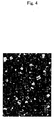
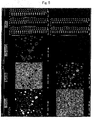
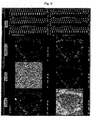
- Fig. 4 shows an backscattering electron image of the sintered body according to example 6, and Fig. 5 is an image showing distribution of elements in the sintered body taken by EPMA over the same visual field as Fig. 4.
- the blackish regions correspond with AlN grains and whitish regions correspond with intergranular phase. Elements having large atomic weights present in the whitish regions. As the brightness of the region is higher, a larger amount of elements having larger atomic weights is present in the region.
- the intergranular regions are interconnected with each other and consist mainly of Eu, O and Al. It is already described that the intergranular phase has a crystalline phase of EuAl 11 O 18 or EuAl 12 O 19 phase by means of X-ray diffraction analysis.
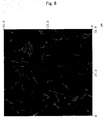
- Fig. 6 is a current distribution analytic image of the sintered body of example 6 observed using an atomic force microscope (AFM).
- the test sample had a shape of a plate with dimensions of about 3 mm ⁇ 5 mm ⁇ 0.5 mm (thickness).
- the face of the sample for current distribution analysis was polished.
- the analysis was carried out using a model "SPM stage D 3100" (probe type "DDESP") supplied by Digital Instruments.
- the measurement was performed on contact AFM current measurement mode.
- a direct current (DC) bias was applied on the lower face of the sample and the current distribution on the polished face was measured using the probe.
- the image is whitish and brighter, the current value is larger and the conductivity is higher.
- the intergranular phase functions as a conductive phase.
- Fig. 7 is a current distribution analytic image of the sintered body of example 11, and Fig. 8 is an image showing distribution of elements in the sintered body taken by EPMA over the same visual field as Fig. 7. It is proved that the intergranular regions are interconnected with each other and the distributions of Eu and Sm are identical. The results also correspond with the profile of X-ray diffraction analysis.
- Fig. 9 is a graph showing a current value after a voltage of 50 to 500 V/mm is applied on the sample of example 5 for about 60 seconds.
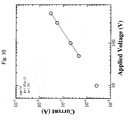
- Fig. 10 is a graph showing a current value after a voltage of 50 to 500 V/mm is applied on the sample of example 11 for about 60 seconds.
- the " ⁇ " value was 1.24 in the example 5 and 1.20 in the example 11, exhibiting nearly ohmic properties. It is thus proved that the inventive material has a small dependency of current value on an applied voltage.
- Sintered bodies according to examples 12 to 15 were produced according to the same procedure as the above examples under the conditions shown in table 3.
- titanium nitride powder was not added to the raw material and titanium nitride powder was added to the raw material in examples 14 and 15.
- the compositions of the examples 12 and 14 are similar, and the compositions of the examples 13 and 15 are similar.
- the resistivity can be slightly reduced by adding titanium nitride. It is thus proved that the volume resistivity can be controlled at a higher precision by adding an element belonging to IVA group of the Periodic Table such as titanium nitride.
- Sintered bodies of examples 16 to 18 were produced according to the same procedure as the above example under the conditions shown in table 5. Titanium nitride and magnesium oxide were added to the raw material.
- the sintered bodies of the examples 16 to 18 had columnar aggregates formed therein, and the intergranular phase forms network like structure in the aggregates.
- the polished surface of each sintered body was observed as a back scattering image in a magnitude of 200 to measure the lengths of the columnar aggregates. It was proved that the length of the columnar aggregates and mean grain diameter of AlN grains were smaller as the content of MgO is higher.
- the aspect ratio of the columnar aggregates was proved to be 10 to 17 in the examples 16 to 18.
- Sintered bodies of examples 19 to 34 were produced according to the same procedure as the above examples under the conditions shown in table 7. Titanium nitride and magnesium oxide or calcium oxide were, however, added to the raw material. It was thus proved that the volume resistivity was lowered as the columnar aggregates are made longer in examples 19 to 23, especially as shown in table 8. Further, the same tendency was observed in the examples 26 to 29. The aspect ratio of the columnar aggregates was proved to be 10 to 30 in the examples 19 to 34.
- the present invention provides a novel aluminum nitride material of aluminum nitride base and having a low volume resistivity at room temperature.
Landscapes
- Engineering & Computer Science (AREA)
- Chemical & Material Sciences (AREA)
- Ceramic Engineering (AREA)
- Manufacturing & Machinery (AREA)
- Materials Engineering (AREA)
- Structural Engineering (AREA)
- Organic Chemistry (AREA)
- Inorganic Chemistry (AREA)
- Power Engineering (AREA)
- Ceramic Products (AREA)
- Container, Conveyance, Adherence, Positioning, Of Wafer (AREA)
Applications Claiming Priority (4)
| Application Number | Priority Date | Filing Date | Title |
|---|---|---|---|
| US45110503P | 2003-02-28 | 2003-02-28 | |
| US451105P | 2003-02-28 | ||
| JP2004033892 | 2004-02-10 | ||
| JP2004033892A JP4424659B2 (ja) | 2003-02-28 | 2004-02-10 | 窒化アルミニウム質材料および半導体製造装置用部材 |
Publications (2)
| Publication Number | Publication Date |
|---|---|
| EP1452510A1 true EP1452510A1 (de) | 2004-09-01 |
| EP1452510B1 EP1452510B1 (de) | 2011-01-05 |
Family
ID=32775285
Family Applications (1)
| Application Number | Title | Priority Date | Filing Date |
|---|---|---|---|
| EP04251025A Expired - Lifetime EP1452510B1 (de) | 2003-02-28 | 2004-02-25 | Aluminiumnitridwerkstoffe und Teile für die Halbleiterherstellung |
Country Status (3)
| Country | Link |
|---|---|
| EP (1) | EP1452510B1 (de) |
| KR (1) | KR100609307B1 (de) |
| TW (1) | TWI262534B (de) |
Families Citing this family (1)
| Publication number | Priority date | Publication date | Assignee | Title |
|---|---|---|---|---|
| JP6393006B1 (ja) * | 2018-02-08 | 2018-09-19 | 日本碍子株式会社 | 半導体製造装置用ヒータ |
Citations (7)
| Publication number | Priority date | Publication date | Assignee | Title |
|---|---|---|---|---|
| EP0548424A1 (de) * | 1990-09-07 | 1993-06-30 | Ngk Spark Plug Co., Ltd | Gesinterter Keramikkörper und Verfahren zur Herstellung eines daraus hergestellten Zündkerzenisolators |
| US5705450A (en) * | 1996-12-17 | 1998-01-06 | The Dow Chemical Company | A1N sintered body containing a rare earth aluminum oxynitride and method to produce said body |
| EP1078902A1 (de) * | 1999-08-25 | 2001-02-28 | Sumitomo Electric Industries, Ltd. | Sinterkörper aus Aluminiumnitrid und Verfahren zu seiner Herstellung |
| US6225249B1 (en) * | 1998-07-08 | 2001-05-01 | Toshiba Ceramics Co., Ltd. | Aluminum nitride sintered body, method of producing thereof, electrostatic chuck, susceptor, dummy wafer, clamp ring and particle catcher using the same |
| US20020110709A1 (en) * | 2000-10-23 | 2002-08-15 | Ngk Insulators, Ltd | Material of low volume resistivity, an aluminum nitride sintered body and a member used for the production of semiconductors |
| EP1249859A2 (de) * | 2001-04-11 | 2002-10-16 | Sumitomo Electric Industries, Ltd. | Substratverarbeitungsvorrichtung |
| EP1314707A2 (de) * | 2001-11-26 | 2003-05-28 | Ngk Insulators, Ltd. | Aluminiumnitridkeramiken, Teile zur Verwendung in einem System zur Herstellung von Halbleitern, korrosionsbeständigen Teilen und leitfähigen Teilen |
-
2004
- 2004-02-16 TW TW093103609A patent/TWI262534B/zh not_active IP Right Cessation
- 2004-02-25 EP EP04251025A patent/EP1452510B1/de not_active Expired - Lifetime
- 2004-02-26 KR KR1020040013034A patent/KR100609307B1/ko not_active Expired - Lifetime
Patent Citations (7)
| Publication number | Priority date | Publication date | Assignee | Title |
|---|---|---|---|---|
| EP0548424A1 (de) * | 1990-09-07 | 1993-06-30 | Ngk Spark Plug Co., Ltd | Gesinterter Keramikkörper und Verfahren zur Herstellung eines daraus hergestellten Zündkerzenisolators |
| US5705450A (en) * | 1996-12-17 | 1998-01-06 | The Dow Chemical Company | A1N sintered body containing a rare earth aluminum oxynitride and method to produce said body |
| US6225249B1 (en) * | 1998-07-08 | 2001-05-01 | Toshiba Ceramics Co., Ltd. | Aluminum nitride sintered body, method of producing thereof, electrostatic chuck, susceptor, dummy wafer, clamp ring and particle catcher using the same |
| EP1078902A1 (de) * | 1999-08-25 | 2001-02-28 | Sumitomo Electric Industries, Ltd. | Sinterkörper aus Aluminiumnitrid und Verfahren zu seiner Herstellung |
| US20020110709A1 (en) * | 2000-10-23 | 2002-08-15 | Ngk Insulators, Ltd | Material of low volume resistivity, an aluminum nitride sintered body and a member used for the production of semiconductors |
| EP1249859A2 (de) * | 2001-04-11 | 2002-10-16 | Sumitomo Electric Industries, Ltd. | Substratverarbeitungsvorrichtung |
| EP1314707A2 (de) * | 2001-11-26 | 2003-05-28 | Ngk Insulators, Ltd. | Aluminiumnitridkeramiken, Teile zur Verwendung in einem System zur Herstellung von Halbleitern, korrosionsbeständigen Teilen und leitfähigen Teilen |
Non-Patent Citations (1)
| Title |
|---|
| VANDAMME N S ET AL: "LIQUID-PHASE SINTERING OF ALUMINUM NITRIDE BY EUROPIUM OXIDE ADDITIVES", JOURNAL OF THE AMERICAN CERAMIC SOCIETY, AMERICAN CERAMIC SOCIETY. COLUMBUS, US, vol. 72, no. 8, 1 August 1989 (1989-08-01), pages 1409 - 1414, XP000115194, ISSN: 0002-7820 * |
Also Published As
| Publication number | Publication date |
|---|---|
| TWI262534B (en) | 2006-09-21 |
| TW200421427A (en) | 2004-10-16 |
| KR100609307B1 (ko) | 2006-08-08 |
| EP1452510B1 (de) | 2011-01-05 |
| KR20040077505A (ko) | 2004-09-04 |
Similar Documents
| Publication | Publication Date | Title |
|---|---|---|
| US7122490B2 (en) | Aluminum nitride materials and members for use in the production of semiconductors | |
| JP2001163672A (ja) | 窒化アルミニウム焼結体および半導体製造用部材 | |
| EP1201622B1 (de) | Werkstoff mit geringem Volumenwiderstand, Aluminiumnitridsinterkörper und Gegenstand für die Halbleiterherstellung | |
| KR100445050B1 (ko) | 질화알루미늄 소결체 및 반도체 제조장치용 부재 | |
| EP1314707B1 (de) | Aluminiumnitridkeramiken, Teile zur Verwendung in einem System zur Herstellung von Halbleitern, korrosionsbeständigen Teilen und leitfähigen Teilen | |
| US6607836B2 (en) | Material of low volume resistivity, an aluminum nitride sintered body and a member used for the production of semiconductors | |
| KR100500495B1 (ko) | 질화알루미늄질 세라믹스, 반도체 제조용 부재 및 내식성 부재 | |
| EP1420004B1 (de) | Eine Aluminiumnitridkeramik und ein Bauteil für die Herstellung von Halbleitern | |
| JP2002249379A (ja) | 窒化アルミニウム焼結体及び半導体製造装置用部材 | |
| EP2189431B1 (de) | Gesintertes Aluminiumoxidprodukt, Verfahren zu dessen Herstellung und dieses Produkts enthaltende elektrostatische Einspannvorrichtung | |
| EP1357097B1 (de) | Aluminiumnitridwerkstoffe und Teile für die Halbleiterherstellung | |
| US4810679A (en) | Rare earth fluoride additive for sintering aluminum nitride | |
| JP2003226580A (ja) | 窒化アルミニウム質セラミックスおよび半導体製造用部材 | |
| EP1452510A1 (de) | Aluminiumnitridwerkstoffe und Teile für die Halbleiterherstellung | |
| JP2004315308A (ja) | 耐食性部材 | |
| JP3106160B2 (ja) | 窒化アルミニウム焼結体及びその製造方法 | |
| JP2742600B2 (ja) | 窒化アルミニウム質焼結体およびその製造方法 | |
| JP2025000176A (ja) | 窒化アルミニウム焼結体及び静電チャック | |
| JP2720094B2 (ja) | 窒化アルミニウム質基板の製造方法 | |
| JP2004083292A (ja) | 窒化アルミニウム焼結体、及びその製造方法、並びに窒化アルミニウム焼結体を用いた電極内蔵型サセプタ |
Legal Events
| Date | Code | Title | Description |
|---|---|---|---|
| PUAI | Public reference made under article 153(3) epc to a published international application that has entered the european phase |
Free format text: ORIGINAL CODE: 0009012 |
|
| AK | Designated contracting states |
Kind code of ref document: A1 Designated state(s): AT BE BG CH CY CZ DE DK EE ES FI FR GB GR HU IE IT LI LU MC NL PT RO SE SI SK TR |
|
| AX | Request for extension of the european patent |
Extension state: AL HR LT LV MK |
|
| 17P | Request for examination filed |
Effective date: 20050225 |
|
| AKX | Designation fees paid |
Designated state(s): DE FR GB |
|
| 17Q | First examination report despatched |
Effective date: 20050411 |
|
| RBV | Designated contracting states (corrected) |
Designated state(s): DE FR GB |
|
| 17Q | First examination report despatched |
Effective date: 20050411 |
|
| GRAP | Despatch of communication of intention to grant a patent |
Free format text: ORIGINAL CODE: EPIDOSNIGR1 |
|
| GRAS | Grant fee paid |
Free format text: ORIGINAL CODE: EPIDOSNIGR3 |
|
| GRAA | (expected) grant |
Free format text: ORIGINAL CODE: 0009210 |
|
| AK | Designated contracting states |
Kind code of ref document: B1 Designated state(s): DE FR GB |
|
| REG | Reference to a national code |
Ref country code: GB Ref legal event code: FG4D |
|
| REF | Corresponds to: |
Ref document number: 602004030843 Country of ref document: DE Date of ref document: 20110217 Kind code of ref document: P |
|
| REG | Reference to a national code |
Ref country code: DE Ref legal event code: R096 Ref document number: 602004030843 Country of ref document: DE Effective date: 20110217 |
|
| PLBE | No opposition filed within time limit |
Free format text: ORIGINAL CODE: 0009261 |
|
| STAA | Information on the status of an ep patent application or granted ep patent |
Free format text: STATUS: NO OPPOSITION FILED WITHIN TIME LIMIT |
|
| 26N | No opposition filed |
Effective date: 20111006 |
|
| REG | Reference to a national code |
Ref country code: DE Ref legal event code: R097 Ref document number: 602004030843 Country of ref document: DE Effective date: 20111006 |
|
| REG | Reference to a national code |
Ref country code: FR Ref legal event code: PLFP Year of fee payment: 13 |
|
| REG | Reference to a national code |
Ref country code: FR Ref legal event code: PLFP Year of fee payment: 14 |
|
| REG | Reference to a national code |
Ref country code: FR Ref legal event code: PLFP Year of fee payment: 15 |
|
| PGFP | Annual fee paid to national office [announced via postgrant information from national office to epo] |
Ref country code: GB Payment date: 20220106 Year of fee payment: 19 Ref country code: DE Payment date: 20220105 Year of fee payment: 19 |
|
| PGFP | Annual fee paid to national office [announced via postgrant information from national office to epo] |
Ref country code: FR Payment date: 20220118 Year of fee payment: 19 |
|
| REG | Reference to a national code |
Ref country code: DE Ref legal event code: R119 Ref document number: 602004030843 Country of ref document: DE |
|
| GBPC | Gb: european patent ceased through non-payment of renewal fee |
Effective date: 20230225 |
|
| PG25 | Lapsed in a contracting state [announced via postgrant information from national office to epo] |
Ref country code: GB Free format text: LAPSE BECAUSE OF NON-PAYMENT OF DUE FEES Effective date: 20230225 |
|
| PG25 | Lapsed in a contracting state [announced via postgrant information from national office to epo] |
Ref country code: GB Free format text: LAPSE BECAUSE OF NON-PAYMENT OF DUE FEES Effective date: 20230225 Ref country code: FR Free format text: LAPSE BECAUSE OF NON-PAYMENT OF DUE FEES Effective date: 20230228 Ref country code: DE Free format text: LAPSE BECAUSE OF NON-PAYMENT OF DUE FEES Effective date: 20230901 |