EP1452961A1 - Terminal de communication mobile, dispositif, systeme, procede et programme de demarrage de logiciel d'application - Google Patents
Terminal de communication mobile, dispositif, systeme, procede et programme de demarrage de logiciel d'application Download PDFInfo
- Publication number
- EP1452961A1 EP1452961A1 EP02793345A EP02793345A EP1452961A1 EP 1452961 A1 EP1452961 A1 EP 1452961A1 EP 02793345 A EP02793345 A EP 02793345A EP 02793345 A EP02793345 A EP 02793345A EP 1452961 A1 EP1452961 A1 EP 1452961A1
- Authority
- EP
- European Patent Office
- Prior art keywords
- application software
- communication terminal
- identification information
- mobile communication
- starting
- Prior art date
- Legal status (The legal status is an assumption and is not a legal conclusion. Google has not performed a legal analysis and makes no representation as to the accuracy of the status listed.)
- Withdrawn
Links
Images





Classifications
-
- H—ELECTRICITY
- H04—ELECTRIC COMMUNICATION TECHNIQUE
- H04L—TRANSMISSION OF DIGITAL INFORMATION, e.g. TELEGRAPHIC COMMUNICATION
- H04L63/00—Network architectures or network communication protocols for network security
- H04L63/08—Network architectures or network communication protocols for network security for authentication of entities
-
- G—PHYSICS
- G06—COMPUTING OR CALCULATING; COUNTING
- G06F—ELECTRIC DIGITAL DATA PROCESSING
- G06F9/00—Arrangements for program control, e.g. control units
- G06F9/06—Arrangements for program control, e.g. control units using stored programs, i.e. using an internal store of processing equipment to receive or retain programs
- G06F9/44—Arrangements for executing specific programs
- G06F9/445—Program loading or initiating
-
- H—ELECTRICITY
- H04—ELECTRIC COMMUNICATION TECHNIQUE
- H04W—WIRELESS COMMUNICATION NETWORKS
- H04W12/00—Security arrangements; Authentication; Protecting privacy or anonymity
- H04W12/06—Authentication
Definitions
- the present invention relates to a mobile communication terminal, application software starting device, application software starting system, application software starting method, and application starting program.
- mobile communication terminals which are capable of downloading application software from a network such as the Internet.
- application software include software used for viewing stock price charts, map software, action games, and the like.
- the conventional techniques described above have had the following drawbacks. Specifically, the operating buttons and operating methods used for starting application software in the mobile communication terminals often differ between various makers and machine models. Mobile communication terminals are also more compact and have smaller display screens than personal computers and other information devices to allow for portability and carryability. Therefore, the selection and execution of the desired application software from a plurality of application software is not necessarily easy for the user to perform. This is particularly inconvenient in cases of outdoor use when rapid selection is required.
- the present invention was devised with the foregoing problems in view, and is aimed at providing a mobile communication terminal, application software starting device, application software starting system, application software starting method, and application starting program capable of executing the desired application software quickly and easily.
- the mobile communication terminal pertaining to the present invention is a mobile communication terminal for communicating with an application software starting device, and is characterized in comprising storing means for storing application software in association with identification information; receiving means for receiving identification information transmitted from the application software starting device; and starting means for retrieving from the storing means and starting application software that corresponds to identification information received by the receiving means.
- the application software starting device pertaining to the present invention is an application software starting device for communicating with the mobile communication terminal, and is characterized in comprising identification information storing means for storing identification information for application software that is executable by the mobile communication terminal, and transmitting means for transmitting identification information stored in the identification information storing means to the mobile communication terminal.
- the application software starting method pertaining to the present invention is an application software starting method in a mobile communication terminal for communicating with an application software starting device, and is characterized in comprising a storing step in which the mobile communication terminal stores application software in association with identification information in a storing means; a transmitting step in which the application software starting device transmits identification information for application software relating to the application software starting device to the mobile communication terminal; a receiving step in which the mobile communication terminal receives the identification information transmitted in the transmitting step; and a starting step in which the mobile communication terminal retrieves from the storing means and starts application software that corresponds to identification information received in the receiving step.
- the application software starting program pertaining to the present invention executes, in a mobile communication terminal for communicating with an application software starting device, a storage routine for storing application software in association with identification information in a storing means; a transmission routine for transmitting identification information for application software relating to the application software starting device to the mobile communication terminal; a receiving routine for receiving identification information thus transmitted; and a starting routine for retrieving from the storing means and starting application software that corresponds to identification information thus received.
- a mobile communication terminal receives identification information for application software from an application software starting device and automatically starts (push starts) application software that corresponds to that identification information. Consequently, the need is eliminated for the user of the mobile communication terminal to manually select the application software used. As a result, the desired application software can be executed easily and quickly.
- the storing means in the mobile communication terminal stores authentication information used in the external startup of the application software in association with identification information for the application software;
- the receiving means receives identification information transmitted from the application software starting device and further comprises determining means for determining the identity between authentication information stored in the storing means and authentication information received by means of the receiving means; and the starting means retrieves from the storing means and starts application software that corresponds to identification information received by the receiving means when it is determined by the determining means that there is identity between the authentication information stored in the storing means and the authentication information received by the receiving means.
- the identification information storing means in the application software starting device stores authentication information in association with the identification information, and that the transmitting means transmits the authentication information stored in the identification information storing means to the mobile communication terminal.
- authentication information used in the startup of the application software is stored in the storing means in association with identification information for application software in the storing step; authentication information is transmitted to the mobile communication terminal in the transmitting step; authentication information transmitted in the transmitting step is received in the receiving step; a determining step is further provided for determining the identity of authentication information stored in the storing step with authentication information received in the receiving step; and application software that corresponds to the identification information received in the receiving step is retrieved from the storing means and started in the starting step when it is determined in the determining step that the authentication information stored in the storing step is identical to the authentication information received in the receiving step.
- a mobile communication terminal receives identification information and authentication information for application software from an application software starting device, and automatically starts application software that corresponds to identification information only when there is a match with the authentication information. Authentication functionality can thus be provided to the external startup of application software.
- the storing means in the mobile communication terminal to store the authentication information in an invisible state.
- the authentication information in the storing means in an invisible state in the storing step of the application software starting method.
- the mobile communication terminal further comprise setting means for setting the external startup of the application software to be permitted or not permitted, such that the starting means retrieves from the storing means and starts application software that corresponds to identification information received from the receiving means when the external startup of the application software is set to be permitted by the setting means.
- the application software starting method further comprise a setting step in which the external startup of application software is set to be permitted or not permitted for the mobile communication terminal, and application software that corresponds to identification information received in the receiving step is retrieved from the storing means and started in the starting step when external startup of the application software is set to be permitted in the setting step.
- application software is started only when the startup of application software is set to be permitted.
- Application software for which the user does not desire external startup is therefore prevented from being automatically started against the user's wishes.
- the mobile communication terminal further comprise notifying means for notifying the user of the mobile communication terminal that external startup of the application software has been set to be not permitted in the case in which external startup of the application software is set to be not permitted when identification information is received by the receiving means.
- the application software starting method further comprise a notifying step in which the mobile communication terminal notifies the user that external startup of the application software has been set to be not permitted in the case in which external startup of the application software is set to be not permitted when identification information is received in the receiving step.
- the mobile communication terminal further comprise application software receiving means for receiving the identification information and application software from a server device, and that the storing means store identification information received by the application software receiving means in association with application software.
- the application software starting method further comprise an application software receiving step in which the mobile communication terminal receives the identification information and the application software from an external server device; with the identification information and application software received in the application software receiving step being coordinated and stored in the storing step.
- a mobile communication terminal receives and stores identification information and application software from an external server device. Consequently, the heretofore described inventions can apply not only to application software stored in advance in the storing means, but also to application software that is downloaded from an external server device.
- a system configured with the aforementioned mobile communication terminal and application software starting device provided thereto may be constructed/operated as an application software starting system for performing communication between the mobile communication terminal and the application software starting device.
- the application software starting device pertaining to the present invention may further comprise notifying means for issuing notification when it is detected that the application software has not been stored in the storing means of the mobile communication terminal.
- the user of a mobile communication terminal can easily know when application software that corresponds to an application software starting device is not stored in the mobile communication terminal. It therefore becomes possible to evaluate whether or not to acquire application software.
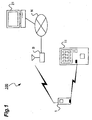
- Fig. 1 is a frame format diagram depicting an example of the overall configuration of the application starting system 100 according to the present embodiment.
- the application starting system 100 comprises a mobile telephone 1 (corresponding to a mobile communication terminal), an automatic vending machine 11 (corresponding to an application software starting device), and an application providing server 21 (corresponding to a server device).
- the mobile telephone 1 is capable of short-range wireless communication with the automatic vending machine 11 using infrared rays.
- the mobile telephone 1 is also connected to a packet communication network N via a base transceiver station B.
- the application providing server 21 is connected by wire to the packet communication network N.
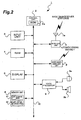
- Fig 2 is a block diagram depicting the functional configuration of the mobile telephone 1.
- the mobile telephone 1 comprises a control unit 2 (corresponding to starting means and setting means), input unit 3, RAM 4, display 5 (corresponding to notifying means), memory unit 6 (corresponding to storing means), wireless unit 7, short-range wireless unit 8 (corresponds to receiving means), and voice processor 9; and these elements are connected via a bus 10 to enable the input and output of various signals.
- the control unit 2 contains ROM (Read Only Memory) 2a, retrieves a program stored in advance in the ROM 2a and deploys it to the RAM 4, and centrally controls each element according to the program. Specifically, the control unit 2 executes the hereinafter described mobile telephone application startup routine (see Fig. 6) according to the input signal from the input unit 3 and the program deployed to the RAM 4; and the results of that routine are temporarily stored in the RAM 4 and displayed on the display 5. The results of the routine, which are stored in the RAM 4, are also stored in a prescribed area within the memory unit 6 as needed.
- ROM Read Only Memory
- the input unit 3 is provided with a setting button for permitting/not permitting application startup, and various operating buttons for directing power ON/OFF, function selection, and the like; and these operating buttons output input signals to the control unit 2 according to instruction specifics by being pushed independently or in combination.
- the RAM (Random Access Memory) 4 comprises semiconductors or the like, and temporarily stores programs retrieved from the ROM 2a and data retrieved from the memory unit 6 in the various routines executed by the control unit 2.
- the RAM 4 also has VRAM (Video RAM) functionality for temporarily storing data displayed on the display 5.
- the display 5 is composed of an LCD (Liquid Crystal Display), EL (Electro Luminescence), or the like, and displays display data on a screen according to display signals that are input from the control unit 2.
- LCD Liquid Crystal Display
- EL Electro Luminescence
- the memory unit 6 is composed of EEPROM (Electrically Erasable and Programmable ROM) or other nonvolatile semiconductor memory, and stores data necessary for the control unit 2 to execute various routines, data generated as a result of such execution, and the like.
- the memory unit 6 forms an ADF storage area 61 and an application storage area 62 during execution of the hereafter described mobile telephone application startup routine.
- the ADF storage area 61 is a data area for storing a file composed of data relating to attributes of application software executable by the mobile telephone 1 as an ADF (Attribute Definition File).
- An example of data storage in the ADF storage area 61 will be described hereafter with reference to Fig. 3.
- a plurality of ADF 61a, 61b, 61c, etc. provided at least with an application ID, keyword, and external startup flag are stored in the ADF storage area 61.
- the application ID is defined as uniquely allocated data (for example, "AP001,” “AP002,” “AP003,” etc.) for identifying application software.
- the application ID may consist not only of symbolic data, but also of alphabetical data or the like for displaying the title of application software, insofar as the application software to be started can thus be identified. This may also be a URL (Uniform Resource Locator) or the like of a Web page as a download source when application software is downloaded for use from the application providing server 21.
- the keyword is defined as authenticating information that is specific to application software and is needed for starting the application software. To provide against theft or modification, the keyword is stored in an externally invisible state or an encrypted state that is difficult to decipher.
- the external startup flag is defined as a flag in which the permission for external startup is indicated with binary numerical data "1" or "0.”
- External startup is defined as the mobile telephone 1 automatically starting (push starting) application software according to a startup request transmitted from the automatic vending machine 11 or other application software starting device.
- An external startup flag value of "1" indicates that external startup is enabled, and "0" indicates that external startup is not permitted.
- the application storage area 62 is a program area for storing application software that is executable by the mobile telephone 1. As depicted in Fig. 3, application software 62a, 62b, 62c, etc. are stored in association with the aforementioned application ID. The application software 62a, 62b, 62c, etc. are therefore stored in association with an ADF 61a, 61b, 61c, etc. by means of the application ID. Examples of such application software include specialized programs by which the mobile telephone 1 can communicate with the automatic vending machine 11 and purchase merchandise and the like.
- the data comprising the application ID, keyword, and external startup flag are shown as being stored in the same storage area (ADF storage area 61), but if a storage embodiment is adopted wherein the data are retrievably coordinated, they need not necessarily be stored in the same storage area.
- the wireless unit 7 comprises a circuit having a modem unit (not shown) for performing modulation/demodulation of signals, and a coding/decoding unit (not shown) for performing coding/decoding of signals; and is provided with an antenna 7a.
- the antenna 7a is telescopically mounted on the upper part of the mobile telephone 1 casing, and is designed to transmit and receive data from the base transceiver station B.
- the modem unit When transmissions are received, the modem unit performs a demodulating routine on the signal input from the antenna 7a to produce a signal that can be processed by the coding/decoding unit. When transmissions are sent, a routine is also performed to modulate the digital signal converted in the coding/decoding unit into a signal that can be wirelessly transmitted.
- the coding/decoding unit is configured according to a codec (CODEC) and is designed to perform processing (demodulation) to convert the digital signal input from the modem unit into an analog signal when transmissions are received.
- processing Encryption
- the short-range wireless unit 8 comprises an infrared communication unit which conforms to IrDA (Infrared Data Association) specifications.
- the transmittable distance thereof is within a radius of approximately 1 m.
- the short-range wireless unit 8 exists within a radius of 1 m and exchanges data with a device having the same infrared communication capability.
- the short-range wireless unit 8 initiates or suspends electric current based on the input signal from the control unit 2.
- the voice processor 9 comprises a converter, amplifier, or the like, and is provided with a microphone 9a and speaker 9b. During a call, the voice processor 9 converts the voice data input from the control unit 2 into analog signals in the converter, and drives the speaker 9b via the amplifier. During a call, the voice processor 9 also converts the voice signal input from the microphone 9a into a wirelessly transmittable digital signal by means of the converter, and outputs the result to the wireless unit 7.
- Fig. 4 is a block diagram depicting the functional configuration of the automatic vending machine 11.
- the automatic vending machine 11 comprises a CPU 12, input unit 13, display 14 (corresponds to notifying means), short-range wireless unit 15 (corresponds to transmitting means), RAM 16, and memory unit 17 (corresponds to identification information storing means), with each of the elements representing an external device connected by a bus 18.
- the CPU 12 retrieves various programs stored in the memory unit 17 and deploys them to the RAM 16, and centrally controls the operation of each element according to the program.
- the CPU 12 also executes the hereinafter described automatic vending machine application startup routine (see Fig. 7) according to the program deployed to the RAM 16; and the results of that routine are stored in the RAM 16 and displayed on the display 14.
- the results of the routine, which are stored in the RAM 16, are then retained in a prescribed retention location in the memory unit 17.
- the input unit 13 is provided with a merchandise selection button, a return button, and the like, and outputs operating signals from manually depressed buttons as input signals to the CPU 12.
- the display 14 comprises an LCD (Liquid Crystal Display) or CRT (Cathode Ray Tube), and displays the merchandise name, merchandise price, amount of money inserted, and the like on the screen according to the display signal instructions that are input from the CPU 12.
- LCD Liquid Crystal Display
- CRT Cathode Ray Tube
- the short-range wireless unit 15 comprises an infrared communication unit which conforms to IrDA (Infrared Data Association) specifications.
- the transmittable distance thereof is within a radius of approximately 1 m.
- the short-range wireless unit 15 exists within a radius of 1 m, and exchanges data with a device having the same infrared communication capability.
- the RAM (Random Access Memory) 16 forms a temporary storage area for the various programs executable in the automatic vending machine 11, input and output data, parameters, and other types of data retrieved from the memory unit 17 for the various routines executed and controlled by the CPU 12.
- the memory unit 17 stores programs that are necessary for execution of the hereinafter described application startup routine.
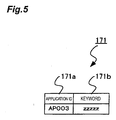
- the memory unit 17 has at least the hereinafter described startup information file 171, as depicted in Fig. 5. Examples of data storage in each table are described in detail hereafter with reference to Fig. 5.
- the startup information file 171 is provided at least with an application ID storage area 171a and a keyword storage area 171b.
- the application ID storage area 171a stores uniquely allocated data ("AP003," for example) as an "application ID” for identifying application software.
- the application ID is used to specify application software when a user purchases merchandise with the automatic vending machine 11.
- the keyword storage area 171b stores data ("zzzzz,” for example) that are specific to the application software and are needed as a "keyword" during application software startup.
- the keyword is stored in an externally invisible state or an encrypted state that is difficult to decipher. Examples of such application software include specialized programs by which the mobile telephone 1 can communicate with the automatic vending machine 11 and purchase merchandise and the like.
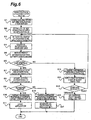
- Fig. 6 is a flowchart for describing the mobile telephone application startup routine.
- the mobile telephone 1 downloads the ADF and application software from the application providing server 21.
- the ADF thus downloaded is stored in the ADF storage area 61, and the application software is stored in the application storage area 62.
- the mobile telephone 1 acquires the download source URL for the ADF and application software by means of the wireless unit 7.
- the URL thus acquired is stored as an application ID in the application ID storage area.
- the control unit 2 sets the external startup of the application software to be permitted or not permitted based on input instructions from the user. Specifically, the control unit 2 stores a "1" in the external startup flag unit corresponding to the aforementioned application ID in the ADF storage area 61 when external startup is set to be permitted. Also, the control unit 2 stores a "0" in the external startup flag unit corresponding to the aforementioned application ID in the ADF storage area 61 when external startup is set to be not permitted. In other words, external startup of application software occurs only when the external startup flag stored in the external startup flag unit is "1." By this means, application software for which the user does not desire external startup is prevented from being automatically started against the user's wishes.
- the control unit 2 initiates an electric current to the short-range wireless unit 8 in accordance with the setting of the external startup flag.
- the short-range wireless unit 8 is capable of wireless communication with the short-range wireless unit 15 of the automatic vending machine 11. Because the startup information file is transmitted as needed from the short-range wireless unit 15, the short-range wireless unit 8 receives the startup information file thus transmitted (S5). Receiving of the startup information file is performed automatically when the mobile telephone 1 is located within the transmission range (within 1 m, for example) of the short-range wireless unit 15.
- control unit 2 reads the external startup flag corresponding to the application ID to the RAM 4 on the basis of the application ID in the startup information file when receipt of the startup information file by the short-range wireless unit 8 is detected.
- the control unit 2 determines that external startup of the application software is set to be permitted, and proceeds to S7 and subsequent routines.
- control unit 2 acquires an application ID and keyword from the startup information file received in S5. Then, from the keyword storage unit in the ADF storage area 61, the control unit 2 acquires the keyword corresponding to the application ID thus received (S8).
- control unit 2 evaluates whether the keyword acquired from the startup information file in S7 matches the keyword acquired from the keyword storage unit in S8 (specifically, the keyword contained in the ADF). By means of this evaluation, a function can be accomplished by which the external startup of application software is authenticated.
- the control unit 2 transmits authentication information to the automatic vending machine 11 (S10) by means of the short-range wireless unit 8 when the aforementioned keywords match (S9; YES).
- the authentication information comprises information with which the mobile telephone 1 notifies the automatic vending machine 11 whether or not external startup of application software is permitted.
- the automatic vending machine 11 determines based on this authentication information whether to continue or suspend transmission of the startup information file to the mobile telephone 1.
- the control unit 2 retrieves from the application storage area 62 and starts (S11) the application software for which the keywords matched in S9.
- the control unit 2 determines that external startup of the application software is set to be not permitted, and proceeds to S12 and subsequent routines.
- the control unit 2 transmits the authentication information to the automatic vending machine 11 by means of the short-range wireless unit 8.
- the mobile telephone 1 according the this authentication information, notifies the automatic vending machine 11 that external startup of the application software is not permitted.
- control unit 2 notifies the user that external startup of the application software is set to be not permitted.
- the method for issuing notification that external startup is not permitted may comprise a visual display on the display 5, issuing sounds from the speaker 9b, or any other means.
- the control unit 2 selects a routine. consisting of either termination of the application startup routine or resetting of permission for external startup on the basis of input instructions from the user.
- the control unit 2 suspends (S15) the electric current of the short-range wireless unit 8 initiated in S2 when termination of the application startup routine is selected (S14; terminate).
- the short-range wireless unit 8 suspends transmission of the startup information file from the automatic vending machine 11.
- the mobile telephone 1 also terminates the sequential mobile telephone application startup routine. Also, when resetting of permission for external startup is selected in S14 (S14; reset), the process returns to S3, and execution of S3 and subsequent routines continues.
- the control unit 2 transmits authentication information to the automatic vending machine 11 by means of the short-range wireless unit 8 (S16) when the keyword contained in the startup information file matches the keyword contained in the ADF (S9; NO).
- This authentication information is for notifying the automatic vending machine 11 that external startup of the application software is not permitted.
- control unit 2 suspends the electric current of the short-range wireless unit 8 initiated in S2.
- the short-range wireless unit 8 terminates the receipt of the startup information file from the automatic vending machine 11.
- the mobile telephone 1 then terminates the sequential mobile telephone application startup routine.
- Fig. 7 is a flowchart for describing the automatic vending machine application software startup routine.
- the automatic vending machine application software startup routine is executed in association with the mobile telephone application startup routine.
- the automatic vending machine 11 transmits the startup information file 171 to the mobile telephone 1 by means of the short-range wireless unit 15. After transmission, the automatic vending machine 11 operates in standby for receipt of the authentication information by means of the short-range wireless unit 15 (T2).
- the CPU 12 determines whether external startup of the application software is permitted based on the authentication information thus received (T3). The CPU 12 otherwise continues transmission (T1) of the startup information file 171 as long as the authentication information is not received (T2; NO).
- the automatic vending machine 11 suspends transmission by means of the short-range wireless unit 15 of the startup information file (T4).
- the sequential automatic vending machine application startup routine is terminated when external startup of the application software is not permitted (T3; NO).
- the CPU 12 restarts the transmission routine of the startup information file 171 (T1) when a mobile telephone other than the mobile telephone 1 is placed within the wireless transmission range of the automatic vending machine 11.
- the mobile telephone 1 coordinates and stores the application software received from the application providing server 21 with the ADF in the memory unit 6.
- the application ID, keyword, and external startup flag are contained in the ADF.
- the mobile telephone 1 receives the startup information file transmitted from the automatic vending machine 11.
- the application ID and keyword are contained in the startup information file.
- the mobile telephone 1 starts the application software when the external startup flag in the ADF is "1" and there is a match between the keywords in the ADF and startup information file. Consequently, it becomes unnecessary for the user to manually select application software that corresponds to the automatic vending machine 11. As a result, the desired application software can be executed easily and quickly.
- the second embodiment of the present invention will next be described with reference to the figures.
- application startup was described with the assumption that an application corresponding to the automatic vending machine 11 was contained in advance in the mobile telephone 1.
- an application corresponding to that automatic vending machine need not necessarily be contained therein.
- a case in which the mobile telephone 1 does not contain such an application will be considered as an example in the present embodiment, and the routines used for the portable telephone and automatic vending machine in this case will be described.
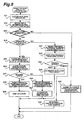
- the mobile telephone application startup routine according to the second embodiment will next be described with reference to Fig. 8.
- the steps comprising the application software startup method pertaining to the present invention will be described.
- the present mobile telephone application startup routine is also similar to the mobile telephone application startup routine (see Fig. 6) described in detail in the first embodiment. More specifically, S21-S22, S24-29, S31-34, S35, and S36-37 in Fig. 8 correspond to S4-S5, S6-S11, S12-S15, S3, and S16-S17 in Fig. 6.
- control unit 2 in S23 refers to the startup information file 171 received in S22 and evaluates whether or not an application ID for application software corresponding to the automatic vending machine 11 is stored in the ADF storage area 61.
- an application ID that matches "AP003" is detected as a result of this evaluation (S23; YES)
- the mobile telephone 1 determines that the aforementioned application software has been stored, and proceeds to S24 and subsequent routines.
- control unit 2 transmits instructions (notification instructions) for issuing notification that the aforementioned application software is not stored in the mobile telephone 1 to the automatic vending machine 11 by means of the short-range wireless unit 8.
- the mobile telephone 1 may at this time be configured so as to notify the user that the aforementioned application software is not stored in the mobile telephone 1 by means of the display 5 or voice processor 9.
- the automatic vending machine application startup routine according to the second embodiment will next be described with reference to Fig. 9.
- the present automatic vending machine application startup routine is also similar to the automatic vending machine application startup routine (see Fig. 7) described in detail in the first embodiment. More specifically, T11 and T13-T15 in Fig. 9 correspond to T1 and T2-T4 in Fig. 7.
- T12 and T16 (routines enclosed by thick lines in Fig. 9), which are routines specific to the present embodiment, are described hereafter.
- the automatic vending machine 11 in T12 stands by to receive the aforementioned notification instruction and proceeds to the routine of T16 as soon as the notification instructions transmitted from the mobile telephone 1 in S30 of Fig. 8 are received by means of the short-range wireless unit 15 (T12; YES).
- the automatic vending machine 11 proceeds to T14 and subsequent routines when authentication information is received before the notification instructions are received (T13; YES).
- the automatic vending machine 11 issues notification that application software corresponding to the automatic vending machine 11 is not stored in the application storage area 62 of the mobile telephone 1.
- the method of notification is arbitrary, and examples thereof may include a text display on the display 14 (see Figs. 10A and 10B), a specific sound, or a blinking light.
- the mobile telephone 1 can download non-stored application software from the aforementioned application providing server 21, but may also be configured to acquire the same from the automatic vending machine 11. Designating the desired application software may be accomplished by the mobile telephone 1 transmitting a URL that is directly input by the user, or by reading the authentication information of the application software by means of a barcode.
- a text message 14a similar to that shown in Fig. 10A is displayed on the display 14 in T16 when the automatic vending machine 11 is capable of providing application software.
- a text message 14b similar to that shown in Fig. 10B is also displayed on the display 14 in T16 when the automatic vending machine 11 is not capable of providing application software.
- the mobile telephone 1 did not contain the application software needed for use by the automatic vending machine 11, regardless of being within the wireless communication range of the automatic vending machine 11.
- the user of the mobile telephone 1 could easily recognize that application software was not stored, by means of the automatic vending machine 11 issuing notification to this effect according to instructions from the mobile telephone 1.
- the next action an application software download, or the like
- the aspects described in the present embodiment represent a preferred example of the application startup system pertaining to the present invention, and are not limited as such.
- the aforementioned embodiments were described with reference to a mobile telephone as a mobile communication terminal, but another information device capable of wireless communication, such as a PHS (Personal Handyphone System) or a PDA (Personal Digital Assistant), may also be used.
- an automatic vending machine was used as an example of an application software starting device in the present embodiment, but this may also consist of a register (including a POS (Point-Of-Sale) terminal), kiosk terminal, game machine, karaoke terminal, another mobile phone, or the like.
- the application software may be application software for purchasing or procuring goods; application software for acquiring or transmitting coupons, electronic money, or electronic tickets; application software for transmitting and receiving various types of information; any other type of software.
- a mobile communication terminal receives identification information for application software from an application software starting device and automatically starts application software that corresponds to that identification information. Consequently, the need is eliminated for the user of the mobile communication terminal to manually select the application software used. As a result, the desired application software can be executed easily and quickly.
Landscapes
- Engineering & Computer Science (AREA)
- Software Systems (AREA)
- Computer Networks & Wireless Communication (AREA)
- General Engineering & Computer Science (AREA)
- Theoretical Computer Science (AREA)
- Computer Security & Cryptography (AREA)
- Signal Processing (AREA)
- General Physics & Mathematics (AREA)
- Computer Hardware Design (AREA)
- Computing Systems (AREA)
- Physics & Mathematics (AREA)
- Stored Programmes (AREA)
- Mobile Radio Communication Systems (AREA)
- Telephone Function (AREA)
Applications Claiming Priority (3)
| Application Number | Priority Date | Filing Date | Title |
|---|---|---|---|
| JP2001374611 | 2001-12-07 | ||
| JP2001374611 | 2001-12-07 | ||
| PCT/JP2002/012771 WO2003048926A1 (fr) | 2001-12-07 | 2002-12-05 | Terminal de communication mobile, dispositif, systeme, procede et programme de demarrage de logiciel d'application |
Publications (2)
| Publication Number | Publication Date |
|---|---|
| EP1452961A1 true EP1452961A1 (fr) | 2004-09-01 |
| EP1452961A4 EP1452961A4 (fr) | 2008-11-26 |
Family
ID=19183152
Family Applications (1)
| Application Number | Title | Priority Date | Filing Date |
|---|---|---|---|
| EP02793345A Withdrawn EP1452961A4 (fr) | 2001-12-07 | 2002-12-05 | Terminal de communication mobile, dispositif, systeme, procede et programme de demarrage de logiciel d'application |
Country Status (7)
| Country | Link |
|---|---|
| US (1) | US7190949B2 (fr) |
| EP (1) | EP1452961A4 (fr) |
| JP (1) | JPWO2003048926A1 (fr) |
| CN (1) | CN1320447C (fr) |
| AU (1) | AU2002359973A1 (fr) |
| TW (1) | TWI238968B (fr) |
| WO (1) | WO2003048926A1 (fr) |
Cited By (2)
| Publication number | Priority date | Publication date | Assignee | Title |
|---|---|---|---|---|
| EP1770534A4 (fr) * | 2004-06-11 | 2009-07-29 | Ntt Docomo Inc | Dispositif mobile et méthode de contrôle d'accès |
| EP2631002A2 (fr) * | 2012-02-21 | 2013-08-28 | Nintendo Co., Ltd. | Appareil de traitement dýinformations, programme de traitement dýinformations, procédé de traitement dýinformations et processeur dýinformations |
Families Citing this family (22)
| Publication number | Priority date | Publication date | Assignee | Title |
|---|---|---|---|---|
| KR100526562B1 (ko) * | 2003-03-26 | 2005-11-03 | 삼성전자주식회사 | 이동통신 단말기의 응용 프로그램 기동 방법 및이동통신망 서비스시스템의 서비스데이터 제공방법 |
| KR100548368B1 (ko) * | 2003-07-03 | 2006-02-02 | 엘지전자 주식회사 | 휴대단말기의 동적 자바푸시 장치 및 방법 |
| KR100697416B1 (ko) | 2003-09-30 | 2007-03-20 | 교세라 가부시키가이샤 | 모바일 통신 단말기, 정보 제공 시스템 및 프로그램을기록한 컴퓨터 판독가능한 기록 매체 |
| JP4457665B2 (ja) * | 2003-12-26 | 2010-04-28 | 株式会社セガ | 情報供給端末 |
| US7865181B1 (en) | 2004-03-19 | 2011-01-04 | Single Touch Interactive, Inc. | Searching for mobile content |
| CN100336023C (zh) * | 2004-08-24 | 2007-09-05 | 英业达股份有限公司 | 一种通过关键词关联机制实现软件调用的方法 |
| US7458510B1 (en) * | 2005-04-19 | 2008-12-02 | Sprint Spectrum L.P. | Authentication of automated vending machines by wireless communications devices |
| KR100877065B1 (ko) * | 2007-01-12 | 2009-01-09 | 삼성전자주식회사 | 통신 프로토콜 결정 방법 및 장치 |
| US11634311B2 (en) | 2007-09-06 | 2023-04-25 | Deka Products Limited Partnership | Product dispensing system |
| US10562757B2 (en) | 2007-09-06 | 2020-02-18 | Deka Products Limited Partnership | Product dispensing system |
| US8204800B2 (en) * | 2009-05-19 | 2012-06-19 | Nokia Corporation | Method and apparatus for displaying purchasing information on a mobile device |
| US20110307599A1 (en) * | 2010-06-11 | 2011-12-15 | Cesare John Saretto | Proximity network |
| US20120117181A1 (en) * | 2010-11-05 | 2012-05-10 | Verizon Patent And Licensing, Inc. | System for and method of providing mobile applications management |
| US20120245985A1 (en) * | 2011-03-24 | 2012-09-27 | Danal Co., Ltd. | Method of controlling system and mobile device for processing payment and data |
| WO2013047093A1 (fr) * | 2011-09-29 | 2013-04-04 | 沖電気工業株式会社 | Dispositif de gestion d'id, programme, terminal utilisateur et système de gestion d'id |
| KR102060646B1 (ko) * | 2013-07-10 | 2019-12-30 | 삼성전자주식회사 | 위치 기반 서비스를 제공하는 방법, 전자 장치 및 컴퓨터 판독 가능한 기록 매체 |
| WO2015112870A1 (fr) | 2014-01-25 | 2015-07-30 | Cloudpin Inc. | Systèmes et procédés de partage de contenu basé sur un emplacement, faisant appel à des identifiants uniques |
| US10628789B2 (en) | 2014-05-20 | 2020-04-21 | Gimme Vending LLC | Communication device for vending machine and method of using the same |
| JP6727805B2 (ja) * | 2015-12-25 | 2020-07-22 | ザ コカ・コーラ カンパニーThe Coca‐Cola Company | 自動販売機、及び携帯端末 |
| JP2017126354A (ja) * | 2017-02-24 | 2017-07-20 | TenTen株式会社 | 自動販売機、自動販売機の制御方法およびプログラム |
| JP2017111838A (ja) * | 2017-02-24 | 2017-06-22 | TenTen株式会社 | 自動販売機、自動販売機の制御方法およびプログラム |
| CN114613344A (zh) * | 2020-12-08 | 2022-06-10 | 比亚迪股份有限公司 | 一种k歌方法、车载终端及汽车 |
Family Cites Families (20)
| Publication number | Priority date | Publication date | Assignee | Title |
|---|---|---|---|---|
| JPH02165290A (ja) | 1988-12-19 | 1990-06-26 | Hitachi Maxell Ltd | Icカード及びその動作方法 |
| US5483658A (en) * | 1993-02-26 | 1996-01-09 | Grube; Gary W. | Detection of unauthorized use of software applications in processing devices |
| US5724655A (en) * | 1994-04-12 | 1998-03-03 | Motorola, Inc. | Method and apparatus for operating a communication unit consisting of multiple devices |
| US5553314A (en) * | 1994-04-12 | 1996-09-03 | Motorola, Inc. | Method of configuring a communication unit using a wireless portable configuration device |
| FI102869B (fi) * | 1996-02-26 | 1999-02-26 | Nokia Mobile Phones Ltd | Laite, menetelmä ja järjestelmä eri sovelluksiin liittyvien tietojen l ähettämiseksi ja vastaanottamiseksi |
| JP3573592B2 (ja) | 1996-05-22 | 2004-10-06 | 富士通株式会社 | 情報処理装置及びその記録媒体 |
| JPH09331579A (ja) | 1996-06-11 | 1997-12-22 | Nec Commun Syst Ltd | 移動端末へのプログラムダウンロード方法 |
| JPH11212894A (ja) | 1998-01-28 | 1999-08-06 | Matsushita Electric Ind Co Ltd | 携帯型情報端末装置 |
| US6577861B2 (en) | 1998-12-14 | 2003-06-10 | Fujitsu Limited | Electronic shopping system utilizing a program downloadable wireless telephone |
| US6434364B1 (en) | 1998-12-24 | 2002-08-13 | Telefonaktiebolaget Lm Ericsson (Publ) | Wireless communication system that supports mobile test software agents |
| JP2000105690A (ja) | 1999-01-27 | 2000-04-11 | Sony Corp | 電子機器におけるプログラム起動装置、プログラム起動方法、および媒体 |
| JP3994219B2 (ja) | 1999-01-27 | 2007-10-17 | ソニー株式会社 | 電子機器及び電子機器におけるプログラム起動方法 |
| FI108813B (fi) * | 1999-03-08 | 2002-03-28 | Sonera Smarttrust Oy | Menetelmä ja järjestelmä tietoliikennejärjestelmässä |
| JP2000349702A (ja) | 1999-06-08 | 2000-12-15 | Nec Shizuoka Ltd | プログラムダウンロード方法、データ送信装置および移動端末装置 |
| JP3562393B2 (ja) | 1999-08-11 | 2004-09-08 | 日本電気株式会社 | 移動通信システム及びそれに用いるプログラムダウンロード方法 |
| JP2001103568A (ja) | 1999-09-30 | 2001-04-13 | Toshiba Corp | 通信システム、この通信システムに用いられる移動体通信装置、携帯型情報処理装置及びデータ通信方法 |
| JP3630059B2 (ja) | 2000-02-02 | 2005-03-16 | 株式会社デンソー | 車載装置 |
| JP2001273135A (ja) * | 2000-03-28 | 2001-10-05 | Nec Corp | 携帯電話を用いた個人認証方法と装置 |
| US6628938B1 (en) * | 2000-08-14 | 2003-09-30 | Koninklijke Philips Electronics N.V. | Wireless system, a method of selecting an application while receiving application specific messages and user location method using user location awareness |
| US6778834B2 (en) * | 2001-02-27 | 2004-08-17 | Nokia Corporation | Push content filtering |
-
2002
- 2002-12-05 JP JP2003550051A patent/JPWO2003048926A1/ja active Pending
- 2002-12-05 CN CNB028243811A patent/CN1320447C/zh not_active Expired - Fee Related
- 2002-12-05 EP EP02793345A patent/EP1452961A4/fr not_active Withdrawn
- 2002-12-05 AU AU2002359973A patent/AU2002359973A1/en not_active Abandoned
- 2002-12-05 US US10/497,389 patent/US7190949B2/en not_active Expired - Lifetime
- 2002-12-05 WO PCT/JP2002/012771 patent/WO2003048926A1/fr not_active Ceased
- 2002-12-06 TW TW091135467A patent/TWI238968B/zh not_active IP Right Cessation
Cited By (2)
| Publication number | Priority date | Publication date | Assignee | Title |
|---|---|---|---|---|
| EP1770534A4 (fr) * | 2004-06-11 | 2009-07-29 | Ntt Docomo Inc | Dispositif mobile et méthode de contrôle d'accès |
| EP2631002A2 (fr) * | 2012-02-21 | 2013-08-28 | Nintendo Co., Ltd. | Appareil de traitement dýinformations, programme de traitement dýinformations, procédé de traitement dýinformations et processeur dýinformations |
Also Published As
| Publication number | Publication date |
|---|---|
| CN1599898A (zh) | 2005-03-23 |
| WO2003048926A1 (fr) | 2003-06-12 |
| CN1320447C (zh) | 2007-06-06 |
| AU2002359973A1 (en) | 2003-06-17 |
| EP1452961A4 (fr) | 2008-11-26 |
| TWI238968B (en) | 2005-09-01 |
| US20050107076A1 (en) | 2005-05-19 |
| JPWO2003048926A1 (ja) | 2005-04-14 |
| TW200300906A (en) | 2003-06-16 |
| US7190949B2 (en) | 2007-03-13 |
Similar Documents
| Publication | Publication Date | Title |
|---|---|---|
| US7190949B2 (en) | Mobile communication terminal, application software initiating apparatus, application software initiating system, application software initiating method, and application software initiating program | |
| US20110313887A1 (en) | System and method for identifying digital media content and downloading the content or a portion thereof to a mobile device | |
| US20100226581A1 (en) | Mobile browsing | |
| JP2002278872A (ja) | 情報提供システム、プログラム、情報記憶媒体およびユーザーインタフェースの設定方法 | |
| JP2003122757A (ja) | 検索案内システム、端末装置およびサーバ装置 | |
| KR20130046151A (ko) | 카드 리더 기능이 구비된 휴대용 단말기를 이용한 방송 수신기에서의 결제장치 및 방법 | |
| JP6179686B1 (ja) | 認証システム、及び、サーバー | |
| JP4387656B2 (ja) | 情報端末、情報端末用プログラム、情報端末の情報処理方法、情報提供方法および情報提供システム | |
| JP5322284B2 (ja) | 通信端末装置及びプログラム | |
| KR20200085508A (ko) | 서비스 요청 디바이스 | |
| JP2003067334A (ja) | 携帯端末、サーバシステム、情報取得方法、及び情報配信方法 | |
| JP4389854B2 (ja) | 電子機器、データ処理方法及びデータ処理プログラム | |
| JP2005269565A (ja) | 携帯端末及びid読み取り携帯端末システム | |
| US20040029526A1 (en) | Image transmitting method, image transmitter, and memory product | |
| JP2002261917A (ja) | 通信端末装置 | |
| KR20210134541A (ko) | 무선충전기 | |
| JP2003076837A (ja) | ユーザ登録方法および情報通信端末 | |
| JP2011023896A (ja) | 携帯端末、広告提供システム、携帯端末の広告提供方法及び広告提供システムの広告提供方法 | |
| JP2003317002A (ja) | 携帯端末用広告システム | |
| JP2007199972A (ja) | 車両用ダウンロードシステムおよびそれに用いられる車両用端末機 | |
| KR100723711B1 (ko) | 무선 단말기에서 컨텐츠별 메뉴 리스트 동적 변경 방법 및시스템 | |
| KR100694988B1 (ko) | 이동 통신 단말기에서 이미지를 이용한 전화번호 표시 방법및 그 이동 통신 단말기 | |
| JP3781474B2 (ja) | 携帯電話システム及び携帯電話システムの処理方法 | |
| JP2002288181A (ja) | 放送関連情報検索システム、検索条件記録端末及び検索条件記録送信プログラム | |
| KR20220099014A (ko) | 노래방 시스템 및 그 제어방법 |
Legal Events
| Date | Code | Title | Description |
|---|---|---|---|
| PUAI | Public reference made under article 153(3) epc to a published international application that has entered the european phase |
Free format text: ORIGINAL CODE: 0009012 |
|
| 17P | Request for examination filed |
Effective date: 20040527 |
|
| AK | Designated contracting states |
Kind code of ref document: A1 Designated state(s): AT BE BG CH CY CZ DE DK EE ES FI FR GB GR IE IT LI LU MC NL PT SE SI SK TR |
|
| A4 | Supplementary search report drawn up and despatched |
Effective date: 20081023 |
|
| 17Q | First examination report despatched |
Effective date: 20090416 |
|
| GRAP | Despatch of communication of intention to grant a patent |
Free format text: ORIGINAL CODE: EPIDOSNIGR1 |
|
| INTG | Intention to grant announced |
Effective date: 20171208 |
|
| RIC1 | Information provided on ipc code assigned before grant |
Ipc: G06F 9/445 20180101AFI20171124BHEP Ipc: H04L 29/06 20060101ALI20171124BHEP Ipc: H04W 12/06 20090101ALI20171124BHEP |
|
| STAA | Information on the status of an ep patent application or granted ep patent |
Free format text: STATUS: THE APPLICATION IS DEEMED TO BE WITHDRAWN |
|
| 18D | Application deemed to be withdrawn |
Effective date: 20180419 |